Rick’s here! Notice the orange added to my pink on the map. It’s a wee line because we had such a short day, but oh my, he landed in a great spot. First, last night continued wonderfully with dinner after his arrival with the group I’ve been having meals with, then window open, quiet, just the river and occasionally the animal bells.
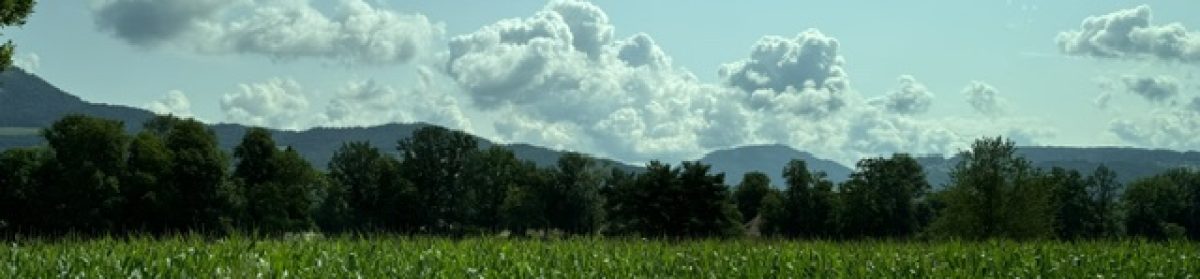
Farewell in the morning to Herrerias with the fog coming in and out and then the sun coming out later, shot taken out our window as we left.

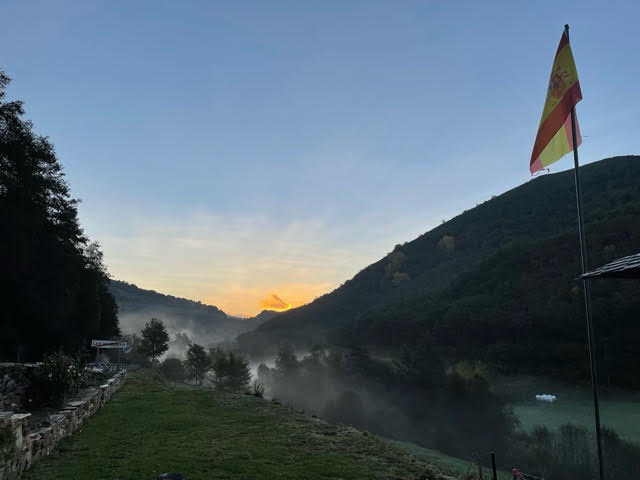
Then further up the mountain with the Spanish flag waving:
On the way went through a tiny town that had a few solid looking houses. This one caught my eye because it’s still used as those big houses in Akerreta used to be used – animals on the bottom, people at the top.

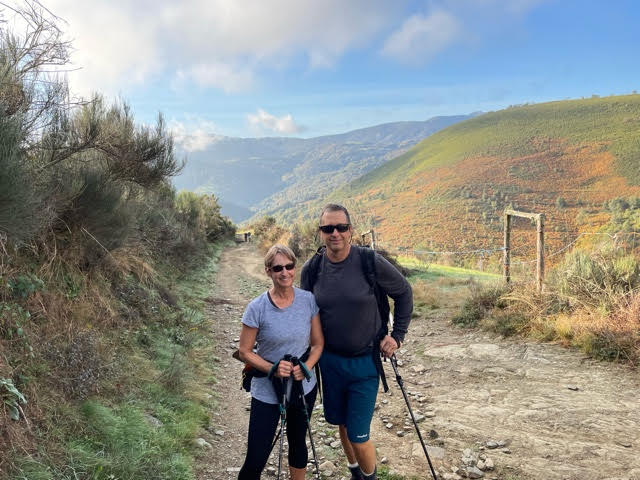
Gorgeous hike, not hard at all with a hot chocolate at the top at a little town, just to make the hike last a bit longer. Then we came into the best little town, O Cebreiro. Here’s a photo from the hill next to the town.
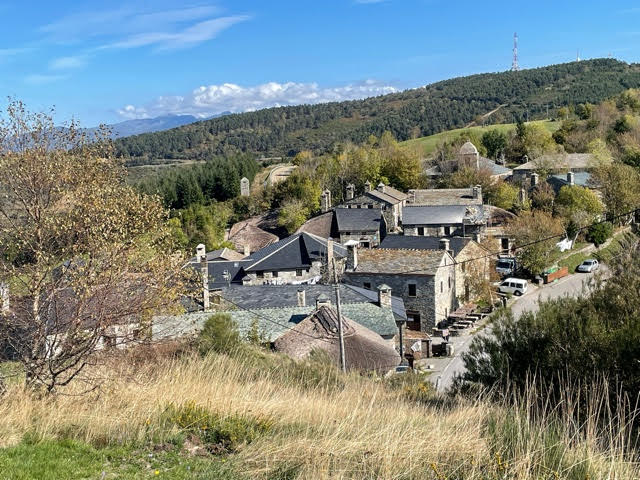
50 inhabitants, many houses remodeled as albergues or hotels. This time we actually have 2 double beds instead of twins, luxury. Definitely stepping up now that there’s two of us in a room.
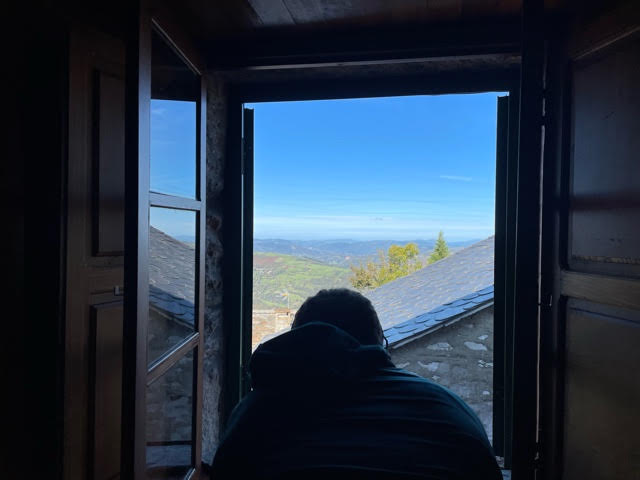
Here’s Rick looking at our window, just delighted with the town, history and best – the church is wonderful and has music playing. I’m going to go sit – he’s already there – when I finish this post.
This town has a wonderful history. Both ancient and recent. Wise Pilgrim:
“O Cebreiro has grown from a small and ancient village of dairy farmers into a small and ancient village of tourism.
It has played an important role throughout the history of the Camino. It was the parish priest, Father Elias Valina Sempedro, who is most responsible for the resurgence of the Camino. It was he that first painted the yellow arrows, and the tales that surrounded him doing so are the stuff of legend. Once, in 1982, he and his white Fiat van parked along a trail in the Pyrenees. It was a time when Basque separatists were training blows with the Guardia Civil, and when they came upon him, suspicions were aroused.
He opened the van door to reveal cans of yellow road paint and identified himself as the parish priest of O Cebreiro (which was far away). When asked what he was doing, his answer was as simple as it was prophetic: ‘I am preparing a great invasion!’ It was he that orchestrated the installation of the granite hitos (mile markers) as well.”
Wise Pilgrim continues: “The parish church is also the setting for a miracle. According to legend, The Holy Grail was hidden there and in the 14th century produced a miracle that was certified by Pope Innocent VIII. A peasant from a local village braved the hike up to O Cebreiro during a dangerous snowstorm to hear mass. The priest chastised him for endangering his life for a bit of bread and wine. At that the bread and wine turned into flesh and blood, cementing the reputation of this small hamlet.”
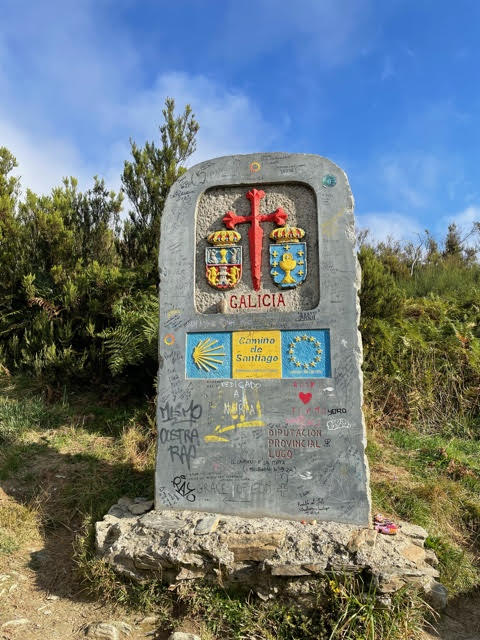
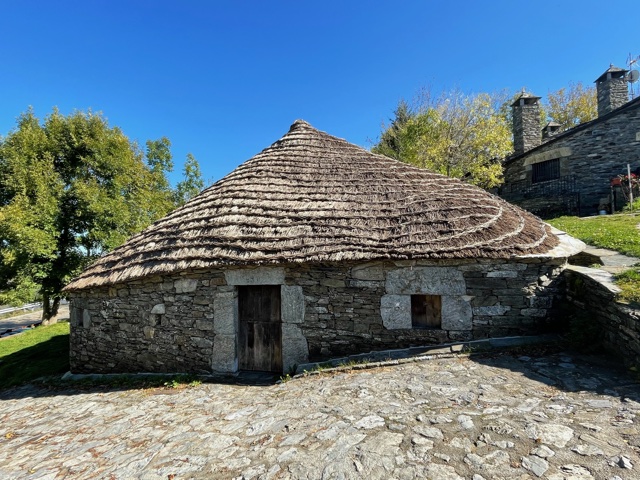
We’re now in Galicia, which was Celtic in the 800’s in origin before the Romans. The music – you think it’s Irish and then realize it’s just a little different, definitely a lot of it makes you want to dance with pointed foot and lots of intricate jumping and moving. The Celtic houses were round with thatched roofs and we saw a number of these on the way up and there are several in this village, though obviously or more recent origin than the 9th century.

The church’s foundations are from the 9th century, don’t know what happened to the churches in between, but the town claims the church is 9th century. Actually, from Pilgrimage Road: “In 1962 excavators found the meager foundations of a pre-Romanesque church under the streets of the village. Between 1965 and 1971 they rebuilt it from the ground up. Inside what remains of the medieval church are the Romanesque baptismal font and the chalice and paten.”
However, this is where the miracle happened. The Pilgrimage Road continues with this translation of an early 15th c poem by a Licendiado Molina:
I want to tell you – a miraculous story
about a host – which was being consecrated.
You will see changed – into perfect flesh
what was at first – was (its) hidden (nature)
An idiot of a priest – who was offering it
doubted the truth – of the consecration
The holy vision – was demonstrated to him,
as it is today – in O Cebreiro.
“The particles remaining from the miracle were eventually placed in a silver reliquary donated by Queen Isabel herself. The church’s statue of the Virgin is said to have inclined her head so as to better view the miracle.”
Ok, you have to love all of that. Such strong beliefs, no wonder the churches often feel welcoming and well loved. And now I’m going to go sit and enjoy the music, the feel and maybe some quiet.
 Reb's Walks!
So nice to hear Rick is walking with you now. Hugs to you both.
Rick and Jill
LikeLike