Our hotel is named thus because the building was directed by Ferdinand and Isabella. They did the pilgrimage, with their entourage, and arrived in Santiago. I’m sure THEY had room at the inn somewhere, but they saw that most pilgrims didn’t.
They ordered it (named Royal Hospital) to be built in 1499 and it’s now considered one of the world’s oldest hotels. The directive from the royals: “Insofar as we have been informed and confirmed that in said city of Santiago, where many pilgrims and the poor of many nations converge to visit the blessed St. James Apostle and Patron of our Spains, there is a great need for a hospital to take in the poor pilgrims and the sick who make a pilgrimage there, and for lack of this building, many of the poor sick and pilgrims have perished and do perish on the floor of said church and in other areas, as they have no place to stay and no one to receive them and lodge them…we therefore order a hospital to be built at our expense, which we will provide for from our own income.”
There are about 80 well-written plaques around the hotel describing its history and that of the city around the hospital. In my enthusiasm with history, I was ready to read all of them. Ran out of steam, but I did get glean a few key facts.
I started this morning after sitting in one of the squares of the cloister for quite a long time. With the time change, the light changed around 8am so took this video of the four courtyards.
There was always a hotel function, but it was also a hospital for the poor, housed an orphanage for foundlings, grew extensive gardens with medical plants and made/provided medicines for the poor and pilgrims.
The building was a city in miniature, with its own corps of priests, health workers, apothecaries, accountants and servants. Physicians trained here. We had dinner in one place that used to be the stables and then the autopsy room. Very flexible thinkers about space…Rick noticed this placard –
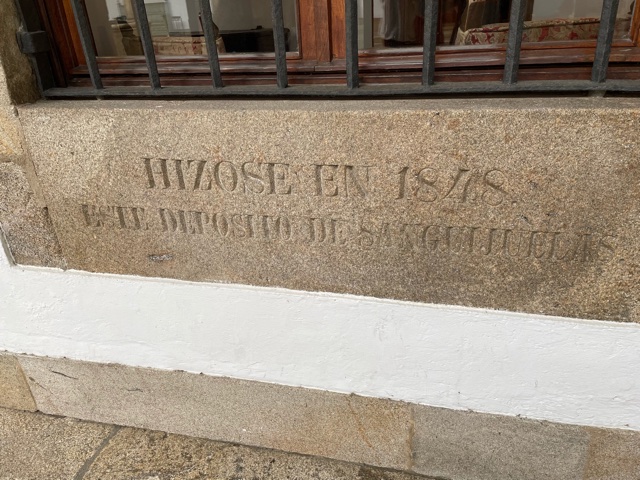
The leech tank. This area was also the hot water room and brazier, giving heat and comfort to patients.
The king and queen gave sole authority to the hospital administrator. This made for challenges because even the archbishop and church authorities couldn’t intervene. If a captive made it past the barrier outside, they were protected if the hospital agreed to house them (except for murderers, highwaymen and other criminals – they weren’t accepted).
Early authors noted that just crossing the through the hospital’s facade must have been a mystical experience because of the welcome and care that greeted them and the message of salvation carved into the doorway.
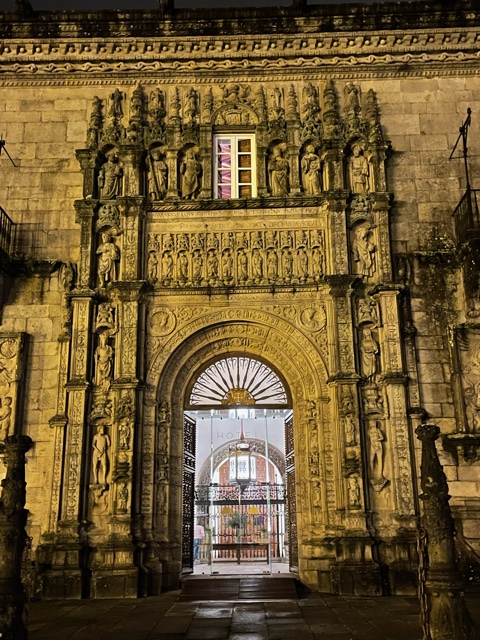
Early morning shot.
The Catholic Monarchs actually “sent a request which specified which facades would be stonework or dry stone, the decoration of the facades, the royal and religious symbols that would adorn the courtyards, the types of wood for floors and roofs, and even the setting up of animal pens, a garden, a cemetery, fountains, and fireplaces.” Amazing.
Here are the meeting rooms at this hotel, seriously flexible with how space is used now…
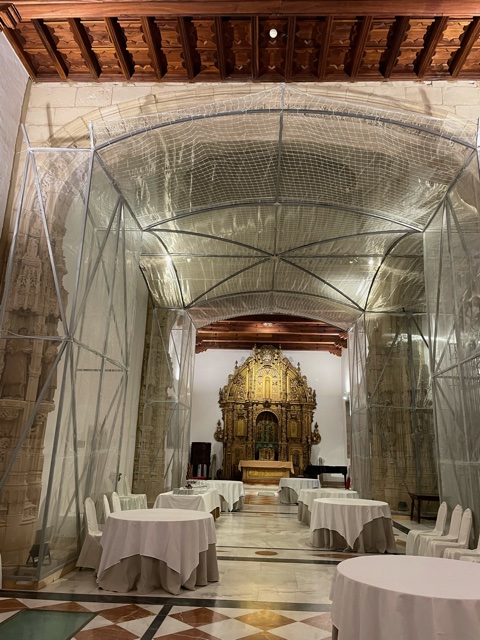

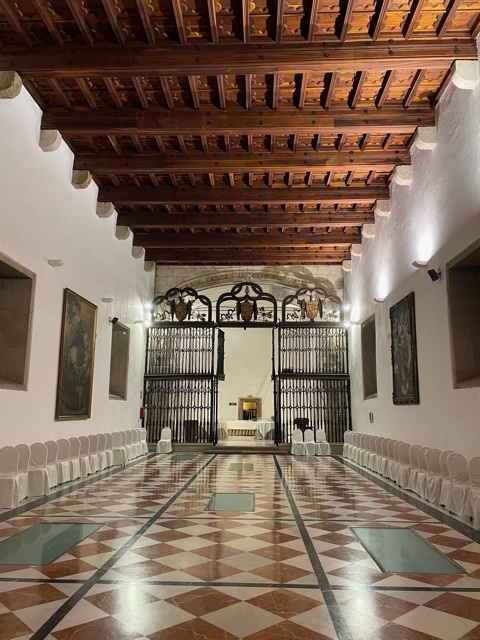
As Rick said, imagine the wedding you could have! These rooms were part of the original, of course, as this is the the church for the Royal Hospital. I mean, you couldn’t just go next door. We do marvel at this fact. We did tours of the Cathedral and of the giant monastery in the next building over. So 3 huge churches on one block. Well, the 3 that we saw, probably more that we didn’t see on this square since one building is the seminary and the other the governmental palace.
I digressed. At first the Royal Hospital had just two courtyards, but in the mid-1700’s they realized they needed more space and medical facilities, so expanded to the large square it is now, including the two new garden courtyards. After this expansion, the foundling orphanage was housed here. This note about the orphanage is worth repeating:
“From it’s founding through 1846, every year the Royal Hospital took in hundreds of children abandoned by their parents. On San Francisco Street, there was a window with a bell and a revolving compartment like those in cloistered convents. A person would ring, wait to hear “Ave Maria, gratis plena” and then leave the newborn.
“Overseeing the orphanage was the headmistress, who also ran the female pilgrims’ quarters. The babies were given to the parish churches, which forcibly distributed them among breastfeeding peasant women. The hospital provided a few changes of underwear and a stipend. Only one out of every five children reached the age of two, although the survivors were sheltered until they were six. After this, the males learned a trade and the girls were handed over to convents.
“In later years, care noticeably improved. The Orphanage Method from 1821, describes what the person on duty should do with an abandoned baby: ‘You will pick it up, caress it, undress it immediately, noting the number, color and quality of its clothing, garments, marks and any papers it might have. You will wash it in warm water with a bit of wine and soap and then wrap it up. In this room there will be a fire and two or more dry beds, a few ounces of chicory syrup with rhubarb, which is the best baby food for the first hours, and a little cream of rice with sugar to distract those who may be older.”
Even with this updated care, it’s amazing any survived.
In 1953 a new hospital opened up and all of the patients and medical staff moved to the new facility. As soon as they moved, the National Institute of Industry (under Franco) got started. In 9 months, working 24 hours a day, they pulled down and rebuilt 22,000 square meters of roofs, 12,000 m2 of stone walls erected, 12 hectares of walls painted, and 20,000 m2 underground prepared, and more. A lot more. They worked “even on Sundays.” The hotel opened on July 24, 1954, on the eve of St. James Day.
I can’t imagine the pressure. Because July 25 falling on a Sunday is what determines the Jacobean holy year. That’s this year too.
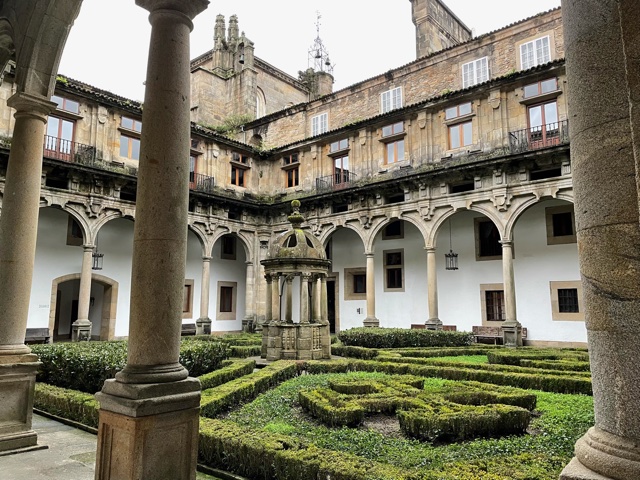
Here are the garden courtyards in the daylight:

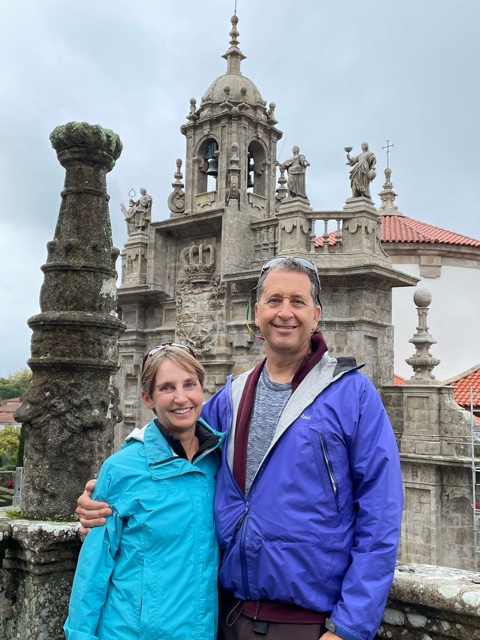
And here’s a photo of Rick and me – with our backs facing our direction tomorrow when we start walking again towards the ocean and Finisterre.
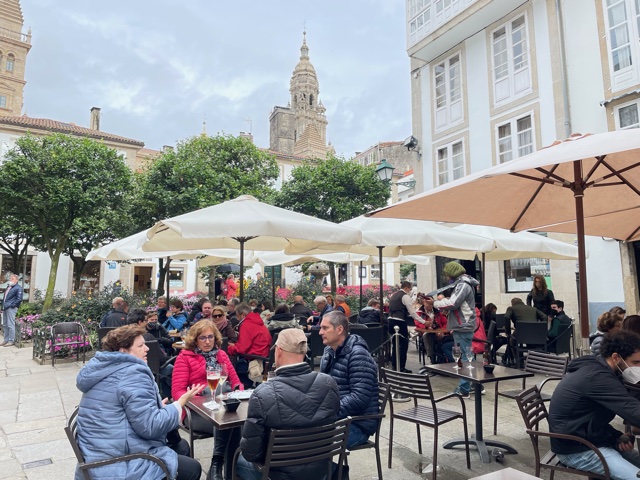
And here’s an afternoon shot before the rain of everyone out enjoying a festival day before tomorrow’s holiday for All Saints Day.
 Reb's Walks!