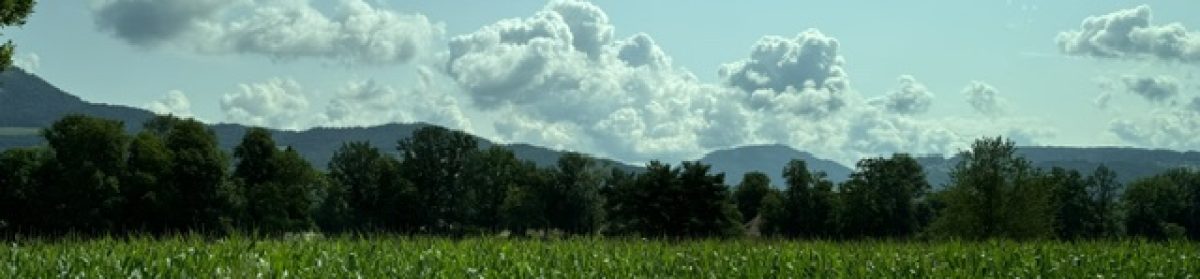
What a luxury to just be able to walk and explore with no agenda. And I easily found food! They start breakfast at 7 here so I could figure out which way I’m going tomorrow when I start again and then go to a service at the Cathedral at 9. This is morning walking towards the cathedral.
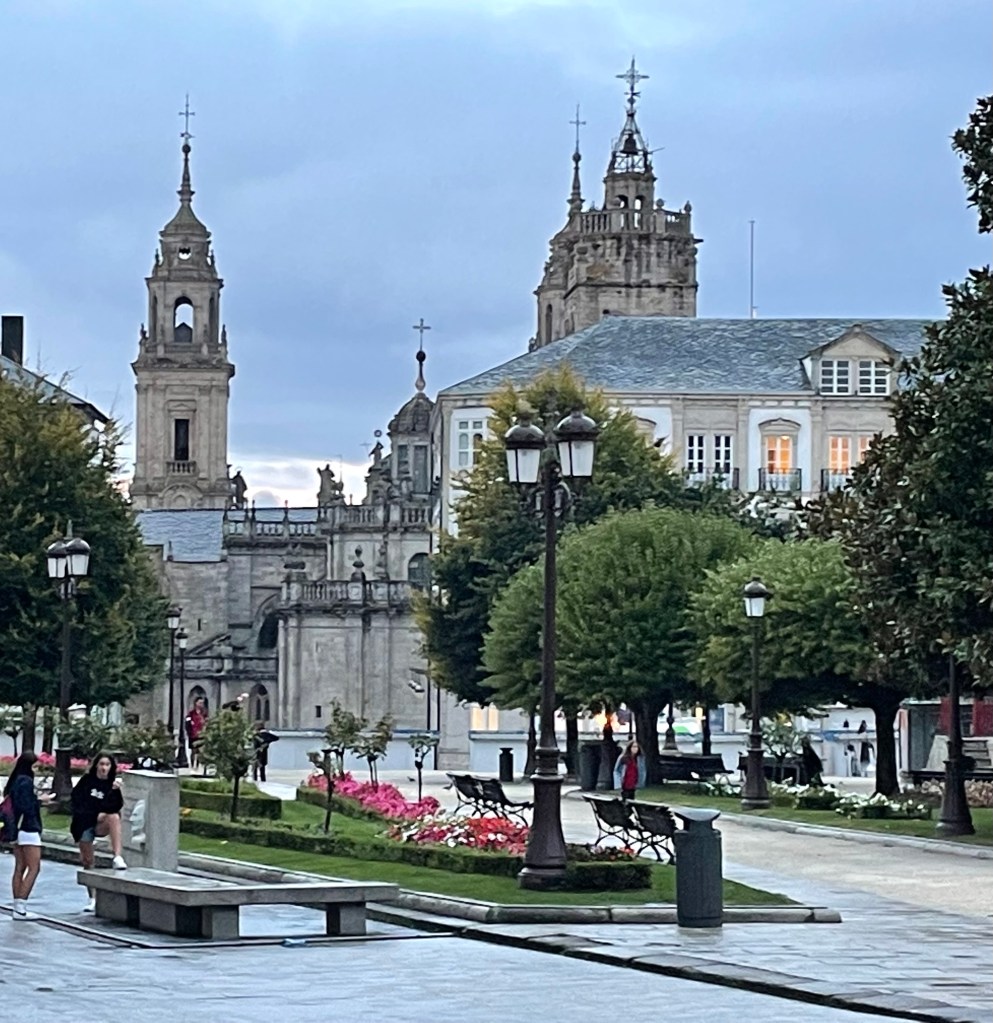
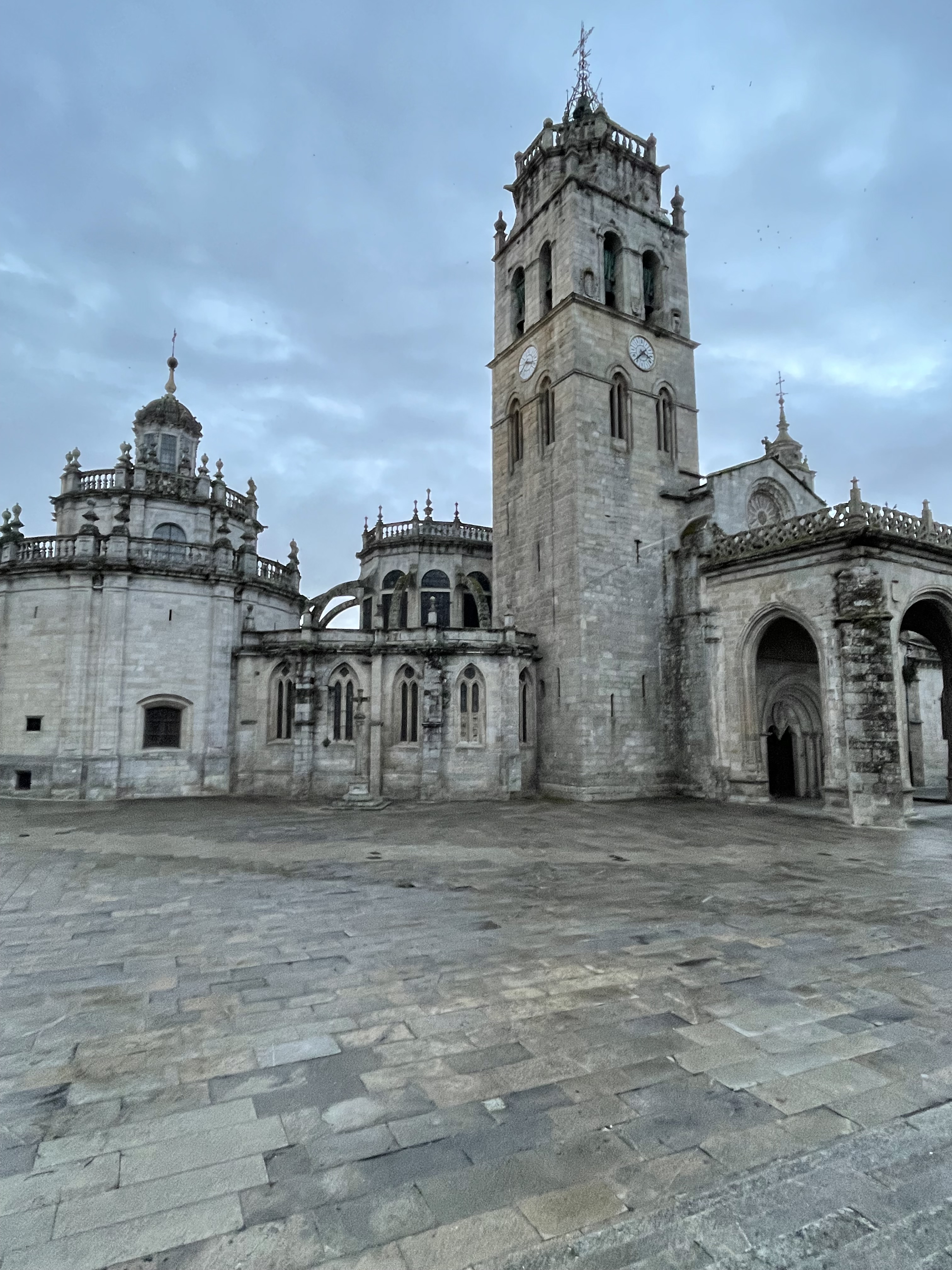
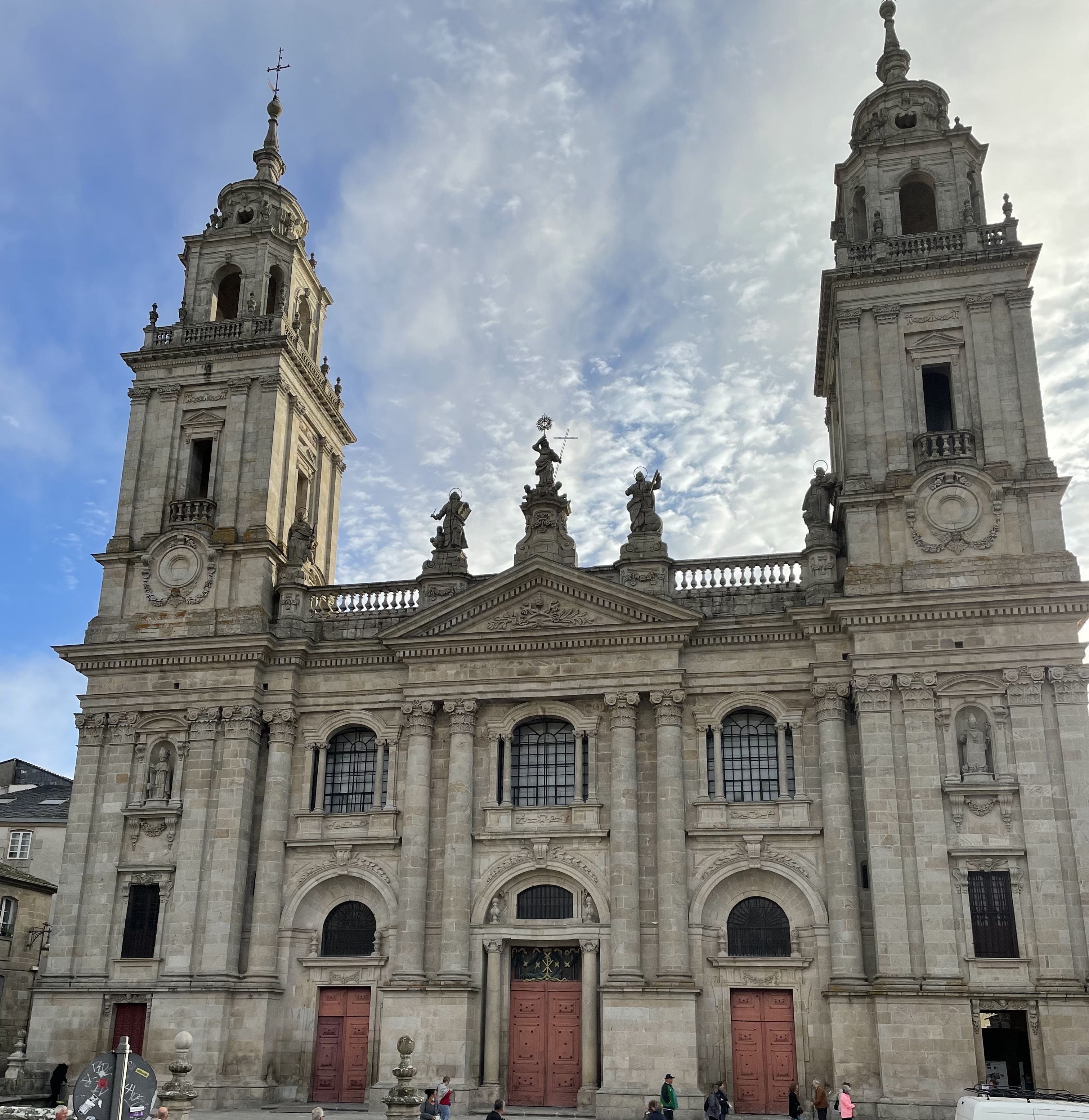
I walked down to where the Camino left town – the walled city really is at the top of a hill. As soon as you walk outside the wall, in any direction, it’s headed downhill and towards 1 of 3 rivers depending on your direction. As I was walking back up the hill, I ran into 1 of 2 fellow Americans who’ve been on the trail these past days. John was hoping to connect with someone who might have found his glasses, but said they weren’t that needed and he’d rather join me going to the service.
I knew he was from PA and by the end of the conversation, knew that John was from Allentown, knows a friend of Rick’s who lives in Phillipsburg, John’s niece was at Haverford the same time as Kaziah and he is a priest who went to seminary just down the way from Haverford.
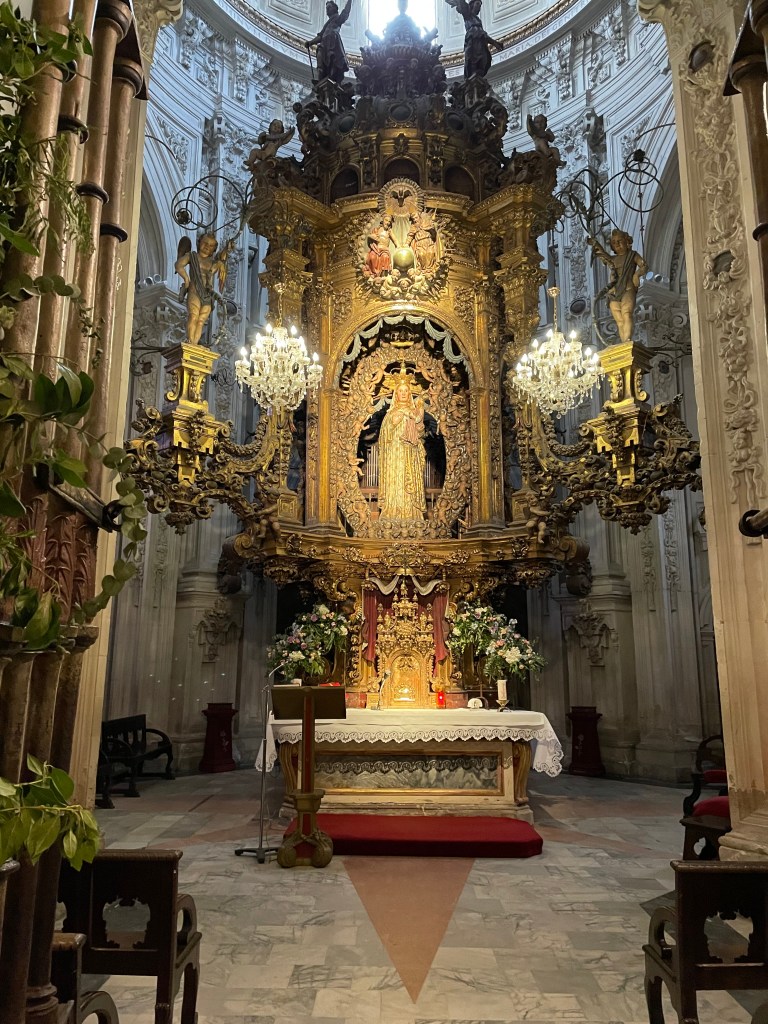
John’d gone to service the night before so knew where to go – it’s a giant cathedral with many spaces and he set me up here, at Our Lady of the Big Eyes (Mary, just FYI). She’s revered in Lugo, is the patron saint, and the tabernacle in the altar holds the Blessed Sacrament and this has been continual for 1500 years, starting with the Romans.
Here’s the history of the Blessed Sacrament in Lugo: The custom of perpetually adoring Jesus in the consecrated Eucharistic host has a long history in the Catholic Church, and some claim it all started in Lugo, Spain.
For many centuries Christians were not able to reserve the Eucharist in their churches, as they were often persecuted and only kept enough hosts to deliver to the sick and homebound.
However, after Christianity spread throughout the Roman Empire, permanent churches were built, as well as tabernacles to house the consecrated hosts.
In the Roman Rite, a tradition started to develop of exposing the Eucharistic host on the altar and inviting parishioners to stay there praying in shifts before Jesus.
According to local legends and stories, the cathedral in Lugo, Spain, might have been one of the first churches ever to start such a custom. What is even more remarkable is that this custom continues to the present day.
The official website of the Cathedral in Lugo offers this explanation.
In the main chapel of the cathedral of Lugo, the Blessed Sacrament is permanently on display. Since time immemorial, day and night. Represented in the coat of arms of Galicia, it makes the Lugo cathedral a unique example of perpetual adoration of Jesus. It is a unique tradition in the world. For this reason Lugo is known as Lugo Ciudad del Sacramento. The main chapel is the spiritual heart of the cathedral, where its inhabitants go to pray almost continuously.
Back to Mary: Because of her history with the church and Lugo, she’s a reason for pilgrimage alone and those who are Mary followers, have been coming since the 1600’s to see her, though this alter was built later, finished in 1832. They used to kneel in a circle all the way around the altar. There were Mary’s in a special room in the museum that were from the 1100’s, but not all were in this chapel.
The chapel was small, but felt big. There were 3 rows of tiny benches that went all the way around, big enough for 2 each, though no one shared and people also sat outside on benches that circled the main alter behind your back if you’re looking at Mary. There were at least 30 people in attendance, and the acoustics of the chapel made it sound like it was a full gathering. And John, the American priest, came out in sacraments and assisted the priest. He knew everything in Spanish and read in Spanish as well. He’s not fluent, but he must have prepared a lot for this. I was impressed. He found me later and said thanks, he seemed so happy to be able to take part.
Going to mass, talking with John, who hasn’t done the Frances, reinforced how different this Camino has been from the last. So much less church, mass, pilgrimage focused. It was wonderful to sit in the chapel and see the service. It was still an older crowd, but it was Monday morning so made sense and they were devoted. It just felt right for being on the Camino.
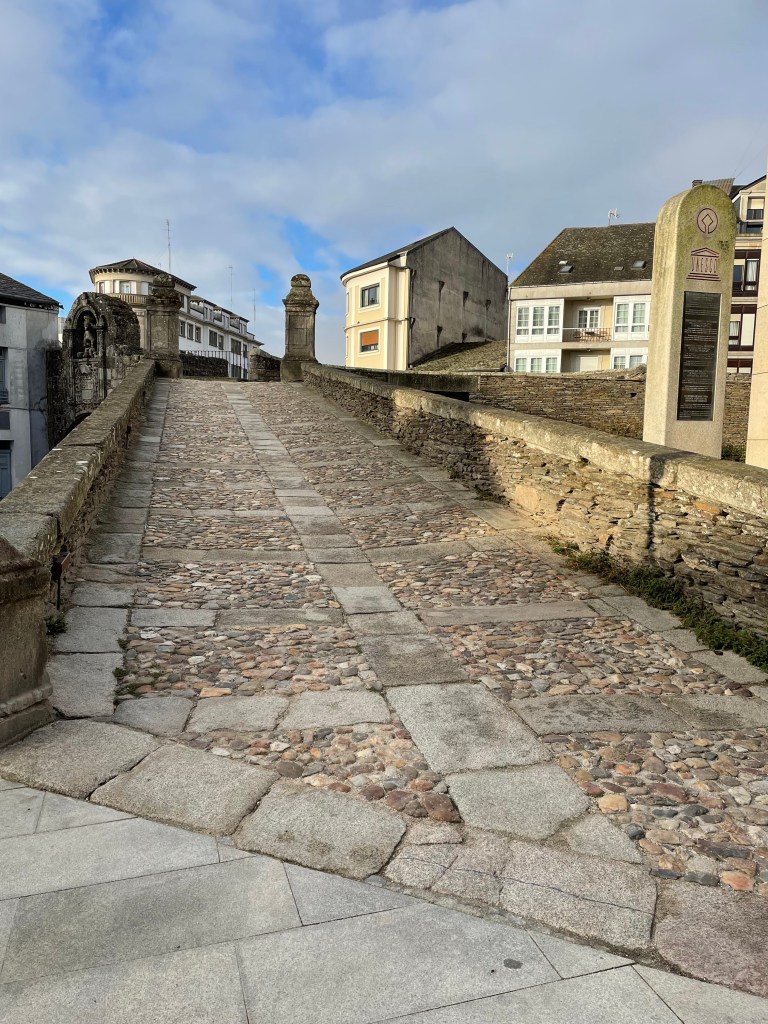
This is the bridge outside the cathedral that leads up to the walled walk, going under the bridge leads you out of the walled city and connects you to the camino. But before I did that, I did the service and then spent an hour with the audio guide learning about the church, the cloisters and the museum. It was great and while I was walking/tiptoeing around, there was a full sung mass going on that happened after the service I was in. The organ, the singer, the priest, all had talent and it was beautiful to be in the church, learning about the history (earliest pieces of the building are from the 600’s) and seeing the art. Amazing. The cathedral in Leon is still by far my favorite, but I loved learning about this one.

This was the back entrance, I don’t know when they use this area, it was classical instead of baroque and seemed calmer.
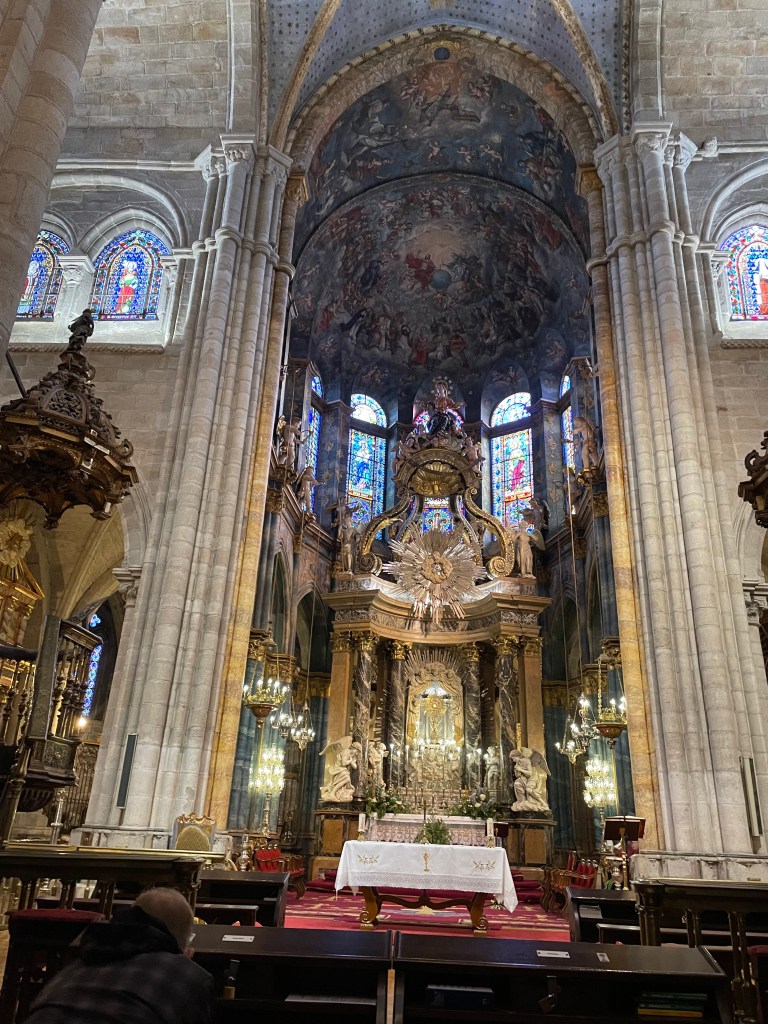
And this is the main alter. Huge. I’m sitting in the choir pews, ornately and beautifully carved. This is the only cathedral that kept the choir and organ in the middle, just as it was in the Middle Ages when all took part in the service and read from the huge books that were in the center of the choir.
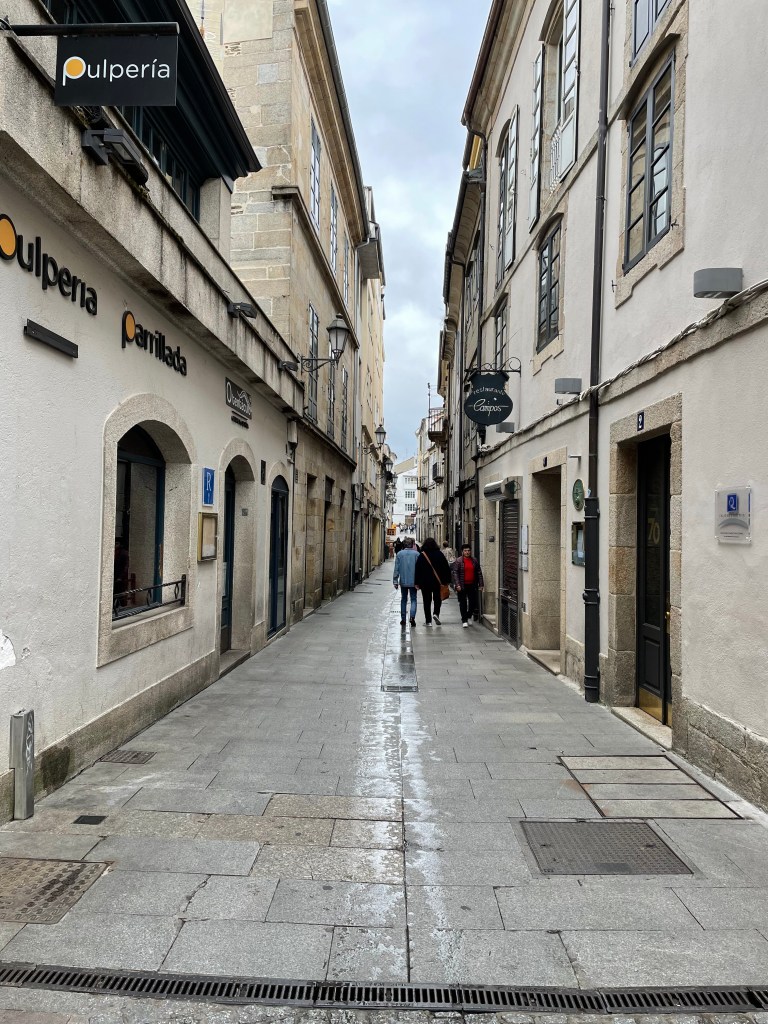
One of the streets in the city. I couldn’t believe how big it felt inside the walls. Cars and vans could come in, but it was either very controlled, or people just knew – you don’t drive in unless you have to to do deliveries or you’re a resident and have actual parking. That was for very few.

And now I’ve walked up that bridge from the cathedral and am on the walk. It is very wide, sand covered and high, with grates and low walls. I was not comfortable at all. I walked in the very center, kept having to regulate my breath to bring my heart rate down. No one else seemed concerned at all. I passed 2 people sitting on the wall for photos and a guy rolling a ball for a border collie – hello, they jump!!! All three made me want to crawl for a while instead of walk. It was a very long 2.2 kilometers. But amazing. It just went on and on.
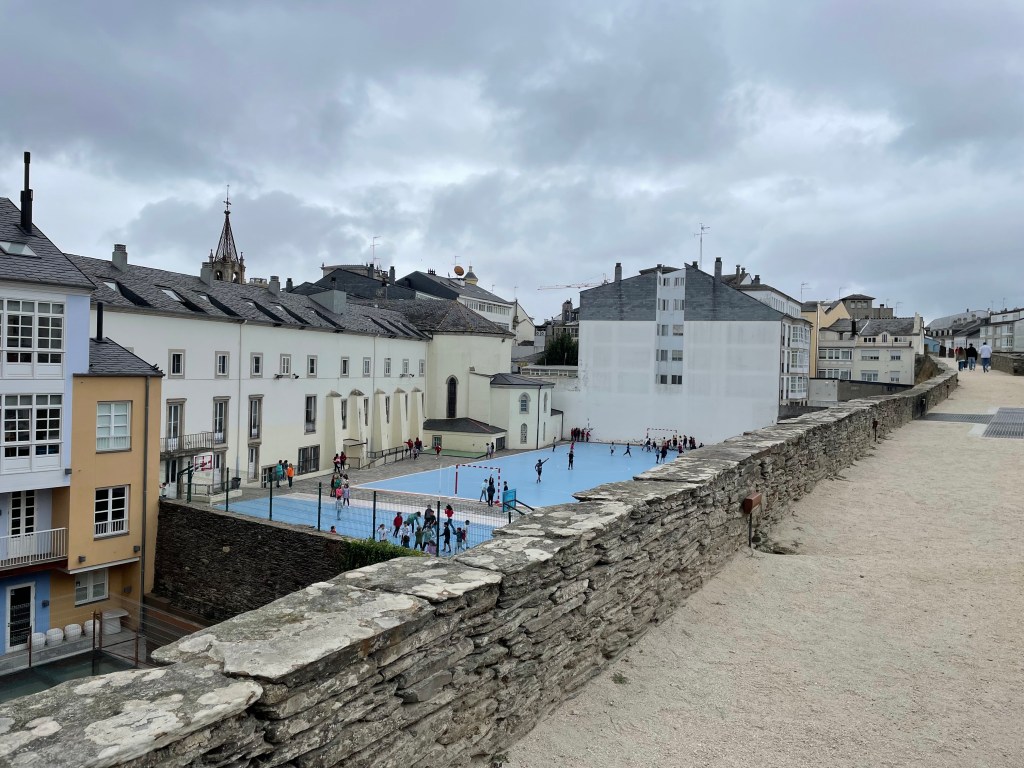
A school in the walls! Imagine growing up thinking it’s normal for the wall of your playground to be a medieval city wall.
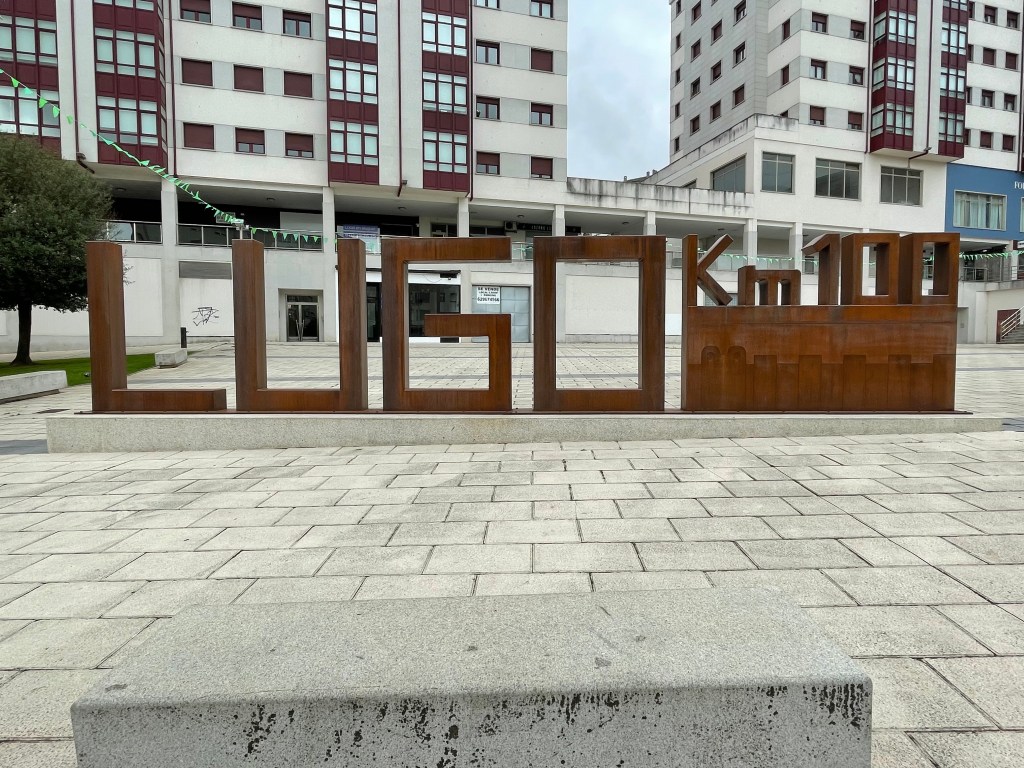
I made myself go down at the 6th portal (there are 13 portals, some closed, some walks, some drivable) to find where the 100km marker was for the Camino. I hadn’t seen it when I walked in and someone told me where to look. I then passed 3 French women I knew from the walk, they were just coming in and said yes, it’s just down there it’s brown. Good grief. I’m guessing noone else missed it. In order to get the camino certificate, you have to start at 100km minimum. I just wanted to see the marker…
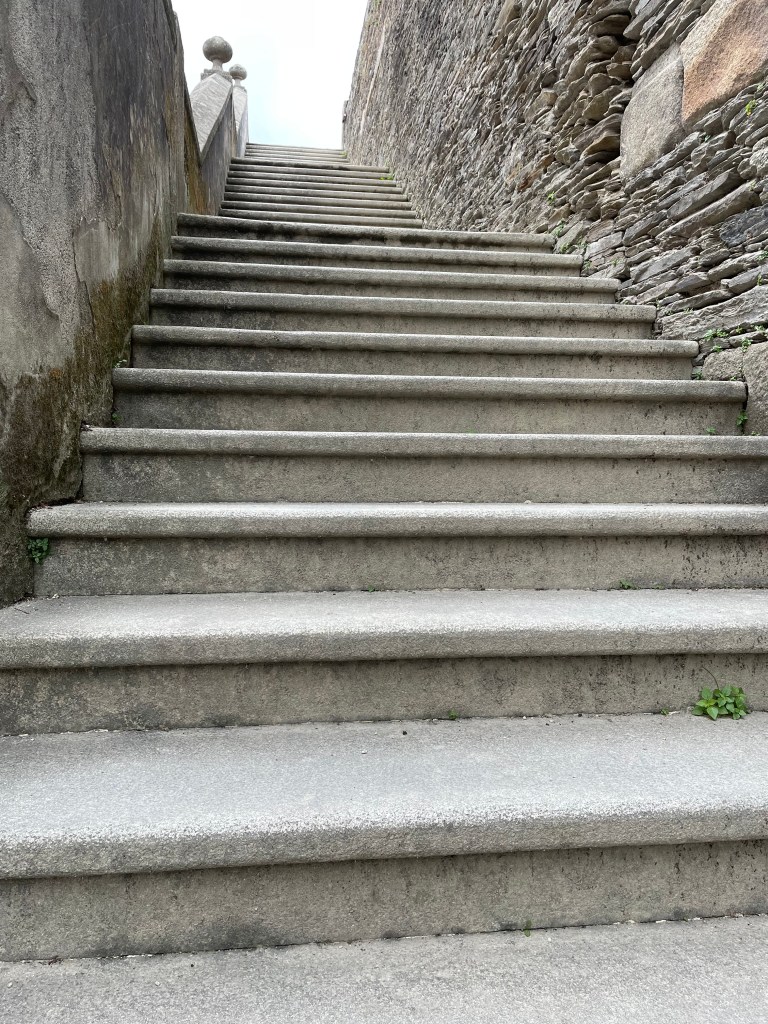
I was so happy being on level ground, I walked easily and briskly down and back up from the marker, and then made myself go back up to the wall walk.
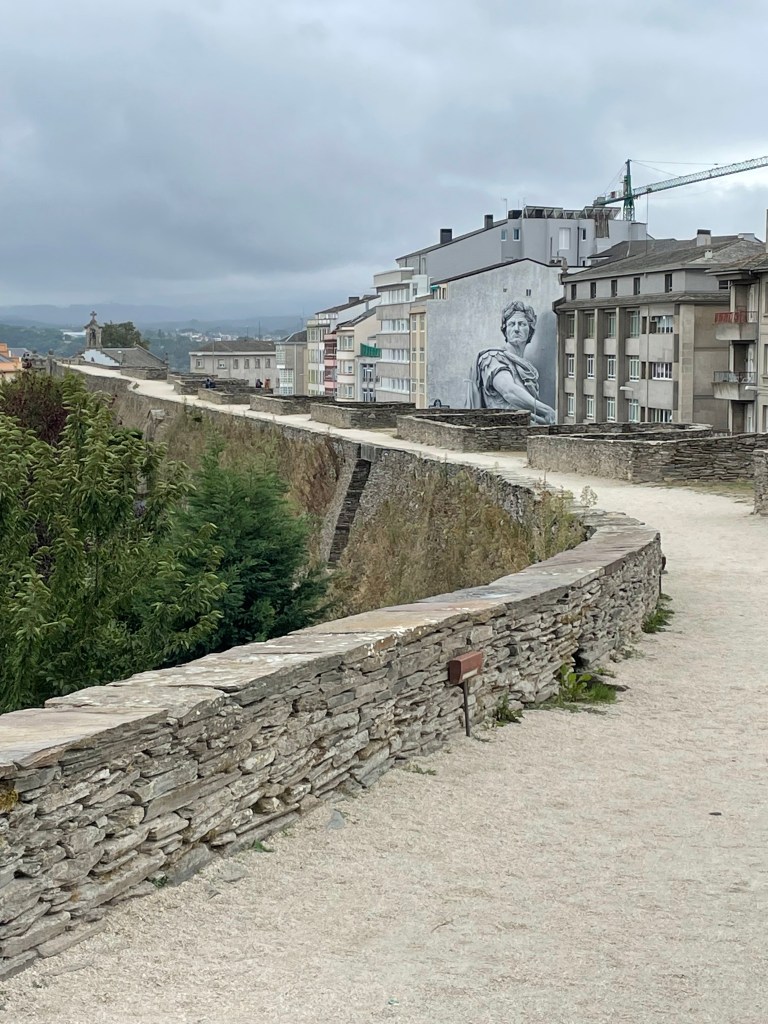
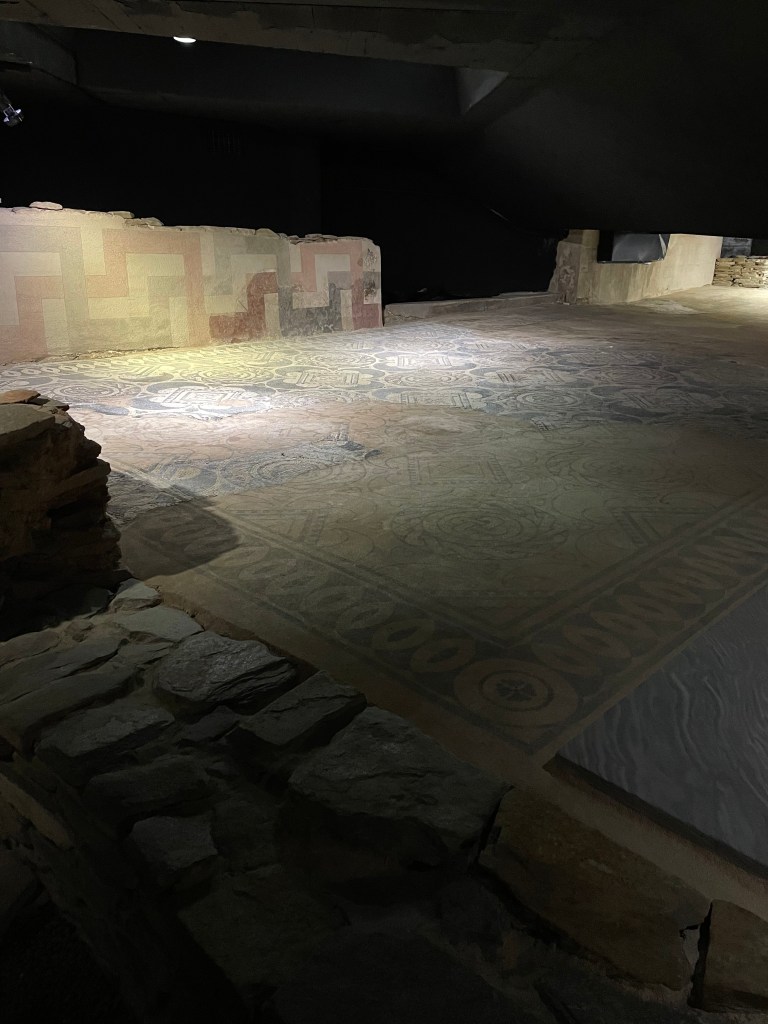
This is a Roman house, 3-4th century that was found under a building in 1998. Can you imagine the dismay of the people building above and the thrill of the archaeologists? Amazing mosaics still intact. They know there’s a lot more under the next building, but…
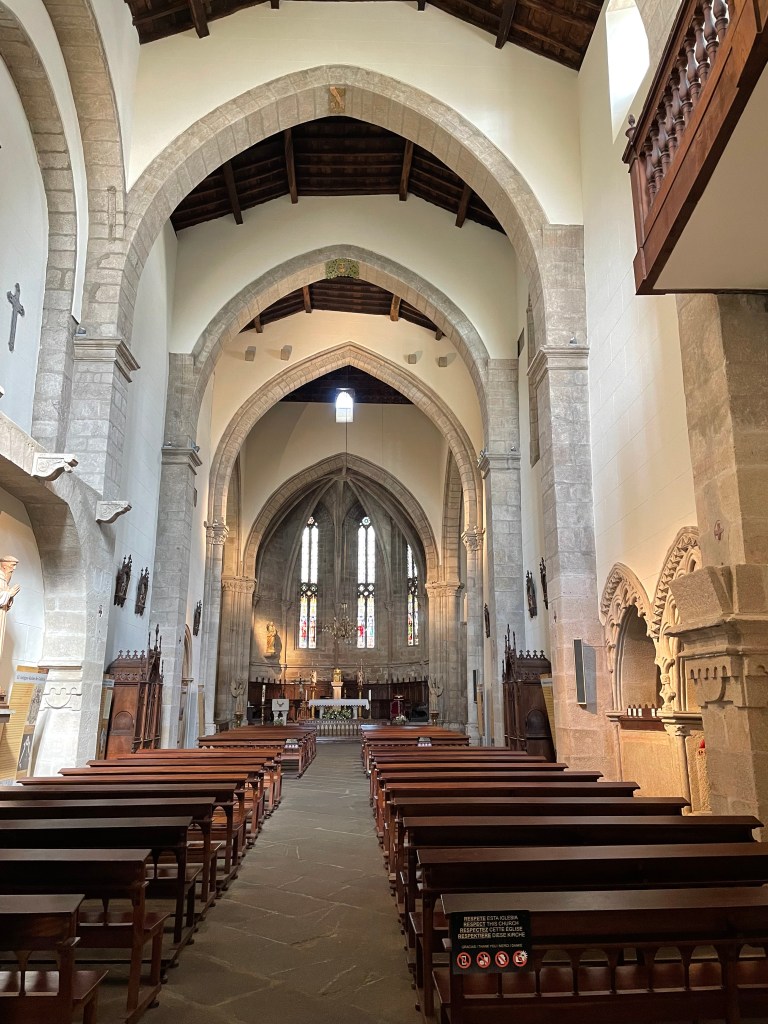
A Franciscan church that I really liked. Quiet, serene.
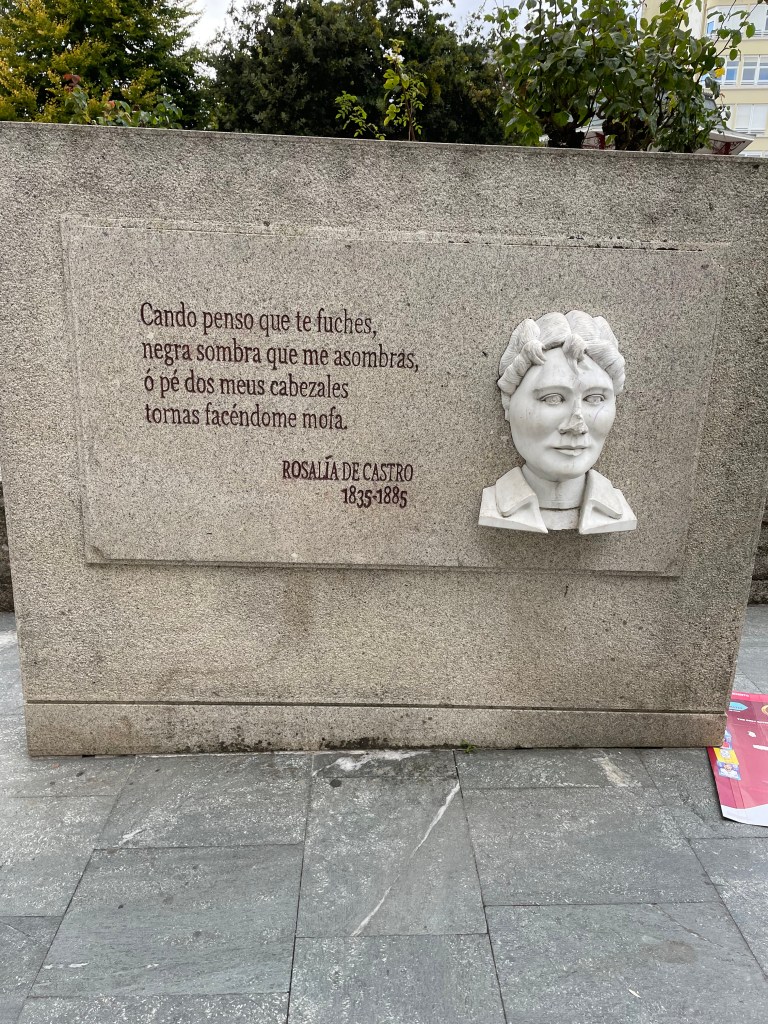
There’s poetry in so many places, this country appreciates the written word and art if the demonstrations and markers are anything to go by.

This is where I walked today.
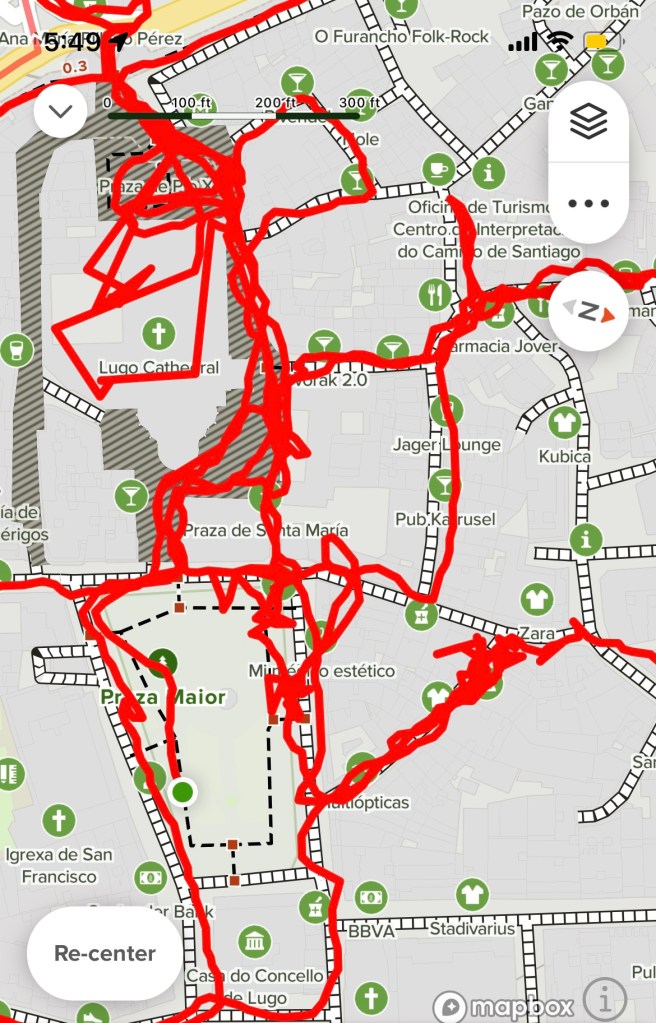
This is a blow up of the interior. Hmmm. Looks a little confused – but it really was a mix of hither and yon.
 Reb's Walks!