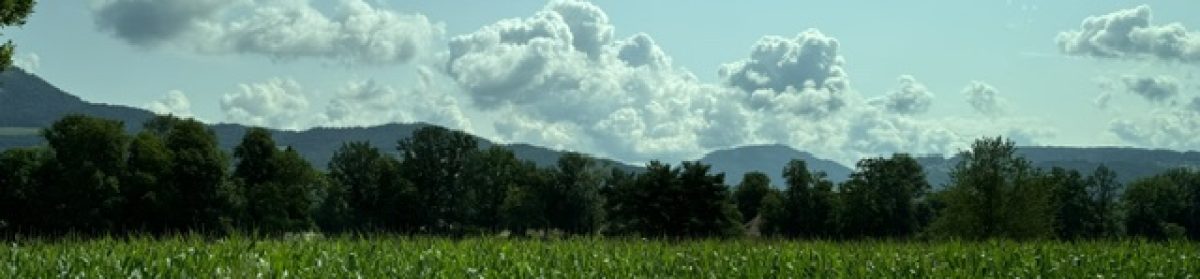
Bob and Susan left this morning; it was such a gift getting to travel with them. Bob took the lead every day, just striding off and carrying the heaviest pack since he packed all the food for the four of us and made it look easy. Hope they have a great day in Rome!
Rick and I had an early breakfast and made a firm decision to not take a chance on walking because 90+ chance of not only rain, but also thunderstorms. So we decided to walk Siena with Rick Steves and his audio guide. What a great decision. He missed the synagogue, but got many other things and we learned way more than we would have if we’d tried to do it on our own.
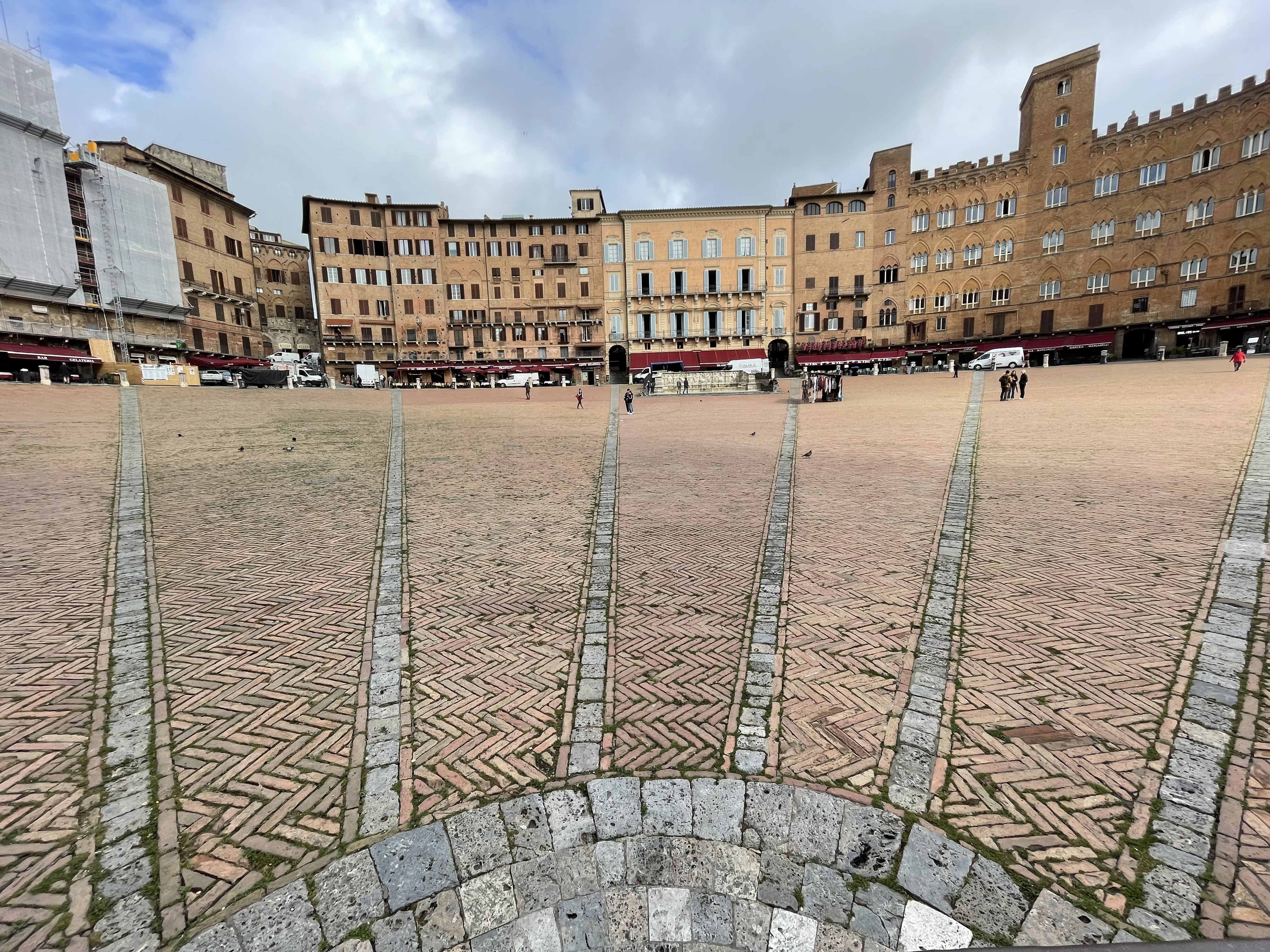
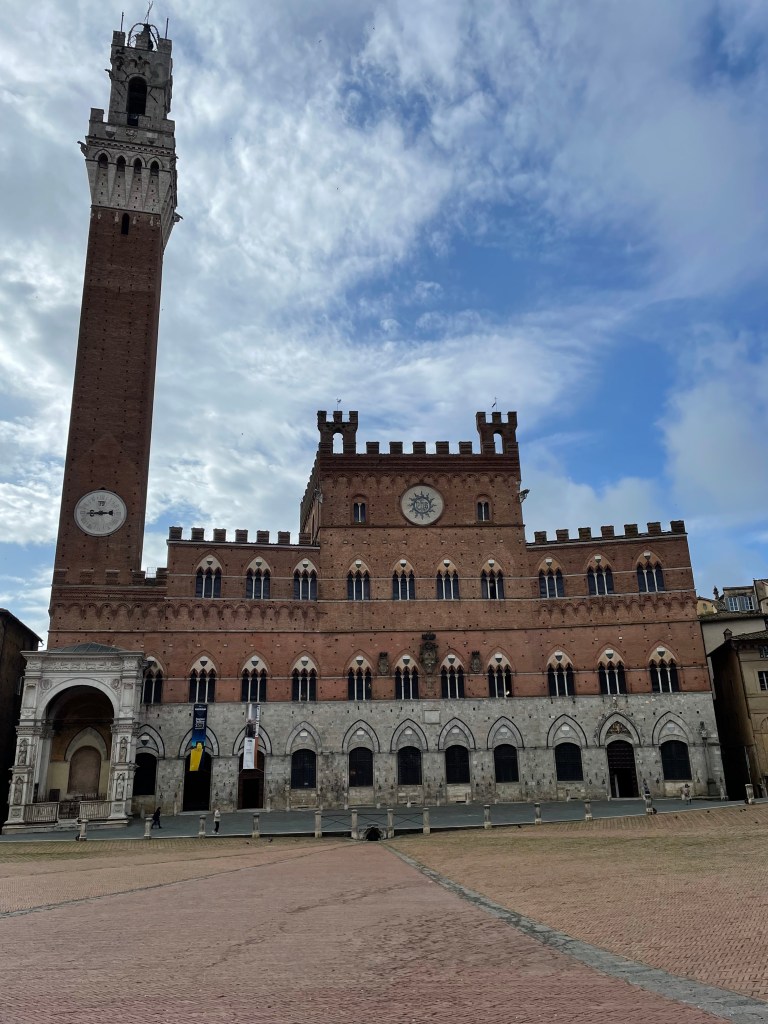
We started at the Campo, the center of Siena life, looks now basically what it looked like in the 1300’s, astonishing (though I’m guessing that indoor plumbing’s been added). The engineering of water run off and all going down towards the town hall and this beautiful drain, just beautiful. Hard to capture in a photo, but did my best. Siena was a republic and all was based on that, so that they built the duomo (cathedral) with the town council and the community, a rare exception of a town run on political lines and not by the church. The town tower here in the campo was the highest tower outside of church towers for many years. The photo below is the long view in an effort to capture the remarkable planning, it’s smaller than this makes it look. It’s around this plaza that the Palio is run in July and again in August. Hard to imagine in that heat 60,000 people packed into the center of the plaza, a trail of sand laid down around the outside and 10 of the 17 districts in the old city have a horse that runs. Whichever horse crosses first after 3 circuits, whether the jockey is still on its back or not, wins for its district. It looks like a crazy crazy scene.

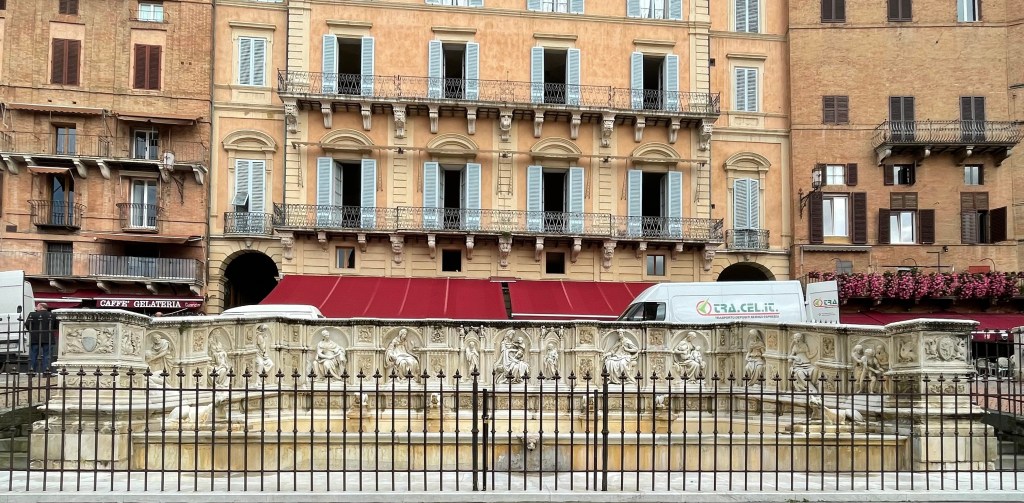
Fountain of Joy, so named because it was the communal source for water in the 1300’s and everyone gathered here, images of all kinds of women helping others all around the fountain.
I really couldn’t capture the entire circle of the buildings, but amazing.
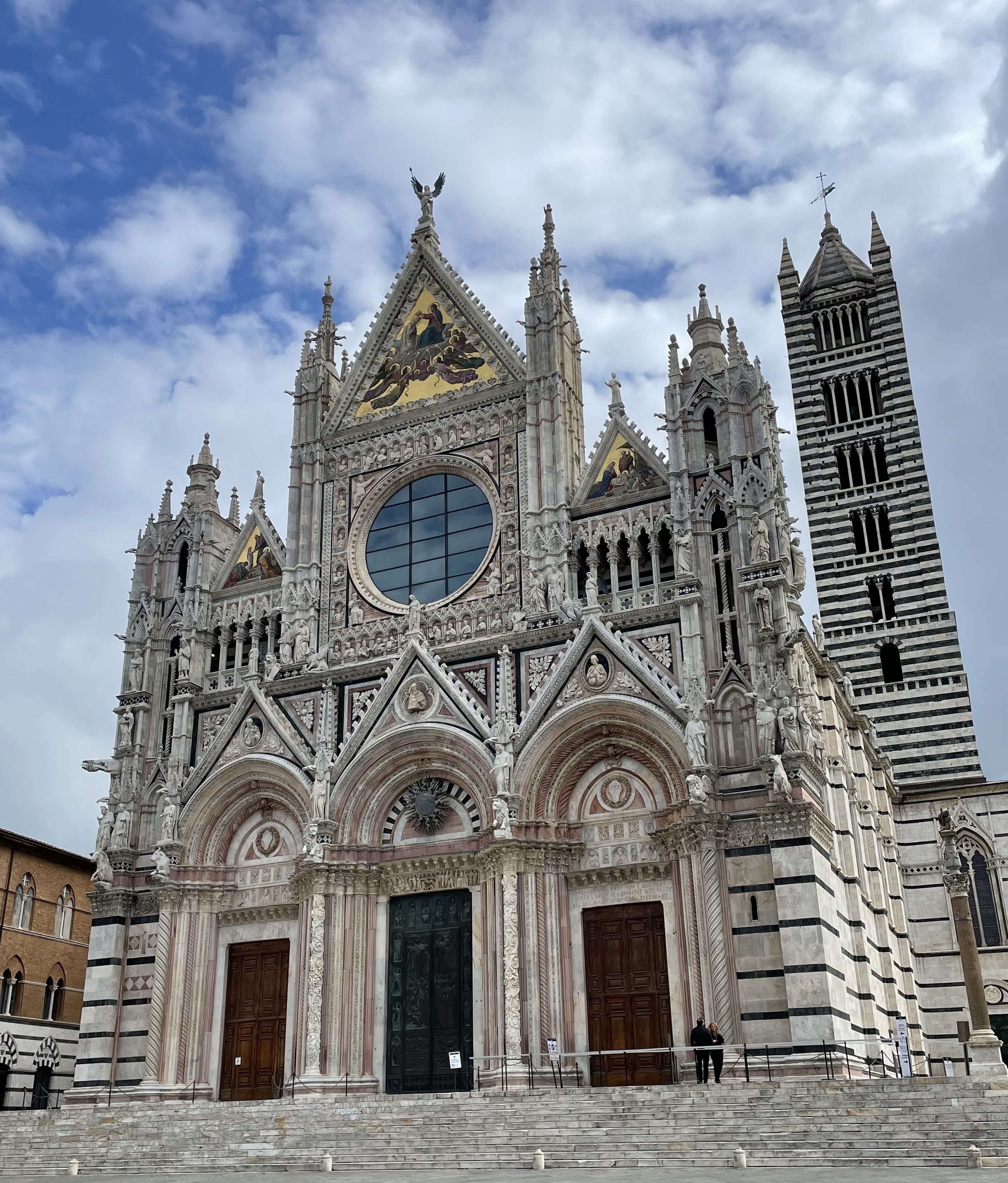
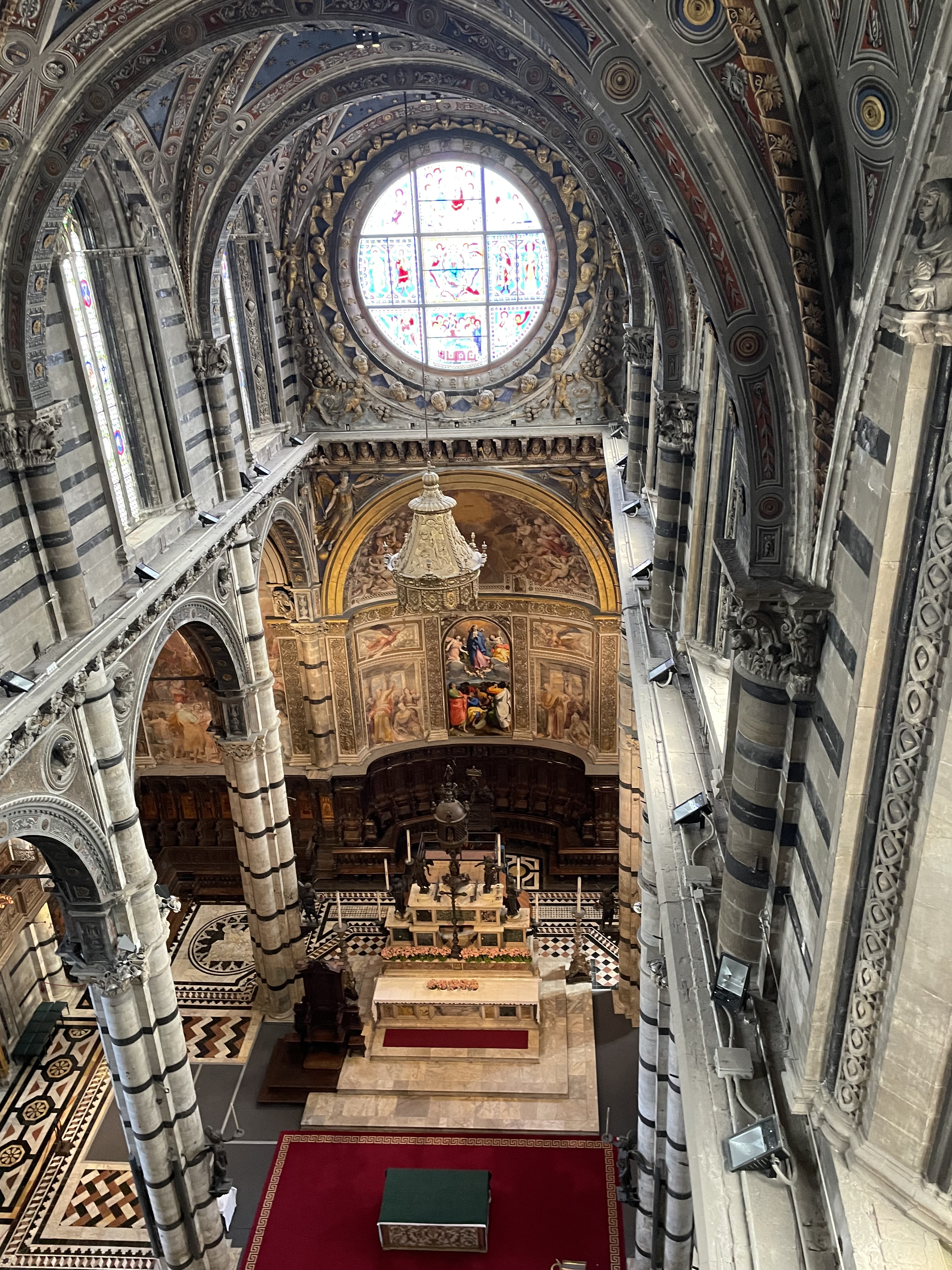
We learned a ton, courtesy of Rick Steves. We started with the roof tour of the cathedral, though Rick had to take some of the photos. Looking down into the cathedral and close to the vaulted ceiling and over the town. How in the world did they do this in the 1200’s – 1300’s? Just boggles the mind. So lucky to see it early before most people were out and about. And this is just the front, it’s incredible all the way around. The bottom half of the duomo was built in the 1200’s. 22 of the 23 kinds marble came from Tuscany, 1 from France. Incredible.
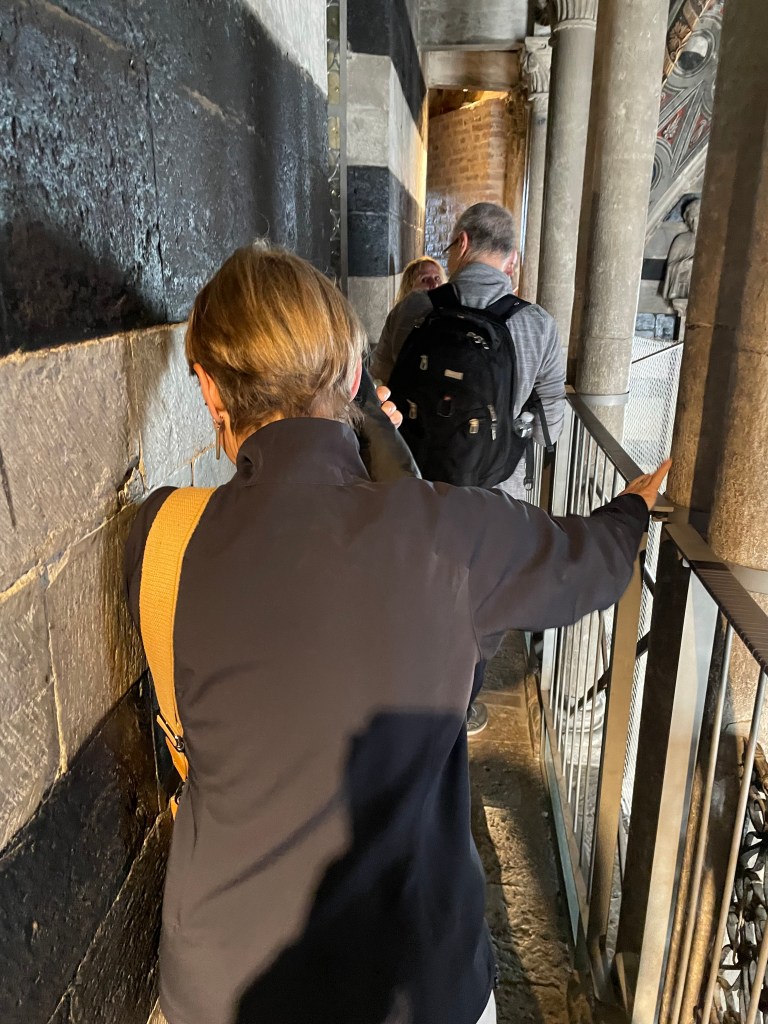
Me, making it around the walkway without looking at all, hanging on the wall and the railing at the spots where it just dropped off, ach.
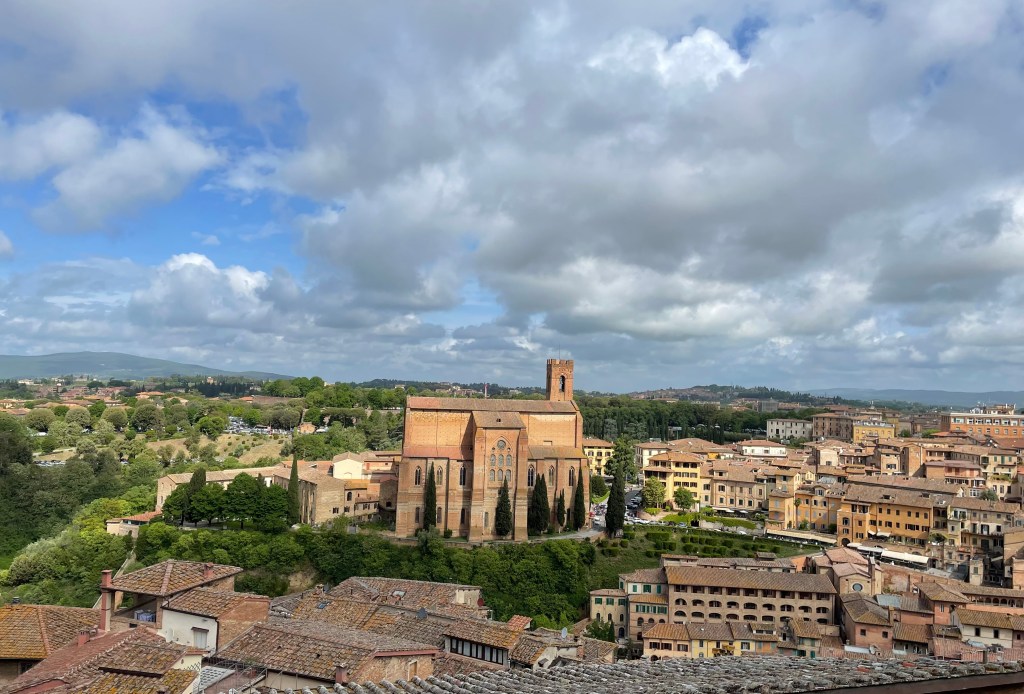
Rick took this with my camera – the church where St. Catherine’s (Caterina) relics are held. She was a remarkable woman and did all of this before she died at the age of 33. From Wikipedia: Catherine of Siena is one of the outstanding figures of medieval Catholicism due to the strong influence she had in the history of the papacy and her extensive authorship.[9] She was behind the return of the Pope from Avignon to Rome, and then carried out many missions entrusted to her by the pope, something quite rare for a woman in the Middle Ages. Her Dialogue, hundreds of letters, and dozens of prayers, also give her a prominent place in the history of Italian literature.
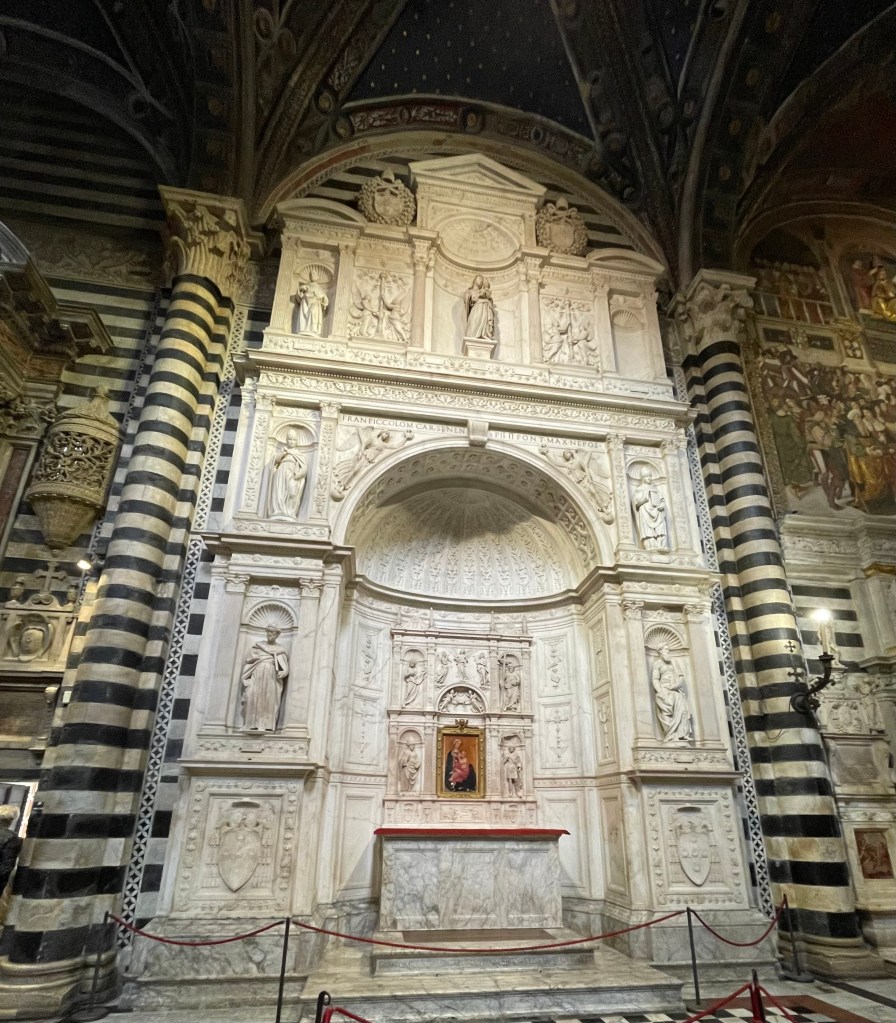
The Piccolini altar design was all supposed to be by Michelangelo. He did the figure of St. Paul on the lower right, but then got “distracted” by working on The David and others did the rest. The figure of St. Paul is amazing.
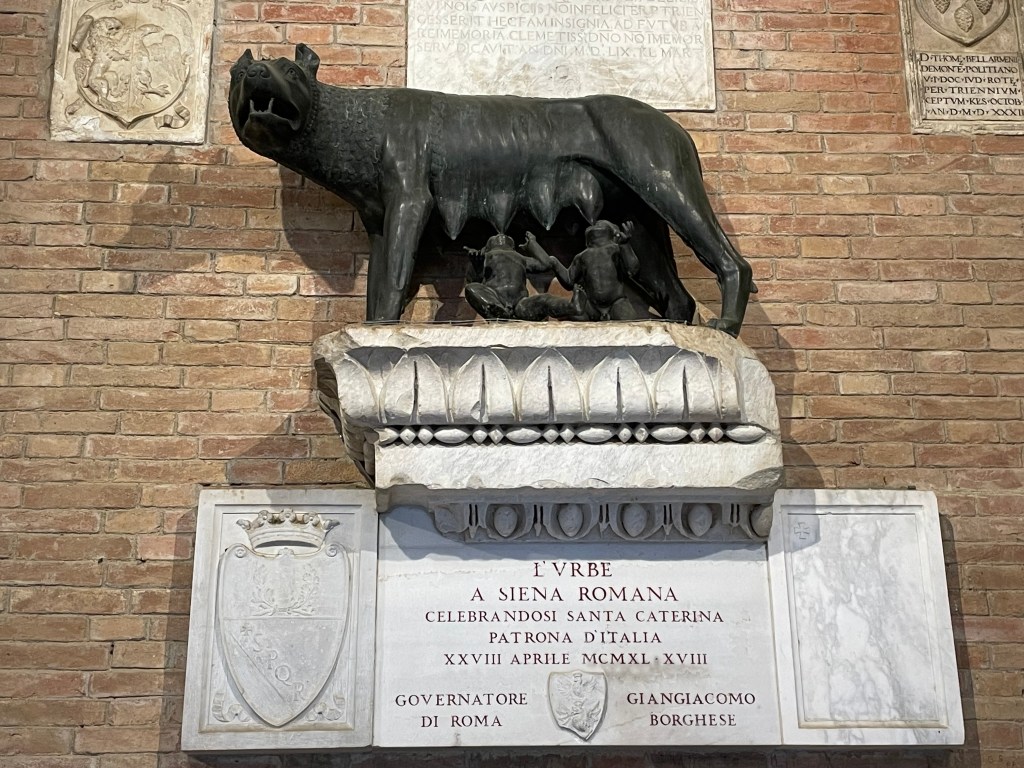
The image below was everywhere, often on top of high columns and we couldn’t figure out what it was about. Turns out the she-wolf is the image for both Sienna and Rome. Rome was named for Remus and Romulus, brothers who were abandoned and nurtured by a she-wolf and who later founded Rome. Then one of them had a son, Siena, who traveled up from Rome and founded Siena.
Siena was strong and mighty and flush until the black plague hit in 1348 and they never recovered. Luckily, they were not hit in WWII, only Sienna and Venice were spared, so Siena is a wonderfully preserved medieval town, as seen from the roof of the Duomo.

So many many things to see, but the final one was the building where the first bank in the world started:

Both Rick and Bob got a kick out of seeing this – and the bank’s still going!
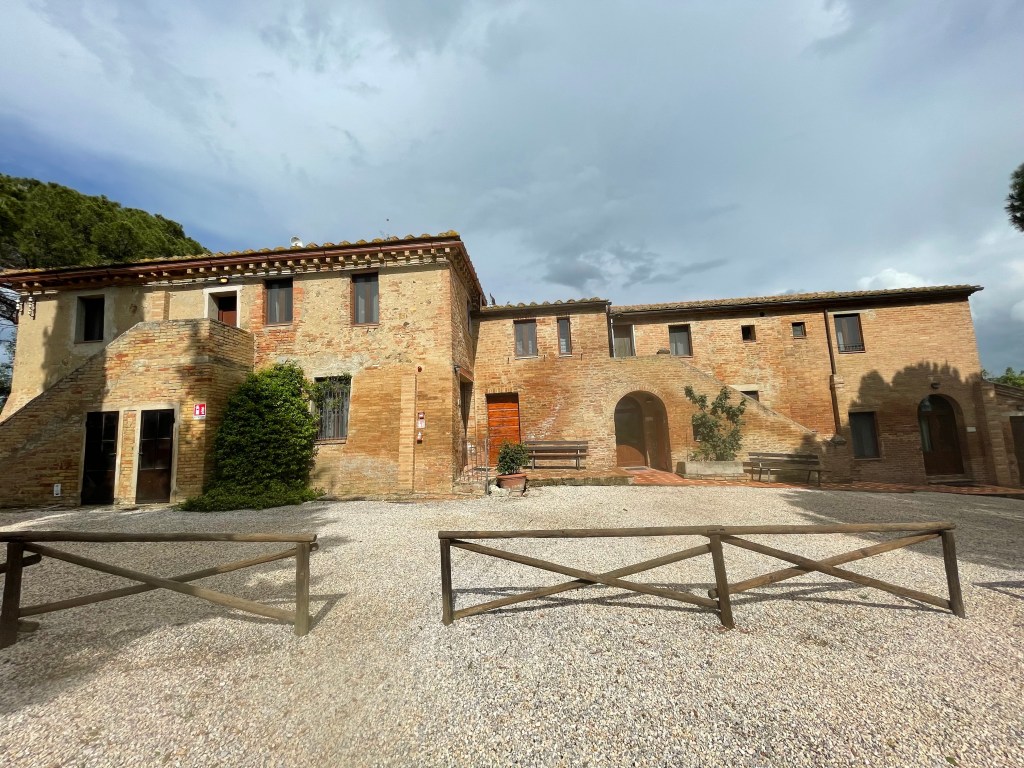
After our tour, we took a cab to our next destination and were very happy we did so as we drove through torrential rain and hail, repeat of yesterday. Then arrived at a cool farmhouse – so different from what we envision at home – that at its peak in the summer can hold 140 people. Crazy.
This is just one set of buildings, they were scattered around, a whole complex.
They have a farm to table restaurant that’s well known and the farm supplies oats, farro, cannellini beans and more to all kinds of companies. Food at dinner was fine, basic, but the rainbow that came out as we arrived at the restaurant was absolutely spectacular. It actually went to the ground, don’t think I’ve ever seen that before. There’s a second one just building from the left…

Then it was quiet and cold and wonderful for the night.
 Reb's Walks!