
I loved today! Every day has been wonderful, but today was especially so because we spent the day in Assisi, home of St. Francis and Poor Clare – or St. Clare – Chiara in Italian. First, we drove to Perugia to get me signed on as a driver, but then very happily, Leaf kept driving. Because our first excitement of the day was confusion around GPS directions and finding parking near where we wanted to start our Rick Steves audio tour. Leaf drove, but he had a LOT of help from the peanut gallery who weren’t driving.
Leaf ended up winding through Perugia tracking and retracking to get us back on the way and then driving all through the medieval town of Assisi. We were scraping by walls and tourists alike with mere inches to spare with Sharon hyperventilating with the precariousnesses of the hills and driving. All of us were laughing so hard that by the time we parked, my sides hurt in ways I haven’t experienced in years. Leaf earned serious kudos from all of us. And parked right in the old city instead of one of the big parking lots. I didn’t get any photos because it was very hard to capture the situation, plus, like Sharon, there were times that both eyes and ears were covered. At one point, we circled the plaza in front of St. Claire’s cathedral which was NOT a driving area. Cathy was looking for any cameras that might capture the moment and trigger a ticket. We’ll all share the cost… Here’s a photo of Sharon beaming in pride at Leaf and Leaf recovering from the drama:

But back to Assisi. I think the reason that this cathedral and the stories had such an immediacy was because both Francis and Clare were born and died in Assisi and had a huge impact on their communities and far beyond. They were so revered in their work and commitment to Jesus that Francis was made a saint 2 days after he died and the Basilica was started the day after that. So when they say they have relics and robes – they really do.
St. Francis was born 1181/82 and died October 3, 1226, aged 44. Clare was born 16 July 1194 and died on August 11, 1253, aged 59. She was canonized on September 26, 1255, by Pope Alexander IV, also unusually quick. So both the town and the churches reflected a man and a woman who felt very present and real.
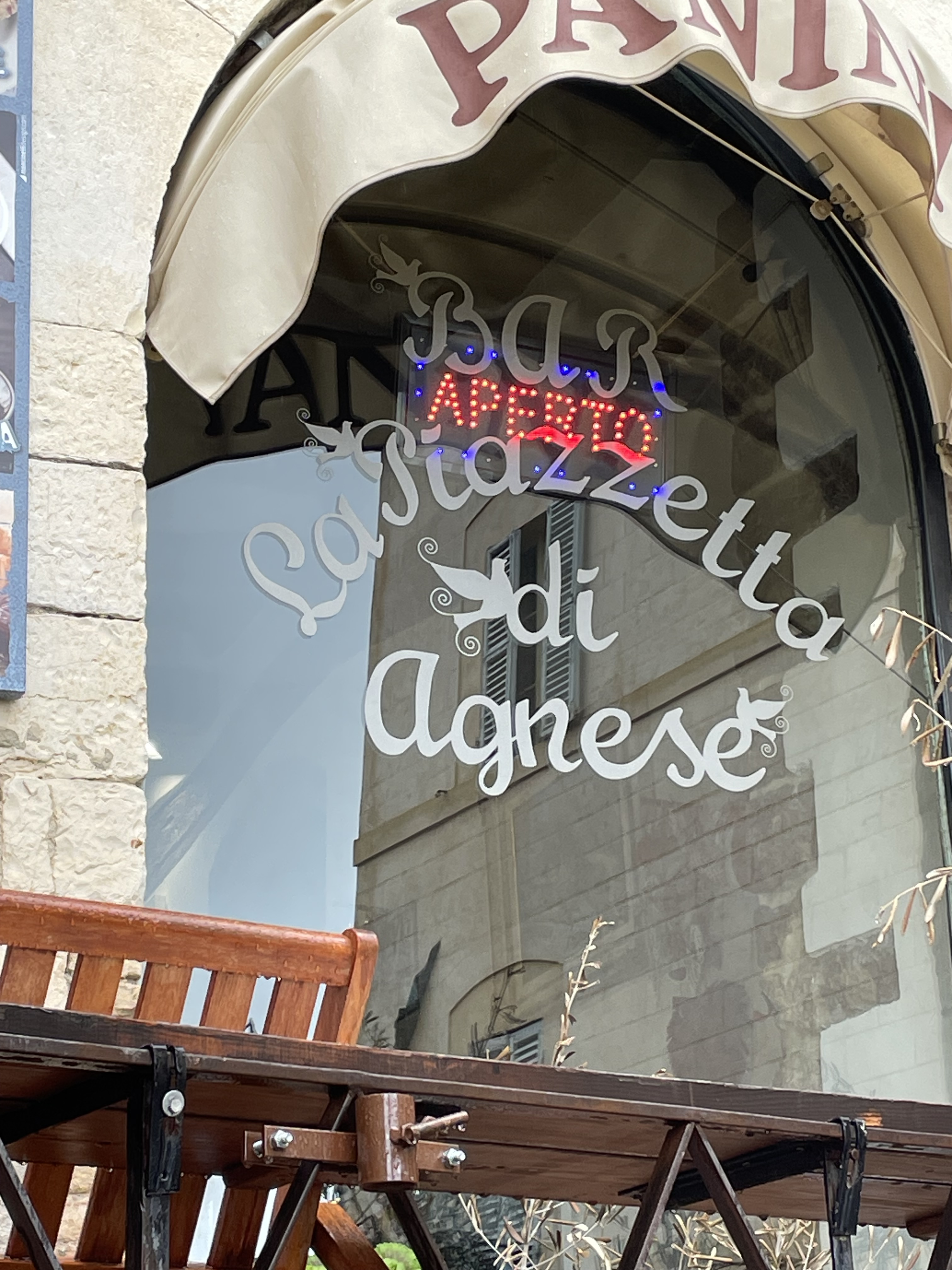
Per our custom now, we started our day (once parked) at a cafe – or in this case a bar that was actually a cafe. I had to choose this one because of the name, thinking of Kaz and Eli’s dog, Agnes’s. Of course, Agnes was also one of Clare’s sisters and very influential in her own right.
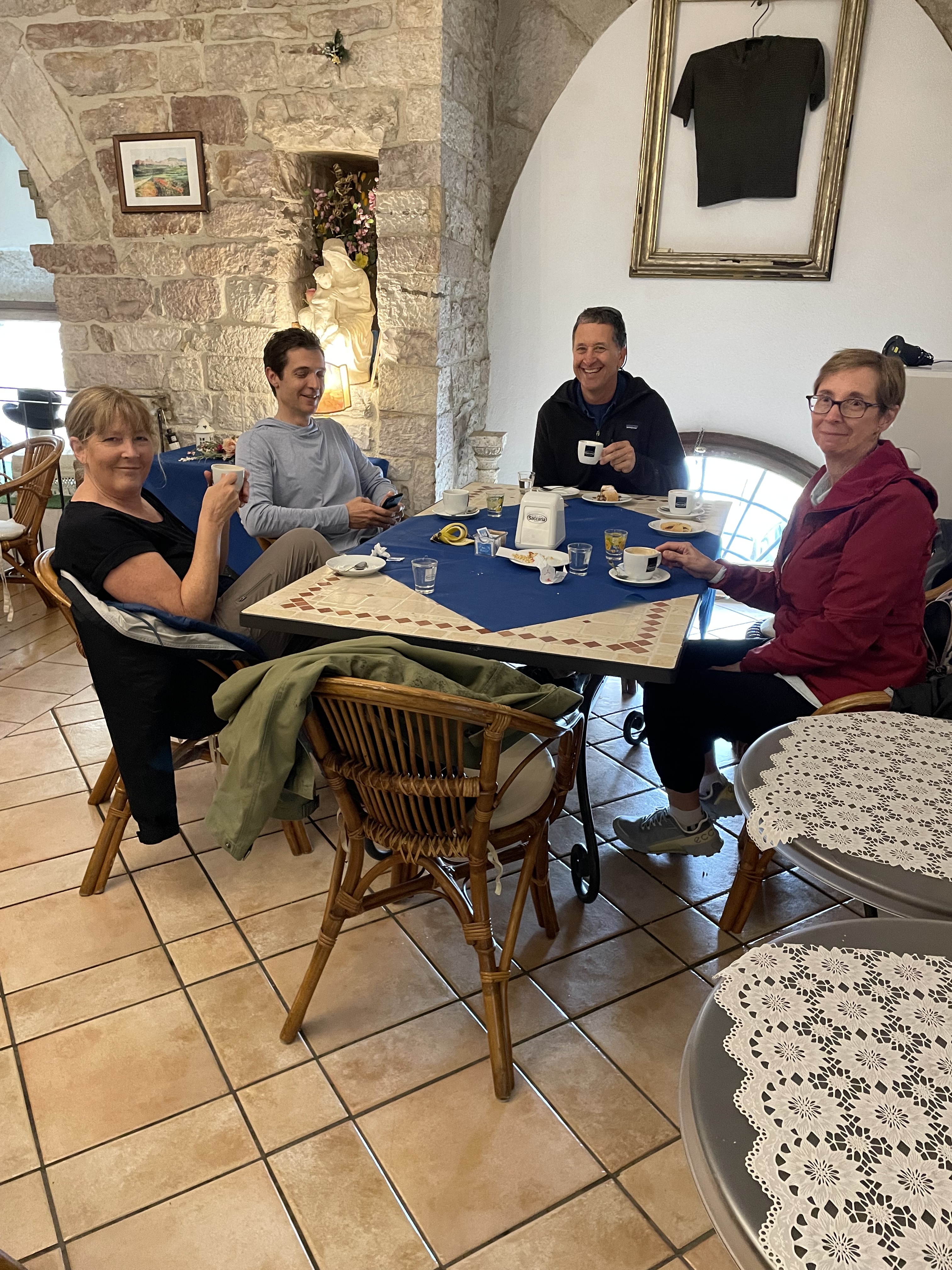
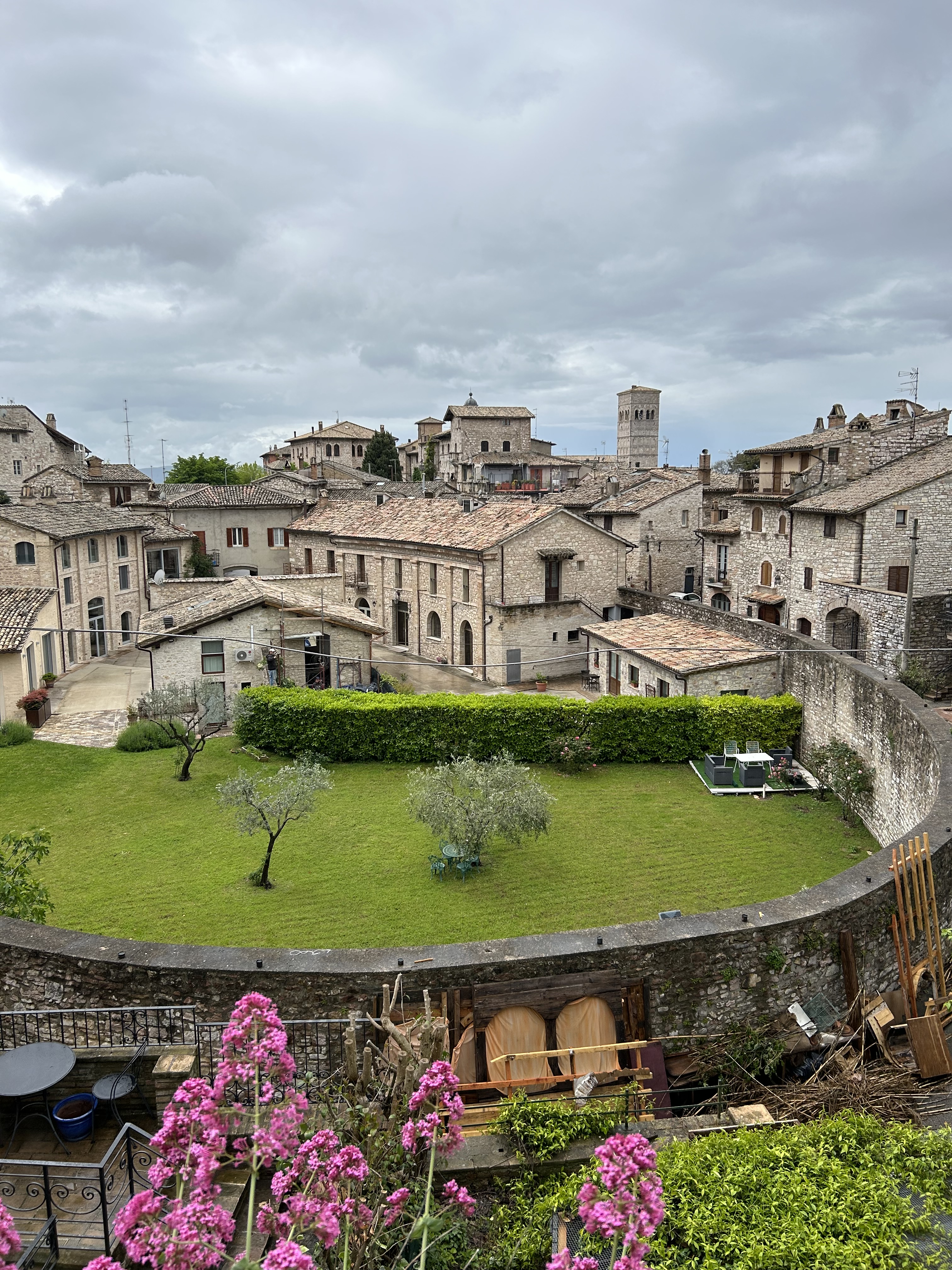
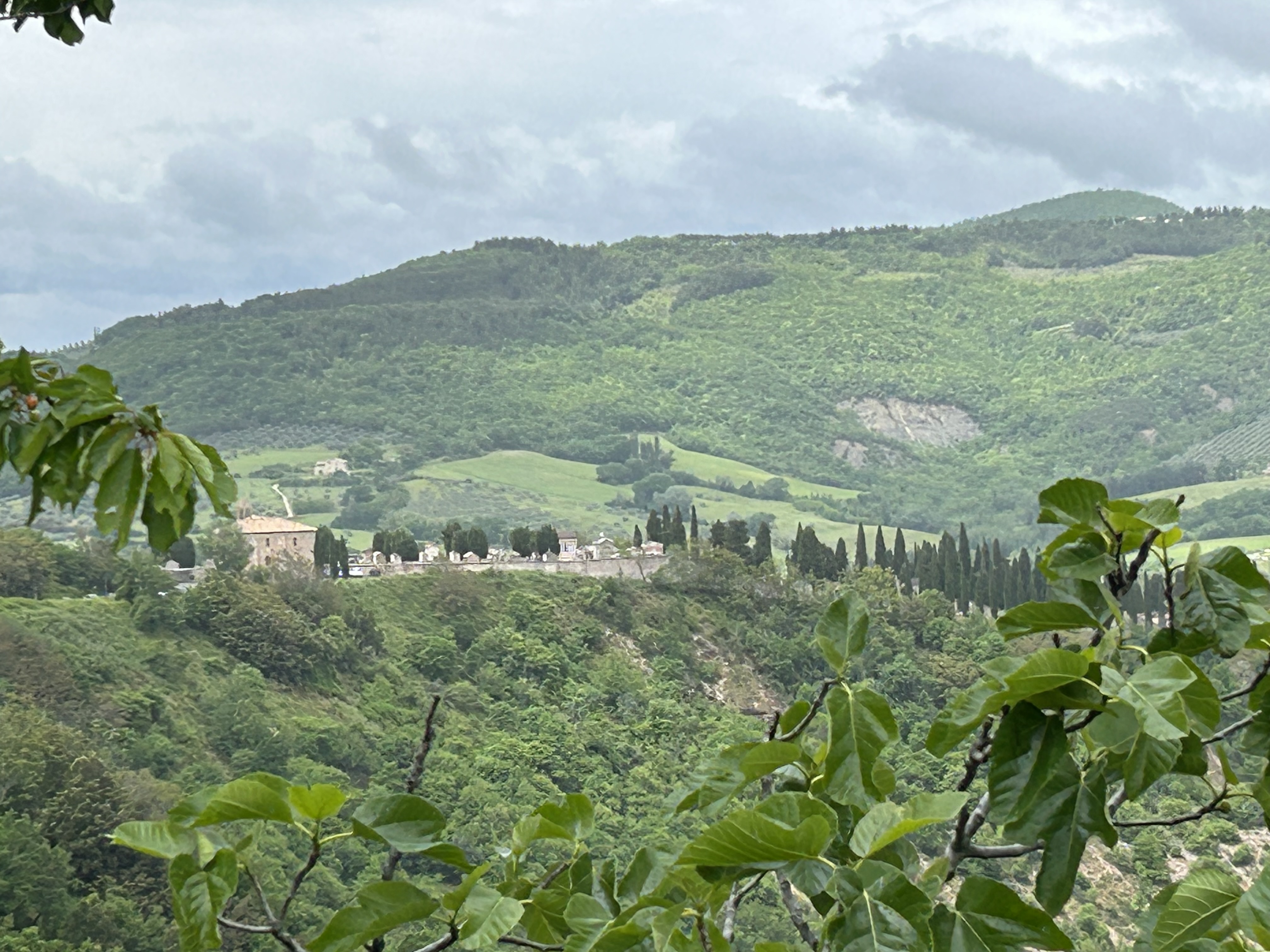
Once we gathered ourselves with coffee and pastry, we started off. In circles. We could not figure out the Rick Steve’s directions for the town tour, it actually was the least clear tour I’ve done and it’s probably my 5th or 6th to do? But we finally got traction. This is the Roman amphitheater, absorbed into a medieval circle of homes. The town gate was just a block away from which you could see out into Umbria – the “green heart of Italy”. It’s the only region that does not have a sea or other country boundary.
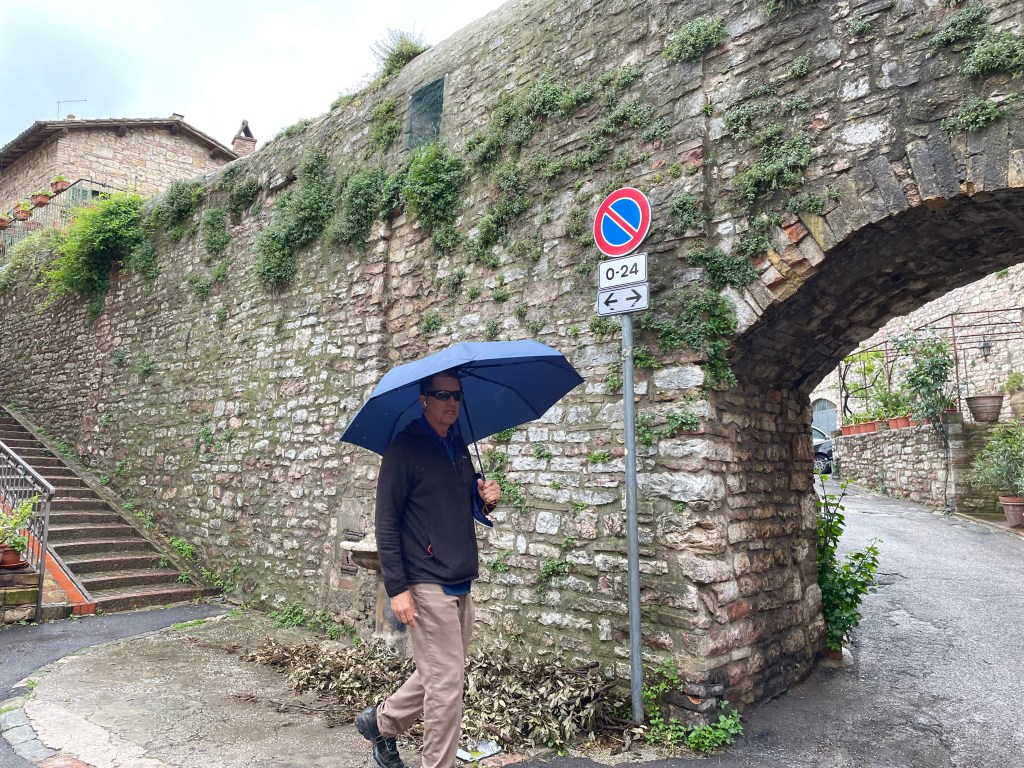
Then we started walking Assisi. The first place of note was the aqueduct built by the Romans and that still brings water to Assisi. There was a fountain that still works and was the gathering place during Roman times for collecting water for the houses in the area. I think I was wearing out re photos because I’m missing a lot. The two above were taken by Sharon and this is the only one I got of the aqueduct and you can see the edge of the fountain behind Rick. Raining pretty steadily, though not hard.
Then we came to the Cathedral of San Rufino, built in 1029, rebuilt in 1140. San Rufino is the patron saint of Assisi to this day and this cathedral is where both Francis and Clare were baptized and practiced until they became adults. Here’s the baptismal font where they were both baptized.

When you walk in, the first thing you register are the two statues of Francis and Clare. So here are the stories of the two.
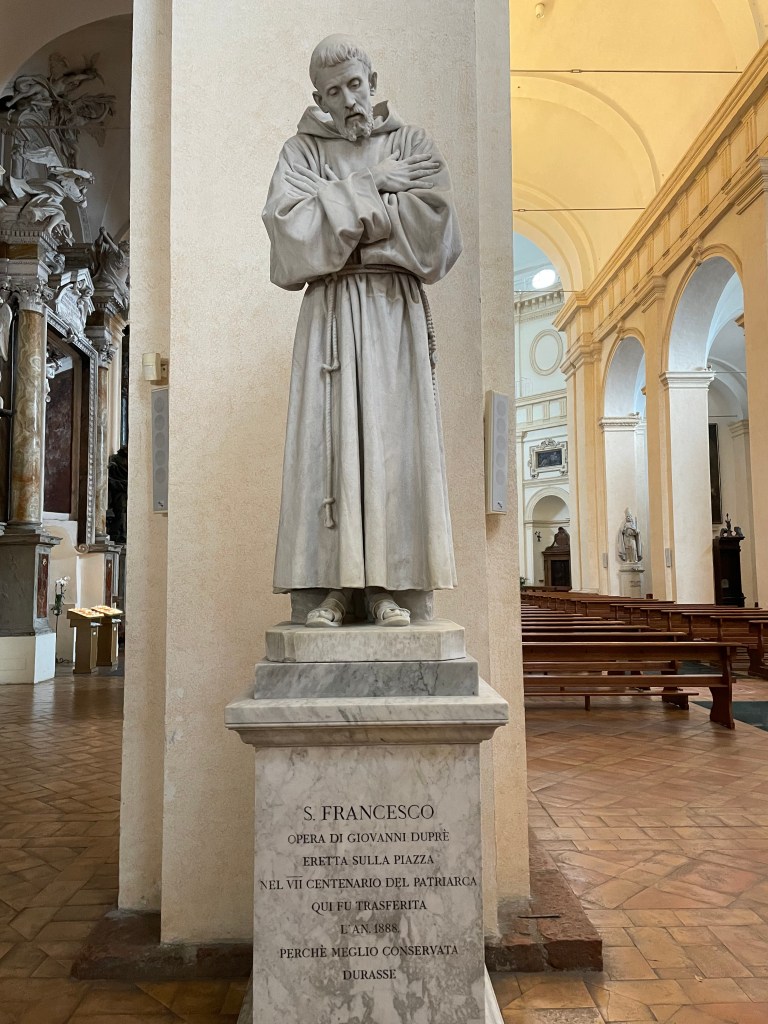
(Biography.com) Saint Francis of Assisi, though revered today, began his life as a confirmed sinner. His father was a wealthy cloth merchant who owned farmland around Assisi, and his mother was a beautiful Frenchwoman. Francis was not in want during his youth; he was spoiled, indulging himself with fine food, wine, and wild celebrations. By age 14, he had left school and become known as a rebellious teenager who frequently drank, partied and broke the city curfew. He was also known for his charm and vanity.
In these privileged surroundings, Francis of Assisi learned the skills of archery, wrestling and horsemanship. He was expected to follow his father into the family textile business but was bored by the prospect of life in the cloth trade. Instead of planning a future as a merchant, he began daydreaming of a future as a knight; knights were Medieval action heroes, and if Francis had any ambition, it was to be a war hero like them. In 1202 war broke between Assisi and Perugia, and Francis eagerly took his place with the cavalry.
Francis and the men of Assisi came under heavy attack, and in the face of superior numbers, they took flight. The whole battlefield was soon covered with the bodies of butchered, mutilated men, screaming in agony. Most of the surviving Assisi troops were immediately put to death.
Unskilled and with no combat experience, Francis was quickly captured by enemy soldiers. Dressed like an aristocrat and wearing expensive new armor, he was considered worthy of a decent ransom, and the soldiers decided to spare his life. He and the other wealthy troops were taken as prisoners, led off to a dank underground cell. Francis would spend nearly a year in such miserable conditions — awaiting his father’s payment — during which time he may well have contracted a serious disease. Also during this time, he would later report, he began to receive visions from God.
After a year of negotiations, Francis’ ransom was accepted, and he was released from prison in 1203. When he came back to Assisi, however, Francis was a very different man. Upon his return, he was dangerously sick in both mind and body — a battle-fatigued casualty of war.
One day, as legend has it, while riding on a horse in the local countryside, Francis encountered a leper. Prior to the war, Francis would have run from the leper, but on this occasion, his behavior was very different. Viewing the leper as a symbol of moral conscience — or as Jesus incognito, according to some religious scholars — he embraced and kissed him, later describing the experience as a feeling of sweetness in his mouth. After this incident, Francis felt an indescribable freedom. His earlier lifestyle had lost all of its appeal.
Subsequently, Francis, now in his early 20s, began turning his focus toward God. Instead of working, he spent an ever-increasing amount of time at a remote mountain hideaway as well as in old, quiet churches around Assisi, praying, looking for answers, and helping nurse lepers. During this time, while praying before an old Byzantine crucifix at the church of San Damiano, Francis reportedly heard the voice of Christ, who told him to rebuild the Christian Church and to live a life of extreme poverty. Francis obeyed and devoted himself to Christianity. He started rebuilding the church of Saint Domian by carrying rocks by hand. He also began preaching around Assisi and was soon joined by 12 loyal followers.
OK – I’ll stop there, but the story goes on describing how his devotion and preaching spread. I found it fascinating. In the upper basilica there is a series of frescoes by Giotto that tells of Saint Francis’ life. They’re just wonderful. We were told how the windows and the murals all over the church were teaching tools for those who couldn’t read, but could see the lives of saints and be inspired. We weren’t allowed to take photos in the lower basilica, where St. Francis‘ bones are buried. Some of his and Clare’s robes and other pieces of their lives are displayed as well. Amazing.
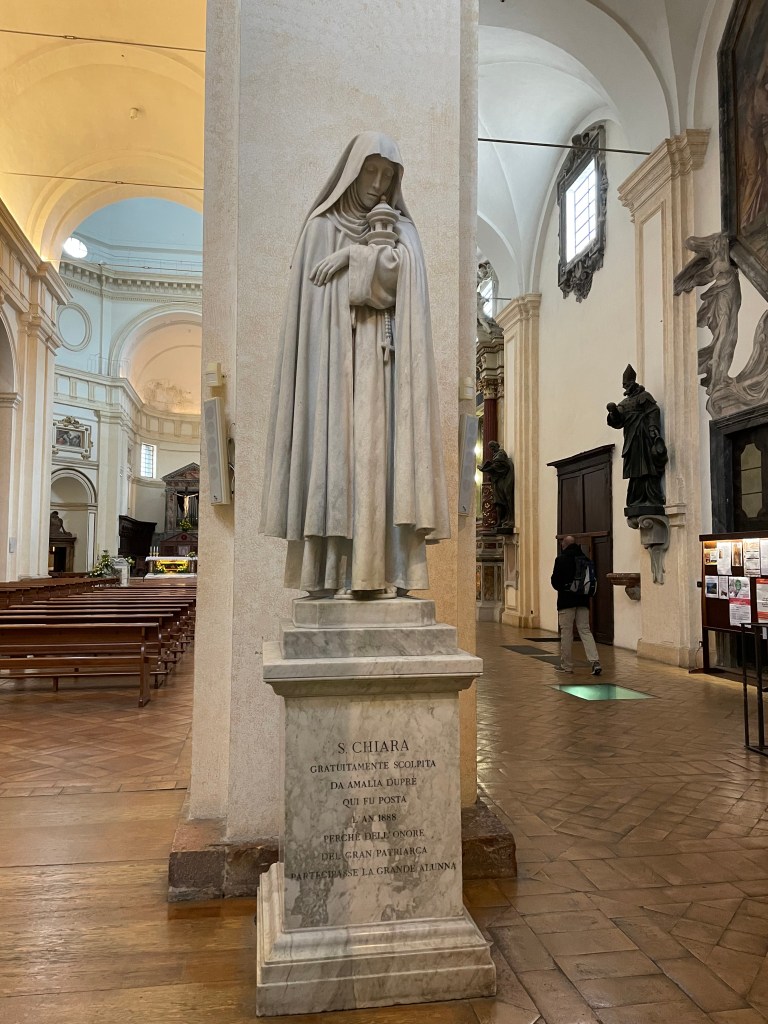
And now, Saint Chiara’s story.
(Biography.com) Clare was born in Assisi, Italy, in 1193 to wealthy parents, and was taught to read and write as well as spin yarn and do needlework. She had little interest in her luxurious surroundings (she lived in a palace), and influenced by her mother’s religious devotion, Clare dedicated her life to God at an early age. She also showed early on that her calling would involve helping the poor, as she set aside food from her family table to give to the needy on the streets.
When Clare was 18, Francis of Assisi came to preach in the church of San Giorgio at Assisi. Inspired by his words, Clare asked Francis to help her in dedicating her life to God, and he vowed to do so. The following year (1211), Clare’s parents chose a wealthy young man for Clare to marry, but she pointedly refused, fleeing soon after for the Porziuncola Chapel, where Francis received her. She took vows dedicating her life to God, and that moment, occurring on March 20, 1212, marked the beginning of the Second Order of Saint Francis.
Clare’s sister Agnes soon joined her, and they moved to the Church of San Damiano, recently rebuilt by Francis. It wasn’t long before other women joined them, and San Damiano’s residents, known for their ascetic lifestyle, became known as the “Poor Ladies.” (Known as the Order of San Damiano, 10 years after Clare’s death the order would be renamed the Order of Saint Clare.)
Again, I could go on about her followers and the growth of the community, but you can read that. But – she was flat out amazing.
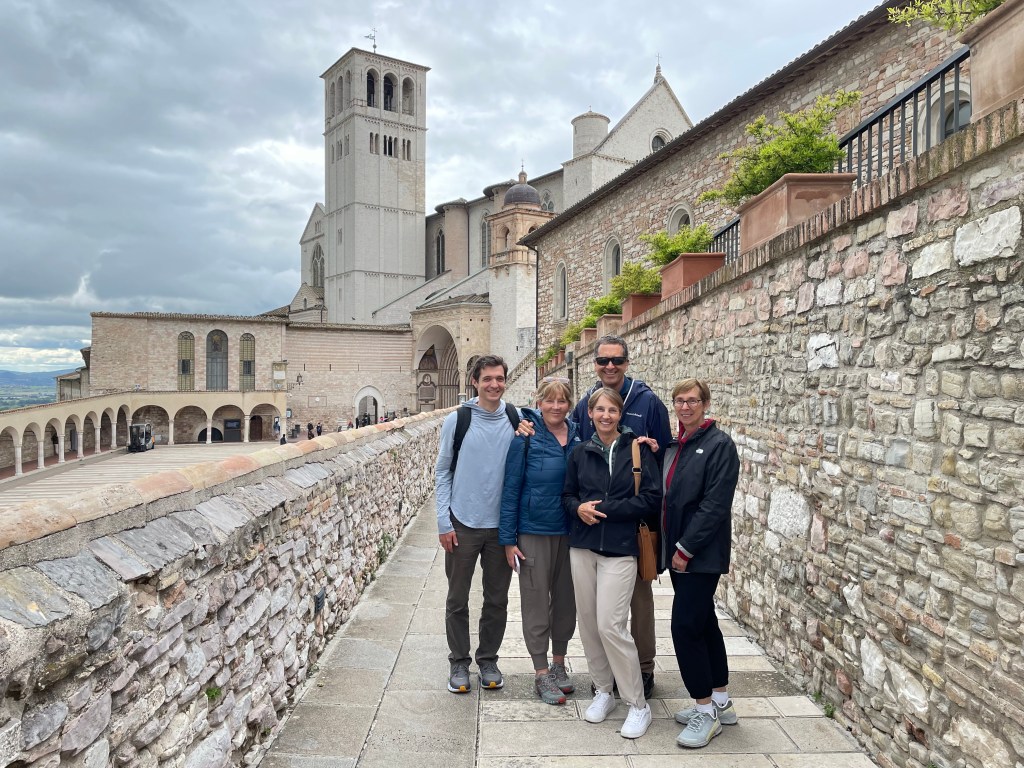
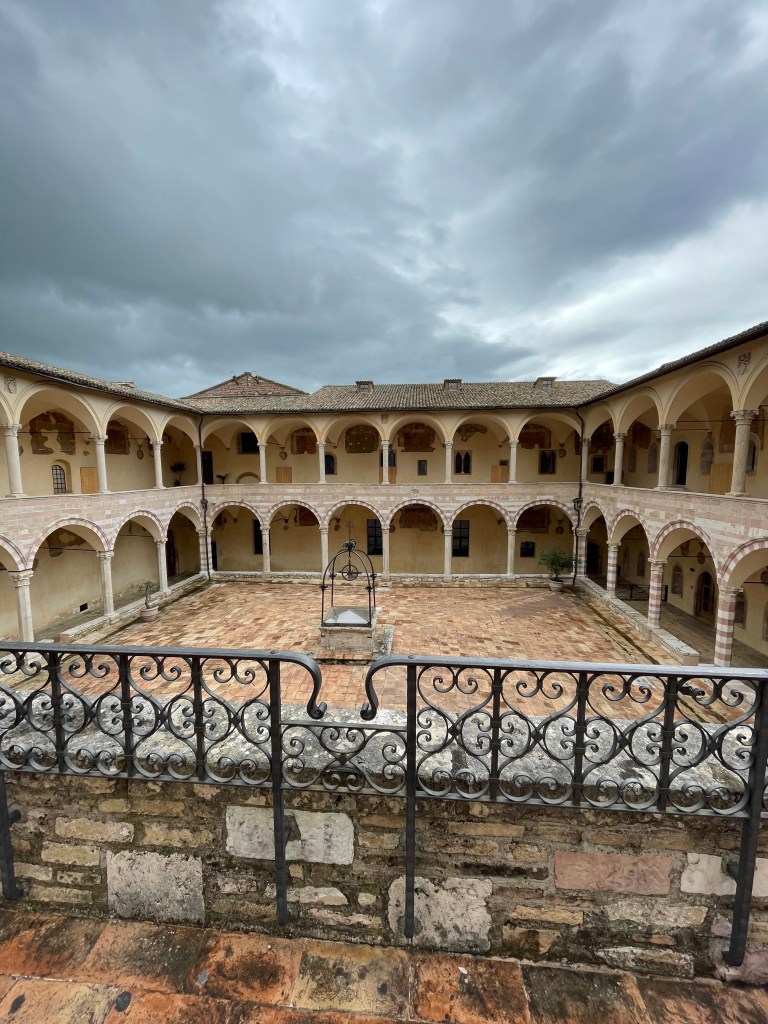
So now we come to the Basilica, the first stone of which was placed the day after St. Francis was canonized. There’s an upper and a lower basilica, as well as a cloister. So much to see. In addition, as one approaches, there’s a plaza with a series of arches in which were stores in the medieval times that people could visit on the way in and out. I’m afraid I was so caught up in the stories (Rick Steve had a tour for the basilica as well) that I got very few photos, but here are a few.
Here it is behind us:
Cloister:
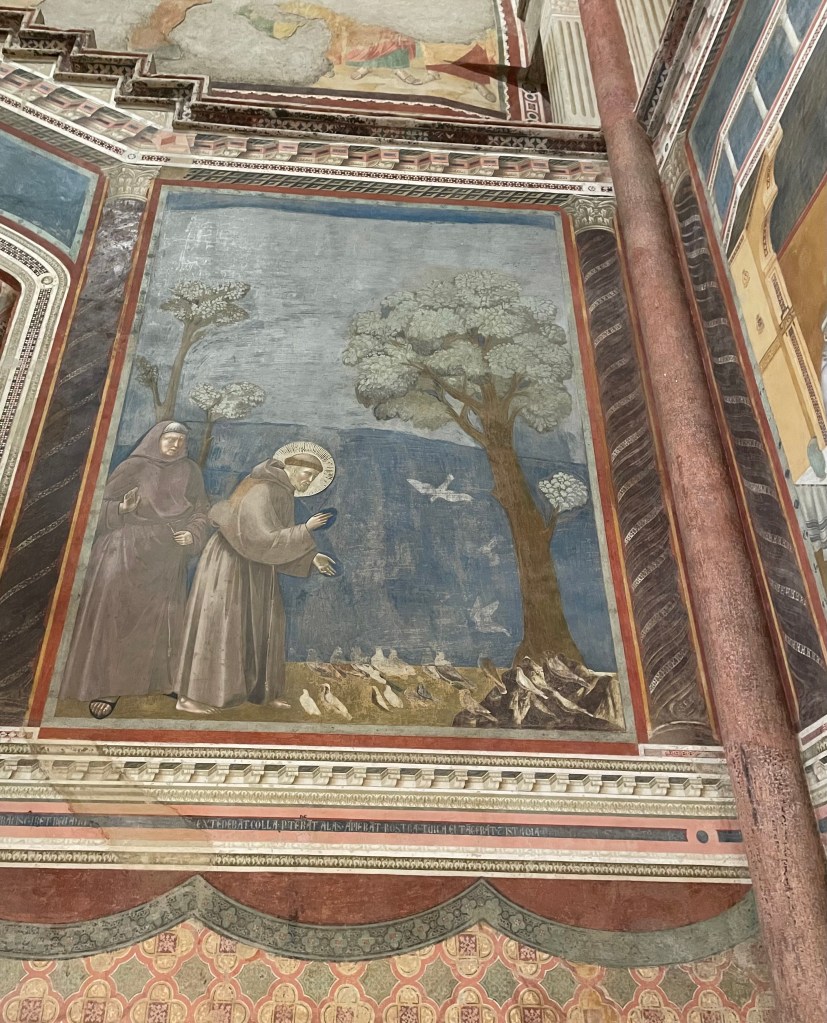
One of the most famous of the frescoes of St. Francis “Sermon to the Birds” – alludes to the truth that all are welcome, all are able to hear the message of Jesus’ love. Tradition has given to Giotto, the best-known naturalistic painter of his period, the authorship of these works, or at the least, the credit for having designed them.
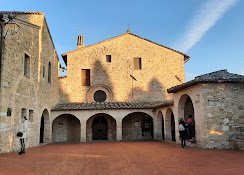
The church for St. Clare was San Damiano. There is another newer one, bigger, that was built after her death because the numbers of her followers had grown so much. However, the small church of San Damiano was just wonderful. It was built between the 8th and 9th century and had fallen into ruin when Francis had a directive “by the Crucifix: “Go Francis and rebuild my house, which as you can see is falling into ruin”. Francis restored it in 1206. He predicted that this place would become the dwelling place of Clare and the other Sisters of San Damiano (Poor Clares) who remained here from 1211 until 1260.” This is where St. Francis wrote the Canticle of the Creatures in 12225. I didn’t get a photo (getting quite tired), but here’s a stock photo of the outside.
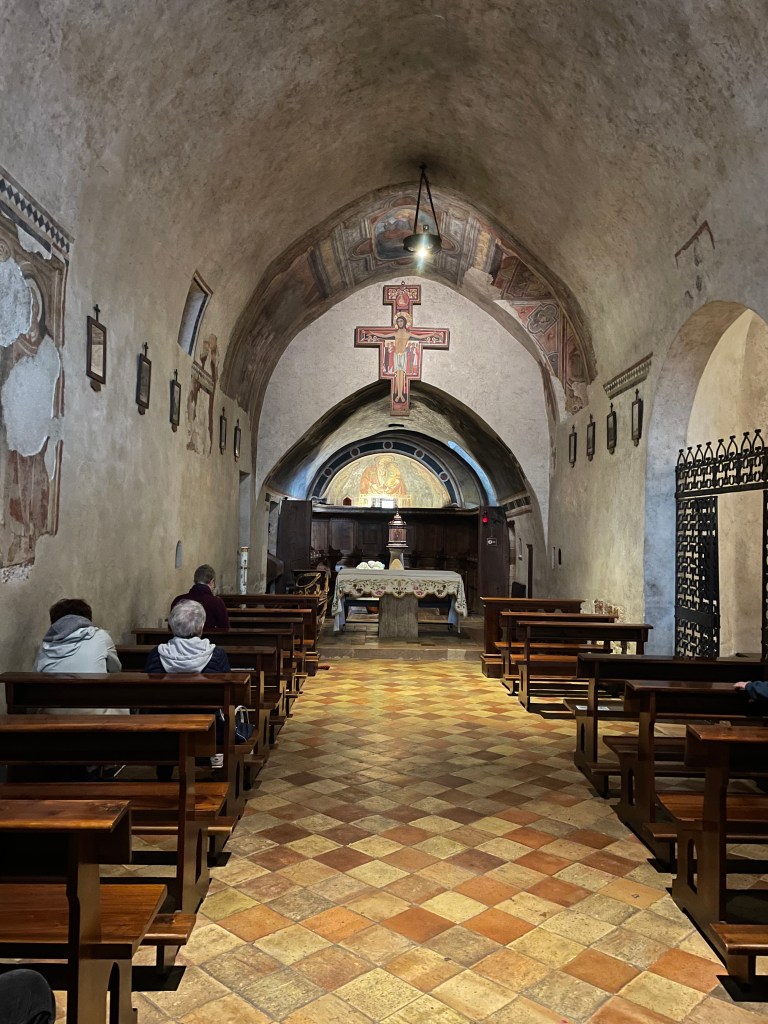
Inside was quiet, more people were sitting in meditation and prayer, so again, few photos.
The cloister:
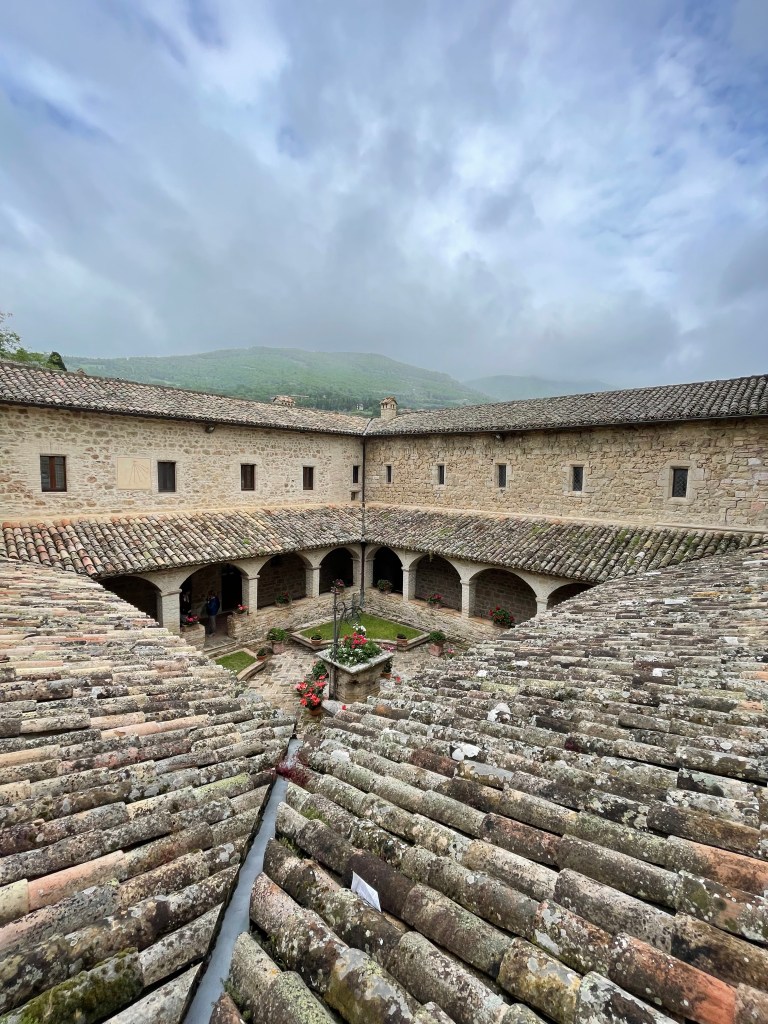
Here’s a story about the cloister that was posted in the church: The Cloister was a haven of peace. Clare, in September 1240, confronted the troops of the Saracens led by the emperor Frederick II of Germany, who entered the cloister. Clare ordered to be brought, infirm as she was, to the door facing the enemies, preceded by the small silver box in which the body of Christ was kept. The Saracens, struck by the force of her prayer, very quickly left the place of San Damiano. The city of Assisi continues to celebrate this liberating event of Clare with the “Festa del Voto” (Feast of the Promise), every year.
There’s so much more that could be written about both the saints, but there was more to be seen in Assisi, so will move on to a few other highlights.
Here’s the Basilica of St. Clare, started in 1260 seven years after her death, and is where her bones are buried. The plaza in front of it is where Leaf drove a circle as we tried to figure out where to go next. Notice the lack cars…
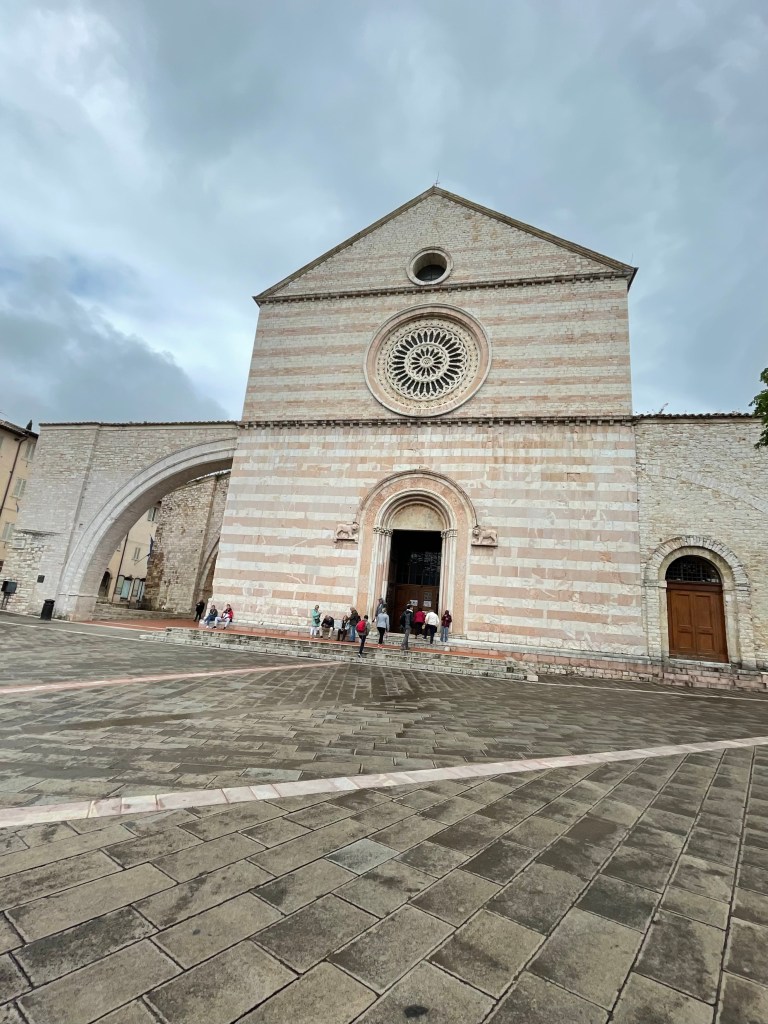
Having remained, like the body of St. Francis himself, hidden for six centuries, Clare’s tomb was found in 1850 after a prolonged search. On Sep 23 that year, the coffin was unearthed and opened. The flesh and clothing of the saint had been reduced to dust, but the skeleton was perfectly preserved. On Sep 29, 1872, the saint’s bones were transferred to a shrine in the crypt of the Basilica of Saint Clare. And this was a scene because of the fervor and devotion of people going down to the tomb, women falling to their knees, praying, crying. Not all, but it wasn’t rare. It felt too disrespectful to take photos any closer with those who were so moved, but this is the layered approach to the crypt.
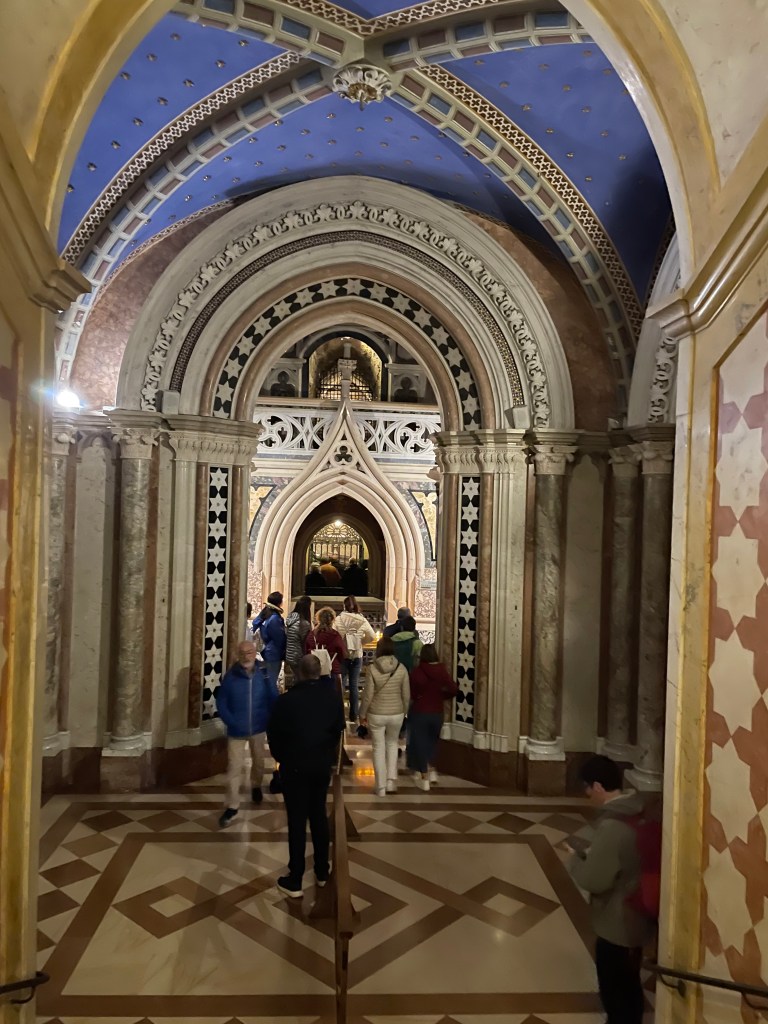
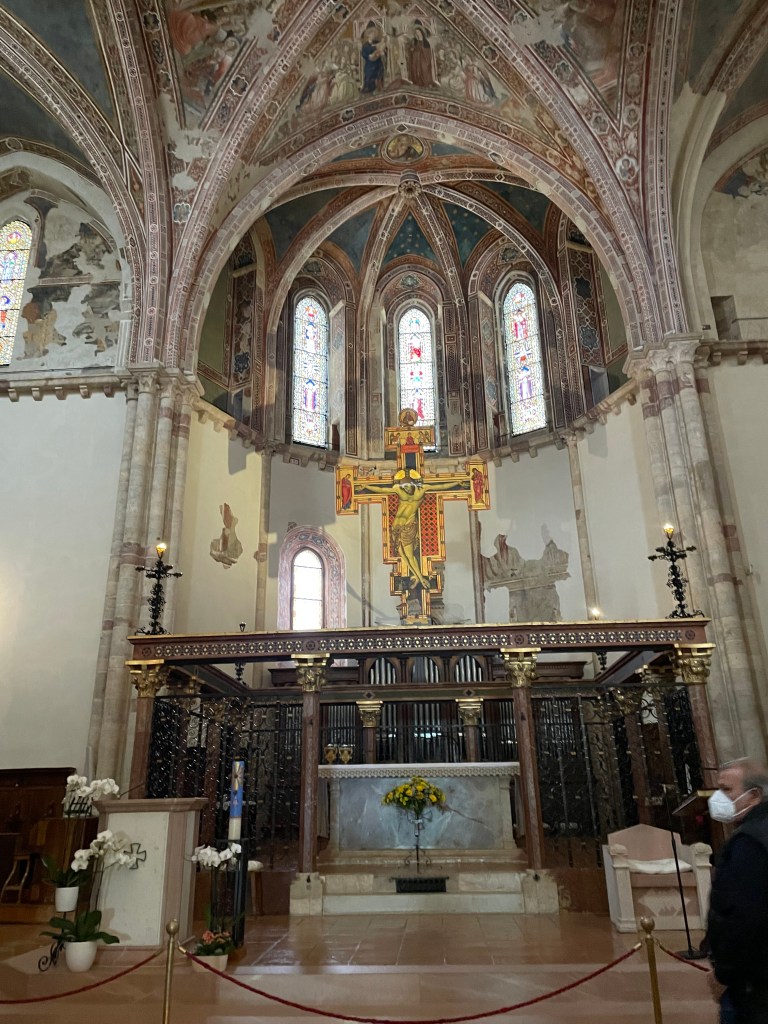
The cross below is the San Damiano Cross that St. Francis was praying before when he received the commission from the Lord to rebuild the Church. It now permanently resides here with a copy in San Damiano.
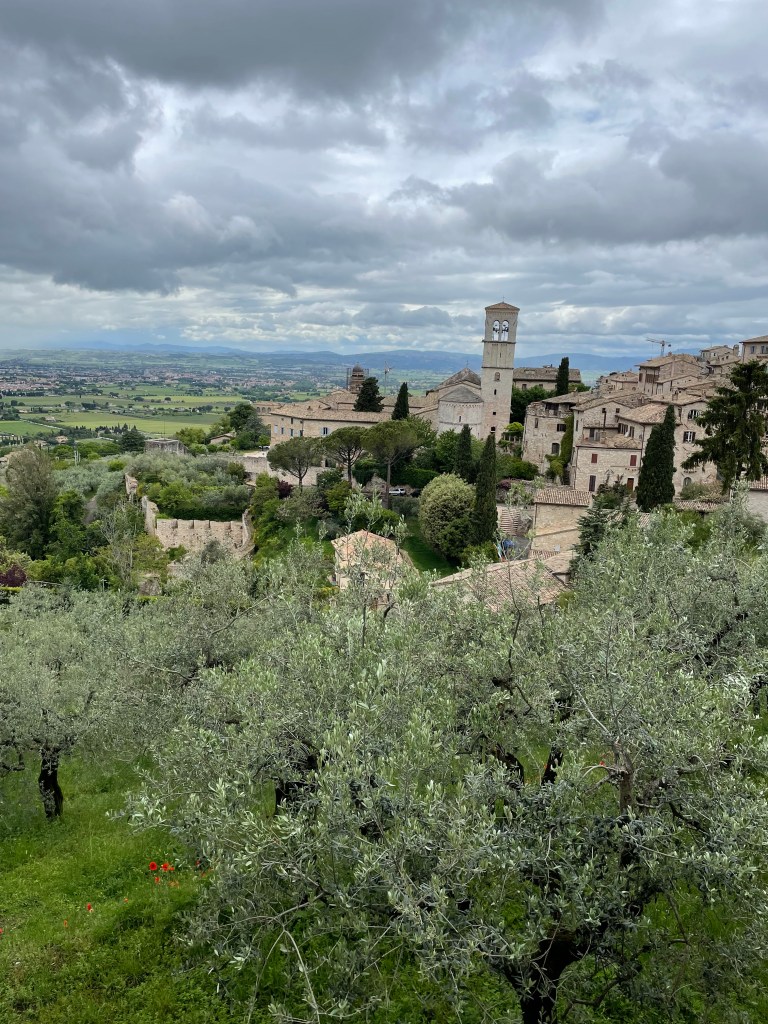
The view from the plaza in front of the Basilica of St. Clare:
The day was just wonderful and a gift. Tomorrow, we’ll take a break from touring and hike 🙂
 Reb's Walks!