Verona
We started the day early to get out for our 5k race – slow walk for most of us. We all wore our shirts and absolutely loved the scene. Warm, dry, bit of a breeze, perfect.
We started in the “stroller, older, wheelchair” group at 8:30. Four of us walked, but pretty quickly Leaf moved into a run and then joined the 10k group and ended up running a crazy path up the hill to the overview of the city on dirt, thin cobbles, all in a big group. But he definitely got a run in!
Waiting for the start:

At the start – and selfies are just hard to get, but you can see all of us there!
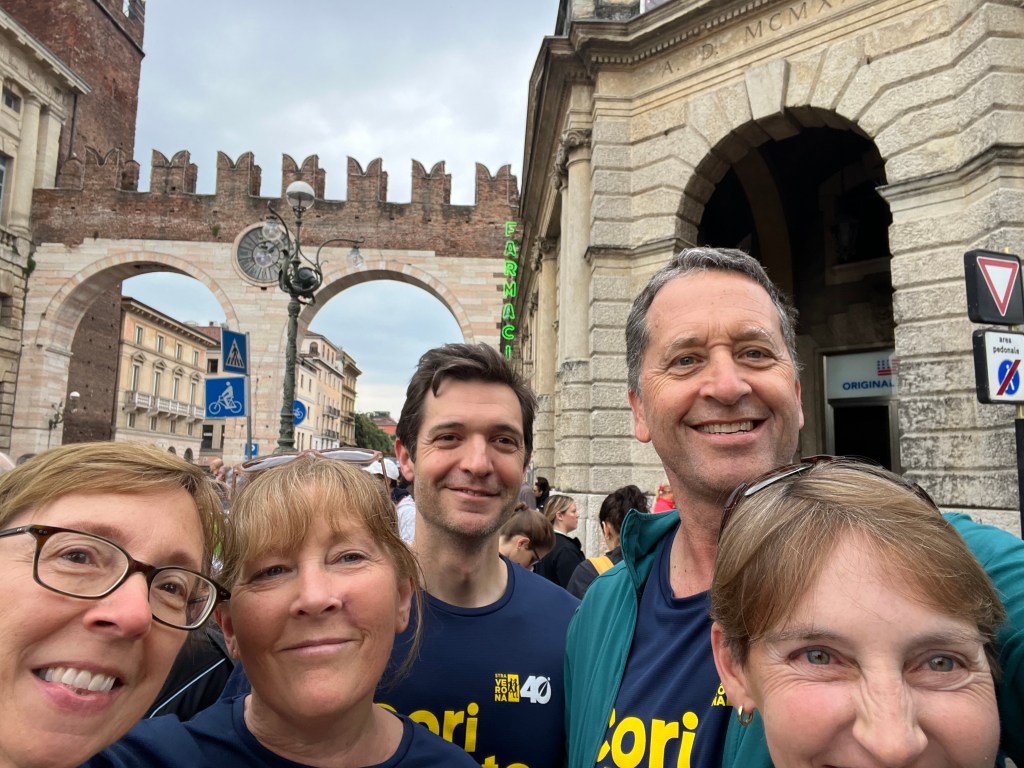
Some scenes along the way:
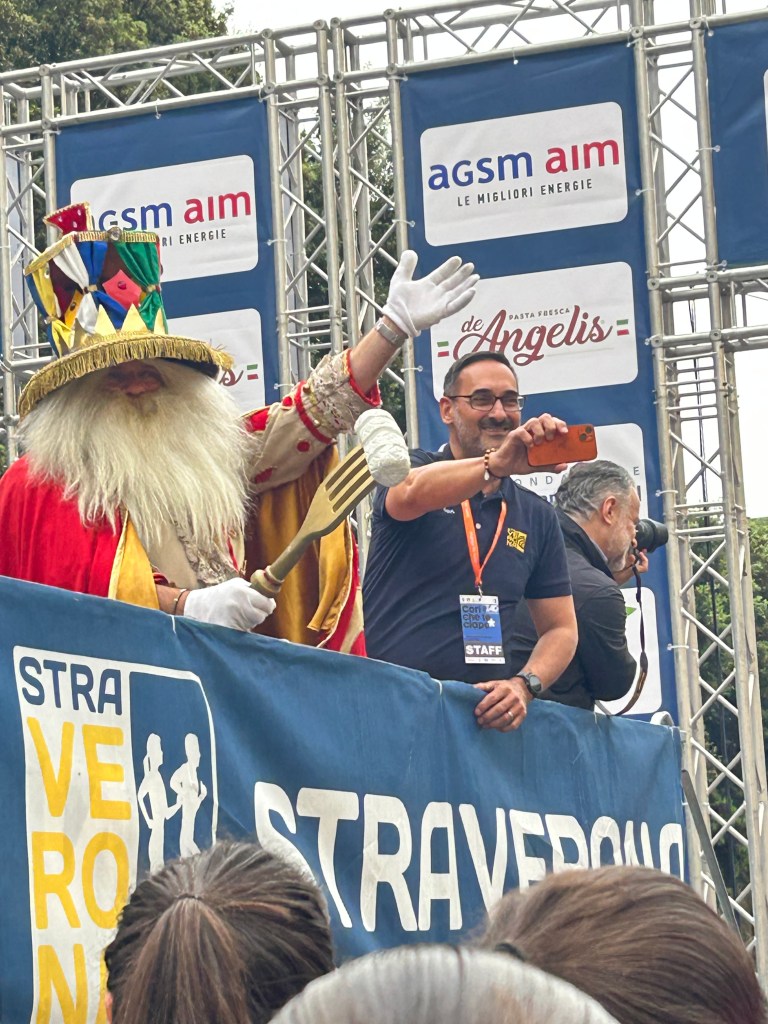
We never figured out what the story was of the guy with the marshmallows.
Below is the medieval bridge attached to the castle 2 blocks from our apartment.
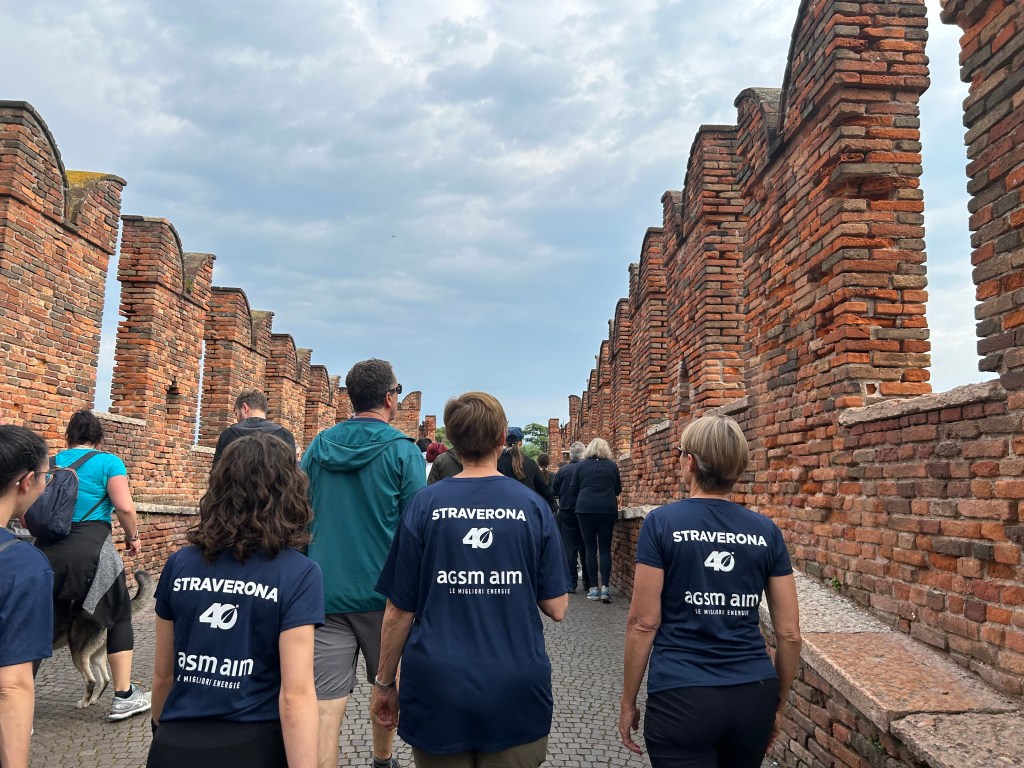
The bridge, Ponte Di Castelvecchio, and castle were built by the Lord Canagrande In della Scala (the big dog) in the 1300’s. The divided top meant that he did not put the church first, but the opposing government. He built the fortress of Castelvecchio with an escape route to the Adige Valley, in case of a riot by one of the enemy factions within the city.
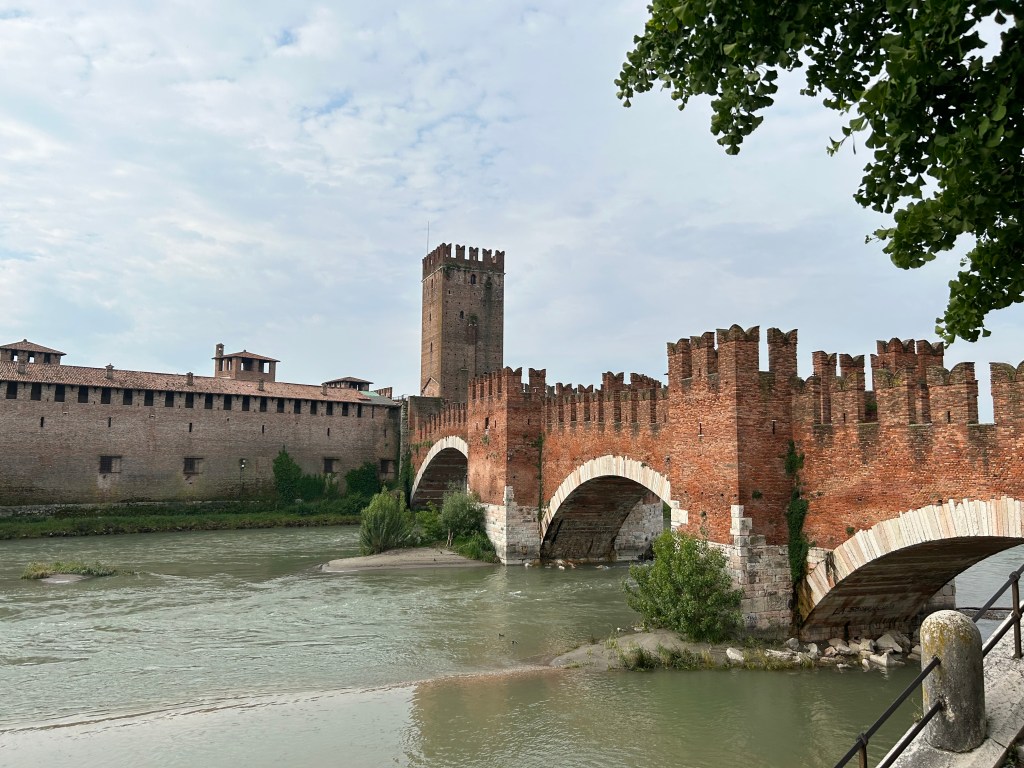
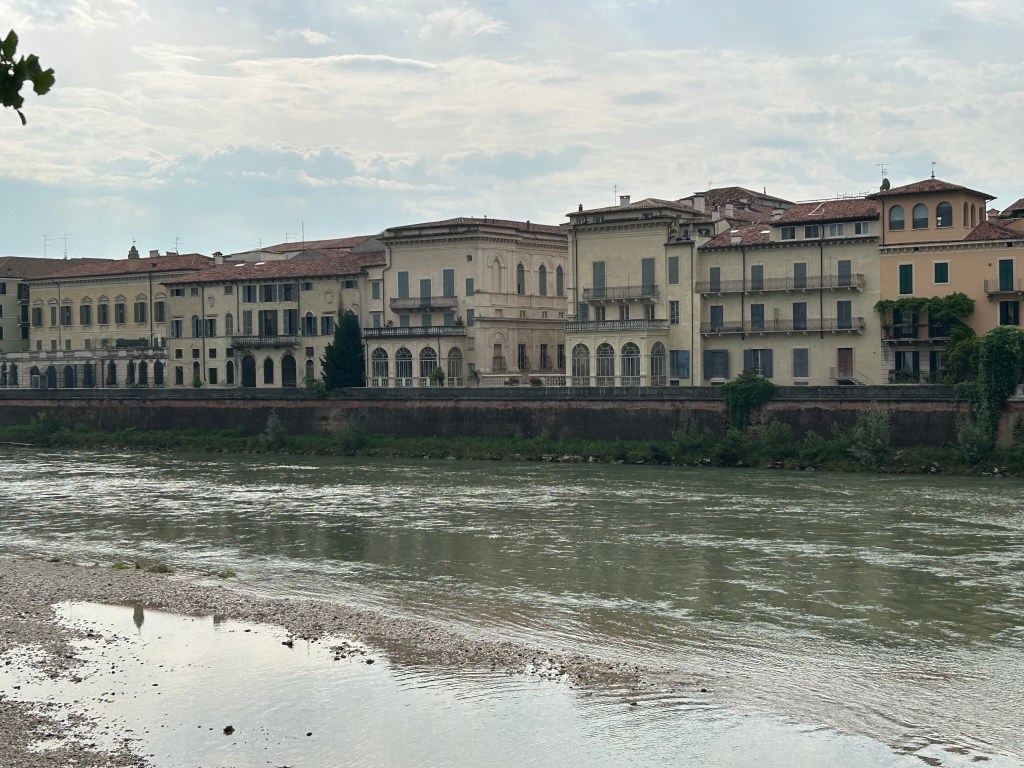
The river Adage curves all around Verona, an easily defensible barrier and the Germans bombed the bridges as they were retreating. Just as in Florence, the people of Verona dived and recovered everything they could from this particular bridge, then built two brick kilns to make replica bricks in order to fully rebuild the bridge.

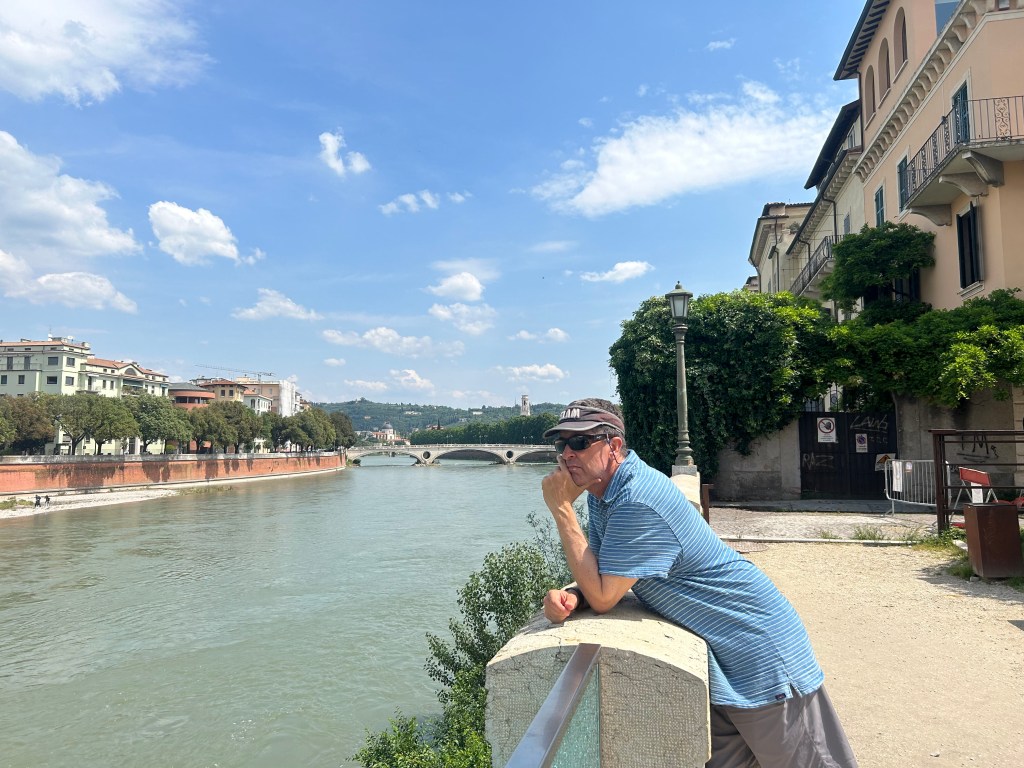
We then came back to the apartment, showered, and then went right back out to meet Krystal for our walk around Verona. She was wonderful! American, so understood our questions, passionate about Verona and its people, history and architecture.
Telling us about the Roman wall seen behind us and looking down the Roman road – straight; “that’s how you know they were Roman, all the other roads twist and turn. The pavers under the wall show how they they’ve been worn by those who’ve passed during and since those times.”
Verona first had a Roman wall around the city, there are only 2 gates left, this is one of them, as well as one bridge (we ran back over this at the end of the run). Then a larger medieval wall was built around the city and most of this wall is still left. Finally a Renaissance wall was built, even bigger yet. A protected city.

Waiting while we get some water, hot day!
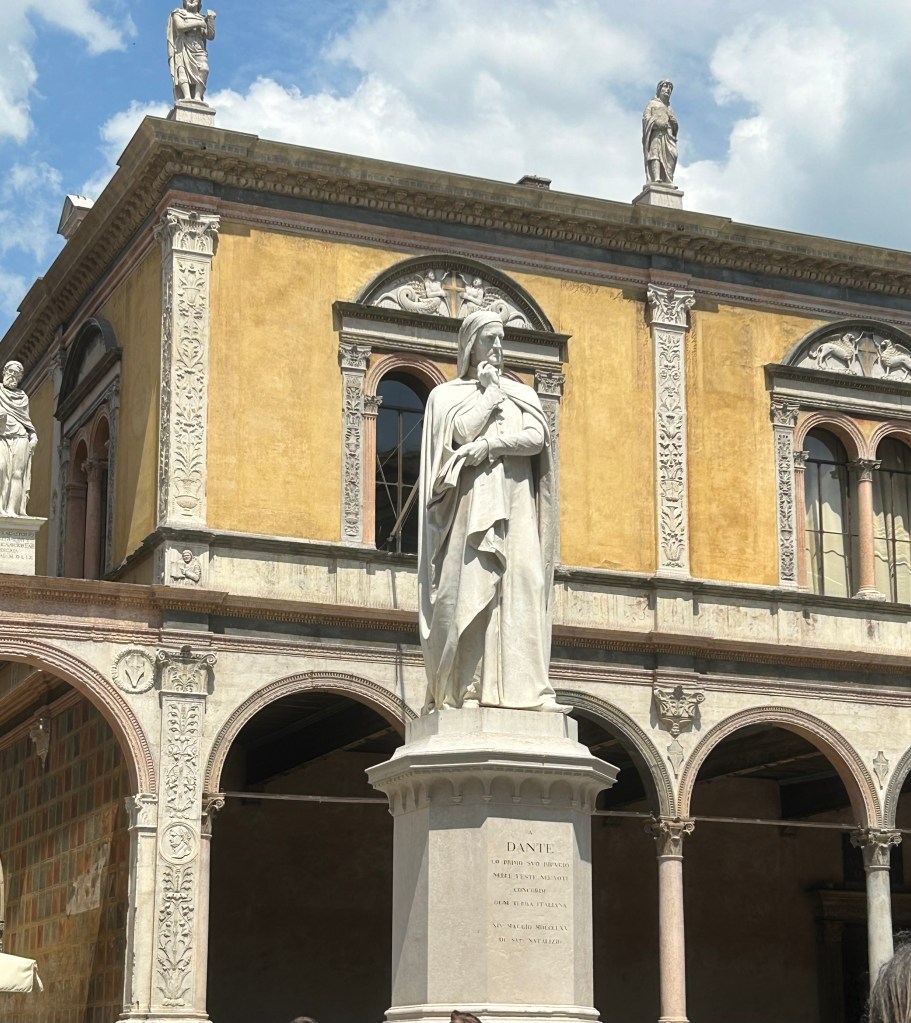
When Dante got kicked out of Florence for disclosing way too much about famous people in his Divine Comedy, he went to Verona and lived there for a couple of years.
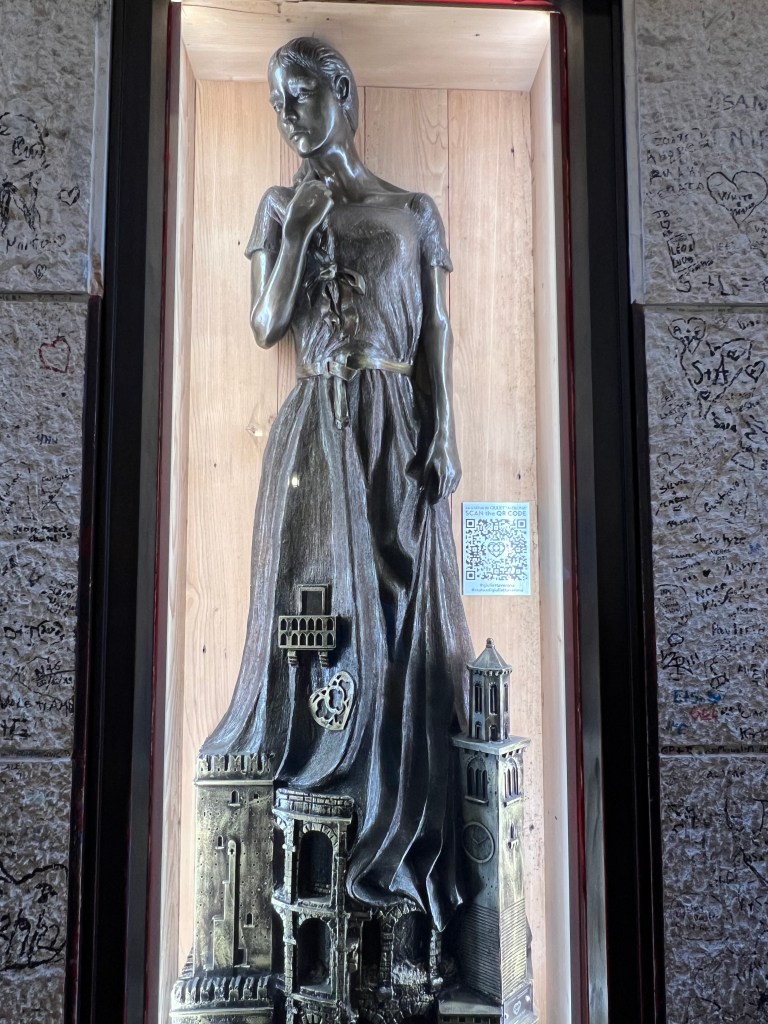
We walked by “Juliette’s” house, which was closed, but the statue below was behind glass across the street to protect it since so many people kept touching her breast to be lucky in love.
I was going to visit the Casa di Giulietta because I thought it was a medieval house museum and it kind of is, but not really, so let it go. The 4th floor balcony was made from Roman stones that had been saved for special building purposes. There’s actually a law against standing on the balcony and reciting Shakespeare. Romeo and Juliet come to mind when thinking of Verona, so here’s a summary for how the house came to be from the casadiguillietta.com.
The story of Romeo and Juliet was born from the pen of Luigi da Porto, a nobleman from Vicenza, and was published as a short story in 1531; the Veronese setting is probably inspired by Dante’s Comedy . In the XVII canto of the Paradiso the lordship of Bartolomeo della Scala is remembered, while in the VI canto of the Purgatorio the Montecchi and the Cappelletti are remembered, medieval families fighting each other. The Montecchi were really an ancient and noble Veronese family involved in the factional struggles of the thirteenth century, while the Cappellettis were a Guelph family from Cremona, believed to be Veronese at the time of da Porto.
The story of Romeo and Juliet immediately began to circulate in Verona and was reprinted and rewritten several times. In 1553 two versions were written, one in prose by the famous novelist Matteo Bandello, the other in verse by the Veronese nobleman Gherardo Boldieri; soon crosses the borders of the peninsula. Known and appreciated in France, it then reached England where, in 1596, it was staged by William Shakespeare with the title of The most Excellent and Lamentable Tragedy of Romeo and Juliet . The universal fame of Romeo and Juliet is owed to the immortal verses of William Shakespeare.
Around 1560 Gherardo Boldieri hypothesised that a sarcophagus of medieval origin preserved in the garden of the church of San Francesco al Corso (indicated by Da Porto as the burial place of Juliet) was the tomb of the young heroine: thus began the Veronese ‘myth’ of Romeo and Juliet.
In the eighteenth century, Juliet’s tomb was already visited by European travelers on the Grand Tour who began to question the existence of the Capulet house. After all, if a tomb exists, a house must have existed too: and so begins the story of Juliet’s house.
The tower house at number 23 of via Cappello has medieval origins and is attested in documents as early as 1351. It housed an inn, called del Cappello, owned by the heirs of a certain Antonio Cappello. This is also attested by the sign with the hat that can still be seen today on the keystone of the arch facing the internal courtyard.
It stayed an inn through the centuries, and at the end of the 18th century European’s began to visit it on Shakespearean tours. Hans Christian Andersen wrote about it between 1833 and 1834: “I climbed the ladder Romeo had secretly climbed, to meet love and death. There was still the grand ballroom, with the faded frescoes on the walls, the large windows reaching down to the floor, but hay and straw were scattered around (…). Here once the proudest families of Verona had danced to the sound of sweet music, here Romeo and Juliet had dreamed their brief love dream; I deeply felt the vanity of all earthly splendor.”
So – back to Rebecca here – the owners decided they should just make it Juliet’s house and created medieval frescoes, some furniture, etc that would reflect the time of Juliet and of the house’s original look.
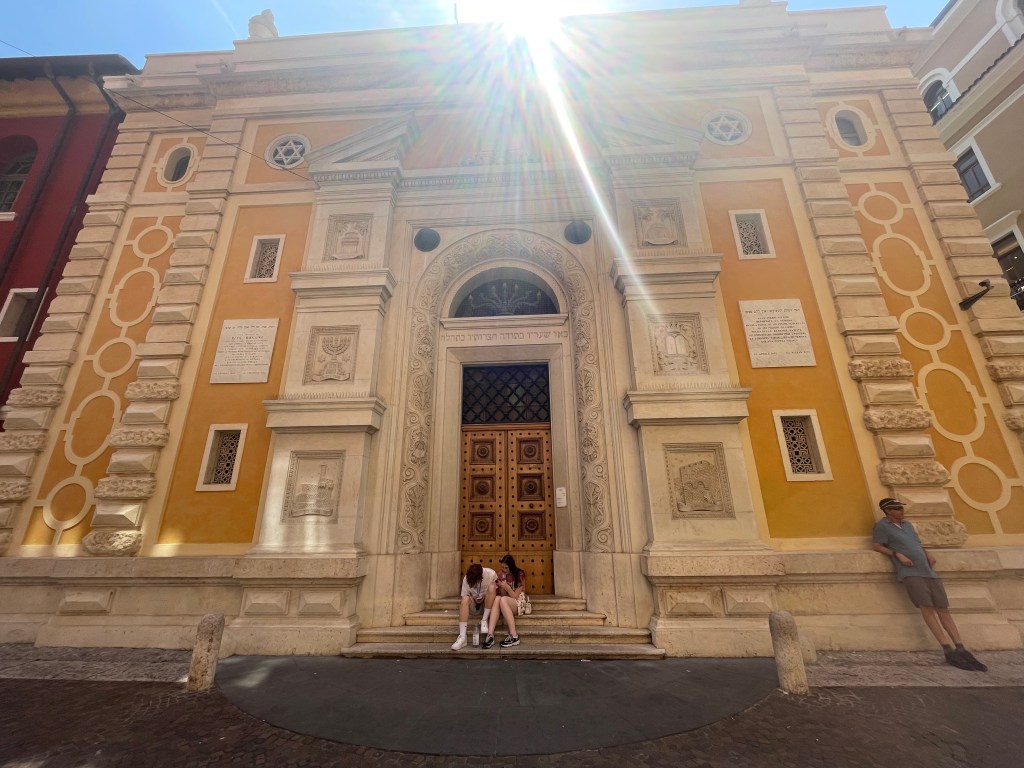
Here’s a much more significant part of Verona’s history, their one remaining synagogue. The sun is shining down as if making sure we don’t miss the building:
Verona has gone back through history and placed gold markers on each spot they could document where someone was arrested and deported – they’re throughout the city.

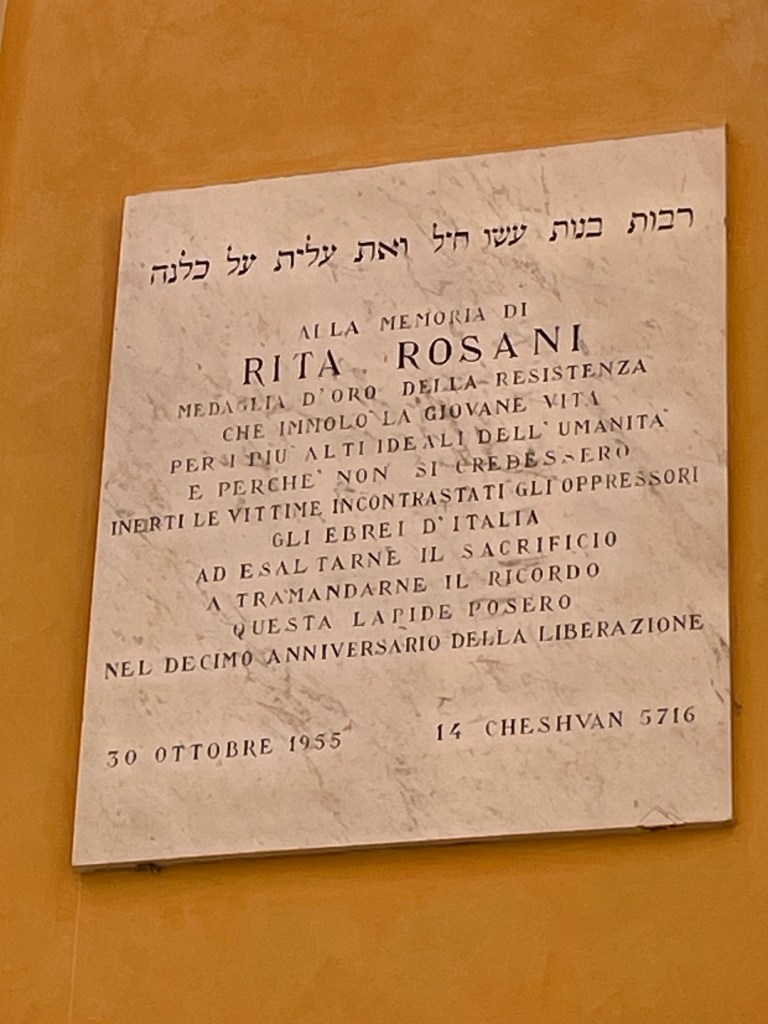
Below photo: There was also a plaque on the building that tells about Rita Rosani, a leader of a group of partisans. The plaque says: “Many women have behaved valiantly, but you surpass them all.” She was only 24 when she died, but she led a small party of partisans and gradually had gathered more until she had 15 with her when there was a final battle. The men were ready to retreat and regroup and she went out in front with a musket and was killed.
Her belated Gold Medal of Military Valor was given with this description: “Persecuted politically, she became part of a partisan armed band living the hard life of a fighter. She was companion, sister, animator of indomitable value and ardent faith. She never retreated from the certain danger and suffering of her rough existence, in order to complete the delicate and very risky missions entrusted to her. When her band was surrounded by preponderant Nazi-fascist forces, she took up arms and last to retreat, she fought strenuously until she fell bravely on the field, sacrificing her young and heroic existence to the homeland.”
I was just going back through my pictures (I’m a couple days behind) and I realized there’s a LOT more to remember from our walk with Krystal, but I’ve already forgotten it. Really have to do these posts each day. What I will say is that Verona has a lot to offer and it’s a wonderfully vibrant town.
We then met Krystal’s husband, Zeno, and their 4 year old daughter, Clara – precocious and darling. We had a long leisurely typically Italian lunch. Rick and Leaf were SO ready to get moving and here came the third course, oh, and desert… Happily, we were outside and in the shade so it was overall a treat of a lunch.
And then – reading, showering post hot day’s walk, and then later walk around town a bit because it cooled down and was perfect 🙂
 Reb's Walks!