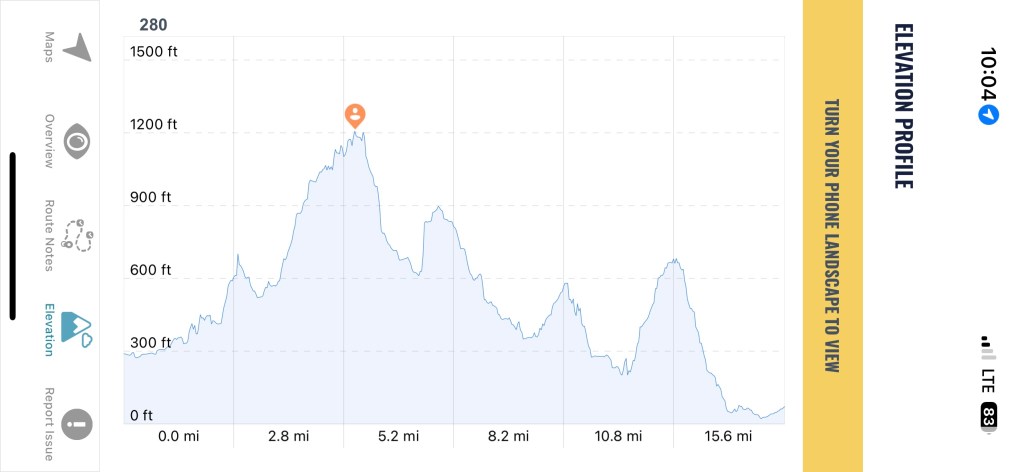
Gernika, 16.5 miles
Gernika history: On April 26, 1937, during the Spanish Civil War, the town was razed to the ground by German aircraft belonging to the Condor Legion, sent by Hitler and by Mussolini’s Aviazione Legionaria to support Franco’s troops. For almost four hours bombs rained down on Guernica in an “experiment” for the blitzkrieg tactics and bombing of civilians seen in later wars. There were five waves of attacks some almost at the rooftops and many of those killed had mistakenly left air-raid shelters believing that the enemy attacks had ceased.
The bombing of Guernica was deliberately chosen to occur on a Monday (April 26, 1937), because it was known that the Basque people who lived outside of Guernica proper would travel into town for the Market Day, thus affording the pilots of the German and Italian aircraft the opportunity to murder as many people as possible.
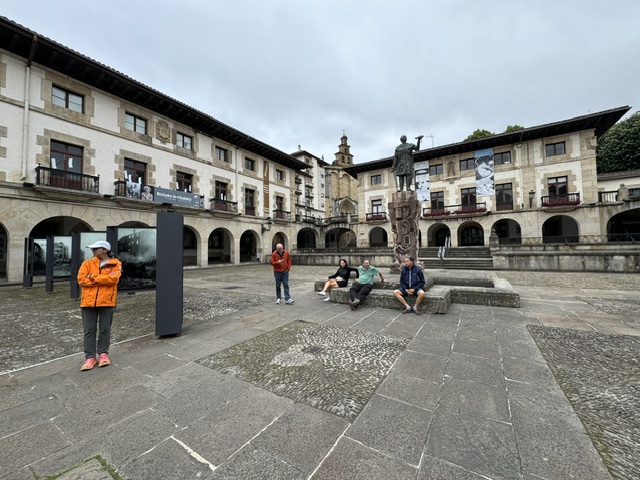
On Tuesday, April 27th, Franco ordered all to lie and declare that the town was bombed by the “reds” and it was a Basque plot. We read this at the Museum of Peace on the outside exhibit of photos: “Justice was never done, but there is no lie that hides the truth forever, because the history of our people is embedded in its collective memory. Having recovered our historical memory, we reveal the truth, we pass on to our descendants the historical moment that our elders lived, and we do justice.”
Our crew, still in post hike tired mode, next to the Peace Museum on the left with the photos of the city after the bombing next to Carol in the orange.
Until modern times, it had been generally accepted that the number of deaths had been over 1,700, but these numbers are now known to have been exaggerated. Historians now agree that the number of deaths was under 300. However, it is true the 85+% of the dwellings were razed. Astonishing that the air raid shelters did such a remarkable job protecting. For Franco – who’d asked for these towns to be targeted (Irún too) because they supported the Republic and were Basque nationalists – this backfired because it cemented the Basque’s commitment to the Republic and to their own liberation.
Basque language: I realized I’ve never written about this. It’s a source of great pride to the Basque people, that their language may be the oldest European language. Both our guides in San Sebastián were Basque and spoke about their language. I don’t know why it’s called Basque when that’s totally different from Euskara (their word for their language). Here’s a note from Wikipedia: Basque euskara is the only surviving Paleo-European language spoken in Europe, predating the arrival of speakers of the Indo-European languages that dominate the continent today. Basque is classified as a language isolate, with no relationship to any other language having been established.
Gorka, our wonderful Pintxo guide in San Sebastián, told us that a Rosetta-stone like discovery of a bronze hand with writing on it proved that Basque was in fact a unique and extremely early written language. Online, I finally found this note: Inscriptions found on a 2000-year-old metal hand may be written in a language related to modern-day Basque. If this interpretation is correct, it could help explain the origins of the Basque language – one of the biggest mysteries in linguistics. Of course, there are scientists who are questioning this, but it’s a big deal here!
Ok, now today’s hike. We all hiked to Gernika from Markina, but Carol and Matthew were in a different hotel and on different timing so we split up for the hike. The rest of us stayed on the MacsAdventure and the Camino signed trails the whole way. It was described as “moderate” whereas yesterday’s hike was described as “moderate-strenuous”. Today was great and it was definitely easier than yesterday in terms of height (today 2500) and distance, but as Bob said, Europe’s “moderate” does not mean the same thing as American “moderate”. Yesterday, I wrote that we rarely saw any creeks or rivers. But then today, we got to walk along a river for the first mile or more, then creeks for a lot of the rest of the hike. That was wonderful.
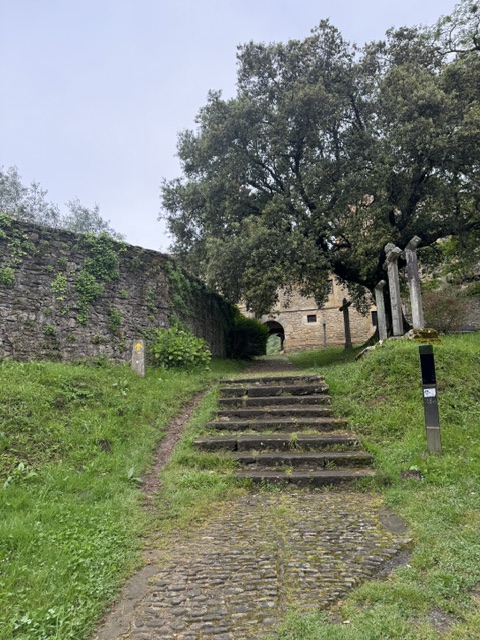
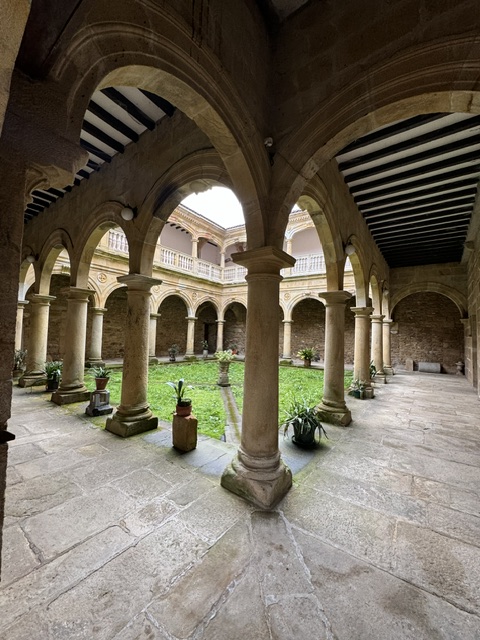
Near the top of the biggest hill was the Monastery of Saint Mary of Zenarruza that was fantastic. You could actually stay there and a sign said they had Baroque concerts. Sadly, we were too early to see it since we left at 7:30 and got up the mountain pretty quickly. The camino went right through it; you can see the arch below:
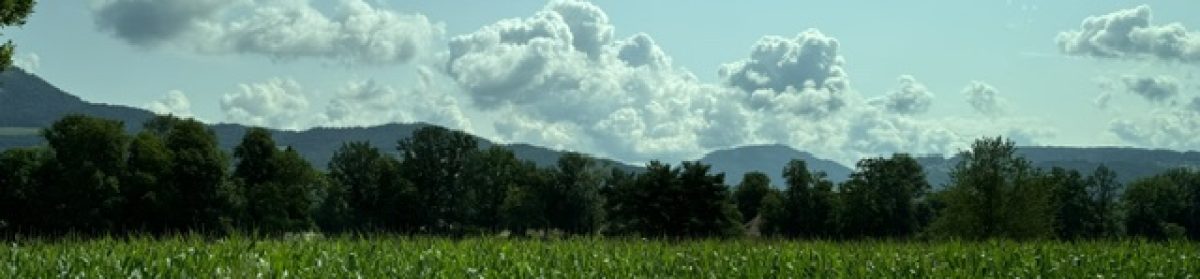
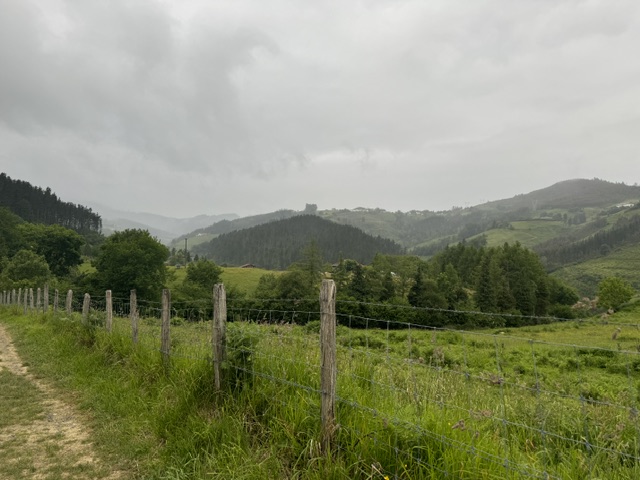
After we’d moved past, we were surrounded by green, mountain views, mist and clouds. At one point, I stopped and it was silent except for the ringing of the monastery bells, birds and the creek. The sounds are just wonderful on these hikes so far.
Monastery:

I couldn’t get all the sounds together, this is the bird chorus:
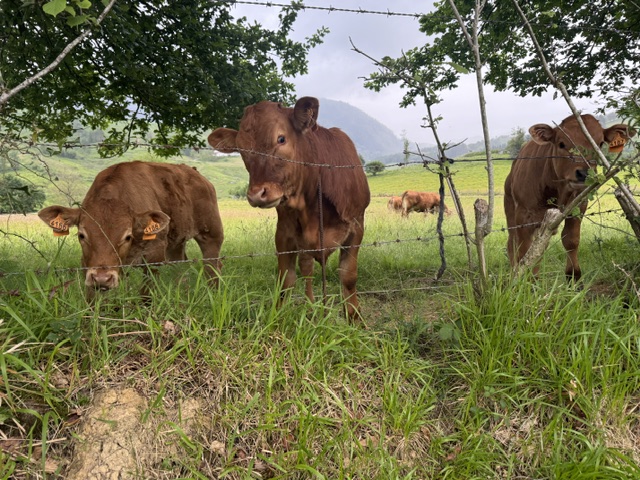
There are so many baby animals! These are still in the field with their mothers, though getting bigger. So far, donkeys, cows, horses, sheep, ducks. Just missing puppies and kittens 🙂
Misty scene
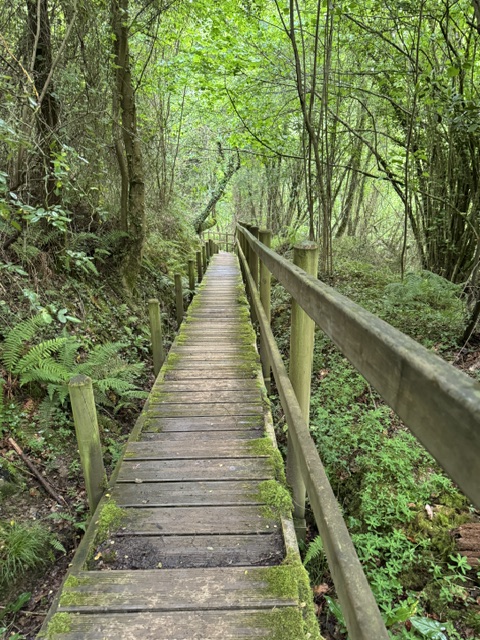
Incredible wooden steps that went down through a whole section of what felt like cloud forest.
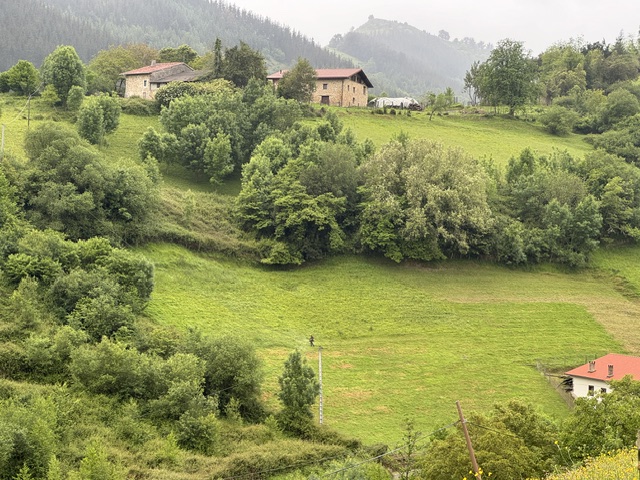
Oh, here’s a cultural note that we’ve all been curious about. Can you see the guy in the distance on the hill? He’s weed whacking the ENTIRE hill. Not mowing, not tractor mowing, weed whacking. We have seen people everywhere doing this. Whole hills, sometimes just berms (which makes more sense), but this one was a doozy. They must get so tired.
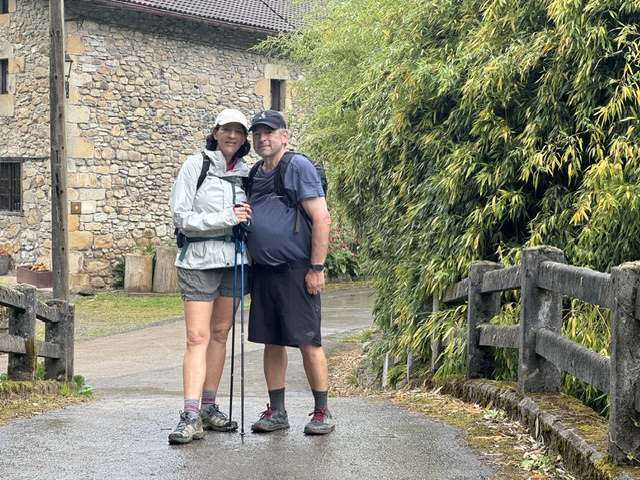
Bob and Susan
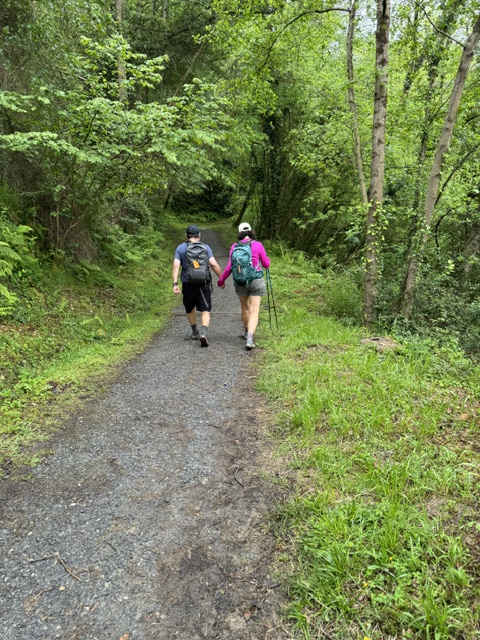
I’m here too:

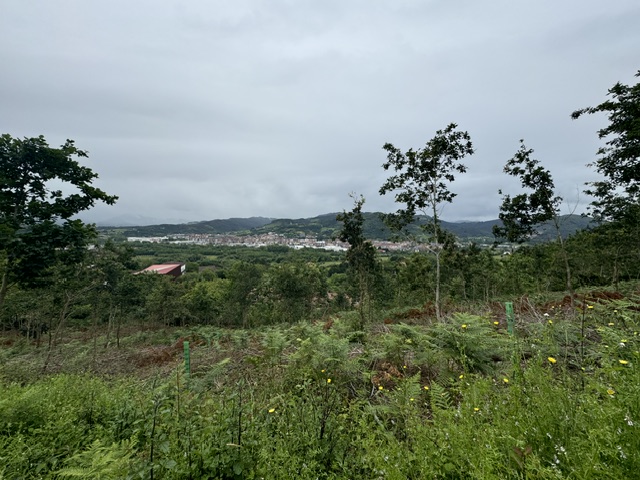
When I saw Gernika from the mountain, I could see that it was just a small isolated town and so horribly easy to target and repeat target as the notes above described.
First monument was a statue:
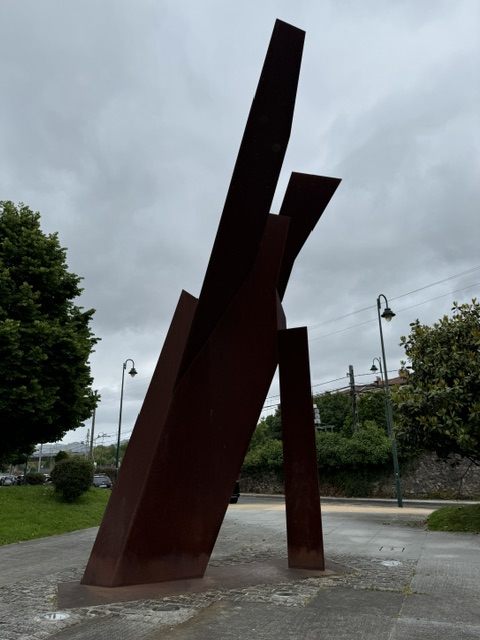

Got into Gernika by 3, quick changed and went to a burger place for lunch. It’s Sunday, most things are closed and this was close to the hotel. Rick has pretty much forsaken his eating norms while we’re here. He’d be crazy hungry if he had to stay vegetarian. But going to the pulled pork sandwich was a big switch up and he said it was wonderful!
We then walked around Gernika, exploring. We knew if we went back to the hotel, we’d never leave again – so walked. Many of the signs, museum, and plaques are about Gernika being a place of peace and connection with all who suffer the impact of bombing and warfare.
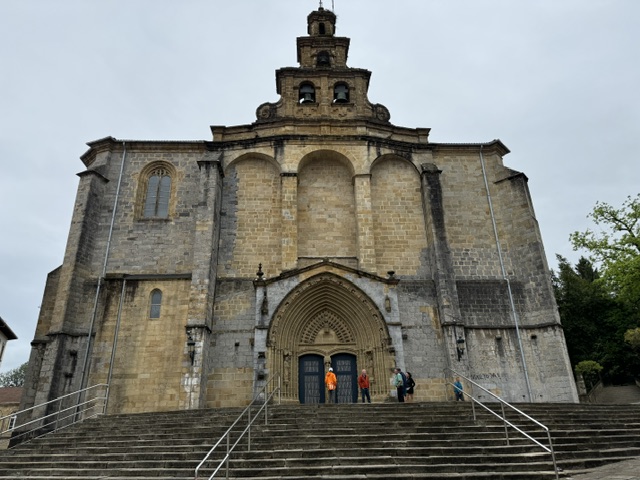
One building left standing, now with repairs showing in different areas was the Iglesia Andra Maria.
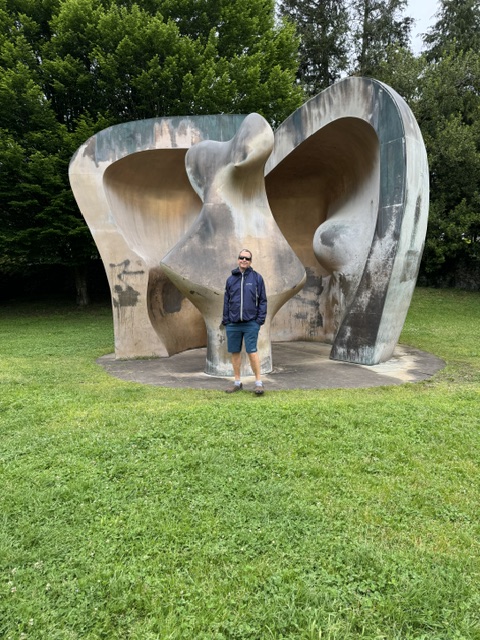
Henry Moore’s “Large figure in a shelter” 1985-86. The year he died, amazing. A tribute to trying to find comfort after being bombed.
Then back to the hotel to repack (every night), shower, set up for tomorrow. Sadly, Rick has to fly to Chicago for work (happily, he loves the work), but then is turning right around and coming back to keep hiking. His feet will be happy to get a break, but we’ve just finally adjusted to jet lag so that’ll be a bit of a readjustment.
 Reb's Walks!