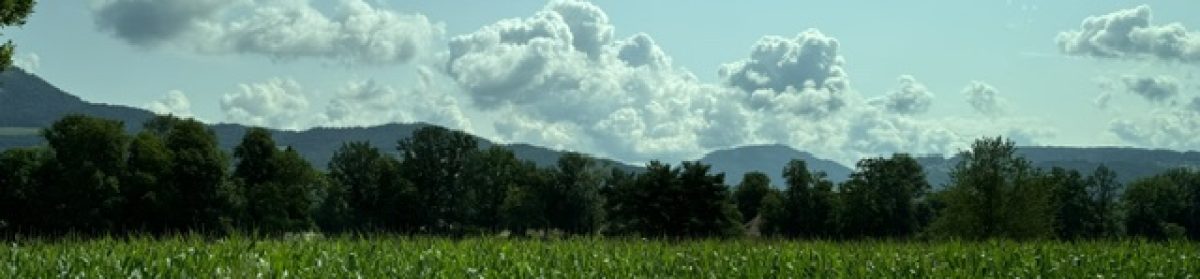
Walking 8.6 miles exploring Bilbao, a truly wonderful city! I’d love to come back with Rick so he can see. This is a long post because I indulged and put a lot of history – for me to remember.
I popped up awake at 5am. Really? On my day off? Ok. Dawdled, then went down to the lounge area to write up another day on the blog and to wait for Bob and Susan so that I could say goodbye. They went off to catch their plane and it ways another beautiful day – so I went out to see what photos I could capture of the Guggenheim without people around.
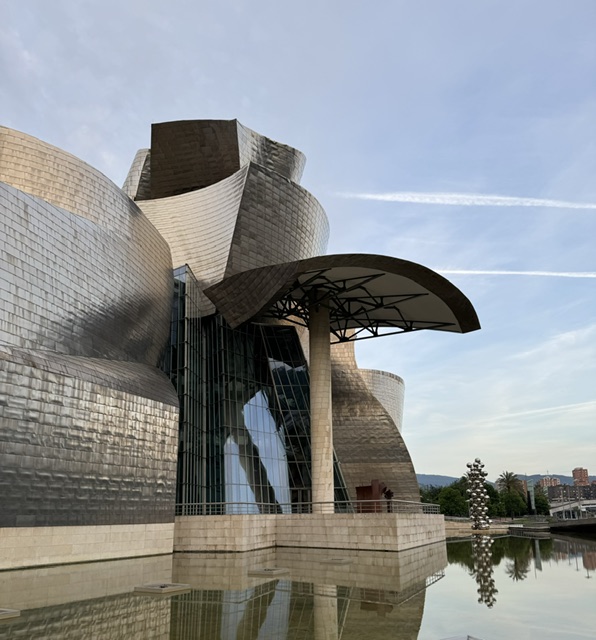
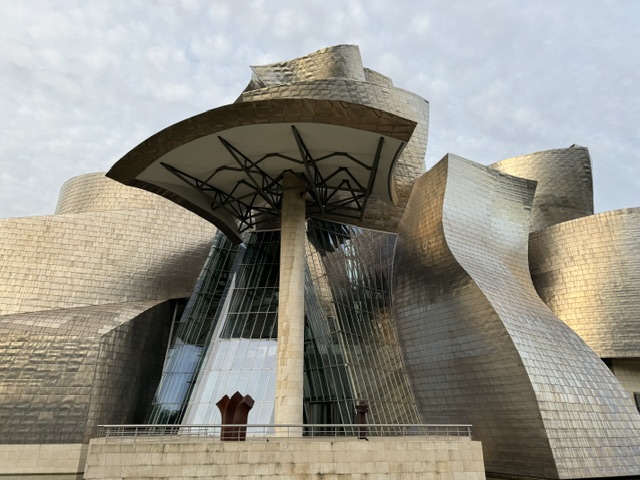
This one shows the idea of a boat stranded on the shore, supposedly a focus of the design (per our boat tour).
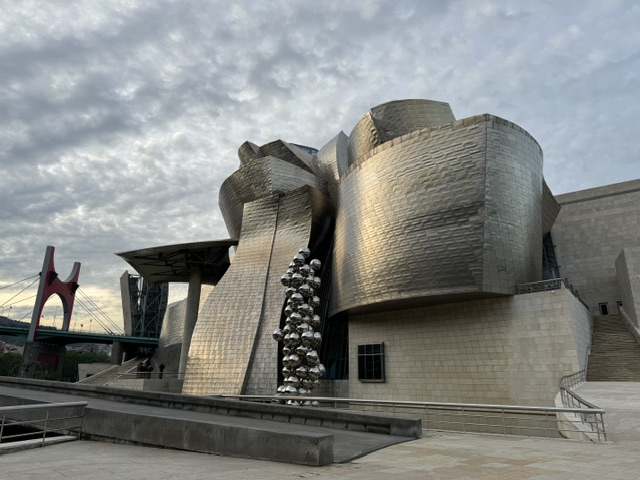
Boat again
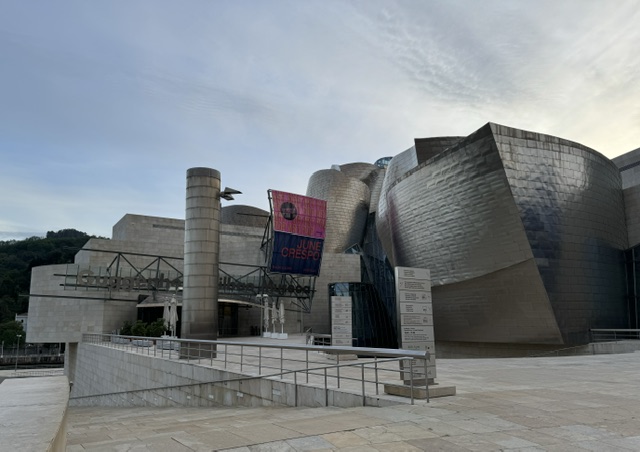
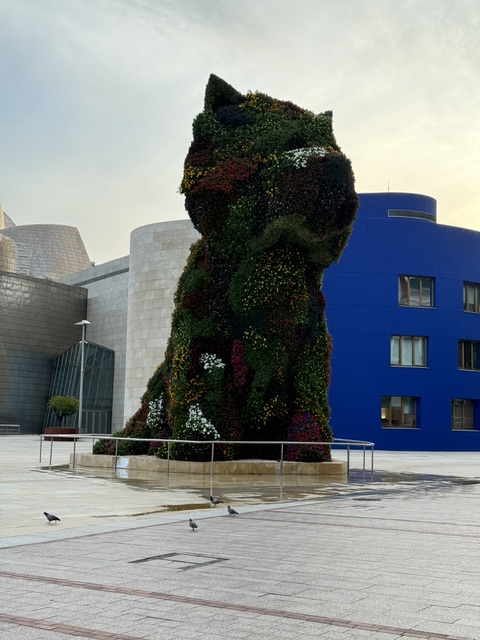
At 7, this is a very quiet city except for runners and dog walkers.
I enjoyed the quiet, the views, the weather for a bit and then came back and had a really good breakfast! That’s not my norm because the offerings are usually pretty lean and I’m not that hungry in the morning, but I could make my own pot of decaf, had eggs, couple pieces of cheese and for the first time, my favorite of toast with tomato, oil and salt. So Spain.
Then I conferred with the front desk guy and a map and started out. There was a funicular within 2 blocks of the hotel that took people up to an entirely different neighborhood at the top of the hill and visitors up to see an incredible view of the city. I was very proud of myself and got in the front car for a full view. It felt way safer than inside the Guggenheim. And it did let me see how big Bilbao is while still contained within the valley. There are about a million inhabitants of the greater area, while central Bilbao is about 350,000.
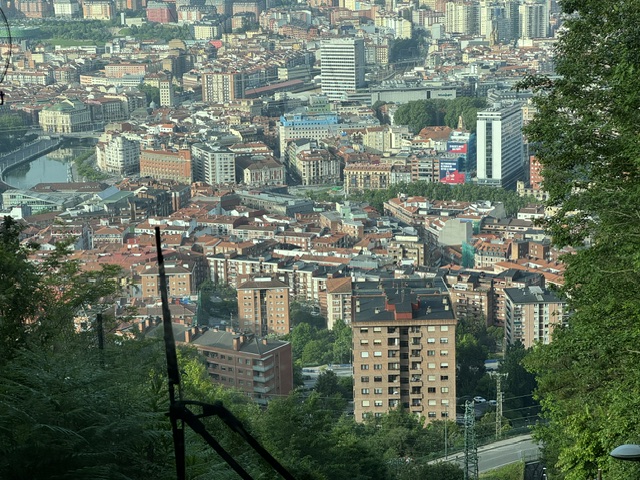
From the funicular car

From the park at the top
I then started wandering to where I was supposed to meet the walking history tour I’d signed up for. Carol and Matthew were going to do a separate exploration on their own using public transport – especially the tram – to see the city in a different way.
I joined the English group with a wonderful guide and I never heard her name. But boy, did she have info. And being a Bilbaoina (her word), she was passionate about her city and the Basque culture. And she talked fast! We walked and talked for 2 full hours and I started dictating to myself so that I could remember a lot. I loved it – so cool.
So – from here to almost the end, it’s summarizing Bilbao’s history from my notes.
In 1300 Diego López V de Haro created a charter for Bilbao. He was a very farsighted and canny Lord of Biscaye. At that point, there was a central group of feudal states in the region, basically 5 mountains with 5 valleys and representation from each of the 5 would come together to meet under that tree in Gernika to set policy, agreements, etc.
The king of Castile in the 1300’s was building alliances through marriages, but was also looking for a safe port to get his goods out and Lord de Haro convinced him that Bilbao would be the choice. Safe, protected river to get the goods out to the sea. De Haro would have a taxation system since everything had to come over one bridge to get to the river and the boats. They worked out a deal and people started coming.
All merchants had to cross over the one bridge at the top of the river to get their goods weighed, pay a tax and move on to boats going to the port. It was so busy that a consulate was built right next to the bridge and the powers-that-be would sit on their balcony and make sure all was going well. It became such an important commercial city, they had a consulate in Belgium through the 1400-1500’s. Not the norm for a city to have a consulate.
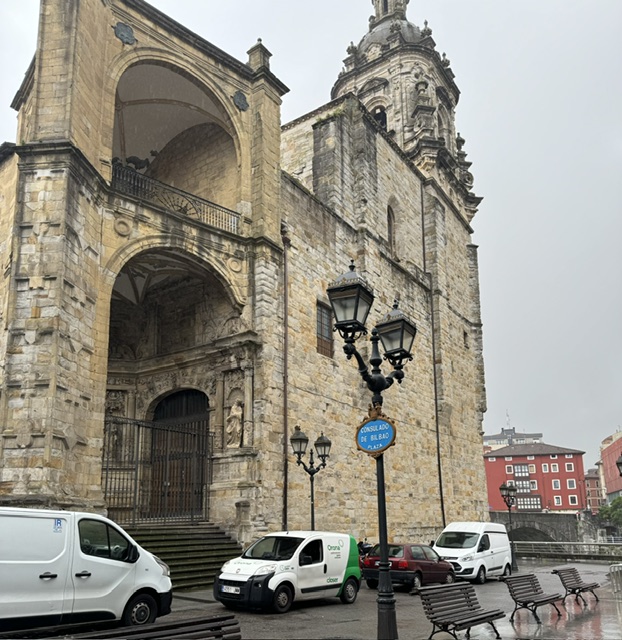
This is a church that replaced the consulate when it was destroyed by a flood, the balcony was the only thing saved – the bridge is to the right, same place, different bridge.
De Haro also decided that he wanted to make Bilbao an important center and let it be known that if merchants settled in the area, they could live tax free. That worked and a medieval town group up within fortress walls. The wealthy and aristocratic (often the same) were within the walls, fishermen, farmers, were outside.
The building was in the arenal area – arenal means quicksand or marsh. They had to drain the area to build since it was two rivers coming together to form the estuary and big river. Because the land was so limited, there was only one small park to meet and it was the one place that people of all walks of life might meet up, though there were designated areas for each group within the park. This was true up until the late 1800’s. The whole focus was the iron industry, the steel industry and wool transfer, not on expanding park areas. Our guide said she grew up with smoke and soot, sounds like how Pittsburgh used to be described.
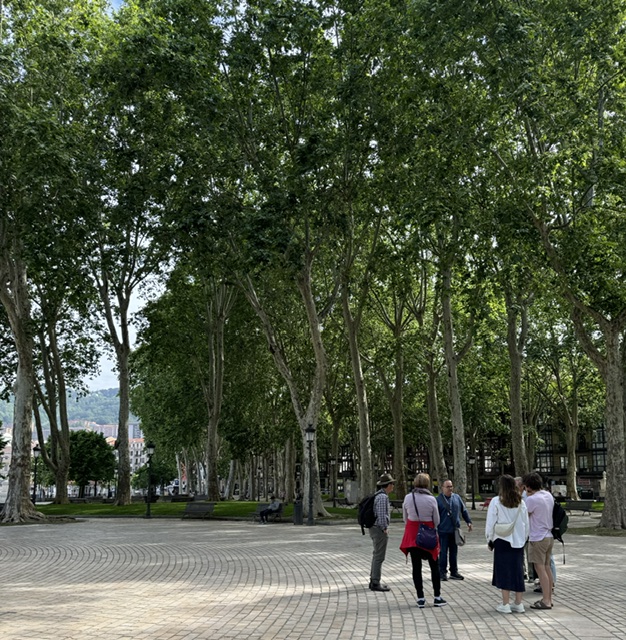
The park is still the same size today, though now there are giant parks made from reclaimed mining and smelting areas.
The train station is a point of pride and dependence – it’s where coal came in since iron and wool were the main products of the area. Built in 1898 and opened in 1902. Right now there are on-going political arguments with Madrid about having a high-speed train come to Bilbao. They’re trying to manage an explosion of tourism, while they want the tourists – a main source of income – they also absolutely want to insure their culture stays true to the Basque as Bilbao is the de facto center of the Basque region. The building on the right side is the conservatives club on going since the 1800’s. Very stuffy, very hard to get into.

As the iron industry grew (second only to Barcelona), the town leaders wanted to make the town much bigger, more sophisticated and they decided to break down the inner city walls and add the neighborhoods of the surrounding villages. They brought in important architects from all over Europe and you can look at the buildings from the late 1800’s and see French, Italian, English architecture influences.
Flags waving from the balconies reflect the fact that the Bilbao football (soccer) won their first big tournament in 40 years. The whole city went crazy and two months later the banners are still waving.
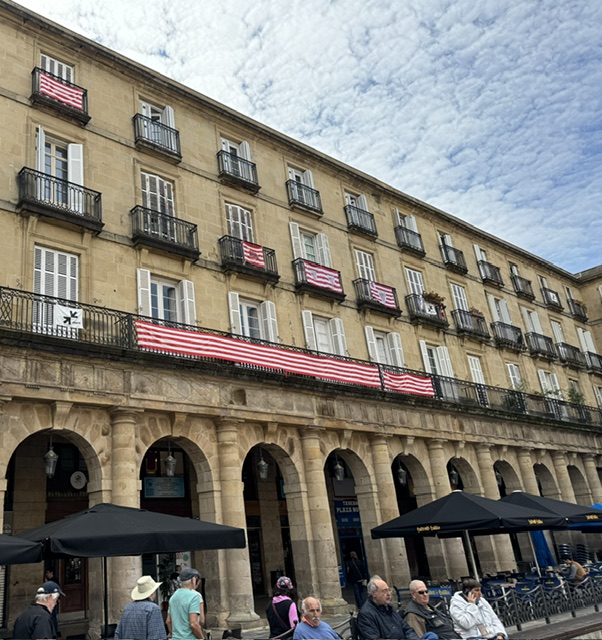
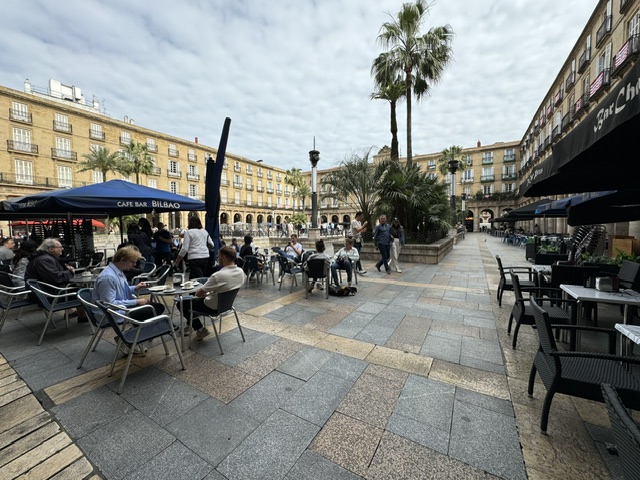
The plaza nueva was built in 1864 and was the first place built outside the old city when they decided to break down the walls. They wanted to expand in a significant way and this was the first design – echoing the central squares in Madrid and other great Spanish towns.
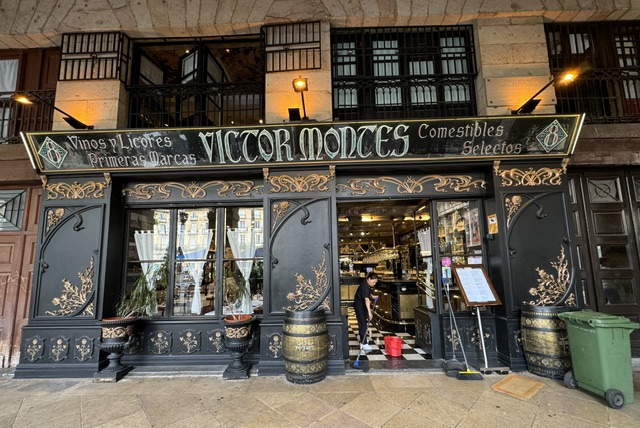
A grocery store stood here before the square was built and this restaurant still reflects the history and the interior design of the store.
These steps are modeled after the Roman steps. This was the way the Camino came through Bilbao down off the mountain behind the town. The Camino del Norte connects to the Camino Primitivo. That one started in the late 900’s, the Norte started in the late 1200’s. There are 374 steps that wind up to a cathedral above where the Camino pilgrims would stop before coming down into town and into the Cathedral de Santiago, also on this path. It was also on this path that farmers would bring their market goods to town, down a long muddy path straight to the market. In the same place where we ate yesterday. They built these stairs to honor the Camino because it brought trade and money, and opened Bilbao up to the outer world.

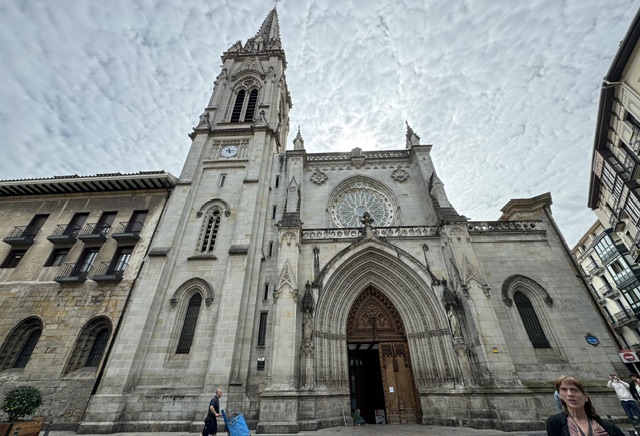
This was also when they built the Cathedral de Santiago to give thanks to the Camino for helping the town so much. Started the building in the 1300s.
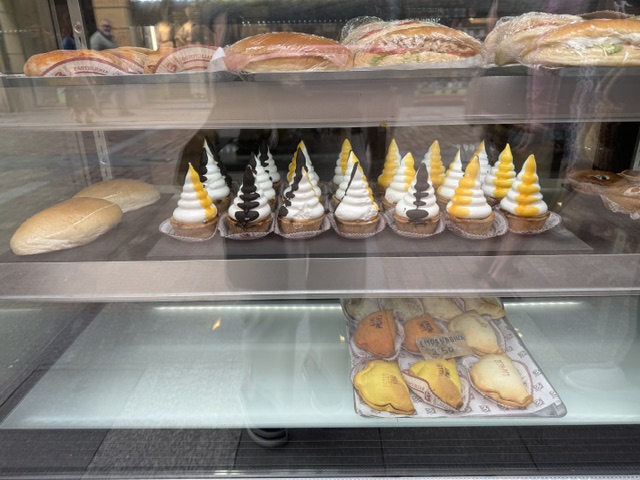
Carolina dessert – famous meringue dessert after the person who crafted it, the white/chocolate/lemon one.
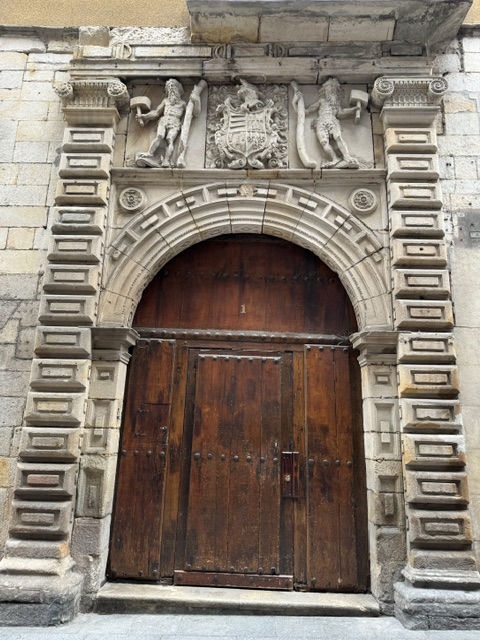
This facade is what’s left of a palace from the 1400-1500’s. The person who lived here would have been of the aristocracy, but they were also in a position to see who came into town, to greet them, welcome them and convince them that this was a great town and it might be worth their while to stay or to at least use this town for most of their trade.
1983 a massive flood, went above the lintel just below the arches here. The painting was commissioned by the city to help rejuvenate the old town, but because of the mud even more than the water, the old town was destroyed and much of it had to be rebuilt. Since the river is tidal, if there’s a really high tide concurrent with heavy rains and flash flooding, it can be catastrophic, as it was in 1983 and several times over the past centuries.
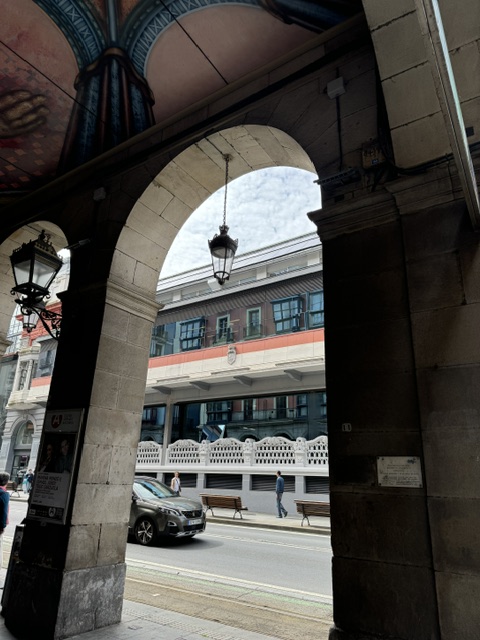
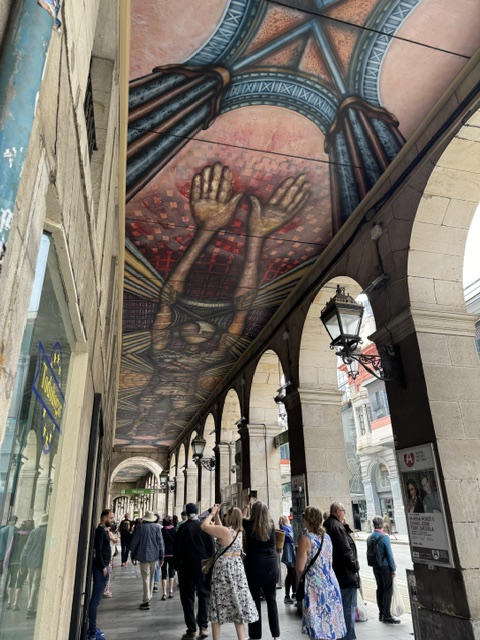
The 1983 flood happened almost simultaneously with the end of the iron mines – tapped out and the end of the steel industry, shutting down of the smelting plants, etc. They decided they had to change the town’s income from industry to service/tourism. There must have been some seriously far ahead thinking on the town’s politicians because the decade after the flood is when they commissioned Frank Gehry to design the Guggenheim museum. This museum brought in so many tourists that it helped jumped start the town again.
It seems that the town’s politicians took the example of the late 1800’s to heart. They commissioned famous architect after famous architect to design buildings. When we did our boat tour (noted later) it was basically an architectural tour of Pristker winner after winner designing building after building. As Matthew said, there didn’t seem to be a plan, but with so many gorgeous and interesting buildings, it became cohesive. This is truly a beautiful city.
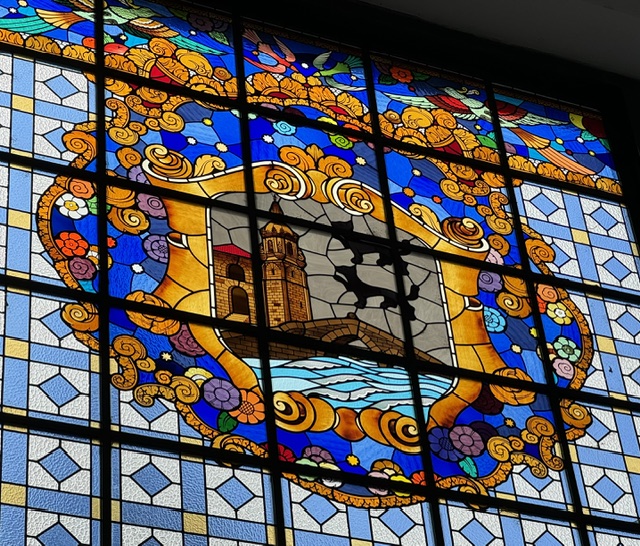
The coat of arms in stained glass at the end of the market showed the consulate building/church, bridge and the wolves reflecting Diego López V de Haro’s name.
Here’s the shield again, at the top of the entry to the Church of St. Nicholas. He is the patron saint for sailors and this shows a desperate scene of widows with drowned husbands and men who’ve lost everything to the sea. The lions holding the shield up are demonstrating the strength and resilience of Bilbaoans who come back after every struggle.

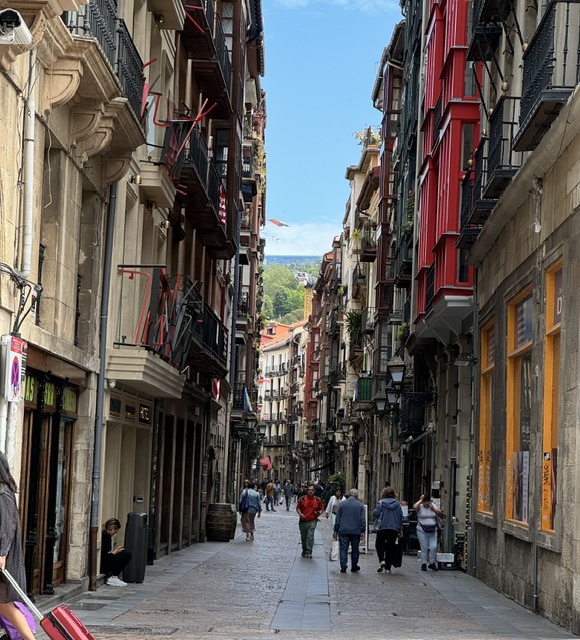
This street is the darkest street of the city, no sun hits it, it’s also one of the 7 planned streets of the medieval city, all running parallel and leading to the market from the mountain behind the town.
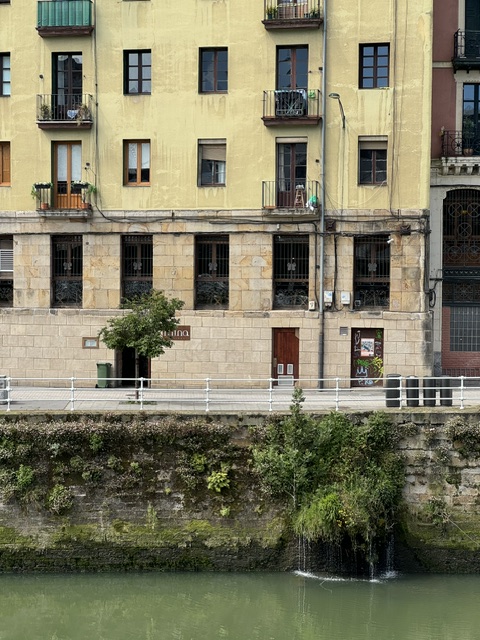
Cool Michelin star restaurant, Mina. Its entry is the entry into the last active iron mine, closed in the 1980’s. When the mine closed, they then started building on top of it, working their way up to the top of the hill. Someone asked if they weren’t worried about building on top of the mines and the guide said no, the rock is incredibly hard and there are no concerns. Right under the restaurant is water coming out and that’s a mountain stream running down and out from under all the houses.
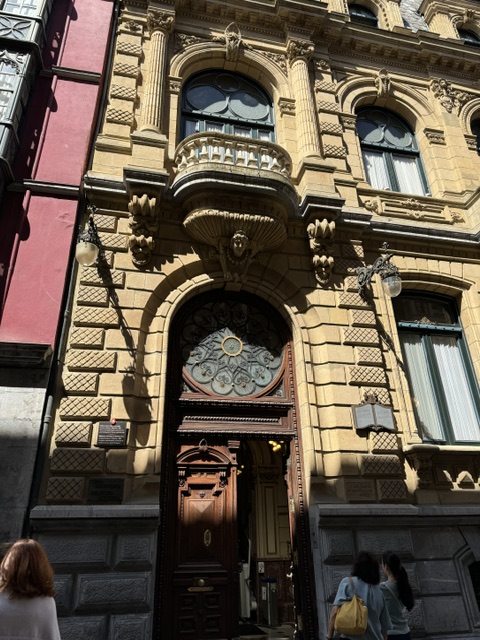
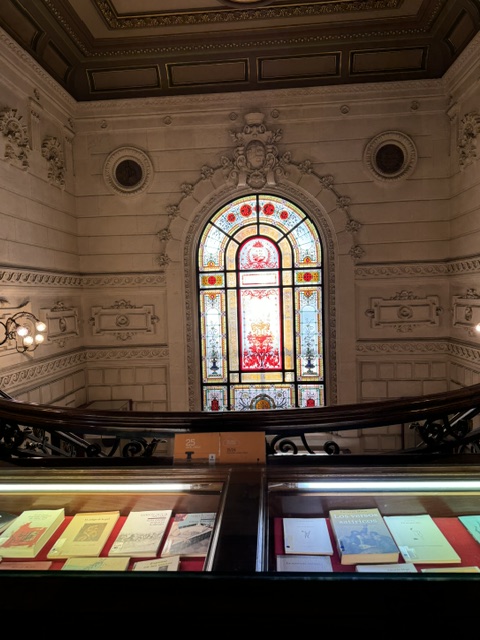
This last palace on our tour was the liberal club (versus the conservative club that was next to the train station). Over the door is a replica of the head of the Statue of Liberty. When Franco came in, he dissolved the club and took the place for his own, when he left, it became the library. The conservative club was more concerned about commercial interests and they held onto their building. I went back later to see the library. I’d study here in a second.
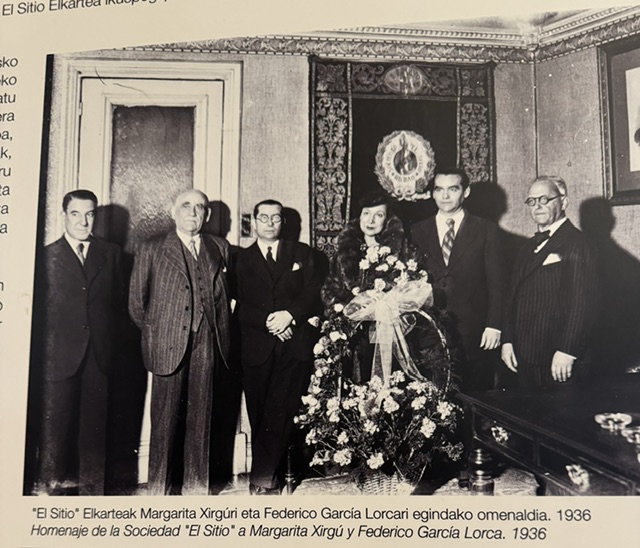
First thing I saw when I walked in was a photo of the poet Frederico Garcia Lorca, one of my favorite poets. Killed by the Francoists in Granada shortly after this photo was taken. Learned about him when we were in Granada with the kids years ago.

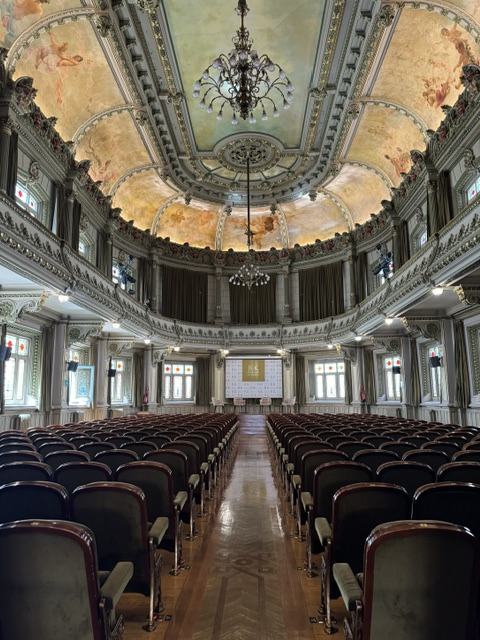
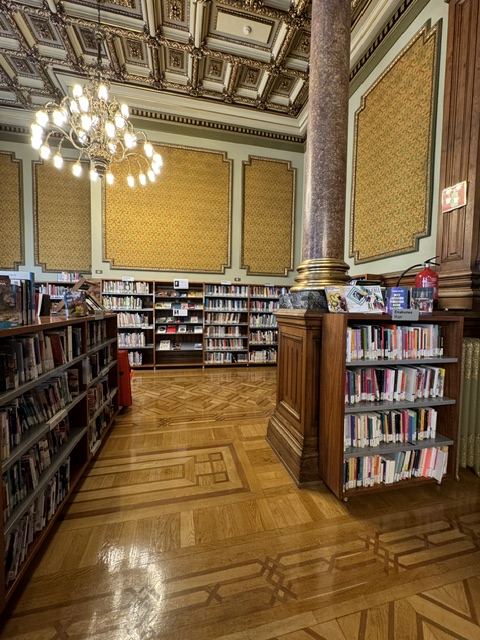
I then went looking for lunch, found the street the guide said was full of good places to eat, I remembered it because of the puppy fountain where Bilbaons commonly meet.
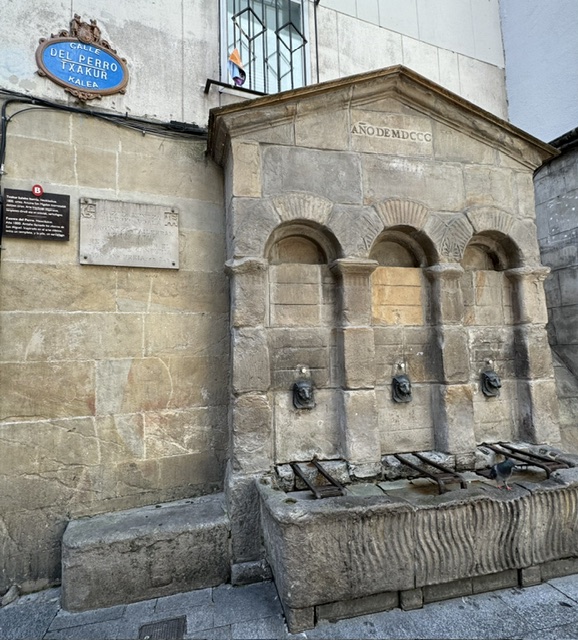
I walked up and down the street 4 times dithering because I knew my timing was all wrong – 12:30pm. Finally went in a place where people were eating and he said the menu del dia started at 1pm, but I could have one of the first course options. Luckily, one of the options was paella and it looked great – he had big pots of the first courses – all stews and the like.
Then I went back to the market to find one of those Carolina treats and ran into Carol and Matthew! They were looking for a treat and coffee too, so we joined up and I told them a bit. We decided we wanted to do the boat tour I’d been thinking about and we planned to meet up later.
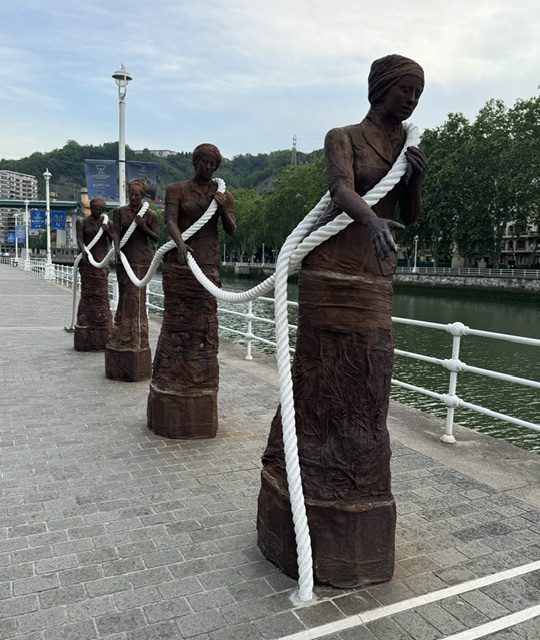
We listened to a recording on our phone talking about the history and the architecture. It was a fun ride and one note of history explained a wonderful statue by Dora Salazar that both Matthew and I had wondered about. Evidently, the boats that came in from the port were pulled up the last part of the river to the head of Bilbao by towing. And the people who often did the towing were widows who had no other way to earn their money and it was a brutal job.
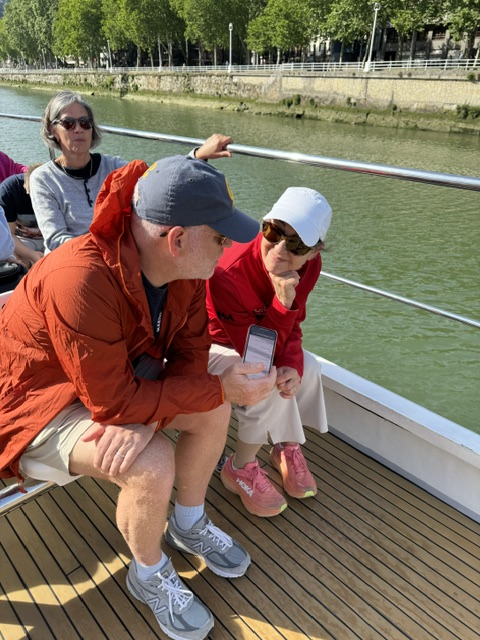
The boat tour ended up being a great way to see more of the city and was really an architectural tour. An amazing city with amazing architecture. Kind of astonishing for a city this size, and it seems to have worked as the planners had hoped – this city is booming!
We then went to a place for pintxos that Matthew’s partner had recommended and it was fantastic! Beautiful building, fun people watching and the food was incredibly good.
Finally, Matthew and Carol sent this Basque gift that they ran into after I left and took the tram down to near my hotel. What a totally great day 🙂
 Reb's Walks!