Santander to Santillana Del Mar, 7.5 miles
Today was so great. First, we had our morning and breakfast at our wonderful hotel in Santander. Then arrangements had already been made for us to take a car a good few miles into the Camino. We’d read in every app/book that if possible, don’t do the walk out of Santander. It was through miles and miles of city and industrial areas. There’s a train that a lot of people take or taxis.
So we looked at the map and realized that we’d actually like to go further than the drop off point to avoid more city-like areas. Our driver suggested he drop us at the far side of the town we’d chosen to avoid continuing industry. So nice!
We walked the road a bit, then turned off the main road and were back on country roads. The hills are more settled, but still with cow pastures and cows and fields of what looks like corn, but is probably animal feed crops.
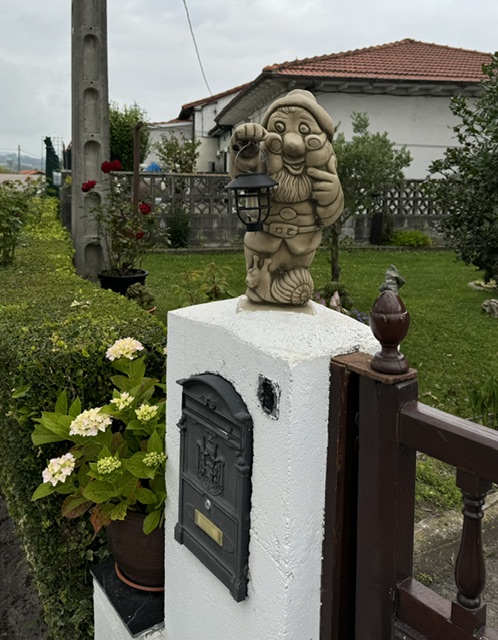
Have I ever mentioned Snow White and the 7 dwarf theme? I’ve seen it on all three caminos, never understand it, not a lot of places, but every once in a while. When it was the 6 of us, we saw the whole crew along a stream in a garden. Here’s a marker on a driveway post.
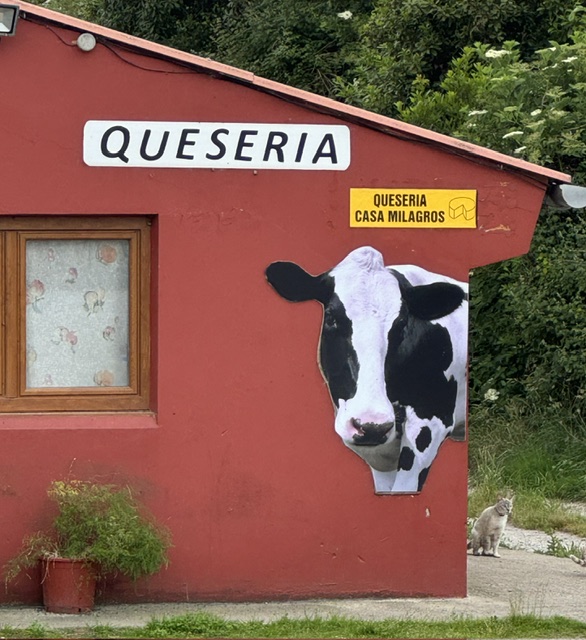
Great store
Then, we walked into a completely medieval town. Couldn’t believe it. We’d read that it was one of the most charming villages we’d see, but couldn’t really grasp it until we were in the midst. All the roads/paths/houses and buildings are consistently the same stone and it’s beautiful.
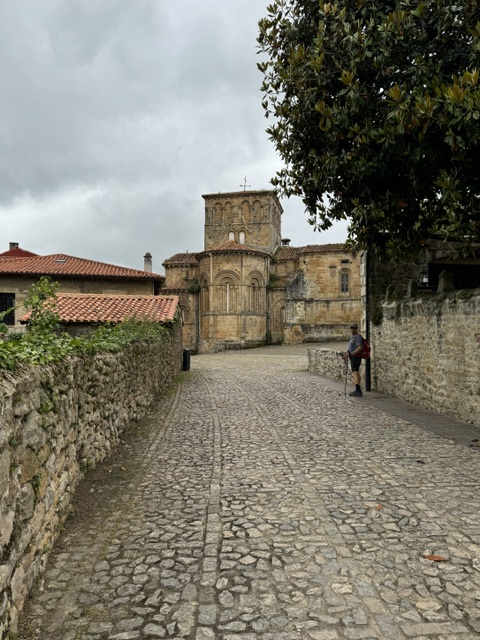

I’m psyched to be spending a night here. There are a ton of school groups of all ages and adult tours as well. But the lucky thing about being here for the night is that I’ll get to walk around tonight and early tomorrow when no one is up to see what it was like. This was one of the two main destinations for trips out of Santander that I’d seen when trying to figure out what to do IN Santander. The other is the cave museum and that and the caves are on my to-see list if we come back.
We wandered a bit, seeing a museum of a local sculptor, wonderful:

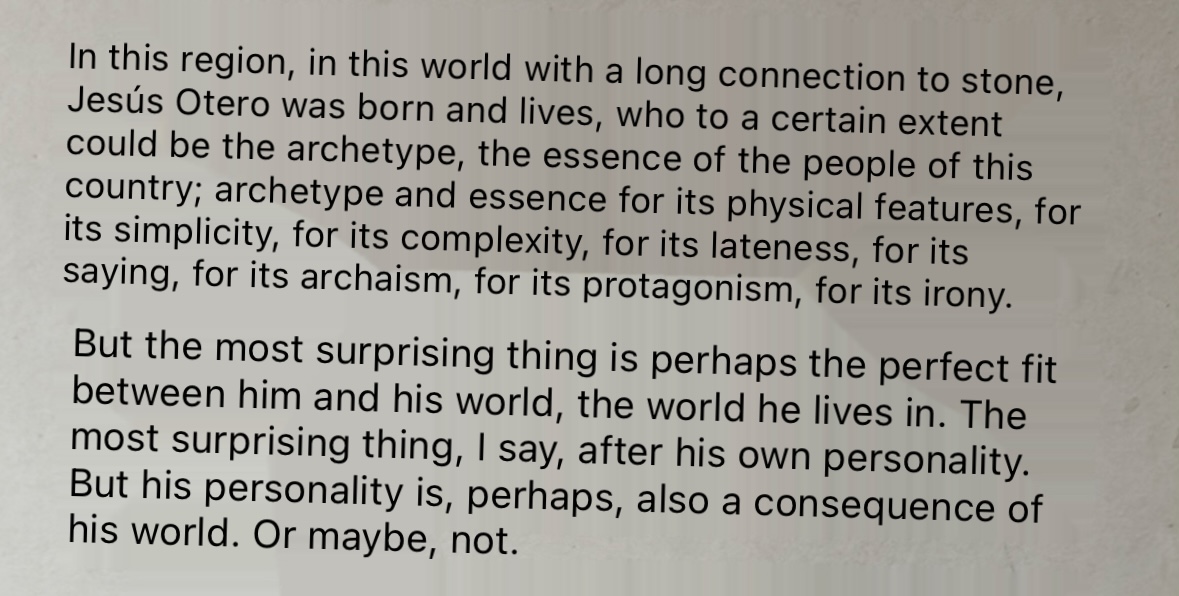
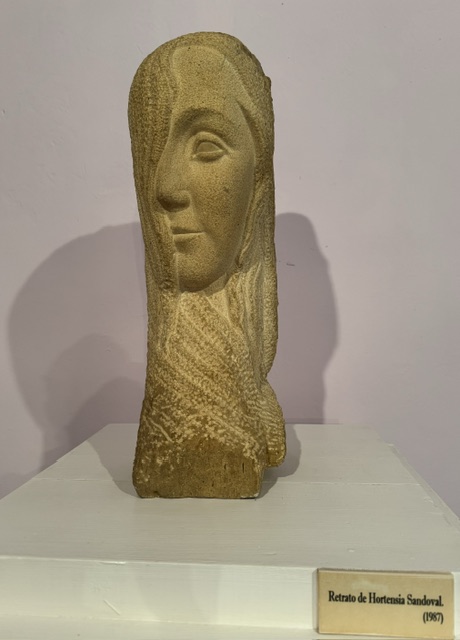
Hard to choose what photo to include, I really liked his work over the many years, decades shown – aside from when Franco jailed him for 5 years.
and decided against seeing a museum about torture and the inquisition.

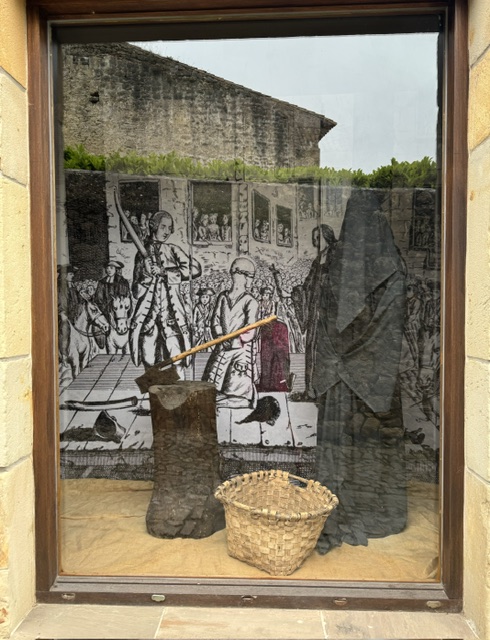
Instead we went to the house-museum that covered the people living there since the 1500’s. Incredible.
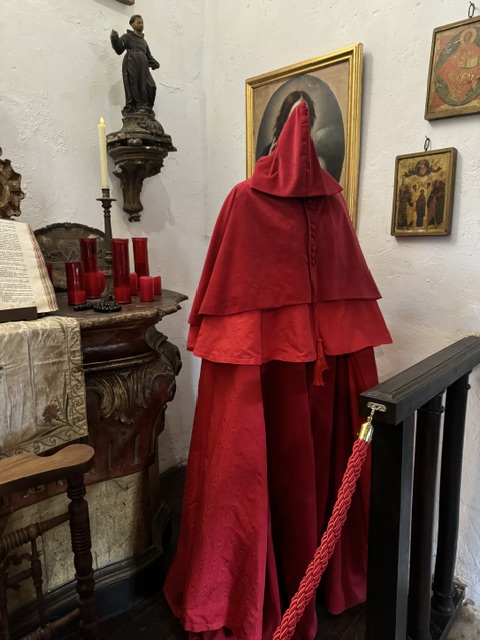
The first owner was one of the lead people in the inquisition. Something to be proud of. Not.
Another was a Nazi soldier, high up in the ranks, whose father helped develop the Inigma code. This soldier tried to work with a few others to go behind Hitler’s back to Switzerland to negotiate a peace treaty. He ended up being the enemy of the Nazi’s and the Allies. He lived here as a carpenter. And there were many more including a woman who started a cottage industry hiring locals for sewing costumes and clothes.
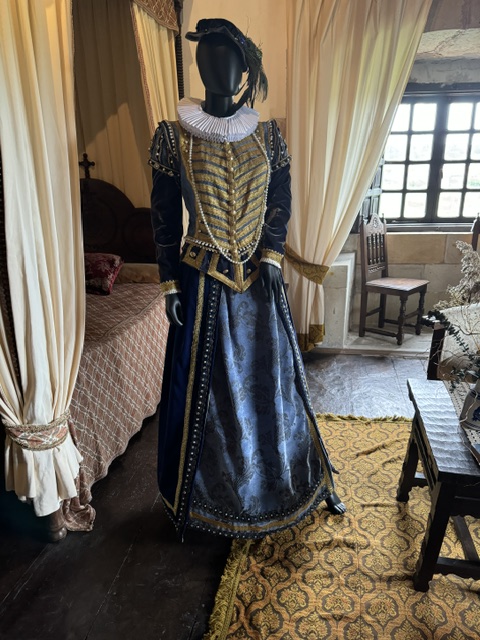
Lady’s suit around 1530’s
Fun note – the four poster bed began around this time to serve a few functions. Warmth when the curtains were drawn and privacy from all the servants who were always around. Who knew?
Cool museum.

Got lunch (overwhelmed again at the amount of food, changing it up going forward) and came back to the room for a shower and a bit of quiet.
Went to the main church here, only one we see that’s still a church, but maybe mostly a museum. The Colegiata de Santillana del Mar. To walk in was to walk into an ancient building. All notes in Spanish, but tried to use translation to get some of the history.
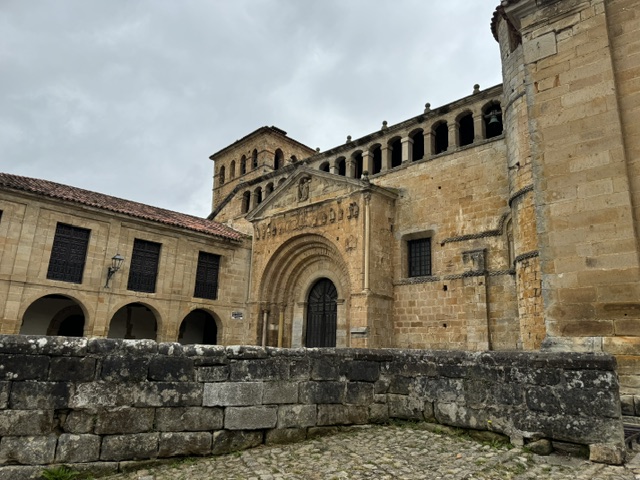
The church has its origins in a monastery dating from 870. Tradition has it that it was home to the relics of Santa Juliana. This is stated as certain when reading about the town. Over the course of the 11th century it was transformed into a collegiate church, although the building visible today dates from the 12th century.
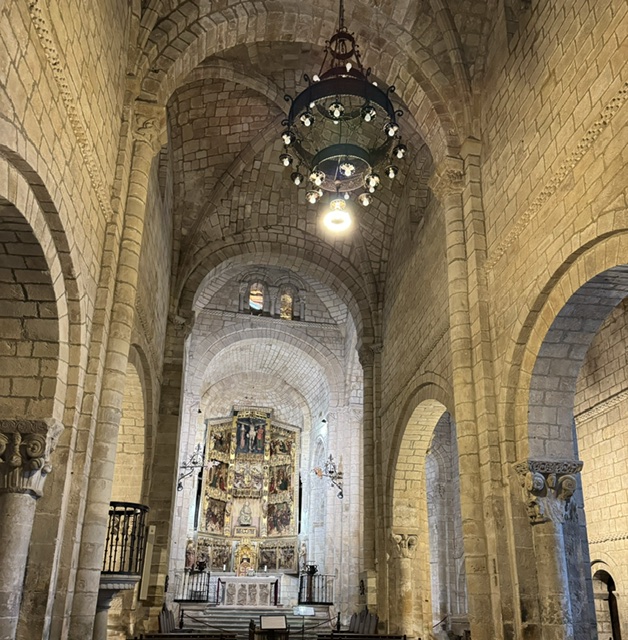
Yet again, it smelled so much like mold that Rick was out very quickly. So strange given that it’s all stone and wood.
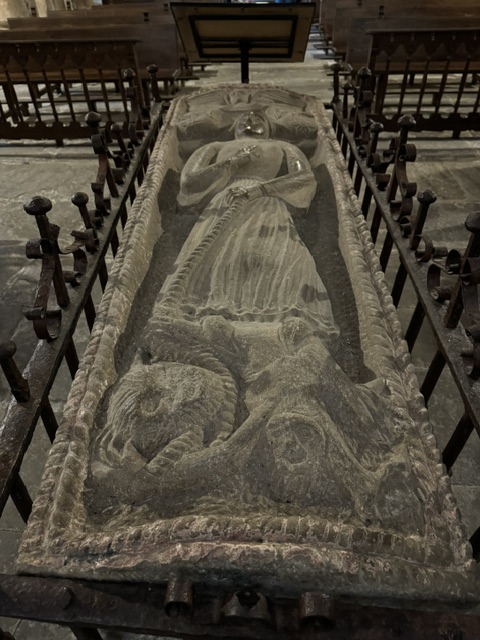
Here Juliana is, face and arm rubbed shiny, probably from people asking for prayers.
Really personal story written on the plaque next to her sarcophagus in the church: Towards the end of the third century during the cruel persecution of Roman emperor Maximillian against Christians, a young senator, named Eluzo, attempted to marry a maiden from Nicomedia, named Julianna, illustrious for her birth, personal merit and unique garments. Love that.
Julianna’s father was a Gentile and one of the most ardent persecutors of Christians in Nicomedia. The daughter had been secretly educated in Christianity. But not content with this, she had resolved never to have any other husband but Jesus Christ, not to aspire to any other goods or honors than those of heaven.
She was in this resolution when her parents promised her to Eluzo. She was strangely surprised when she heard from her own father that everything was already finished, and that the same day the one who was destined to visit her would come to visit her.
Juliana received Eluzo with great courtesy, but with much more modesty, giving him to understand that she could not consent to that wedding until she saw as a judge and prefect of the city. Eluzo, through efforts and money, obtained the position he sought. He took possession of it and sent a message to Julianna, offering her the prefectura at her disposal.
Juliana, unable to hide any longer, sent him to say that she was glad to see him placed in a position of honor, but that he still had to take another step. It was necessary to become a Christian like she was.
Eluzo, without wasting any more time, set off in search of Julianna’s father and told him what his daughter had responded to him. He was overcome with anger and responded to the prefect: I swear to you that I myself have to be my daughters’ prosecutor and you have to be her judge. Saying this, he entered Juliana’s room full of fury and asked: What is this, daughter? Do you not know what an honor it is to be majesty of the prefect of Nicomedia?
I know well, sir, that Eluzo is a gentleman, but he is not a Christian. Her father exclaimed in anger: I myself will go and put him in the clutches of wild beasts, because I want to see him torn to pieces rather than converted into a Christian. And losing all feeling, he treated his daughter with barbaric cruelty. She was then handed over to the city prefect for trial.
So – bad ending for Juliana, tortured and beheaded, but never wavered.
Wikipedia noted that: Eleusius was later eaten by a lion after a shipwreck on an island unknown.
Further note since everything I read had Juliana residing in Naples was this: Juliana is clearly a historical figure as Saint Gregory the Great requested relics of her from Bishop Fortunatus of Naples for an oratory that a wealthy Christian woman had built on her estate in Campania, Italy, to honor Saint Juliana and others. On the other hand, tradition in the north of Spain holds that Saint Juliana is buried there, in a town near the Cantabrian Sea that took its name from her, Santillana del Mar. Santillana is a contraction of Santa-Iuliana. The Church of St. Juliana in Santillana is a Romanesque abbey, well over a thousand years old.
And that’s my history for the day!
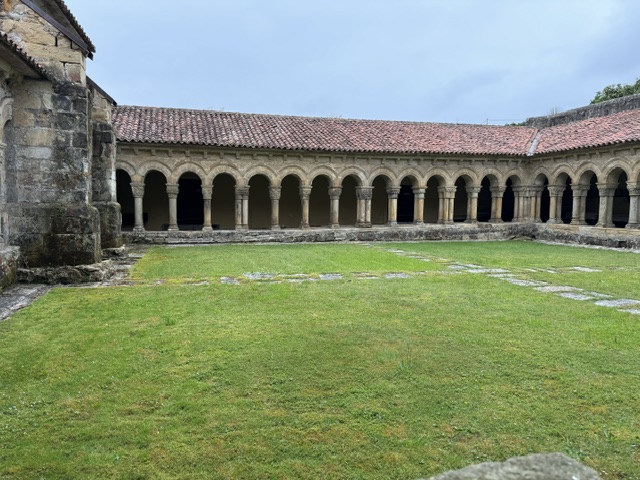
Cloister, looks much bigger than it actually is:
Hotel Museo Los Infantes, wonderful, 17th to 18th century palace became a hotel – moved stone by stone and rebuilt in 1974. The people running it are so nice. “The hotel is a real museum, it is entirely decorated by precious antiques.” Which is true, but means it’s not completely comfortable in the sitting areas. But looks cool!
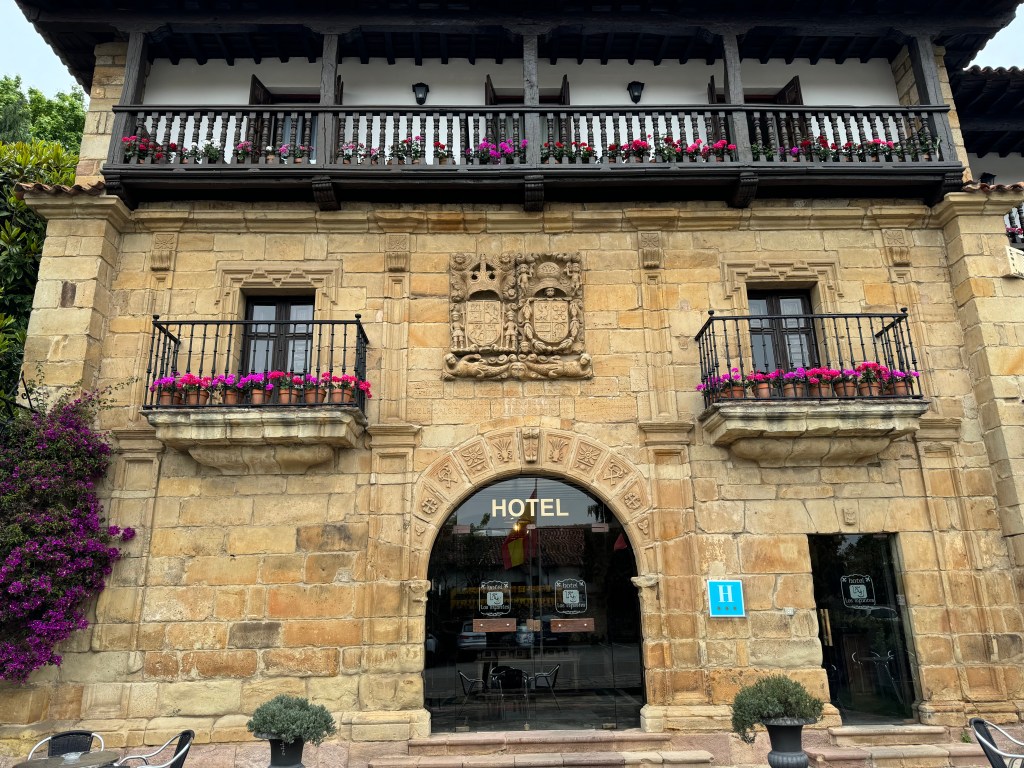
I asked the front desk person why it was named “Los Infantes”, he just shrugged. And I can’t find anything about it online. So – just a cool old building converted to a wonderful hotel!
 Reb's Walks!