Germany, Castles
Today turned out to be really fun. Sadly, Holly and Flynn switched night for day and couldn’t go to sleep until 6am this morning, so there’s no way they could join the jaunt to Linderhof Castle, Oberammergau village, and Neuschwanstein Castle. And it was a long day so they definitely made the right choice. Tricia and I left the hotel at 7:30 and got back at 7. By the end, we thought it was wonderful.
We learned a lot about Ludwig II, the 4th king after Germany became a monarchy in 1805. King Ludwig II adored his grandfather, Lundwig I, who built beautiful buildings and bankrupted the country. Then Ludwig II came along and loved building just as much, also nearly bankrupting the country. He won a war against Prussia, but that was very much an interruption in his studies of architecture, art, philosophy, science, etc. We were told he read a book a day.
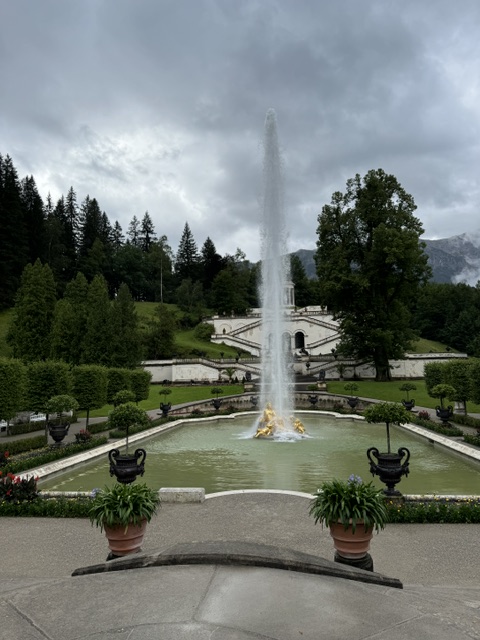
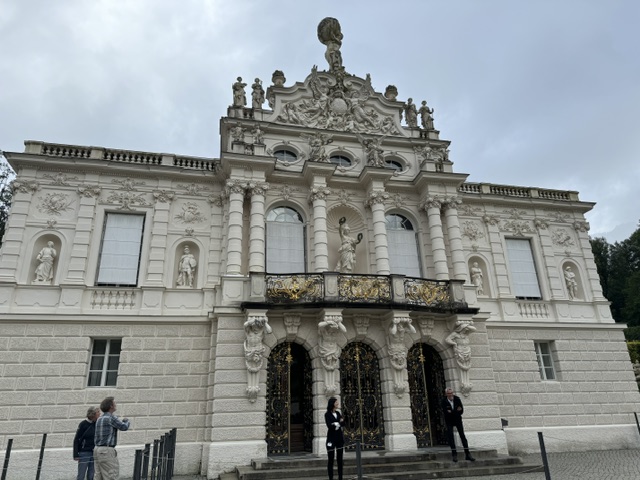
We got to see two of his castles (palaces). The first was his comfort castle, the only one completely finished, and he spent a lot of time there, 2 weeks out of every month. Linderhof Palace was modeled after Versailles since evidently Ludwig II really wanted to be like the sun king, with his position affirmed by the gods. The palace was small, gilt and beautiful, but the real charm and beauty that caught the eye were the incredible grounds. A number of the outbuildings were modeled after scene descriptions from Wagner’s operas, someone that Ludwig adulated and became friends with despite the 40 year age difference. I thought the grotto was incredible – but only saw a short video of it since it’s under serious repair because of water damage. Here’s a description from the Linderhof website:
The Venus Grotto in the palace gardens is a unique construction designed as an artificial flowstone cave and the highlight of King Ludwig II’s illusionary architecture. This grotto not only depicts the 1st act of Richard Wagner’s opera “Tannhäuser”, but also reproduces the motif of the Blue Grotto in Capri by means of artificial illumination in various colours. For this purpose, one of the world’s first electric power stations was created. The grotto was erected in only two years from 1876 to 1877 by court building director Georg Dollmann and landscape sculptor August Dirigl. In the 19th century, it presumably was the largest construction of its kind even though it had been designed only for the king’s own private use.
From the front door, then the castle, then a small piece from the back:

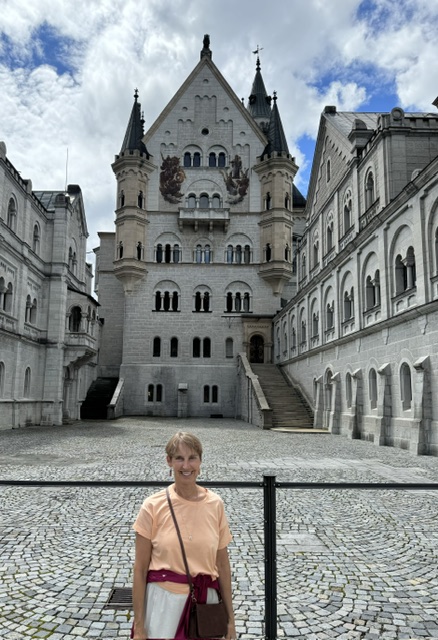
The second castle we saw was named after Lohengrin, the first Richard Wagner opera Ludwig II ever saw (at age 13). Lohengrin was a mysterious swan-knight. Neuschwanstein was the “New-Swan-Stone” palace and there were over 100 images of swans in one room alone. It’s the castle that Disney modeled his castle after. In fact, Disney asked if he could buy the castle and deconstruct and reconstruct it in the US. No. But there was a painted panel of woods in the Singers Hall in the palace that Disney used as the model for the woods from Bambi. And sure enough, it definitely looked the same.
The stories of Ludwig II were interesting and there were a lot of them. He was alone a lot and wanted it that way. In the Swan Palace, it was the king and 32 servants. He never held audiences and very rarely if ever had visitors, even though there was a throne room in both palaces. He installed the first phone in Germany in Neuschwanstein, but could only call his secretary, who was also in the palace, since no one else in Germany had a phone. He only had 172 days in the palace before he died at the age of 40, before the palace was finished. The royal family and ministers of Bavaria put the castle on public view within 6 weeks of Ludwig II dying to try to make up some of the money he spent on it. He was very Catholic, but had several Buddhist elements built into both castles. He struggled because being gay (legal at the time, but not for the monarchy) didn’t align with his position as king. He was probably murdered by his counselors whom he’d asked for funds to build a Taj Mahal in Germany. Oh, yeah, I could go on for a long time.
Neuschwanstein was beautiful and a tribute to Richard Wagner and his operas, though Wagner never visited before Ludwig II died. In a departure from most monarchy, there were no paintings of Ludwig in either castle and his name was written only once in Neuschwanstein on a small panel – along with the architect of the building. It was about beauty and honoring others. Our guide was a lovely young woman, and both she and our guide on the bus spoke about Ludwig as if he was a beloved and quirky uncle.
Happily for me, they didn’t allow photos in the palaces so I got to just revel. Unfortunately, they move people through so quickly (10,000 people a day at Neuschwanstein) that it didn’t really allow a long time to see details and the details were unbelievable, so many to absorb. But the overall impression was of light and beauty. It was so big that these are just a few shots I got:
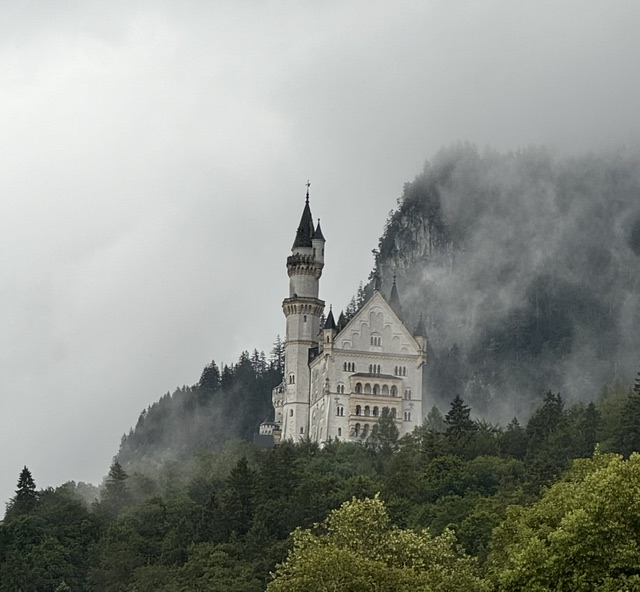
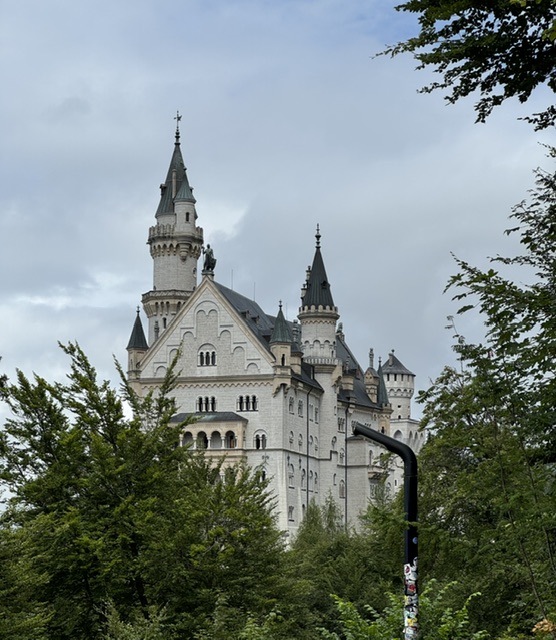
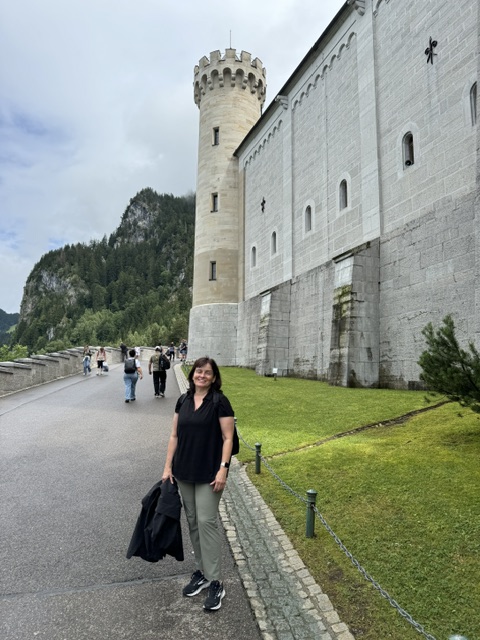
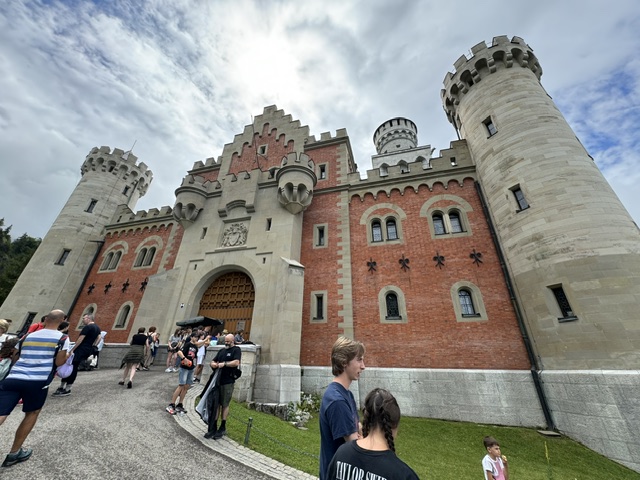
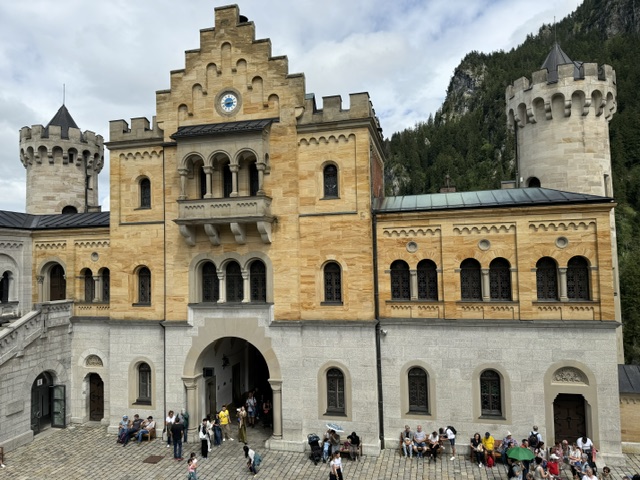
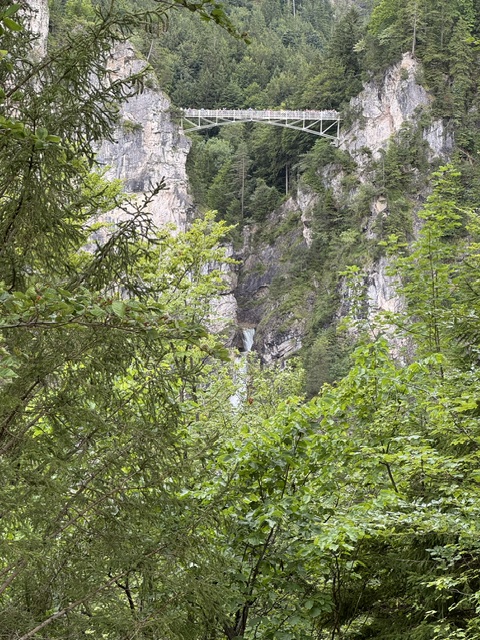
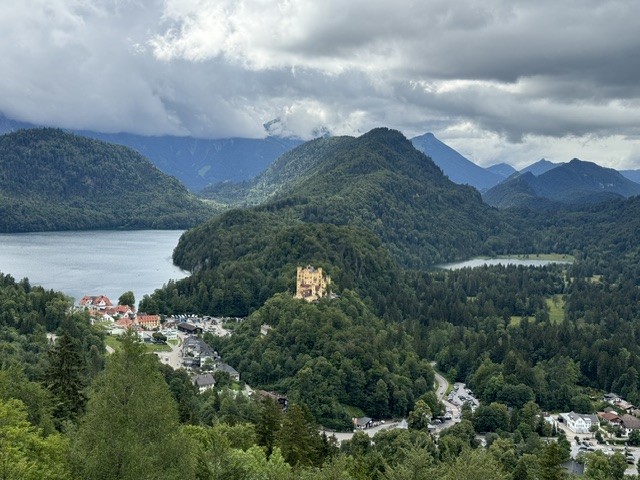
The last one is a bridge that Ludwig’s father built for his mother (though there were two predecessor bridges). Part of managing the whole visitor scene is that everyone goes to the bridge first and sees the scenery all the way down to the lakes with Ludwig II’s father’s castle in front. I got one foot out on the bridge, backed off, Tricia went further, but then some of the wooden planks started moving, so just one shot! We then walked 20 min down to the castle.
We also had a 30 min visit of walking through Oberammergau village between palaces. This village became famous during the plague in 1633. The mayor of the village was determined to protect his village and closed the borders. But a soldier from the 30 years war was so homesick, he was allowed to come home. He died within 3 days and then 300 people from the village died after him. They then decided to put on a play showing the 10 stations of the cross, a Passion Play, with everyone in the village taking part – 2,000 people as actors, techs, musicians, etc. They built a theater a few years ago that can hold 5000 people. Here’s the note from their website: In 1633 the Oberammergau villagers promised to perform the suffering, death and resurrection of Christ every tenth year, in so far as no one was to die of the plague anymore. The villagers were answered by God and therefore in 1634 the first Passion Play took place. The promise has been kept until today. The 42nd Passion Play successfully ran from 14 May to 2 October 2022, after having to be postponed in 2020 due to Covid.
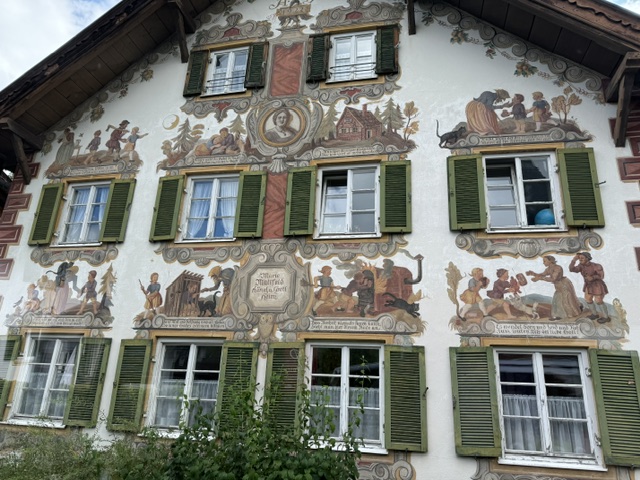
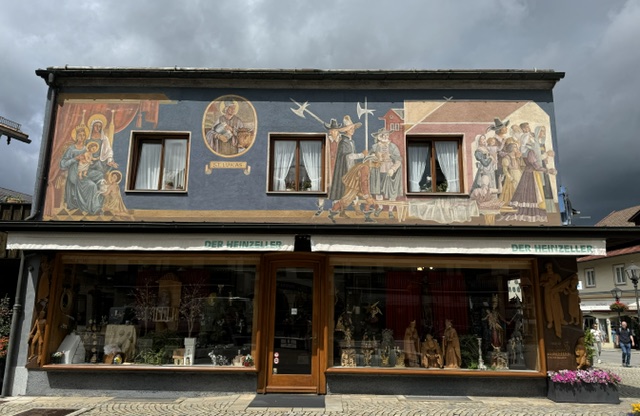
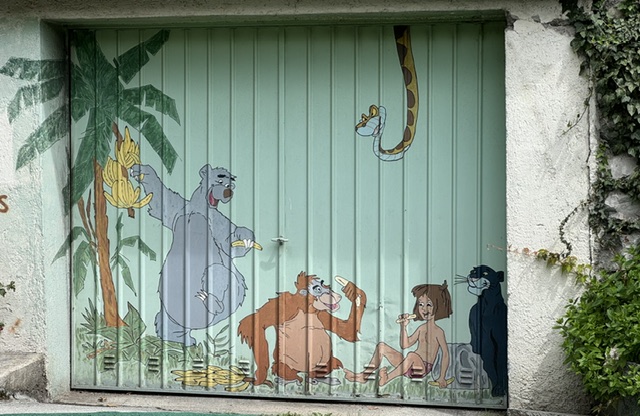
The other thing the village is known for are the paintings on the houses; themes from Christianity and Grimms Fairy Tales. Unfortunately, the fairy tales were mostly painted on houses that we went by on the bus so photos were a challenge, but I walked a bit and tried to get some photos just to show the skill and details. The Jungle Book photo was on a garage of a house. The woman of the house was walking up the stairs and I asked for permission to take the photo and she was so pleased and said yes! It’s 30 years old!

The one below is the entire story of Hansel and Gretl

This is a photo of a maypole showing all of the trades and stores that are offered in the village. So cool. All villages have this and I guess there’s a tradition of neighboring villages trying to steal different signs and put up their own. Don’t know if that still happens, looked pretty permanent to me.
Unfortunately, by the end of the day, Tricia’s foot was really cranky. We had no idea what happened, it had started to hurt a bit on the bus/train from Dachau, but by the time we got back to the hotel today, clearly Tricia wasn’t going to be walking anymore. I wanted mid-eastern food and asked at the desk about a place that I could get take out from and were given a name close. We went upstairs to settle in and to order ice from room service and then it turned out half the menu was mid-eastern food! Wait, and everything was written in German, English and Arabic. How interesting. Turns out there’s a huge influx of visitors from the UAE and Dubai for medical services in particular. They bring the whole family, spend a lot and the community is pleased to welcome them. It seemed (from a very outside perspective) that there was a lot of blending between the communities and obviously, there are also plenty of residents who were Islamic as evidenced from the women’s dress.
So – a great day and hopefully, Tricia’s foot gets better tomorrow.
 Reb's Walks!