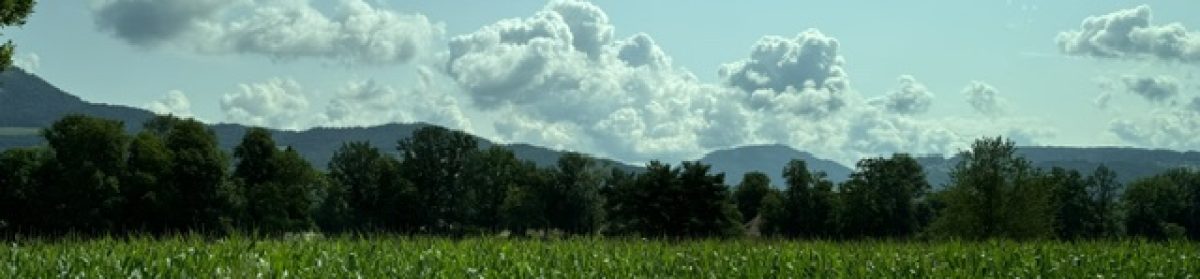
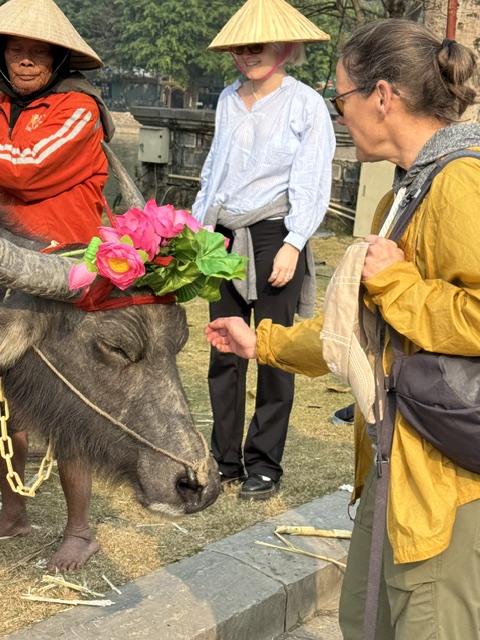
Note from yesterday – forgot Kellie finally getting to see a water buffalo.
Yesterday we were all a bit underwhelmed with the previous day so we didn’t have high expectations for today, but it was great. So incredibly interesting. First, we drove enough to see much more of the city and there are gorgeous buildings built both by the Vietnamese and by the French during colonialization, in addition to wide avenues and lanes of trees.
Our first stop was the Ho Chi Minh Mausoleum, housing the “beloved revolutionary leader affectionately known to the Vietnamese are Uncle Ho.” It’s interesting learning the Viet Cong side of things since the book I’m reading is based more on the Republic’s view of the war. Our guide was adoring and proud of Ho Chi Minh and there were hundreds, thousands?, of people in line and moving respectfully through the paths in the compound towards the mausoleum. No cel phones were allowed past a certain point, well before the building. One small group of older Americans ahead of us were pretty oblivious and despite warnings from the soldiers, one of the women kept pulling out her cel phone. A soldier finally confiscated her phone and then escorted her all the way around the room of the actual body, then in an office at the bottom deleted all the photos and video she was evidently collecting.
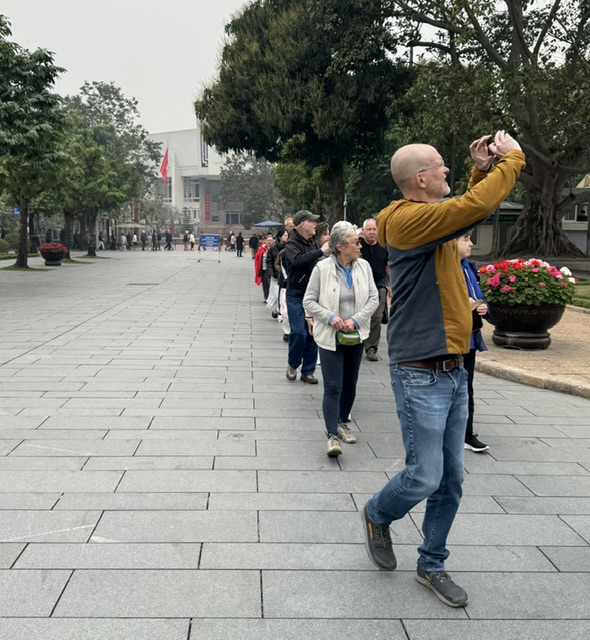
The line curves all the way back and around – and we had to stay single file, our guide kept asking us to move back to single file.
It was a very quiet and respectful crowd, no knees or shoulders showing, no hats. It was actually kind of amazing to see this man so well preserved. That’s really Ho Chi Minh. The man who led this country and defeated first the French and then the American armies.
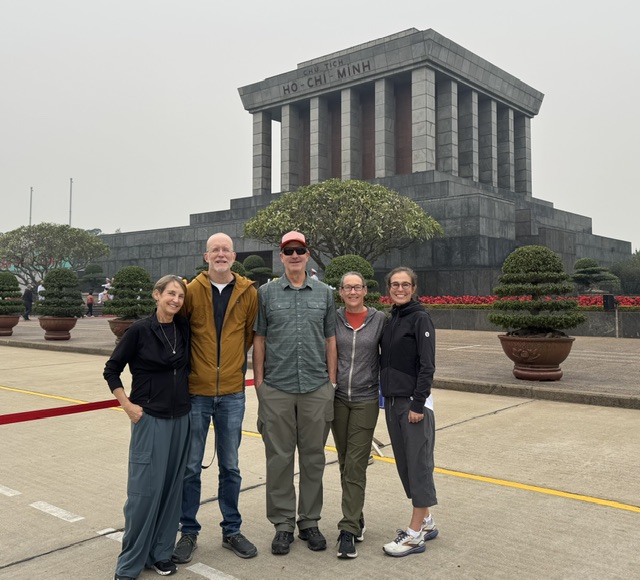
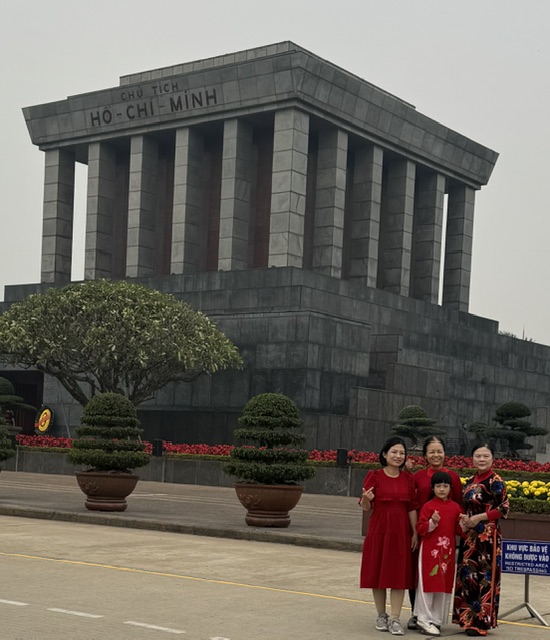
This is after we came out, then photos are allowed.
Saw the changing of the guard, the sign above them says: The Great President Ho Chi Minh Lives Forever In Our Cause. The sign greeting us as we walked toward the monument started with Socialist Republic, but I couldn’t get the rest from our vantage point after the tour.
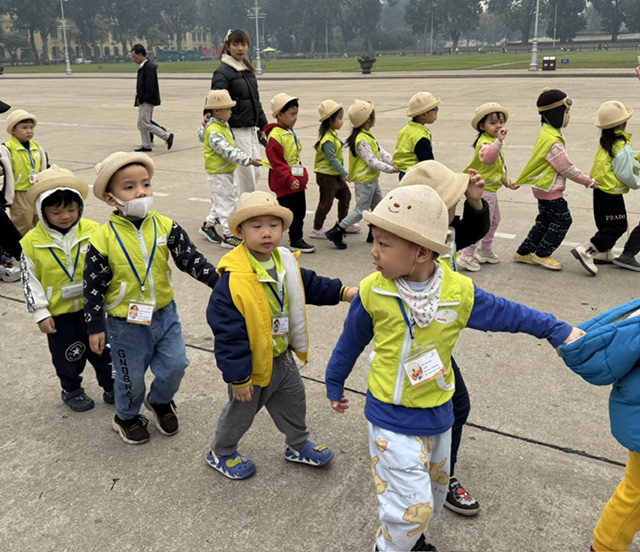
So many groups visiting, the little ones are adorable with all their matching hats.
Many of the visitors wore red and black. I never learned why, but assuming it’s the color of the flag and of communism.
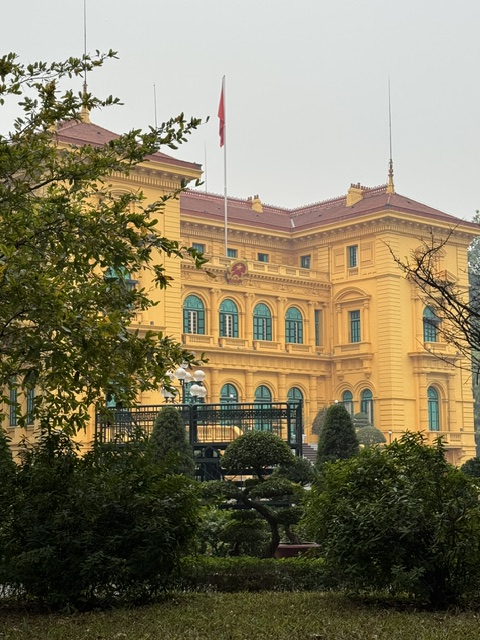
This was an example of one of the French colonial buildings. Gorgeous, but Ho Chi Minh said he wouldn’t stay there, too fancy, he made it into a greeting building for when international dignitaries came.
We then visited Ho Chi Minh’s complex. He lived there from 12/19/54 to 9/2/69, “mapped out the Vietnamese revolution, let the Vietnamese people to construct socialism in the North and fight the American aggressors in the South, contributed actively to the struggle for national independence, democracy, peace and social progress worldwide.”
We saw where he ate, had meetings, etc. It was a pretty compound, not at all pretentious and his home was small and quite simple.
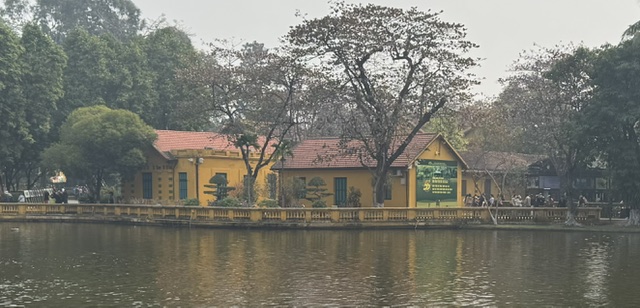
The people then built him a new house, really beautiful, of wood, 2 rooms living above, small office and small bedroom and an open meeting area below. It almost felt Frank Lloyd Wright like. No kitchen or restroom, he went over the other house for those needs.
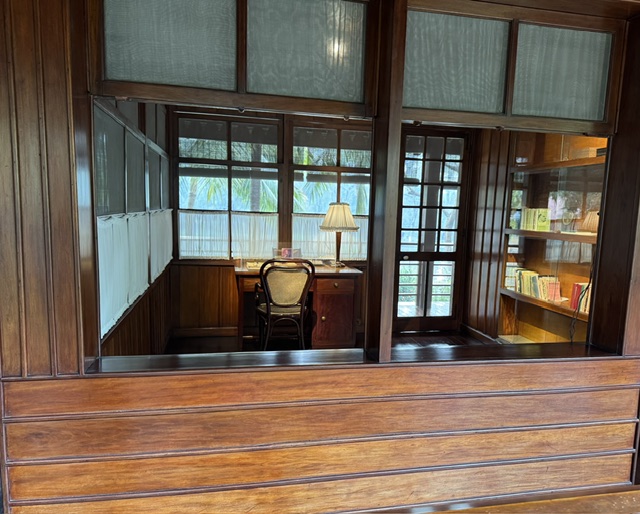
We were wondering what others in the south would say about him, “Uncle Ho”? Or with families who were with the republic, would it be different? The narrative was consistent with both our guide’s stories and the written pieces around the compound of a beloved leader. Ho Chi Minh was a man who kept things simple and walked rough paths with bare feet so that he could walk with the people in the south when he went to visit. He was a reader with books next to his desk and photos of Marx and Lenin above his bookshelf. And completely committed to his people and their well being.
Maybe he didn’t know what the Viet Cong were doing to their fellow Vietnamese? Of course, it went both ways, but knowing how the South in the US still thinks about the “War Between the States”, I’m guessing it’s not quite so consistent a story line throughout the country. But still – it was fascinating.
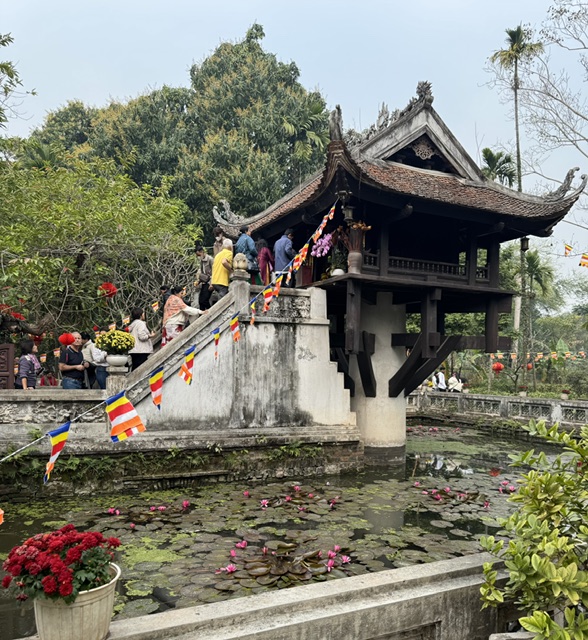
We saw the One Pillar Pagoda, also in the compound. This is a Buddhist temple built in 1049 in the shape of a lotus blossom and set on a single stone pillar, considered by many to be one of Vietnam’s most iconic pagodas.
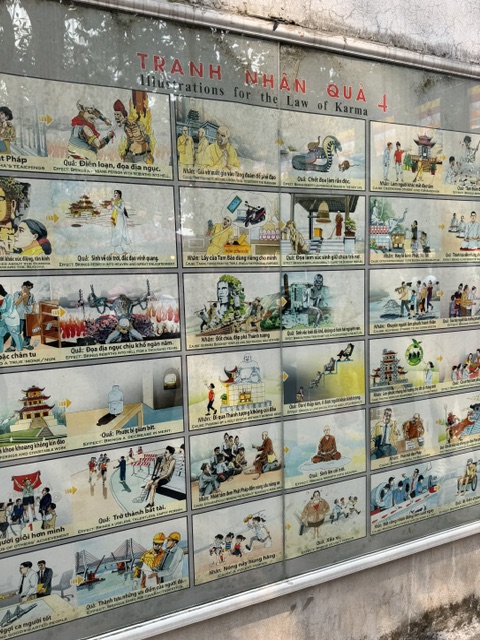
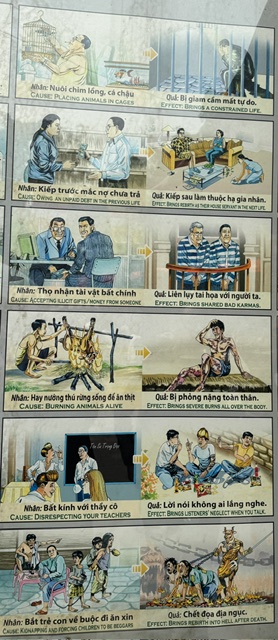
On the surrounding walls of the plaza were murals of Illustrations for the Law of Karma. Lessons on every one. Kellie and I couldn’t get enough of them. I just kept photoing and cropping to be able to read them.

Then we saw the Temple of Literature. This was great. Founded in 1070 by Emperor Le Thanh Tong, this complex is dedicated to the Qufu-born philosopher Confucius (Khong Tu) and was the site of Vietnam’s first university, Quoc Tu Giam (1076). The altars are still popular with students praying for good grades. In 1253 the university was expanded to admit excellent students from common families, becoming a leading educational center and a place to select talented individuals for the country.
Confucius:
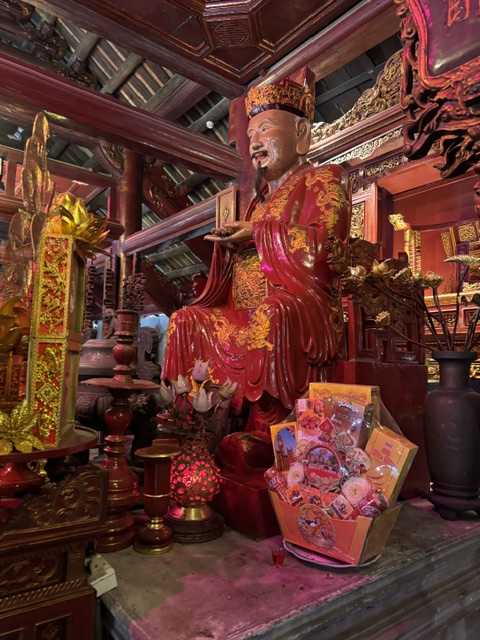
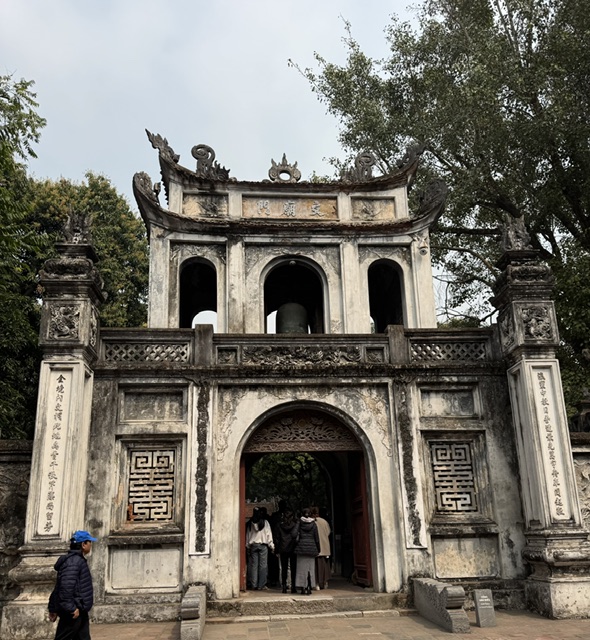
The analogy for the scholars was a fish becoming a dragon – the ultimate symbol in Vietnam. The fish were swimming around and a few exceptional ones were plucked out, they were then on their way and with each accomplishment shifted little by little until they completed their imperial exam and became like a dragon.

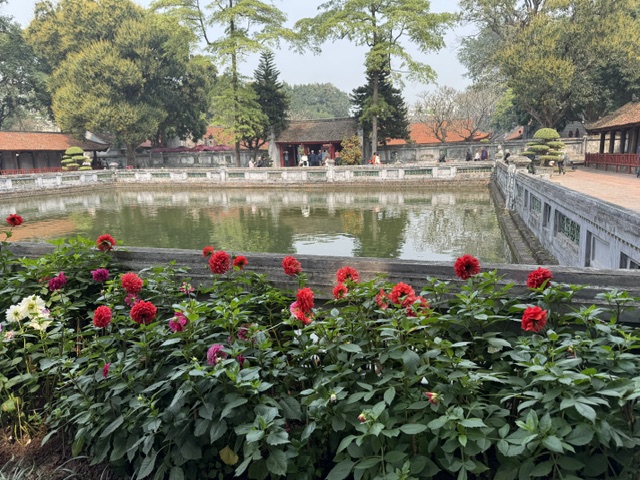

The classrooms, library, and dorms had been rebuilt to resemble the architecture at the time and were beautiful. This school continued from the late 11th century to 1779 when the last exam was given. Over these 100’s of years, exams were only given 116 times, with 1,032 people graduating.
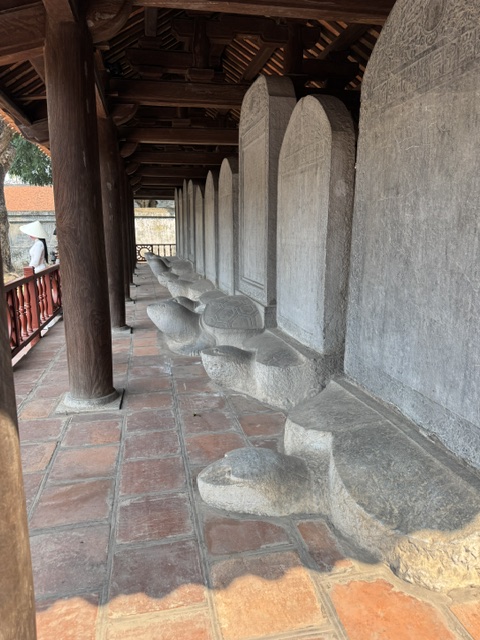
Each time an exam was given, a turtle was carved and a panel erected above it. There are 82 of these carvings left. The graduates were all then launched into careers supporting the king and other areas of government. Their name was enscribed on the panel. However, if they were not illustrative or successful, their names were then erased.
Our final stop after a quick lunch was the Hanoi Hilton, named by the American POW’s, all of whom were titled pilots by the Vietnamese regardless of their role in the war. This was grim, of course, because it was first built by the French to punish political prisoners and criminals. The political prisoners were treated much more harshly. It was then used by the Viet Cong for their prisoners. I don’t know what the reality was for the Americans imprisoned there, but there were photos of them having Christmas, playing games, reading letters from home, etc. Of course, this is Hanoi and they were looking for American visitors.
And now, we’re flying to Hue, the imperial capital of the Nguyen Lords from the 17th to the 19th centuries.
We stayed in yet another totally cool and old hotel, had dinner, went to bed. Notice I don’t say to sleep. Jet lag is a strong companion, but it’s all so interesting that we make it right through the day.
 Reb's Walks!