Every day has gotten better. Today was so interesting. I confess, I did a fair amount of it a bit dingy since I woke up at 2:30; we’re all dealing with jet lag at different paces. But – it was a great day.
Our new guide and the driver are delightful. Yesterday, in our group we discussed communism and Vietnam and how Hie, our guide, seem to portray in action someone very devoted to and admiring of the system as well as being anxious that he did everything right – with what seemed like concerns of who was overseeing his work. That may be just our projections, but we all picked up on it. He also talked about the cement “king” just doing what you can do if you’re rich – you’ve worked hard and are able to show off your success.
He was truly admiring of Ho Chi Minh, thought that Vietnam (or at least as he presented to us) was a country of one people, no north or south except for direction and location of cities and that all benefited by the one party system. Holly, last night at dinner, had read to us of a Proclamation, secretly written by the politburo last year, prior to Biden’s visit. This was not to be supposed to be disseminated, but was leaked. The document expressed the politburo’s intent to open more and more to market systems, but that there would be further suppression of any free press (there is none) and opposition parties. Yes, a market economy but ruled as a one-party system.
Our current guide’s family was from the center and supported the monarchy and republic from generations back. His family’s history reflected the book I’ve been reading; this is a much more nuanced country than was presented by our other guide who’s based in Hanoi and has always supported Ho Chi Minh. Our Hue guide’s family were intellectuals, had served in the republic and were pretty well off. Their house was taken, they had to flee, and when they were allowed to return, a government official had taken over their house.
We asked about the cement king and he said, yes, he did earn that, he was also given the rights and privileges because of his party connections. It’s not in isolation. He told us of struggling to find his way for a living and finally realizing that maybe he could train as a guide. He spoke both French and Vietnamese and was studying English. He scored the highest score in English and when he went to the school that he was trying to enter, he should have been assured of a spot because of his scores. Instead, his name had been erased in favor of someone connected to the party.
He also said that it’s definitely not one country in terms of how people feel about the party, but that all the way to the most southern parts, everyone loves Ho Chi Minh. So the narrative as presented at Ho Chi Minh’s mausoleum and his homes may in fact have been a pretty accurate story of how he lived his life and his commitment to his people. Again, per our guide, I guess Ho Chi Minh was horrified by the Tet offensive and how many of his own people were killed and targeted, but he was already very ill by that time. There is speculation that his generals held off until Ho Chi Minh was quite sick to initiate the offensive and then the news was what finally undid him. Interesting slant.
Honestly, there’s been SO much to learn and think about that I can’t write it all, but wanted to get the highlights down. And I haven’t even started on what we saw!
We’re exploring Hue now. It felt like a really nice city as we drove through, seemingly middle class, nice size and comfortable. From 1802 to 1945 Hue was the capital city of Vietnam under the Nguyen Emperors who were based at the Imperial City, Hue’s great walled citadel inspired by the Forbidden City in Beijing. The complex originally contained over 160 building with ornate palaces, pavilions, gardens and gateways in traditional style dominating the site. Most remained unchanged until 1945 with the last emperor was deposed.
Battles then took a toll, first between the Viet Minh and French in 1947, burning the core including the main palace. Worse happened in 1968 during the Tet offensive between the VC and the US (who originally refrained from bombing the area in order to avoid damaging the historic structures, but as fighting intensified, restrictions were ignored). After the Battle of Hue, only 10 major sites survived. Now many are restored, but large empty spaces are left to show a hint of what was lost.
Our guide told us that Nguyen is the most common name in Vietnam. When mandarins (soldiers) wanted to move up, they gave their daughter to the king, who never said no. So all those children had the name. Then when wars were fought and there were prisoners, they could be let off more easily if they took Nguyen as their last name. Same for peasants who only had first names. If they would take Nguyen as their last name, it gave them a leg up. Currently 40% of the people in Vietnam of Nguyen as their last name.
Since the Citadel was the name of the area we were seeing, I assumed we’d be spending our time exploring the fort:
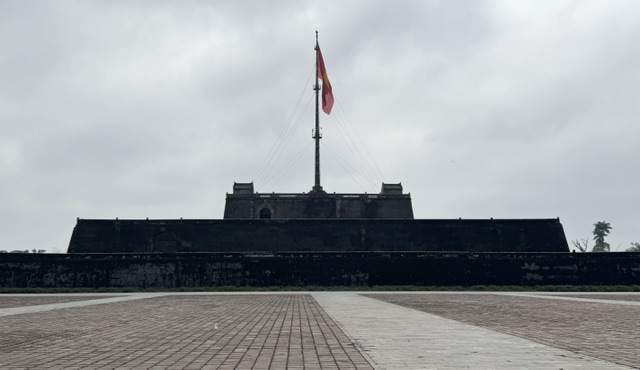
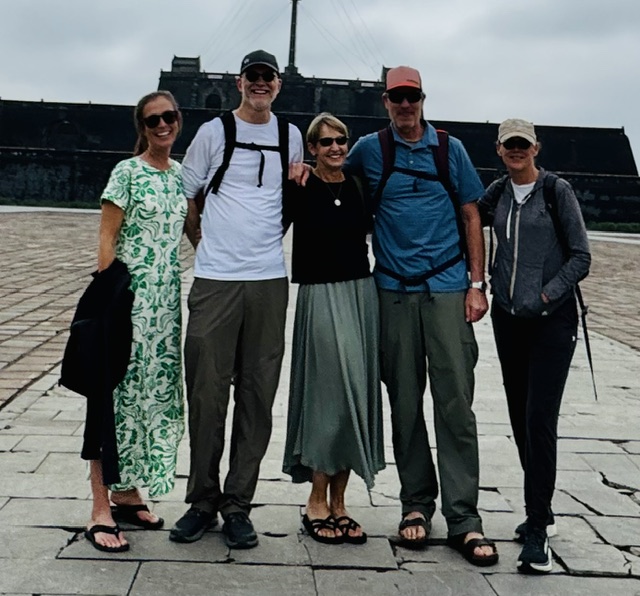
But no, we were on our way to seeing some incredible temples.
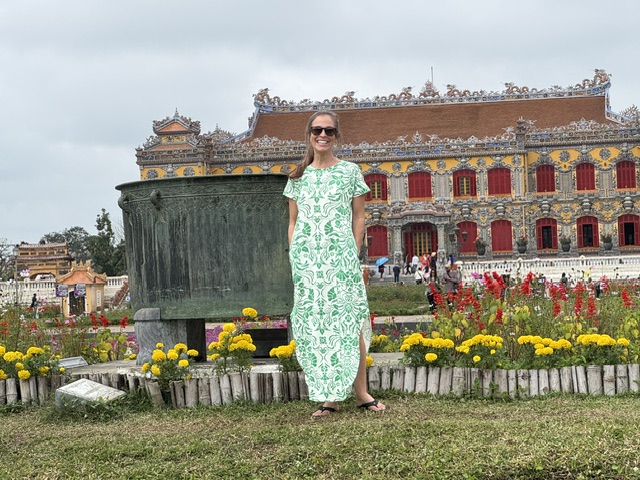
These Nguyen’s are the ones who rebuilt the temples in Hoa Lu on the origins of temples from then 9th and 10th century. The Hue Imperial Citadel was beautiful, with building after building lined up on a grid. This area was heavily bombed during the Vietnam War (Tet offensive happened here) and was the middle ground, so back and forth between the republic and the VC. Large sections of the Citadel were preserved and others have been restored. Then there were large spaces where the entire temple was gone.
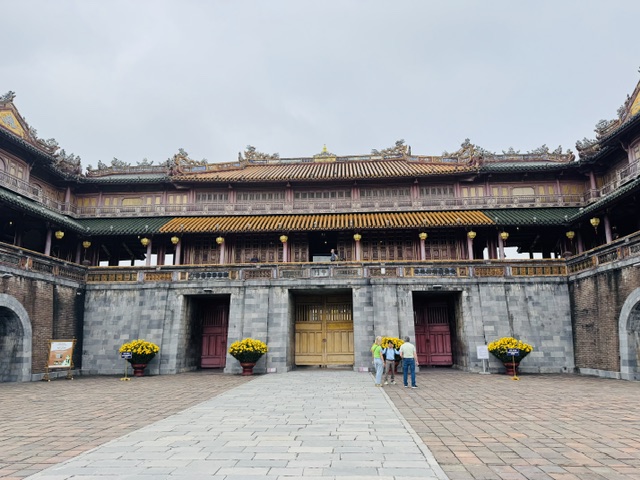


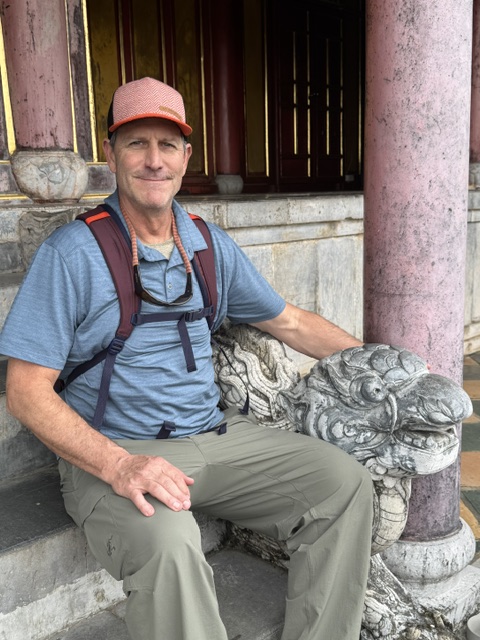
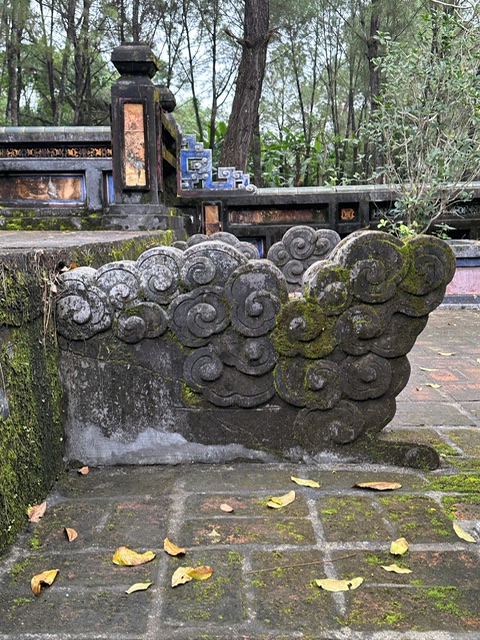
Shoot, I can’t remember the name, or find it online, but this precursor to the staircase banister was one of the many details that Pat loved seeing in the architecture. The details were incredible!
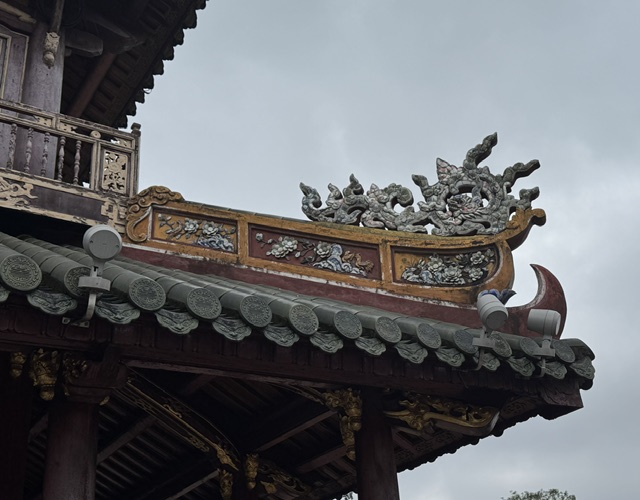
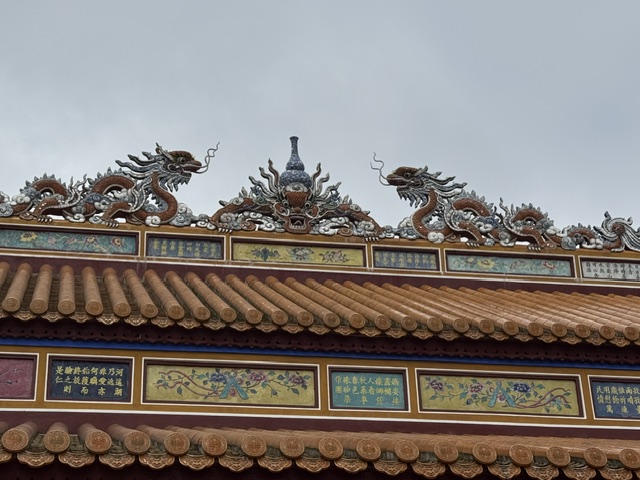

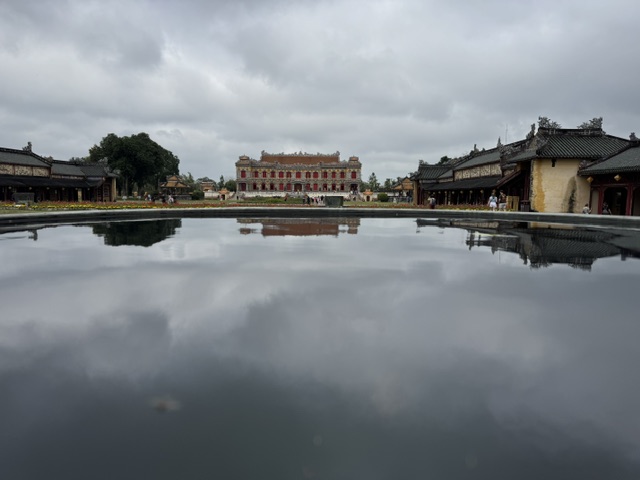
Per our guide’s advice, the photo above was taken from the top of the brass cauldron below.
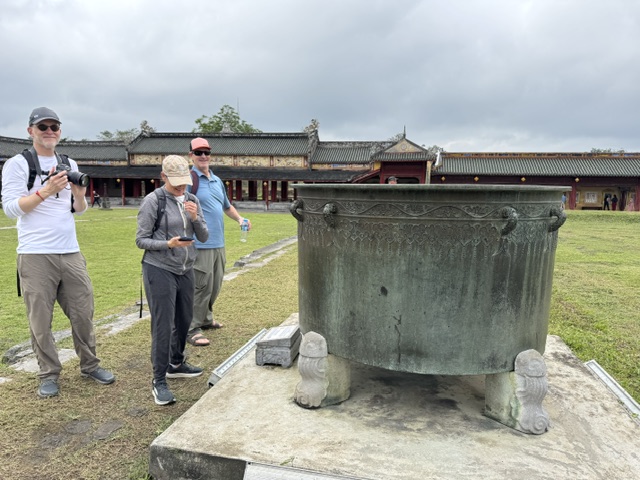


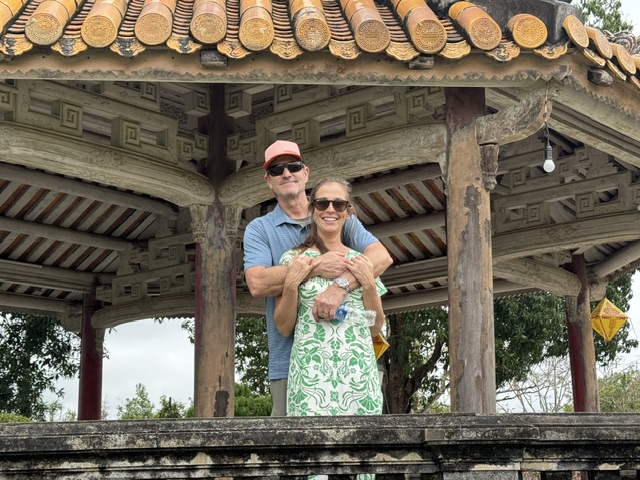
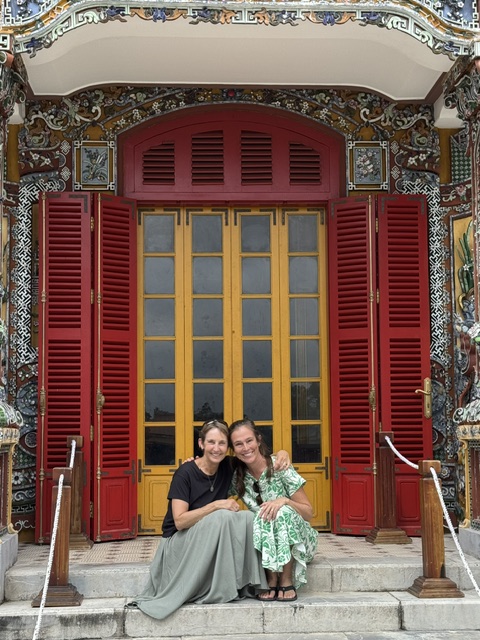
We then drove to the Thien Mu Pagoda, Hue’s best preserved religious monoment and still an ongoing monastery. It was built in 1601 and is a 7 storied tower pagoda, on top of a hill overlooking the Perfume River. I guess it’s an iconic image of Vietnam, it was new to me. But – this monastery, so far, stands out for me as the most wonderful place we’ve visited.
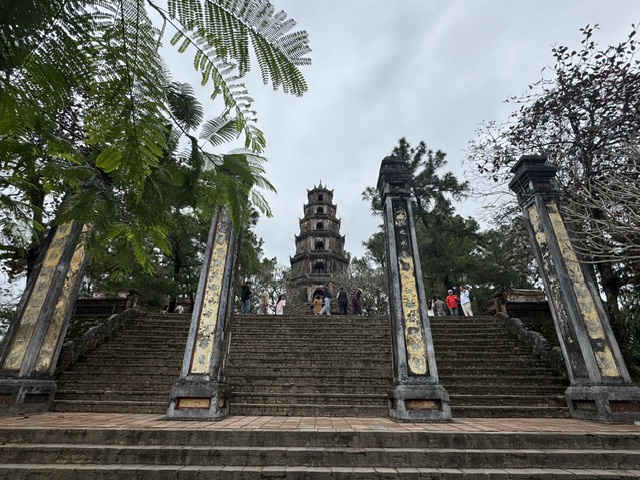
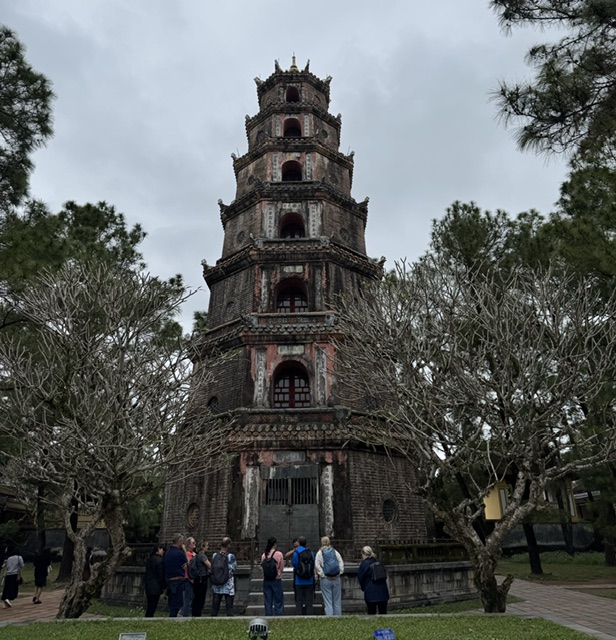
As soon as we passed the pagoda, the architecture became much more simple, one story, white with greenery all around. The plantings were incredible and so very intentional.
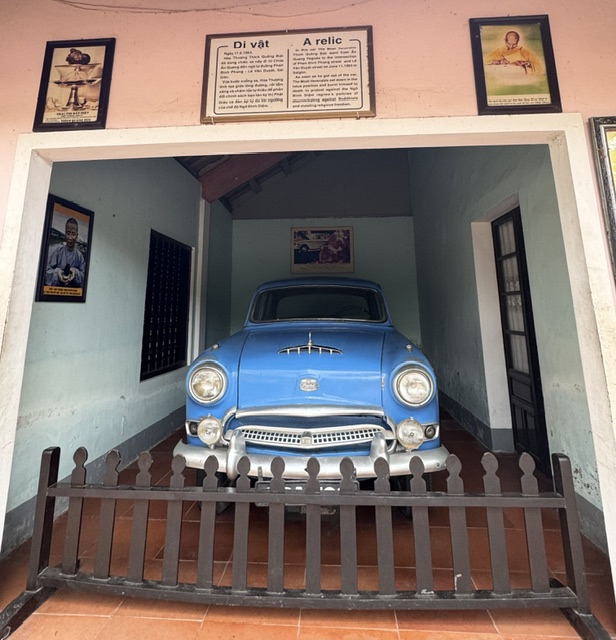
The first building had an old car with the story of a monk who had immolated himself. 6 of his fellow monks had done this in protest in Hue. This monk took this car, drove it to Hanoi, stepped out and put himself on fire. Incredibly sad. His face was beautiful, and such a commitment to his practice and protesting what was happening to Buddhists in the war. Somehow, it was a peaceful memorial, perhaps because of his photo.
We then continued back into the property, all of us spreading out, called to different areas, architecture, and plants. There was an incredible and ancient bonsai garden. I could have stayed there for the rest of the trip. There was something rare and peaceful that seeped into your bones if you stood still for even a moment.

And then yes! There was more. Such a day.
Next we visited the Khai Dinh Royal Tomb. This tomb was built for a king that had 132 wives and no children, maybe he had smallpox? But he wanted to have an incredible tomb. Khai Dinh was the penultimate emperor of Vietnam, from 1916 to 1925, and widely seen as a puppet of the French. It took 11 years to construct his flamboyant tomb from his designs, finishing after he died.
Confession here – I didn’t take my phone. Probably forgot it in the heat and long day.
As our guide said, the king was 50/50 good/bad. He built wonderful buildings that lasted, an entire complex that was Feng Shui. And he killed over 200 people because he forced them to keep working all summer in the brutal heat. This king wanted to leave a record of his accomplishments and wrote 500 Chinese characters on a large stelae, finishing it before he died.
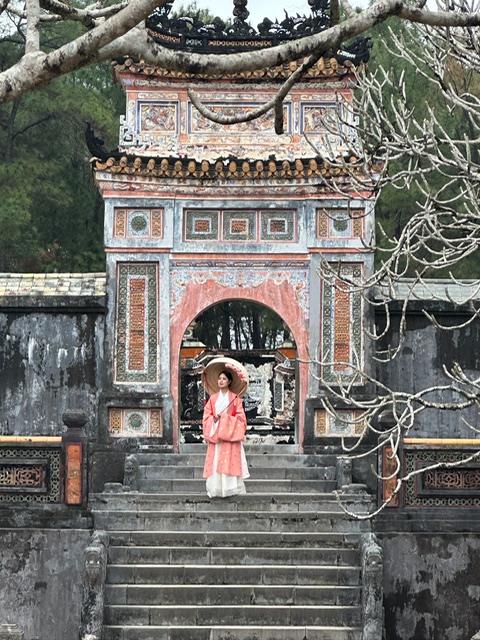
There was a standout “instagram” woman at this place. She/her photographer chose perfect places for her to pose and her outfit was the most spectacular of the MANY costumes that we had seen. They’re very serious in these poses, but when Scott walked by her and told her how beautiful he thought she was, she gave him a big grin. Photo courtesy of Scott:

As part of our tour on this day, we went to the Tu Hieu Pagoda where Thich Nhat Hanh died. Thich Nhat Hanh was a Vietnamese Zen master, poet, scholar, and peace activist. He was born Nguyen Dinh Lang in Hue in 1926. He was cremated after his death in 2022 at the age of 95. His funeral was a seven-day silent meditation course. Thousands of people attended his funeral at the Tu Hieu Pagoda.
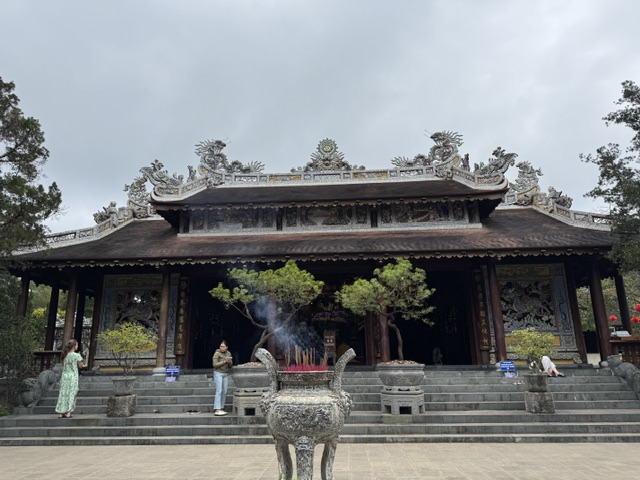
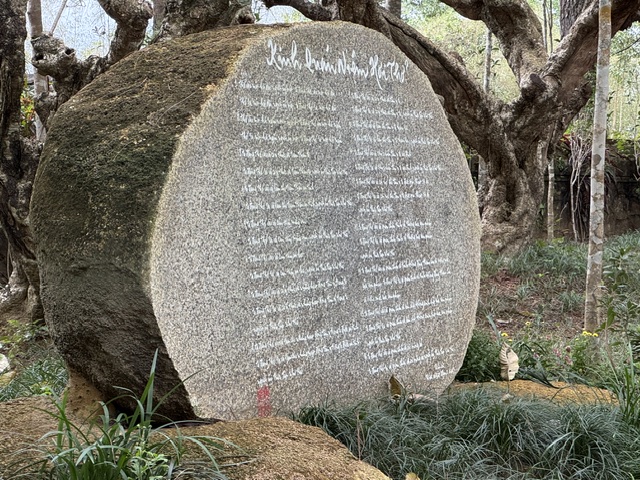
A slim chance was offered that we could go to the 4am chanting practice in the building where the monks practice, but our guide wasn’t able to find any monks and the buildings where he had gone before were locked behind a fence. We did see TNH’s burial tomb and the stone with a piece of his writing next to it. I would love to know what it says, but the script defied all of the translation apps. I’ll keep searching.
It was amazing being somewhere that Thich Nhat Hanh had been, but it didn’t feel like Thien Mu Pagoda and monastery. Still – a gift.
And finally, Scott had asked about where incense was made – we’d been seeing these astonishing circle incense burners that could burn for days, sending prayers and blessings out once lit. Turns out that right near Thich Nhat Hanh’s burial place was incense row.
Sadly, I was tired and missed getting a photo, but take these photos of this shop’s incense and multiply it by 10? 15? For all the stores in a row, beautiful. We ended up buying a variety of things here. We took so long, they finally gave us tea and ginger and we just sat down while they made a bracelet for Pat.


That was our last stop. Our guide said there was a great restaurant 10 min from the hotel, bit all we could think is that when we got back to the hotel, we weren’t leaving!
In the meantime, our guide was supposed to drive and drop us in Hoi An, the next town, but we liked him so much, we asked him to stay with us and do a walking tour of the town once we got there. And he could! That’s tomorrow.
 Reb's Walks!