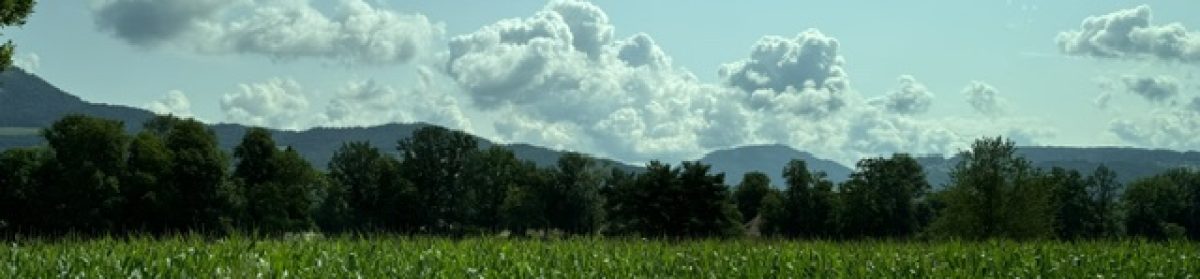
Per usual, I was up at 5 and saw this early morning scene from in front of my room. Early fishing boat:

Today we took an early flight from Danang to Saigon. Again, we walked into a really interesting day, this time fully focused on the Vietnam war. Our guide (I’ll call him Joe) said – you’ve come from the north – they’ll be really careful about what they say. You can ask me anything in the van, if we’re outside the van, we can talk some, but quietly.
US Consulate – we drove by this, it’s still in operation, though it’s been modernized. It was empty for 20 years after the year, then was given back to the US. Since it was in poor shape, they had to tear down one main building, but the rest remain.
Reunification Palace – former headquarters of the South Vietnamese Government and presidential residence, then taken over by the North Vietnamese. This was a very cool building, though at first it seemed pretty uninteresting compared to the original French building that had been there. However, the windows were largely designed with bamboo looking pillars that allowed air and light to flow through, allowed them to see enemies approaching, but didn’t allow anyone to see in. Pretty remarkable. The whole building was designed on Feng Shui principles.

There were photos of someone who’d been a VC (learned that Cong in Viet Cong meant communist in Vietnamese) and had joined the south as a spy. He was in the South Vietnamese army for 5 years, rising up through the ranks and was then sent to America to train as a jet pilot. He came back and moved up in the Air Force until he was flying jets. He then loaded his jet with 2 bombs and drove over the palace and dropped his bombs. He’d been in the building and knew the weak point was the staircase. He dropped successfully but the bombs didn’t explode. Local lore is that the dragon rug given them years before at the center of the building just in front of the stair case kept the bombs from exploding. No one was hurt and they now show where they were dropped next to a helicopter. The pilot flew straight to “an improvised airstrip prepared by the Liberation Forces” and turned his plane over the VC.
The note about the bombing was interesting – adding this detail. “This feat seriously undermined the republic’s authority and prompted the US President to order the evacuation of the last of the Americans still in Sài “. Note Liberation Forces capitalized and republic is lower case letter. Throughout our days in central and southern Vietnam, the stories and semantics shifted depending on who was presenting the info.

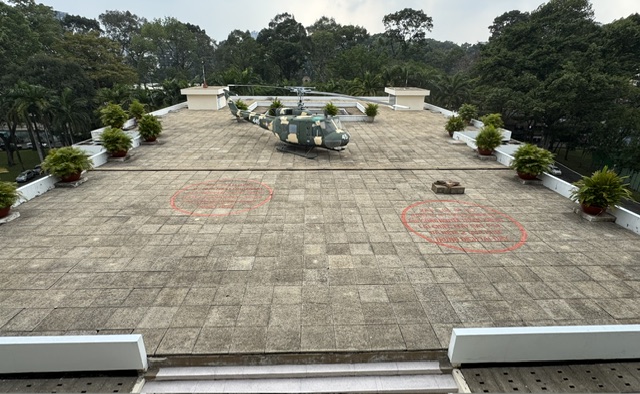
It was interesting to go through the whole residence. Some gorgeous meeting rooms and designs, as well as this scene used for a photo posed by Joe, our guide.
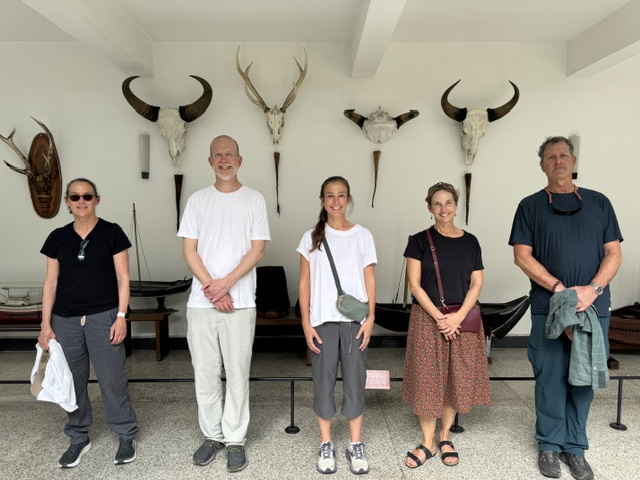
We then went down to the bunker.

Throughout the Reunification Palace, if it was the president’s private area, there were multiple phones for different connections. If there was a black phone, that was the direct line to the US. In the bunker, there were multiple rooms with phones, typewriters, radios and it was so hot. This was the president’s bedroom.
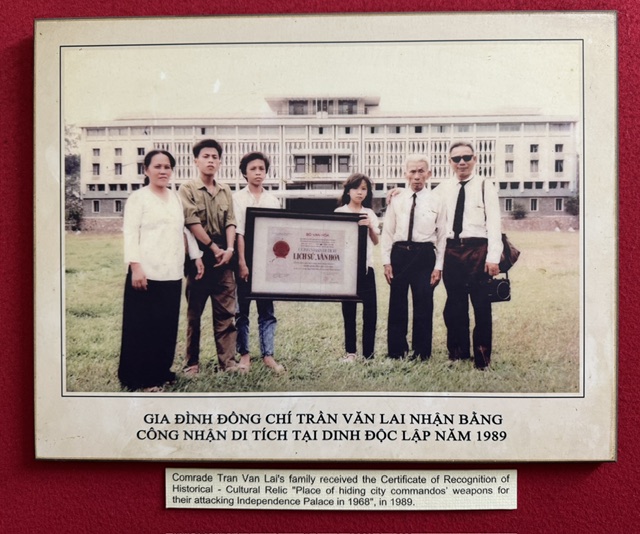
Our next stop was a secret weapons chamber used by the VC. This was a wild story. The man who owned this house was secretly devoted to the communist party. He was the contractor who rebuilt the Reunification Palace. He knew that the weak part was on the side. He and fellow VC secretly brought in weapons from the Ho Chi Minh trail hidden in fruit baskets, bamboo rolls, carved out panels of wood, and under food carts coming to the market – which was outside his door on the street.
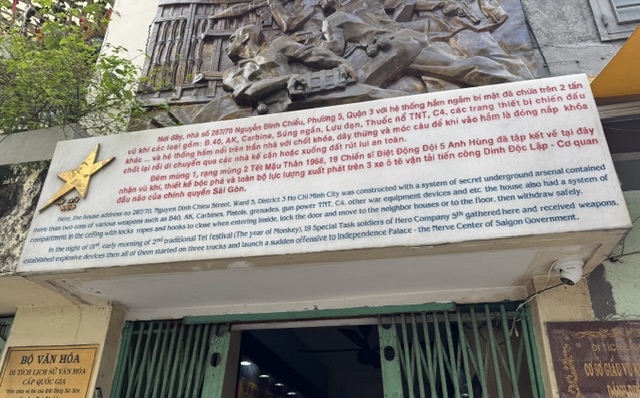
He then built a bunker under the house that connected to bunkers under 3 more houses. It was a tiny space in the one that we saw, but he stored a ton of weapons in preparation for attacking the Reunification Palace in an assasination attempt on the president. There were 50 in the group who attacked; he wasn’t there since he was directing as general. They severely damaged the building, but in the end were all killed or declared missing. There was a photo of maybe 8 of them with the general after the war was over. The South Vietnamese strongly suspected that his house was the source of the weapons and came with weapons firing and shot up his front gate – you can still see the bullet marks. They then went through the whole house (tiny) looking for the storage space. It was so cleverly disguised that they never found it. Red and white checkered floor – with one very small panel that could be pulled up by the edge of one of the tiles – hid the bunker. We went down into it, tiny, crazy, and clearly the man was completely committed to the case. Later after the war, he was very famous and highly rewarded for his efforts.
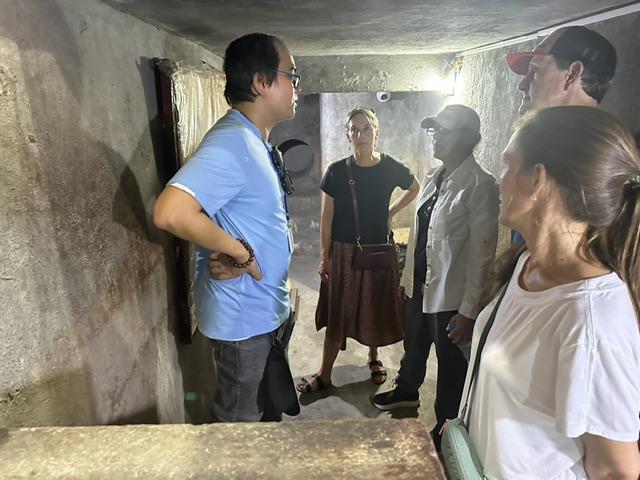
In the bunker.
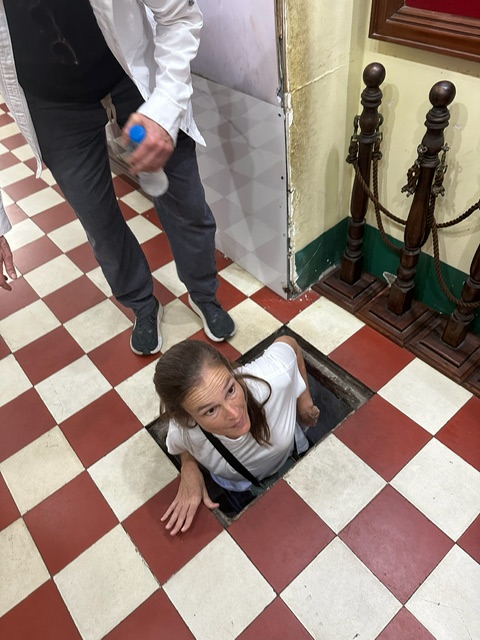
Getting into the bunker!
Next was the former residence of the US Ambassador of South Vietnam in the early 1960’s, Mr. Henry C. Lodge Jr who “supported the overthrow of the South Vietnamese government”. This note was from Wikipedia and things can definitely be slanted here when you Google items. In fact, he was very committed to the Vietnamese, but thought it was a losing battle by the end and wanted America to pull out. We watched a short documentary film in the living room which fleshed out a bit of the story from Henry Lodge’s perspective. The house itself was a fourth of what he had when he lived there with his family – there were 4 houses connected, a full block. Now it’s one section, but still beautiful. Joe’s boss is the owner of the guide business and bought this house, keeping a fair amount just as it was when Lodge was there and living more in the back. Amazing.
Joe then took us to our favorite lunch of the whole trip. This was a fried pancake shop, making the same kind of pancake sandwich that we had on the bike ride. But the woman who started it had a particular method of cooking and particular ingredients. Her daughter/grandaughter? Was the one cooking now and we were able to take video as well as photos because she loved explaining how she cooked (vegetable oil now because of so many allergies) and seeing how much people liked her food. There were also two things that came in banana leaves – a rice paste with things on top. I really liked this one as well as the fried pancake.
Her son did a trick with a piece of wood and a screw and three beer bottles, opening them with one quick chop. A big crowd pleaser that one!
Finally, the woman showed us a photo from the Tet offensive during the war – mostly destroyed. Scott or Pat then took a photo from the same vantage point showing what it looks like now. I’m hoping I can find those photos.
Rex Hotel – we went here for a drink at the end of the tour. I asked why so many signs say Cocktails/Mocktails. Has it always been that way? Joe said that last year they cracked down on drinking and driving. If you’re caught having drunk anything at all, you’re fined severely and can have your scooter/bike/car taken away for 2 months. Serious consequences. Joe then said that many police are undercover and just watching. So they’ll be on a corner and watch what people are doing, remember the faces of people drinking and then if they see a person driving who’s been drinking, they pull them over. Joe said he couldn’t pick out the policemen. When they’re wearing their uniform, they’re off and showing off. Most are undercover when on duty.
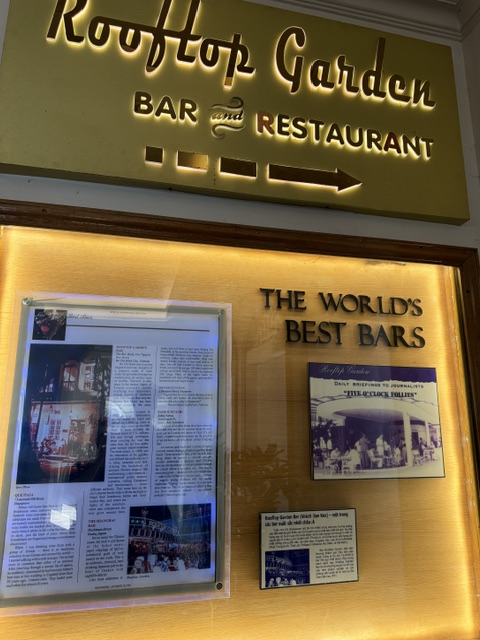
The hotel’s bar was the site of the United States military command’s daily press conference, and derisively named Five O’Clock Follies by cynical journalists who found the optimism of the American officers misguided. The daily event was hosted by Barry Zorthian, chief spokesperson for the U. S. government in Saigon from 1964-68.
From the Rex Hotel on the balcony – where the famous bar is – we could see the former CIA building, where helicopters did the final evacuation in April 1975. We saw this from a distance and it was a TINY little spot on top of a building. They had a photo of swarms of people on the ladder and leading up the ladder – they’d climbed 9 stories to get to this spot. And only 8 people were able to get on the helicopter and then it was gone. Awful. That famous ladder is now in the Gerald Ford museum.

We were ready to call it a day after this, but Joe told us we were making a BIG mistake if we missed the Vespa food tour. From the first time we started planning this trip, Kellie had said she was not going to do the Vespa tour. In the end, we all went.
Our guide and the Vespa drivers were all from the Vespa Wanderers Team. My cortisol leves were VERY high for the first leg, by the second stop, I’d relaxed, by the third, I wasn’t even paying attention to the traffic and was just watching the city go by. The drivers were so safe, communicating by radio on their vests, using blinkers and totally safe.
Saigon is a beautiful city, very prosperous, clean, lot of great food and a lot of shopping. For the party members – crazy high end shops and cars driven by only a few. But many people were out and about and it seemed like it was far removed from being a third world country. In fact our guide, the gorgeous and very energetic Chi, said that was the case. People have food, are starting to have more choices. She was from Hanoi, but had left and was living and working on her own and having a great time!

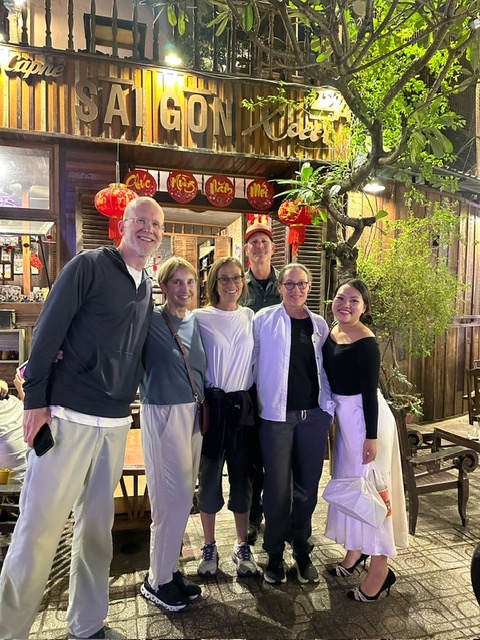
Finally relaxed after this stop!
So – a long day, but full of very cool experiences, and we ended it on a high because the Vespa tour was so much fun.
 Reb's Walks!