We got to sleep in a bit today. Surprisingly, everyone was still up and at breakfast by 7:30, with Eli W being the first one up!
We decided to meet and walk towards the Agora, going through the Plaka area, the old city with shops, coffee shops, restaurants. I led the way, repeating my walk from a couple of days ago.
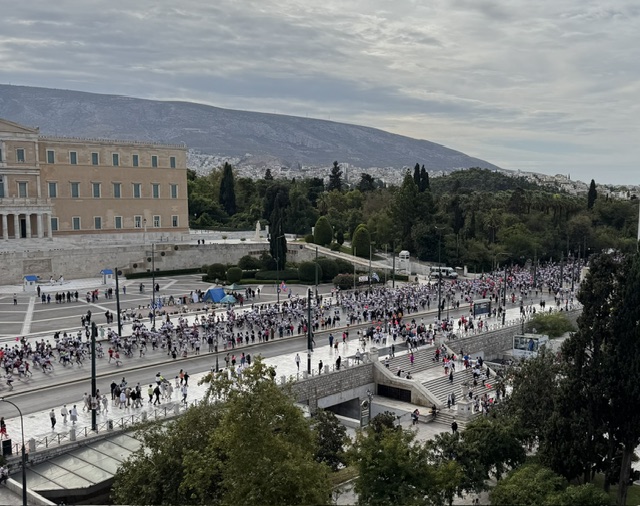
We started down through a street completely clogged with a Race for the Cure run. A 5 K that had 1000’s of people streaming up from the metro to join the start in the park. How totally fun to be able to see the gathering start from above before we left for our walk. I hope they raised a ton of money!
Hard to imagine now, with 4.5 million people and modern streets and incredible history, but 200 years ago when Athens started to rebuild after the Ottoman Empire was ousted, there were only 10,000-12,000 residents. Europe had helped Greece oust the Ottoman Empire and put a king, King Otto, from Germany in place. He rebuilt the city, making Athens the capital of Greece.
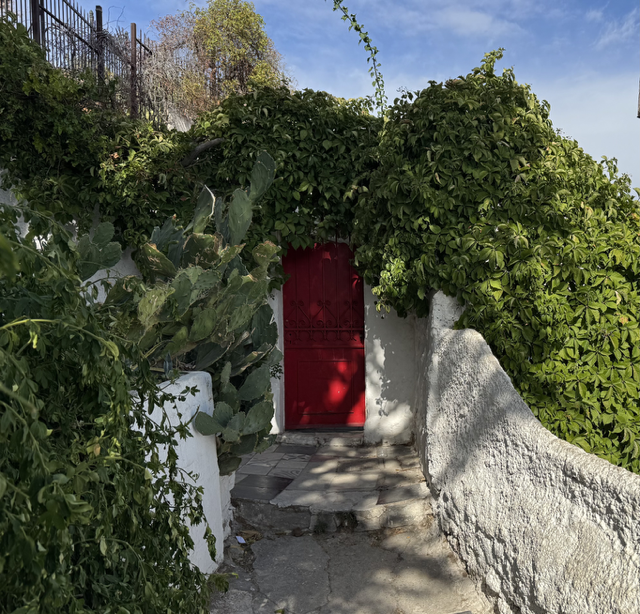
We walked along narrow streets, ending up in the wonderful neighborhood of Anofiotika. This cool neighborhood was built into the hillside below the Acropolis. In the 1840s expert masons, stone-workers, and builders from the Cycladic island Anafi signed on to construct a royal palace for the new King Otto and to help excavate archaeological sites around the Acropolis. A law at the time stated that if you erected a building between sunset and sunrise, the property was yours. So working at night, using the traditional Cycladic building methods they had grown up with, these builders fashioned their homes right below the monument they were excavating by day. The new locals called their neighborhood Anafiotika, which means “Little Anafi”. This little neighborhood is just wonderful, tiny lanes, tiny sidewalks, a wonder to walk through.
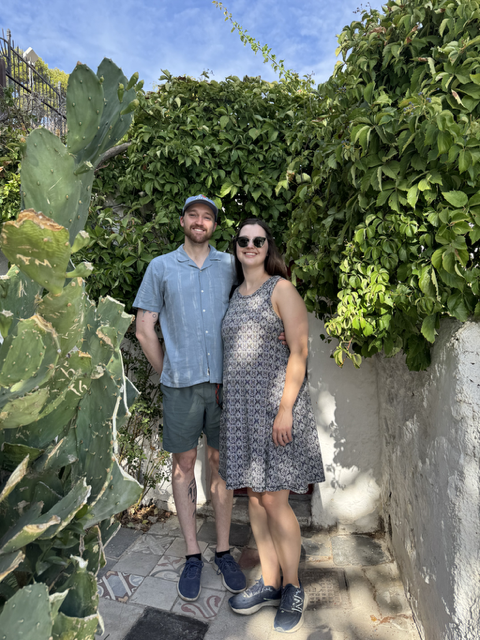
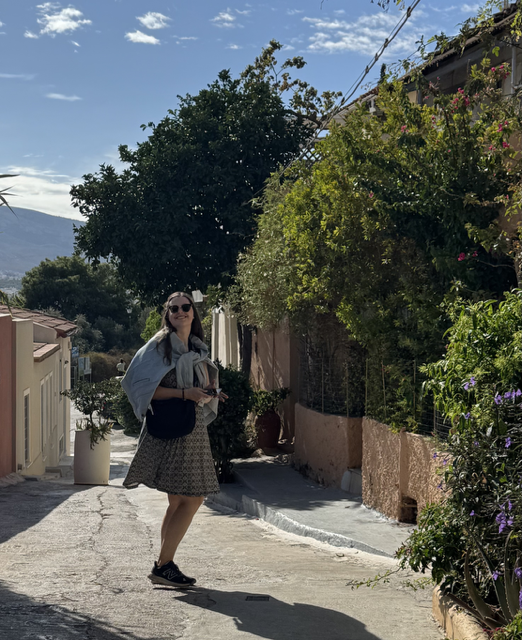
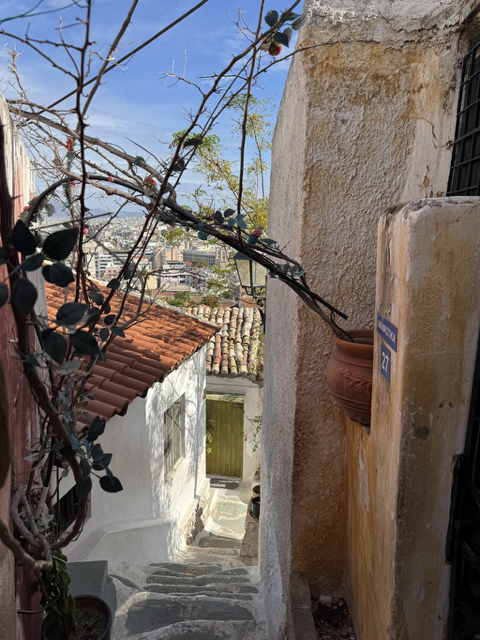
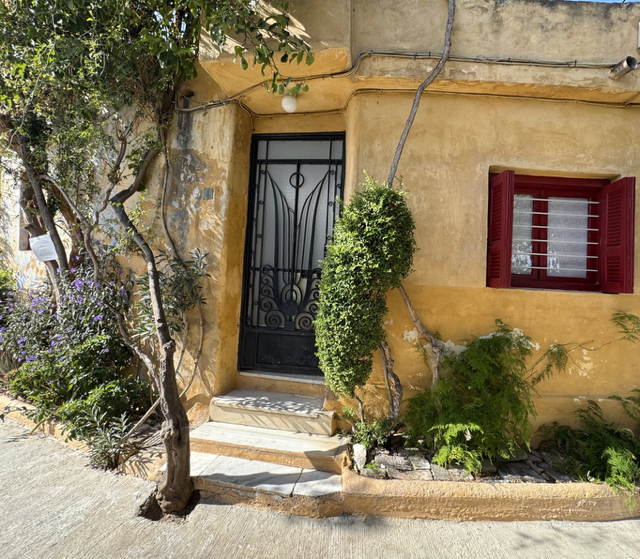
We then walked down through the Plaka neighborhood, just below and curving around Anafiotika. There were shops, restaurants, houses on a sleepy Sunday morning with people going to church and visiting family. Rick, Eli W and I continued onto the Agora to listen to Rick Steve’s tour (for me again, always learning more). Rick wanted to see where Aristotle taught – yep, here in the Agora!
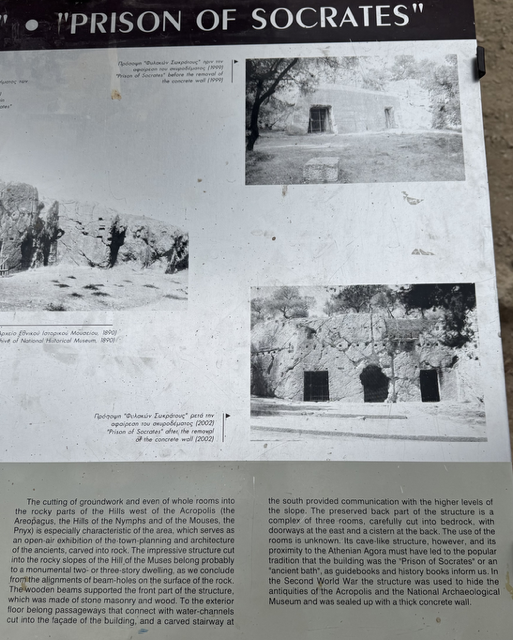
We then walked back, circling the Acropolis as I had done the other day, but MUCH more efficiently, getting back to the hotel in about 30 minutes. We did see Socrates’ Prison. Turned out this was a name given to the space, I don’t know that Socrates was ever here, but the Greeks hid the treasures from the Acropolis here when the Nazis invaded, cementing up the wall in front of the caves. And it worked! Saving many treasures. I thought I had photos of Rick in front, but nope, don’t know what happened. Here’s the plaque and a photo.
Back at the hotel, we rested our feet and then walked out again with Valentina – a guide taking us on a food tour of the Plaka. Oh my goodness, so good and so much fun! She was full of stories and enthusiasm about food and Greece and Greece’s history.
And did I take photos? Hmm, not many. Valentina took a bunch of photos and is sending to me, I along with the names of where we went, what we ate, etc.
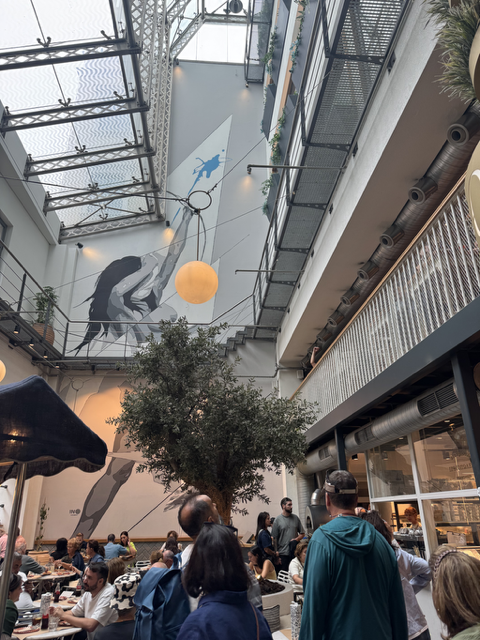
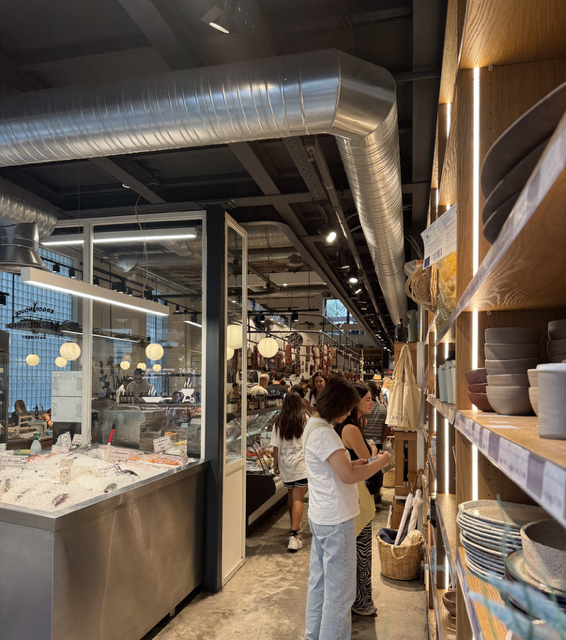
This was a stop, Ergon, for 3 kinds of cheese, 2 kinds of meat. All of them were originating from Italy. The Greek creators lived in Italy, learned a specific item, then came back to Greece and made it Greek. Sheep and goat milk instead of cow, spices added to the meats specific to Greece, etc.
The family who started this restaurant/store was a couple with two young boys who had a market stall. When they were ready to sell, the brothers decided they wanted to grow the business. Their parents were already known for selling the most pure cheese products, meat products, vegetables, etc. So the the brothers decided to stay with this theme and traveled the country looking for small farmers, entrepreneurs specializing in the BEST feta, the BEST ham, the BEST mushrooms, etc. They then enlarged the space and started serving a small cafe as well as the store. They grew, started a second store, then built this restaurant store, decorated by the most famous Greek street artist.
In the background, they were also quietly doing work with their producers, teaching them how to market, set a logo, disseminate their products etc. Helping many in Greece get the word out about their unique products. They did not advertise anything about this foundation sideline, but work got out. And their fame and name grew.
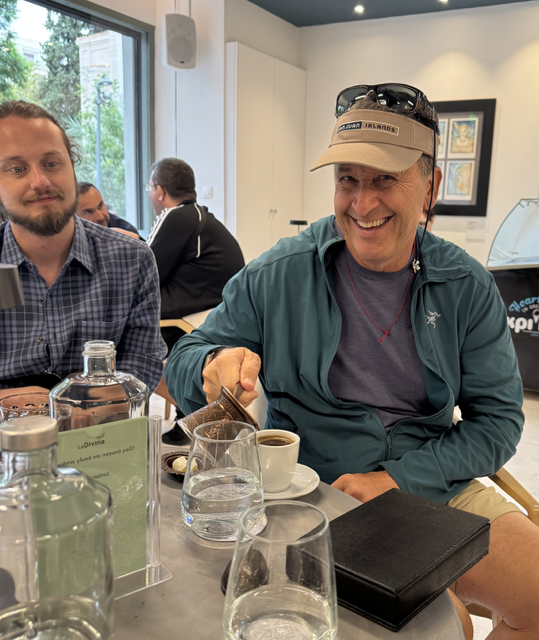
Our next stop was for Greek coffee. The cafe off the Maria Callas museum, and it was wonderful. Turns out in order to make real Greek coffee, it has to be heated over hot sand cooking in a copper pan until bubbles rise in the small cup and once the grounds in the bubbles are skimmed off and it’s almost at a full boil, it’s turned off. You can add a bit of sugar, but NO milk product. That would be horrifying.
This tradition came from the Arabic traders who brought the beans to Greece. Evidently (according to myth/fact) one of the nomadic traders wanted to have coffee during the day, not just in the evening when they had time to cook it. They only carried copper pots and he realized between the metal and the heat of the sun, he could bring water and coffee grounds hot enough to make a great coffee. Obviously, not a lot of cows traveled with the camels. A final note was that it was to be sipped, not tossed back. No, no – there’s mud at the bottom! Rick said it was amazing coffee.
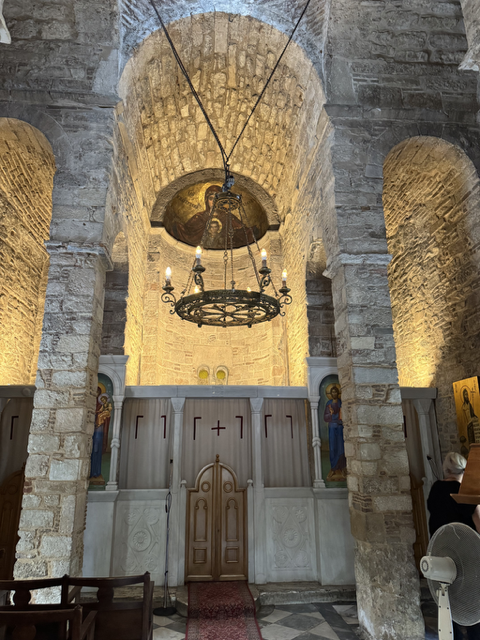
We did make one church stop – the little one that I’d seen before next to the giant cathedral, built in the 1000’s, maintained and we got to see inside. It’s tiny, but simple and wonderful. The family rolled their eyes that I managed to get in a church viewing even on a food tour. But just one!
We moved way too fast for Eli C – he loves all the items, would have been very happy to have way more time in the stores. But, hopefully, when we come back through after Meteora, we can go back and get some products. Like halva (sesame paste, so pure, incredibly good), honey, oil, spices. He’s going to need another suitcase 🙂
We had eaten our way until 5:30 and we came back to the hotel and that was it for the evening. Eli C went out for one more souvlaki, but the rest of us were ready for a chill evening. However – there was a big event going on outside our hotel and I watched it build from 5:30 until it ended around 9:30.
We’d gone by the parliament building and had seen the flowers, candles and a tent set up outside the building. We learned that this was an ongoing protest about a train accident from 2 years ago and this week, one of the fathers of the one of the young people killed had started a hunger strike protest.
It was kind of bizarre to see the soldiers marching in front of the tomb of the unknown soldiers in the midst of this sad protest. But they continued their march. We had seen them marching in front of the president’s house yesterday and had noted the kilts, the pompoms and the piece of black material hanging down from the hats. And tap shoes? The steps were incredibly precise, I’ll include a video. I knew that the kilts had 400 pleats to recognize the 400 years of Turkish rule that was overthrown, starting in 1827, fully recognized and borders drawn by the European countries in 1932. But the pompoms and black piece of fabric? Valentina told us that every piece of the uniform and the march itself were symbols of the war of independence.
The slow loud march of the tap shoes was because that was part of the guerrilla strategy against the bigger forces of the Turks – making them think there were more soldiers coming their way than there were. The black material indicates the mothers’ tears for all who died. The pompoms were part of what people wore on their shoes in the days of revolution. They weren’t allowed to carry weapons, so they fashioned pompoms as “decoration” but in fact they were designed to hide daggers. Here’s a video of the march in the midst of the protest.
Back to the protest: I went online to get specifics on the protests – they’ve been ongoing for 2 years since the accident – and have grown huge again. Today, with the father of one of the university students who died having started his hunger strike and the people in the city for the race, there was a huge protest on the steps of the parliament building. When I searched online, the first article that popped up was from NPR from February and it’s now September and the protests are still going strong.

https://www.npr.org/2025/02/27/g-s1-50918/greece-train-crash-tempi-protests
It was sad and impressive and I very much hope they get answers and accountability. Valentina said they had the money to do the necessary repairs that the train unions had been advocating for, but the money went into someone’s pocket. She also said the families of the students who died have become a strong network with a lot of public support.
I watched throughout the evening, listening to the songs, trying to get google translate to decipher the speakers’ messages – didn’t work except for brief random sentences.
Then, vacationers that we are, Eli W, Rick and I also watched the second episode of this season’s Great British Baking Show.
 Reb's Walks!