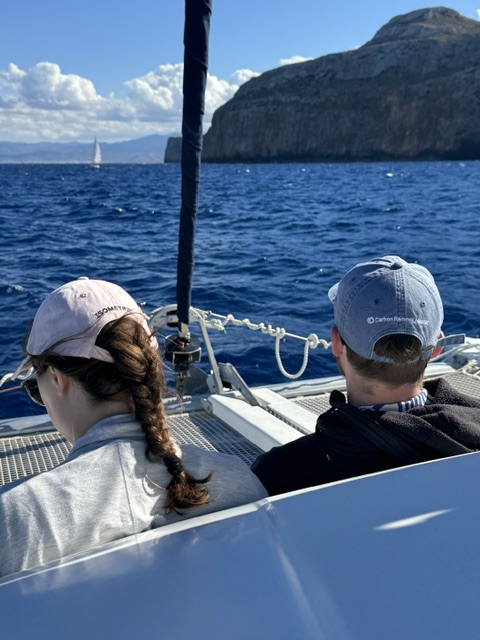
Today was a day mostly away from history and culture. We went out on a catamaran to see the gorgeous Greek water, a particular wish of Eli C’s.
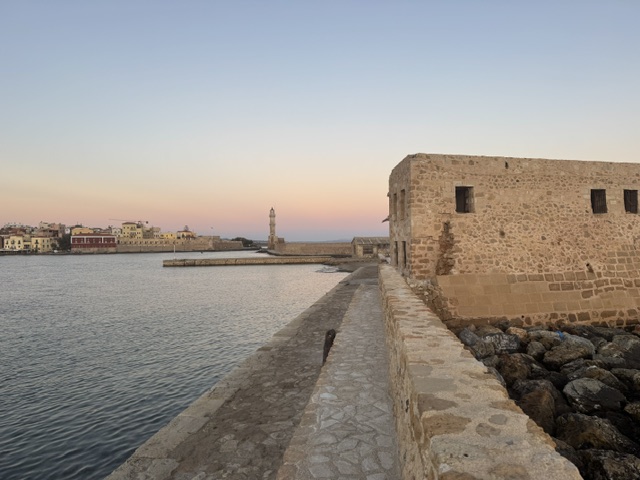
First, however, Rick and I got up in time to see the sunrise from the Venetian harbor of Chania.
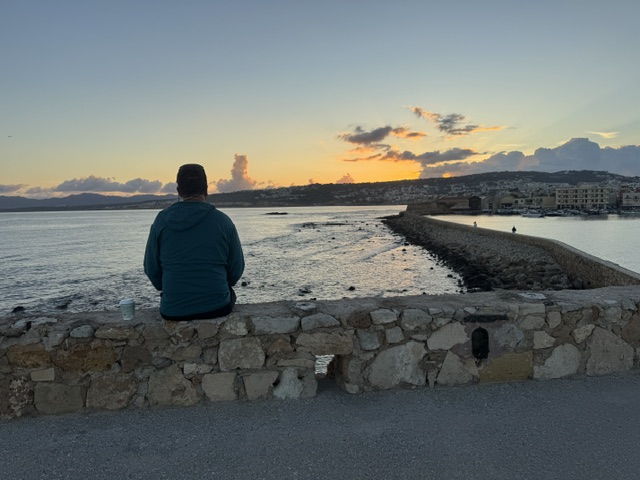
A man and his coffee cup 🙂

Eli W decided to stay back from the boat trip, he’s not such a swimmer and he really wanted to explore the town on his own. He said he had a really nice day exploring the old town and found a pair of linen pants that suited the hot weather.
Eli C, Kaziah, Rick and I went, meeting up with 4 other people and it was just a treat of a day.
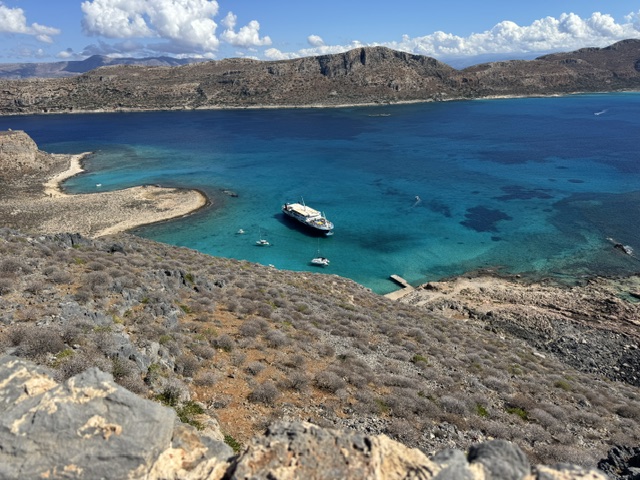
Below is our catamaran from the top of Fort Gramvousa – I’ll write about that in a bit. Our boat felt quite sizable when we were on it, but next to the ferry pulling in and unloading a ton of people, we look tiny. Rick and I climbed up, but Kaz and Eli wanted all the swim time possible. The water is wonderful with so many different hues of blue.
Our first stop was the Balos lagoon, whoops, I forgot to get any pictures. But Kaziah did. Here’s Eli reveling in the warm turquoise water.
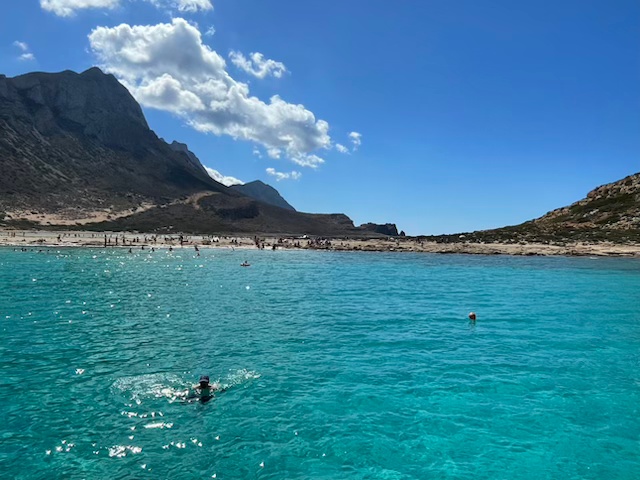
We swam to the lagoon from the boat and played a bit around the boat, had lunch on the boat which was great and then continued to Gramvousa Island. Ok that island did have some fun history to add to our day of leisure.
The Gramvousa Island fort defended Venetian trade routes and was also a strategic base in the event of a new Ottoman-Venetian war for Crete. Greeks fled the Ottomans on the mainland to Gramvousa and Gramvousa then became a hive of piratical activity that greatly affected Turkish-Egyptian and European shipping in the region. During that period the population of Gramvousa became organised and they built a school and a church. The church was called Panagia i Kleftrina and was dedicated to the wives of the pirates. Only pirates were allowed to enter. The pirates did have a code they lived by – they only stole food and cargo/money, but never killed anyone and always left the boat to the sailors/passengers.
In ancient times the island was known as Korykos, which means leather bag. The island was renamed “Gramvousa” in honour of Vousa, the wife of a pirate chief and the only inhabitant of the island to evade capture when the pirates were forcibly removed in 1828 by British and French ships after Greece gained independence and had naval support from Britain and France.
Currently there’s a caretaker who lives there with his wife and 2 kids (not an extravagant life) because he likes the isolation. Tons of people get off the ferries during the season, but then free!
We went out to dinner that night at a place Valentini had suggested for “authentic Greek” that Kaziah directed us to. Unfortunately, we’re not authentic Greeks so it wasn’t a successful meal except for a couple of amazing appetizers, but cats were coming around and I wanted to give them Rick’s fish. It didn’t have sauce and would have been benign. To the family’s dismay, I took a chunk and dropped it to the cat looking up at me with pleading eyes. We were sitting on the porch next to the sidewalk, so we were outside. Then there were 2 more cats. We had worried about that. I then read online that many people took their left overs and gave them to the stray cats that were everywhere. The family wouldn’t let me do it. Not sure why.
The next day, we asked our guide about this situation. She said yes, people give food right in the restaurants and take their left overs for stray animals. We saw signs in the old city of Chania near restaurants saying please don’t feed the cats, we give them the food at the end of the night. I didn’t see a single cat that didn’t look well fed and they looked healthy too.
When I looked online to see what it said about Greece and cat culture, it supported this idea that they’re cared for and appreciated. “In Greek culture, the regard for cats is a mix of ancient respect for their utility and independence and a modern appreciation for them as a beloved and ubiquitous part of the landscape. Cats have served as pest control, symbols of luck and resilience, and companions cherished by locals and tourists alike.”
It was a treat of a day – again!
Note on corruption – wow, completely consistent, these people do not have any regard or trust in their government. Cristos who drove us to and fro the catamaran said that these current protests for the rail accident are small, but continuing. He’s friends with the lawyer who represents the parents of the victims. He’s seen crowds of a million in Athens and 10,000 in Chania protesting this accident and the government coverup. Legally and politically, once you’re in the system you can’t be touched. So even if they knew directly whose pocket has the money that was supposed to fix and update the trains and the signals – they couldn’t touch them. But they’re continuing to try.
 Reb's Walks!