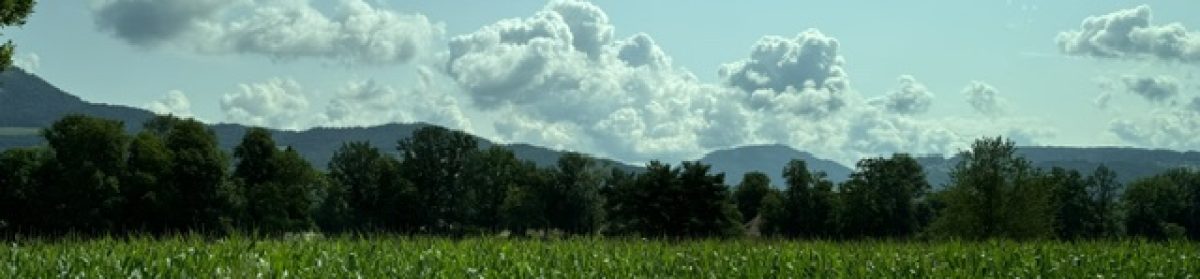
Katarina our guide was great. I wrote a few notes in the van as we drove north towards Delphi and Meteora. We were driving into new territory to us and she said that 80% of Greece is covered by mountains and hills, Olympus is the highest at 10,000. Parnasus goes up to almost 8,000 feet and Delphi is there.
Helas is what the Greeks call their country. In the 6th century BC, the Mediterranean Sea was actually a Greek sea since the Greeks owned all the land around. Barbarbar – was the word they used for barbarians – for those who didn’t speak the language and weren’t cultured.
On the way to Delphi, we passed the dammed Marathon lake that was the sole source of water for Athens until the 1950’s. The Marathon race gets its name from this area. The Greeks defeated the Persians in 490 BC and the fastest runner, chosen by the king, ran back 26.2 miles to Athens to let people know. He gave the news, then dropped dead. Happily, the outcome is different for most who run marathons these days. The marathon is held the first week of November here and is huge.
Now passing Thebes. Thebes, Argos, and Athens have all had continual occupants for 5 millennia. Thebes is the birth place of Dionysius, god of wine. The most famous offspring of Thebes was Oedipus.
We passed through a small town before Delphi. In WWII, Mussolini demanded that Greece allow the Italian army to invade coming from Albania. They said no and had success pushing them back. But then the Nazis crossed the border from Bulgaria and within a couple of weeks, the Nazis reached Athens and put the swastika flag on the Parthenon. Right away, guerrillas, men and women, immediately went to the forest and started attacking transport trains, bridges that supported them, etc. Each time they had success, the Nazis would decimate a village.
4/12/44 end of the Nazi rule. On the way out of the country, the Nazi’s destroyed everything they could, canals, fields, villages, etc. This really pushed the farmers to move towards Athens, nowadays the trend is being reversed. People are starting to move back towards their families villages houses that were still held and kept when they moved away. The people who moved back post/curing COVID are doing tourism, agroturismo, or farming.
Agachova – we drove through this incredibly picturesque mountain town, so pretty. But in the van, so I don’t have photos.
The Panhellenic Games were the biggest of the competitions that brought all together, in the name of Zeus. The second biggest were in Delphi in honor of Apollo. The symbol of Apolonia was the laurel – the poet laureate gets its name from here. Delphi was considered to be the center of the Greek world. Zeus dropped the stone in the spot – known as the navel.
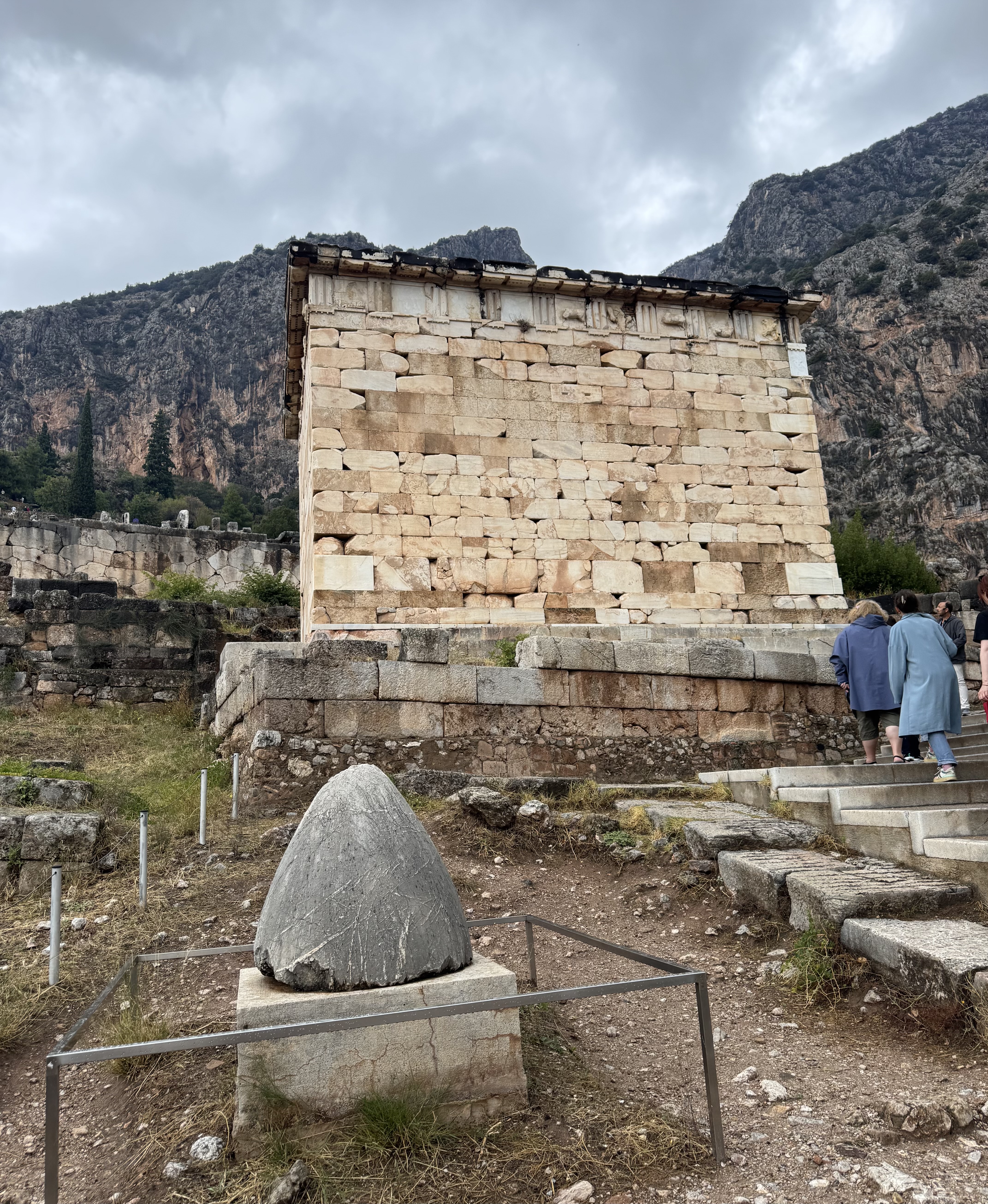
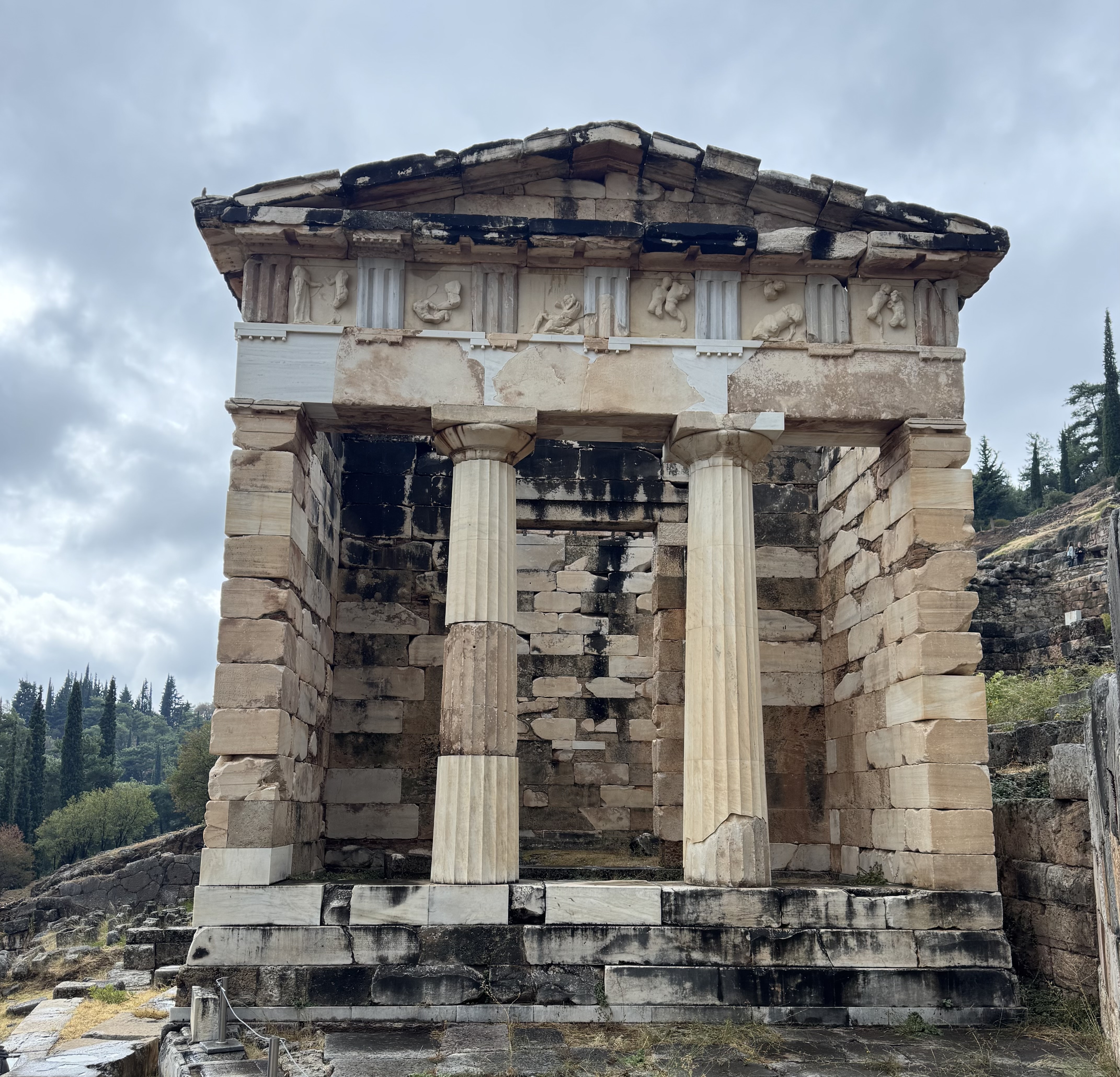
This photo shows an ancient, though probably not the original, egg shaped “navel” that was at the center of the temple. Behind it is the rebuilt wall of the Athenian treasury from the people of Athens to Apollo. Again, using all the original pieces they could find and it’s remarkable what they did find.
There was never a city in this area, it was considered a panhellenic sanctuary. So no big center or settlements nearby because the temple might come under the auspices of that settlement.
The Delphi sanctuary had to be excavated because an entire village was built on top of Delphi. The village had to be torn down and rebuilt a few meters to the west. I asked about how the people felt about this and they were ok. They knew there was an important site under their houses, they got new houses, new infrastructure and the possibility of jobs both working at the site and being able to offer food, hotels, etc. to tourists. The French started the work here with an agreement with the Ottomans who were still in partial control. This started in the early 19th century.
Delphi was originally a site of Gaia, the female earth goddess. There was a serpent that guarded the site and Apollo killed the serpent in order to take over. The prophecies at the Oracle of Delphi were given over a period of nearly 2,000 years, beginning in the Mycenaean period (around 1400 BCE) and ending in the 4th century CE. The oracle, known as the Pythia, was a priestess of the god Apollo who was believed to channel prophecies while in a trance.
Prophecies were given 9 days a year, once a month except during winter. There was a process on the days of prophecies. The people would line up on the avenue leading to the temple. A group called the Panhellinion league would hear the question and it had to be a clear question presented by a city’s delegation. This was not a place to ask about your future or if you would get a husband. The requests were about auspicious places to put a temple, build a city, manage a political issue, auspicious time to have a festival. If your question was deemed important enough to put to the priestess, a pure perfect animal was sacrificed and then the question was put forth.
The offerings given at Delphi were always vague, not specific. The people of the time believed you couldn’t escape fate, but you could have direction in how you lived your life. The league was made up of representatives from all areas of Greece. This was a neutral territory recognized as sacred by all.
This Panhellenic league would know most of the country’s issues because of all the people who came to request answers and would navigate the ongoing questions to keep the peace as best as possible. The league would give the question to a priestess (at the most popular times, there might have been 3 at most). A priestess, Pythenian, would get the question and go into the inner temple and breathe the air (most recent science indicates that there was a gas that came up through the rock fissures), and come back out to give the answer. The answers are always needed interpretation. The saying over the temple door was “Know Thyself”. Thus, if you were clear, knew yourself, you could interpret the best outcome from the priestess’ answer. If you weren’t clear, your interpretation probably wouldn’t be clear and you might not be able to even approximate what the message said.
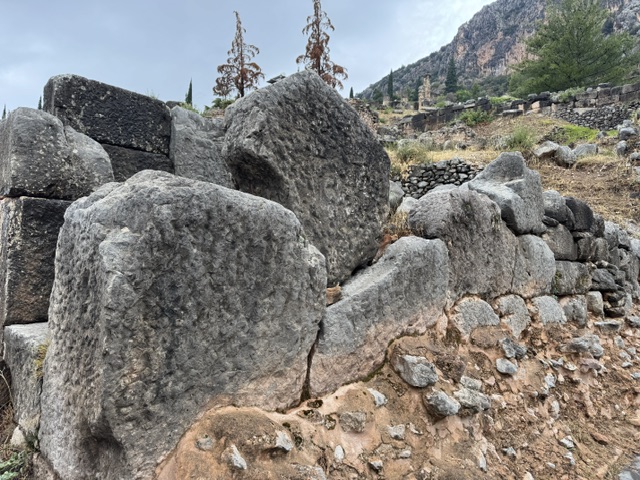
These stones forming the wall are from 6th century BC, earliest parts of the temple.
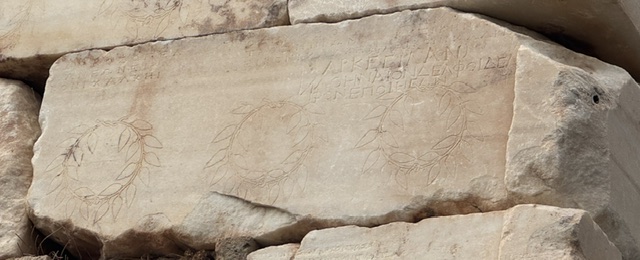
These stones below were inscribed with winners of the Panhellenic games, the great honor to have their names on the stones at the base of the temple. You can see the laurel wreaths.
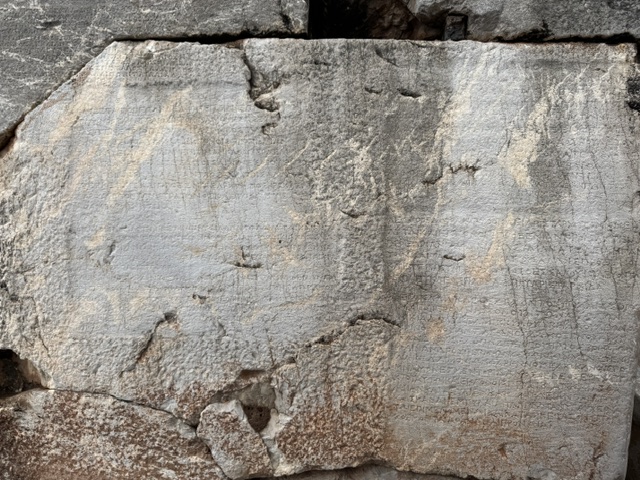
This stone’s writing below were the names of slaves who had earned enough to buy their freedom or had been ransomed and had been freed. By coming to the temple and having their names inscribed in the foundation block, they were official. Then it was their choice whether they stayed or went back to the country where they had been taken – most did this. Almost all slaves were from those areas that had lost in battle.
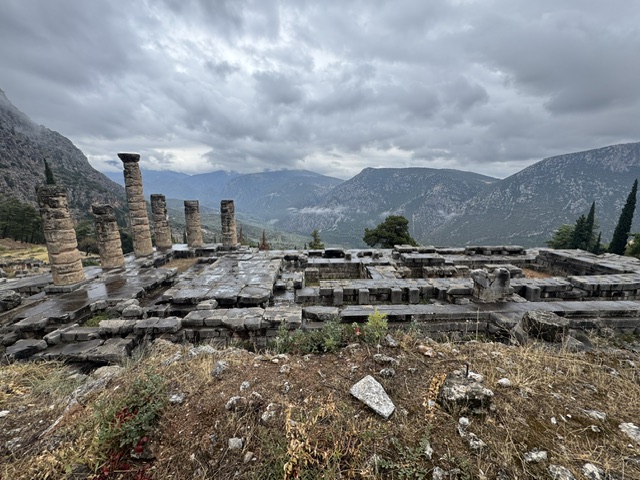
Here’s my best photo of the full temple – hard to grasp how big it is.
Dionysius was honored here when it wasn’t in Apollo’s hands. Apollo was all about order, music, poetry, the sun. Dionysius was the opposite, going for escstasy – having the wine, being drunk was like having the god inside you. The festivals were for everyone, high and low, women and men, including slaves. It let all those who were repressed to let go in a big way.
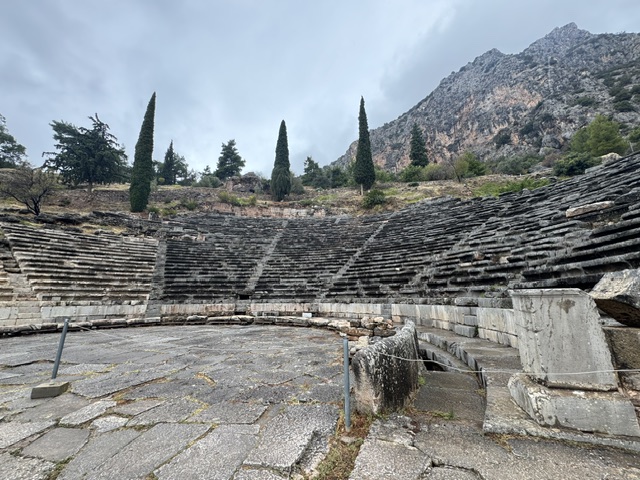
This is the theatre – it used to be much bigger, but it’s still pretty impressive!
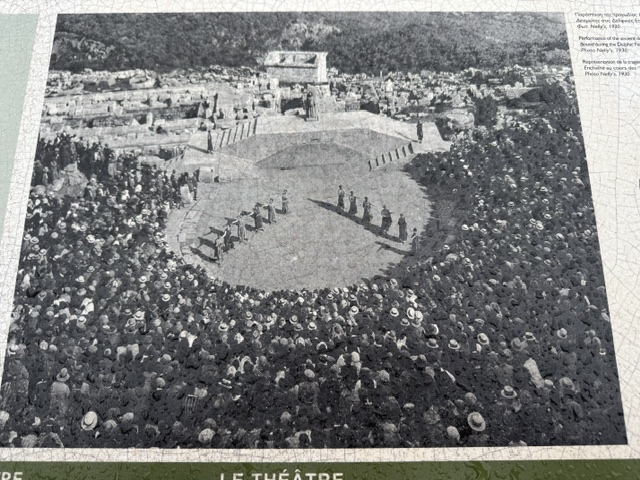
It was still in use in 1930, could hold 5,000 people – a performance during the Delphic Festival.
The citizens here strived for a balance: “Nothing in excess, everything in moderation” is inscribed in the Delphi site. This plus “Know Thyself” are the only two inscriptions. So balancing Apollo’s and Dionysian values.
Every 4 years were known as the Pythian game, originally started as funerary games for the serpent Python. The priestess was also related to this Python – all went back to the earlier traditions.
So Apollo, Dionysius, then Athena were worshipped here. She had a temple, we just couldn’t reach it because it was blocked off.
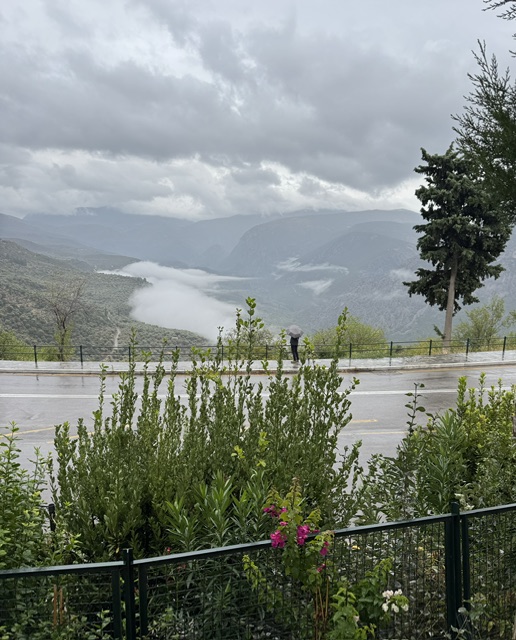
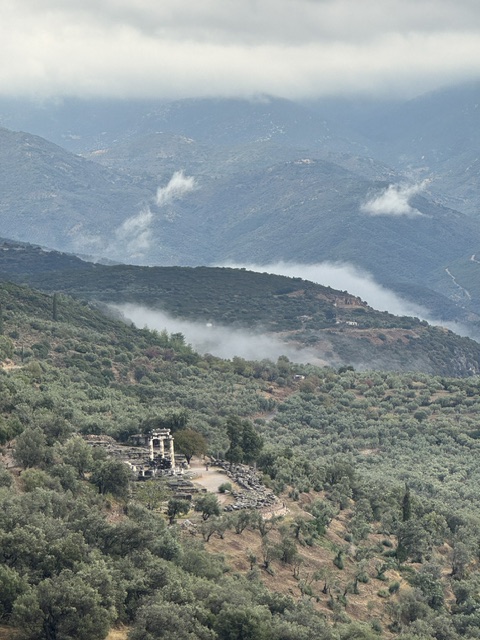
This is the view from the temple, the museum and walks around. It is a plain filled with olive trees below the Parnassus mountain. So beautiful and we got to see it before it completely filled with fog.
We then went to the museum which really did have just remarkable pieces from the site. My favorite, though not the most famous, were these two statues. Kleobis and Biton. Can you imagine finding these as archeologists? They knew immediately who they were because of oral traditions telling their history, but Herodotus wrote of them as well.
They are real characters, not mythological. 2500 years ago or so, there was a well-off woman who would go to practice at the site on the days welcoming women. One day, the oxen did not show up who were supposed to pull her palanquin. So her twin sons, strong, fit, at their prime, yoked up and pulled her to the temple. When there, she prayed that her sons would be given immortality. They pulled her back home after. That night, both brothers died in their sleep.
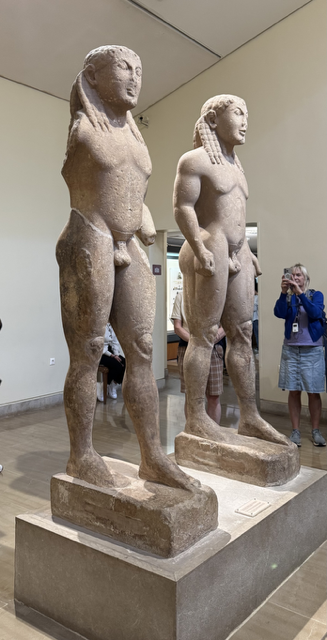
As Katarina said, this was the mother’s prayer answered. Since the people did not believe in any after life, the only way to have immortality was to be remembered. Because the sons were in the peak of their life, had done wonderful deeds, were beautiful, they have never been forgotten. As Katarina said, I’m telling you their story 2500 years after they died and we still know them and talk about them!
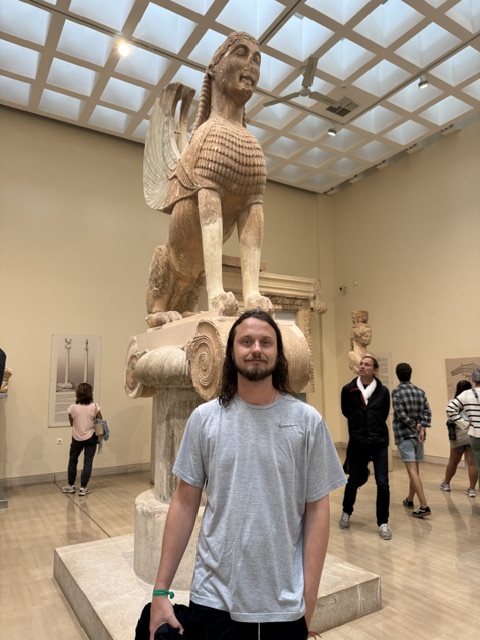
I loved the sphinx that guarded the temple, incredible to find it. 6th century BC. Crazy.
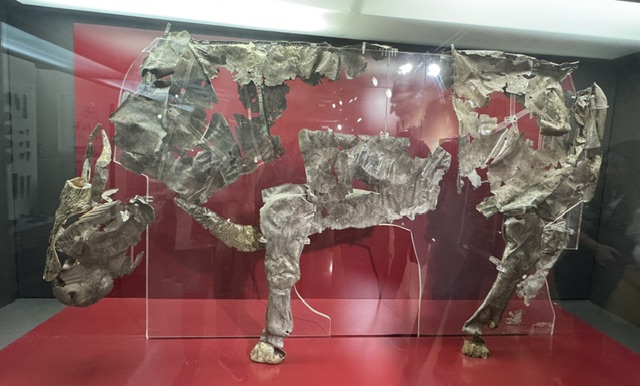
This was a bull that was wood, with silver nailed to cover it and then gold plated in different areas. Truly amazing, both that it had survived from 6th century BC and that they were able to put it together this well. A number of the nails that held the silver to the wood were still in the metal.
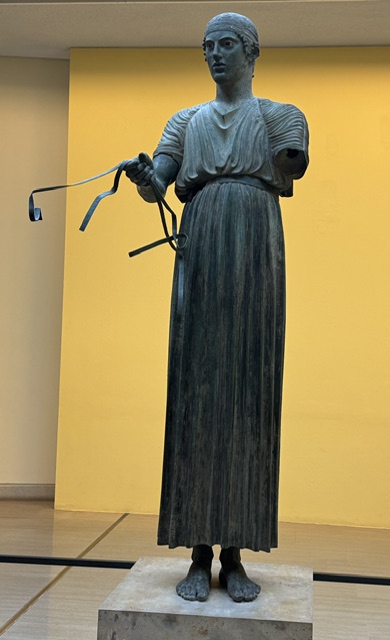
Finally, the most famous piece was this bronze charioteer, 470BC. There was a photo of the archeologists who found it. Needless to say, that was a very good day!
And we had a really good day too 🙂
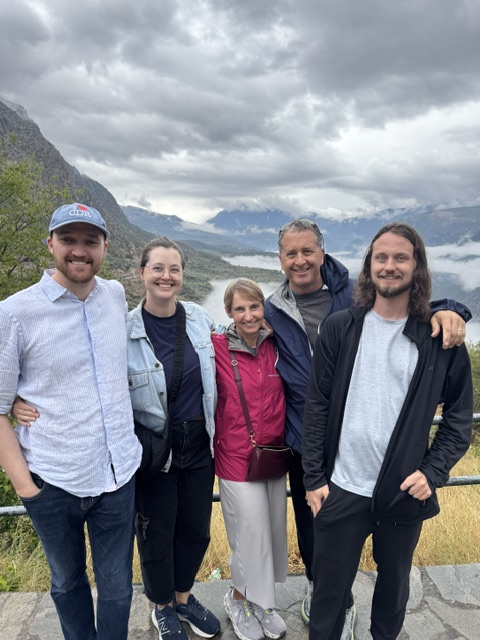
Though I have to say that seems like I’m shrinking – when did I get so small?!
 Reb's Walks!