Meteora and Thermopylae
The word Meteor means suspended in the sky. There used to be 24 monasteries on the top of these mountains. Now there are 6 and 2 of them are converted to convents. They didn’t have enough monks who wanted to live a secluded life, so the archbishop converted 2. The ascetics (word derived from asceccsis sp?) meaning exercise, mind, body, etc. They started in the caves here in the 12th century. They would come down periodically for services and to get what they needed to survive in the caves.
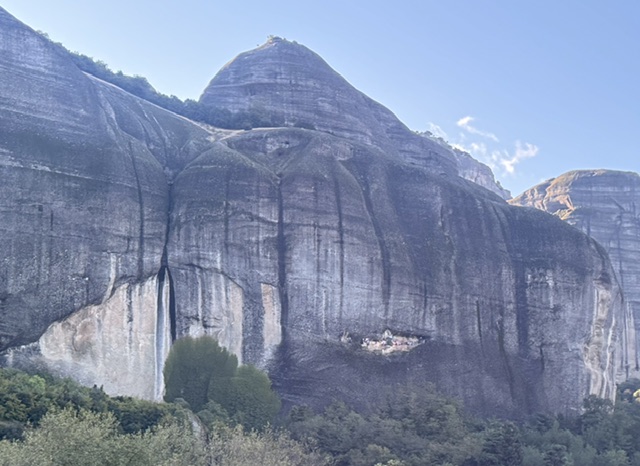
In the midst of the rock wall that we could see from the van was a small area carved out of the wall with flags showing. Every year on April 23, ever since the 14th century- men would go up/down climbing with their women’s scarves to dedicate their faith to St. George. Some would climb by perseverance – then would throw rope ladders for others, and use nets and baskets to bring up what they needed to build the chapel. Now men and women go to visit. Incredible.
What makes a monastery? Needs to have a church and more than one person. Needs to be a community in practice. Try to be self-sufficient. It often started with an ascetic – lives by himself in a natural cavity completely isolated from the world. Hermits – derived from the work hermos – desert. Jerusalem ascetics. But these were called ascetics.
We passed by the St. Nicholas monastery – by itself on the rock. The whole thing was built with nets/baskets to bring up the material to build it. That’s the only way people could approach. Cistern for water. Build a courtyard to grow vegetables. Meat would not have been part of their daily diet. Bread, olives, onions, tomatoes would be their diet.
Visitors can go – there are cells where people can go on retreat – can ask to spend time there. Need to be Greek Orthodox. Oh my lord, they dropped down sheer walls for people and goods to come up. We passed the one to St. Nicholas, closed on Friday, where the balcony that was the drop spot was so high, I couldn’t see where the bottom was from the road. Plus, I really didn’t like looking, frankly.
Our first stop was the Holy Monastery of the Transfiguration. It was started by the Saint Athanasios the Meteoritis in the middle of the 14th century. He set down the rules by which the community was to live in this first monastery and all other monasteries followed these guidelines. He started in a cave and gradually others came to practice and study with him and the monastery grew. The Blessed Athanasios (he’s been sainted) wrote/said? “I place you under the roof of the Blessed Virgin Mary which is the purpose of this monastery.” He was succeeded by a prince who became a monk under his guidance, who built up the monastery closer to what it is today, named in honor of the Transfiguration of Christ. The skulls of both these monkeys are saved here and honored on the 20th of April every year. Now the monastery looks huge, but only 3 monks inhabit it. However, there’s considerable space for Greek Orthodox who want to go on retreat short or long, now both men and women can be there. The way up and down was by net and baskets. Incredible. Now – we can walk up carved and built stairs – otherwise I definitely wouldn’t have seen it.
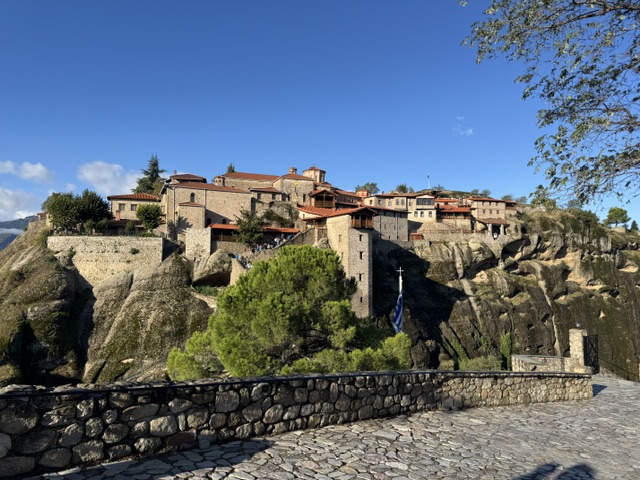
If you look closely, there’s a wooden balcony just above and to the left of the flag. That’s where they dropped the nets to bring up visitors and necessary commodities. Needless to say, it was much smaller in those days without accommodations for extras or rarely extras.
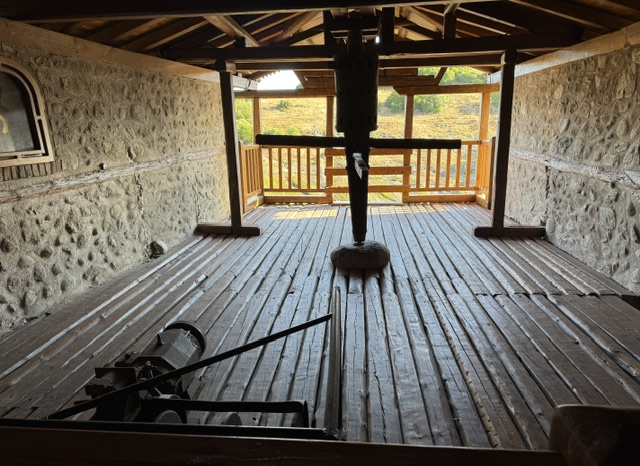
Here’s the pulley system and rotating spindle that you could push against to raise and lower the nets and baskets
When we were in the chapel, Katarina added more information for the Orthodox practices. Over the exit door is a painting of the sleep of Mary, that’s the euphemism for death. In fact, the word for cemetery is derived from the Greek word meaning the place of sleep. Standing over her is Jesus with the image of her rebirth at the second coming resting on his hand. To the north is Jesus’ resurrection. Super interesting because it’s entirely different from the Catholic images we’re used to. In this image, Jesus is descending into Hades, stepping on the door, all the locks and keys are to the side and the angels are holding back people trying to stop him. He’s reaching down to two coffins – Adam and Eve – taking their hands and pulling them up as the start to the second coming.
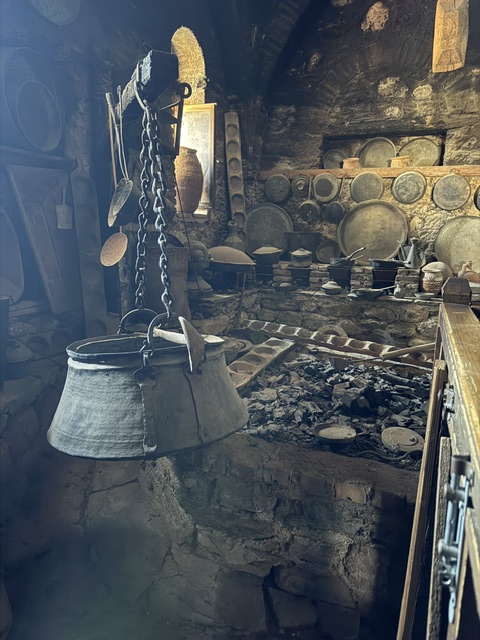
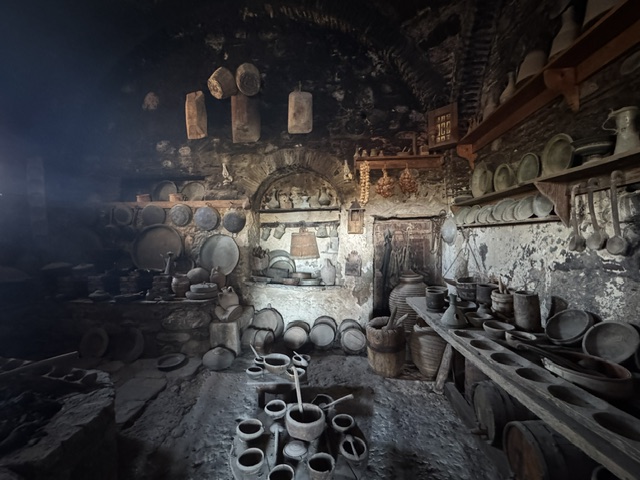
Katarina also told us a lot of stories about visiting her grandmother in the summers in her home village. When we saw the kitchen in the monastery, many of the elements were used in her grandmother’s kitchen. The monastery closed this kitchen in the 1950’s when they built a new kitchen for those coming for retreat. In the 1980’s it was made a UNESCO site and tourism grew and funds helped restore and build to make it an accessible building. They clearly had a lot of people who were eating up here in those days.
Katarina also talked about going with her grandmother at least once a summer to the monastery near her village, but similar to these, built high up on a wall of the mountain. They would spend the night, get clean, fast for a long time, go to confession and then to the service. She said it felt like a theater to her when she was little. People stand for the service, though there are some chairs along the walls that look like the choir stalls you see in old Catholic churches. You pull up the seat and stand in the space, but there’s a little leaning shelf where you can rest a bit. So she’d be standing, the service was in Eastern Orthodox Greek, understandable when you’re older and listening carefully, but when little just flowed over here. There were candles, murmuring, singing and incense. She said that sometimes because the fasting was for a long time, she would feel very faint. I’m guessing those services left a big impression.
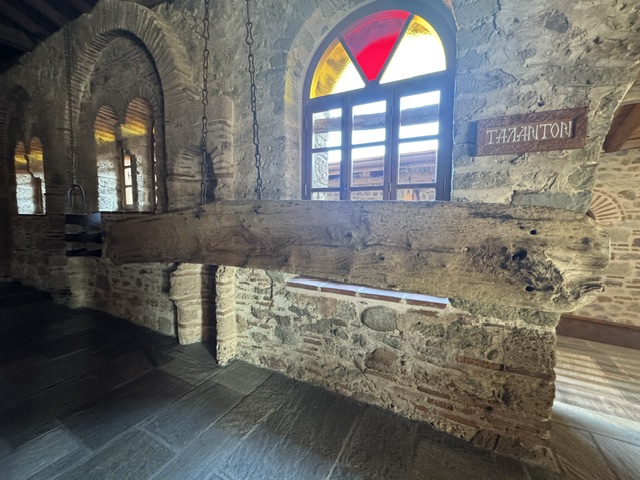
During Ottoman times people could practice, but not make a loud noise about it. Literally. So no bells to call people to service. Instead, the monks made this long wooden plan to hit with a mallet and it gave different signals depending on where and how it was tapped. In addition, to the left was a small chime that could be used for the main services to call the monks.
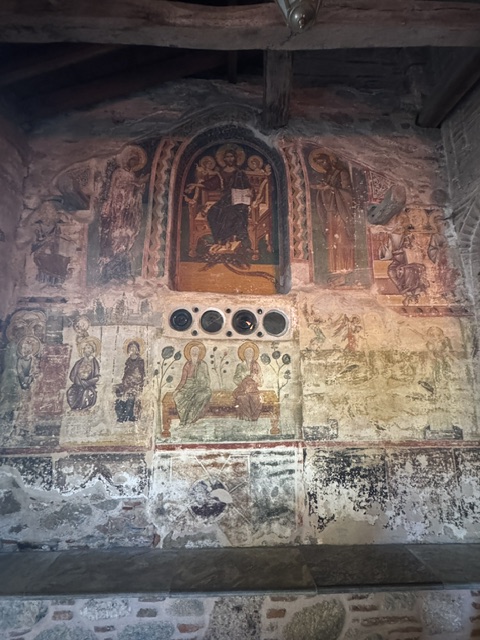
The whole monastery was painted with icons and frescoes telling stories. These are original and have held their color so well because of the protection, over 400 years old.
Below is from the courtyard of the monastery.
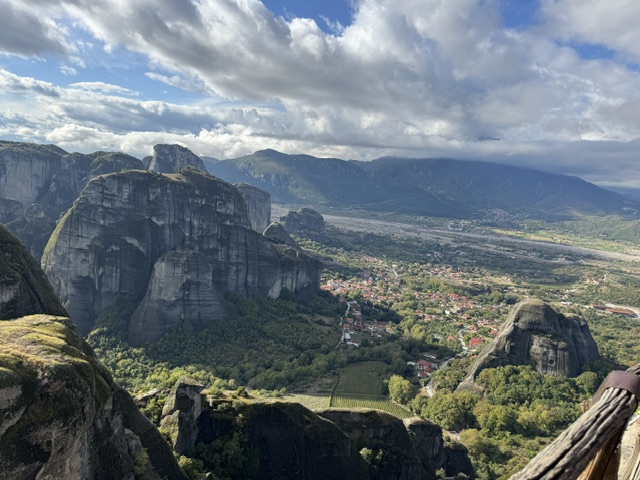
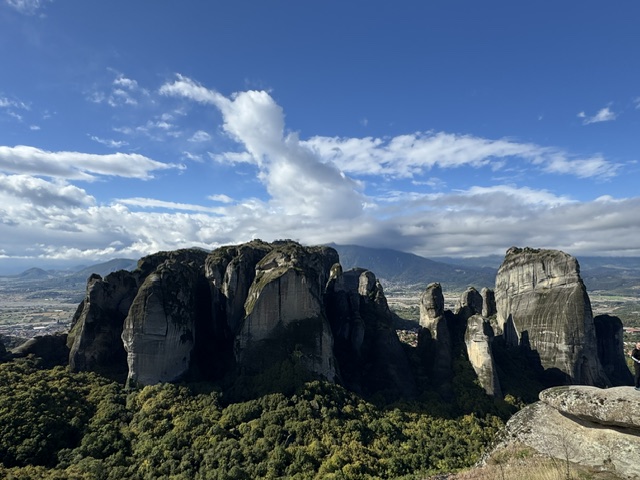
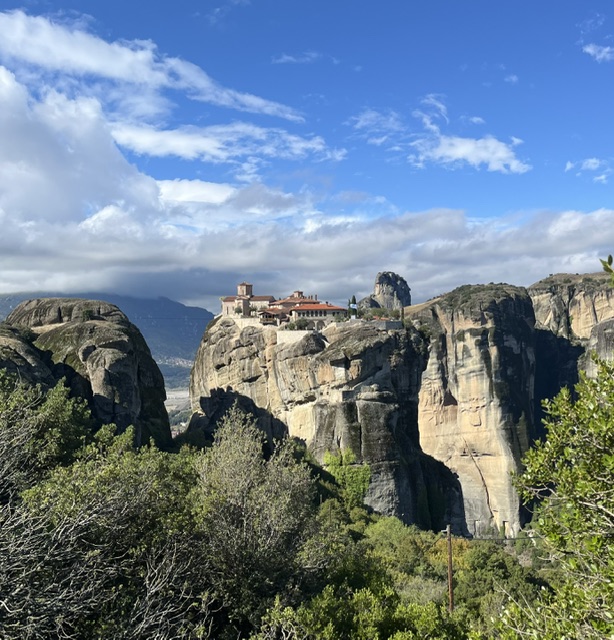
And this is the first monastery we were just visiting from a distance, hard to even see and how in the world did they build this? I mean, I know, lower a basket for supplies, but really?!
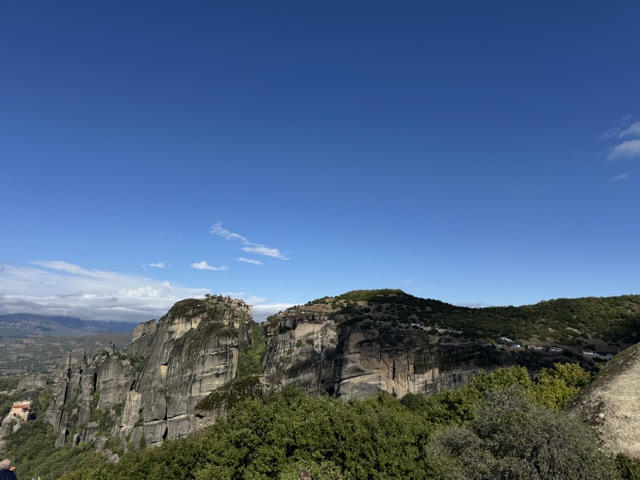
I was hiding in the bus to avoid the photo opp heights and the driver told me that the caves were caused because high winds spin small amounts of sand that gradually eroded out a space “some are big enough to park this bus (20 seater)”. There are a lot of winds in these mountain tops, but it was gorgeous when we were exploring.
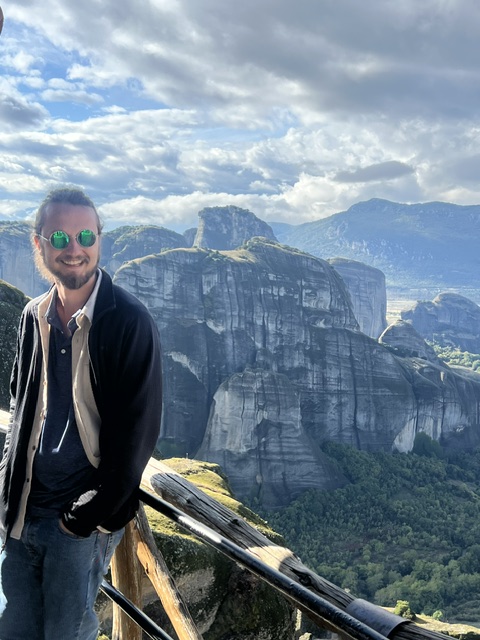
Here the rest are standing near the edge of the photo opp:
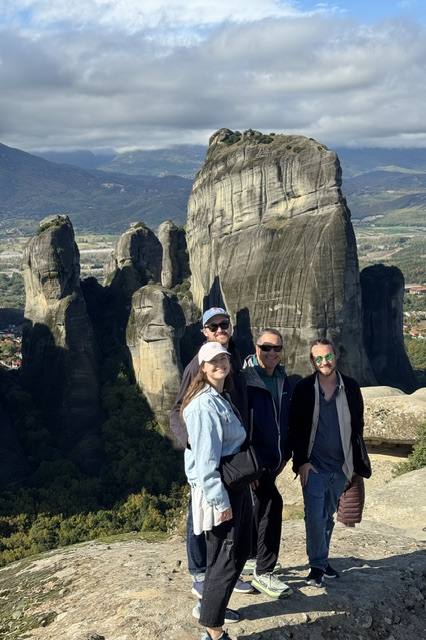
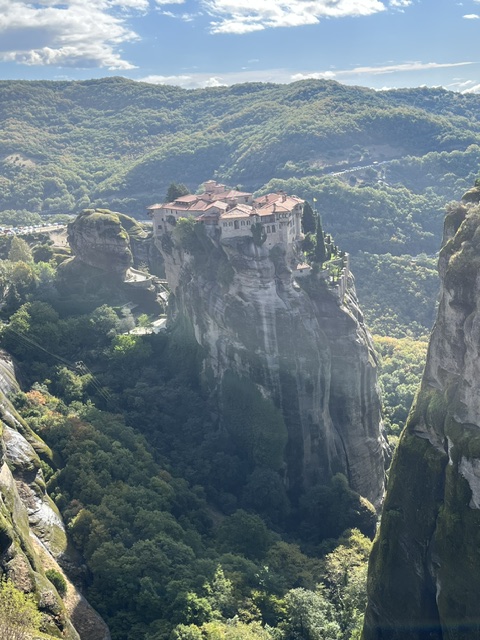
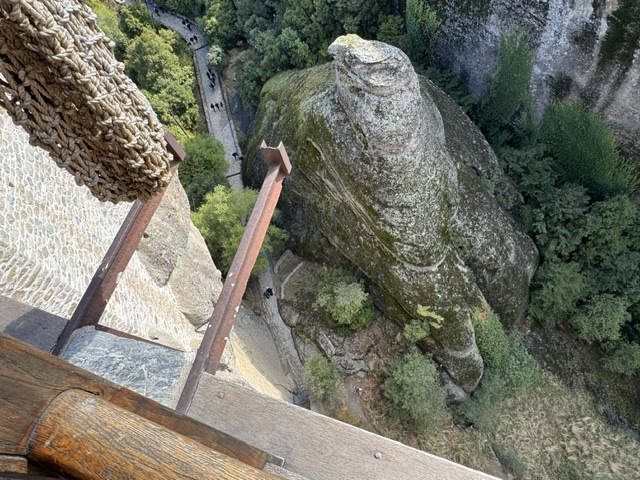
We then stopped at the Monastery of Holy Trinity. This was a higher climb so fewer tourists go, and again we were grateful that we were traveling now and not earlier in the summer when there were so many tourists, it was hard to see anything. This monastery still had the net hanging outside showing where transportation happened. It’s hanging off the wooden balcony about mid-way up the building. Straight down. I did NOT go near to look down, but Eli C took photos for me. This monastery also currently has 3 monks. They transport both here and at the main biggest monastery via a small cart that crosses on wires – looked totally sketch, but definitely easier to get groceries in!
The stairway carved into the hillside is courtesy of UNESCO funds. Thank you!
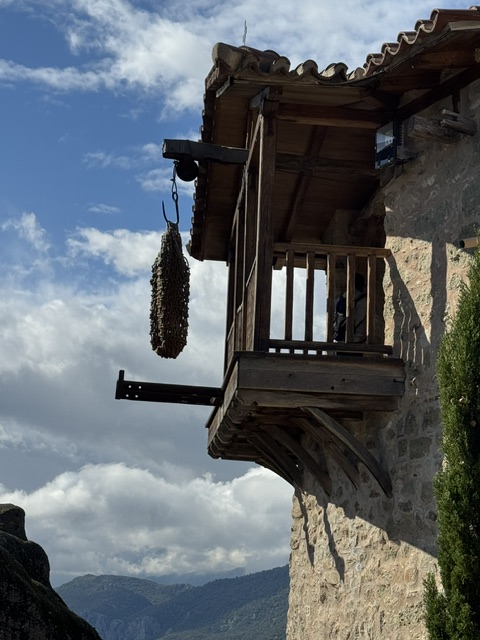
Looking down from the balcony – I didn’t take the photo
We drove by 2 convents and they have more occupancy, up to 23 or 24 nuns and some come from other orthodox communities. Here’s one of them seen from the second monastery. This is the most visited of all the sites because there’s a bridge from the road to the building, no stairs.
There were courtyards and gardens – they must have started with crating dirt up and over time more accumulated. Notice the skirt – no women were to enter with their knees – even the idea – showing.
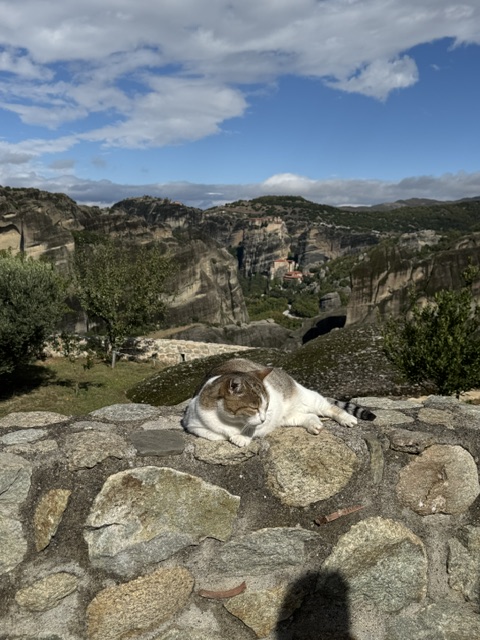
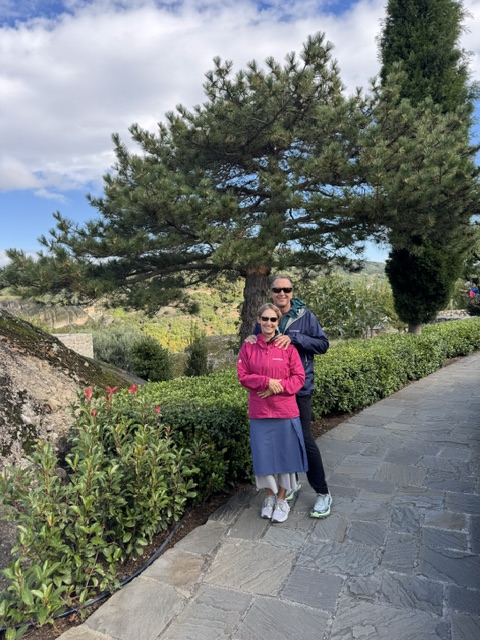
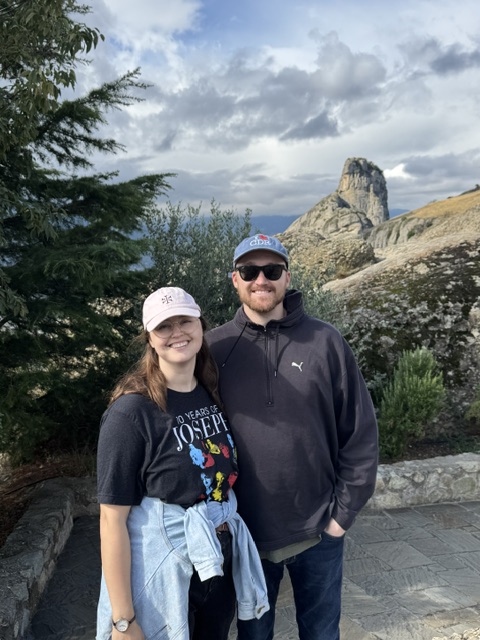
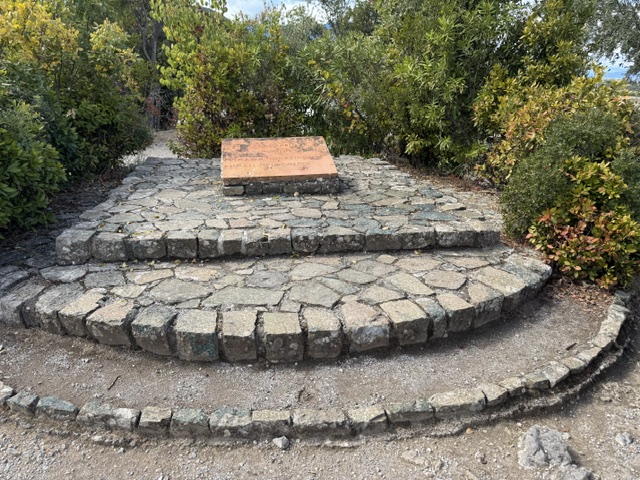
On our way back to Athens, we stopped at Thermopylae. The word means – steam and gates – there are hot springs here and have been since 5th century BC. In addition, in earlier centuries it was a narrow width so could be considered a gate. They did excavate and found arrows and blades that were Persian and dated from the time of the war. Thus, it was confirmed that this is where the famous battle was – however, it was just a hill where they battled, there were no ruins or buildings to excavate, so they put a plaque down to commemorate and built a new monument to King Leonidas.
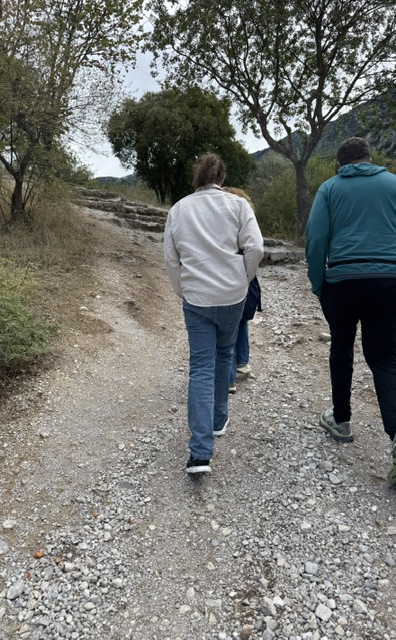
Where we stopped used to be a narrow space between the mountain and the sea and they’d built a wall between the mountain to the sea. 10 years earlier, the Greeks had successfully defeated the Persians, but they came back and conquered. The famous battle happened here between the Greeks and the Persians, with the Spartans leading the land forces and the Athenians leading the naval forces. Now – it’s hard to imagine how they could have blocked the Persians because over time a river coming down the mountain brought soil and silt, and the sea moved back so it’s now a big opening from the mountains to the plains. In the 5th century BC though it was a narrow opening and, this is where the Spartans took a stand against the Persians, delaying them from passing into Greece.
However, they had been betrayed by a Greek man who showed the Persians a local trail through the mountains in order to surround the Greeks. The leader, King Leonidas, asked 300 Spartans to stay, they all had to have sons back in Sparta because they knew this would be a suicide mission. They had a 1,000 other Greeks from other areas also taking a stand as part of the force. The goal was to hold back the Persians long enough for others to get away and protect what they could. I guess there’s a movie about this, books, stories, I’m afraid I was ignorant, but Eli W and Rick knew about and wanted to see the spot.
Evidently the Spartans (I mean I do know the Spartans) had a saying, come back carrying your shield or being carried on your shield. Either you were victorious or you were dead. They were also the only Greeks whose woman competed and trained at the gymnasium (separately from the men) because they wanted them to be strong women who’d give birth to strong sons. The sons were taken at 7 years to train as soldiers.
We came back – it took 6 hours – to get back, a lot of it because of Athens traffic. But the consensus was that it was worth the trip because of Delphi and Meteora. The next morning, Rick and I were in a cab and the driver asked where we’d gone. When we said Meteora, he said, “Oh that’s really special. Islands, beaches, that’s normal. Getting to see Meteora is wonderful.”
We went to dinner at that great store/restaurant we’d see with Valientini – Ergon. And it was wonderful as advertised!
 Reb's Walks!