September, 2021
Hi y’all, wanted to give a bit of the history/expectation of the Camino then will launch into the Camino. Quotes are from my guidebook by The Reverend Sandy Brown sent out by Macs Adventures, the organization who’s moving my bags (oh thank goodness, 2 small, but still) and set up housing and mileage after we conferred (“I’d like a day off every 7-9 days please!”)
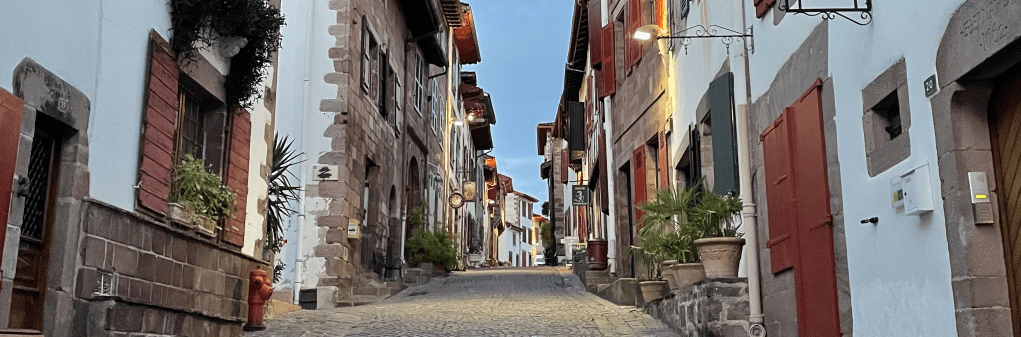
“Of the Camino’s many tributaries, the Camino Frances is its most legendary, its most traveled and most revered. The ‘French Way’ begins on the French slopes of the Pyrenees Mountains where pilgrims receive a stamp on their pilgrim passports in red-roofed Saint Jean Pied de Port.”
I’m adding the soaring expectation that is written because so many people talk/write/sing about the transformation. Honestly, working on a moment at a time, but just so you know how people think of the Camino: “Some say the first third of the Camino Frances is a renovation of the body as it adjust to the physical challenge. The second third is transformation of the mind as the emotions confront the monotony (or beauty) of the vast plains of the Meseta. The final third is renewal of the spirit or soul as pilgrims consider their purpose in life while they near their journey’s end. The compostela certificate releases the pilgrim back to the world with a changed identity and renewed purpose.”
So there you go. Luckily I love driving Nebraska and Kansas and the panhandle in Texas, so guessing the Meseta will feel freeing. Sky.
History: “Tradition holds that after the death and resurrection of Jesus, his apostles spread out across the world to tell his story. James, one of the most beloved disciples and first to be martyred, spread the gospel in the Roman province of Hispania, modern-day Spain and Portugal. Over the centuries, tradition developed that each apostle was buried in the region he had evangelized.
Origins of the city of Santiago: “Around 813, depending on the storyteller, either a monk named Pelayo or a simple shepherd boy saw a star that seemed to rest above an elaborate marble sarcophagus, overgrown and forgotten near the Church of San Fiz de Solovio in northwest Spain. Alerted to the discovery, the local bishop, Teodomir, immediately claimed the remains to be those of James the Great, Apostle of Jesus Christ.”
“Legend developed that at the 844 Battle of Calvino (now seen as a mythical rather than historical battle) Santiago Matamoros (“killer of Moors”) appeared on a white stallion, leading the charge against the Iberian Muslims.”
So there’s a lot more, of course, but these two stories are the basis of the pilgrimage. Since I’m from Boulder, I’m going with the first myth more than the second…
What I love is the idea of all these people walking for healing, from belief and devotion throughout the ages (and to get money/forgiveness for sins from the church…), though there was a hiatus for a few centuries. If I reside in the awareness of devotion, it’s amazing.
 Reb's Walks!