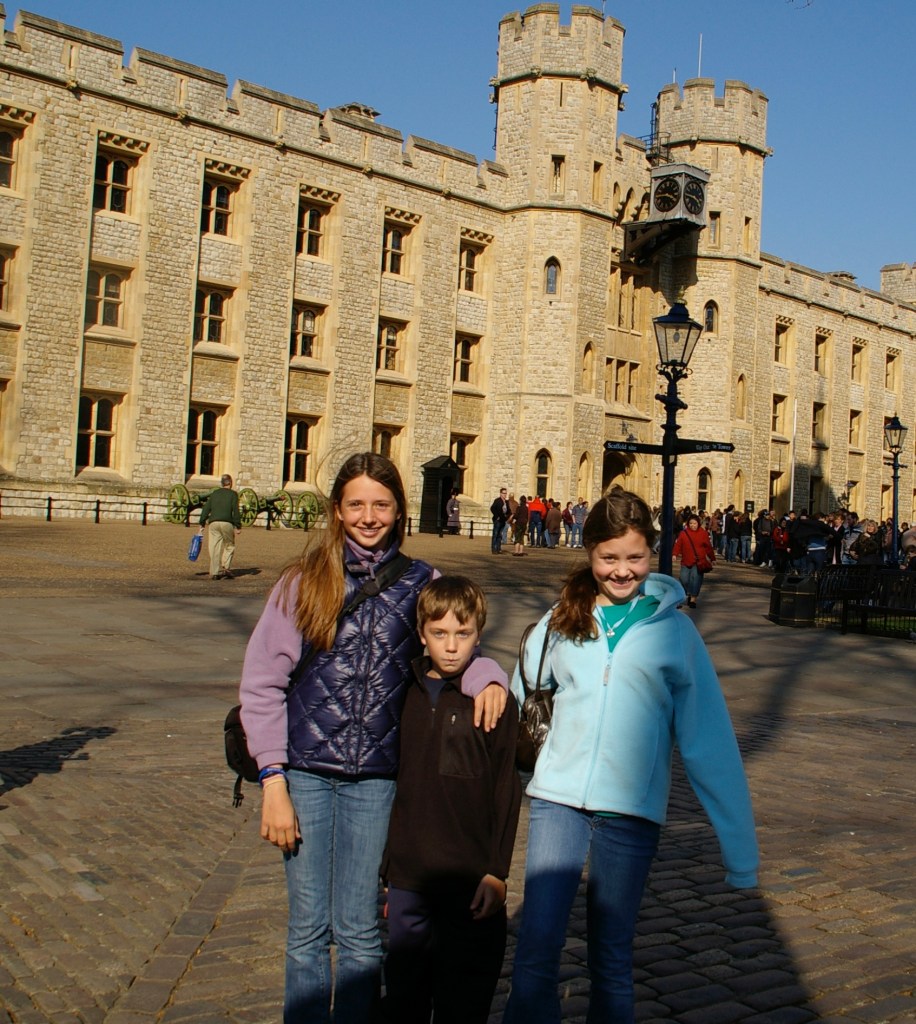
Mother’s Day – which Rick remembered as soon as he woke up. So sweet – he’s made this a special day every year from the very beginning when Kylie was born. In fact – that’s what he said – happy Mother’s Day, your 30th! A Mother’s Day from years ago:
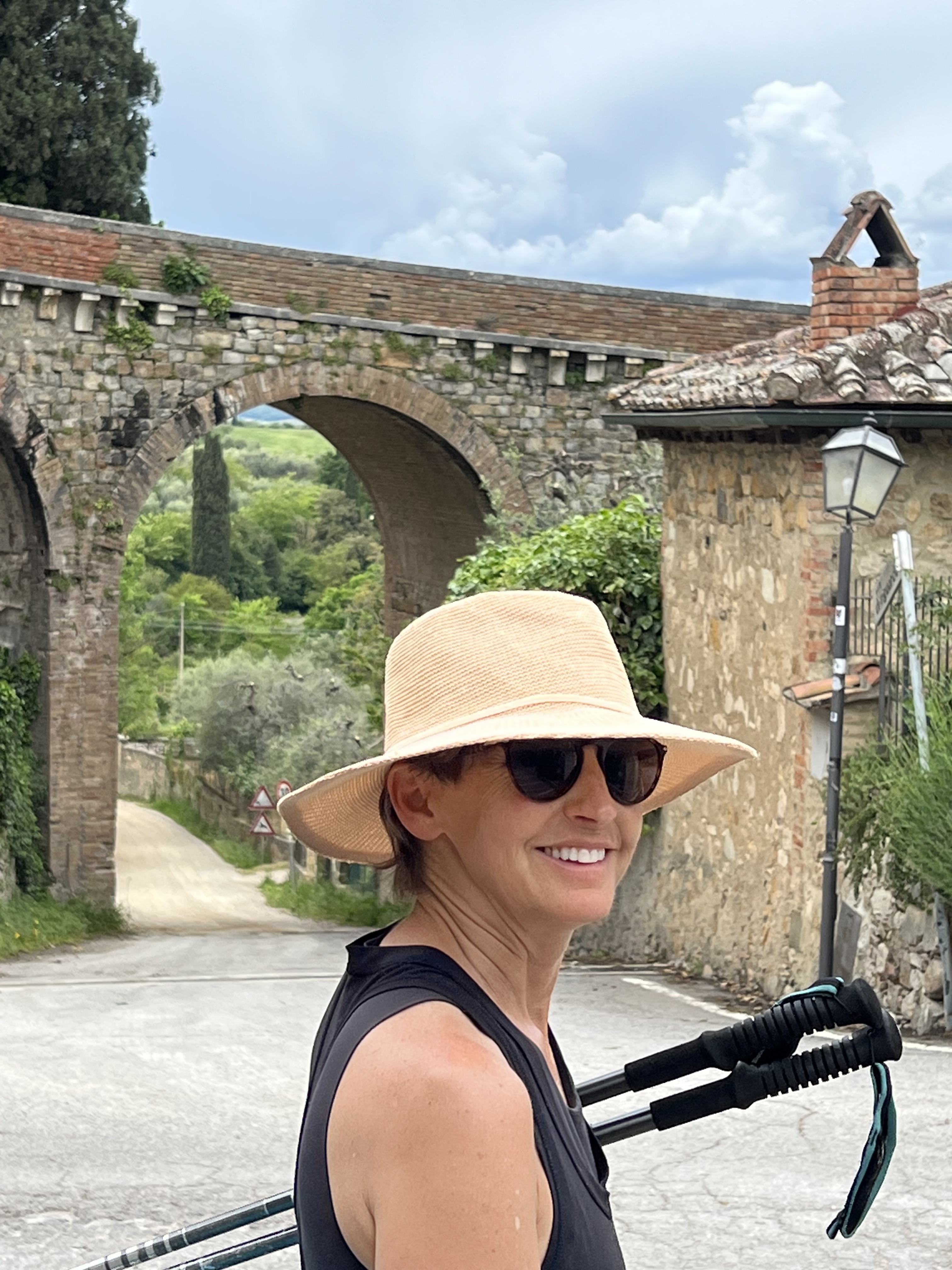
This Mother’s Day:
We had a day completely dislocated from agenda, requirements, calendar appointments, expectations. A rare rare day. And we loved it. Rick woke at the unheard of time of 7:15, I’d been reading a romance (what better way to start the day) for an hour, we had a leisurely breakfast, then we sat and had quiet time for an hour near the pool. Not raining – another happy thing – looking over the Tuscan countryside with the birds, the pool’s little waterfall sounding beside us. It was amazing.
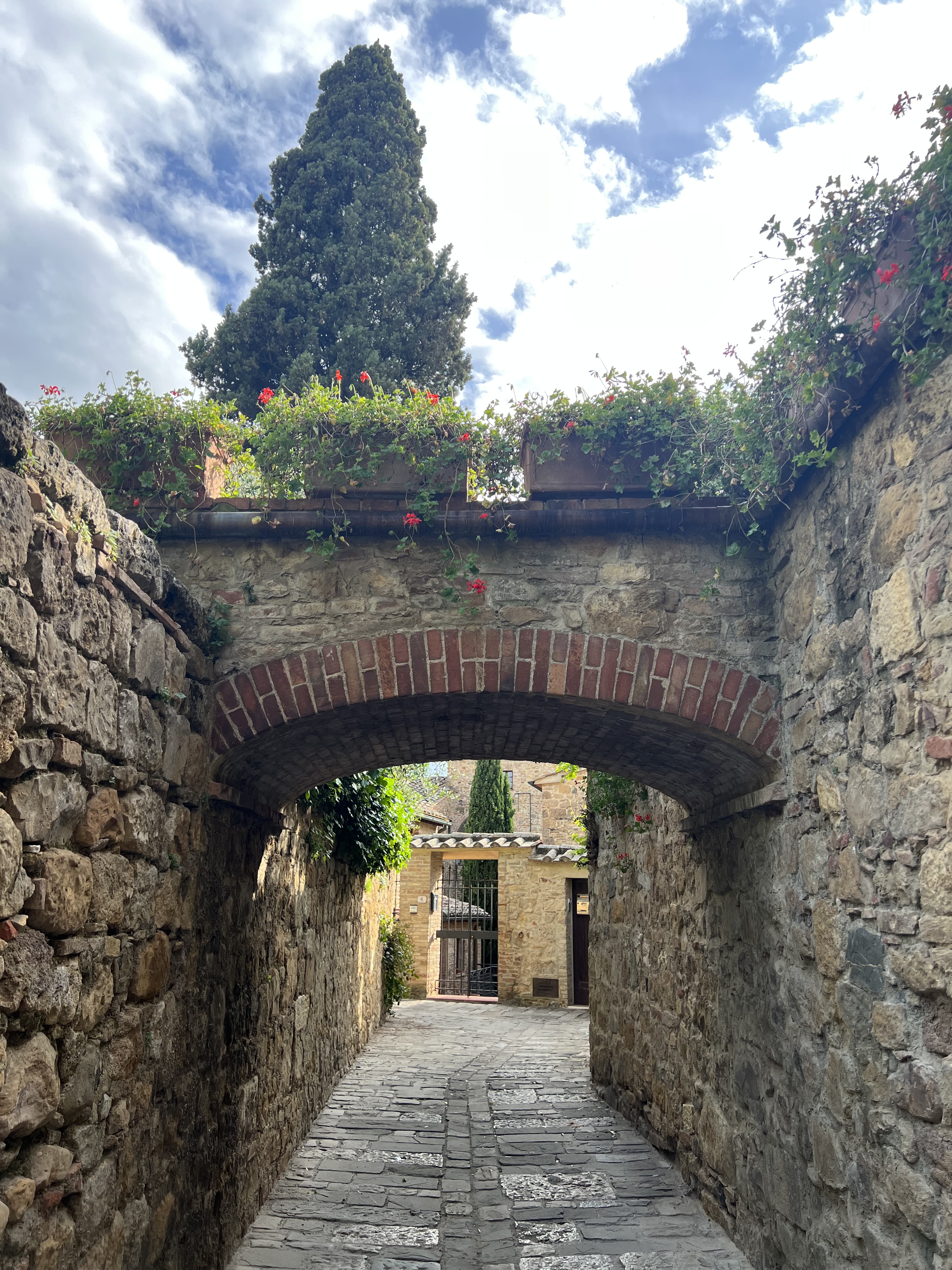
Then we walked into town for a bit of circular around the walls of the town, exploring all the little curving streets and a few shops that were open. I just love the golden stone and shapes of the streets. This town is an Unesco World Heritage town named after Saint Quirico, an 3 year old martyr and his mother Julieta who angered the Romans.
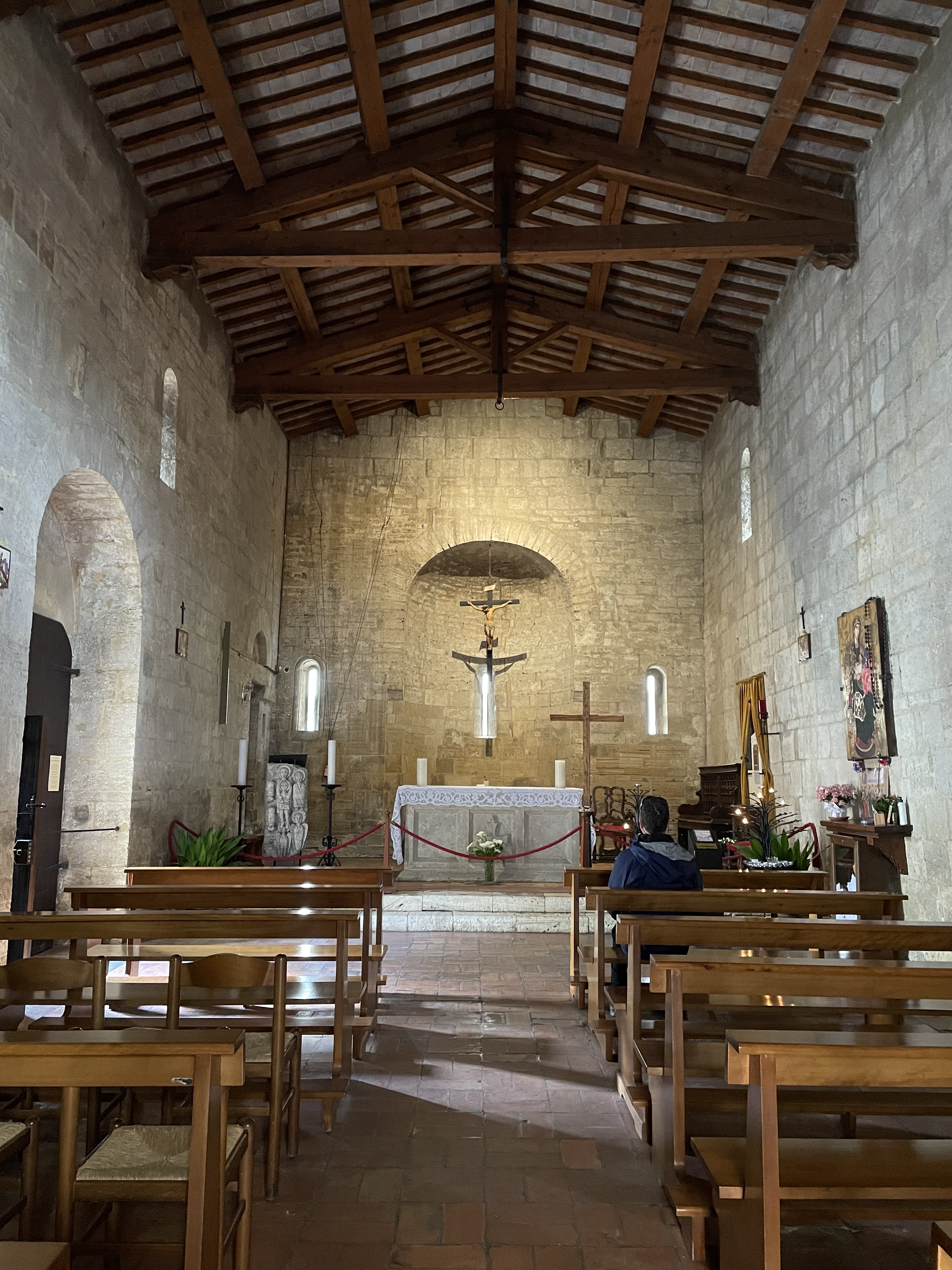
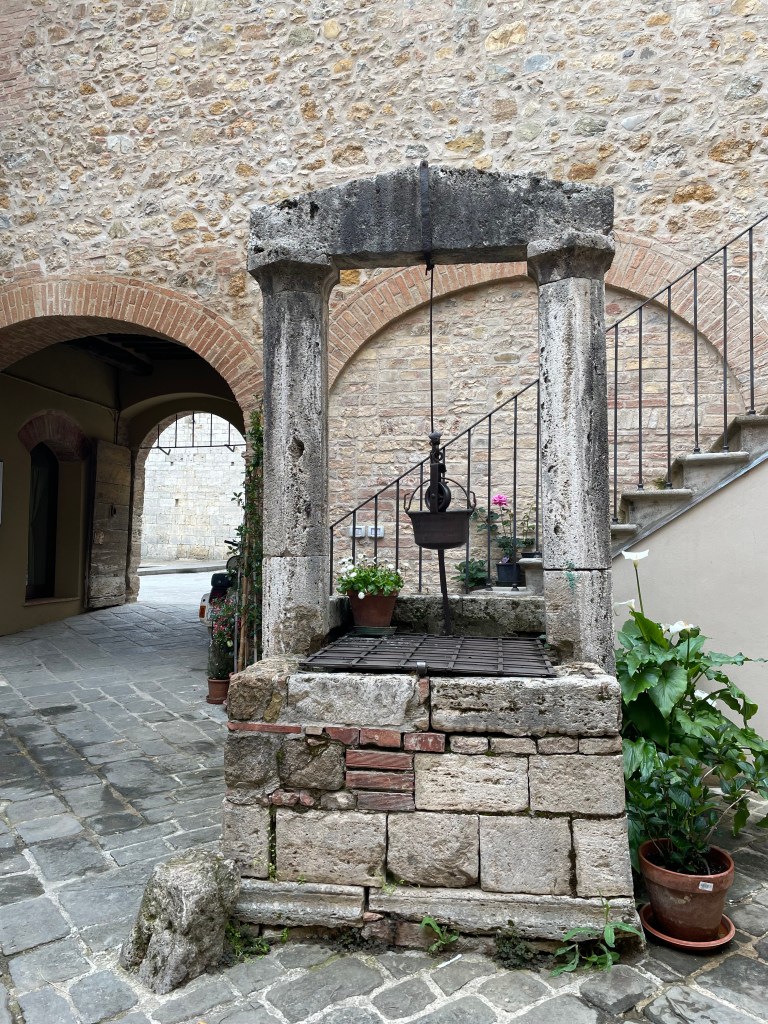
This is the church for the Via Francigena – Chiesa Santa Maria de Assunta, 12th century. Our favorite church in the town, plain, simple and the hospital (hospitality for pilgrims) was across the way with a beautiful well.
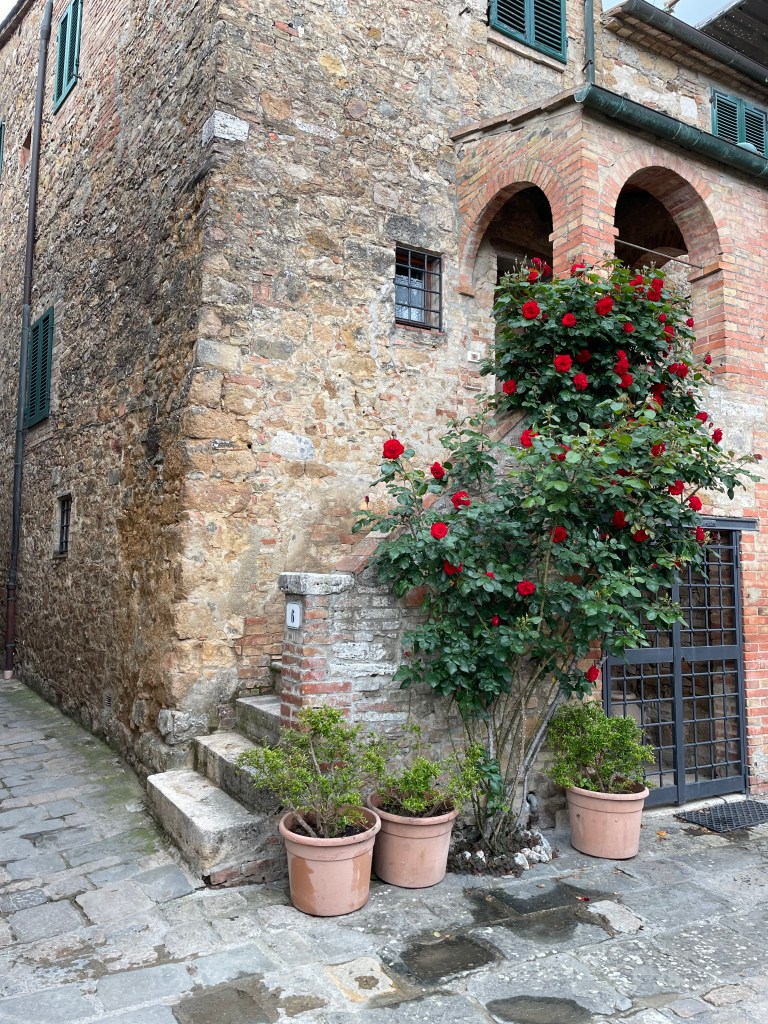
The roses have been gorgeous.
Built into the wall, this thin building below had two apartments, the top one a vacation rental. I’d love to see inside a lot of the created apartments and homes – so much ingenuity to have 20th century homes inside buildings from the Middle Ages.
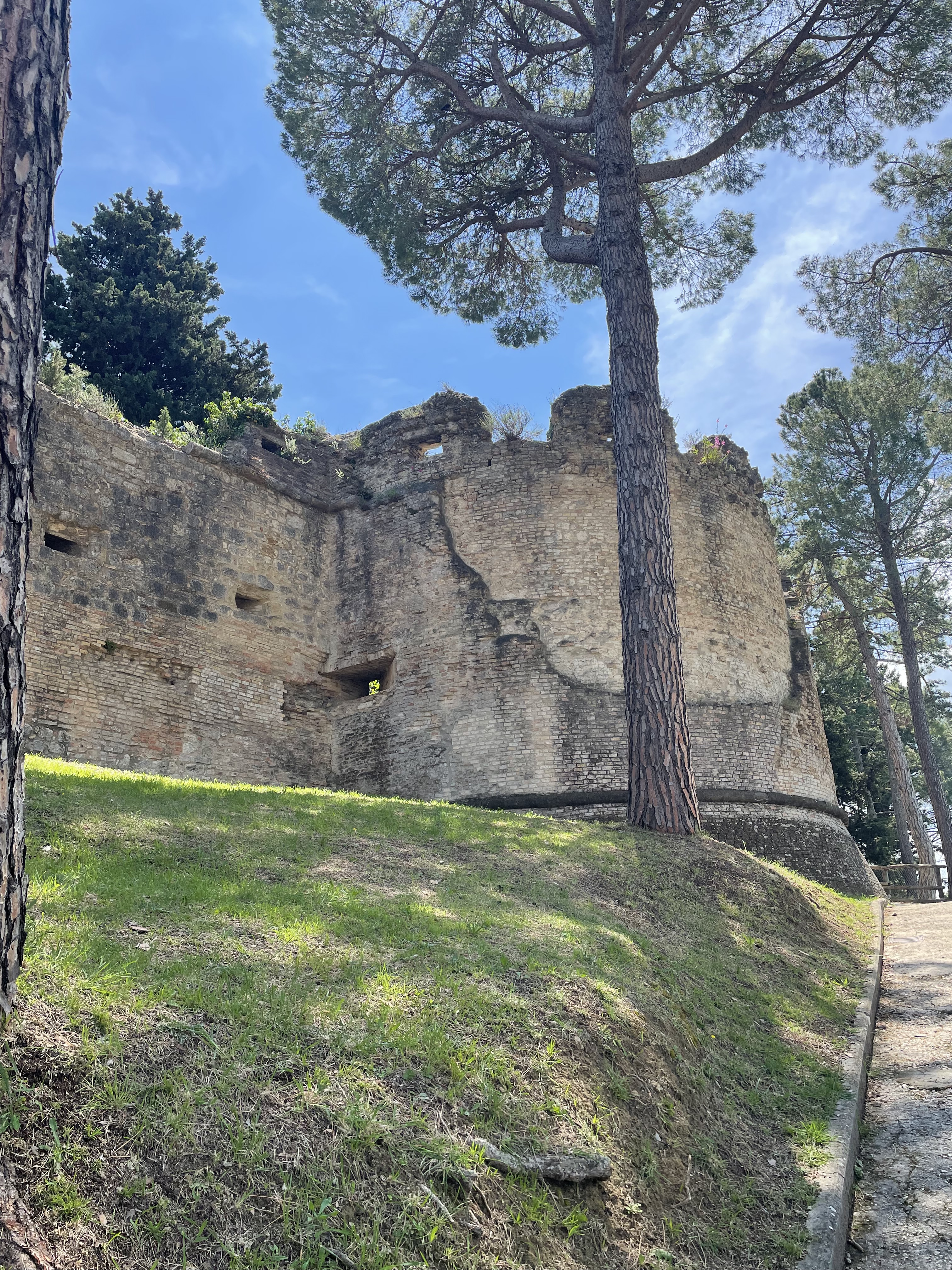
I know about arrow holes in these walls; I’d love to know that this specific design is for:
On top of the wall:
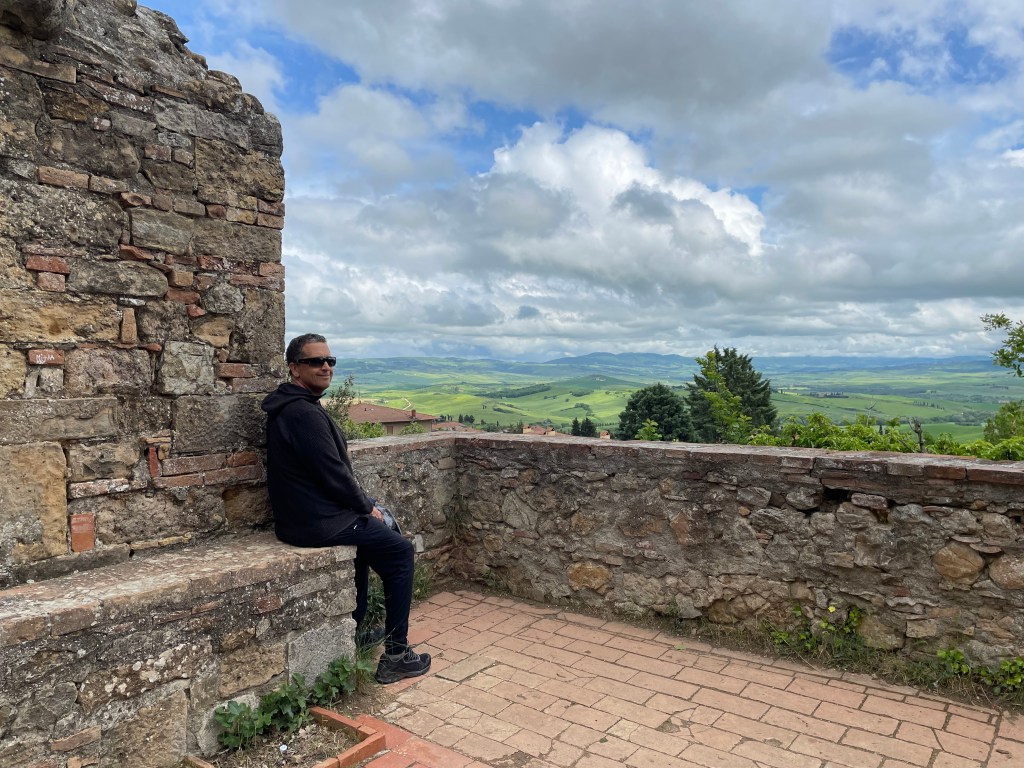
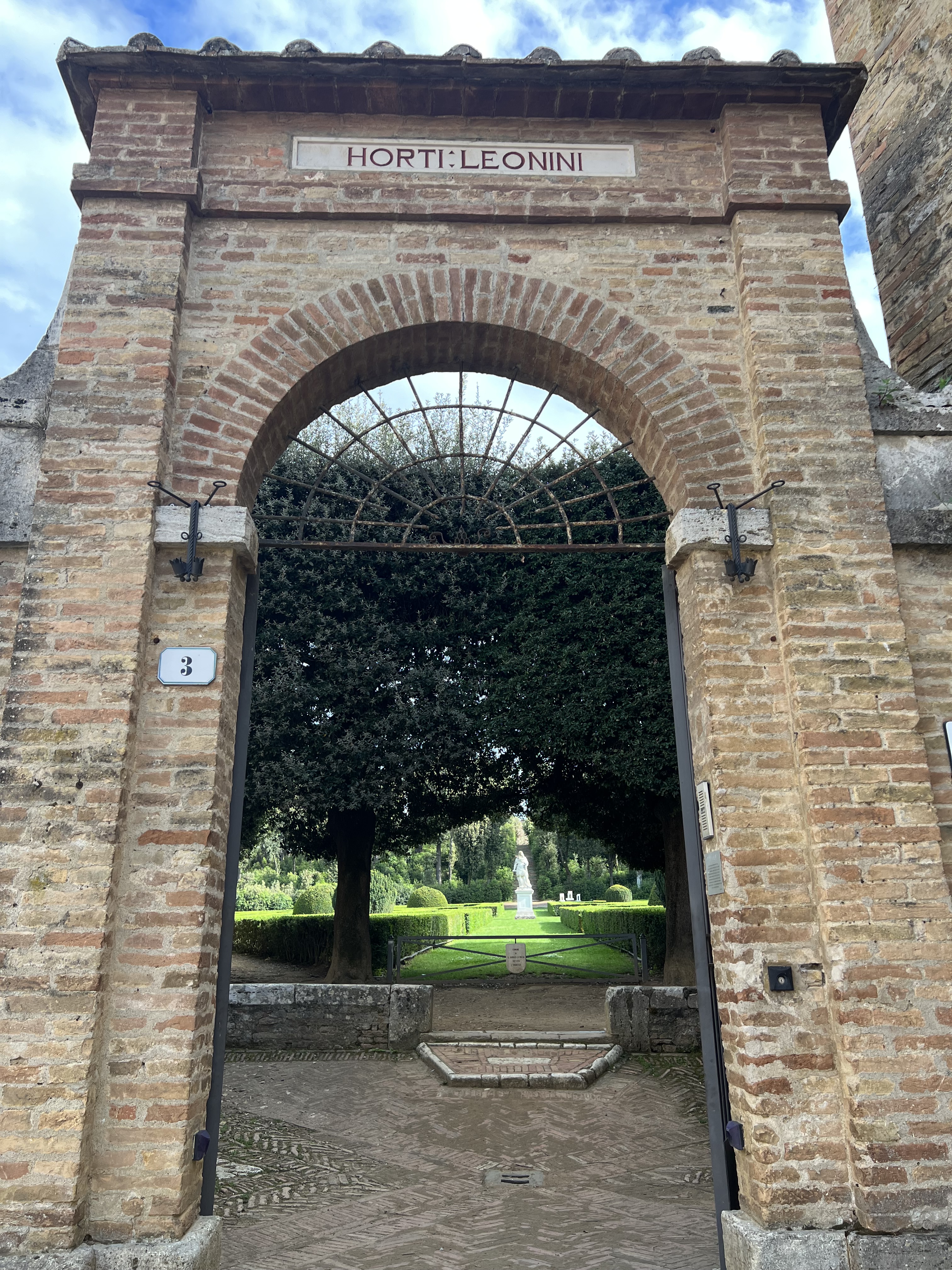
And a wonderful garden, Horti Leonini, with a formal design below and a “wild” garden above was designed in 1580 by Diomede Leoni. Francesco I de’Medici gave him the land for the garden. It’s the same today as it was in the 1500’s. I’m standing in the wild garden…
After our wandering, Rick and I had lunch at the place two different people had recommended. Food was good, atmosphere was great, seeing older couples and groups coming in dressed up after church, chatting, holding the hands of very old small women. I loved it.
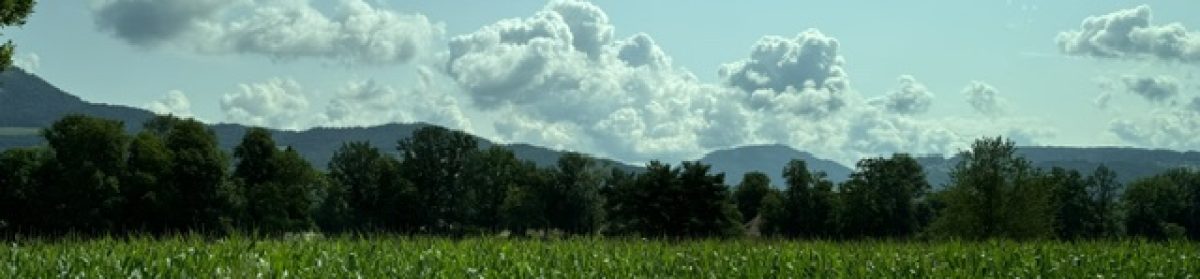
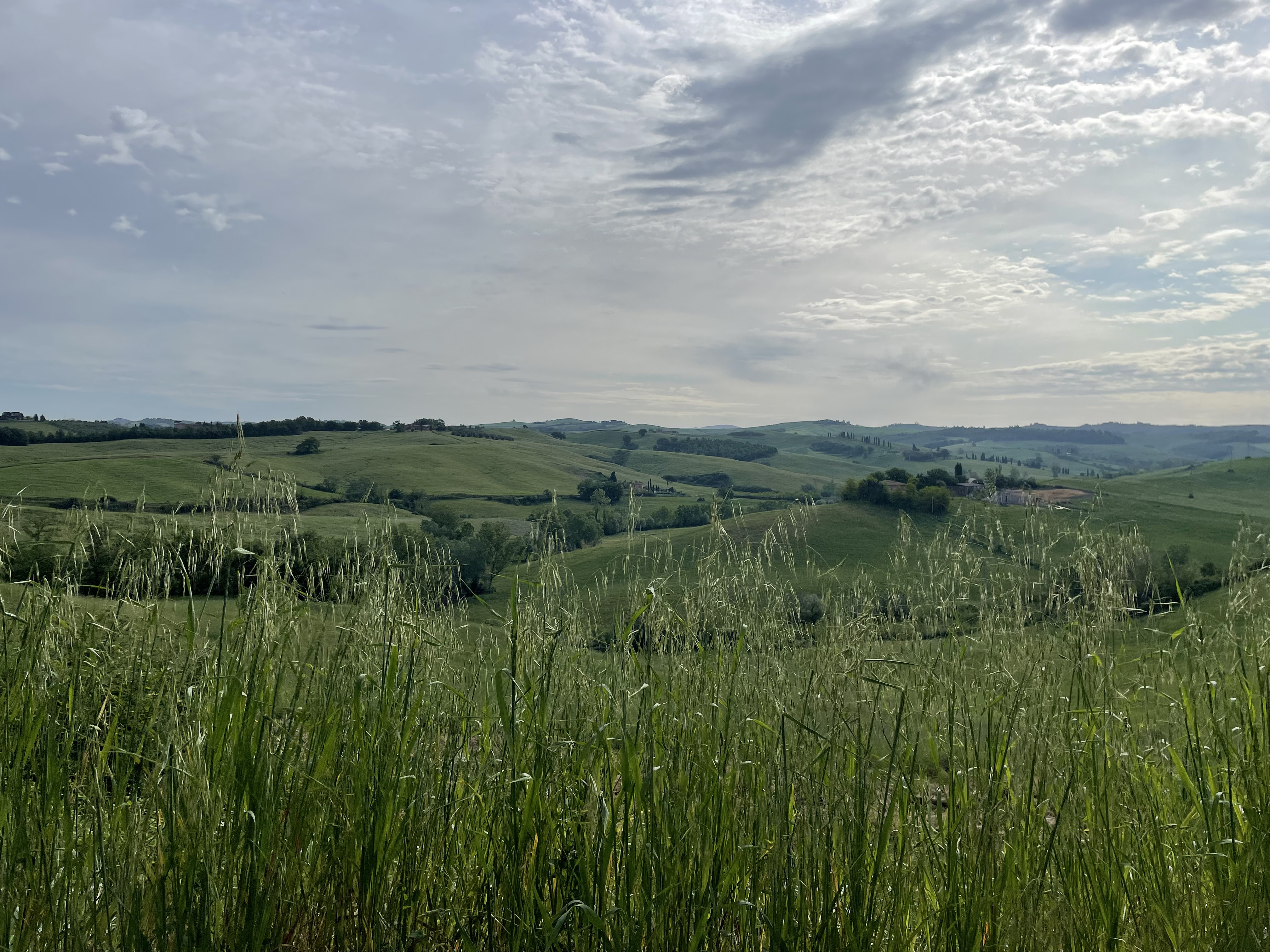
Back to the hotel where we read/dozed and then got up and took a walk – because that’s what you do in Tuscany – and marveled yet again at how beautiful it was.
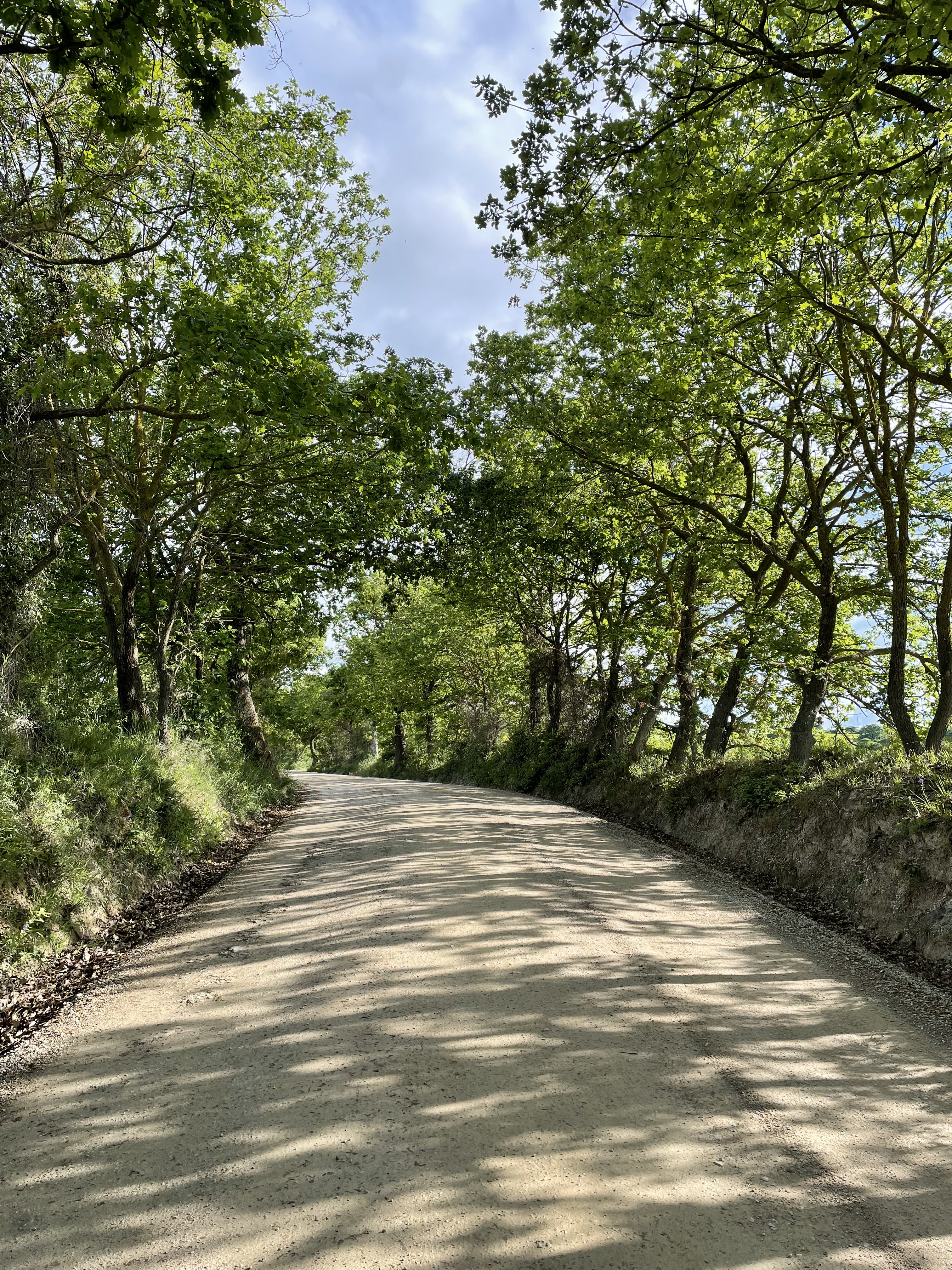
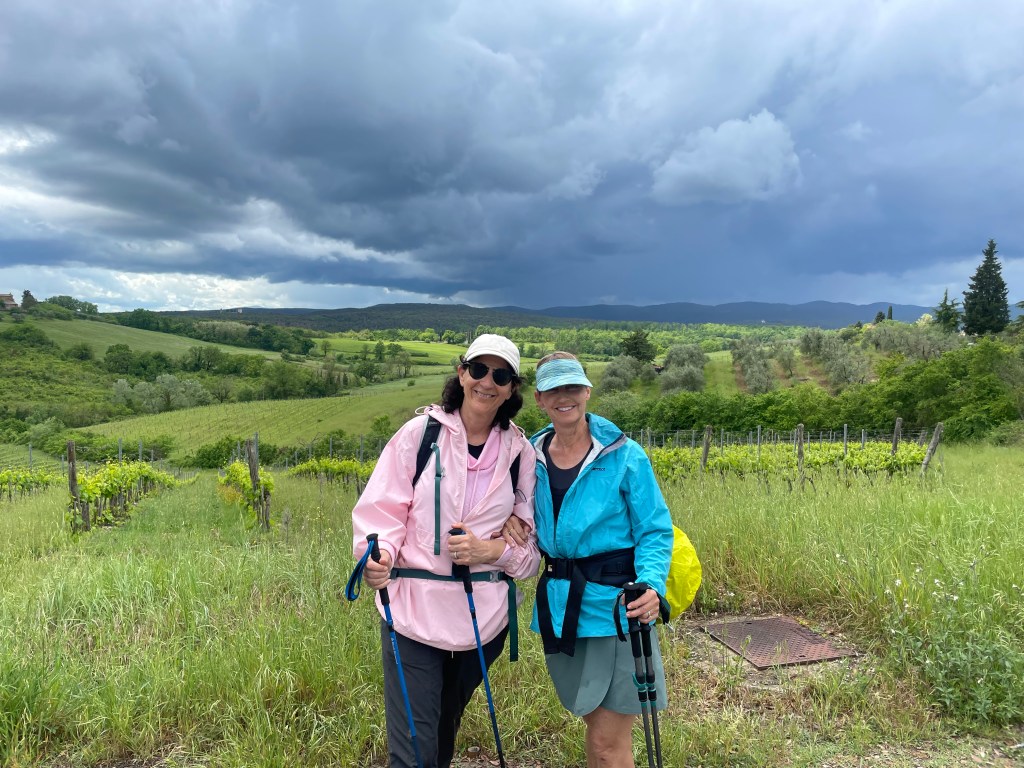
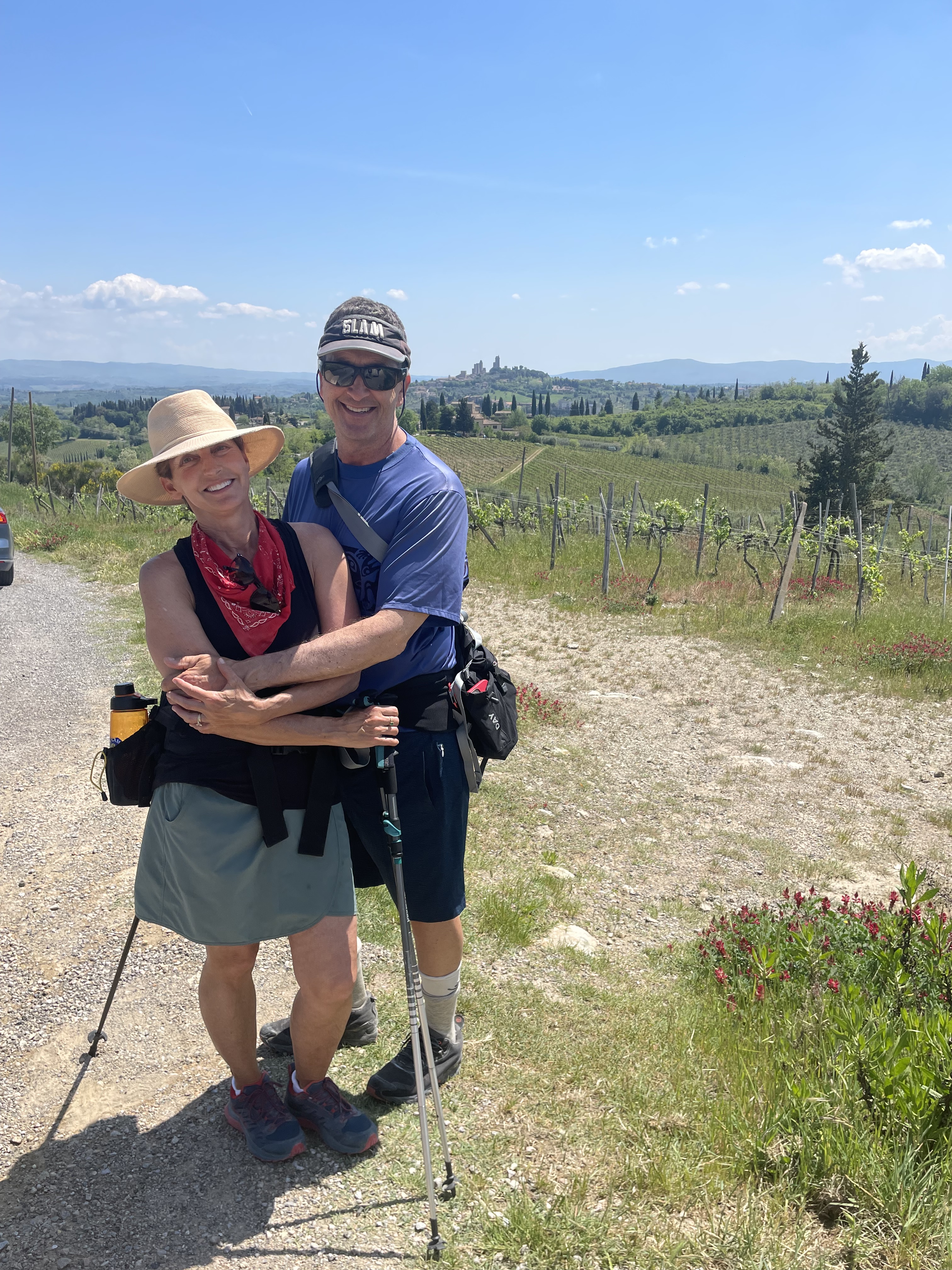
As Rick said, “you couldn’t make this up,” talking about how beautiful the scenery was today. We had a quiet easy walk, little over 13. It went quickly and no rain! Astonishing.
This rose caught our eye and we realized there were roses planted at the end of each row, each a different color. Beautiful!
That’s Rick in the distance walking up the hill, getting some quiet time.
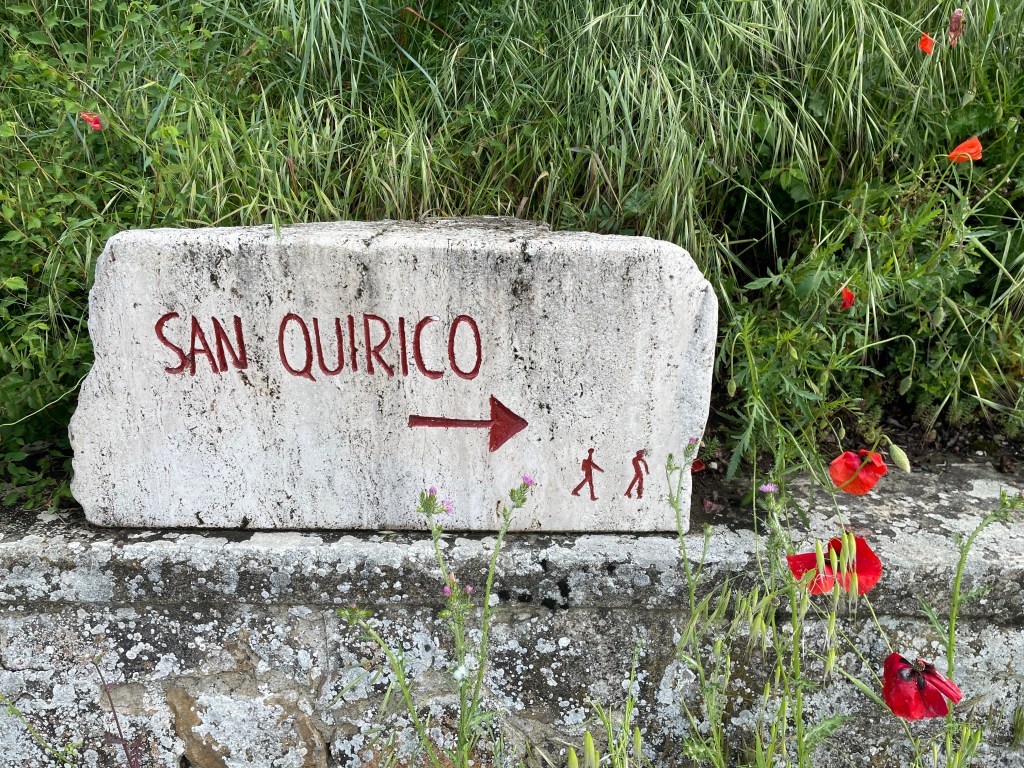
We arrived in San Quirico, another beautiful little medieval village in Tuscany. Our last before we meet up with Sharon, Leaf, and Cathy on Monday and go to Umbria.
We had lunch at the hotel and then walked into town to the laundromat and got all of our clothes clean. On Monday, we’ll send a bunch of things back to CO so that we have lighter loads when we meet up. 5 people in an Italian size car requires small luggage 🙂
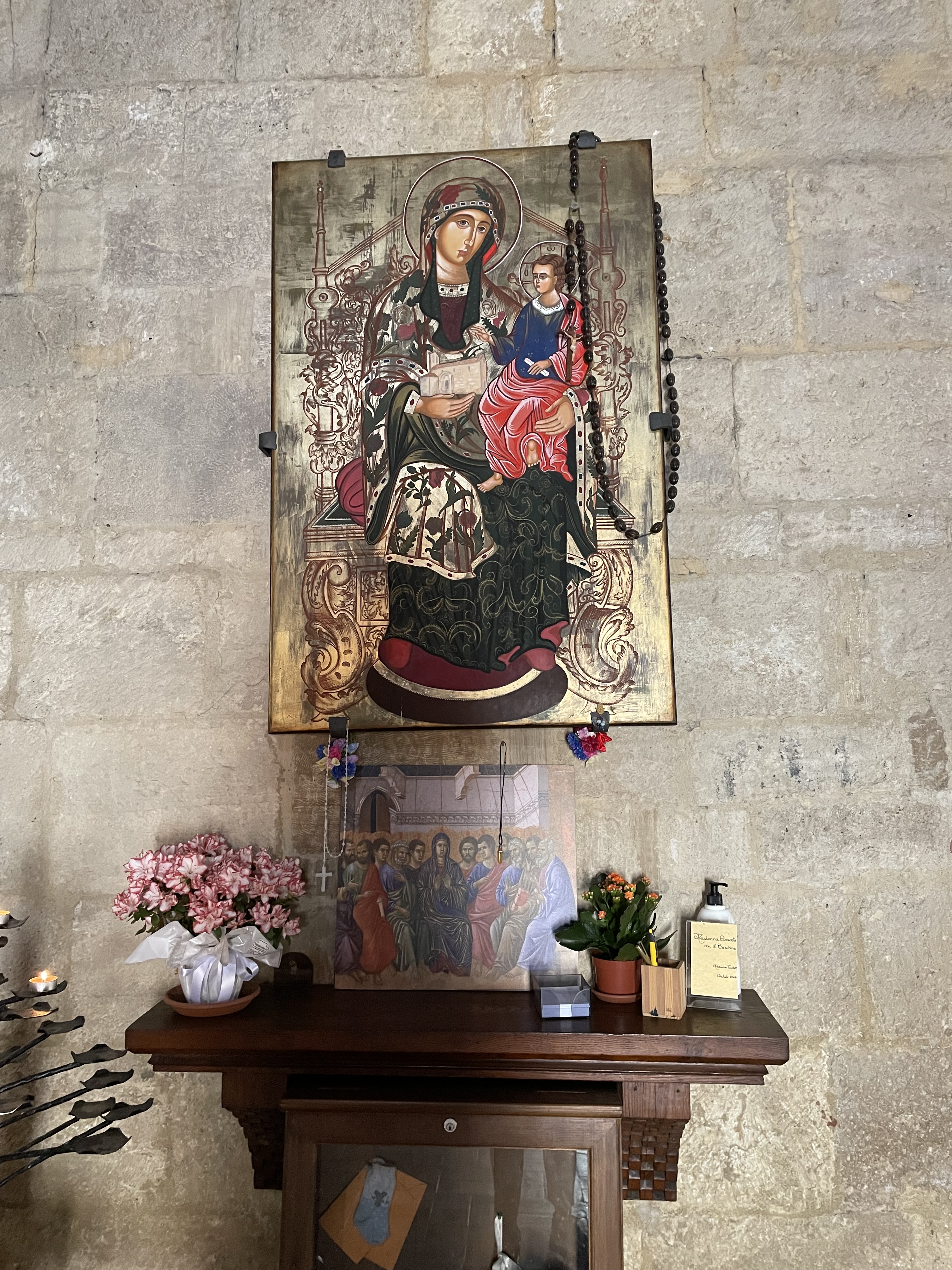
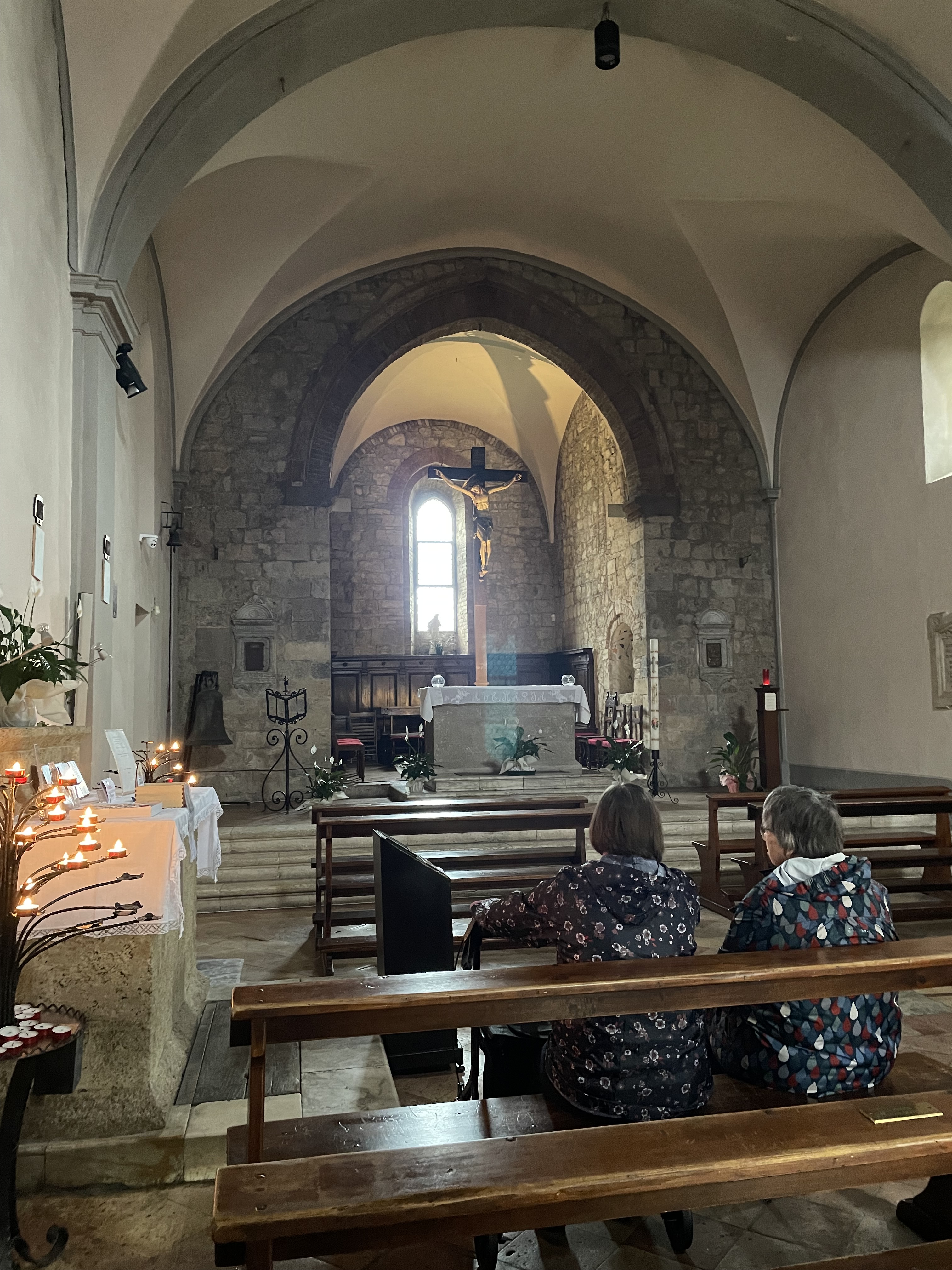
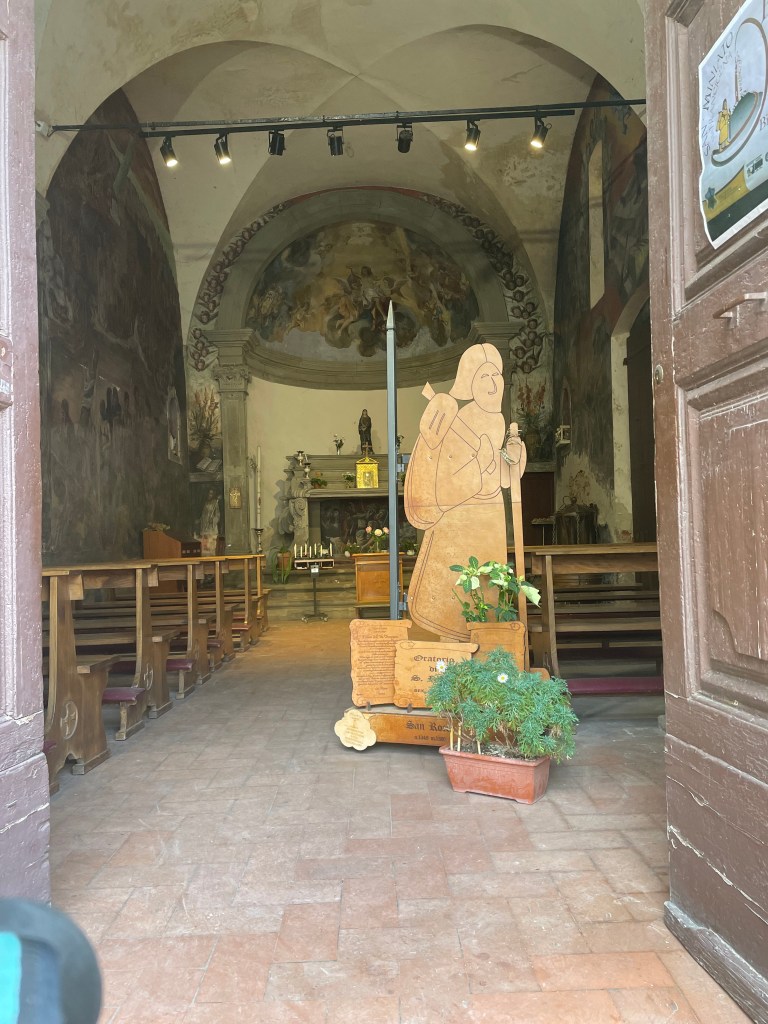
We had a quick walk around town while waiting for the wash to be done and are looking forward to going back tomorrow and exploring at leisure. Our first stop today was a tiny church built around 1060 with a wonderful large statue of Mary in the front. My kind of church. And a bonus, no one was there except for a nun up front who was practicing some songs with a device that gave her background music to support. Rick and I sat down and just enjoyed.
Dinner at the hotel, too tired to go back into town, we’ll eat in town tomorrow. Kind of nice to have some quiet with no expectations and no agenda.
Bob and Susan left this morning; it was such a gift getting to travel with them. Bob took the lead every day, just striding off and carrying the heaviest pack since he packed all the food for the four of us and made it look easy. Hope they have a great day in Rome!
Rick and I had an early breakfast and made a firm decision to not take a chance on walking because 90+ chance of not only rain, but also thunderstorms. So we decided to walk Siena with Rick Steves and his audio guide. What a great decision. He missed the synagogue, but got many other things and we learned way more than we would have if we’d tried to do it on our own.
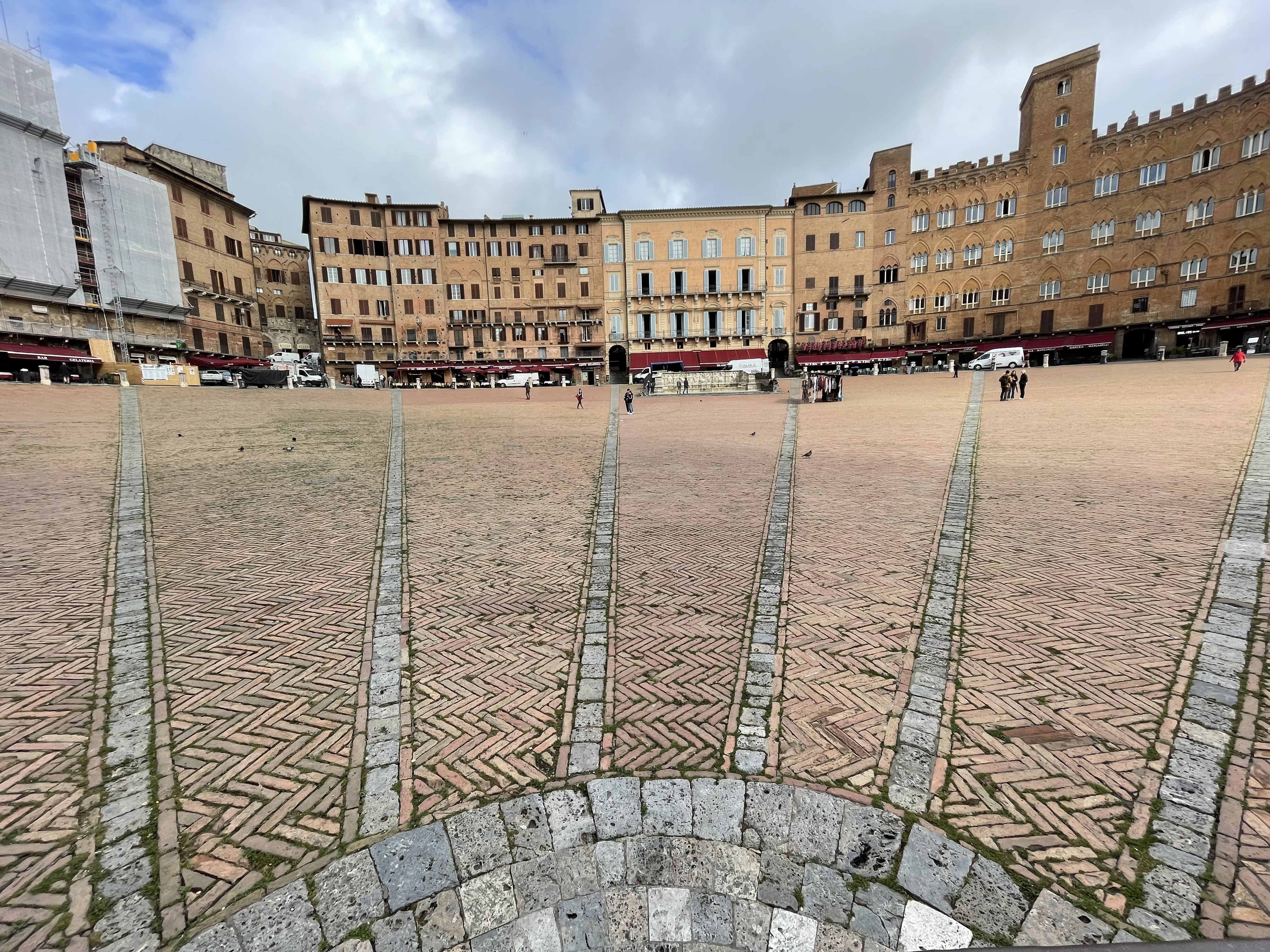
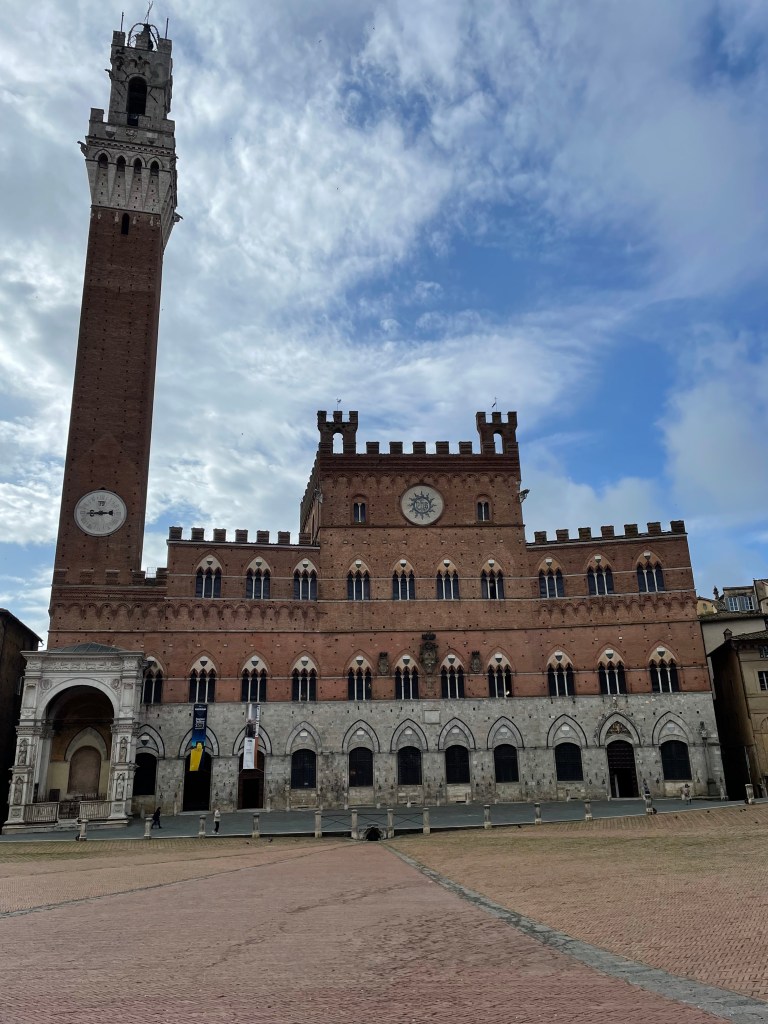
We started at the Campo, the center of Siena life, looks now basically what it looked like in the 1300’s, astonishing (though I’m guessing that indoor plumbing’s been added). The engineering of water run off and all going down towards the town hall and this beautiful drain, just beautiful. Hard to capture in a photo, but did my best. Siena was a republic and all was based on that, so that they built the duomo (cathedral) with the town council and the community, a rare exception of a town run on political lines and not by the church. The town tower here in the campo was the highest tower outside of church towers for many years. The photo below is the long view in an effort to capture the remarkable planning, it’s smaller than this makes it look. It’s around this plaza that the Palio is run in July and again in August. Hard to imagine in that heat 60,000 people packed into the center of the plaza, a trail of sand laid down around the outside and 10 of the 17 districts in the old city have a horse that runs. Whichever horse crosses first after 3 circuits, whether the jockey is still on its back or not, wins for its district. It looks like a crazy crazy scene.
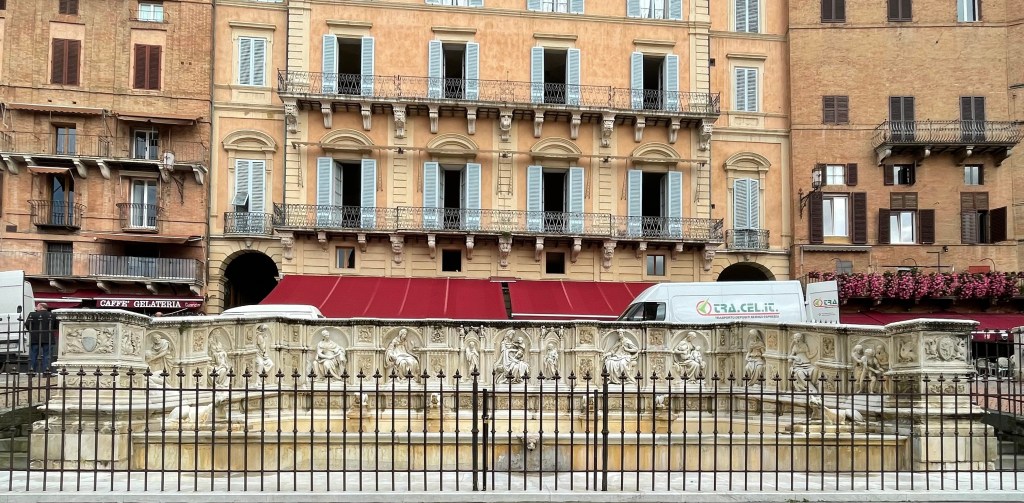
Fountain of Joy, so named because it was the communal source for water in the 1300’s and everyone gathered here, images of all kinds of women helping others all around the fountain.
I really couldn’t capture the entire circle of the buildings, but amazing.
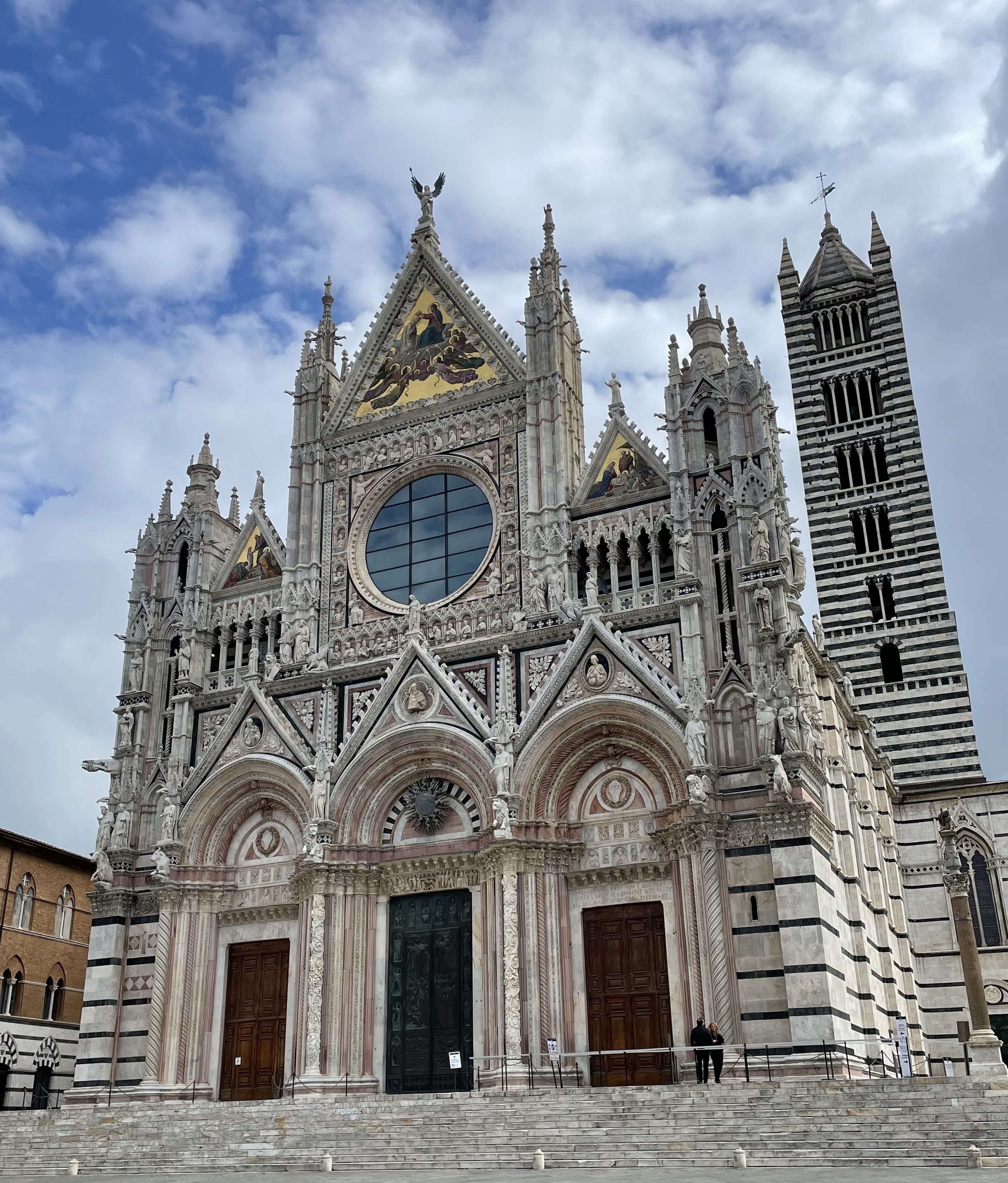
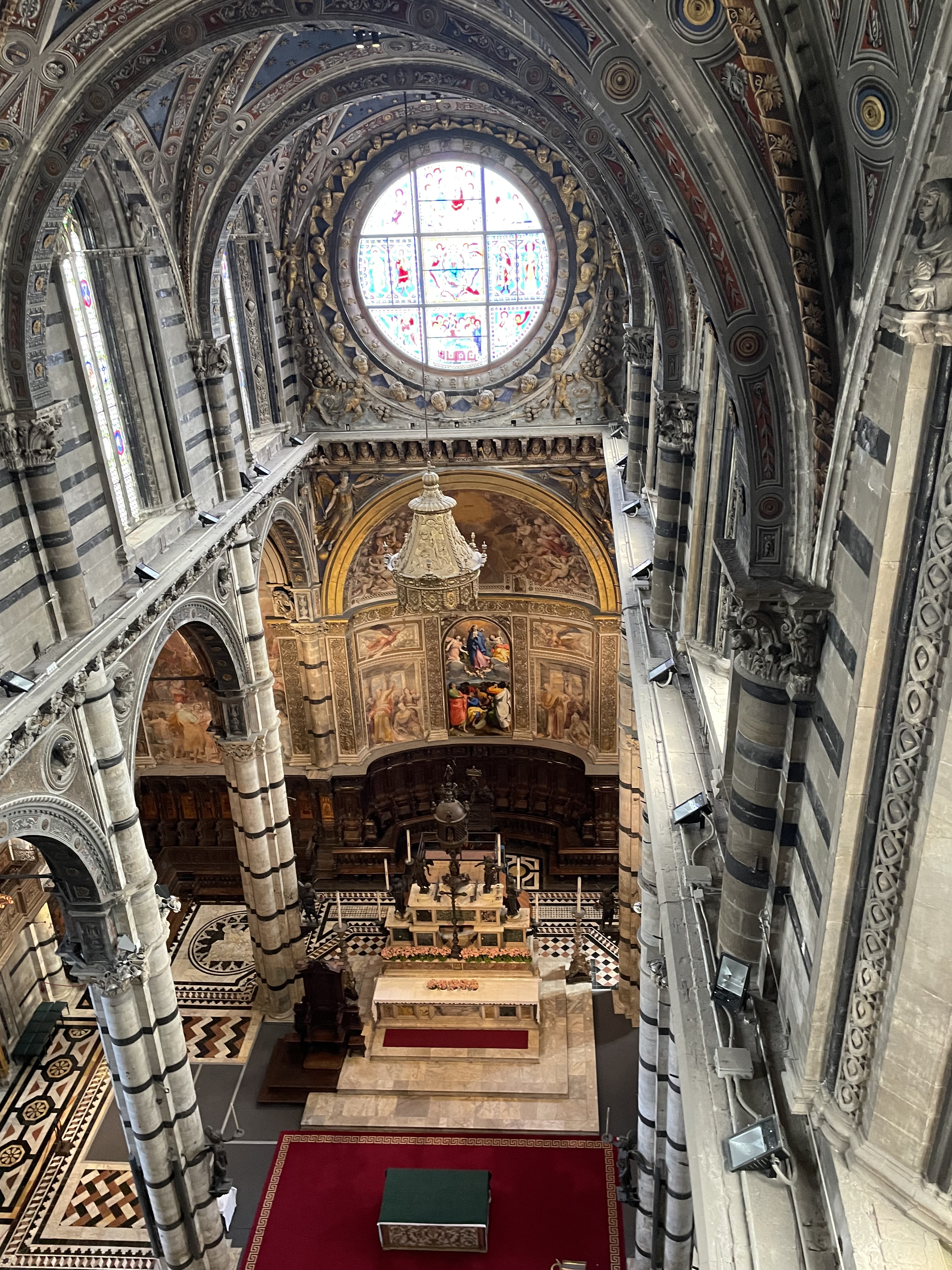
We learned a ton, courtesy of Rick Steves. We started with the roof tour of the cathedral, though Rick had to take some of the photos. Looking down into the cathedral and close to the vaulted ceiling and over the town. How in the world did they do this in the 1200’s – 1300’s? Just boggles the mind. So lucky to see it early before most people were out and about. And this is just the front, it’s incredible all the way around. The bottom half of the duomo was built in the 1200’s. 22 of the 23 kinds marble came from Tuscany, 1 from France. Incredible.
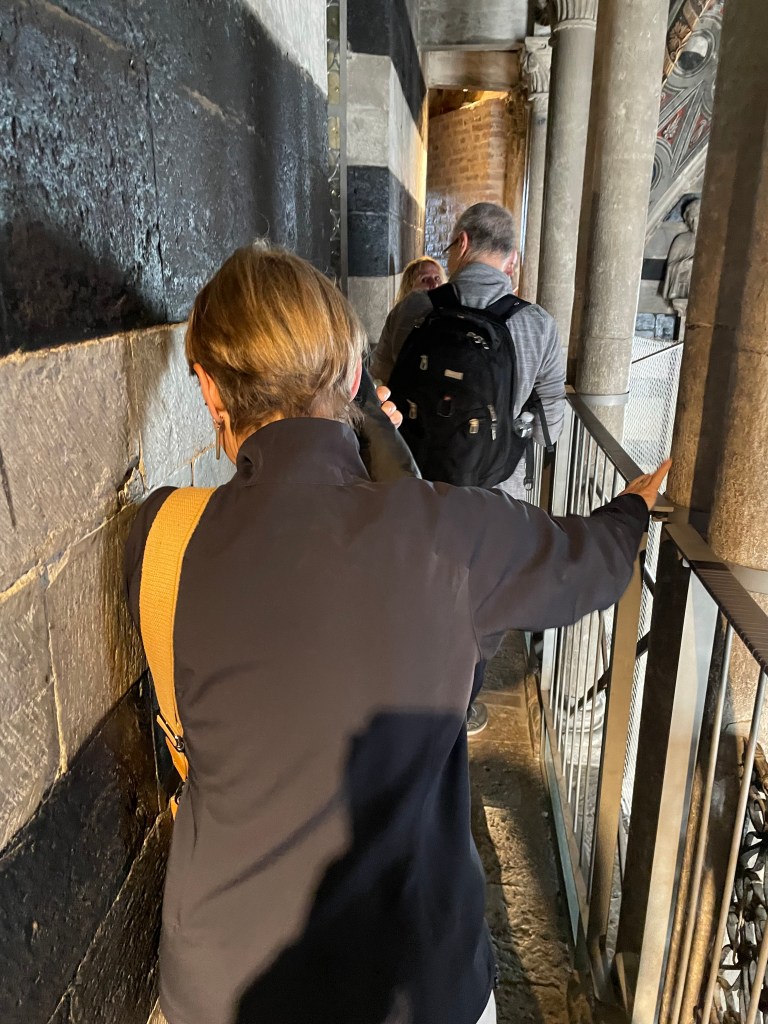
Me, making it around the walkway without looking at all, hanging on the wall and the railing at the spots where it just dropped off, ach.
Rick took this with my camera – the church where St. Catherine’s (Caterina) relics are held. She was a remarkable woman and did all of this before she died at the age of 33. From Wikipedia: Catherine of Siena is one of the outstanding figures of medieval Catholicism due to the strong influence she had in the history of the papacy and her extensive authorship.[9] She was behind the return of the Pope from Avignon to Rome, and then carried out many missions entrusted to her by the pope, something quite rare for a woman in the Middle Ages. Her Dialogue, hundreds of letters, and dozens of prayers, also give her a prominent place in the history of Italian literature.
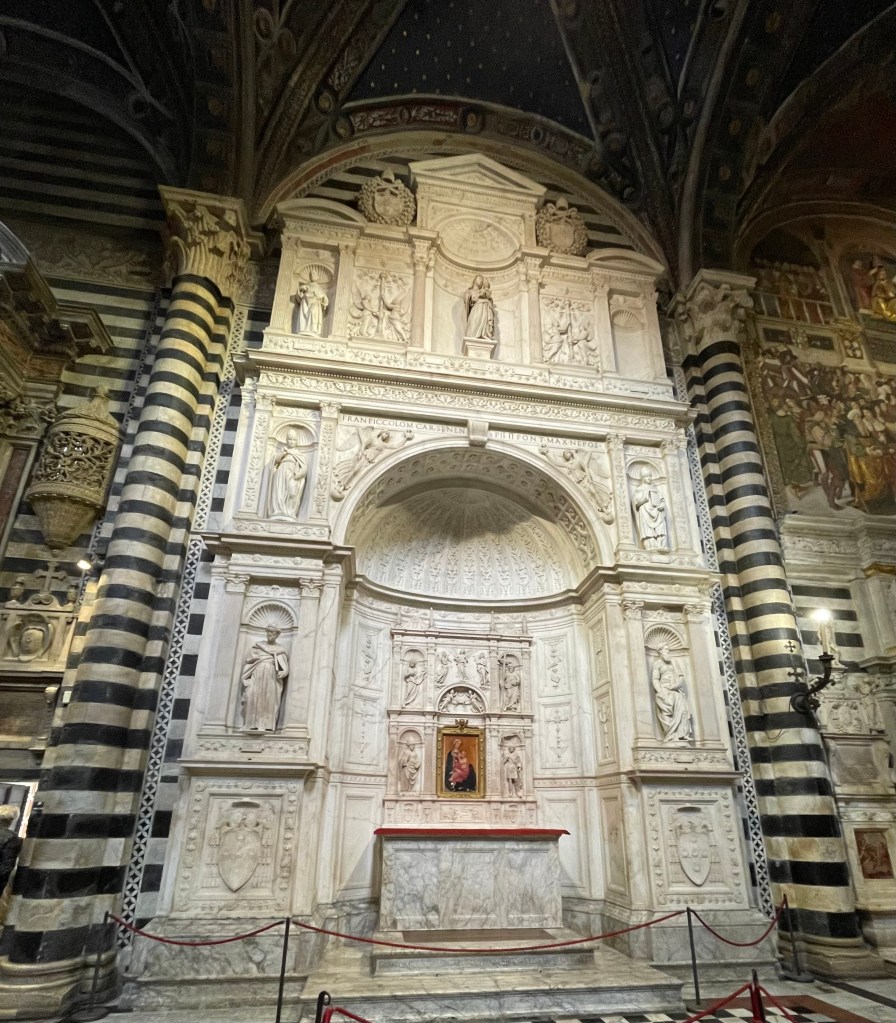
The Piccolini altar design was all supposed to be by Michelangelo. He did the figure of St. Paul on the lower right, but then got “distracted” by working on The David and others did the rest. The figure of St. Paul is amazing.
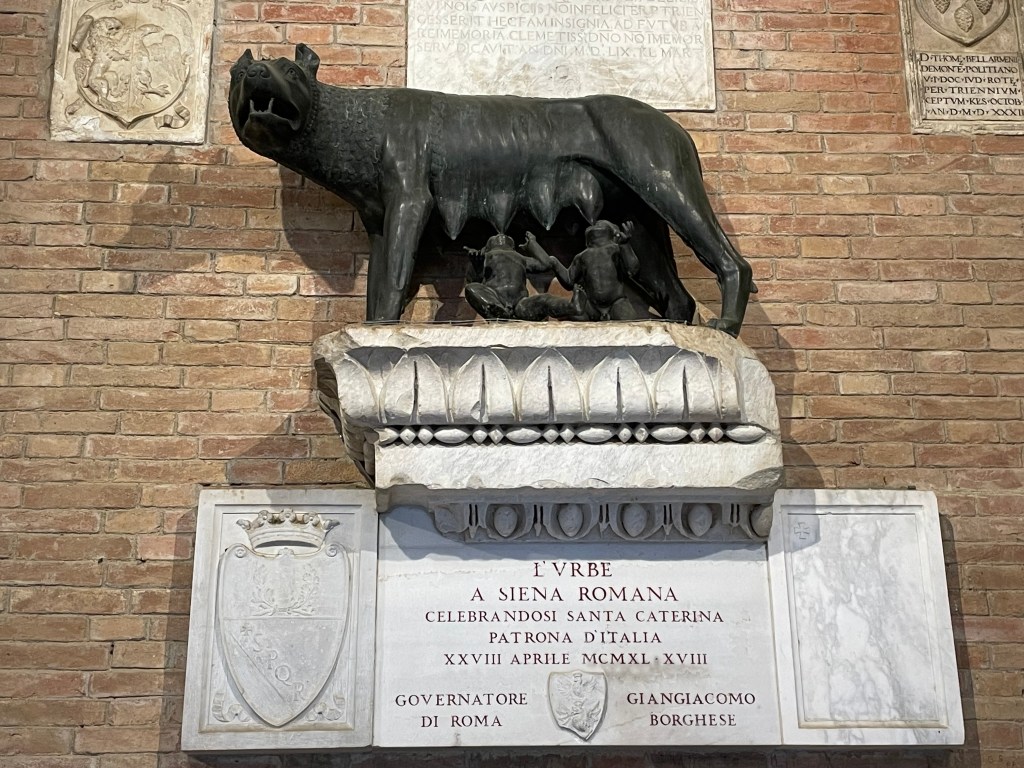
The image below was everywhere, often on top of high columns and we couldn’t figure out what it was about. Turns out the she-wolf is the image for both Sienna and Rome. Rome was named for Remus and Romulus, brothers who were abandoned and nurtured by a she-wolf and who later founded Rome. Then one of them had a son, Siena, who traveled up from Rome and founded Siena.
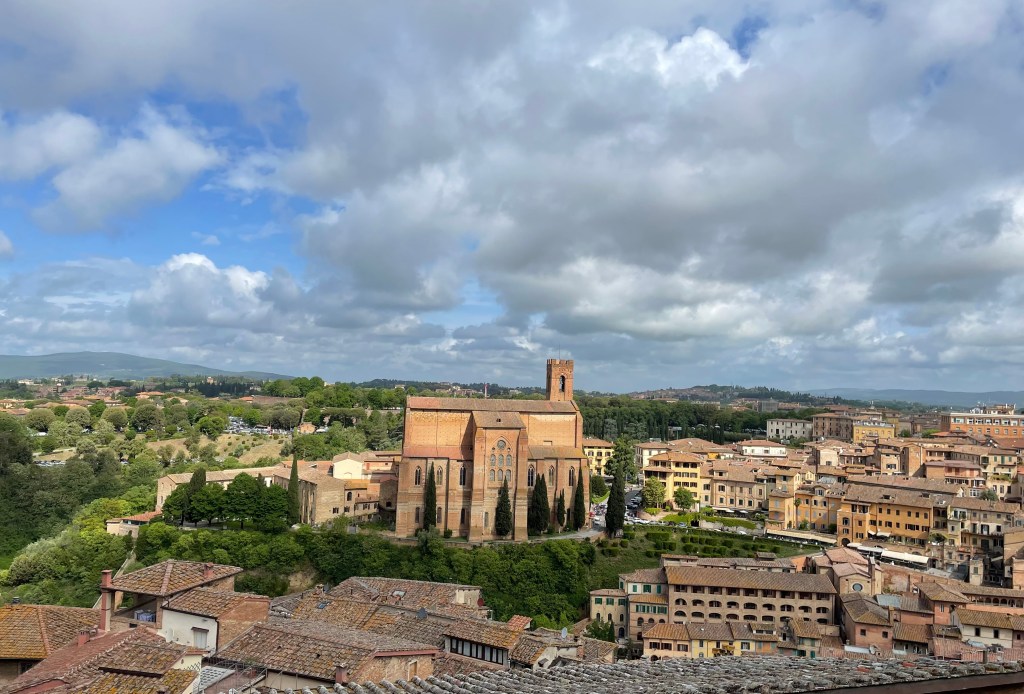
Siena was strong and mighty and flush until the black plague hit in 1348 and they never recovered. Luckily, they were not hit in WWII, only Sienna and Venice were spared, so Siena is a wonderfully preserved medieval town, as seen from the roof of the Duomo.
So many many things to see, but the final one was the building where the first bank in the world started:
Both Rick and Bob got a kick out of seeing this – and the bank’s still going!
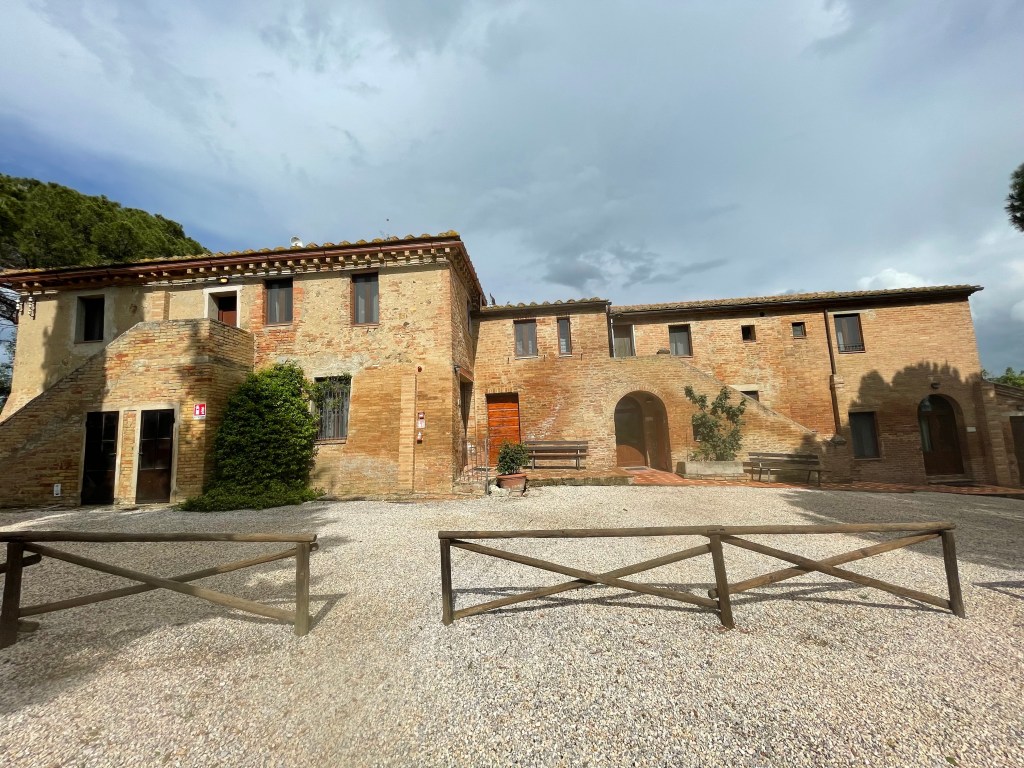
After our tour, we took a cab to our next destination and were very happy we did so as we drove through torrential rain and hail, repeat of yesterday. Then arrived at a cool farmhouse – so different from what we envision at home – that at its peak in the summer can hold 140 people. Crazy.
This is just one set of buildings, they were scattered around, a whole complex.
They have a farm to table restaurant that’s well known and the farm supplies oats, farro, cannellini beans and more to all kinds of companies. Food at dinner was fine, basic, but the rainbow that came out as we arrived at the restaurant was absolutely spectacular. It actually went to the ground, don’t think I’ve ever seen that before. There’s a second one just building from the left…
Then it was quiet and cold and wonderful for the night.
We were determined to walk today, supposed to only be 12+ miles and all of us had energy after taking the day off yesterday. Rain was predicted for 1pm and we wanted to see if we could get most of it done. It ended up being 14+ and 3 more walking around Siena. Made up for missing the day before!
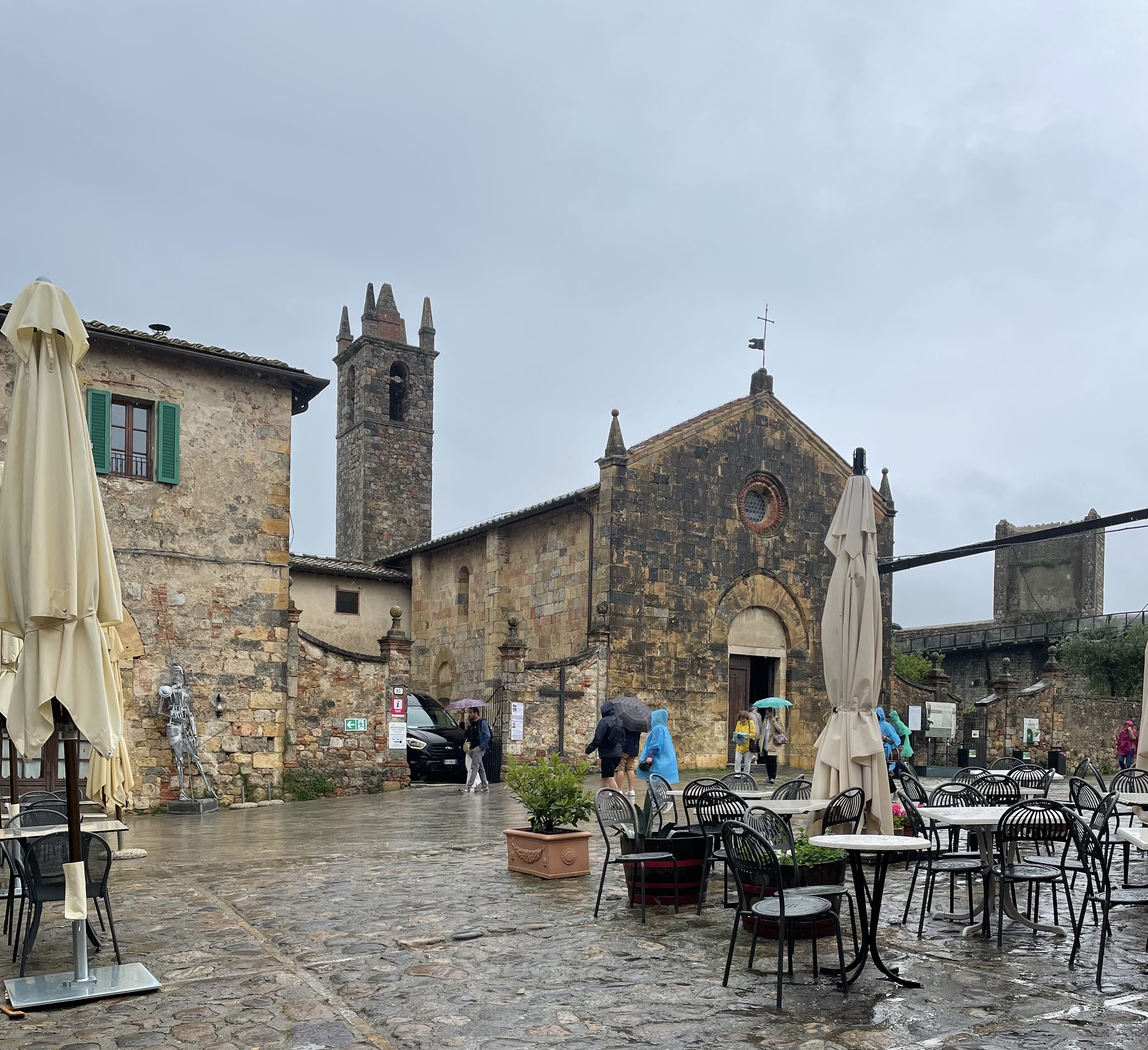
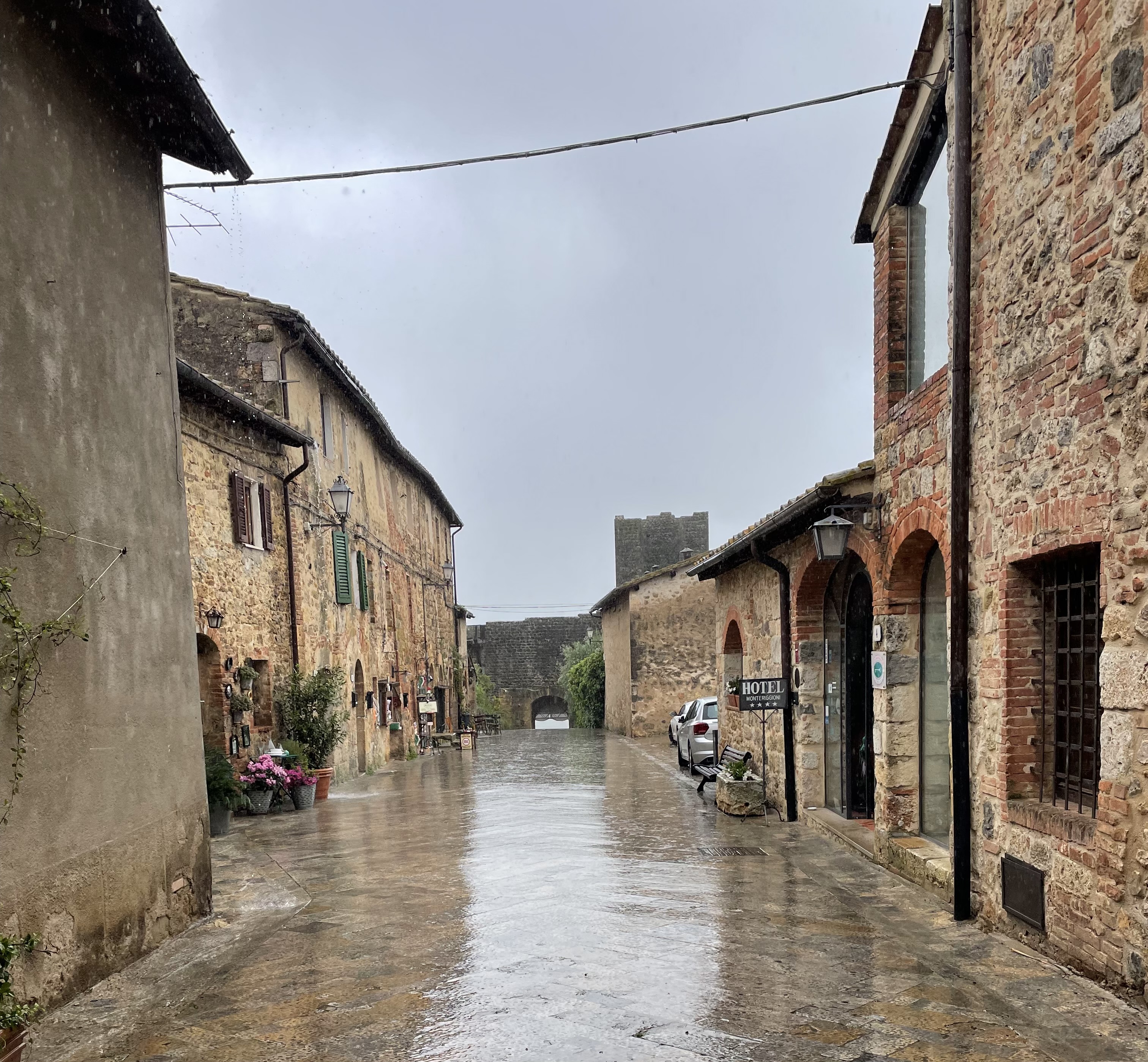
But first – somehow, I didn’t include photos of the town of Monteriggioni yesterday. The first was the 13th century church, then the village in the rain.
Last night, the woman at the hotel had recommended a restaurant 300 feet away, there was a choice of 4! But we went to the one she recommended and it was a fantastic meal. So so good and I’m not even a foodie. Then because the town was all of about 3 blocks long, it quieted down quickly and the window was open and Rick and I both actually slept. Amazing.
The hotel owners had said that they started breakfast at 8:30. After some discussion, we decided we just oculdn’t leave that late, wanted to leave at 7:30 latest and we told them, no problem, we bought sandwiches and had a few snacks, so would be fine. Plus, we’d eaten so much the night before, no big deal on missing a meal.
Then we woke up, got our bags down (thank you elevator) and found that the older man had gotten up early and set out his full breakfast for the guests. We couldn’t believe it. We actually were good to go, but no way, so sat down and had cappuccino, tea, and the usual bread, cheese, ham, fruit, etc. Then he brought out warm croissants that looked gorgeous and I broke my usual and had bread – and it wasn’t just bread – it was wonderful. Never had a warm perfect croissant with jam inside. Wow. Way to start the day happy.
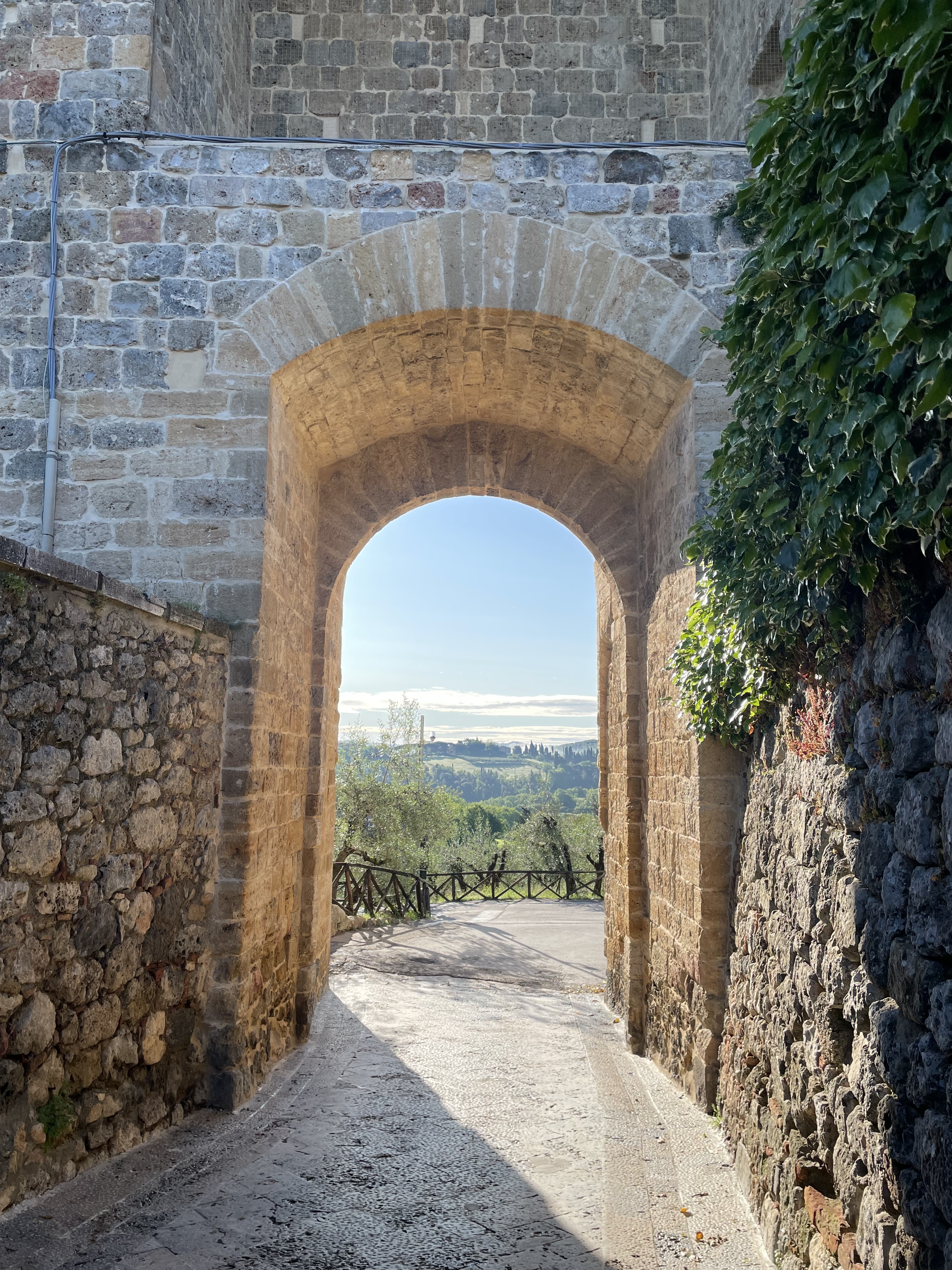
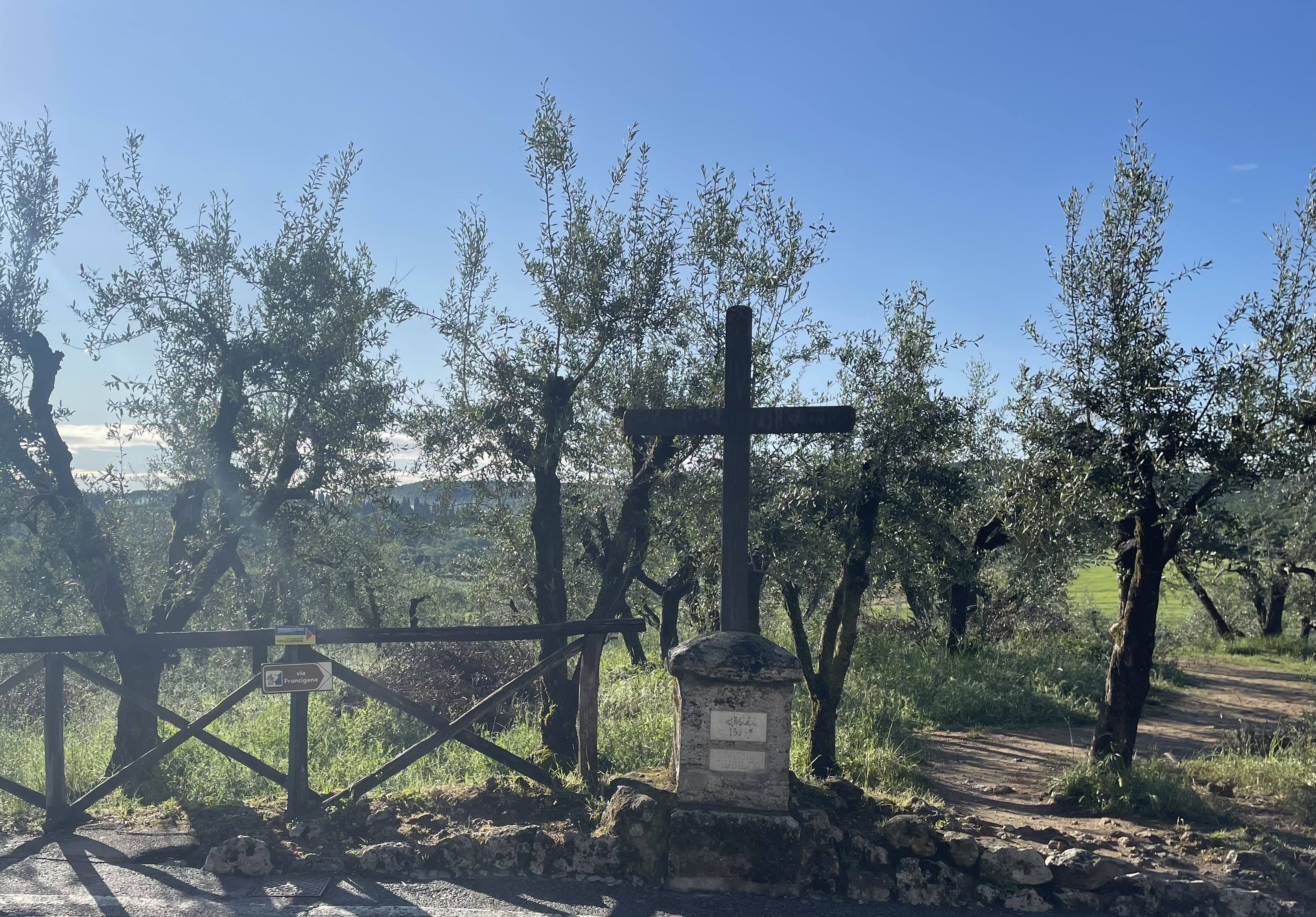
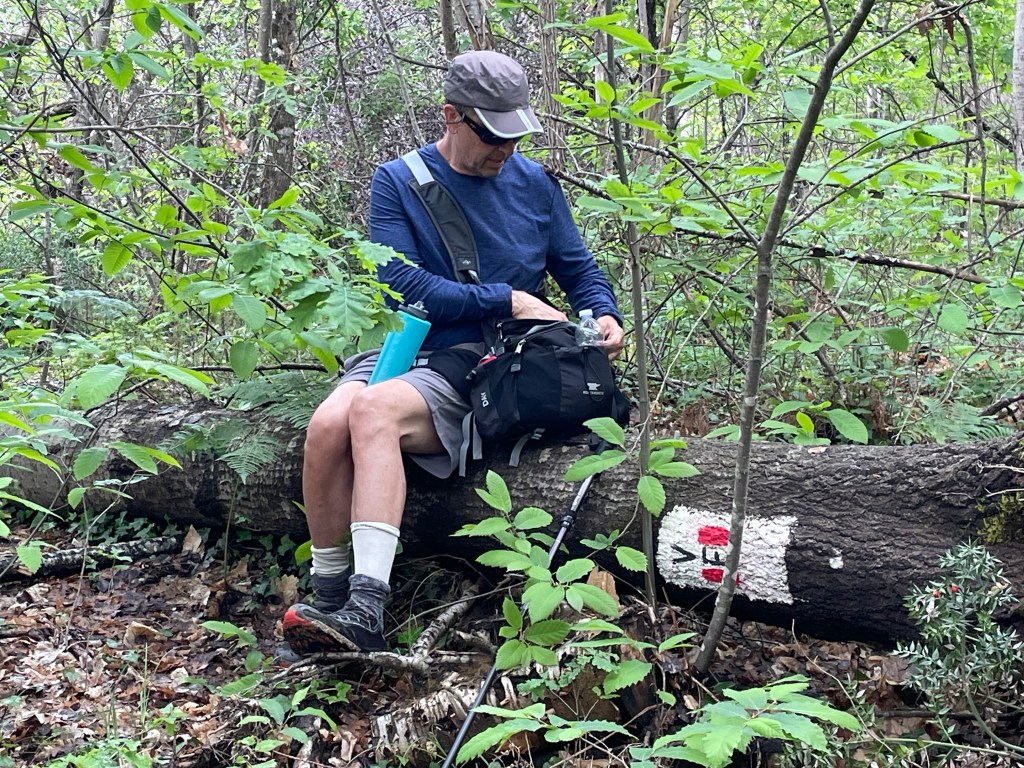
And off we went. Happily, it was sunny, perfect temp and beautiful again. Leaving the gate and onto the VF:
Impact from the rain the day before:
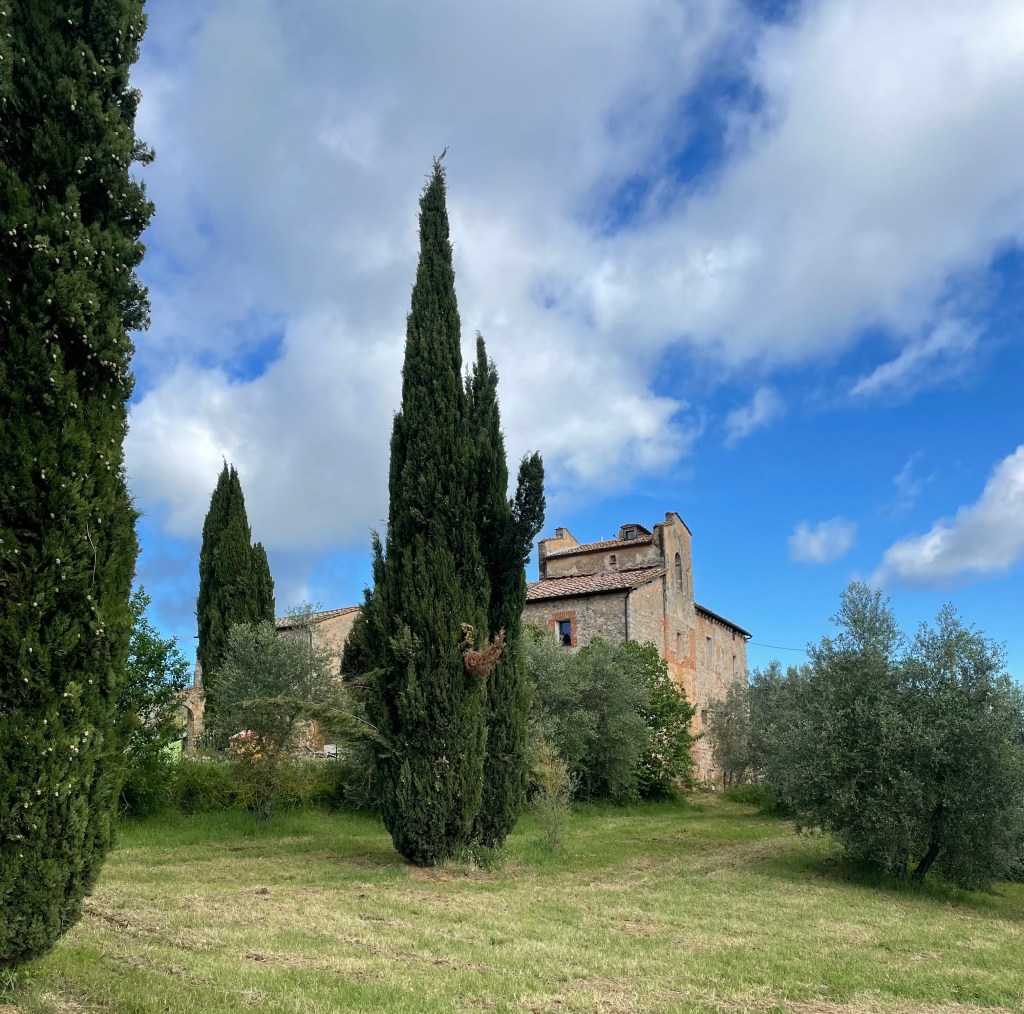
We’re walking along and I see the sign for a castle. The Castella della Chiocciola. Huh, well, it is huge and in the midst of nothing, so took the photo.
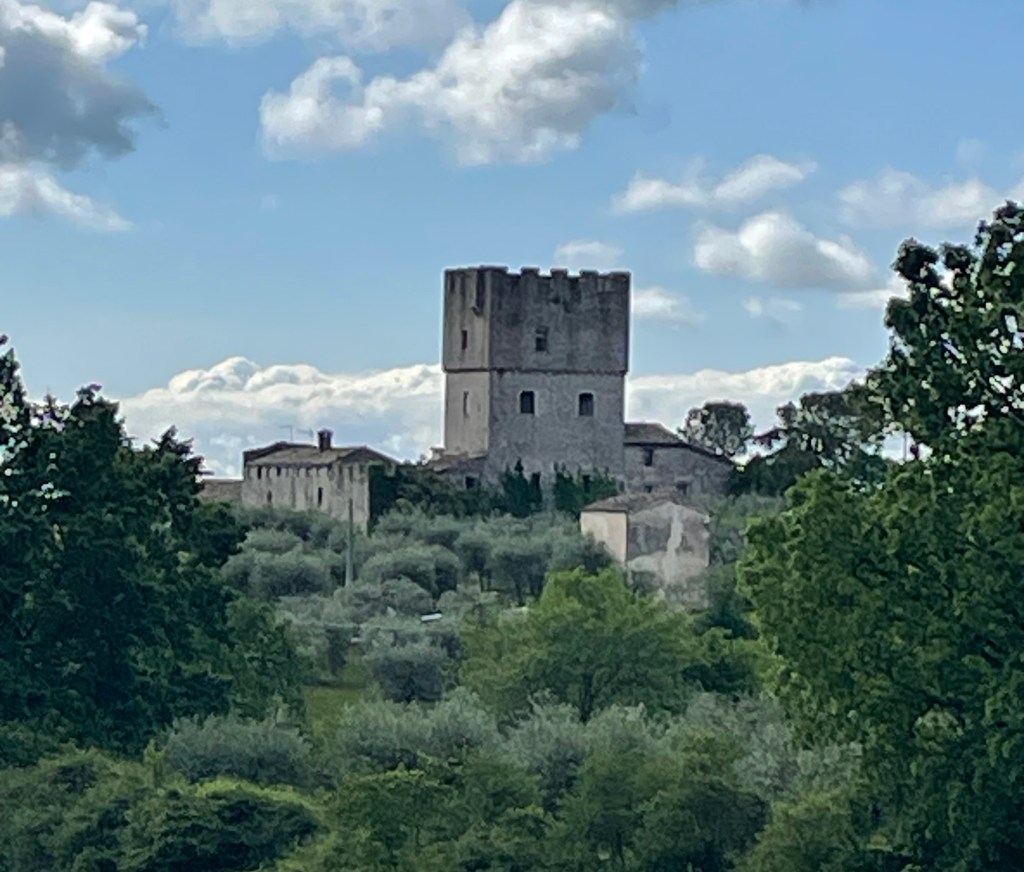
Oh, no, there it is, but doesn’t look like we can get too close.
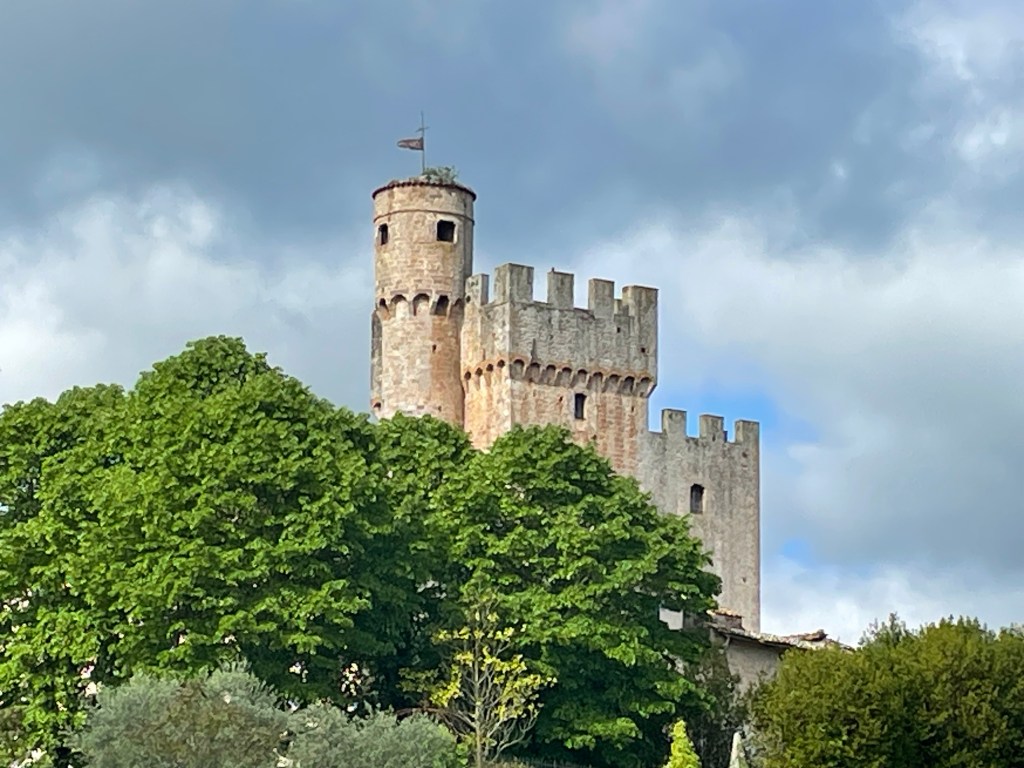
Oh, this is definitely a castle. All within 200 feet or so of each other! Though staggered on opposite sides of the VF.
The Castle of La Chiocciola, built in the 14th century, known for the resistance it opposed to armies of Spaniards and Austrians during the war of Siena in 1555. it takes its name from beautiful stone winding stairs connecting the stories of a cylindrical tower. Clearly, I hadn’t read the full sign…
I said, there’s someone living there. Rick said no way, noone’s living there. Yes, I think they are. Nope. Well, I’m going to walk up to the gate. And I did and waved to the person hanging out the window. Walked back down and then 2 cars full of people pulled in the drive, making Rick move out of the way. I would love to have been able to join them to see what they were going to see. We’ve realized we can’t at all guess which buildings have people living in them and which don’t. Some are pristine, all are beautiful, but boy, it looks like so much work to manage farm/vineyards/buildings. I hope there are many magical moments for people who live in these historical buildings and keep them alive.
We kept going, had our sandwiches,
kept going and then the rain hit. We started getting close to Siena, and it started thundering, bit of lightening and then it started pouring.
It lightened up, we thought we were good
And then it was really pouring. Then hailing. Rick almost ruined his phone trying to figure out where we were going, it took all night to recover. The last 2 miles walking through Siena towards the old city were at least 5 miles long, we were definitely wearing out. But we got to our hotel right at 2:15 and they said if we could get down there in 5 minutes, they’d give us lunch. AND they’d taken our bags up to our rooms which was really nice because it was up several floors and no elevator. We had soup and salad and it was perfect. The soup was the one that Stanley Tucci showed his mom making in the Tuscany episode of his show. Seriously perfect for cold sopping people, albeit in dry clothes after a quick change.
Then we took an hour to shower and recover and started off again walking to see Siena. Bob and Susan were leaving the next day (no!!!!!) to go to Rome and then fly home so we needed to see what we could see. And it was so cool. We went first to the synagogue. Unbelievable history of survival, from the 1200’s with records showing a yeshiva. The ghetto was created in 1571 by Medici upon orders by the pope. The synagogue we saw was built in 1756 on orders of another pope who wanted the community to have only 1 synagogue rather than the 10 or so that were scattered around.
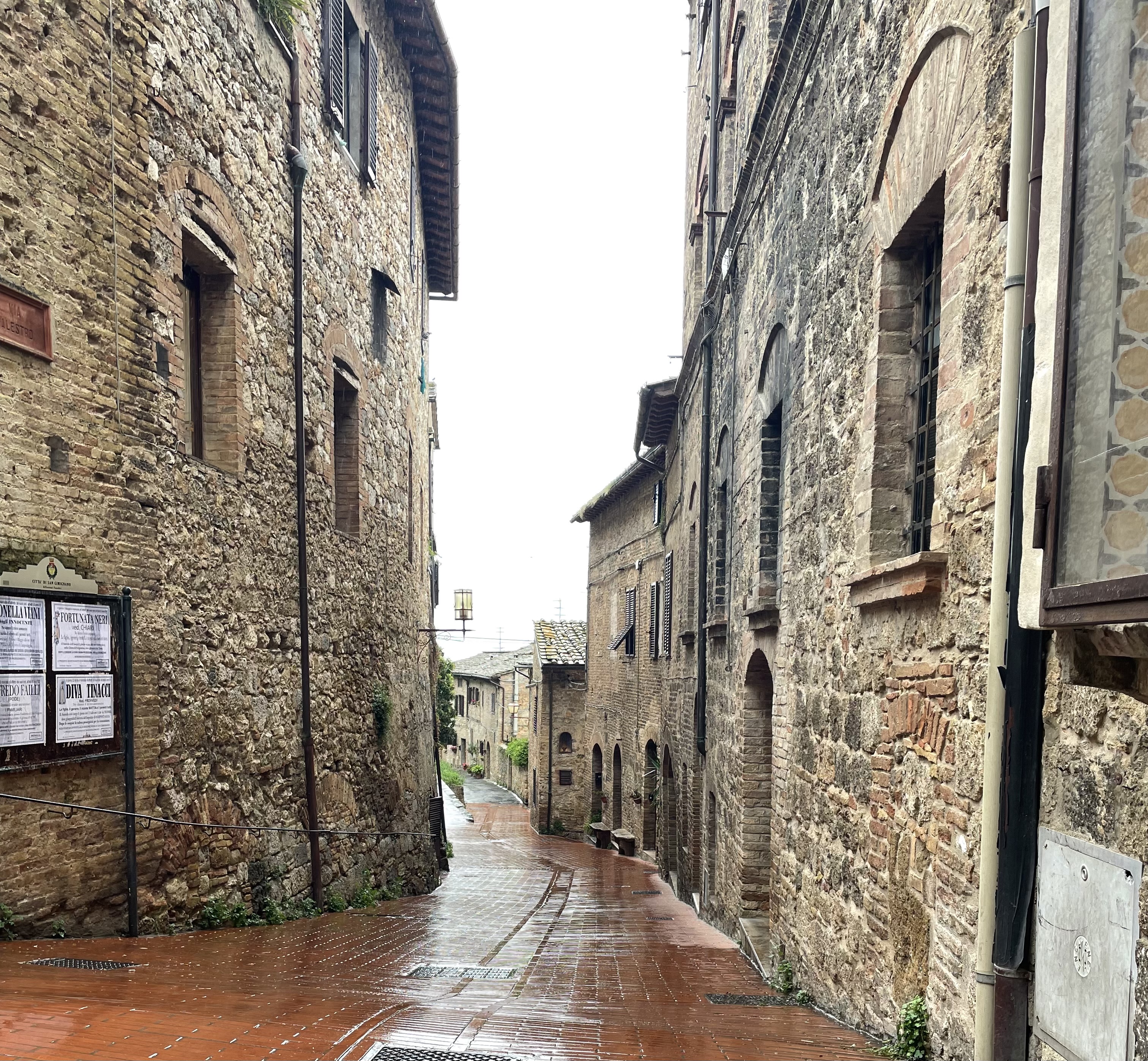
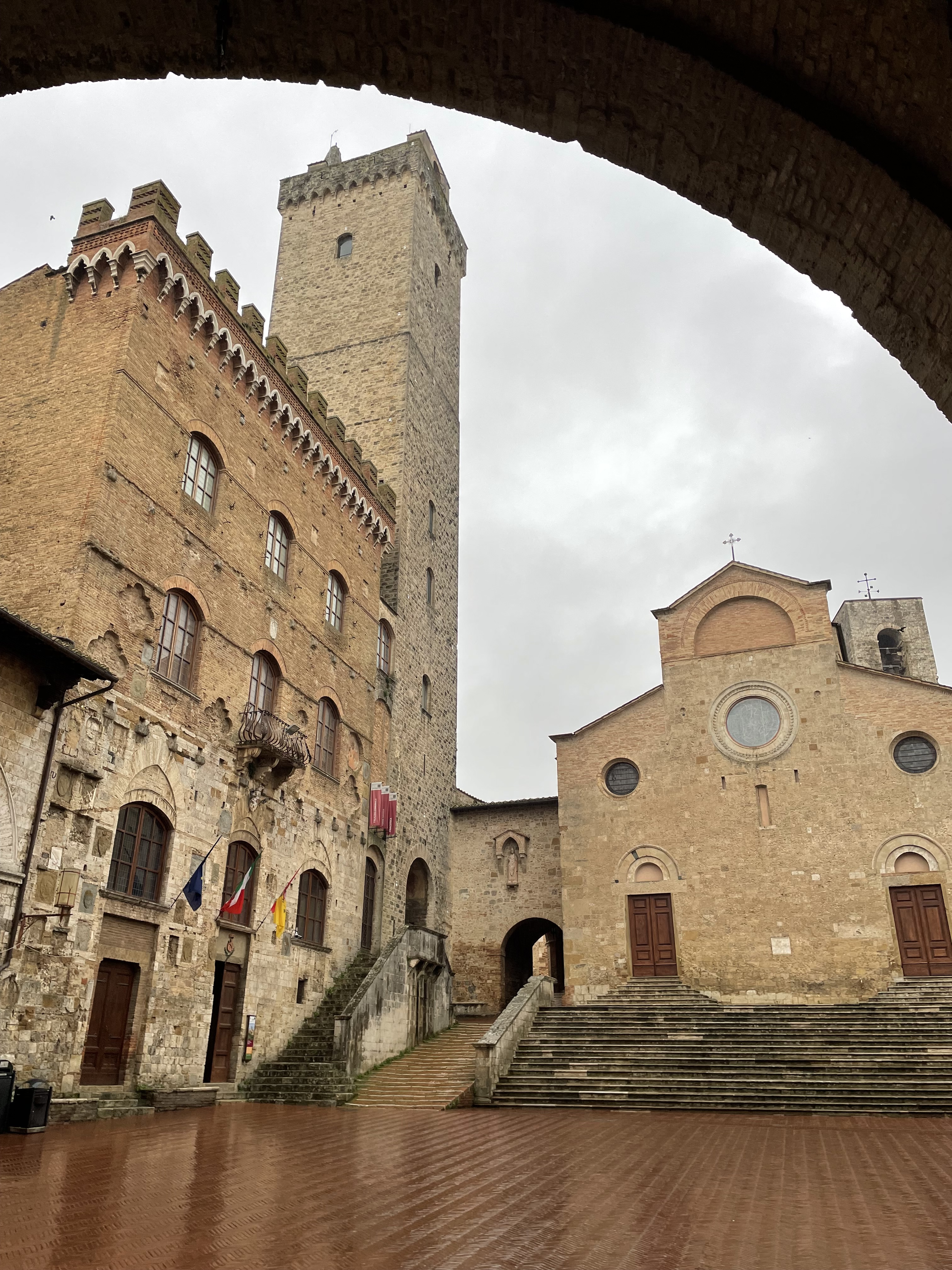
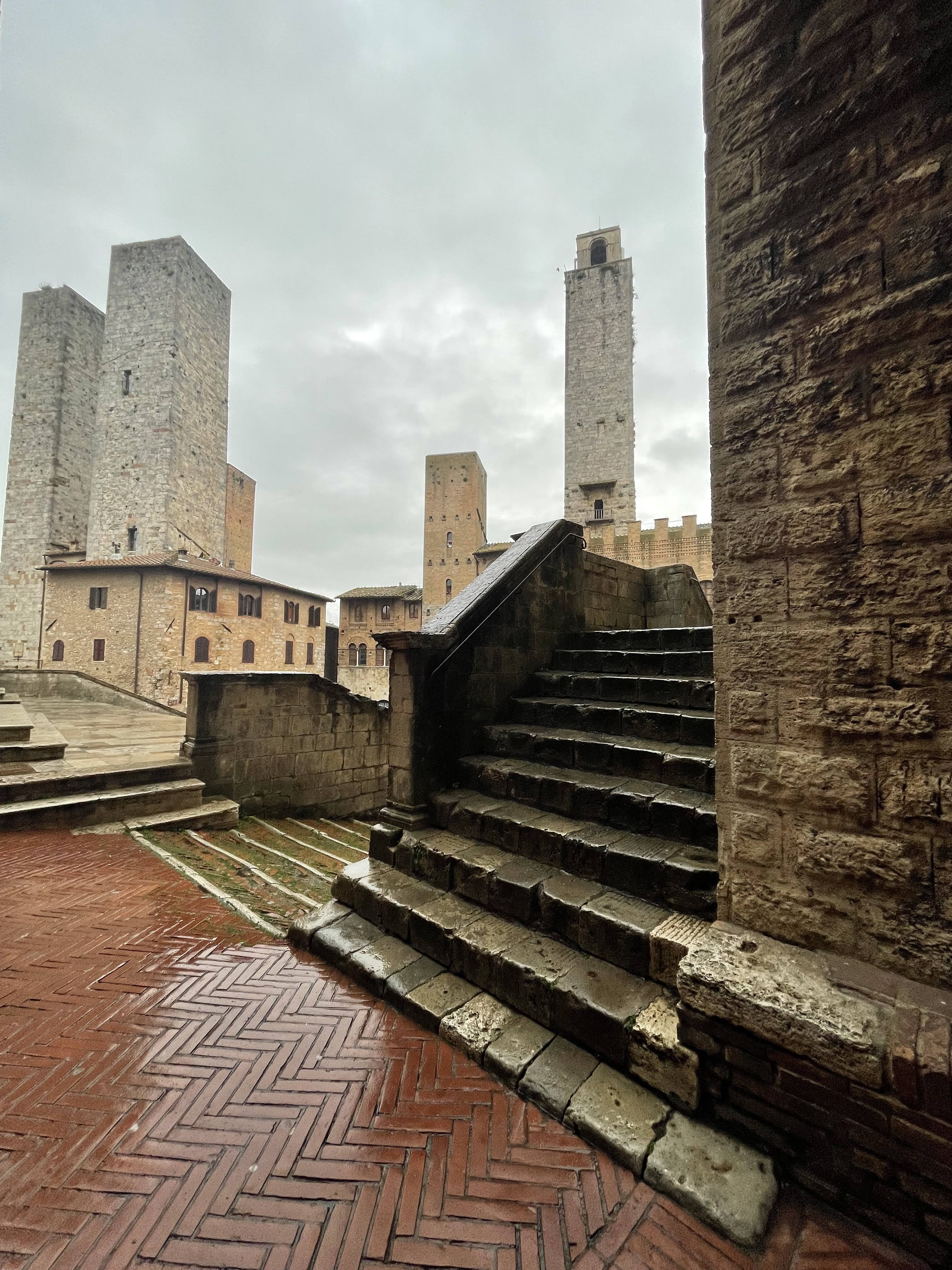
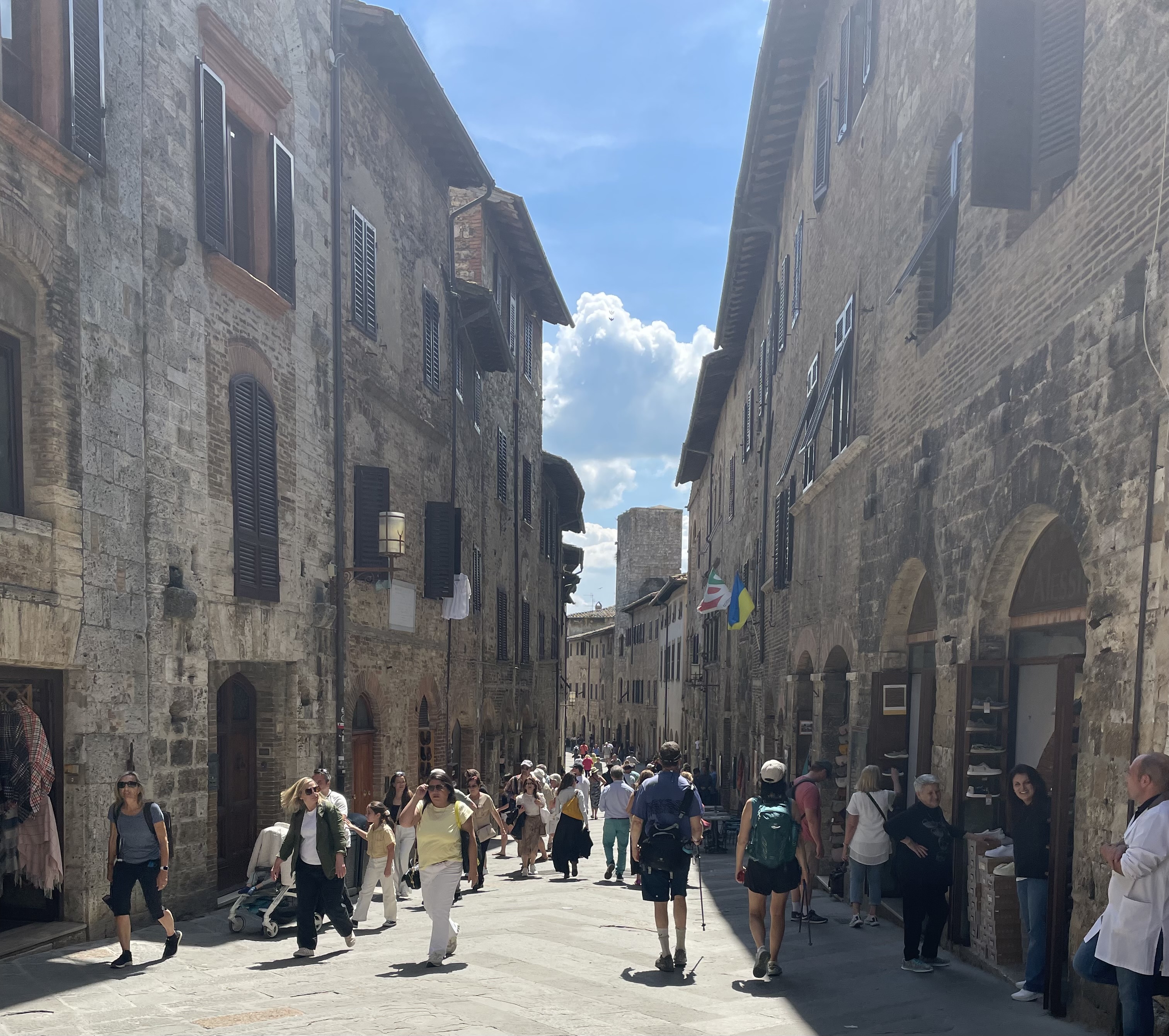
Such a smart decision to take a cab today instead of walking. To say it poured would be putting it mildly – all day. But we got to take our time in the morning which was a treat. I got out early and was able to see the town in the rain and empty of the floods of tourists that came off the buses starting around 10. I felt so lucky to be able to spend the night in San Gimignano and to have those moments in the morning.
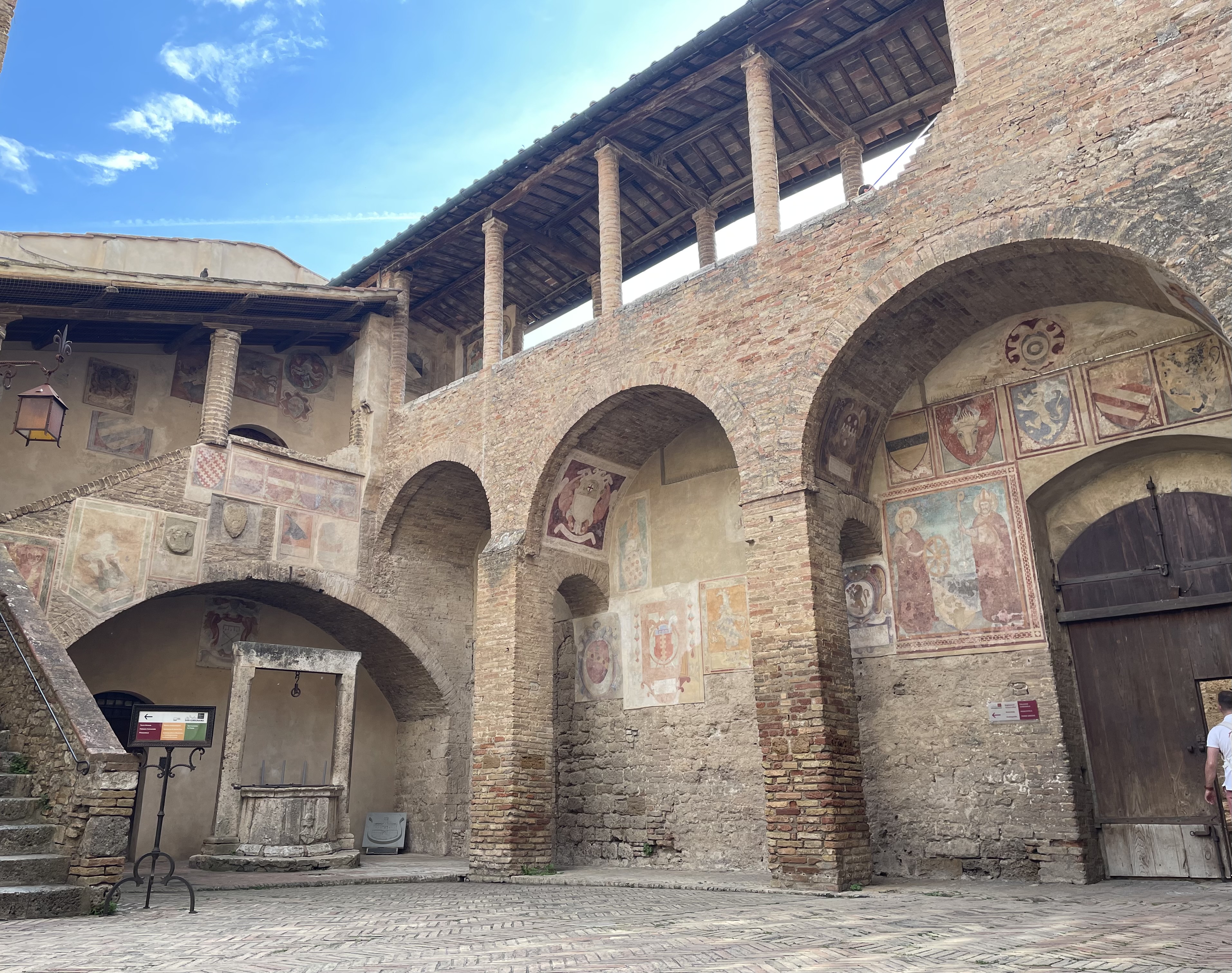
We then went to the castle/mansion? Not sure what they called it in the day, Musei Civici now. We thought it told the history of the town, but it was actually an art museum in the home of the “podesta” or rulers of the town from the Middle Ages. It had the meeting room where Dante was a delegate from Florence. There’re a lot of Dante things here, though he was only here a few months (per the woman at the desk at our hotel). But in the main room is art and a bust of him from when he was negotiating in the war between Florence and Sienna.
This is the room with a mural on the right from 1317, don’t when the others were painted. Dante was there in May of 1300, so just missed the painting…
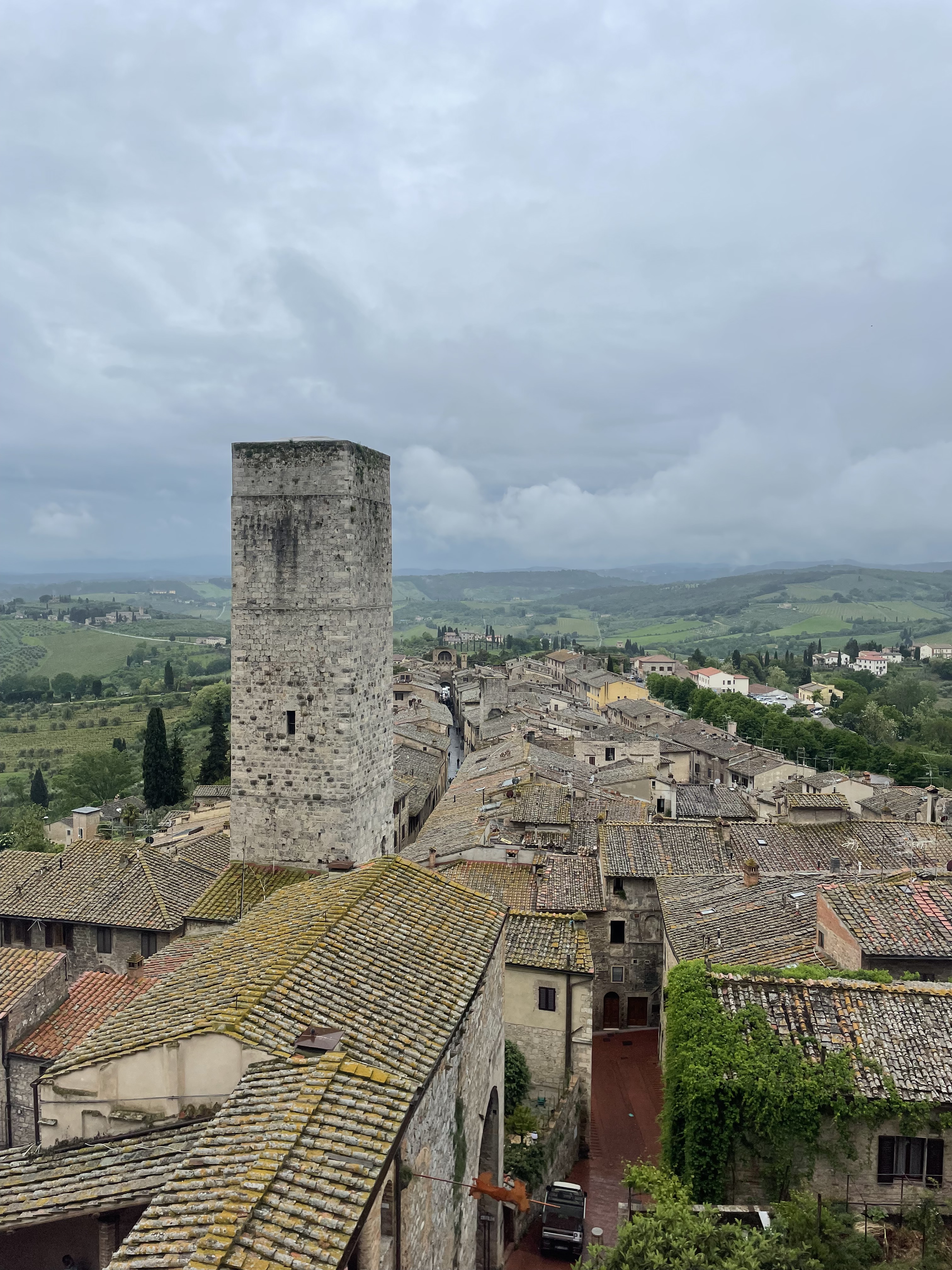
There was a tower that was an active tower since it was connected to the seat of power. I got part way up and could see so much of the countryside, then I came down when everyone else climbed up and up…
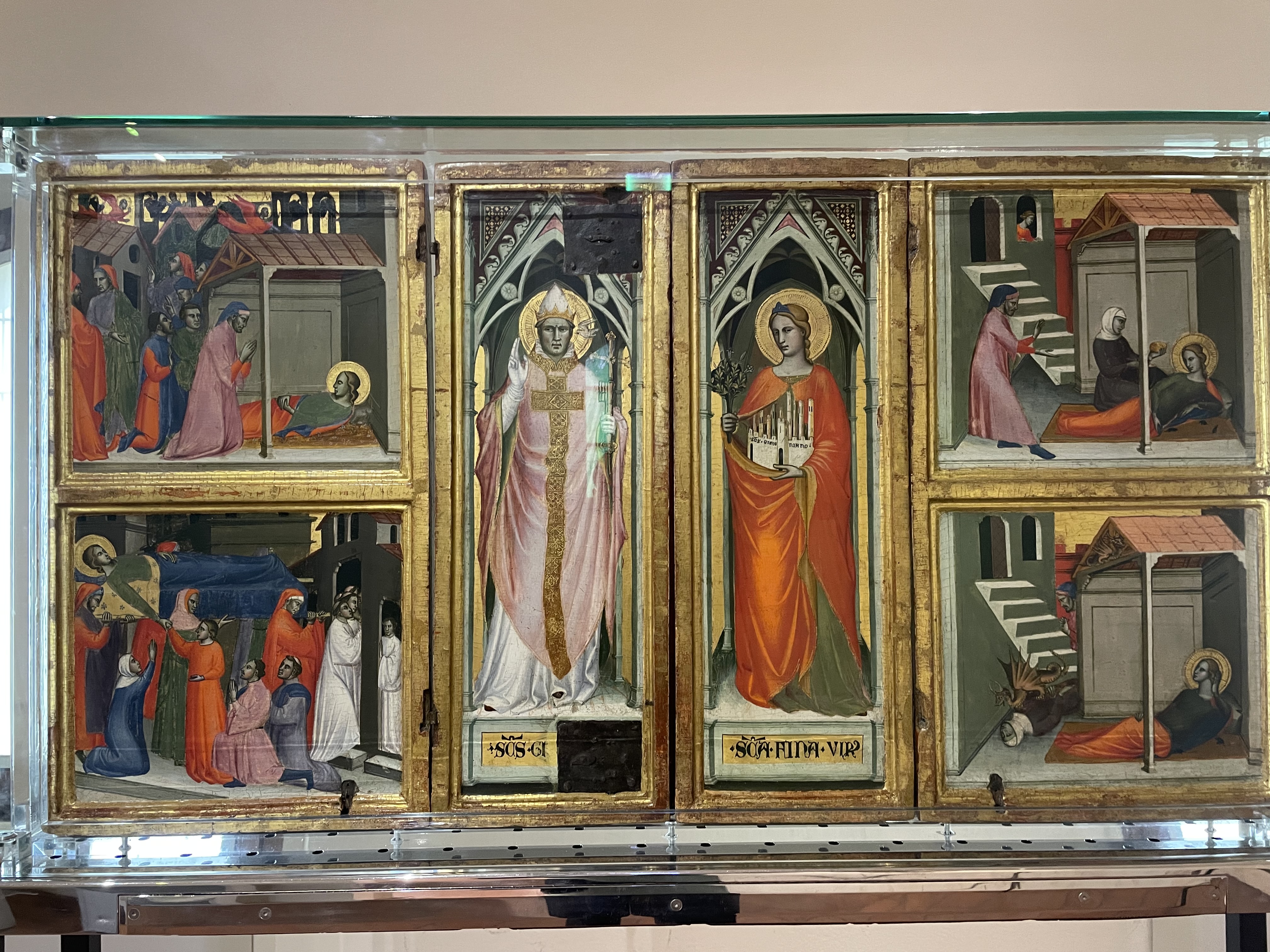
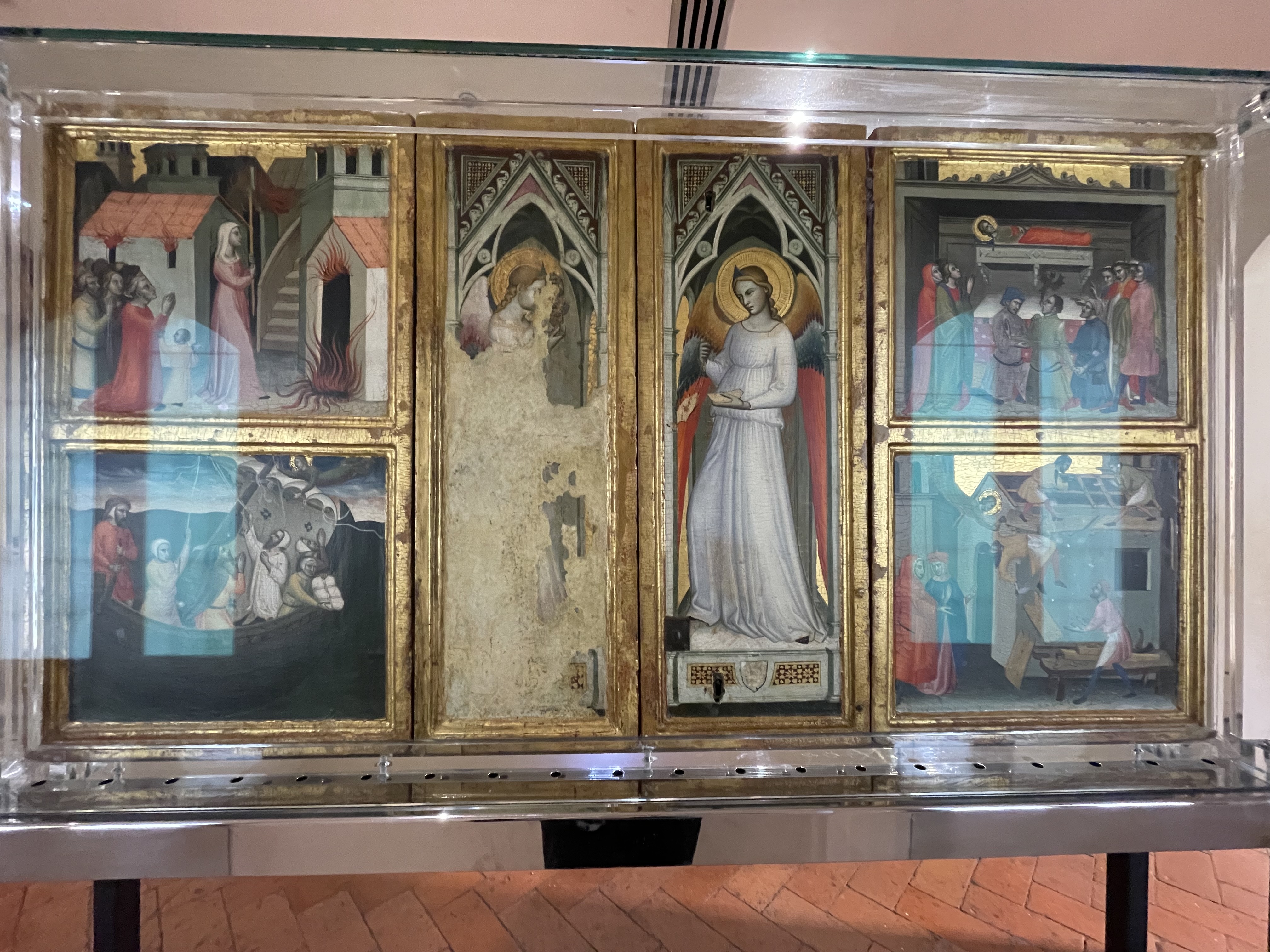
I enjoyed some of the medieval art focusing on Mary and the female saints. The most famous of whom, in San Gimignano, is Saint Fina. Again, the woman at the desk was lovely telling us about Saint Fina. She is adored in the town and every year on March 12 flowers bloom and there’s a celebration for Saint Fina. I started reading about her in Wikipedia and seriously wished I’d seen the chapel and scenes in the Cathedral that Rick, Sue and Bob were asking about – the chapel for Saint Fina.
But in synopsis, in 1248 at the age of 10, Fina, a sweet and joyful girl from a poor family, contracted a paralyzing illness and for five years chose to lay on a wooden pallet instead of a bed and to pray, particularly to St. Gregory the Great, who predicted several things to her when she saw him, including her death date, March 12, 1253. When she died white violets appeared on the walls of San Gimignano. When the woman at the desk was telling us about this, she said they appear to this day on March 12, blooming all over the walls and tower and there’s a grand festival.
Loved this piece from her wikipedia story: “The most important thing “produced” in the memory of Saint Fina is the hospital, which took her name and was built in 1255 thanks to donations given at her tomb. The hospital gave hospitality to old and poor people and pilgrims too. It became in the following century one of the best in Tuscany. The building changed its name in 1816 and remained in function until the end of the 20th century. In the hospital’s chapel, the original oak wood table (Rick would roll his eyes; I’m happy to believe) where Saint Fina lay down for five years is preserved.” Wish I could have gone to see this!
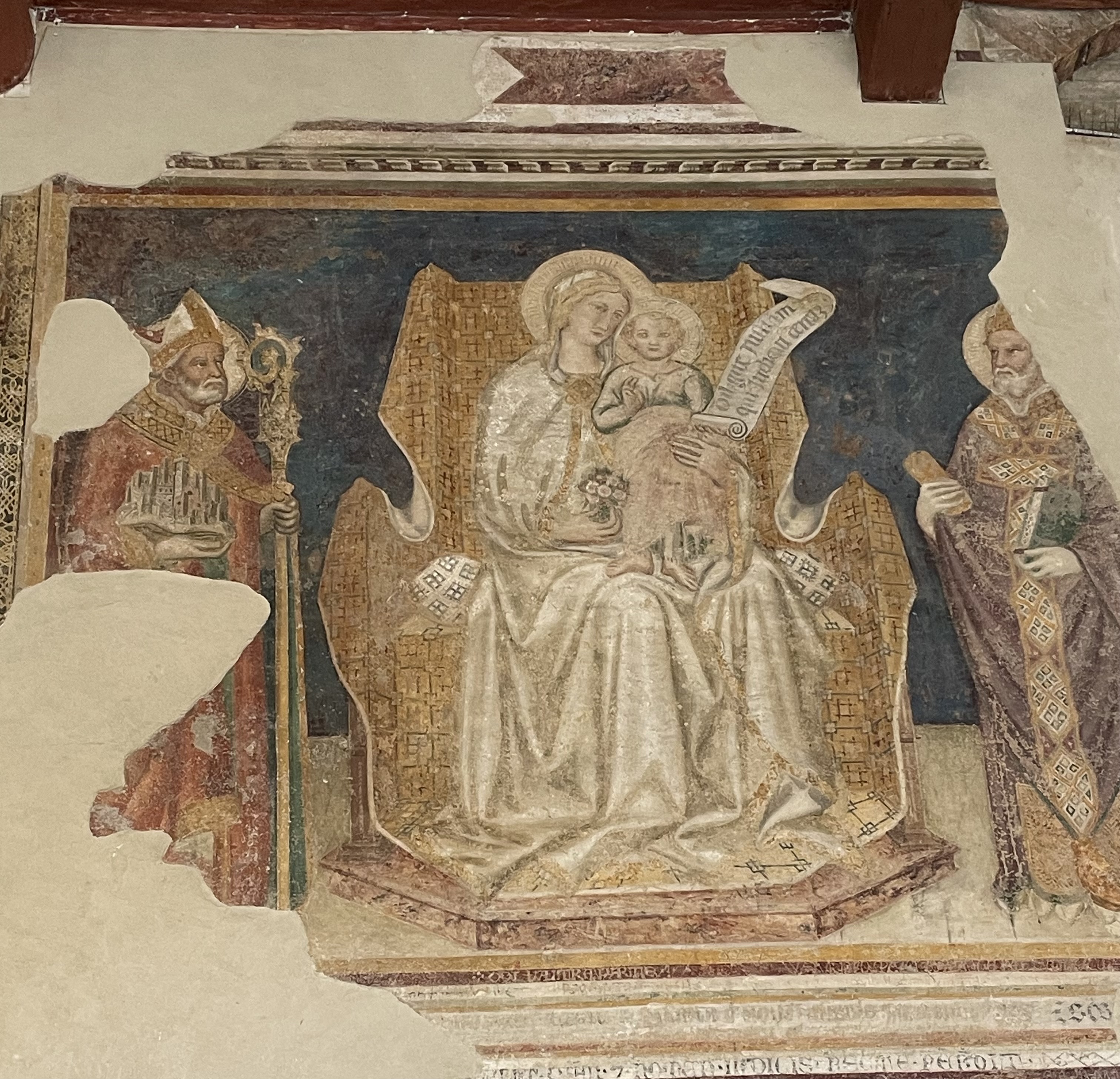
I first learned about Saint Fina when I saw a wood tabernacle painted by Lorenzo di Niccolò in 1402 depicting Saint Fina holding a model of San Gimignano along with eight scenes of her life and miracles.
The last thing I enjoyed in the Civic Museum was the Camera del Podesta. This room had a series of frescoes from the 1500’s celebrating love.
Frescoes of the Camina del Podesta
I don’t know if this mural video will send, but I hope so. The pictures came through so clearly! Incredible that they’re so well preserved from the early 1300’s.
From Visitworldheritage.com:
Camera del Podestà—or the chamber of the highest office of the village—had frescoes of a love story painted by Memmo Di Filippuccio, San Gimignano’s civic painter. The room is also a famous location for marriage proposals. Here, love is the pillar of life. It is also possible to see what happens when love is not respected.
On the left side of the room, there is the amoral couple that could never get together because the young groom was lured by two deceitful women who steal his goods, beat him, and leave him aching. In this case, love is dangerous. Nearby, there is another tragic love: “Paolo e Francesca,” the famous lovers from Divina Commedia by Dante Alighieri—their faces rubbed out in a sort of “damnatio memoriae.”
On the right wall, there are scenes of marital love. The bride and groom are meeting their relatives surrounded by symbols of loyalty. The real masterpieces are the last two scenes: the young couple, now married, enjoys the intimacy of a warm bath. Finally, the nuptial bed embraces the couple, giving love the opportunity to fulfill one of its highest tasks: create life.
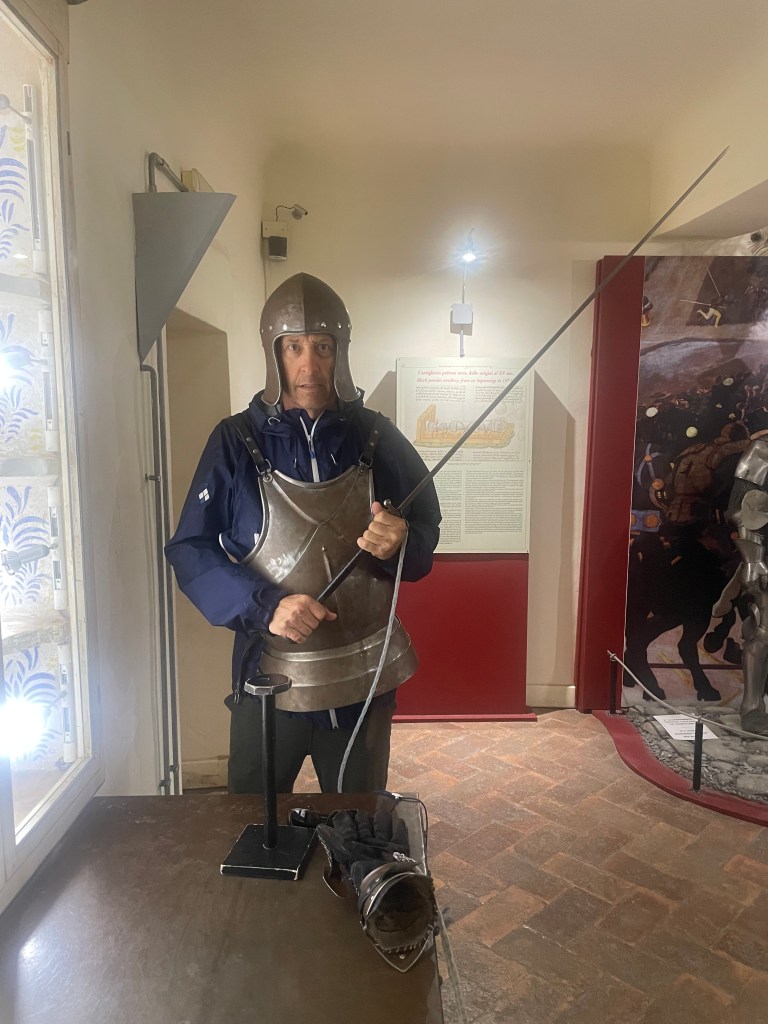
Then time to leave this wonderful town and to go to another one! Our taxi was right on time and while it poured down, we moved dryly from San Gimignano to Monteriggioni. Oh my lord, another totally cool town. This is much smaller, completely encircled by the medieval walls with room between outer wall for a garden before the first row of houses, a wee street, then another row of houses, finally the plaza with the church, a museum of medieval warfare and siege and our hotel, just 2 doors down from the museum, right in the center of town!.
Picture of the town from the museum, pretty much still looks the same, but has modern plumbing and some great food:
The church is tiny and I thought would invite some sitting, but honestly, it was dark and the imagery didn’t call, but still a sweet church for a tiny town and the bells ringing at noon were great!
The museum was our last visit after walking the walls a bit on a new supported structure, then the town and getting sandwiches for tomorrow’s hike (bread, cheese, ham – same every day).
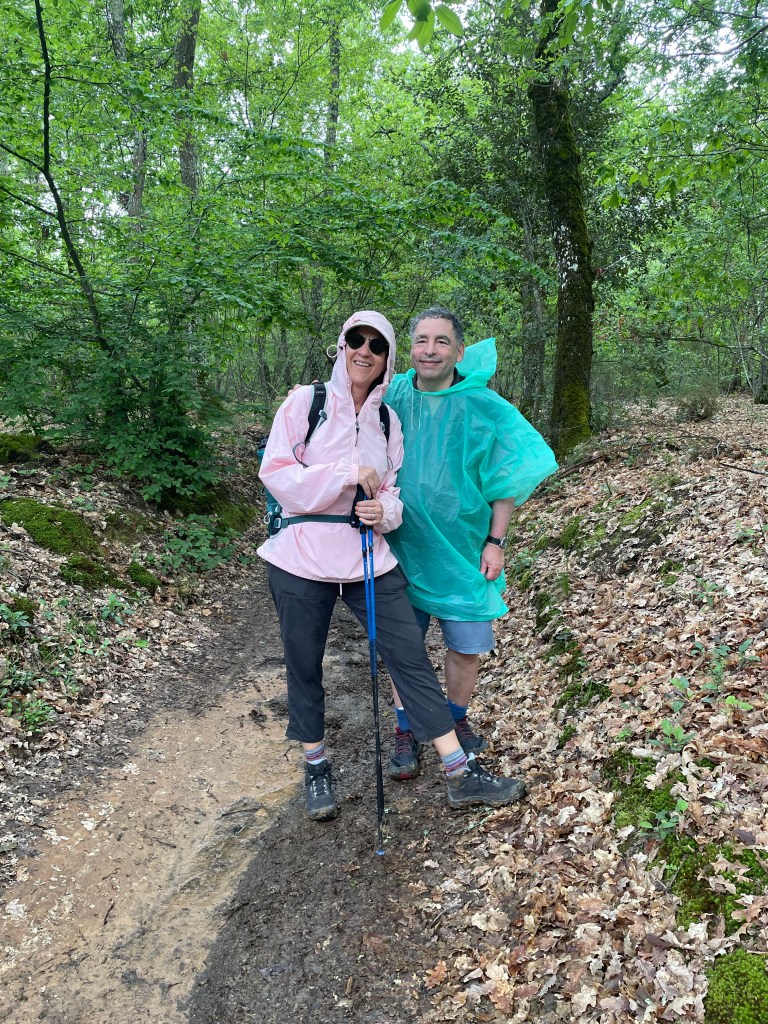
Lucky, lucky, lucky is all I can say. I fell on a rock yesterday so have a cranky knee, Bob pulled his hamstring a bit, Rick – well, more than can be written. And yet, today was just fantastic. So incredibly beautiful and on our way to San Gimignano, the reason I chose this segment of the Via Francigena. Rick said at one point, “I think it’s even more beautiful than yesterday!” Really, we couldn’t believe it.
We were supposed to do 9 miles today, but started off a little differently. We did a full circle of Gambassi Terme, ending up back in front of our hotel. Another mile. Huh. So we all stopped talking for a bit and starting paying more attention. The VF has more signs for norte than the Caminos. Probably because the first pilgrimage by Sigeric was from south to north. That’s just a guess. But we did a circle of north and south VF signs. Found the right way, then we were off!
Two of the scenes we got to see twice:
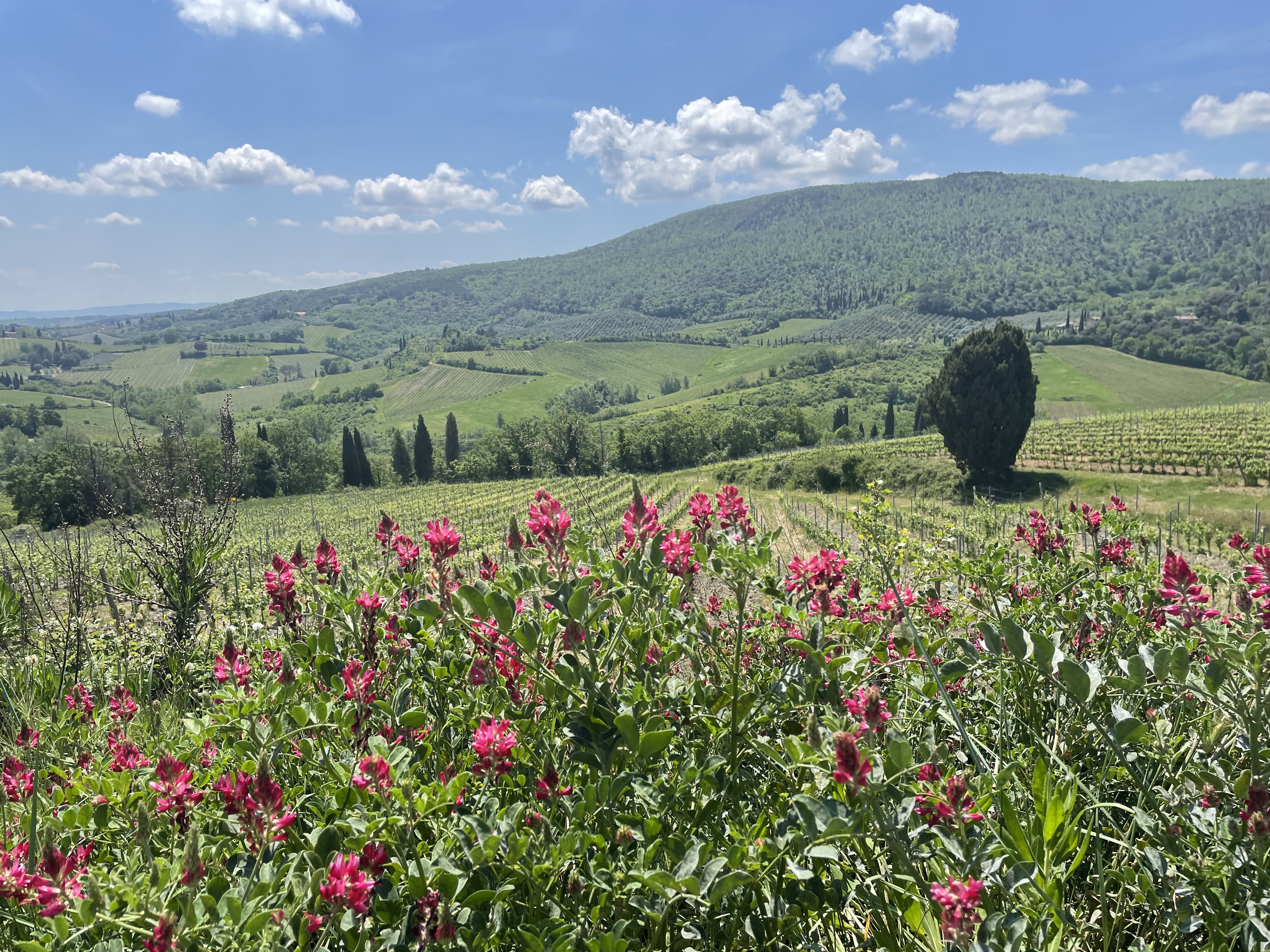
Scenery shots:
The first interesting structure we found was a convent, Santuario di Pancole – The English part of the sign: in 1668 the Blessed Virgin Mary appeared to a young deaf-mute girl called Bartolomea Ghini. She was cured and thereafter the Mother of God arranged for the provision of her poor family’s basic necessities, flour, wine and oil. Thereafter she was venerated as the Mother of Divine Providence. In 1670 the Sanctuary was built, but was destroyed by German soldier in 1944 and reconstructed in 1949. Rick said – really? There was no reason at all to bomb this place, it has no regional importance, just nuns living peacefully.
We couldn’t go in the sanctuary’s church because we very much had the wrong clothes on – so didn’t see the famous painting from the 1400’s by Pier Francesco Florentino which represents the Blessed Virgin breast feeding the Holy Child (really, it can’t be like what I’m imagining, may have to google) BUT – we could walk down to the grotto, a small cave with an elaborate set up of the nativity.
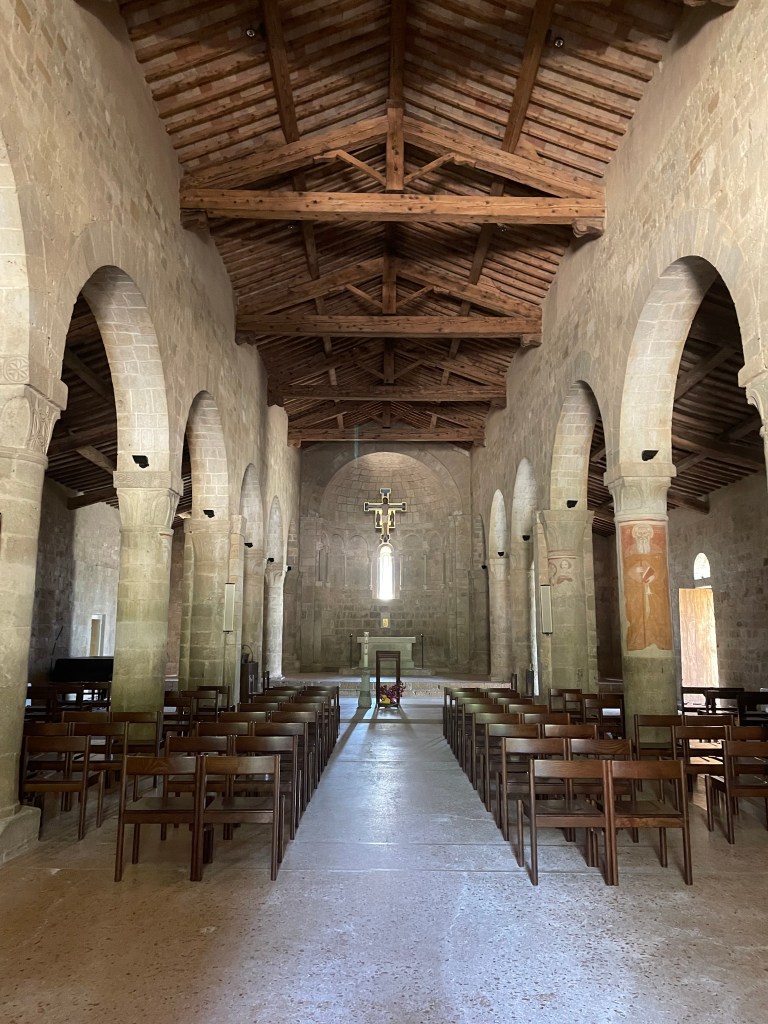
Our next interesting site was the Monastero di Bose a Cellole. The most wonderful monastery, still active (Rick looked through the door after they called for prayers and saw 4 monks and 2 visitors in the service). It is a 12th century Romanesque church, austere, quiet and wonderful. They take guests for retreat and Rick was ready to sign up.
Then we arrived in San Gimignano, had a quick rinse (it was quite hot today) and then had the best lunch – best meal – we’ve had since we arrived in Italy. Fantastic and attached to the hotel. Hotel was definitely a lovely tick up.
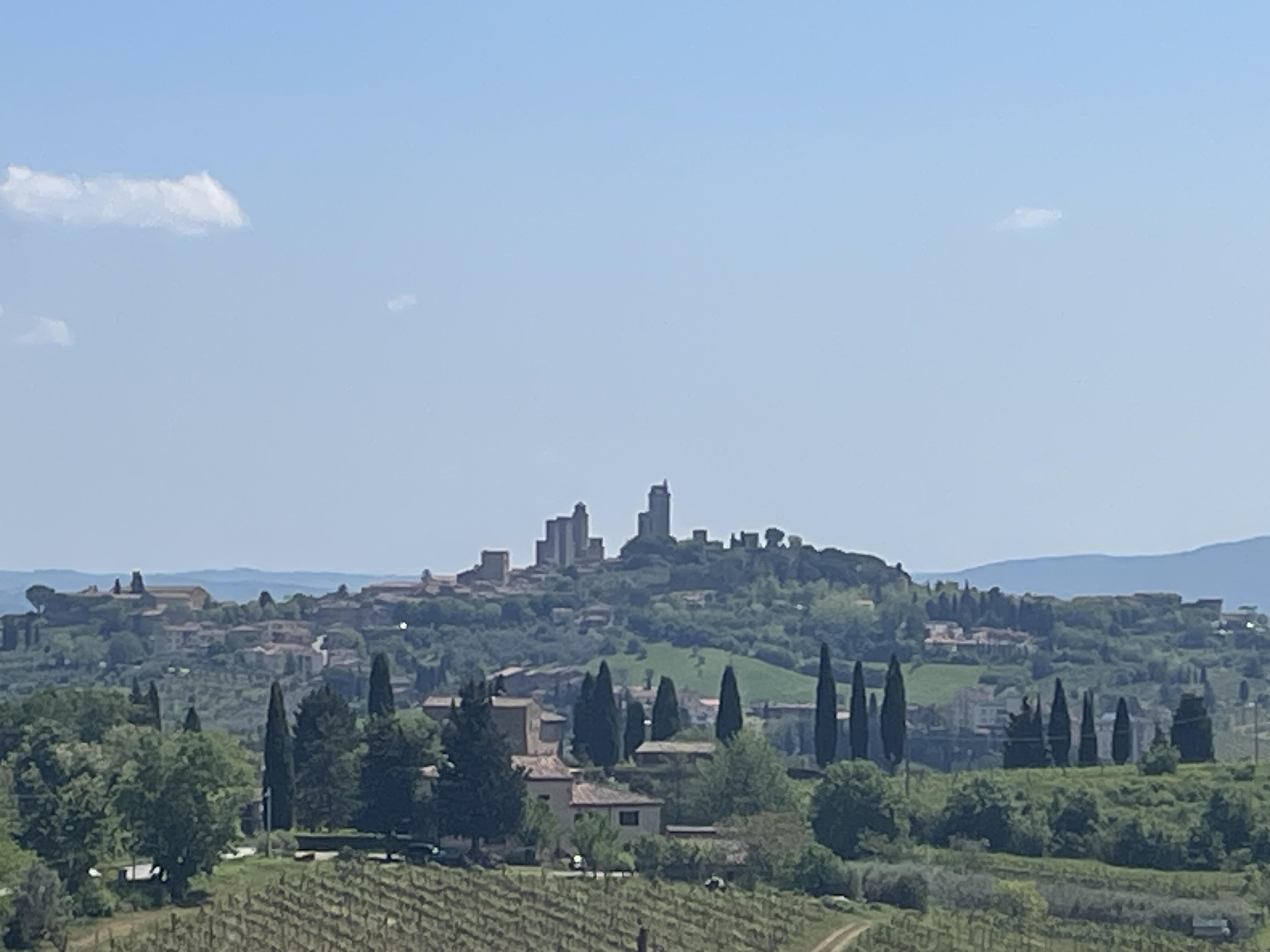
View of the town on approach:
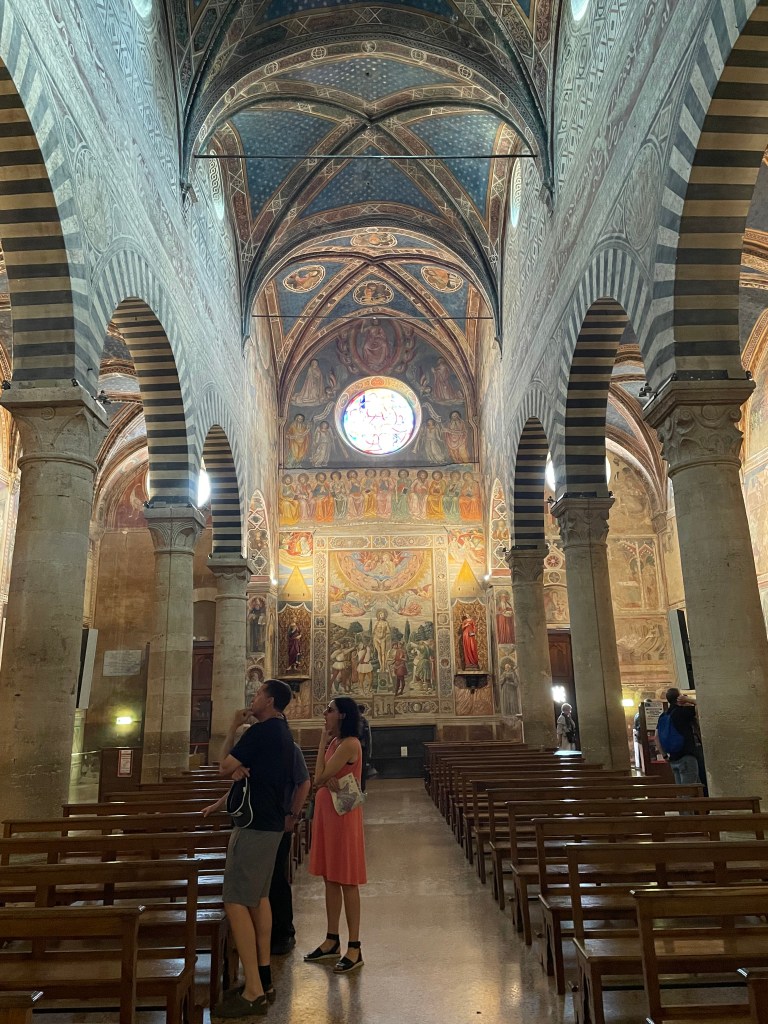
Showered, took a bit of time and then started walking around San Gimignano. It’s as wonderful as I’d hoped. The others fell in love too, so fascinated by the walls, the streets, the history. The main cathedral had a whole series of murals that were remarkable. We couldn’t get the audio to download – too big a file, but we’re going to listen to it belatedly. But can’t give any info here.
Unfortunately, the museum I’d most hoped to see, archeological, is closed for updates and the famous Etruscan statues are elsewhere. But – still everything was a treat.
There were 72 towers in this town, 13 remain. Most were built as testament to wealth and importance and were not functional, but it definitely still gives the look of a feudal Tuscan town. I didn’t capture the towers well. I’ll try tomorrow morning.
It’s amazing because there are original paintings outside that they’ve preserved by removing, securing to a fiber glass support and putting right back up. Without a cover! The painting below, Virgin with Child, was painted circa 1370 and was outside in the patio below.
None of us were ready to leave, so we looked at the next walk. It’s actually supposed to be the one of the most beautiful of the entire Via Francigena, but…we’re going to miss. We decided we’d rather sleep late, go to the museum of San Gimignano and learn more about the town. Then we’ll take a taxi through the downpour that’s supposed to happen all day tomorrow – to another totally cool town and hotel. We made the decision at dinner and had dessert to celebrate! All of us were psyched, relieved and ready to rest the aches and pains. Plus Rick slammed his big toe against a lip of the bathroom, he’s beginning to wonder what in the world is going on. But he’s a trooper and in good spirits.
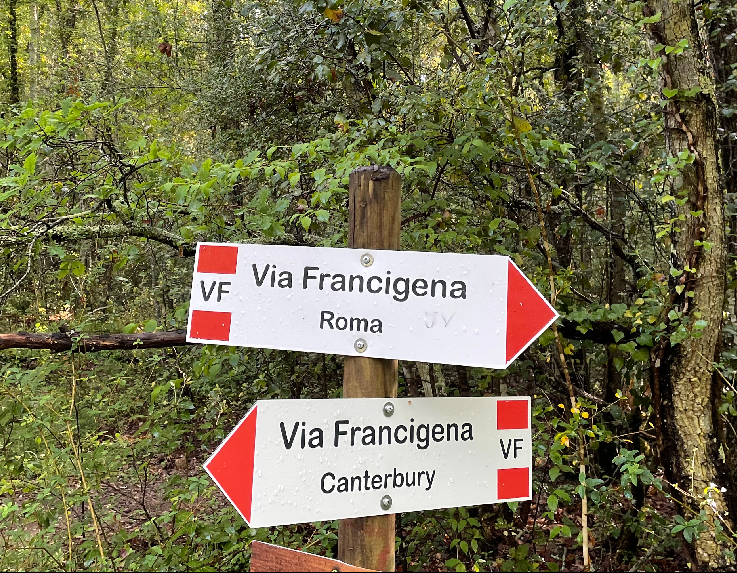
Today, we started the Via Francigena. 15 miles, supposed to rain, but we were set, had water, sandwiches, few snacks and rain coats. So psyched to be on another camino – called the same thing here as in Spain. Here’s some background to the VF, courtesy of the VF website.
Via Francigena, that is to say “road that originates from France”. The name included, beyond the current French territory, also the area of the the Rhine valley and the Netherlands.At that time, the traffic along the Via was growing, so that the path established itself as the main connection axis between the North and the South of Europe, along which merchants, armies and pilgrims passed through.
Between the end of the first millennium and the beginning of the second, the practice of pilgrimage acquired a growing importance. The holy places of Christianity were Jerusalem, Santiago de Compostela and Rome, and the Via Francigena represented the central junction of the great faith roads. Pilgrims coming from North travelled on the Via towards Rome and eventually along the Appian Way towards the bridges of Puglia, where they could embark for the Holy Land. Vice versa, Italian pilgrims that were headed towards Santiago, travelled on the Via towards North, to reach Luni, where they could embark for the bridges of France or they could continue towards Moncenisio and then to the Via Tolosana, that led to Spain. Pilgrimage soon became a mass phenomenon and this intensified the role of the Via Francigena, that became a determinant communication channel for the realisation of cultural unity, that characterised Europe during the Middle Ages.
It is mainly thanks to the travel journals, and in particular the notes of the illustrious pilgrim Sigeric, that we can nowadays reconstruct the ancient path of the Francigena. In 990, after being ordained as Archbishop of Canterbury by Pope John XV, the abbot went back home noting on two manuscript pages the 80 mansions where he stopped for the night. Sigeric’s journal is still considered the most authoritative source, so much so that often we talk about “Via Francigena according to Sigeric’s itinerary”, in order to define a more “philological” version of the path.
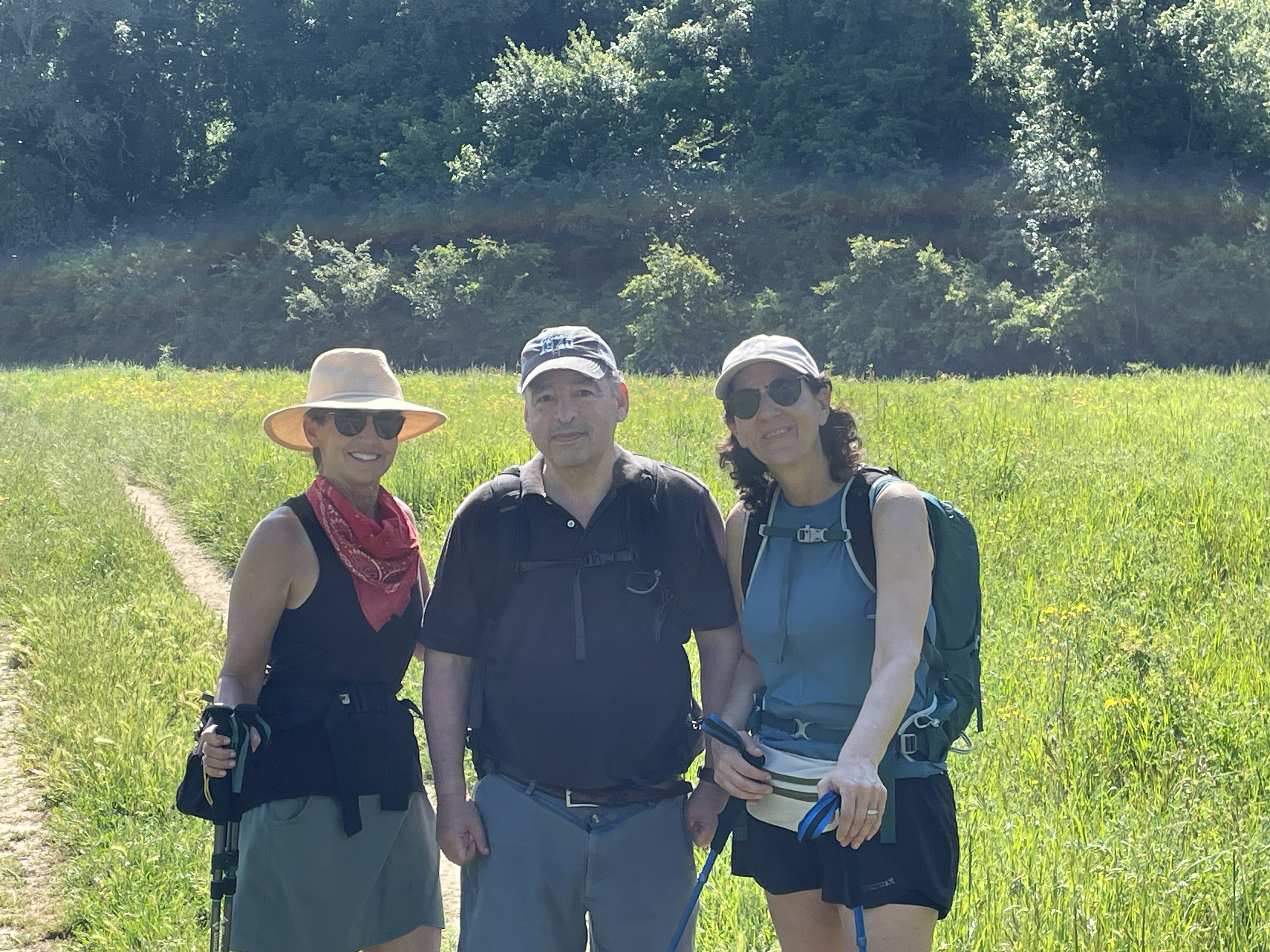
So – there’s a synopsis. We’re doing Stage 90-95 through Tuscany. We have our pilgrim’s passports, good shoes, hiker’s goo and lambs wool to assist the feet. Rick has a fanny pack with a shoulder strap and is keeping it light, actually let me carry one of his bottles of water as well as his small protein shake. You know he’s hurting when that happens. But we’re off – the little sign between Bob and Susan is what we were keeping an eye out for, plus I was tracking on AllTrails and the others were using MacsAdventure’s maps.
Right away, I darted off the path to see this very small church, so cool. Built in 1524 during a plague period and dedicated to Saint Sebastian, patron saint against the plague. I thought the mural was amazing. The others rolled their eyes, but then came back because I took so long. I was trying to talk with the woman who’d just opened the church. Oh, if only I could speak as much Italian as Spanish! Not that I know much Spanish, but I could have understood some of it for sure…
We walked from San Miniato to Gambassi Terme. In a word – gorgeous, just so beautiful. None of us could believe it. I felt so so lucky to be walking with Rick and friends we’ve known for almost as long as Rick and I have known each other – in Italy! And seeing scenery that at every turn gave a new gift. Sadly, my photos aren’t great at capturing, but I tried!
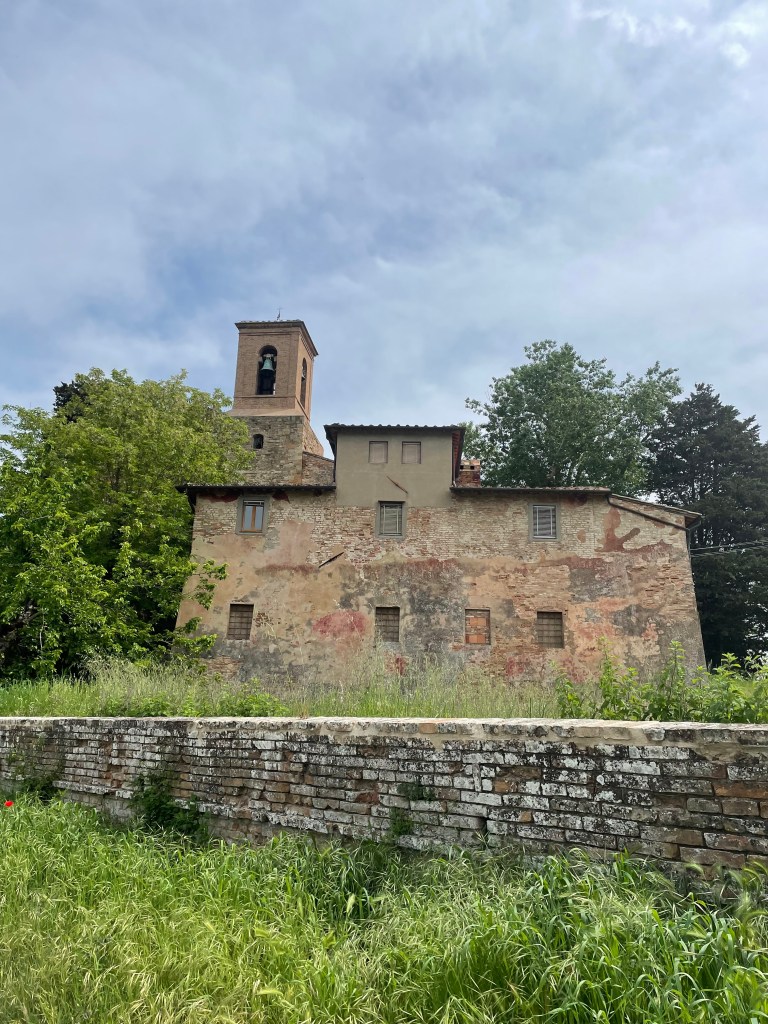
And this church – obviously not doing great, doesn’t seem to be used, but the parish dates back to the time of Sigeric and was recorded as one of his halting places.
And then more scenery:
And, finally, we arrived at Gambassi Terme. We were lucky that there were 2 water fountains on the way because it was hot and we ran out. Gambassi Terme is small, probably lovely, but all we wanted was a shower and then dinner, in a big way. Our hostess at the B&B welcomed us and said there were no restaurants in the town. But there was one pizzeria that was open. We went early. And thank goodness because we were able to sit at the bar. The place only had 4 tables and people kept coming in looking so hungry. Probably all the other people who’d hiked that day. They did get in, but it took a while. Salad, pasta carbonara and I ate every bite. Wonderful.
Today was such a fun day. We did a brief walk around Florence, hitting the highlights again with Bob and Susan. This time I got a photo of the actual grill through which babies were passed to the foundling hospital. They had to fit through the grid, and were placed on a soft cushion then taken to the wet nurse area. The grid looked absolutely tiny, only small babies were accepted, older children had to go elsewhere.
Shoot, Susan took the photo, I forgot my camera, I’ll post later.
Then we packed up and took a taxi to San Miniato, a medieval village that was our start point for the Via Francigena. We walked all over town, then on our way to hotel (an old convent), took the wrong road. All together walked 10 miles, not really our plan. But Rick said, ok, think I can do 15 tomorrow. We knew that there was no support/cafes/nothing for the entire 15 miles, so found sandwiches for the next day. Only options were flatbread with ham and cheese, or focaccia with ham and cheese. Rick’s had to toss vegetarianism and GF to the wayside, though we keep trying.
My first church, right in the center of town, huge. But this was just one of maybe 5 that we saw? Huge and in such a tiny town. Can’t imagine how they afforded or made them. This one is the Cathedral of Sant Maria and San Genesis, first erected in the 1200’s, enlarged in the 1400’s.
Random view between 2 windows.
Gorgeous town.
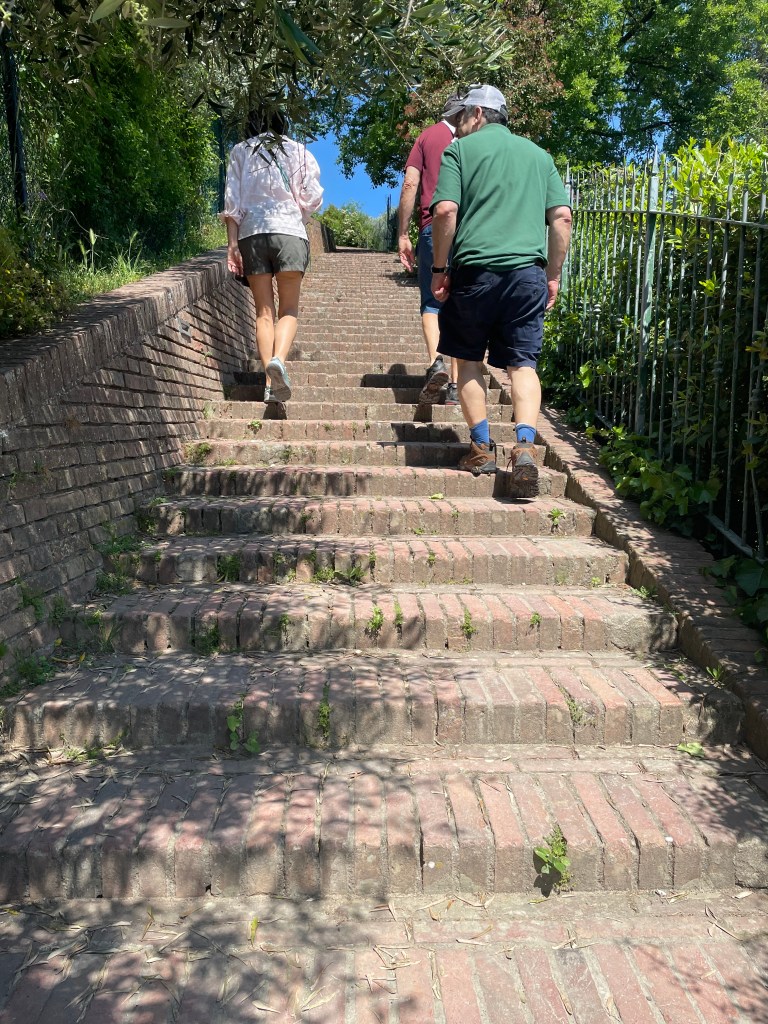
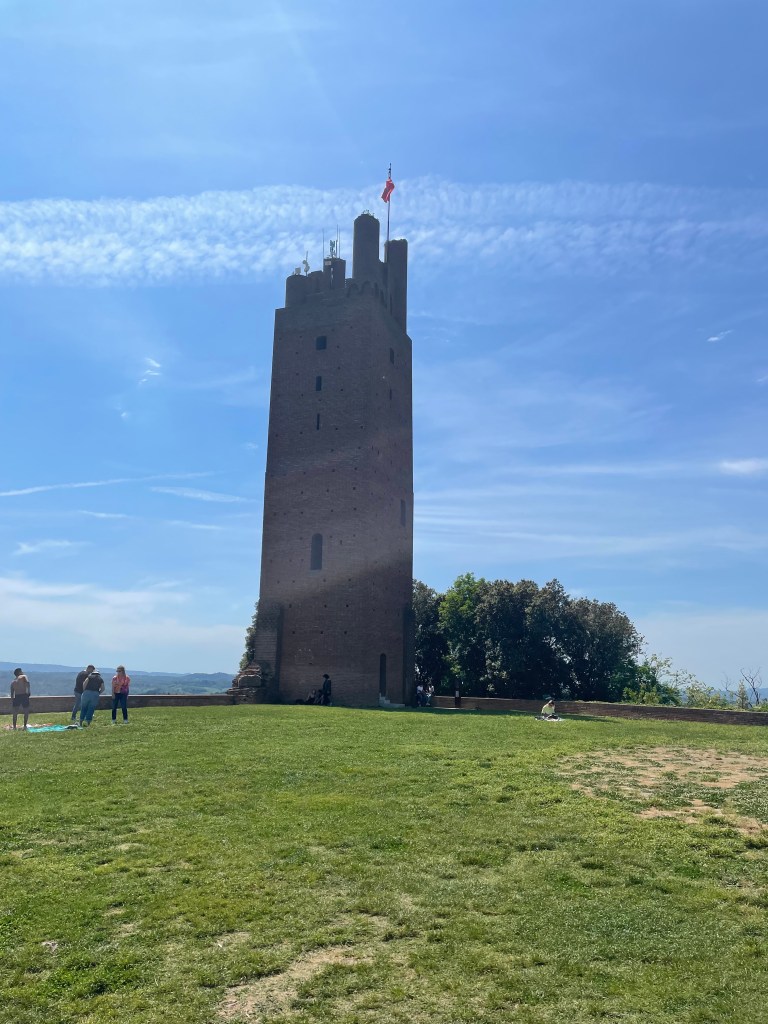
One of the first walks was after the church and up the hill to the Torre de Frederico II. Hadn’t started the hike and already climbing.
The tower was built between 1217-1223, destroyed by the Germans, then rebuilt exactly. Amazing that they were building things like this in the 1200’s. I bought tickets for all of us, started up the open staircase and got all of one flight up when I realized – nope. But I tried!
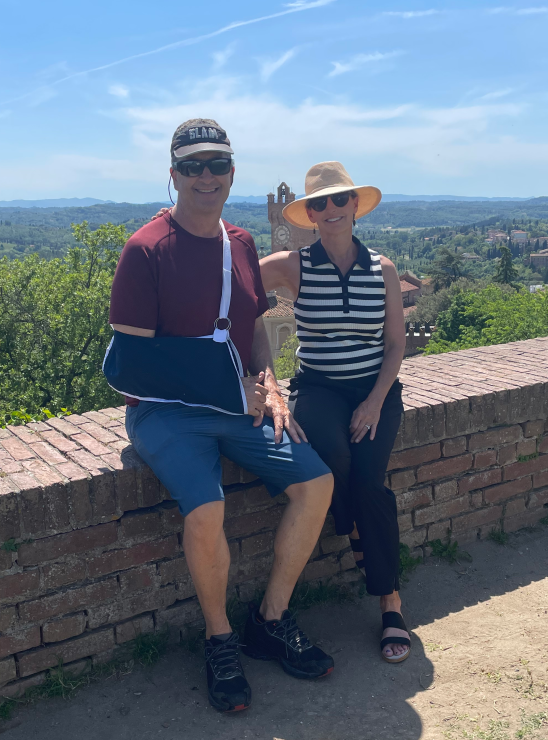
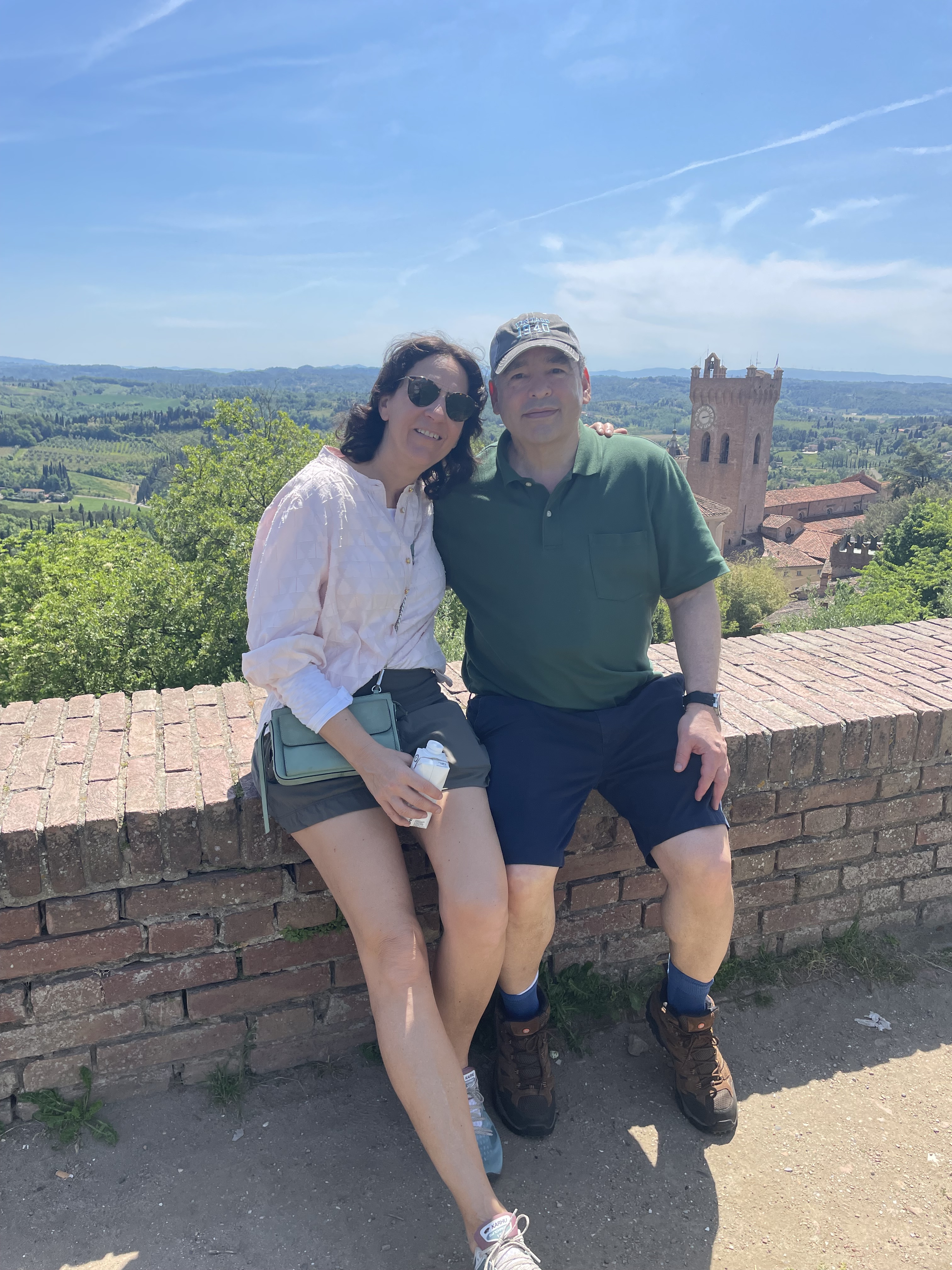
View from next to the tower and us sitting next to the view.
We’d had a big breakfast at our hotel and around 3 started getting hungry, we stopped to look at a restaurant and a young guy came running out – we can have you if you come in now, closing at 4. Oh right – nothing between 4 and 8 generally – we’d be WAY too tired to make it, so had lunch and then after all our walking and resting a bit, went back out for gelato. I’ve actually never liked gelato much, but this was so good! We all had a very small one, then Rick and I looked at each other and went right back for another one, a perfect dinner.
We expected to be asleep by 9, but Rick was enjoying the book, The Wager, so much we stayed up till 10:20, crazy, but he finished it!
We made it, really didn’t know how it would unfold after Rick’s bike accident. But he did well on the plane and seems like he might be able to walk some if not all of the Camino starting Monday. We also like the potential of taxis!
My first picture is from the plane. I couldn’t believe how beautiful Florence looked and that was just from the sky! Gorgeous day, sunny, nice temps, upper 70’s, and the contrast between the green and the red roofs, amazing.
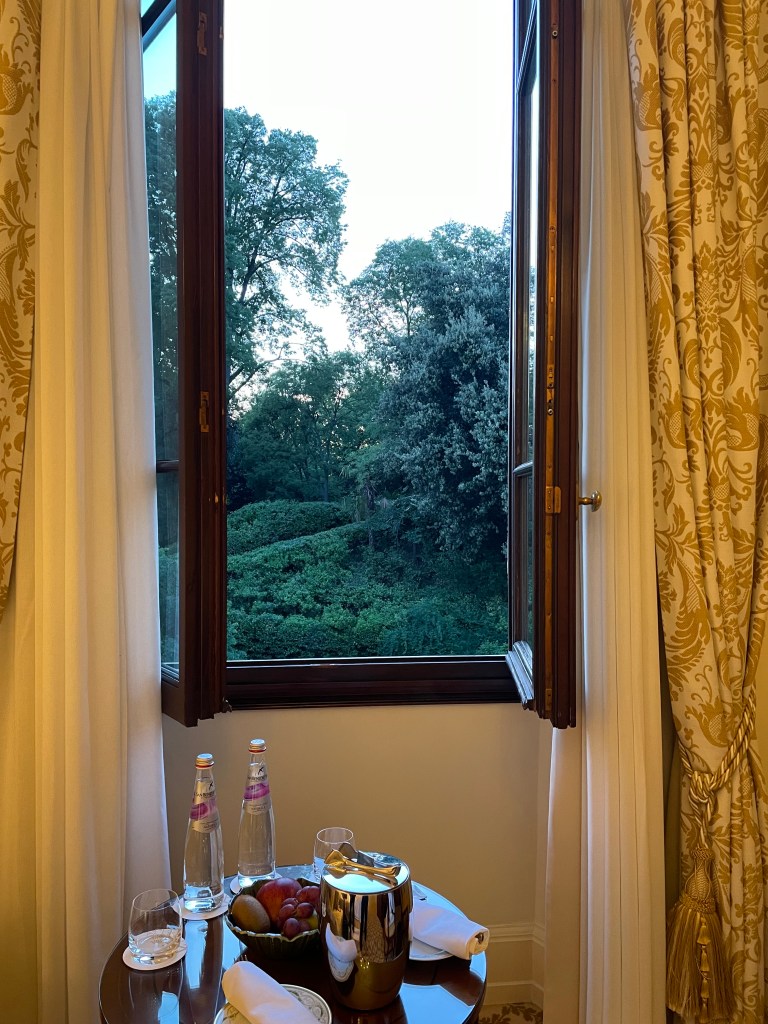
We got to our hotel, next photo of our window, so pretty!
And then we didn’t do anything else. We had quick walked from plane to plane in Munich and actually made the connection despite delays. Worried it would take a toll on Rick, but again, he didn’t seem to have any damage from the pace, our bags didn’t make it, but we did. Our hotel is a Palacio from the late 1400’s and it has a really large garden with all kinds of statues.
We asked if it would be possible to get a tour guide just to get a sense of Florence since we only had one day. The hotel concierge said, well, I don’t know, very unlikely as it’s so last minute and then he called – we got one of our favorites! Chiara was her name and she was wonderful.
We had a slow breakfast, met Chiara and off we walked. We’re close to the city center and she was able to show us the highlights and tell us history and details about what we were seeing. As Rick said, “That was fantastic, I never would have learned anything if we’d just walked.” Chiara was passionate about history and how important it is to understand what’s come before in order to not repeat.
And the crowds, goodness. But it was all cheerful and fun to hear the languages.
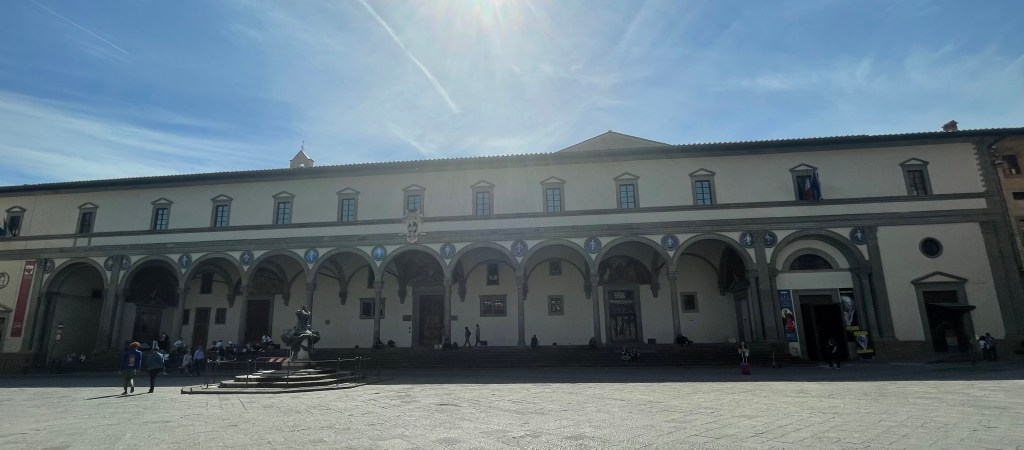
Piazza della Santissima Annunziata, the start of the renaissance happened here (according to Chiara). This was the first building that Brunelleschi designed and he was making a statement – that the windows and shapes reflected the shape of a person’s head and shoulders, thus the arch. No longer the steep shapes that pointed to heaven and were meant to remind humans how small they were in comparison to God. This the Hospital of the Innocents for orphans. Brunelleschi said that he wanted to give beauty to the orphans to try to make up for how hard their lives were. There’s a famous wheel that is still visible where it was possible to abandon newborns anonymously by making them enter a cavity that was opened by turning the wooden wheel.
This is the baptistery in front of the Duomo (cathedral), started in 1069, solely for baptisms. You weren’t allowed to enter the church without having been baptized.
Impossible to actually get a full photo of the Duomo, but it was truly spectacular. It’s been cleaned and they’re working their way around the building – the detailing was remarkable. The dome by Brunelleschi was the final piece and was put on after 20 years of a giant empty hole at the end of the cathedral because no one could figure out how to put on a dome. They had a competition for who could design the dome and Brunelleschi won. Happily, he lived the 15 years it took to finish it because he was the ONLY one who knew how to do it. He then destroyed all of his notes so that no one else could replicate his design.
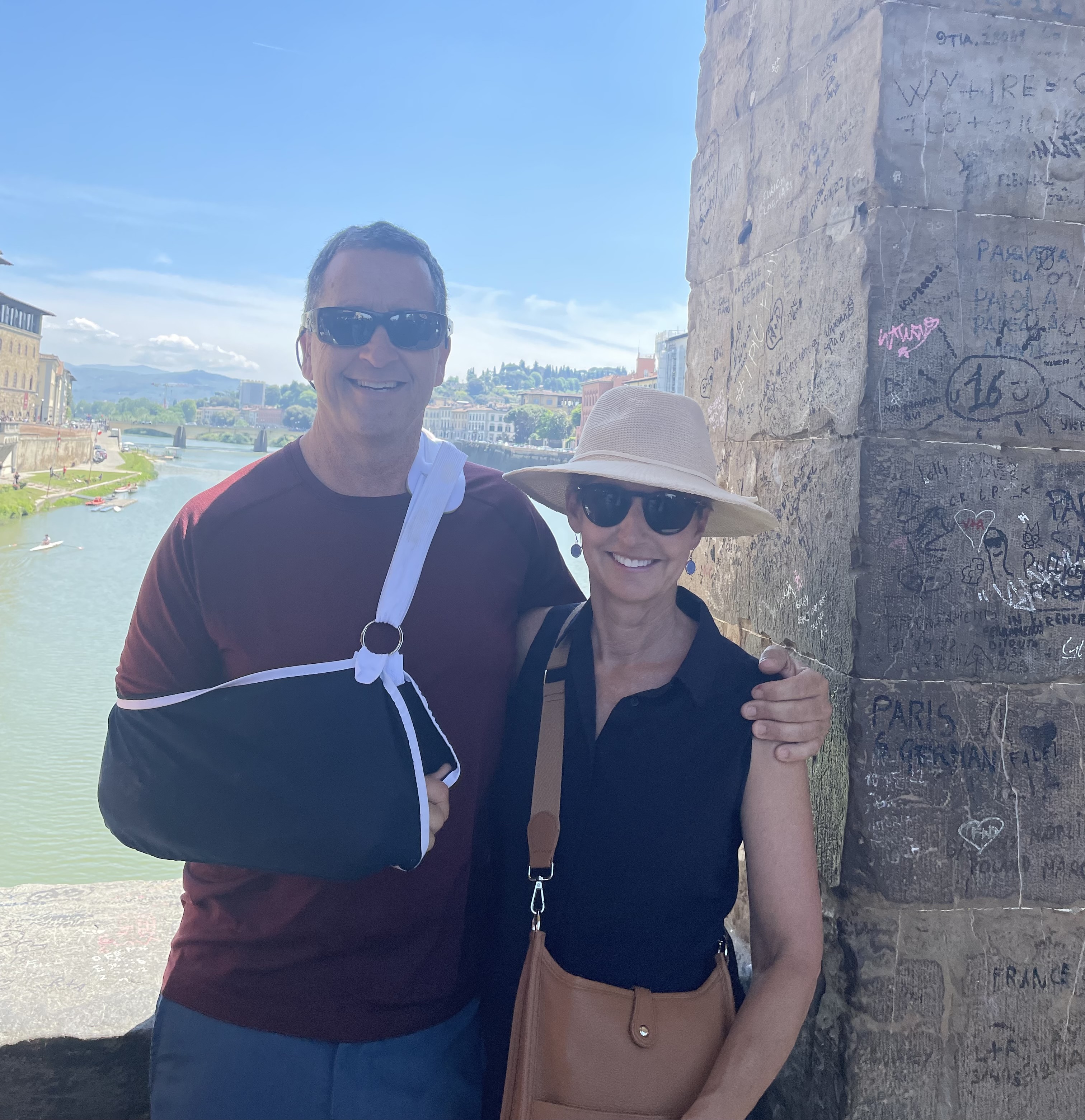
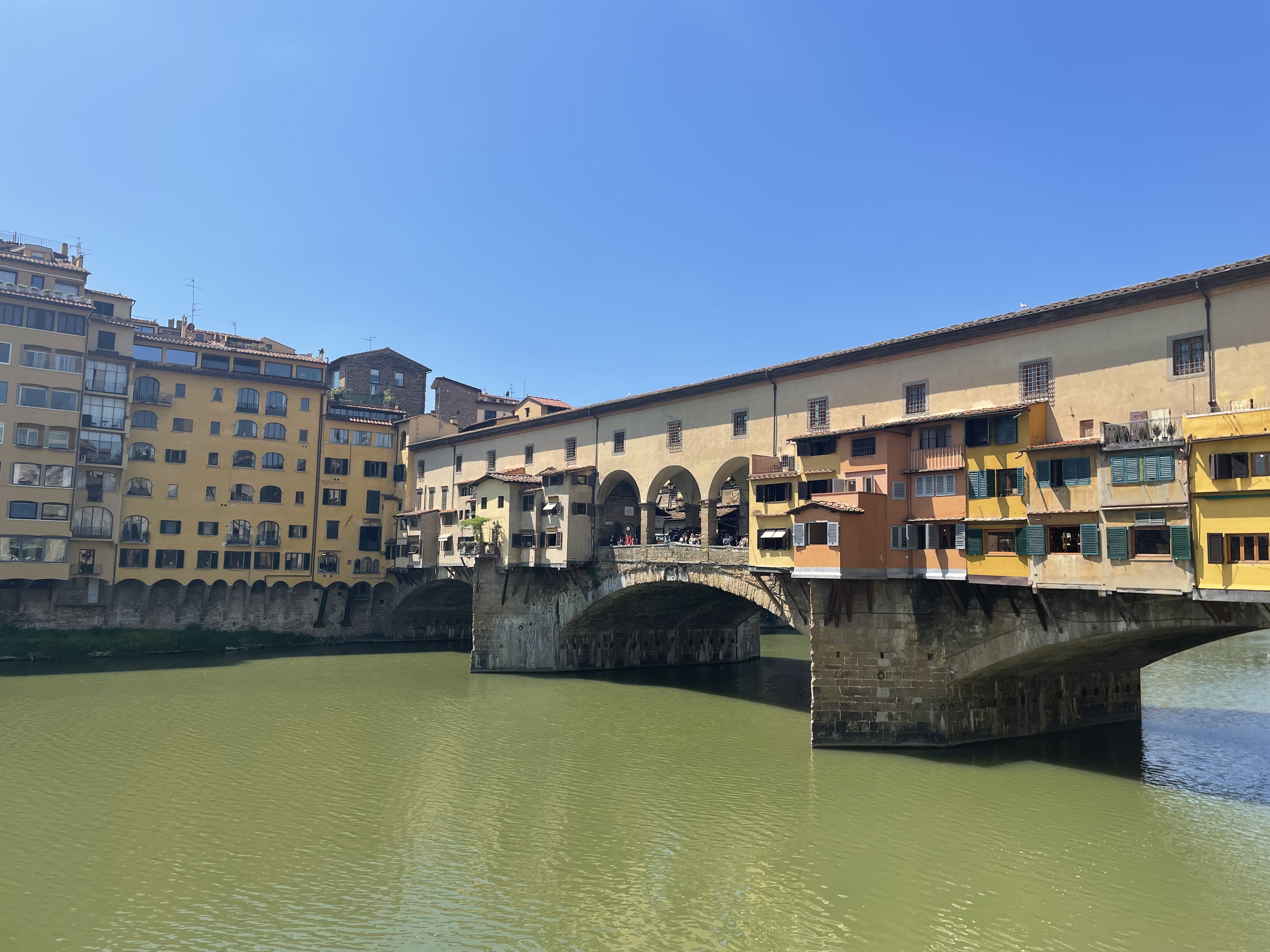
Ponte Vecchio – pictures of us on the only surviving bridge over the Arno River after WWII. The reason it survived is because the Italian general directing the strikes (to keep the allies from moving their weapons and troops through town) had gone through the upper corridor that connects the Palazzo Vecchio (Florence’s town hall where Cosimo de Medici governed) with the Palazzo Pitti (where Cosimo lived) in 1565. The general had seen all of these portraits of Cosimo in the corridor and knew there was valuable history and that it shouldn’t be destroyed. Plus he knew that the bridge itself couldn’t hold the heavy allied vehicles. So he bombed the roads leading up to the bridge and all of the other bridges, but saved this one.
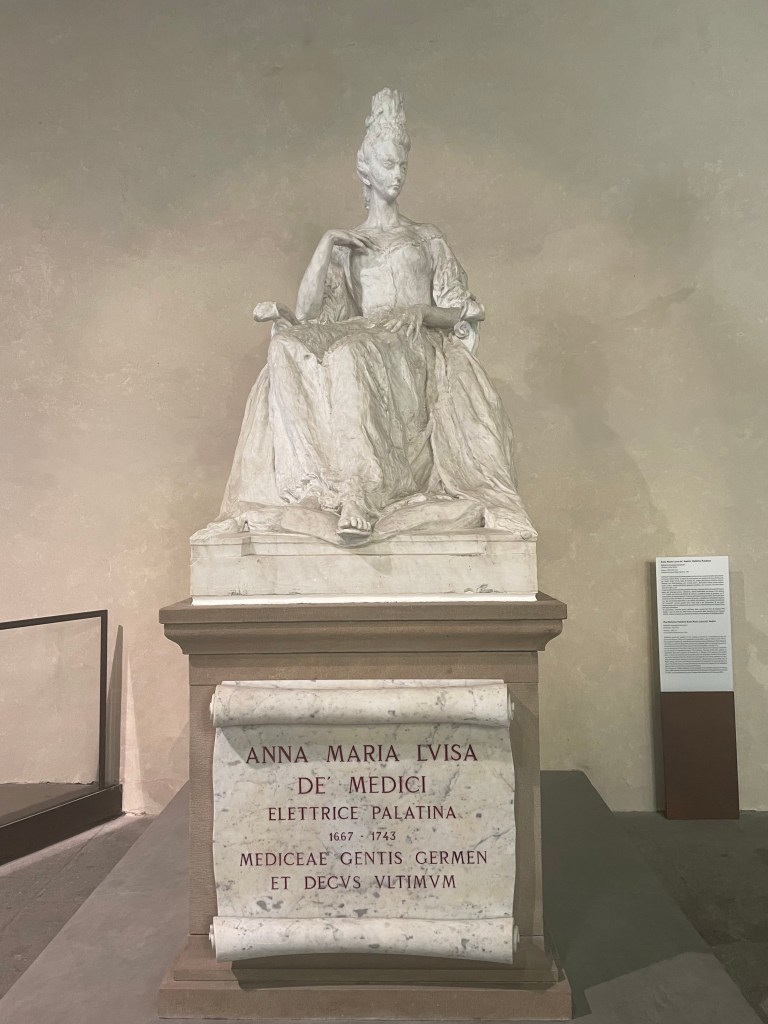
Anna Maria Luisa de Medici was the last surviving Medici. They had inbred to keep the assets in the family and by the end, all were sterile or impacted by other health issues. Since there was a law from the 9th century that women couldn’t rule, she knew that the Hapsburgs would inherit. She changed her will so that all of her holdings were to be given to the city of Florence upon her death. Thus the city was able to hold onto all of the paintings and statues from the renaissance. They couldn’t hold onto the jewelry because the Hapsburgs would just put it on and carry it away…
And Chiara, our wonderful guide, jumped into the ticket office for the Accademia Gallery of Florence as we passed by and said – wow, there’s no line! If you want to see the David, go ahead and buy tickets and then come back. So we did – got tickets for 5 to close the museum. Finished our walk with Chiara, came back to the hotel for a break (ice for Rick) then back out 10 minutes away and saw the David (and the rest of the museum). Just astonishing.
Then Bob and Susan came in! Yay, so fun, and we’re off tomorrow to start our Camino on the Via Francigena
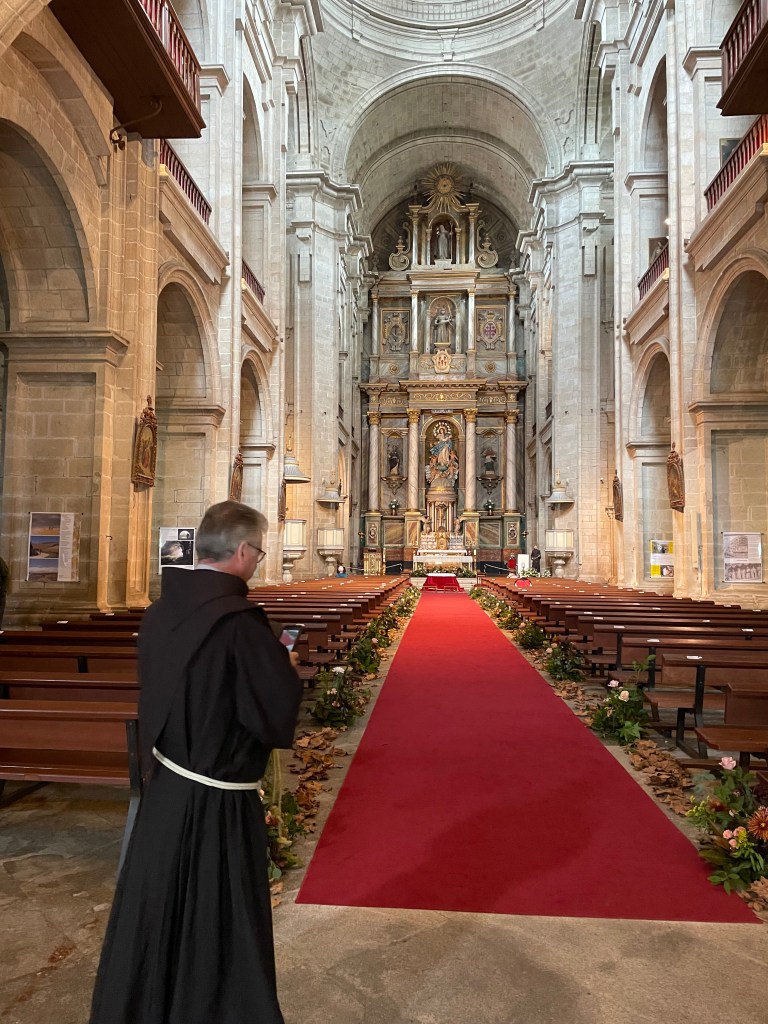
I was able to go into the church that was part of the convent where I was staying. I also learned that in Spanish, it was called a convent if it was in a city, whether for nuns or monks and monastery was a word reserved for the communities outside of the cities. So this is a San Franciscan convent. And – a wedding was going to happen so here’s one of the friars.
That cathedral that felt pretty dreadful in Malide was in real constrast to this one. Almost all the images were uplifting, inspiring and the whole place felt wonderful and welcoming.
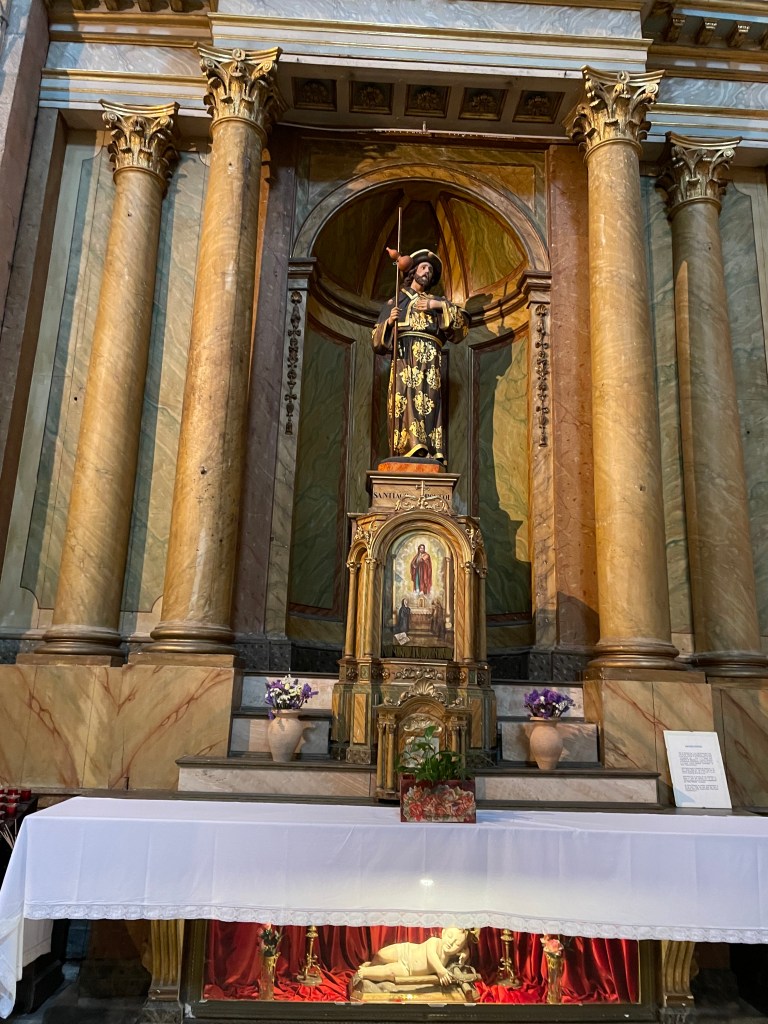
The image below was just to the left of the altar – of a pilgrim.
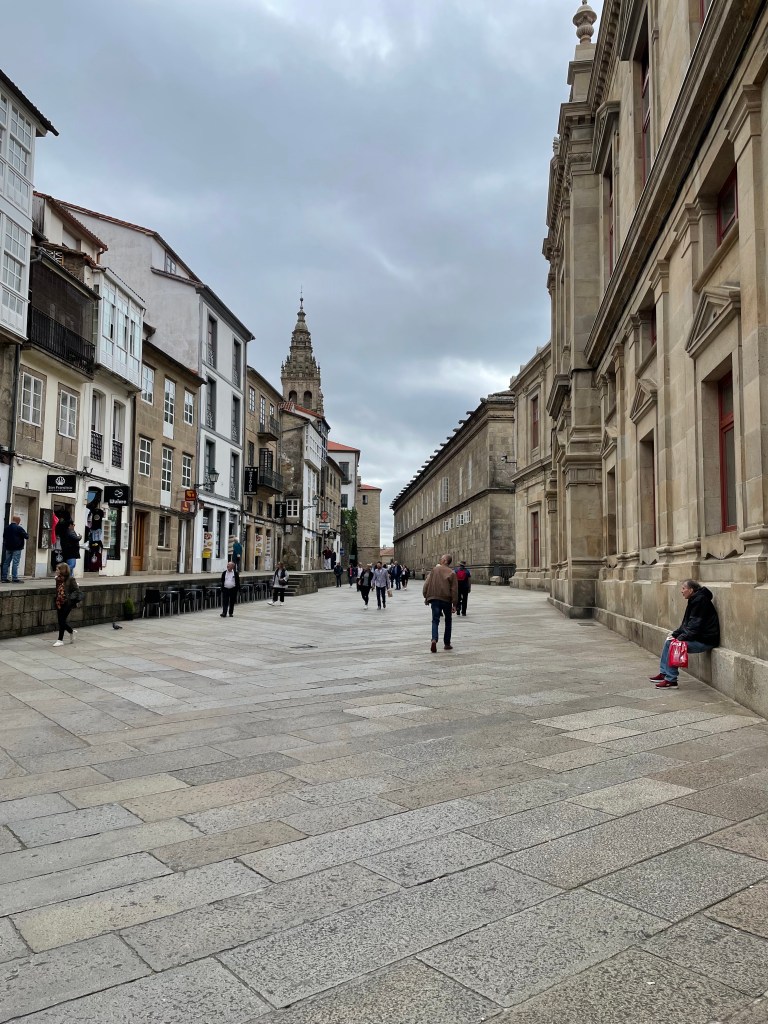
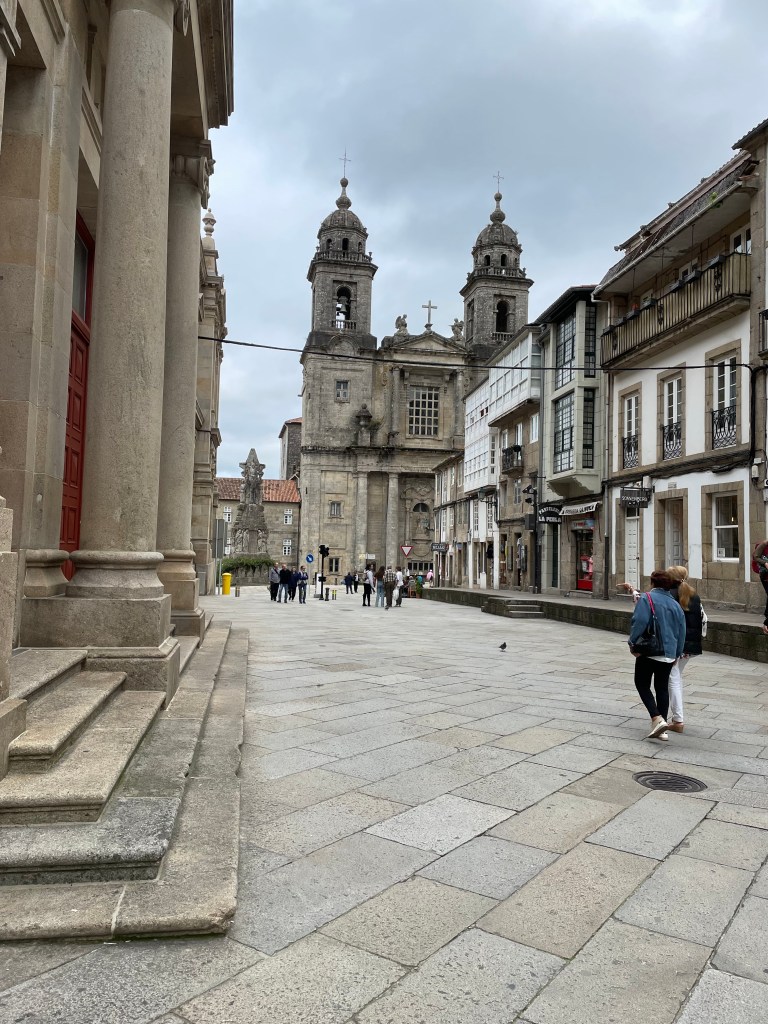
I’m standing in one place and this is the street that leads between where I’m staying and the cathedral – the big one!
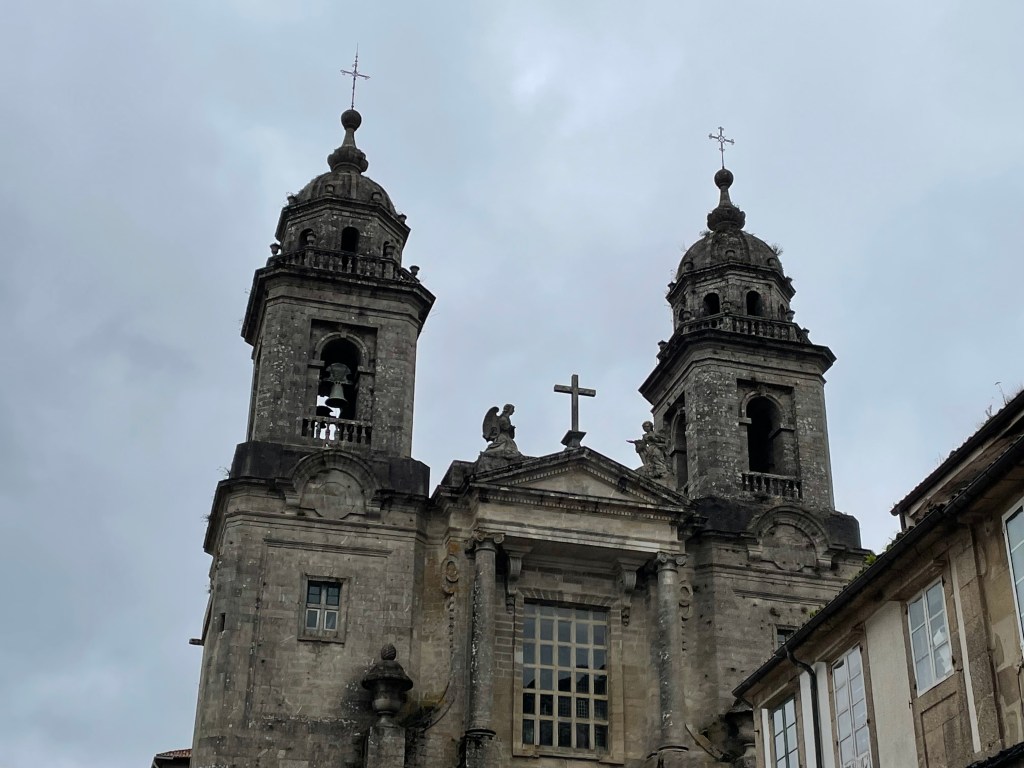
Last view – angels on top of the San Franciscan church. Even the outside is inviting.


















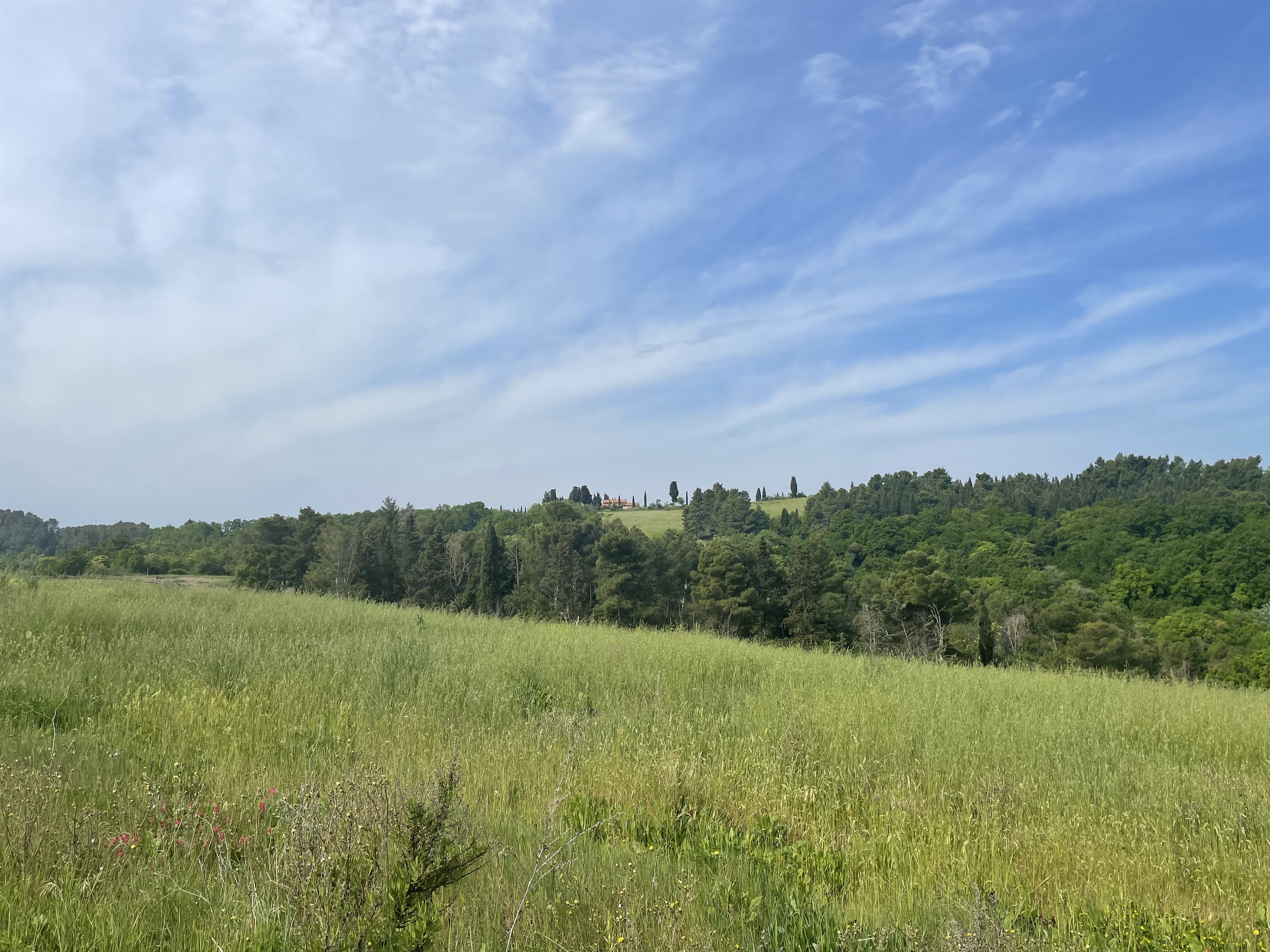
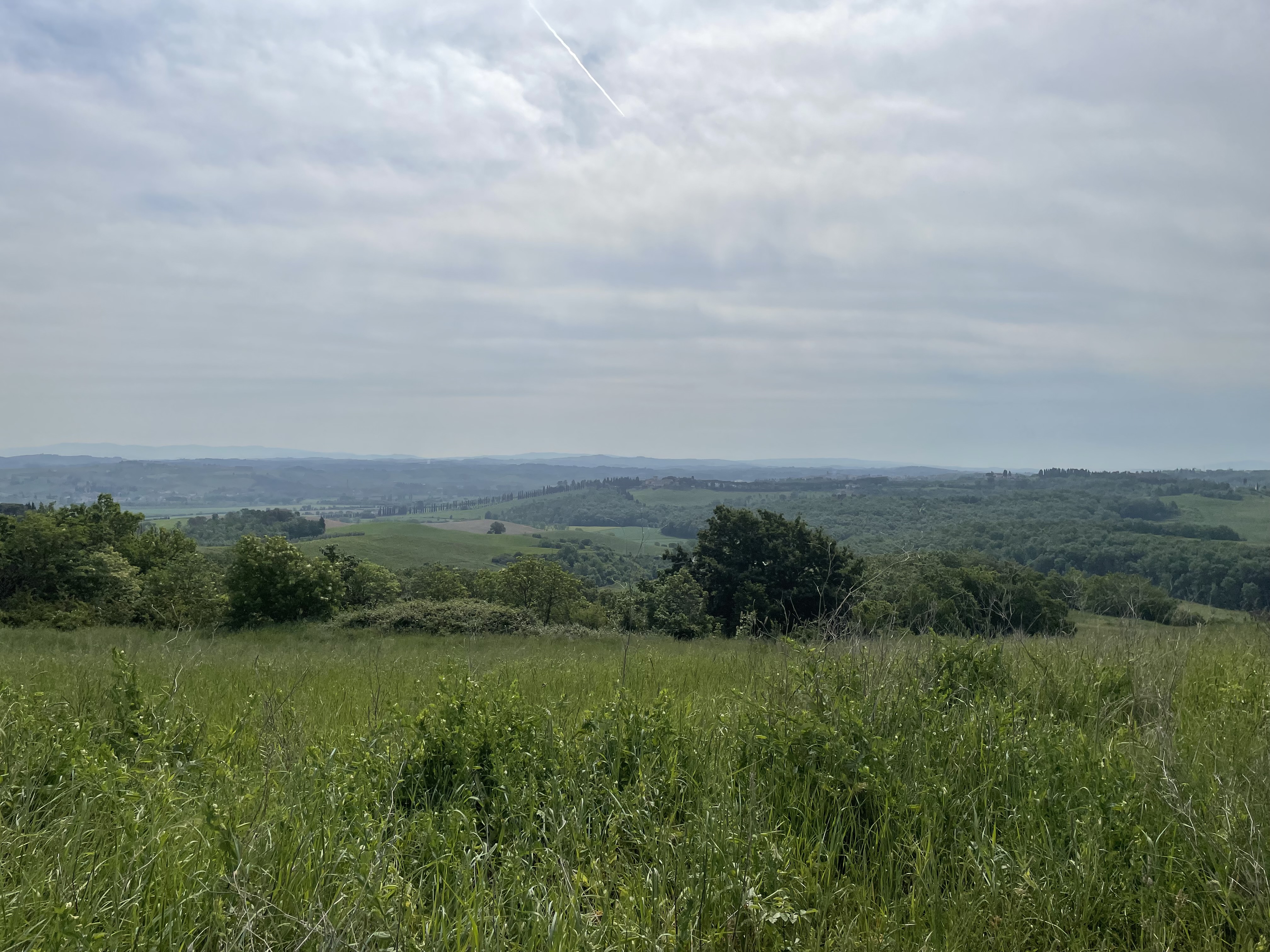
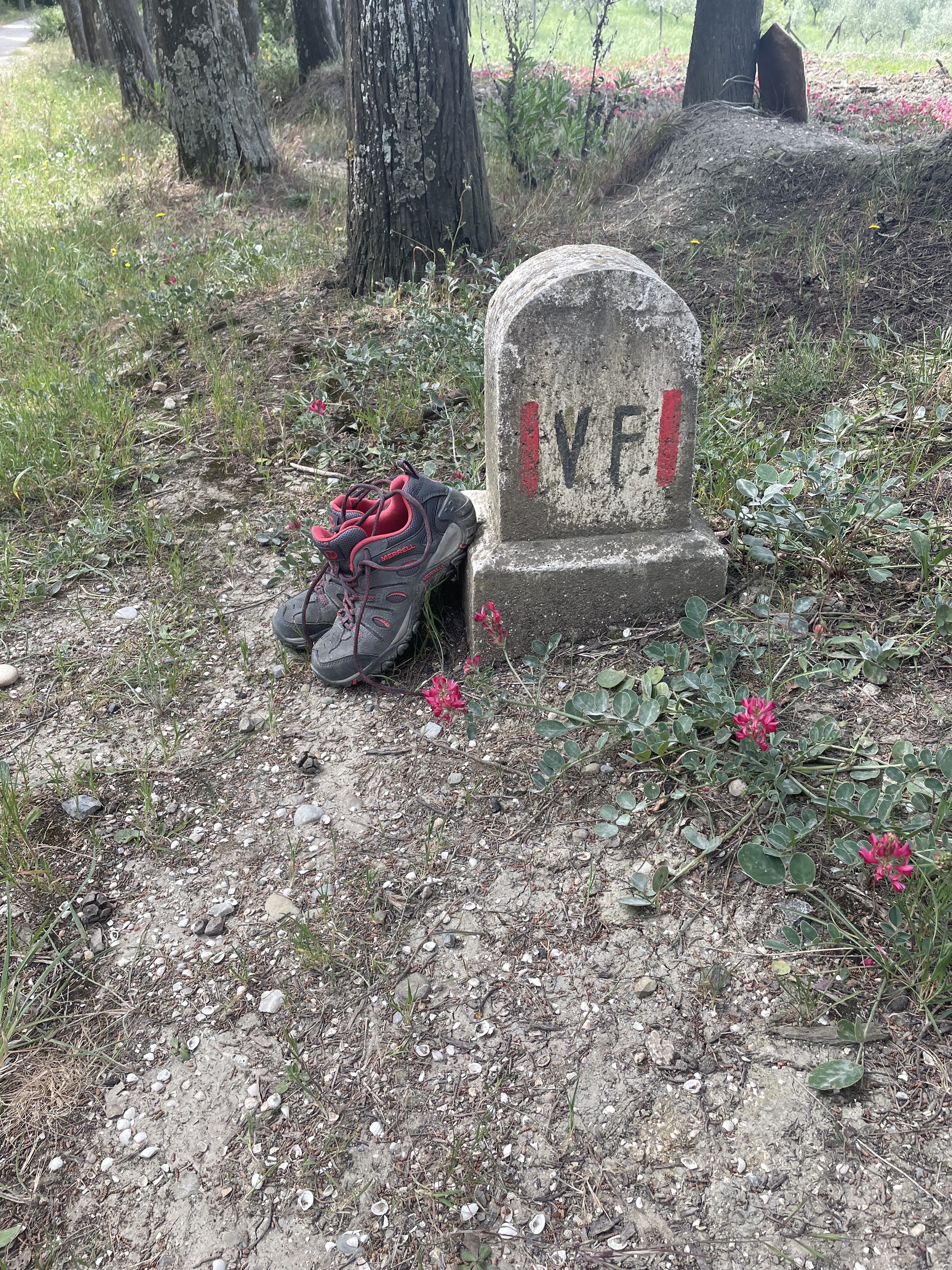
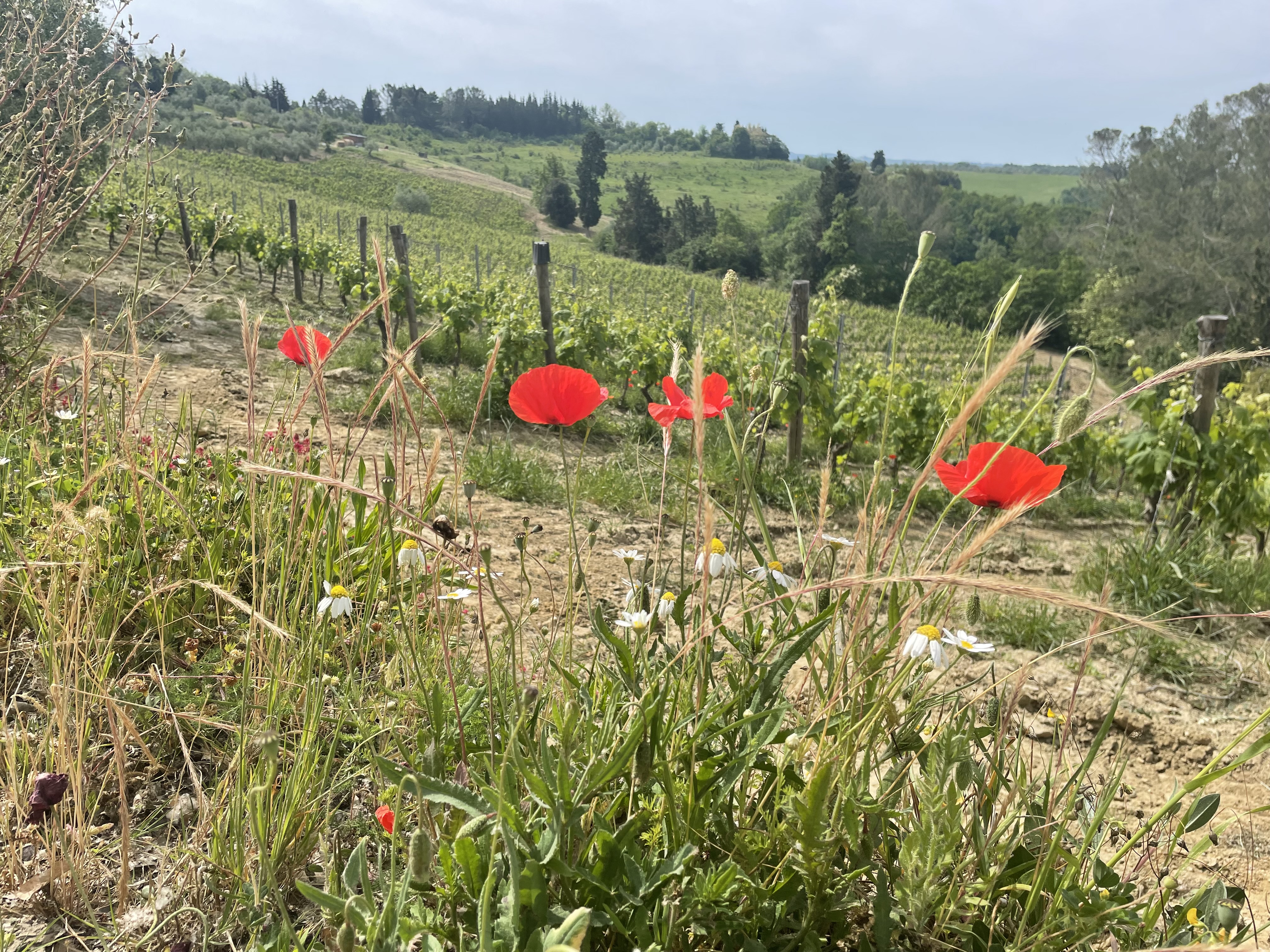





 Reb's Walks!