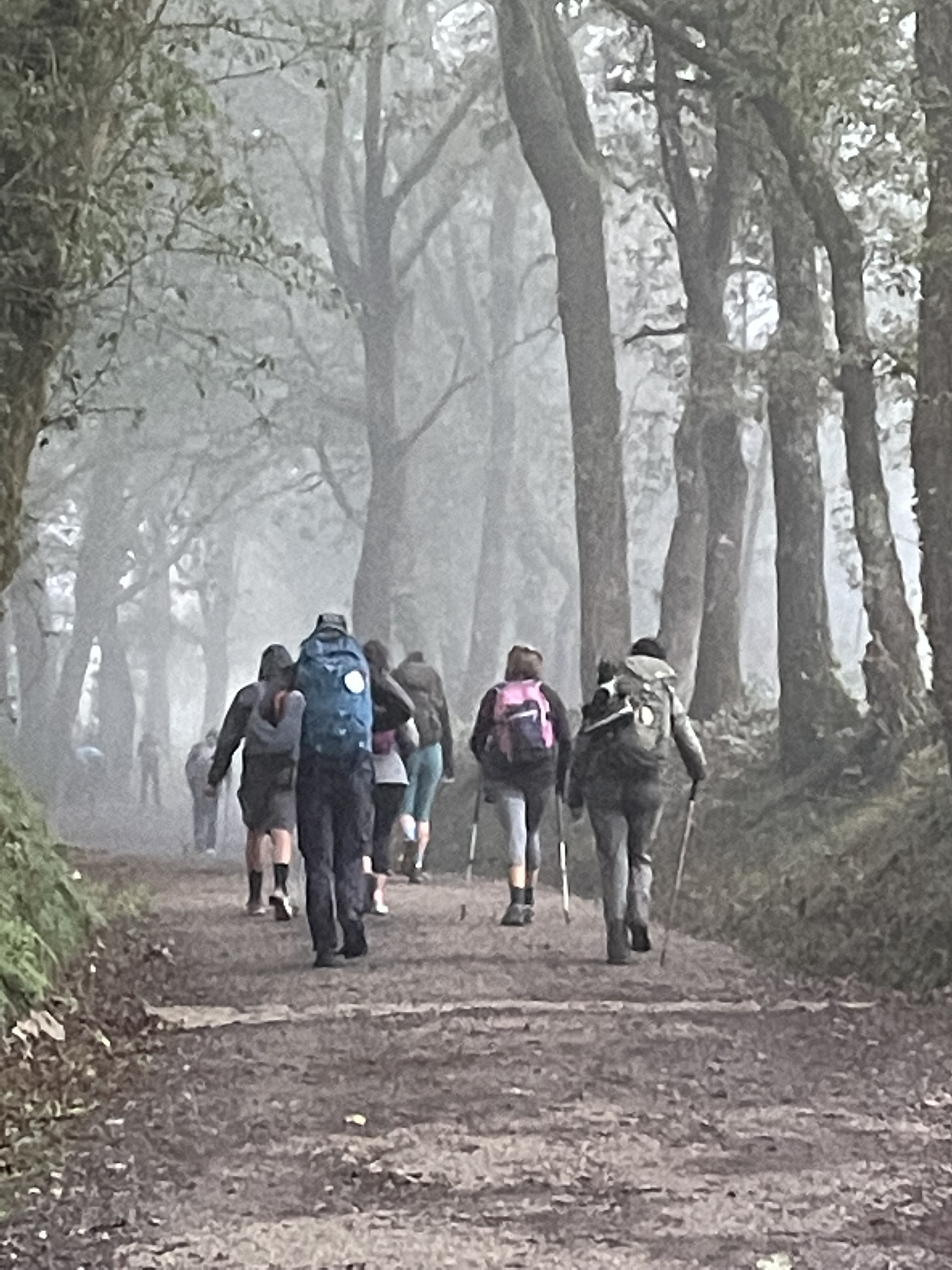
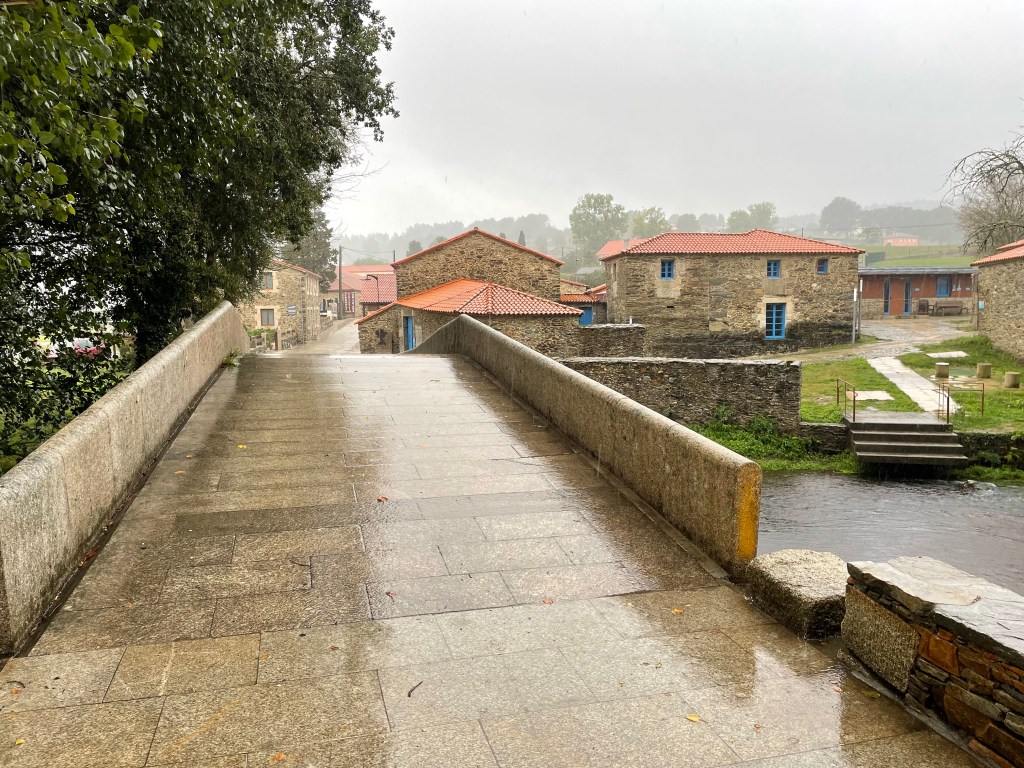
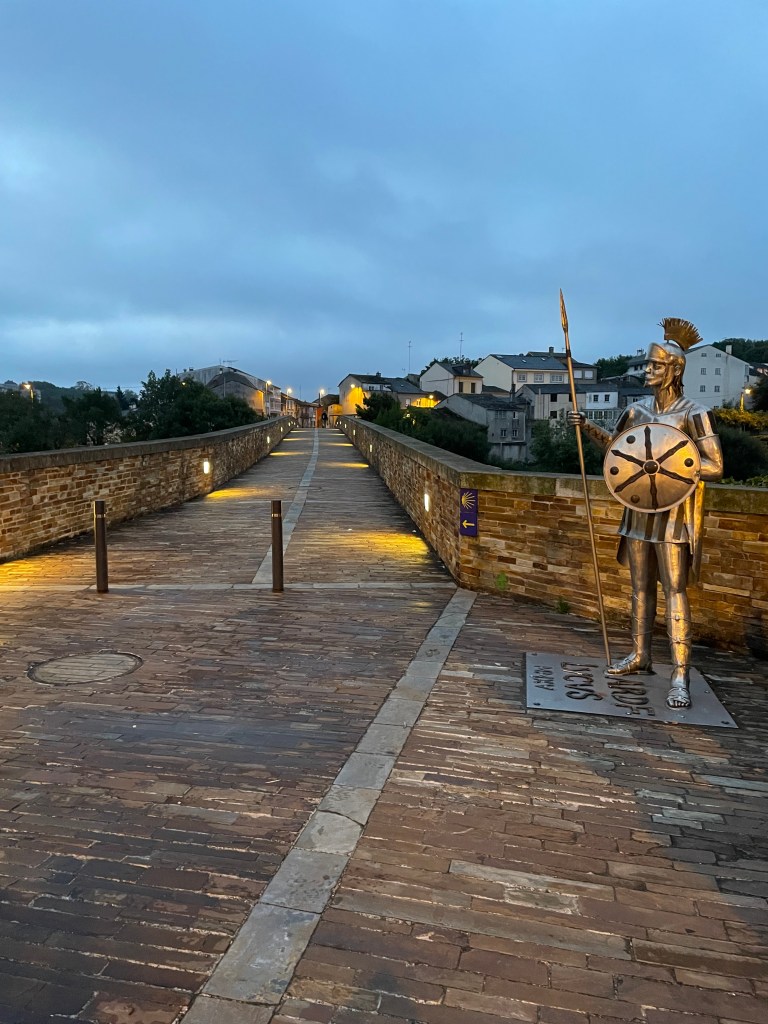
I started off before 8 from Arzua and was immediately engulfed in a throng. Seriously a lot of people on the trail, tromping of feet and laughing chatting voices in several languages. The umbrella shot of the bridge was just fun, it was misty and droplets, but no rain for the whole day, really nice.
Then, just before I was supposed to stop for the night, I was having a hot chocolate and realizing how early it was. I’d already been in the area, though different place, and it was only 12:30. I knew there was nothing to do, but ok. Then the women from Barcelona that I’d chatted with off and on for days stopped at my table. They were continuing on past my stop until 8k before Santiago. That way they could get to Santiago early since they were flying out on Saturday. Hmmm. I could go all the way to Santiago. It’s early, I feel pretty good and had a short day yesterday. So – I changed hotels, got my bag moved and continued on. It was actually really nice. Since no one seemed to be doing the same thing I was, I quickly left everyone behind and was basically alone again for my last day. And, even near Santiago, there was still a fair amount of country.
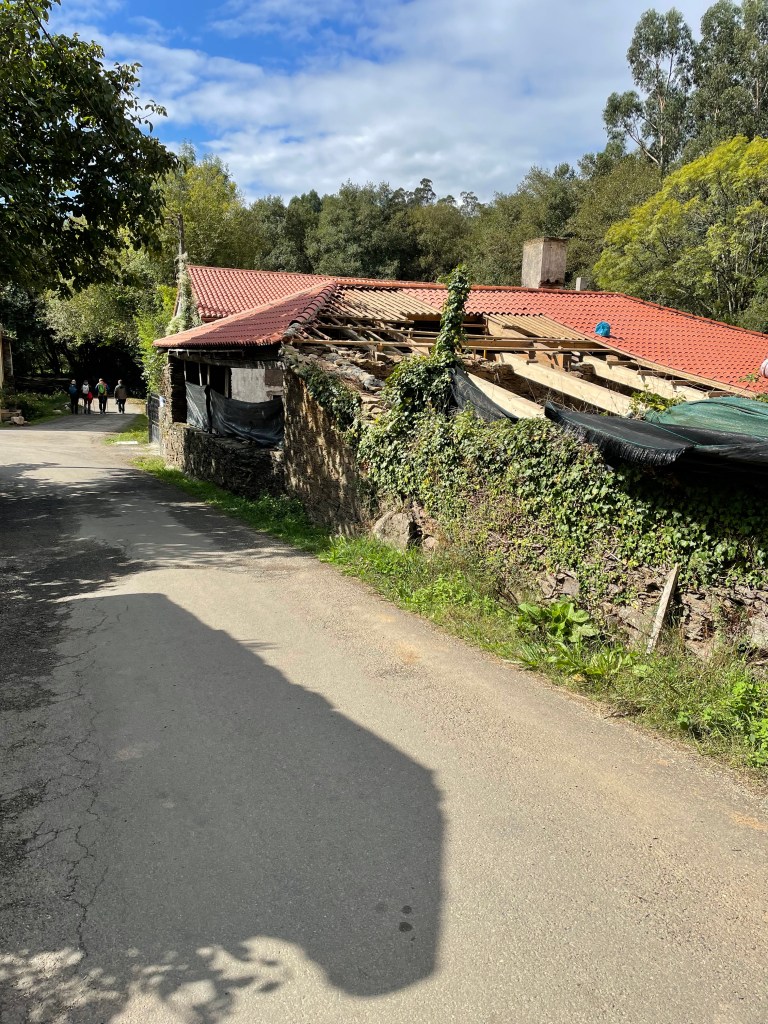
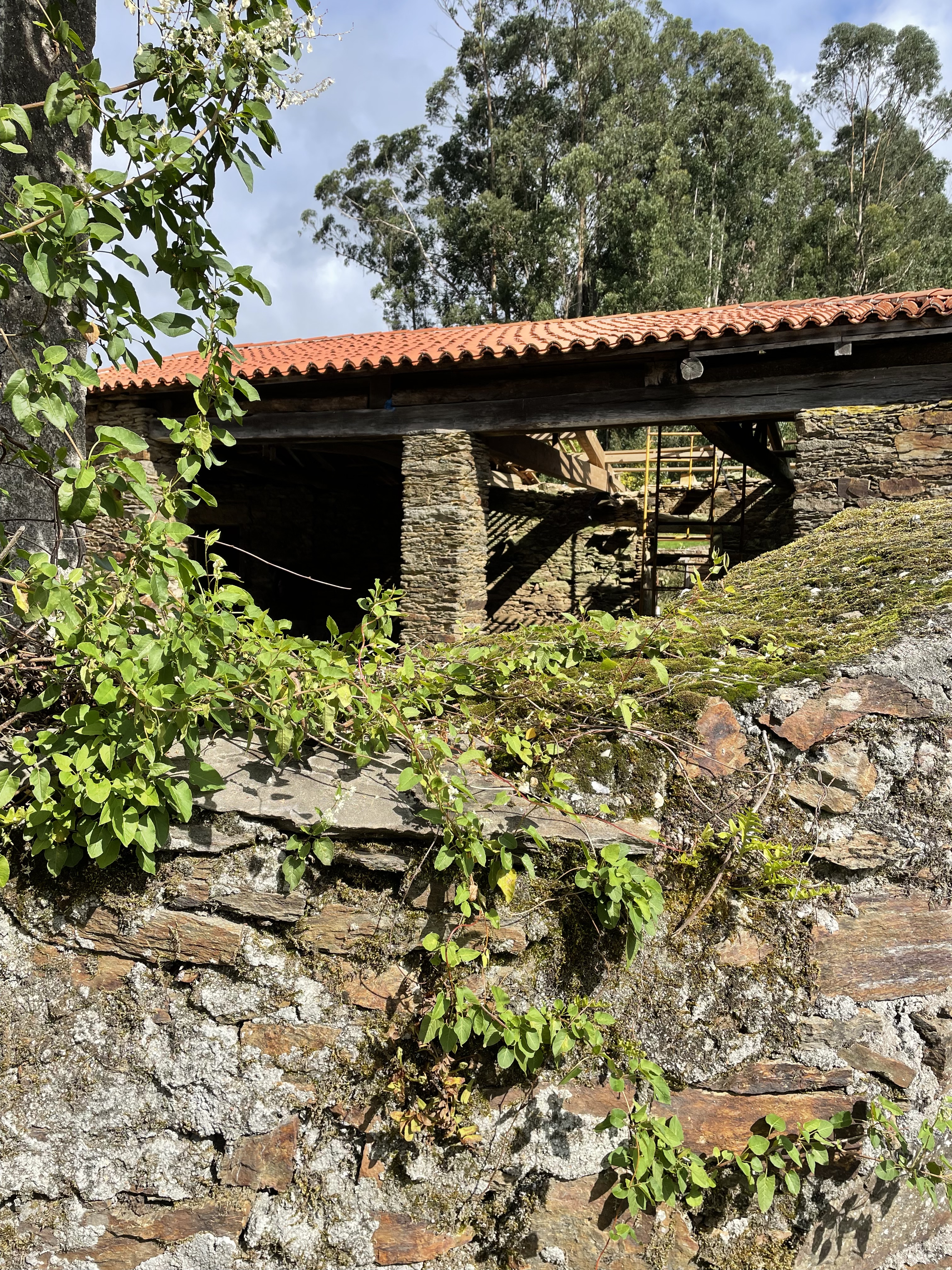
This roof was being repaired with the most beautiful clay shingles, I marveled because this must be the start of doing something with one of these ancient stone structures. Would love to see it when it’s done because it’s hard to imagine.
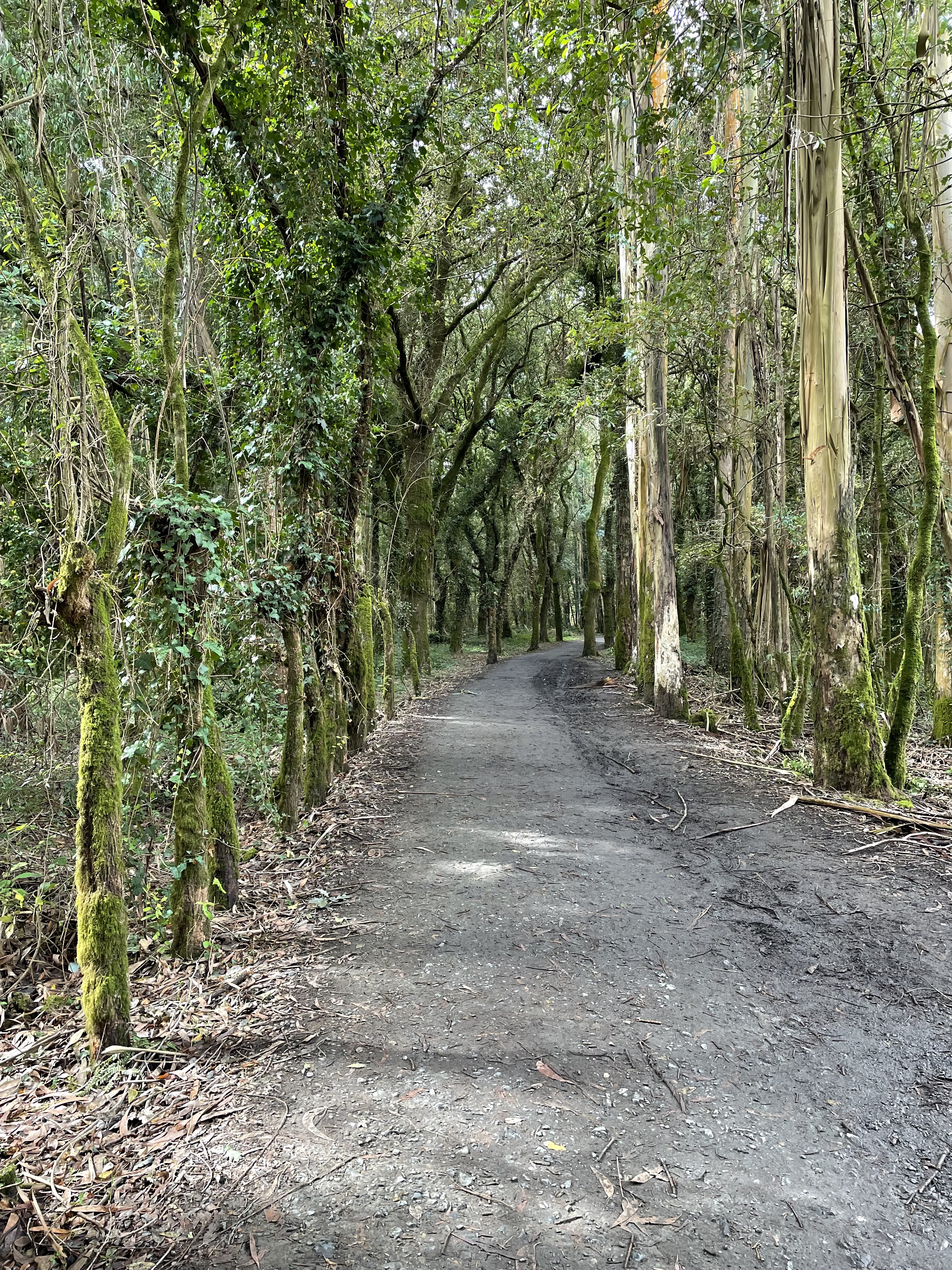
This lane is between the airport and getting to Santiago. They must protect the Camino is all I can think.
Those two statues in the distance? They’re where pilgrims can first see the cathedral. I was WAY too tired to walk over there.
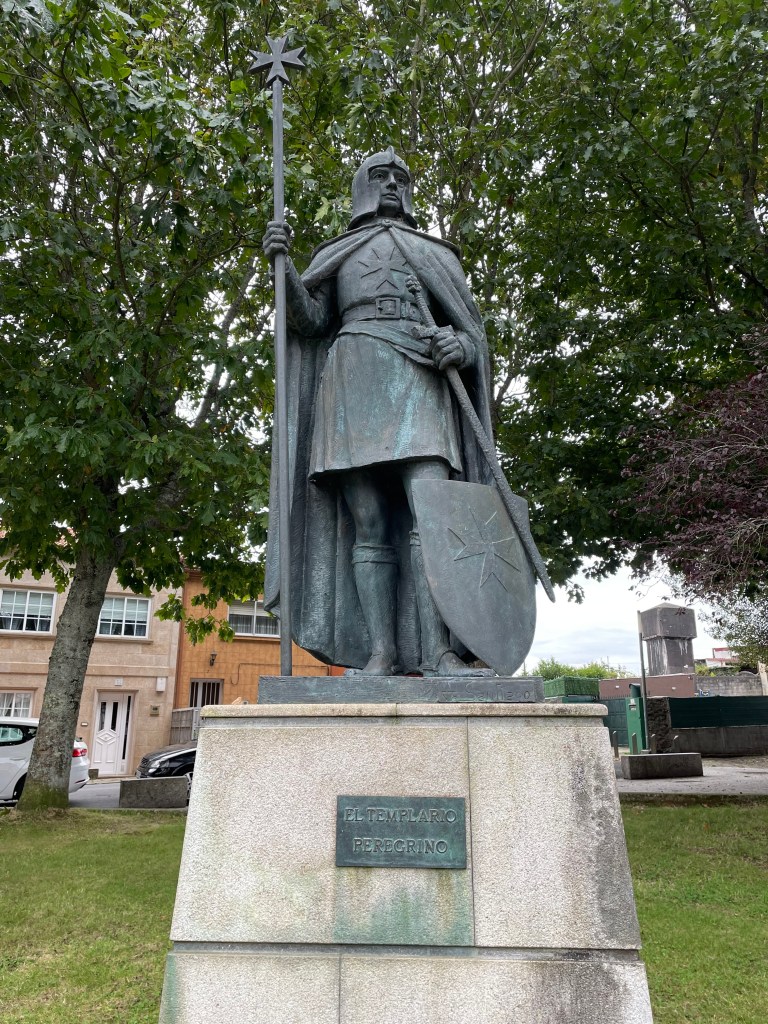
Knights Templar – just have a ring to the name because of their history.
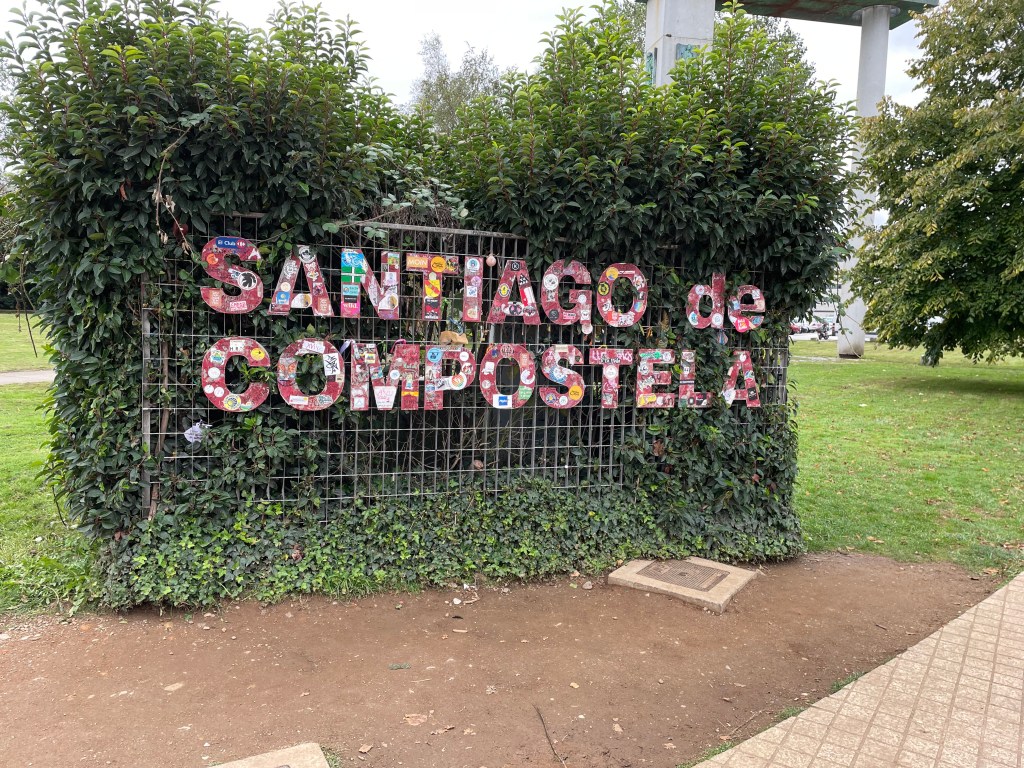
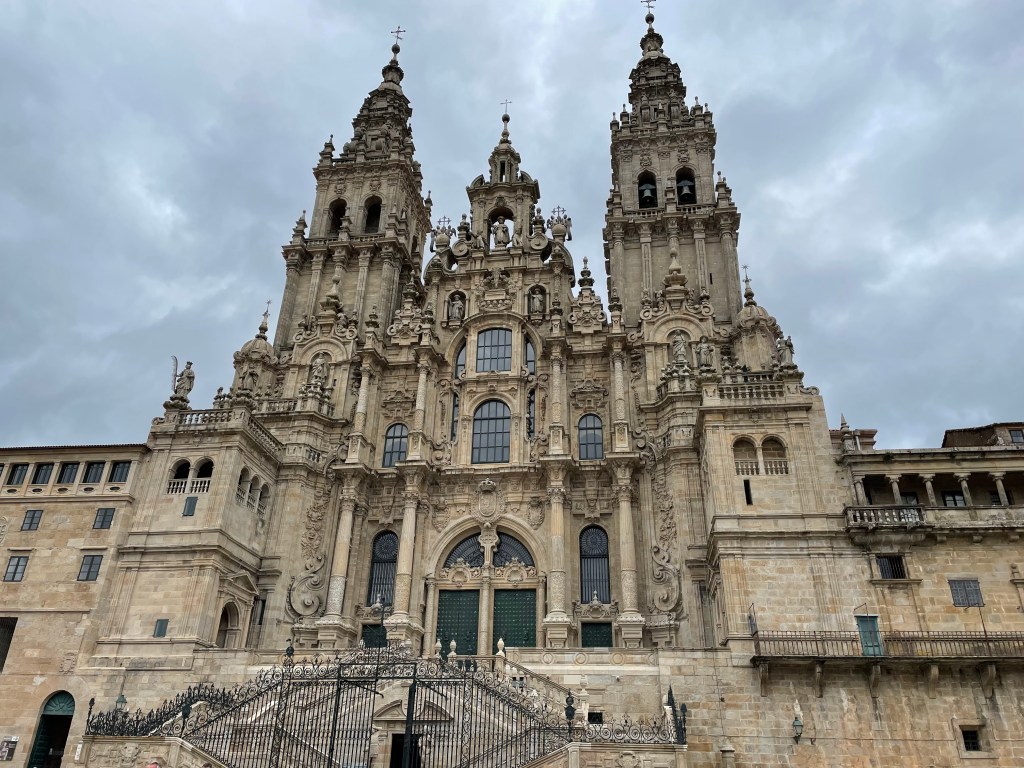
And – I’m here!
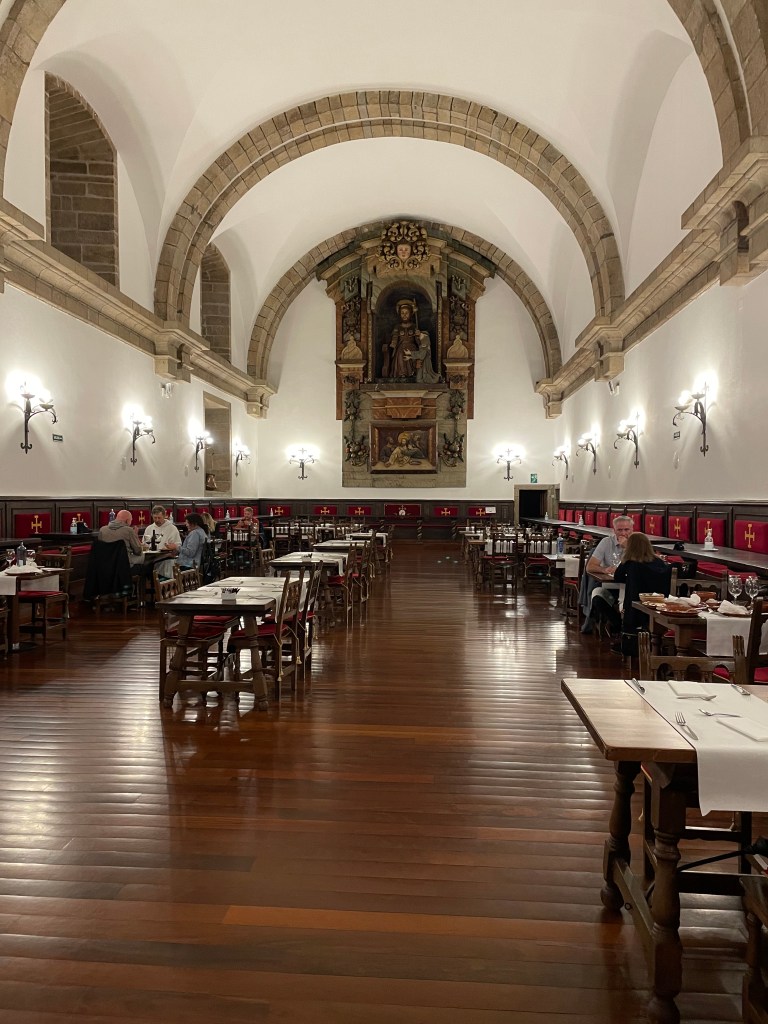
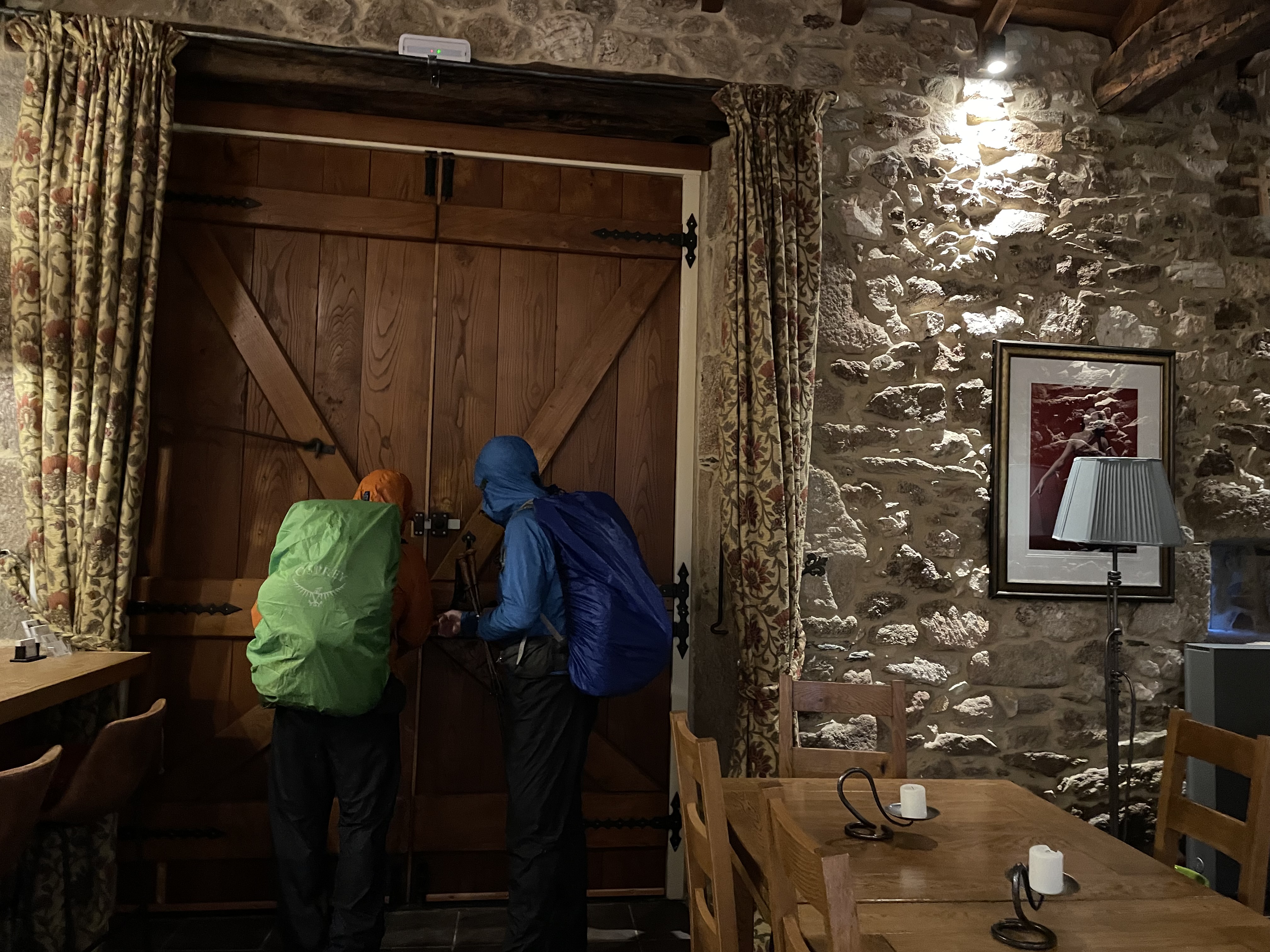
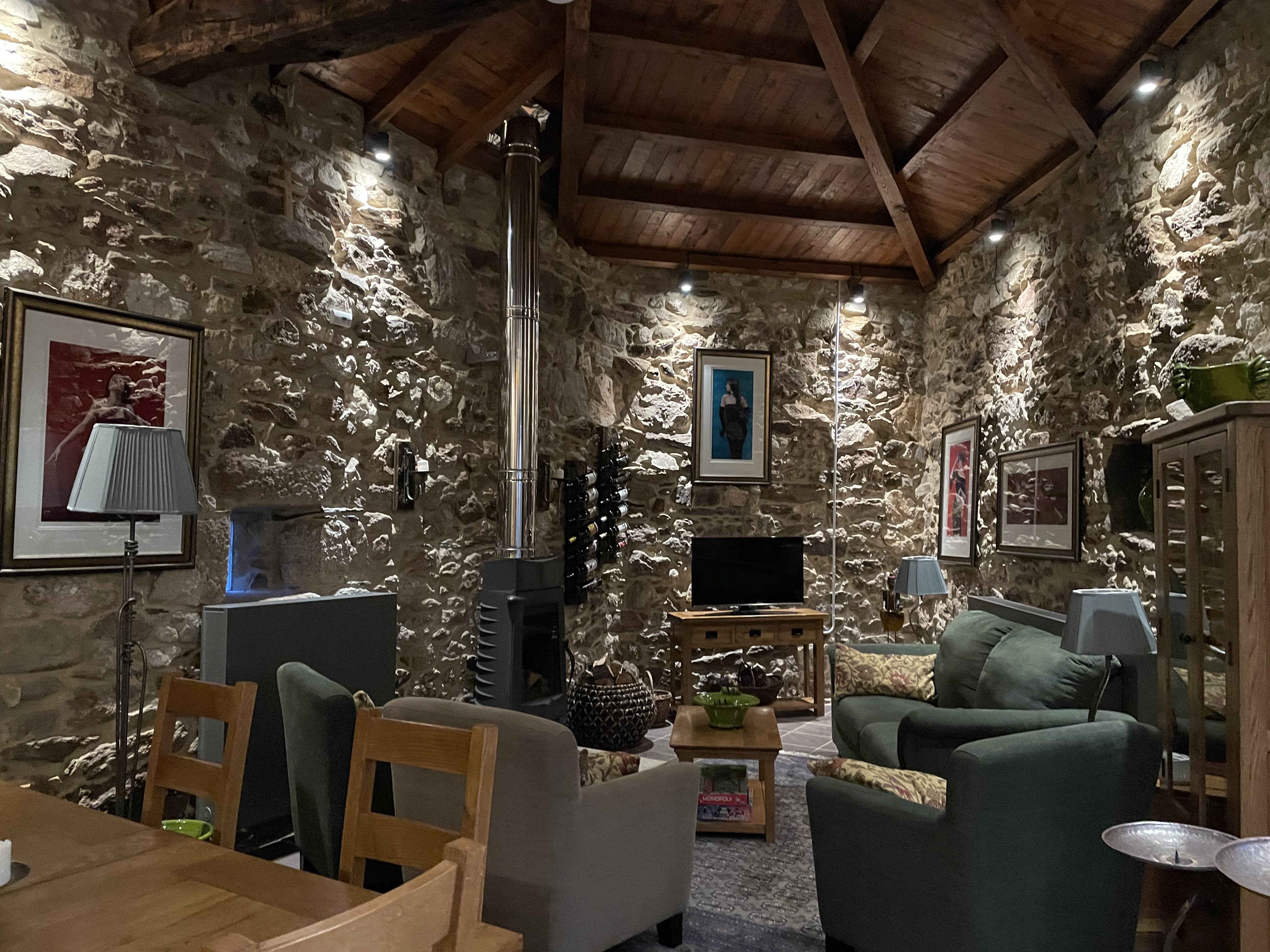
Last time, Rick and I stayed at a totally cool hotel, but that was occupied. This was where I ended up. This is the dining room! Crazy these old spaces. The Hotel Monumento San Francisco. This is a San Franciscan Monastery turned hotel, but there are still private areas (probably huge spaces) and 9 monks still live here.
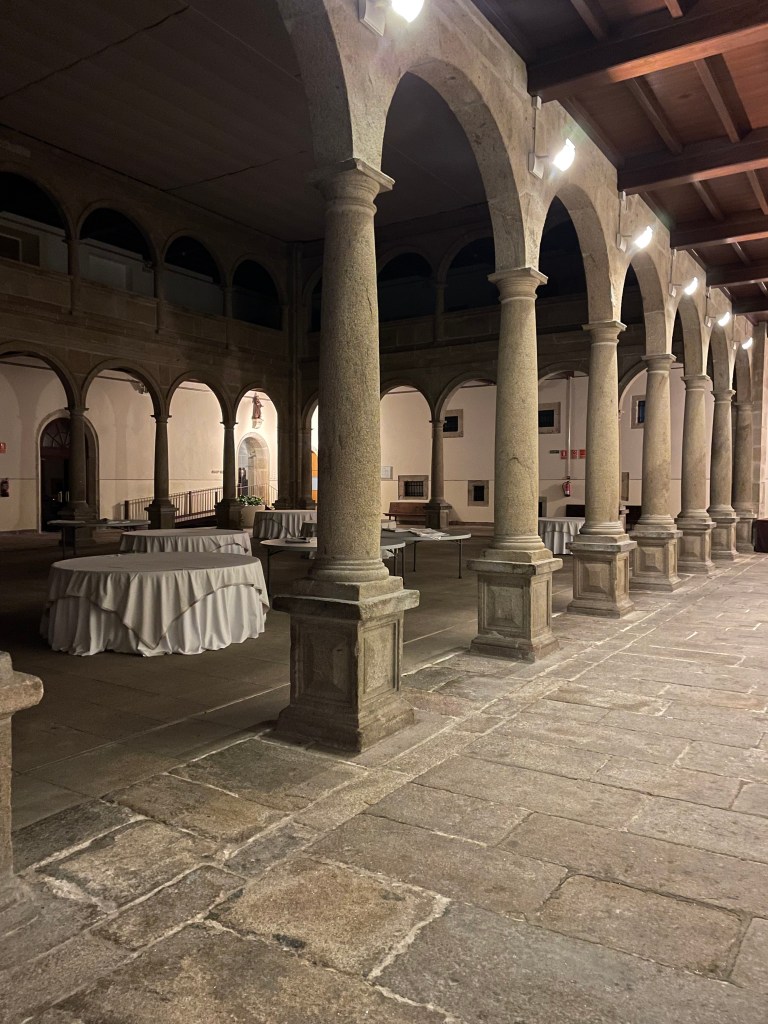
The spaces are huge – two internal courtyards that I could see, but the main church isn’t even part of the hotel. I don’t know if you can go in. I’m going back out today and will see.
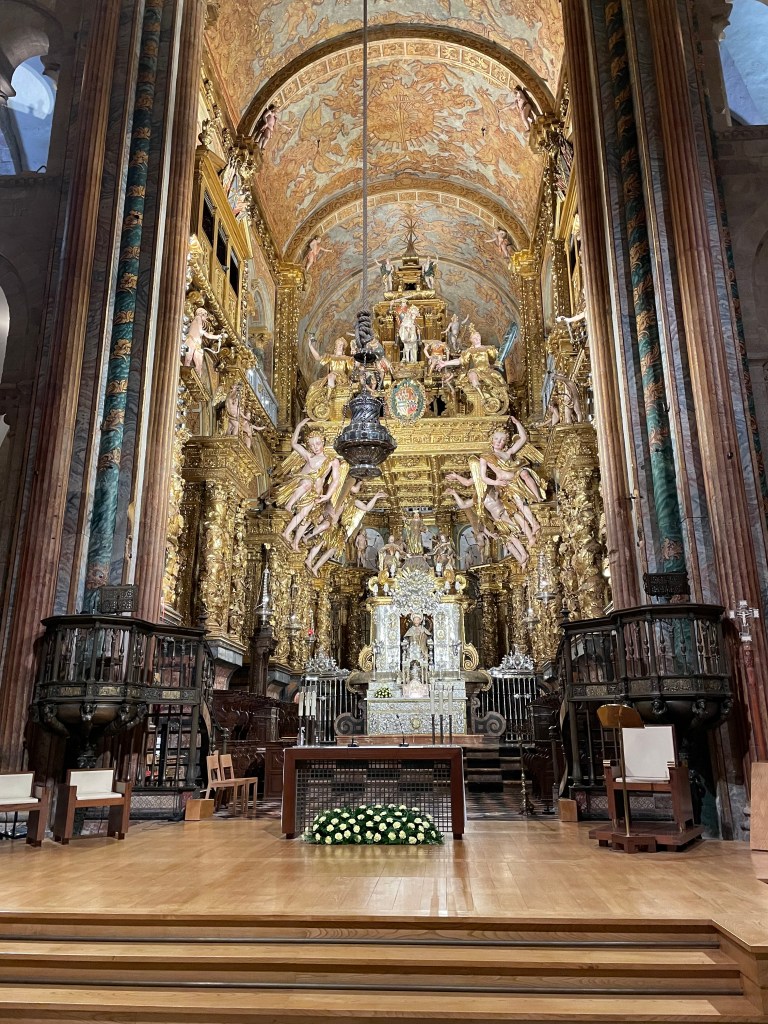
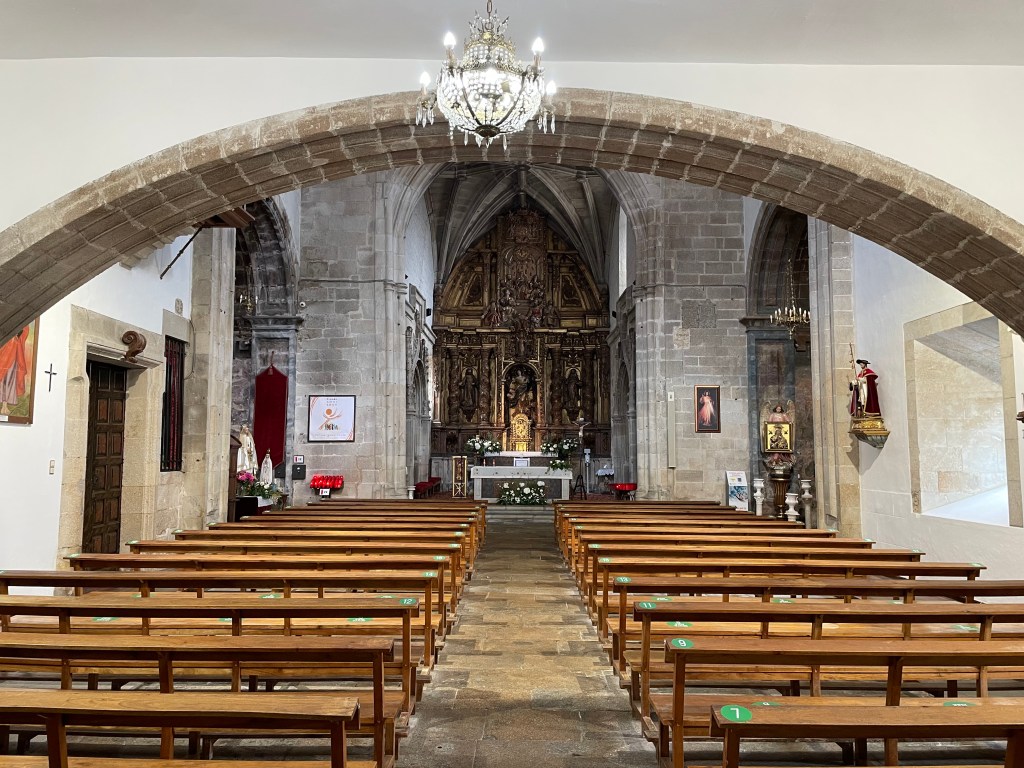
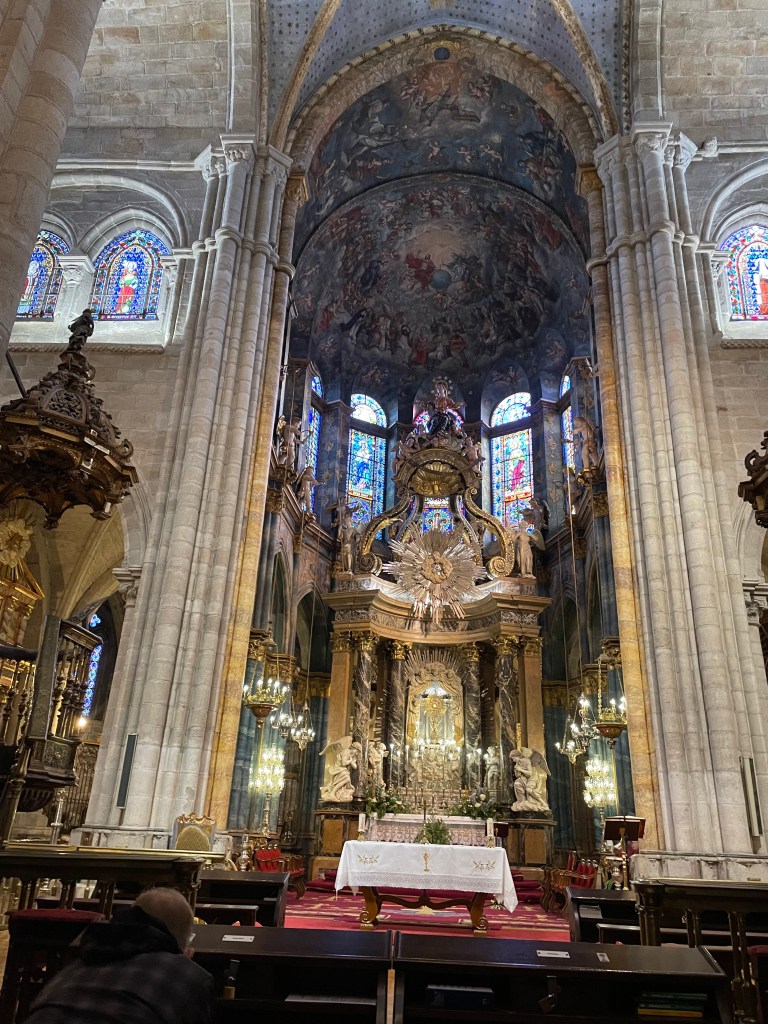
Went to the 7:30am service, had forgotten how odd (to my eyes) the alter is with those faces of the angels (?) holding the whole thing up. But lovely to be there early, about 60 people at the service.
I don’t know why, but I was tired today and it’s my shortest day of the whole trip. It rained all day, but I was warm and comfortable and it was a lighter rain than yesterday. I looked back at the route to see what I’d written last year when Rick and I were walking this and there was so much more history because of my resource book. I liked seeing some of the same places and actually, tonight, I’m staying in the same place we stayed in before. It’ll be the only time. I’d love to have Rick with me here to revisit together.
Isn’t this pretty? All one farmhouse and buildings.
I left early, seeing large groups of both adults and students loading their luggage, so leaving early allowed for a bit of quiet time on the trail. I also consistently chose the alternative route that was the original. So few people make this choice because it usually adds a bit to the day. And it’s always been beautiful!
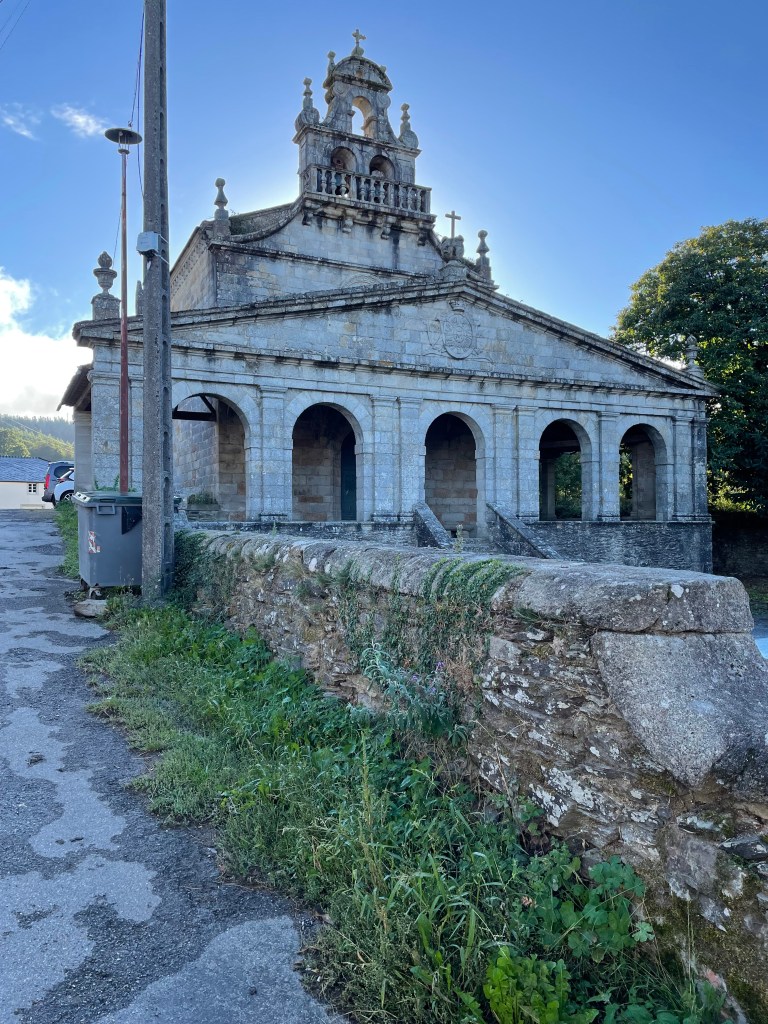
This is the church that was the stopping point during the Spanish flu period – pilgrims couldn’t go further, so if they made it here, they got their certificate or whatever it was they were given for making the pilgrimage.
Another wonderful stone village. I haven’t mentioned it but I watched Beauty and the Beast on the plane – can only handle seriously light material when I need to sleep. And I’ve been singing Emma Watson’s first song ever since, about the provincial village. So stuck and has been since I started walking.
This is from my room, so pretty and thinking it’ll be quieter tonight, might not even need my phone’s river sound noise!
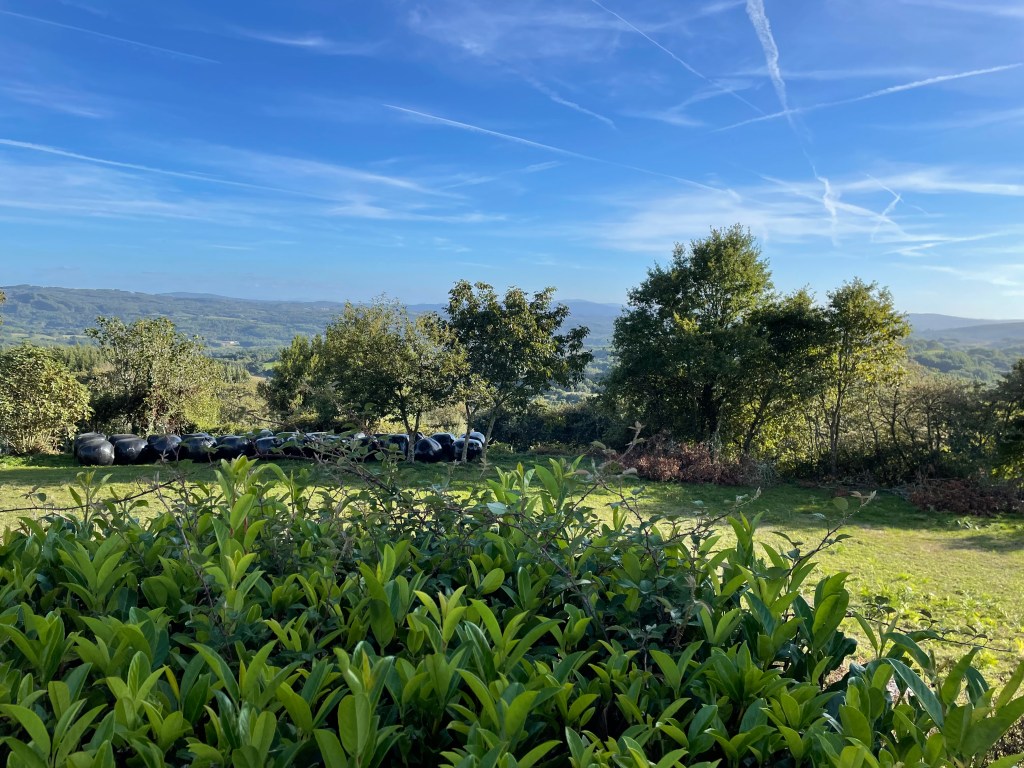
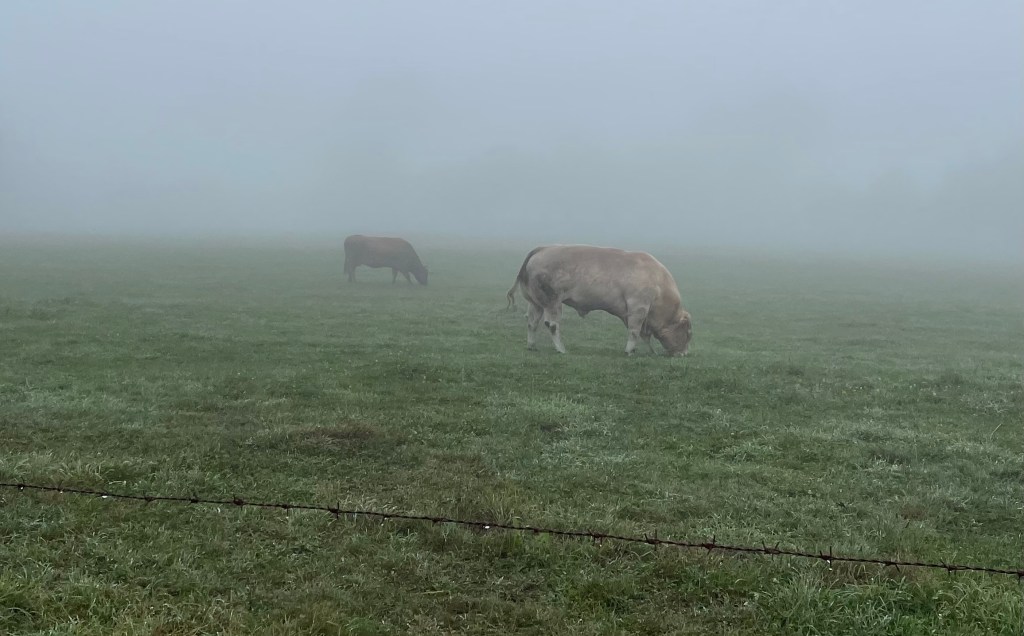
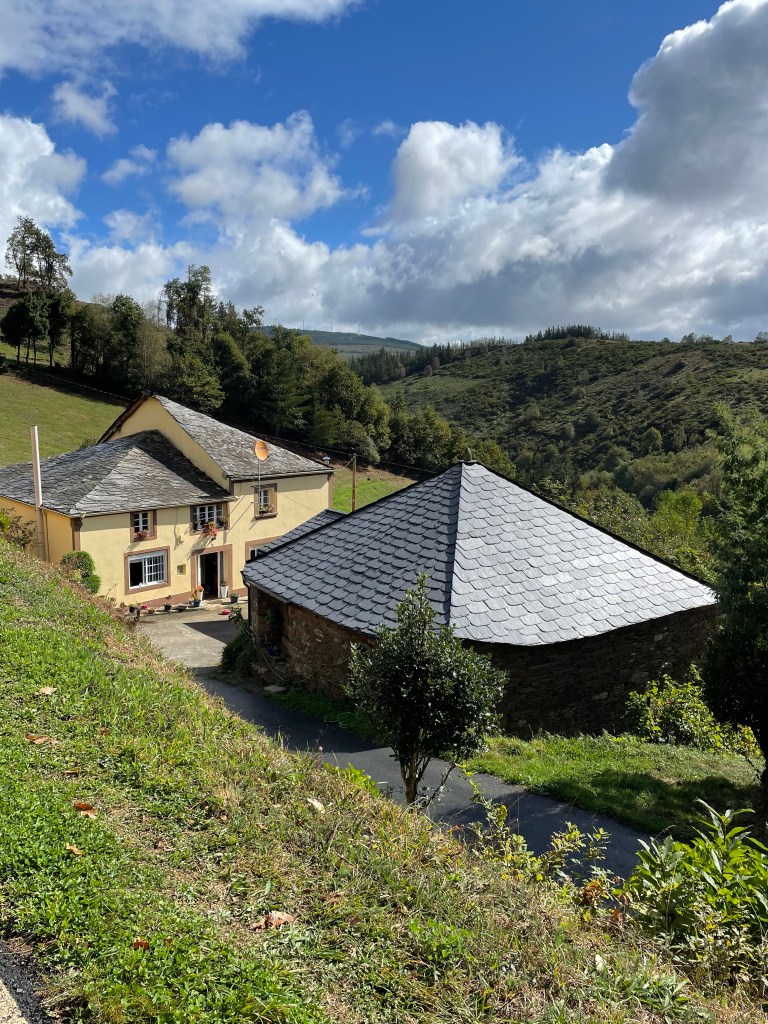
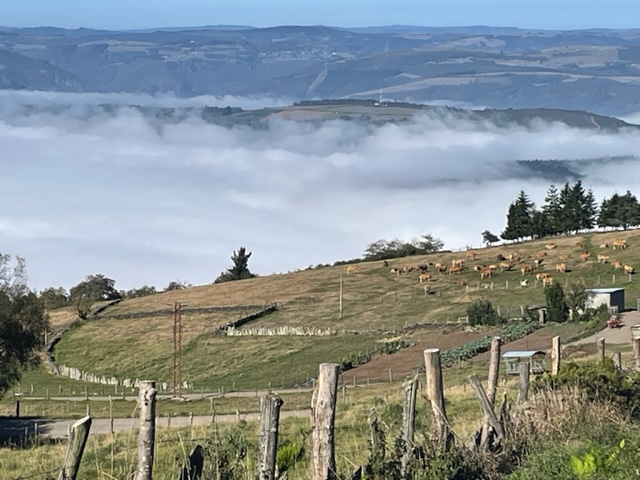
The photo below is from the place I stayed last night. So beautiful. The previous owners did an incredible job of adapting a very old farmhouse into a truly inviting home/B&B. And – they get to look at this, but not be responsible for cows or land since they just have the land the house sits on. The new owners were thrilled about that piece, though wished the cows wouldn’t share their flies quite so generously.
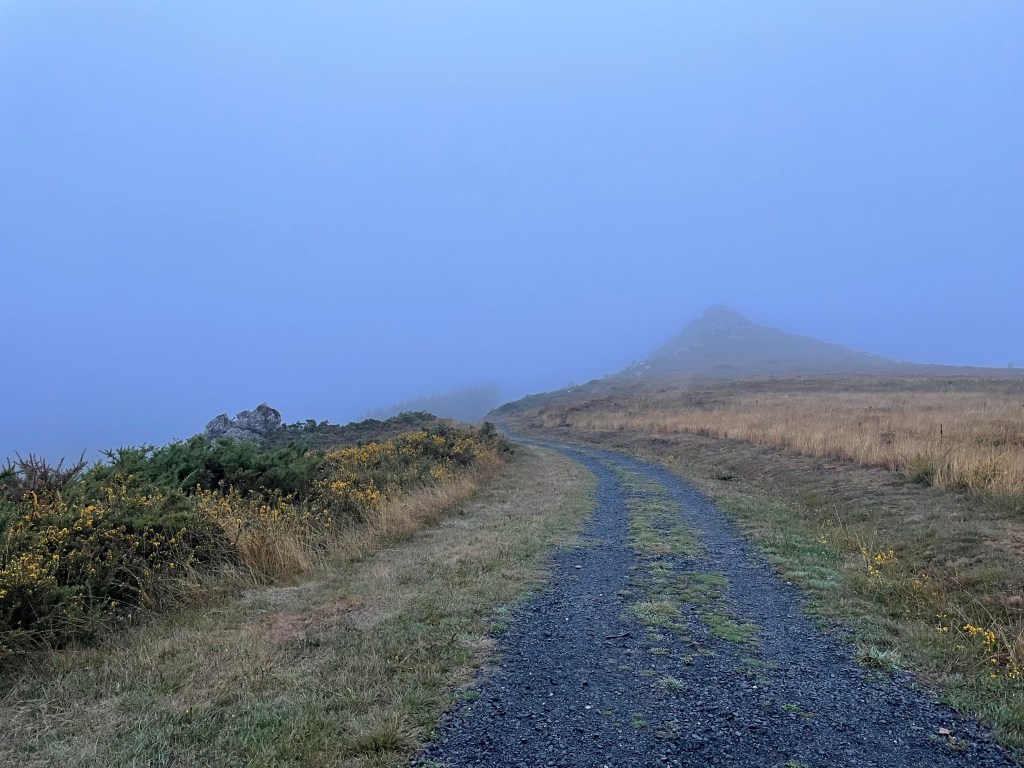
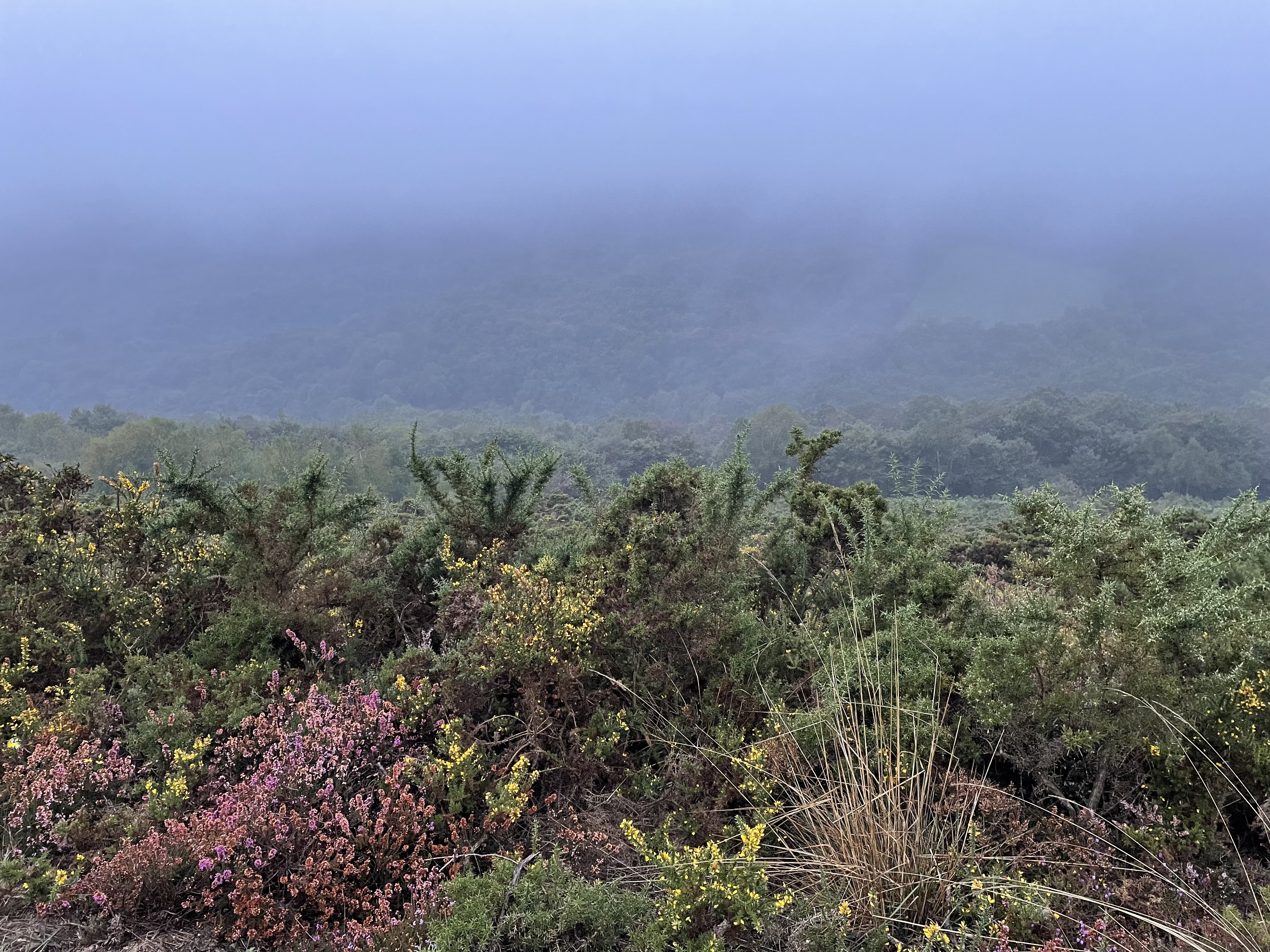
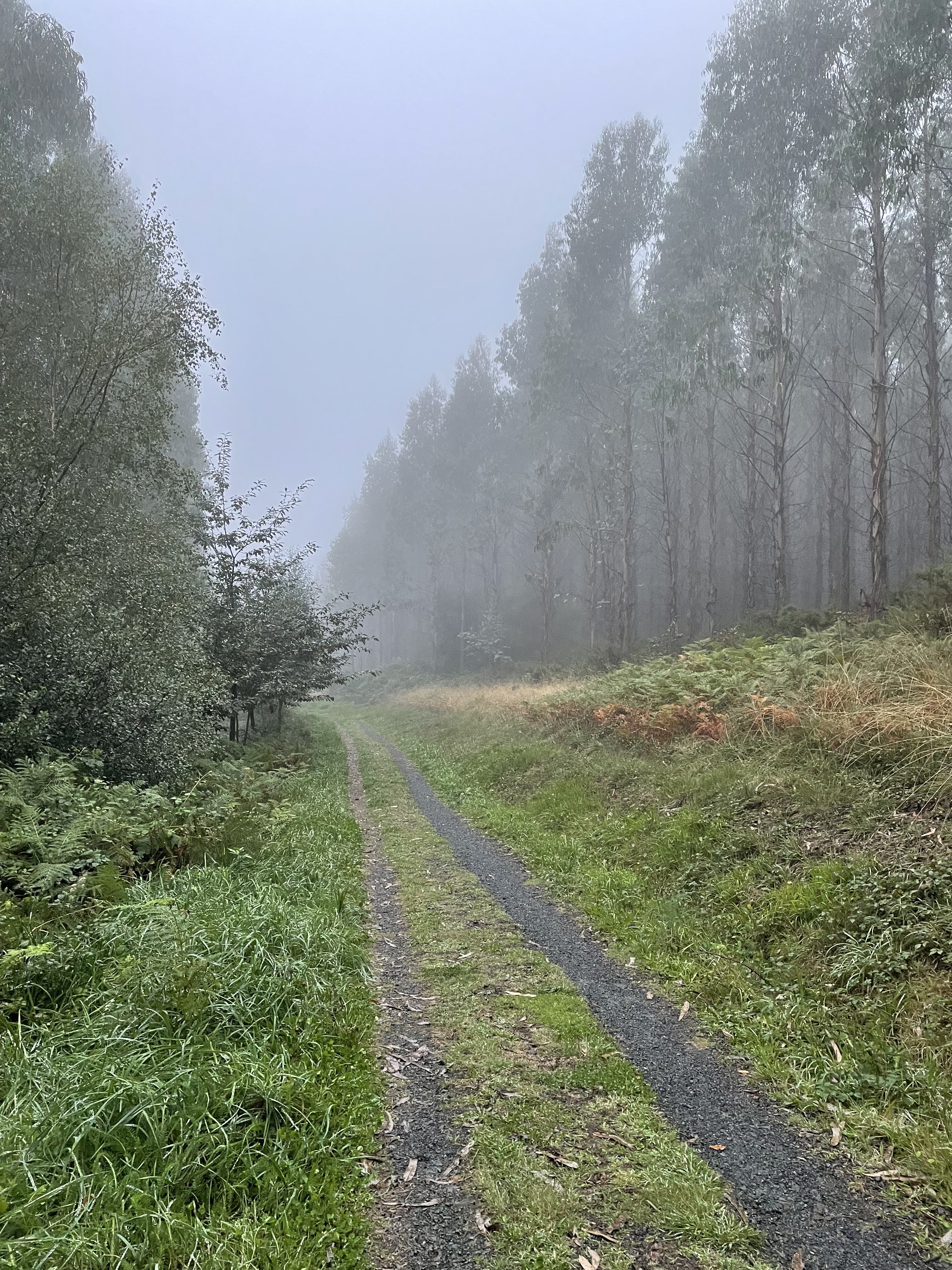
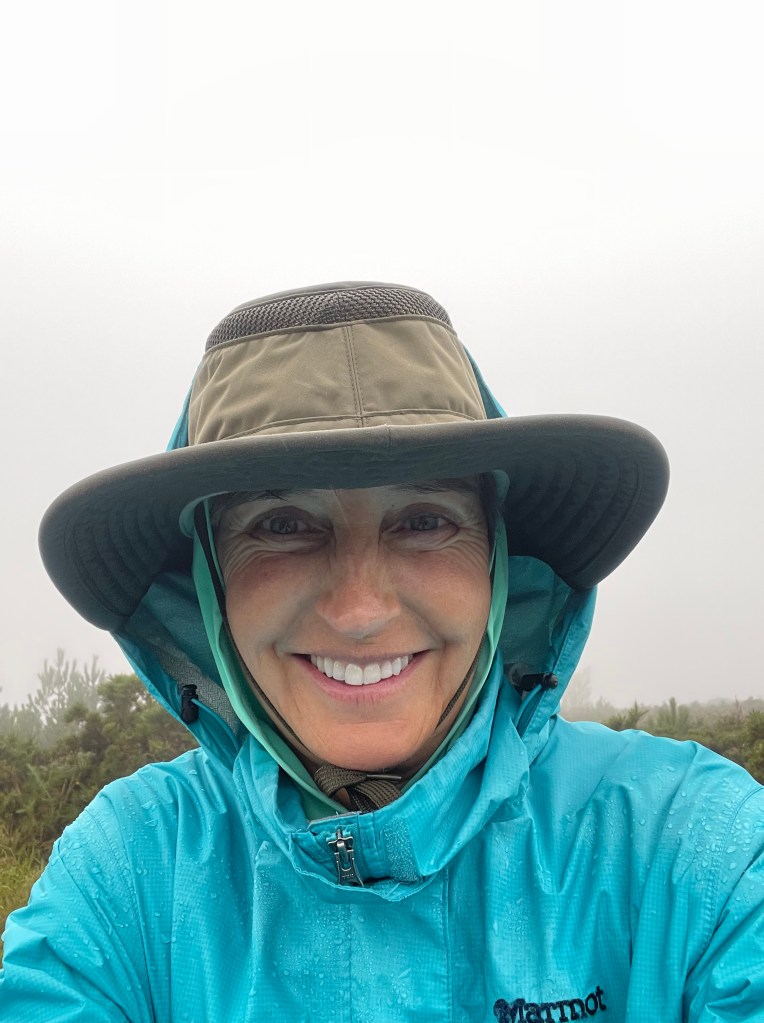
And this is today. I had one of those giddy happy moments here, just me and the mist/rain. Actually, once it started to rain, it didn’t stop for the rest of the day, but at this point, I loved it. The day started with some confusion on my part. I’d been picked up yesterday and the notes from Camino Ways, who organized everything, said they’d take me back down in the morning. But as I got ready to go, 2 other guys were leaving and the owner said – oh yes, just walk out that door over there. What? Well, turns out that the road we came up was the Camino and I hadn’t realized because I’d so enjoyed looking at the view and listening to the girls and their dad talk in German. Hmm, so do I worry that I missed 3.9 miles of the Camino? Not enough to go down and then back up. Plus I walked a ton in Lugo, that covers just the mileage, so off I went on my happy way. The advantage was that since we were 3.9 miles outside of Ferreira, no one else was walking here on the Camino yet and the two guys ahead of me walked much faster. Thus, the quiet.
Then about 15-20 minutes later, I looked up and I was back where I’d started! Good grief. I could not figure out how I got there, but luckily, a taxi was passing and turned me around and said go that way. Mind you, there’s only one taxi for the whole area – nice timing. Well, that made up for 1.5 miles of what I missed.
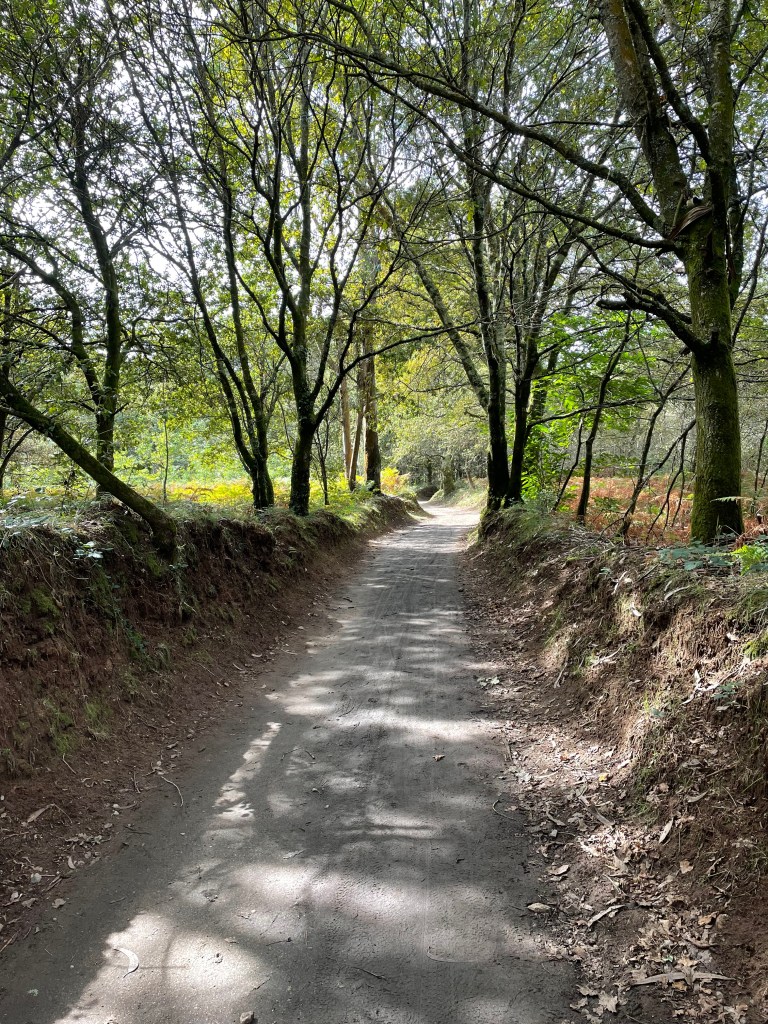
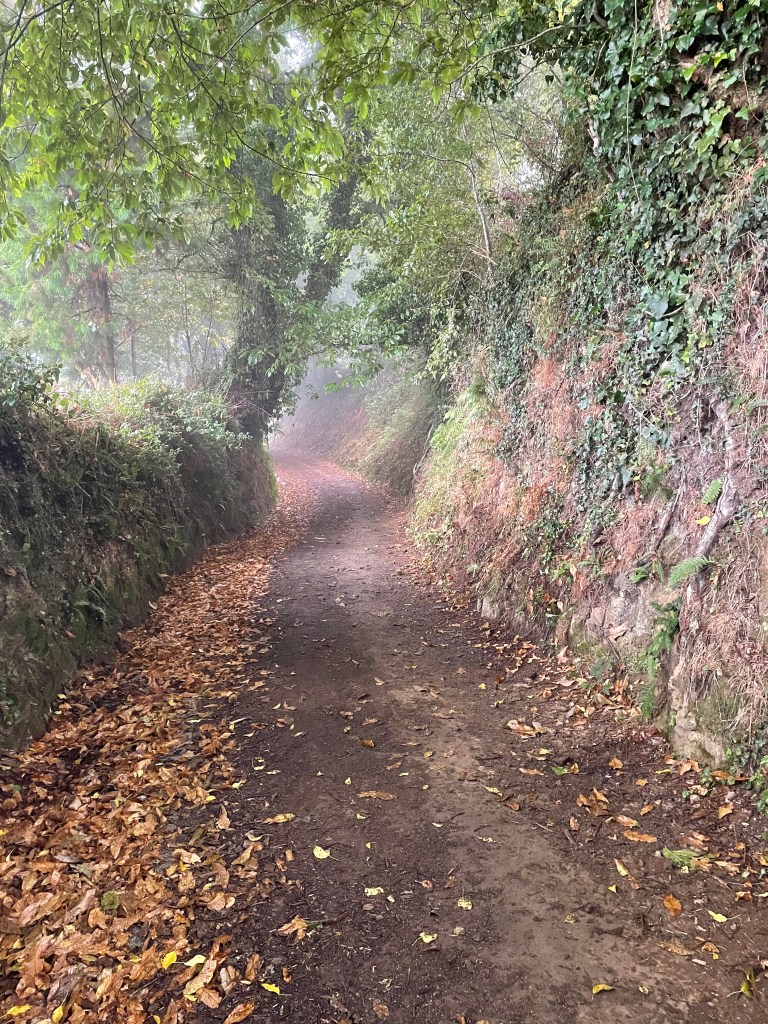
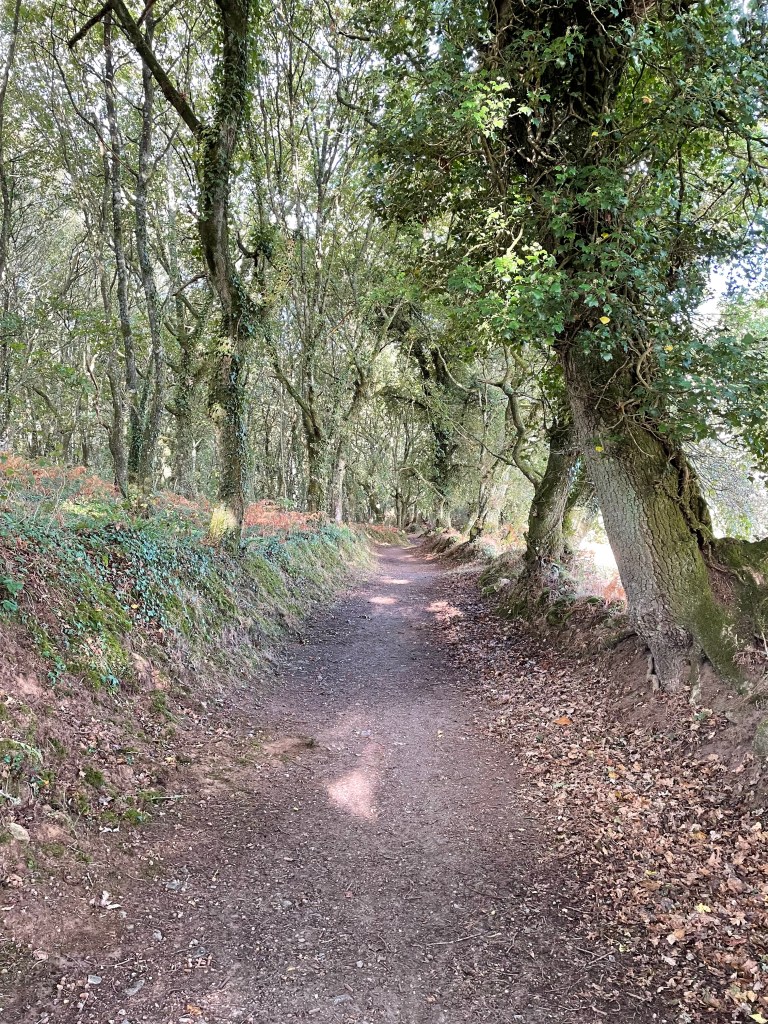
Did I write about this yet? I was looking back at last year’s Camino notes and I wrote about it there, but this is a hollow way and it’s the same phrase here as in England, where I first learned about it. A road walked for so many years, it’s sunk down from the surrounding land. I’m walking in history’s footsteps of the regular folks and pilgrims.
Do you see them? I couldn’t…
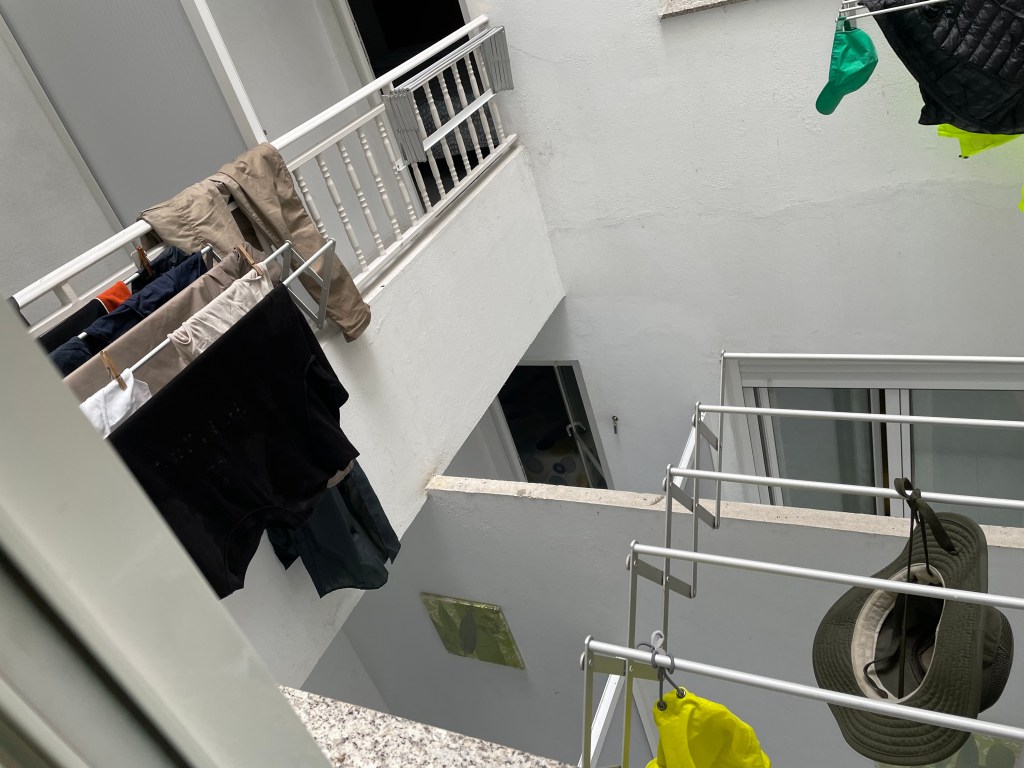
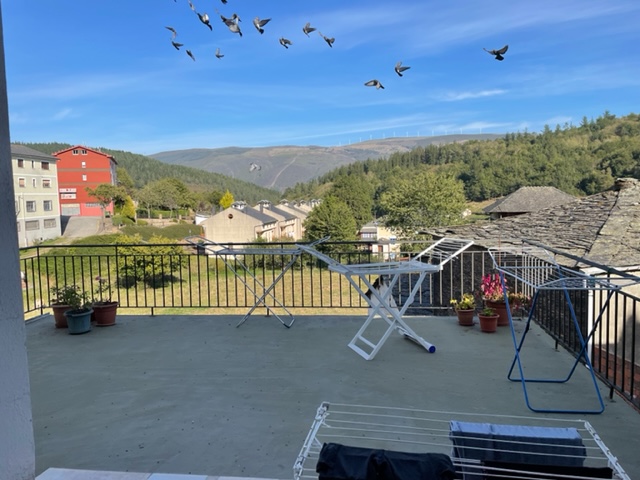
I was SO wet when I got to the hotel. Startled, per usual, to walk into town suddenly. I went to my room, radiators not working yet – nowhere – how am I going to dry anything? Then I heard all around me people in their rooms chatting through the windows onto this central covered space, I looked out and they’d all popped out these hanging racks and were putting their things out. Cool! I took the photo without the guy across from me because he’d already taken everything off at least on top and I didn’t want to take a chance of looking too closely. They were all hilarious chatting. The woman next to me told me we were neighbors now hanging our things out to dry – couldn’t tell you what else she said, this is all I got.
I wrote about the history of these places in Melide last year. But what I was struck by this year was how grim it was in this cathedral. I don’t know how anyone would grow up with a positive or hopeful spiritual life if you were in this space every day. Blood, swords, hearts outside the body with knives stuck in. Every church/cathedral has it’s own character and feeling which is interesting since it’s all the same religion.
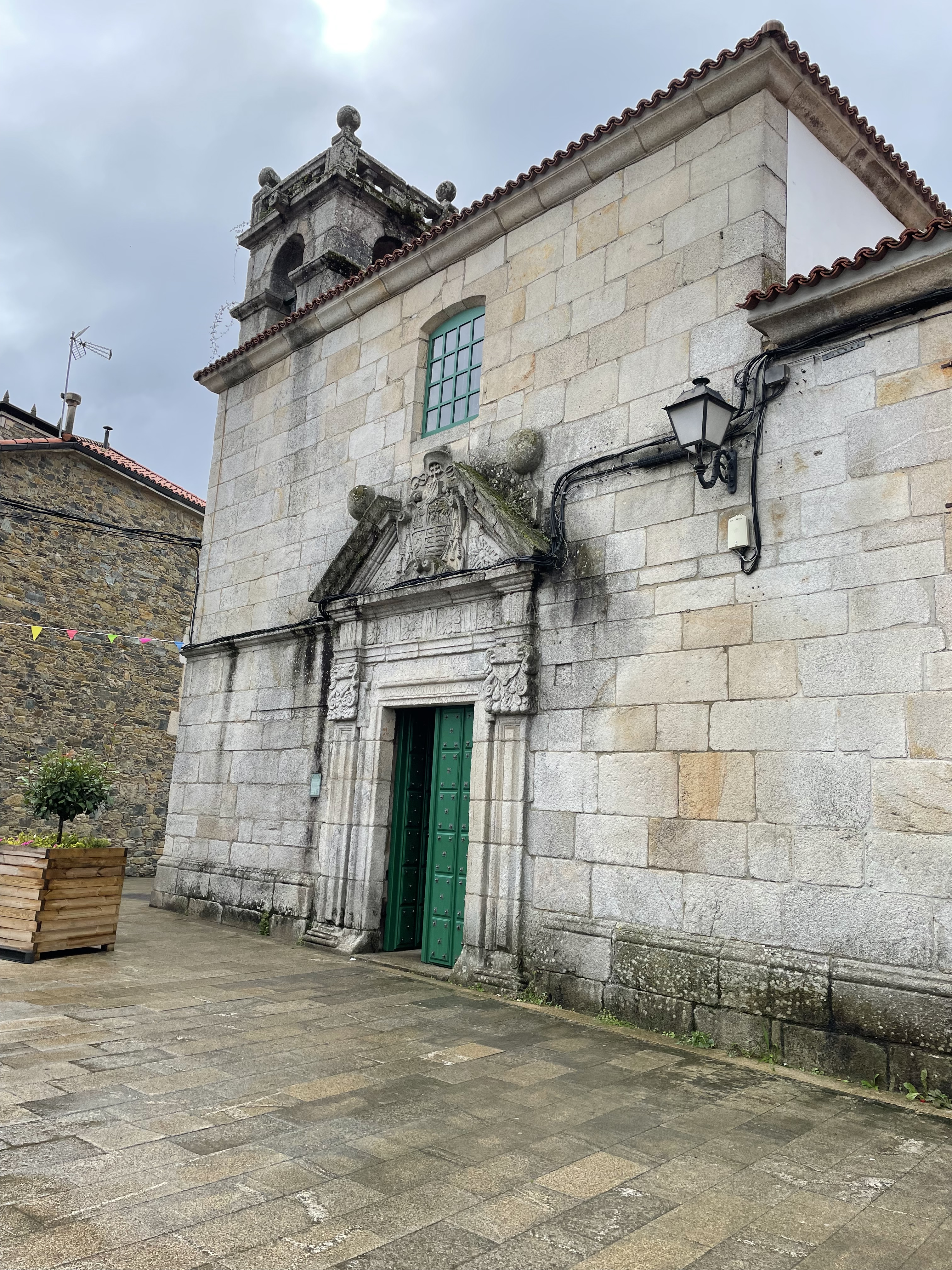
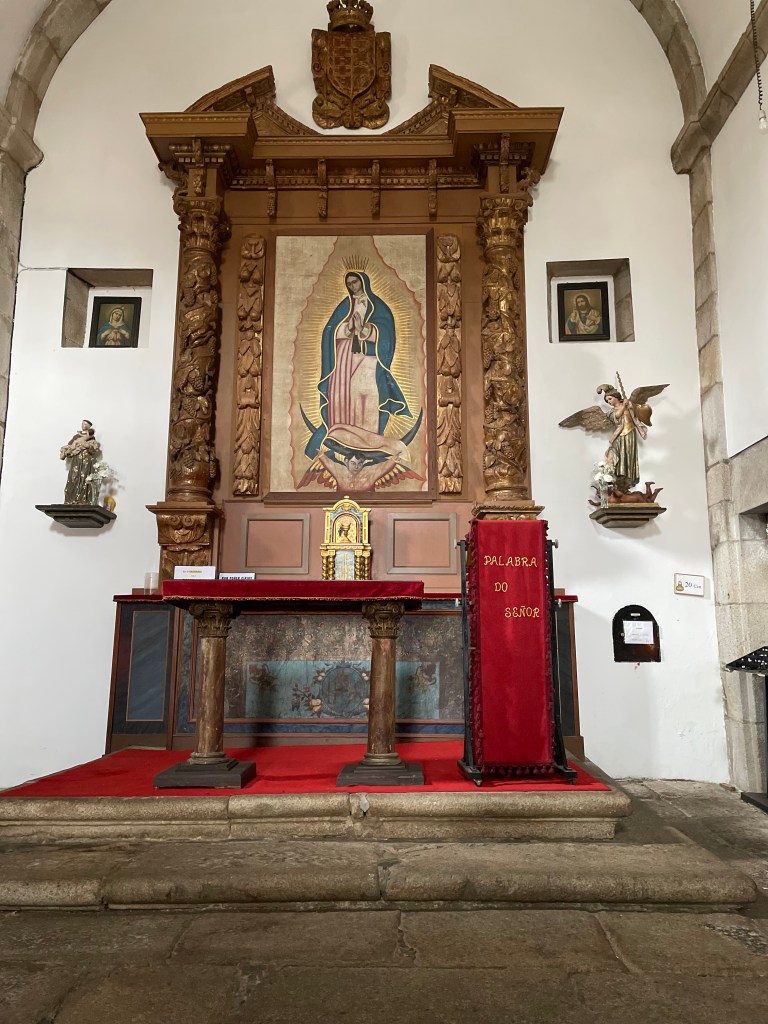
This little chapel was my favorite space in this town last year and this year, I was struck by the fact that Mary’s robe looks a lot like the blue blanket Kaziah used to use when she was 5-6 and playing at being Mary with it draped just the same way.
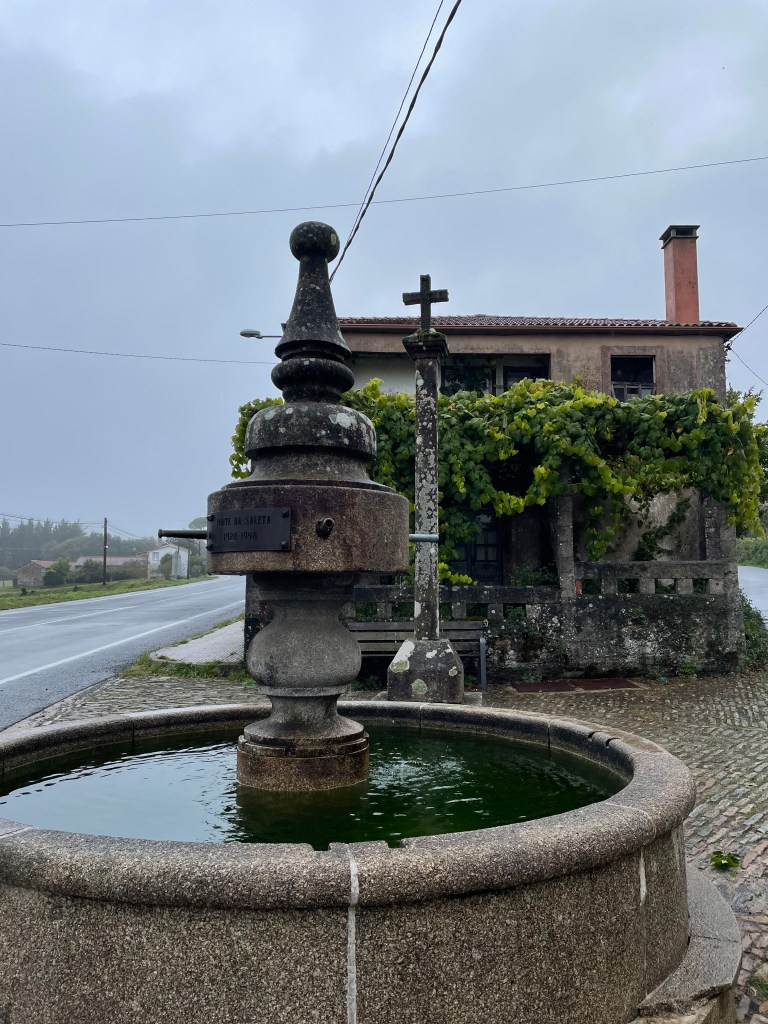
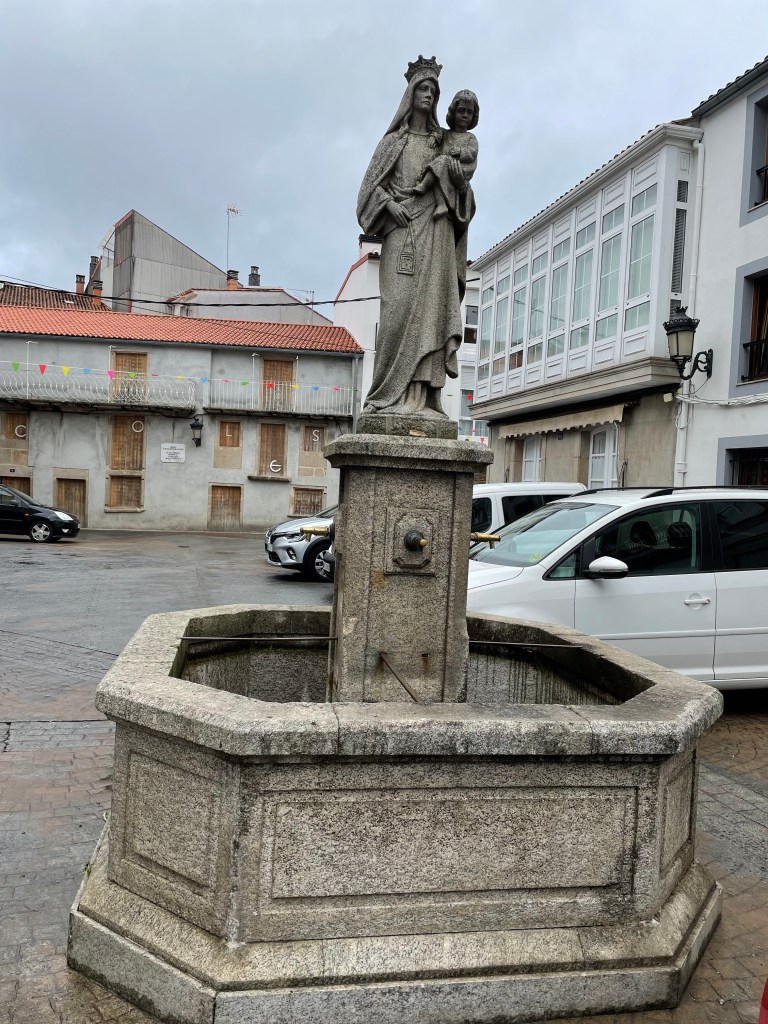
Wonderful Camino fountain. As of today, I’m now on the Camino Frances, repeating what Rick and I did last year. Technically, I’m still on the Camino Primitivo since that was my path of origin. We were so lucky last year – it was a month and a day later in the year and yet we had such good weather. Hoping maybe it won’t rain quite so much tomorrow, but no matter, it’s a short day. Only 13k.
Today started out beautifully, I left at 7:45 and was happy I’d prewalked yesterday to know where I was going. Loved this photo start below – crossing the river.
This was the church of San Lazaro, below was the hospital of San Lazaro. The sign about it was great. I’ve noticed a few signs now that are blunt (snarky?) about poorly done remodels of ancient buildings: This hospital (the row on the left) has existed from at least the XII century, but its current state arises from its final reconstruction carried out in 1779….In spite of its division and subsequent practical alterations devoid of aesthetic touch, the original space has been preserved mostly with integrity.
Hard to capture, but Lugo was really big – had no idea because they somehow craft the Camino to easily go from country to city and back out again.
It actually took a while to get to this state of country – rural with intermittent houses for at least an hour or two before started having country paths instead of road. I was just really happy that we did still get paths and birdsong!
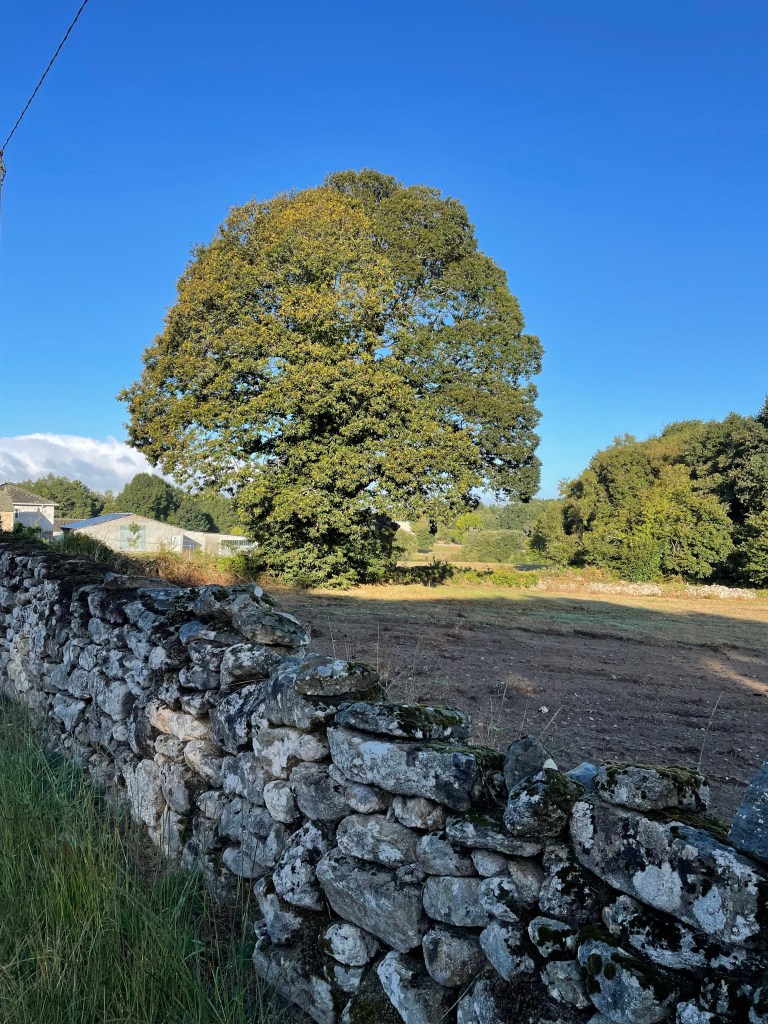
Giant chestnut tree.
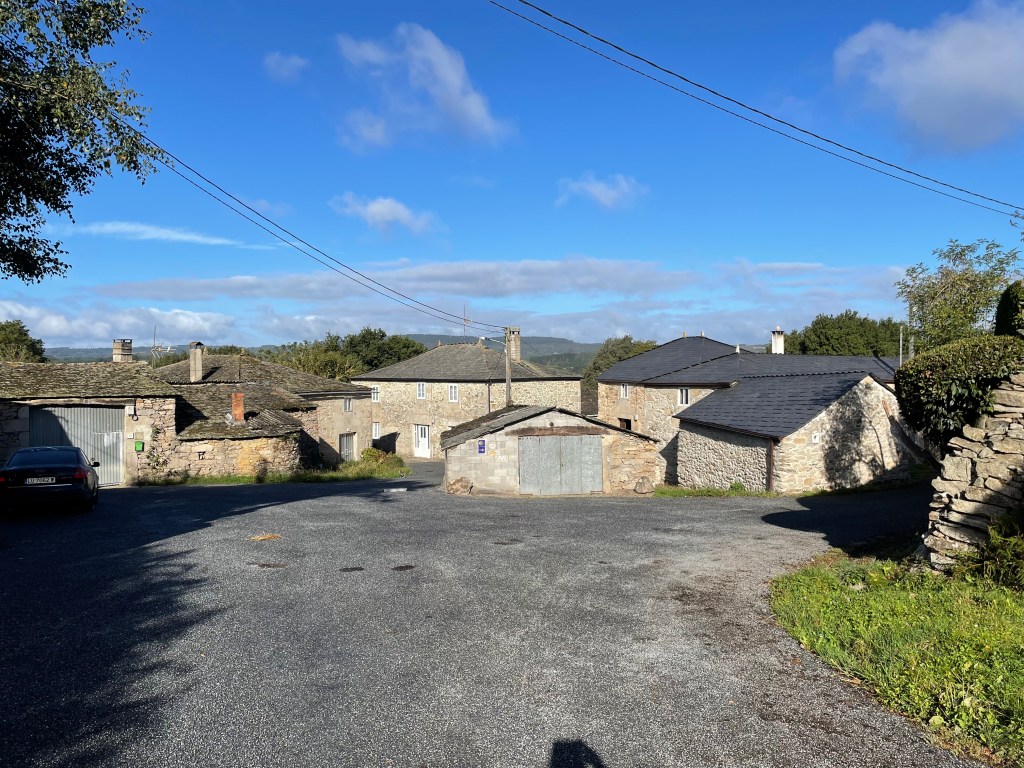
Perfect old stone village.
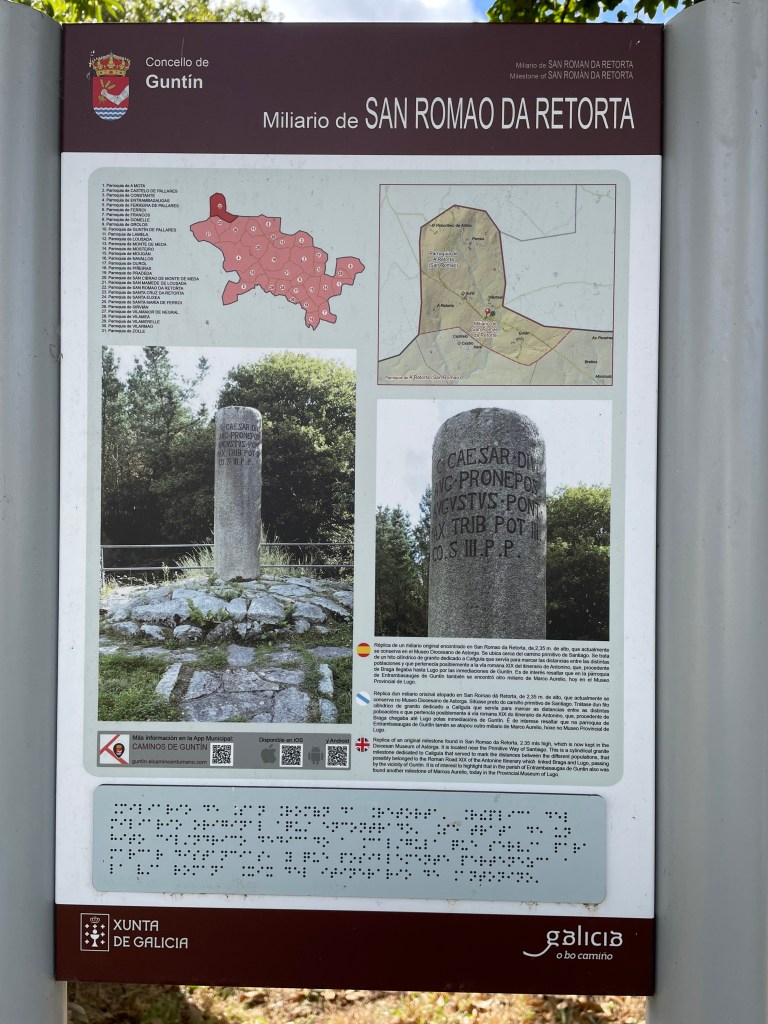
Yep, hitting tired here. Forgot to take the photo of the object written about here. This sign is saying that the stone column is a replica of an original Roman milestone (it’s now in a museum), that was here, on the Primitive Way. This milestone was dedicated to Caligula and served to mark the distance between different populations. There was another milestone in the next town dedicated to Marcus Aurelio. People have been traveling these roads for a long time!
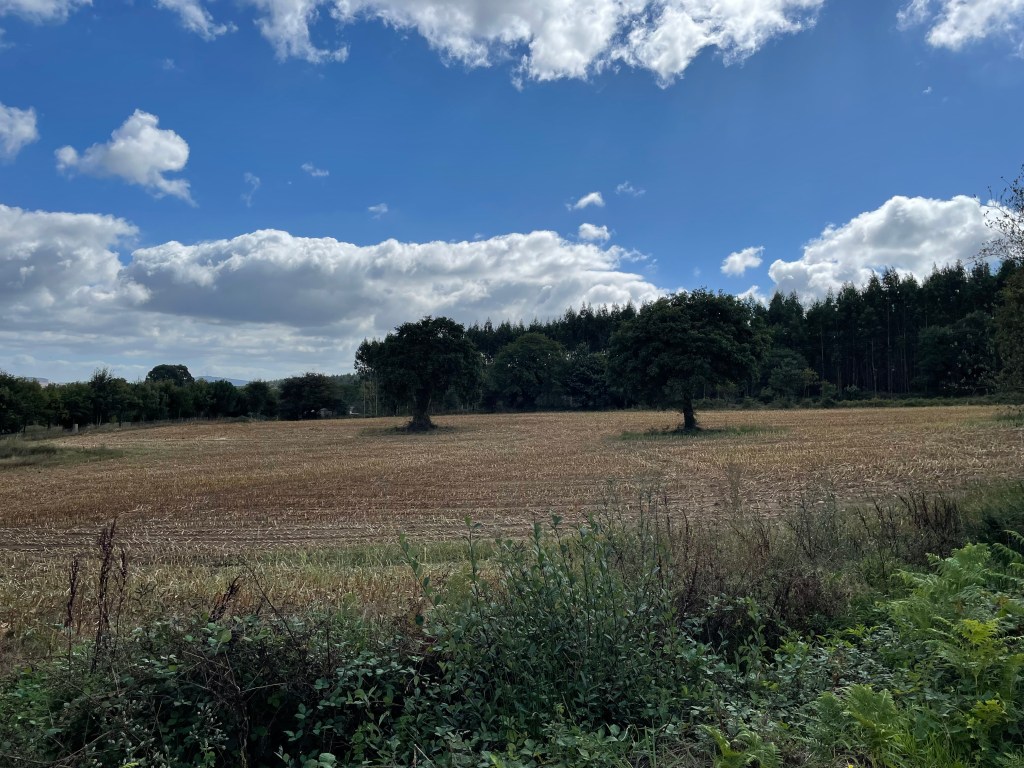
So appreciated that the farmer sowed his corn field (now cut down) around these two wonderful trees.
Much fewer cows, a lot more corn, still so pretty.
I got to Ferreira, a town of one cafe and 3 albergue spread out. I’m sure there are houses, but didn’t see that many. I waited at an albergue for the owner of the place I was staying to come pick me up. I chatted with the women owner for quite a while, super nice. She was Dutch and she and her husband had done a lot of different Caminos, but liked Galicia the most. They looked and looked and finally found an albergue that was nice enough, small enough to manage, and in a good spot. They’ve been running it since 2018, weathererd COVID, but are now looking to sell next year. 26 beds in 3 bunk rooms, vegetarian communal dinner every night, no help, all sheets, cleaning, she’s getting tired. I was just amazed.
Then the husband of the couple running the house where I was staying picked me up. He was young and had just picked his girls up from school, 9 and 5 years old. I thought he didn’t look Spanish and then his girls started talking – in German. They had moved two weeks ago and took over this guest house from the previous owners, with the bookings and all furnishings just carrying on. Wow. Brave. The couple is lovely, both cook, and the woman told me that she now has 3 full time jobs doing this, and is only now realizing that it’s really happening. The girls are in school in classes that are split between Spanish and Galician. Amazing.
Both husband and wife seemed really happy and somehow both focused on their daughters and yet taking great care of the 7 of us who are here.
What a luxury to just be able to walk and explore with no agenda. And I easily found food! They start breakfast at 7 here so I could figure out which way I’m going tomorrow when I start again and then go to a service at the Cathedral at 9. This is morning walking towards the cathedral.
I walked down to where the Camino left town – the walled city really is at the top of a hill. As soon as you walk outside the wall, in any direction, it’s headed downhill and towards 1 of 3 rivers depending on your direction. As I was walking back up the hill, I ran into 1 of 2 fellow Americans who’ve been on the trail these past days. John was hoping to connect with someone who might have found his glasses, but said they weren’t that needed and he’d rather join me going to the service.
I knew he was from PA and by the end of the conversation, knew that John was from Allentown, knows a friend of Rick’s who lives in Phillipsburg, John’s niece was at Haverford the same time as Kaziah and he is a priest who went to seminary just down the way from Haverford.
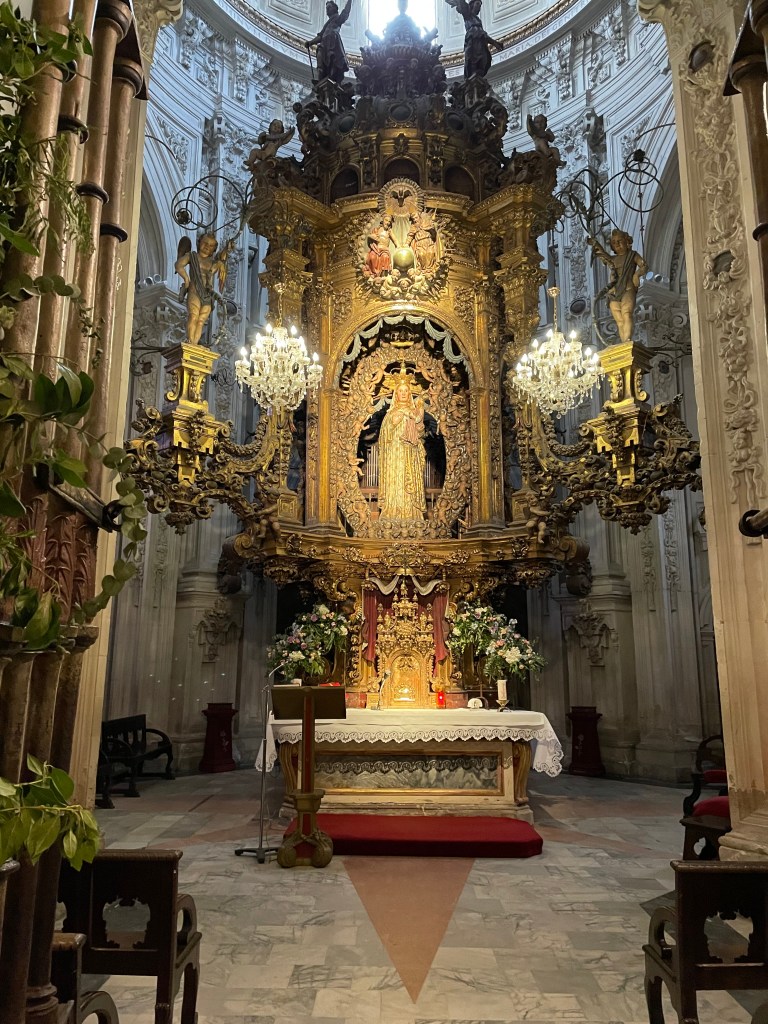
John’d gone to service the night before so knew where to go – it’s a giant cathedral with many spaces and he set me up here, at Our Lady of the Big Eyes (Mary, just FYI). She’s revered in Lugo, is the patron saint, and the tabernacle in the altar holds the Blessed Sacrament and this has been continual for 1500 years, starting with the Romans.
Here’s the history of the Blessed Sacrament in Lugo: The custom of perpetually adoring Jesus in the consecrated Eucharistic host has a long history in the Catholic Church, and some claim it all started in Lugo, Spain.
For many centuries Christians were not able to reserve the Eucharist in their churches, as they were often persecuted and only kept enough hosts to deliver to the sick and homebound.
However, after Christianity spread throughout the Roman Empire, permanent churches were built, as well as tabernacles to house the consecrated hosts.
In the Roman Rite, a tradition started to develop of exposing the Eucharistic host on the altar and inviting parishioners to stay there praying in shifts before Jesus.
According to local legends and stories, the cathedral in Lugo, Spain, might have been one of the first churches ever to start such a custom. What is even more remarkable is that this custom continues to the present day.
The official website of the Cathedral in Lugo offers this explanation.
In the main chapel of the cathedral of Lugo, the Blessed Sacrament is permanently on display. Since time immemorial, day and night. Represented in the coat of arms of Galicia, it makes the Lugo cathedral a unique example of perpetual adoration of Jesus. It is a unique tradition in the world. For this reason Lugo is known as Lugo Ciudad del Sacramento. The main chapel is the spiritual heart of the cathedral, where its inhabitants go to pray almost continuously.
Back to Mary: Because of her history with the church and Lugo, she’s a reason for pilgrimage alone and those who are Mary followers, have been coming since the 1600’s to see her, though this alter was built later, finished in 1832. They used to kneel in a circle all the way around the altar. There were Mary’s in a special room in the museum that were from the 1100’s, but not all were in this chapel.
The chapel was small, but felt big. There were 3 rows of tiny benches that went all the way around, big enough for 2 each, though no one shared and people also sat outside on benches that circled the main alter behind your back if you’re looking at Mary. There were at least 30 people in attendance, and the acoustics of the chapel made it sound like it was a full gathering. And John, the American priest, came out in sacraments and assisted the priest. He knew everything in Spanish and read in Spanish as well. He’s not fluent, but he must have prepared a lot for this. I was impressed. He found me later and said thanks, he seemed so happy to be able to take part.
Going to mass, talking with John, who hasn’t done the Frances, reinforced how different this Camino has been from the last. So much less church, mass, pilgrimage focused. It was wonderful to sit in the chapel and see the service. It was still an older crowd, but it was Monday morning so made sense and they were devoted. It just felt right for being on the Camino.
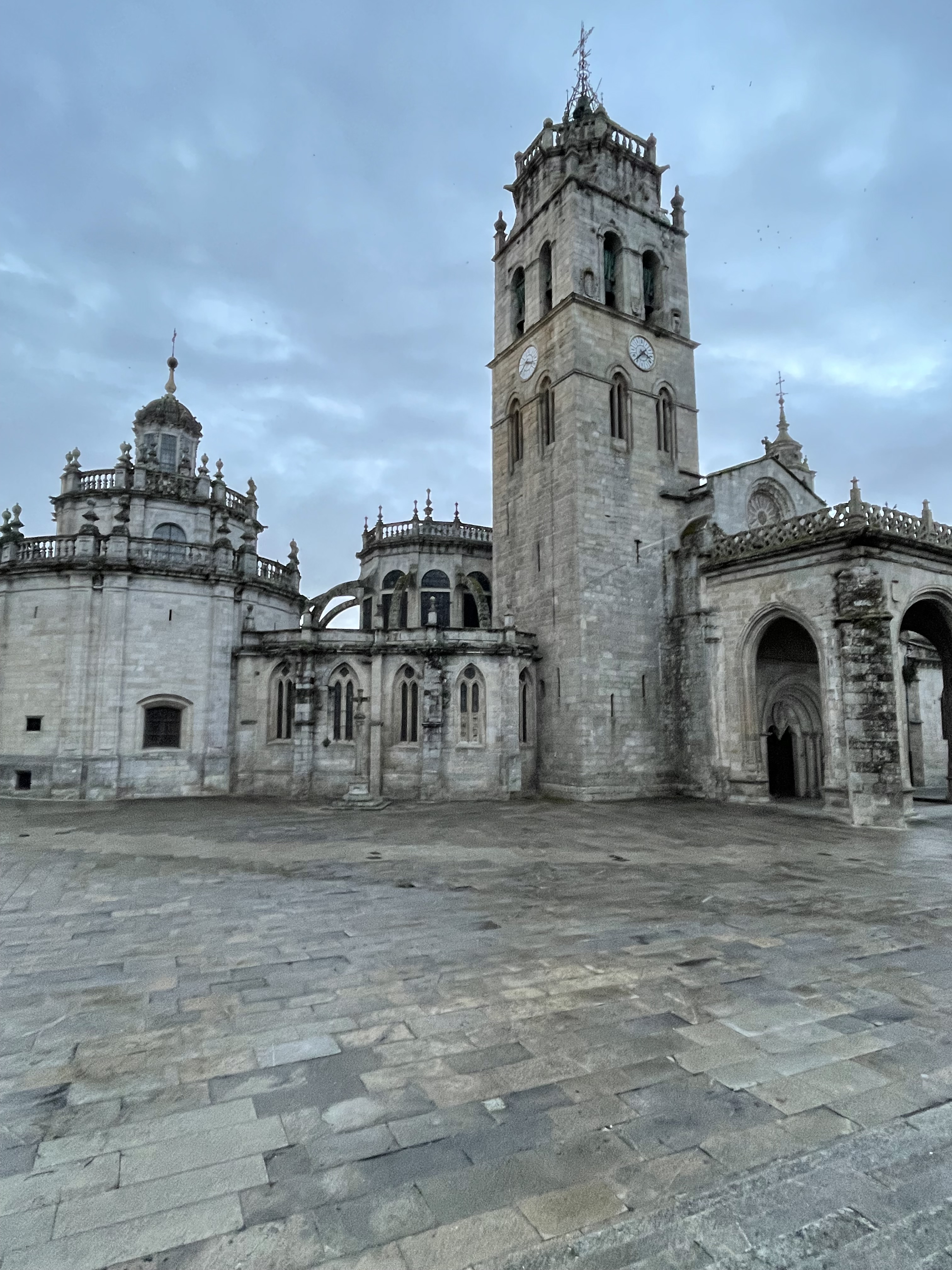
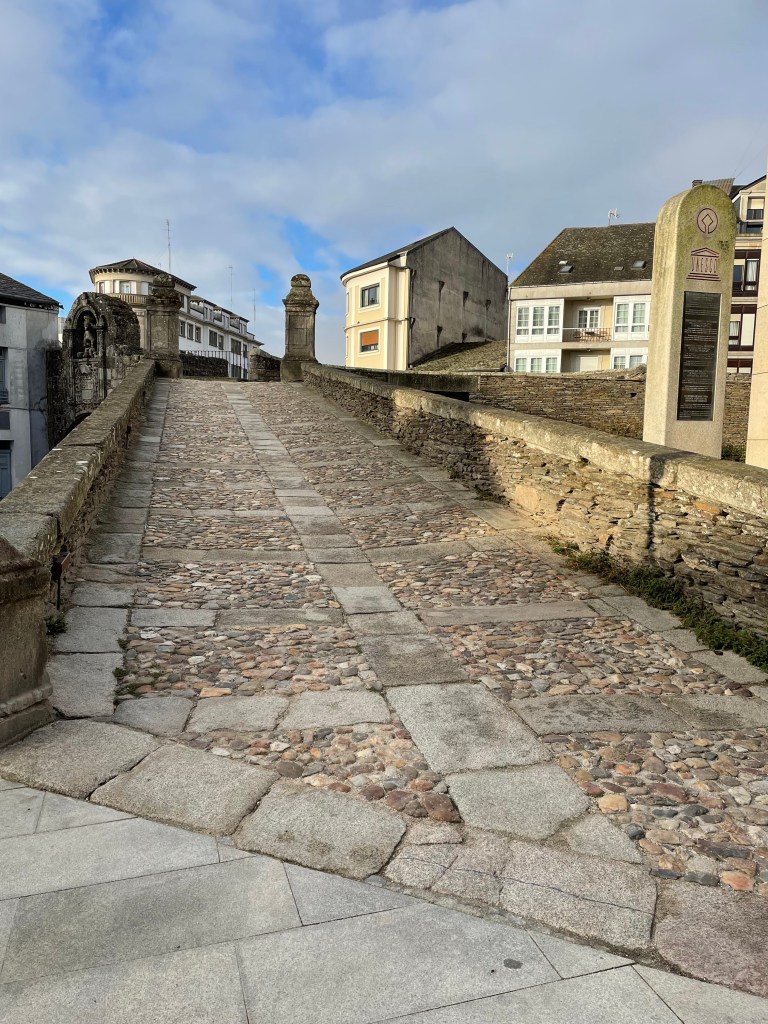
This is the bridge outside the cathedral that leads up to the walled walk, going under the bridge leads you out of the walled city and connects you to the camino. But before I did that, I did the service and then spent an hour with the audio guide learning about the church, the cloisters and the museum. It was great and while I was walking/tiptoeing around, there was a full sung mass going on that happened after the service I was in. The organ, the singer, the priest, all had talent and it was beautiful to be in the church, learning about the history (earliest pieces of the building are from the 600’s) and seeing the art. Amazing. The cathedral in Leon is still by far my favorite, but I loved learning about this one.
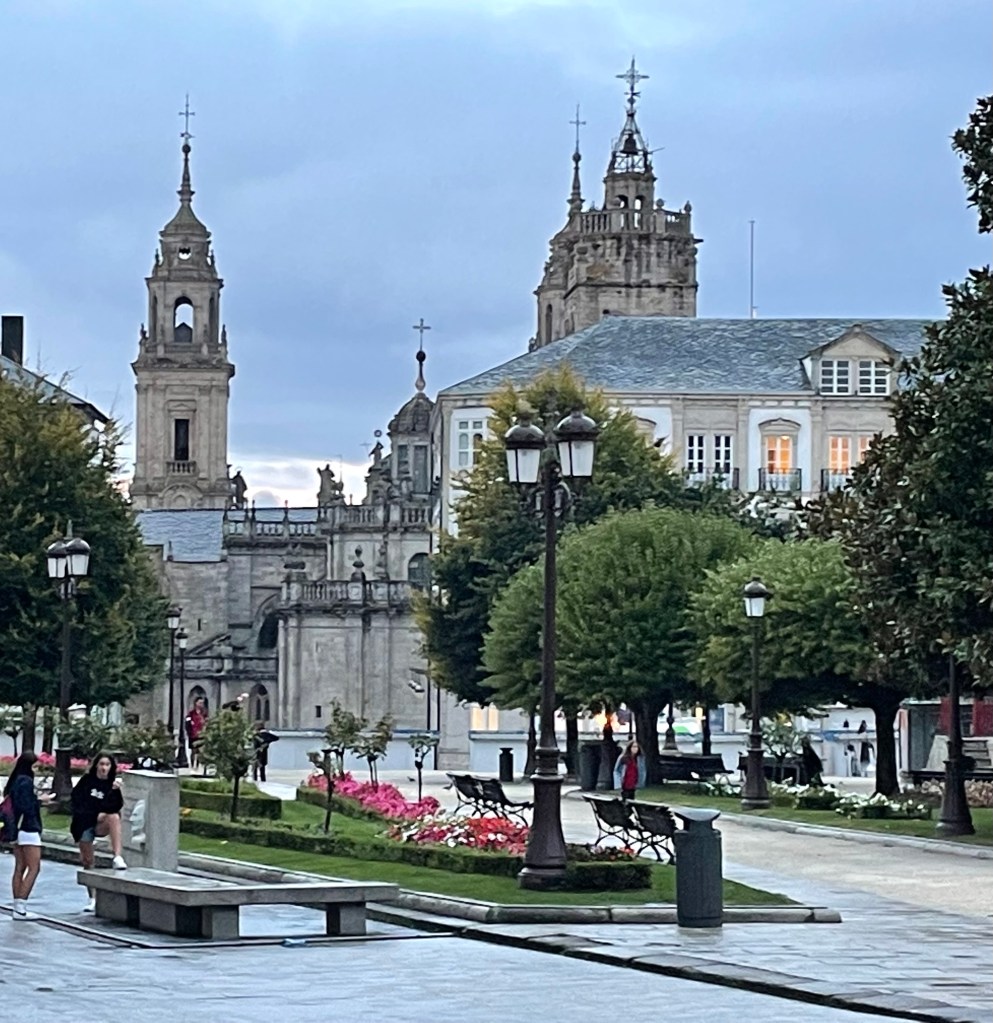
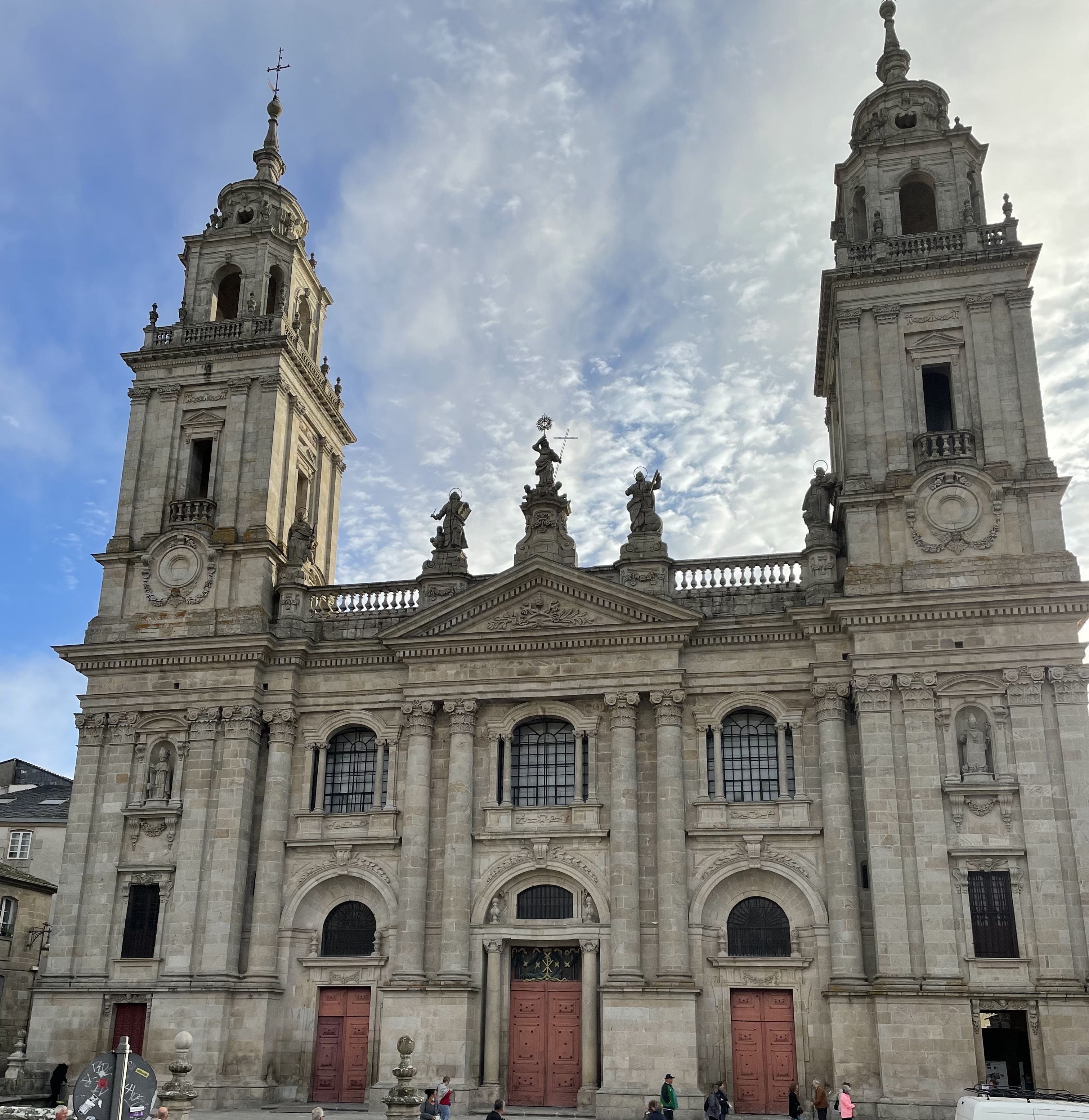
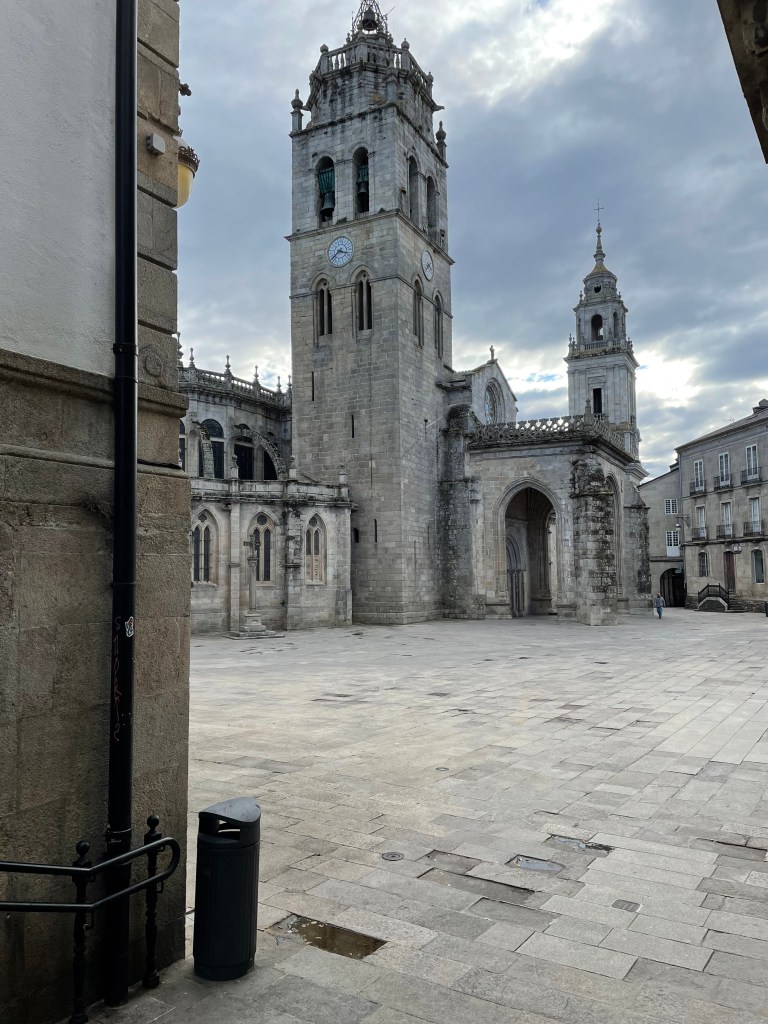
Lugo Cathedral
This was the back entrance, I don’t know when they use this area, it was classical instead of baroque and seemed calmer.
And this is the main alter. Huge. I’m sitting in the choir pews, ornately and beautifully carved. This is the only cathedral that kept the choir and organ in the middle, just as it was in the Middle Ages when all took part in the service and read from the huge books that were in the center of the choir.
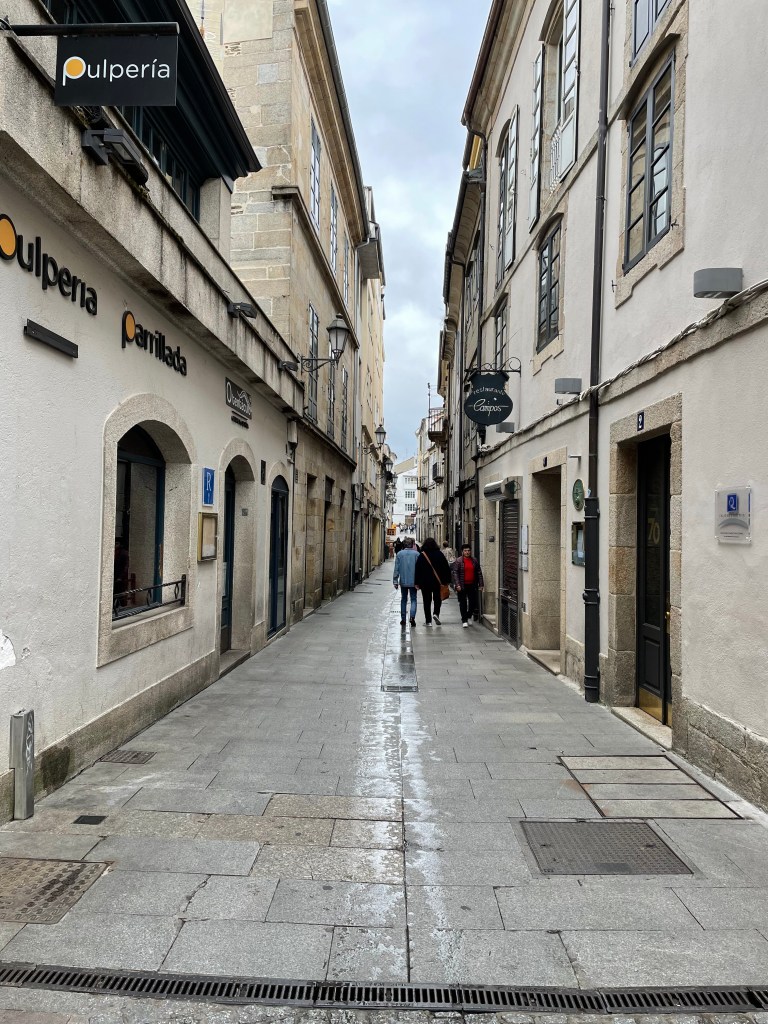
One of the streets in the city. I couldn’t believe how big it felt inside the walls. Cars and vans could come in, but it was either very controlled, or people just knew – you don’t drive in unless you have to to do deliveries or you’re a resident and have actual parking. That was for very few.
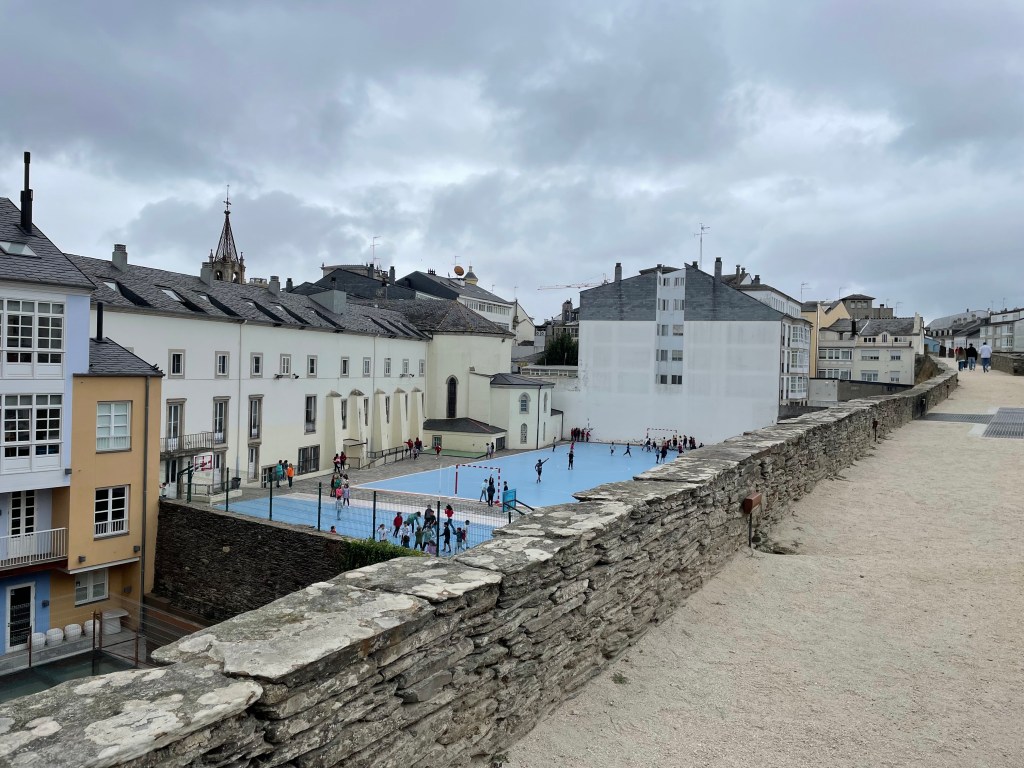
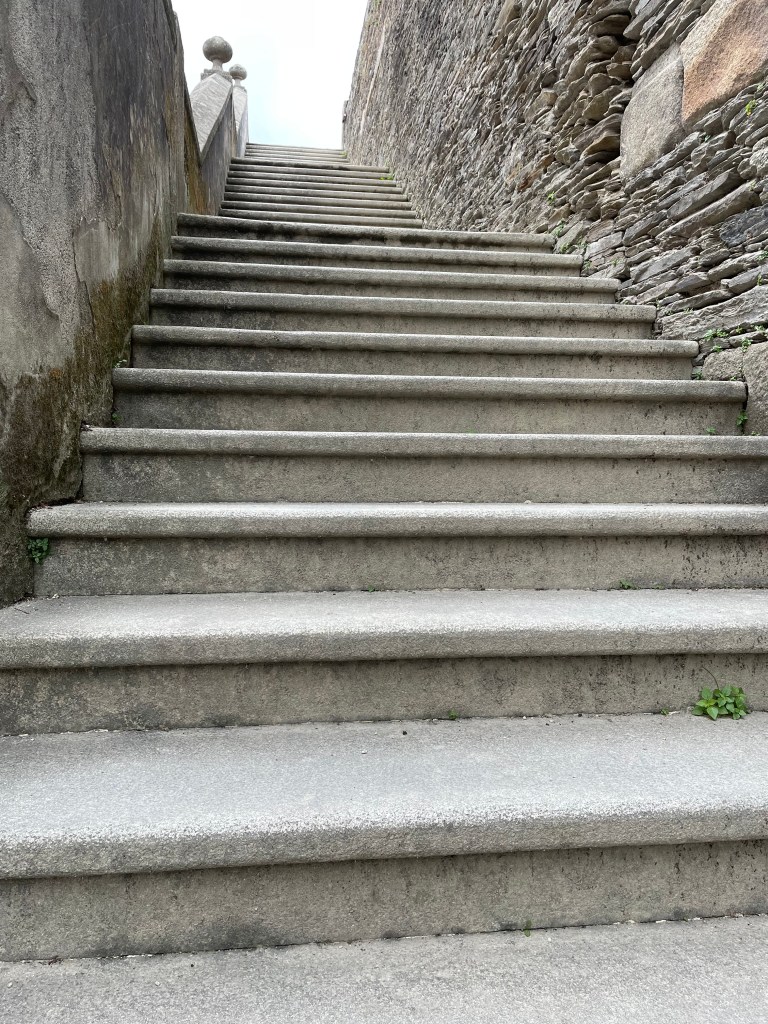
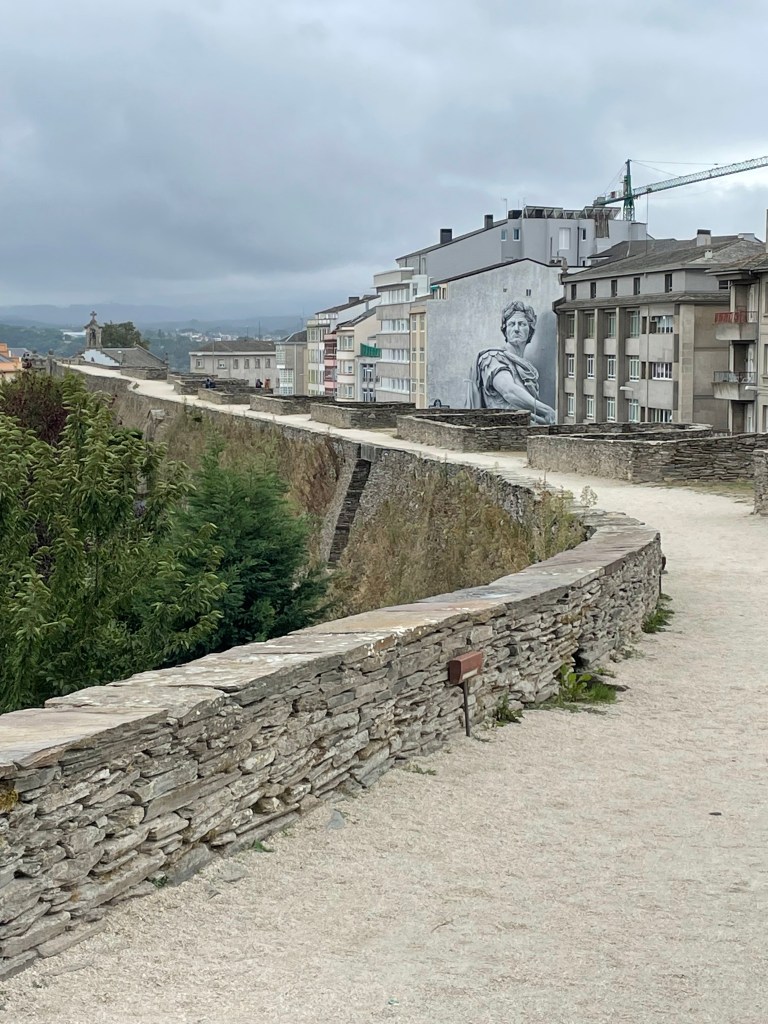
And now I’ve walked up that bridge from the cathedral and am on the walk. It is very wide, sand covered and high, with grates and low walls. I was not comfortable at all. I walked in the very center, kept having to regulate my breath to bring my heart rate down. No one else seemed concerned at all. I passed 2 people sitting on the wall for photos and a guy rolling a ball for a border collie – hello, they jump!!! All three made me want to crawl for a while instead of walk. It was a very long 2.2 kilometers. But amazing. It just went on and on.
A school in the walls! Imagine growing up thinking it’s normal for the wall of your playground to be a medieval city wall.
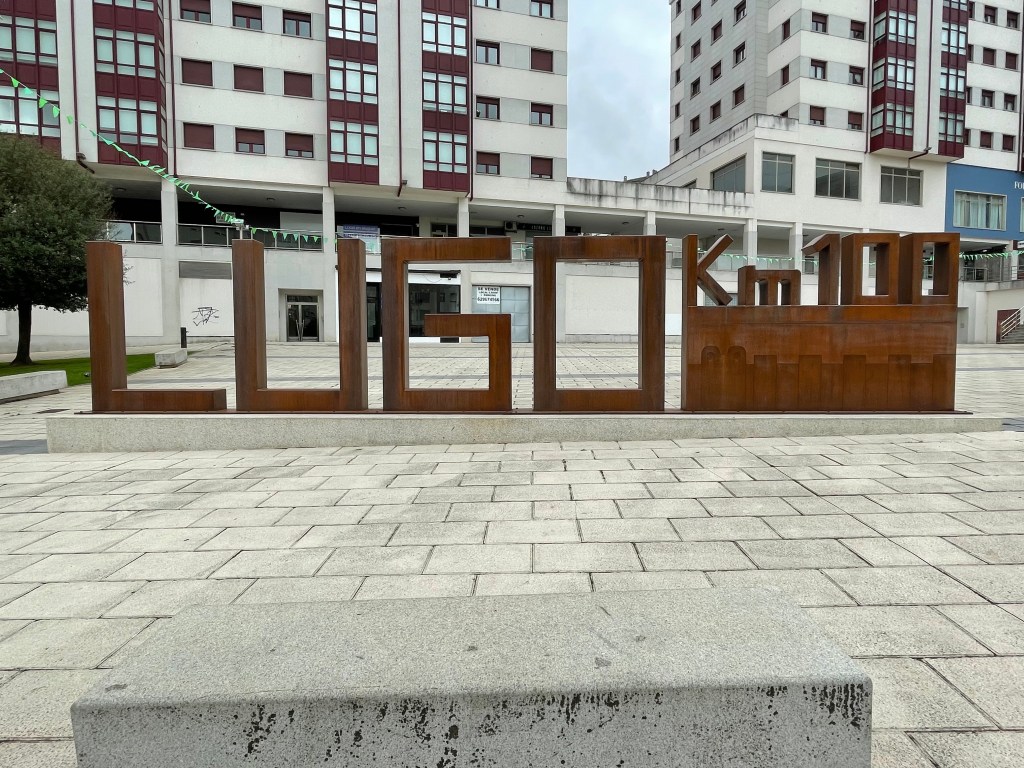
I made myself go down at the 6th portal (there are 13 portals, some closed, some walks, some drivable) to find where the 100km marker was for the Camino. I hadn’t seen it when I walked in and someone told me where to look. I then passed 3 French women I knew from the walk, they were just coming in and said yes, it’s just down there it’s brown. Good grief. I’m guessing noone else missed it. In order to get the camino certificate, you have to start at 100km minimum. I just wanted to see the marker…
I was so happy being on level ground, I walked easily and briskly down and back up from the marker, and then made myself go back up to the wall walk.
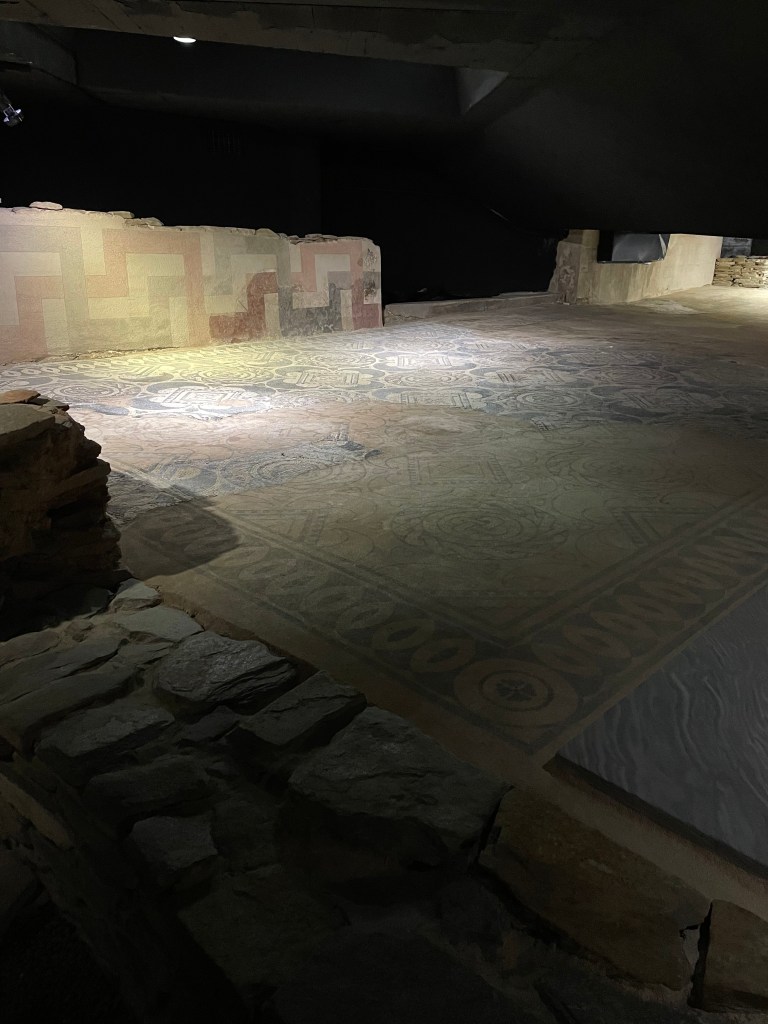
This is a Roman house, 3-4th century that was found under a building in 1998. Can you imagine the dismay of the people building above and the thrill of the archaeologists? Amazing mosaics still intact. They know there’s a lot more under the next building, but…
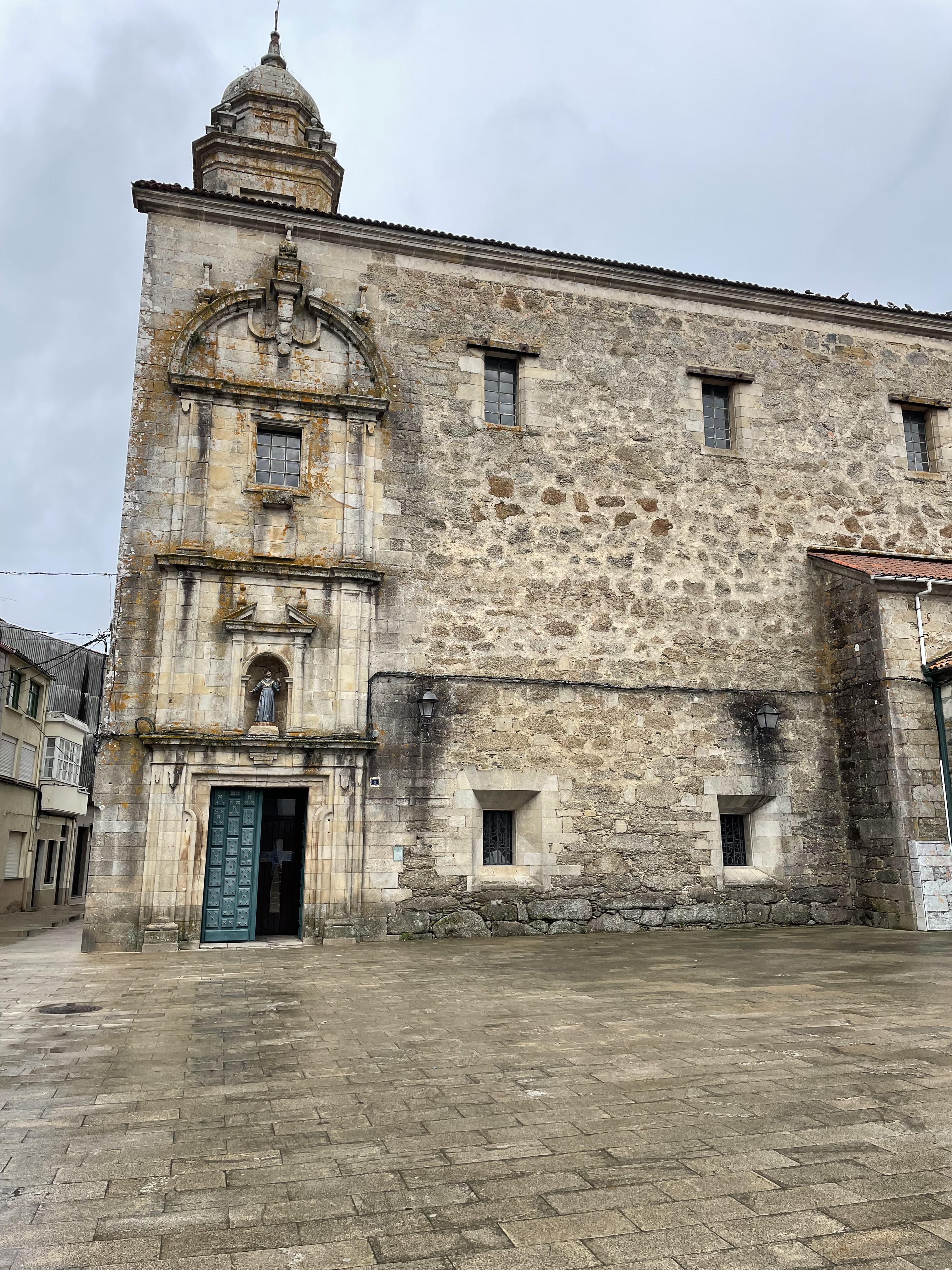
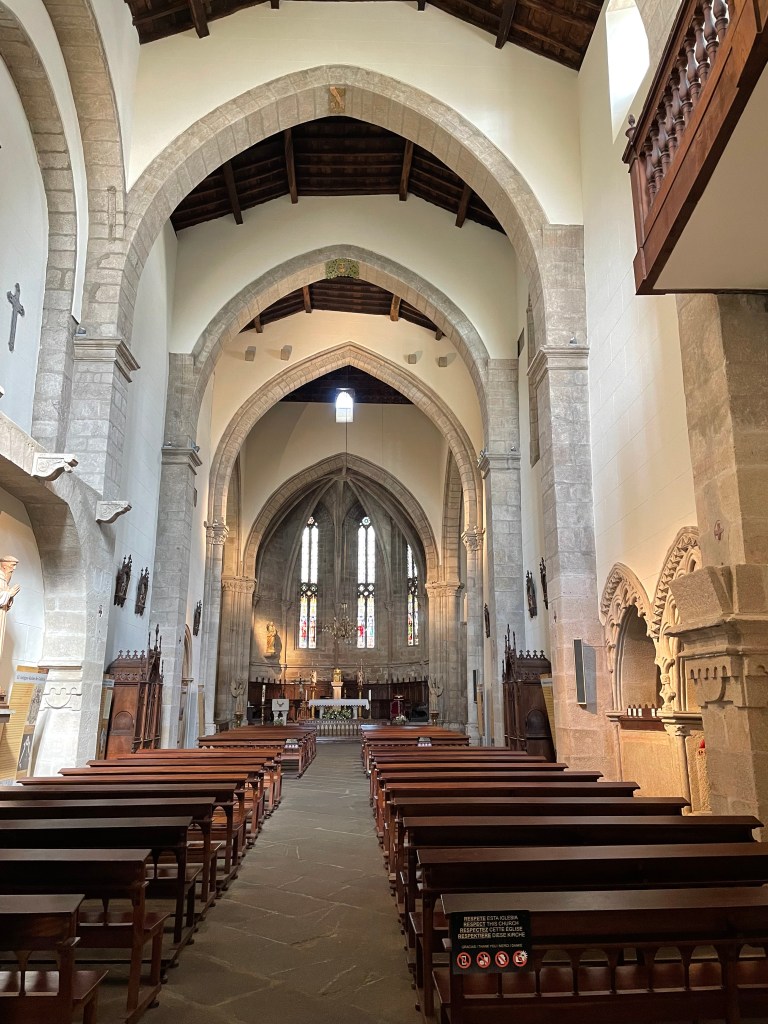
A Franciscan church that I really liked. Quiet, serene.
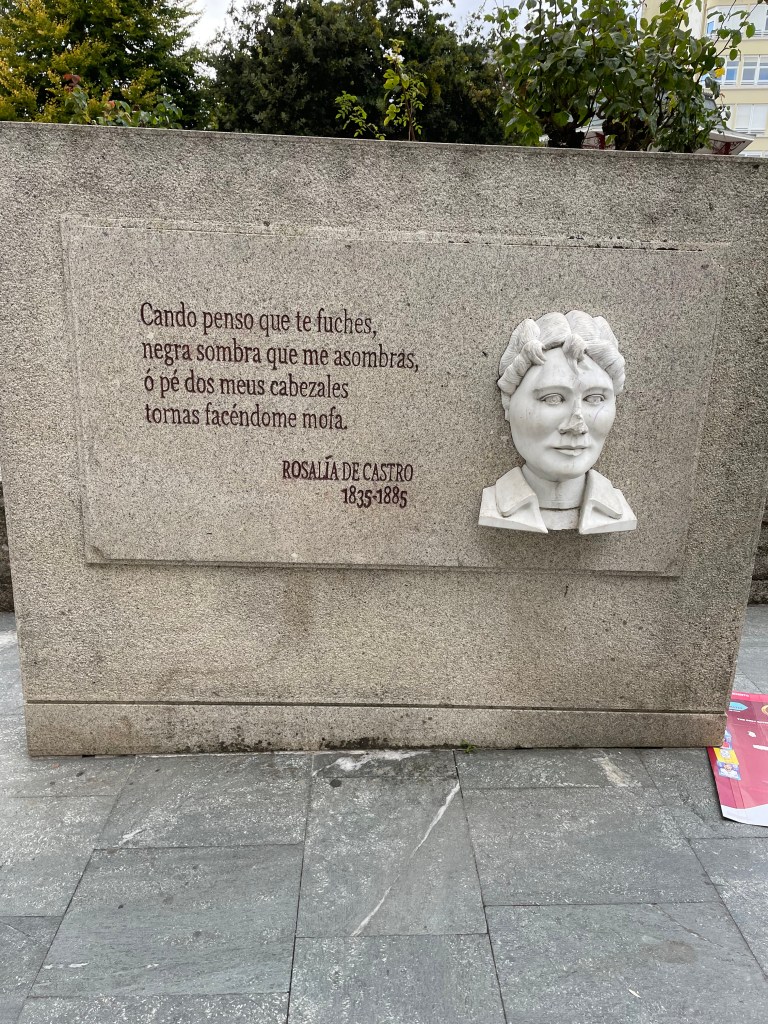
There’s poetry in so many places, this country appreciates the written word and art if the demonstrations and markers are anything to go by.
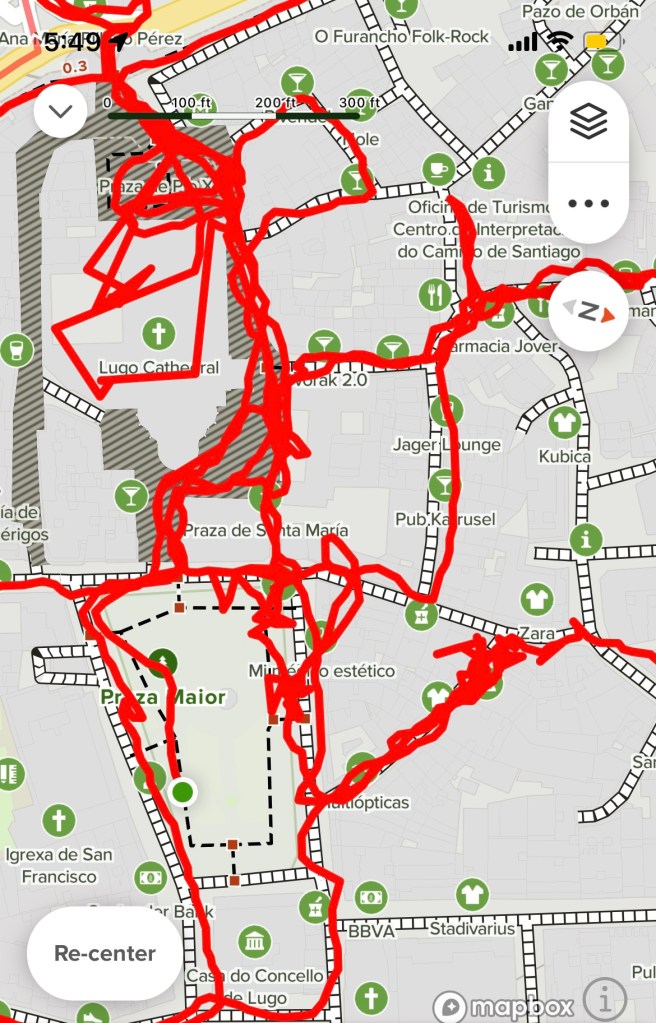
This is where I walked today.
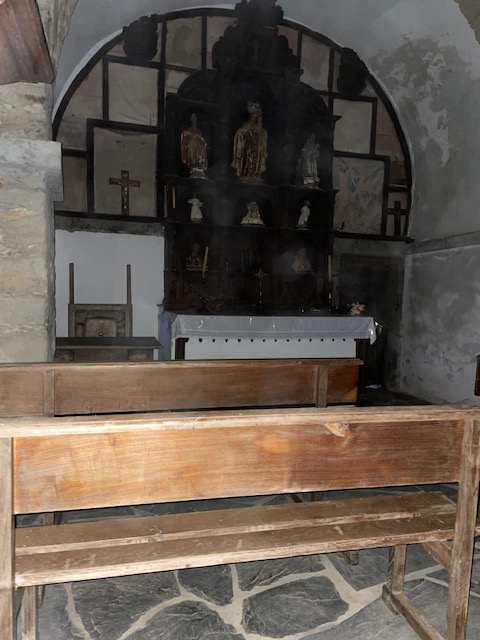
This is a blow up of the interior. Hmmm. Looks a little confused – but it really was a mix of hither and yon.
Walked into another beautiful misty country day, but no rain. The walking was also much easier with ups and downs and different types of trails, but not mountains or steep pitches.
By now, I recognize every single person on the trail. I’m guessing there are about 20 of us on the same day schedule? We all smile at each other now, mixing Spanish, French, and English. The Germans and Scandinavians use one of those other languages so that we can talk. It’s nice. Many of us are taking a day off in Lugo, but Lugo is also a start point for a lot of people because it’s 100k from Santiago. I wonder how many of the 20 I’ll see day after tomorrow…
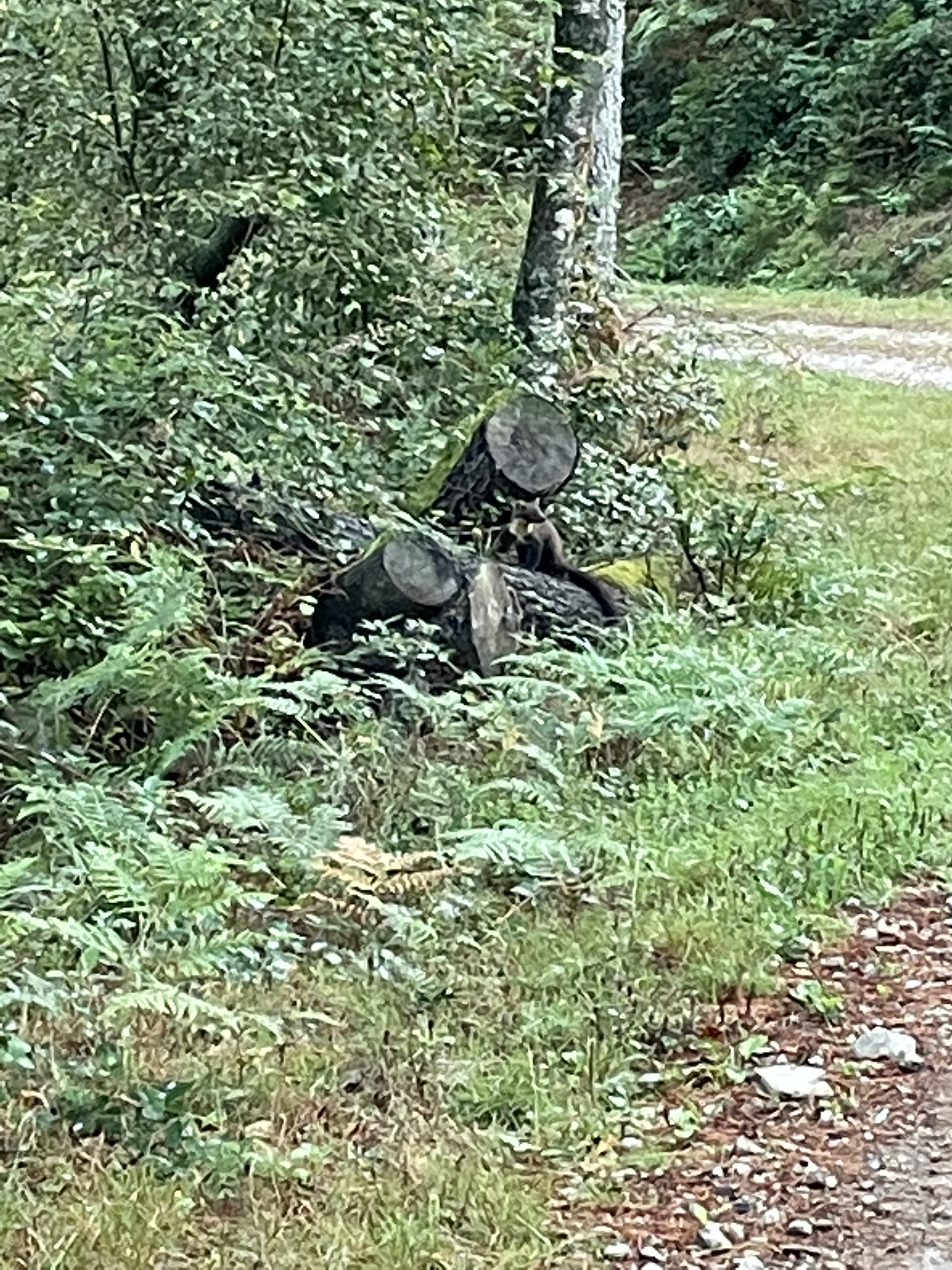
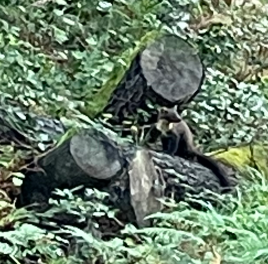
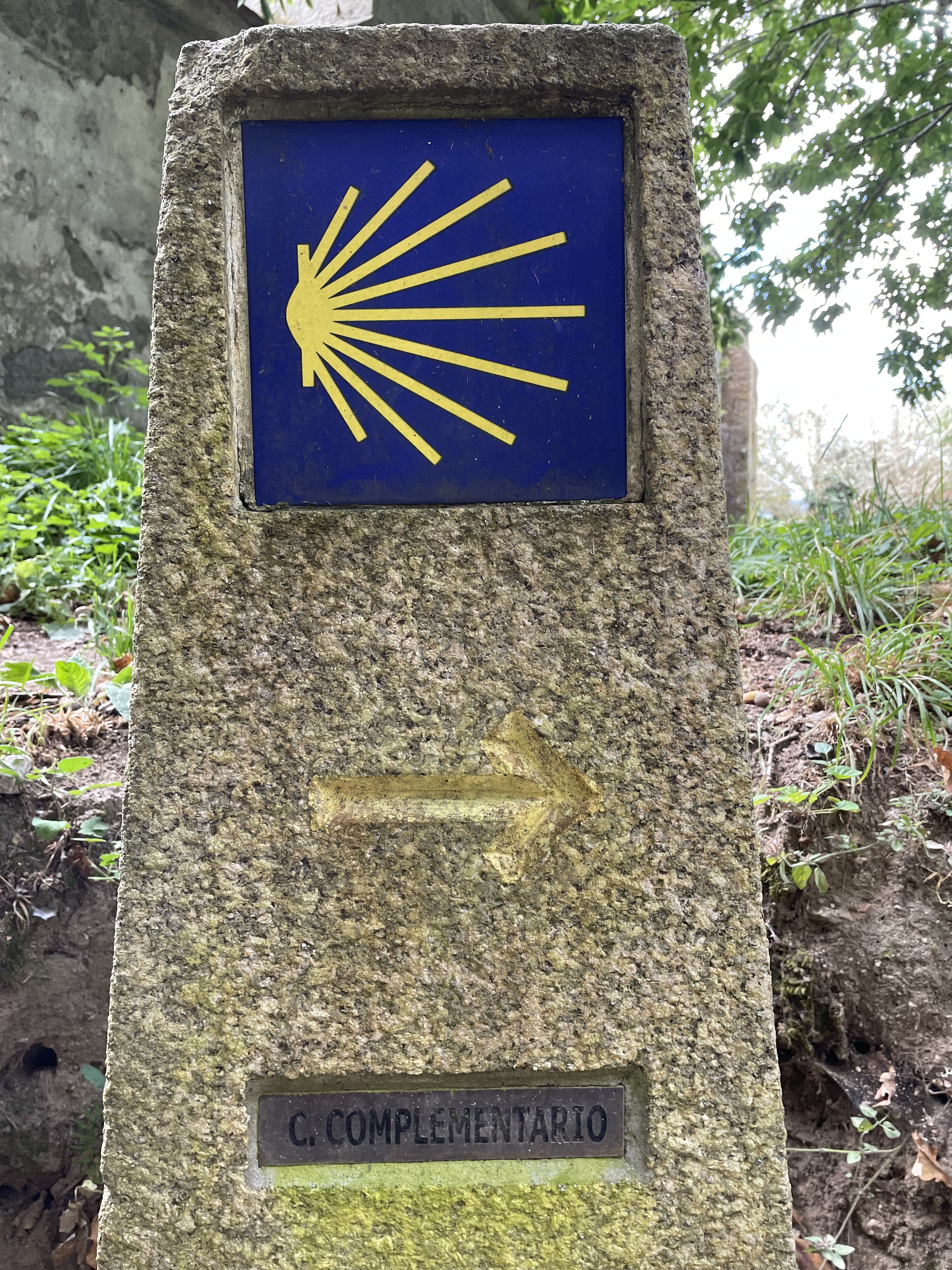
Per my Wise Pilgrim app, I took a Complementario route twice, adding another kilometer to the walk, but the two paths were a gift. The Galician government added an official Camino route, and left the original one – calling it the Camino Complementario route. Have no idea why and it certainly did a number on the few areas that lost the main Camino. But for me – the first choice of trail, every other person went on the main one, partly because it was slightly shorter. So suddenly, I was all alone, it was quiet, the cows were sleeping and it was a good bit further away so I lost any traffic sounds. Just birds. It was amazing. AND because no one else was walking, I saw animals. It’s a bit blurry because I was trying to telephoto – but there’s a weasel on the log above. At least 2’ long from snout to end of the tail and it seemed to feel pretty safe. It just watched me as I took a few steps, then a few more, trying to get closer. Later I saw two very small deer – don’t know what kind – leaping across a field.
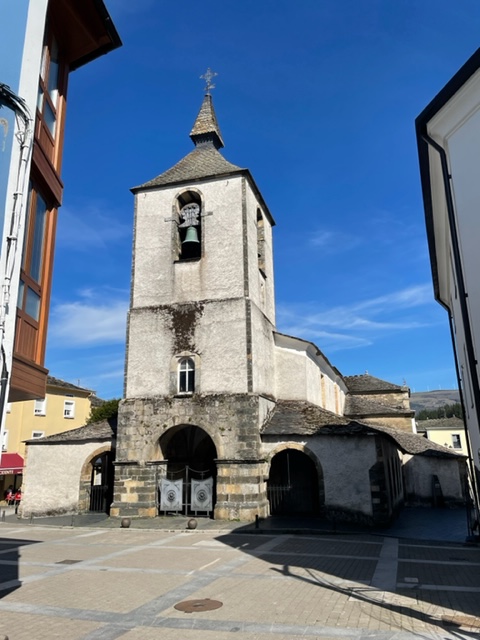
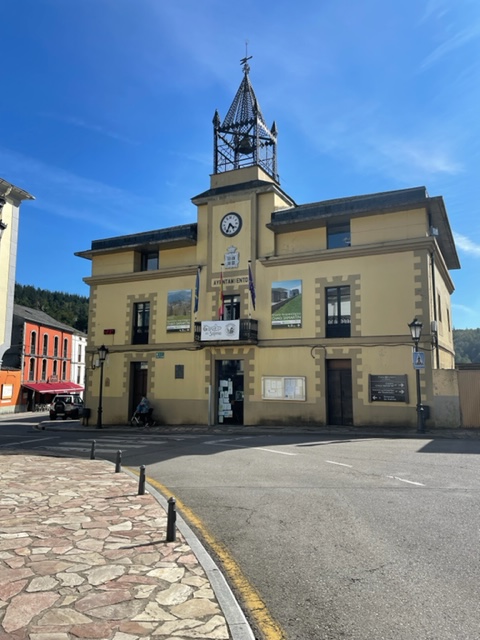
This was a small town with a beautiful church – big for such a small town and town hall that used to be the tourism office. Sad for the town to lose people coming through.
This town was the last to get a snack for another 21 k – per all the websites. Turned out there was one more, but definitely got a hot chocolate here and stopped for a bit.
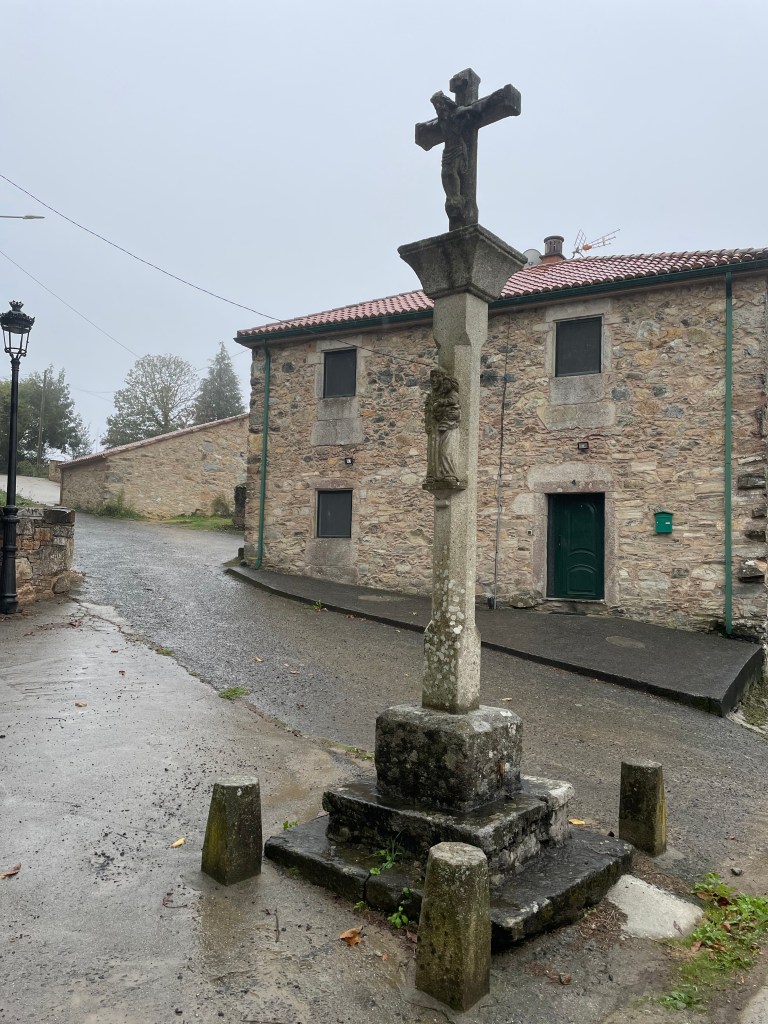
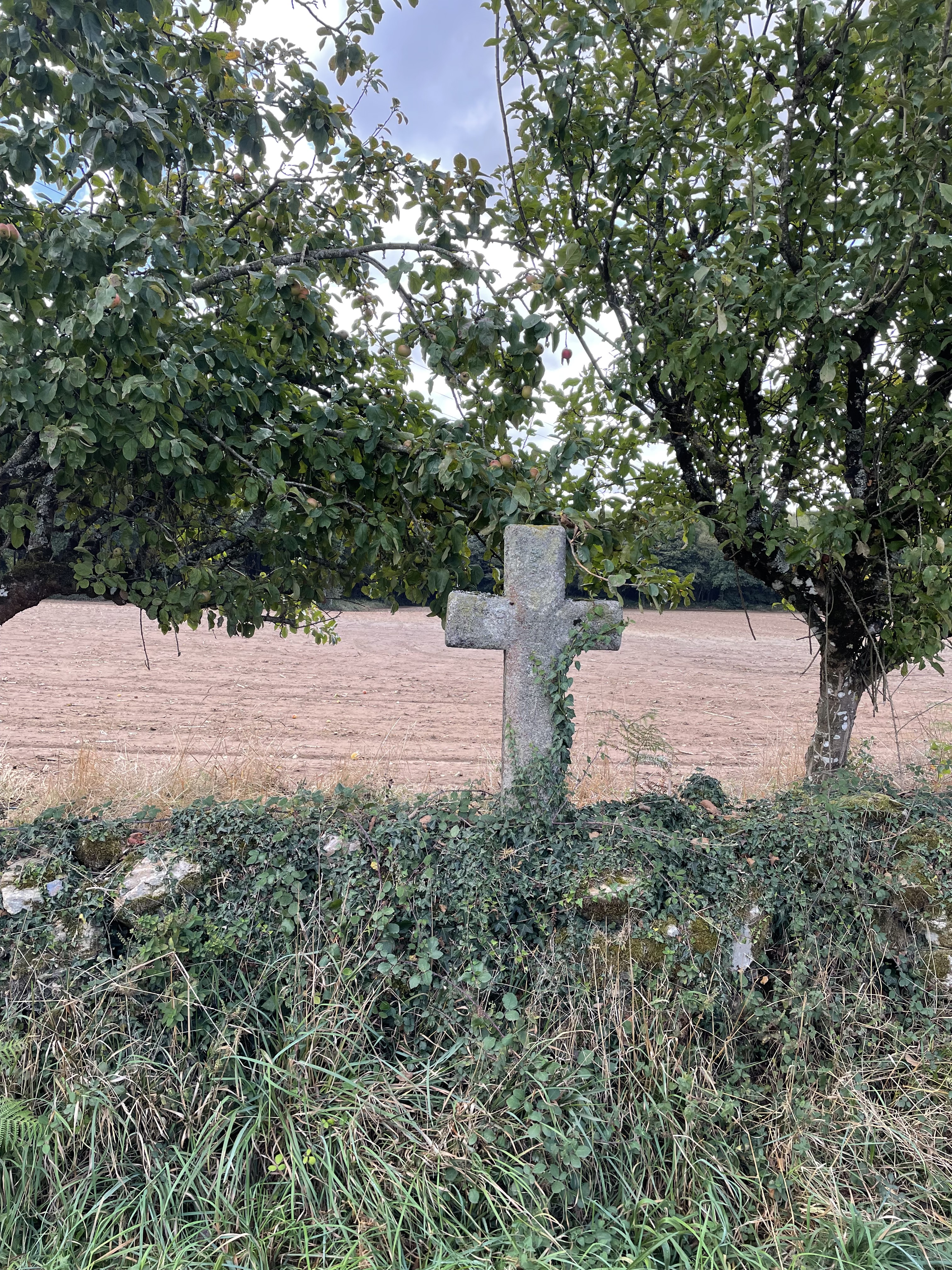
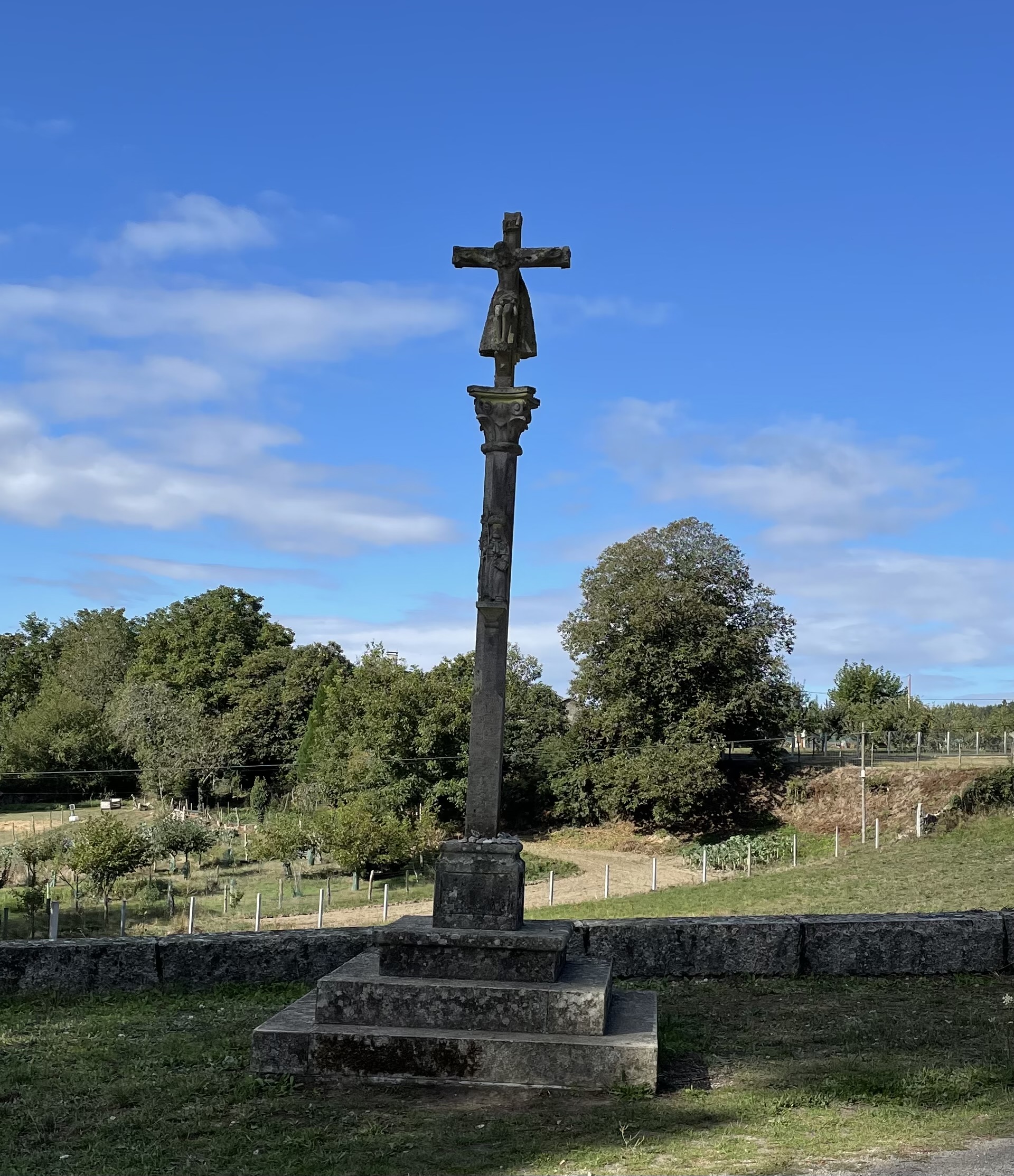
These Cruceriros were such a big marker last year on the Camino Frances. They’re just now appearing in Galicia, but they really seem incidental. I saw one on a lawn and they’d built a modern house and fence around it. Important enough to leave it, but not important enough to let it be on it’s own spot. These were said to forgive some sins and protect travelers on the Camino.
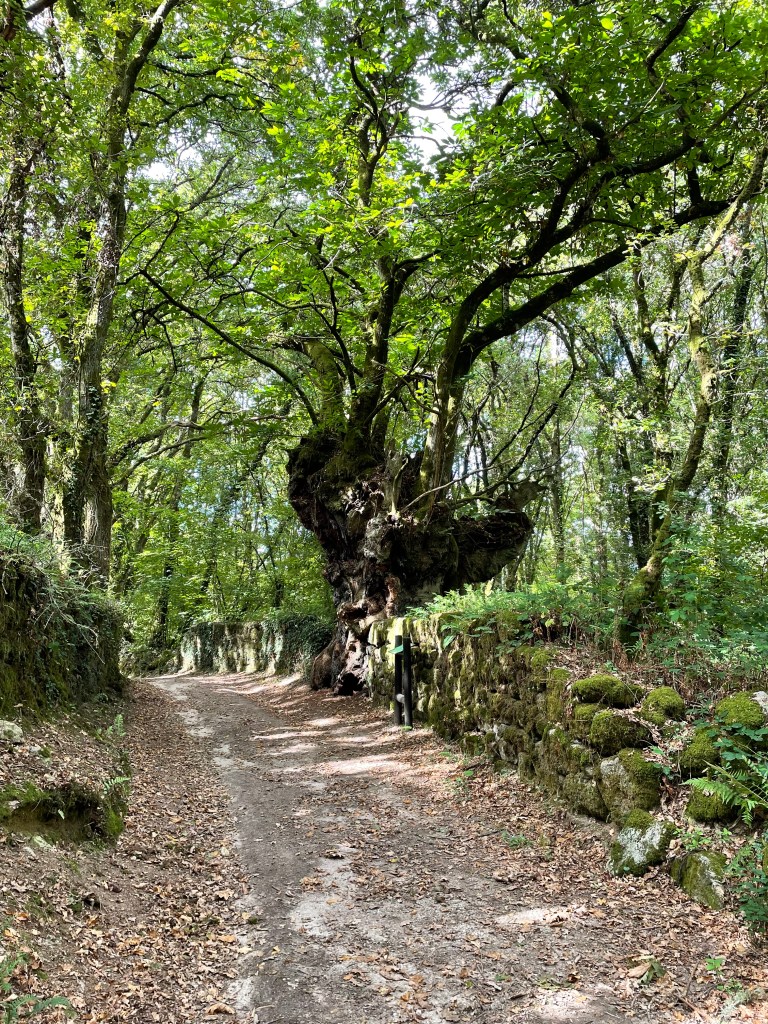
This was on the second Complementaria, a 350 year old chestnut tree.
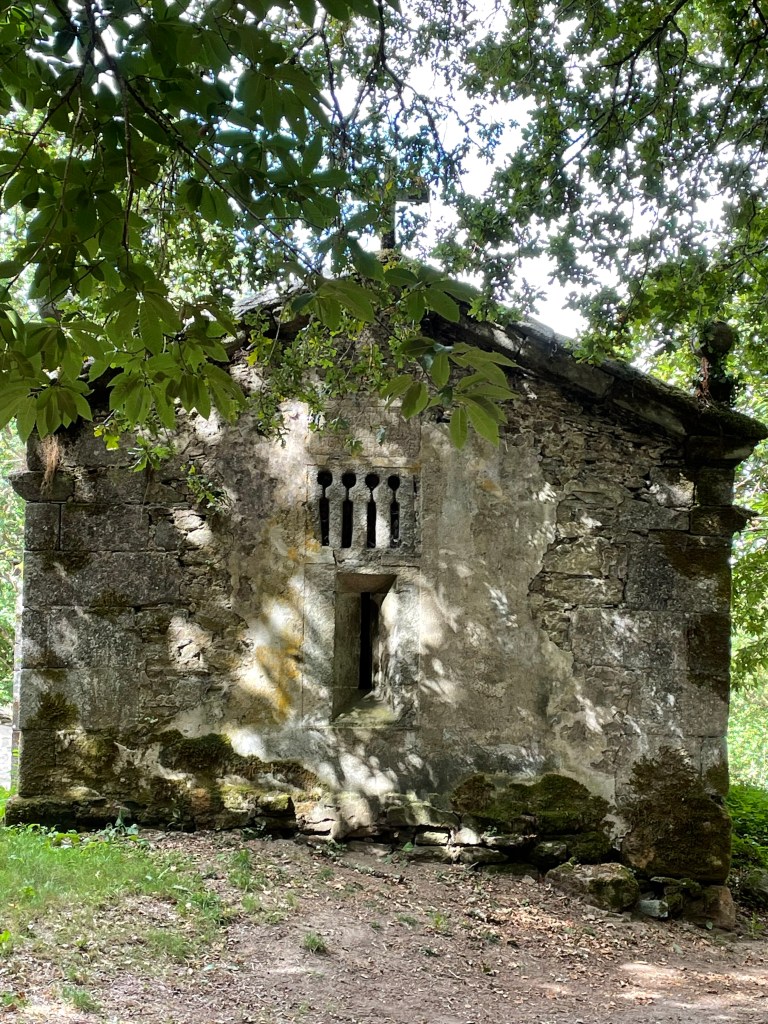
This site was one of the points of the ancient Camino. Notes I found about it: It seems certain that in the privilege of the church of Lugo, granted by Alfonso III in the year 897, the reference made to San Salvador de Ramilani (Romeán) alludes to or involves that of (the above temple/church). A sale dated in 1005, which refers to the temple of San Salvador de Romeán and its monks.
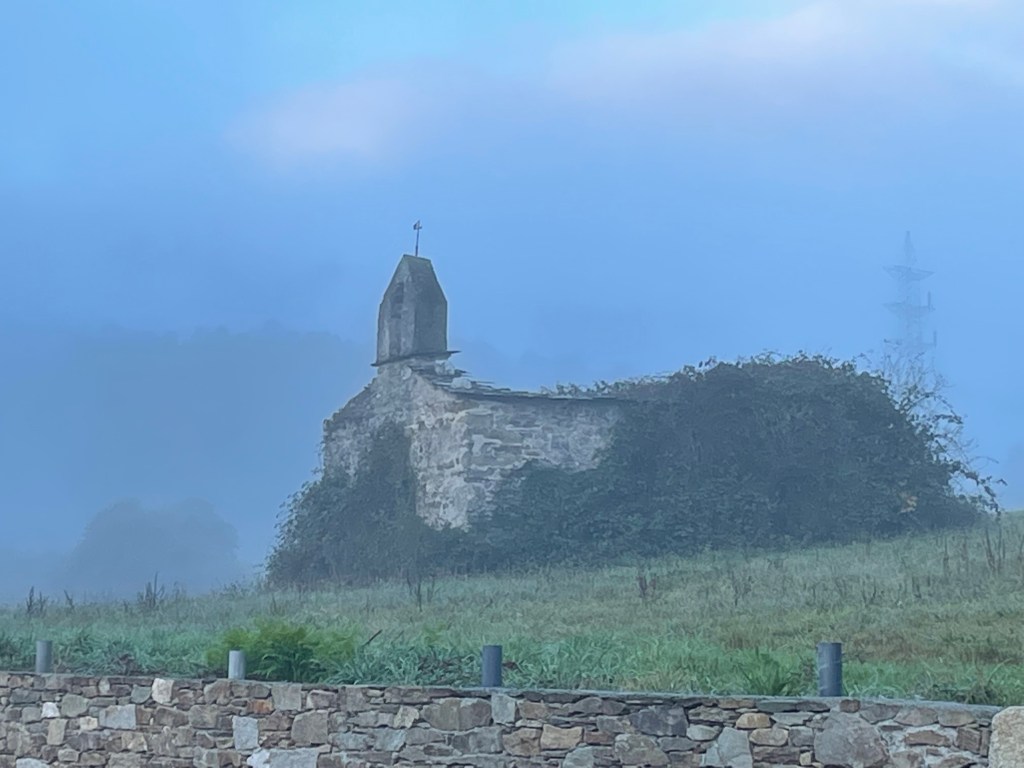
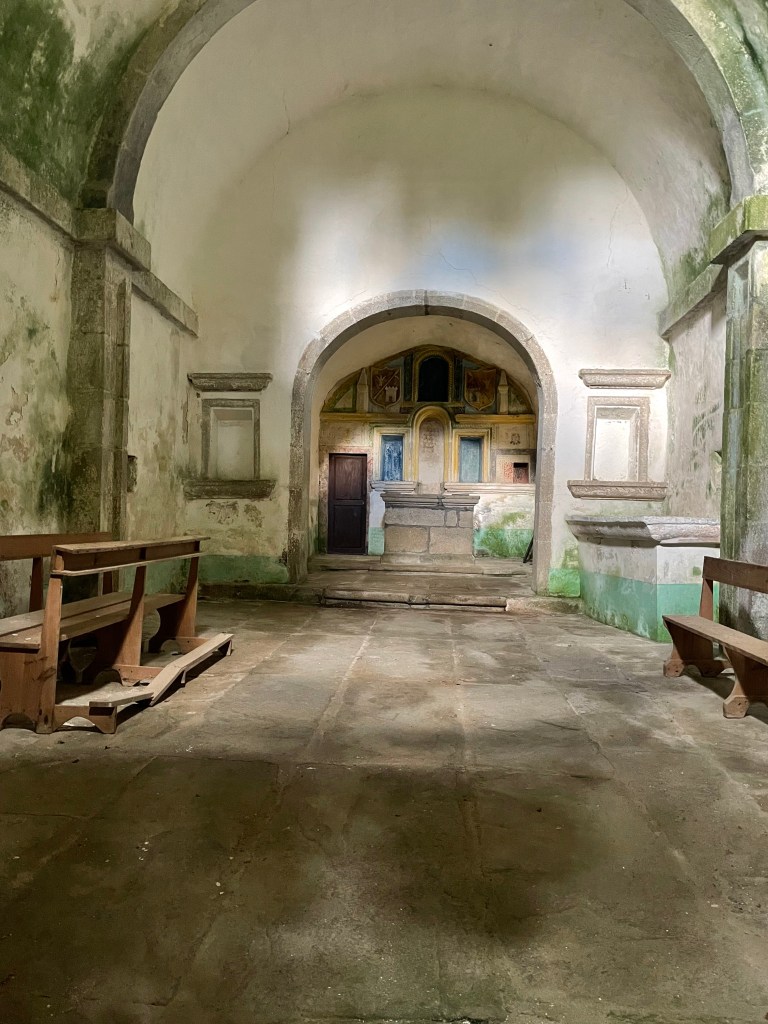
Locked, but a small hole in the door to see inside. Rebuilt for monks, but with pieces that had Moorish influences and and earlier Roman influences.
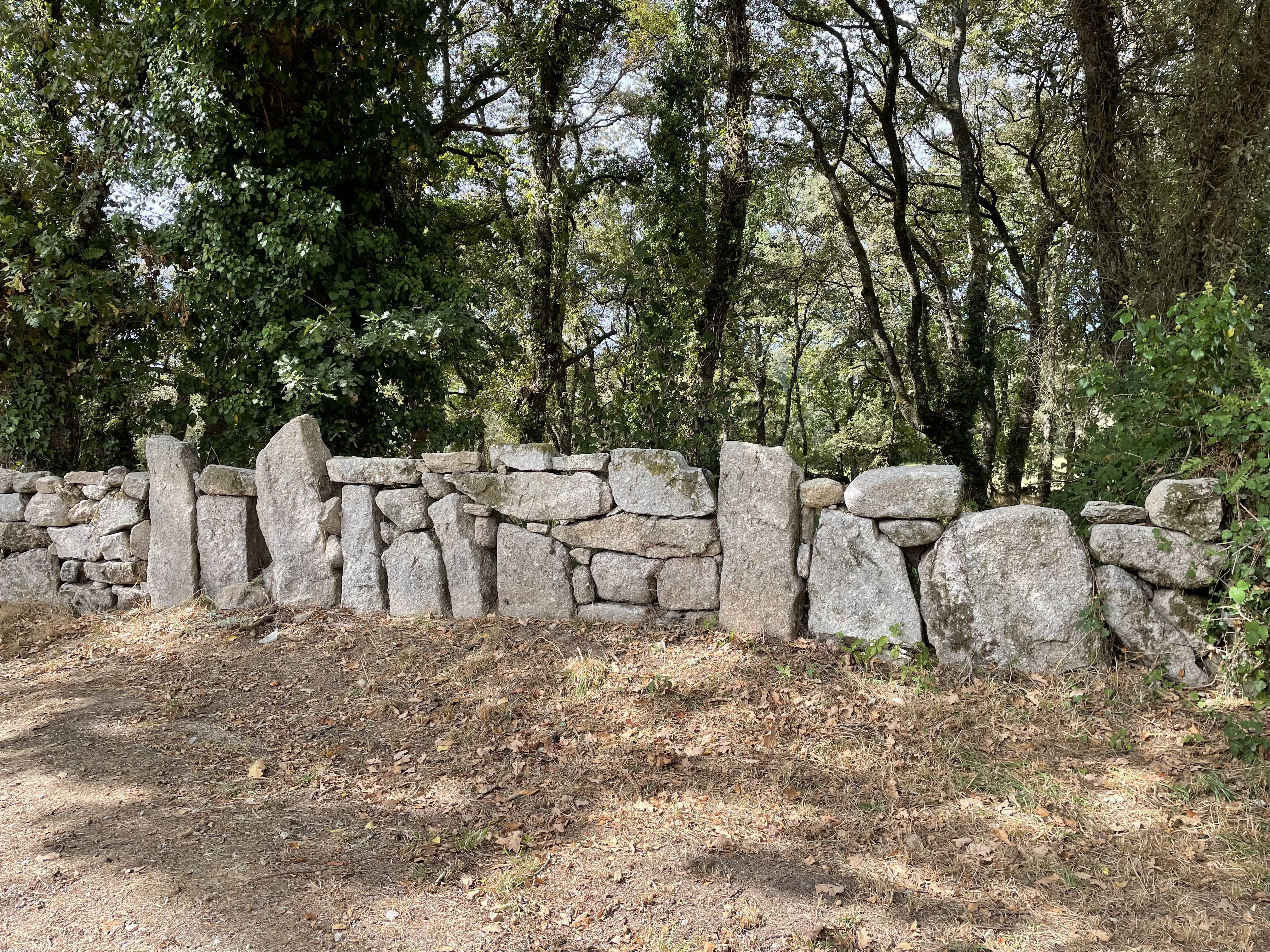
Amazing wall.
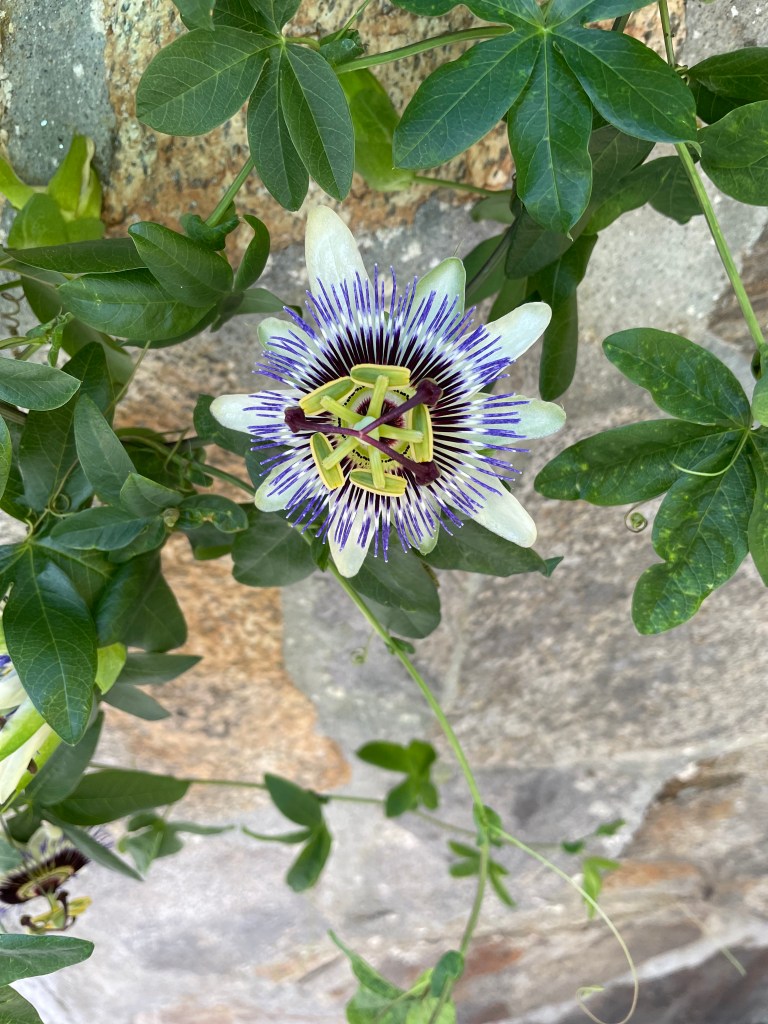
Amazing flower! Greeted me on the outskirts of Lugo.
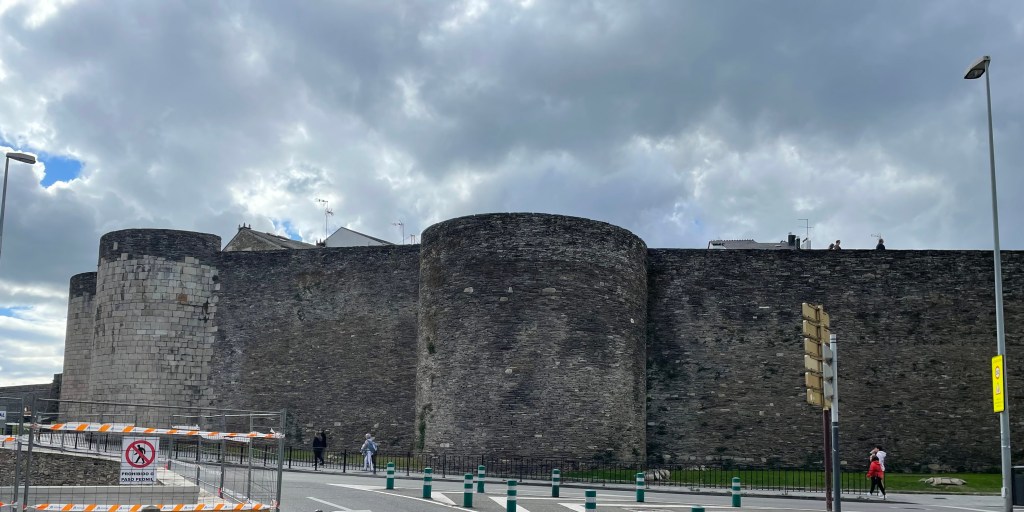
And Lugo. How cool is this to walk up and see?! Here’s a bit about it and tomorrow, I’ll get to explore. Lugo is the capital of the province of Lugo. The city was probably founded by Celtic inhabitants of the region and dedicated to Lugos, a pan-Celtic God of light, oaths and arts. Later conquered by Paulus Fabius Maximus and called Lucus Augusti in 13 BC on the positioning of a Roman military camp, while the Roman Empire completed the conquest, in the North, of the Iberian Peninsula.
Lugo is the only city in the world to be surrounded by completely intact Roman walls, which reach a height of 10 to 15 metres along a 2117 m circuit ringed with 71 towers. The walk along the top is continuous round the circuit and features ten gates. These 3rd-century walls are protected by UNESCO as a World Heritage Site. The bridge over the Minho is essential of Roman date, though many repairs over the centuries have effaced its Roman character.
The Cathedral, dedicated to St. Froilán, was built about 1129, though the actual main facade and towers date from 1769. Its elegant stalls were carved by Francisco Mouro in 1624. This cathedral enjoys the privilege of having the Blessed Sacrament perpetually exposed, a fact commemorated in the armorial bearings of the town. (I don’t know what that means that the Blessed Sacrament is exposed – I’ll figure it out for tomorrow.)
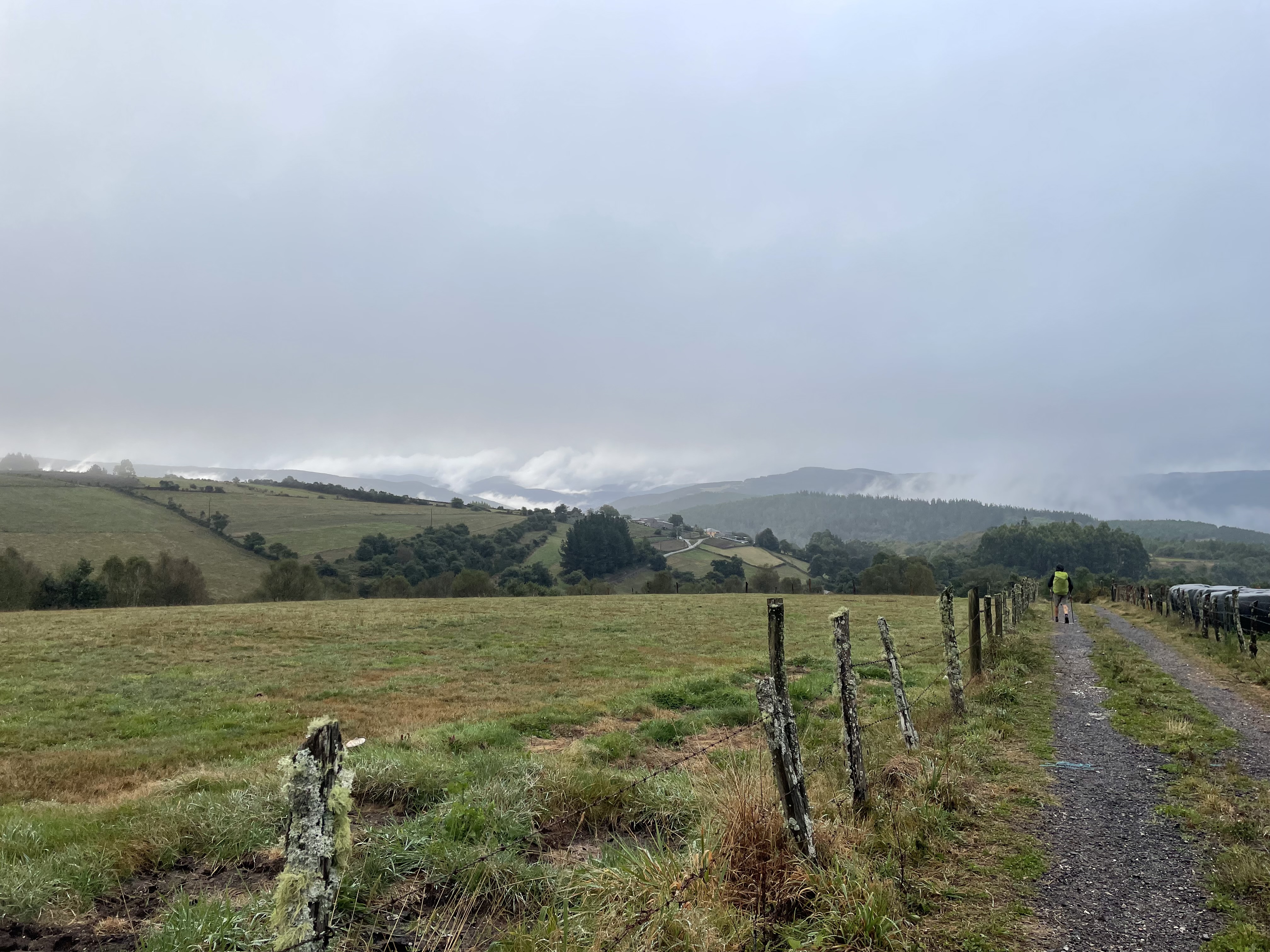
Another gorgeous day. It started off with rain and I started off as soon as there was a bit of light. I evidently started with all the eager beavers that I don’t normally see because they were moving! It was nice though even though they passed me so fast my hair was flying, they were close enough that I could see which way to go without worrying. The view below was a hint that it might not stay rainy, but I was happy with the rain.
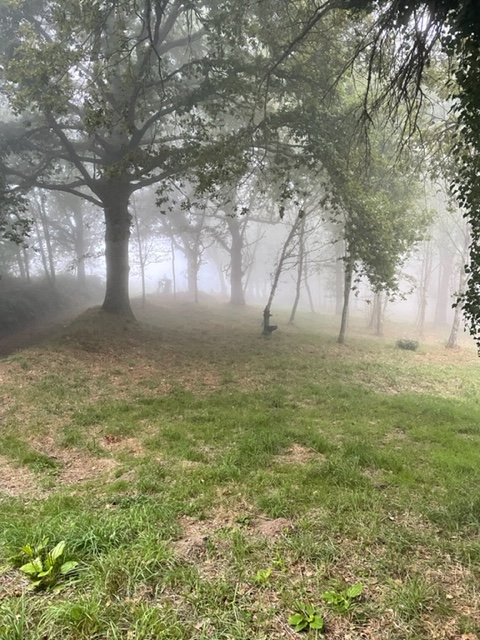
Again, clouds of mist, I’d start to get a photo and within seconds the whole scene would be covered. The rain was wonderful, soft, easy and never impacted hiking and I was perfectly set up for temperature and rain. Love my oh-so-light rain pants.
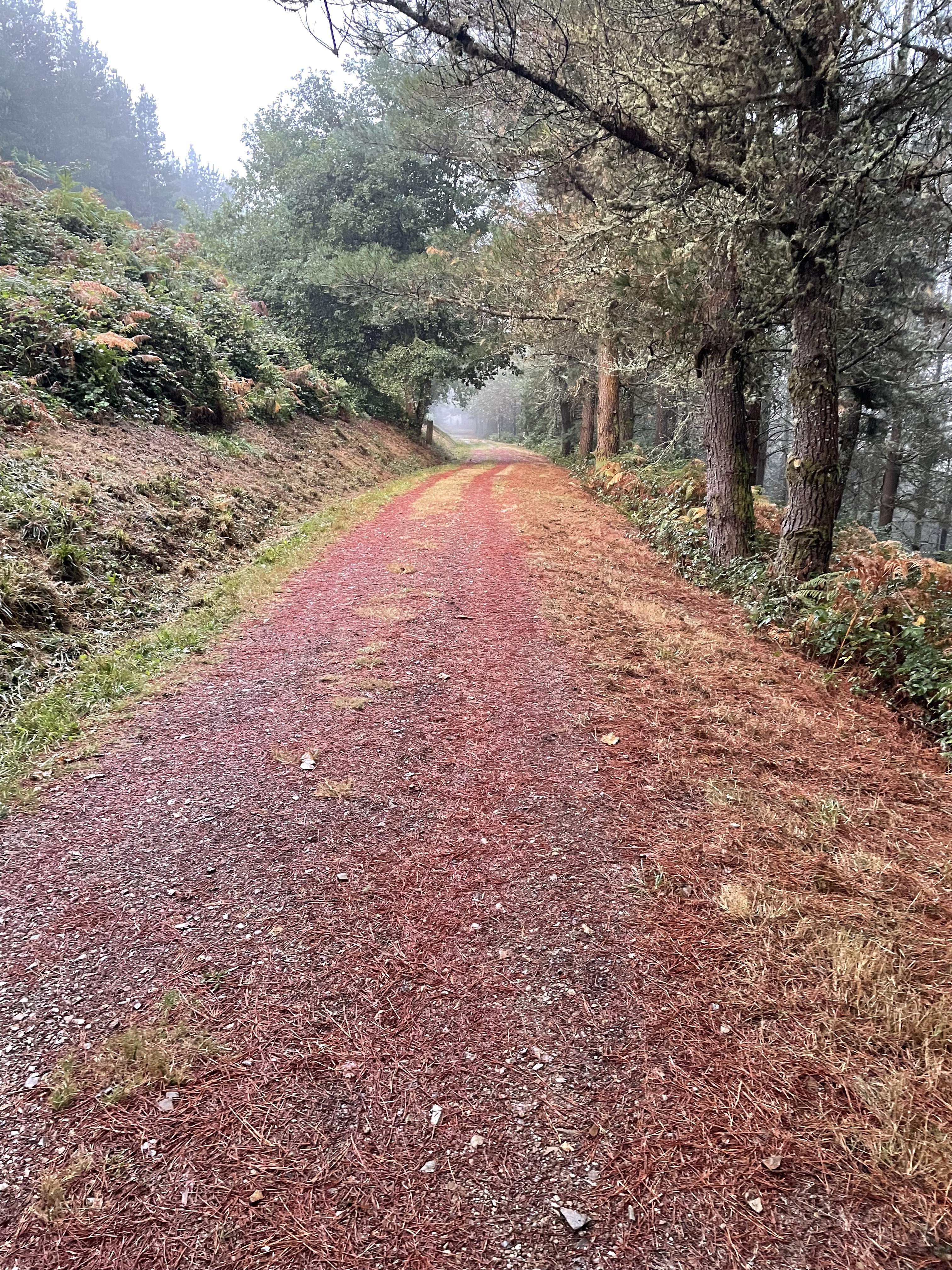
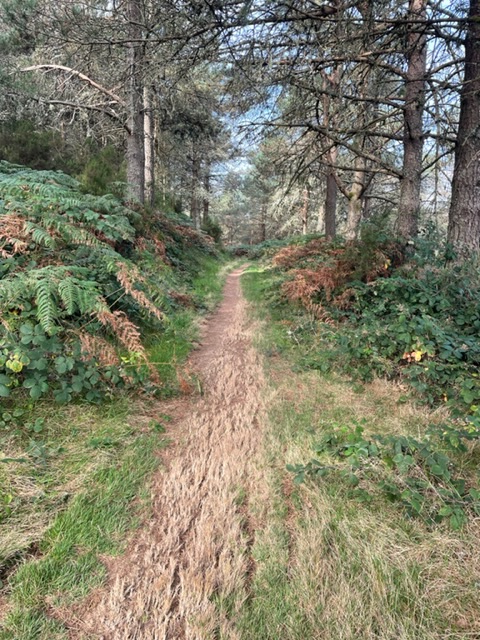
This path below was striking because it was so red from the pine needles. Sadly, that’s because the moss was attacking the trees, but it made for a pretty and really soft trail. I do notice the sections that are soft.
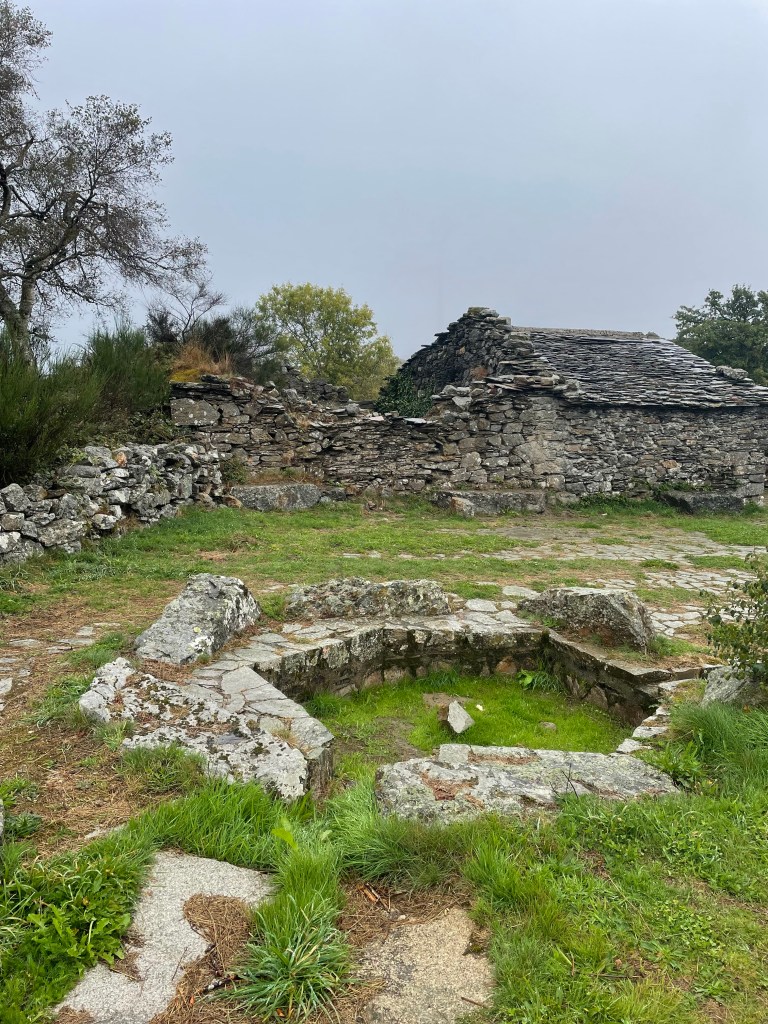
This was the Hospital de Montouto, originally built in 1357 by Pedro I the Cruel (maybe trying to redeem himself?) and the main refuge for pilgrims on this section of the route. I’m guessing it was beautiful. The pool above had a channel going away and to, indicates constant water. Summer found a link and the woman wrote more about this: Built in 1357, then moved to another site and rebuilt in 1698, on this spot (because the trail shifted) and was used up to the mid-20th century. Amazing!
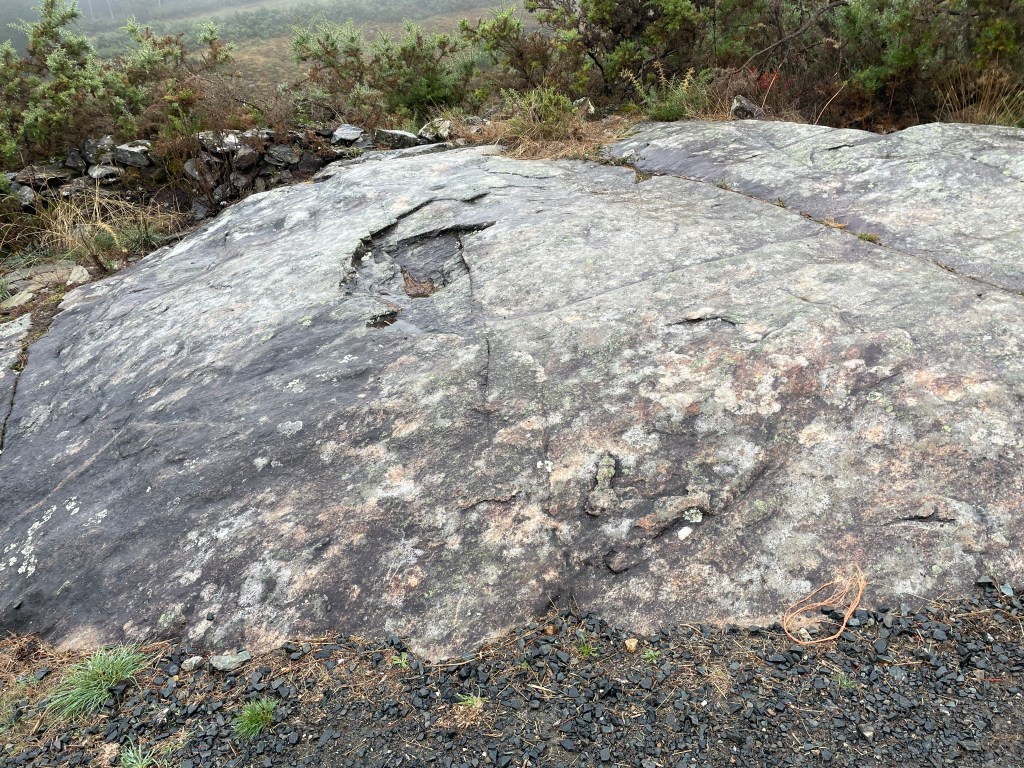
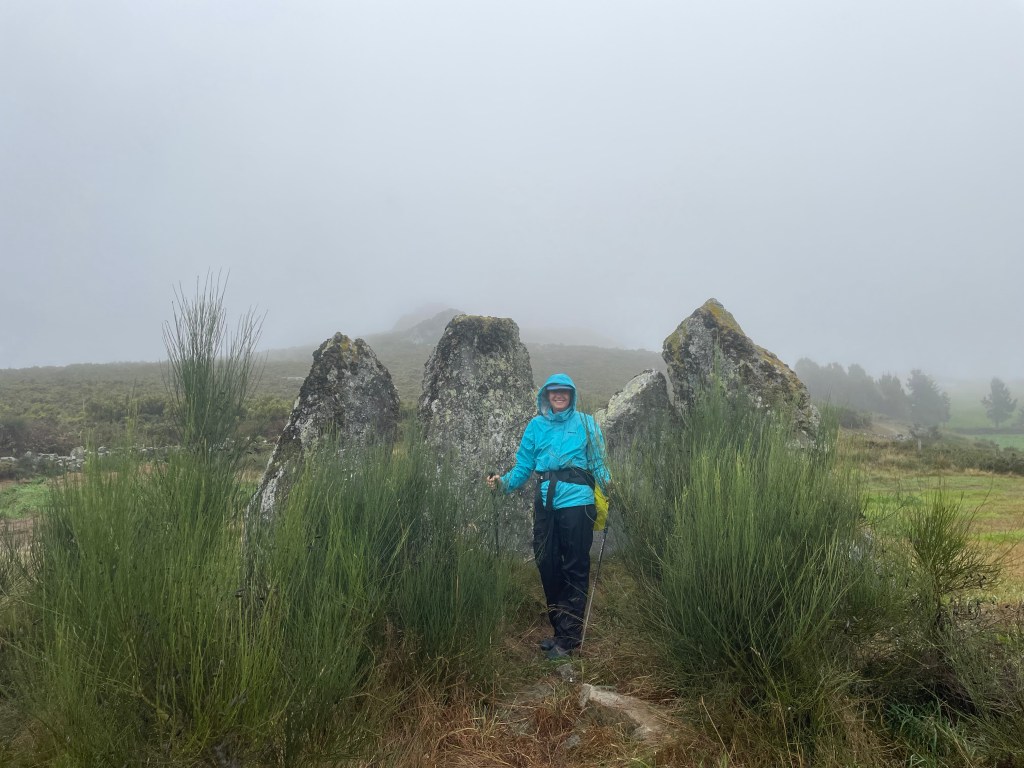
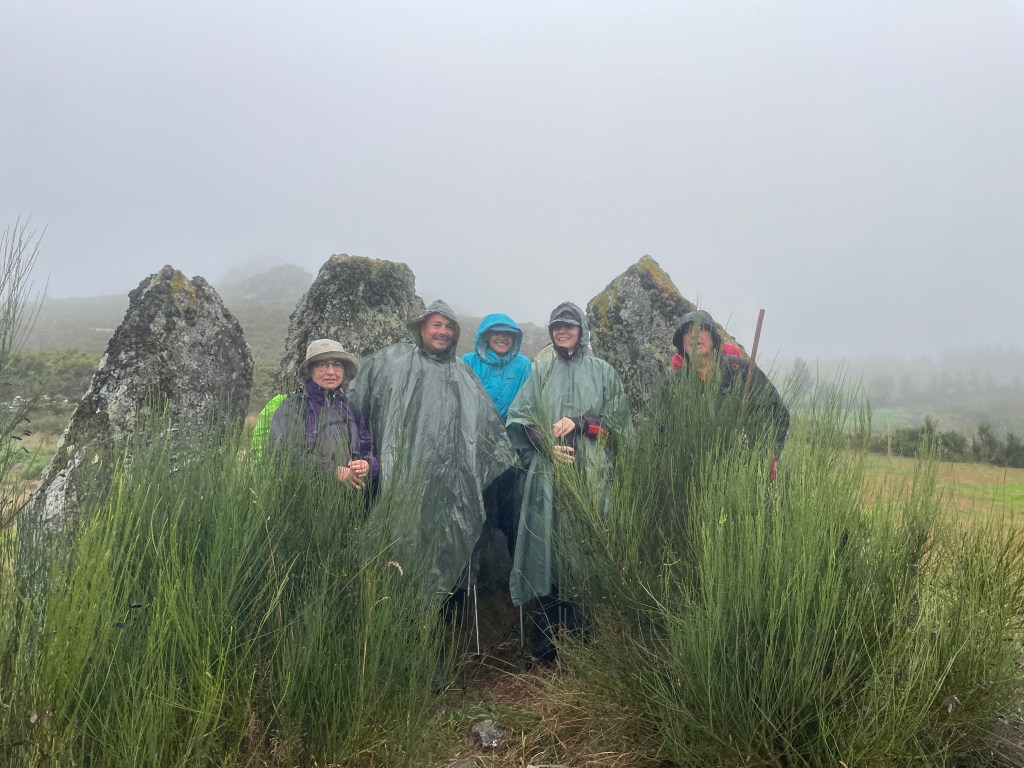
While I was here, I was with a group of Spaniards from Barcelona, cheerful, happy to be chatting nonstop and they were so nice. I walked with a few of the women, chatting back and forth in English and Spanish. One of the women led all of us up to this spot behind the Hospital. She was talking about how old it was and sacred. Summer found the name: The Pedras Derelitas attributed to Neolithic times. The women with us who knew the most said that there used to be a top stone that was covered with sod to hide the spot. This is where sacred treasures were hidden to protect them. They took my picture and then asked, “don’t you want a picture with your compadres?!” Oh, of course!
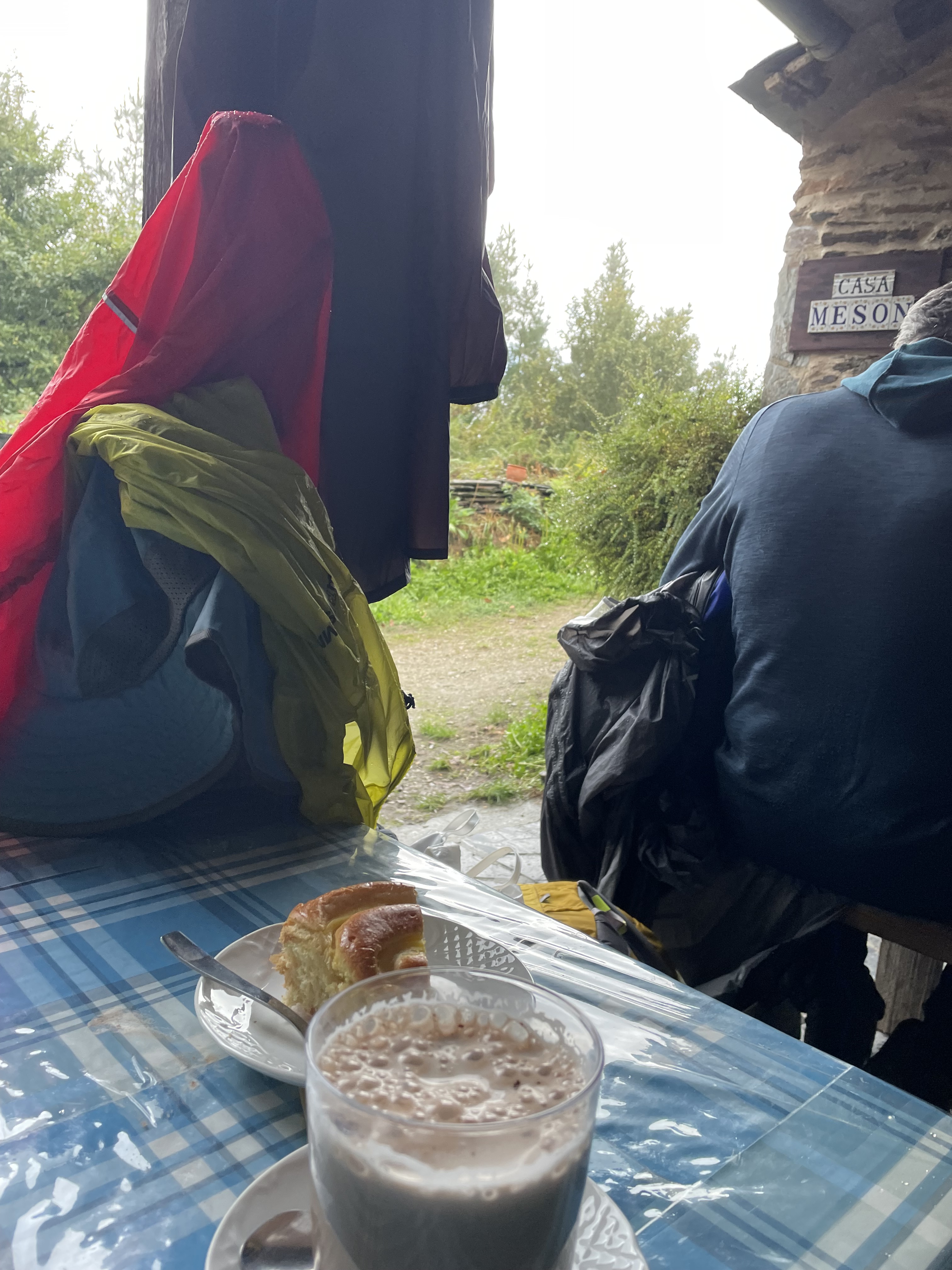
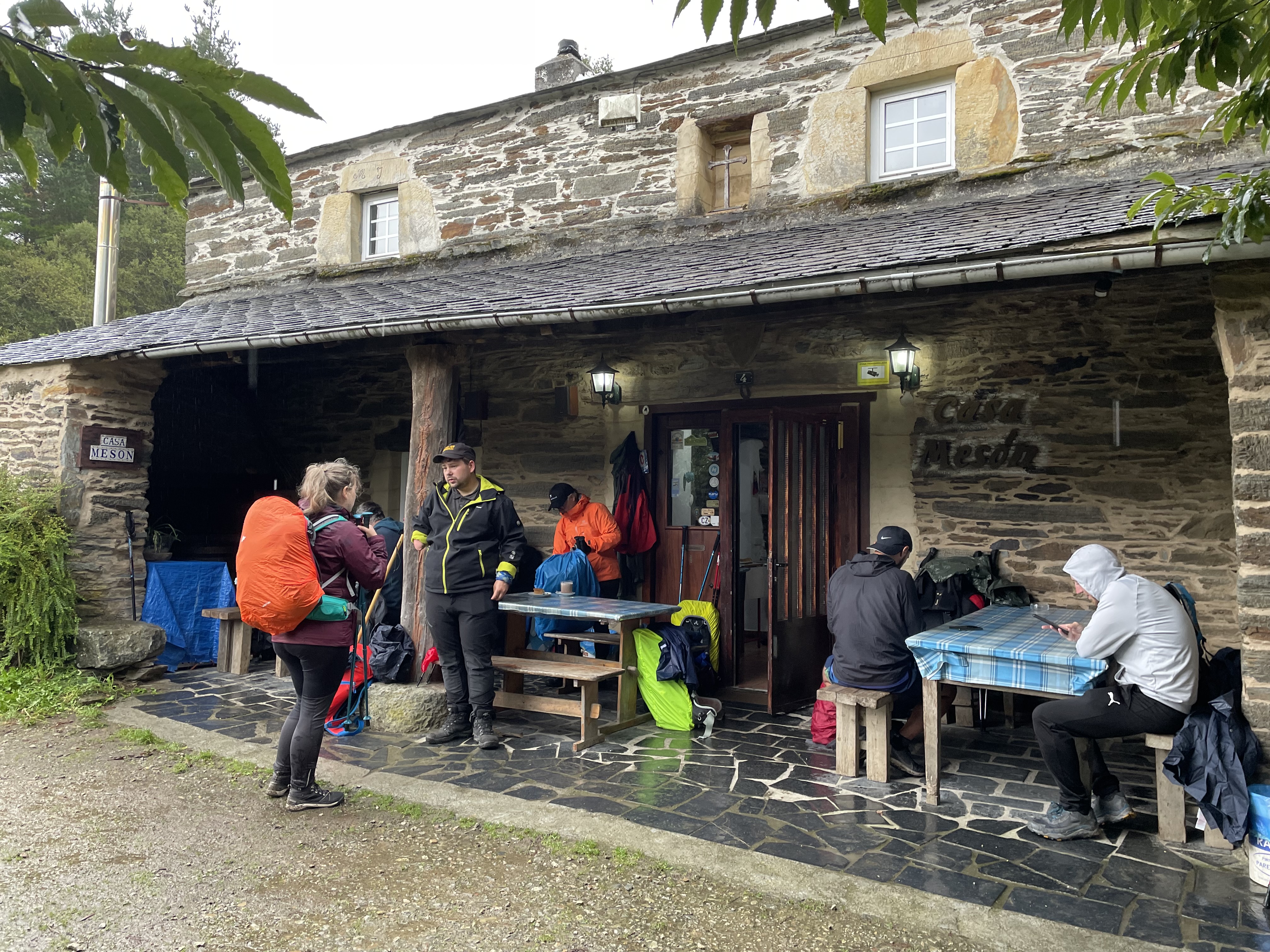
The sun made a brief showing, long enough for me to take off my rain pants and rearrange, then it started really raining. Luckily, I found a shed/barn and went in and changed again. Then at the end of the downhill, I saw this cafe – Casa Meson. Oh, such a happy site. The only place in 15 miles between the two towns, and man, the guy running it could move. I’m pretty sure every single person stopped here to warm up, get a drink and something to eat. I had cake and hot chocolate and was very happy indeed.
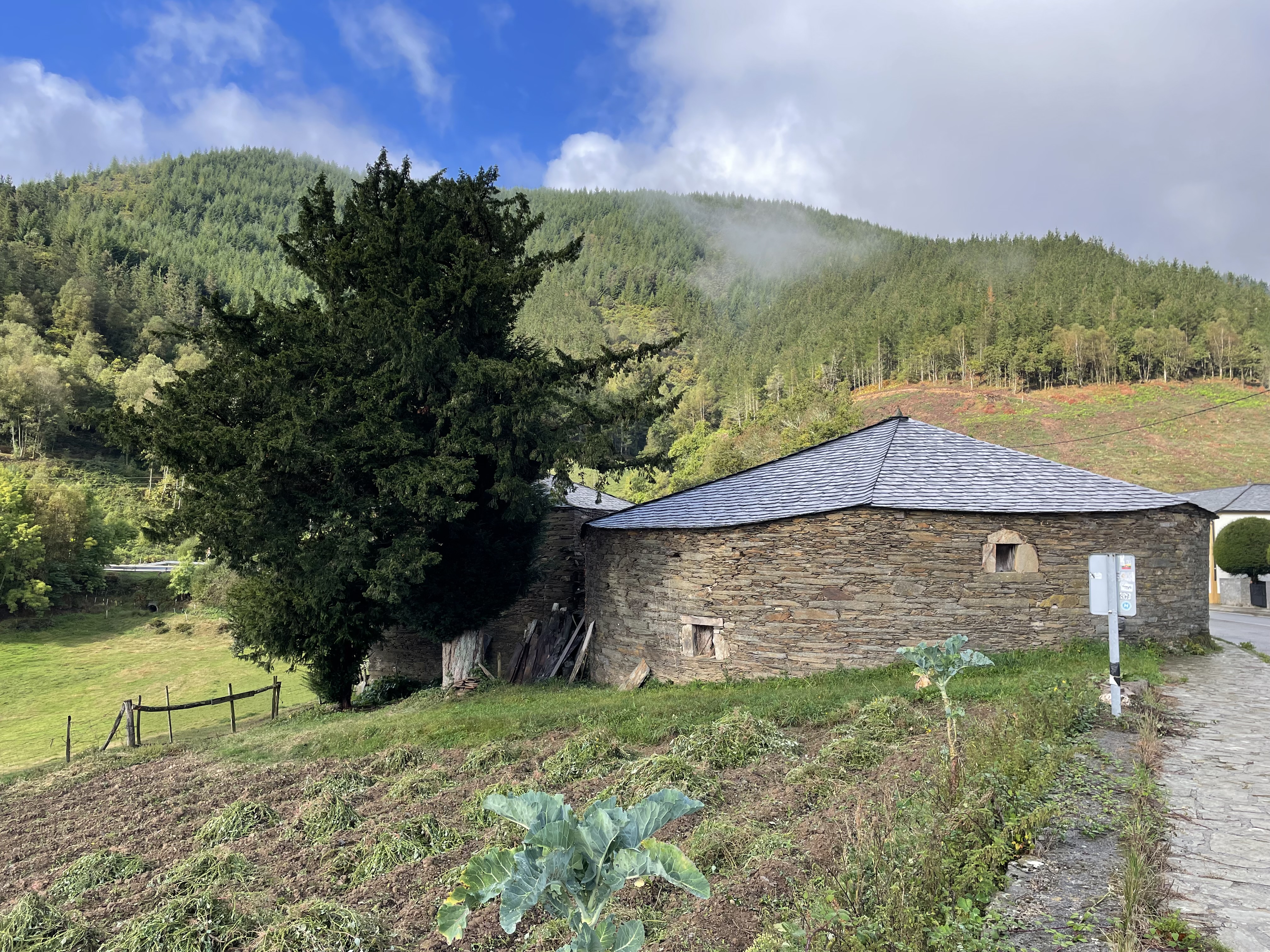
Then the sun really did come out and the rest of the walk continued beautifully. The round house above is the mark of Galicia. They are Palozza’s, round huts made of stone and in the old days, topped with thatch.
Dream House.
I don’t actually know why today was supposed to be a “leg wrecker.” It took 8 hours total, but was very manageable and none of the up or down trails were horribly rocky. I walked in silence the first 3 hours, then in between chatting with a few others, I listened to “House by the Cerulean Sea.” It was a really fun walk!
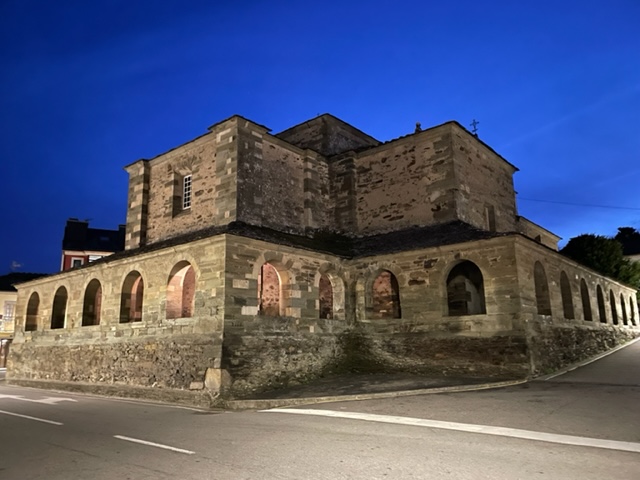
Last night I stayed at LaBarra hotel, simple, clean, owners so nice. It was across from the church, so took this last night walking back from dinner, it really was a massive structure, but how cool to have built in the walk around it – protected from the rain.
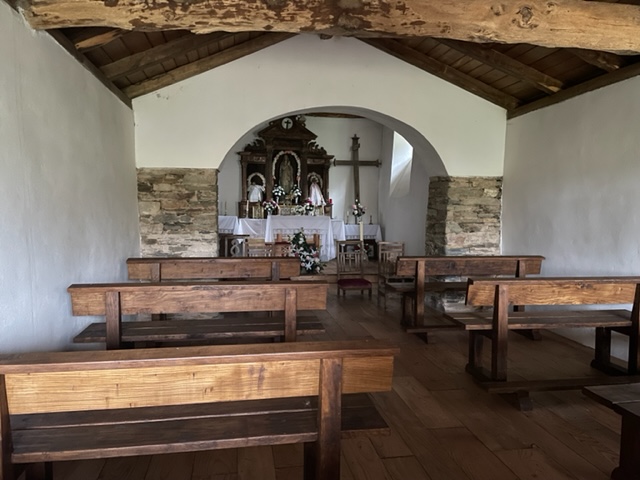
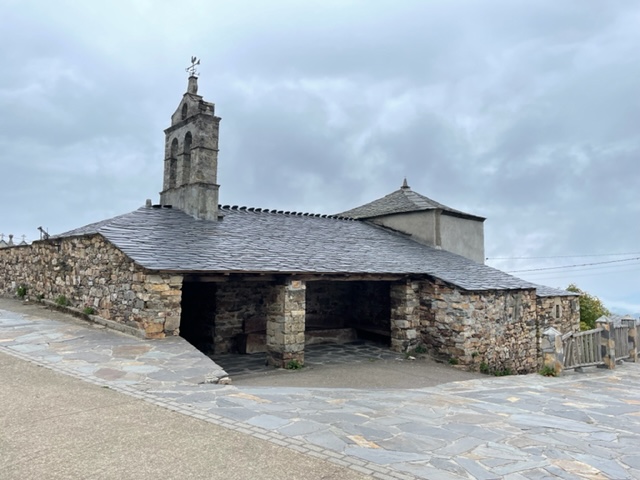
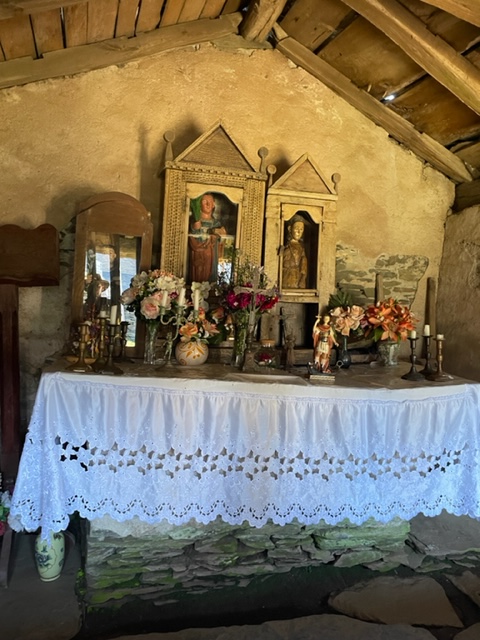
These tiny chapels are just wonderful, inviting of just a few to join in practice. Sadly, all of the churches, chapels, and hermitages have been locked with rare exception. We can see into the chapels and hermitages, usually not the churches. This one was just outside of town as I left. I’d love to know the story of why it was built, when it was only about 5 blocks to go to that church. This was Capilla del Carmen, 1700’s.
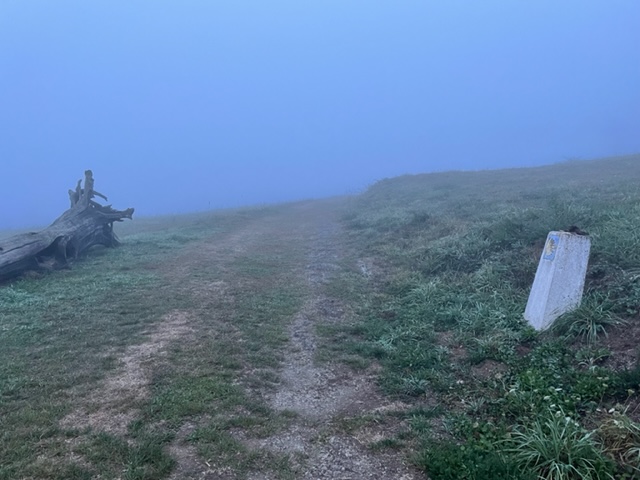
Such a cool image as I walked up the mountain and back into mist. I love the mist here.
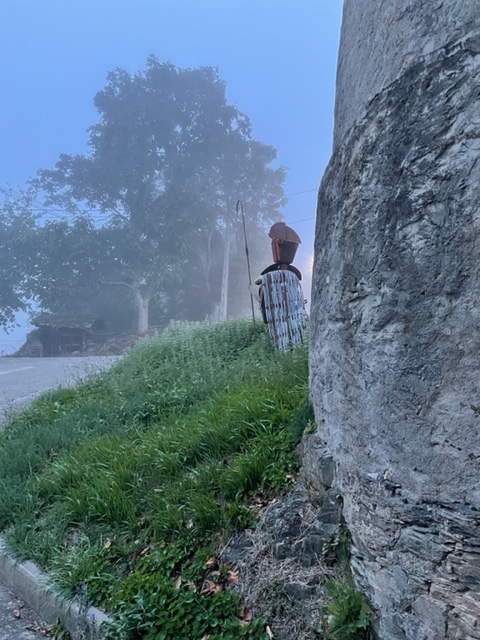
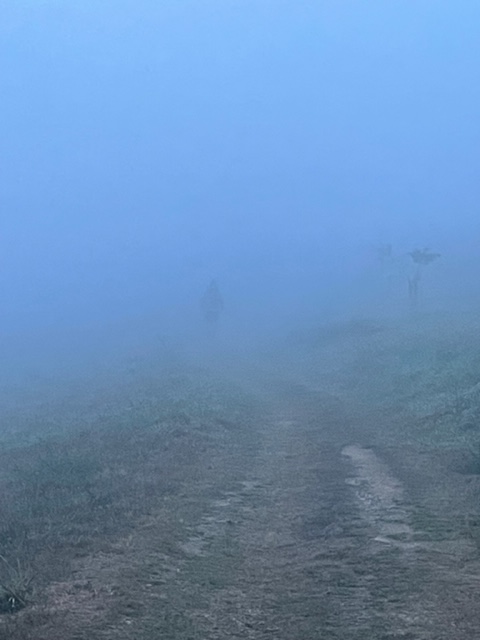
Trying to keep that peregrino in sight since the first few turns weren’t completely clear.
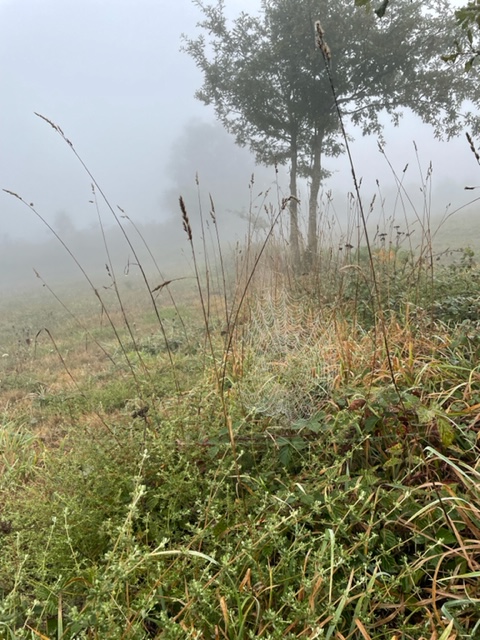
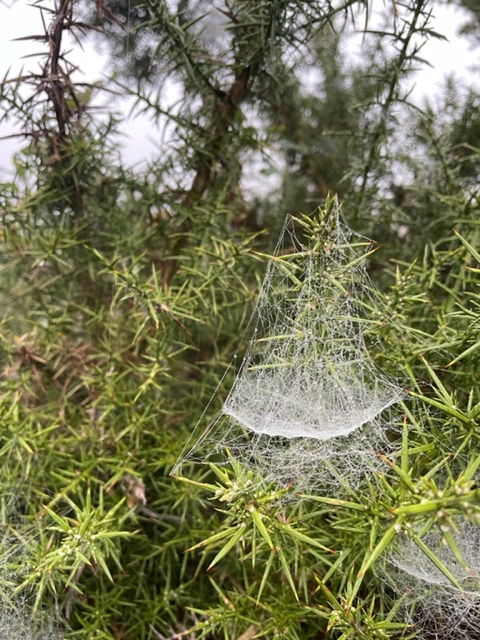
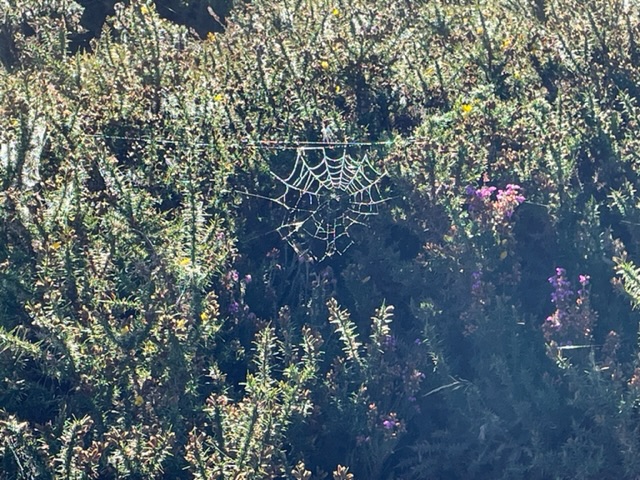
The morning was gorgeous, but the ornaments were the perfect spider webs (sorry, Kaziah). They shimmered in the light, some perfectly speckled with the mist and the ones like below were distinctly different, clearly a pocket.
Capilla de la Esperanza de Malneira, more can gather here, I assume from the town below which consisted of 4 houses that I could see.
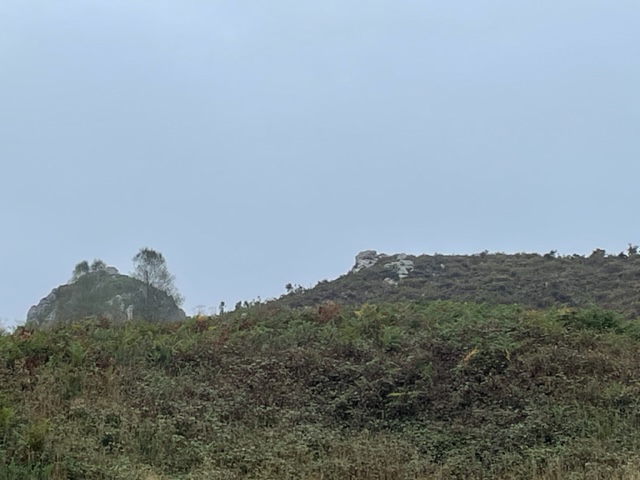
I know this looks like two rock piles and that is what they are now, but this is actually a historic park, Castro de Chao Samartin. It was slightly off the Camino, but I had to see after reading a bit about it. Sadly, it was closed and I couldn’t get close to see what the archeologists had uncovered, but this is a bit of the note outside: The Chao Samartin fort was originally established as a fortified settlement towards the end of the Bronze Age (3000 years ago). There was a moat and palisade that was a holy enclosure. A huge building faced it, it kept growing during the Iron Age…I won’t go on, but how cool that they know all this and are seeing it rediscovered!
Ermita de San Lazaro de Padraira, reconstructed in 1689. Amazing.
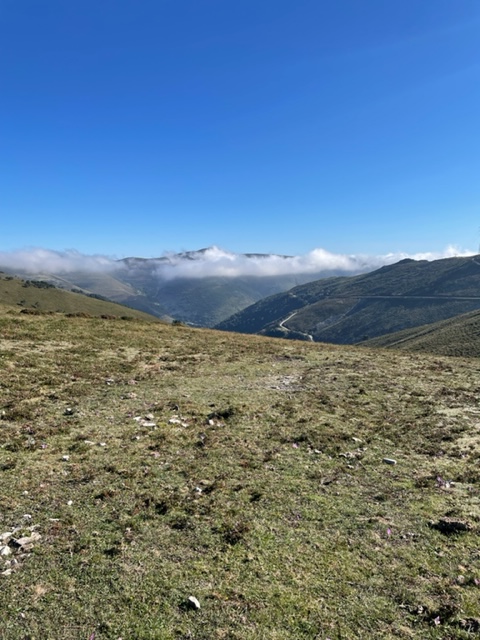
The Cantabrian Mountains.
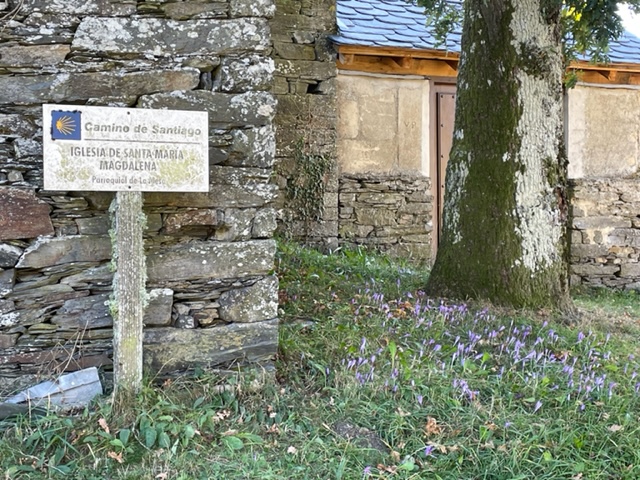
Iglesia de Sta. Maria Magdalena de Penafonte, constructed in 1605.
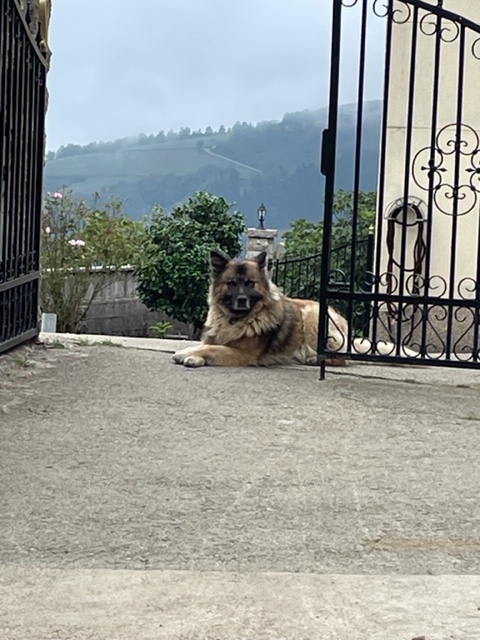
Don’t mess with me. But not on a chain and totally calm, notice the paws…
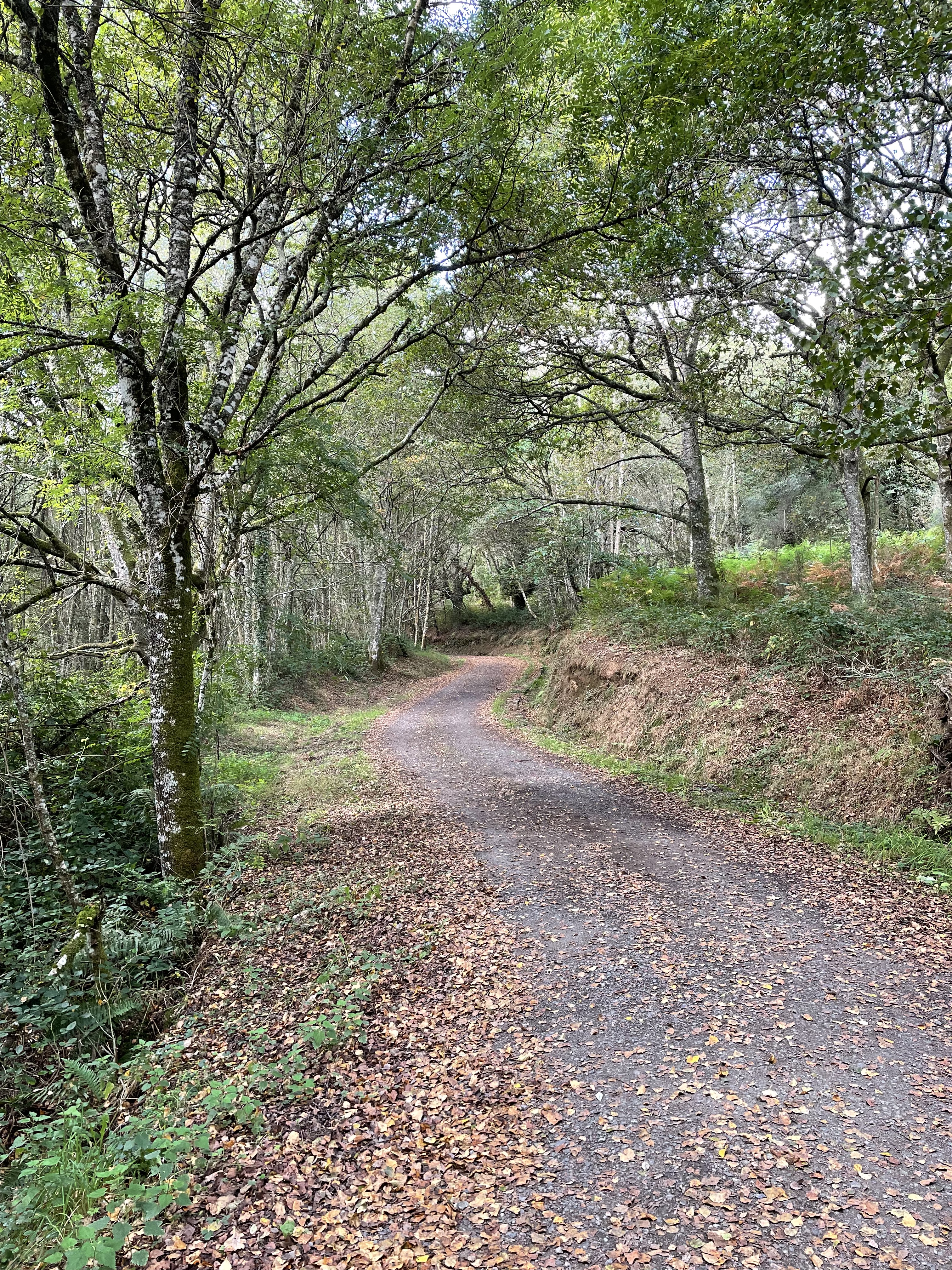
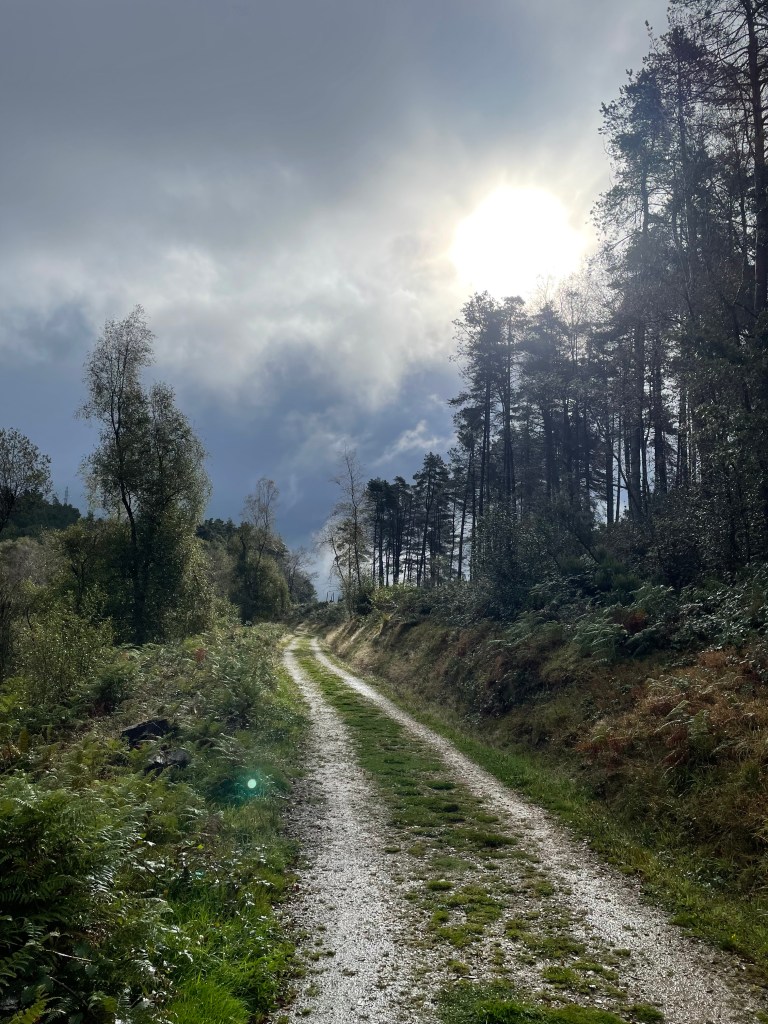
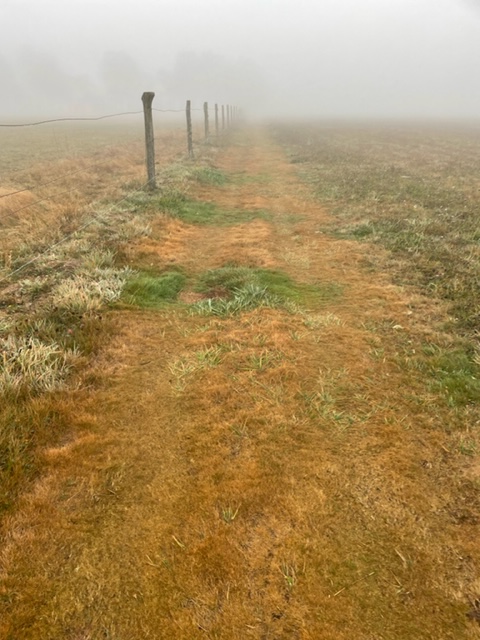
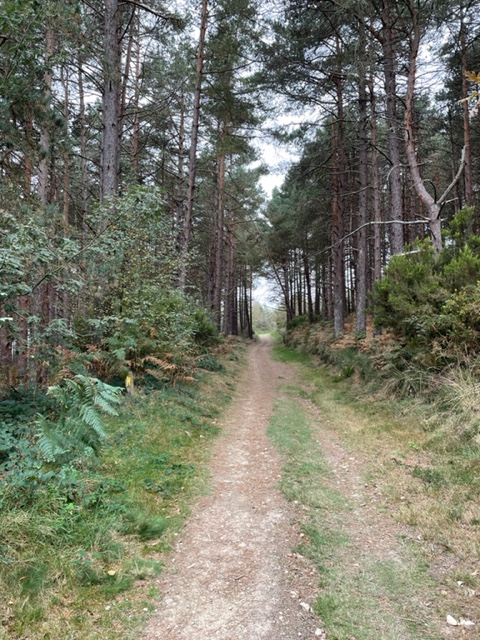
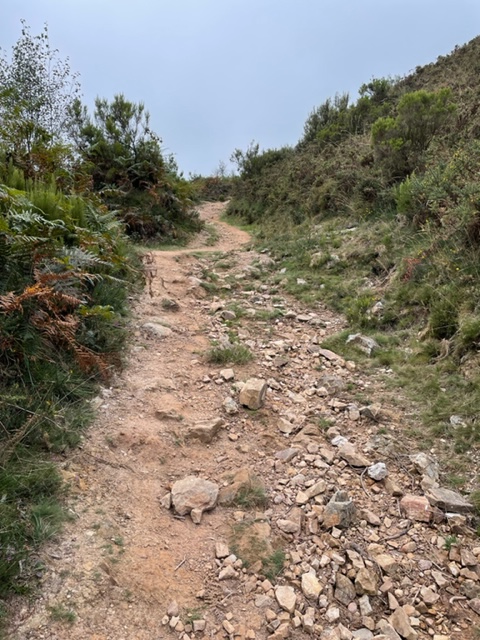
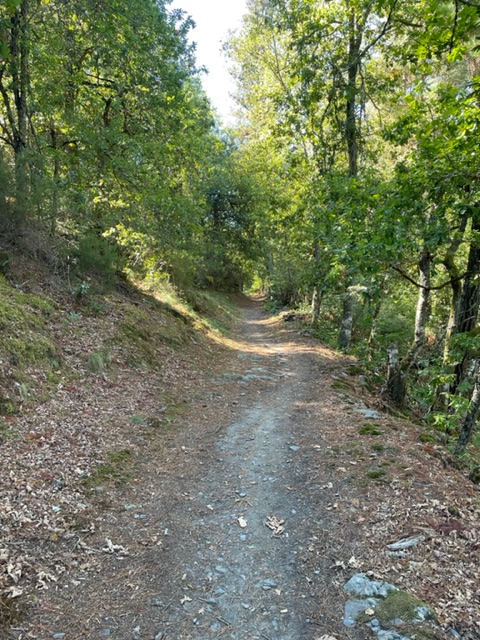
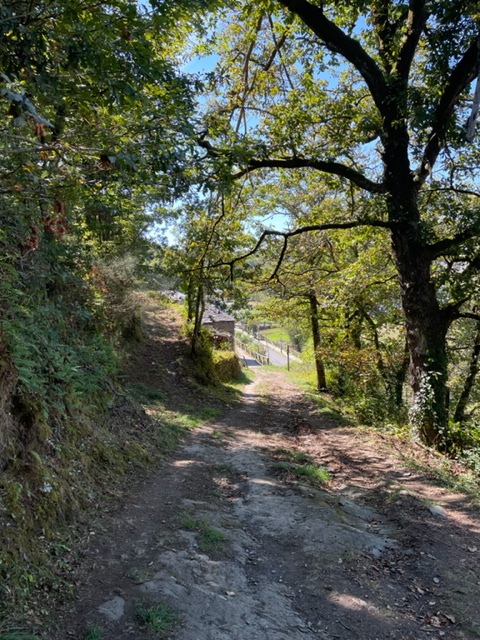
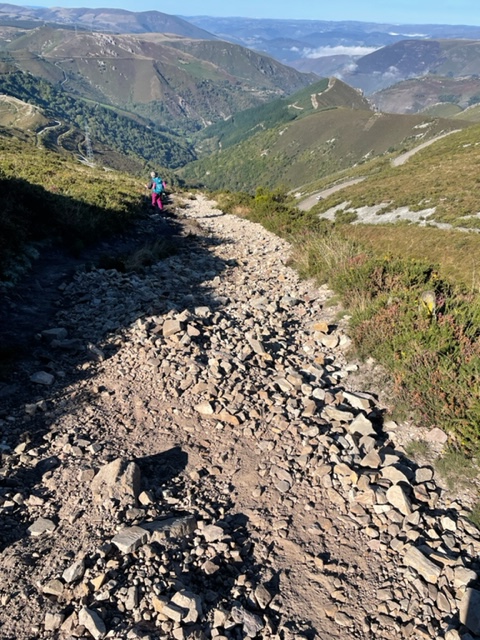
The photos below just show the variety of paths I encountered over the day.
Galicia! I’ve left Asturia and moved into the “land of the Celts.”
This is the reason that the town of A Fonsagrada exists. This was reputed to have been the site of one of St. James’miracles. It is said that after being approached by an impoverished woman, he turned the water from the fountain into milk for her children.
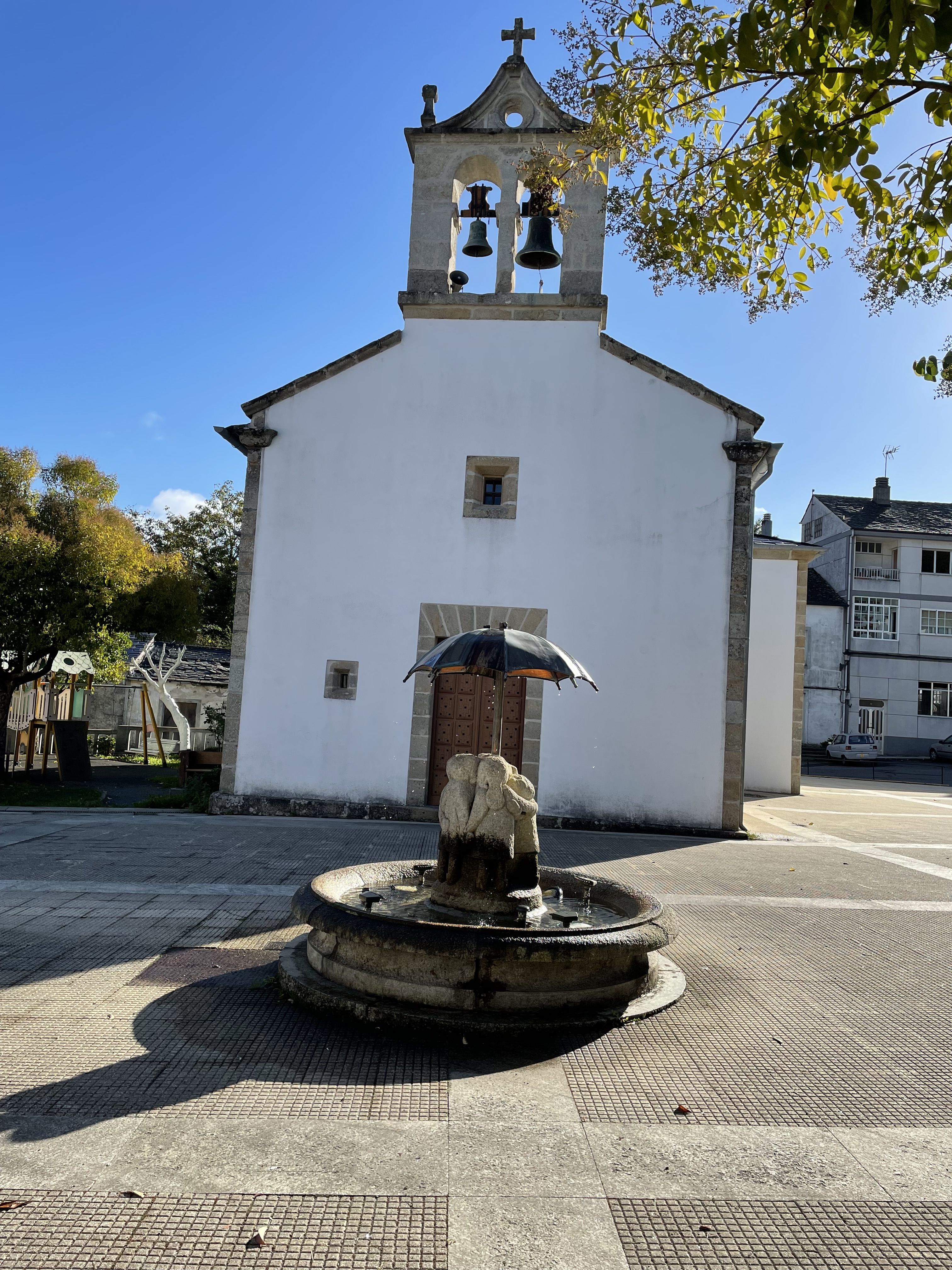
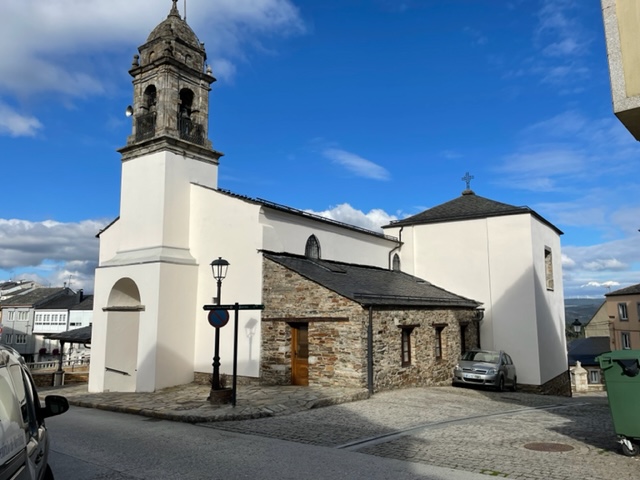
This is the church behind the fountain, mix of old and new and in the center of the small town.
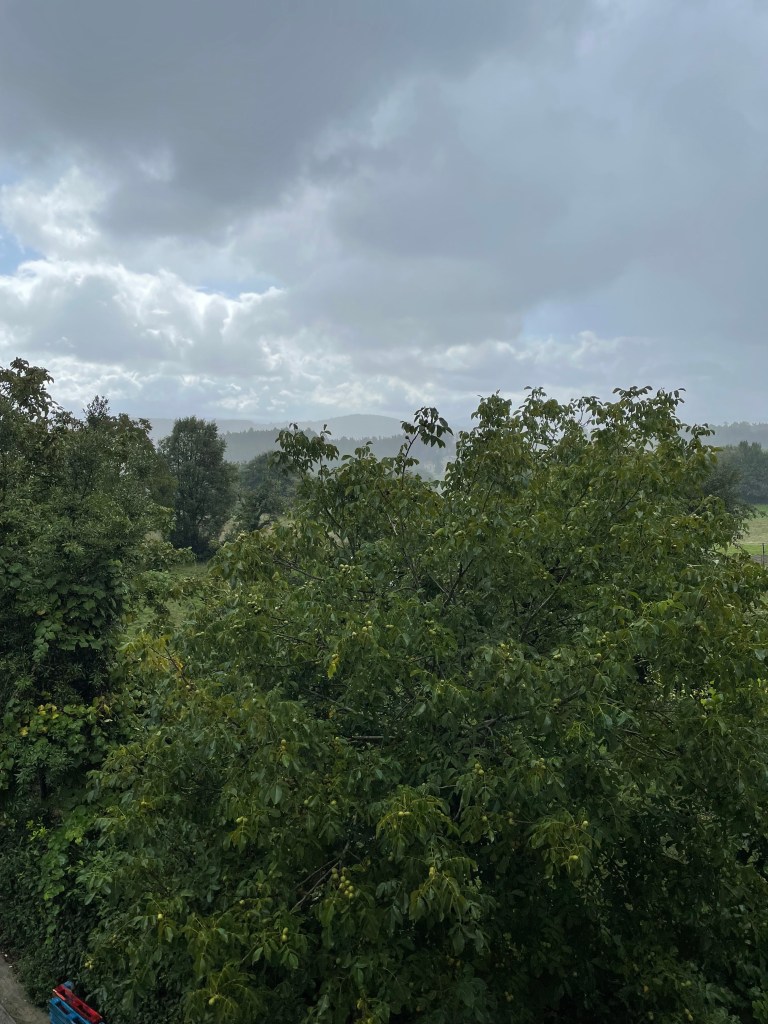
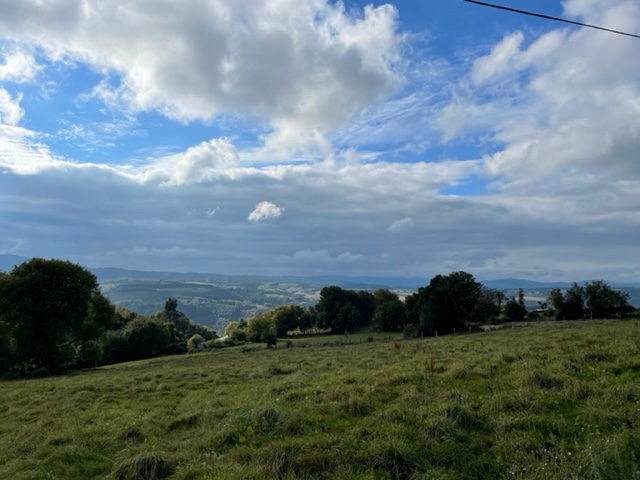
This is the view behind my hotel, but not from my room. I so appreciate that the towns are concise, closely gathered and then surrounded by mountains.
I just read that tomorrow’s hike is nicknamed the “leg wrecker”, longer and up and down. Really? I thought the hardest day was 2 days ago, but now this one is. Well, they’ve all been beautiful. It’s supposed to rain tomorrow, but I have to count myself as SO lucky because it hasn’t rained at all when we’ve been hiking. So – due since this area is known for its rains and mud. Can’t complain about it as I look at the green above.
Started off the day, waking up and realizing I’d slept! Wow! What a great start to the day. Then when the taxi driver came, I asked him to please slow down just a bit. And he did. He was fun to chat with as much as I could. Mostly he talked about how tired he was, that he’d started the day at 6 am and would keep going. He doesn’t take a day off from March to October, because after that, there’s no business and things are really expensive here – actually he talked about groceries and necessaries. I’m not surprised because it’s so remote. He said that crazy road he was driving is closed off and on during all of winter because the snow gets too high. Then he asked if I would mind if he smoked. I said yes, because it hurts my head. He said you never smoked? I said nope, one puff made my head explode (word for explosion is the same in both languages). He then said, everyone dies, what does it matter? Why worry? I said I wasn’t worried about dying, I just didn’t want my head to explode!
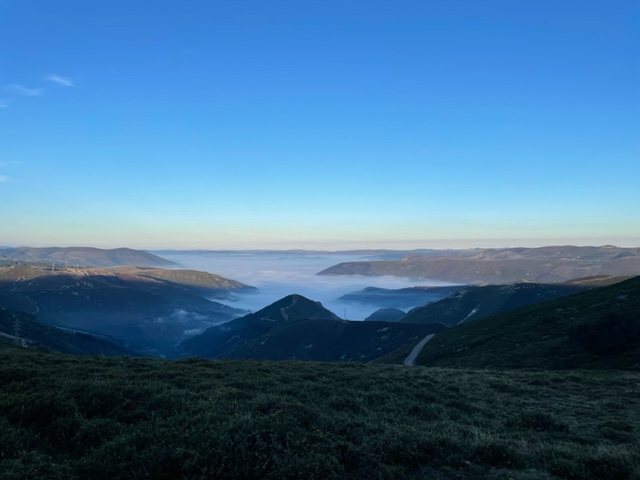
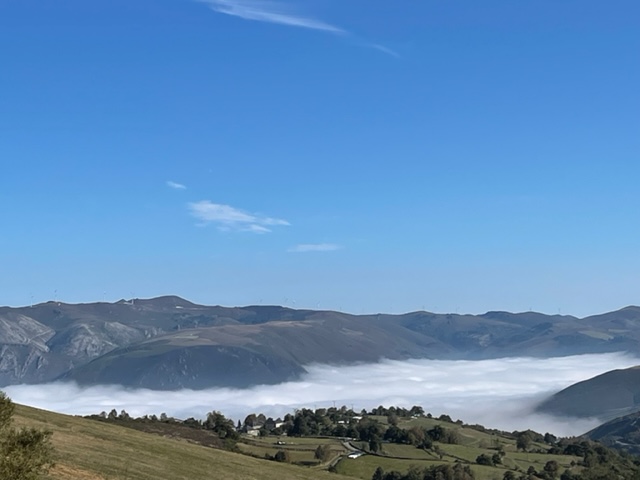
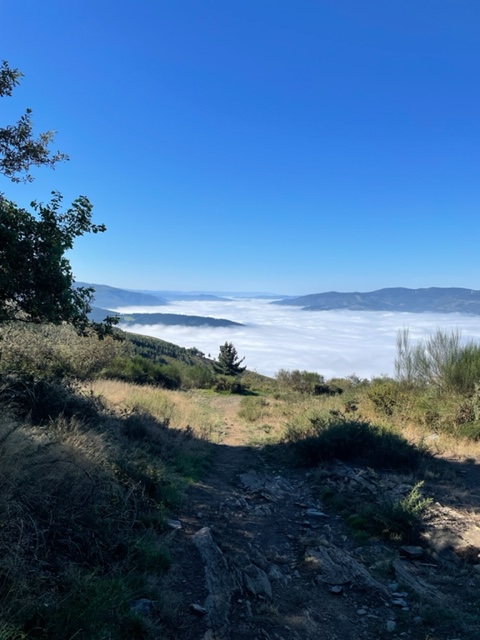
Then I started my hike. Only 12 miles and it took me over 6 hours! Long up and really long down, but oh so beautiful. The mist down below was just amazing and I stayed above it the whole time until it was gone and then I was coming down.
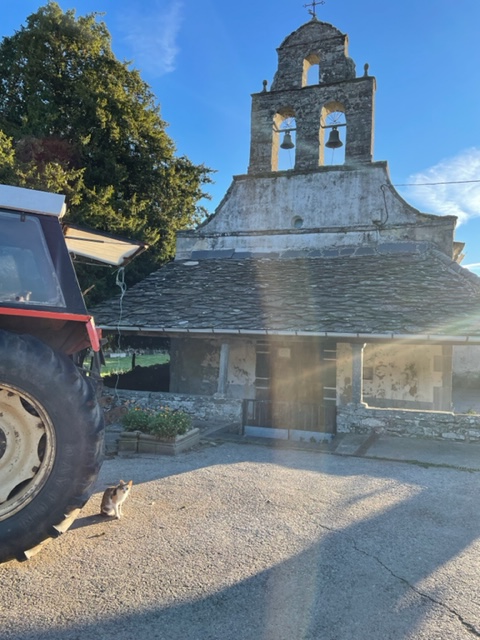
First little town, just tractor, cat, tiny church. Says it all.
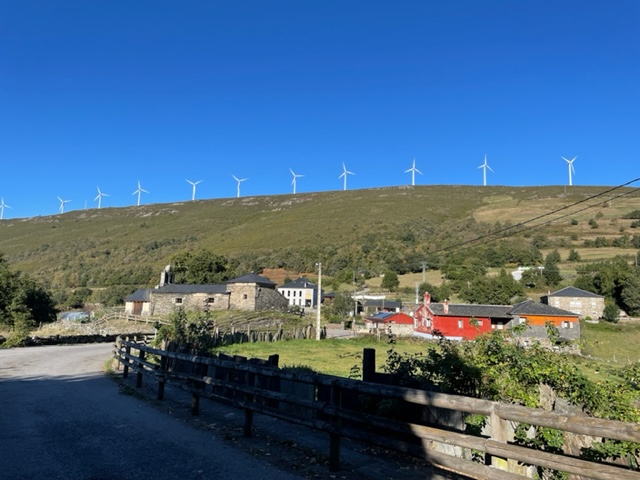
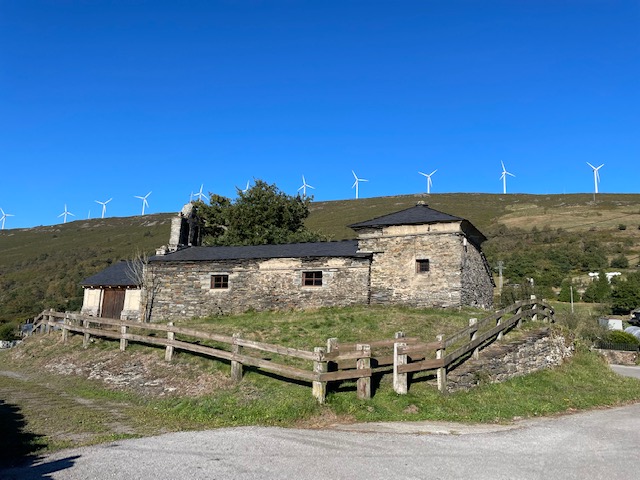
Coming into La Mesa, these windmills are on many of the hills and they get a lot of their electricity from them. Good thing because the hydro plant was definitely dead. Getting to it later. There was an albergue that had a cafe and Wise Pilgrim said there’s nothing else pretty much until you get to Grandas de Salime, so glad I stopped.
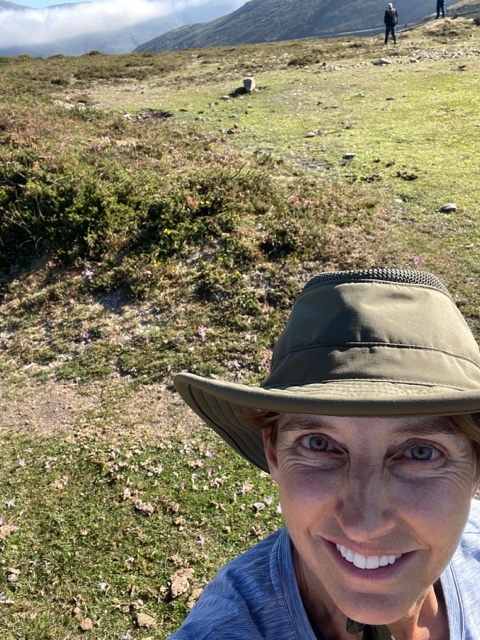
The little crocus like flowers to the right are the most intriguing flowers for me. First, because it seems like they’d be spring flowers and second because they are in a bunch here, but usually, they’re singular and just seem to randomly pop up in the most barren areas. Really cheerful little bursts of color.
I couldn’t take enough pictures of how beautiful it was.
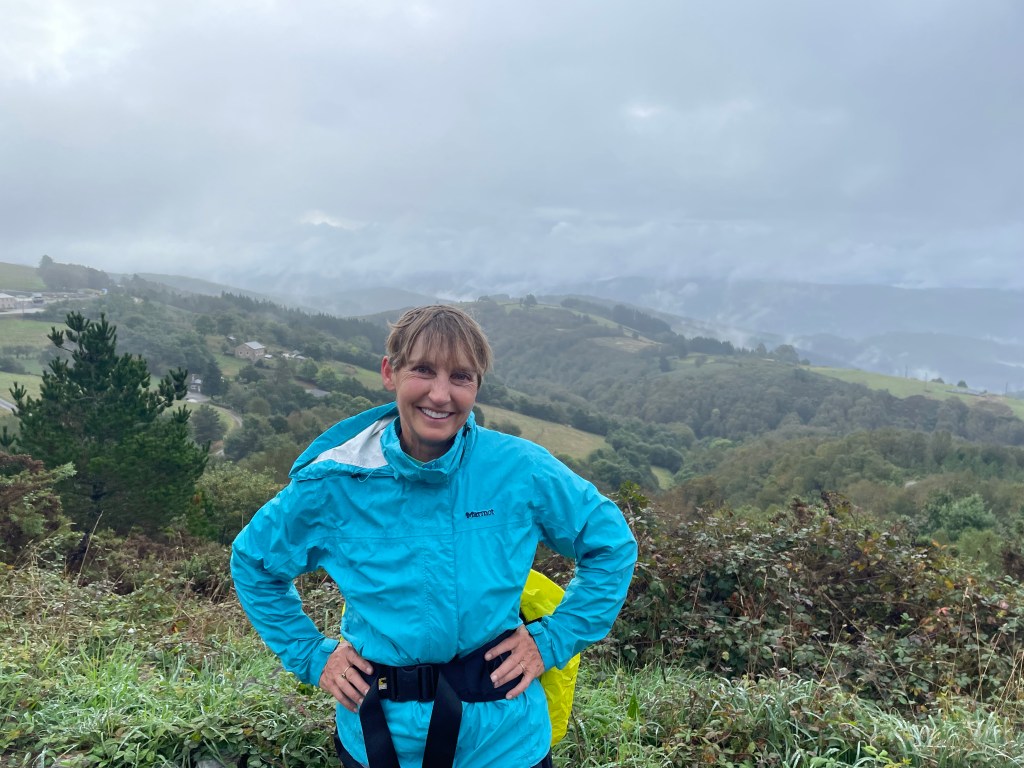
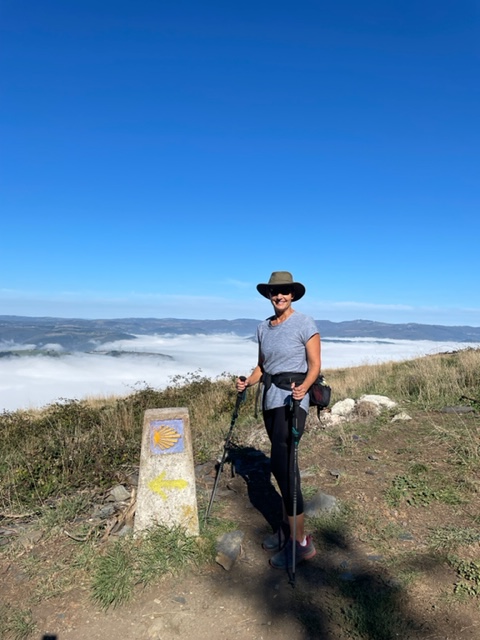
I saw a woman doing a selfie with a tripod and everything, examining the photos, but she stayed put so I asked her to get a photo. Isn’t it amazing behind me?
And now going down. For hours, but the paths were never as rough as they were yesterday.
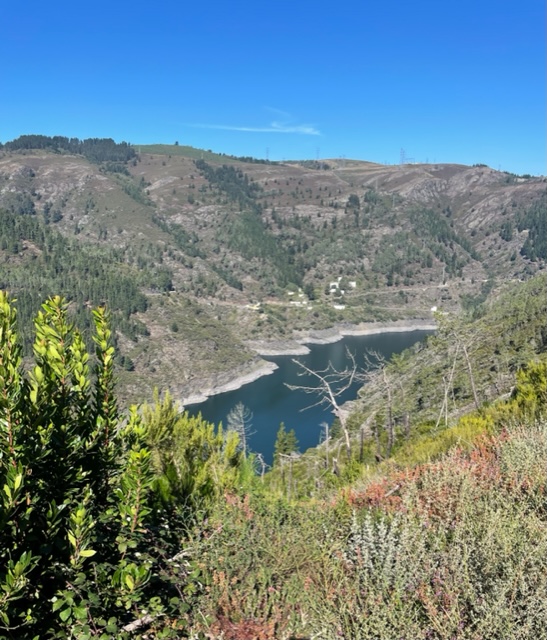
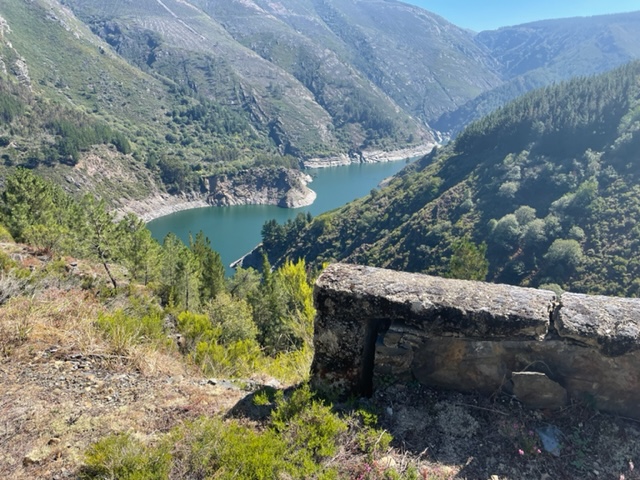
Here’s the dammed reservoir, but it looked like a long river.
Ok, I was tired at this point and totally missed getting photos of the defunct ghost town of the hydro plant. I’d come over the ridge at the right, down to the river to cross on the damn and was now going back up the other side. The last photo was across the way. I was trying to get a photo here to show how incredibly high this road was, with seemingly a straight cliff all the way down. Needless to say, I couldn’t get close enough for an accurate picture, but it was really really high.
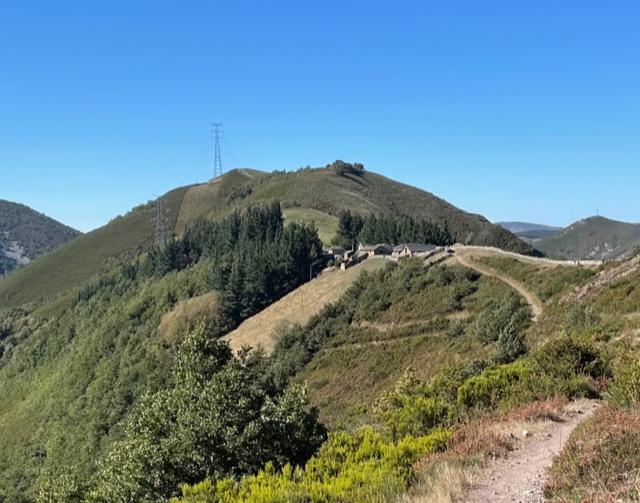
I had to stop by the side of the road to have a snack, I was listening to “House by the Cerulean Sea” a fantasy book recommended by Kaziah and Eli C and suddenly I was off the road that I’d been following into the sky, onto this beautiful path, that just got prettier and prettier. I was definitely in an altered state and when I saw this pretty little town emerging after a long time on the trail, I wasn’t sure how much was book related. I turned off the book.
Really cool church, giant, actually, at the center of this wonderful little town. Iglesia de San Salvador de Grandas, directly related to the Primitivo Santiago Way. A temple is mentioned in 1186, then it was completely remodeled and extended during the 17th, 18th, and 19th centuries. However, the front door, gargoyles and the font are from the original building.
Town building, the bell rings the hour and the church’s bells seem to chime in for longer ringing. Love hearing the bells.
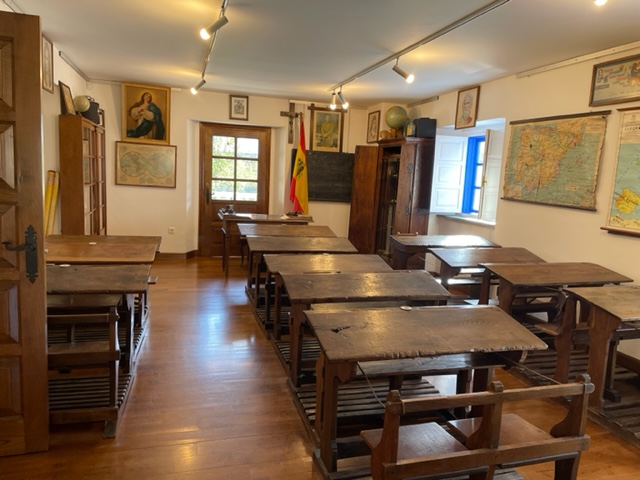
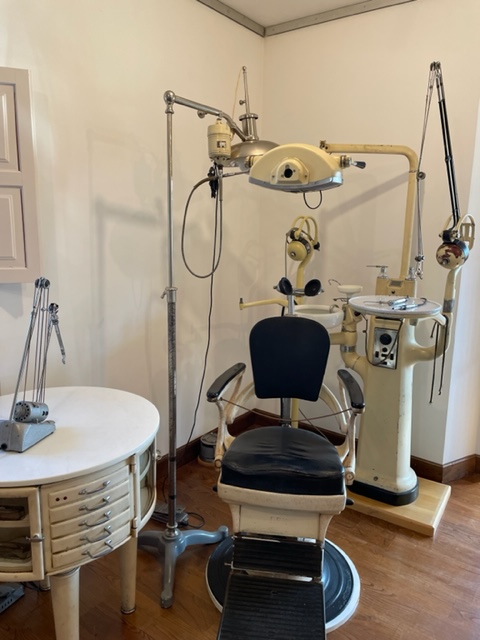
There is an ethnographic museum here, showing the cultural anthropology history of the Asturian area. It was a really impressive museum. I had to take a picture of the schoolroom, of course, and then appreciated how they wrote about it in the guide: This area, however, is more than the sum of the objects it contains; it is the place where a universe of knowledge and learning enabled children to open their minds to goals and horizons which were formerly only open to a few, to the wealthy.”
“General dissemination of rural schools arrived with the 2nd Spanish Republic, and although General Franco used them as indoctrination centers for his regime, education was able to prise the door open and help to bring freedom to the people.”
Isn’t that great?
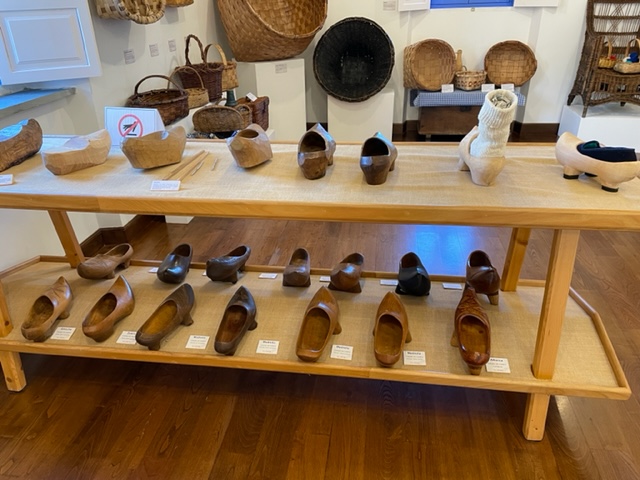
And here are those shoes. They were clogs worn to manage the wet and mud that was (and still can be) ever present. They made my shoes look SO comfortable.
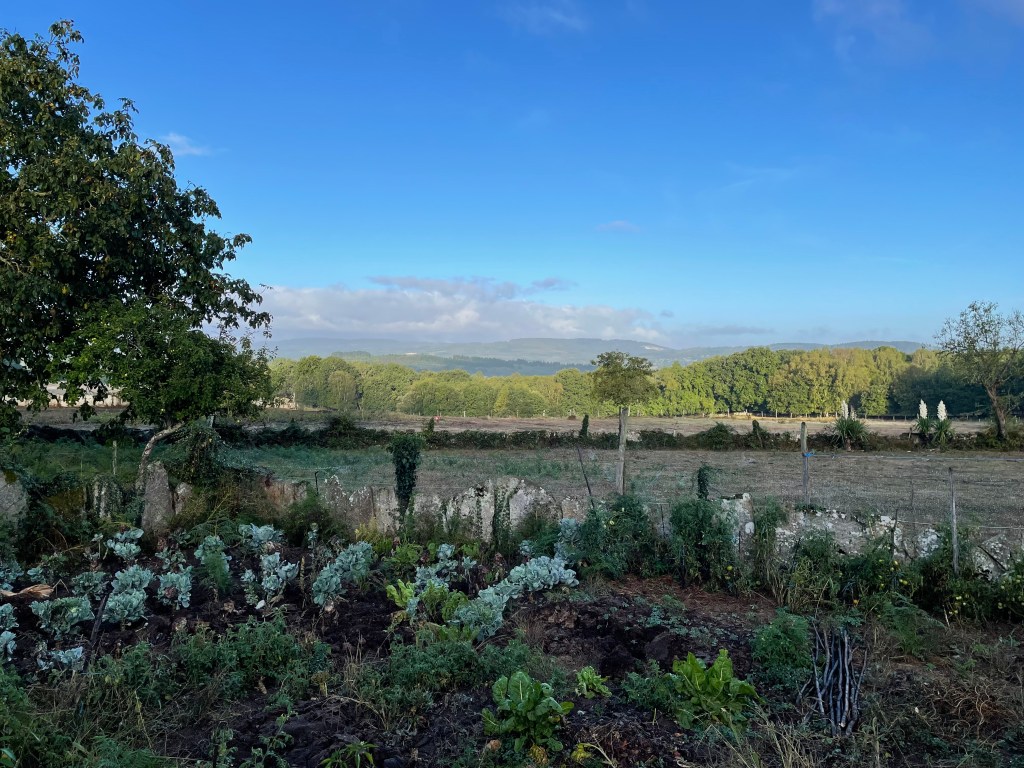
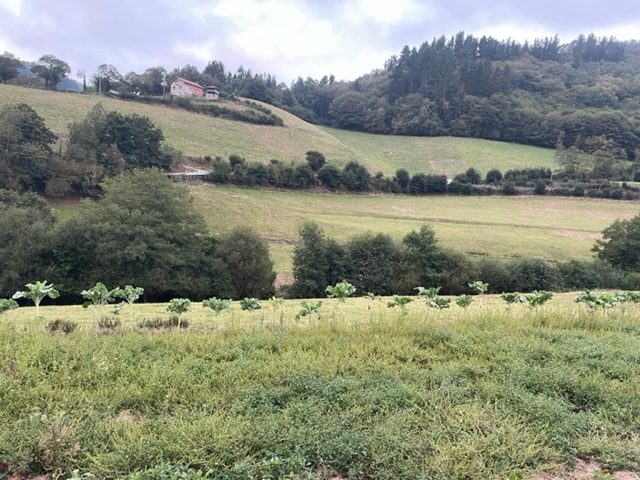
I had another wonderful day. These days of wandering through the country are just a dream and it is so beautiful. I don’t know if I mentioned it, but arriving at both Tineo and Pola de Allande were surprises, walking, walking, turn a corner and there it is. I think it’s because of how the towns are nestled into the mountains. So started off out of Pola de Allande and first thing I see is this view with kale set up as a border.
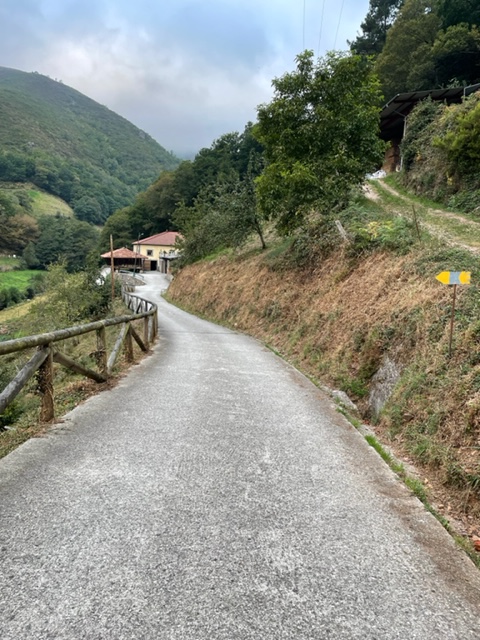
This arrow pointed straight to the farm. Ok. And sure enough, you could go through the space between the house and barn or to the left. I went to the left, but a guy riding a bike towards me went right through their space. I’m realizing that when a mosaic shell is embedded in the side of the house that it’s both directly on the camino and that it’s also probably quite old. This was a beautiful farm, saw her on the way to collect eggs and the he was just going out on the tractor.
This is maybe one of the biggest differences from the Camino Frances. All these little towns are lived in, if the house is falling down, no, but if not – someone’s there. Last year, it seemed like a lot of the houses on the Camino might be second homes, or traditional ones that they just come back to occasionally.
And now I’m off on another truly beautiful hike.
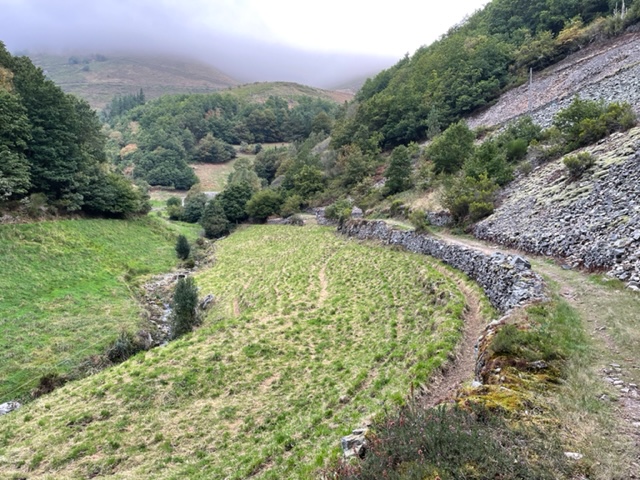
I marveled at this. Obviously, the rocks are there to work with, but there were only 2 houses at the end of this valley! And the walls for both holding back the rock fall and to border the road were extensive and beautiful. So generations?
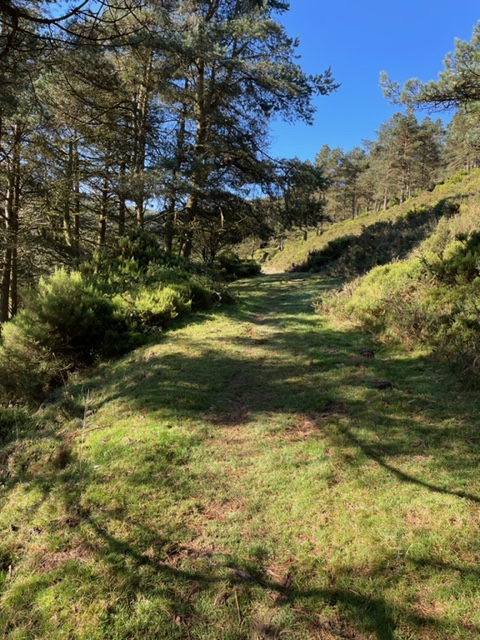
Oh, I was SO happy to see this grass trail. There are a lot of rocks here…
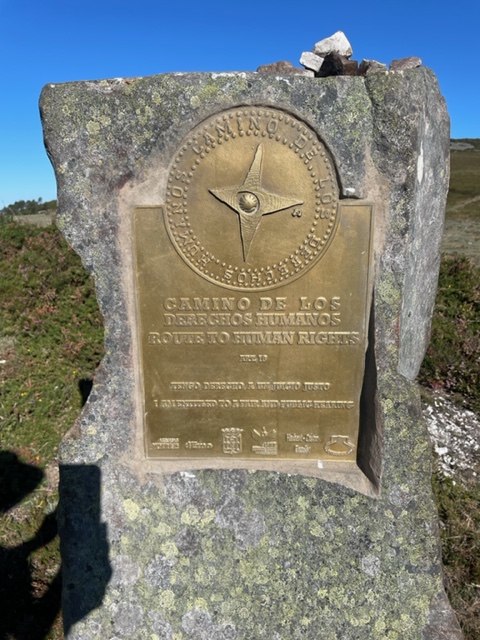
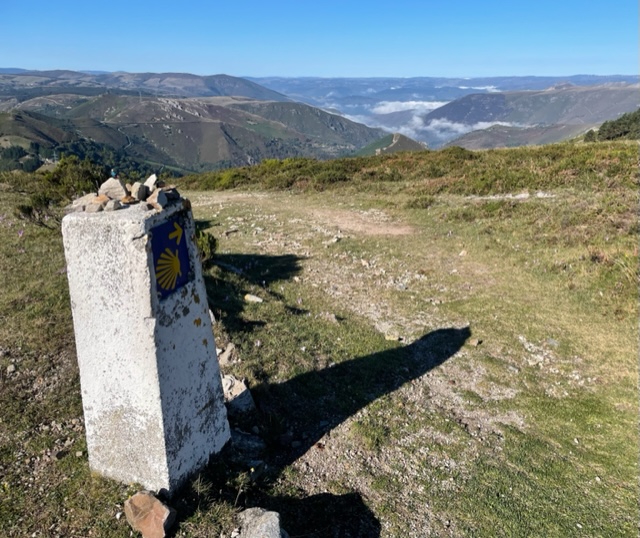
And I’m at the top of the pass. This was a marker for human rights and I loved the little music note next to the star.
According to the Asturias site – the area that I’m walking through until I hit Galicia – The Route to Human Rights along the Camino Primitivo of Saint James launched a pioneer program to present and promote the values of the Universal Declaration of Human Rights in schools along the Original Way of Saint James.
I also learned that the Camino de Santiago in it’s Primitive Way itinerary was declared in 2015 a “World Heritage Site” by the UNESCO. There are 30 artistic bronze plagues along the 13 stages of the Primitive Way for the Human Rights Route.
Hmmm. I’ve seen two. I’ll have to start paying attention.
Tired, but pleased to be at the top.
Then I saw the sign pointing down and the drop. Hmmm.
Yup and it went down and down. I walked DOWN and DOWN a steep side of rocks for quite a while. My toes had a lot to say about it that night. After a long time, I saw this beautiful farm or something in the distance. I really really hoped there might be a small cafe.
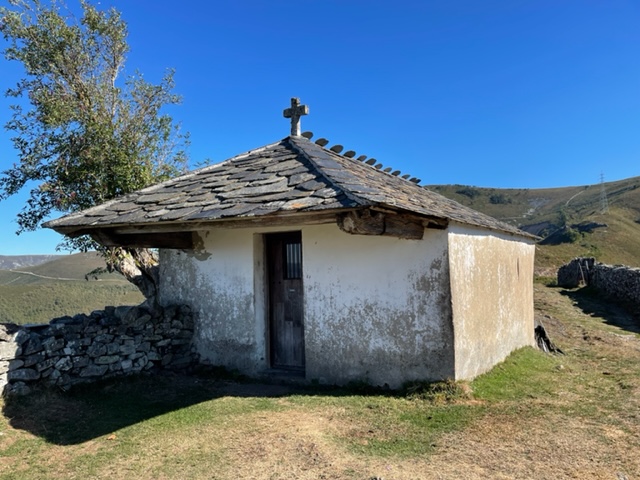
Nope, but it was a beautiful farm with a tiny chapel. It used to be a hospital on the route many, many years ago. Now a farm, though not many buildings looked weather safe. Evidently there was someone in residence because there was a dog sleeping ON the trail who blended in, I almost stepped on him even though he was really big. The chapel was the Capilla de Santiago de Montefurado. So pretty inside, but I was tired and really wanted tea, so forgot to take a picture.
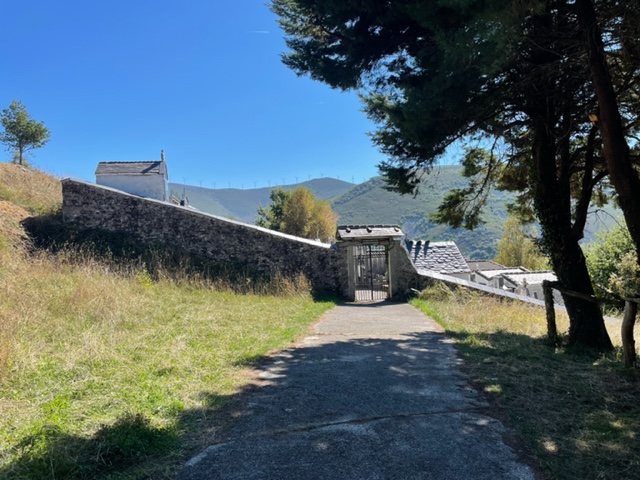
Walked for a couple more hours and suddenly came on this cemetery. What? Why?
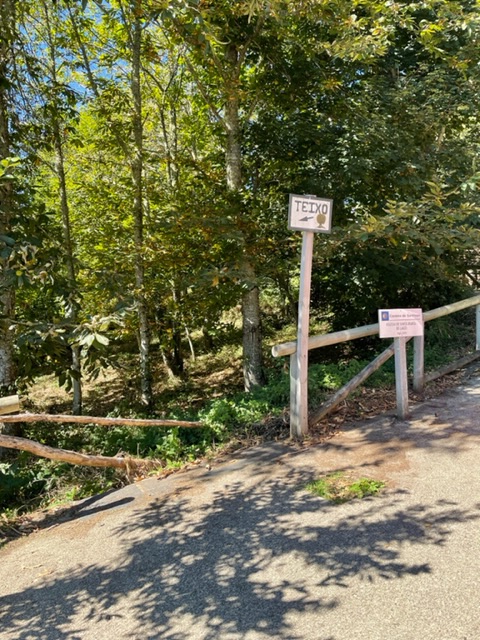
Then, the most wonderful surprise. I came around a corner of an ancient church a bit further on and two men were there, “want some lemonade?” Really? Yes!! It was completely delicious and they were so nice. One spoke some English and they told me about the huge tree next to the church. Teixo is the Asturian spelling. The tree is over 1,000 years old and is treasured. It was used by the Celts for their spiritual practices when they were here back then. I couldn’t really get an accurate picture because how it was hidden behind the tree.
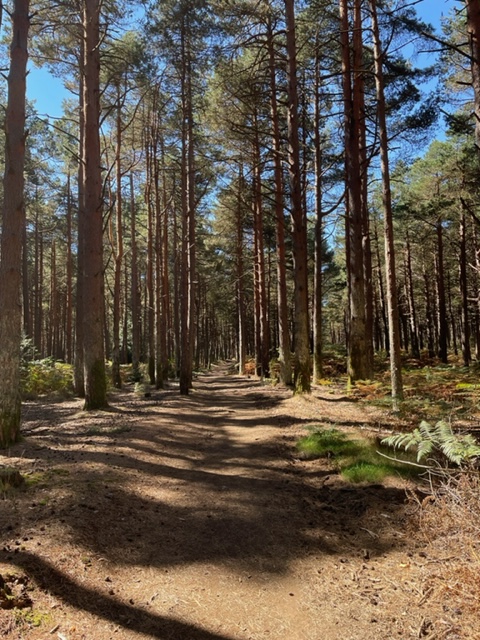
Hiked on into the woods and then to Berducedo. I think there’s a group Albergue and at least one small hotel, but not much so I had to call a taxi and wait for about an hour to go back to Pola de Allande. That was ok with me because it gave me 2 nights in a hotel, time to go to a lavanderia and then hang things in my room to dry. Plus the hotel had a great restaurant and super nice people.
Then I got in the taxi and I thought this was going to be my last day. The paving was great, but the road was pretty crazy, like Trail Ridge Road going through Rocky Mountain National Park, but more. At one point, I clutched the door handle which caught the drivers eye. Didn’t make him slow down…
I made it back safely.
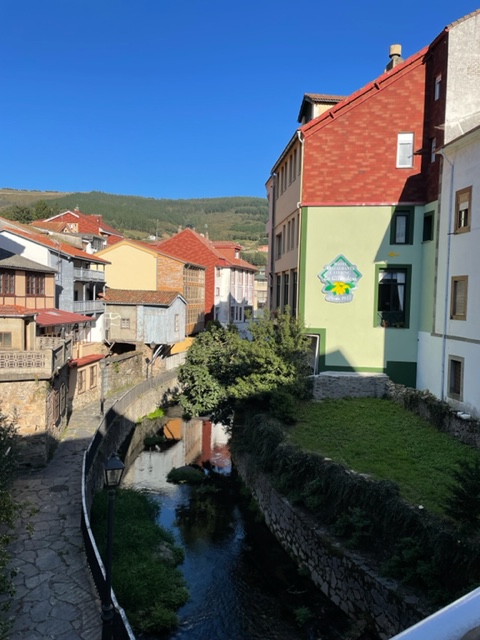
This was my hotel on the river, I looked out towards the front, but it was fine because the whole town got quiet by 11.
De Buspal is the farm’s name after the hospital that used to be there.








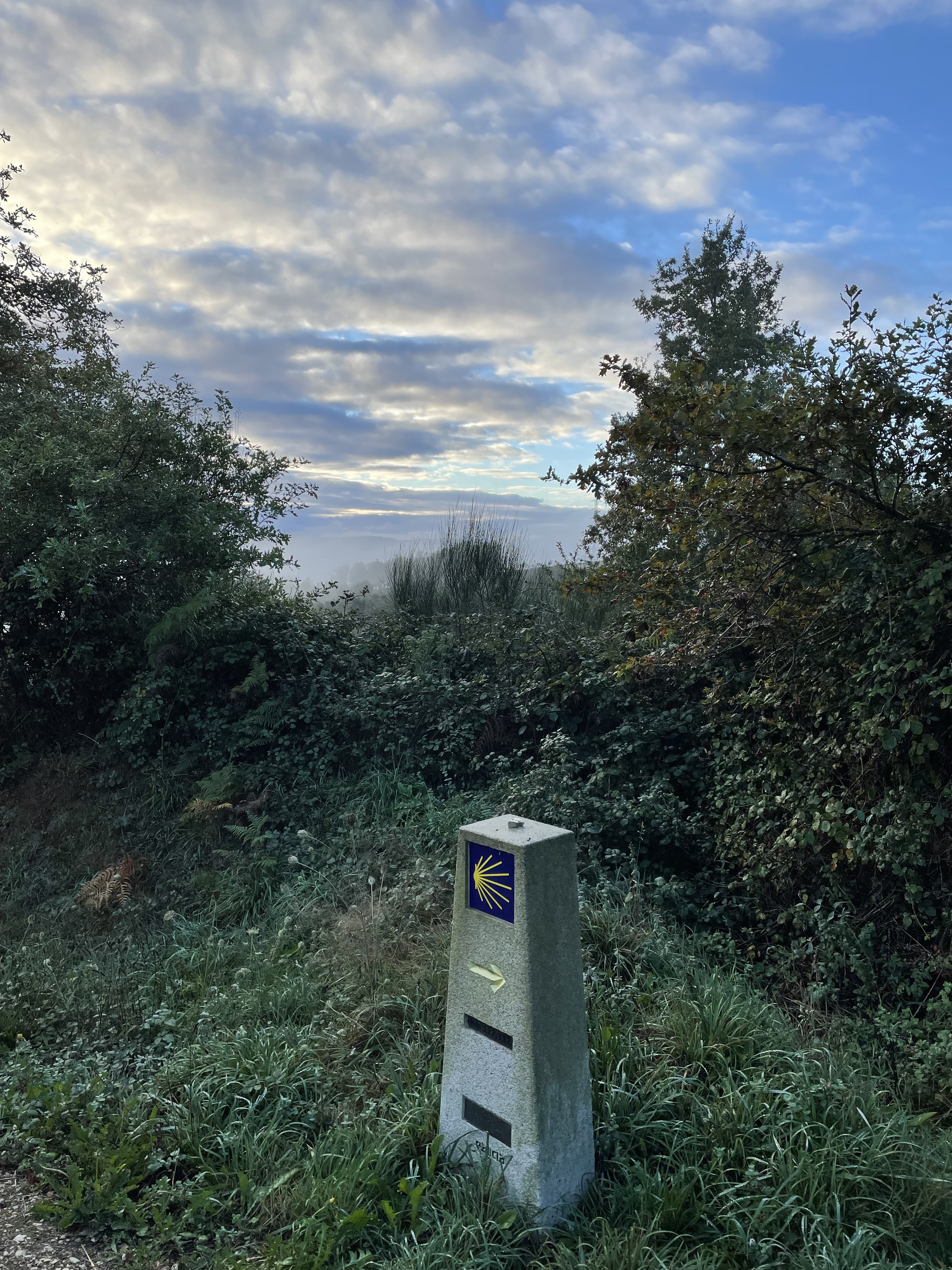
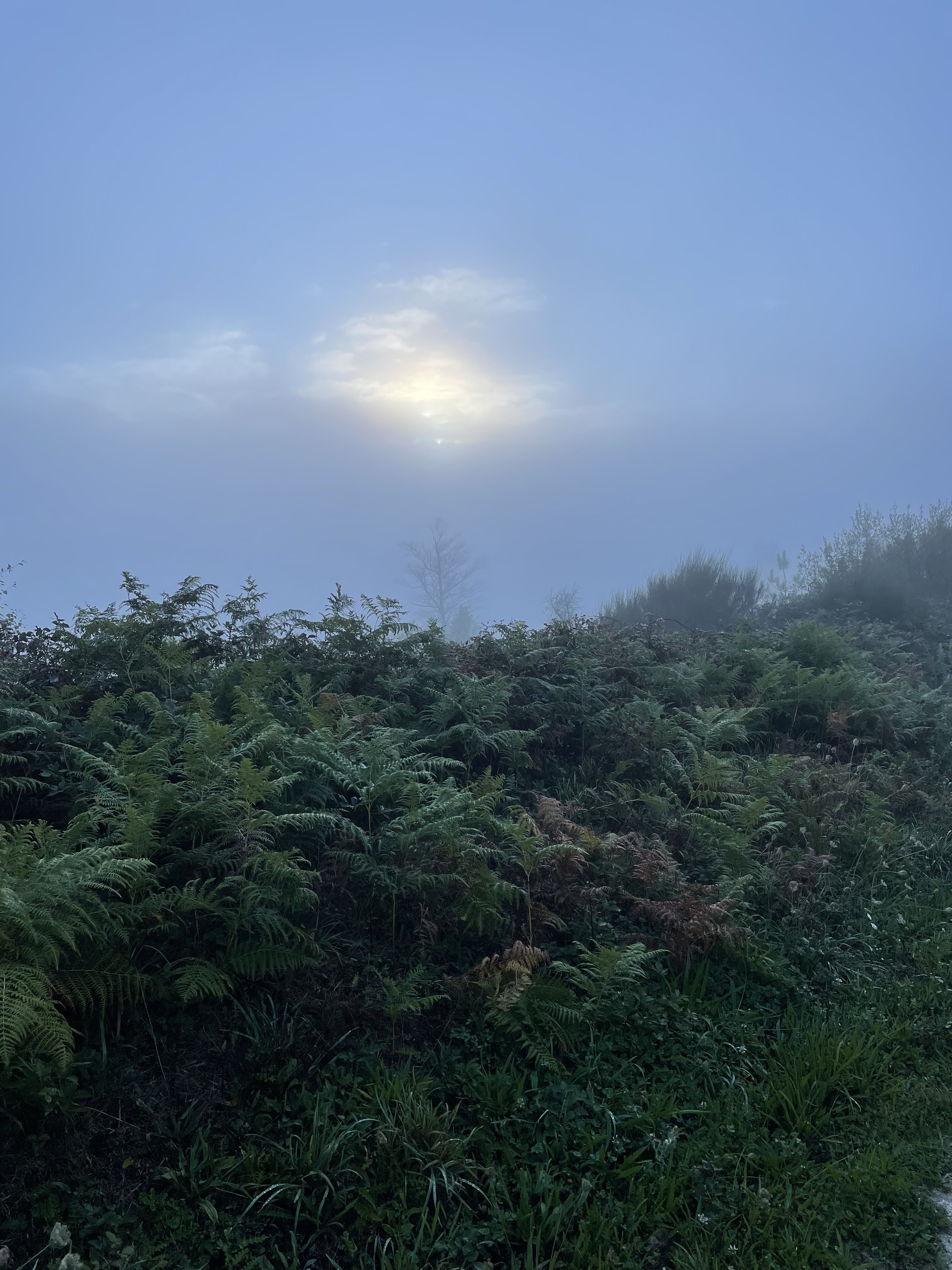






 Reb's Walks!