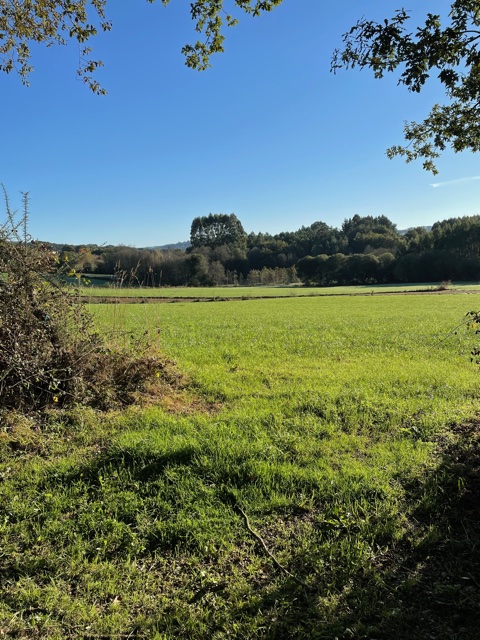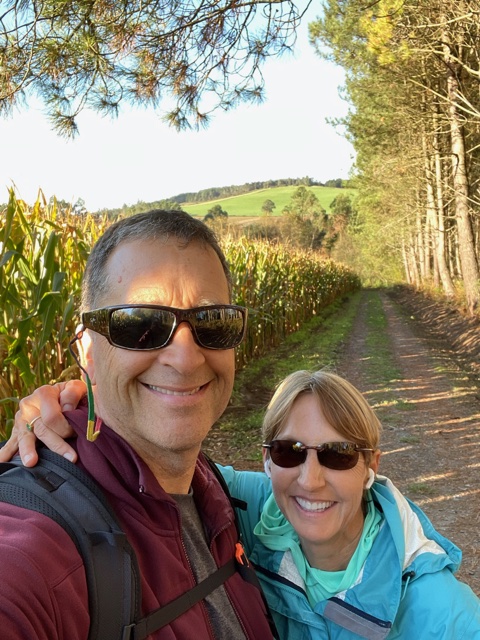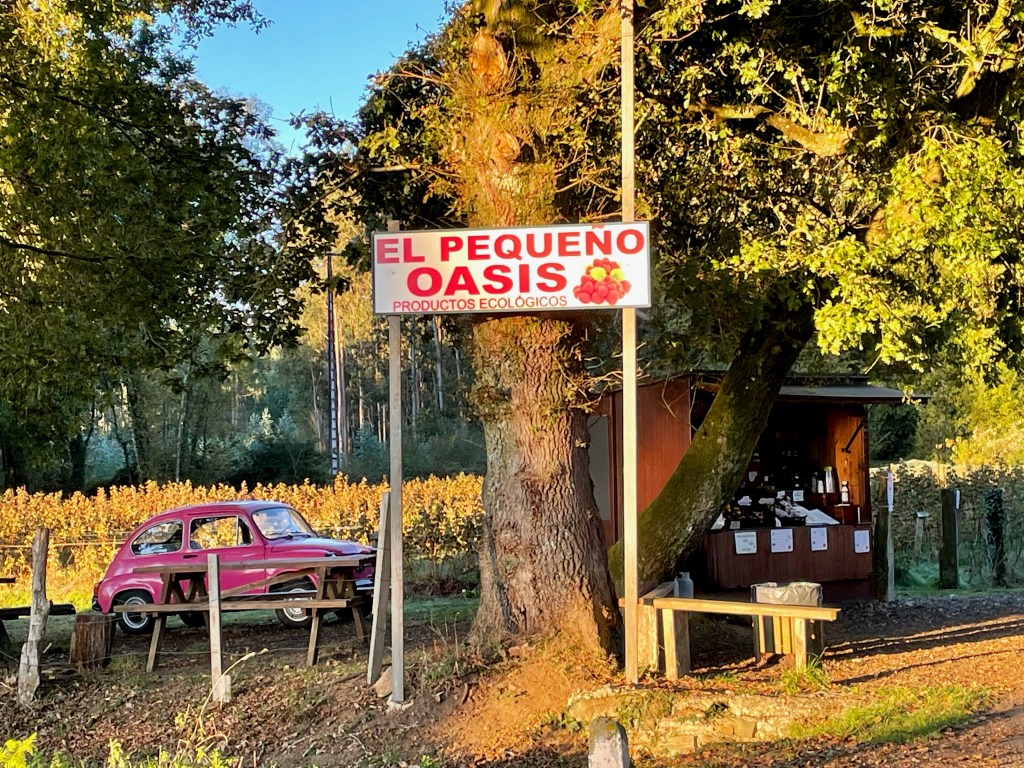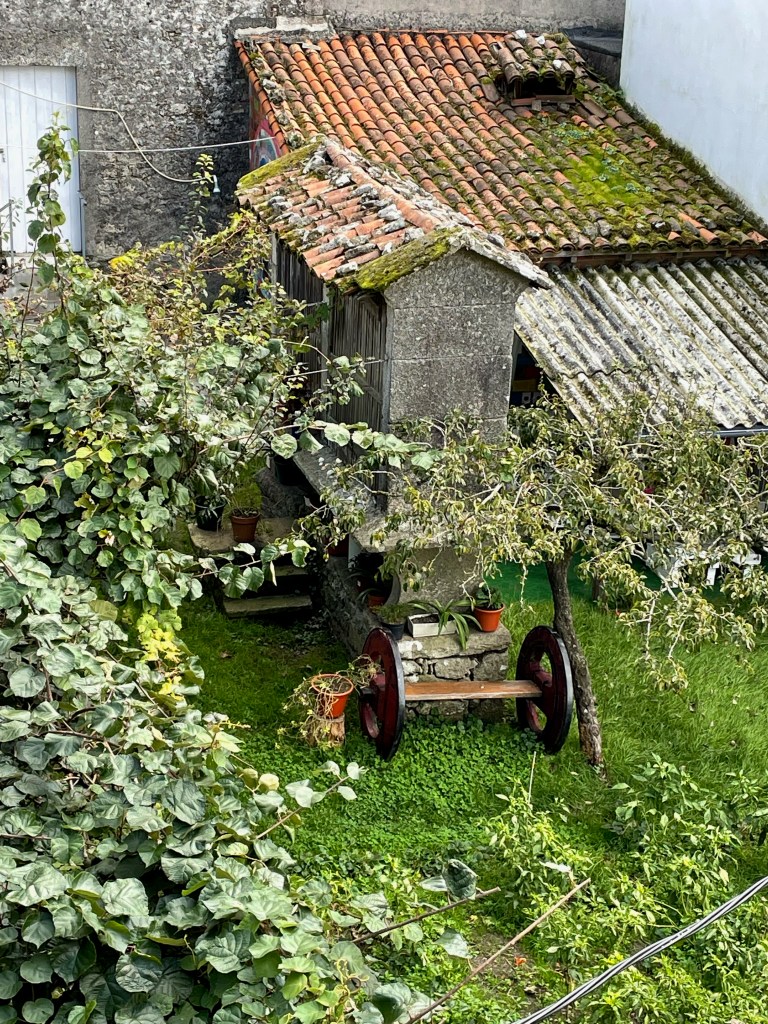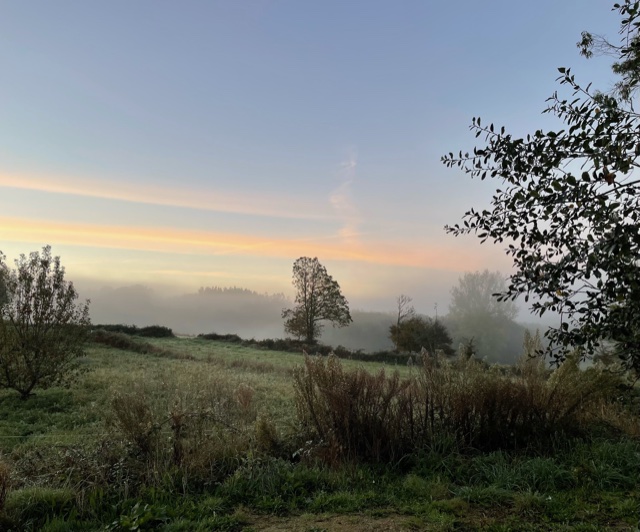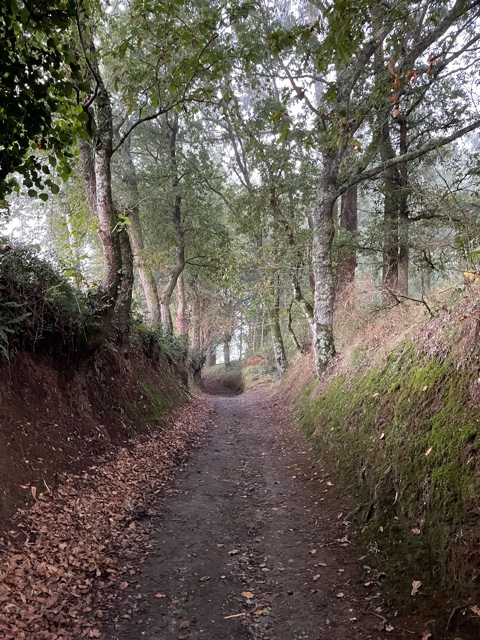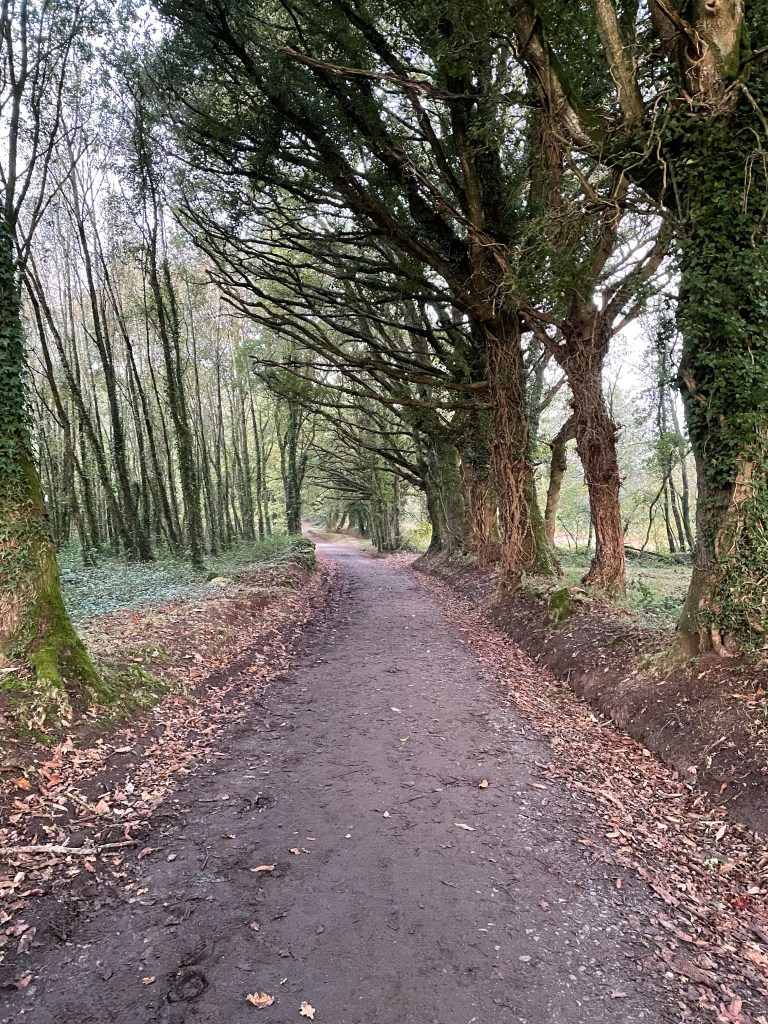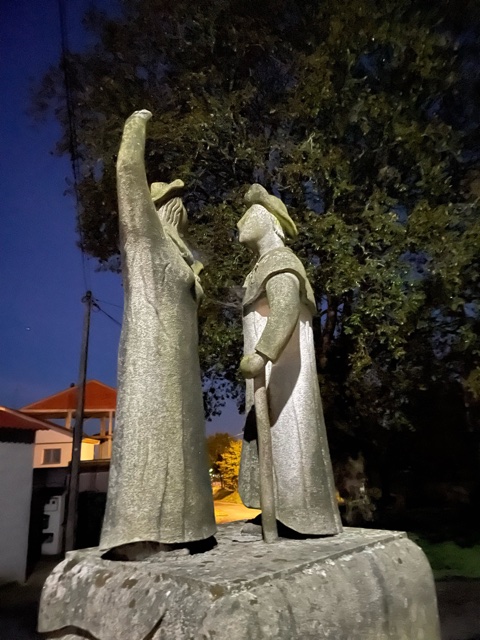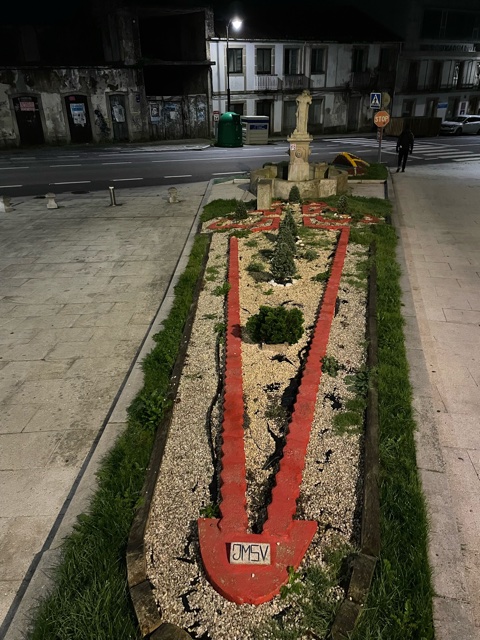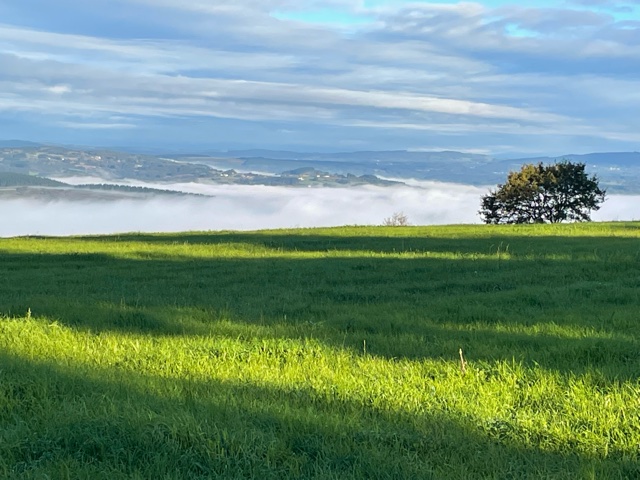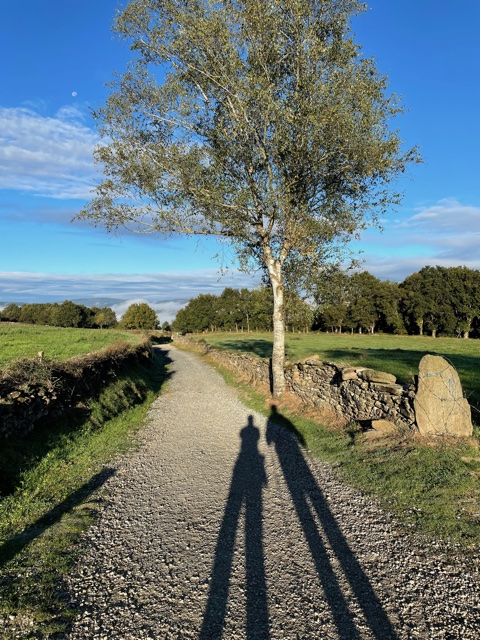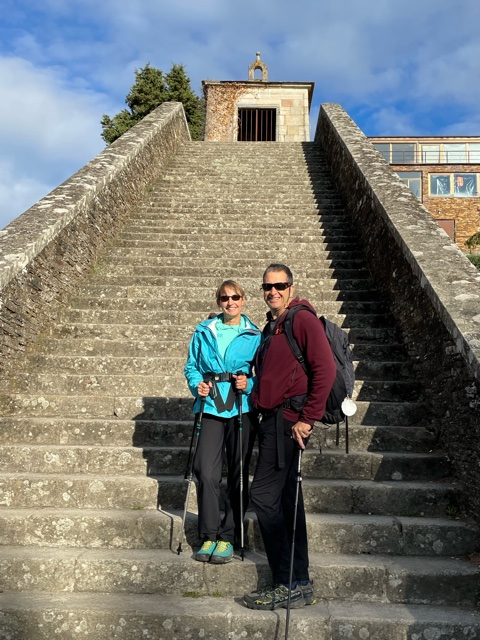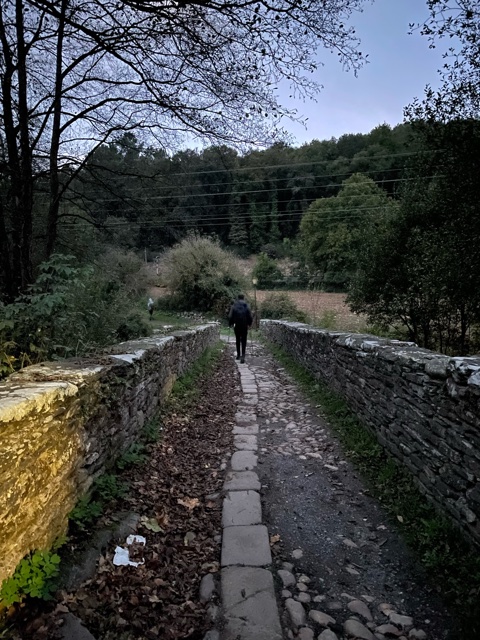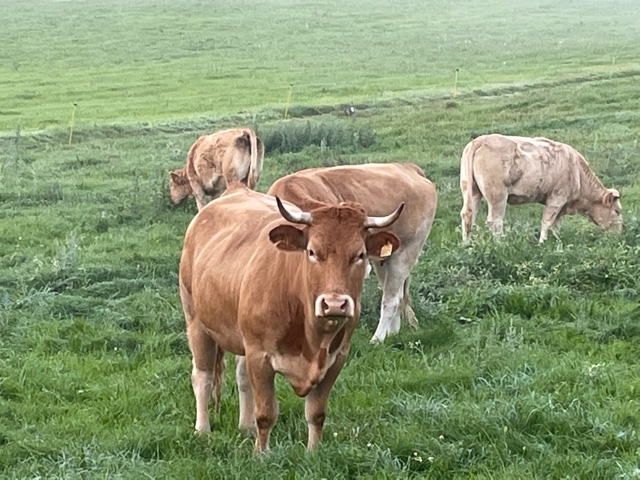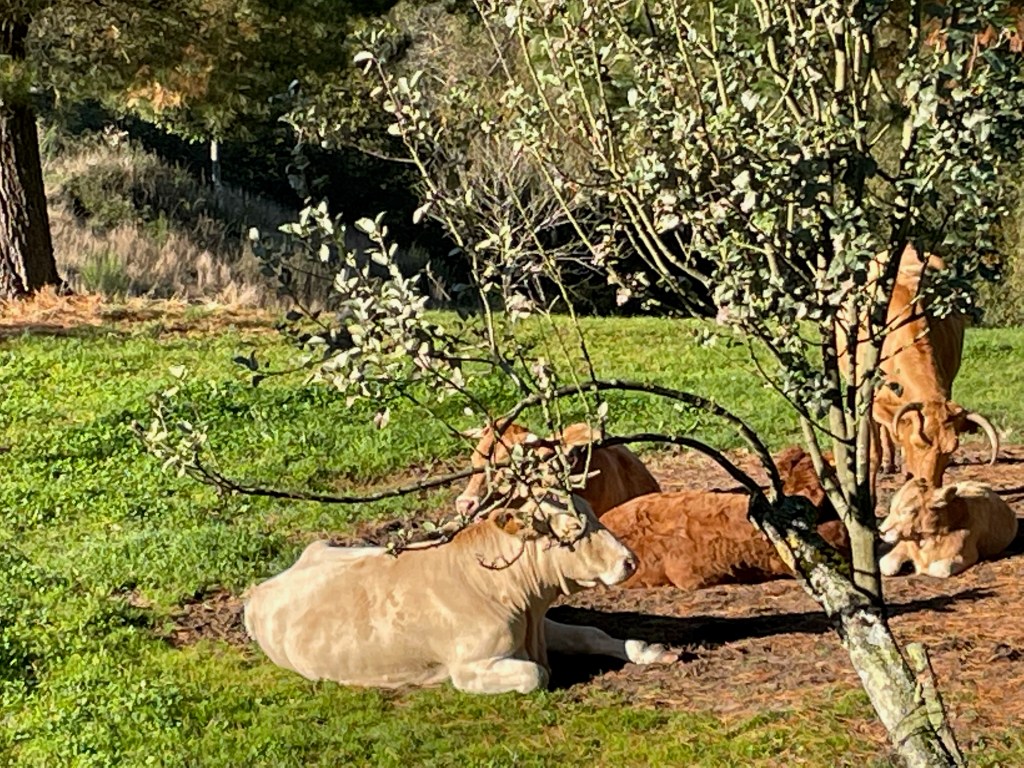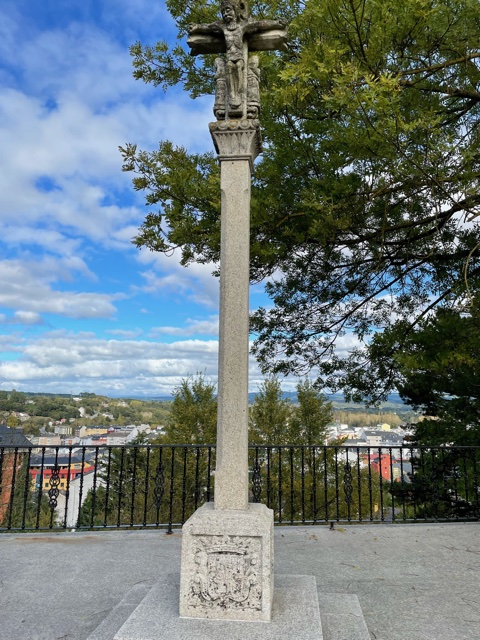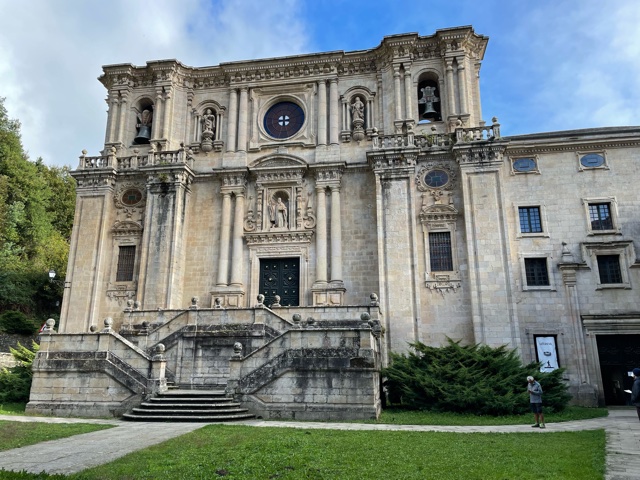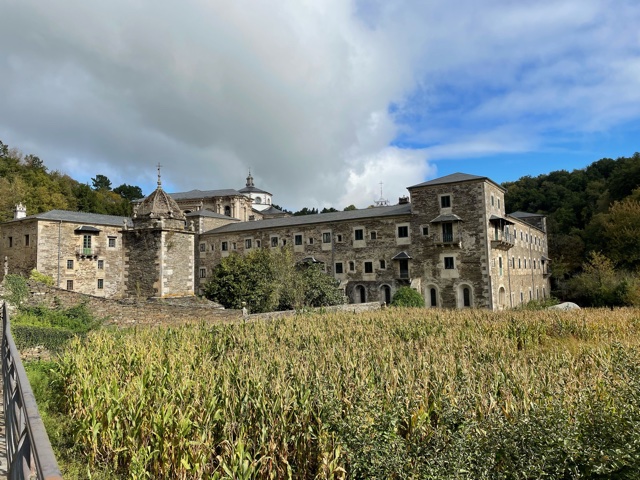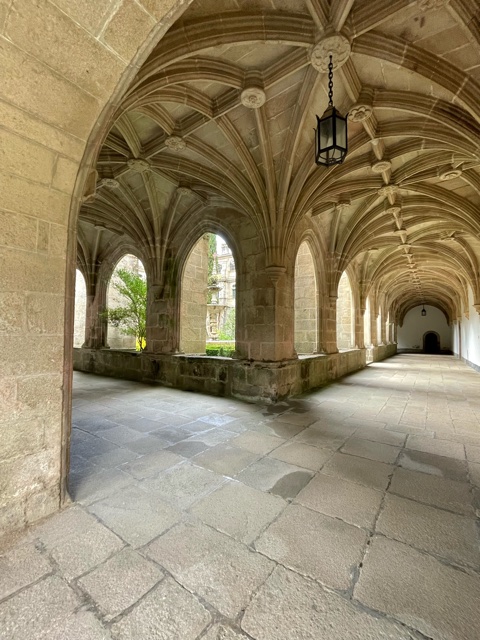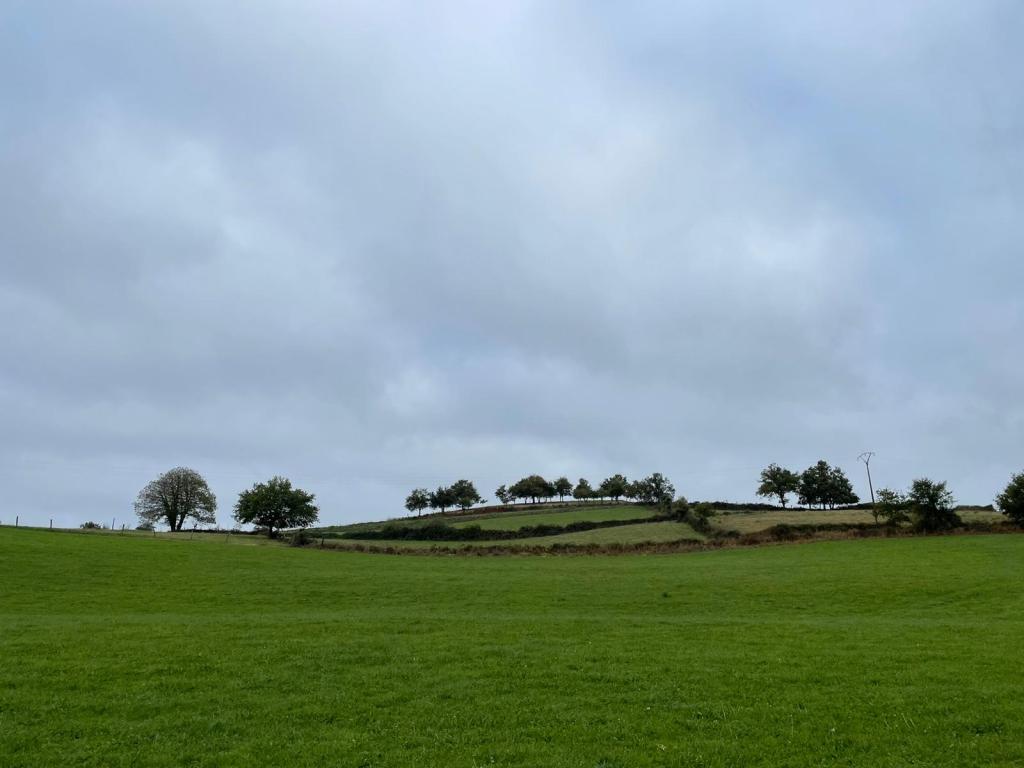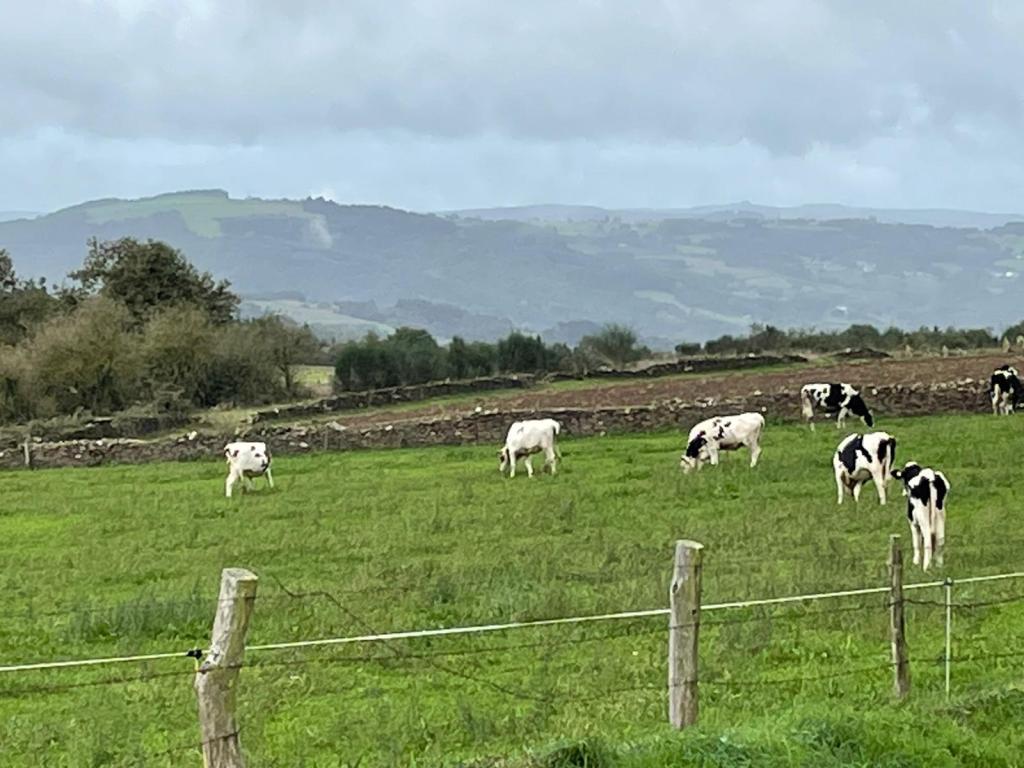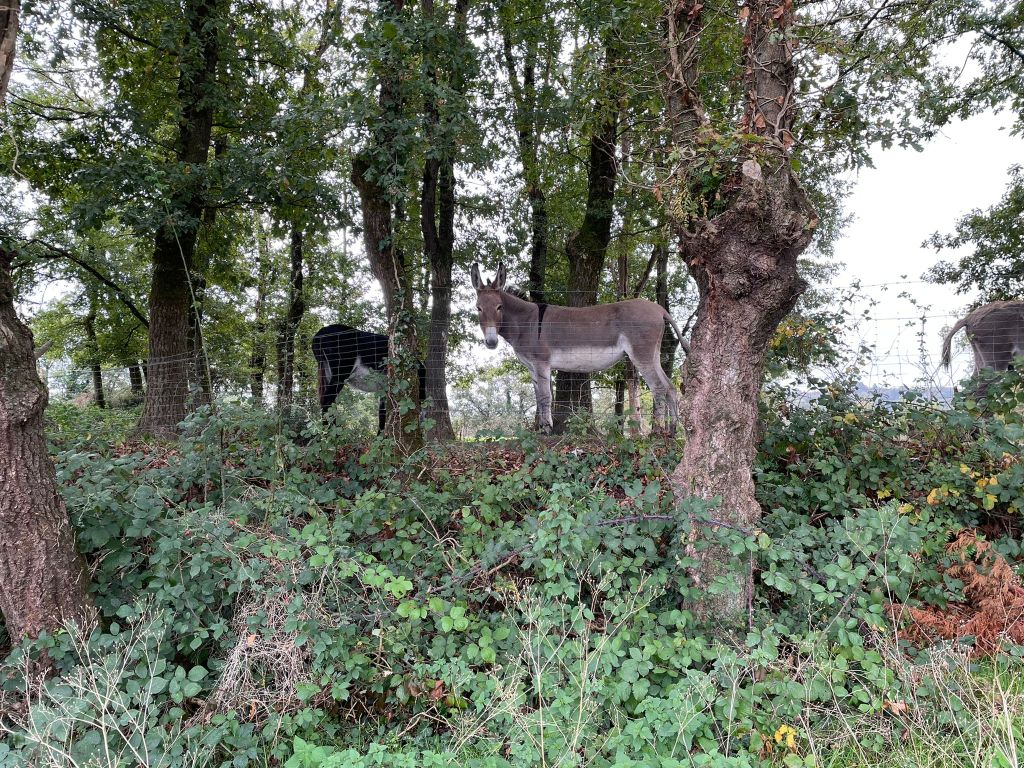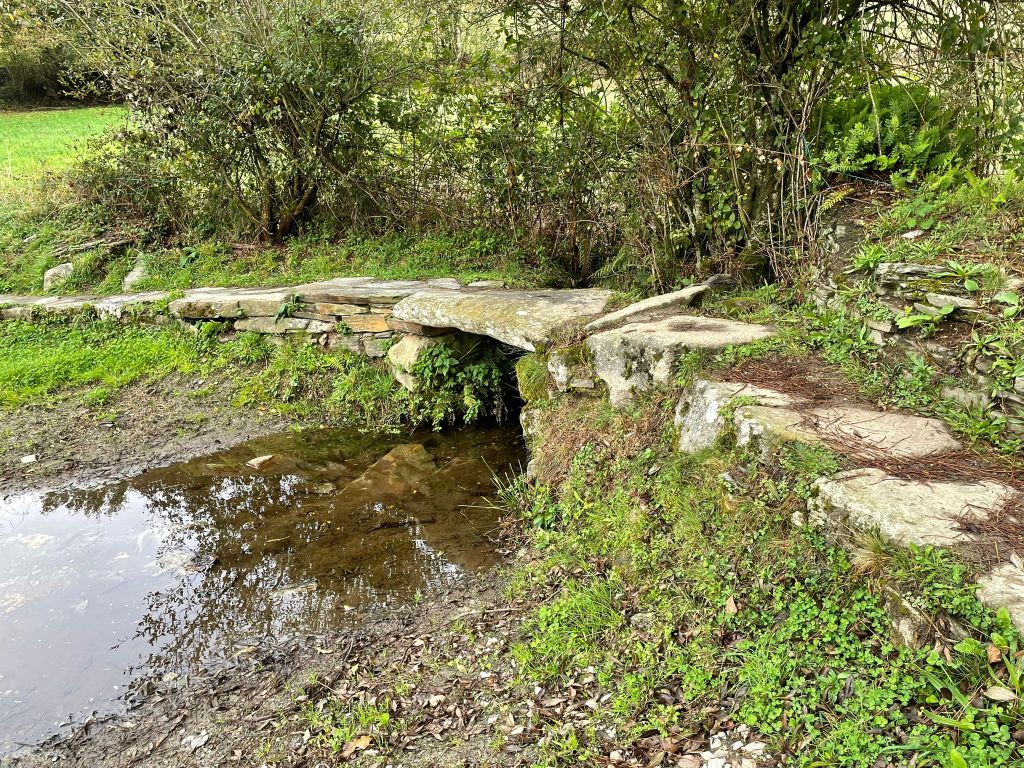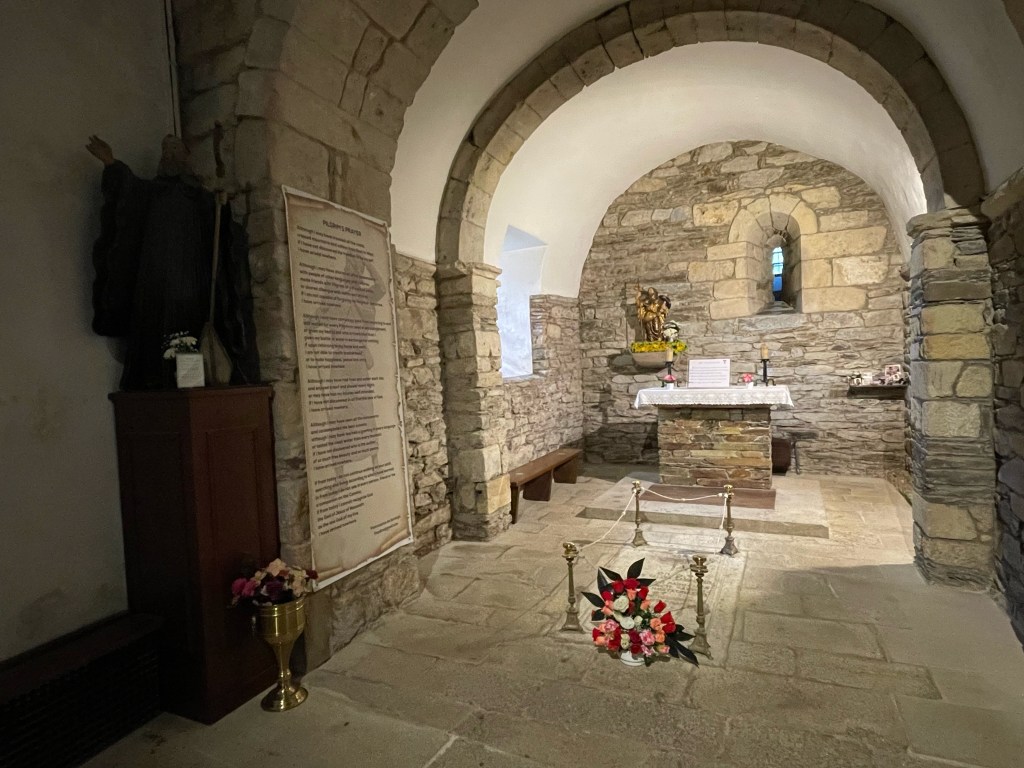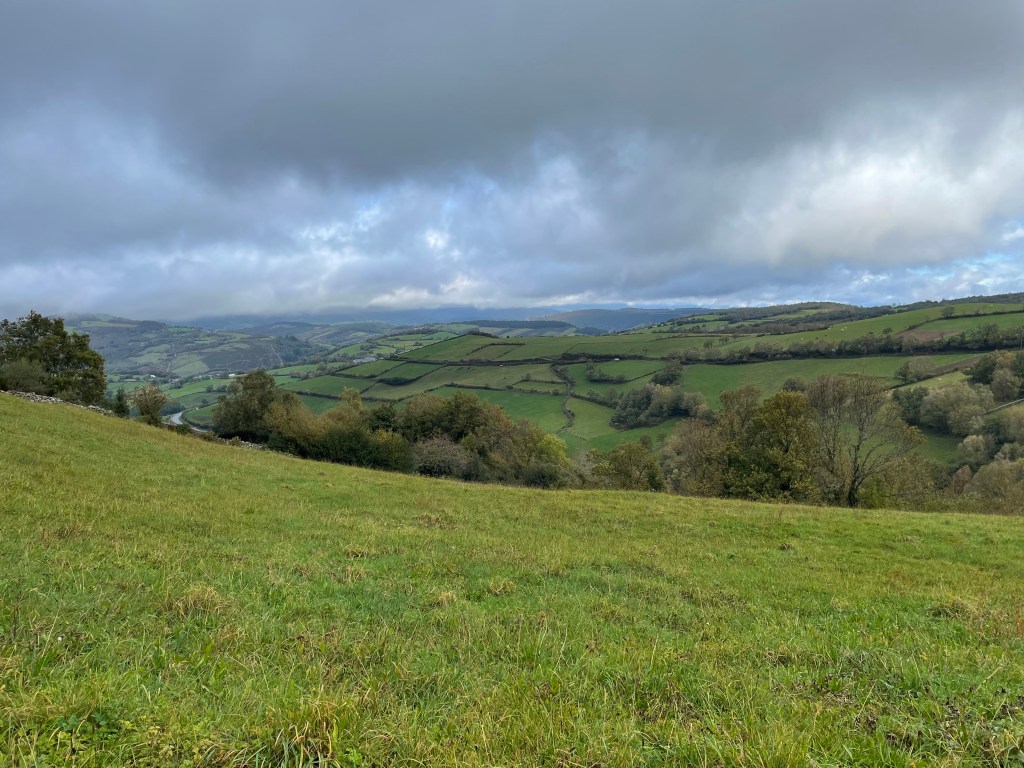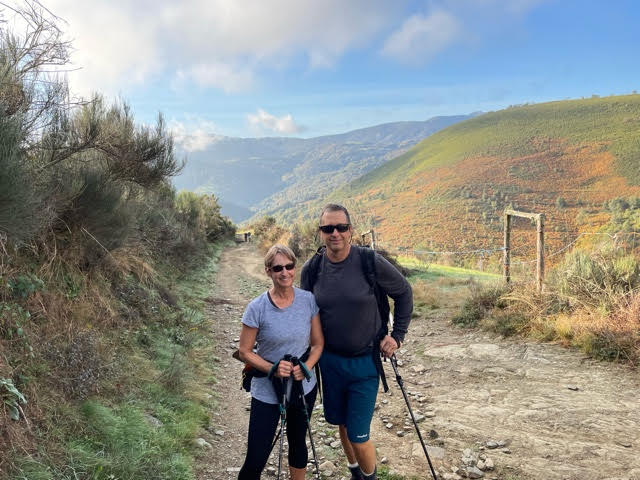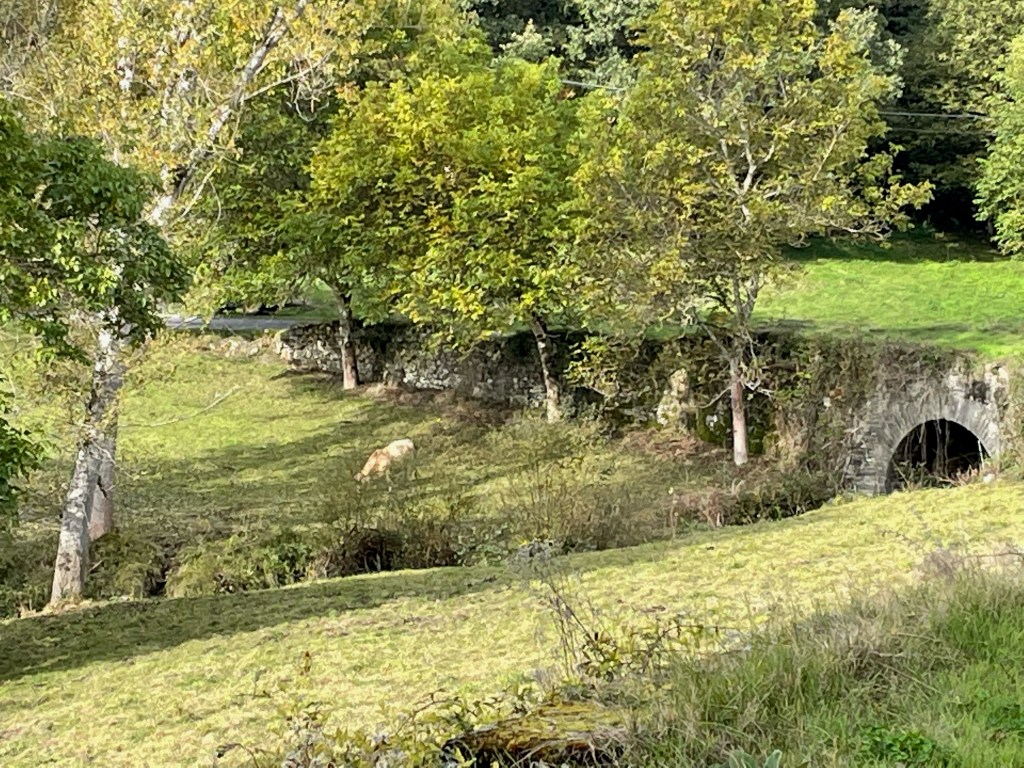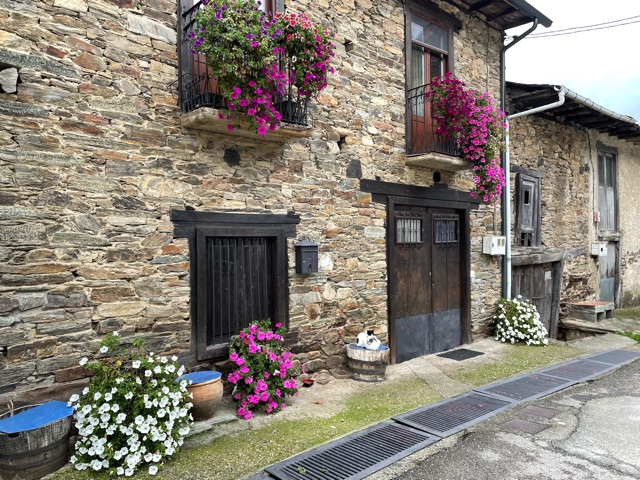
Today was a beautiful day because of the scenery. We’re in Sarria now, and have a layover day. Everyone else we’ve met is going on tomorrow so Rick and I will be exploring on our own after tonight.
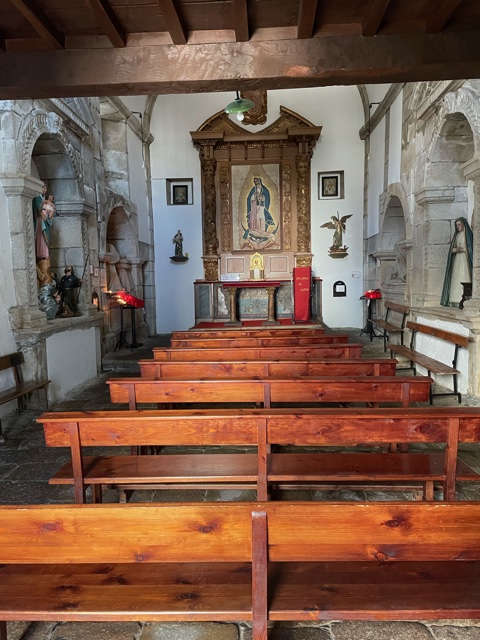
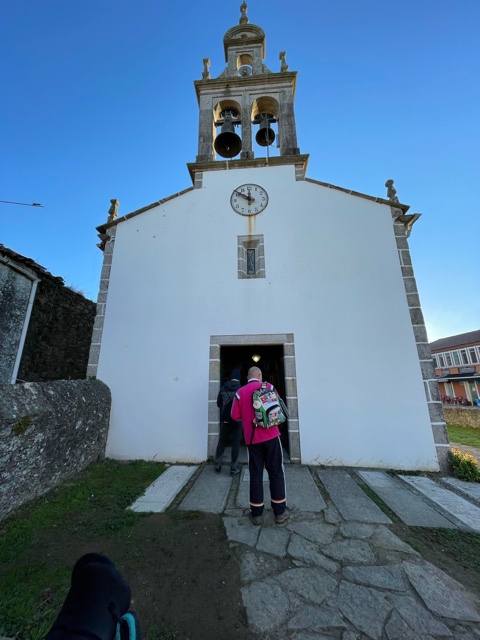
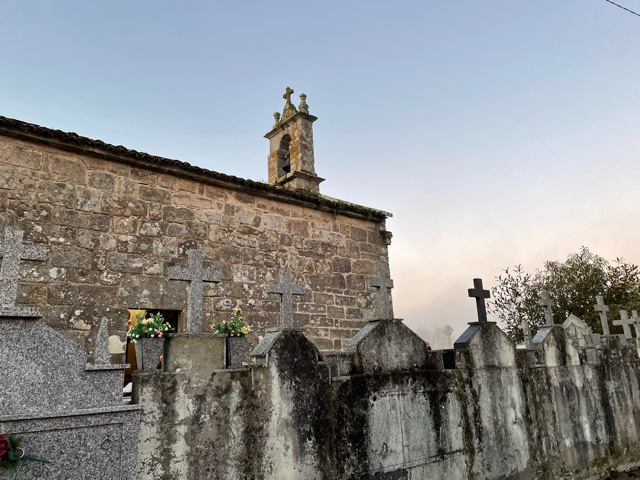
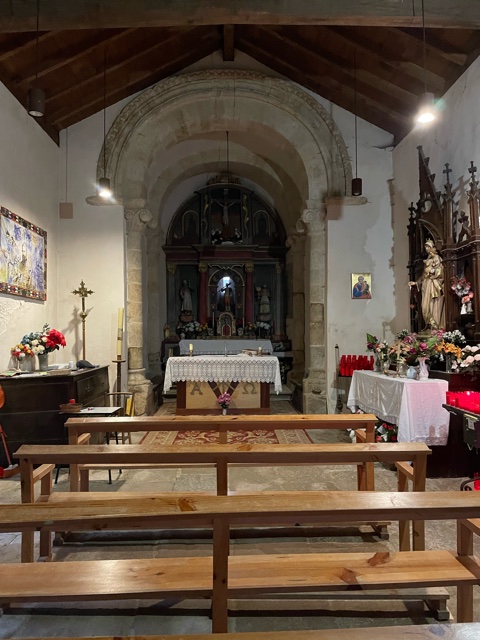
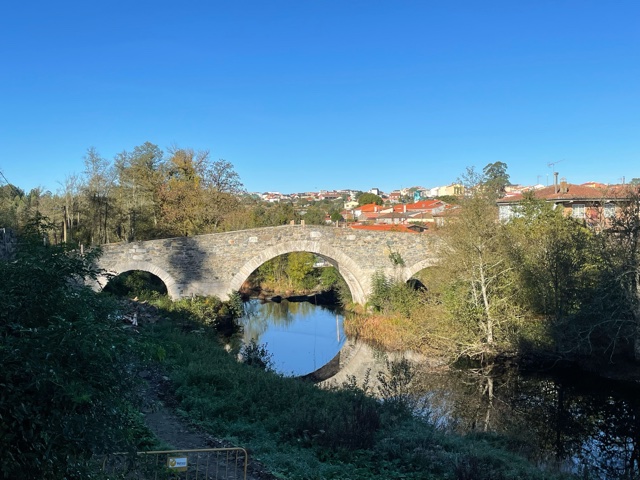
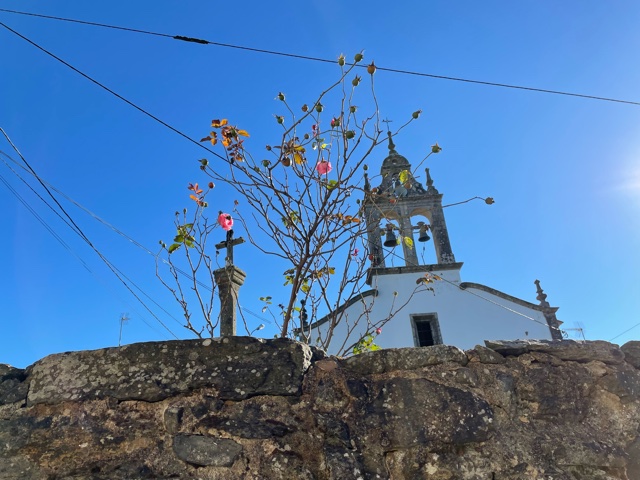
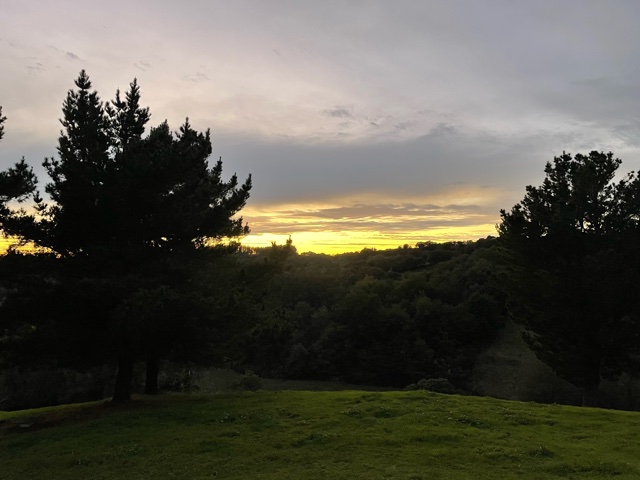
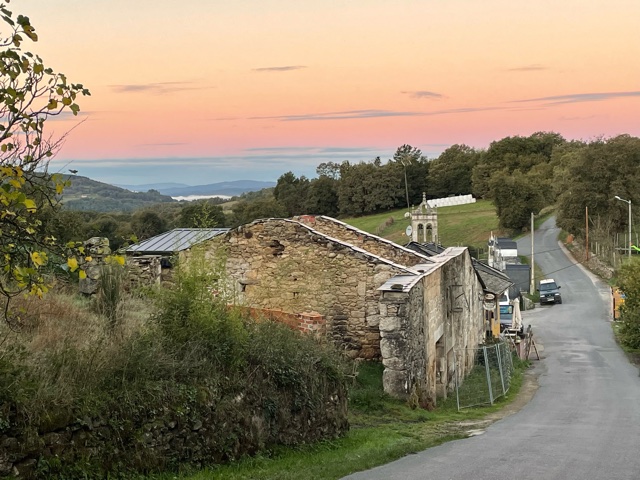
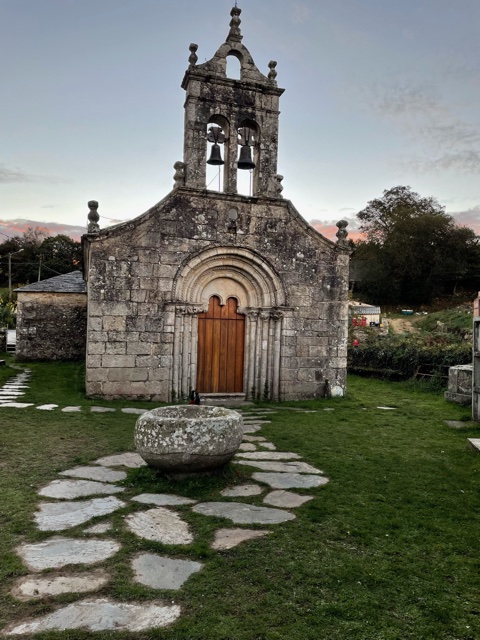
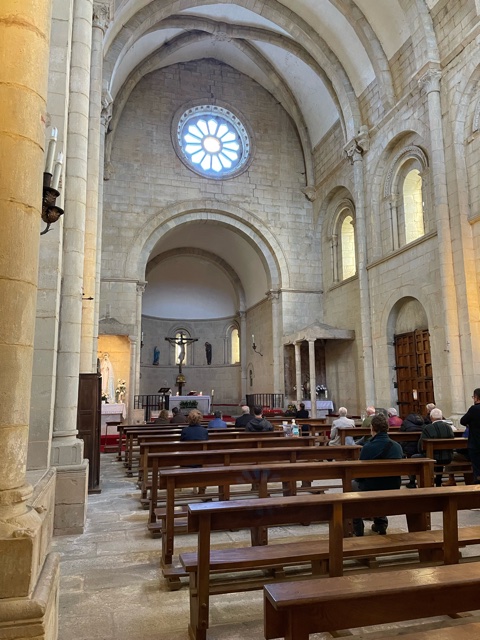
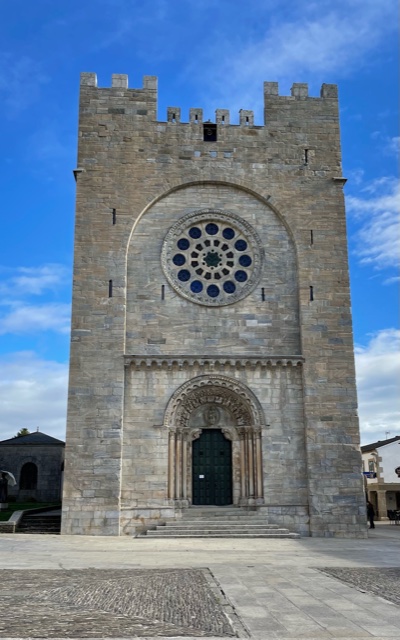
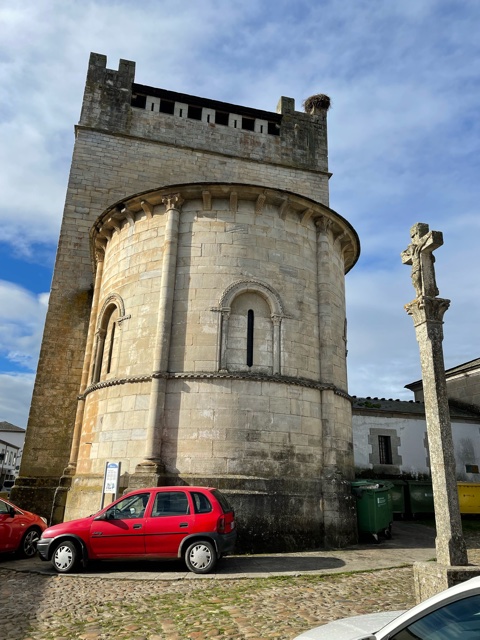
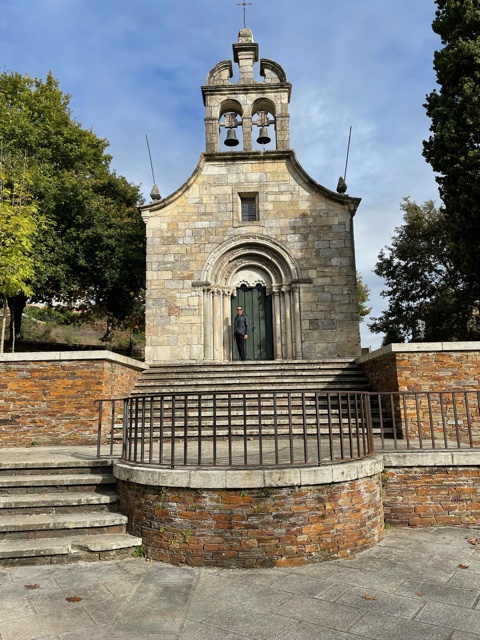
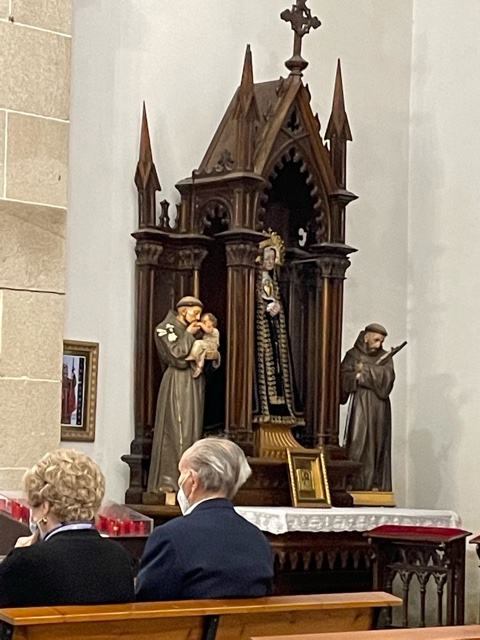
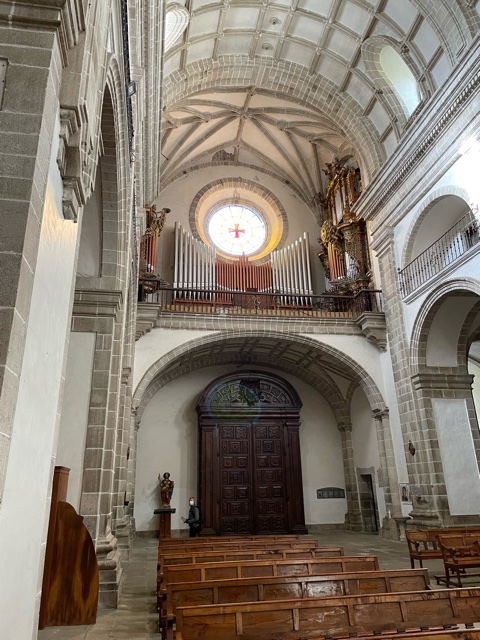
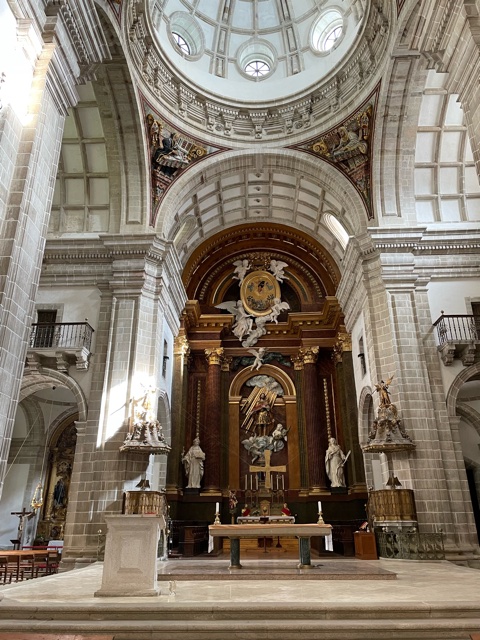
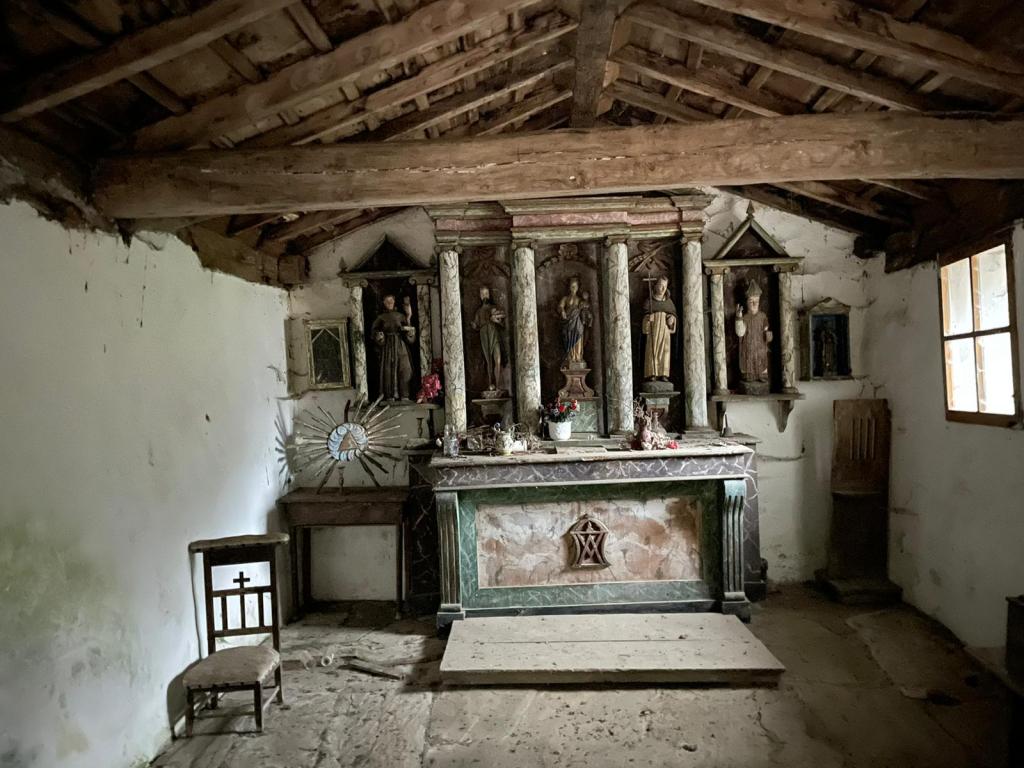
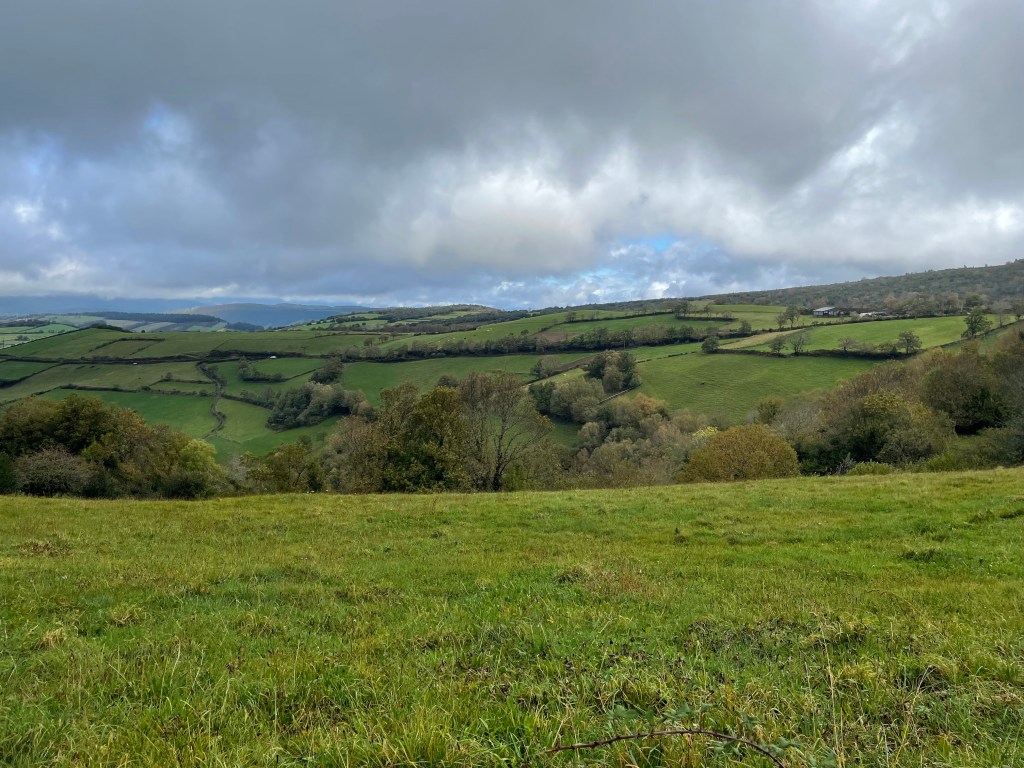
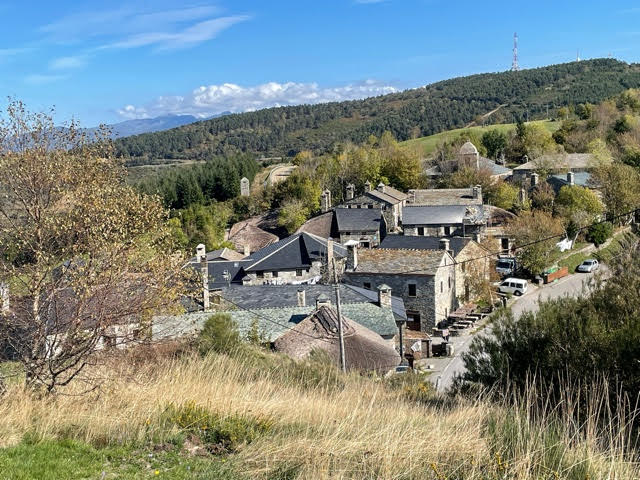
Here are a few shots of the scenery and two very small groups of houses that were actually two different villages. The difference between them is that someone clearly had enough money to figure out how to integrate the medieval buildings with more substantial livable buildings – as well as filling in the street beautifully. I liked both places, of course. Each small village had a church at the end of the group of houses, the second one was wonderful. I couldn’t see how much it had until I used a flash on my camera just inside the security grille and I saw all the statues in the niches.
Hard to see, perhaps, but the light brown are all the ferns that have changed color for the fall – so pretty.
Just so pretty with the birds
Ancient town not fixed, or st least not much
Just a 100 meters (?) away, next group of houses, but had fixed the street and added/remodeled somehow integrating old and new
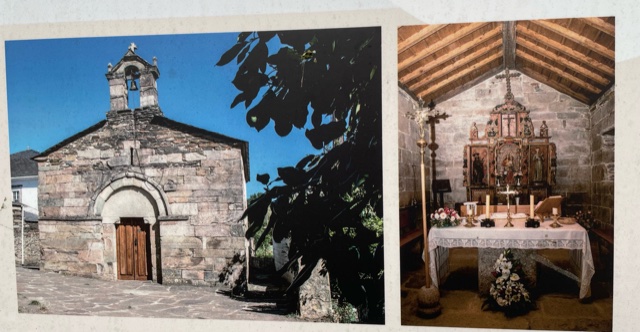
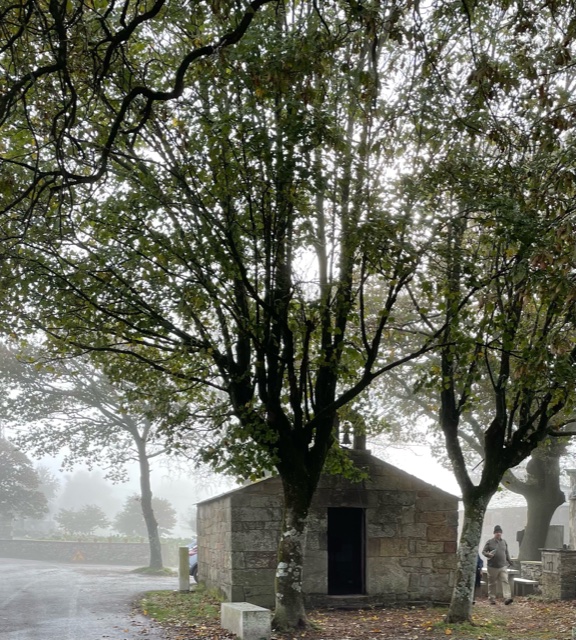
Each little town had a chapel at the end of it. The run down town had the little one with the blue cross, this was at the end of the second one. Chapel of San Antonio da Balsa. I didn’t realize all the statues were there til my camera flash lit them up. I think this would be a wonderful place to sit. Elias Valina, I think the priest who restarted the Camino, described it as “humble, traditional” from the early 1800’s.
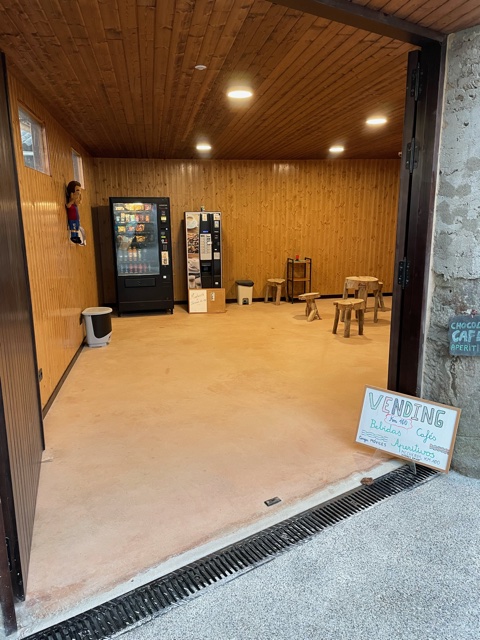
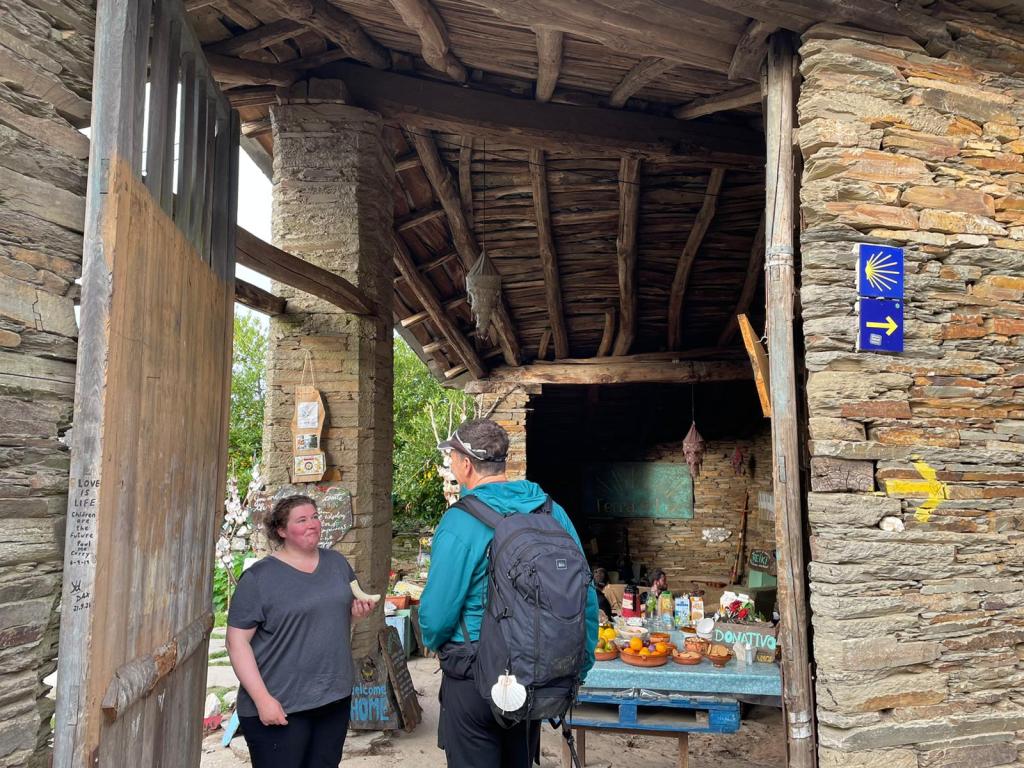
Below was a shot of a hippie like gathering, complete with a guy playing the guitar and a group sitting around on couches in this open area. Felt a little studied to me, but I also felt old! We just looked in and kept going on. Rick’s talking to Johanna who we’ve met a few times, so nice, taking her time walking the Camino. She’s the one who left our wonderful place a couple of nights ago at 5:30am and walked up in the dark through the woods. She moves slowly and wants a lot of time, but wow. She told us today she was worried about wolves. I’d be worried about getting lost and not seeing an arrow to point my way.
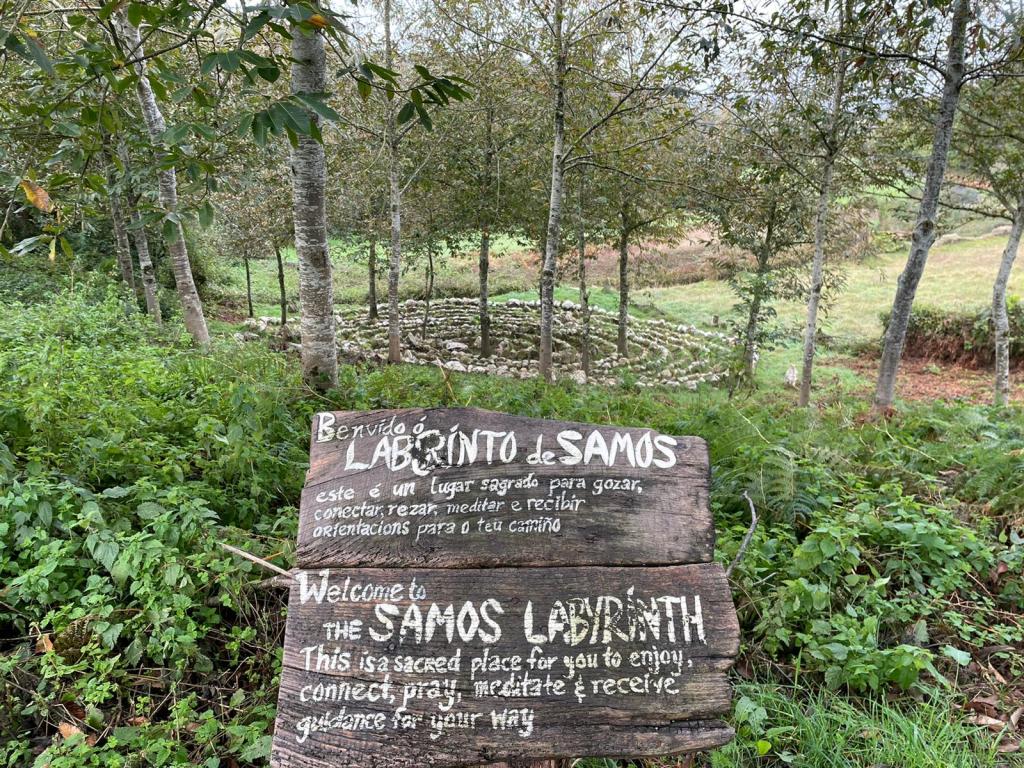
But, whoever this group is, they built an amazing labyrinth years ago. Both Rick and I walked it and it probably took us close to 15 minutes and not going super slowly, just quietly.
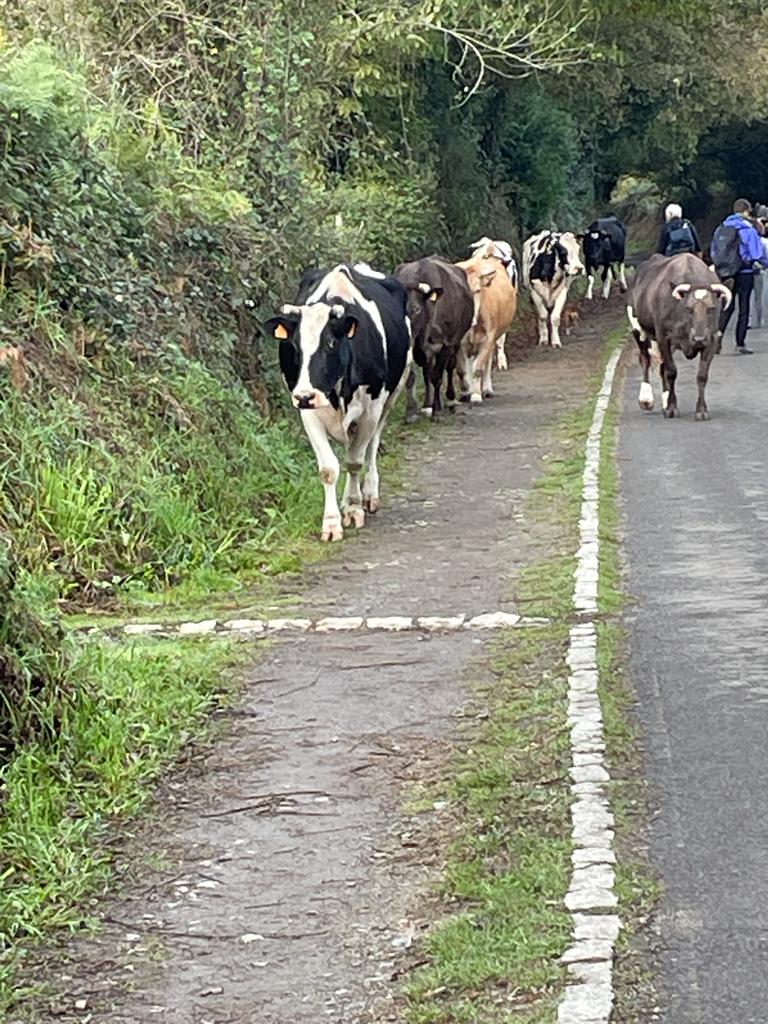
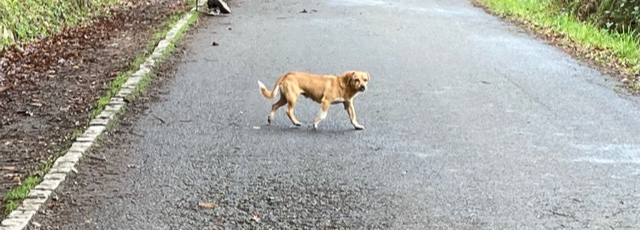
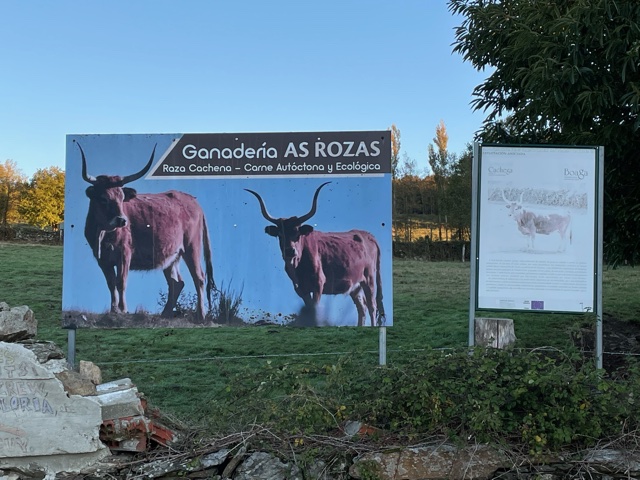
Then the cows changed – Jersey now? Not bushy and tan. And finally a few donkeys. I’ve heard them periodically over the days, but hadn’t seen any.
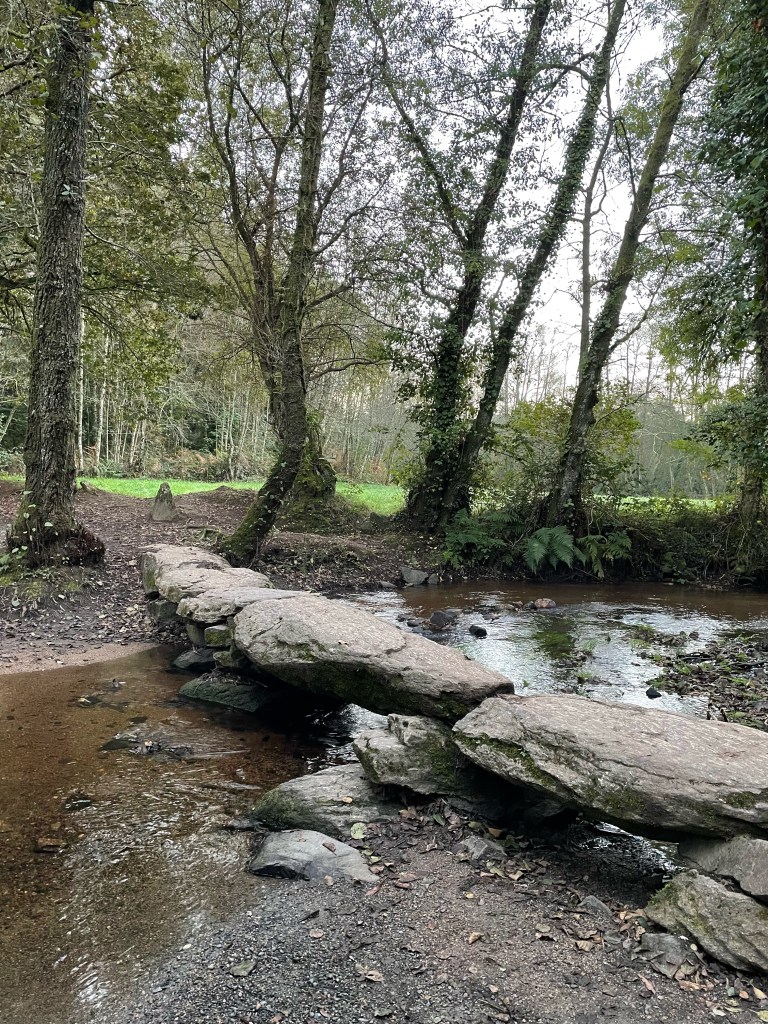
And, finally, a little path that led over a creek, realized later that it was the same shot that was in one of my books.
We had a great day in O Cebreiro after our hike, as I wrote about yesterday. But later I did get time in the church and the priest who was so dedicated to the Camino is buried here and the Pilgrim’s Prayer displayed to him was/is wonderful. Cut off the title – but it is Pilgrim’s Prayer. Think it’s similar if not the same as the one in … Burgos, I think.
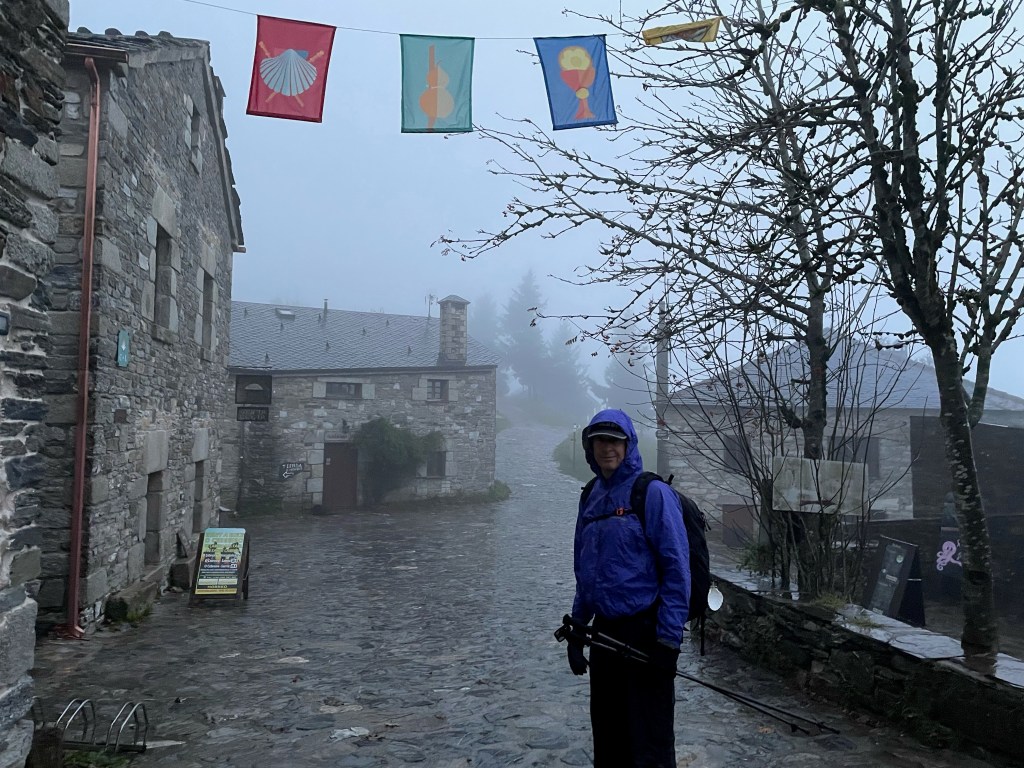
So we started off today after breakfast, this is what it looked like:
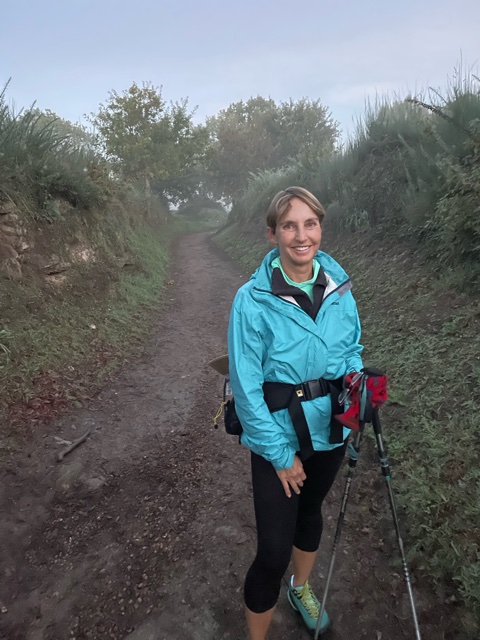
This is what I looked like without the dress and with a fanny pack instead of a pack:
We were mostly warm enough, dry enough – not – but it made for a wonderful dream walk, quiet and I really enjoyed until I was cold enough that I was very happy to land here. We got chairs next to the fire and thawed a bit.
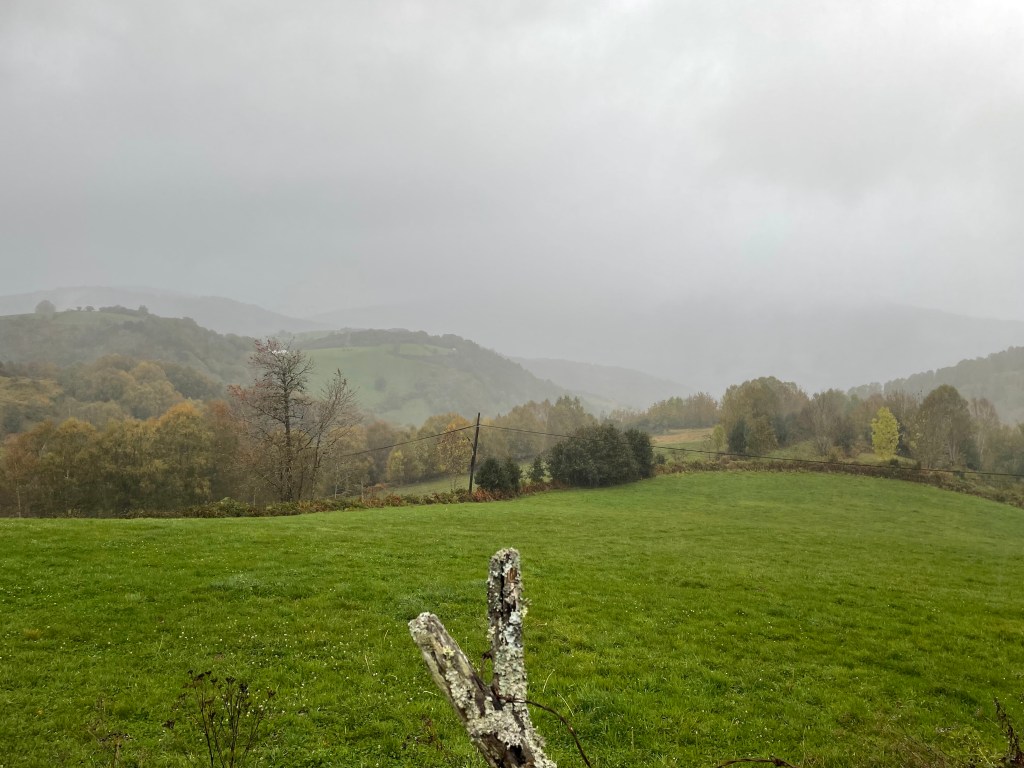
But the result of all this rain and why the area of Galicia is called the Ireland of Spain is not just because of the music and the ancient Celtic houses, it’s also because it looks like this:
It started to lighten up a mile from the end and it was beautiful, plus both Rick and I were listening to fun things which motivated us, both dharma and then the Moth. Thank goodness for the Moth Radio for some of the end of the day miles.
We’re now in Triacastela, named for 3 castles that are no longer to be seen. The church’s front porch is from the 6th (!) century with the rest added as needed after various wars and nature’s gifts.
Only one restaurant in the small town, people very nice everywhere. Rick and I have a cozy little room on the ground floor of our very small hotel/albergue and it looks like it’ll be quiet!
Rick’s here! Notice the orange added to my pink on the map. It’s a wee line because we had such a short day, but oh my, he landed in a great spot. First, last night continued wonderfully with dinner after his arrival with the group I’ve been having meals with, then window open, quiet, just the river and occasionally the animal bells.
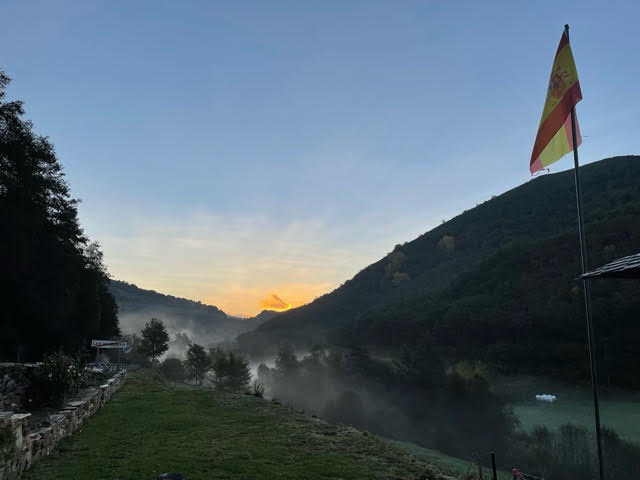
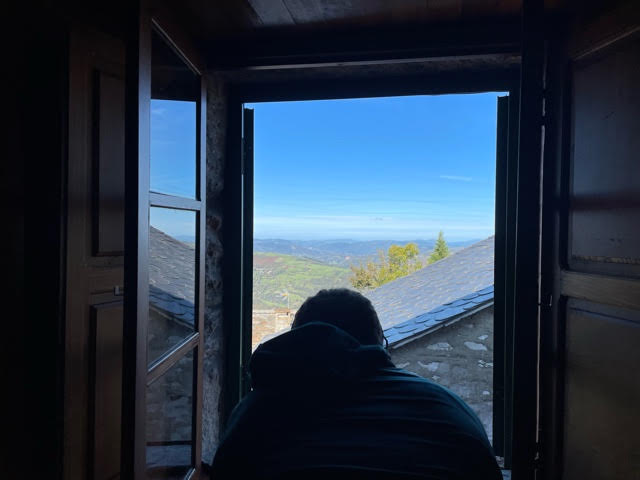
Farewell in the morning to Herrerias with the fog coming in and out and then the sun coming out later, shot taken out our window as we left.
Then further up the mountain with the Spanish flag waving:
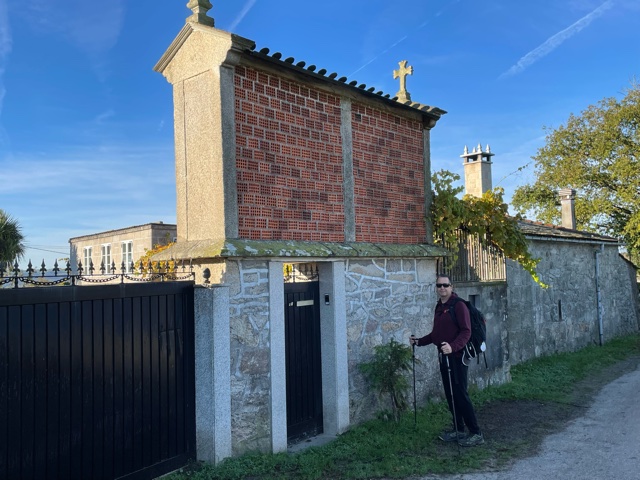
On the way went through a tiny town that had a few solid looking houses. This one caught my eye because it’s still used as those big houses in Akerreta used to be used – animals on the bottom, people at the top.
Gorgeous hike, not hard at all with a hot chocolate at the top at a little town, just to make the hike last a bit longer. Then we came into the best little town, O Cebreiro. Here’s a photo from the hill next to the town.
50 inhabitants, many houses remodeled as albergues or hotels. This time we actually have 2 double beds instead of twins, luxury. Definitely stepping up now that there’s two of us in a room.
Here’s Rick looking at our window, just delighted with the town, history and best – the church is wonderful and has music playing. I’m going to go sit – he’s already there – when I finish this post.
This town has a wonderful history. Both ancient and recent. Wise Pilgrim:
“O Cebreiro has grown from a small and ancient village of dairy farmers into a small and ancient village of tourism.
It has played an important role throughout the history of the Camino. It was the parish priest, Father Elias Valina Sempedro, who is most responsible for the resurgence of the Camino. It was he that first painted the yellow arrows, and the tales that surrounded him doing so are the stuff of legend. Once, in 1982, he and his white Fiat van parked along a trail in the Pyrenees. It was a time when Basque separatists were training blows with the Guardia Civil, and when they came upon him, suspicions were aroused.
He opened the van door to reveal cans of yellow road paint and identified himself as the parish priest of O Cebreiro (which was far away). When asked what he was doing, his answer was as simple as it was prophetic: ‘I am preparing a great invasion!’ It was he that orchestrated the installation of the granite hitos (mile markers) as well.”
Wise Pilgrim continues: “The parish church is also the setting for a miracle. According to legend, The Holy Grail was hidden there and in the 14th century produced a miracle that was certified by Pope Innocent VIII. A peasant from a local village braved the hike up to O Cebreiro during a dangerous snowstorm to hear mass. The priest chastised him for endangering his life for a bit of bread and wine. At that the bread and wine turned into flesh and blood, cementing the reputation of this small hamlet.”
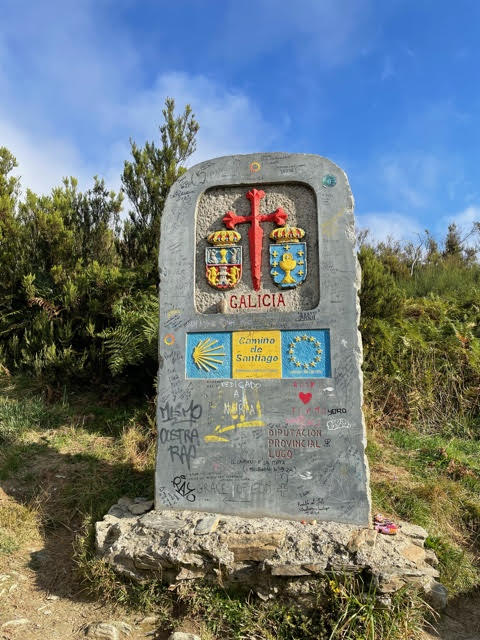
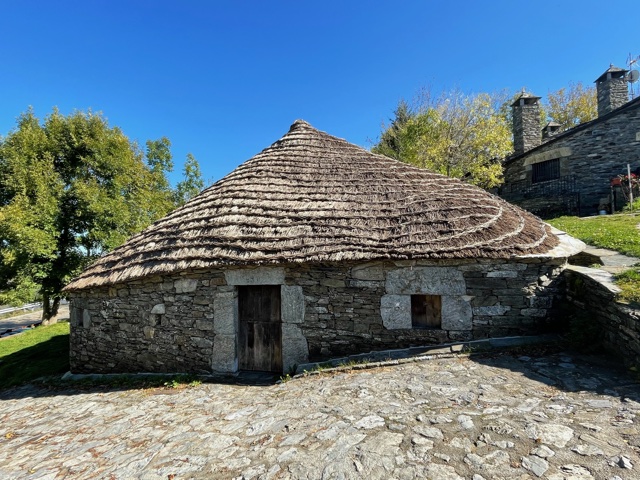
We’re now in Galicia, which was Celtic in the 800’s in origin before the Romans. The music – you think it’s Irish and then realize it’s just a little different, definitely a lot of it makes you want to dance with pointed foot and lots of intricate jumping and moving. The Celtic houses were round with thatched roofs and we saw a number of these on the way up and there are several in this village, though obviously or more recent origin than the 9th century.
The church’s foundations are from the 9th century, don’t know what happened to the churches in between, but the town claims the church is 9th century. Actually, from Pilgrimage Road: “In 1962 excavators found the meager foundations of a pre-Romanesque church under the streets of the village. Between 1965 and 1971 they rebuilt it from the ground up. Inside what remains of the medieval church are the Romanesque baptismal font and the chalice and paten.”
However, this is where the miracle happened. The Pilgrimage Road continues with this translation of an early 15th c poem by a Licendiado Molina:
I want to tell you – a miraculous story about a host – which was being consecrated. You will see changed – into perfect flesh what was at first – was (its) hidden (nature) An idiot of a priest – who was offering it doubted the truth – of the consecration The holy vision – was demonstrated to him, as it is today – in O Cebreiro.
“The particles remaining from the miracle were eventually placed in a silver reliquary donated by Queen Isabel herself. The church’s statue of the Virgin is said to have inclined her head so as to better view the miracle.”
Ok, you have to love all of that. Such strong beliefs, no wonder the churches often feel welcoming and well loved. And now I’m going to go sit and enjoy the music, the feel and maybe some quiet.
It was an easy day today, in to my hotel by 1:30 and such a sweet albergue. Just outside the town of Herrerias. I’m surrounded by green pastures, can hear both the river and the cow and sheep bells as well as the radio from the bar. Here’s a view from the balcony along the hotel.
And the food was good! Had a great lunch and am already looking forward to dinner in 3-4 hours. Sue and I have had all of our meals together for days now and we laugh that we get in, cleaned up, eat lunch. Huh, it’s 4 – 4:30 and yep, we’ll be good to eat in another 3-4 hours. Weird schedule, but it works. Rick’s coming in tonight and still on American thinking, re no – can’t eat that late.
We start tomorrow with our shortest hike of the Camino, 5.6 miles straight up a mountain. Don’t imagine it’s all the way up, but it’s enough that the business that takes people up via horseback a-la-pilgrims-of-old does a steady business. 3 of our friends did it today and said it was great. 2 more are doing it tomorrow. Sue says no, then she’d regret not having walked the whole thing. I’d probably think about it, but can imagine what Rick would say for his first day of walking if I rode instead. So – probably not!
I’ll walk into Santiago righteous indeed…
My calves are still talking after the steep downhill couple days ago, hoping going straight uphill will undo that talking.
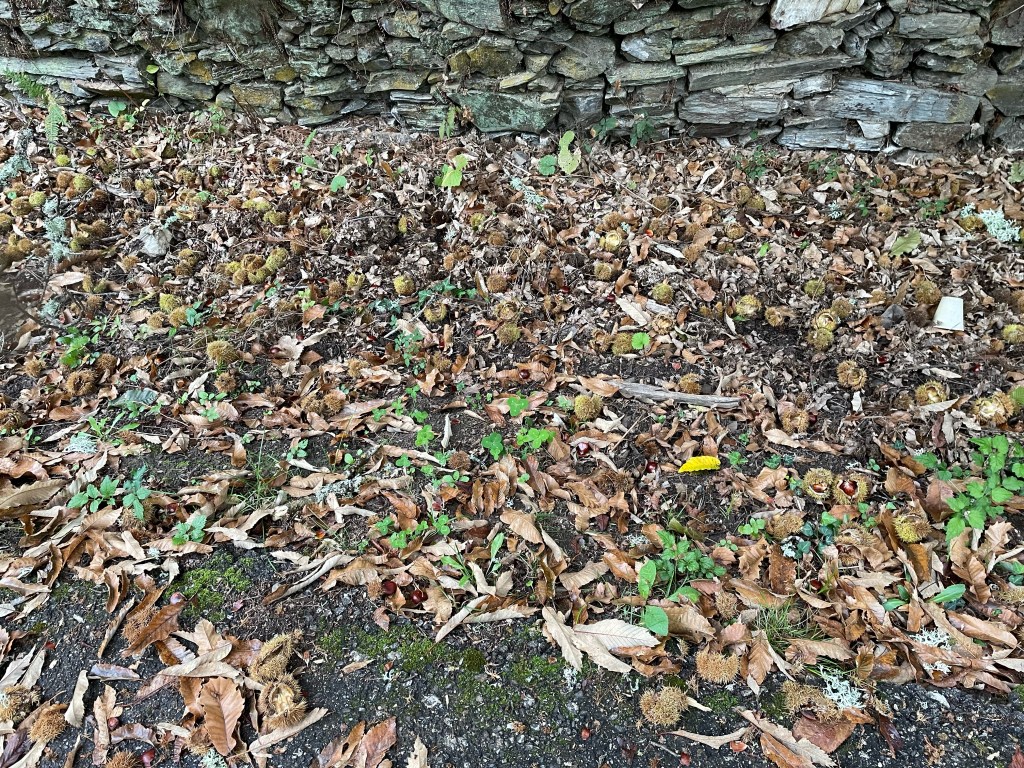
Here’s a photo of chestnuts on the ground – big around here and saw people parked by the side of the road picking up chestnuts. An ancient woman was stooping and reeeaaaccchhhinggg out to pick up one at a time. She had already filled one apron pocket and was still collecting. I couldn’t believe people just walked by without helping. So I started looking and realized you do have to be a bit picky, rich color, nothing eaten into it. I gave her one, was going to find more, but realized her hands were already full. Sweetest face, talked a lot and I didn’t understand but maybe 1 in 10 words, thick accent. So cool. I love this adventure.
Not a single church today to explore. There was one that looked like it might be open with a curtain covering half the door, but it also looked like it might fall down on you if you walked in, so kept walking.
It’s beautiful in this area, walking between the road and the river, flat pavement with easy hills.
The country has changed again, heading into mountains tomorrow. I don’t know why everyone makes such a big deal about the Pyrenees on the first day, then again, I was straight from CO. It was completely beautiful and also very doable. These next mountains look steeper and with more challenging trails. But maybe not!
The photo below is from a mural on the outside of a church outside Ponferrada, I’ve never seen the gospels pictured as animals. Attracting pagan practioners? Particular traits to all but Matthew?
And this bit of a video is from where I took 10 minutes to eat a banana and sit with the brook and birds.
I passed the most complete castle on the Camino in Ponferrada, built by the Knights Templar, but it wasn’t open and I had a long day so couldn’t wait.
There’s also a castle here in Villafranca, but it’s not open to the public, but still cool!
This town is wonderful, medieval falling apart mixed with updated, mixed with renovated and some new. The main plaza reflects this – churches in the background, old cobbled streets, restaurant/residence that looks good in the front, but has been sprayed heavily with the yellow insulation I’ve noted before that both keeps things warm and probably holds together ancient walls.
This doorway is from a the Iglesia de Santiago – the church for pilgrims. We weren’t allowed to take photos of the inside, very bare, felt so old and not added/changed except to keep it standing over the centuries. The north portal, shown here, is from 1186 and is called the Puerta del Perdon. “According to tradition pilgrims too sick to go on could enter the church through this door, take communion, and receive pardon for their sins, a privilege confirmed by the 15th c Popes Urban II and Calixto III (great names). Then they could return home and not go all the way to Santiago. Evidently a French pilgrim in 1965 fell very sick and requested the door be opened. He prayed, healed and returned home contentedly. I’m not taking that option – plus I’m not sick!
This church, Iglesia de San Francisco was huge – you can see the people in front to get a sense of scale. It wasn’t open, sadly, I’d have loved to see inside. The Pilgrimage Road to Santiago: “Tradition holds that San Francisco (Saint Frances of Assisi) himself founded this church in 1214 on his pilgrimage to Compostela (Santiago).” There are a few pieces of the church from the 13th c, but most is now a 15th c Gothic church. The description of it sounds incredible, but I’m not meant to see it.
Four of the friends I’ve been with for the last two weeks are moving on tomorrow, doing a long hike that’s broken in to two days for Sue and me. We used the same travel agency out of England – they just happen to have an office in Boulder, of all places. Rick’s probably going to be disappointed, but his first day we only go 5.1 miles. It is supposed to be basically going straight up. Only short day of the trip. Sue and I will be thrilled!
First, a farewell to Rabanal with a gorgeous sunrise:
The scenery has suddenly changed to ferns, cows, trees:
Passed a few little towns, eating lunch on the way. This one hut/stop was actually a town, Wise Pilgrim wrote: “Manjarin wins the prize for the least inhabited inhabited town on the whole of the Camino. Exactly one person lives here year round, joined occasionally by friends and pilgrims. His name is Tomas and he holds himself to be the last of the Knights Templar. No services…
Climb up wasn’t bad, but the downhill was long and rocky so took it very slowly. This sign at the top of one downhill wrote: “a pilgrim without good humor is like the empty world.” And, really, everyone was good humored about the long trek down. I finished my book, In Love with the World by Yongey Mingyur Rinpoche. Incredible. So many things to ponder as I walk.
This is what part of the descent looked like looking back up:
I just took it really slowly and at the bottom our whole group collected over time for lunch at an albergue run by a guy from Houston who lives there for the season, then goes back home for the winter months. It was so nice to chat with someone who spoke English, got a great salad instead of the usual meat/cheese/giant bread sandwich. And they made the best hot chocolate yet, so two more people joined me when they saw mine. The owner and I then exchanged stores about the Rice and A&M bands competing at football games. Flash from the past! There were four of us at the table with Texas roots.
Then I got to my town for the night, Molinaseca. A beautiful town. Here’s a day shot, then a night shot. Sue said it looked like Diagon Alley.
Tomorrow’s a long one, passing a town that has a castle – wish I could see, but won’t have energy probably. I’ll just admire as I pass.
Here’s morning views of the Cathedral on my way out of Astorga:
Then right after the cathedral, I saw this sign and a memorial re the peninsular war with Napoleon.
I’ve read a ton of books based during this time and realized that I rarely see anything about it when I’ve been in London. Granted, maybe I wasn’t looking, but to see these notes brings back how rough that war was. War is always awful, but for some reason, this one isn’t too present in current language except everyone knows aboutBattle of Trafalgar (recognized at Trafalgar Square in London) and Waterloo which finally ended Napoleon’s reign and come back.
Then a long walk. Actually, only 12 miles, but for some reason the second half felt long. Luckily, between book, The Moth radio and Poetry Unbound podcasts, finally got my mind off how tired my legs were. I think I’ve slowed down to about 25 minute miles, whew, really flying along. I do take breaks thus part of the slow pace.
Another interesting artistic interpretation for pilgrims at a more modern church:
This town is the only town on the entire Camino named after a woman:
And an impromptu creation by passerby pilgrims, went the length of the fence:
And, then walked into Rabal del Camino.
I know it looks like yet another ancient Spanish town, but something’s different about it. It’s really small, but feels solid. The town before this was literally falling down – and was noted as so in the Wise Pilgrim, the app I’ve started using. Great details.
But Rabal feels welcoming, kind, I don’t know. Thought it was just me, but then talked with a couple of guys over lunch, both late 20’s, episcopal priests, great people. One a chaplain in the army (“I differ from others of my profession, I profoundly disagree with war and think there better be a very good reason for being there – not for oil, etc.) and the other from Houston at the cathedral downtown. They said it first, that walking into this town was different. Feels healthy and welcoming. Yep – I thought the same. AND there is a vesper service with the monks every night at 7. Definitely looking forward to it. A tiny church, only holds max 25 (that might be a little bit because of COVID).
Another sign of this cool town was this little table and the poem next to it:
Of course I had to take part, so dropped in an euro and got this poem as a random pick:
The small man builds cages for everyone he knows While the sage, who has to duck his head when the moon is low, Keeps dropping keys all night long For the beautiful rowdy prisoners. Hafiz
I did go to the vesper service, sung by a single monk (the other one was sick) and the returns were sung by the woman who sat next to me. The only villager who was there aside from the pilgrims. She told me she was born in the town and clearly knew and took part in the services. Seems like it could be lonely for the 2 monks, except they probably know everyone in town and take care of counseling, helping, and whatever else the community might need. Both of them had great voices!
It was nice, sung in Latin, so couldn’t understand anything, though there was a Spanish translation running parallel in the program. Just knowing that services had been held there since the 1100’s is amazing. It was really small, there were probably maybe 20 max people and that basically filled the space with COVID space between people. There were patches everywhere as part of ongoing renovation, but I did look a bit gingerly at the roof.
Then dinner with 8 of us here at our hotel, Refugio. Should be fun, then the three amigos go on farther than me tomorrow, sad to see them go. Maybe I can get them to come up to Boulder to visit. Sue’s with me at least one more night, maybe a couple more, not sure about Bev. Things do shift and turn on this journey.
Today was blissful for most of the early hours, I was alone on the path (thanks to the 20 miles yesterday), it was beautiful out and cool, then sunny. I had hours of quiet before starting my book.
I started out by walking back into Hospital de Orbigo to get back on the Camino. I passed a younger guy just loading up. He had a large backpack, a day pack and a grocery sack full of things. I have no idea how he was going to walk. I remarked on all of his stuff and he noted how little I was carrying. We both laughed and both were very pleased with our relative situations. And it was in Spanish which is always truly satisfying no matter how simple the vocabulary and small the conversation. So I started the day with a grin.
After about 2 hours, I came into Santibanez de Valdeiglesias – how’s that for a name? I was ready for a break, a hot chocolate, but first went to the church because there was a sign that it was open. It was a newish church, still really ornate in the altar and completely quiet. No people except for the man who opened and had the stamp for my Camino passport. I was able to sit and just have silence and it was perfect. Just as I had imagined when coming over here, but has rarely happened.
Then I had my hot chocolate and off I went again. Next I encountered a side stand run on donations. It must have taken a lot of work and was a treat. Everyone was stopping and eating fruit, peanut butter on bananas, whatever they wanted. I took a large bunch of grapes, dropped a euro in and went on my way. A perfect snack for the road.
Then Camino art around pilgrims:
And then walked into Astorga. I am in a really nice hotel – surprise! Right next to the cathedral, truly quiet, clean, so nice. I remarked on the change from the gas station hotel to the front desk clerk and she said – well, that’s the Camino. A different experience every night! True, very true.
Showered, had lunch – it was decent and not meat, had fish! Then the bank, then the laundromat – yay clean clothes – it was so satisfying to see it going around in the washing machine, much better than the sink. Then – the chocolate museum. Yep, there’s a giant cathedral, but didn’t want to miss the chocolate museum.
Chocolate making and Astorga happened in the 16c – this is how the brochure put it: “It started when Herman Cortes came back from Central America conquest. Herman Cortes could have had a connection with the city of Astorga, due to the marriage agreement of his daughter with the heir of marquessate of Astorga in 1545, although finally this marriage didn’t carry on, it could be that previously, as a marriage portion cocoa could have been included, not for its nutritional value, but for its economic value.”
Love the phrasing. Astorga is still known for chocolate, but its heyday was in 1925 when there were 51 chocolate makers working at the same time in the city. Can you imagine? It must have smelled wonderful.
And then on to the cathedral. I always love it when I catch the bells, here’s just the side view, but the bells started chiming so did the quick video:
It was begun in 1471 and most of the work was done in the 1500’s. It was described as German gothic and it was a heavier feeling place than Leon. I was mostly interested in the different depictions of Mary. This is the main altar and was done byGaspar Becerra in the 1500’s – described as the Michelangelo of Spain. My book says this retablo mayer (display behind the altar) is one of the best Renaissance ensembles on the Road – it really is monumental.
Here are 2 more of Mary, the first from the 11c and the second from the 16c, so different.
And a third that was used for baptisms and had the kindest face, forget when it was done:
Then the Gaudi, or Disney, or no, Gaudi museum – didn’t get to go in, but wonderful building, as was the building in Leon. Someday, I’d love to go to Barcelona to see his architecture on full display.
Just a great day and now to bed and maybe even to sleep!
Well, today was a bit challenging. By the end, there were no other pilgrims and my maps weren’t working and I was beginning to wonder if I’d ever get here. Here being a gas station hotel. Hmmm. It was also the first day that I needed more water and didn’t have it. Oops. There were no cute little towns with cafes and that was a surprise because it looked like there were on the map I did have. The towns were there, but nothing open at all. I was walking through another asleep village and saw a farmer hosing down his tractor in a giant garage so I asked if I could have some water and filled up my water bottle. Saved me!
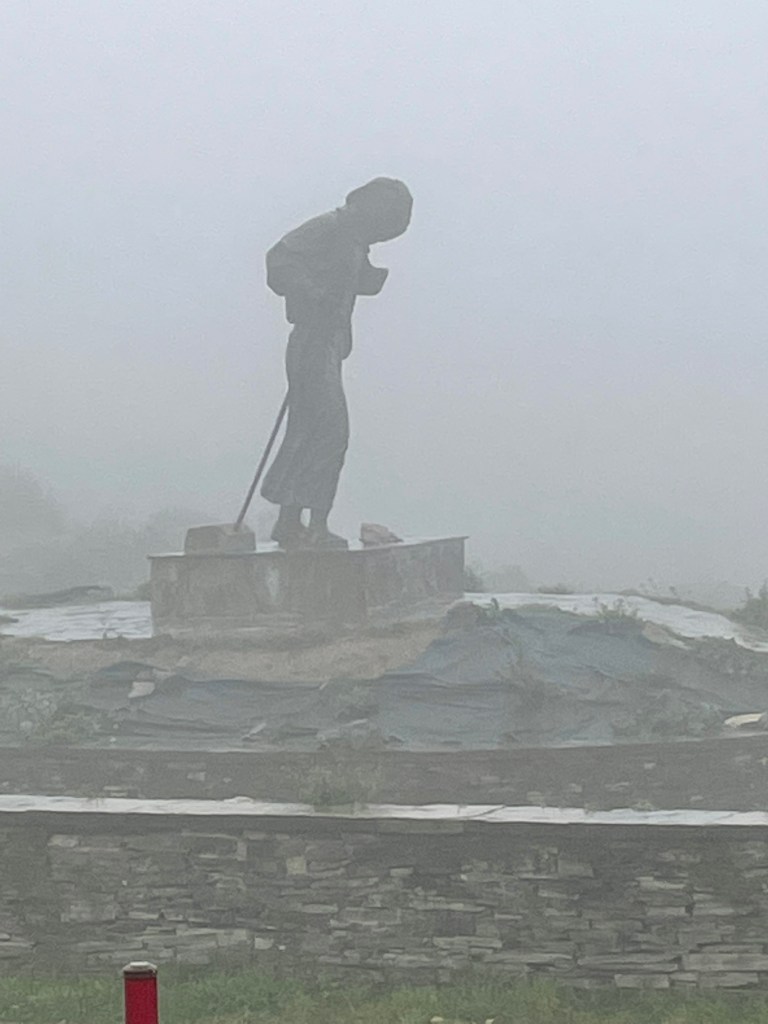
But it was pretty, land changing again, starting to be a bit hilly, just slight, tomorrow the climbs start happening. Happily, tomorrow is only 10 miles. The photo above was a fun pilgrim statue – and that was it for that town. Don’t know where the town was, maybe it’s just a sign of a town.
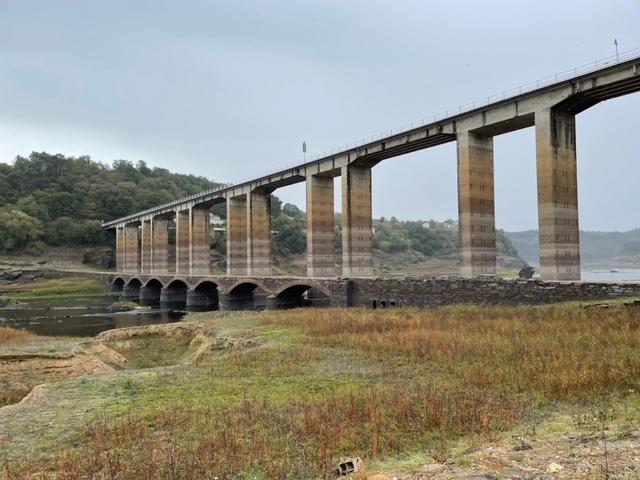
The town that I’m just outside of had this bridge which was the most significant thing for the town and it was beautiful.
This one had a good story – And this bridge of 19 arches has 4 that are original to 13c and were there for the story!
From The Pilgrimage Road to Santiago:“In 1434 the Leon knight Suero de Quinones held forth on this bridge against all comers in what may have been Europe’s last true medieval tournament. Suero, scorned by his lady, wore an iron collar around his neck as a sign that he considered himself bound to her. When that failed to impress, he resolved to challenge the best lances of Europe to meet him on the Orbigo Bridge. Suero went to King Juan II at Medina del Campo, where he secured the King’s permission. In fact, the King had his herald ride through the kingdom reading out Suero’s 22 conditions of challenge. The word spread like wildfire through a European nobility sated with the messy intricacies of court politics and gruesome dynastic wars and yearning for the simpler world they read about in Amadis de Gaula and their other books of chivalry. That fictitious world was a place in which a single knight, by the force of his personality and sword, could prove the virtue of his cause though the whole world be arrayed against him.
The wooden lists were constructed in what is now the grove alongside the bridge: 146 paces long, with a palisade and spectator galleries. 1434 was a Jacobean Holy Year (like this year, actually) so in addition to the contestants, their retinues, royalty, and the merely curious, the Orbigo road also thronged with pilgrims. Suero had the sculptor Nicolas Frances make him a life-size mannequin, sumptuously dressed like a herald, to set beside the pilgrimage Road with a sign pointing the way to the lists. The jousting began 2 weeks before St. James’s Day, the moment of maximum traffic along the Road (Camino). Colorful battle tents were pitched everywhere; pennants fluttered in the breeze. The air rang with the shouts of squires and the clang of steel as the knights rehearsed for the upcoming contests.
At dawn on July 11, 1434, the longed-for tournament began. Musicians blared out the fanfare, church bells rang, and the assembled knights and their retinues marched to the village church for mass. The jousting went on for several weeks and after each day’s contests the knights banqueted on the river bank. Musicians played and the knights and ladies danced in the flickering torchlight. On July 15 Suero was pitted against a Calatan challenger who, respecting Suero’s reputation, dressed in a double thickness of steel. To mock him, Suero appeared in only light armor covered with a woman’s blouse. The enraged, heavily encumbered Catalan was no match for the prancing Suero until a lucky blow to Suero’s head knocked him from his horse. The crowd gasped. But a moment later, Suero danced up, crying, “It is nothing.” On July 20, Suero and his close companions stood off 9 knights of Gutierrez de Quijada, who had stopped at the tournament on their way to Compostela (Santiago). Gutierrez, his knights beaten, rode off swearing vengeance.
On the last day of the tourney, August 9, a final great procession was held. Suero appeared and proclaimed that since he had proven his fealty to his secret lady by wearing the iron band and by breaking 300 lances at the jousts, he was now free. With that he removed the iron band and presented it to the judges. The crowd roared its approval. From the bridge, Suero led a procession all the way back to Leon (what I did today) where he vowed – now that he was free – to journey to Compostela as a pilgrim. This he did, and when he reached the cathedral, he deposited a jewel encrusted gold bracelet as token of his release from the prison of love. You will see the bracelet in Compostela around the neck of the image of Santiago Alfredo in the cathedral museum.
Footnote: 24 years later, after taking part in many battles in the 15c civil wars, Suero was riding in open countryside when he chanced upon the still-rancorous Gutierrez de Quijada. The 2 men dropped their visors and charged at each other. A moment later, the quixotic Suero de Quinones lay dead.”
Ok – totally fun story, the best I’ve read in the whole book. I’m definitely going to the museum to look for that bracelet and what a fun piece of pageantry to put into my head when I walk back into the little town to continue the Camino tomorrow!
Ok, I have a new favorite city. Leon is truly beutiful and you can just walk and walk within the old city and continue to see more plazas, beautiful buildings, remnants of medieval and Roman buildings incorporated into newer buildings. Really not sure how they do that and would love to see the inside of some of these buildings. The highlight is definitely the cathedral.
I had a wonderful morning. I got up and out by 8, knowing that the sun would be coming up and most Spaniards do NOT get up early given that they are out late – which you can hear most nights till quite late. I caught these photos early on:
I walked all the way around the Cathedral of Leon, seeing ancient walls and then the cloister. An older woman was walking into the cloister and told me a service would be at 9am, before it officially opened. I reconfirmed I heard right and went to have a hot chocolate and croissant while I waited. Then the sun hit the cathedral as I watched and the stone shifted in color.
I went into the cloister and it was wonderful. There’s a scene in Love Actually when the guard behind Hugh Grant suddenly breaks out in a deep baritone in a carol, same thing happened here. The priest was starting the communion service and suddenly this voice came behind us and this man in a suit was just singing unaccompanied in the most beautiful, seemingly effortless voice. The acoustics were perfect. I didn’t get a picture of the church – clearly not appropriate, but I did get a photo of the entry into the chapel and of the cloister.
The cloister is right next to the cathedral. I hadn’t put it all together yesterday when we did the tour. But going through that arch at the back of the cathedral and round the cloister, then seeing through the chapel into the cathedral linked it for me. I decided to go back into the cathedral, listen to the tour again (in English!!!) and try to remember more details. I was able to get some photos without so many people and noise. Actually, just music for a bit, so nice. It’s the most beautiful church I’ve ever seen. The stained glass is just incredible. Some of the things I learned:
The Romans fell and it continued as a serfdom until things began to shift in the 11th and 12th centuries as the Christians started gaining territory and moving the Muslims out. The story of the back and forth seems just painful and the Jews had the worst time of all, the Muslims were better with them, but things would just settle and then the persecution would start again. Leon has a whole focus on the Jewish culture and history, but everything is either gone or just a ruin, so I didn’t see anything that could give me a sense of the life for the Jewish people.
From the Christian perspective, life lightened in the 12th century with gradual prosperity building, a bourgeois class developing and there was Christian euphoria to be celebrated. Simultaneously, architects realized that they could use ribbed arches and not need as massive a Roman walled structure, thus allowing for light, high ceilings, windows and stained glass. Early Gothic was clean, airy and beautiful. This cathedral was built in the second half of the 13th century, 50 years. Incredible.
The stained glass generally had vegetable/fruit/mineral in the lower levels, human allegories showing the capacity for love and hate, then the highest windows were all related to religious stories and celebrations. There are 1800 sq meters of stained glass in this cathedral. The rose window was truly spectacular, but hard to capture, I did my best.
The early gothic then started to be more elaborate and the lecture called the period of the 1400s-1500s late or florid gothic. This is the thistle gate, entrance to the pulpits with elaborate carvings and details. She said, “luckily, the cathedral was practically unaffected” by this over enthusiastic demonstration of skill.
Below is a statue from the 1200’s (?) and is particularly beloved by the people of Leon – that of a pregnant Mary.
This is in one of the chapels behind the main alter. Then a closed gate with the chapel for “his holiness”. This is the chapel that’s part of the cloister, but turns out it’s also just off the cathedral. Interesting how it unfolds. My photos is taken from through the gate keeping people in the cathedral out. This chapel was built in the 1500’s so is “florid gothic”, but the lecturer didn’t seem to think it was too florid and I thought it was wonderful. Inside it is the container for the sacraments. When he opened it this morning, I thought it must be pure silver. Turns out, yup, the most valuable piece in the whole cathedral.
Isn’t is amazing? A whole church within a church. I don’t know why I’m surprised since this has been true every time, but still amazing.
I then finally tore myself away, went back to the hotel for breakfast and then back out to walk for a few hours, just absorbing the city, finding more ancient walls, walked into 3 more services. I seem to have a knack for communion. I’m becoming fascinated by the different manners of the priests, but they all have the exact same movements for communion. It’s “Spanish Day” here today and there were a lot of people at every service. And they all sing this beautiful song to Mary at the end of every service.
Turns out Spanish Day is actually Columbus Day – or that’s what we call it. We’ve pretty much moved past thinking that’s something to celebrate, but hasn’t changed here!
Beverly and I, as we walked through the city after breakfast, asked in restaurants for reservations for lunch (2-4pm and most places booked). Eventually found a place on a smaller plaza at a Japanese restaurant. The three Texans joined and we had a wonderful meal, completely happy to be eating different foods and it was seriously good. So today – my perfect schedule. Late breakfast with eggs, juice, toast, tea and then late lunch and then that’s it. Yay! Last night was also a great meal that I got a reservation for at a Spanish restaurant that was fantastic, but didn’t leave until after 10.
Leon is so great, it’s making me think I would consider doing the Camino again if Rick wanted to do the whole thing…