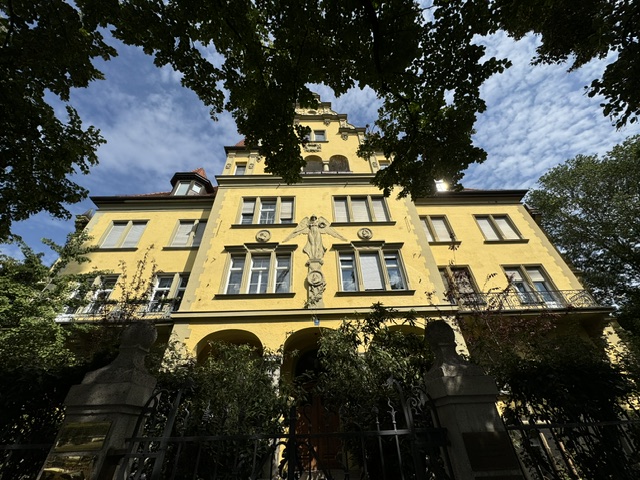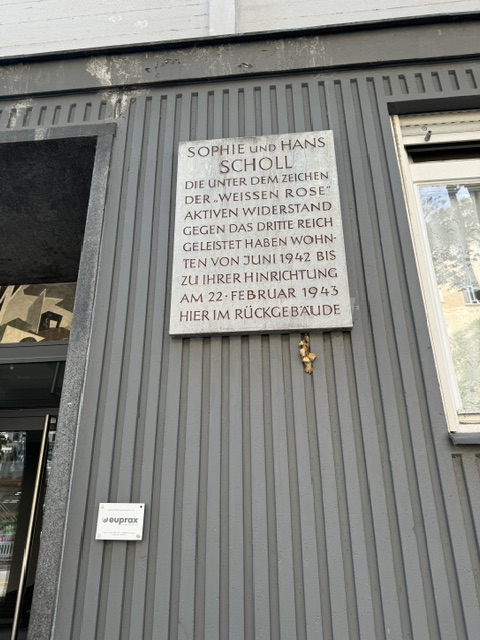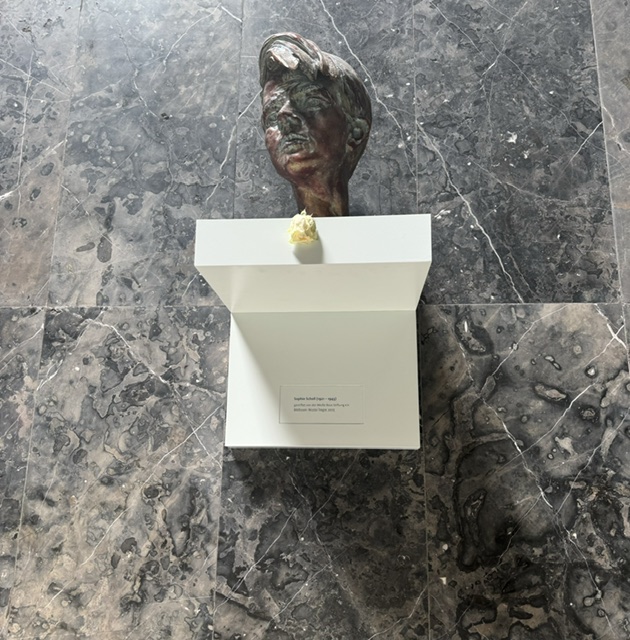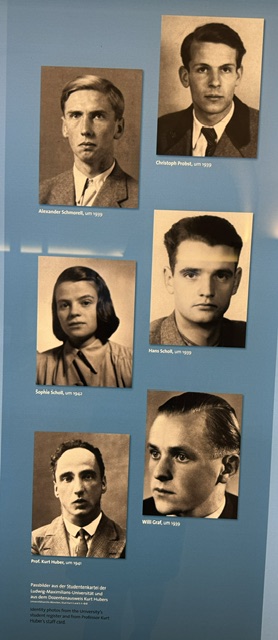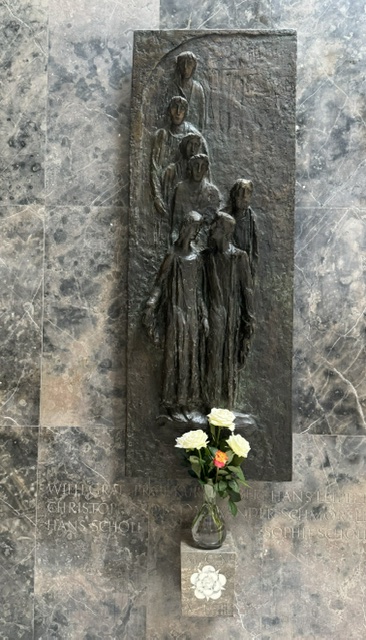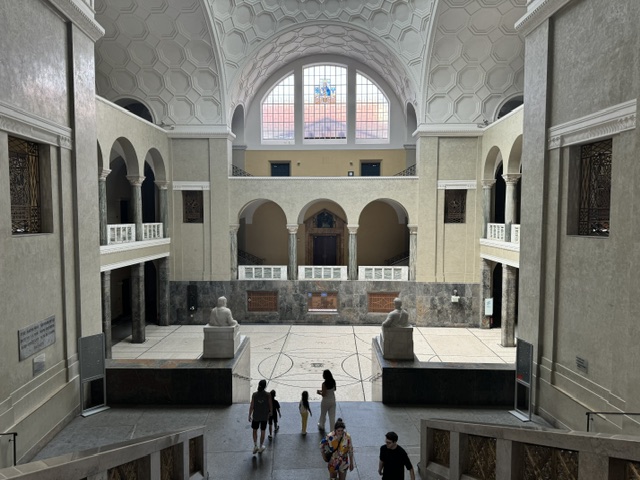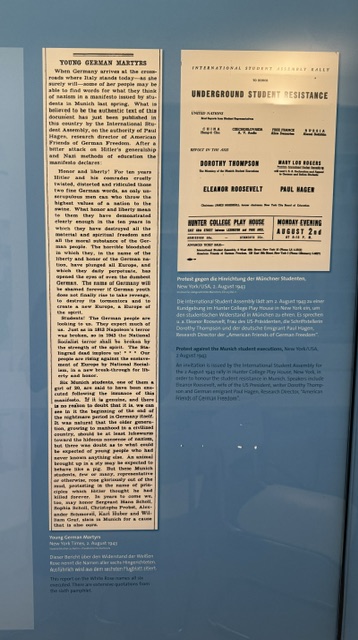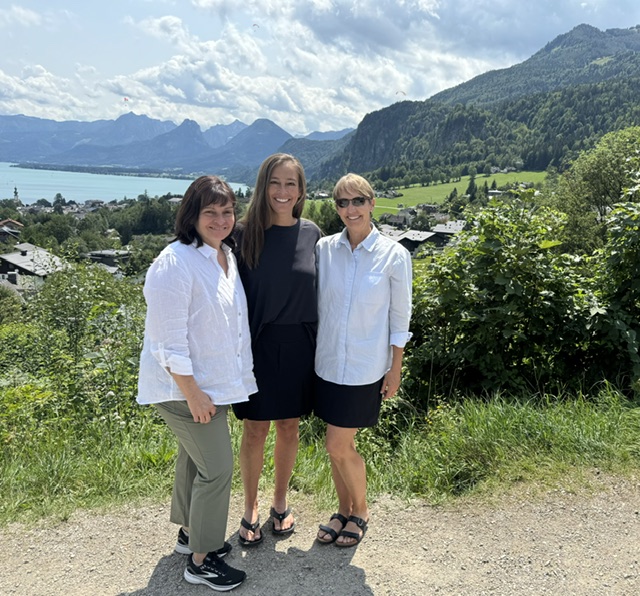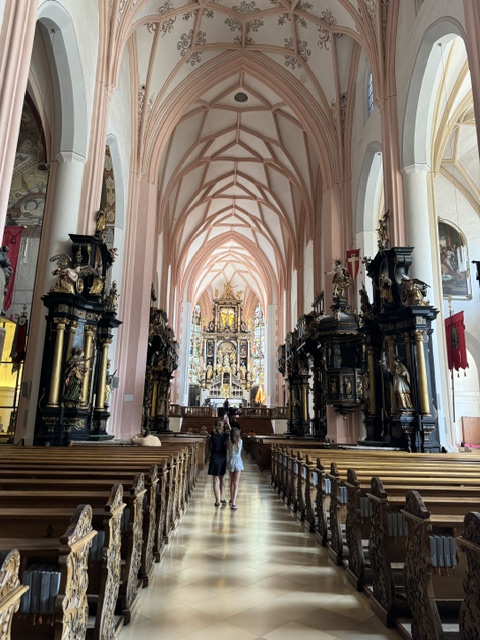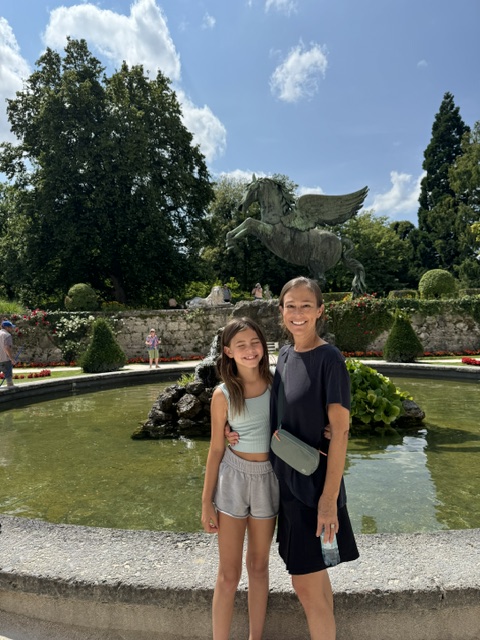
Austria, 24.July.2024, Wednesday

Salzburg

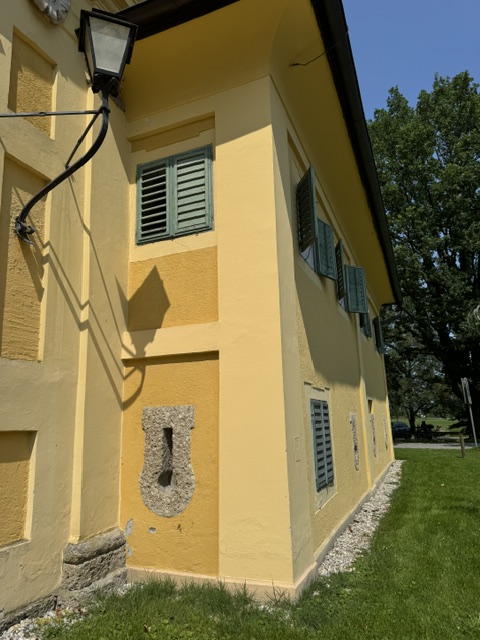
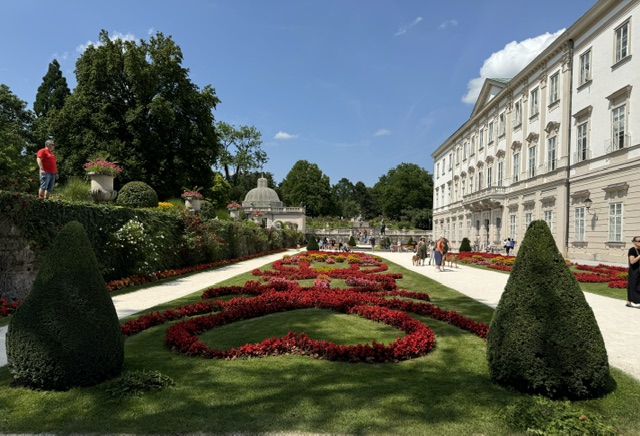
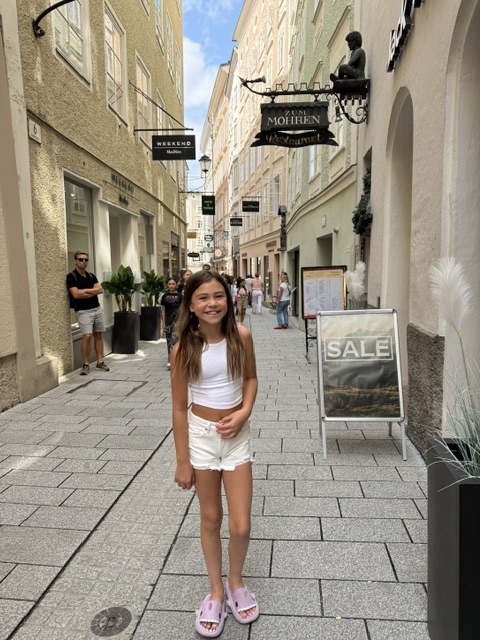
Of course, we’re here because of the Sound of Music (evidently Austrians do not get this avid interest, but finally decided to cash in on Americans’ crazy devotion), but oh, this city is so much more. It’s truly beautiful. We have a hotel in the old town, a Radisson – Altstadt Hotel – and it’s very old, redone, and the front desk people are lovely. The inscription on the paint outside says 1332 and 1992. 

Tricia and I are in a crazy room, the Kaiser Suite, which was the servants attic, I’m sure, but made into a great giant room. Tricia said she was game for the sleeper sofa, but I was up most of the night and watched her turn a 360, so clearly not that comfortable. We’ll share tonight. I also realized that if you’re in the attic, there are no opening windows, but the balcony, and the fun of it, and the luck for being short, all makes it a very fun and surprising room. 

We took the train from Munich and then a cab to the hotel, all so easy. We got lunch at a place that took forever, but was seriously good. The headline on the menu said the highlighted recipes were based on a cookbook from 1719 from the restauranteur and they had the cookbook on display! Amazing. I had one of the highlights, vegetables cooked in a pot, so good. Then we ordered a tray of apricot desserts to share, but they brought us all one and we were in heaven. Apricot cannoli, sorbet, stewed, cake, soup. 

Then Flynn took some time off in their room watching a show and Holly, Tricia and I did the Rick Steve’s audio tour. The buildings are beautiful, a lot of Italianate which I wouldn’t want on my house, but love to see in big grand buildings. There were bombings here too, but not as destructive as Munich. 

Turns out this the reason so much is Italianate is because this was the Rome over the alps. The prince here was also the archbishop so both religious and political leader for the area. He was the voice of the pope in this area. 

Even though Americans think of Salzburg as the home of the Sound of Music, which it is, people in Salzburg think of it as the home of Mozart. Even though Mozart left here at 25 and didn’t look back, Salzburg needed a big tourism boost and his sister and father helped create a museum in his birth house after he died. The Mozart Foundation started the Mozart Museum in 1880 and it’s great – it was my last stop for the day. His wife and two sons supported this and took care with his music to preserve as much as possible.

Walking into Mozart Plaza:

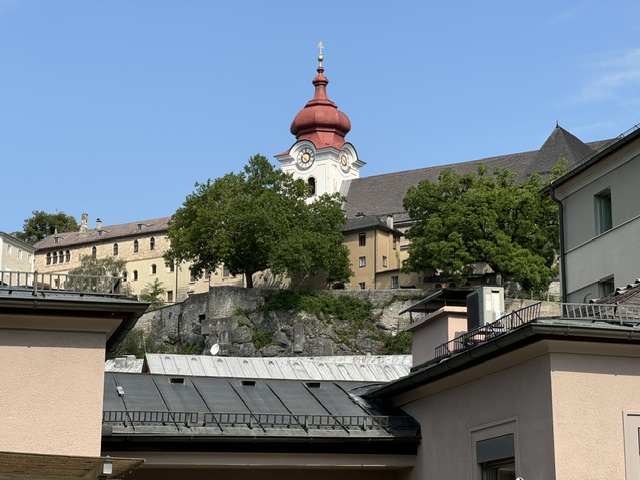
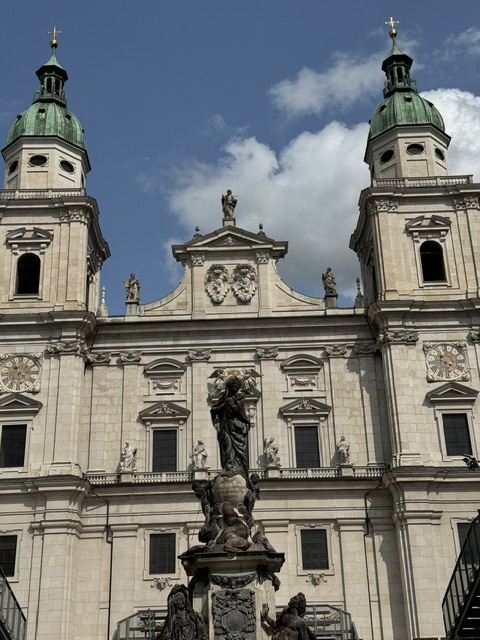
This is the Cathedral that St. Rupert started in 690? Something like that. The cool thing is that if you back way up, you can see the statue of Mary welcoming all to the city and she’s set so that two angels on the front of the cathedral holding a crown look like they’re putting it on her head.

Inside

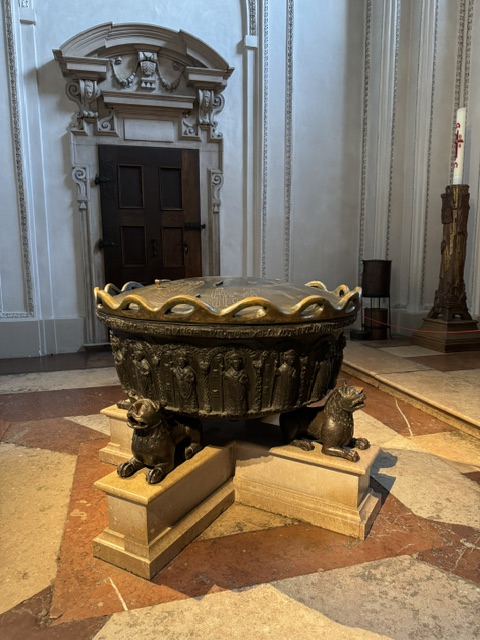
Mozart’s baptismal font (a lot of other people too before and after), had etchings of key stories from the Bible. At first, I thought they were Grecian because that’s what they looked like, but nope. It’s from 1320. 

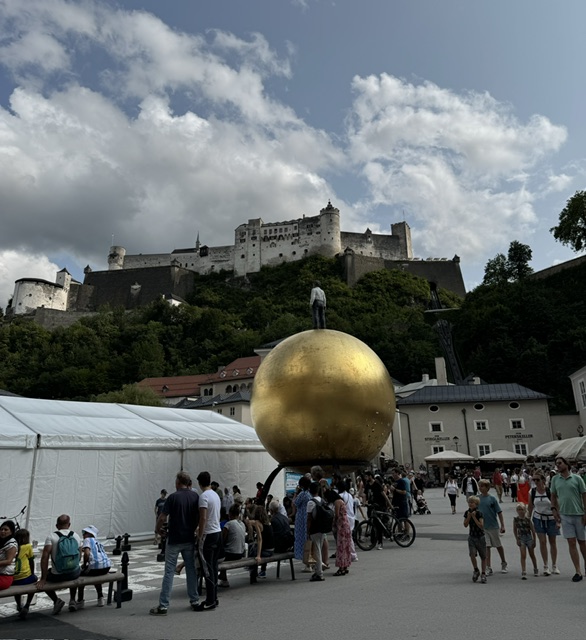
Here’s the fort with a piece of modern sculpture in front of it.

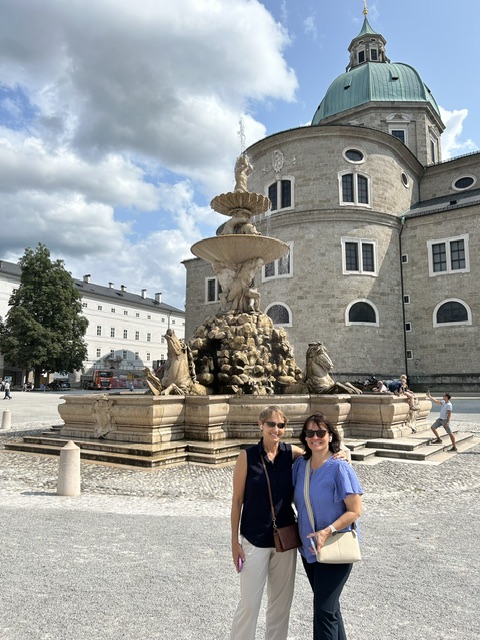
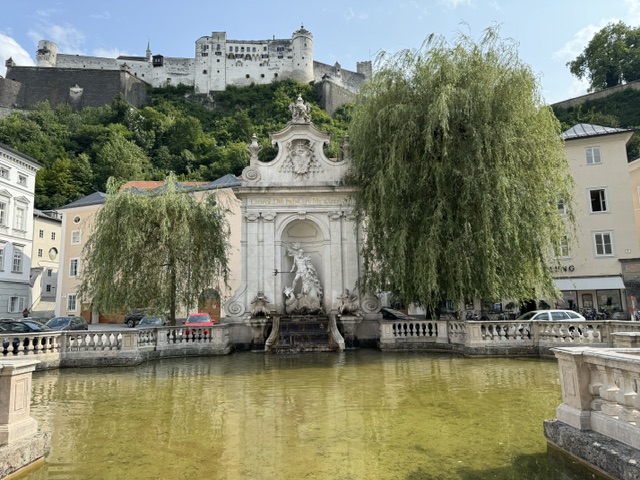
Great fountain that was built in the 1600’s for horses to take a bath:

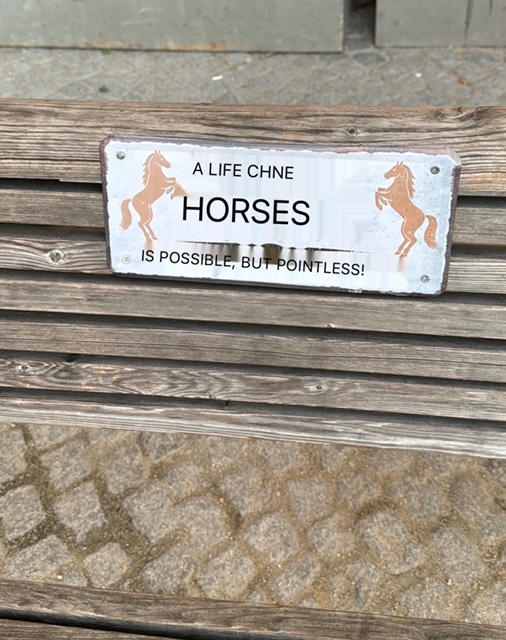
Bench next to the cathedral – the one unintelligible word means “without”.

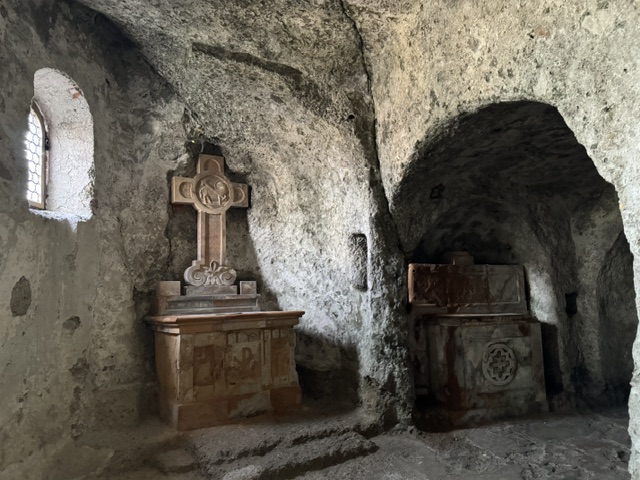
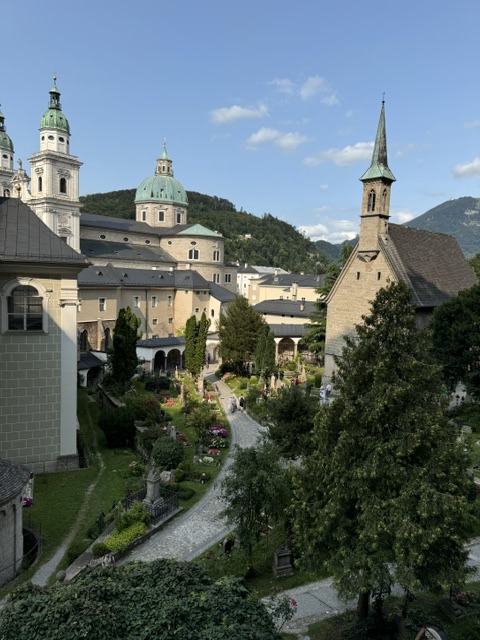
Amazing catacombs, don’t know the story, but so old. The view from the caves up top shows the churches basically on top of each other with a small cemetery where if you didn’t keep renting the space you go moved out – all of you and your monument. This is where they filmed the Von Trapp family hiding in the cemetery in the convent. 

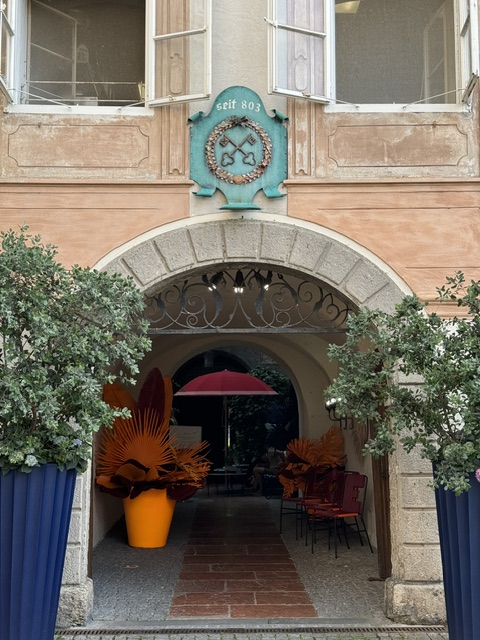
Next to St. Peter is a restaurant that claims to be the oldest in Europe, maybe the world? The visitor that is claimed from that year was Charlemagne. It’s a beautiful restaurant, with music in the evenings, but sadly, can’t to – no time!

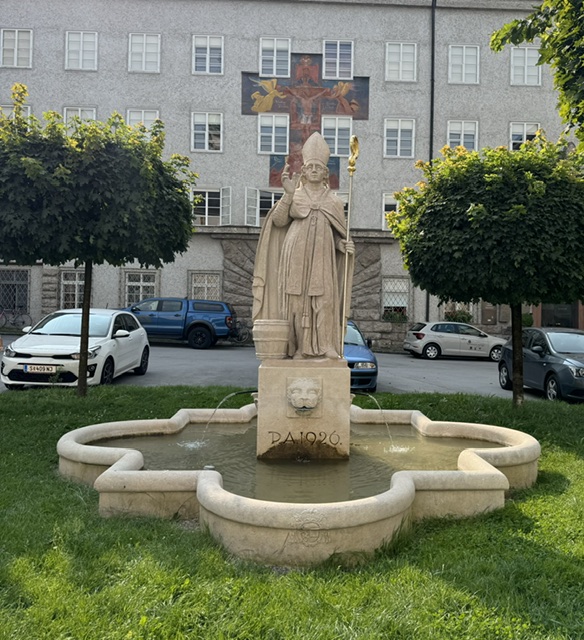
St. Rupert (660-710AD) put Salzburg on the map, built the fort, built up the salt, he re-established the monastic community at St. Peter’s and laid the foundations of Salzburg Cathedral. He also founded the Benedictine nunnery beneath the fort he started. His niece Erentrude became the first abbess. This is the nunnery where Maria knocked on the door and asked to be a novitiate. 

So – a lot to learn and explore and I’m left with questions and more places I’d like to see, but lucky to even get 2 nights and a full day here. 

Germany, 23.July.2024, Tuesday

Sadly, Tricia’s foot was not better and she ended up going to a hospital to get it assessed to make sure she didn’t have a stress fracture. The main goal was to figure out if she walked, would she create more damage. After quite a lot of money (get medical insurance from now on), it turned out to be an infected bug bite. We discussed the fact that if she told people she was bitten by something at Dachau, there would be no sympathy. That was a whole other element of misery that the prisoners would have experienced that was never even mentioned. So many facets that can’t be comprehended. But for Tricia since we didn’t have a schedule or plan for the day, she was able to read, keep ice on and off and the antibiotics went to work. 

I met with my friend Rick Steves (Holly couldn’t figure out how I made a friend to explore with so quickly) and walked for a few hours through Munich. I’d made a list of things I wanted to see from Atlas Obscura and we covered all but two of the items. Oh, so interesting. I’m going to be strong and only say 8 historical facts:

Monks started the town in the 800’s and eked out a living salt trading. Then a Bavarian prince, Henry the Lion, started building a city around the salt trade, and built a toll bridge, walled the city, etc. 1158 was the start of this town. Munich for monk.

St. Peter’s Church built in 1368 is the beloved church for this staunchly Catholic country. When Luther started the Reformation, Bavaria (Munich is the capital) stayed Catholic. The best thing in this church is a skeleton in the box covered by jewels (glass?), beheaded for her faith. Her name is Mundita and is the patron saint of spinsters.

Munich was Hitler’s base and the building from which he ordered Kristallnacht was just to the right of the Glockenspiel. 

There were 10,000 Jews at that point because traditionally Munich had been very open to other religious practices. Then there were none. Munich came back to its open roots and now has a Jewish population of 10,000 again and a synagogue, museum and school in the heart of the city. 

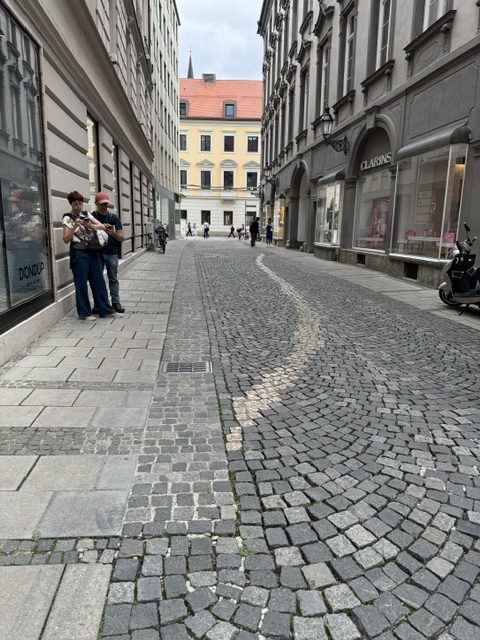
When Hitler came to power, he made a memorial for all to recognize the first martyrs of the Third Reich. All Germans were required to raise their hands in salute as they entered the square. Those who refused turned off on this street. These cobbles mark the detour that people took to rebel. 

When German cities started making the decision of what their look would be after the war, Frankfurt chose modern skyscrapers and Munich chose to recreate its history and it’s a beautiful city. The Nazi’s took meticulous photos of some of the inside of historic buildings and there were photos of the exterior of the city that existed and Munich was able to rebuild. 

That memorial to the women I mentioned before – “rubble women” was a term for the women who pulled bricks from each giant pile that used to be a building and saved the reusable  ones and piled the unusable ones up on the edge of the city.  These debris hills were then landscaped into grassy parks at the edge of the city.

The giant building that said “Residenz” that I’d taken to be high-end apartments, was actually a GIGANTIC palace started in the 1300’s and added onto for many royal families. 

Munich hosts the world’s largest Oktoberfest, going on since 1810 King Ludwig I’s wedding celebration was so successful that they repeated – every year, with 7.2 million in 2023.  

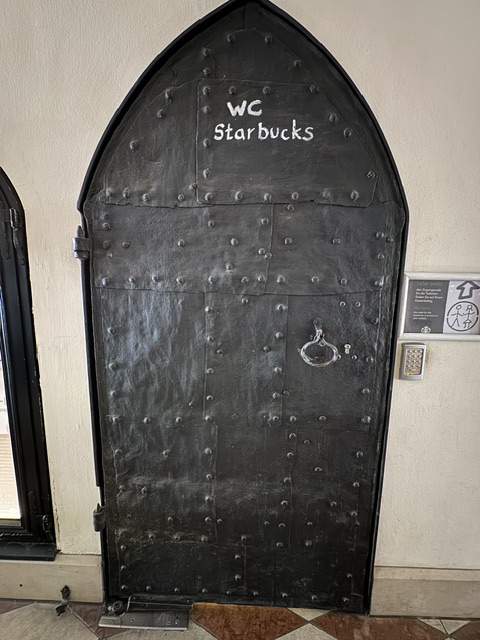
I took a break because I was tired and decided to yes, go to Starbucks, to get a chai. It was terrible, but I loved this.

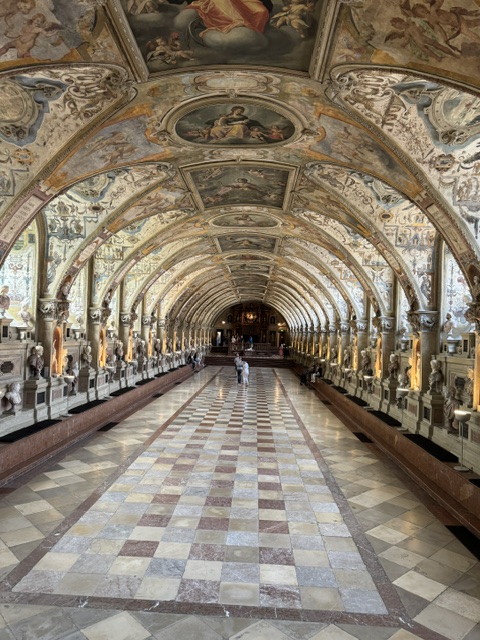
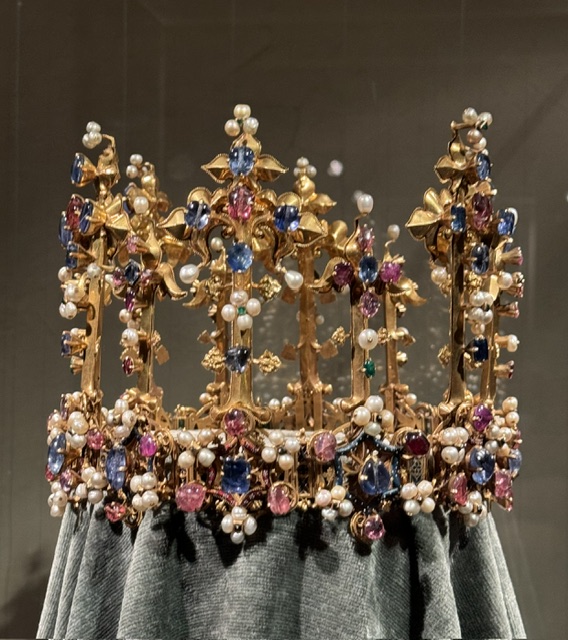
After the Rick Steves tour, I decided to visit the Residenz. Oh my lord, I could not believe how big it was, one section after another. 130 rooms that were on display. What I’d seen was just the front, didn’t realize the gorgeous building I’d seen yesterday was also part of it – couple blocks. I lost track of all the royal branches (all Wittelsbach for 738 years). By the end, even I, history lover that I am, wanted roller skates to get through more quickly. But it was amazing. The treasury was bigger than anything I’ve ever seen. This crown was from 1380:

This door after a crazy grotto.

I opened it and…

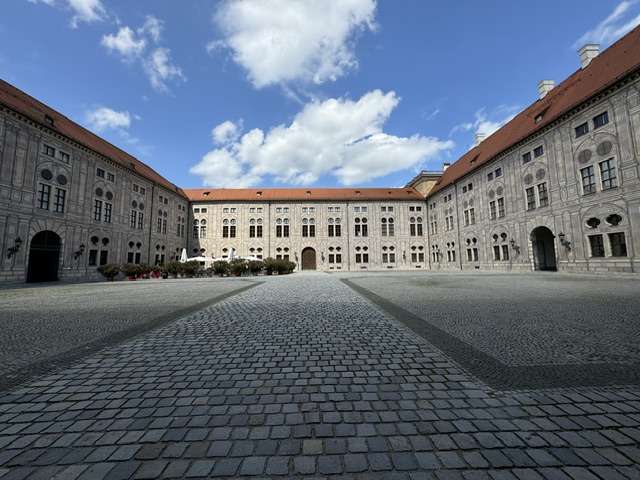
One of the courtyards:

And that’s all just a bit.

Then I came back to the hotel, double checked on Tricia, who was glad she’d taken the day and whose foot was better. Yay since she wants to explore Salzberg tomorrow. 

Holly and I decided we should go to a beer hall, because. We did go and I had a rotter, half beer, half lemonade which helped it be more drinkable. We went to the Hofbrauhaus, where the original brewery was built in 1583, rebuilt in 1800 and then again after WWII. It was huge and I asked a couple of guys in Leiderhosen if we could get a table. Oops, they didn’t work there. Turns out they were the musicians and ended up bringing their concertina and tuba and sat across from us to play and have beers. Funny. 

Germany, 22.July.2024, Monday

Germany, Castles

Today turned out to be really fun. Sadly, Holly and Flynn switched night for day and couldn’t go to sleep until 6am this morning, so there’s no way they could join the jaunt to Linderhof Castle, Oberammergau village, and Neuschwanstein Castle. And it was a long day so they definitely made the right choice. Tricia and I left the hotel at 7:30 and got back at 7. By the end, we thought it was wonderful. 

We learned a lot about Ludwig II, the 4th king after Germany became a monarchy in 1805. King Ludwig II adored his grandfather, Lundwig I, who built beautiful buildings and bankrupted the country. Then Ludwig II came along and loved building just as much, also nearly bankrupting the country. He won a war against Prussia, but that was very much an interruption in his studies of architecture, art, philosophy, science, etc. We were told he read a book a day.

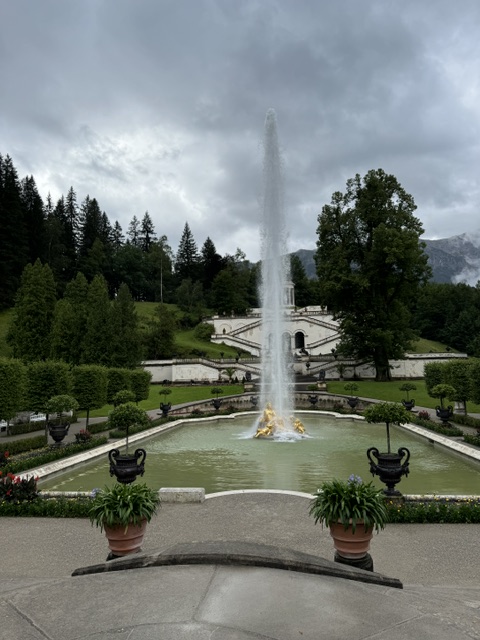
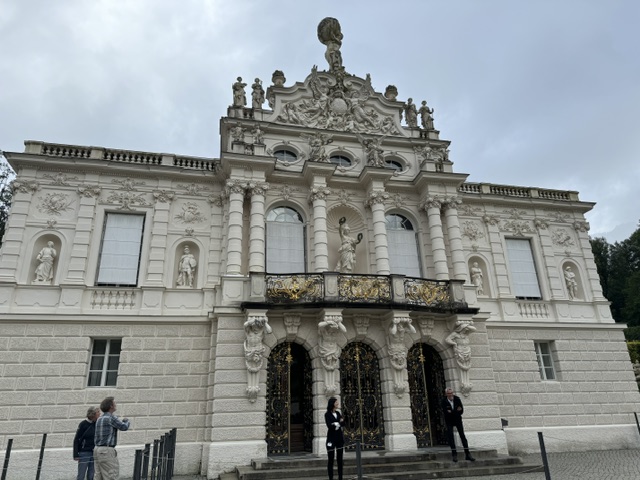
We got to see two of his castles (palaces). The first was his comfort castle, the only one completely finished, and he spent a lot of time there, 2 weeks out of every month. Linderhof Palace was modeled after Versailles since evidently Ludwig II really wanted to be like the sun king, with his position affirmed by the gods. The palace was small, gilt and beautiful, but the real charm and beauty that caught the eye were the incredible grounds. A number of the outbuildings were modeled after scene descriptions from Wagner’s operas, someone that Ludwig adulated and became friends with despite the 40 year age difference. I thought the grotto was incredible – but only saw a short video of it since it’s under serious repair because of water damage. Here’s a description from the Linderhof website:

The Venus Grotto in the palace gardens is a unique construction designed as an artificial flowstone cave and the highlight of King Ludwig II’s illusionary architecture. This grotto not only depicts the 1st act of Richard Wagner’s opera “Tannhäuser”, but also reproduces the motif of the Blue Grotto in Capri by means of artificial illumination in various colours. For this purpose, one of the world’s first electric power stations was created. The grotto was erected in only two years from 1876 to 1877 by court building director Georg Dollmann and landscape sculptor August Dirigl. In the 19th century, it presumably was the largest construction of its kind even though it had been designed only for the king’s own private use.

From the front door, then the castle, then a small piece from the back:

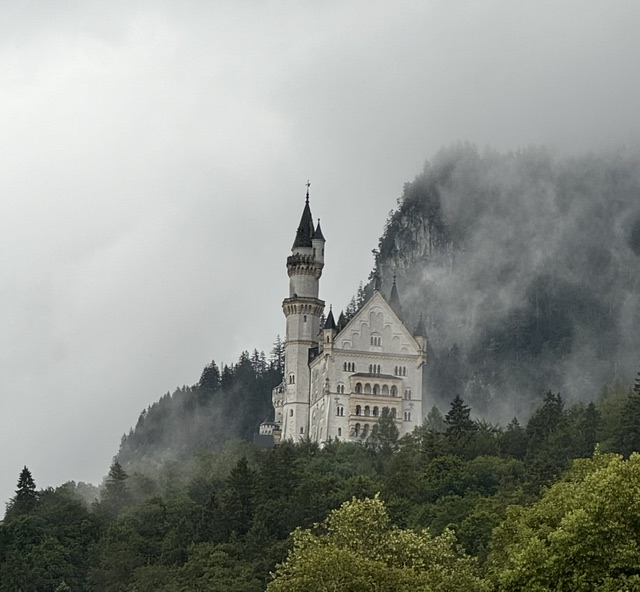
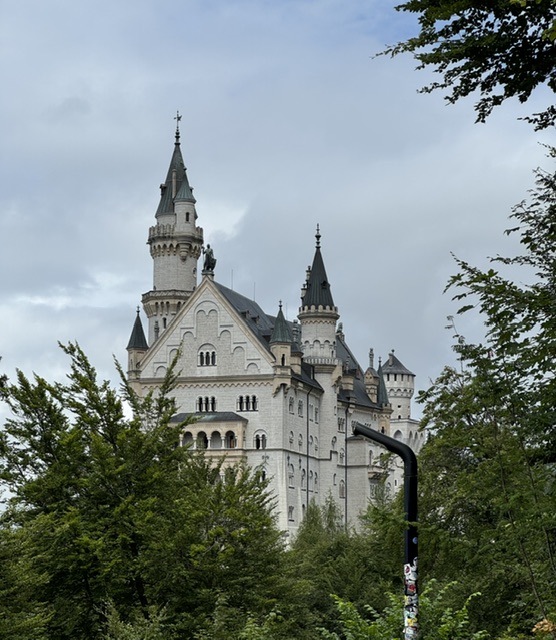
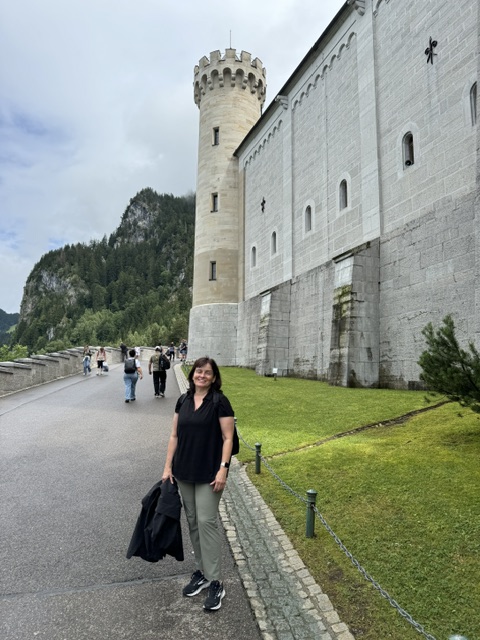
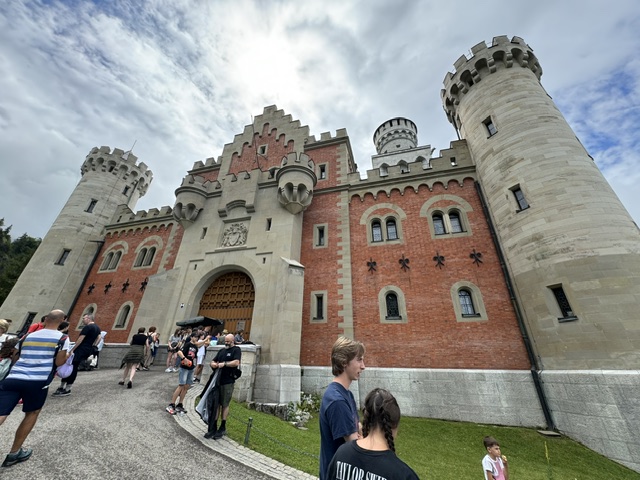
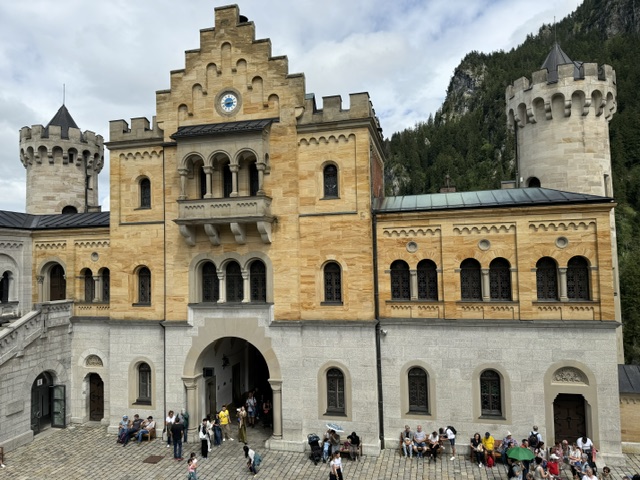
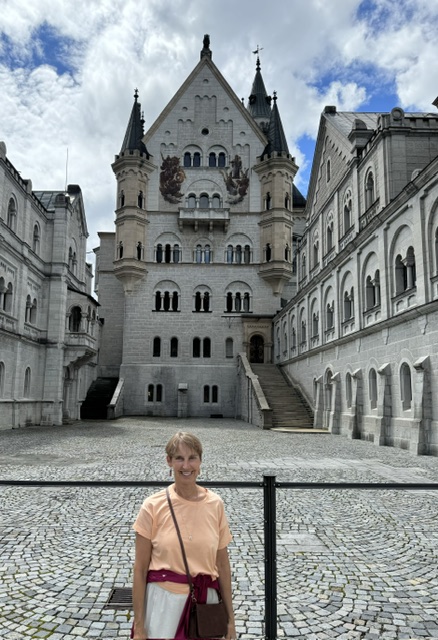
The second castle we saw was named after Lohengrin, the first Richard Wagner opera Ludwig II ever saw (at age 13). Lohengrin was a mysterious swan-knight. Neuschwanstein was the “New-Swan-Stone” palace and there were over 100 images of swans in one room alone. It’s the castle that Disney modeled his castle after. In fact, Disney asked if he could buy the castle and deconstruct and reconstruct it in the US. No. But there was a painted panel of woods in the Singers Hall in the palace that Disney used as the model for the woods from Bambi. And sure enough, it definitely looked the same. 

The stories of Ludwig II were interesting and there were a lot of them. He was alone a lot and wanted it that way. In the Swan Palace, it was the king and 32 servants. He never held audiences and very rarely if ever had visitors, even though there was a throne room in both palaces. He installed the first phone in Germany in Neuschwanstein, but could only call his secretary, who was also in the palace, since no one else in Germany had a phone. He only had 172 days in the palace before he died at the age of 40, before the palace was finished. The royal family and ministers of Bavaria put the castle on public view within 6 weeks of Ludwig II dying to try to make up some of the money he spent on it. He was very Catholic, but had several Buddhist elements built into both castles. He struggled because being gay (legal at the time, but not for the monarchy) didn’t align with his position as king. He was probably murdered by his counselors whom he’d asked for funds to build a Taj Mahal in Germany. Oh, yeah, I could go on for a long time. 

Neuschwanstein was beautiful and a tribute to Richard Wagner and his operas, though Wagner never visited before Ludwig II died. In a departure from most monarchy, there were no paintings of Ludwig in either castle and his name was written only once in Neuschwanstein on a small panel – along with the architect of the building. It was about beauty and honoring others. Our guide was a lovely young woman, and both she and our guide on the bus spoke about Ludwig as if he was a beloved and quirky uncle. 

Happily for me, they didn’t allow photos in the palaces so I got to just revel. Unfortunately, they move people through so quickly (10,000 people a day at Neuschwanstein) that it didn’t really allow a long time to see details and the details were unbelievable, so many to absorb. But the overall impression was of light and beauty. It was so big that these are just a few shots I got:

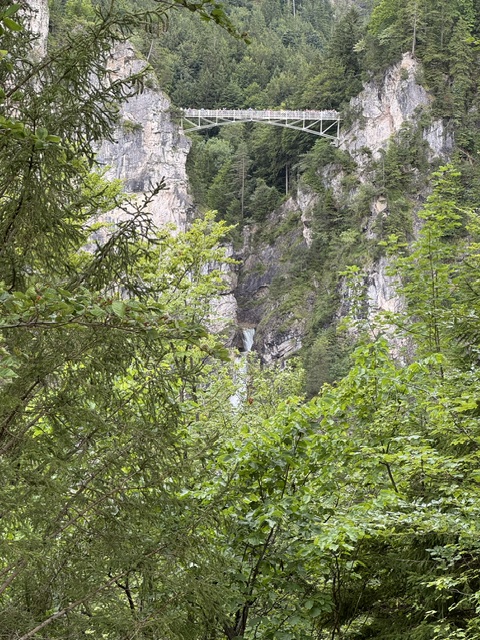
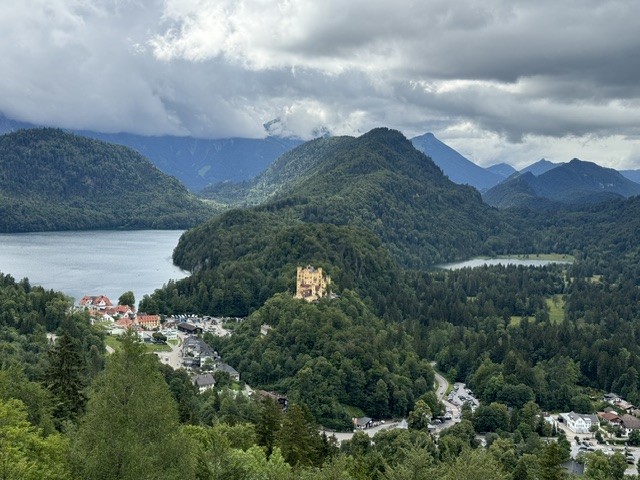
The last one is a bridge that Ludwig’s father built for his mother (though there were two predecessor bridges). Part of managing the whole visitor scene is that everyone goes to the bridge first and sees the scenery all the way down to the lakes with Ludwig II’s father’s castle in front. I got one foot out on the bridge, backed off, Tricia went further, but then some of the wooden planks started moving, so just one shot! We then walked 20 min down to the castle. 

We also had a 30 min visit of walking through Oberammergau village between palaces. This village became famous during the plague in 1633. The mayor of the village was determined to protect his village and closed the borders. But a soldier from the 30 years war was so homesick, he was allowed to come home. He died within 3 days and then 300 people from the village died after him. They then decided to put on a play showing the 10 stations of the cross, a Passion Play, with everyone in the village taking part – 2,000 people as actors, techs, musicians, etc. They built a theater a few years ago that can hold 5000 people. Here’s the note from their website: In 1633 the Oberammergau villagers promised to perform the suffering, death and resurrection of Christ every tenth year, in so far as no one was to die of the plague anymore. The villagers were answered by God and therefore in 1634 the first Passion Play took place. The promise has been kept until today. The 42nd Passion Play successfully ran from 14 May to 2 October 2022, after having to be postponed in 2020 due to Covid.

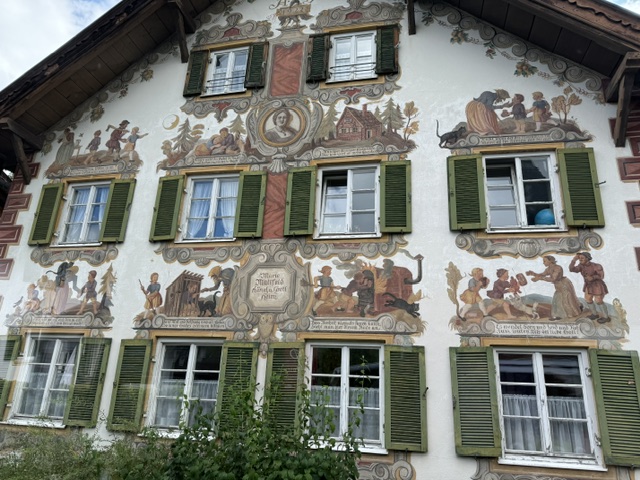
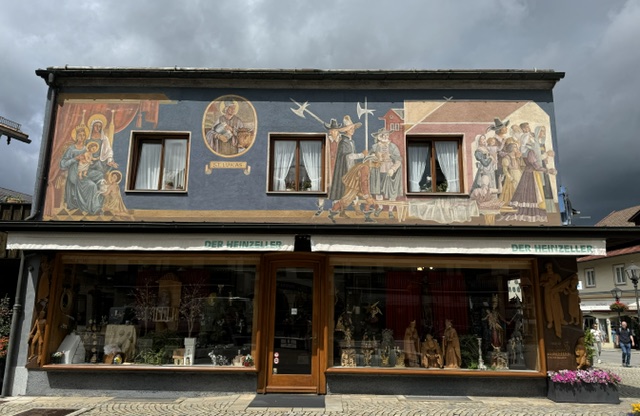
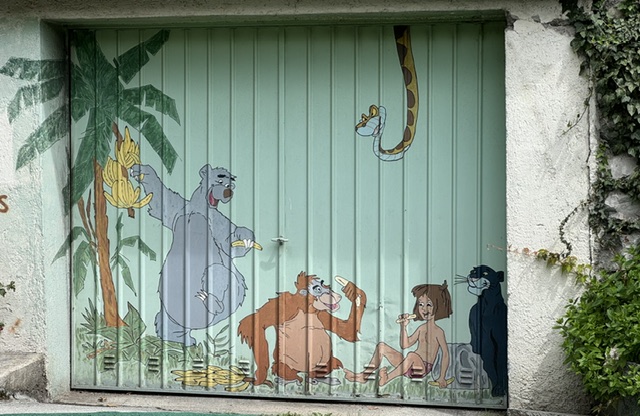
The other thing the village is known for are the paintings on the houses; themes from Christianity and Grimms Fairy Tales. Unfortunately, the fairy tales were mostly painted on houses that we went by on the bus so photos were a challenge, but I walked a bit and tried to get some photos just to show the skill and details. The Jungle Book photo was on a garage of a house. The woman of the house was walking up the stairs and I asked for permission to take the photo and she was so pleased and said yes! It’s 30 years old! 

The one below is the entire story of Hansel and Gretl

This is a photo of a maypole showing all of the trades and stores that are offered in the village. So cool. All villages have this and I guess there’s a tradition of neighboring villages trying to steal different signs and put up their own. Don’t know if that still happens, looked pretty permanent to me. 

Unfortunately, by the end of the day, Tricia’s foot was really cranky. We had no idea what happened, it had started to hurt a bit on the bus/train from Dachau, but by the time we got back to the hotel today, clearly Tricia wasn’t going to be walking anymore. I wanted mid-eastern food and asked at the desk about a place that I could get take out from and were given a name close. We went upstairs to settle in and to order ice from room service and then it turned out half the menu was mid-eastern food! Wait, and everything was written in German, English and Arabic. How interesting. Turns out there’s a huge influx of visitors from the UAE and Dubai for medical services in particular. They bring the whole family, spend a lot and the community is pleased to welcome them. It seemed (from a very outside perspective) that there was a lot of blending between the communities and obviously, there are also plenty of residents who were Islamic as evidenced from the women’s dress. 

So – a great day and hopefully, Tricia’s foot gets better tomorrow.

Germany, 20.July.2024, Saturday

Munich

I can’t believe it, but I’m back in Europe, so so lucky. This time I’m traveling with Tricia, Holly and Flynn and the initial impetus was a Taylor Swift show happening on the 28th here. Yep, totally joining the madness and it’s been really fun in the anticipation for it. Kylie told me a couple of months ago that I was WAY behind in learning all of TS’s songs and history. So – I’ve been learning and actually am very impressed with her energy and determination and I quite like a lot of her songs. Can’t wait to see the actual show!

But – since we’re going to be in Munich, Holly and I decided to make a week of it and then Tricia joined in when Kylie realized she couldn’t do the trip. 

Then – and big – I realized that Salzberg is only 2 hours away by train. Oh boy! Finally, finally, getting to see the Sound of Music city. When I asked Holly if she’d be interested, she said, yes! For one of her birthdays, she had a sleepover group and watched the movie at night and again the next morning. Tricia was totally aligned too. Flynn’s never seen it, but Holly’s going to try to get her to see it before we go. Of course, it moves in VERRRRRRRRY slow motion compared to today’s electronic offerings, so we’ll see how that goes. We’ll go to Salzburg mid-week.

Then, I realized that Dachau is only 30 minutes outside of Munich. And that’s a must in light of history and today’s reality that’s so wrong in so many places. That’s just a Tricia and me venture. We both feel like that comes first, so we’ll go tomorrow. Holly’s already been and the tours we’ve found recommended no one under 14 join. So Flynn and Holly will have a different day and we’ll join up later. 

Today the flight was easy, direct from Denver for Holly, Flynn and me and direct from Newark for Tricia.

We joined up at the hotel and then went out and had schnitzel for a late lunch/dinner since none of us had eaten for the day. I mean, Germany, schnitzel was a must at least once. And it was good! 

Holly and Flynn then got diverted by shopping and Tricia and I walked, largely re-walking a lot of what she saw earlier when she was waiting for the hotel room to be ready. 

This is a beautiful city! One of those European cities (maybe they’re all like this?) where you turn corners and there’s another incredible building to explore. So, the camera was out and my questions started popping. 

We’re staying in a great hotel, Hotel Vier Jahreszeiten Kimpinski Munich, booked ages ago so reasonable and right in the midst of Munich. We can walk everywhere! It was opened in 1858  as a hotel and was modern – running water, fast lights and baths, steam engines in the collars for hot water and heating. Pretty cool!

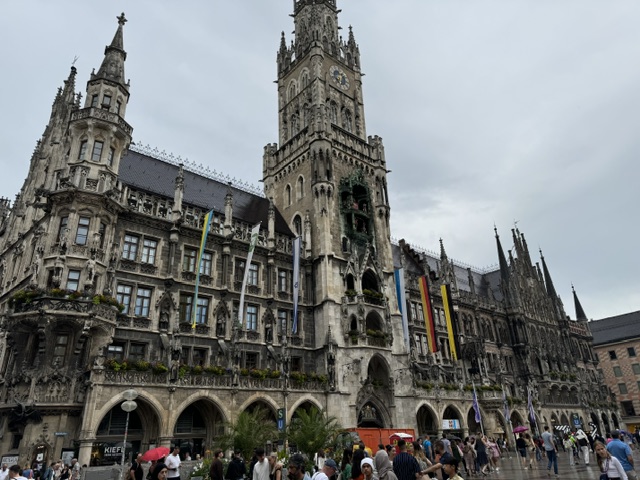
First thing we walked to see, of course, was the Glockenspiel, the only thing I remembered from when I was here with Eli and Kaziah years ago for 3 days when traveling back from visiting Kelly, Jerry and kids in Malta. Here’s a photo, but I’m really hoping I can catch it one of the 3 times per day that it’s open and operating. It takes 15 minutes to tell the story of the 1569 royal wedding of Duke Wilhelm V and Renata of Lorraine (one of the most expensive and decadent weddings of the Middle Ages), jousting tournament and dance. I can’t wait!

Here’s a website that has an embedded video of the whole thing if you’re really interested 🙂 Munich Glockenspiel – about the Glockenspiel Munichdestination-munich.com

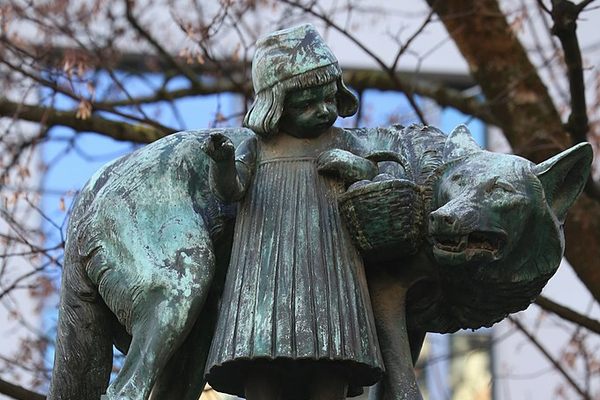
We walked by a statue of Little Red Riding Hood . I wanted to how/why it came about and why there? And – found it! In Atlas Obscura.

We then walked through a small part of the English Garden, one of the largest inner-city parks in the world. It’s fabulous and very well used! We stopped and watched the surfers for a good while, but there were also people in the river, playing volleyball and many more things – including a beer garden that we didn’t even see. 

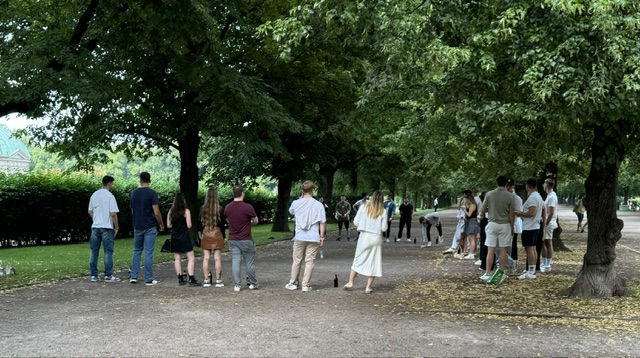
Here’s something Tricia and I both marveled at – a classic demonstration of delayed gratification. This big group, both men and women – college ish aged were standing in a 3 sided square. They were quietly chatting, laughing, and very orderly.  A water bottle was in the middle, every one had an open beer bottle at their feet and people in the two longer sides took turns throwing another water bottle at the one in the middle. We must have watched 20-30-more throws? (Tricia kept watching while I took photos of cool old mural panels showing history). Finally as we were walking away, one of the guys managed to hit the water bottle, his side swooped down in synchronized order to grab their beer bottles and drink while someone from the other side raced to the middle, grabbed the thrown bottle, righted the other, and raced back to his side to stop the drinking. Clearly the competition was to see whose side would finish their bottle first. And it was not going to be quick! 
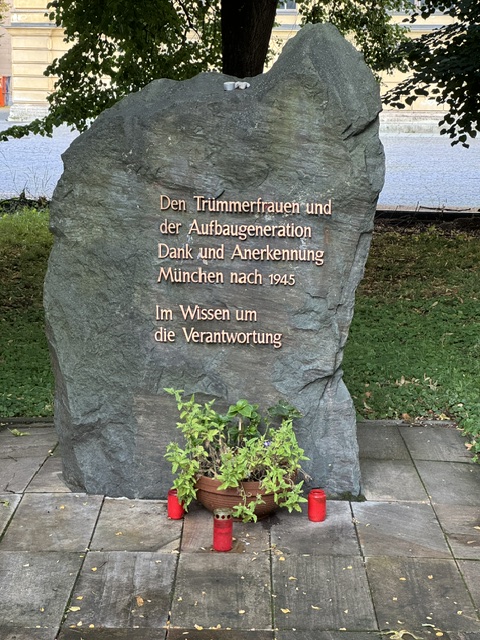
This was a quiet small memorial; the translation read: Thanks and recognition to the women who cleared the rubble and the reconstruction generation Munich after 1945, knowing about responsibility. When I read this I was pleased they recognized the women, but…and why was Munich in rubble?  (see https://en.wikipedia.org/wiki/Bombing_of_Munich_in_World_War_II)

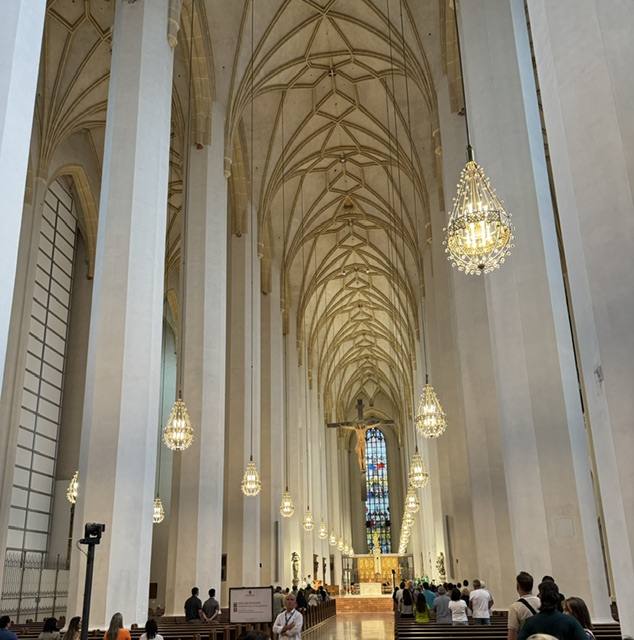
And – The Church of Our Lady Munich, built in the 1400’s on top of a much older church. Beautiful and actually really full with a wonderful organ recital happening. Snuck a photo, but we really wanted to keep walking, so I didn’t sit. Plus, the whole giant cross thing hanging from the roof just didn’t call, though the building itself was wonderful light and welcoming. 

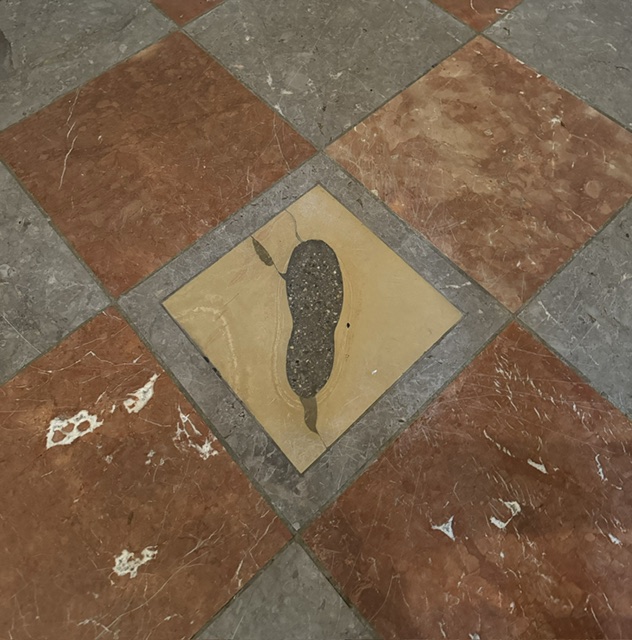
Fun story about this footprint: According to legend, the famous footprint in teh entrance tall was made by the devil himself. He made a bet with the master builder for his souls, that there would be no windows in the church. Upon return to the aforementioned place, he could not see any windows at first, as they were covered by the columns. Out of joy at the supposed ignorance of the people, he stamped up and left his footprint in the ground. But when the devil took another step forward, he discovered the windows and felt that he had been deceived. Angrily, he turned into wind in order to destroy the building. It’s probably the devil is still trying, because near the cathedral or at the entrance where the footprint is, you tend to feel a slight breeze. And it’s true, there was a breeze at that spot!
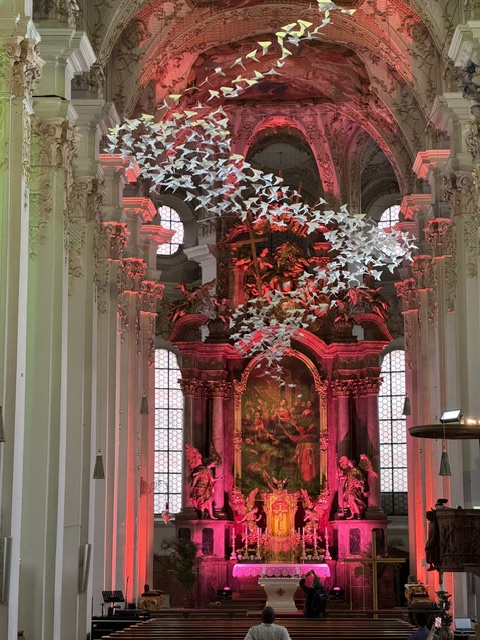
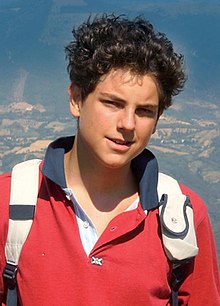
Ok, this church was kind of amazing, fantastical art inside, but then you read the story of the young man whose photos were every where. I was using my translation app of these different posters to understand what in the world. It turns out that this young man, only 15 years old, was beatified. Kind of an incredible story. It’s actually kind of hard to find the names of these churches, maybe Church of the Holy Spirit?

Here’s the beginning from Wikipedia, then the link if you want to read more. Worth the time. He was probably an angel or a bodhisattva. 

Carlo Acutis (3 May 1991 – 12 October 2006) was an Italian website designer who documented Eucharistic miracles and approved Marian apparitions, and catalogued both on a website he designed before his death from leukaemia.[4] Acutis was noted for his cheerfulness, computer skills, and devotion to the Eucharist, which became a core theme of his life.

He was beatified by Pope Francis on 10 October 2020, and in 2024, his canonization was approved, making him the first millennial to be made a saint.

Carlo Acutisen.wikipedia.org

Yep, jet lag in full force – in the lag perception, wide awake and I could just keep going and I’ve only been here a few hours! Stopping now. 

Germany, 21.July.2024, Sunday

Munich

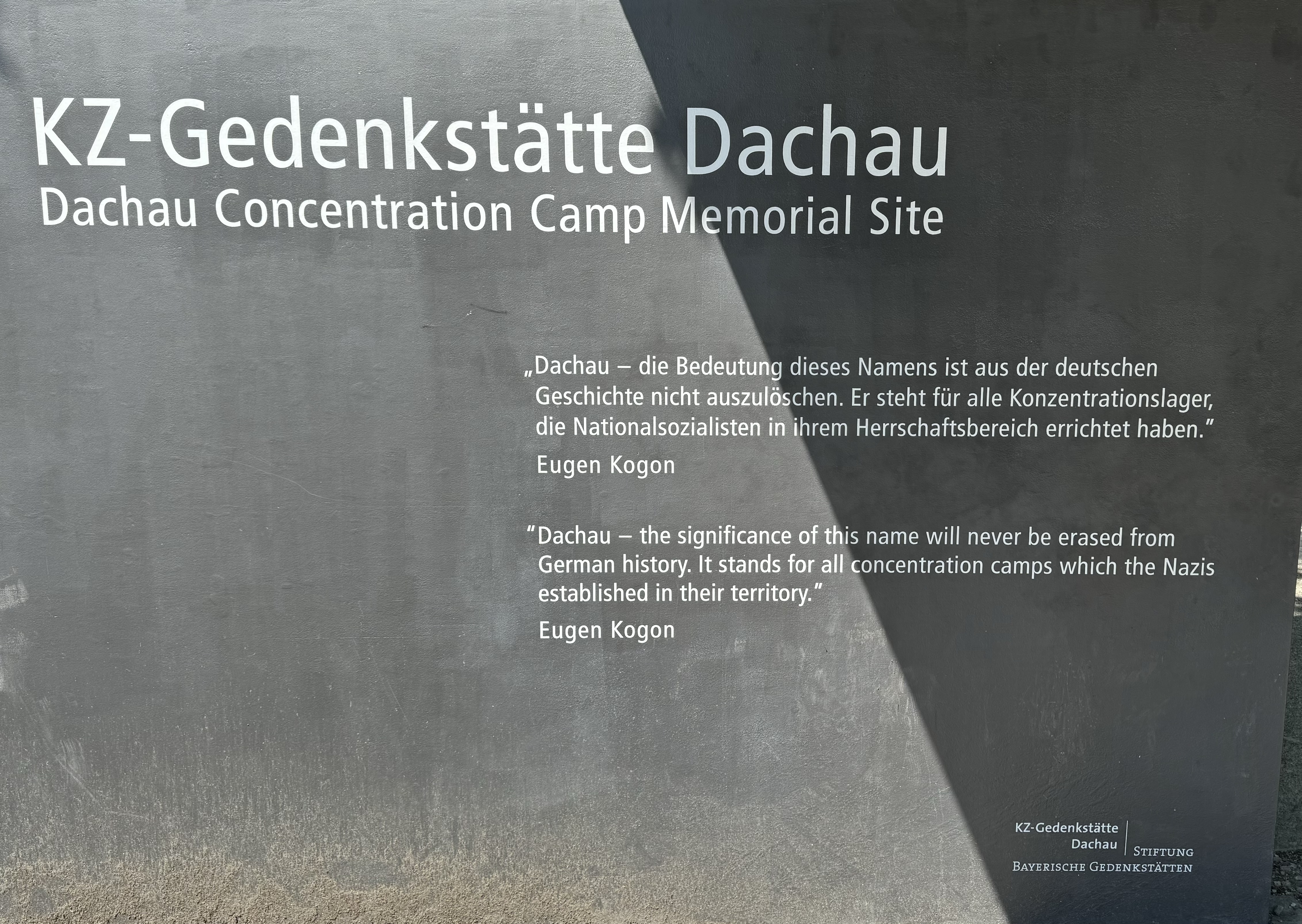
Tricia and I went to Dachau today. The memorial is 30 min away, took a cab out and then a bus/train combo to come back. This is my only photo, couldn’t imagine taking photos of the actual site or images shown. We were really glad we went. We walked, listened, read, for 4.5 hours before we had finished learning as much as we could. They’ve done a wonderful job of telling the history. And the survivors were the ones who insisted that it be made into a memorial. I didn’t realize that this was the model for all concentration camps; the commander of Auschwitz learned his trade here. 

Camino del Norte, 12.June.2024, Wednesday

Madrid. 1.5 miles

We flew from the airport an hour away from Ribadesella to Madrid. Got to see our first full sunrise from the car – bye Camino del Norte!

Madrid, we got to our hotel and mostly thought we don’t want to walk anywhere. But then thought – let’s go see the Crystal Palace in El Retiro park. We had never gone, have always headed to the ancient areas. This was old too, just not as old. The Crystal Palace was built in 1887 as the official headquarters of the General Exhibition of the Philippines in Madrid. They’re doing remodels so no entry, but truly a beautiful building.

And, look! We’re still standing and smiling. 
The park was a great scene and it was a Wednesday! But the weather was perfect, 74 degrees, a bit of a breeze and so many talented musicians. We could have sat and watched for hours. Here’s a bit of 2 groups. The bassoonist and cellist had gone to the conservatory here in Madrid. The guitarists reminded me of the music from Chocolat. 

What a gift of a trip. A few people had asked how many miles we walked. I hadn’t totaled, but did so now and I walked 268 over the weeks. It didn’t seem that long, but I guess it adds up. 

It was a truly wonderful experience with Rick and friends, history, people, getting to practice Spanish, food, walking through so much incredible terrain. This camino – I totally recommend. I loved it.

Camino del Norte, 11.June.2024, Tuesday

Llanes to Ribadesella, 23 miles

First a note from yesterday walking the town. We actually were able to go into the cathedral and sit for a bit. And we could sit because it was the first church that didn’t smell overwhelmingly of mold. Of note were the two giant shells at the top of the rentable. This was clearly a camino church. And, unlike most others, it held regular masses. I would have gone just to see, but too long a day and it was very monitored. Tourists were not invited during that time except for the mass and I didn’t want to sit for a full hour. 

Today:
We made it! And we walked the whole thing, it just unfolded that way. We got to the point, the only point really, where we could easily get a taxi – and saw one waiting for a fare – but it was way too early. We both agreed we were having a great day, it was pretty and we kept going. Incredible, given that Rick broke 4 vertebrae, one shattered, only 4 months before we started the walk. 

Here’s a photo from last night, I got Rick to walk up despite the 97 stairs because it was such a pretty view, plus I wanted him to see the green path I hoped to walk to start our last day.

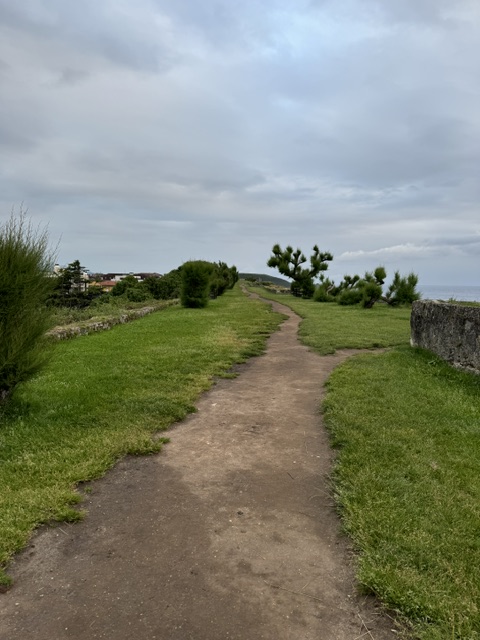
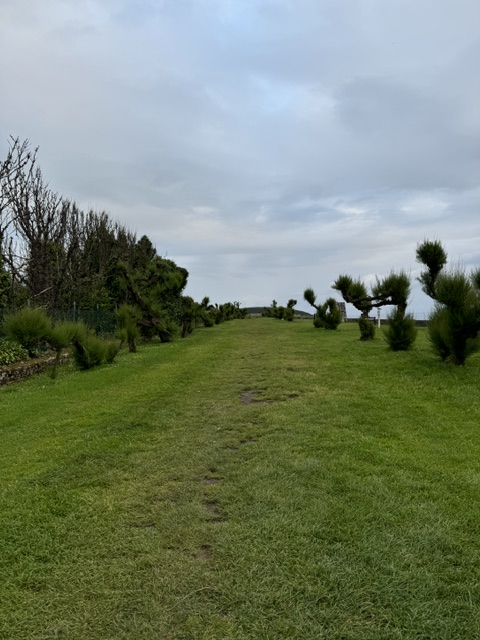
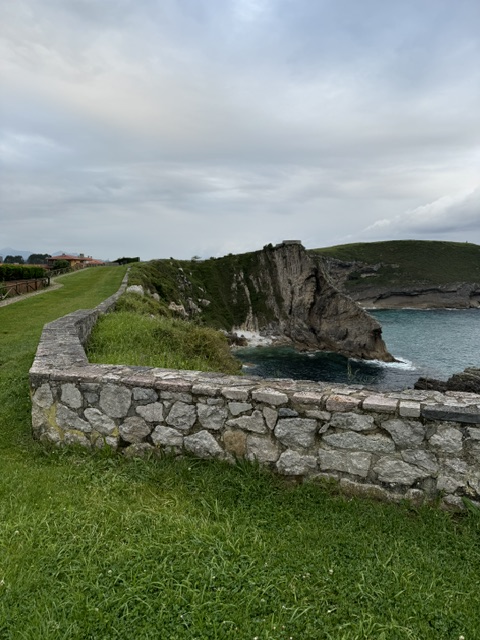
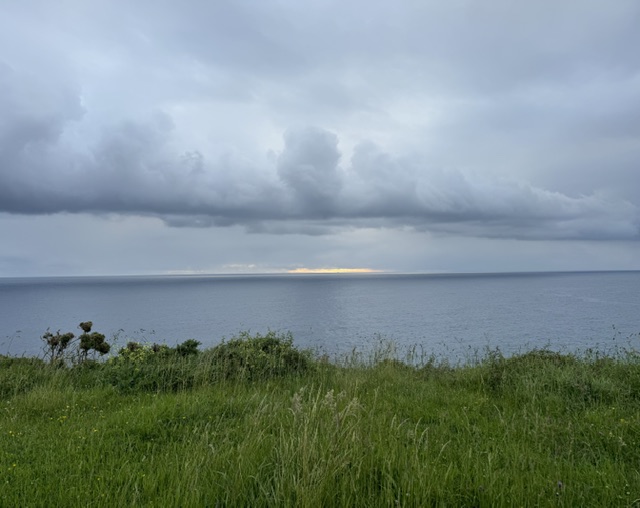
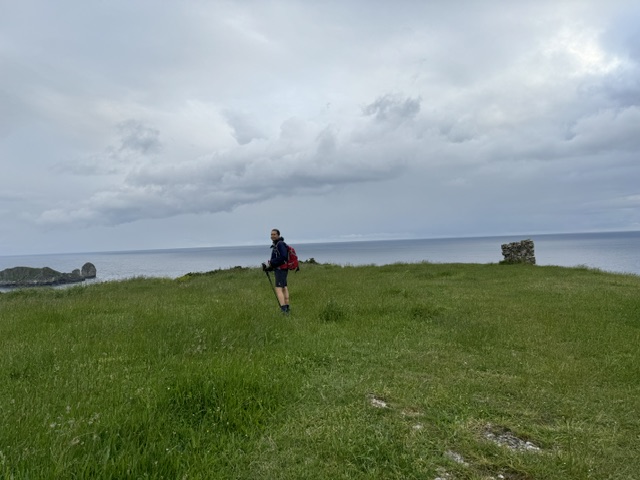
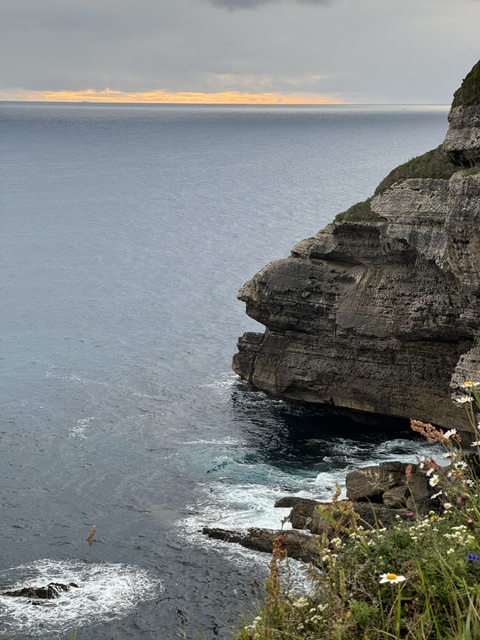
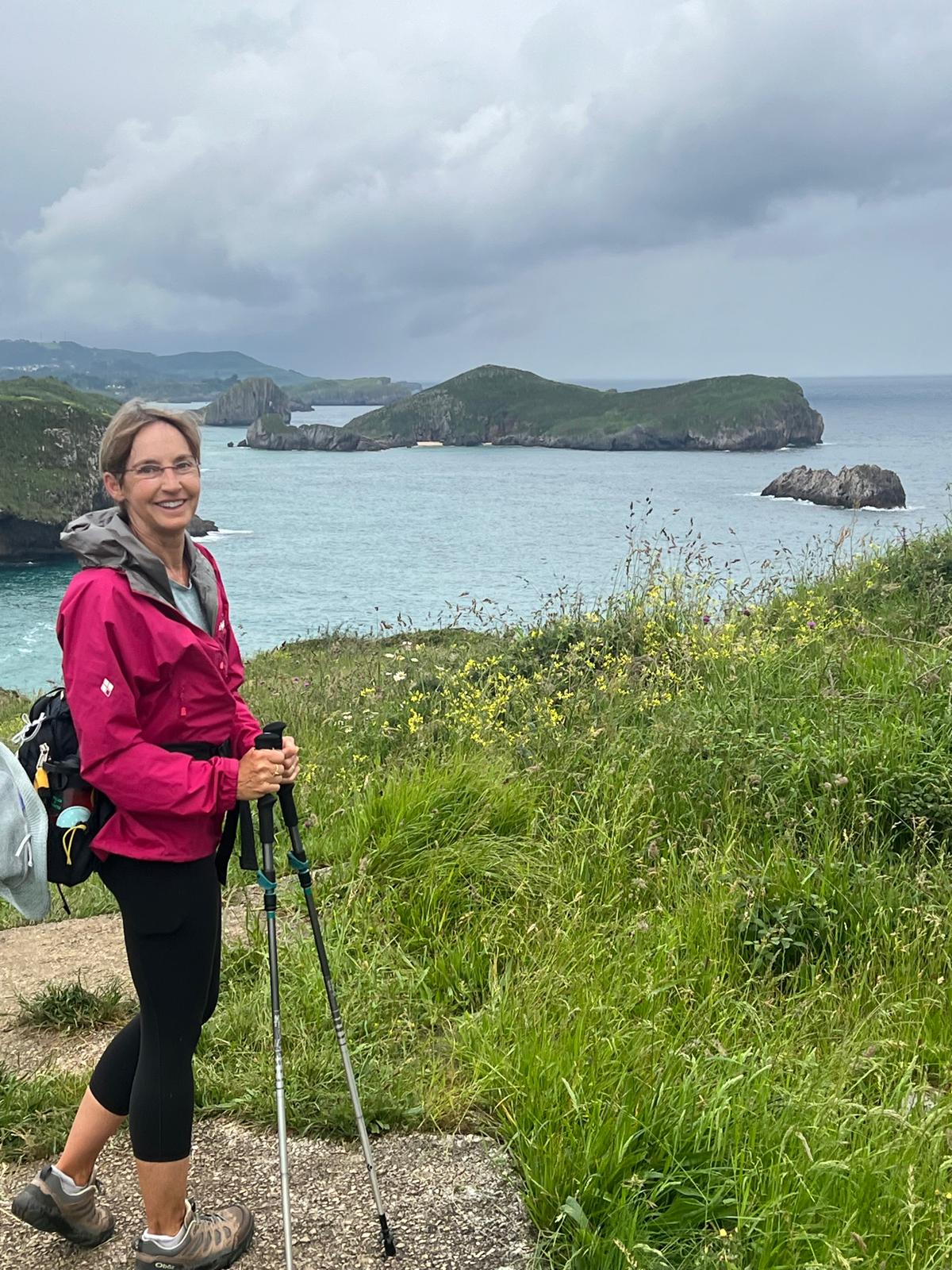
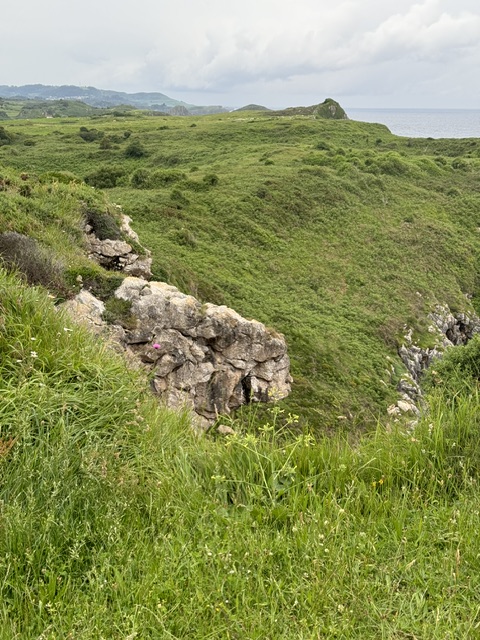
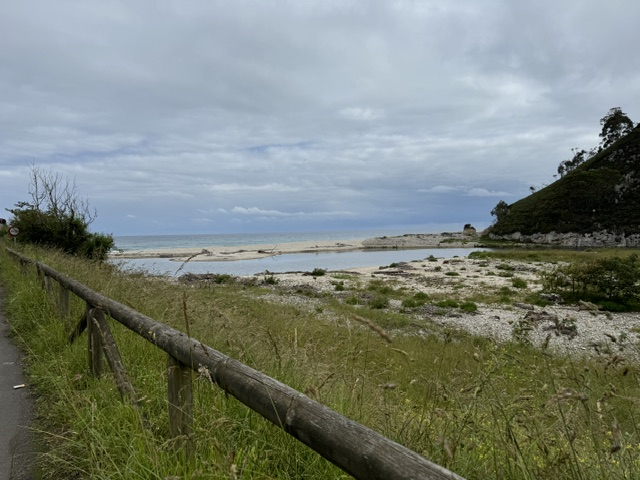
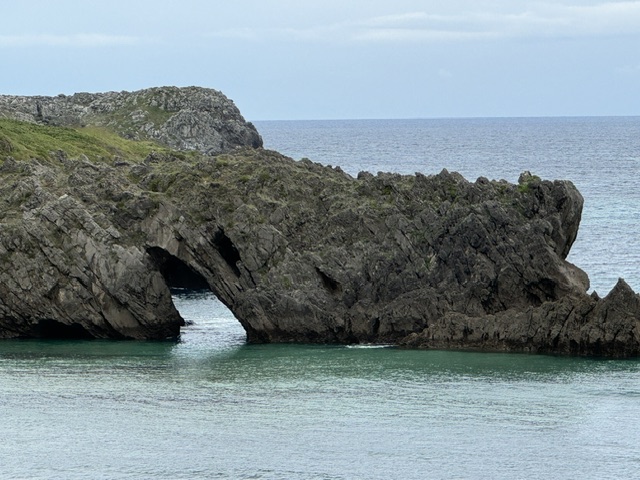
This morning, the first part of the walk right along the coast was such a gift. It was the green path from the top of the hill that we’d been on last night. Rick had agreed to do the extra 1.6k (on top of expected 20 miles) by going the coastal route which I really wanted to do. A wonderful way to start our hike. I mean, look at these photos – this is was what we walked. The one photo with the rocks down low looks like a man’s head, pointed out by a Spanish birder out for the early day’s walk. The other with the rocks sticking out from the side, he also pointed out – nature’s gargoyle.

Rick and I’ve both developed a system that works for us with water/electrolytes/food to keep us going on pace. I used fountains all along the way since I only carry a one-liter bottle. I have come to love the LMNT packets for electrolytes. I’ve also learned I need to eat every 2 hours or less – at 6 drank my wee protein shake before we left, morning snack at a bar on a beach, then my meat/cheese and roll, the “picnic” the hotel gave us for breakfast, then my Whole Foods protein balls, then my almond M&Ms, then my honey sting gummies – and I still had  a pumpkin seed back up that I didn’t open. 

Here’s our last camino breakfast! Looking over the cove with the monastery on the right.

The guide book had said that we would pass some monasteries on the way and that these early monasteries had it down, prime real estate alongside the town with the best views and access to the water. No kidding.

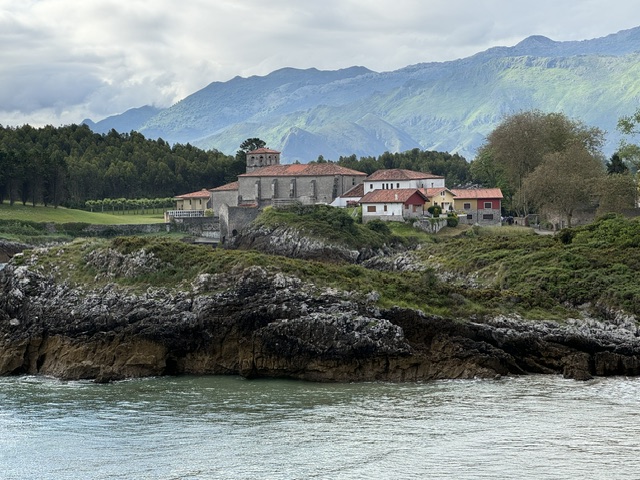
The first monastery we passed, the Monasterio de San Salvador de Celorio, a Benedictine monastery. Sign says 17th century, but online it looks like this building started in the 11th century, but info was pretty sketchy. It first presented as a pretty, well-kept small church on the path. Then we had our breakfast and continued up a little path on the other side of the beach to the promontory just to see the side view and it was huge! Plus a castle up on the hill. The monastery looked like it was in surprisingly good shape, couldn’t really discern the details for either this or the castle from this distance. 

We thought it was this
It was really this

And the castle/fort/place for bad monks? up the hill to the left:

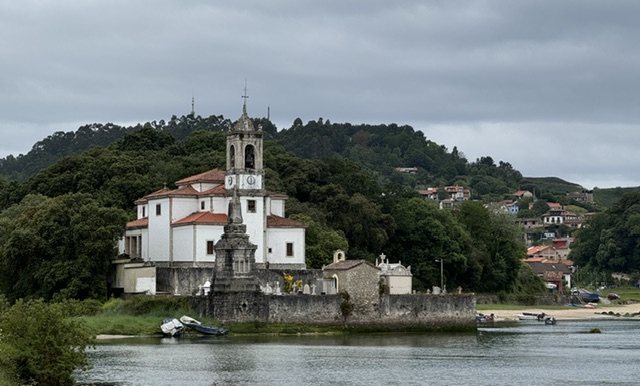
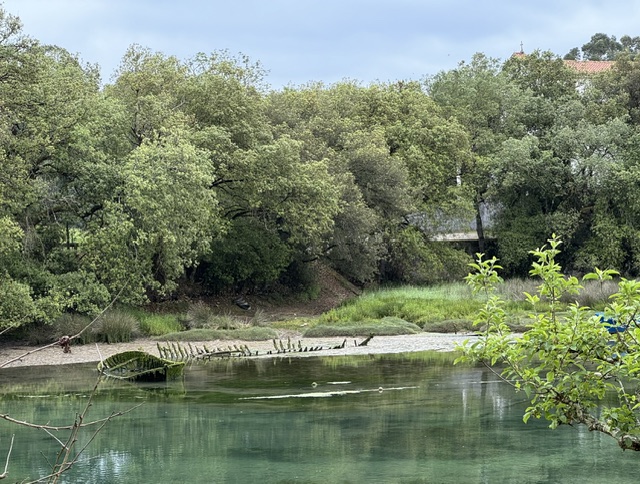
The Iglesia de Nuestra Señora de los Dolores. I wondered about this one since “dolor” means pain or to hurt. Ok, “Our Lady of Sorrows.” Well, I guess she did have a rough life. Built in 1794, a youngster. And next to the Iglesia was a marine graveyard. Rick said it looked like an Andrew Wyeth painting. I think the boats are older than the church.

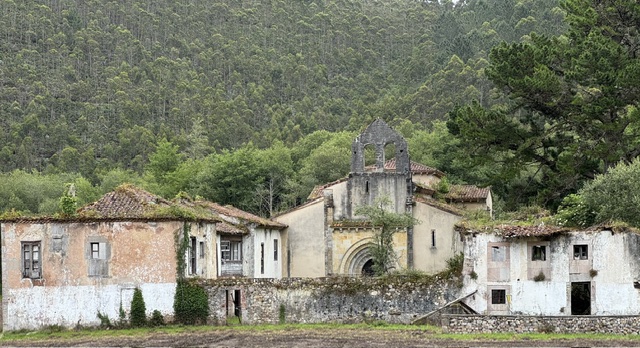
The Monasterio de San Salvador, also Benedictine, had a pilgrim refuge in the 13th century. For me, the visual just leads the imagination to think what it would have been like to come upon it after so many miles of walking in the 1300’s, 1400’s, 1500’s, how long? And then the changes that led to today’s condition. It’s been declared an asset of cultural interest. So enough money for a plaque, but sadly for the building’s sake, no more. But it is zoned for agriculture and heritage, so no condos coming in.

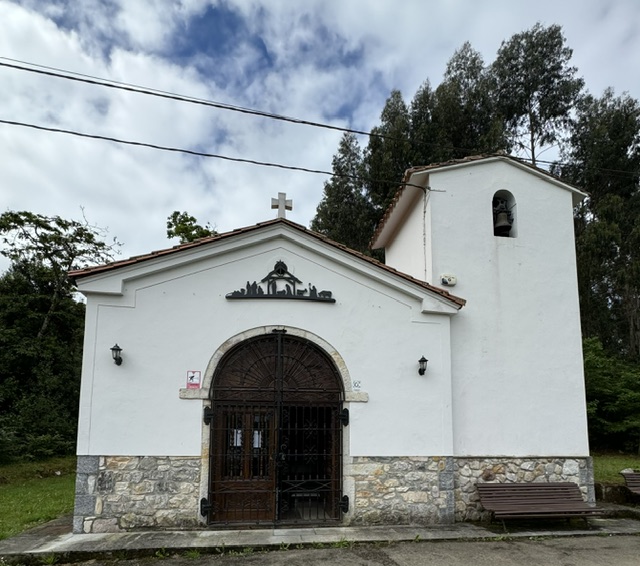
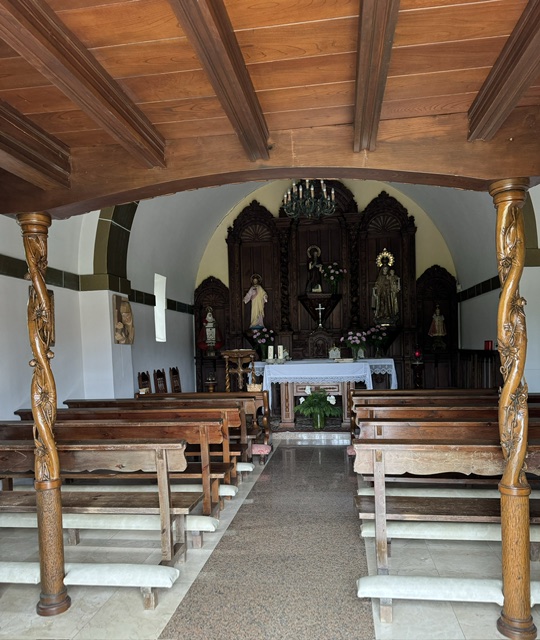
A chapel that was finally open, so calm and sweet, hearing the cow bells behind us. If we had had more time we would have sat for a bit. 

Walked in the meadows and hills, then get sightings of beaches or coves. 

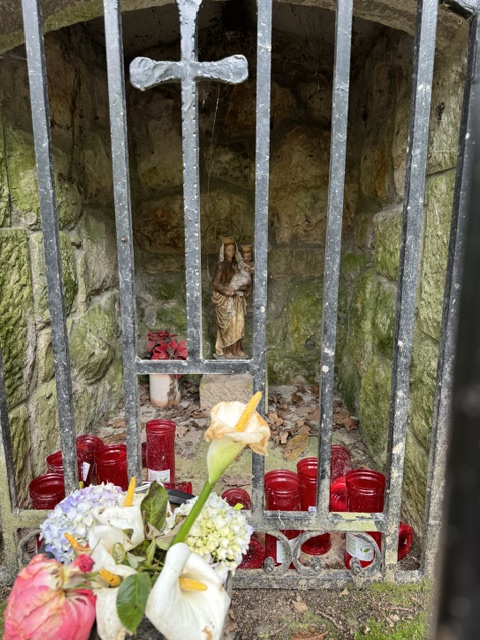
And a dog’s chapel? We really didn’t know, but clearly cared for with many candles.

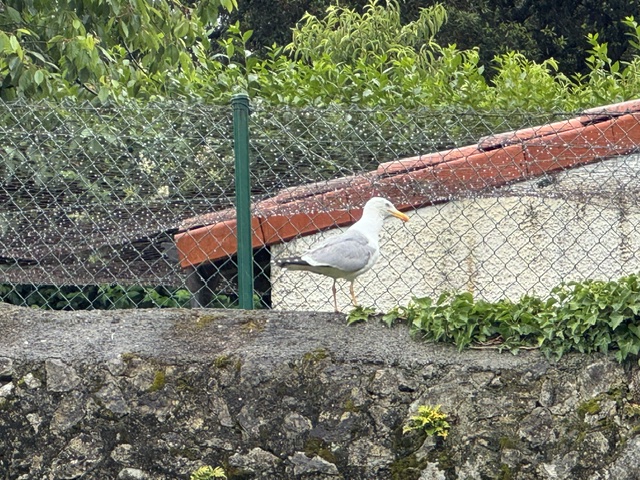
This seagull got us both laughing. It was walking up and down, stopping, looking longingly through and talking to the chickens in the other side for the fence who all had something to say. Clearly confused why it wasn’t in there with its fellow chickens being handed food for no work!

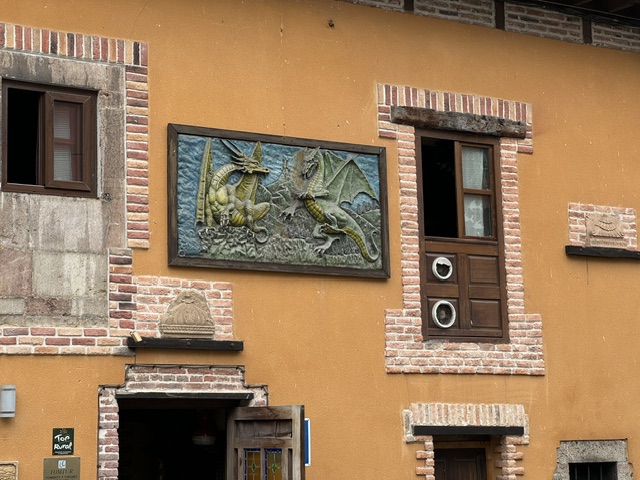
This was the town, Nueva, that we thought might be a stopping point. A pretty and very active small town, but what intrigued us was the theme of St. George and the Dragon.

On the side of a hotel
St. George above the windows

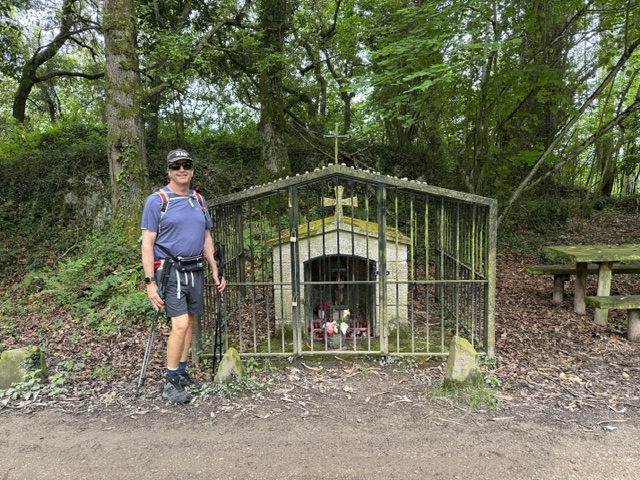
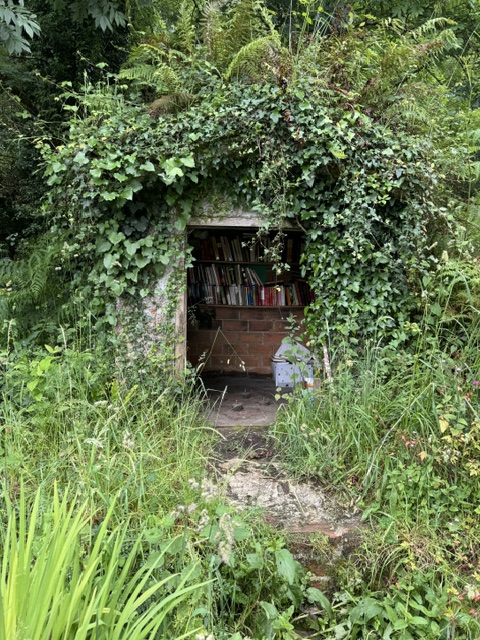
And our kind of chapel, for sure, just missing a few chairs.

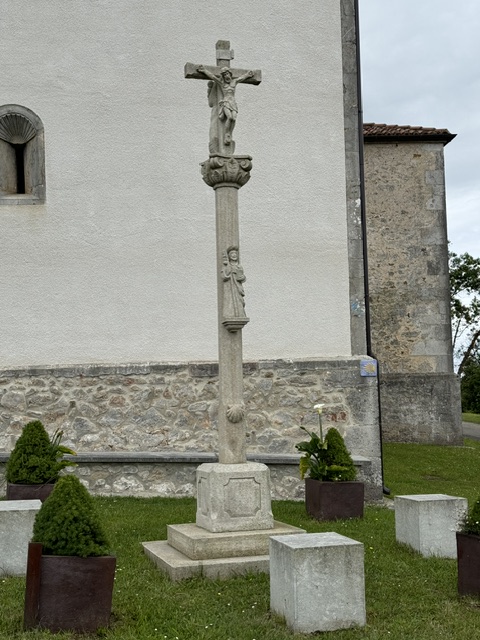
One of our stopping points, a church with a step to sit on, a cross that is the marker all along the Frances, but first one we’ve seen here and a fountain on the side of the cemetery. A group of Spanish women asked me if the water was potable, I said yes since it was actually marked on our map.

Really glad we’re on this side of those mountains and we don’t have to cross them, but they’re beautiful to see in the different light changes we keep having.

And we finally walked into town, but it didn’t feel like we were dragging the last few miles, a nice change. The town, Ribadesella, is known, like Santillaña del Mar’s Altamira, for its caves. The Altamira caves have had to be closed for protection reasons and a museum has been opened up with a full replication – can’t imagine. In Ribadesella, you can see the real thing. You have to reserve long in advance for both. Someday – maybe we can return.

The town, Ribadesella, was conquered by the Romans during Augustus’ rule, then founded in 1270 by Aflsono X and like some of the other towns, developed around whaling. Then the wars totally impacted, from Napoleon, the Carlist Wars, and the Spanish Civil War. We didn’t se anything medieval, it seemed more Victorian on the harbor, if anything. But really pretty and inviting. Except since seen from tired feet, we just kept moving toward the hotel. 

When we finally got to the hotel too late for eating and too early for eating, a feeling remembered all too well from my early days on the Camino Frances, we were both heading towards hangry. We got showers, stretched with the roller to get time used up and still – when we had to walk back into town (ach) for food, there was none. Seriously, not a single plate of ANYTHING on people’s tables in the restaurants, just coffee, maybe a drink, not even tapas. When I asked at a restaurant if it was possible to find food anywhere, he said not until 8. Oh yeah, that was going to be a problem. 

The only thing open was an ice cream shop, so we got an ice cream, then saw a panadería that had empanadas and got enough to manage the evening. Really, we didn’t need much, just something. 

Then back to the hotel, walking the promenade a little just to see, and then Clarkson’s Farm and bed. I listened to the bells at 10, one last time for my Spanish bells. And I slept! It was a beautiful  thing.

Hotel Verdemar, clean, outside of town, half block from promenade that goes around the bay. Good to ask for high room, no restaurant though it had the illusion. And no one else in the hotel, except maybe one person.

Camino del Norte, 10.June.2024, Monday

Bustio to Llanes. 19.9 miles.

A wonderful day. Rick and I weren’t sure given that the hike was supposed to be 17ish miles, but it was fine. I was very done by the end, but the vast majority of the day was just an unfolding of beauty, mountain and ocean and villages. 

Since the apartment didn’t have breakfast and the cafeteria didn’t start until 8, we decided we’d just stock up on our food items and go when we woke up. Plus the apartment owner had left us home-made yoghurt that turned out to be incredible. No way to thank you, but wish we could have. 

We were on our way by 7:20 and walked in wonder for an hour. Even though the first hill was immediate and Rick said it was like being given a double black diamond when you just walked out on the slope for the first time. But really, over quickly and wonderful with the cow bells, church bells, green all over. 

It was misty, cool, perfect, the rain never overwhelmed

A wonderful little altar, fresh flowers, so lovingly cared for

And then we saw two women going to care for it

Loving mom
Train station

Interesting plants, seems like it should be a big flower coming out, but branch on the left is what comes out

We ran into a couple from Vermont after about 1.5 hours and they were just delightful. Both fascinating, Rick and I fell into conversation and that kept up for another hour. I’d already drunk my protein shake and started on my protein snack when we finally found an open cafe and stopped. Yay. And that was our only stop available all day, glad we stopped! 

Then we were back on our own, walking, dreaming, about 6 hours in, starting to listen to books. 

Unexpected coves, beaches would appear around a corner

Great little towns with wonderful color

Finally see our town, way down there

We finally walked town around 2:30 which wasn’t bad at all and a faster pace than normal.

Both of us had feet that were calling for different shoes so went straight to the hotel, change quickly and then went looking for food. A lot of it. We went back to a restaurant that we’d seen earlier that was full of people and got a table outside, looking at the marina. 

Rick had to take a photo of these guys, they never took their helmets off!

Rick headed back to the hotel, but I’d gotten a burst of energy when we were walking to the restaurant and I saw what looked like a medieval town right near our hotel. So cool!

Yet again, I had no expectations for the town and have been absolutely delighted with what we found. Another port town, made it’s living from whaling, city walls from 1200’s, church from 1300’s, alongside the new and beautiful. There’s a beach right outside our hotel and the ancient walls are right across from it and the mountains ring behind the whole town.  Incredible. This has been so different from the Camino de Frances or Primitivo because the towns are all port towns, or mountain towns and have so much character. I loved those other caminos for sure, but wow the towns/villages are additive on this one. 

I started to walk, first saw the casino – a number of towns had this, all built late 1800’s or very early 1900’s.

Town hall, totally different next door

Turned a corner and saw this!

Had to wander this area, so beautiful

Church from the 1300’s and this is just the back, La Iglesia de Santa Maria del Conceyu. In order to build the church the town raised a tax with which everyone collaborated. These days, the church is still owned by the town of Llanes.

This is the front, couldn’t get back enough in the little square to get a photo of the whole building.

Walls across from our hotel

I took a few videos trying to capture the bells and the town and ocean. There’s a wall going up outside our hotel across the beach and you can walk all along this wide park-like walk for an extra 1.6 kilometers to the next town. We’re going to do that tomorrow morning. Amazing the attention given to the outdoors and public spaces. 

Our hike tomorrow is at least 19.5, but we’re thinking we’re going to shorten it. It’s so nice here, I really want to do that walk that adds the extra AND there are two monasteries I’d really like to see tomorrow AND another wonderful fishing village. Our last night. So rather than be totally wiped out, we’re opting for choices. We’ll start early again, maybe we’ll change our minds, but we’ve gotten the name of the taxi company and we may call!

Camino del Norte, 9.June.2024, Sunday

St. Vincente de la Barquera, 9.9 miles

Today just flew by, such an easy gorgeous walk. We both were a bit startled when it was over so quickly. And it ended at an apartment, so that was a surprise too. But the lady who checked us in was great and I managed to get everything we needed from her very fast Spanish about being in the apartment. The great thing is that there’s a washer and she said we could turn on the radiators to dry things if the rack on the balcony didn’t do the trick. And we were definitely due, I was going to find a lavandería for our clothes and then realized, oops, Sunday. Ach. 

But the walk – it was through a national park, Parque Natural de Oyambre, with some houses/farms clearly grandfathered. It was founded in 1988 after a lot of work of preservationists. And it was just beautiful. We started out with misty rain and by the end it was warm enough and we were down to t-shirts. And the terrain was mostly dirt roads and back road tarmac so easy to walk and look and listen. And that’s what we did all the way. I never turned on music or a book because it was just a treat.

Outside a pretty alburgue – seemed like people left prayers here 

The place on the left below was the only place we found for coffee and a snack on the way since we’d left so early. The name was Taberna La Gloria and that’s the church right next to it. Sunday morning. We started counting who and how many were going to the two different places. Sadly, the Taberna edged it out. When we walked by the church, there were lay people leading the reading and we didn’t see a priest, so just the neighborhood gathering together, mostly older folks. But sweet. The doors were wide open so they heard the game and the people next door in the bar. Very communal and the little town seemed pretty active. Rick’s wearing his poncho that he called the blueberry. The blueberry did get some work time!

Leaving the town, so pretty, these walls everywhere are amazing. No cement, or rarely, just very carefully placed stone.

We got into the apartment, did a load, hung it out, started the next load and went to find lunch. We went to the first restaurant we found that was full of locals and had a great dinner. We’re finally learning to share the salad or first course – we usually want salad – and then have a second. They just have enormous portions! 

Our salad had lettuce and tomato, walnuts, sardines (a totally different thing here and delicious) and a new type of thing called gula. I finally called the wait person over to ask what is this yummy little thing we’re eating? Gula – from the river. We decided they were river worms. 

Here’s what I found: Gula’s live in freshwater and travel from rivers to the Caribbean Sea, where they lay their eggs. Each specimen lays between 500,000 and 4,000,000 eggs. Initially, they have a millimetre of length, they do a 11-month trip till they arrive to the European rivers, where they finally settle down. And we eat them. Rick wondered if it was worth it. To the worm or baby eel.

The things we are learning on this trip. Also, Rick and I have started a new Netflix special and are cracking up every night. Kylie told us about it and said she’s on the third season and still laughing with every episode. Clarkson’s Farm. Guy in the Cotswolds who decides to farm his farm himself after stopping his career. Truly funny. 

Camino del Norte, 8.June.2024, Saturday

Comillas to St. Vincent de la Barquera, 8.7 miles

Today was an amazing day. First, the scheduled hike was only 7 miles which felt very doable (the different mileage reflects how much we walked in the town, getting to the hotel, lunch, etc.). Then, we were able to get an earliesh tea and coffee from our super nice front desk woman who also manned the bar (that’s where you get coffee) until the breakfast opened downstairs. 

We left at 9, so civilized and not at all motivated to leave earlier.
The weather was cloudy, cool, but t-shirt weather most of the time with a bit of breeze.
The scenery was so engaging, I never turned on any books or music, just watched the scenery go by. 
My back rallied and so did my energy!

So we had a great day, both of us marveling. We were on a beautiful avenue out of town and then made a right and were next to the ocean the rest of the time. Even when we couldn’t see it because of a hill between us and the water, we could hear it. Such a nice way to walk.

Ideal farm:

Rick and I watched curious to see what would unfold with these guys. It seemed like a lot of work and noise, but they must have been pleased once they got up. I realized when I rewatched it, that it does a nice job showing the ocean and the fishing village we’re walking to built into the hills. Gorgeous. Raining, misting, but raincoats were great and it stayed a perfect temperature.

Proud town sign, the bridge beyond is a stone bridge built in the 15th century on the site of another built of wood, then added to over the centuries. When it was built during the time of Carlos III, it was considered one of the largest bridges in the kingdom. 

The town itself is up and down hills, a fishing town, with a giant castle and a giant church, both built in the 1300’s and added onto till the 1500’s. Both of which you could only see on Monday. Really? We tried because we were told at our usual late lunch that a wedding was happening at the cathedral at 5 and if we walked up, we should be able to see it. We saw the florist walk in and Rick and I went behind, Rick got a few feet in and saw the beginning of splendor before the wedding planner yelled that we weren’t supposed to be in there. 

So, really, this giant Catholic Church has been turned into a wedding venue. Amazing. I tried to photograph both the castle and church, plus the town walls from the 1300’s, but hard to get a grasp. 

Here’s the sign for it – just tempting people, really.

This is the door of the pilgrim. San Vicente de la Barquera was an important point of the Camino del Norte and had numerous hospitals and shelters for pilgrims, all within the city wall. Hikers on their way west, after leaving town would go through the wall by what is known as Door of the Pilgrim. 

Pilgrim door on the left, church, and hospital on the right.

Here are some of the city walls outside the church:

Best I could get of the castle. Castillo del Rey. Built in 1210 (!) by Alfonso VIII, on top of an 8th century castle when King Alfonso 1 was the Asturian king.

This photo is from our hotel window and kind of shows how the town is built up into the hills, with the marina below. We’re on the next hill over from the castle and church. I’m sitting here, listening to the church bells celebrating the wedding and to sheep baaing, though I can’t see them. Probably in the hills just behind us.