Vietnam, 11.Feb.2025, Tuesday

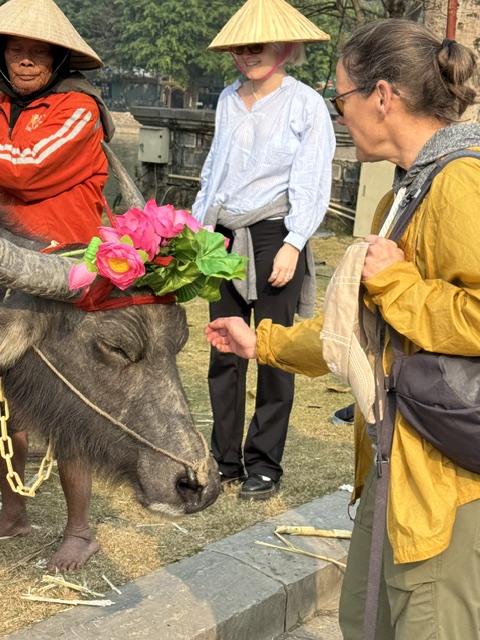
Note from yesterday – forgot Kellie finally getting to see a water buffalo.

Yesterday we were all a bit underwhelmed with the previous day so we didn’t have high expectations for today, but it was great. So incredibly interesting. First, we drove enough to see much more of the city and there are gorgeous buildings built both by the Vietnamese and by the French during colonialization, in addition to wide avenues and lanes of trees. 

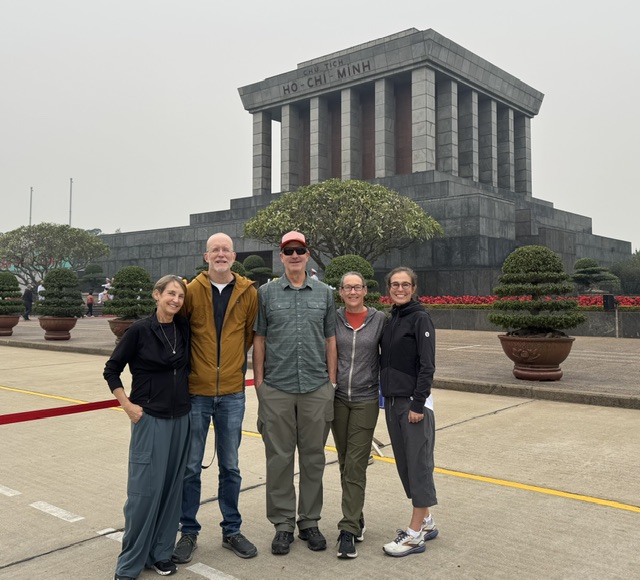
Our first stop was the Ho Chi Minh Mausoleum, housing the “beloved revolutionary leader affectionately known to the Vietnamese are Uncle Ho.” It’s interesting learning the Viet Cong side of things since the book I’m reading is based more on the Republic’s view of the war. Our guide was adoring and proud of Ho Chi Minh and there were hundreds, thousands?, of people in line and moving respectfully through the paths in the compound towards the mausoleum. No cel phones were allowed past a certain point, well before the building. One small group of older Americans ahead of us were pretty oblivious and despite warnings from the soldiers, one of the women kept pulling out her cel phone. A soldier finally confiscated her phone and then escorted her all the way around the room of the actual body, then in an office at the bottom deleted all the photos and video she was evidently collecting. 

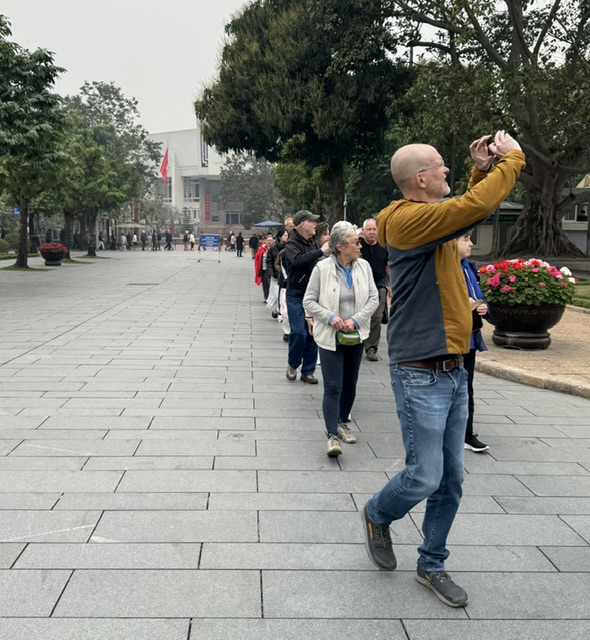
The line curves all the way back and around – and we had to stay single file, our guide kept asking us to move back to single file.

It was a very quiet and respectful crowd, no knees or shoulders showing, no hats. It was actually kind of amazing to see this man so well preserved. That’s really Ho Chi Minh. The man who led this country and defeated first the French and then the American armies. 

This is after we came out, then photos are allowed.

Saw the changing of the guard, the sign above them says: The Great President Ho Chi Minh Lives Forever In Our Cause. The sign greeting us as we walked toward the monument started with Socialist Republic, but I couldn’t get the rest from our vantage point after the tour.

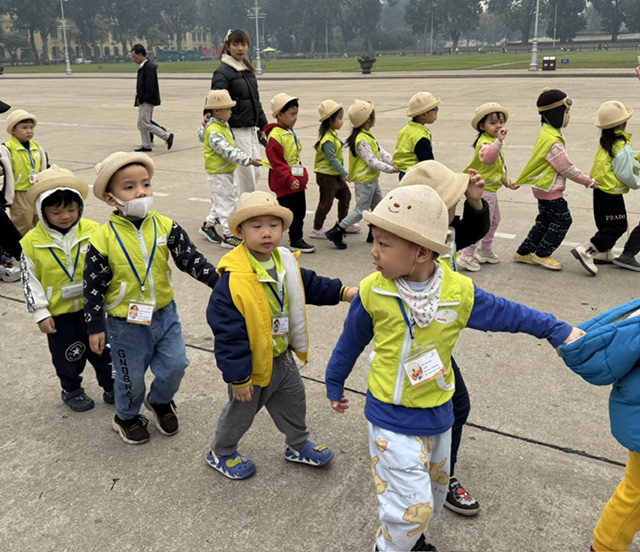
So many groups visiting, the little ones are adorable with all their matching hats.

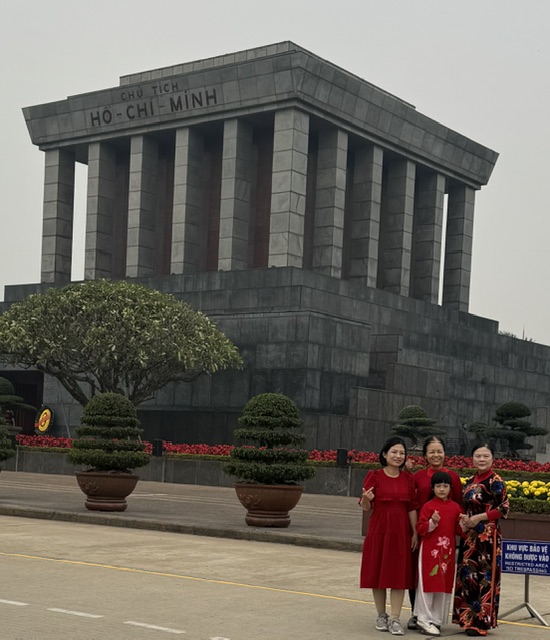
Many of the visitors wore red and black. I never learned why, but assuming it’s the color of the flag and of communism.

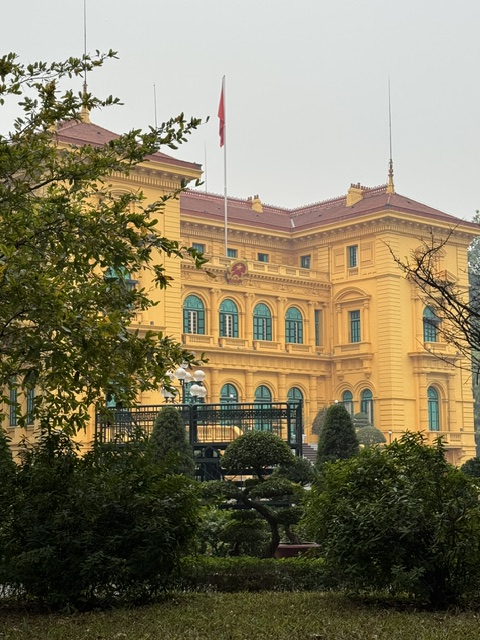
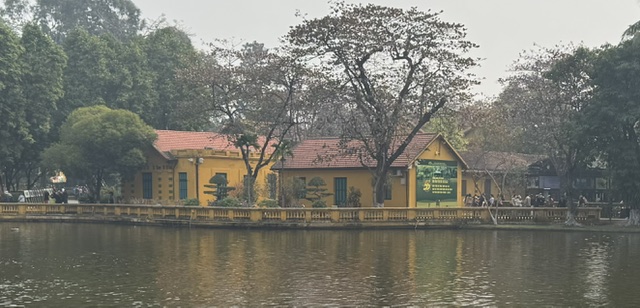
This was an example of one of the French colonial buildings. Gorgeous, but Ho Chi Minh said he wouldn’t stay there, too fancy, he made it into a greeting building for when international dignitaries came. 

We then visited Ho Chi Minh’s complex. He lived there from 12/19/54 to 9/2/69, “mapped out the Vietnamese revolution, let the Vietnamese people to construct socialism in the North and fight the American aggressors in the South, contributed actively to the struggle for national independence, democracy, peace and social progress worldwide.” 

We saw where he ate, had meetings, etc. It was a pretty compound, not at all pretentious and his home was small and quite simple. 

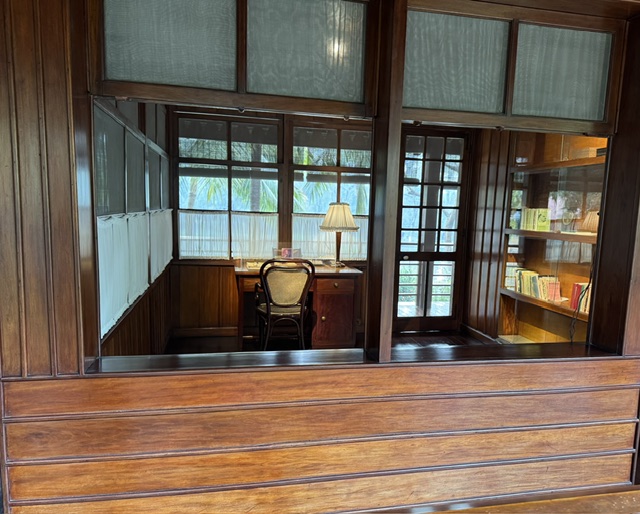
The people then built him a new house, really beautiful, of wood, 2 rooms living above, small office and small bedroom and an open meeting area below. It almost felt Frank Lloyd Wright like. No kitchen or restroom, he went over the other house for those needs.

We were wondering what others in the south would say about him, “Uncle Ho”? Or with families who were with the republic, would it be different? The narrative was consistent with both our guide’s stories and the written pieces around the compound of a beloved leader. Ho Chi Minh was a man who kept things simple and walked rough paths with bare feet so that he could walk with the people in the south when he went to visit. He was a reader with books next to his desk and photos of Marx and Lenin above his bookshelf. And completely committed to his people and their well being. 

Maybe he didn’t know what the Viet Cong were doing to their fellow Vietnamese? Of course, it went both ways, but knowing how the South in the US still thinks about the “War Between the States”, I’m guessing it’s not quite so consistent a story line throughout the country. But still – it was fascinating.
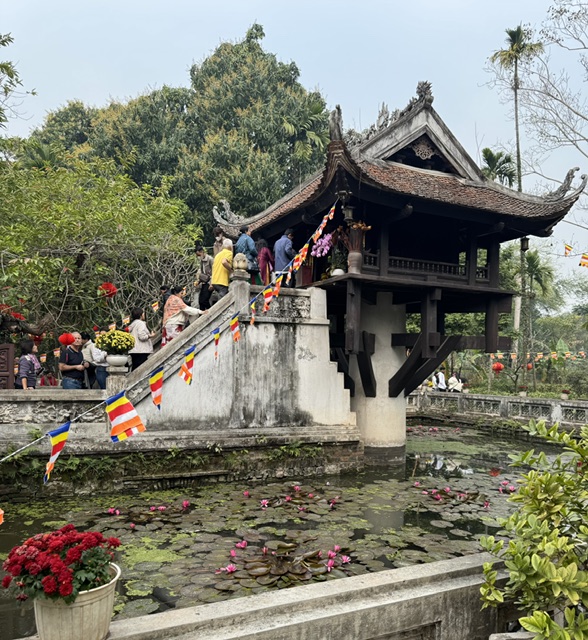
We saw the One Pillar Pagoda, also in the compound. This is a Buddhist temple built in 1049 in the shape of a lotus blossom and set on a single stone pillar, considered by many to be one of Vietnam’s most iconic pagodas. 

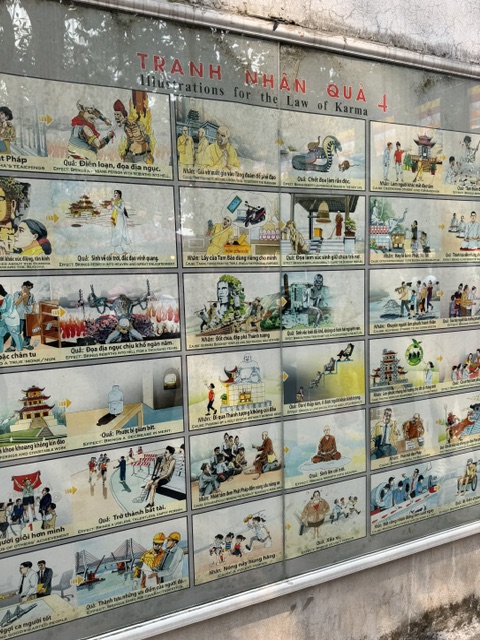
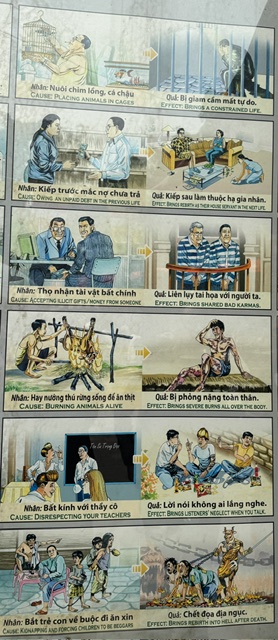
On the surrounding walls of the plaza were murals of Illustrations for the Law of Karma. Lessons on every one. Kellie and I couldn’t get enough of them. I just kept photoing and cropping to be able to read them.

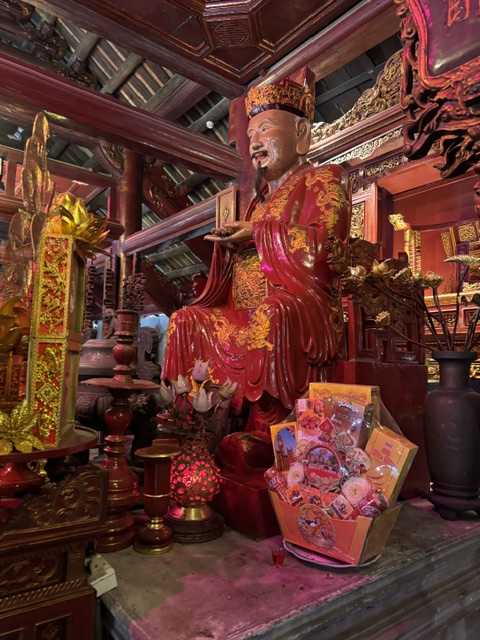
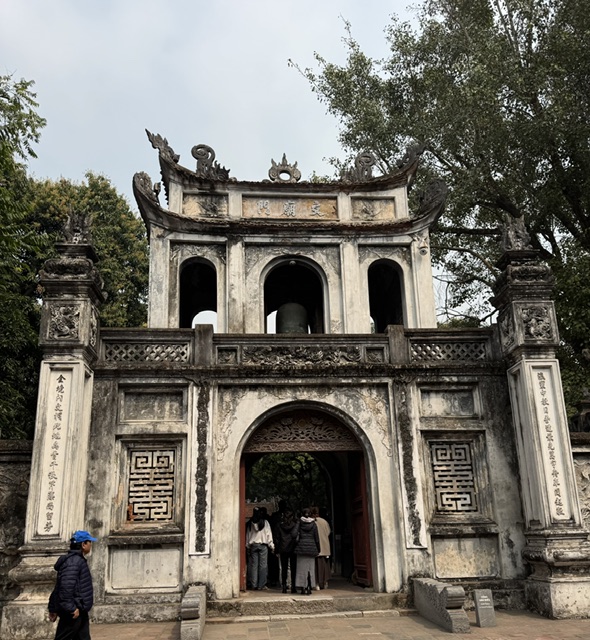
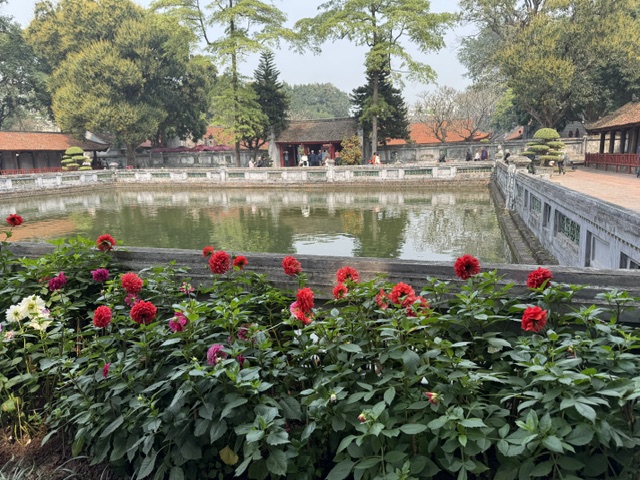
Then we saw the Temple of Literature. This was great. Founded in 1070 by Emperor Le Thanh Tong, this complex is dedicated to the Qufu-born philosopher Confucius (Khong Tu) and was the site of Vietnam’s first university, Quoc Tu Giam (1076). The altars are still popular with students praying for good grades. In 1253 the university was expanded to admit excellent students from common families, becoming a leading educational center and a place to select talented individuals for the country. 
Confucius:

The analogy for the scholars was a fish becoming a dragon – the ultimate symbol in Vietnam. The fish were swimming around and a few exceptional ones were plucked out, they were then  on their way and with each accomplishment shifted little by little until they completed their imperial exam and became like a dragon. 

The classrooms, library, and dorms had been rebuilt to resemble the architecture at the time and were beautiful. This school continued from the late 11th century to 1779 when the last exam was given. Over these 100’s of years, exams were only given 116 times, with 1,032 people graduating.

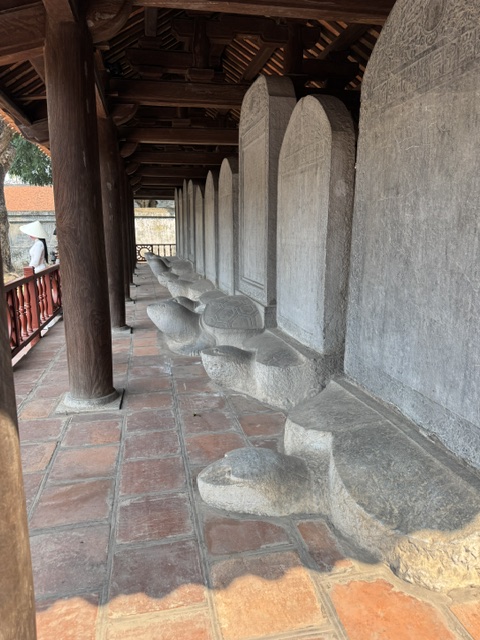
Each time an exam was given, a turtle was carved and a panel erected above it. There are 82 of these carvings left. The graduates were all then launched into careers supporting the king and other areas of government. Their name was enscribed on the panel. However, if they were not illustrative or successful, their names were then erased. 

Our final stop after a quick lunch was the Hanoi Hilton, named by the American POW’s, all of whom were titled pilots by the Vietnamese regardless of their role in the war. This was grim, of course, because it was first built by the French to punish political prisoners and criminals. The political prisoners were treated much more harshly. It was then used by the Viet Cong for their prisoners. I don’t know what the reality was for the Americans imprisoned there, but there were photos of them having Christmas, playing games, reading letters from home, etc. Of course, this is Hanoi and they were looking for American visitors. 

And now, we’re flying to Hue, the imperial capital of the Nguyen Lords from the 17th to the 19th centuries. 

We stayed in yet another totally cool and old hotel, had dinner, went to bed. Notice I don’t say to sleep. Jet lag is a strong companion, but it’s all so interesting that we make it right through the day.

Vietnam, 10.Feb.2025, Monday

Today, we all relished breakfast again, such good food. Pat and Scott asked the server about the Vietnamese coffee that is a traditional drink. It’s very very slowly pressed strong coffee with condensed milk and poured over ice. They decided to try the coffee. They both loved it, thought it was a great addition to the coffee repertoire. Even Scott who doesn’t normally drink caffeine. Pat began slightly hallucinating because it was so strong and on top of the coffee he’d already drunk, the caffeine load was big. He and Scott then jittered their way out of the restaurant 🙂

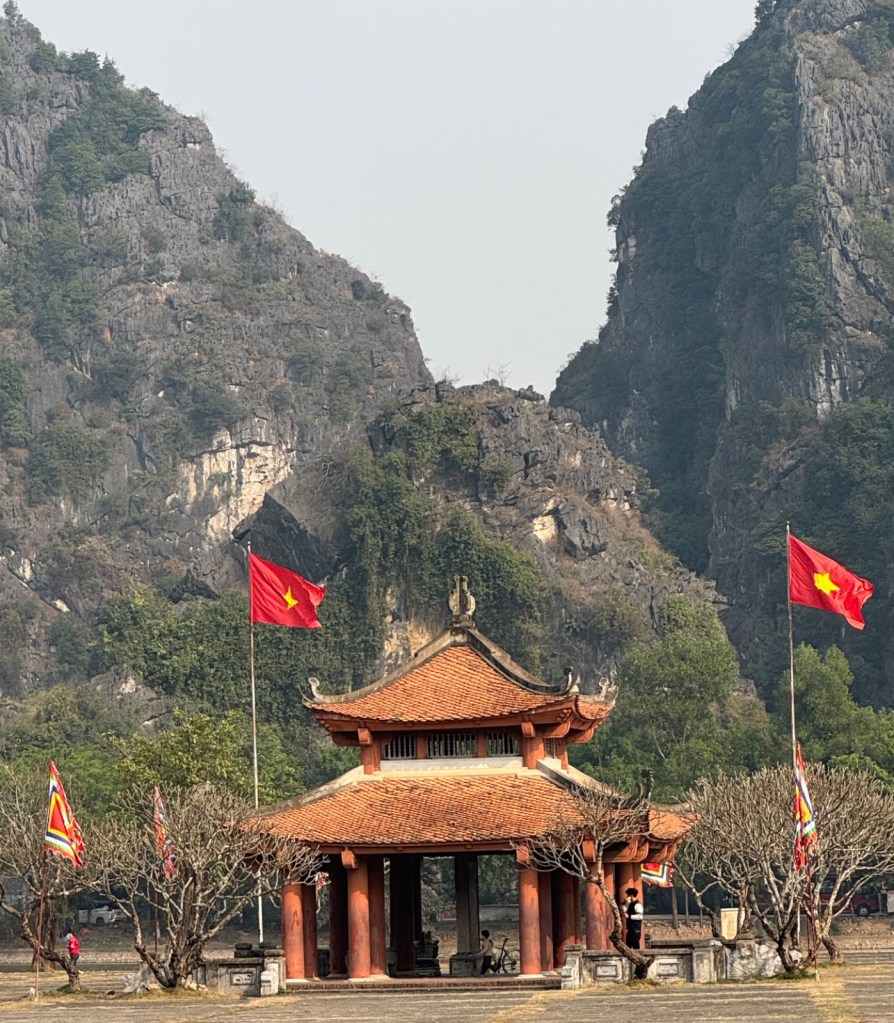
Today, we’re driving out to the Tràng An. A scenic area near Hoa Lú which is renowned for its boat cave tours and historic temples. On 23 June 2014, at the 38th session of the World Heritage Committee in Daha, the Trang An Scenic Landscape Complex was inscribed as a UNESCO World Heritage Site. 

Honestly, it was a bit odd. It’s a two hour drive, we’ve been driving almost two hours now (I’m writing in the van) and it’s been a continual city spread, occasional rice patties, but mostly just a series of buildings, with occasional houses in the midst along the road. Reminds me of Houston, where the spread just never ends. The video shows a bit of this. 

The photo here is the “house” of one of the two cement kings. As our guide says, if you have money, you can show off as much as you want. He wanted to build a house that looked like St. Petersburg. And he did!

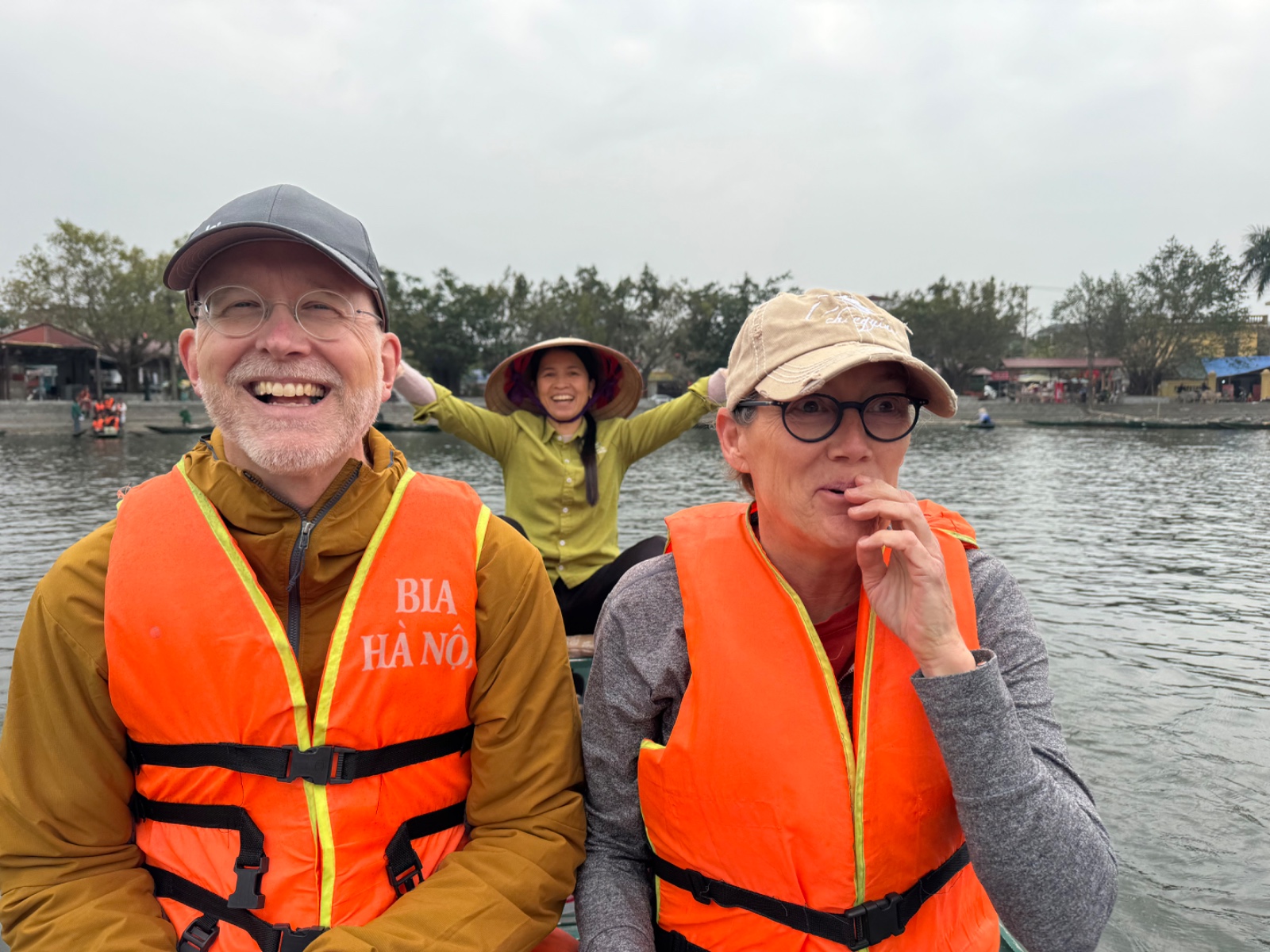
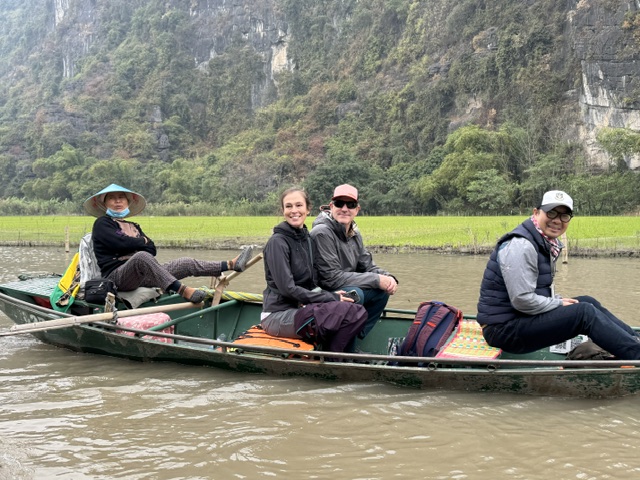
At the end of the drive, we got out and into an open air bus that drove us to a river spot. And we were in Disney. Well, obviously it wasn’t, but it felt like it. We got into boats, 3 into each with a rower; both of our rowers were women. The rowers were small and strong. They started off using hands, then switched to feet to row us for almost 2 hours up a river and then back down. So all these little boats are going along in a row, all visitors wearing bright orange life vests. 

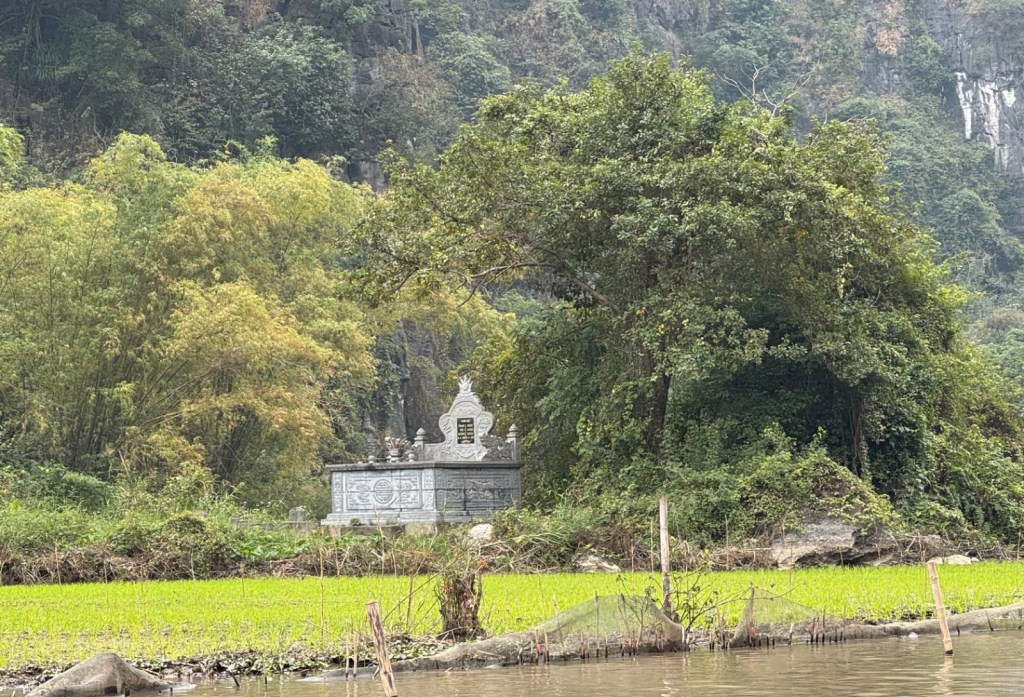
It was pretty rowing along the rice patties surrounded by the karst peaks. There were occasional cemetery spots or just a cemetery stone. The practice for cemeteries in this area is when someone dies, they are buried. After 5 years, the family lifts the body out of the grave, cleans the bones, then they put it back in with the rest of the family. The vaults along the rivers are recent and carved out of cement. Later they will be painted. Some of the cemeteries we passed were beautiful with the carvings and paintings.

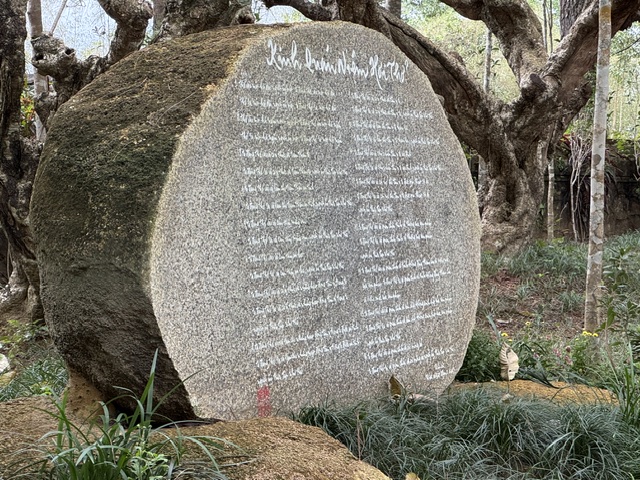
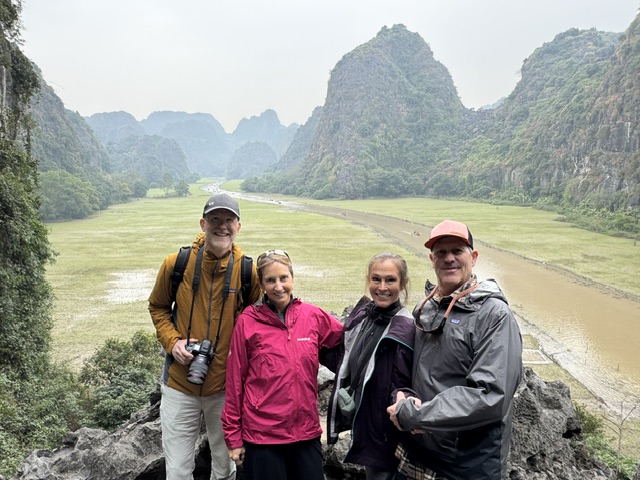
After almost 2 hours, we left the boats, thanking our guides, and walked along a path that passed an ancient small temple carved into the mountain. My photo translation of the stone said “The Tran Dynasty brought spring to the country after thousands of years of Chinese domination.” Thai Vi Lunh Tu was the leader of this dynasty who consolidated Vietnam and the various fighting factions to defeat the Chinese. 

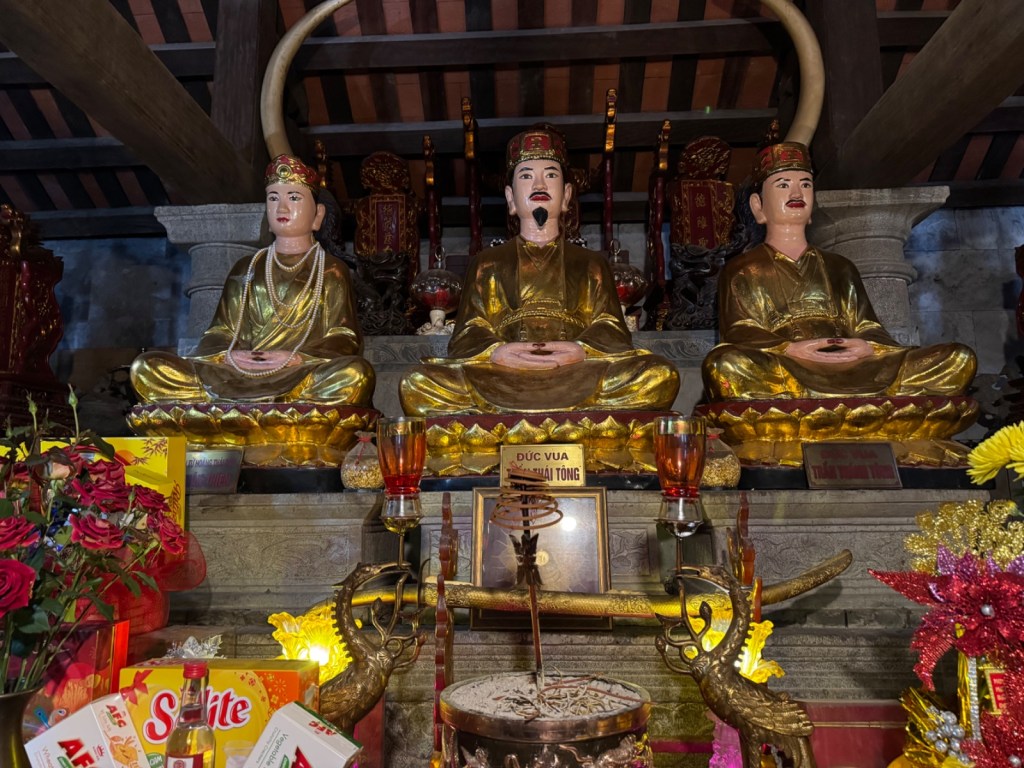
This cave temple was “The sacred place of worship of the Tran dynasty, established by the Supreme Emperor Tran Thai Tong, the first King of the Tran Dynasty to leave home and become a monk in 1273.”  The final note on the stone was clearly a more recent note recognizing history. “Since the Dai Viet era, our people have always firmly protected the fatherland, all people as one, chasing the enemy to the north. The Tran Dynasty had great achievements in the three resistance wars against the Yuan-Mongol army. Generations of Vietnamese people have always worshiped the Tran Kings as the sun that appears daily from the east, radiating a radiant halo for the nation.”
Turns out that where we were going next after lunch was the 18th century recreation of the temples recognizing these original emperors. 

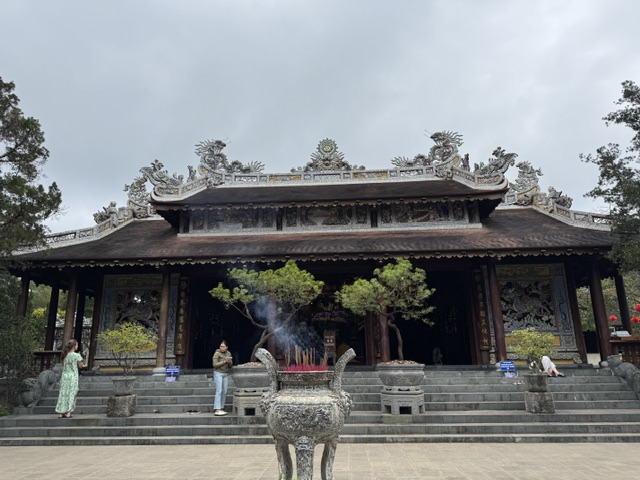
Our guide told us that a temple honors kings/emperors and a pagoda is a place of worship and there were both in this site we were visiting.

But before that site, we went to a temple with some notes (transcribed) about the history: Thai VI Temple. Saving the country is a great achievement, the old temple is a 1000 years old, the Northern land is famous. May the people be blessed with endless blessings. Ancient temple, a building that the South can admire.

And no, it’s not a dead dog, just sleeping hard.

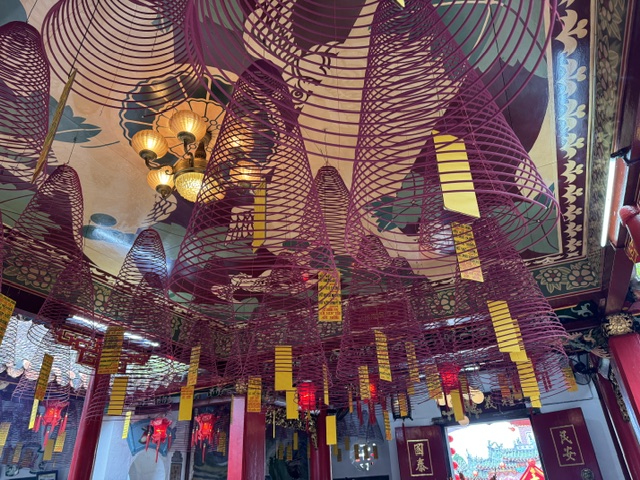
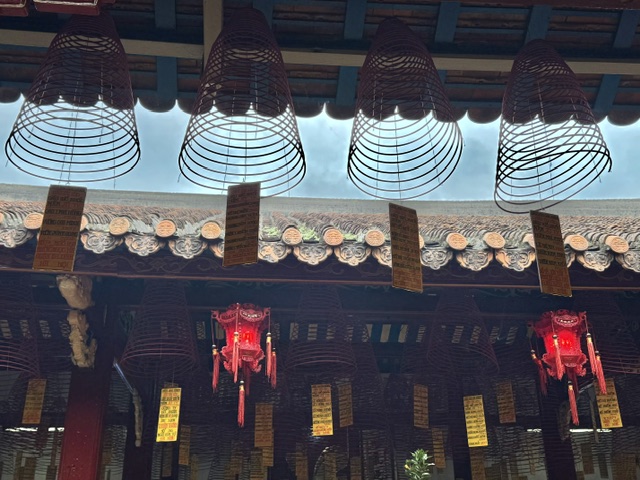
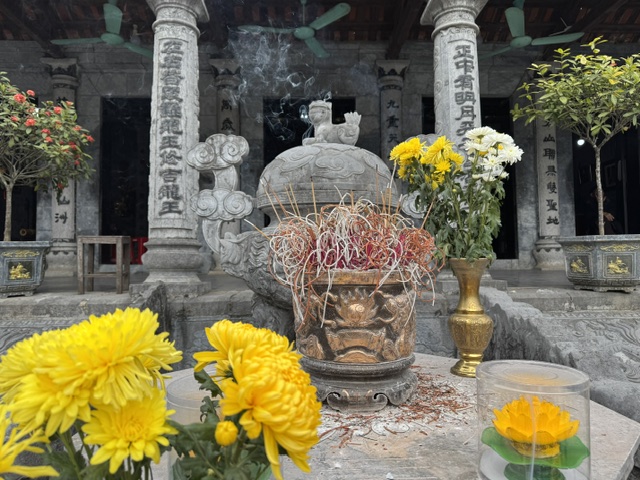
Incredible incense container behind the yellow flowers.

As we were leaving haunting music started, instantly transporting us back many years.

Then we saw the musician. I could have stayed there a long time. He told us that he was the last who could play the instrument and that no one wanted to learn.

 And now to the main destination. Lu is the site of a 10th-century capital of an ancient Vietnamese Kingdom called Dai Co Viet. This small Kingdom covered an area of only 300 hectares, and reigned from the 10th century, during the Dinh and Le dynasties to the 11th century, during the Ly Dynasty. In 968, King Dinh Bo Linh of Dai Co Viet (an ancient name of Vietnam) constructed his capital in Hoa Lu and ruled until 980. This first king fought off the Chinese and brought all the Vietnamese groups together. Hoa Lu endured for almost 31 years through the Le dynasty (980-1009) and the Ly dynasty (1009–1010). This latter dynasty cemented power and built gorgeous buildings (all now long gone). 

Banner welcoming us says: Celebrate the 1057th Anniversary of the Dai Co Viet State (968-2025)

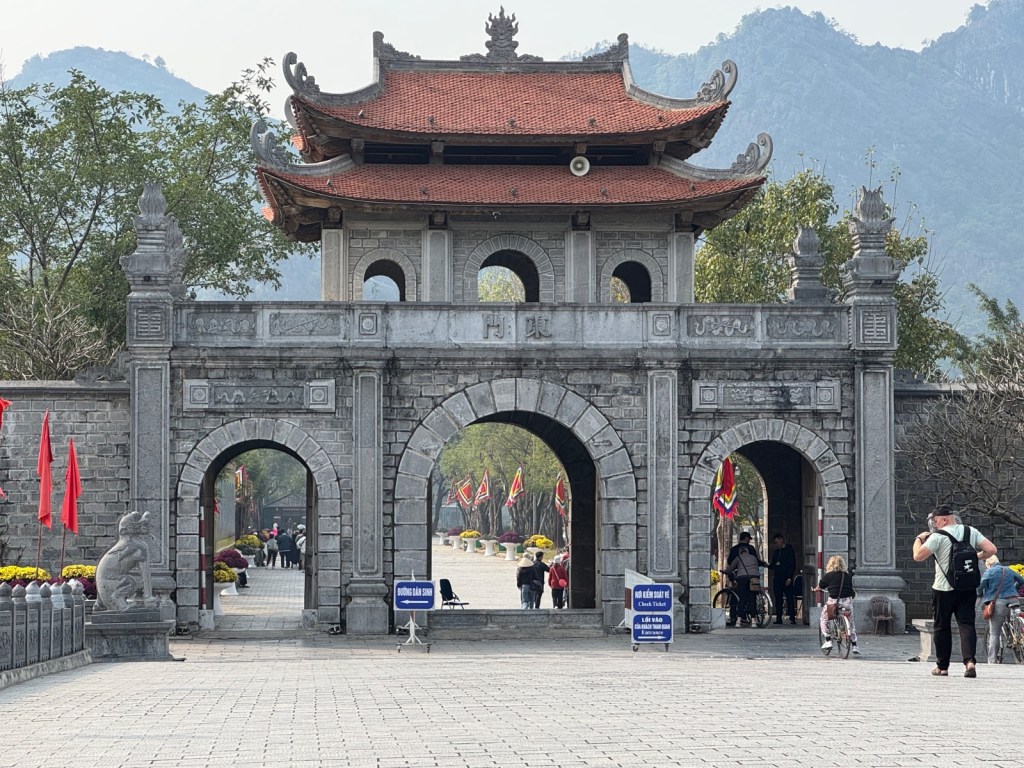
Entrance gate. 

The first emperor, statue in Hanoi.

River surrounds a lot of the site. 

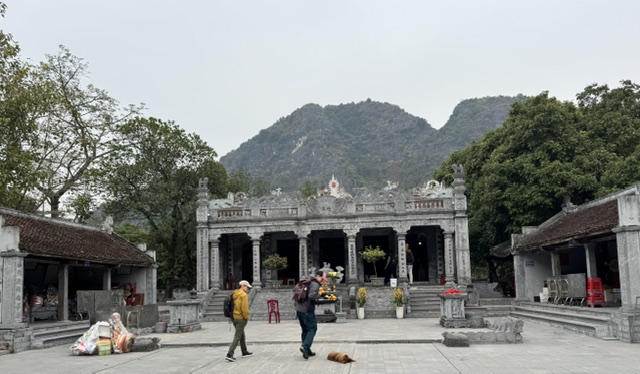
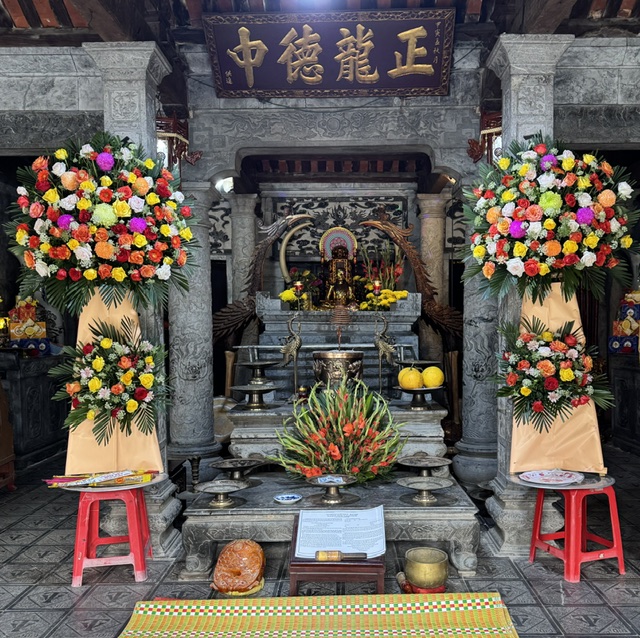
It was hard to get photos of the full buildings, ornate, with sculptures and incense burners in front. This was the first small temple we saw:

A marker next to a temple  had these words (per my Photo Translate and shortened a bit): This was the first ancestor of the Dam Huy Hoan family. More than 2000 years ago…he was an intelligent, upright and brave person and he had many descendants. In the family genealogy, there is a passage that says: The Dam family had scholars who passed the imperial examinations (more about this later) . In the family, there was a daughter who worked as an oil painter. Because she was from a noble family, she was intelligent and virtuous, complete in both her ability and her behavior. And it continued on through her son who revered her. Nice to see a woman so noted. Not a lot of that here. 

Except for these two women, mentioned several times over our days: Two of the country’s most revered heroes are the Trung sisters, Trac and Nhi, who led an insurrection against China in A.D. 40 and liberated Vietnam. One of their commanders, Phung Thi Chinh, is said to have given birth during the battle and to have continued fighting with her infant strapped to her back.

A few scenes that definitely miss the intricacy of the palaces and temples:

The Vietnamese knew where the palaces were, and the early history of Vietnam’s first emperors. The Nguyen dynasties rebuilt on the original site temples in their own style in the 17th and 18th centuries to celebrate Vietnam’s history. It wasn’t until the late 1990’s and early 2000’s that they uncovered the original palaces, finding columns, coins, pottery, etc. Amazing 1000 year old pieces. 

That night we were all feeling jet lagged and had dinner at the hotel and all went to bed. 

Vietnam, 9.Feb.2025, Sunday

I’m off on a trip to Vietnam, Cambodia and then continuing on to see Singapore on my way to visit my sister Summer in Brisbane, so a big trip. So cool. I’m with friends, Scott, Kellie, Pat and Holly and Rick was a critical element of the group and he’s not here. Rick’s beloved (by all the White clan) Aunt Audreé died the weekend before we left and he couldn’t miss the funeral. So we left without him, not easy for any of us. Hardest on Rick of course, but he rallied and had some of his own adventures while I was gone.

Normally, part of what I love doing in these blog posts is talking about the history, but oh man, the history of Vietnam is incredibly complicated. I keep trying to put it together, but it will stay a challenge throughout our trip. Between dates, colonization, wars with China, France and America, monarchies, independence at different times, etc. hard to synthesize. 

Our first day we took time to recover from the flights. The flights were so easy, connected, but oy, they’re long. When I was trying to figure out how to attend the funeral, we were able to set up flights coming back and returning without losing too much time off the trip, but then Rick did the calculation of travel versus time in country and it didn’t remotely make sense. He’s done so many Asian trips because of work that he knew what he was talking about. I was in serious fantasy land with my hopes to come back. Now I know. This is a far far distance away. 

We started in Hanoi. In the 11th century the King moved the capital here and called it  Tung Lao – ascending dragon – because of a cloud formation that he saw. Now the city is called Hanoi which means inside the river, renamed in the early 19th century. There used to be regular flooding with houses built on one side of the river to try to hold back the river from the rest of the city. Now hydro electric plants control the river so it no longer floods the city.

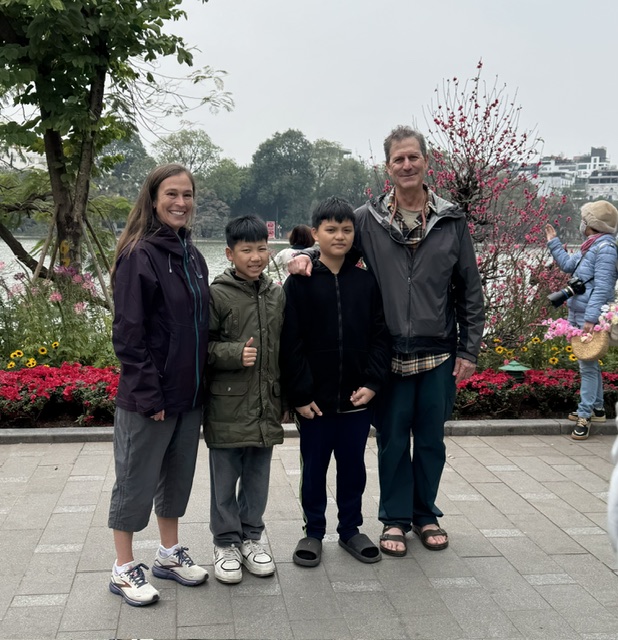
Sunday was a day off to explore, walk, see Hanoi and try for a nap. There’s a lake in central Hanoi that is walking distance from the hotel (Sofitel, built in 1901, oldest elevator in Hanoi, a very beautiful old building) and Pat, Holly and I went to see. Groups of middle-aged (mostly) women were doing these exercise routines to music all around the lake.

In addition there were moms with kids who would ask “do you have time?” Then the kids would ask questions from their papers – learning to speak English. So we had some delightful interactions with the kids – Pat and Holly were a hoot, they couldn’t resist any of the kids!

Pat and Holly also got caught by shoe cleaners. Pat thought the guy who told him he could repair a tear on his green suede Birkenstocks was great. Then before the end, his cool Birkenstocks had been turned into dark brown, no longer suede and the guy told him $20 American wasn’t enough and told him where to go to find a bank. Funny. 

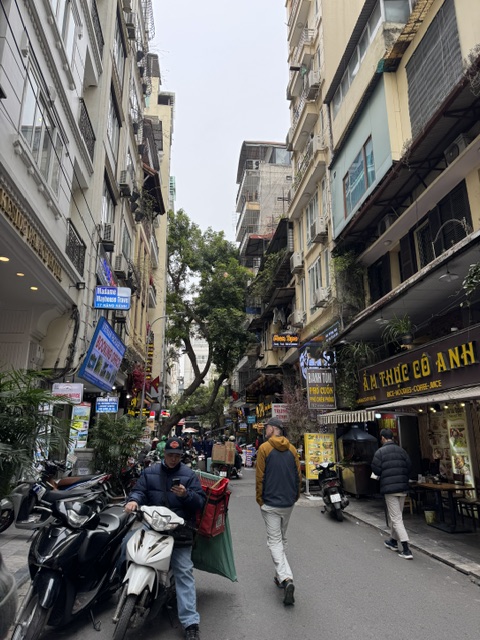
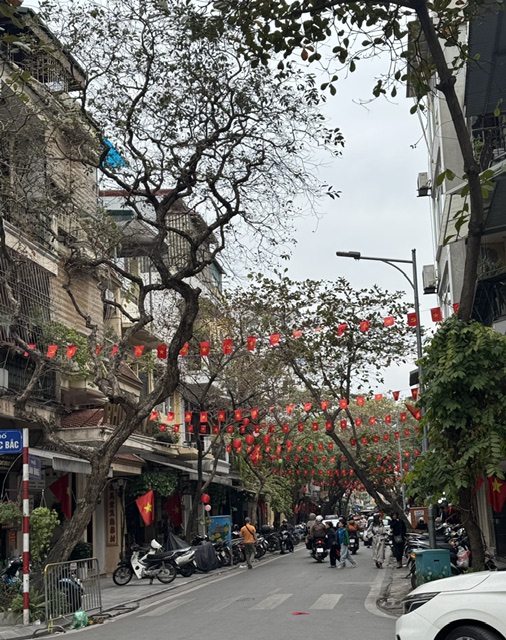
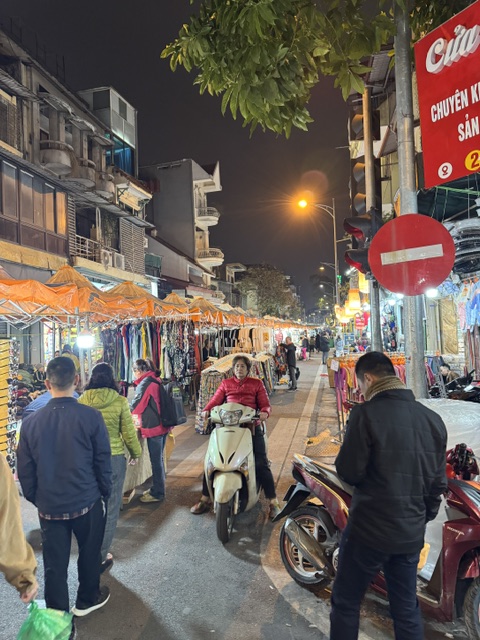
Scott and Kellie then joined after a late breakfast and we walked again, this time exploring the old city. Scott never seems to lose his way and he steadily led us on and around without ever referring to his phone. Amazing. We wound onto smaller roads, 100s of scooters lined up on the sidewalks so we walked the streets along with the cars, scooters, people, tourists, people cooking street food on the sidewalks and somehow it worked. You really can walk around Hanoi – at least the part where we were. 

It was pretty clean, regular small piles of trash collected at the curb and then picked up. And though it’s grey, crowded and busy, the plants and trees that somehow survive add to the walkability of the city. 

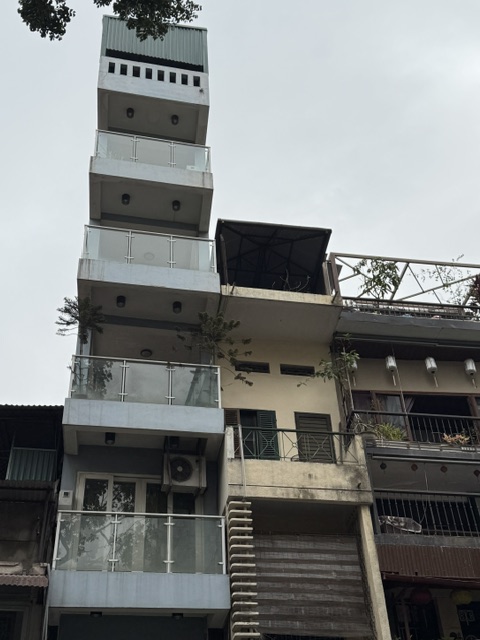
We were fascinated by the very thin and tall buildings. Some were left from the French colonial times and were beautiful, even if it’s just the facade that’s holding up. They were right next  to houses that were a wonder they were still standing. Our guide we had later for a walking food tour told us that each generation’s family keeps adding up, with the senior family member having the first floor.

Traditionally, the business was/is at the front of the building, the middle of the building committed to the manufacturing of whatever is sold and then living at the back. There were slim little alleys leading to each section and access. Our guide stopped at one point and pointed to the electrical boxes, one per family. There were 17 in one alley and you just had to guess how the configuration worked since it wasn’t at all obvious how 17 families were in that building.

Our last stop before walking back was the “train street”.  Scott knew about it and led us to an entrance, but a woman stopped us and just talked a lot about coffee. Confusing and she wasn’t letting us go up to see the train street. So we went to the left to find our way around. We found a way and then I understood the term “train street”.  The only way to be on the street when the train came through (5/day) was by being IN the buildings, looking out, or on the curb fronting the buildings. Our timing was amazing because we got front row seats in a cafe, ordered fries, cokes, smoothies and then a group came along and we heard the guide say the train was coming in 10 minutes. And it did! People were blowing whistles and waving oblivious tourists back – “you’ll die if you don’t move off the street” – and then we waited with cameras in hand (of course). Crazy. I have the video below. 

We went back to the hotel for some down time and then met our guide, Hi, for a walking food tour. We had pretty high expectations since a lot of us had done different food tours in other countries that were amazing. The next morning, Kellie said the good thing about this food tour is that none of us got food poisoning. So  – fun to see the lights and all the people out eating on tiny little stools and chairs and tables and to hear some of the stories, but it wasn’t a repeater.

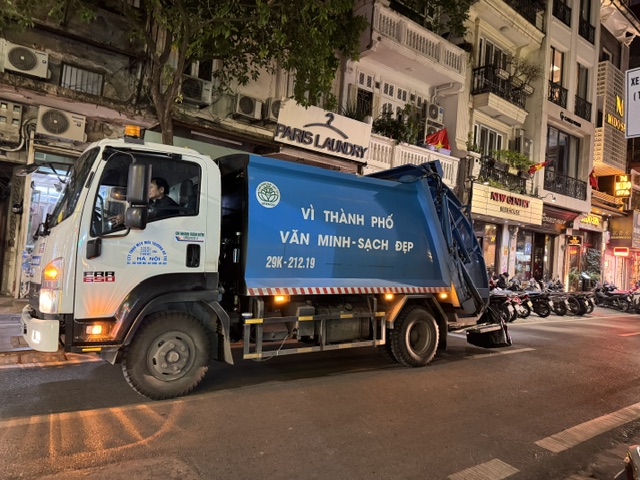
One thing we saw was the trash pick up truck – it was singing a song that evidently beckoned everyone to bring their trash and both home owners and business people were bringing their bags out – small that we saw. 

Brief notes from Hi’s talk during our evening walk re different farm ownership over Vietnam’s history:

When the Kings ruled, the farmer got land for himself and land to support the owner of the land which he worked and thus paid the owner. On his own land he could also earn money for himself and feed his family.

The French ruled Vietnam from 1858–1885 and again from 1887–1954 and supported the land owners. The farmers were taxed so highly that they then gave up. So many farmers moved to working in manufacturing and mining and working for the French in the later 1800’s. 

When Ho Chi Minh wanted to unify the country, he said the farmland belonged to the farmer and the factories belonged to the country. So the farmers were able to plant for themselves, but also had to provide for the troops. Then all the land become a cooperative. All had to work and could only sell their goods to the country which undercut motivation and agricultural productivity tanked.  

In 1989 when the Soviet Union left, inflation was at 300%. Then the north started making changes, giving land back to the families, and initiating a market economy. There was a tax, but farmers could also sell at market prices. Vietnam became the second biggest rice exporter. Now industry is starting to exceed rice exports and gradually more rice land is being converted. 

Right now the average income is 2500 per person. 

The last king was in 1945. 

Here’s a synopsis of more recent history:

In WWII Japan ruled Vietnam. At the end of WWII the Chinese liberated Hanoi from the Japanese, the British liberated Saigon, from the Japanese. The British turned the south over to the French who were here before. Ho Chi Minh declared independence for ALL of Vietnam, saying no to the division and declared war against the French with Chinese support. 100,000’s of Vietnamese died. In 1954 the French retreated. The Geneva convention in 1954 declared a south and north Vietnam, but Ho Chi Minh said no. The Geneva convention set a DMZ around Danang, but it didn’t work. Americans came in 1954 in a low level way to support the Republic in the South and it just escalated further and further through the Vietnam war until Ho Chi Minh won.  

China supported Ho Chi Minh during the Vietnam war, providing military equipment, etc. That involvement escalated after the arrival of US combat troops in 1965. After the Vietnam war, China left, but left their weaponry behind.

In 1979, China invaded Vietnam in response to Vietnam’s invasion of Cambodia, but Vietnam used all of the Chinese weapons left (this was according to one of our guides) and defeated the Chinese in a war that lasted about a month, with China withdrawing its troops in March 1979.

The conflict damaged relations between China and Vietnam, and diplomatic relations were not fully restored until 1991. According to our Hanoi guide, over time the Chinese started flooding Vietnam with tourists. But the tourists were so disrespectful in their behaviors that Vietnam said no. They built a wall in the north and then restricted how many Chinese could visit. 

Germany, 27.July.2024, Saturday

Munich, the White Rose movement, and Taylor Swift

I know that this week all started with Holly and me thinking about seeing Taylor Swift, but the trip has turned out to be so much more than that, starting with Dachau. Today was my last day to learn more, following up on pieces that I had seen or learned about this week. 

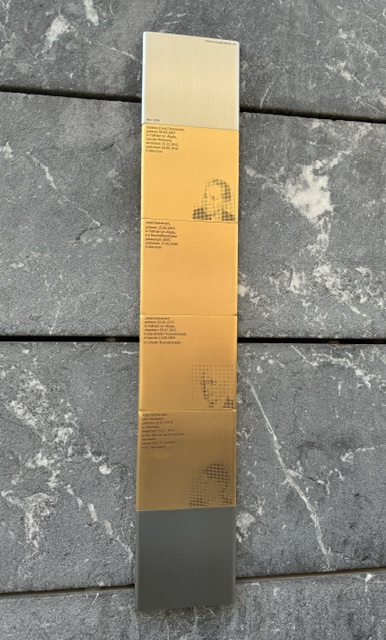
I decided to get back to some of the history related to WWII and to walk around Munich some more, just learning the city a bit. I started with trying to find where the Holocaust memorial plaques were placed – it’s an ongoing project. Munich decided they wanted to move from the “stumbling stone” approach that they and many other European cities have used – plaques in the ground where people were taken, the name, date, reason, date when the person died and where. Munich is now putting plaques on the sides of building where people lived as a more respectful way of honoring victims of the Third Reich instead of possibly walking on them if not noticed. That being said, I did notice the ground plaques; we all thought people looked down more than up. But – glad they’ll have both.

I was looking online to figure out where to go to see some of the new plaques and found a woman who’s passionate about WWII, loves Munich and gave a lot of information and ideas. Munich WWII Sites: 26 Eye-Opening Spots You Need To Know

I wish I’d found this sooner. There’s a tour she notes that I’d have loved to do, but it was booked up: Munich: Resistance against Hitler – Historical Walking Tour | GetYourGuide

Tricia wanted to get out in the early morning before it got hot to see one of the plaques as well, so we went together to the closest one before she went back to rest her foot. This plaque was within .4 miles of the hotel: 4 members of the same family. 

Karoline (Lina) Bacharach, born 29.09.1887 in Fellheim in Allgäu, evicted from her apartment 14.11.1941, died 28.06.1942 in Munich.

Isaak Bacharach born 15.09.1864 in Fellheim in Algäu, forced to close down his business in 1935, died 17.09.1936 in Munich.

Julius Bacharach, born 22.09.1870 in Fellheim in Allgäu, deported 23.07.1942 to the Theresienstadt ghetto, murdered 13.05.1943 in the https://player.vimeo.com/video/994309517?h=9dd488a558https://player.vimeo.com/video/994309517?h=9dd488a558

Theresienstadt ghetto. 

Kiara Bacharach, née Heumann, born 16.01.1879 in Munich, deported 23.07.1942 to the Theresienstadt ghetto, murdered probably 25.10.44 in Auschwitz concentration camp.

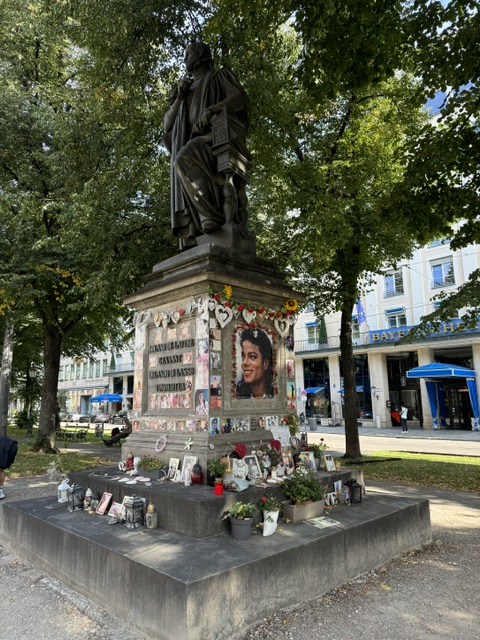
I then continued on and found this – I’d read about it, but still found it so confusing. After 2009 which Michael Jackson died, fans set up a memorial on the statue of the composer Orlande de Lassus across from a hotel where Michael Jackson stayed. A number of people are not happy about this memorial and every morning go spread bird feed at the base of the statue in hopes that the birds will destroy all the daily contributions of fans. 

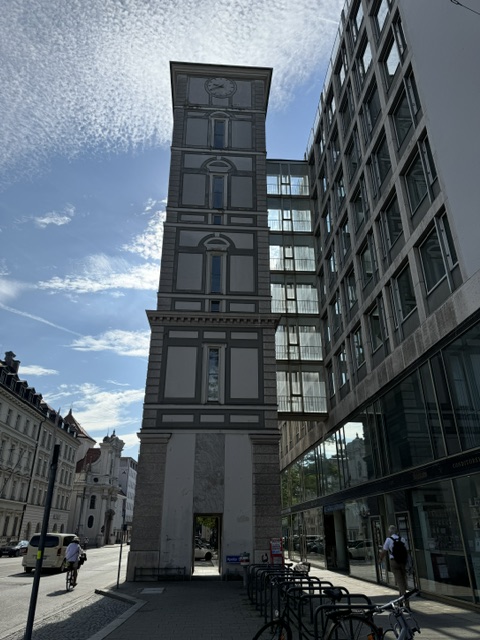
Kept going and found this – sole tower left from a large 1500’s complex, that was destroyed in WWII. I had my usual regret for the loss of history coupled with knowing it was lost was because of the Third Reich’s actions. 

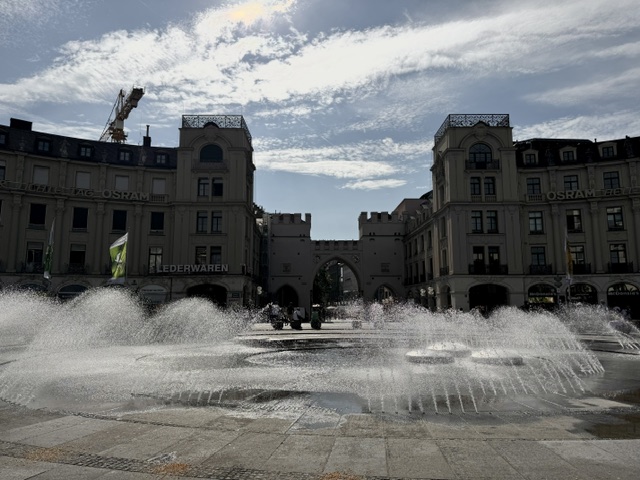
Then passed the last city gate from medieval times, really pretty with the fountain.

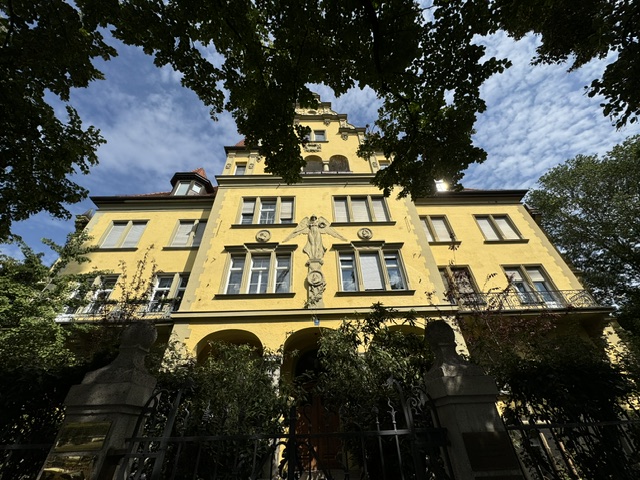
I was trying to find the plaque remembering Albertine Neuland,  I did find her house before Kristalnacht when she was thrown out, which made it clear that no one was immune or safe because it was a gorgeous house.

I never found her plaque, but I did find this website. She died when America refused her entry because of her age despite her son in America who did everything he could to get her to the states. 

I kept walking and found myself in a neighborhood with a lot of Arabic shops and restaurants mixed in and just saw regular Munich since I was quickly out of the main tourist areas. A lot to people were in cafes and as I passed one group, I heard “Oh, mein gott” and I thought – I do know some German!

I found more plaques as I headed towards LMU and also passed this:

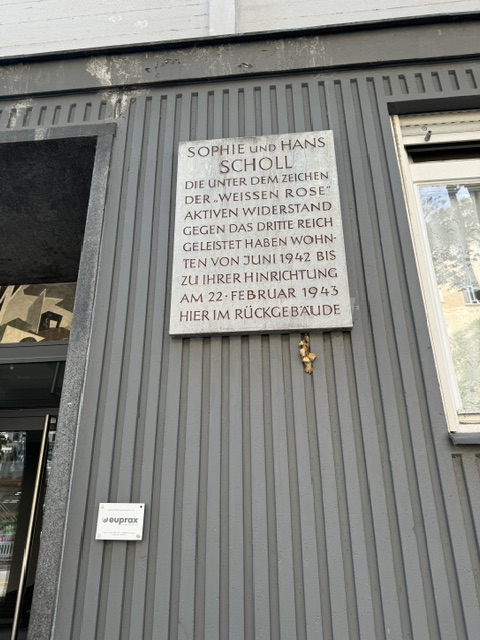
Sophie and Hans Scholl: Those who offered active resistance against the Third Reich under the sign of the white rose, lived here in the rear building from June 1442 until their execution on 22 February 1943.

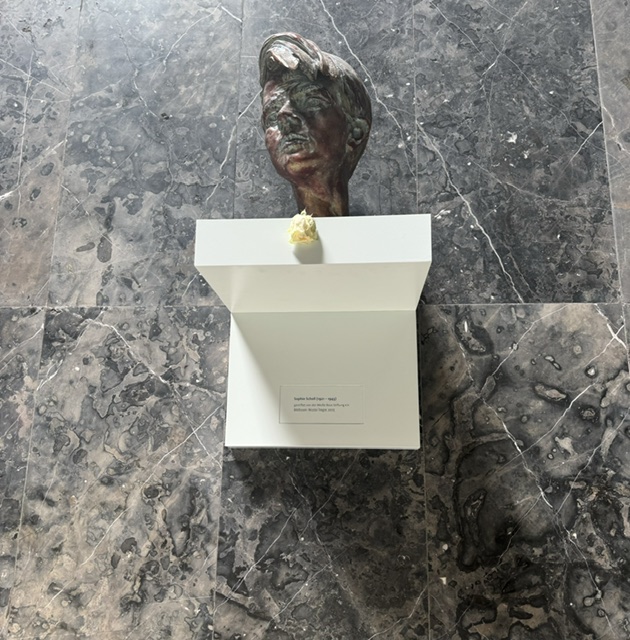
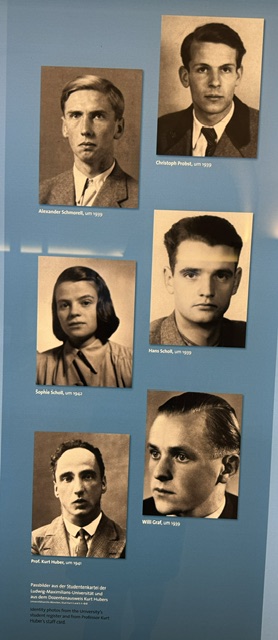
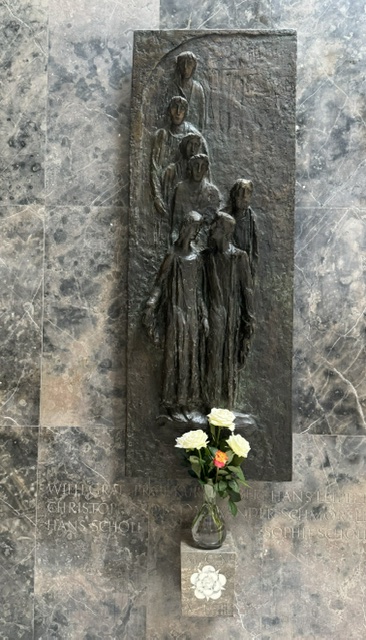
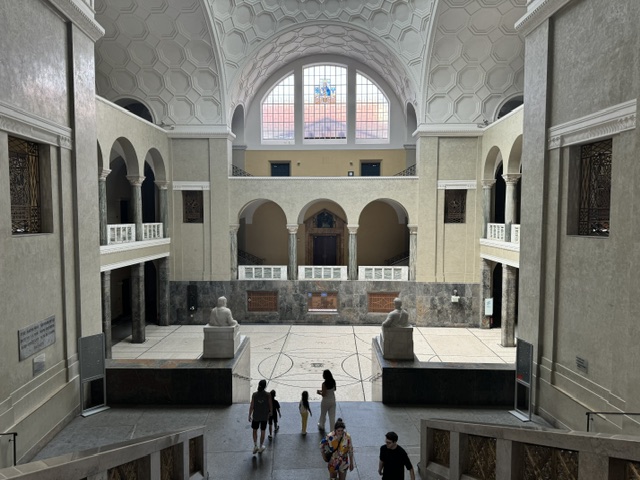
I arrived at Ludwig Maximilian University assembly hall and The White Rose Resistance to the NS Dictatorship Museum. Here are photos of Sophie, and of 6 of the 7, a memorial in the hall, and the hall. 

Sophie threw pamphlets from the balcony, was seen by the janitor who turned her in.

Briefly, 7 people, 6 students and a professor initiated a resistance group spreading pamphlets as far across the country as they could, starting in Munich, right next to Hitler and the regime headquartered here. 3 of the students were medical students and had already been sent to the front. They saw what was being done to the Poles, to the Russians and had to speak up. Unbelievably brave. 

The museum was incredible. I was immersed, reading about all 7 of the people who were the leaders, what happened to their families, how the word spread. I read everything. When I walked out into modern day Munich, it was jarring. A link for a bit of the story: The White Rose Opposition Movement | Holocaust Encyclopedia

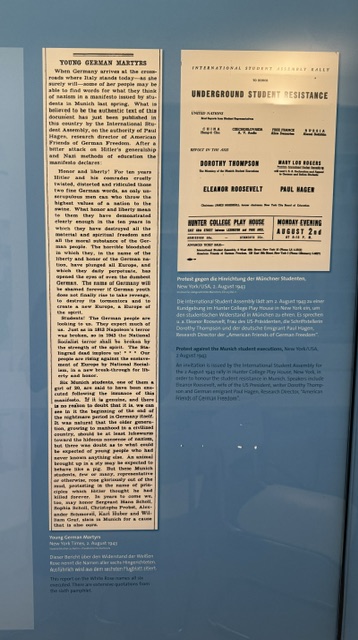
I could go on and on, and will if you ever want to talk to me in person, but here’s a photo of The NY Times article that put their names and story out into the world and then inspired protest groups around the world.

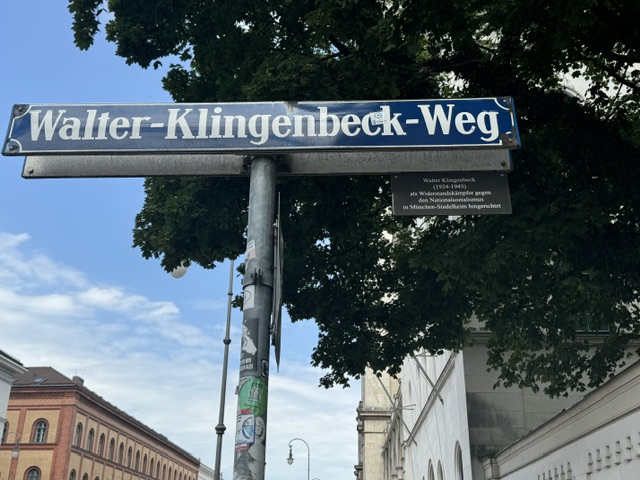
Within a few blocks I saw another acknowledgement of someone killed. The addition to the sign said this:

Walter Klingenbeck (1924-43) as a resistance fighter against National Socialism executed in Munich-Stadelheim. A lot of people in Munich really are determined for the history and people to be remembered. 

Then back to the hotel and Tricia and I decided to use the credit (love how they do that, as if you weren’t paying for it) that each person got at the hotel for incidentals and went to a late lunch in the hotel restaurant. It turned out to be an incredible meal and enough to hold us through the rest of the day/concert.

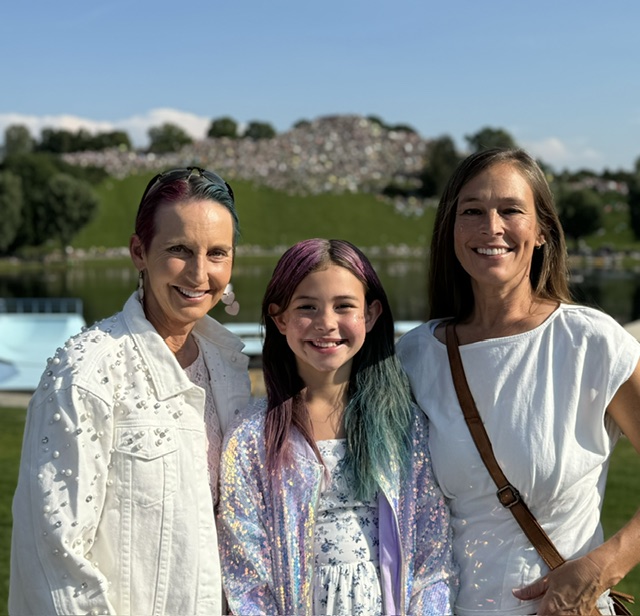
And now, the Taylor Swift concert. Flynn came to Tricia’s and my room and used the hair dyes I’d gotten and gave me tips for make-up and getting more color into my hair. Then – we were off!

First, I have to say – the concert was so totally worth the trip, though the rest of the trip put it into perspective. But my goodness, Taylor Swift is incredible. She made you feel like everyone there was beloved and she was so happy to see all of us. She thanked the crowd of 74,000 plus acknowledged the crowds of people on the hills behind the stadium, 2000? I heard estimates of that additional crowd. Some waiting since 5 that morning to be able to see and hear what they could from above. 

It was truly fun to be there with Flynn who knows EVERY word and gesture and sang along with every song. She was adorable. I sang along with what I knew and just enjoyed the rest. We left the hotel at 5 and got back at 1am and it never stopped being fun. Well, actually I thought the opening band was boring and ended up reading my book on my phone. Kylie told me that Paramore was actually a big pop band and very popular. I mean the lead was cute, but nope, the music did nothing for me or anyone else in our group. But the minute Taylor started revving the crowd and then appeared – totally great. What a great way to end an amazing week!

Austria to Germany, 26.July.2024, Friday

Salzburg to Munich

We had a relaxed morning and then took a car to the train to a car and back to our hotel in Munich – we even got the same rooms!

Holly realized we needed to make sure we had transportation to the concert for the next day and went down to talk to the front desk. They said, taxis, their cars, all had been booked up for weeks before. Holly then got the bright idea to see if she could reach the driver who’d taken us back and forth for the train and he said yes! So great and he was amazing. So – that’s set. 

We didn’t have plans so went over the beer garden and market for lunch and then decided to go out to Nymphenburg Palace Park. 

The market was a scene and I had bratwurst that was actually great. As long as I was having meat and fries, threw up my hands and went crazy, ordering a Coke too 🙂

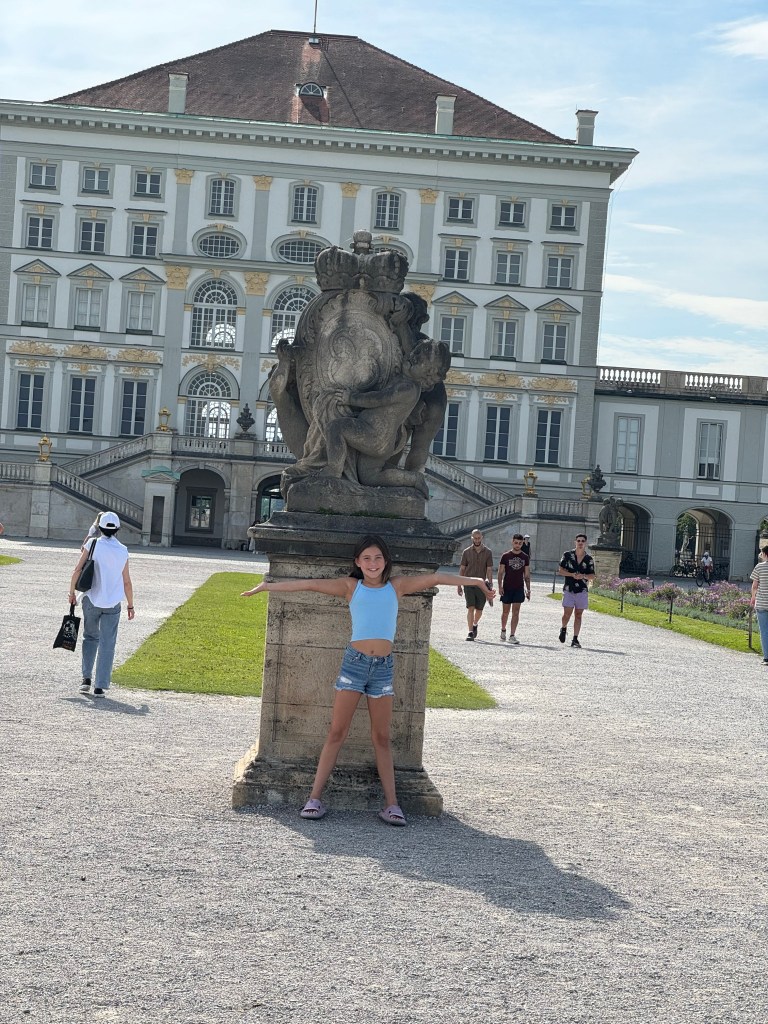
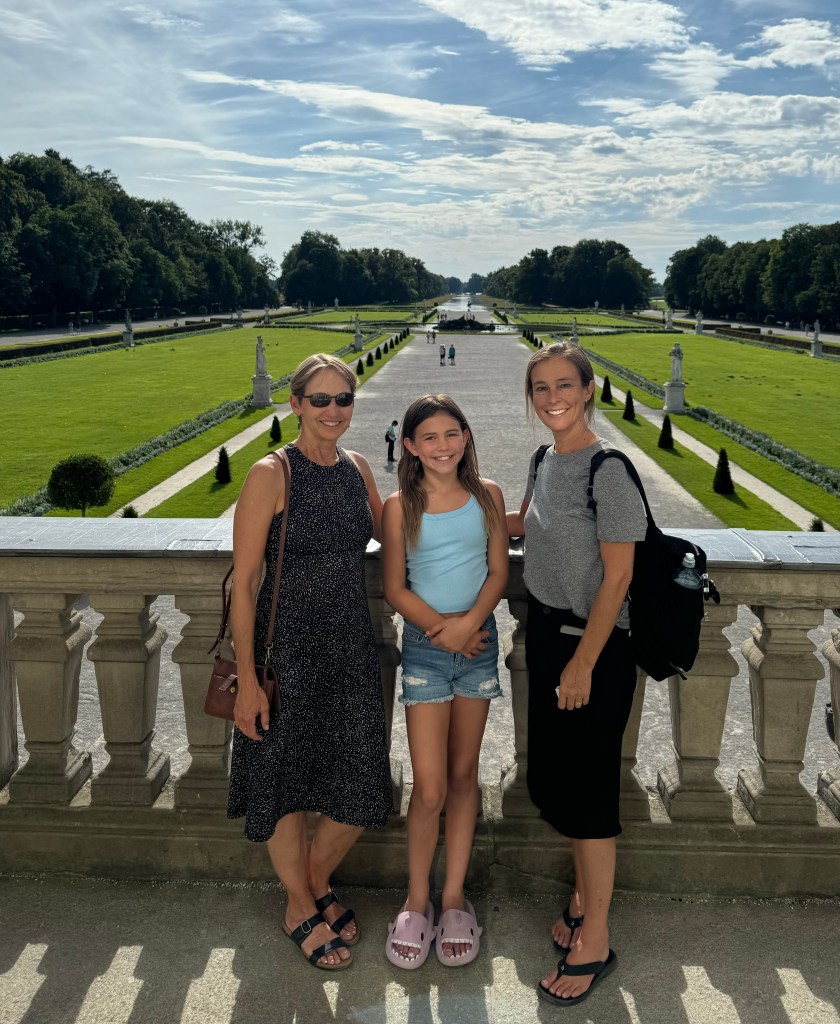
It just didn’t seem right for Flynn to be in Munich and not see any palaces! Luckily for our energy and Flynn’s attention, there is really only one floor to explore at Nymphenburg Palace, but it’s beautiful and elaborate and gives a hint of the lives of Ludwig I and family. No photos allowed. There is a gorgeous park all around the palace and we saw a lot of people clearly out for their daily run running through the gates and then through the grounds. Pretty amazing. 


Flynn then decided she might like to live here and make it her own:

We then came back to the hotel, full from the treats we got after the palace and late market lunch so just had a quiet evening, so nice!

Austria, 25.July.2024, Thursday

Salzburg

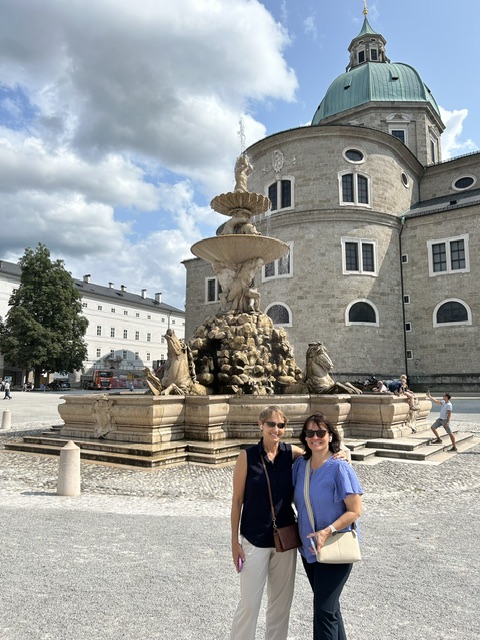
I started the day by walking over to the Residenz Platz to try to hear the bells caroling – there are 32 bells in the tower that are played by a barrel that turns and strikes the bells according to the tune chosen. But this ringing happened as 7am and I really love hearing bells. At first all the other church bells were ringing and this one didn’t play, then it started a few minutes after all others had quieted and it was a great way to start the day. 

Ok, today was a completely and totally wonderful day. I had moments of pure happy on the tour for Sound of Music, like I do at times on a Camino. It was the best having Tricia, Holly and Flynn with us. Flynn was a trooper because this wasn’t a flashback for her, even though she’s seen the movie. But for the rest of us, it was just great. 

Very cool surprise – our guide was a relative of the Von Trapps on the Captain’s first wife’s side. He was really passionate about his subject and had talked to a lot of the members of his family getting details and learning. He said when he went to Vermont and met Maria, he was startled because she was older and stout and didn’t look like Julie Andrews – but she was still warm and wonderful and told great stories. 

Peter gave us a really interesting synthesis between Maria’s autobiography and stories cousins and family told, the play with Mary Martin, and the filming of the movie with Julie Andrews, Robert Wise (director) and Maria Von Trapp. Robert and Julie wanted Maria with them the whole time to tell them how it really was and what it was like for her. 

So as we toured, Peter talked about Maria’s life, how Robert integrated it into the movie, and how the Von Trapp family felt about it all. 

I’m really hoping that someday I can come back and do it with Kaziah – a particular wish of hers – so I won’t put all I learned here, plus it would be a lot. But just know that when we watch the movie – it really did honor Maria’s life and wishes. So cool. And also, Christopher Plummer really was just as snotty and rude as we imagined after reading his complaints about doing the role. But they handled him! Maria was very strong.

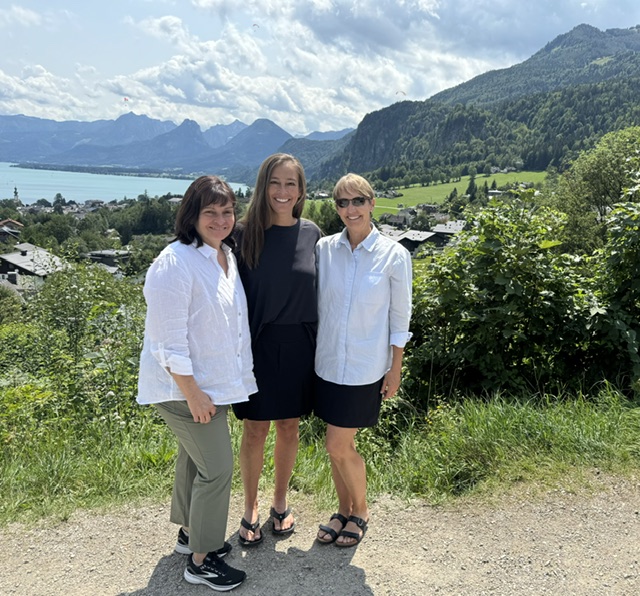
It took us four hours in and out of Salzburg, in and out of the car, with a total of 10 min for a break, but it flew by. Salzburg and the country around it are beautiful. Since Peter drove us out to the church of the wedding scene and the meadows and mountains of some of the movie scenes, we got to see more than just the city. So green and beautiful. We had a perfect weather day to explore.

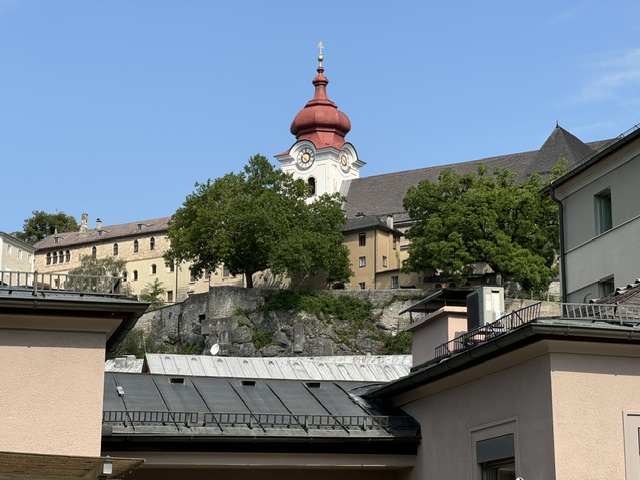
I’ll tell just the beginning story of Maria and how that melded with the movie. (Per Peter since it differs from Wikipedia.) We drove first to see the Benedictine convent (seen from below since you can’t visit, nuns, though far fewer, are still in residence) where Maria was. This was Nonnberg Abbey, the convent started in the 800’s by Prince Rupert with his sister as the abbess. Maria was born on the train as her parents left Tyrol on their way to Vienna. Since the authorities couldn’t give “train” as her birthplace, they put Vienna since they were on their way there. But Maria always considered the mountains her home and loved hiking. 

Maria’s parents died when she was young and she was fostered by relatives, but it was abusive and she left when she was 15 to live with a friend. She was very lonely, wishing she had family, and was trying to figure out what to do with herself. She went to a concert at the church. However, the concert was canceled and instead a Jesuit priest spoke. He talked being in the family of God and caring for others, what it meant to be in community with others of like mind and how they supported each other. Maria decided she wanted to be a nun so she would have a family and to go to Salzburg since it’s near the mountains. She rang the bell (the same in the movie) and told them she wanted to be a postulate. The two nuns she spoke with recognized that she didn’t have a calling, but needed a family. They then appealed to the Mother Superior who said they were meant to be her family and she could teach music at the parochial school.

Here’s Nonnberg Abbey. The bell isn’t there any more that the kids rang because tourists rang is so constantly, that they had to remove it. The four windows on the upper left are in the Mother Superior’s room and the scene with the “Climb Every Mountatin” happened in this room (via movie set). The movie scene was very close to the real scene when she told Maria she should leave the convent because “when a door closes, a window will open.” 

She did teach music, but she also really did cause chaos, since she ran, sang, whistled and generally behaved with more enthusiasm than decorum. Finally, the Mother Superior secretly pulled all the nuns together and told them had to pray and pray hard that a husband could be found for Maria. They prayed with their rosaries for 9 days straight and at the end, someone came to the convent asking for a governess for the youngest daughter of a Captain Von Trapp whose wife had died of a heart ailment and whose younger daughter had the same condition. Hallelujah!

So – there’s the start of Maria and the Von Trapps, many many more stories. Peter would point out something and say, remember when they…..in the movie. And Holly, Tricia and I would all say yes! So that’s where they filmed it and this is how it related to what really did happen in Maria’s life, which was often very close. 

Uncle Max’s real house and where the real and movie scene happened with the kids in the boat and the balcony where the Captain saw the boat turn over. The real story was a little different, but core the same. 

Max was an amazing person, strong, determined, kind. Started the Salzburg music festival in an effort to unite countries and people. He told people if they wanted to perform, they had to spend at least one summer living here in company with all others so that they could learn all were performers and people despite different skin, traditions, heritages. This was all part of his strategy go bring people together. I guess it really worked until Hitler came along. 

He had to flee (partly Jewish) with his American wife to the US and died of a broken heart shortly after getting to the US. After the war, the American Commandant wanted to give the house back to his wife. She said she couldn’t afford it, the upkeep, at all. A few soldiers under the Commandant were there who were Harvard students, and they loved what Max had tried to do. They said they could help. If she’d take the estate back, they had wealthy family and connections from Harvard and would help set up a foundation to bring in speakers from around the world, to continue Max’s wish to open doors between people. This became the Salzburg Global Seminar. (The Wikipedia link tells it a little differently). 

It’s the mansion on the right, blow it up and you can see the balcony!

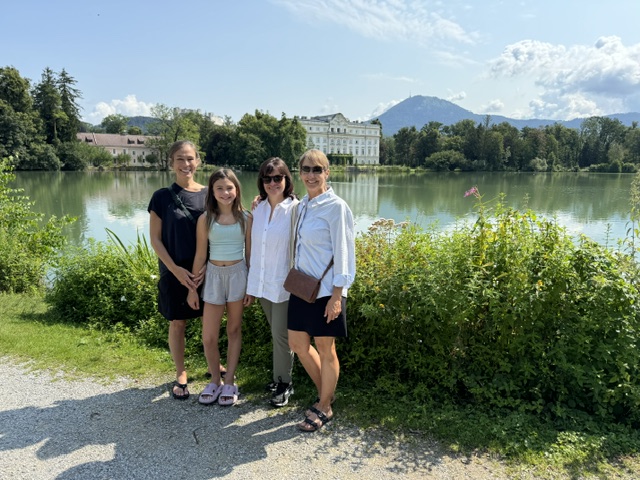
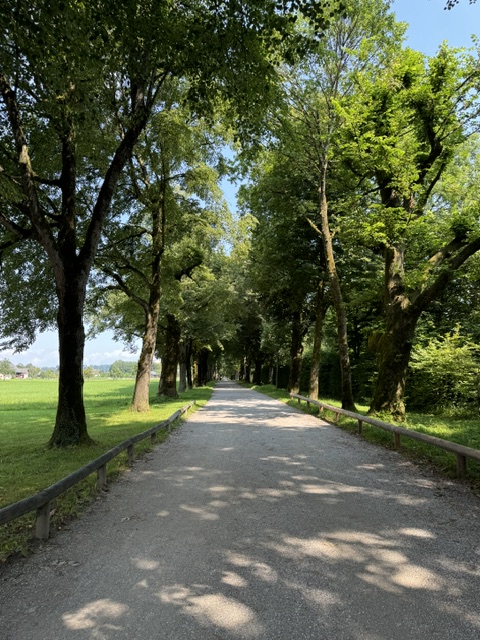
Grounds near this mansion, all of this is really close to Salzburg, the bike path would be amazing. Saw this on our way to the row of trees where Maria got off the bus. 

Just makes you want to sing about having confidence, doesn’t it?

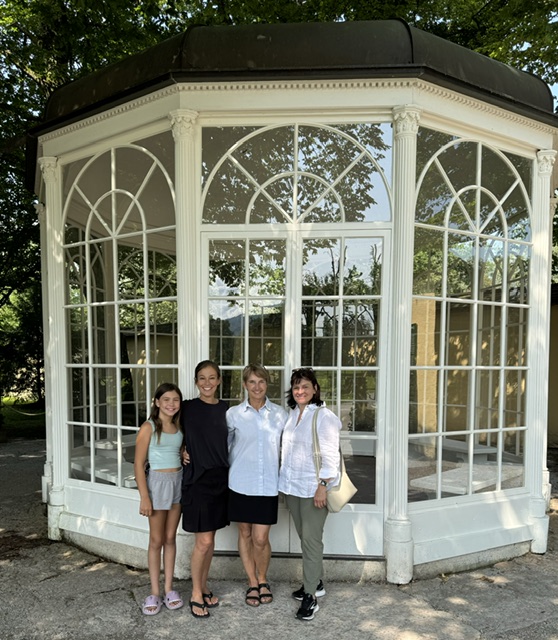
Then on to the Gazebo where Leisl sang and danced. It used to be to the left of Max’s mansion, but there were so many visitors and they were so loud, that they disturbed the lectures going on in the Salzberg Global Seminar and it had to be moved. It’s now at the Schloss Helbrunn which is also an incredible place, though we didn’t see much. 

I liked this wikipedia entry for the actress who played Leisl.

Moment for Flynn:

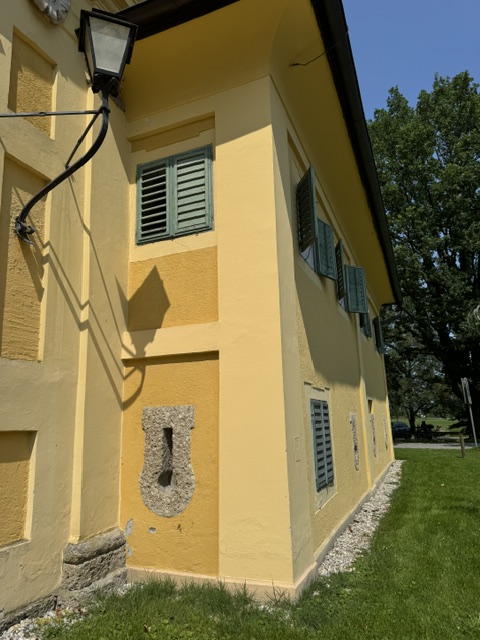
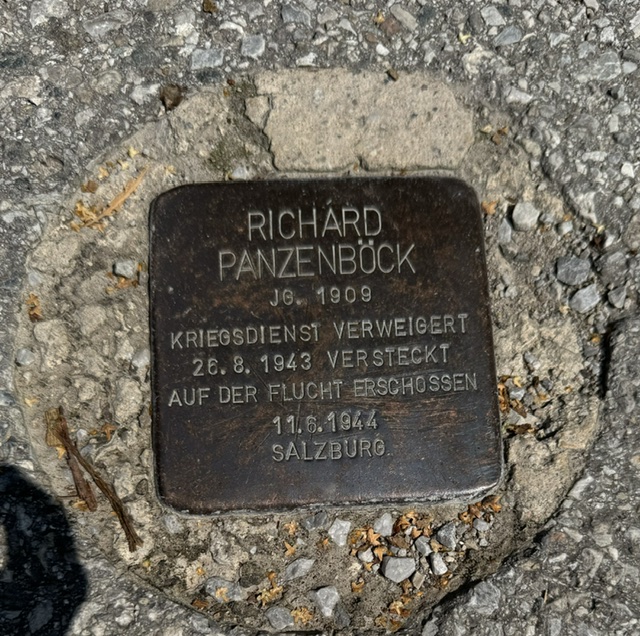
Outside the Schloss I saw these and they stopped me in my tracks. These are two of the “stumbling stones” that mark name, date, why, end for a victim of the regime. 

Born 1890, arrested in teh resistance, March 14, 1942. Lived in the apartment house. Executed May 7, 1943 in Munich-Stadelheim.

He lived here:

Born 1909, refused to do military service August 28, 1942. Shot while hiding in Salzburg, June 11, 1944 Salzburg.

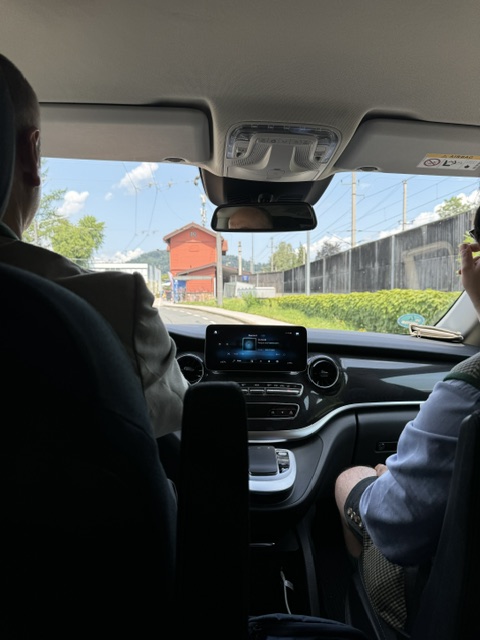
These were a stark reminder of what was happening at the time and later of Sound of Music.  This is the train station that the family used – right near their house (actual house, not Max’s) to escape using their diplomatic performance visas.

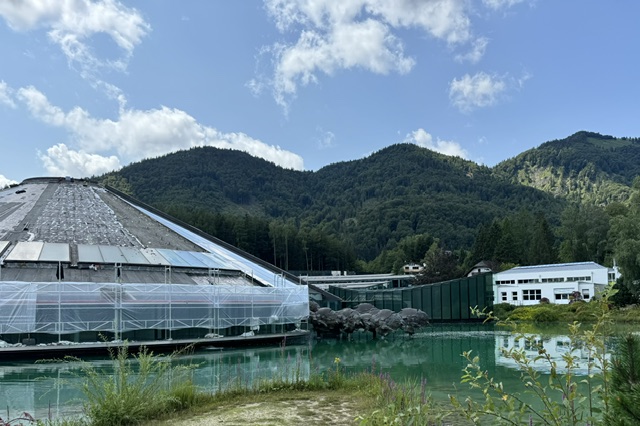
Driving to Maria’s movie wedding church, we pulled over to see the Red Bull campus. I had no idea, but it’s owned 51% by the Thai whose herbs were the genesis of the drink and 49% by an Austrian group. The whole facility was built on Feng Shui principles to blend with the water and mountains. It’s under repair, but you can still see how incredible the feeling is. Gorgeous. And – turns out that the Austrian family have been huge sports promoters, but evidently also do a lot to support the local area and economy, especially during COVID. 

Back to Maria 🙂

The meadow behind and to the right is where they learned do-re-mi…

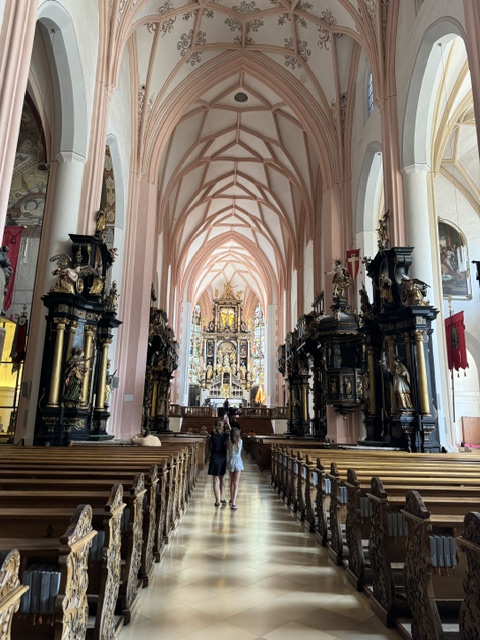
Here’s the church from the movie, Robert Wise asked Maria what her dream wedding would have been, she said in this church with all the locals celebrating at a party afterwards. So that’s what they did!

And here’s a bit of how the music might have really sounded since we were lucky enough to hear musicians practicing. 

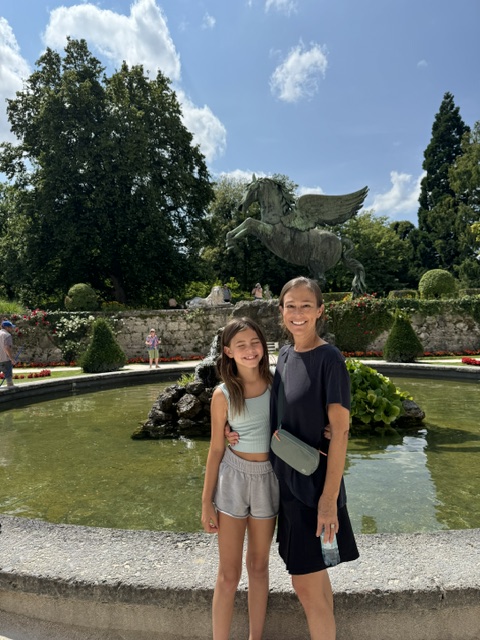
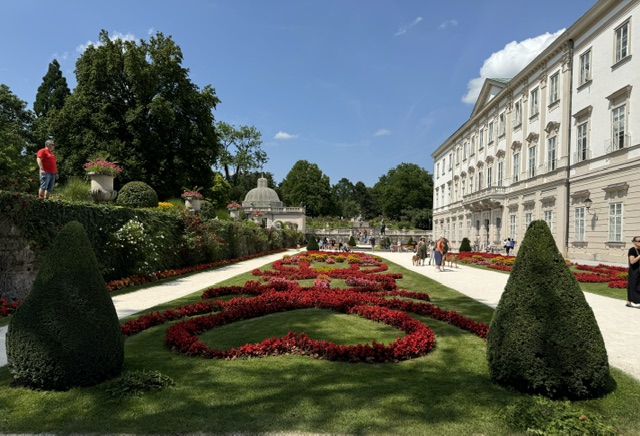
And, finally, back in Salzburg, Mirabell Gardens where a lot of scenes from the do-re-mi song were filmed with the kids playing. 

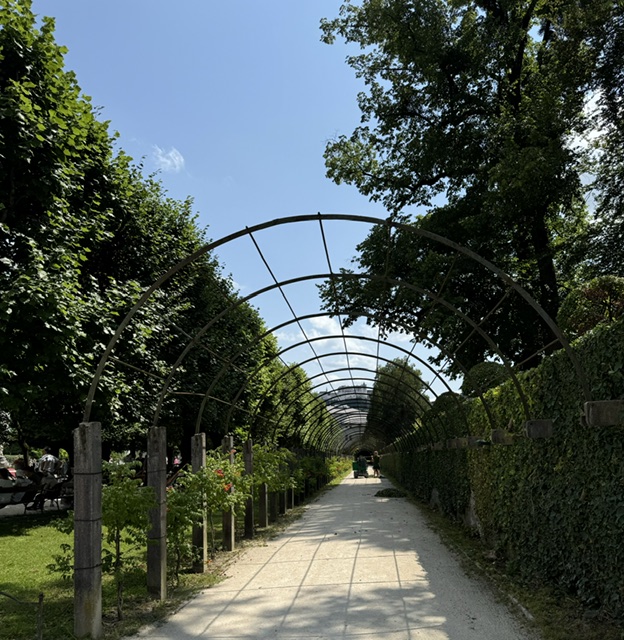
They’d just trimmed WAY back the arbor over this trellis.

And I didn’t get a picture of the stairs because there were so many tourists walking them and getting photos – but the stairs where they hopped up and down singing are behind me as I look at this trellis. And – that’s the end. It was magical.

This is just a bit of why the Mirabell Gardens are so named (the palace is on the right), the stairs are at the far end:

Back to Salzburg focus – during the summer there’s an incredible music festival, this year from 7/19-8/31 and we happened to be here for it. If I were to come back, I would plan way ahead for tickets and scheduling. Since it’s Mozart’s birthplace, they take that to heart and all kinds of music, opera, and types of performances are available in all types of buildings. Some free, some inexpensive, probably some very expensive. 

Tricia and I had decided we really wanted to see some concerts before we’d left for the tour and I’d arranged two seats at the Residenz for a piano concert and then 2 seats at Mirabell Schloss (palace for whole the gardens were made) for an evening chamber concert. Both so reasonable! Holly decided she and Flynn would rather try to find some gifts and just wander the city. However, when we got back, Tricia and I were too tired and hungry to go straight to the piano concert, gave up our tickets and the four of us went to lunch. 

After that, Tricia and I took the funicular up to see the fort. It was SO huge, I just couldn’t imagine what it was like up there. We had limited time which was perfect since we were pretty toured out. It was clearly a city within a fortress, different eras of buildings, and always used a pulley system of getting materials up there, animals pulling in the old days. Ach, probably horrible. 

We didn’t have time to go into any of the museums (maybe 3?), nor eat, 2 restaurants, 3 cafe/bistros, tower, prison, etc. In fact, I just walked around getting a video which I’ll share if it’s any good so Tricia could get a sense of it. She was sparing her foot since we were going to have to walk to and fro the evening concert. 

Then we went to the Mirabell Schloss concert and it was fantastic. A really good chamber group of 5 and a wonderful guest pianist who made the notes seem like water, just gorgeous. Haydn, Mozart, Hayden, Mozart. The acoustics in the hall were wonderful, and the time flew by. 

Then walked home at night. It was a perfect day. 

Austria, 24.July.2024, Wednesday

Salzburg

Of course, we’re here because of the Sound of Music (evidently Austrians do not get this avid interest, but finally decided to cash in on Americans’ crazy devotion), but oh, this city is so much more. It’s truly beautiful. We have a hotel in the old town, a Radisson – Altstadt Hotel – and it’s very old, redone, and the front desk people are lovely. The inscription on the paint outside says 1332 and 1992. 

Tricia and I are in a crazy room, the Kaiser Suite, which was the servants attic, I’m sure, but made into a great giant room. Tricia said she was game for the sleeper sofa, but I was up most of the night and watched her turn a 360, so clearly not that comfortable. We’ll share tonight. I also realized that if you’re in the attic, there are no opening windows, but the balcony, and the fun of it, and the luck for being short, all makes it a very fun and surprising room. 

We took the train from Munich and then a cab to the hotel, all so easy. We got lunch at a place that took forever, but was seriously good. The headline on the menu said the highlighted recipes were based on a cookbook from 1719 from the restauranteur and they had the cookbook on display! Amazing. I had one of the highlights, vegetables cooked in a pot, so good. Then we ordered a tray of apricot desserts to share, but they brought us all one and we were in heaven. Apricot cannoli, sorbet, stewed, cake, soup. 

Then Flynn took some time off in their room watching a show and Holly, Tricia and I did the Rick Steve’s audio tour. The buildings are beautiful, a lot of Italianate which I wouldn’t want on my house, but love to see in big grand buildings. There were bombings here too, but not as destructive as Munich. 

Turns out this the reason so much is Italianate is because this was the Rome over the alps. The prince here was also the archbishop so both religious and political leader for the area. He was the voice of the pope in this area. 

Even though Americans think of Salzburg as the home of the Sound of Music, which it is, people in Salzburg think of it as the home of Mozart. Even though Mozart left here at 25 and didn’t look back, Salzburg needed a big tourism boost and his sister and father helped create a museum in his birth house after he died. The Mozart Foundation started the Mozart Museum in 1880 and it’s great – it was my last stop for the day. His wife and two sons supported this and took care with his music to preserve as much as possible.

Walking into Mozart Plaza:

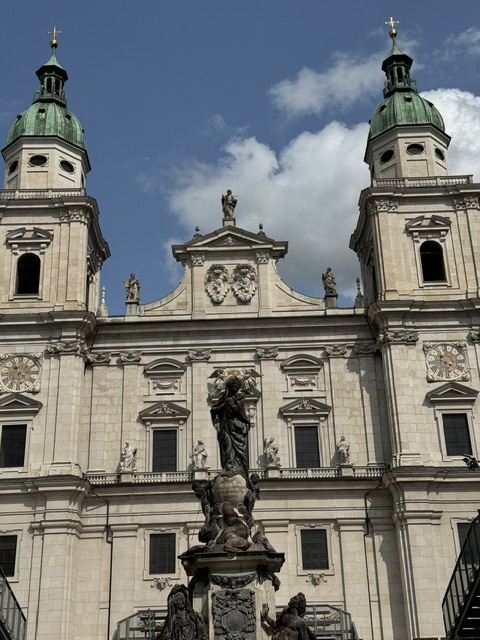
This is the Cathedral that St. Rupert started in 690? Something like that. The cool thing is that if you back way up, you can see the statue of Mary welcoming all to the city and she’s set so that two angels on the front of the cathedral holding a crown look like they’re putting it on her head.

Inside

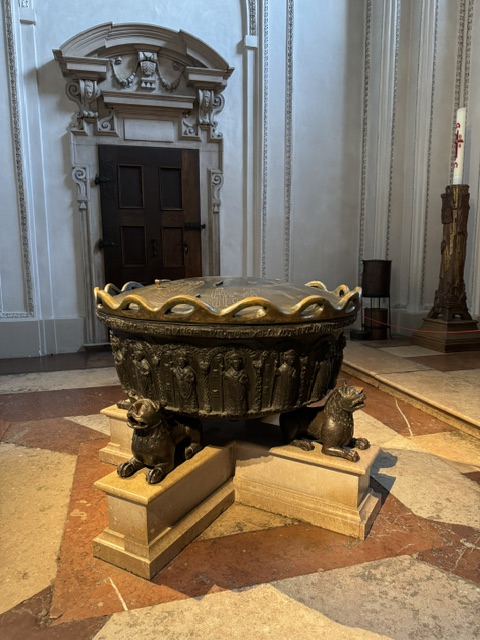
Mozart’s baptismal font (a lot of other people too before and after), had etchings of key stories from the Bible. At first, I thought they were Grecian because that’s what they looked like, but nope. It’s from 1320. 

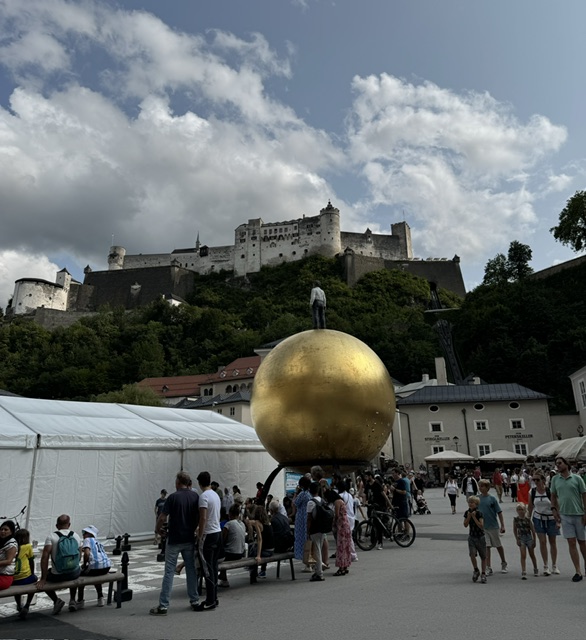
Here’s the fort with a piece of modern sculpture in front of it.

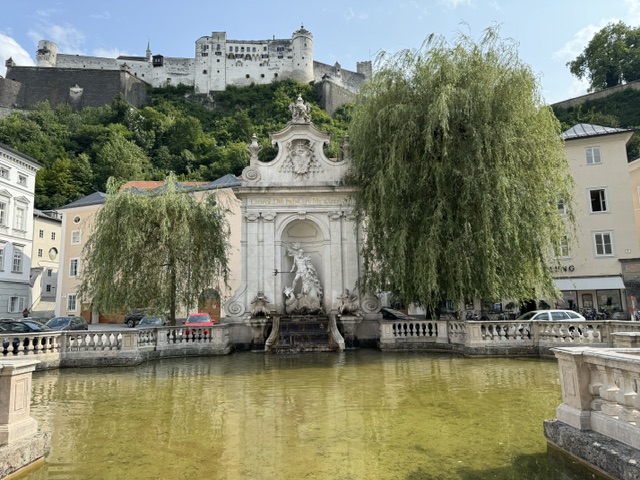
Great fountain that was built in the 1600’s for horses to take a bath:

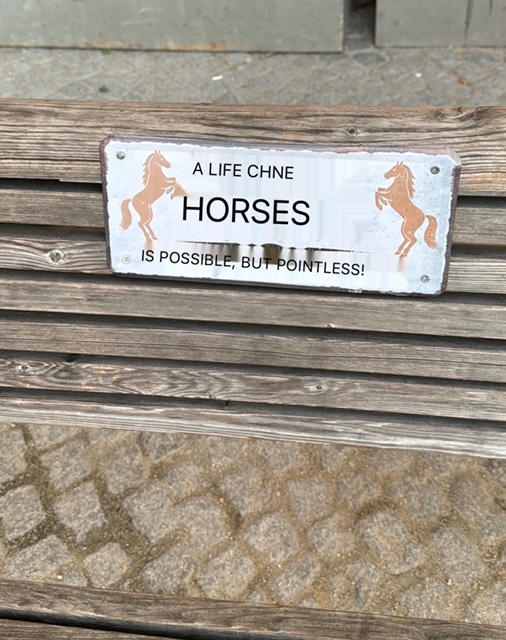
Bench next to the cathedral – the one unintelligible word means “without”.

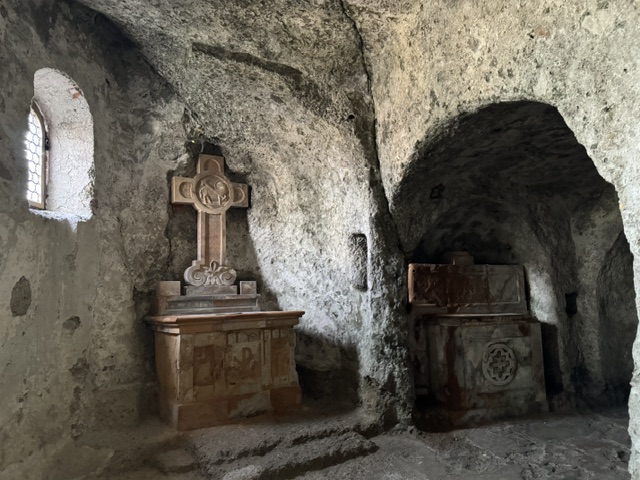
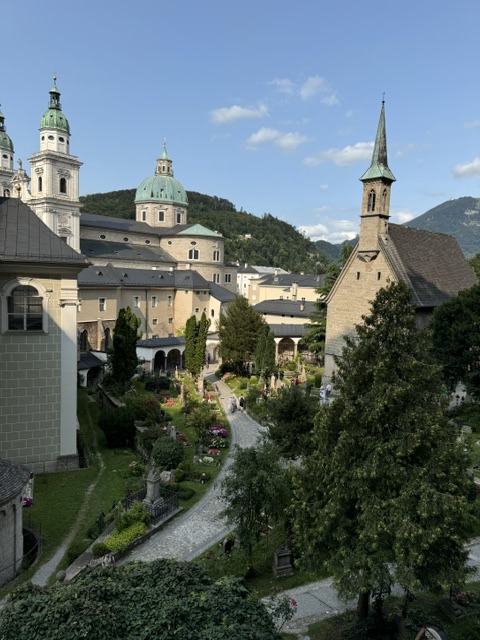
Amazing catacombs, don’t know the story, but so old. The view from the caves up top shows the churches basically on top of each other with a small cemetery where if you didn’t keep renting the space you go moved out – all of you and your monument. This is where they filmed the Von Trapp family hiding in the cemetery in the convent. 

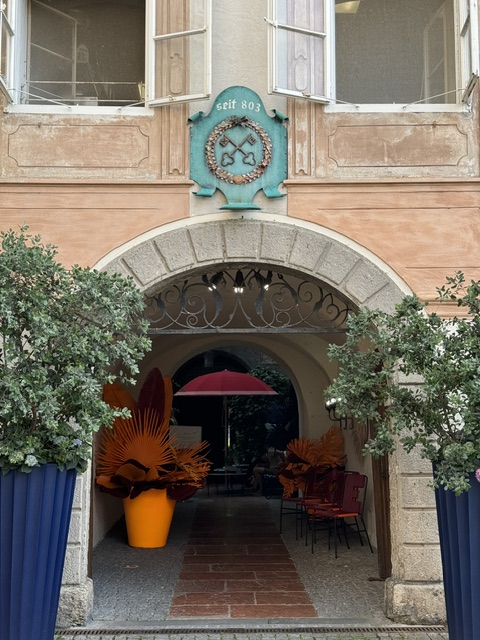
Next to St. Peter is a restaurant that claims to be the oldest in Europe, maybe the world? The visitor that is claimed from that year was Charlemagne. It’s a beautiful restaurant, with music in the evenings, but sadly, can’t to – no time!

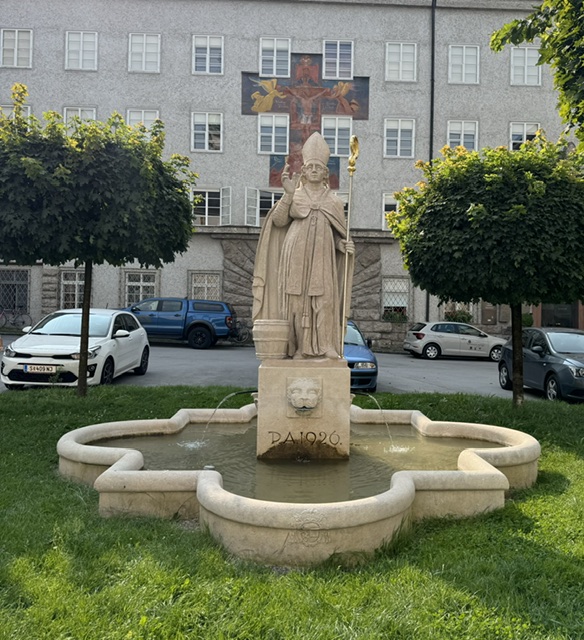
St. Rupert (660-710AD) put Salzburg on the map, built the fort, built up the salt, he re-established the monastic community at St. Peter’s and laid the foundations of Salzburg Cathedral. He also founded the Benedictine nunnery beneath the fort he started. His niece Erentrude became the first abbess. This is the nunnery where Maria knocked on the door and asked to be a novitiate. 

So – a lot to learn and explore and I’m left with questions and more places I’d like to see, but lucky to even get 2 nights and a full day here. 

Germany, 23.July.2024, Tuesday

Sadly, Tricia’s foot was not better and she ended up going to a hospital to get it assessed to make sure she didn’t have a stress fracture. The main goal was to figure out if she walked, would she create more damage. After quite a lot of money (get medical insurance from now on), it turned out to be an infected bug bite. We discussed the fact that if she told people she was bitten by something at Dachau, there would be no sympathy. That was a whole other element of misery that the prisoners would have experienced that was never even mentioned. So many facets that can’t be comprehended. But for Tricia since we didn’t have a schedule or plan for the day, she was able to read, keep ice on and off and the antibiotics went to work. 

I met with my friend Rick Steves (Holly couldn’t figure out how I made a friend to explore with so quickly) and walked for a few hours through Munich. I’d made a list of things I wanted to see from Atlas Obscura and we covered all but two of the items. Oh, so interesting. I’m going to be strong and only say 8 historical facts:

Monks started the town in the 800’s and eked out a living salt trading. Then a Bavarian prince, Henry the Lion, started building a city around the salt trade, and built a toll bridge, walled the city, etc. 1158 was the start of this town. Munich for monk.

St. Peter’s Church built in 1368 is the beloved church for this staunchly Catholic country. When Luther started the Reformation, Bavaria (Munich is the capital) stayed Catholic. The best thing in this church is a skeleton in the box covered by jewels (glass?), beheaded for her faith. Her name is Mundita and is the patron saint of spinsters.

Munich was Hitler’s base and the building from which he ordered Kristallnacht was just to the right of the Glockenspiel. 

There were 10,000 Jews at that point because traditionally Munich had been very open to other religious practices. Then there were none. Munich came back to its open roots and now has a Jewish population of 10,000 again and a synagogue, museum and school in the heart of the city. 

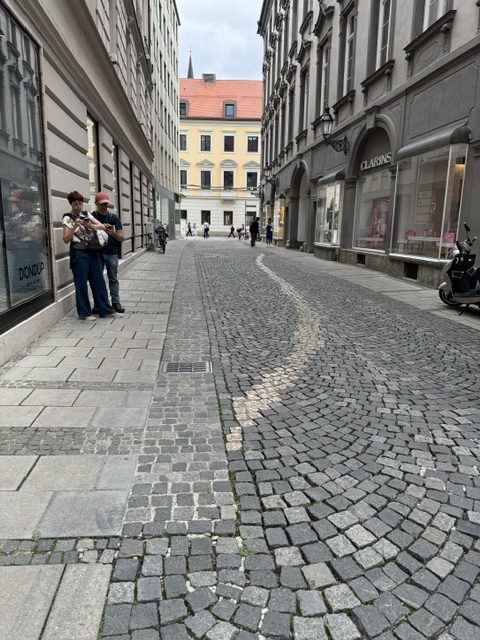
When Hitler came to power, he made a memorial for all to recognize the first martyrs of the Third Reich. All Germans were required to raise their hands in salute as they entered the square. Those who refused turned off on this street. These cobbles mark the detour that people took to rebel. 

When German cities started making the decision of what their look would be after the war, Frankfurt chose modern skyscrapers and Munich chose to recreate its history and it’s a beautiful city. The Nazi’s took meticulous photos of some of the inside of historic buildings and there were photos of the exterior of the city that existed and Munich was able to rebuild. 

That memorial to the women I mentioned before – “rubble women” was a term for the women who pulled bricks from each giant pile that used to be a building and saved the reusable  ones and piled the unusable ones up on the edge of the city.  These debris hills were then landscaped into grassy parks at the edge of the city.

The giant building that said “Residenz” that I’d taken to be high-end apartments, was actually a GIGANTIC palace started in the 1300’s and added onto for many royal families. 

Munich hosts the world’s largest Oktoberfest, going on since 1810 King Ludwig I’s wedding celebration was so successful that they repeated – every year, with 7.2 million in 2023.  

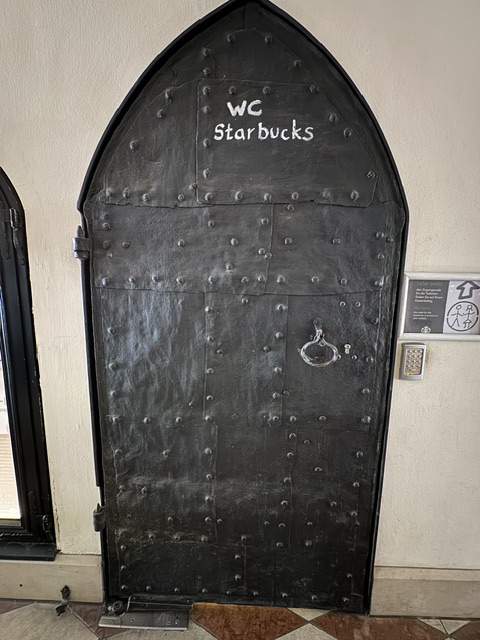
I took a break because I was tired and decided to yes, go to Starbucks, to get a chai. It was terrible, but I loved this.

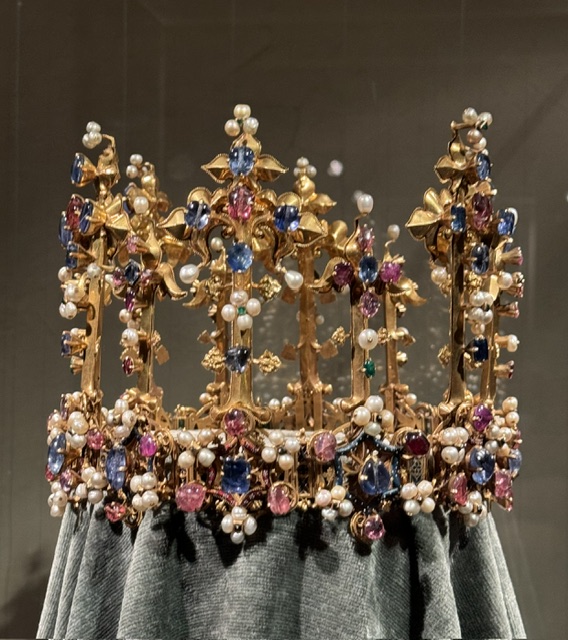
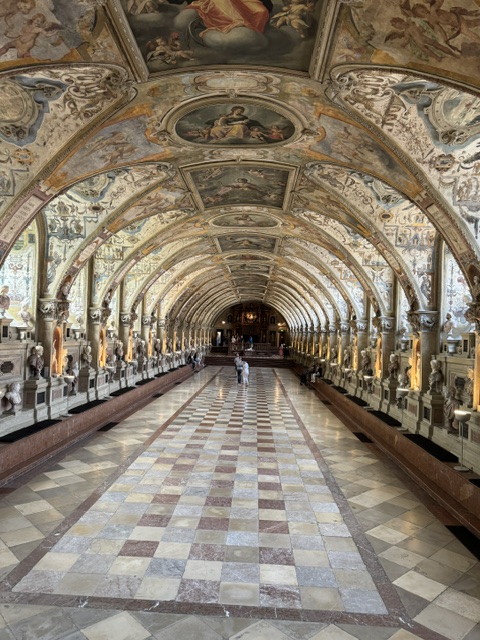
After the Rick Steves tour, I decided to visit the Residenz. Oh my lord, I could not believe how big it was, one section after another. 130 rooms that were on display. What I’d seen was just the front, didn’t realize the gorgeous building I’d seen yesterday was also part of it – couple blocks. I lost track of all the royal branches (all Wittelsbach for 738 years). By the end, even I, history lover that I am, wanted roller skates to get through more quickly. But it was amazing. The treasury was bigger than anything I’ve ever seen. This crown was from 1380:

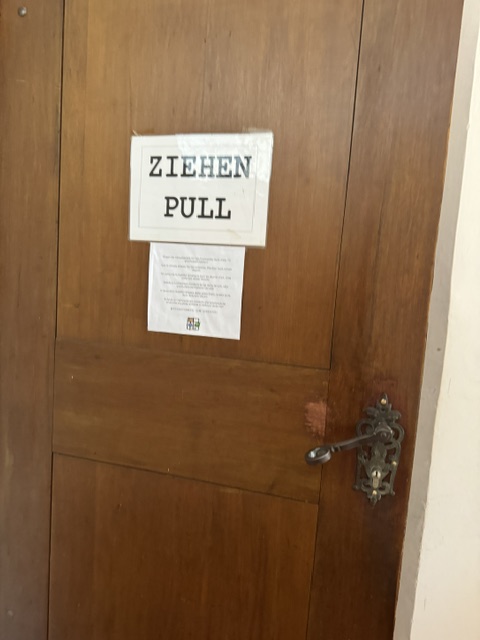
This door after a crazy grotto.

I opened it and…

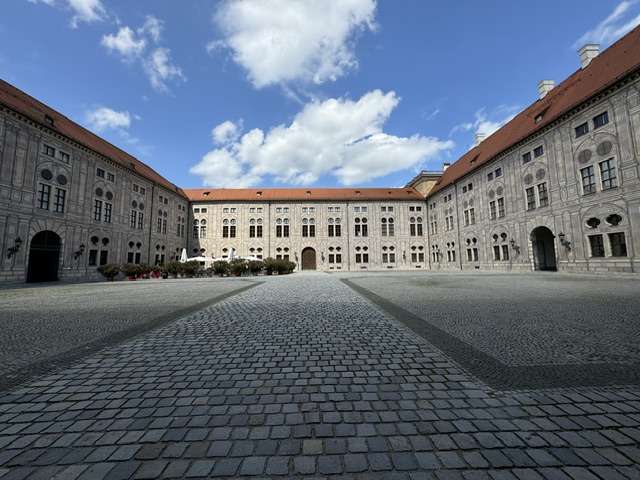
One of the courtyards:

And that’s all just a bit.

Then I came back to the hotel, double checked on Tricia, who was glad she’d taken the day and whose foot was better. Yay since she wants to explore Salzberg tomorrow. 

Holly and I decided we should go to a beer hall, because. We did go and I had a rotter, half beer, half lemonade which helped it be more drinkable. We went to the Hofbrauhaus, where the original brewery was built in 1583, rebuilt in 1800 and then again after WWII. It was huge and I asked a couple of guys in Leiderhosen if we could get a table. Oops, they didn’t work there. Turns out they were the musicians and ended up bringing their concertina and tuba and sat across from us to play and have beers. Funny. 

Germany, 22.July.2024, Monday

Germany, Castles

Today turned out to be really fun. Sadly, Holly and Flynn switched night for day and couldn’t go to sleep until 6am this morning, so there’s no way they could join the jaunt to Linderhof Castle, Oberammergau village, and Neuschwanstein Castle. And it was a long day so they definitely made the right choice. Tricia and I left the hotel at 7:30 and got back at 7. By the end, we thought it was wonderful. 

We learned a lot about Ludwig II, the 4th king after Germany became a monarchy in 1805. King Ludwig II adored his grandfather, Lundwig I, who built beautiful buildings and bankrupted the country. Then Ludwig II came along and loved building just as much, also nearly bankrupting the country. He won a war against Prussia, but that was very much an interruption in his studies of architecture, art, philosophy, science, etc. We were told he read a book a day.

We got to see two of his castles (palaces). The first was his comfort castle, the only one completely finished, and he spent a lot of time there, 2 weeks out of every month. Linderhof Palace was modeled after Versailles since evidently Ludwig II really wanted to be like the sun king, with his position affirmed by the gods. The palace was small, gilt and beautiful, but the real charm and beauty that caught the eye were the incredible grounds. A number of the outbuildings were modeled after scene descriptions from Wagner’s operas, someone that Ludwig adulated and became friends with despite the 40 year age difference. I thought the grotto was incredible – but only saw a short video of it since it’s under serious repair because of water damage. Here’s a description from the Linderhof website:

The Venus Grotto in the palace gardens is a unique construction designed as an artificial flowstone cave and the highlight of King Ludwig II’s illusionary architecture. This grotto not only depicts the 1st act of Richard Wagner’s opera “Tannhäuser”, but also reproduces the motif of the Blue Grotto in Capri by means of artificial illumination in various colours. For this purpose, one of the world’s first electric power stations was created. The grotto was erected in only two years from 1876 to 1877 by court building director Georg Dollmann and landscape sculptor August Dirigl. In the 19th century, it presumably was the largest construction of its kind even though it had been designed only for the king’s own private use.

From the front door, then the castle, then a small piece from the back:

The second castle we saw was named after Lohengrin, the first Richard Wagner opera Ludwig II ever saw (at age 13). Lohengrin was a mysterious swan-knight. Neuschwanstein was the “New-Swan-Stone” palace and there were over 100 images of swans in one room alone. It’s the castle that Disney modeled his castle after. In fact, Disney asked if he could buy the castle and deconstruct and reconstruct it in the US. No. But there was a painted panel of woods in the Singers Hall in the palace that Disney used as the model for the woods from Bambi. And sure enough, it definitely looked the same. 

The stories of Ludwig II were interesting and there were a lot of them. He was alone a lot and wanted it that way. In the Swan Palace, it was the king and 32 servants. He never held audiences and very rarely if ever had visitors, even though there was a throne room in both palaces. He installed the first phone in Germany in Neuschwanstein, but could only call his secretary, who was also in the palace, since no one else in Germany had a phone. He only had 172 days in the palace before he died at the age of 40, before the palace was finished. The royal family and ministers of Bavaria put the castle on public view within 6 weeks of Ludwig II dying to try to make up some of the money he spent on it. He was very Catholic, but had several Buddhist elements built into both castles. He struggled because being gay (legal at the time, but not for the monarchy) didn’t align with his position as king. He was probably murdered by his counselors whom he’d asked for funds to build a Taj Mahal in Germany. Oh, yeah, I could go on for a long time. 

Neuschwanstein was beautiful and a tribute to Richard Wagner and his operas, though Wagner never visited before Ludwig II died. In a departure from most monarchy, there were no paintings of Ludwig in either castle and his name was written only once in Neuschwanstein on a small panel – along with the architect of the building. It was about beauty and honoring others. Our guide was a lovely young woman, and both she and our guide on the bus spoke about Ludwig as if he was a beloved and quirky uncle. 

Happily for me, they didn’t allow photos in the palaces so I got to just revel. Unfortunately, they move people through so quickly (10,000 people a day at Neuschwanstein) that it didn’t really allow a long time to see details and the details were unbelievable, so many to absorb. But the overall impression was of light and beauty. It was so big that these are just a few shots I got:

The last one is a bridge that Ludwig’s father built for his mother (though there were two predecessor bridges). Part of managing the whole visitor scene is that everyone goes to the bridge first and sees the scenery all the way down to the lakes with Ludwig II’s father’s castle in front. I got one foot out on the bridge, backed off, Tricia went further, but then some of the wooden planks started moving, so just one shot! We then walked 20 min down to the castle. 

We also had a 30 min visit of walking through Oberammergau village between palaces. This village became famous during the plague in 1633. The mayor of the village was determined to protect his village and closed the borders. But a soldier from the 30 years war was so homesick, he was allowed to come home. He died within 3 days and then 300 people from the village died after him. They then decided to put on a play showing the 10 stations of the cross, a Passion Play, with everyone in the village taking part – 2,000 people as actors, techs, musicians, etc. They built a theater a few years ago that can hold 5000 people. Here’s the note from their website: In 1633 the Oberammergau villagers promised to perform the suffering, death and resurrection of Christ every tenth year, in so far as no one was to die of the plague anymore. The villagers were answered by God and therefore in 1634 the first Passion Play took place. The promise has been kept until today. The 42nd Passion Play successfully ran from 14 May to 2 October 2022, after having to be postponed in 2020 due to Covid.

The other thing the village is known for are the paintings on the houses; themes from Christianity and Grimms Fairy Tales. Unfortunately, the fairy tales were mostly painted on houses that we went by on the bus so photos were a challenge, but I walked a bit and tried to get some photos just to show the skill and details. The Jungle Book photo was on a garage of a house. The woman of the house was walking up the stairs and I asked for permission to take the photo and she was so pleased and said yes! It’s 30 years old! 

The one below is the entire story of Hansel and Gretl

This is a photo of a maypole showing all of the trades and stores that are offered in the village. So cool. All villages have this and I guess there’s a tradition of neighboring villages trying to steal different signs and put up their own. Don’t know if that still happens, looked pretty permanent to me. 

Unfortunately, by the end of the day, Tricia’s foot was really cranky. We had no idea what happened, it had started to hurt a bit on the bus/train from Dachau, but by the time we got back to the hotel today, clearly Tricia wasn’t going to be walking anymore. I wanted mid-eastern food and asked at the desk about a place that I could get take out from and were given a name close. We went upstairs to settle in and to order ice from room service and then it turned out half the menu was mid-eastern food! Wait, and everything was written in German, English and Arabic. How interesting. Turns out there’s a huge influx of visitors from the UAE and Dubai for medical services in particular. They bring the whole family, spend a lot and the community is pleased to welcome them. It seemed (from a very outside perspective) that there was a lot of blending between the communities and obviously, there are also plenty of residents who were Islamic as evidenced from the women’s dress. 

So – a great day and hopefully, Tricia’s foot gets better tomorrow.

Germany, 20.July.2024, Saturday

Munich

I can’t believe it, but I’m back in Europe, so so lucky. This time I’m traveling with Tricia, Holly and Flynn and the initial impetus was a Taylor Swift show happening on the 28th here. Yep, totally joining the madness and it’s been really fun in the anticipation for it. Kylie told me a couple of months ago that I was WAY behind in learning all of TS’s songs and history. So – I’ve been learning and actually am very impressed with her energy and determination and I quite like a lot of her songs. Can’t wait to see the actual show!

But – since we’re going to be in Munich, Holly and I decided to make a week of it and then Tricia joined in when Kylie realized she couldn’t do the trip. 

Then – and big – I realized that Salzberg is only 2 hours away by train. Oh boy! Finally, finally, getting to see the Sound of Music city. When I asked Holly if she’d be interested, she said, yes! For one of her birthdays, she had a sleepover group and watched the movie at night and again the next morning. Tricia was totally aligned too. Flynn’s never seen it, but Holly’s going to try to get her to see it before we go. Of course, it moves in VERRRRRRRRY slow motion compared to today’s electronic offerings, so we’ll see how that goes. We’ll go to Salzburg mid-week.

Then, I realized that Dachau is only 30 minutes outside of Munich. And that’s a must in light of history and today’s reality that’s so wrong in so many places. That’s just a Tricia and me venture. We both feel like that comes first, so we’ll go tomorrow. Holly’s already been and the tours we’ve found recommended no one under 14 join. So Flynn and Holly will have a different day and we’ll join up later. 

Today the flight was easy, direct from Denver for Holly, Flynn and me and direct from Newark for Tricia.

We joined up at the hotel and then went out and had schnitzel for a late lunch/dinner since none of us had eaten for the day. I mean, Germany, schnitzel was a must at least once. And it was good! 

Holly and Flynn then got diverted by shopping and Tricia and I walked, largely re-walking a lot of what she saw earlier when she was waiting for the hotel room to be ready. 

This is a beautiful city! One of those European cities (maybe they’re all like this?) where you turn corners and there’s another incredible building to explore. So, the camera was out and my questions started popping. 

We’re staying in a great hotel, Hotel Vier Jahreszeiten Kimpinski Munich, booked ages ago so reasonable and right in the midst of Munich. We can walk everywhere! It was opened in 1858  as a hotel and was modern – running water, fast lights and baths, steam engines in the collars for hot water and heating. Pretty cool!

First thing we walked to see, of course, was the Glockenspiel, the only thing I remembered from when I was here with Eli and Kaziah years ago for 3 days when traveling back from visiting Kelly, Jerry and kids in Malta. Here’s a photo, but I’m really hoping I can catch it one of the 3 times per day that it’s open and operating. It takes 15 minutes to tell the story of the 1569 royal wedding of Duke Wilhelm V and Renata of Lorraine (one of the most expensive and decadent weddings of the Middle Ages), jousting tournament and dance. I can’t wait!

Here’s a website that has an embedded video of the whole thing if you’re really interested 🙂 Munich Glockenspiel – about the Glockenspiel Munichdestination-munich.com

We walked by a statue of Little Red Riding Hood . I wanted to how/why it came about and why there? And – found it! In Atlas Obscura.

We then walked through a small part of the English Garden, one of the largest inner-city parks in the world. It’s fabulous and very well used! We stopped and watched the surfers for a good while, but there were also people in the river, playing volleyball and many more things – including a beer garden that we didn’t even see. 

Here’s something Tricia and I both marveled at – a classic demonstration of delayed gratification. This big group, both men and women – college ish aged were standing in a 3 sided square. They were quietly chatting, laughing, and very orderly.  A water bottle was in the middle, every one had an open beer bottle at their feet and people in the two longer sides took turns throwing another water bottle at the one in the middle. We must have watched 20-30-more throws? (Tricia kept watching while I took photos of cool old mural panels showing history). Finally as we were walking away, one of the guys managed to hit the water bottle, his side swooped down in synchronized order to grab their beer bottles and drink while someone from the other side raced to the middle, grabbed the thrown bottle, righted the other, and raced back to his side to stop the drinking. Clearly the competition was to see whose side would finish their bottle first. And it was not going to be quick! 

This was a quiet small memorial; the translation read: Thanks and recognition to the women who cleared the rubble and the reconstruction generation Munich after 1945, knowing about responsibility. When I read this I was pleased they recognized the women, but…and why was Munich in rubble?  (see https://en.wikipedia.org/wiki/Bombing_of_Munich_in_World_War_II)

And – The Church of Our Lady Munich, built in the 1400’s on top of a much older church. Beautiful and actually really full with a wonderful organ recital happening. Snuck a photo, but we really wanted to keep walking, so I didn’t sit. Plus, the whole giant cross thing hanging from the roof just didn’t call, though the building itself was wonderful light and welcoming. 

Fun story about this footprint: According to legend, the famous footprint in teh entrance tall was made by the devil himself. He made a bet with the master builder for his souls, that there would be no windows in the church. Upon return to the aforementioned place, he could not see any windows at first, as they were covered by the columns. Out of joy at the supposed ignorance of the people, he stamped up and left his footprint in the ground. But when the devil took another step forward, he discovered the windows and felt that he had been deceived. Angrily, he turned into wind in order to destroy the building. It’s probably the devil is still trying, because near the cathedral or at the entrance where the footprint is, you tend to feel a slight breeze. And it’s true, there was a breeze at that spot!

Ok, this church was kind of amazing, fantastical art inside, but then you read the story of the young man whose photos were every where. I was using my translation app of these different posters to understand what in the world. It turns out that this young man, only 15 years old, was beatified. Kind of an incredible story. It’s actually kind of hard to find the names of these churches, maybe Church of the Holy Spirit?

Here’s the beginning from Wikipedia, then the link if you want to read more. Worth the time. He was probably an angel or a bodhisattva. 

Carlo Acutis (3 May 1991 – 12 October 2006) was an Italian website designer who documented Eucharistic miracles and approved Marian apparitions, and catalogued both on a website he designed before his death from leukaemia.[4] Acutis was noted for his cheerfulness, computer skills, and devotion to the Eucharist, which became a core theme of his life.

He was beatified by Pope Francis on 10 October 2020, and in 2024, his canonization was approved, making him the first millennial to be made a saint.

Carlo Acutisen.wikipedia.org

Yep, jet lag in full force – in the lag perception, wide awake and I could just keep going and I’ve only been here a few hours! Stopping now.