Today we did half of what is usually the first day of the Camino del Norte. Our schedule has us starting from San Sebastián, but a friend, Jean Marie from my Mamaroneck days, had done this route last year and gave me the inside scoop. You have to do the traditional first day! Take a taxi up to the bridge, ask them to wait and walk across the bridge to France to the actual start and then come back and take the taxi to the base of the mountain, skipping the city walk. We decided to skip the bridge, but did take taxis to the base of the mountain.
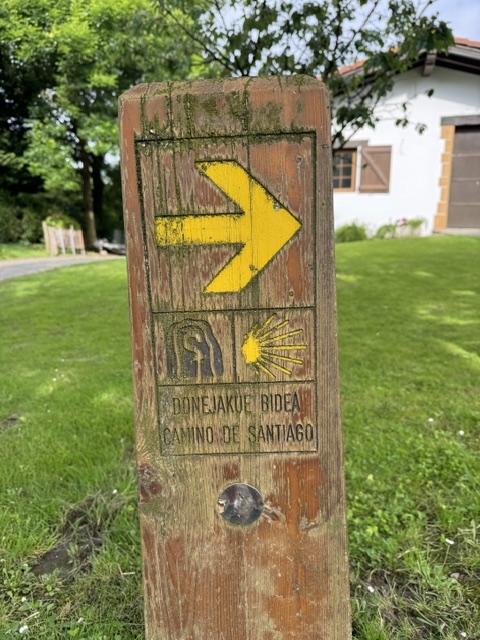
Yes, we spun around a bit trying to find our way, but we were close and quickly were on the trail. I loved getting to see the camino signs again!
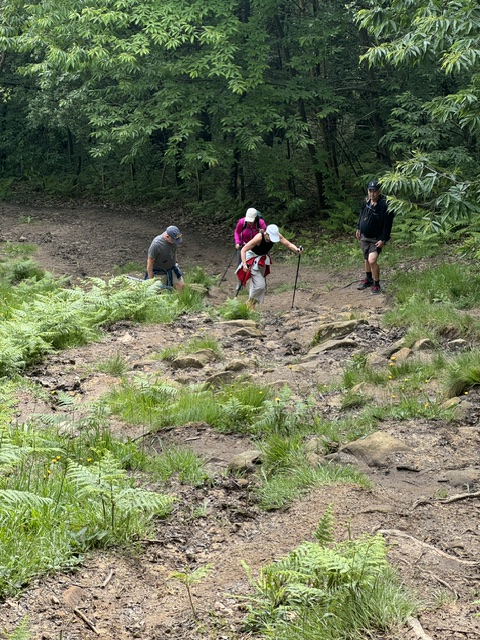
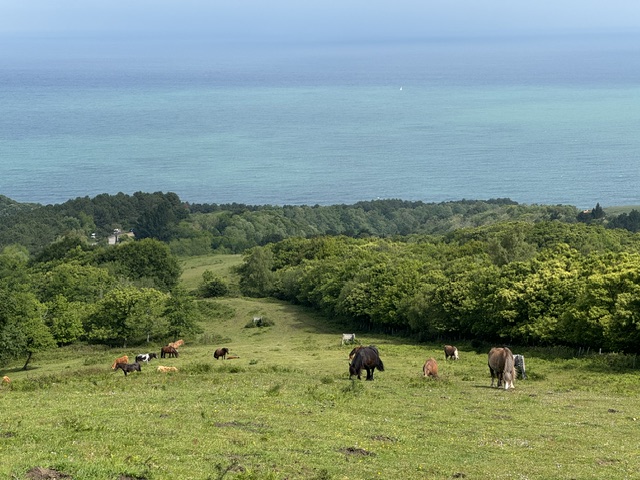
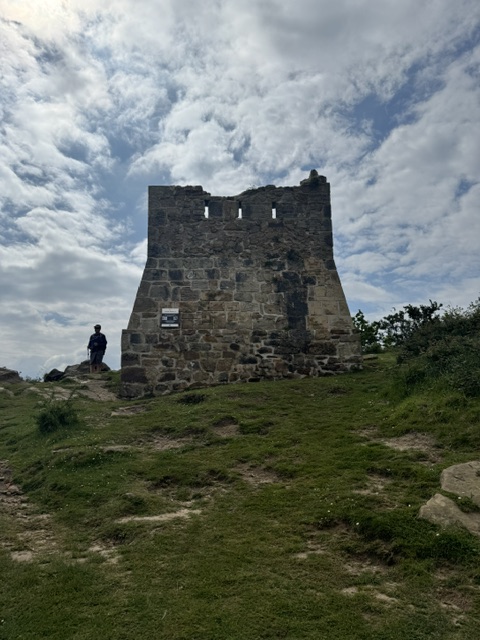
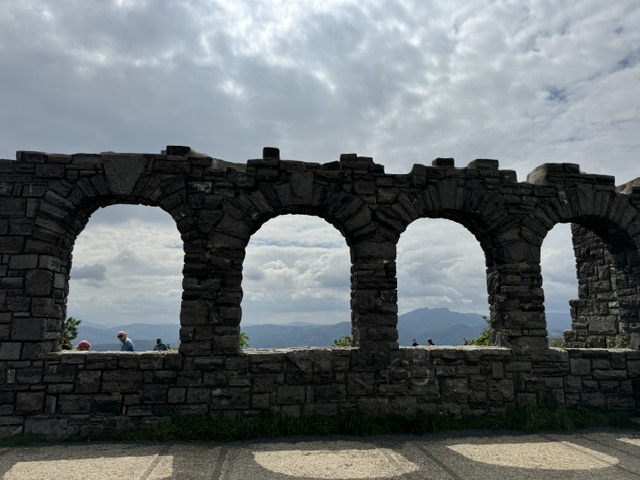
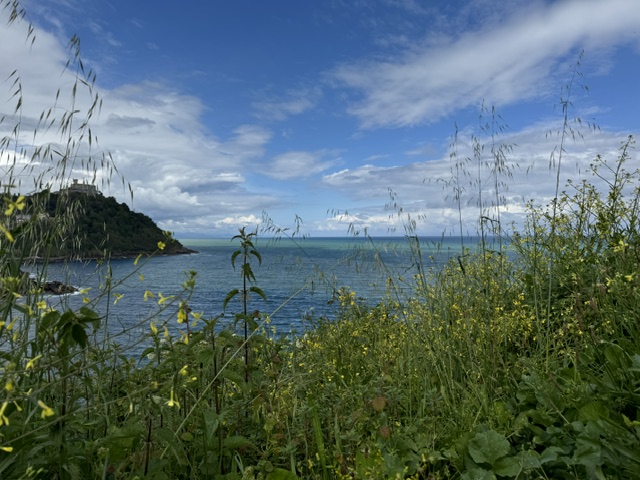
We walked up some seriously steep trails – short, but steep – and then we were on a ridge going along the Bay of Biscay. So beautiful. I’ll let the photos speak for themselves.
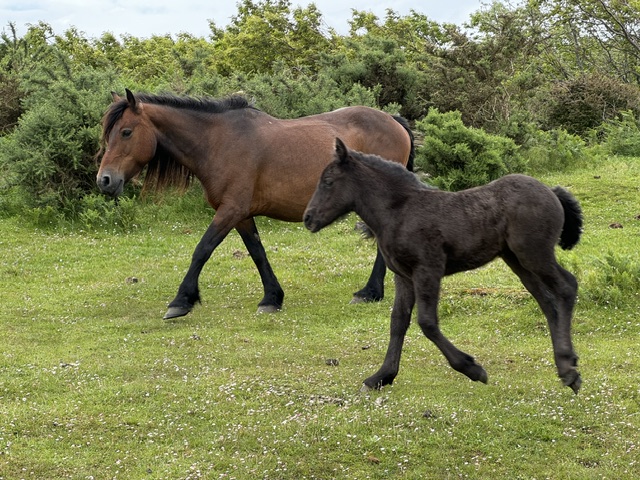
It was pretty windy and cold, but bright and sometimes warmed completely up – so jackets off and on and I just relished all the sounds – birds, roosters from the farms, cows and horses with bells – I’m back in Spain! I do love it here and I so love the walking and getting to see things at a slow pace. We actually went too slowly, so ended up only hiking 10 miles instead of the 15 we’d expected.
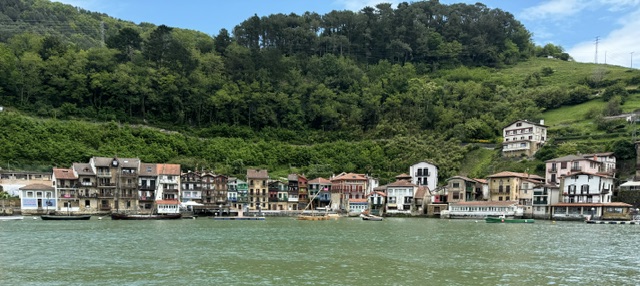
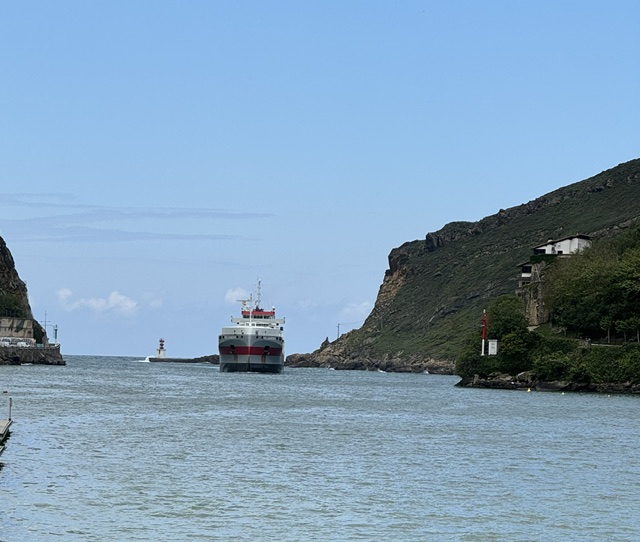
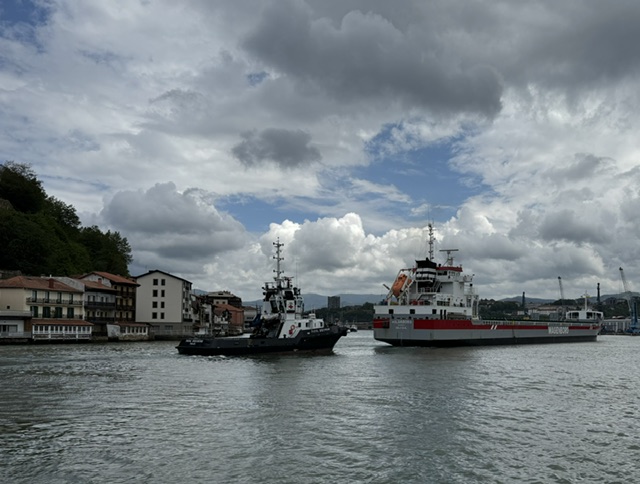
So – for the end of our hike, we came down the mountain into a completely darling little fishing village on one side of the port entry. The other turned out to be an amazing ship building port and the port that all the big ships came into for industry and commerce for the San Sebastián region. We were amazed at the tiny space that these giant ships came through to get into the port. If they got through – they were safe, but oy, in the old days, without motors? We did watch a freighter coming in and wondered why in the world the tug was at the back. Turns out, it was because the boat had to power its way in to stay straight, but then the tug had to pull it backward to slow it down in order to dock. Amazing.
If we’d only known, Rick for sure would have gone to the site where they’re building a galleon with all the old craft to replicate a Spanish galleon that went down off the coast of Canada. When the man who was inspired to start rebuilding wooden boats in the Basque region went looking for craftspeople, there were none left. The only people left in the world who knew how to build wooden boats were in Maine at the WoodenBoat School, a place Rick has dreamed of going to to learn the craft. Maybe if he ever retires…
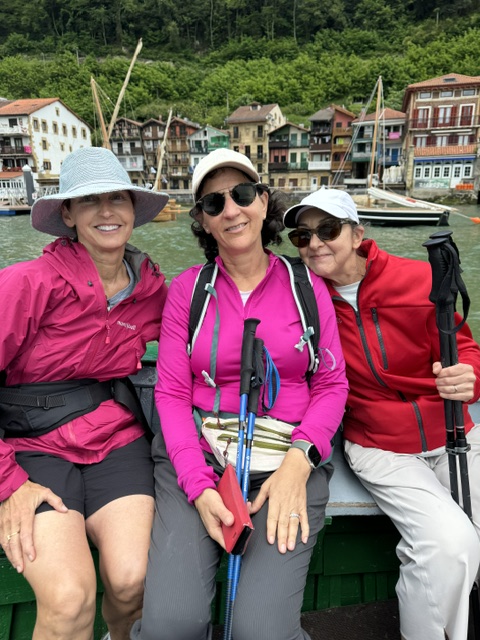
We crossed the river on a little ferry and then debated the taxi option. We could have gone another 8 miles (our distances were just oddly off in planning), but instead we grabbed a taxi to go back to San Sebastián. We had a Pinxto’s tour planned (courtesy of Jean Marie’s advice) and we didn’t want to miss and wanted to clean up as well.
Came back, had some down time and then – we went to meet Gorkas, the mayor of the town as Rick called him. A young guy, passionate about the Basque traditions and history, a wonderful teacher and he loved food as much as his country and culture. He was known to everyone, hellos, brief conversations, hugs everywhere we went and he was so graceful about juggling the greetings and us.
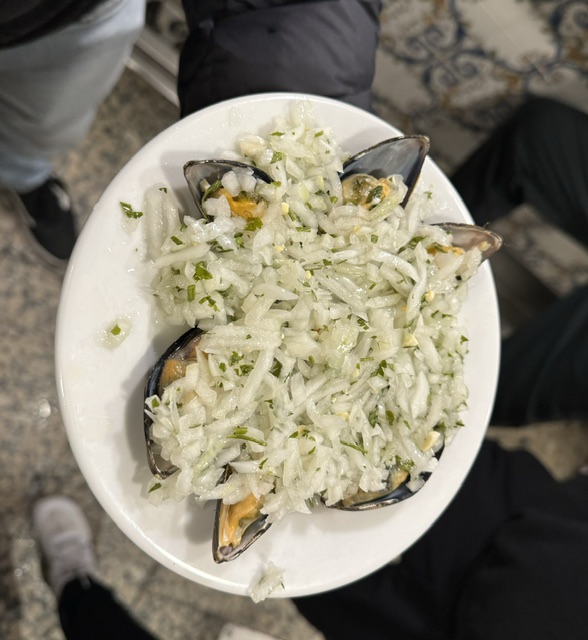
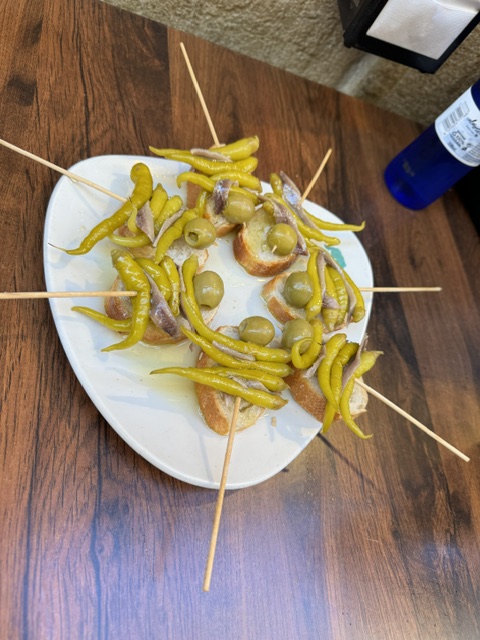
The last one probably doesn’t look completely scintillating, but it was delicious! And it was the original type of pintxo, La Gilda. I forgot to get pictures of a lot of them!
Bit of history for La Gilda: But this history has another key figure inside Casa Valles: Joaquín Aramburu, a.k.a. “Txepetxa”. One of the regular patrons. Nobody knows how many hours have spent Txepetxa sitting and drinking in that bar counter until that day when, at his own risk, he took an anchovy, a chilli pepper and an olive, and skewered them in a stick. This wisecrack came together among the other regulars, and soon they started to ask for that combination.
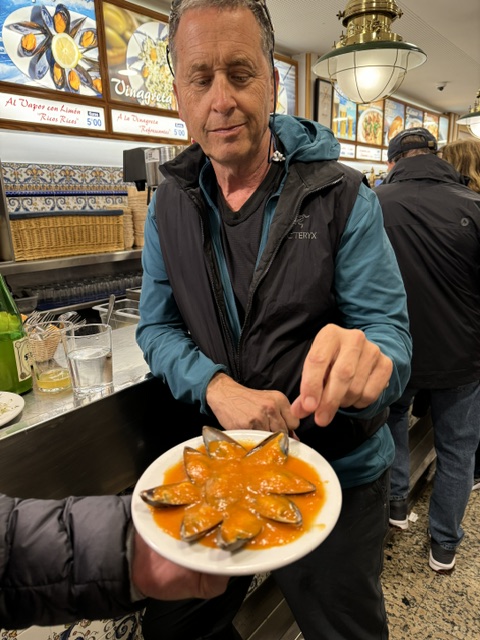
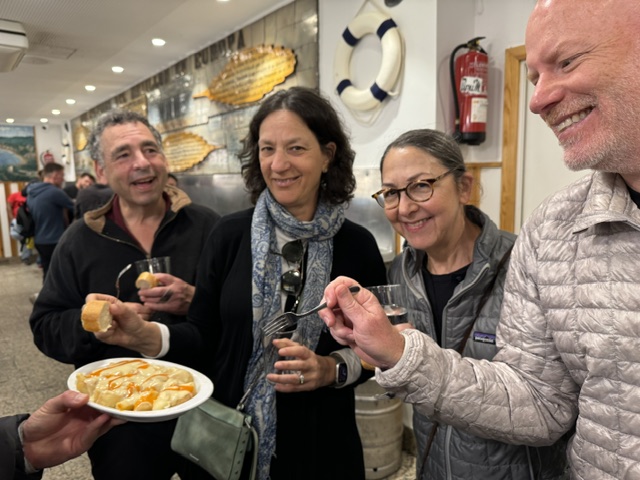
We went to 6 different places, getting to try many different pinxtos. Gorkas took it in stride that most of us didn’t drink much and promptly moved us to water with occasional samplings of drinks. Pinxtos is a Basque term that means skewered. Later, in other places, these little dishes became known as tapas, here – definitely pinxtos. I was seriously hungry and thought this is not going to fill me up at all. But since we are now eating everything, I had beef, anchovies, potatoes, muscles, Iberian ham (there are four gradations), shrimp, risotto and we ended with a traditional desert (“my grandmother made this for us” ) of French toast soaked in cream and spices and surrounded by a custard. As Rick said, several of us Hoovered it ALL up. Such a fun night. I’d recommend Gorkas to anyone who was wanting a tour of any sort he chose to lead.
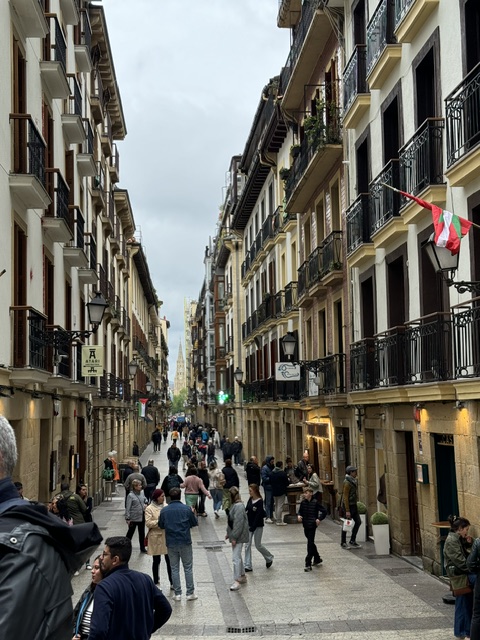
Carol and Matthew got in last night and we met up in the old town and started walking. This is a wonderful town for walking!
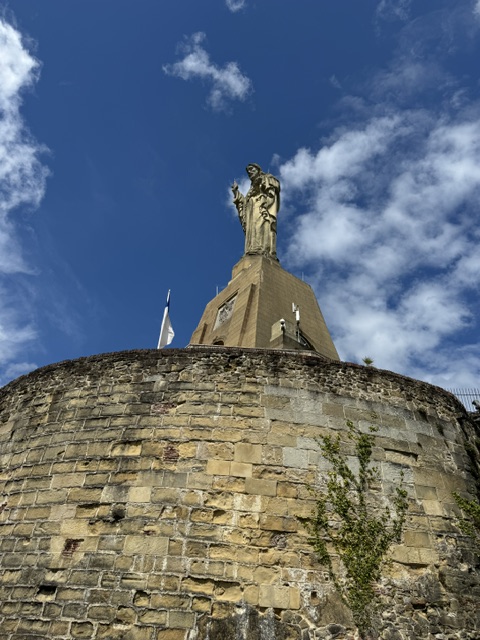
We started with the huge statue on the mountain (we’d call it a hill in CO) on the right side of the bay with the giant statue of Jesus of the Sacred Heart. Evidently if his hand is up in this form that’s what it means.
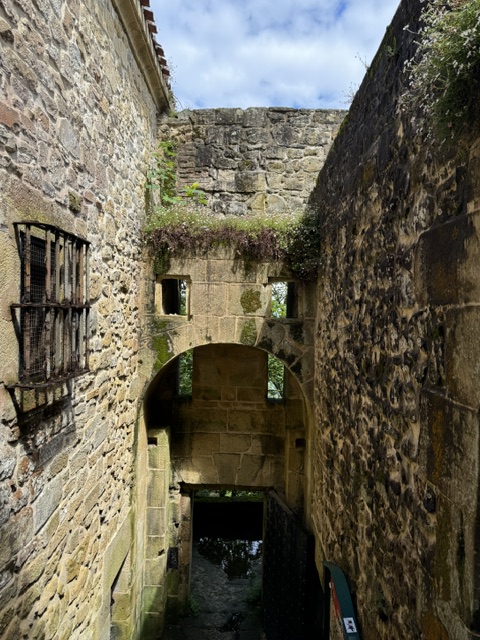
We walked up and around the castle and then back down, getting to spend a little more time in the old town. Gorgeous.
We walked by the bay and realized that the writing you see here was redone every day. I asked someone about it and they said that part of the beach is recreated every day, sometimes protest words, sometimes art, sometimes mandalas. In this case, it was protest and memories for both the Basque cause and for Ukraine.
Then, Matthew, Rick and I had a new experience – we went to the Talasoterapia Circuit. The what? The hotel had told us about it and that they were reserving our spots and I asked if we could bring a guest. Yep. So we walked in thinking everything was paid for and Matthew ended up paying for everything. And cheerfully!
We knew to bring bathing suits and I knew to bring a swim cap, turns out men need them too, so they got little blue beanies. We were just bewildered with the rapid flow of Spanish/Basque, but took our cards and walked through the turnstiles to get in. Then single sex? No? Change? Weird little spaces with doors on both sides – only on the way back out did I see the hooks down low to secure the doors while changing. I walked out the other side and only saw men. Oy. Went back and forth a few times trying to figure out. During one of my back and forth times, Rick went out and only saw women – but he asked is this only women here? No – and we all then found our way to the most amazing place.
Giant pools with massage jets. There was a circuit working all the way up and down the back and legs and it really did massage! The water was just the right temperature so we were completely comfortable moving around the pool with water at neck height about, so could walk or swim, at the end was a resistance stream for exercise. And that was just the first pool. There was another pool with different amounts of jets and a circuit that included underwater bikes, tread mills and arm machines. There was a hallway with shooting jets of all different termeratures of water coming at you from all directions. A hot tub that wasn’t too hot looking over the bay, an ice plunge, a steam sauna, a machines that poured iced that people rubbed all over themselves – not me at all – and the option to run out and jump in the ocean (freezing) and then back to the jacuzzi. And a final large pool with a waterfall you swam under to get to the “relaxing” pool with violet light and heads resting back on the rim when the rest of you floated. All of it was saltwater. We had a 2 hour slot and we used it! Matthew did everything, I did everything that didn’t involve cold.
No – no pictures for obvious reasons. But a very cool place. Matthew wondered why we’d never seen such a thing anywhere else. It was fantastic.
We came back and found that Susan and Bob had arrived and all of us ended up eating at Nobu. We gave up on the menu and just had whatever they suggested. It was a great meal, interesting flavors – but we’re going to go back to Narru for our last night.
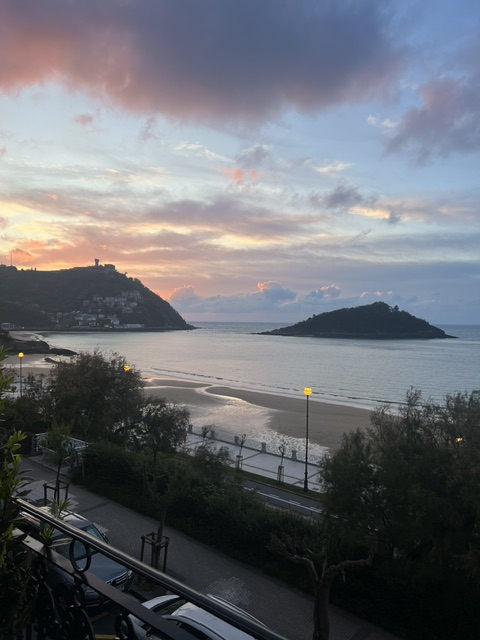
We talked over the hike for the next day and planned to meet at 8:30. Another great day and a gorgeous sunset over the bay.
We flew Iberia to San Sebastián (Donostia is the Basque name) – short, easy flight and landed in this wonderful town. A few people had told me that this was one of their favorite towns and now I get it. We’re staying on the bay and can see the water from our room, it’s beautiful.
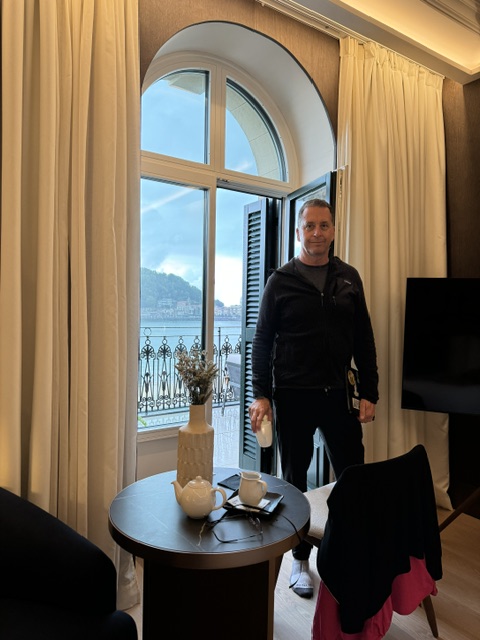
Yep, there’s Rick. He said that when we passed a window that he felt like he was in his pajamas. But then we realized that’s because we’re in our Vuori clothes, completely comfortable and not styling. But it was raining on and off and windy so we were happy to be comfortable, warm and dry with our rain jackets.
We realized we were too tired to stay up for an 8pm res for dinner and asked the hotel to change us to an afternoon lunch, 3pm, and they were able to get a spot at Narru. Oh my goodness, the best meal in Spain I’ve ever had. Rick and I were giddy. Belatedly, I realized I should have taken photos, a la Kaziah. But I didn’t think. Our heads were swinging every time someone came by with food for us or anyone else because it was beautiful. Such a fun lunch.
We then started exploring the Old City and going into churches. I really won’t be doing a litany of churches like I did on my first Camino, but there were some notable things.
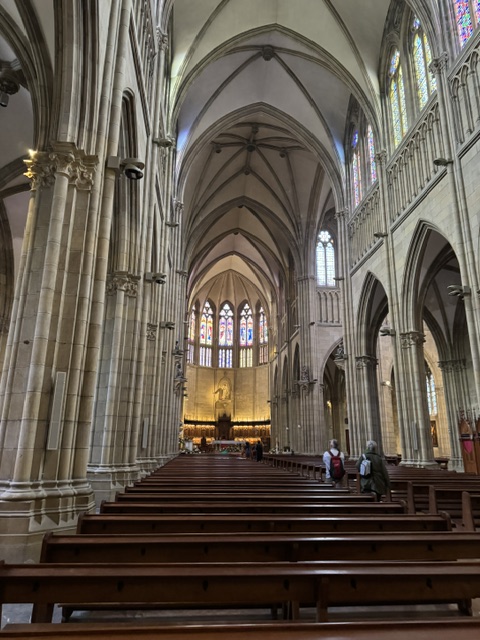
This is the Cathedral of Good Shepherd or San Sebastián cathedral. Rick looked up the history, and here’s a note from Wikipedia: The Spanish royal family, who were vacationing in the city, were invited to the laying of the foundation stone. The events took place on September 29, 1888. The queen regent, Maria Christina, her children and the Infante Antonio, along with ministers and other officials, attended the solemn mass that the diocesan bishop D. Mariano Miguel Gómez held in the provisional parish church of the Sacred Heart. Following the ceremony, the royal entourage moved to the site of the new church and there proceeded to lay the foundation stone, which covered a lead box in which were enclosed pictures of the Pope and the royal family, various coins of the time and copies of the Gazette of Madrid and of the Ecclesiastical Gazette. The minutes of the ceremony were signed by the baby king Alfonso XIII, aged two years and four months, for which his mother had to take his hand. It is the first signature of Alfonso XIII on an official document.
It was built by Basque craftsman in 9 years (2 on hiatus when money ran out) on sand and marsh. Amazing. I liked it because it was much more simple inside than many.
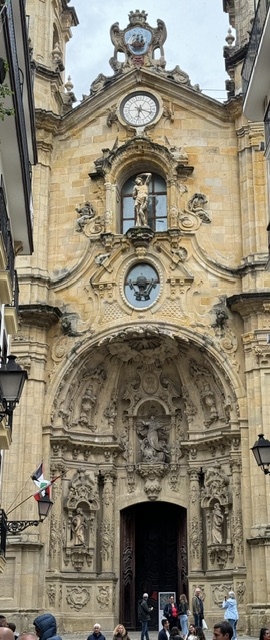
We found another church, the Basilica of Santa Maria del Coro and were able to sit and listen to choir music, that was wonderful. At the top you can see the sailing ship – that emblem is everywhere. It was the main port for the Basque region and it was a combo of port for whaling and commercial ships and a military fortress. But the marine life is much more vivid.
We found another church, the Basilica of Santa Maria del Coro and were able to sit and listen to choir music, that was wonderful. At the top you can see the sailing ship – that emblem is everywhere. It was the main port for the Basque region and it was a combo of port for whaling and commercial ships and a military fortress. But the marine life is much more vivid.
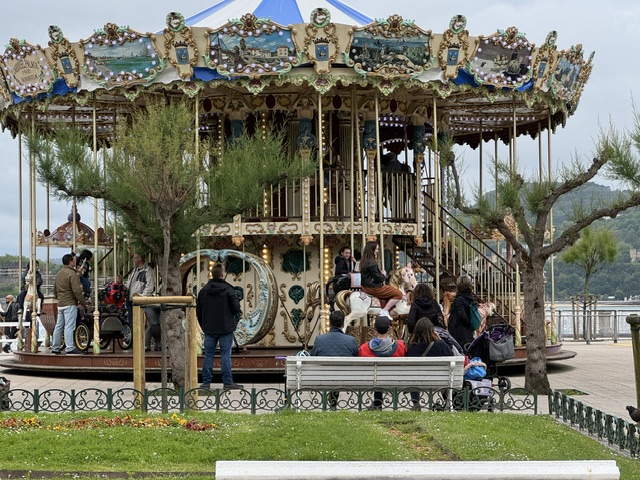
Cool double decker carousel on the bay:
The old town is gorgeous and we wandered up and down the streets and admired the bay and the incredible walls the town has put up to manage the onslaught of wind, sea, and boats that used to crash regularly.
The Bay of Biscay is famous for wrecking ships. There’s a small lighthouse, but despite warnings, ships would get swept towards shore because there’s almost always a strong onshore breeze. Also, the Continental shelf, which means shallower water, extends a long way into the Bay of Biscay, and is responsible for many problems for mariners and the weather and sea state there generally. Rick and I had heard/read about it repeatedly so it was amazing to see.
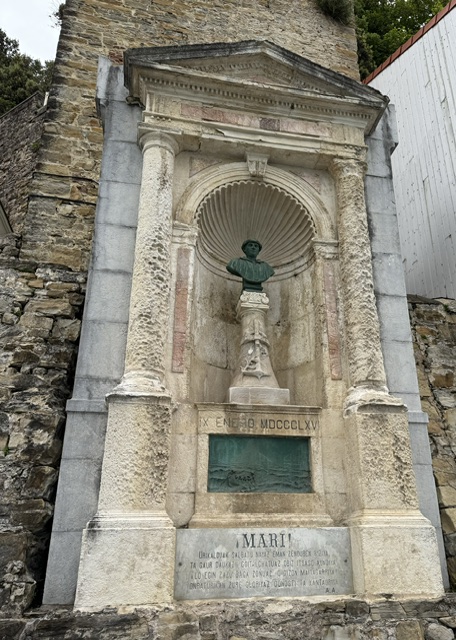
This statue is a memorial for Marti – the note said that he was fishing with his father by the time he was 9 and then sailed across to the americas for years. He then settled back in San Sebastián and was known for his kindness and commitment to helping others. He repeatedly went out to save people from wrecked boats. A boat went down off the shore and he managed to get out there and save everyone on board, but then a huge wave came and capsized his boat. Other boats had gotten out there by then and saved everyone again, except for Marti.
After wandering, we came back to the room, made decaf tea and settled in to read, opened the windows and listened to the rain and the sea. A great night.
We’re starting our Camino del Norte with a one-day layover in Madrid. We staggered to our hotel after getting off the plane, dozed for a couple of hours and then went out to do a tour.
I’d read about Afrohispanica Tours with Kwame Ondo in The Guardian. It’s a tour in Madrid focusing on Black history. I was interested because I’d been following the reporting that The Guardian has done with their stories on Manchester and other areas in England and how their rise and success was based in large part on the slave economy. This was Madrid’s reality and Kwame was terrific. Both Rick and I learned a lot we’d never known. And, no, I can’t remember everything, but here’s a few facts:
The banks in Spain were all based on the coast, mostly in Santander, and a lot of the money boosting the banks came from the slave trade.
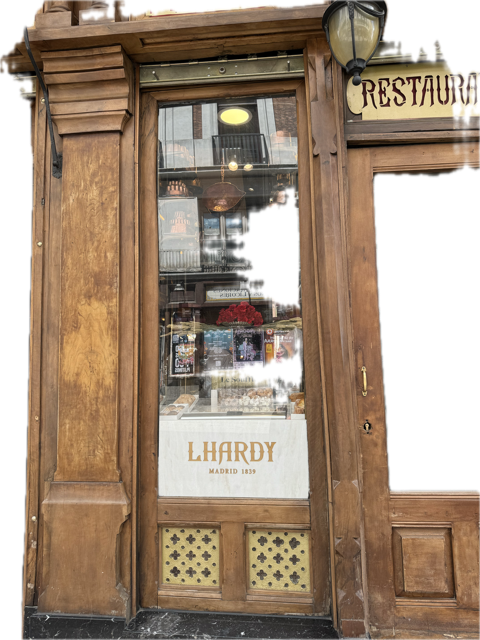
Spain supported slavery until 1873 when the president wrote and proposed the ending to the trade. He had to leave the country because wealthy families and businesses based on the trade were furious, but it was still passed. Both the president and the vice president were ardent abolitionists, so even when the president had to leave, the vice president took over. Thus the Spanish colonies in the Caribbean were among the last to abolish slavery, in Puerto Rico in 1873. The restaurant below is where the president wrote his proclamation:
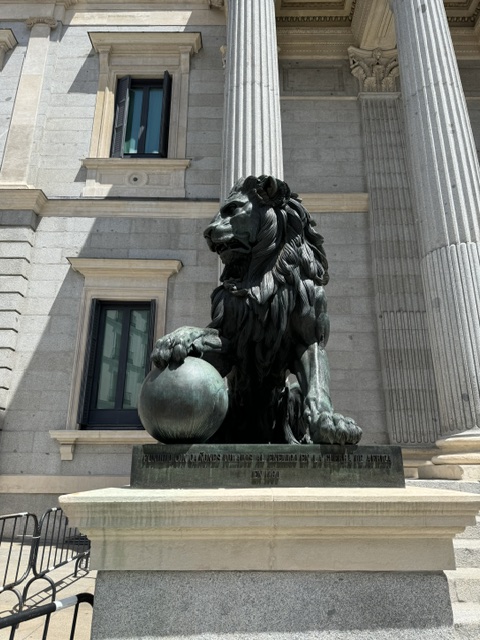
The lions in front of parliament were made from cannons from the Moroccan and Spanish war, when the Moroccans were fighting for independence.
There was a conference, the Berlin conference, in 1884-5 when the European nations divvied up Africa for who could colonize and capitalize on the workers there. Maybe not enslaved peoples, but worked as if. How could we not have known this?
There was a street in Madrid named Calle de las Negras – for the concentration of enslaved women in that area. The name has now changed.
King Carlos III was one of the biggest slave owners of his time, keeping 1,500 enslaved people on the Iberian peninsula and the 18,500 others held in Spain’s colonies in the Americas. As aristocratic families sought to keep up with the monarch, the proportion of enslaved people in Madrid swelled to an estimated 4% of the population in the 1780s. (Fact from the Guardian article).
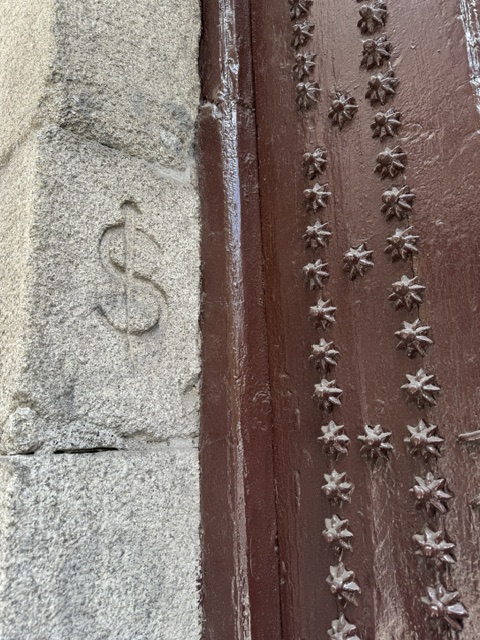
This is the symbol of slavery in the doorway of the Parish of San Ginés, we thought it was a dollar sign. But it’s an S for slave with a nail driven through it. Horrifying. And it’s on the other side of the church from one of the oldest bookstores in Spain – both connected to the church. One enlightened, one not.
The tour definitely broadened our perspective on Madrid and Spain’s Black history and opened the door to learning more about it. Thanks, Kwame!
Then Rick and I were the first to arrive at the restaurant at the hotel and had dinner and went straight to bed. We’re such an exciting pair of travelers.
Today was our travel day from Verona to Venice, but we stopped in Padua to see a colleague of Leaf’s, Enrico, and one of his post-doc co-teachers, Marta. The traffic getting into Padua was crazy busy and it did not look like any kind of interesting inner city was going to unfold. Leaf, bless him, was driving. At one point the GPS guide told him, “make a u-turn when you can”; she’d given up. The next thing was take a right or a left with arrows pointing both ways. Needless to say, Rick in the front passenger seat, had his phone open to another map option and between the two, we finally got into the old city. Then parking – nope, none, anywhere. We’re looking and looking and getting more into the old city and then Leaf said, “I think left”, all other voices said, “looks right”, so he went left.
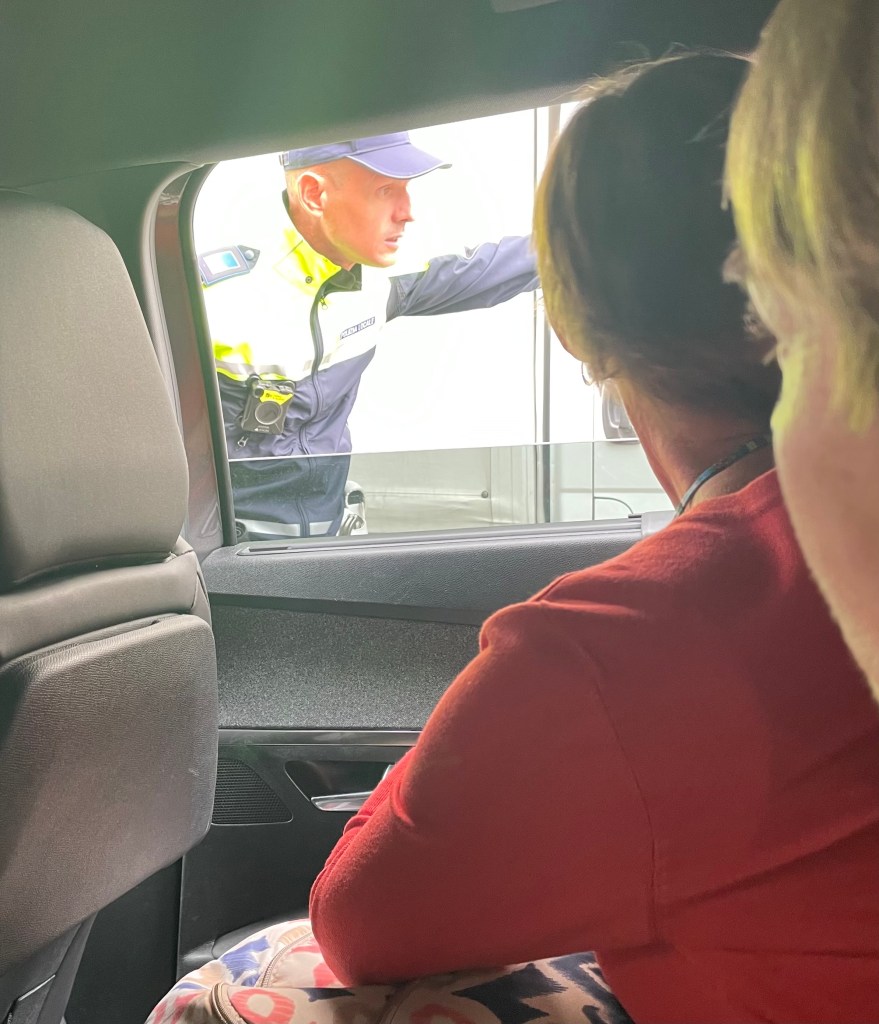
This was the result.
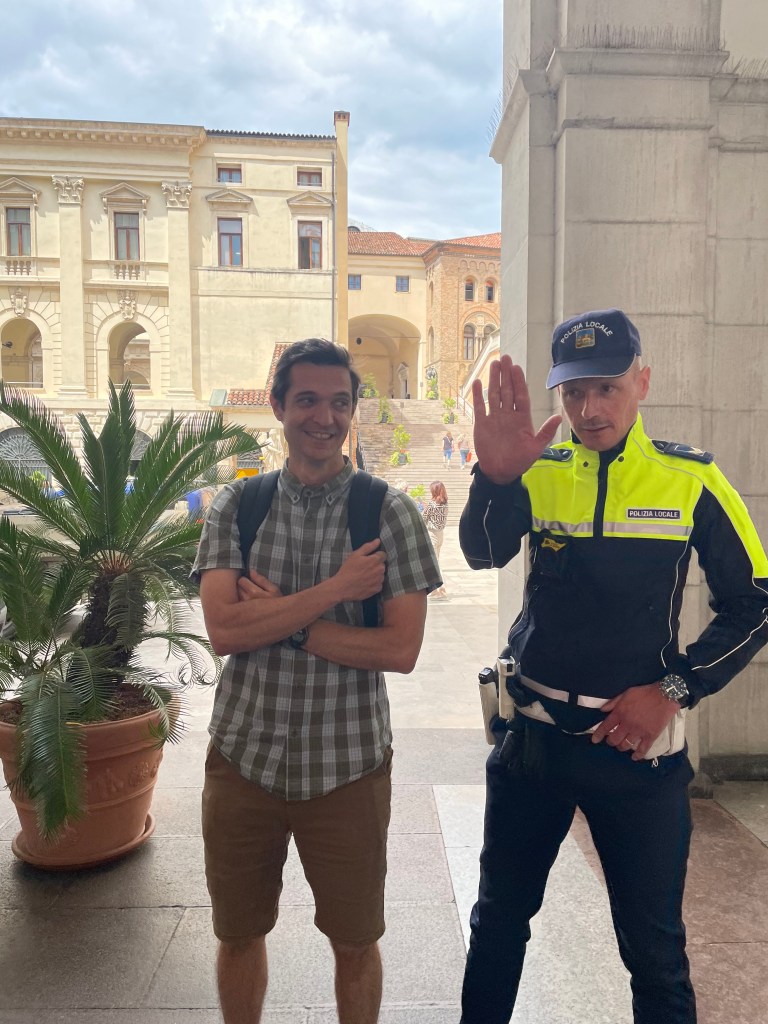
Aaaoouuut! Aaaoouut! Only pedestrians! Yep, repeat of Sienna. Needless to say, hilarity was reining inside the car. The first person we saw as Leaf drove into what turned out to be the MAIN pedestrian area between the town hall buildings and the university, both from the 1200’s, was a woman who ran toward us, but also was laughing. She stopped us and then ran to get a policeman who could speak a bit of English. Sharon was quick to grab my phone and get photos. I was laughing too hard to think about it. Those words above were the policeman’s. But he too, was smiling and directing. Leaf had to do a u-turn in the same area in the drive of shame back to the street that would lead us out.
The rest of the drive until we finally found parking way outside the center area was filled with repeating the aaaooouuut directive. When we walked back into the plaza to explore, the first person we saw sitting in the guard booth was the policeman who’d directed us. I waved at him, laughing and he promptly came out to greet us. When we asked if we could get a photo, he immediately joined into the fun of it, telling us to wait while he adjusted his swagger and belt of gear. So fun. Great intro to Padua.
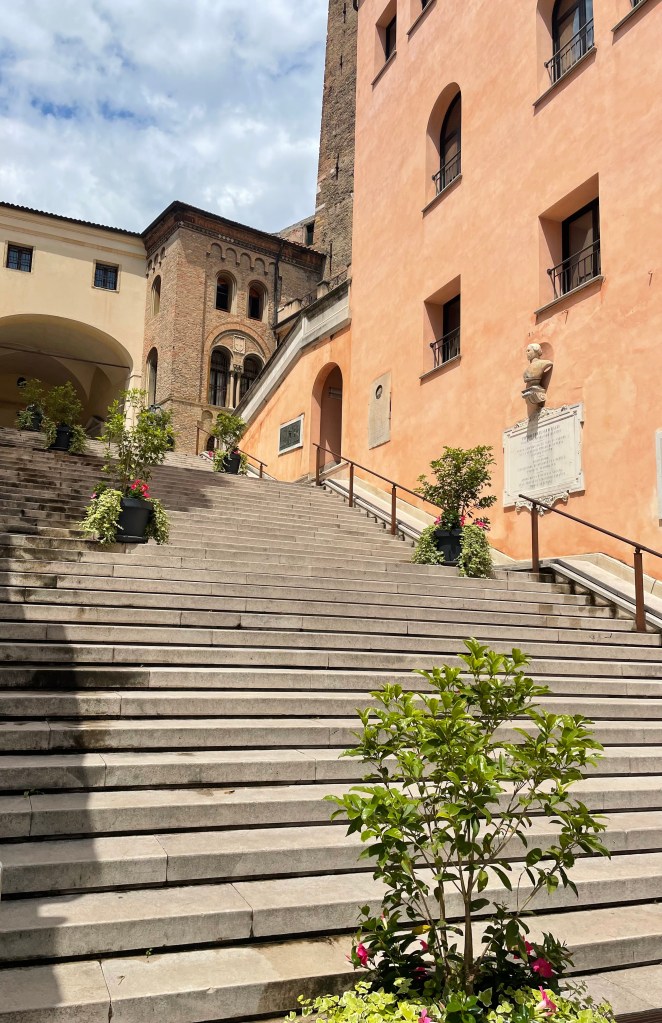
The buildings, per usual once you’re in the center, were beautiful. First town hall, hard to capture because of the multitude of layered buildings:
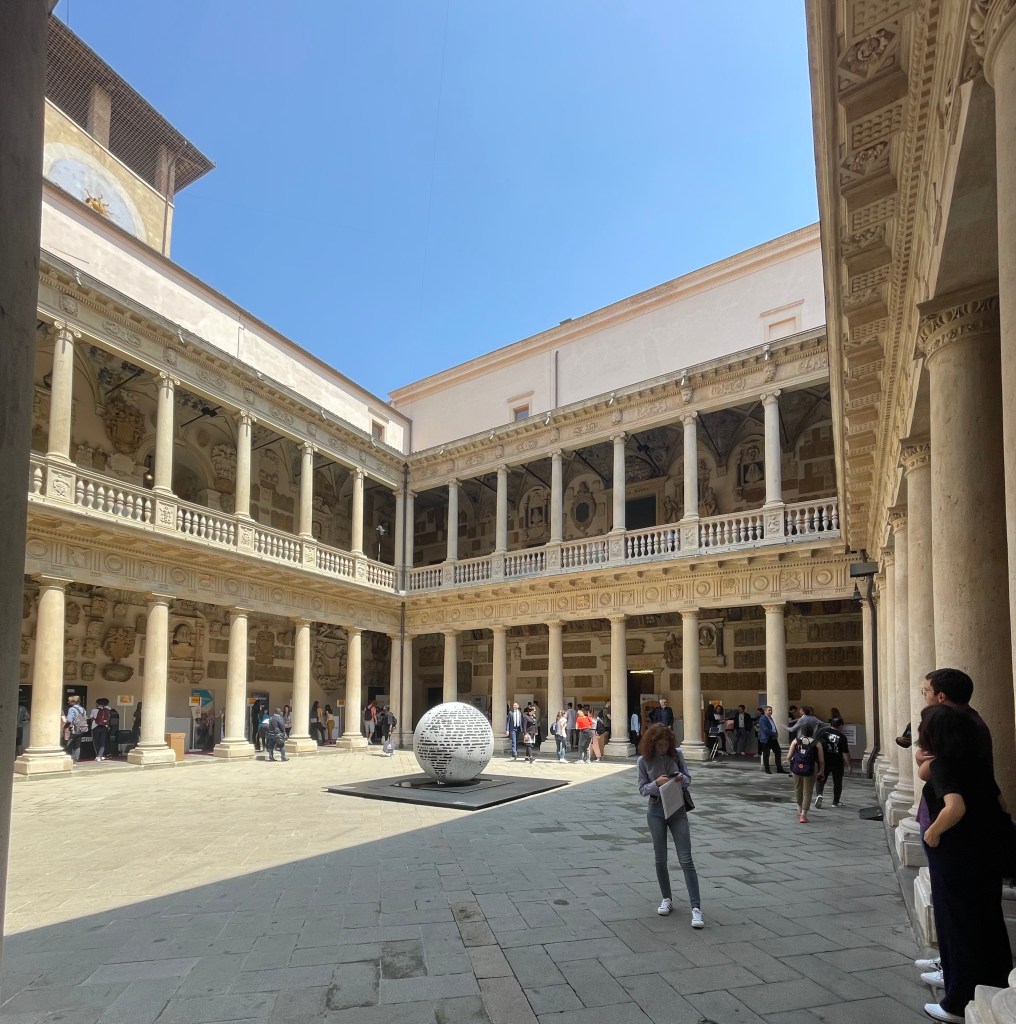
Then the university. The university is the 2nd oldest in Italy and the 5th oldest continuously operating in the world. So cool. And Enrico had offices in the old buildings and brought in us for a brief view. It was career day for new/potential students so a very active scene.
We had a lovely coffee and treat at one of the oldest coffee shops that was in the area, creating part of the communal culture between town hall and the university. Looks modern now…
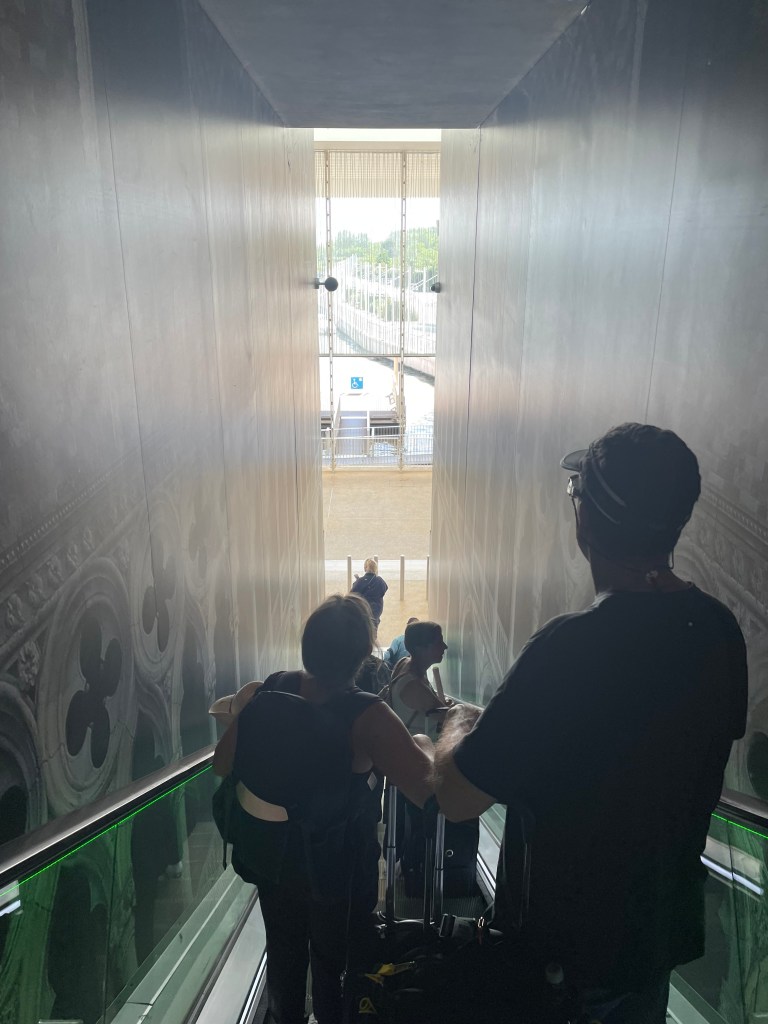
We then drove to the Marco Polo airport to drop our car, with a bit of a sigh of relief, and then walked our things through the airport and suddenly come out on a dock! I knew we were getting a boat taxi, but was still surprised. Sleek elevator and then there’s the water with a dock:
Coming into Venice, passing islands:
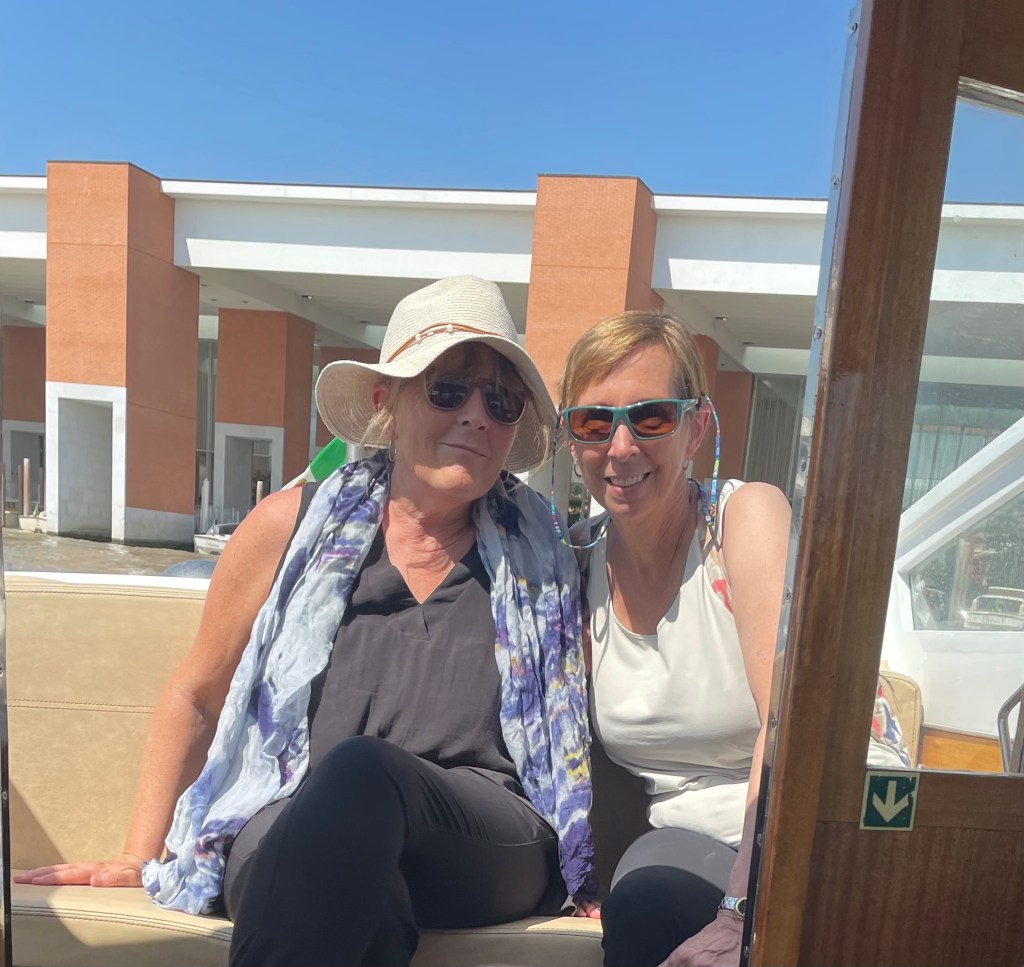
And then – Venice. Oh, how lucky am I to get to finally see this magical water city with Rick and such great friends. And we had 3 nights! Our water taxi (I’d call it a boat) brought us to the campo San Giacomo dell’ Orio. We got out on the dock area, walked over the little bridge – our first of many – and our apartment was in the first building on the right. The gentleman who was meeting with us to get keys was right there, so easy! Our apartment is neat and clean, on the 2nd floor with windows onto a little courtyard complete with well and other windows overlooking the canal. Low timbered roofs and a bit of up and down to create 3 bedrooms. Just enough to stumble on 🙂 I’m guessing it’s VERY hard to have modern conveniences in many of these apartments, so felt lucky when we saw ours. Plus the host has been beyond helpful in setting things up.
We had an hour to settle, then I looked out our windows to the parch below and there was Andrea – the guide I’d arranged. The tour was titled “Venice from a Venetian perspective” and Andrea was fantastic. Born and lived here all of his life and loved his city. He led us through a series of little “streets”, over bridges, telling us history, and his perspective as a Venetian: “I leave in August because of the crowds or I might get socially inappropriate.” He told us there are now 50,000 residents; it’s a dying city. There were 150,000 in the 1950’s. And 5,500,000 visitors who came through in 2019. Yikes.
But we got unbelievably lucky. A bit prior to high season and the weather – Andrea said this weather is truly miraculous. Mid 70’s, breezy, dry. It will forever leave us with a misperception of how wonderful the weather is in Venice. That works for me!
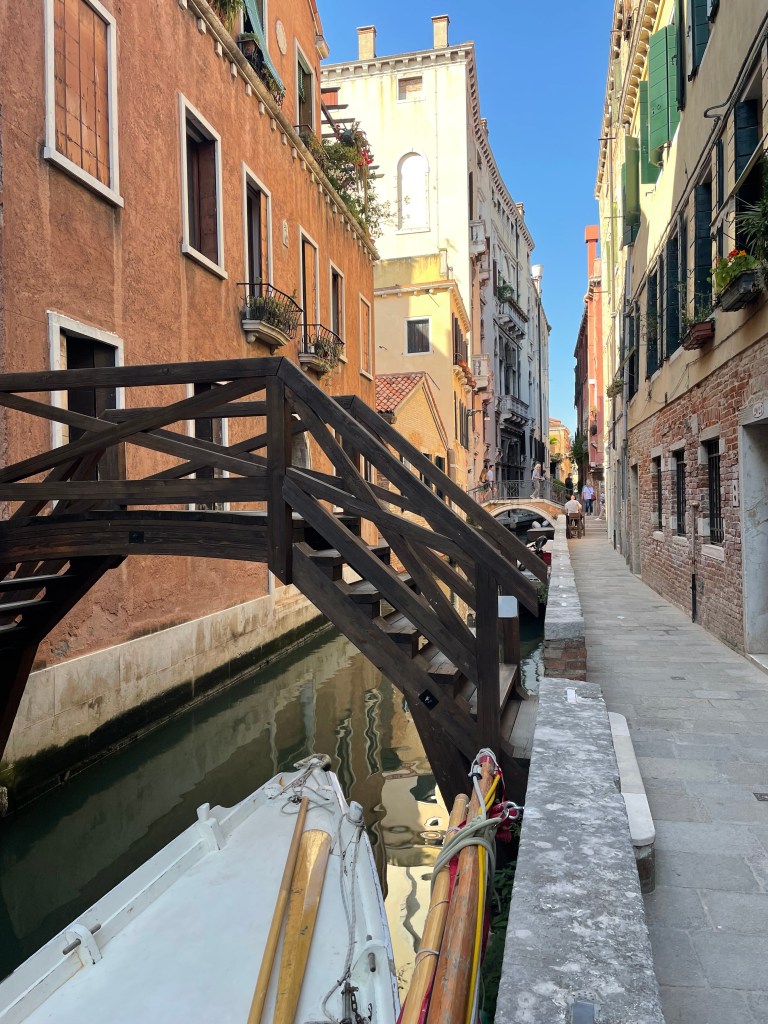
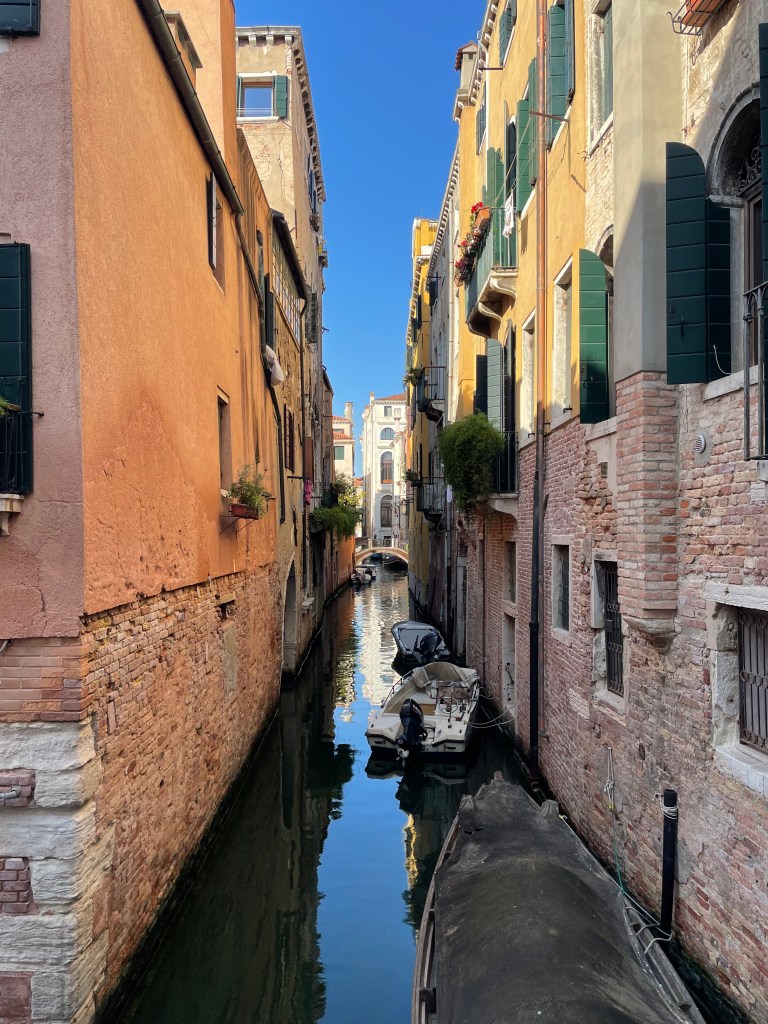
Andrea said that it’s a small town, you can easily walk everywhere. And maybe he’s right, but we walked a ton each day and still didn’t see everything. It’s kind of a mix of every section looks the same with multiple bridges over multiple canals and yet looks different. There are 180 islands, 170 canals, most natural, only manmade ones were the larger straight ones. Otherwise, they wind in often tight curves. Our last walk back to our hotel we found yet another huge plaza we hadn’t seen.
It’s a mix of worn out beautiful city, gorgeous buildings and bridges, and some parts that looked well fixed up. It radiates history, my favorite kind of place. Hardly any trash or graffiti – most of the books I’d read about it were set in the 1800’s and articles for more recent times and I expected a much dirtier city. It was beautiful. I loved, loved it, and couldn’t believe I was in Venice. Few scenes:
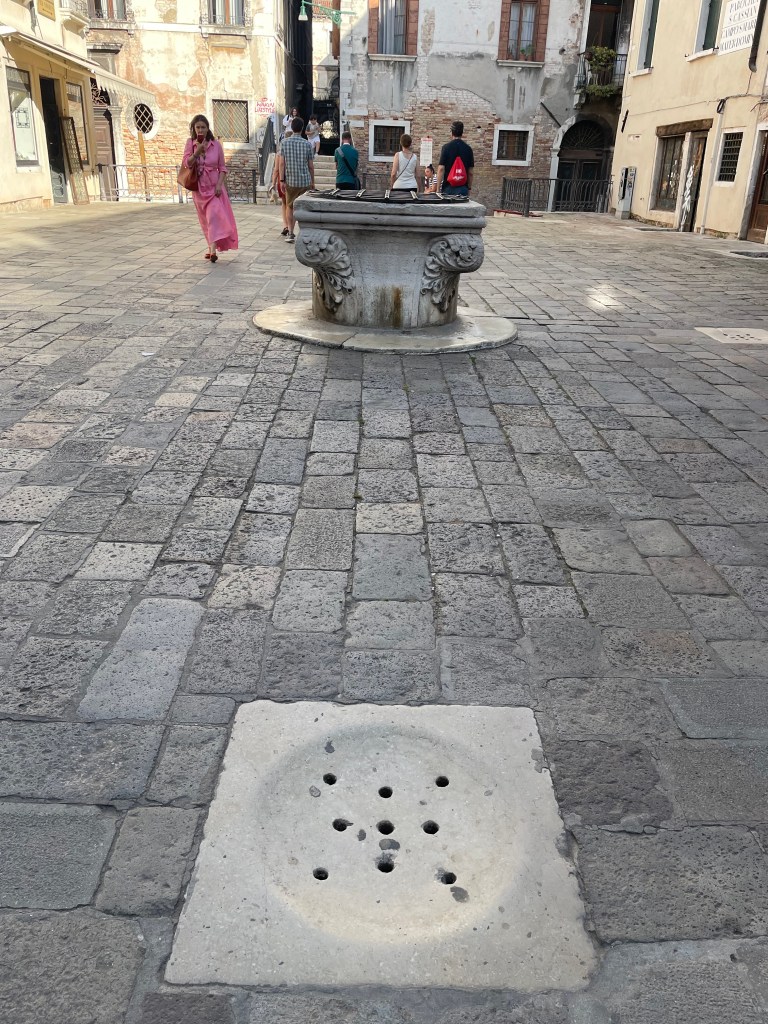
The well below is typical of almost all the plazas. They built big cisterns below with the water filtering through the sand so that when it reached the well, it was clean and good for drinking. The number of drains depended on the size of the plaza. This one had 4, the closest one to us the white square with holes.
Interesting facts from Andrea:
History: Venice was a naval power from the 5th century. Began its power when people fled the mainland when Rome fell. She was independent for 11 centuries – until Napoleon 1797. During this whole time it was a trading city with aristocratic merchants (a contradictory state anywhere else) ruling. Ottomans were here since 11th century, and even during the Ottoman wars, there was still trading between powers.
How it was built: The marshland still determines byways, there are sand bars everywhere and you could actually walk across the lagoon at low tide with your head above water. Given the possible sewage issue, can’t imagine wanting to – but still. So all boats have to follow wooden pillars indicating safe pathways. Because of the high water table, when they started building, they had to pound large timbers as far down as they could until they hit solid packed clay. Then – since the timbers were covered and protected in the muck, they gradually turned into petrified rock. 12,000,000 wooden poles/petrified hold many of the buildings. Andrea showed us a picture of a big guy pounding down a timber with a giant mallet. Oh, ouch.
Re sewage. First – in the early industrial centuries, it was actually considered one of the cleanest of European cities because it’s a marshland, islands surrounded by water with tidal shifts that clean it out twice a day. In the 50’s 60’s, they installed septic tanks for all, oy, can’t imagine that project. So now – a system, but a system that can be and is overwhelmed by floods. Andrea talked about the locals watching visitors when water covers St. Mark’s square – lowest point – taking off their shoes and splashing around taking photos of themselves. Ach.
Population: Breaks his heart. Down to 55,000 and more than a 1,000 leave every year. It’s a gorgeous old folks home. 20,000 commute in from the mainland every day to work there. But it’s just too hard/expensive to live there. The usual of outsiders buying up for second homes and raising the prices.
I have to say walking around, there are SO many young people. On the weekend there were many large groups of young people – lot of bachelor and bachelorette parties. Plus there’s a large university in town with 30,000. And the tourists were a wonderful mix of peoples, ages, backgrounds, languages. So the lack of population is not obvious. Our apartment was in the wonderful neighborhood of San Giacomo, quiet, enough off the beaten path that in the evenings and weekend it felt local, there were all kinds of families. Kids with bikes, soccer balls, running around while parents ate at restaurants on the plaza. In our building, it seemed like we were in the only rental. Others were off to work, hanging laundry, etc.
So – a lot more, there always is, but those were the highlights that Andrea gave us.
We then had a dinner at a place that Marta’s (met her in Padua) boyfriend’s cousin owned near the Rialto Bridge and walked home with the gift of GPS who was not quite as confused here. A great first day in Venice.
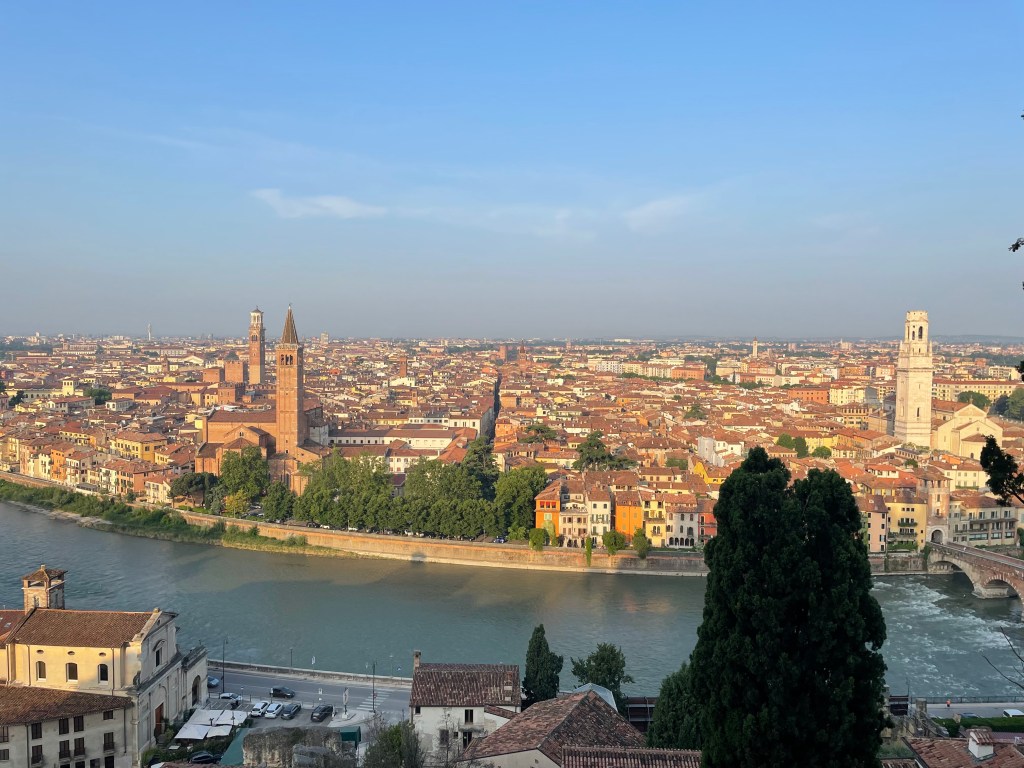
Verona/Vicenza I took an early morning walk around Verona today, up the hill to see the view and back through town. It’s taken long enough to start to get a clear sense of how to move once in the streets where you can’t really see landmarks outside to orient. In this photo, the Duomo’s white tower looks the tallest, but the family of Della Scalia who built the medieval Castel on the distant left, made sure their tower was higher than the churches – thus the lack of the steeple. Government over church.
A few things came back from Krystal’s walk.
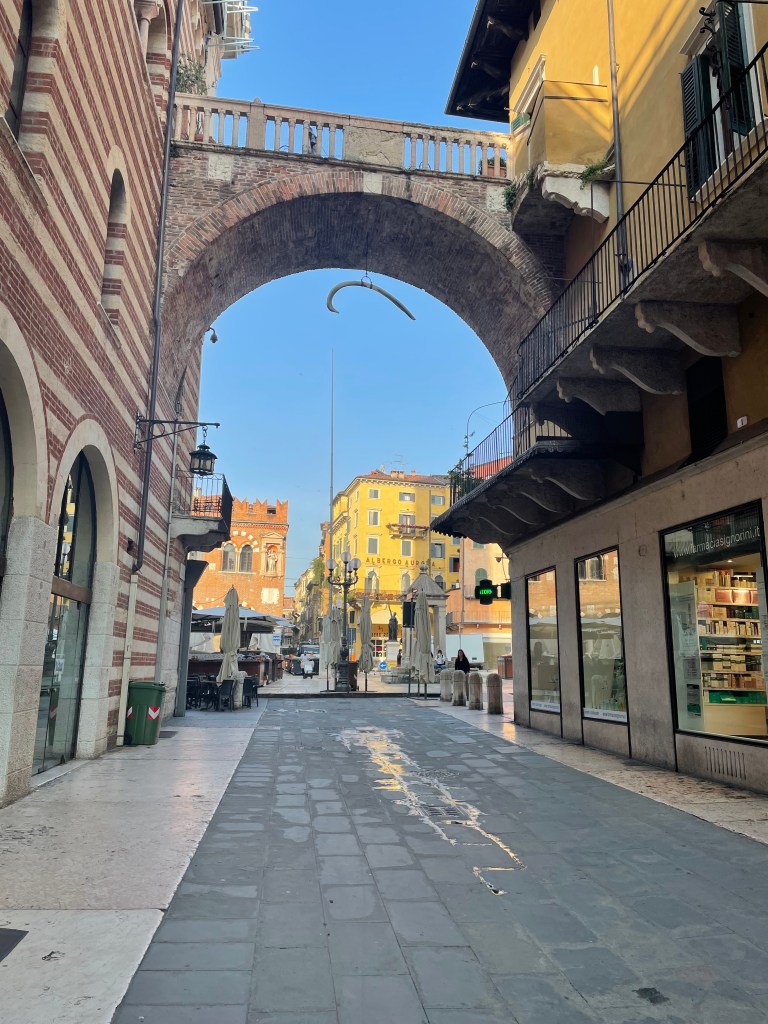
Whale bone hanging, noted in Atlas Obscura: A whale rib was used to advertise the store by the arch that offered exotic goods from far away.
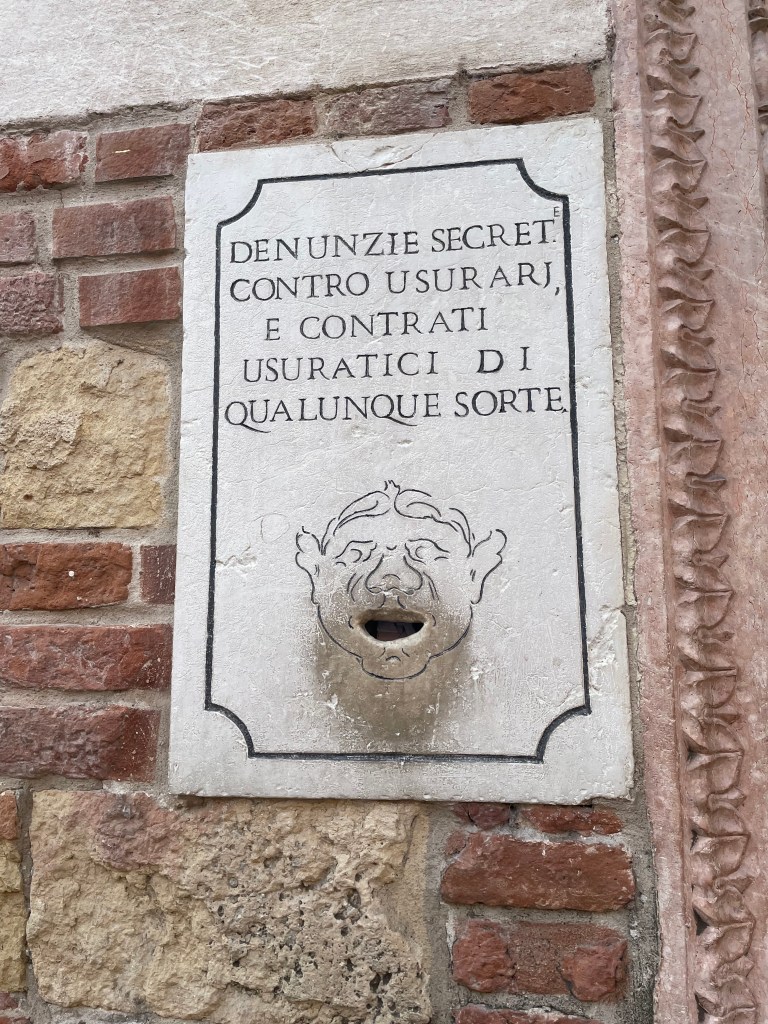
Citizens could voice their concerns anonymously by placing hand-written notes into designated boxes. In turn, the government would address each complaint individually. These boxes, or bocche di leone (lions’ mouths), were scattered throughout the city. Each stone receptacle resembled an intricately carved face, often that of a lion—the winged lion of St. Mark is the symbol of Venice —with a slot at the mouth into which letters could be inserted.
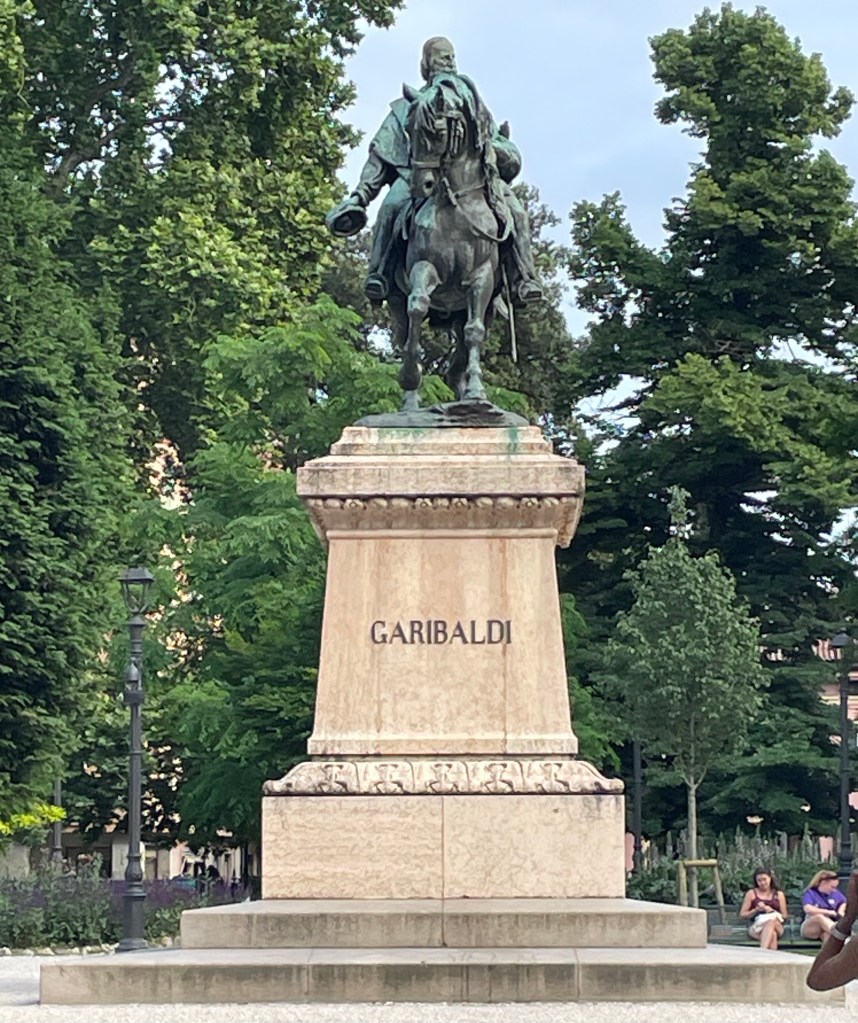
Garibaldi is the man who united Italy, starting in 1848.
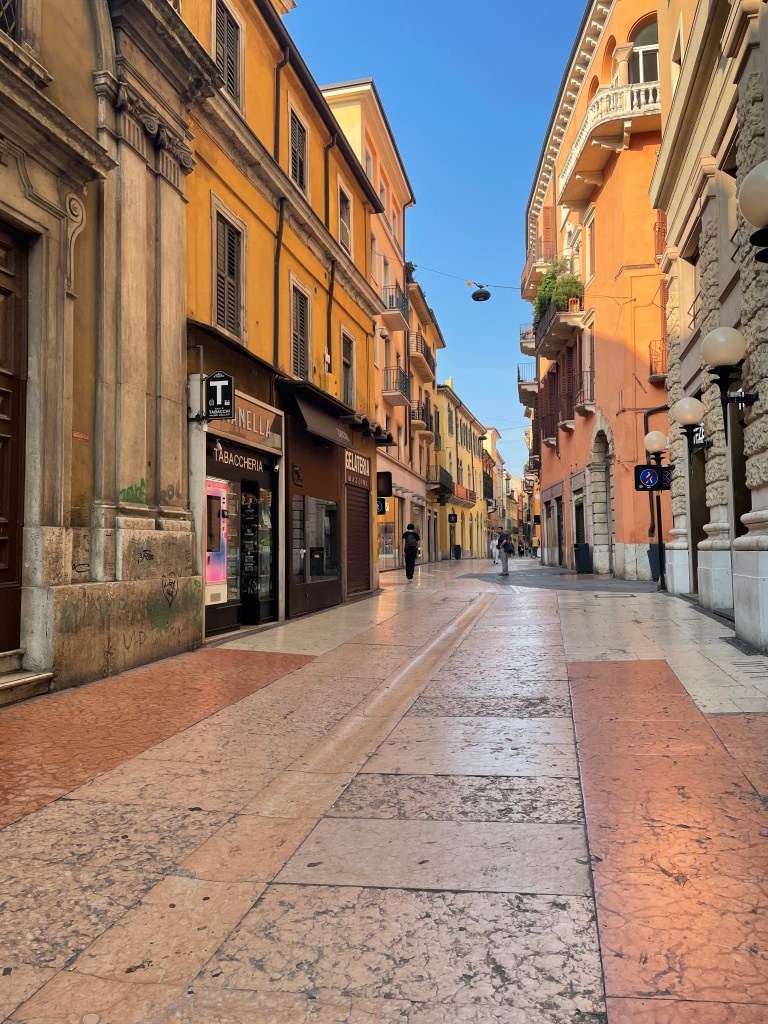
Main shopping and pedestrian street paved with marble.
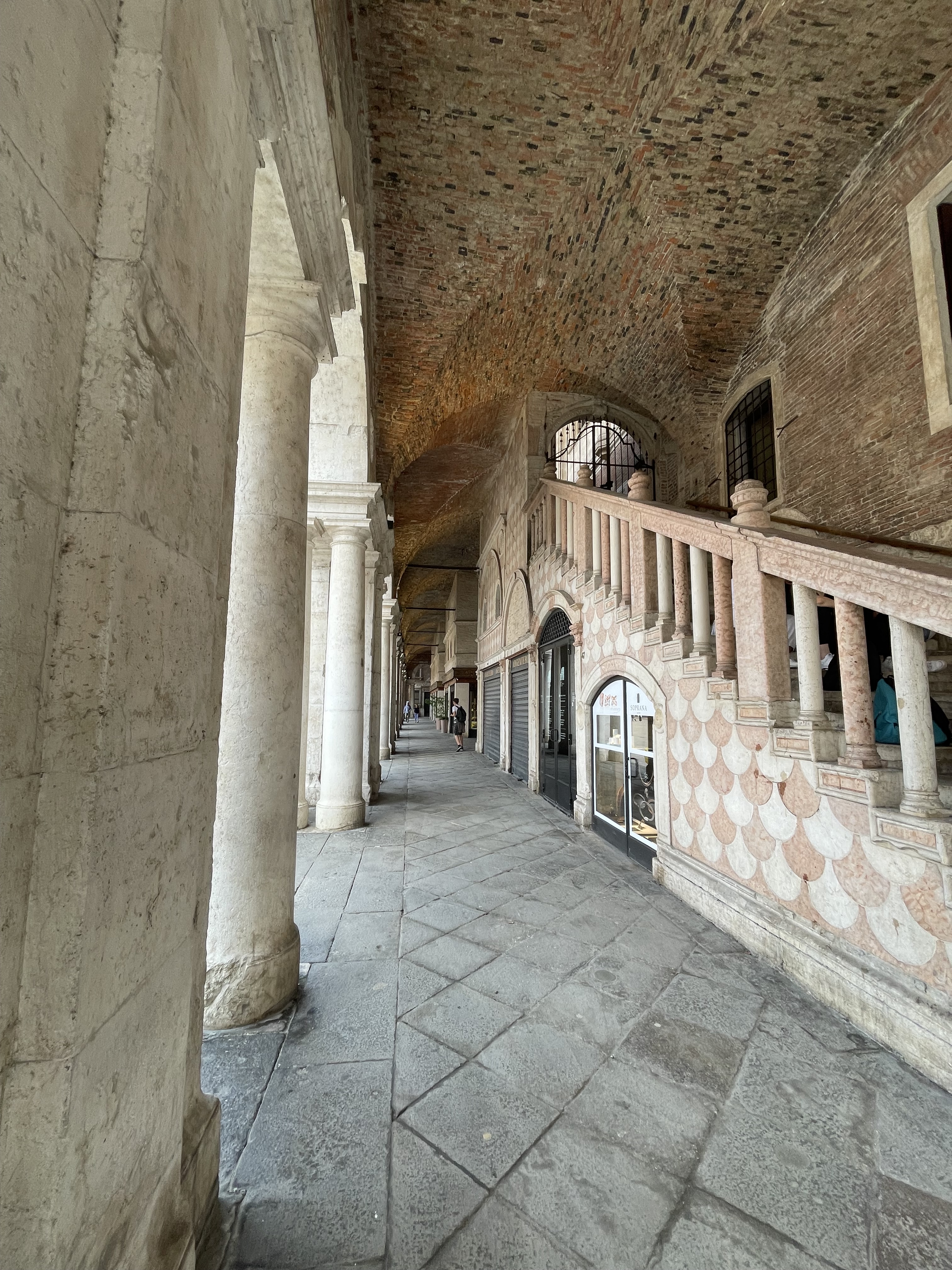
And then back to the apartment to get ready to go to Vicenza. Cathy had wanted to see this city, which is famous for Palladian architecture. Leaf stayed home to work, but the rest of us jaunted off for the day. It took about an hour and went mostly on the Autostras, filled with semis and then through the industrial outskirts until we arrived in the old city. The buildings were just astonishing and so many!
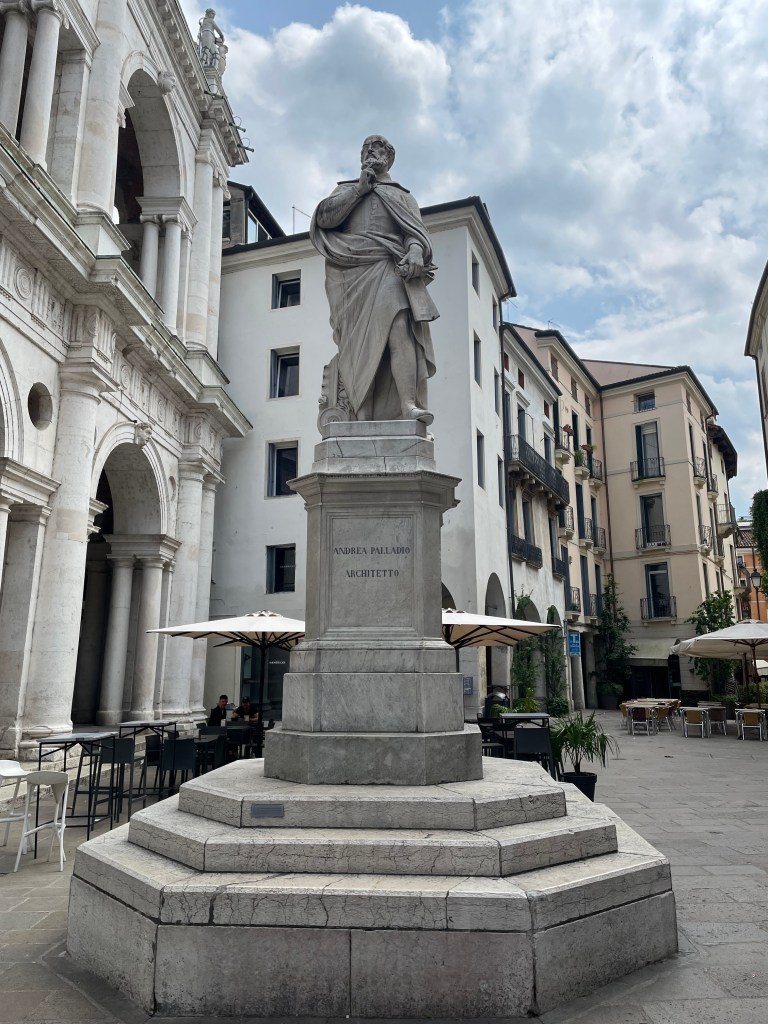
From Brittanica.com – Andrea Palladio, original name Andrea di Pietro della Gondola, (born Nov. 30, 1508, Padua, Republic of Venice—died August 1580, Vicenza), Italian architect, regarded as the greatest architect of 16th-century northern Italy. His designs for palaces (palazzi) and villas, notably the Villa Rotonda (1550–51) near Vicenza, and his treatisce I quattro libri dell’architettura (1570; The Four Books of Architecture) made him one of the most influential figures in Western architecture.
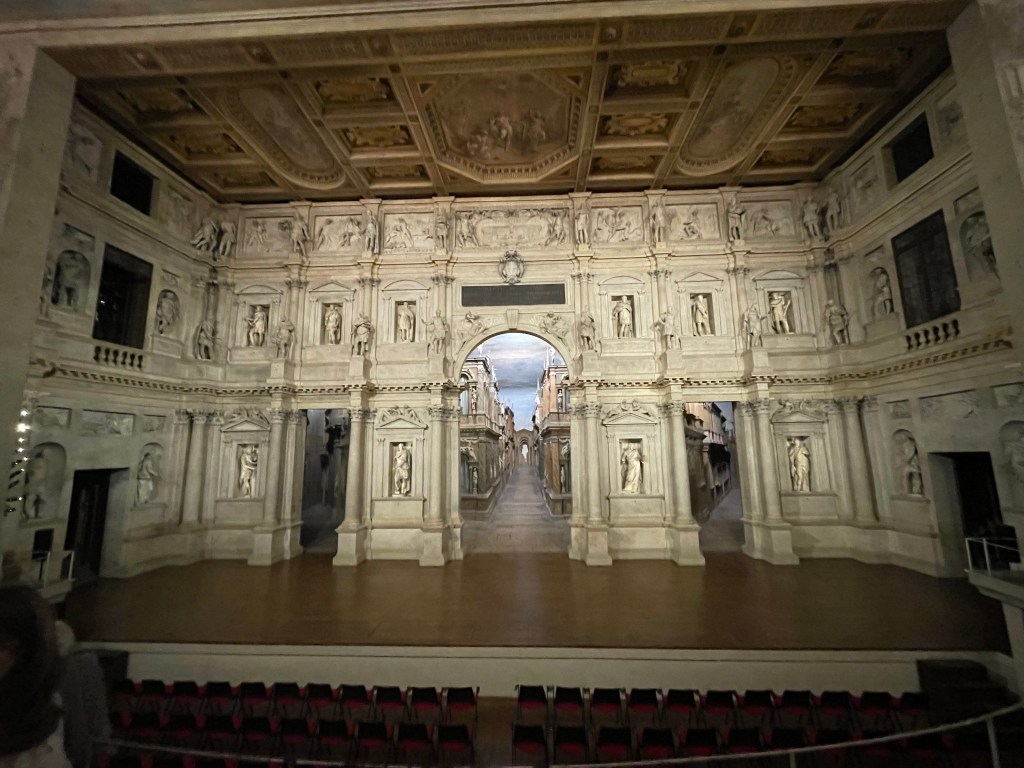
Happily, they had an audio guide that actually downloaded to our phones (almost never works) and we were able to wander the old city of Vicenza discovering some of Palladio’s buildings. We started with the Olympic Theatre built in 1585. The theatre is the same today as when it was built, the stage set a remarkable design with 7 streets (only able to see all 7 if you move about the theatre) which was the city of Thebes since they were putting on Greek plays. It was the first covered theatre ever and the set design was only dismantled once, during WWII, to protect it, putting it in the basement of the basilica.
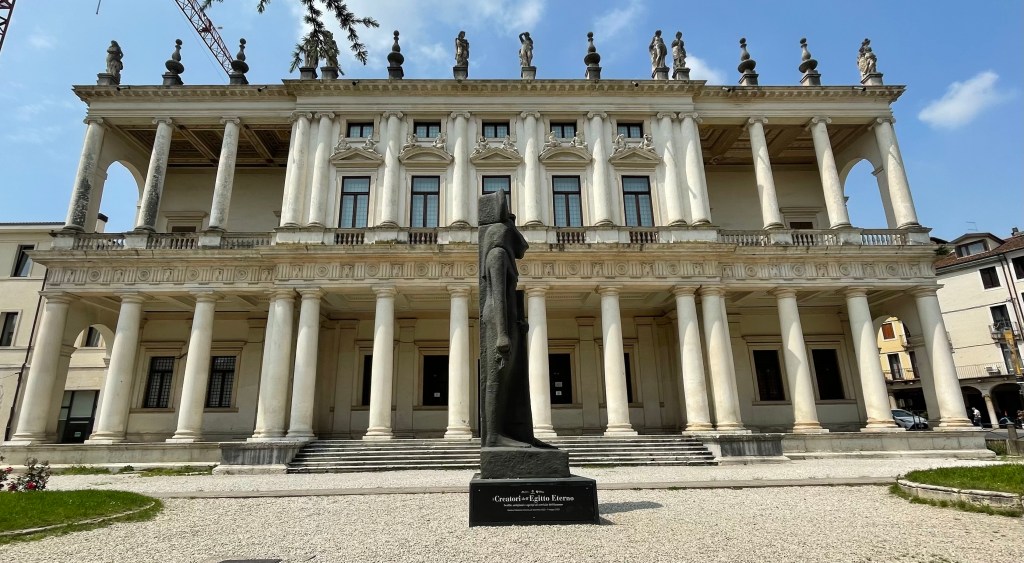
Palazzo Chiericati – designed to welcome guests who arrived on the two rivers that intersected in front of the building. The arcade under was a place to protect guests from the rain and weather.
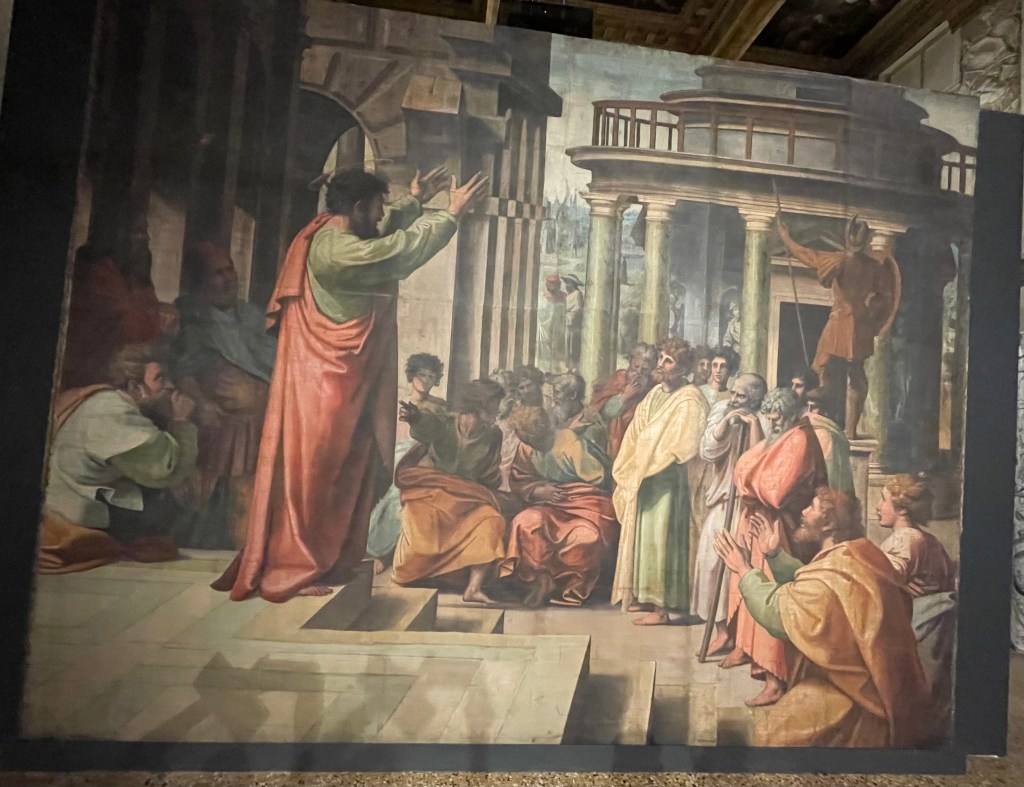
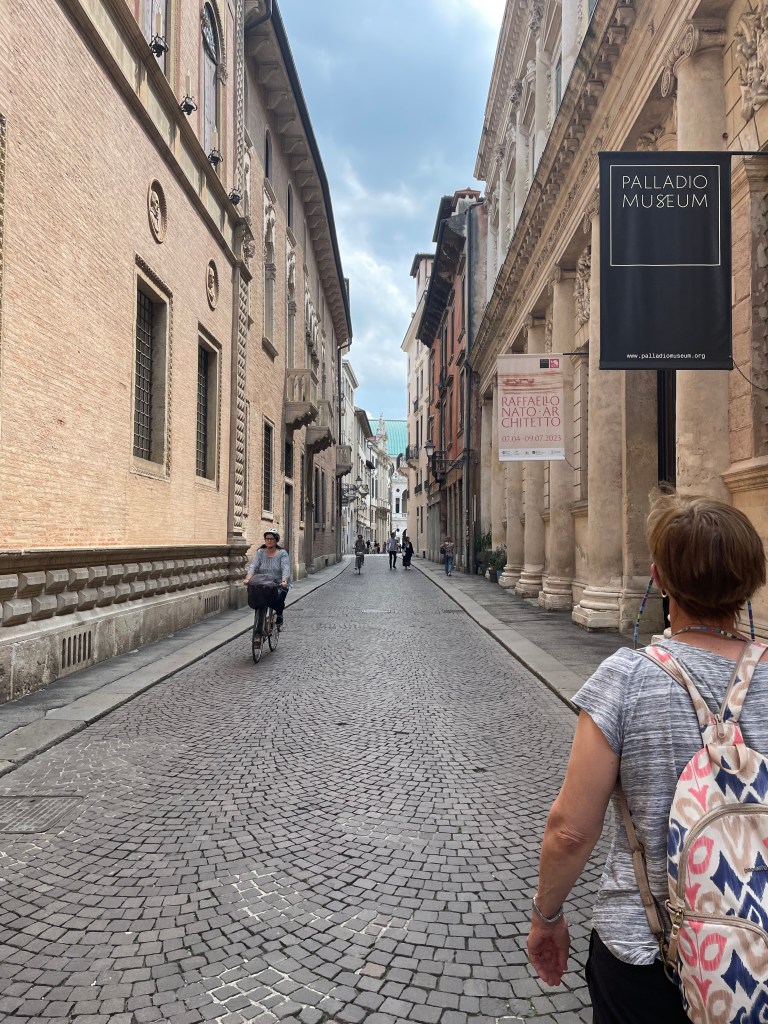
Palazzo Barbarano, the Palladio Museum was wonderful. There was a current exhibit of Rafael as architect – and yes, the same Rafael that we think of as a painter. Total reframe looking at one of his famous paintings and focusing on all the architectural elements.
Here’s the painting that was examined with the focus on the columns, angles, etc.
We had lunch, a great lunch with interesting flavors, on a side street that we found near the museum. This entire street was filled with gorgeous buildings, one after the other. They must have all been palazzos and people walked down the street like it was normal!
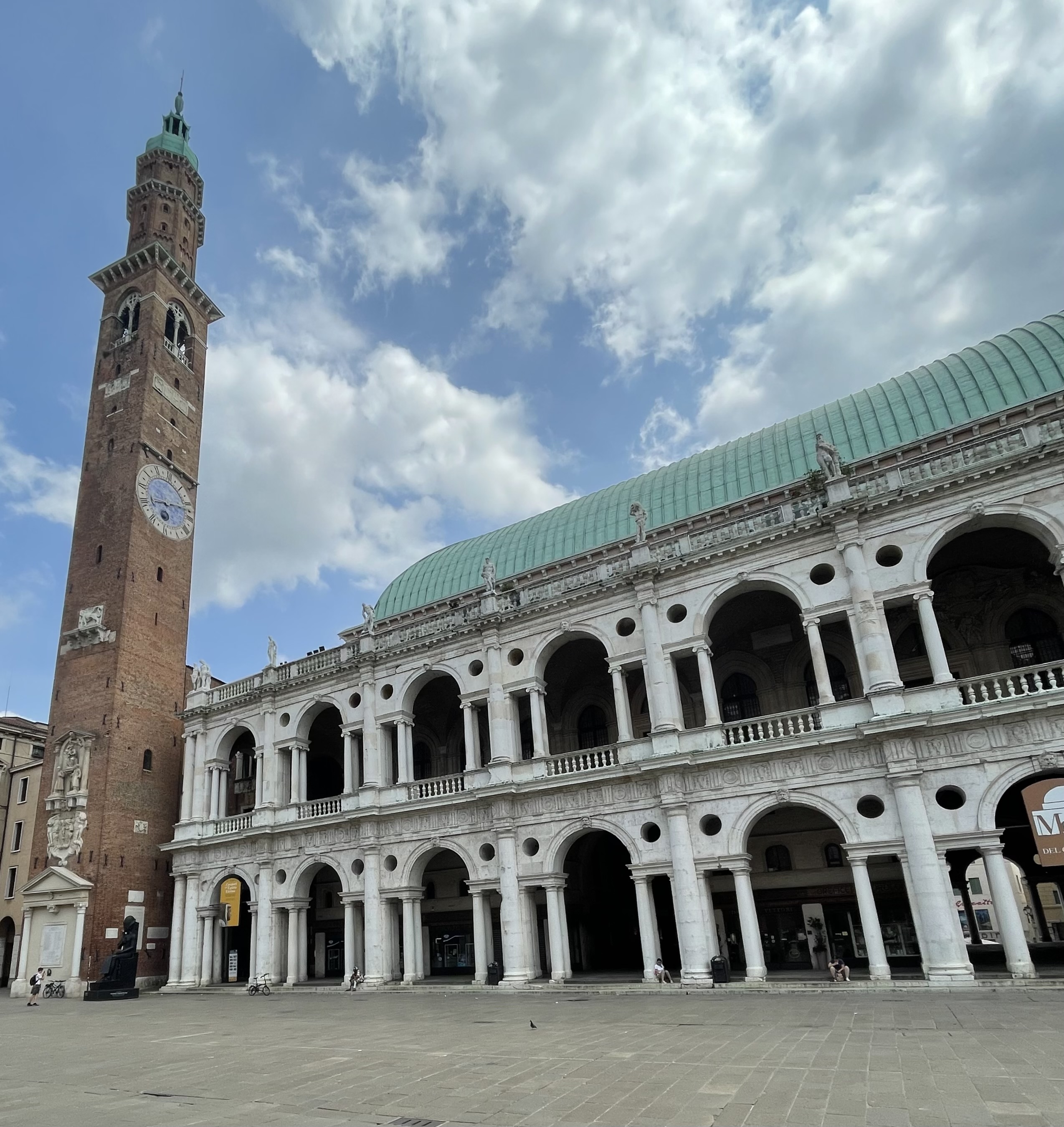
This sign did a good job explaining Palladio’s vision and purpose for the basilica.
Ach – really couldn’t get the whole thing in the photo
And Palladio:
We could have continued for hours if not another day with buildings inside and outside the main town center of Palladio’s design.
We then drove home (after 5 days, it does feel like coming home), did a final wander on our own and then made dinner trying to clean out the frig and cupboards since tomorrow’s travel is car to boat and will be harder to carry multiple bags.
Verona We had a day of exploring Verona today, getting lost a few times in this small city because of the windy streets, but we’re getting to know it.
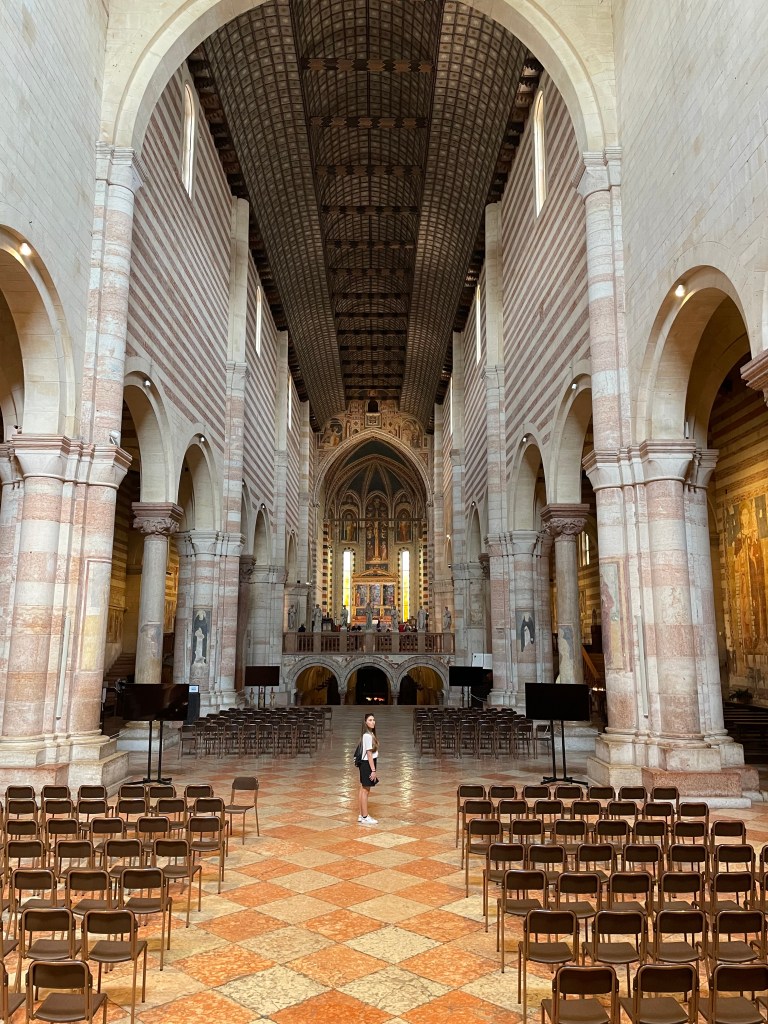
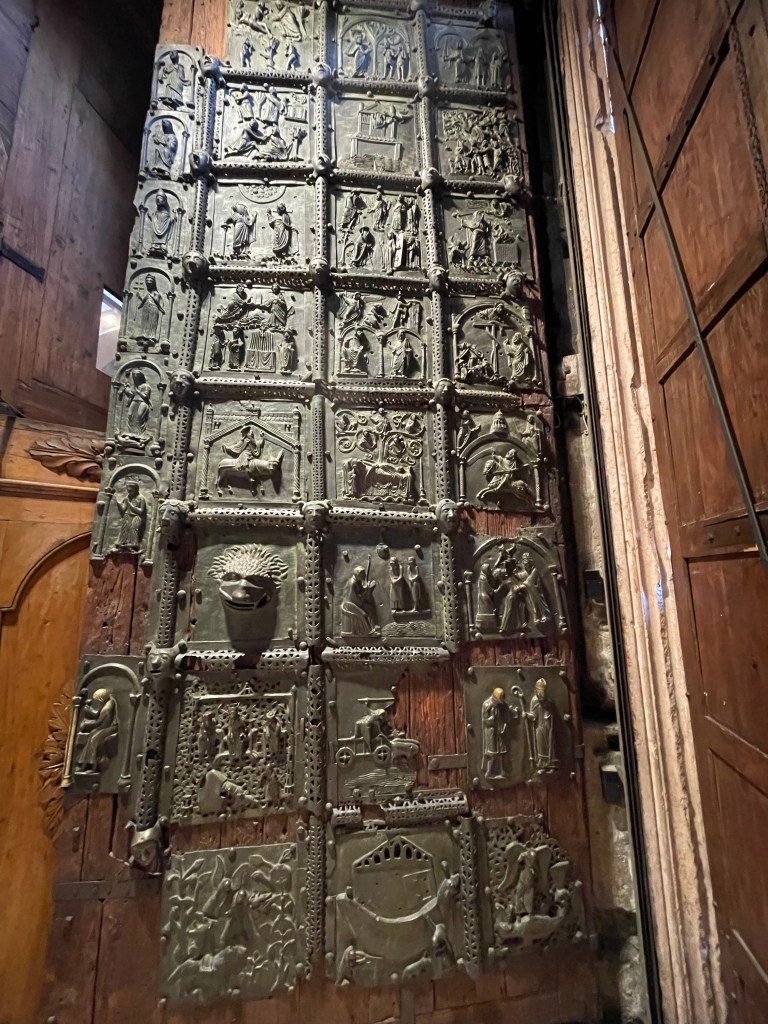
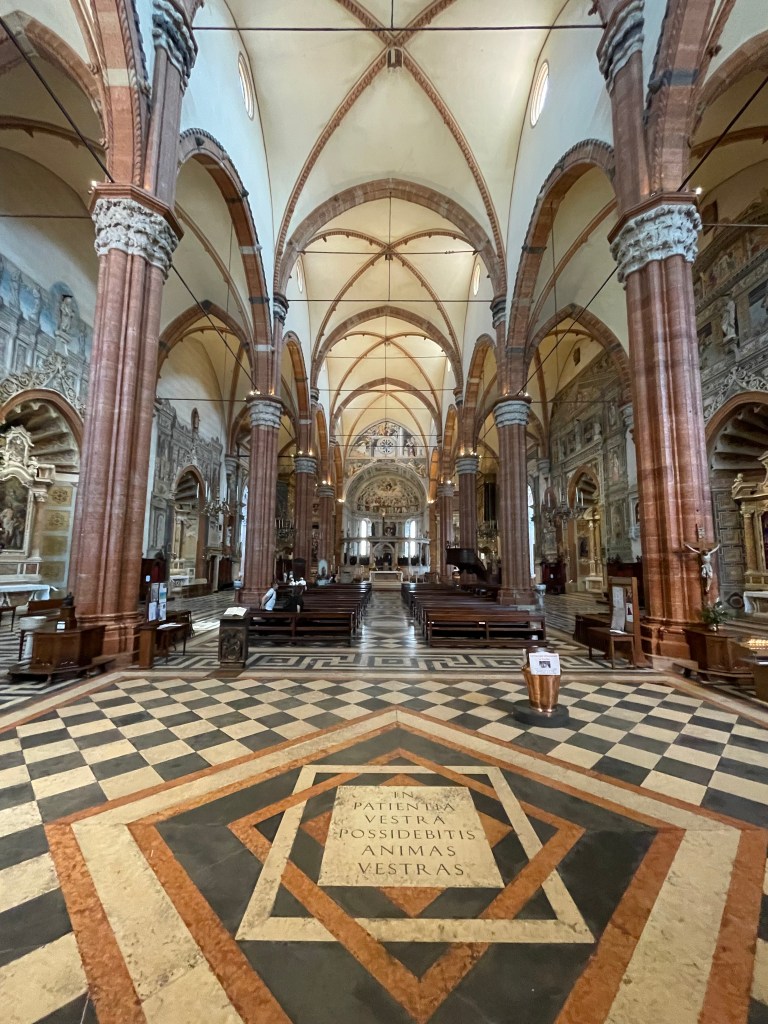
I went out early and sat by the river, like yesterday, but this time decided to wander over to the Basilica of St. Zeno. It’s huge! I don’t know why I keep being surprised. Rick, Cathy and I came back later so that we could go inside. Some of the discoveries: different building design, painting by Raphael, alter piece by Montagna, and the most incredible bronze doors with plaques of different scenes.
From bikethecity.it: San Zeno Maggiore, or St. Zeno in English, is the patron saint of Verona. He was the 8th Bishop of Verona from 362 until his death in 380, known for founding Christianity in the city. He was respectfully nicknamed ‘il Vescovo Moro’, which translates as the Moor Bishop. This is due to his African origins as he was born in Mauritania.
Saint Zeno lived a simple life in austerity and was a well-educated man. He is considered the protector saint of fishermen because it is said that he used to fish in the river Adige.
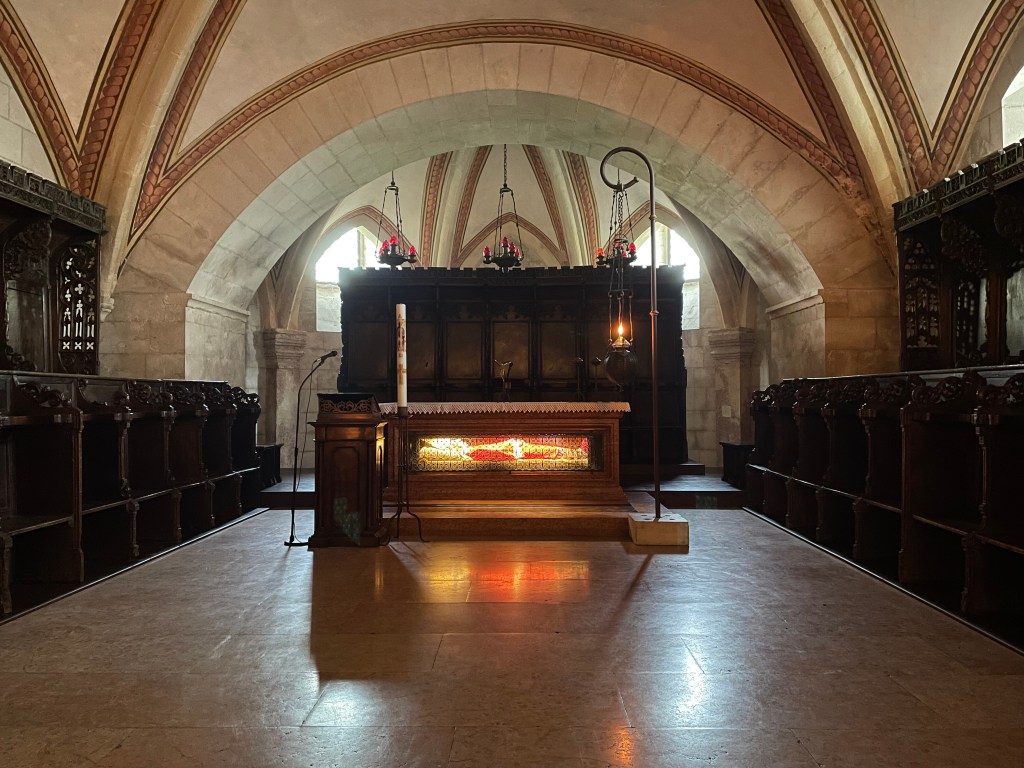
The San Zeno Basilica holds his remains in the crypt under the main altar.
Here’s a bit of the church history from Wikipedia: “The current church was built on the site where at least five other religious buildings had previously been built. It seems that its origin is to be found in a church built on the tomb of San Zeno of Verona, who died between 372 and 380. The building was rebuilt at the beginning of the 9th century at the behest of Bishop Ratoldo and the King of Italy Pippin who judged it inappropriate for the body of the patron saint to rest in a poor church. The consecration took place on 8 December 806 while on 21 May of the following year the body of San Zeno was transferred to the crypt.”
Modifications/changes continued for centuries, but it feels cohesive even as you can see the particularly ancient areas. The art that I mentioned above was worth a lot of time and Cathy and I pondered the bronze doors for a good while. Our favorite was of one of the three artists, who cast himself doing the creating. He’s on the lower left side.
On the steps up to the altar, we saw a great example of the fossils that Krystal had told us about on our tour with her. She noted that the streets and sidewalks in a lot of Verona are made with marble, but it’s not really pure marble. Instead, it’s Verona marble, which you can tell because of all the fossils embedded in the stone.
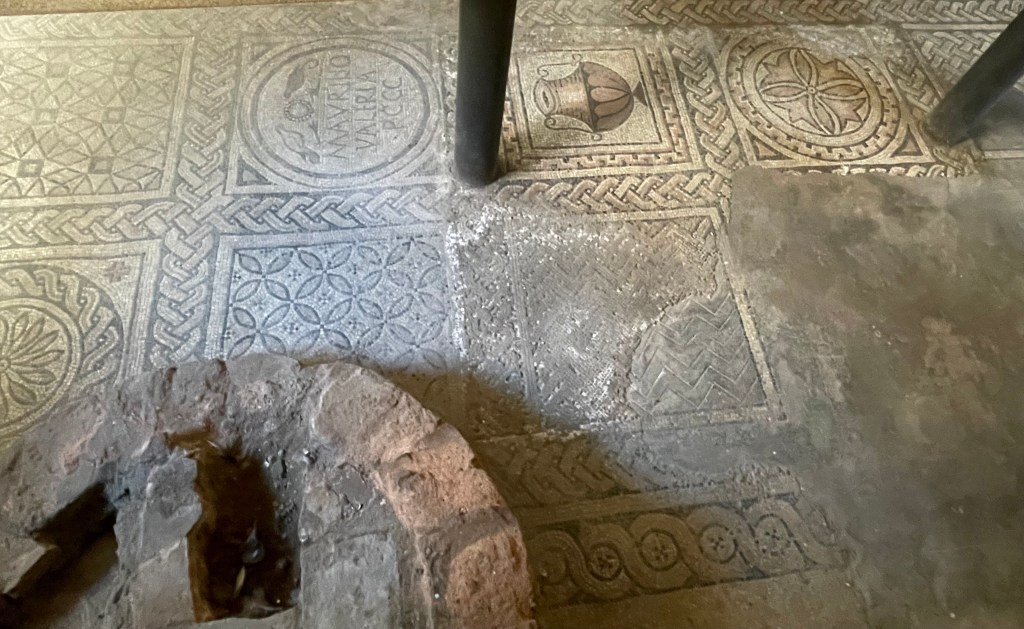
Sharon, Cathy, Rick and I also went to the Duomo and did a quick tour. The most remarkable piece of the tour was seeing the 3rd and 4th century church through glass flooring under S. Elena’s church which itself started in the 9th century.
Then, we had the most amazing tour. Leaf had wanted to see the Biblioteca Capitolare, the oldest continually operating library in the world. And it was fantastic. He had a whole series of emails in goggle translated with the library to try to get us into an English tour – and it worked! The young woman who did the tour was incredibly knowledgeable and loved her work and sharing the stories.
Valeria, our guide, started by showing us the outside of St. Helen’s canonical church that a few of us had seen earlier when we toured the Duomo – only way to see the inside. In 1320 Dante Alighieri held his dissertation, the Quaestio de Aqua et Terra, in St. Helen’s canonical church. The church belonged to the same Chapter of Canons which was in charge of the Library. This event is remembered by an inscription on the external wall of the church. There was a statue designed to commemorate his 700th birthday.
We then moved to see many more mosaics from the Roman church that we’d first seen in S. Elena’s church. These continued through all of the buildings we were in – with sections of floor glassed, or flooring open to the designs below. Incredible. Valeria particularly liked 2 different mosaics. The one below had her name – a couple who donated to the churches gave enough to be able to put their name in the design.
This one’s first name meant dung – which could have had many meanings, bringing life, secure enough to carry off the name, and his design included 382 florins – which is how much he donated to put in a lot of mosaics.
When we were in this area, the site of the first church, she said speculation assumed that the library started in the 3rd or 4th century on this site. Here’s some information from the Biblioteca Capitolare’s website:
Originally, it was founded as a Scriptorium: a sort of writing laboratory, dedicated to the production of parchment books for the education and the spiritual training of the future clergymen. The scribes, in charge of copying the books, belonged to the Schola majoris Ecclesiae, the Cathedral Chapter’s school (“Capitulus” is the Latin word for “Chapter”, from which the name “Capitolare” comes from). During the transitional centuries between the Late Antiquity and the Early Middle Ages, marked by deep crisis, it was mainly churchmen who were given an education. Despite the political, social, demographic and economic decadence, they had the chance to receive and pass on the ancient classical culture.
One of those scribes, Ursicinus, left us the first written evidence of the Scriptorium’s existence. The book he copied, now known as Manuscript XXXVIII, contains the narration of the lives of St. Martin of Tours – written by Sulpicius Severus – and of St. Paul of Thebes, by St. Jerome. At the end of the last page, he added some data which were very unusual for the time: his own name, the place and the date. The date, written as “the Kalends of August in the year of consulate of Agapitus”, is identifiable as 1 August AD 517: a time when Verona was under the rule of Theodoric, King of the Ostrogoths.
The note, although very concise, is extremely important. In fact, it bears witness of a first form of cultural activity, organized for the book copying, back in the early 6th century. It is therefore likely that the first installation of the Scriptorium had been founded at least one century before. According to other scholars, its foundation might also be connected to the establishment of the first Basilica in the late 4th century.
Amongst the other treasures of the Capitolare there are also a few books even older than Ursicinus’: for example, Manuscript XXVIII, the oldest known copy of the “De Civitate Dei” (The City of God) by St. Augustine. It dates back to the early 5th century, and it is therefore contemporary with the author.
Valeria, our guide, had a group of 10 people who were in nerdeuphoria. Seriously cool. We were all riveted. She told us all of the above with a wry sense of humor and delight about what we were going to see and were seeing as we walked the cloister where the order of the Chapter still has members living and working in the library.
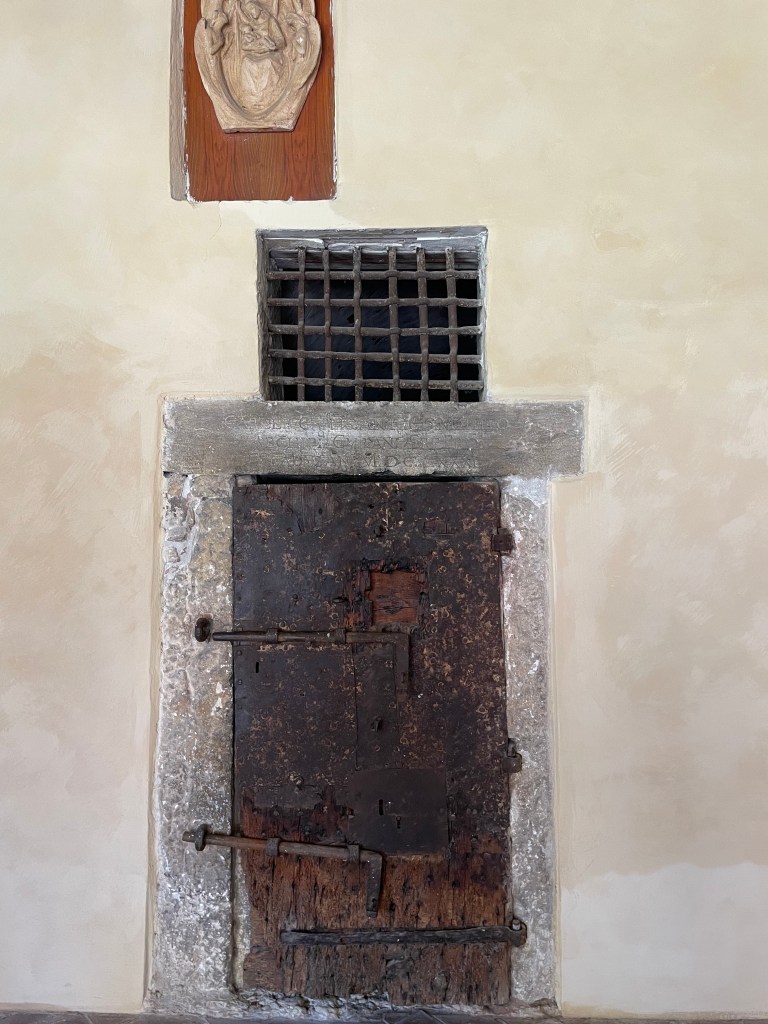
And the little room where priests or cannons were having a hard time following the rules spent time. Now, it’s where they keep their bikes:
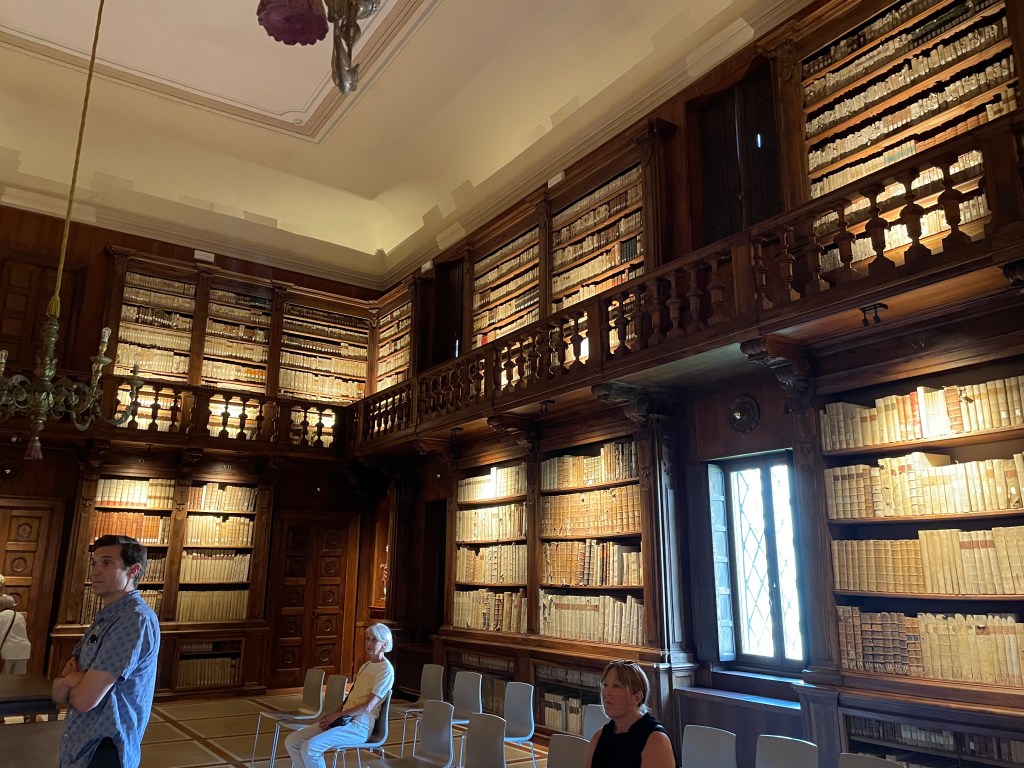
And then into the library which had to be fully rebuilt after it was bombed by the Americans. Sigh. WWII.
The librarian Giuseppe Turrini had already removed the manuscripts and the most valuable printed books, and stored them in the rectory of Erbezzo – a small town on the nearby mountains. Other precious books had been previously hidden in a secret room inside the Cathedral. Those which were left, buried in rubble, were then partially retrieved and put back on the shelves after the hall’s reconstruction. They still show signs of the damage they underwent from the damages of the explosion. We could see this when she pointed them out.
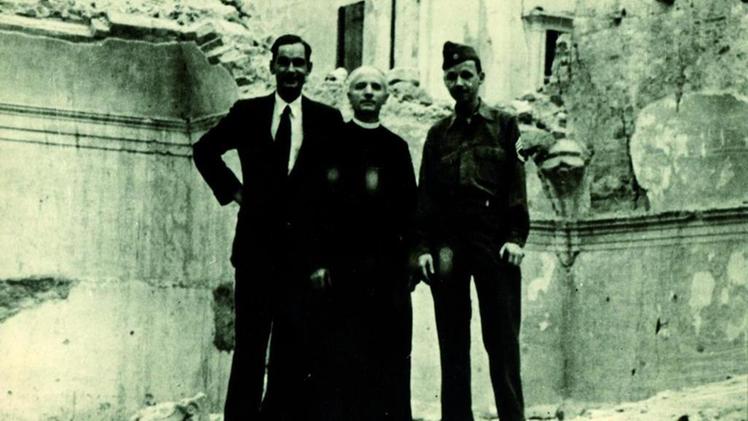
Wolfgang Hagemann, Giuseppe Turrini and Bernard Peebles in 1945. Really – the story is amazing, so am putting the whole thing here, from L’Arena:“ A priest between two enemies who, on opposite fronts, had fought for a common goal: to save the Chapter Library from war. The image taken 70 years ago shows Monsignor Giuseppe Turrini, prefect of the Capitolare, between Wolfgang Hagemann and Bernard Peebles in the rubble of the library, in the uniform of a sergeant major of the US army, special department of Monuments, Fine Arts and Archives: the Monuments Men at whose feats the George Clooney film was dedicated. Hagemann and Peebles were eminent philologists, both had studied in Verona on the codes of the Capitolare. Enlisted on opposite fronts, they had found a way to get sent to Italy with the same concern: to save the Capitulary. Hagemann had arrived in Verona with ranks of officer and prestige: he had been Rommel’s personal interpreter, the desert fox. He placed himself at Turrini’s disposal and was invaluable: the monsignor, fearing the bombings which punctually arrived in January 1945 (destruction of the monumental Maffeian hall, 1,250 volumes and files lost) had transferred codes and manuscripts to the rectory of Erbezzo. He believed them to be safe, but Hagemann warned him instead of the danger: it was an area of anti-partisan operations and the Germans could set fire to the town (Vestena suffered this Nazi retaliation). Hagemann sent a trusted officer to Erbezzo, Fritz Weigle, who had also studied at the Capitulary in 1927, and he affixed a «befel» signed «Wolff/SS-Obergrappenführer u. General der Waffen-SS» which declared the KUNSTDENKMAL building: «Prohibited occupation and requisition», as translated for use by the fascist militias. In the last, dramatic period of hostilities, however, Hagemann intervened to advise the transfer of the codices to the Marciana Library in Venice and to other safer hiding places. Meanwhile, Peebles, who had already saved the archives of Philip V in Sicily, was going up the peninsula with the allied troops, recovering documents from 1713 that were used as wallpaper. Arrived in Verona with the first liberators, he rushed to the Capitolare: the photo shows him with the former enemy, rediscovered as a scholar and custodian of the cultural heritage.
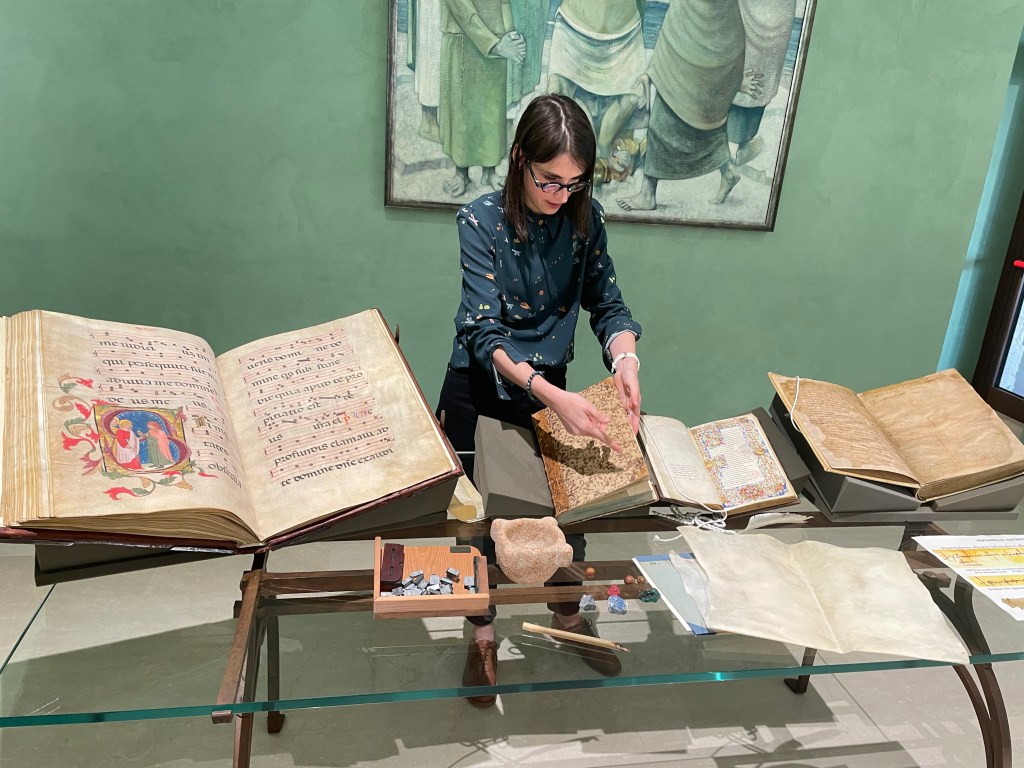
Then – the grand reveal – Valeria showed us several incredible examples of their collection. She washed her hands first and told us that the experts no longer used white gloves. They’d learned that the weave of the gloves could do damage and the lack of hand sensitivity with the barrier meant that damage could happen when turning the pages.
First she showed us books made with parchment – sheep for the big pages, lamb for the small pages. The yellower side was the outside where you could still see pores. It was incredibly durable and absorbed the ink really well. One skin held two pages, front and back:
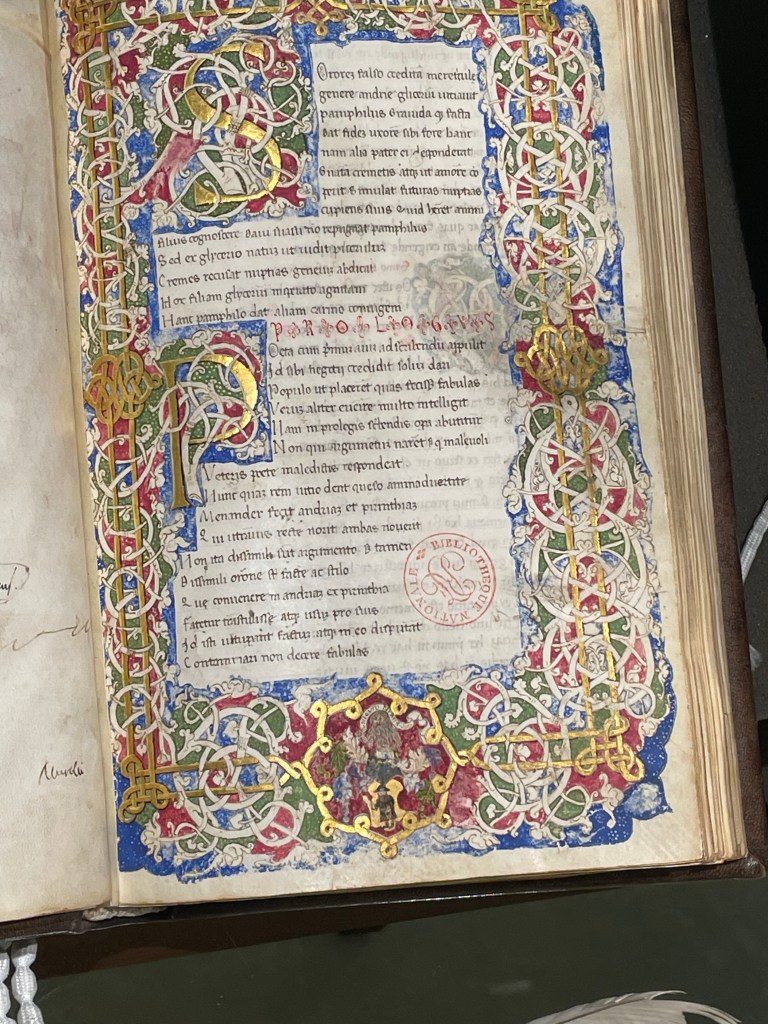
The text below was taken by Napoleon after he left post invasion, each item was stamped as owned by France. They were able to get back about 2/3rds of the collection that he took away and felt lucky to get them. They have requested another specific book from their collection, but it’s been 25 years and they haven’t heard anything yet.
With the invention of the printing press, around 1450, the library got its first incunabula (early printed books, produced between 1450 and 1500). The one below was the Divine Comedy. Illustrated with incredible detail within the wooden blocks for the press – the big print on the written page is Dante’s words, the rest is commentary. Seriously.
Today we had a day away from Verona, driving to Lago di Garda. It was wonderful! We had read a few articles that Cathy had from a friend of hers who lives in Lucca – mykindofitaly.com. He wrote 2 posts about Lago di Garda that were informative and a treat to read. So – that’s what we used to explore the lake.
We started to go into the town at the bottom of the lake, Sirmione, but as we got close, everything in the article indicated better to go up along the lake if we didn’t mind missing Roman ruins. We didn’t.
Our Sirmione detour added at least 30 min to the drive, but Leaf took it in stride, Rick made a few jokes about our planning, and we drove up a lot of the east side of the lake, finally stopping at Malcesine. It was a 2-lane road and the ride was hairy a lot of the way because there were multiple bikers, of all varieties, scooters, motorcyclists who wove between the lines, and no shoulder. Oh, and cars and trucks and people walking across the streets at all of the little towns. And it’s not even high season! You had to be calm and very alert. Leaf, of course, was both.
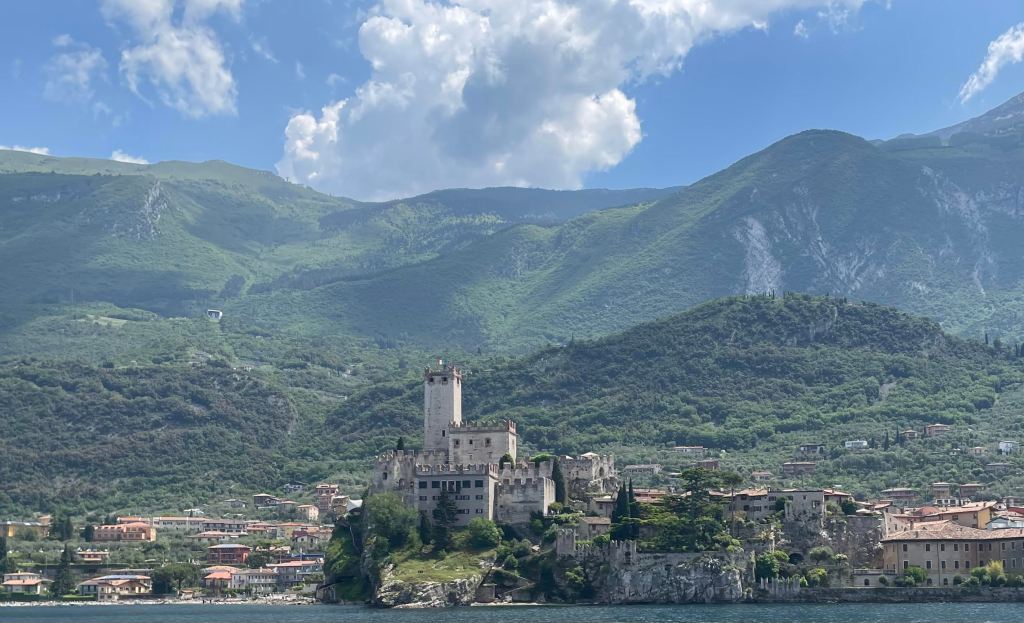
We knew there was a ferry at Malcesine that crossed over to Limone. We’d been in the car for more than an hour and were ready to move when we got to Malcesine. We parked, found a restroom, then bought ferry tickets at the information office (really conveniently located in the middle of town, next to parking and a grocery store). We caught a ferry just as it was loading up. And we got seats on top!
It was beautiful. Spectacularly beautiful. Bewildering because all the messages on the ferry were in German. Wait, what? And they continued – only in German. Once back on land, we heard German, most of the tourists seemed to be German (Swiss German?), written signs were in German first, then Italian – but the food was all Italian. Confusing, but interesting.
We enjoyed the ride over, cool breeze, beautiful on both sides of the lake with dramatic mountains on both sides as well. We landed in Limone and caught a quick lunch of paninis that were seriously good. Then – off and walking. This would have been a terrible day for our Eli – castles on both sides of the lake in each town, and we missed both and instead took a trail that the blog said was fantastic. And it was! Short, only 2.8 miles each way, but the walkway was built into the mountain and hung out over the lake and was quite dramatic. Happily, it was pretty wide and had a solid feel to it – no surprise views below my feet – so I was able to walk the whole thing without issue.
We strolled along, watching paragliders up high and an incredible variety of water activity below, wind surfers, parasail surfing, foils, sunfish, really colorful and fun to watch.
Hmm, guess I was watching, I don’t have photos of the actual walk hanging over the lake or the water activity!
When we got back to Limone, we were SO hot. We got lemon freeze drinks and again – caught the ferry just as it was leaving and hopped on. Our timing was lucky both ways.
We decided to drive the rest of the way up to the top of the lake, not far, and then take a more major road home, away from the lake. I was driving now and had it easy. The traffic and bikes had decreased a bit so it wasn’t quite as nerve racking negotiating the road.
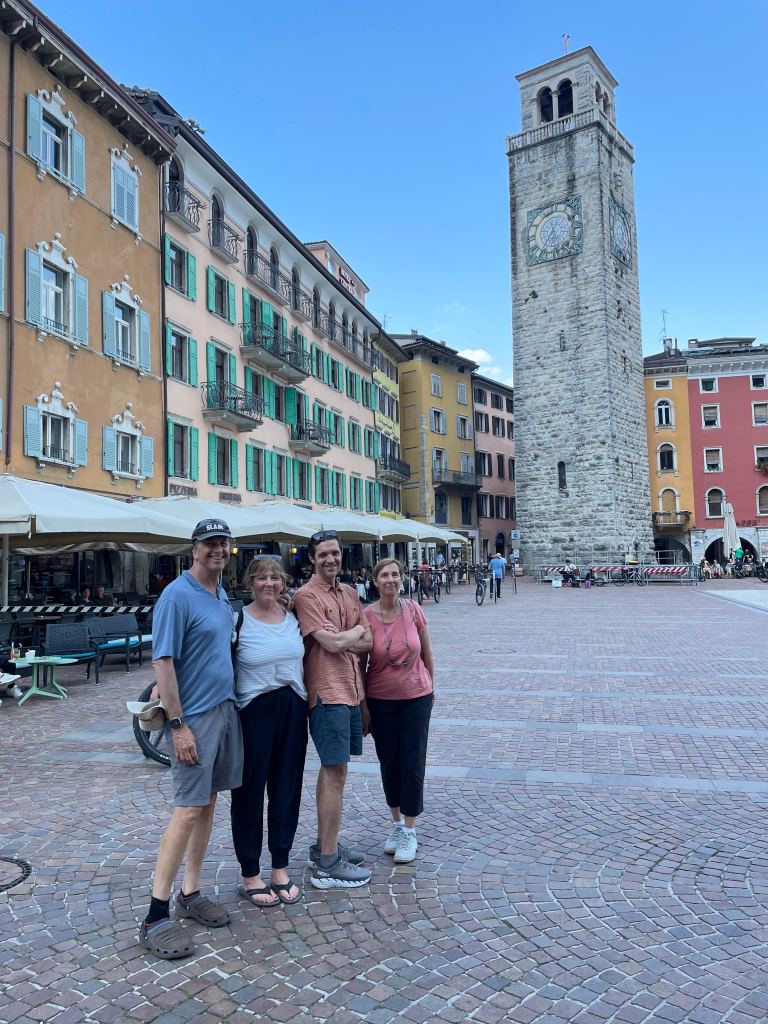
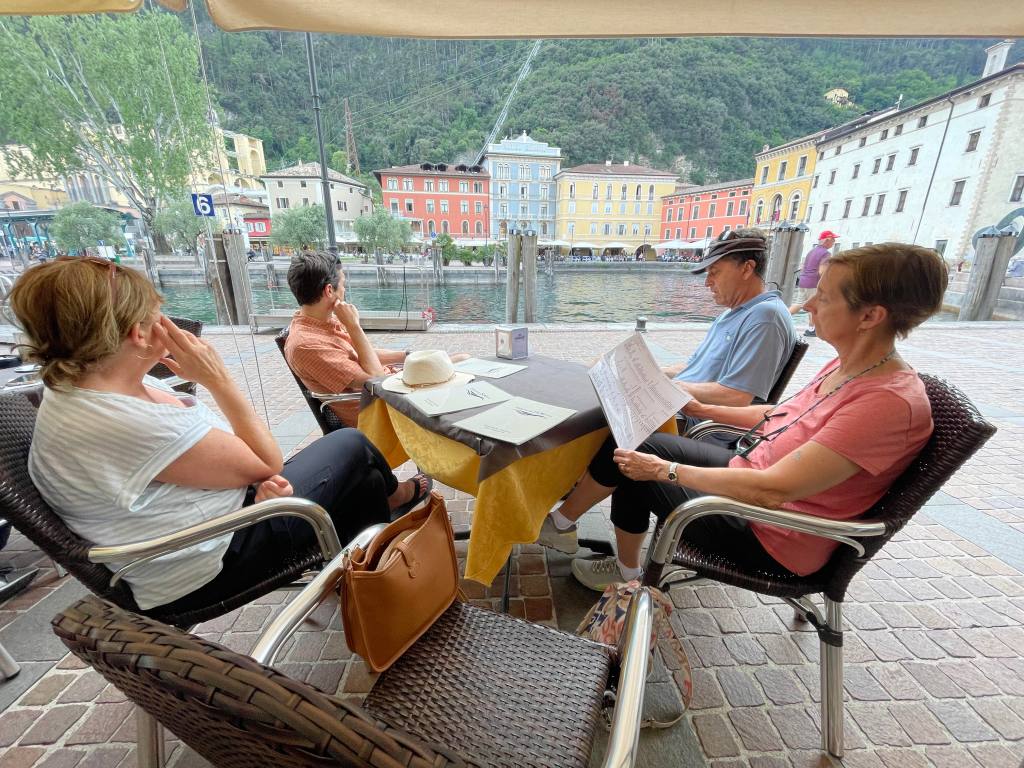
We got to Riva del Gardia at the very top of the lake and suddenly, we felt like we were in a different country. Maybe Switzerland? The buildings were so different from what we’d seen in every other Italian town. It was beautiful in a very different way. We walked around town and then sat down for a snack next to the water. The town really was a pleasure to walk around. It had cooled down, the streets were wide and almost the whole town was pedestrian and bike only.
When I read a bit of history, as well as looking at the signs around town, we realized that Austria had occupied this area quite a bit. The constant push and pull between the church and the German/Austrian powers over the years had left their influence.
I drove home on the Autostrada and it was easy. I love having the road clear of all but a few entrances and exits, it feels much safer. People don’t usually go the speed limit, makes sense since it’s close to 80, but in general, it feels really safe and there are rarely crazy drivers. In addition, Rick noted that the vineyards were planted very differently – so we had interesting views on a lot of the ride home. This is one beautiful country!













 Reb's Walks!