Camino del Norte, 26.May.2024, Sunday

Gernika, 16.5 miles

Gernika history: On April 26, 1937, during the Spanish Civil War, the town was razed to the ground by German aircraft belonging to the Condor Legion, sent by Hitler and by Mussolini’s Aviazione Legionaria to support Franco’s troops. For almost four hours bombs rained down on Guernica in an “experiment” for the blitzkrieg tactics and bombing of civilians seen in later wars. There were five waves of attacks some almost at the rooftops and many of those killed had mistakenly left air-raid shelters believing that the enemy attacks had ceased.

The bombing of Guernica was deliberately chosen to occur on a Monday (April 26, 1937), because it was known that the Basque people who lived outside of Guernica proper would travel into town for the Market Day, thus affording the pilots of the German and Italian aircraft the opportunity to murder as many people as possible. 

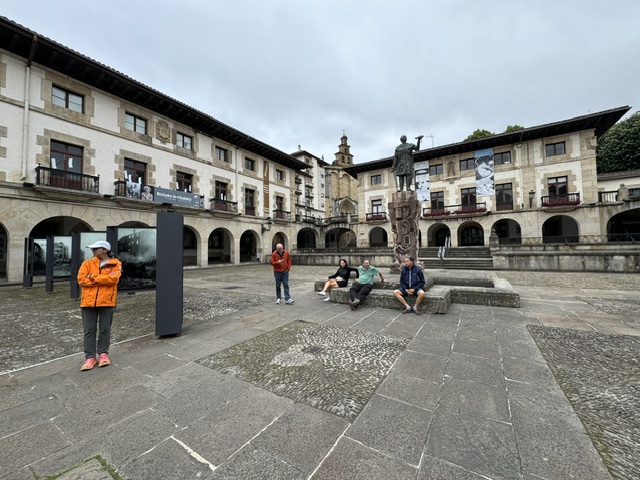
On Tuesday, April 27th, Franco ordered all to lie and declare that the town was bombed by the “reds” and it was a Basque plot. We read this at the Museum of Peace on the outside exhibit of photos: “Justice was never done, but there is no lie that hides the truth forever, because the history of our people is embedded in its collective memory. Having recovered our historical memory, we reveal the truth, we pass on to our descendants the historical moment that our elders lived, and we do justice.” 

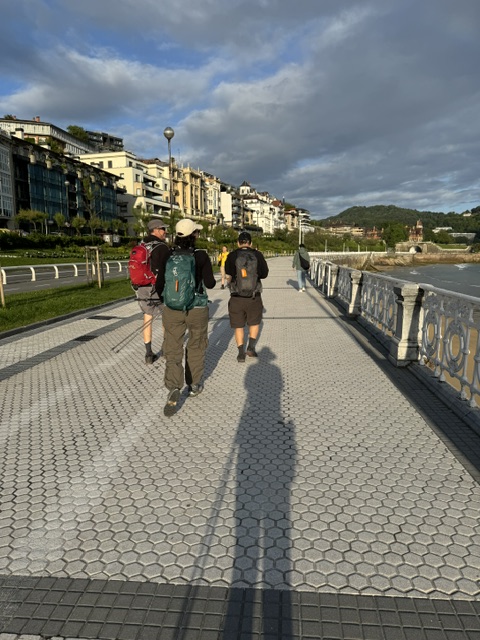
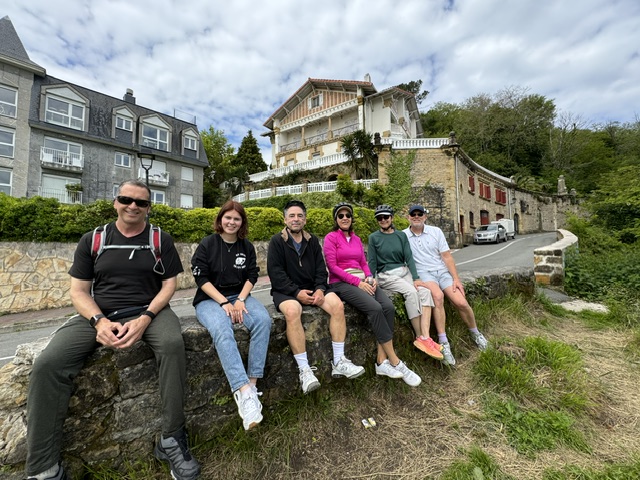
Our crew, still in post hike tired mode, next to the Peace Museum on the left with the photos of the city after the bombing next to Carol in the orange.
Until modern times, it had been generally accepted that the number of deaths had been over 1,700, but these numbers are now known to have been exaggerated. Historians now agree that the number of deaths was under 300. However, it is true the 85+% of the dwellings were razed. Astonishing that the air raid shelters did such a remarkable job protecting. For Franco – who’d asked for these towns to be targeted (Irún too) because they supported the Republic and were Basque nationalists – this backfired because it cemented the Basque’s commitment to the Republic and to their own liberation. 

Basque language: I realized I’ve never written about this. It’s a source of great pride to the Basque people, that their language may be the oldest European language. Both our guides in San Sebastián were Basque and spoke about their language. I don’t know why it’s called Basque when that’s totally different from Euskara (their word for their language). Here’s a note from Wikipedia: Basque euskara is the only surviving Paleo-European language spoken in Europe, predating the arrival of speakers of the Indo-European languages that dominate the continent today. Basque is classified as a language isolate, with no relationship to any other language having been established. 

Gorka, our wonderful Pintxo guide in San Sebastián, told us that a Rosetta-stone like discovery of a bronze hand with writing on it proved that Basque was in fact a unique and extremely early written language. Online, I finally found this note: Inscriptions found on a 2000-year-old metal hand may be written in a language related to modern-day Basque. If this interpretation is correct, it could help explain the origins of the Basque language – one of the biggest mysteries in linguistics. Of course, there are scientists who are questioning this, but it’s a big deal here!

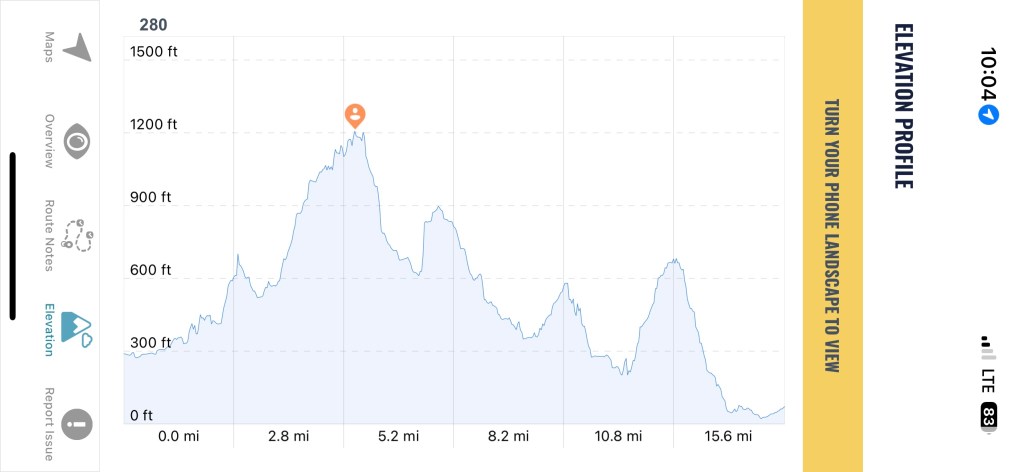
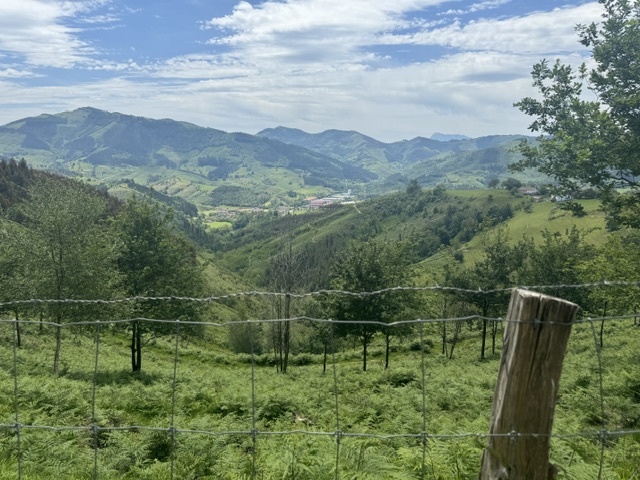
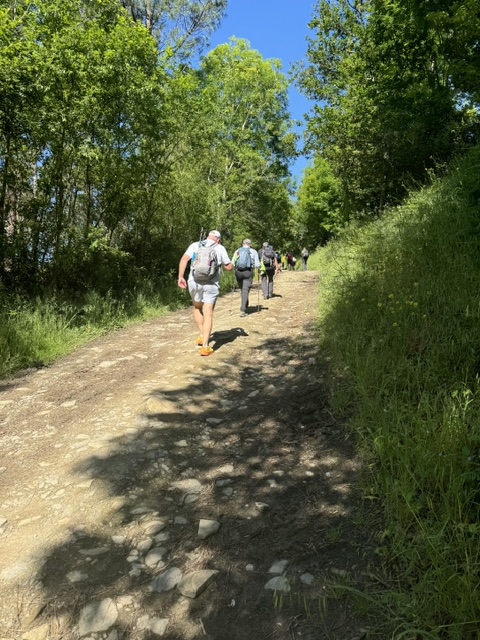
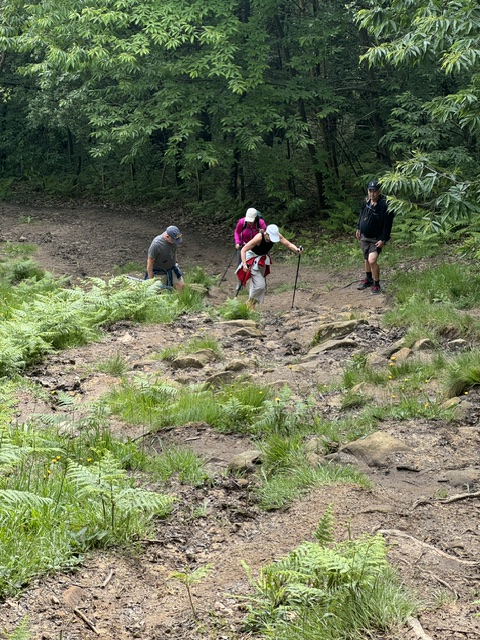
Ok, now today’s hike. We all hiked to Gernika from Markina, but Carol and Matthew were in a different hotel and on different timing so we split up for the hike. The rest of us stayed on the MacsAdventure and the Camino signed trails the whole way. It was described as “moderate” whereas yesterday’s hike was described as “moderate-strenuous”. Today was great and it was definitely easier than yesterday in terms of height (today 2500) and distance, but as Bob said, Europe’s “moderate” does not mean the same thing as American “moderate”.   Yesterday, I wrote that we rarely saw any creeks or rivers. But then today, we got to walk along a river for the first mile or more, then creeks for a lot of the rest of the hike. That was wonderful. 

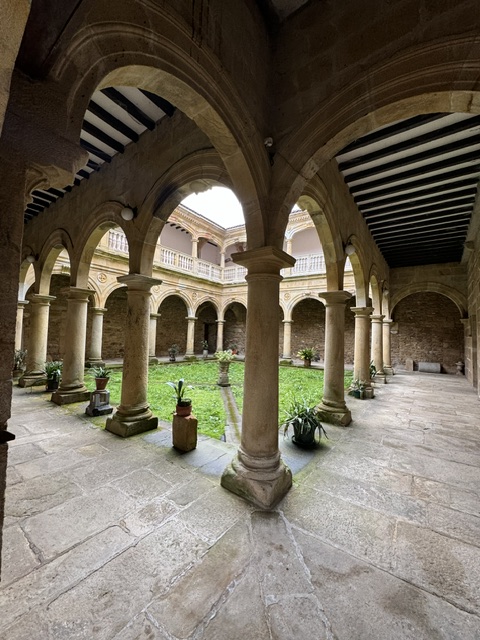
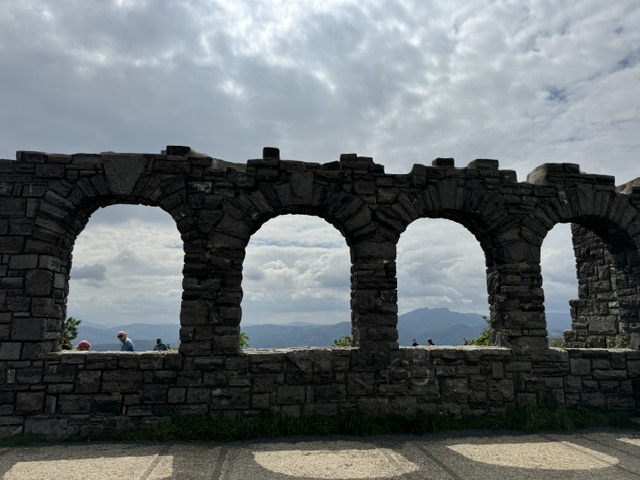
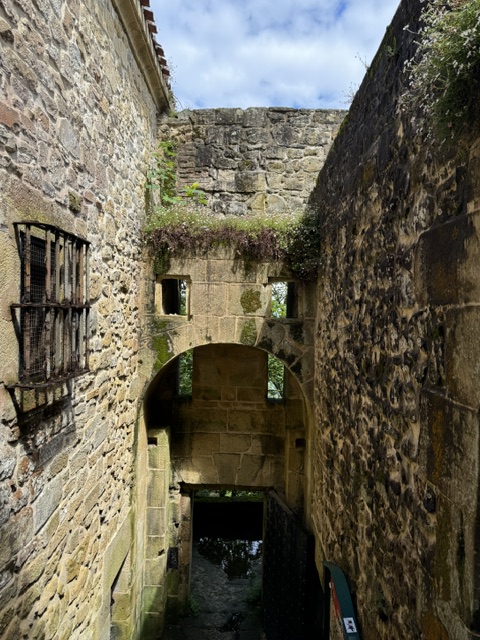
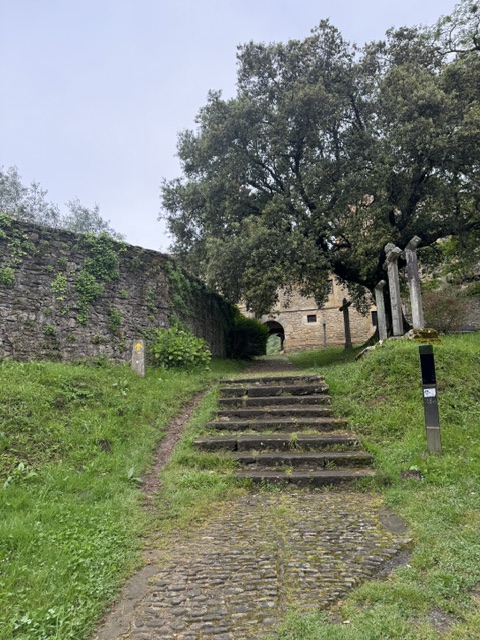
Near the top of the biggest hill was the Monastery of Saint Mary of Zenarruza that was fantastic. You could actually stay there and a sign said they had Baroque concerts. Sadly, we were too early to see it since we left at 7:30 and got up the mountain pretty quickly. The camino went right through it; you can see the arch below:

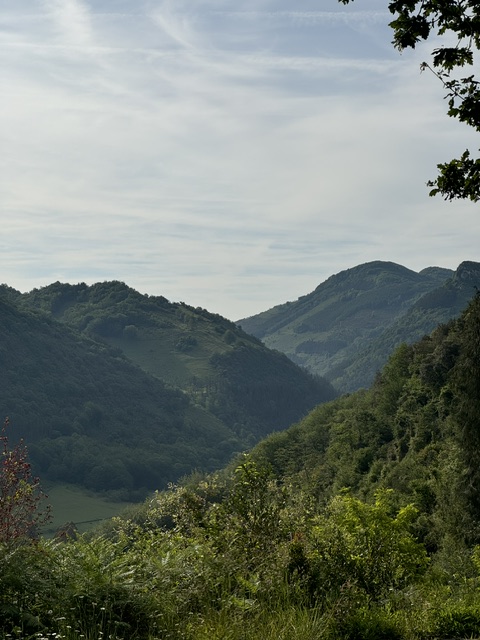
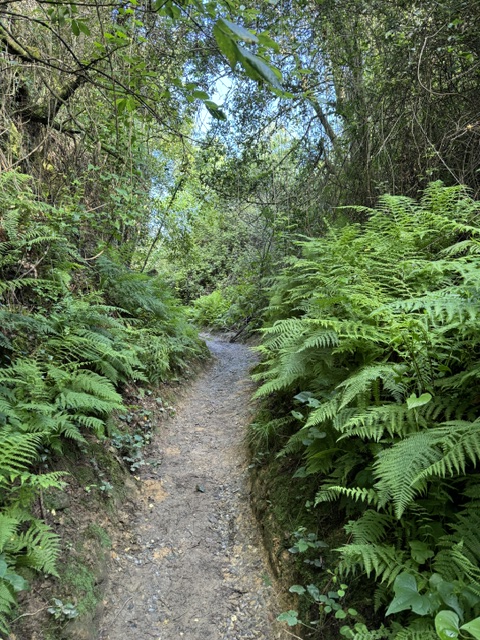
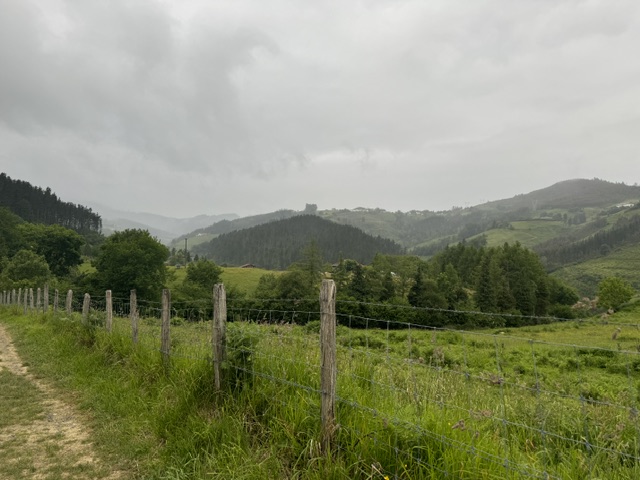
After we’d moved past, we were surrounded by green, mountain views, mist and clouds. At one point, I stopped and it was silent except for the ringing of the monastery bells, birds and the creek. The sounds are just wonderful on these hikes so far.

Monastery:
I couldn’t get all the sounds together, this is the bird chorus:
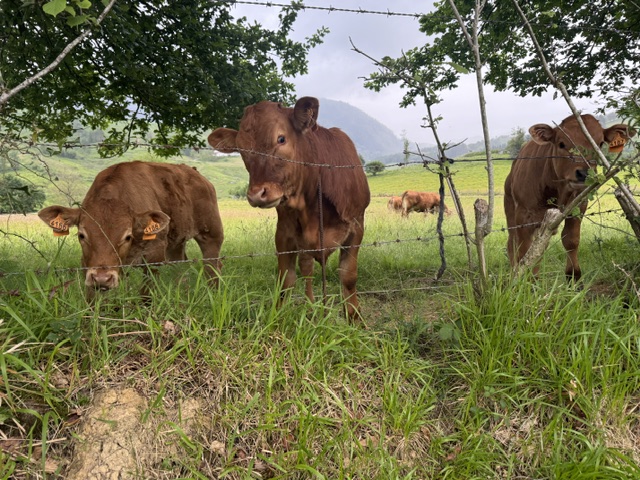
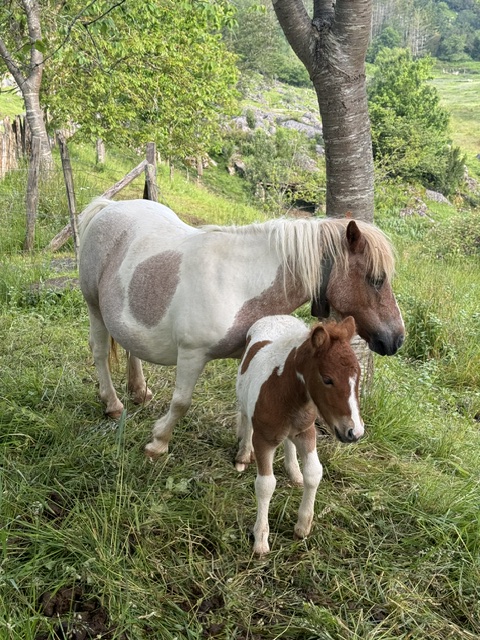
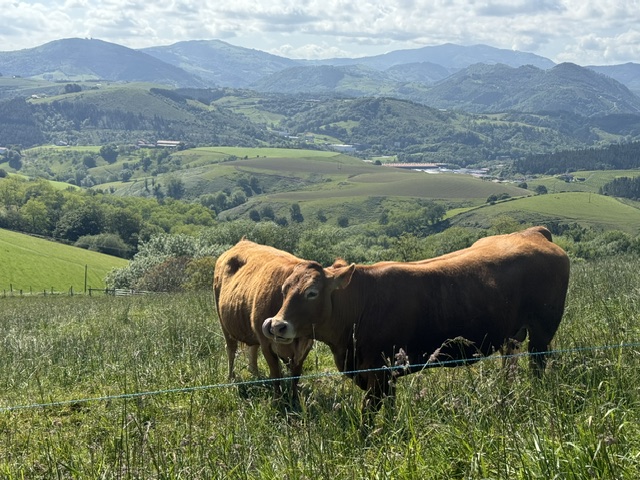
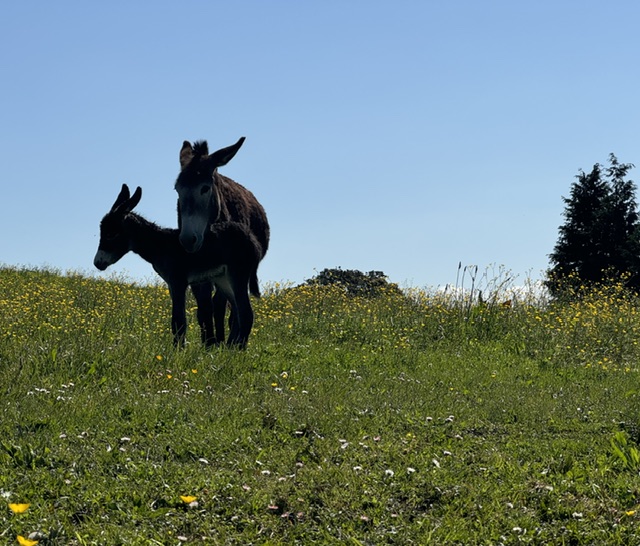
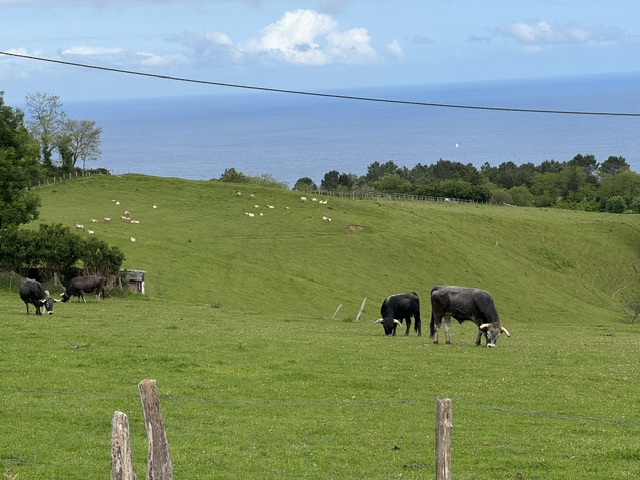
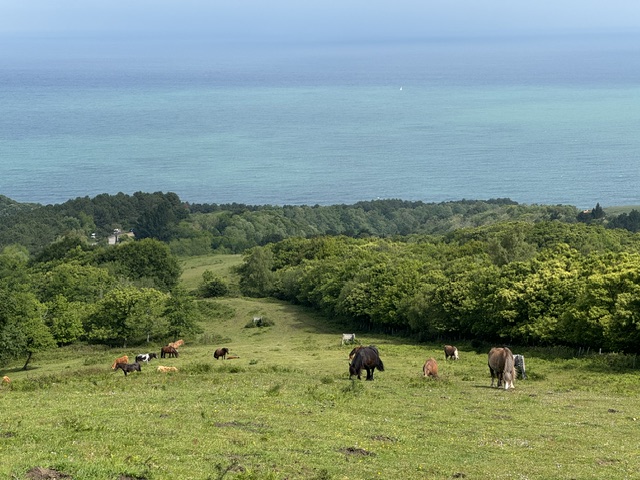
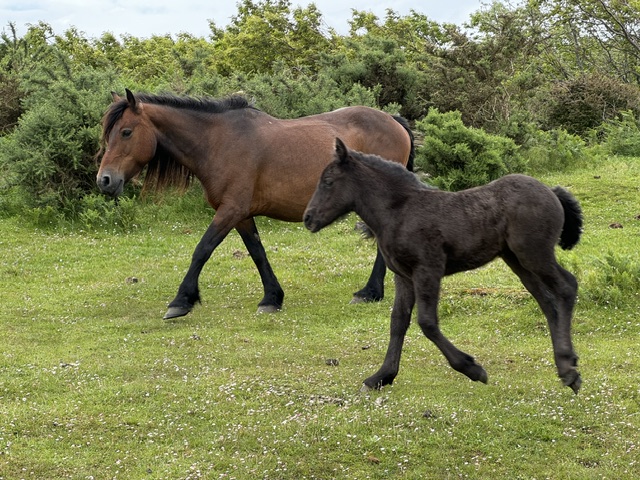
There are so many baby animals! These are still in the field with their mothers, though getting bigger. So far, donkeys, cows, horses, sheep, ducks. Just missing puppies and kittens 🙂

Misty scene
Happy moment for our group

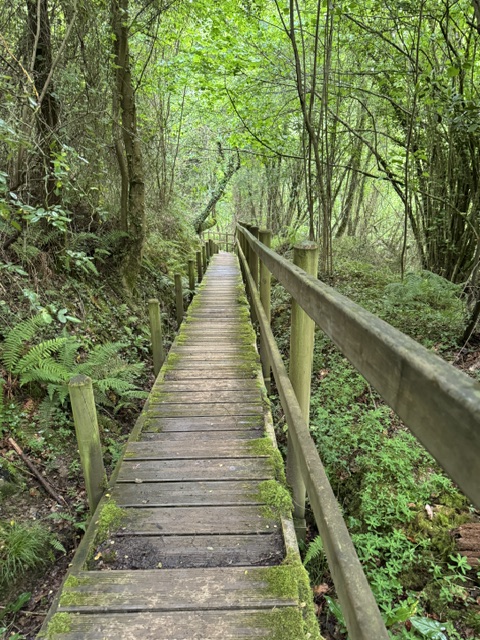
Incredible wooden steps that went down through a whole section of what felt like cloud forest.
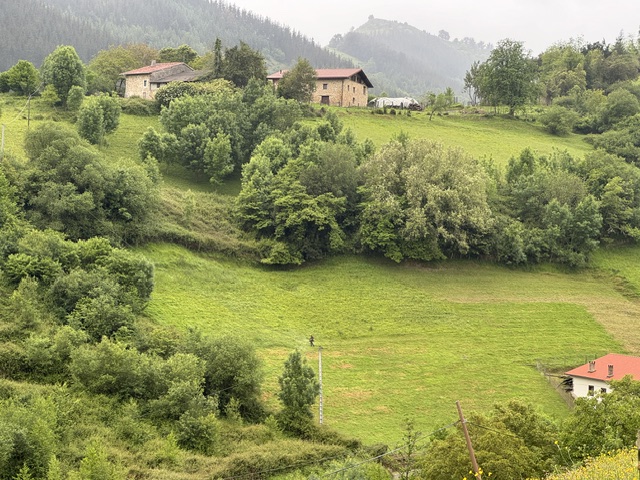
Oh, here’s a cultural note that we’ve all been curious about. Can you see the guy in the distance on the hill? He’s weed whacking the ENTIRE hill. Not mowing, not tractor mowing, weed whacking. We have seen people everywhere doing this. Whole hills, sometimes just berms (which makes more sense), but this one was a doozy. They must get so tired.
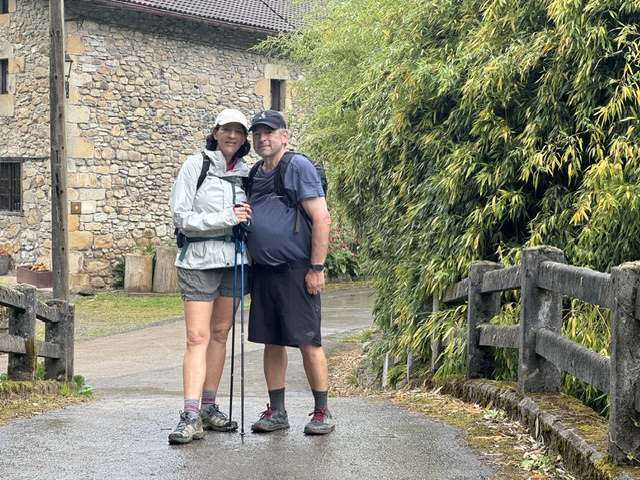
Bob and Susan
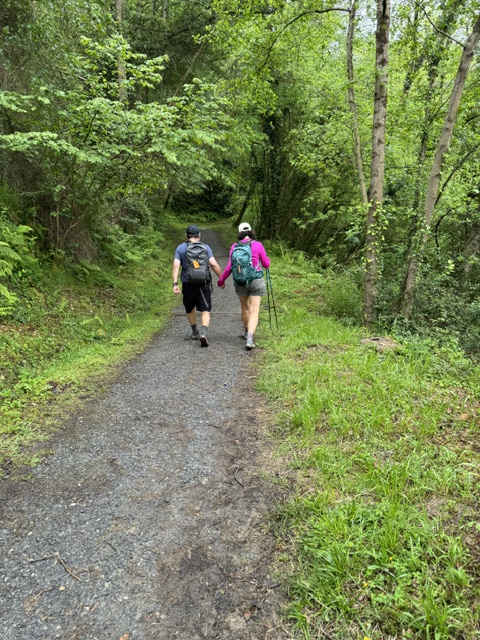
I’m here too:

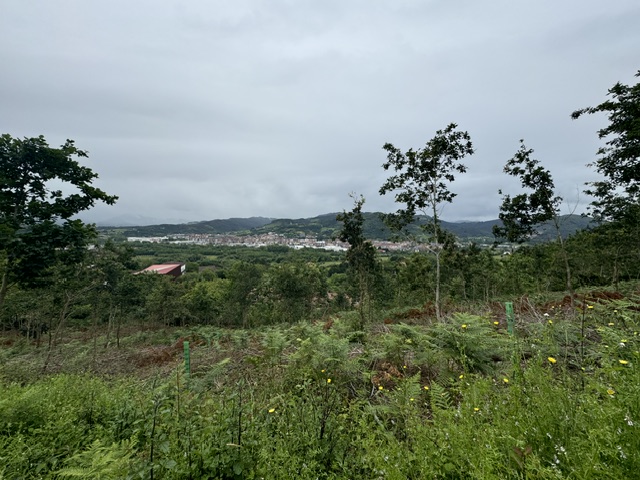
When I saw Gernika from the mountain, I could see that it was just a small isolated town and so horribly easy to target and repeat target as the notes above described. 
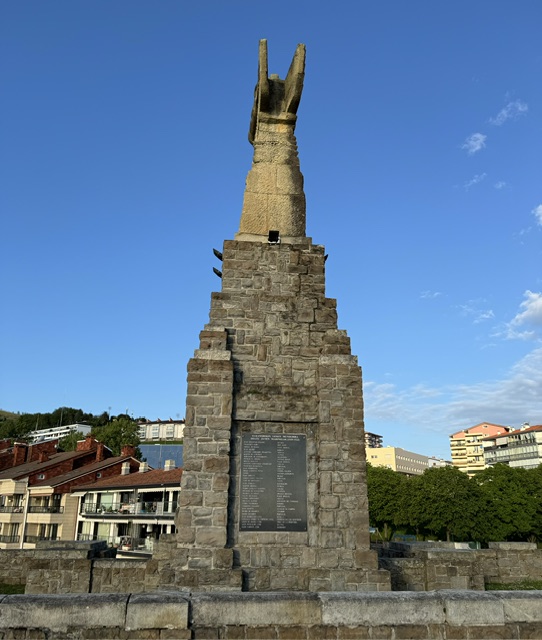
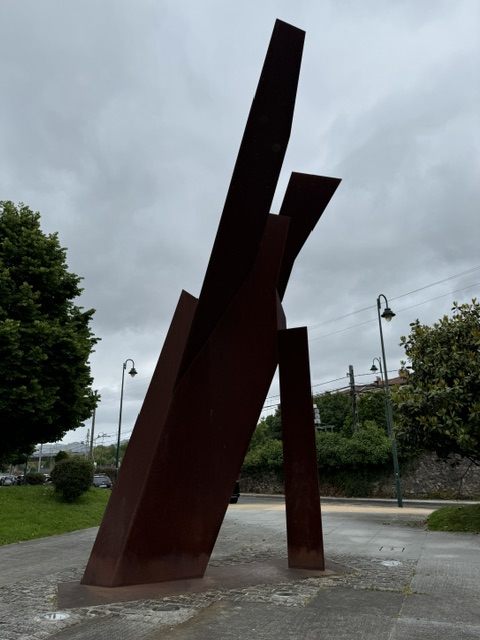
First monument was a statue:
Got into Gernika by 3, quick changed and went to a burger place for lunch. It’s Sunday, most things are closed and this was close to the hotel. Rick has pretty much forsaken his eating norms while we’re here. He’d be crazy hungry if he had to stay vegetarian. But going to the pulled pork sandwich was a big switch up and he said it was wonderful!

We then walked around Gernika, exploring. We knew if we went back to the hotel, we’d never leave again – so walked. Many of the signs, museum, and plaques are about Gernika being a place of peace and connection with all who suffer the impact of bombing and warfare. 

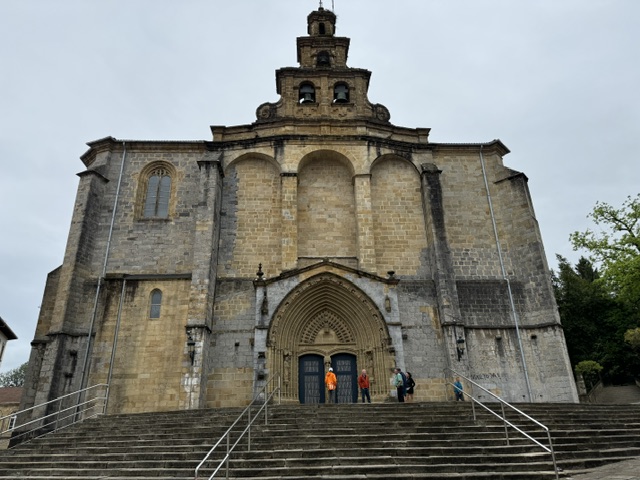
One building left standing, now with repairs showing in different areas was the Iglesia Andra Maria.
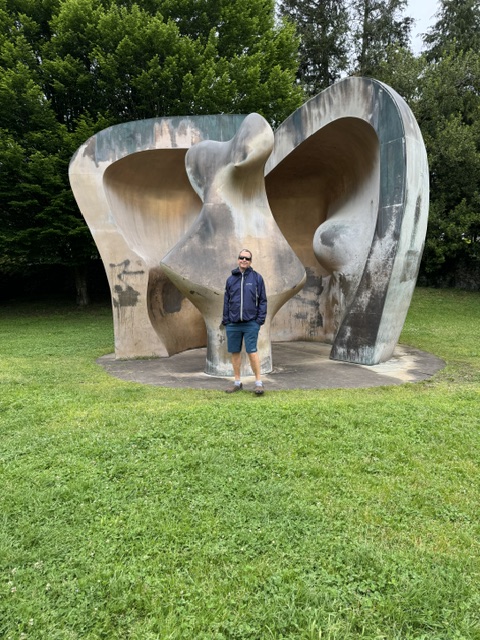
Henry Moore’s “Large figure in a shelter” 1985-86. The year he died, amazing. A tribute to trying to find comfort after being bombed. 
Then back to the hotel to repack (every night), shower, set up for tomorrow. Sadly, Rick has to fly to Chicago for work (happily, he loves the work), but then is turning right around and coming back to keep hiking. His feet will be happy to get a break, but we’ve just finally adjusted to jet lag so that’ll be a bit of a readjustment. 
Camino del Norte, 25.May.2024, Saturday

Ixnia to Markina, 18 miles

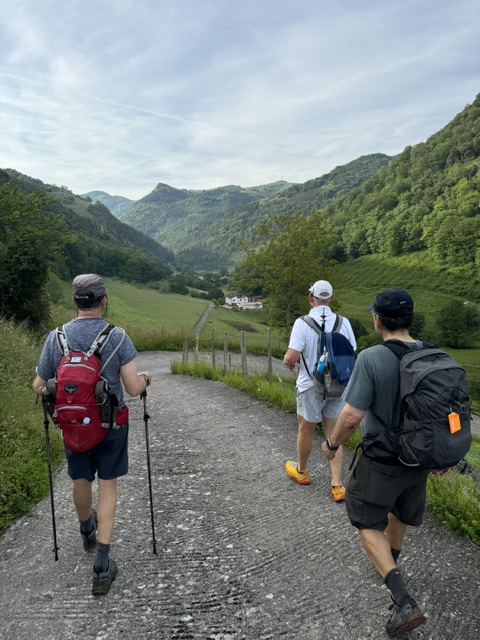
Ok, today was a big one. We knew it was going to be long and Rick and I wore out at the end. But – it was spectacular. Matthew had found a way through GPS to cut off a few miles from the expected 17 that we were going to do. We all started together, then Carol and Susan continued down to see the town Deba and to walk the coastal path for 1.5 hours. They then caught 2 buses sequentially to get up to Markina, our destination. 

The rest of us turned left into mystery land, trusting Matthew’s enthusiasm and exploring mind. And it was incredible. We were the only ones there (huh, good thing?) and it was definitely on a map so we kept going. We left behind all traffic noise (and people) and walked through the hills. I took a short video trying to see if I could capture the bird song that accompanied us as we walked through a forest. This was right at the beginning, before we’d really gotten into the more remote hills. 

We walked up and down and down and back up and up and down. Yep, a lot. In the end we walked 18 miles and did 3500 vertical. At one point, someone walking by, told us that we were on the wrong road, it ends and then – he drew his hand across his throat to say – really the end. But then I explained that we were on camino and taking a short cut because of time. Then, he nodded and said, good to go – kind of, tricky trying to communicate between Spanish and Basque. But he wished us luck (I think) and off we went. 

I was so happy for a long long time. Every day, just filled with happiness for so many moments. We stopped at a fountain to refill our water, eat a quick snack and kept going. Then we started going up. For a long long time. Matthew and Bob outpaced us and we never saw them again. Happily, Rick and I are pretty well matched and we certainly weren’t going to lose each other. We took another 5 minute break when I absolutely had to sit down, then kept going. Both of us pulled out our earbuds, me for a book, him for music and then a book. And, oh thank goodness, we had those resources. Basically we were on the MacsAdventures mapped trail for a small fraction of the time for the entire day, just briefly seeing Camino signs and then we were off again. The rest of the time we were using All Trails and just hoping we would get to the town of Markina. 

 Some scenes on the way:

We thought we’d be going down and then up the other side on the trail faintly seen. We were right.

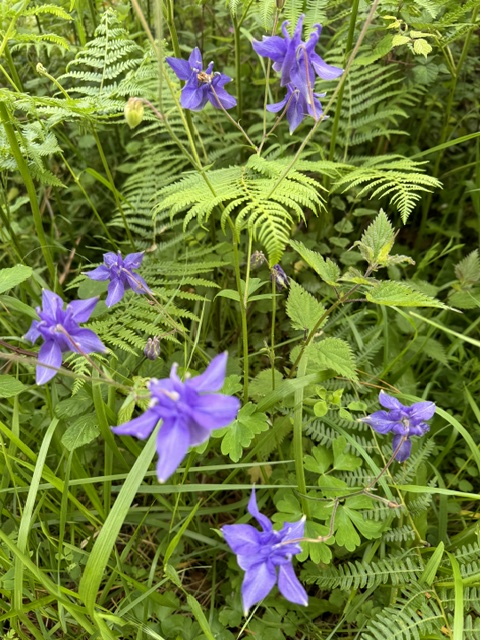
European Columbine

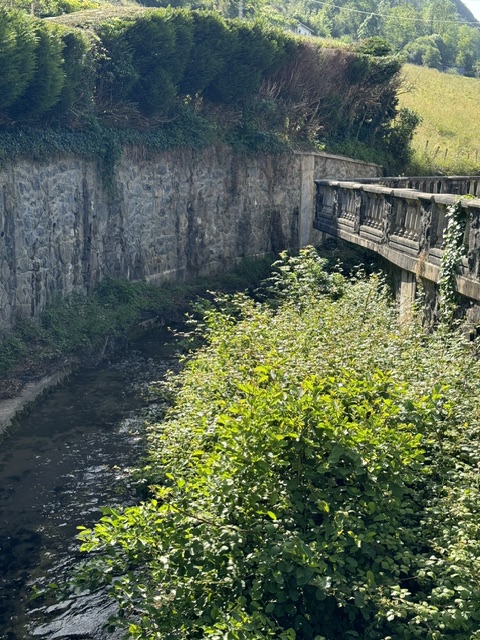
There’s a ton of water here, so lush and you can hear the water, but it’s been managed for so long that it generally feeds through pipes to the farms and towns, so we see very few creeks.

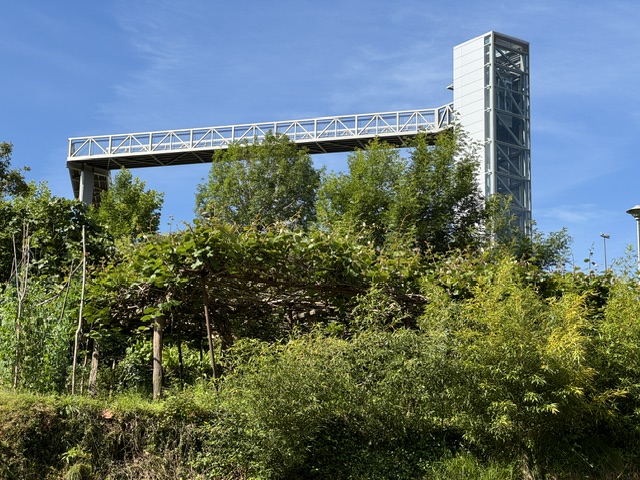
We walked near this town, but didn’t see any cafes so we didn’t deviate from the path. Sigh. This is one of the elevators set up to get people up the hill. 

Conferring

And, finally, Markina? Please, please let it be Markina. Now, how do we get there?

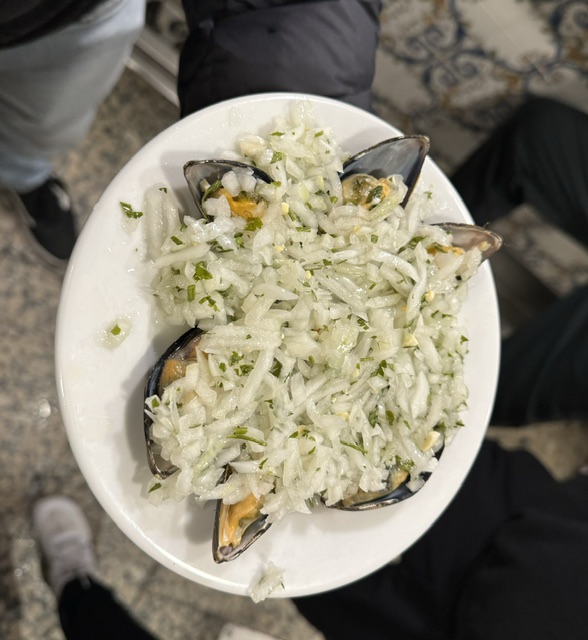
I’m afraid that by the time we got to the town, we were both used up. We literally went in circles trying to figure out where our hotel was and then decided we had to eat. We found a little place, totally local, not a word of English and managed to order and then just sat. And, actually the food was just fine, better than we’d expected. The vinegar they used on the salad was great! We recovered, stopped cursing and finally figured out where the hotel was. 15 minutes away. 

Turns out it’s a hostel, blend of hotel rooms and bunks for walkers. The  Casa Rural Intxauspe is a pretty busy scene, really nice family running it and we settled into our room. I quickly did a load of laundry and hung it on the line and got a shower – bliss. 

Bob and Matthew had walked straight to Matthew and Carol’s hotel, turns out it’s 30 min away from ours and had an amazing lunch with Carol and Susan. Made Matthew happy! There’s no way we were going to add any extra time to our walk, plus we were 45 min behind Bob and Matthew. 

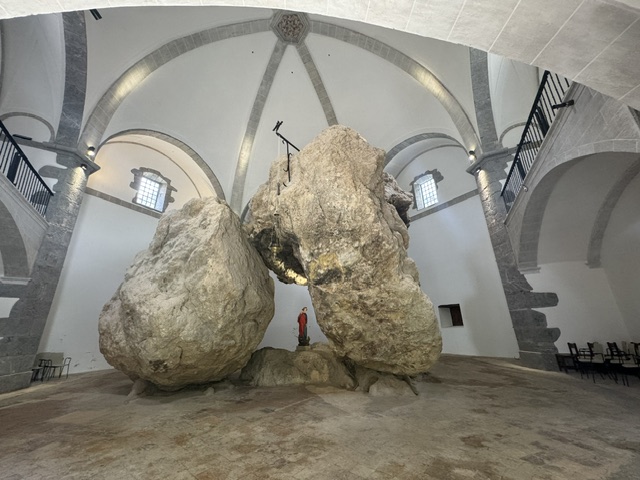
Rick and I did see one startling monument on our way into town, we didn’t even try to see the churches. This monument is the hexagonal Ermita de San Miguel de Arretxinaga, founded in the 11th century around three Megalithic stones. The archangel saint Michael is the statue you can see, probably about my size.  The saint wields the spear against the demon at his feet in the form of a dragon or another fantastic animal. I was so tired, I didn’t even try to go in to explore, just looked in, goggled at the stones and left. 

Despite having lunch, it wasn’t the grand lunch that we’ve usually had, so we’re going to go down to dinner as well. That’s new, then hoping we sleep a LONG time. 

Camino del Norte, 24.May.2024, Friday

I got up and out early, hoping to walk the town, Getaria, a bit. Then I wished I’d had another hour. 

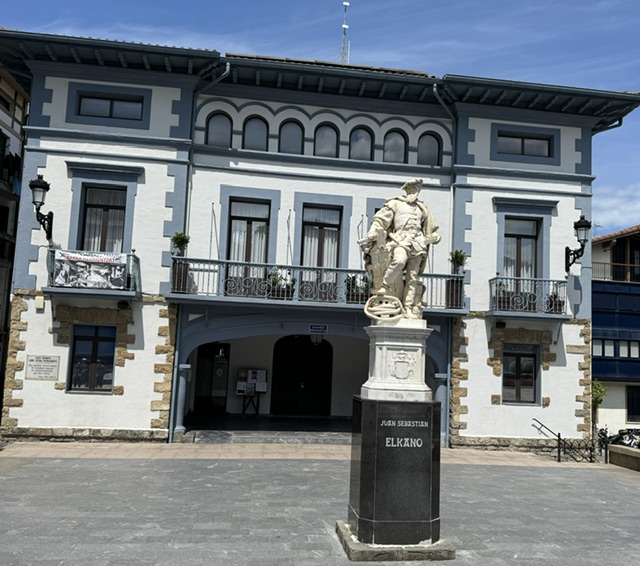
It’s a beautiful town with amazing history. This is a photo of the monument to Juan Sebastian Elkano (1487-1526). He was the navigator for the Magellan expedition. Basques never refer to Magellan, (at least in this town) only to Elkano. His name is everywhere. The lot where he lived, the house is gone, was against the back of the hotel where we were saying. The plaque said “The lot of the natal house of the navigator who gave the first round the world trip.”  Matthew immediately knew who he was. Wikipedia: Juan Sebastian Elcano was a Spanish navigator, ship-owner and explorer of Basque origin from Getaria, part of the Crown of Castile when he was born, best known for having completed the first circumnavigation of the Earth in the Spanish Ship Victoria on the Magellan expedition to the Spice Islands. 

Then this monument blow was HUGE, too big to even be able to get a photo of the entire structure, just the top. I climbed up to it, then down and realized between the street and the bottom of the hill at the harbor were 11 staircases. We’ve decided this area has to be a blue area – fish, olive oil, and climbing. Everyone looks so strong, young and old. The plaque caught my eye because it was clearly naming a lot of people, but from 1519-1522. 500 years ago and people can still read their names. What did they do? Turns out they went with Elkano – and I guess they all came back. Incredible and they kept a record of all of their names. I love that. 

We were early and tried the cafe that Matthew and Carol had found that opened early, but only saw sweets. I wasn’t thinking yet and didn’t ask about something hot and more protein oriented. Carol just asked and the others all got a great morning breakfast sandwich and then we were off on another perfectly gorgeous hike. This time in full sun with sea breezes most of the way. We were hiking up and down hills that on the elevation map didn’t look so bad, but many felt almost straight up. I was leaning on my poles to pull me up. But most of the climbs were short and by the time you really wanted to be at the top – you were. 

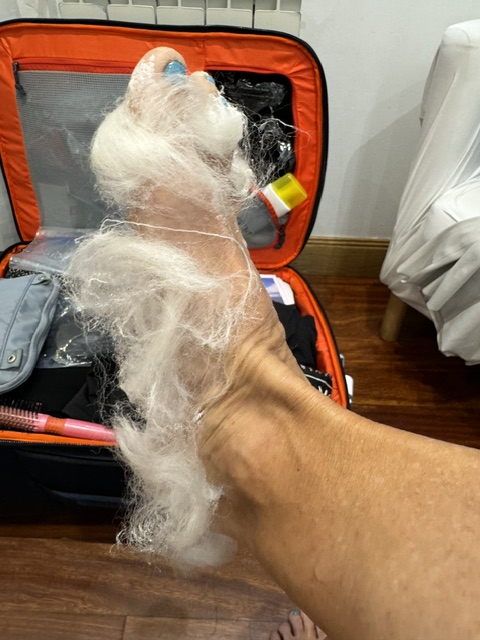
This is how my feet manage it, Hikers Goo and Hikers Wool, pretty 🙂

Sadly, there was a mix up between MacsAdventures and TeeTravel, the local Spanish tour company that sets everything up and our hike was shortened to just 10 miles, maybe that. We were on a roll because it was so beautiful, but ok, we’ll stop! Which sets us up for 18 miles tomorrow. Might be a bit too much and some may opt for a taxi to take us part way. We’ll see. It’s supposed to be high 70’s, slightly cloudy, nice. I’d love to do it if the timing could work because so far, it’s all so beautiful. 

Rick and I had a call tonight so we couldn’t explore more. Plus, we’re too far to just walk into town and back. We asked about getting a taxi, but were told there are only 3. For the entire area. And, at that point, one was on the way to the hospital, one to the airport and one elsewhere. Funny. So a call and relax!

Some images:

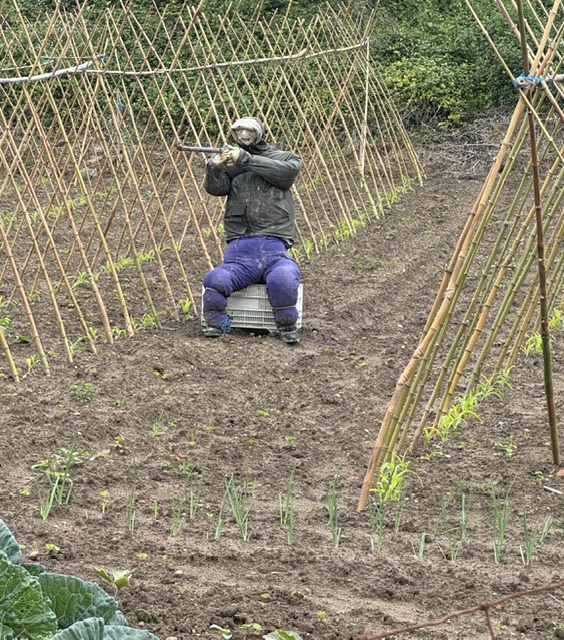
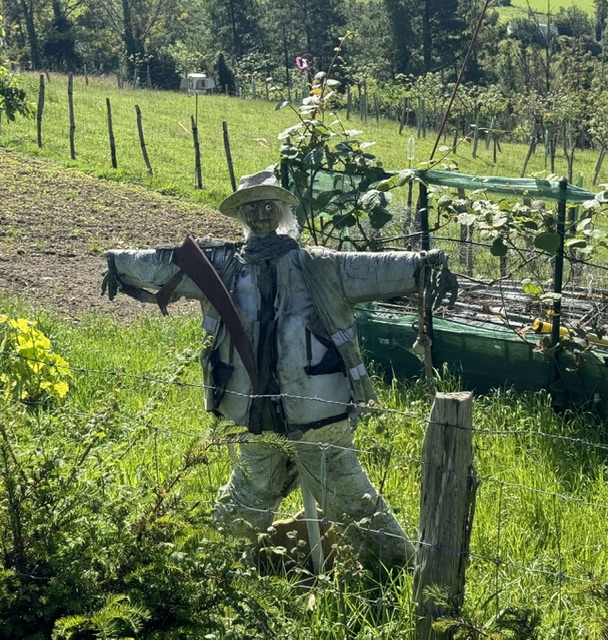
Scarecrows, they take them seriously here:

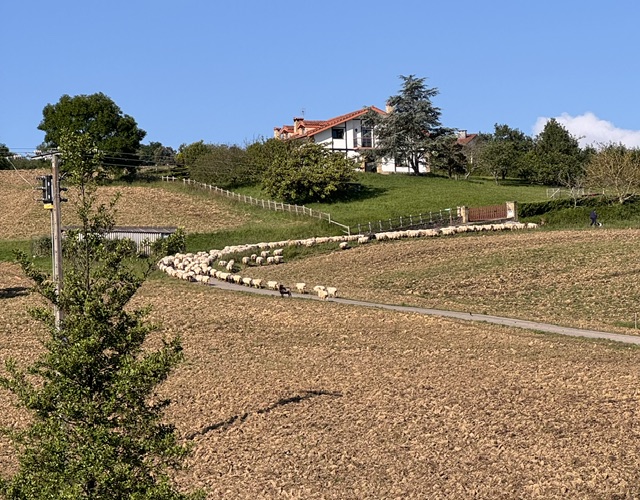
Sheep on the move 

Down and up

Animals

Staying at Hotel Kalana Itziar, outside Deba. Guessing they couldn’t get rooms in Deba. The woman running things is so nice, told us about the three taxis and an alternative walk along the coast, then getting a bus to the next town. And the lunch was great, but still if doing again, definitely push for being in Deba. It’s supposed to be really nice town, but with 18 miles, we won’t get to expire.

Camino del Norte! 23.May.2024, Thursday

Susan, Bob, Rick and I started straight from our hotel, Carol and Matthew started from a different point and we planned to meet up.

Oh, today was magic. I was so so happy. Walking again, a long distance, Spain, gorgeous Spain. Sounds – roosters, cows and sheep bells, people chatting, quiet walking. Lots of up and down hills, some pretty steep. Views of the bay, a few pretty towns, coastline, farms, wooded walks. I had chat and quiet time, a perfect blend.

Stone steps – amazing, the amount of work that must have gone into this part.

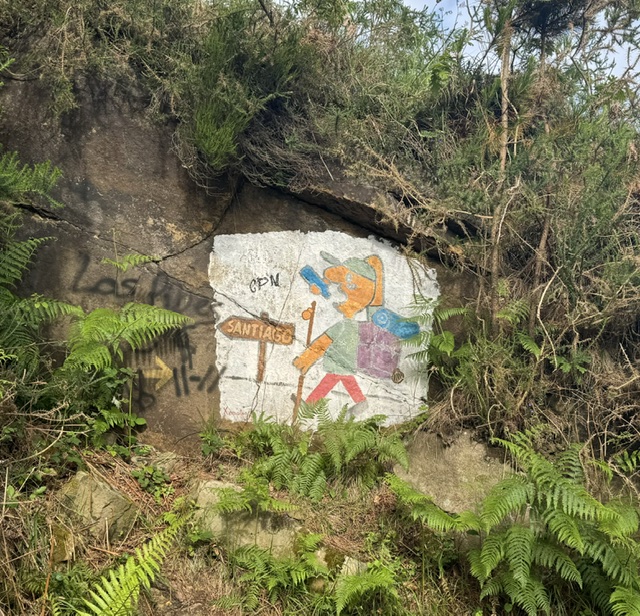
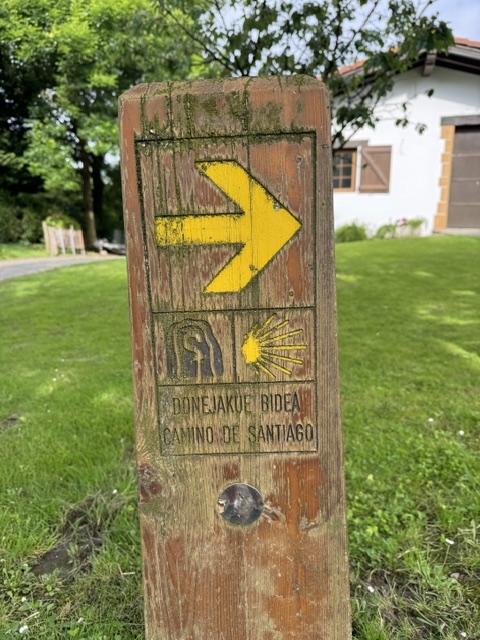
I love the random Santiago or Camino signs

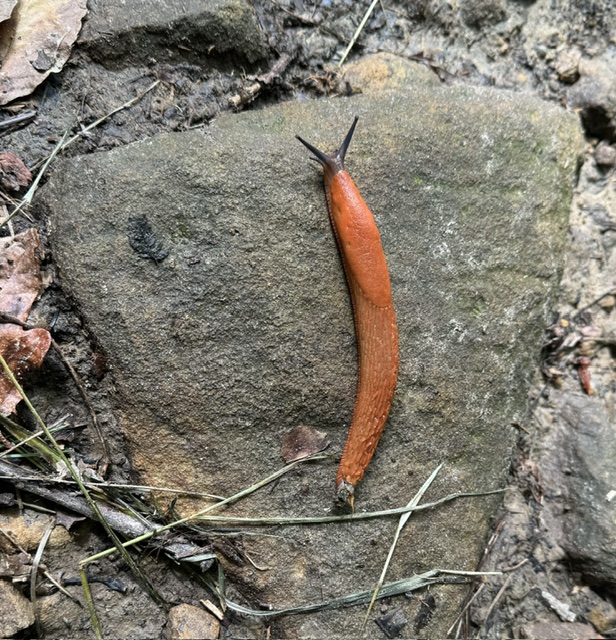
The slugs are the most vividly colored slugs – all over the wet Basque region

This was a small Ermita de San Martin (Saint Martin chapel) that we couldn’t see into, but was in a beautiful scene. Amazing – built in the 13th century and renovated in the 15th century. This was the first sign that went into extensive notes about the architecture.

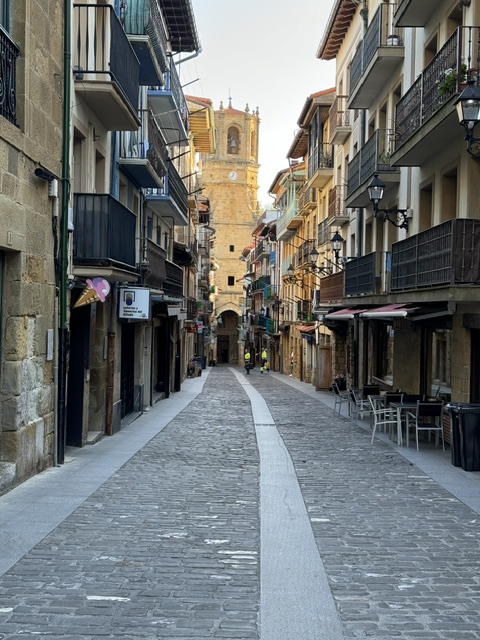
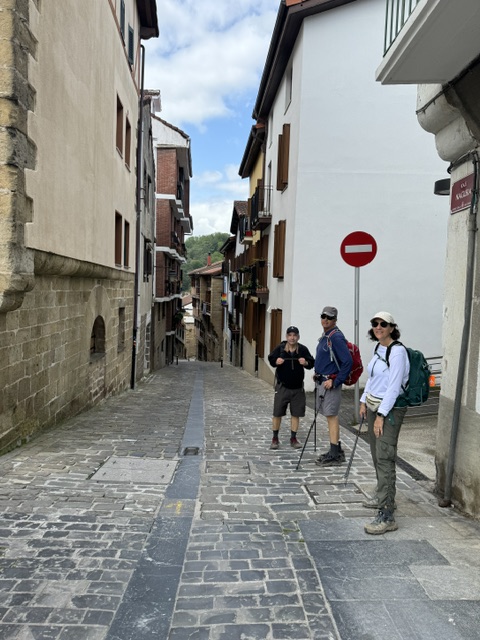
We were starting to get a bit tired and hoping to find a cafe for a snack, so kept going towards Orio. It was a pretty town, with ancient houses (of course), and I started taking photos of all the plaques on the houses. Then I realized they were telling very little to nothing about the people in the houses, instead describing the architecture. I love the buildings, but I just want to look at them and have little memory for this roof versus that or this building technique versus that. Plus the streets were small enough, I couldn’t back up enough to get photos that were at all satisfying. Here’s one street photo. 

Carol and Matthew’s timing was amazing – after 10 miles, we sat down at a little cafe in Orio, a small fishing community, set down our coffee or hot chocolate and some snacks and there were Carol and Matthew! 

We then walked together for the next 6 miles. 

The church at Orio was interesting because unlike most churches, it was basically hidden in the small town streets, and you didn’t see it coming into town nor did you see it when you left town. Usually, the church is the focal point, seen from far away and beckoning all to join. I managed to sneak in for just a bit during a service and found something new – these communities are all about the sea. This boat is hanging in the air about halfway back. Seemed like there should be a sign, but obviously the community understood why it was there and it’s significance. 

We went off the trail the MacsAdventures had set out for us and ended up climbing up and over a hill instead of going along the coast, but it was beautiful. So though it added a mile +, it ended up being wonderful with views over the bay as we went in and out of the woods. 

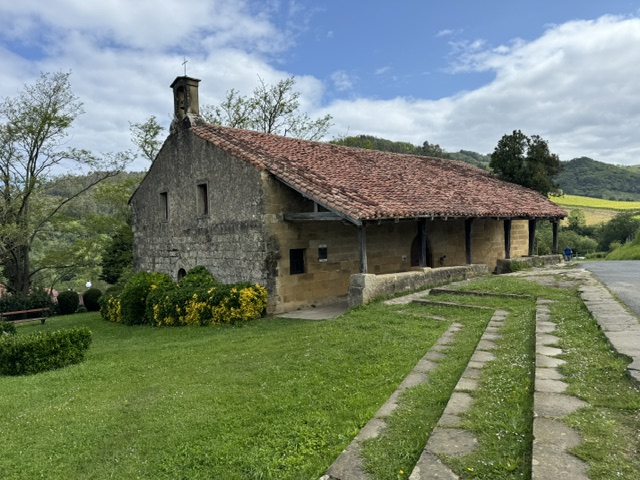
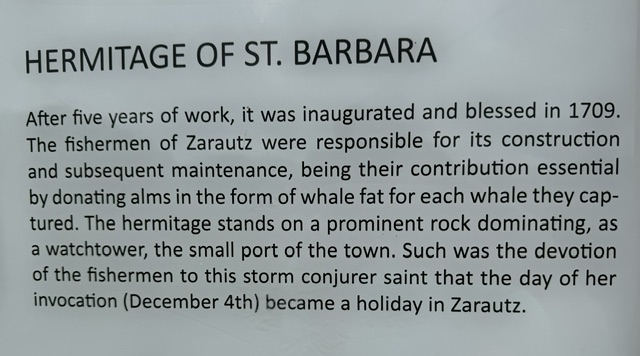
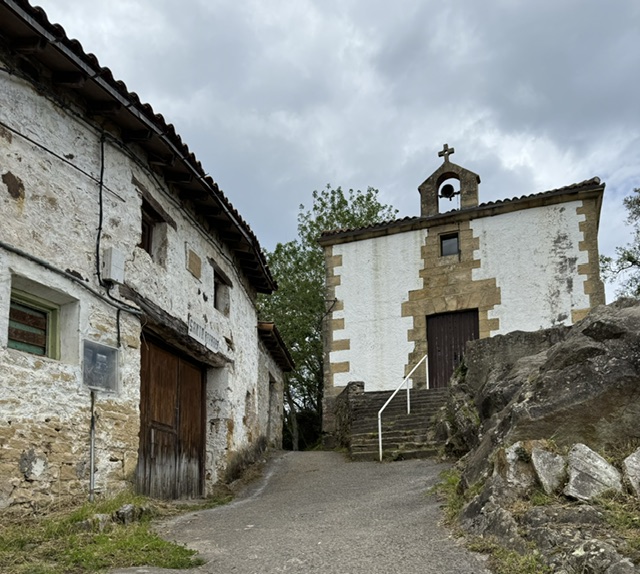
We also ran into this Ermita, again reinforcing the connection between the churches and the water.

We finally came down into the town of Getaria. Isn’t that a pretty name? We walked into our hotel, the Hotel Itxas-Gain, and the nicest woman greeted us at the front desk. When she realized we really wanted to go for lunch – we knew it was getting late, almost 4, she jumped into action and called till she found a restaurant willing to take us and told us, “go, go quickly!”  So we dropped our packs and quickly walked down the long hill, round the church, onto the harbor and then into the restaurant. We had to climb 3 flights which felt challenging at that point, 4 people in a row told us we were too late, they closed at 3:30, but then the owner found us, confirmed the ok and we had an amazing meal. Truly, this is a new experience for me to have so many gorgeous meals in Spain. I couldn’t stop eating. Finished our fish and Carol and Matthew’s who had left some bits on theirs. These are whole fish perfectly grilled and lightly flavored. And I keep forgetting to take photos. But – salad, grilled fish, incredible desserts, best yet on that front. 

Then back to the hotel. The woman was so helpful, telling me about the laundromat, showing us this wonderful terrace where we could sit and watch the water and enjoy the sun. Yes, sun!

Tomorrow is a shorter day, only 12 miles with a fair amount of up and down. Happily, the whole crew is on the early out, great late lunch, chill afternoon and evening. Isn’t that nice?

San Sebastián, 22.May.2024, Wednesday

Today was a treat. We took it easy in the morning, everyone doing their own thing and then we met near the City Hall and did a 3 hour electric bike tour. Perfect for tired legs from the day before. We only went 10 miles, but we got to see a lot of San Sebastián, going behind the old town, to neighborhoods, up hills, through the most incredible tunnel I’ve ever experienced. Matthew got an amazing video of it, but I forgot to get a copy. 

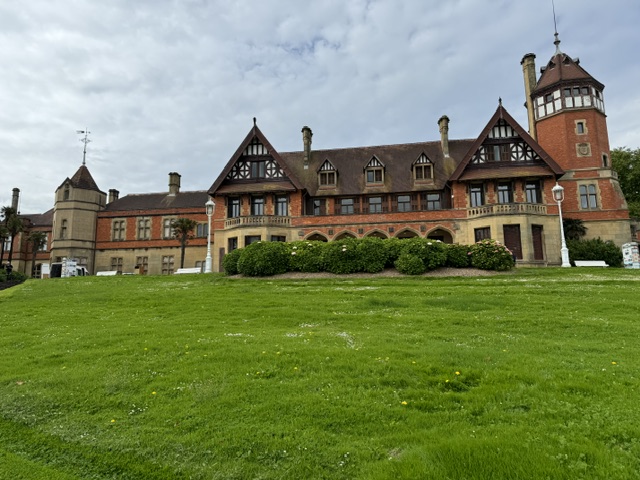
One of the places I was curious about was this gorgeous building up on the hill that we’d passed a couple of times as we walked along the bay. The old town has remnants from the 1500’s, 1600’s, then Napoleon destroyed it in 1813. It took 45+ years to rebuild the old city, with a commitment to building the buildings as they had been (though presumably updating at least a bit the interiors, don’t know about that. Anyway, after 1860, they started building the new areas outside the original town walls and continued through the belle epoch era. And then there was this departure piece up the hill. 

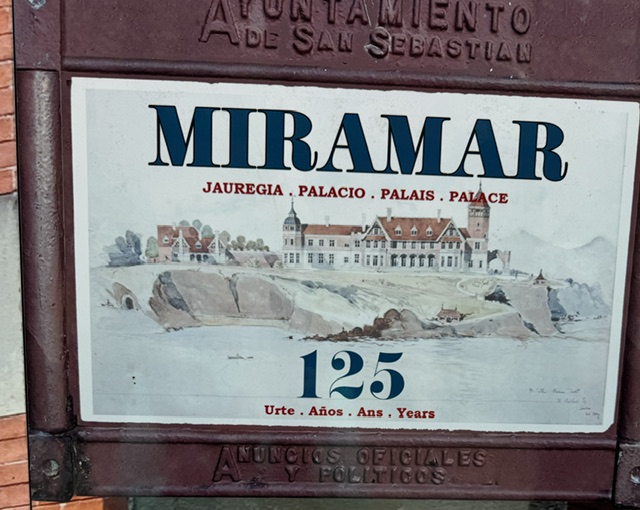
Turns out that Queen Maria Christina visited in 1887 for health reasons and fell in love with the town. She had her summer palace built as an English country cottage (cottage!). She named it Miramar – ocean view. She ended up reviving San Sebastián as a destination get away, inviting Queen Victoria amongst others to visit. This made San Sebastián famous, started the food trend and all went well until Franco. 

Quote from one of the plaques about Queen Maria Christina near the palace/cottage: “Her affable nature earned her the affection of the city’s inhabitants and she even grew familiar with the Basque language. She was the best ambassador the city could have, and there was no cause in San Sebastián that she did not support in Madrid, such as obtaining a permanent telephone line concession or having the Ministry of War sell Mount Úrgull (the mountain with the Jesus of the Sacred Heart statue) to the city. In acknowledgment of all this, in 1926, the Town Hall appointed her “Honorary Mayoress” by acclamation, granting her the city’s first Golden Medal.”

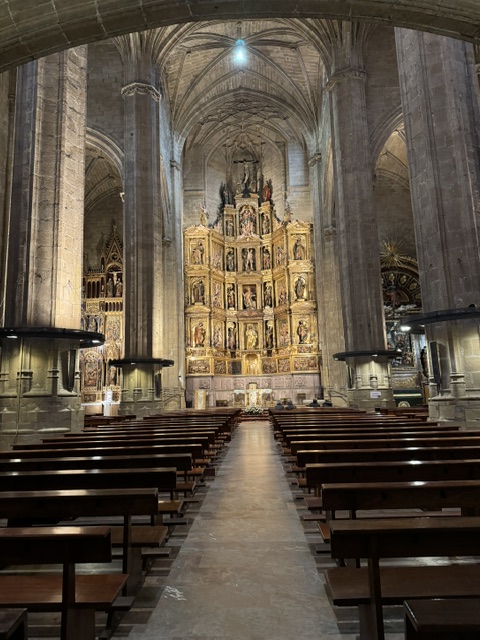
After the bike ride, we had the afternoon to chill. I went back to the earliest cathedral – built in the 1500’s/1600’s. It was the cathedral for the Camino, had a shell and plaque about it’s place for the Camino del Norte, but no stamp. I’ve done a passport for the last 2 caminos and thought I’d go ahead and do this one, though I know I wouldn’t be finishing this year. But – no stamp. Strange and a first for me. But wow, it was gorgeous How could people build like this 500 years ago?

We met at Narru for dinner and had an amazing meal, everyone loved it. A great way to end our San Sebastián stay.

San Sebastián-Camino del Norte, 21.May.2024, Tuesday

Today we did half of what is usually the first day of the Camino del Norte. Our schedule has us starting from San Sebastián, but a friend, Jean Marie from my Mamaroneck days, had done this route last year and gave me the inside scoop. You have to do the traditional first day! Take a taxi up to the bridge, ask them to wait and walk across the bridge to France to the actual start and then come back and take the taxi to the base of the mountain, skipping the city walk. We decided to skip the bridge, but did take taxis to the base of the mountain.

Yes, we spun around a bit trying to find our way, but we were close and quickly were on the trail. I loved getting to see the camino signs again!

We walked up some seriously steep trails – short, but steep – and then we were on a ridge going along the Bay of Biscay. So beautiful. I’ll let the photos speak for themselves. 

It was pretty windy and cold, but bright and sometimes warmed completely up – so jackets off and on and I just relished all the sounds – birds, roosters from the farms, cows and horses with bells – I’m back in Spain! I do love it here and I so love the walking and getting to see things at a slow pace. We actually went too slowly, so ended up only hiking 10 miles instead of the 15 we’d expected. 

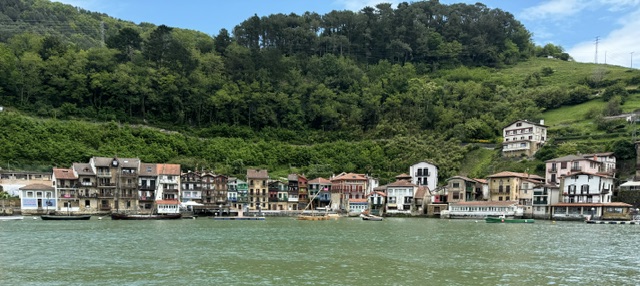
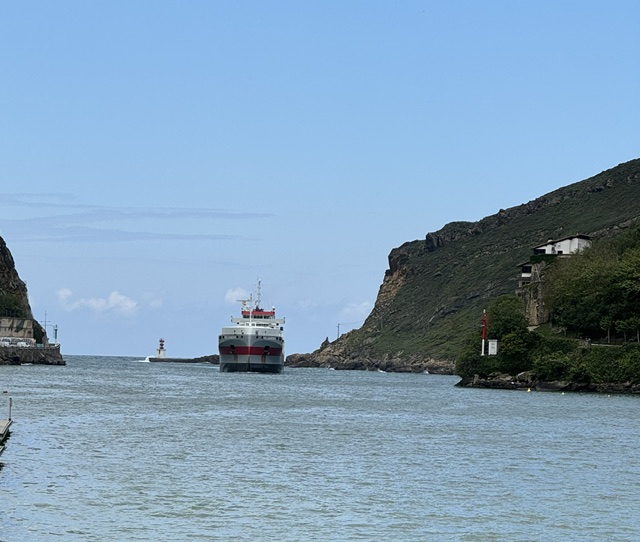
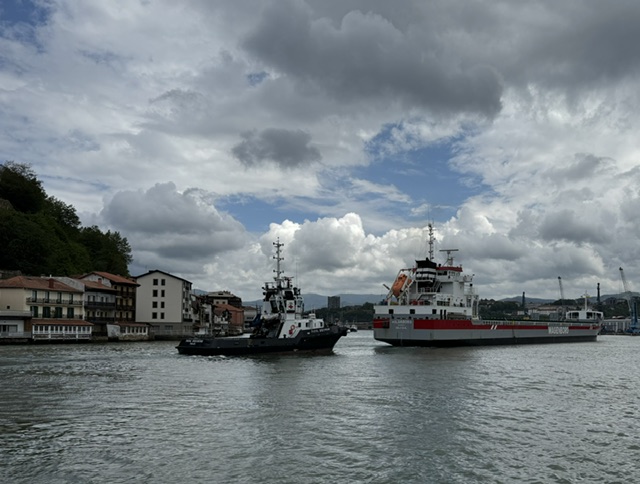
So – for the end of our hike, we came down the mountain into a completely darling little fishing village on one side of the port entry. The other turned out to be an amazing ship building port and the port that all the big ships came into for industry and commerce for the San Sebastián region. We were amazed at the tiny space that these giant ships came through to get into the port. If they got through – they were safe, but oy, in the old days, without motors? We did watch a freighter coming in and wondered why in the world the tug was at the back. Turns out, it was because the boat had to power its way in to stay straight, but then the tug had to pull it backward to slow it down in order to dock. Amazing. 

If we’d only known, Rick for sure would have gone to the site where they’re building a galleon with all the old craft to replicate a Spanish galleon that went down off the coast of Canada. When the man who was inspired to start rebuilding wooden boats in the Basque region went looking for craftspeople, there were none left. The only people left in the world who knew how to build wooden boats were in Maine at the WoodenBoat School, a place Rick has dreamed of going to to learn the craft. Maybe if he ever retires…

Here’s an article about the whole adventure.
The Basque city rebuilding its maritime history – Dokumentazio zentroa

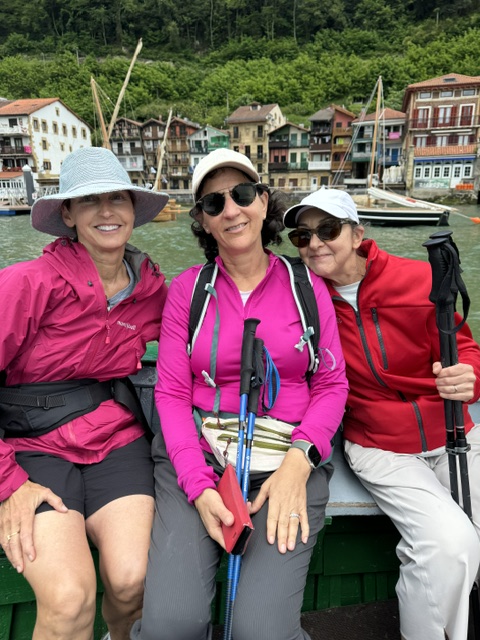
We crossed the river on a little ferry and then debated the taxi option. We could have gone another 8 miles (our distances were just oddly off in planning), but instead we grabbed a taxi to go back to San Sebastián. We had a Pinxto’s tour planned (courtesy of Jean Marie’s advice) and we didn’t want to miss and wanted to clean up as well. 

Came back, had some down time and then – we went to meet Gorkas, the mayor of the town as Rick called him. A young guy, passionate about the Basque traditions and history, a wonderful teacher and he loved food as much as his country and culture. He was known to everyone, hellos, brief conversations, hugs everywhere we went and he was so graceful about juggling the greetings and us.

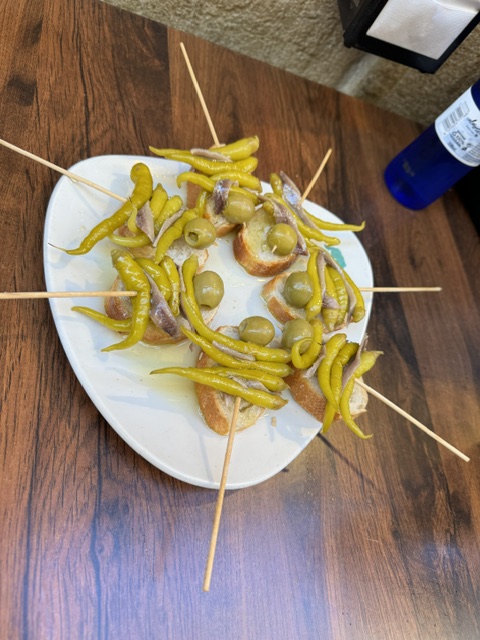
The last one probably doesn’t look completely scintillating, but it was delicious! And it was the original type of pintxo, La Gilda. I forgot to get pictures of a lot of them!

Bit of history for La Gilda: But this history has another key figure inside Casa Valles: Joaquín Aramburu, a.k.a. “Txepetxa”. One of the regular patrons. Nobody knows how many hours have spent Txepetxa sitting and drinking in that bar counter until that day when, at his own risk, he took an anchovy, a chilli pepper and an olive, and skewered them in a stick. This wisecrack came together among the other regulars, and soon they started to ask for that combination.

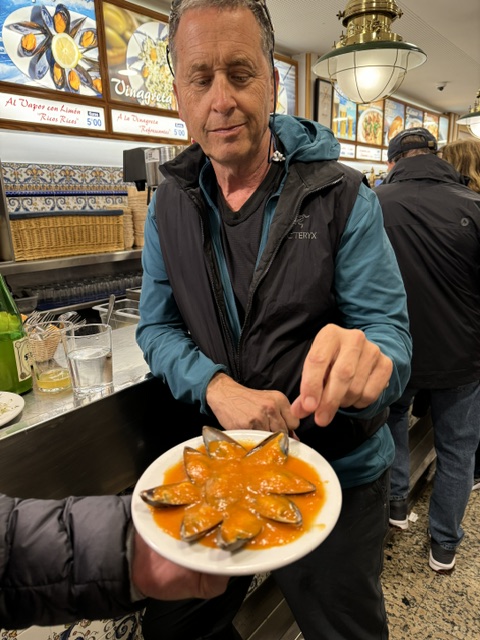
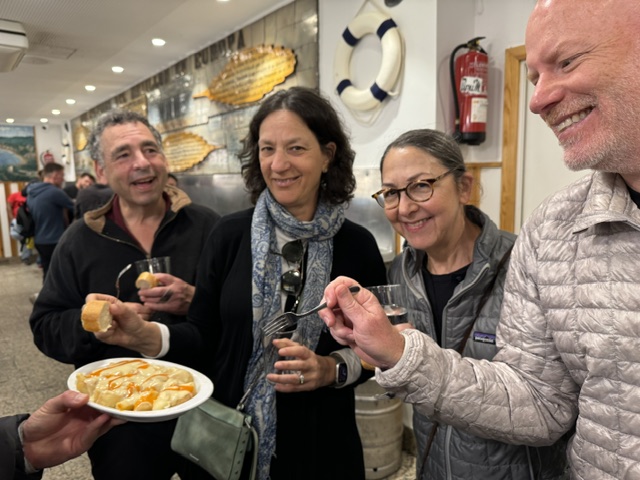
We went to 6 different places, getting to try many different pinxtos. Gorkas took it in stride that most of us didn’t drink much and promptly moved us to water with occasional samplings of drinks. Pinxtos is a Basque term that means skewered. Later, in other places, these little dishes became known as tapas, here – definitely pinxtos. I was seriously hungry and thought this is not going to fill me up at all. But since we are now eating everything, I had beef, anchovies, potatoes, muscles, Iberian ham (there are four gradations), shrimp, risotto and we ended with a traditional desert (“my grandmother made this for us” ) of French toast soaked in cream and spices and surrounded by a custard. As Rick said, several of us Hoovered it ALL up. Such a fun night. I’d recommend Gorkas to anyone who was wanting a tour of any sort he chose to lead. 

Ultimate San Sebastian Pintxos & Wine Tour (Evening) 2024

San Sebastián, 20.May.2024, Monday

Carol and Matthew got in last night and we met up in the old town and started walking. This is a wonderful town for walking! 

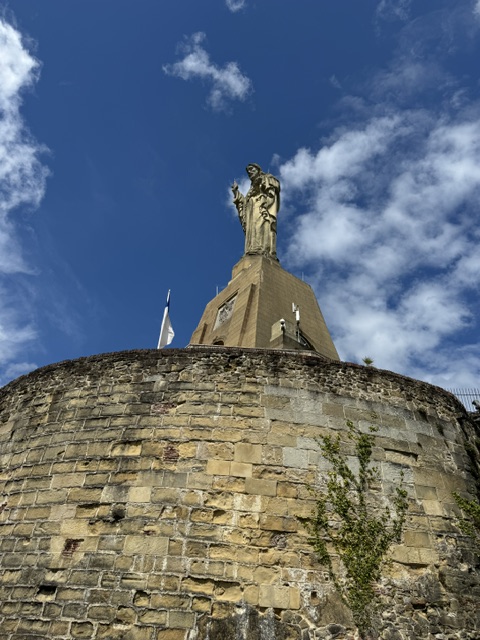
We started with the huge statue on the mountain (we’d call it a hill in CO) on the right side of the bay with the giant statue of Jesus of the Sacred Heart. Evidently if his hand is up in this form that’s what it means.

We walked up and around the castle and then back down, getting to spend a little more time in the old town. Gorgeous. 

We walked by the bay and realized that the writing you see here was redone every day. I asked someone about it and they said that part of the beach is recreated every day, sometimes protest words, sometimes art, sometimes mandalas. In this case, it was protest and memories for both the Basque cause and for Ukraine.

Then, Matthew, Rick and I had a new experience – we went to the Talasoterapia Circuit. The what? The hotel had told us about it and that they were reserving our spots and I asked if we could bring a guest. Yep. So we walked in thinking everything was paid for and Matthew ended up paying for everything. And cheerfully! 

We knew to bring bathing suits and I knew to bring a swim cap, turns out men need them too, so they got little blue beanies. We were just bewildered with the rapid flow of Spanish/Basque, but took our cards and walked through the turnstiles to get in. Then single sex? No? Change? Weird little spaces with doors on both sides – only on the way back out did I see the hooks down low to secure the doors while changing. I walked out the other side and only saw men. Oy. Went back and forth a few times trying to figure out. During one of my back and forth times, Rick went out and only saw women – but he asked is this only women here? No – and we all then found our way to the most amazing place. 

Giant pools with massage jets. There was a circuit working all the way up and down the back and legs and it really did massage! The water was just the right temperature so we were completely comfortable moving around the pool with water at neck height about, so could walk or swim, at the end was a resistance stream for exercise. And that was just the first pool. There was another pool with different amounts of jets and a circuit that included underwater bikes, tread mills and arm machines. There was a hallway with shooting jets of all different termeratures of water coming at you from all directions. A hot tub that wasn’t too hot looking over the bay, an ice plunge, a steam sauna, a machines that poured iced that people rubbed all over themselves – not me at all – and the option to run out and jump in the ocean (freezing) and then back to the jacuzzi. And a final large pool with a waterfall you swam under to get to the “relaxing” pool with violet light and heads resting back on the rim when the rest of you floated. All of it was saltwater. We had a 2 hour slot and we used it! Matthew did everything, I did everything that didn’t involve cold. 

No – no pictures for obvious reasons. But a very cool place. Matthew wondered why we’d never seen such a thing anywhere else. It was fantastic. 

We came back and found that Susan and Bob had arrived and all of us ended up eating at Nobu. We gave up on the menu and just had whatever they suggested. It was a great meal, interesting flavors – but we’re going to go back to Narru for our last night.

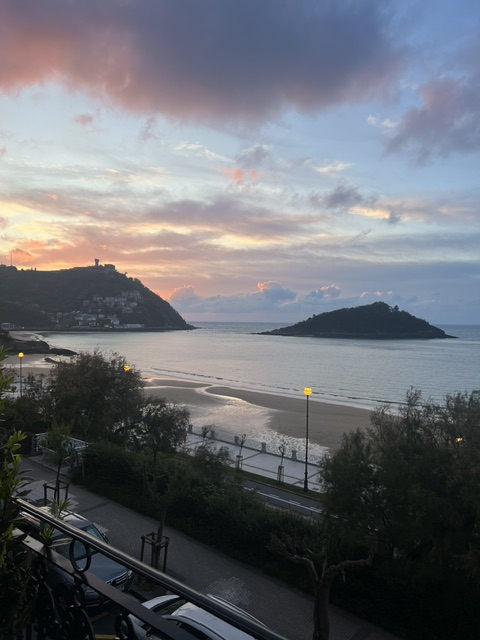
We talked over the hike for the next day and planned to meet at 8:30. Another great day and a gorgeous sunset over the bay. 

San Sebastián, 19.May.2024, Sunday

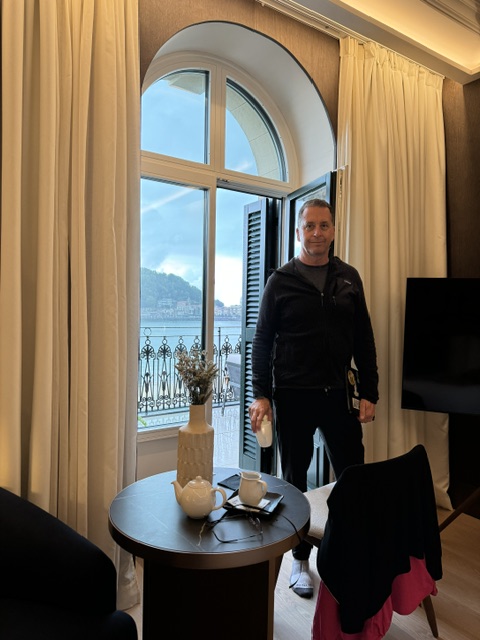
We flew Iberia to San Sebastián (Donostia is the Basque name) – short, easy flight and landed in this wonderful town. A few people had told me that this was one of their favorite towns and now I get it. We’re staying on the bay and can see the water from our room, it’s beautiful. 

Yep, there’s Rick. He said that when we passed a window that he felt like he was in his pajamas. But then we realized that’s because we’re in our Vuori clothes, completely comfortable and not styling. But it was raining on and off and windy so we were happy to be comfortable, warm and dry with our rain jackets. 

We realized we were too tired to stay up for an 8pm res for dinner and asked the hotel to change us to an afternoon lunch, 3pm, and they were able to get a spot at Narru. Oh my goodness, the best meal in Spain I’ve ever had. Rick and I were giddy. Belatedly, I realized I should have taken photos, a la Kaziah. But I didn’t think. Our heads were swinging every time someone came by with food for us or anyone else because it was beautiful. Such a fun lunch. 

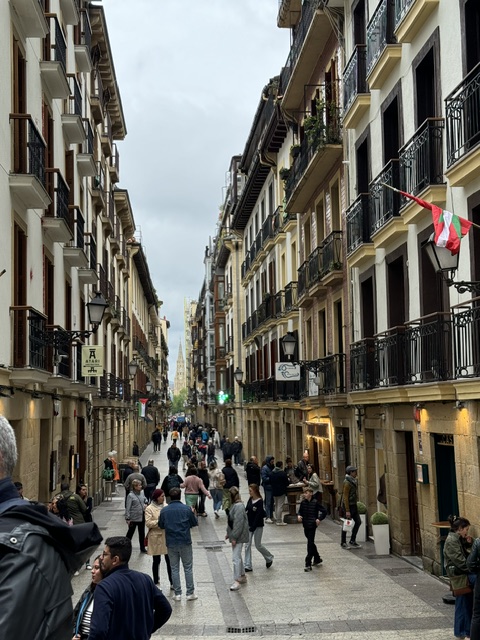
We then started exploring the Old City and going into churches. I really won’t be doing a litany of churches like I did on my first Camino, but there were some notable things. 

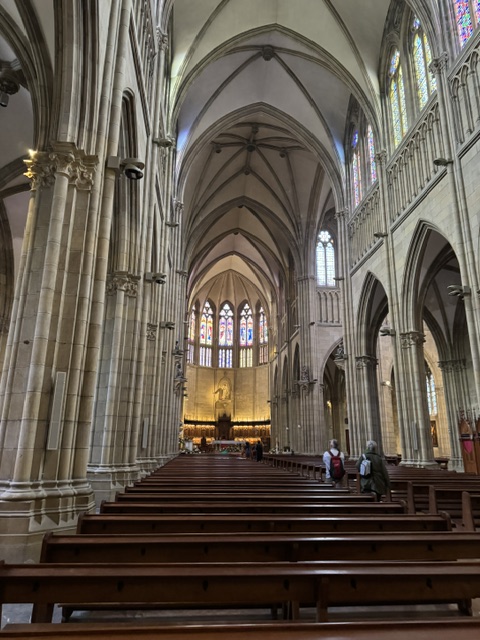
This is the Cathedral of Good Shepherd or San Sebastián cathedral. Rick looked up the history, and here’s a note from Wikipedia: The Spanish royal family, who were vacationing in the city, were invited to the laying of the foundation stone. The events took place on September 29, 1888. The queen regent, Maria Christina, her children and the Infante Antonio, along with ministers and other officials, attended the solemn mass that the diocesan bishop D. Mariano Miguel Gómez held in the provisional parish church of the Sacred Heart. Following the ceremony, the royal entourage moved to the site of the new church and there proceeded to lay the foundation stone, which covered a lead box in which were enclosed pictures of the Pope and the royal family, various coins of the time and copies of the Gazette of Madrid and of the Ecclesiastical Gazette. The minutes of the ceremony were signed by the baby king Alfonso XIII, aged two years and four months, for which his mother had to take his hand. It is the first signature of Alfonso XIII on an official document. 
It was built by Basque craftsman in 9 years (2 on hiatus when money ran out) on sand and marsh. Amazing. I liked it because it was much more simple inside than many. 

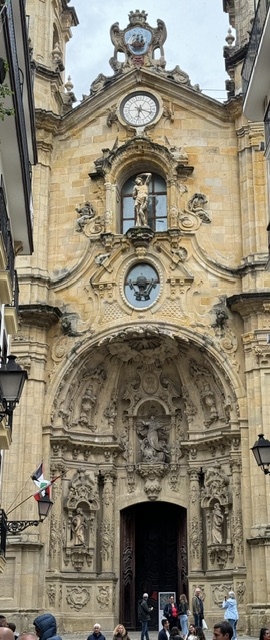
We found another church, the Basilica of Santa Maria del Coro and were able to sit and listen to choir music, that was wonderful. At the top you can see the sailing ship – that emblem is everywhere. It was the main port for the Basque region and it was a combo of port for whaling and commercial ships and a military fortress. But the marine life is much more vivid. 

We found another church, the Basilica of Santa Maria del Coro and were able to sit and listen to choir music, that was wonderful. At the top you can see the sailing ship – that emblem is everywhere. It was the main port for the Basque region and it was a combo of port for whaling and commercial ships and a military fortress. But the marine life is much more vivid. 

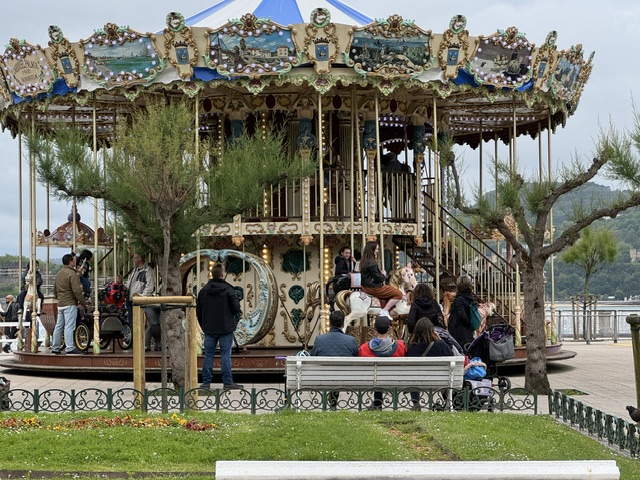
Cool double decker carousel on the bay:

The old town is gorgeous and we wandered up and down the streets and admired the bay and the incredible walls the town has put up to manage the onslaught of wind, sea, and boats that used to crash regularly. 

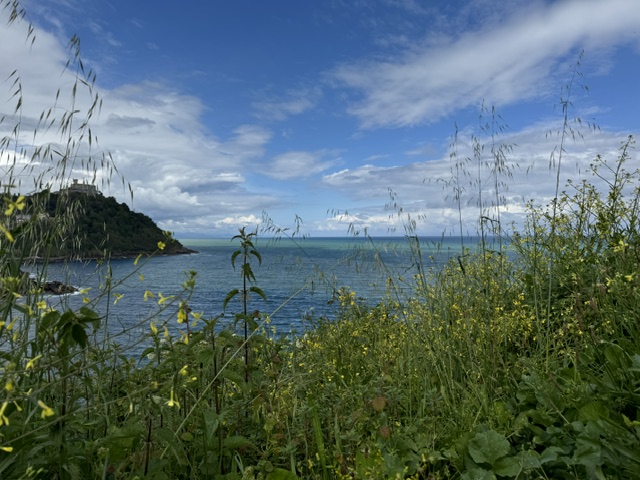
The Bay of Biscay is famous for wrecking ships. There’s a small lighthouse, but despite warnings, ships would get swept towards shore because there’s almost always a strong onshore breeze. Also, the Continental shelf, which means shallower water, extends a long way into the Bay of Biscay, and is responsible for many problems for mariners and the weather and sea state there generally. Rick and I had heard/read about it repeatedly so it was amazing to see. 

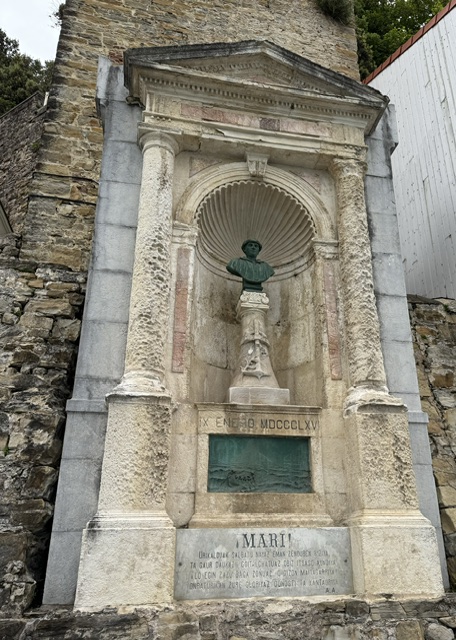
This statue is a memorial for Marti – the note said that he was fishing with his father by the time he was 9 and then sailed across to the americas for years. He then settled back in San Sebastián and was known for his kindness and commitment to helping others. He repeatedly went out to save people from wrecked boats. A boat went down off the shore and he managed to get out there and save everyone on board, but then a huge wave came and capsized his boat. Other boats had gotten out there by then and saved everyone again, except for Marti. 
After wandering, we came back to the room, made decaf tea and settled in to read, opened the windows and listened to the rain and the sea. A great night. 

Madrid, 18.May.2024, Saturday

We’re starting our Camino del Norte with a one-day layover in Madrid. We staggered to our hotel after getting off the plane, dozed for a couple of hours and then went out to do a tour. 

I’d read about Afrohispanica Tours with Kwame Ondo in The Guardian. It’s a tour in Madrid focusing on Black history. I was interested because I’d been following the reporting that The Guardian has  done with their stories on Manchester and other areas in England and how their rise and success was based in large part on the slave economy. This was Madrid’s reality and Kwame was terrific. Both Rick and I learned a lot we’d never known. And, no, I can’t remember everything, but here’s a few facts:

The banks in Spain were all based on the coast, mostly in Santander, and a lot of the money boosting the banks came from the slave trade.

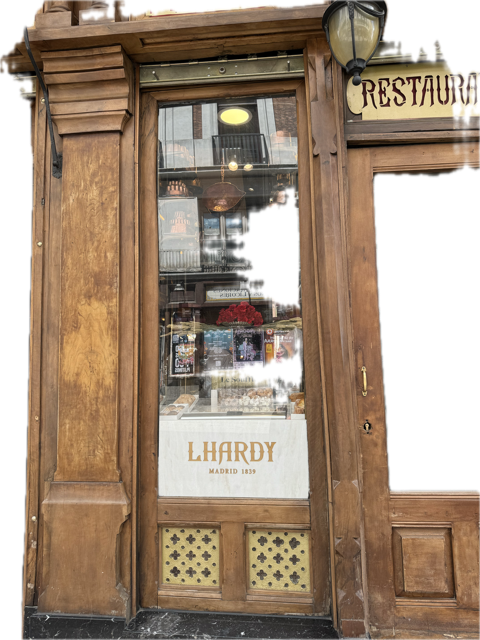
Spain supported slavery until 1873 when the president wrote and proposed the ending to the trade. He had to leave the country because wealthy families and businesses based on the trade were furious, but it was still passed. Both the president and the vice president were ardent abolitionists, so even when the president had to leave, the vice president took over. Thus the Spanish colonies in the Caribbean were among the last to abolish slavery, in Puerto Rico in 1873. The restaurant below is where the president wrote his proclamation:

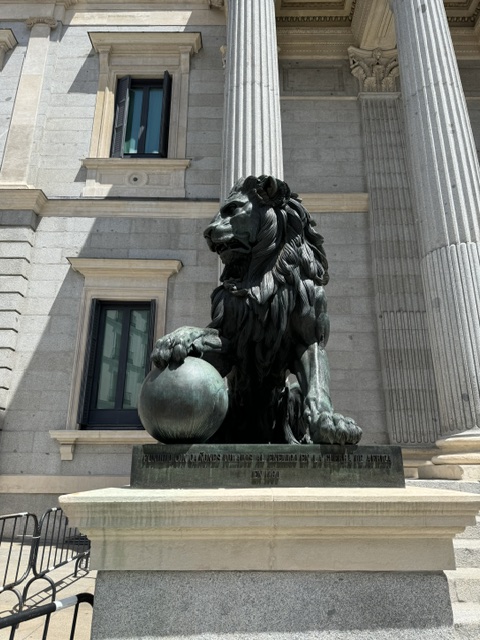
The lions in front of parliament were made from cannons from the Moroccan and Spanish war, when the Moroccans were fighting for independence. 

There was a conference, the Berlin conference, in 1884-5 when the European nations divvied up Africa for who could colonize and capitalize on the workers there. Maybe not enslaved peoples, but worked as if. How could we not have known this?

There was a street in Madrid named Calle de las Negras – for the concentration of enslaved women in that area. The name has now changed. 

King Carlos III was one of the biggest slave owners of his time, keeping 1,500 enslaved people on the Iberian peninsula and the 18,500 others held in Spain’s colonies in the Americas. As aristocratic families sought to keep up with the monarch, the proportion of enslaved people in Madrid swelled to an estimated 4% of the population in the 1780s. (Fact from the Guardian article). 

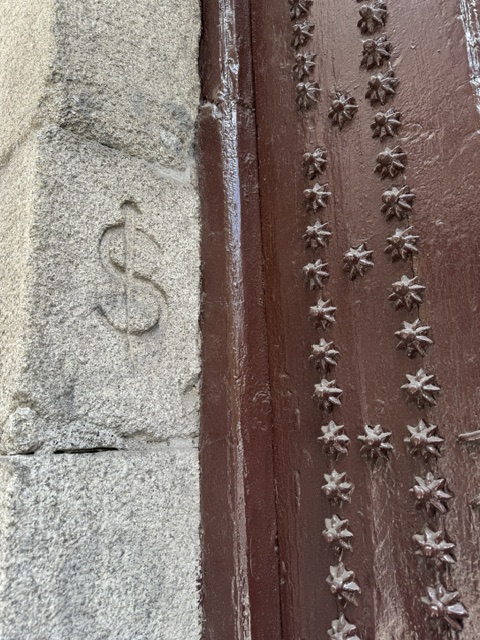
This is the symbol of slavery in the doorway of the Parish of San Ginés, we thought it was a dollar sign. But it’s an S for slave with a nail driven through it. Horrifying. And it’s on the other side of the church from one of the oldest bookstores in Spain – both connected to the church. One enlightened, one not.

The tour definitely broadened our perspective on Madrid and Spain’s Black history and opened the door to learning more about it. Thanks, Kwame!

Then Rick and I were the first to arrive at the restaurant at the hotel and had dinner and went straight to bed. We’re such an exciting pair of travelers.