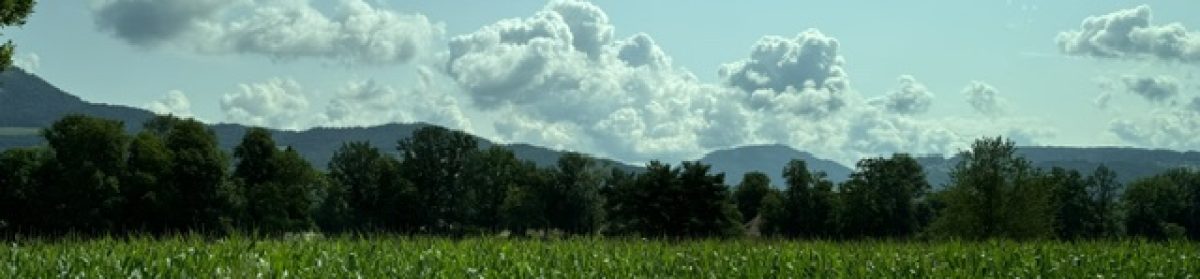
Today’s breakfast didn’t go well at the hotel, delayed, missing pieces, not great. So Kaziah and I ran out to THE place in Chania for bougatsa – the traditional treat for any time of day of filo dough enclosing sweet cheese and sprinkled with sugar or a less sweet cheese and sprinkled with sugar and cinnamon. This was to help sustain Eli C until lunch and it was delicious!
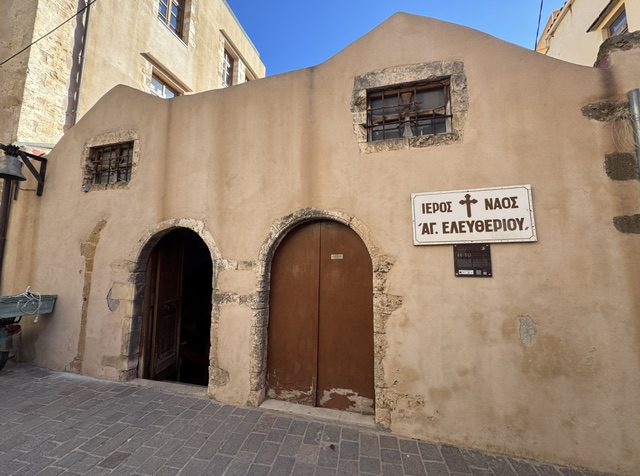
On the way, on our block, we passed a church from the 11th century and it was open. I veered toward it and Kaziah grabbed my arm and kept me moving. We realized this had become a pattern with the family, me veering, them correcting course. I really have become predictable. But the history! The cool insides, all slightly different, quiet. And for this one – for over 1,000 years, people have been coming here for comfort and support. I just love that. Ok, maybe tomorrow (this one is only open early in the morning).
Today we met our guide, Iro, at our hotel lobby and we drove to see a monastery that produced olive oil and wine (and Orthodox Christianity) and then to tour Chania.
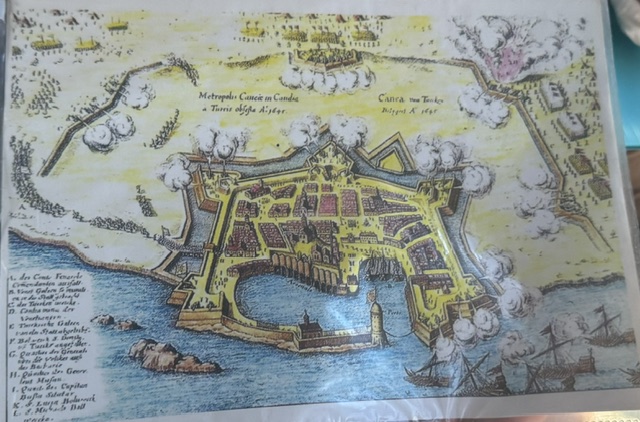
Iro was wonderful, completely delightful. So full of knowledge and loving her subject. First, we looked at the maps of Chania to see the original Byzantine walls, then the Venetian walls extending beyond, but still protecting the community. You can still see so much of this today.
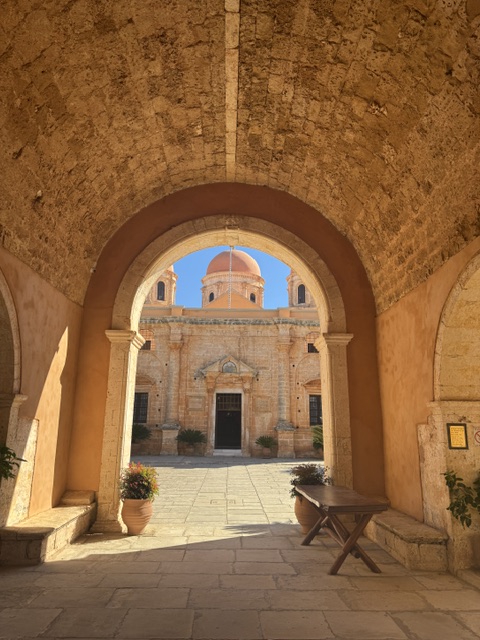
We then went to the The Holy Trinity Monastery, the Agia Triada. It was built in the 17th century by two brothers of the Venetian Zangaroli family on the site of a pre-existing church. This monastery had an interesting history of origin. The Venetians were Catholic and thus their churches reflected the western approach to Christianity. However, when this church was being built, the Ottoman’s were encroaching and the Venetians wanted to the support of the community. So they supported the building of an orthodox monastery in the hopes that they would sway the community to support them. That didn’t happen, but the community didn’t fight on either side – all were occupiers.
Probably related to this, there is fierce support for Palestinians in Greece, considered to be another occupied country. Signs, posters, shirts, people gathering to protest, especially visible in Chania.
Back to the monastery. It was truly beautiful and so well maintained. There are only 6 monks left and it has been continually occupied since it was built. The buildings looked immaculate because of renovation. They were not as clear about what was replaced as they were at the Parthenon and our guide regretted the lack of clarity in this aspect. But it was beautiful.
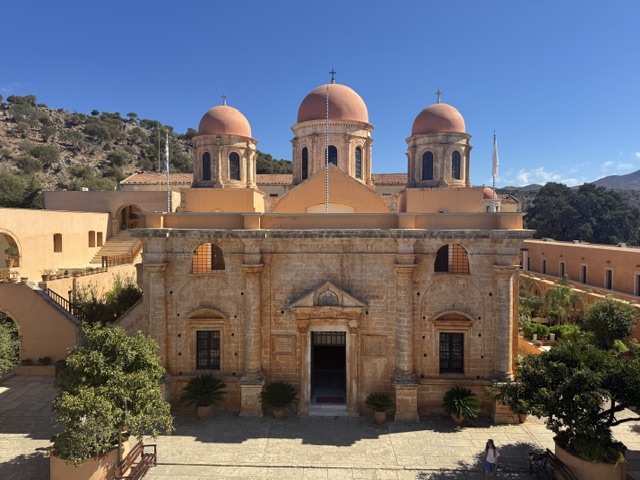
The facade of the church has double columns of Ionian and Corinthian style and bears an inscription in Greek, which is dated to 1631.
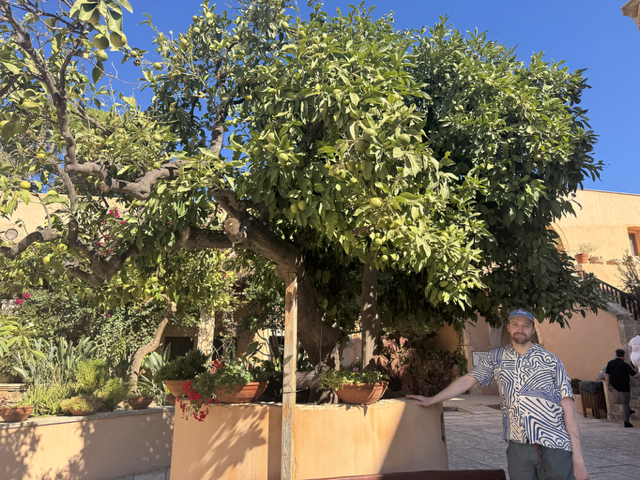
This tree had a plaque saying that is was from the original structure and was 600 years old. Iro was dubious, but we loved the idea. And olive trees can live for up to 5,000 years old, though usually their life span is 300-600 years. So this might be the original olive tree planted when the church was built.
We couldn’t take photos in the actual building, so I didn’t, but Iro explained some of the practices here and that was helpful. The reason so many of these churches are dark inside is the flashes of light off the lanterns and the liberal use of gold and silver was because these are glinting reminders of the Holy Spirit. The reason people would come in, greet an icon, do a circle of the church and then kiss the icon after making 3 signs of the cross is because it’s as if they’re physically connecting with the saint. I saw this done in every church. They said many fewer people are practicing orthodoxy, but in every church I saw men and women of different ages making this gesture to the icons.
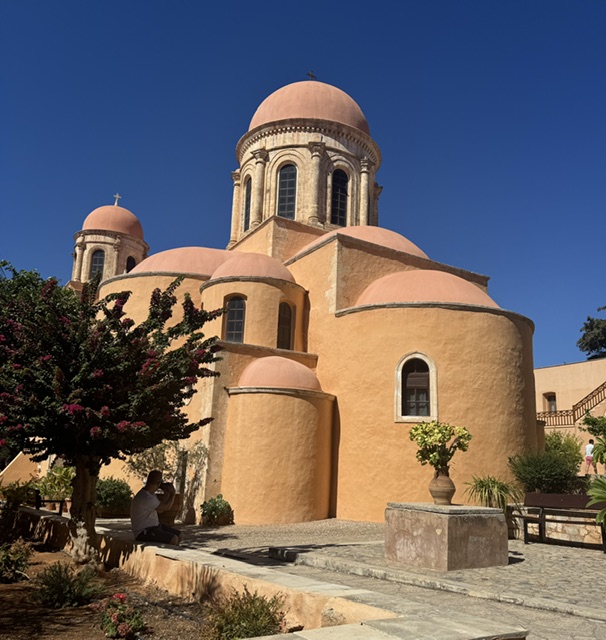
This is from the back of the church and shows a key element of the Orthodox Church. The rounded dome are to indicate the symbolism of the earth. Often inside in the roof of the dome will be a painting of Jesus with his arms outspread so as to say, all are in my care throughout the world.
We then went to look at some of the original oil production implements. To this day, all the land we could see was owned by the church/monastery. They are farmed locally and then I’m guessing the product supports both farms and the monastery. The products were sold out of the monastery’s store and they covered a range of oils, vinegars and wine.
This olive press was the first step, dumping in the olives and donkeys would walk in a circle with the giant stone grinder gradually reducing the olives to a pulp. This was then wrapped multiple times in linen and again pressed in another machine until it produced the oil. I said that yoke was huge for a tiny donkey and she said, no – they weren’t as big as a large horse, but they were much bigger than ponies. Still, probably not a great life for a donkey. But – the oil got made!
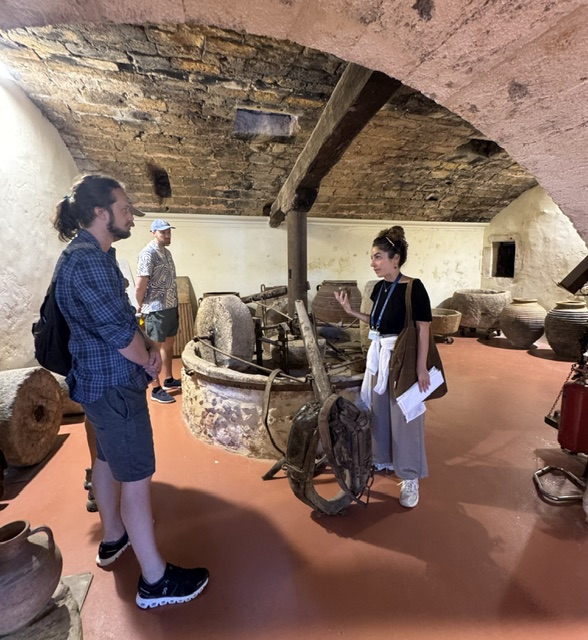
Even though I’d gone to the organic olive farm in Italy and had Cathy to tell me info, I’d missed the fact the olive oil ages rapidly and diminishes its antioxidants and all the other healthy aspects of the oil. I thought it aged and got better like wine! No wonder the wonderful oil I got from the Italian farm is no longer as fiery as it was when I first opened it. I’ll have to start using it up more rapidly. Everywhere a distinction was made between EVO – those first pressed olives – used for tasting and salads and the regular olive oil used for cooking. At lease I was already doing that.
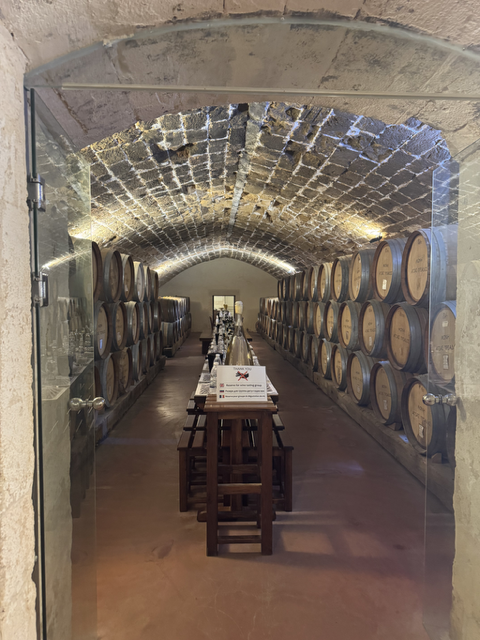
The wine cellar was beautiful, but none of us are wine drinkers, so we just admired. We did taste the vinegars and oils!
We then walked the streets of Chania with Iro and learned a lot more about the history. Which I’m not going to recount. Well, not all of it. This church was interesting. It’s the only one in Greece that shows the three different occupations. In the middle the Catholic Church built during the Venetian period. On the right most of the original minaret added in the Ottoman Empire and the bell tower on the left built more recently making this an Orthodox Church. The sign outside said:
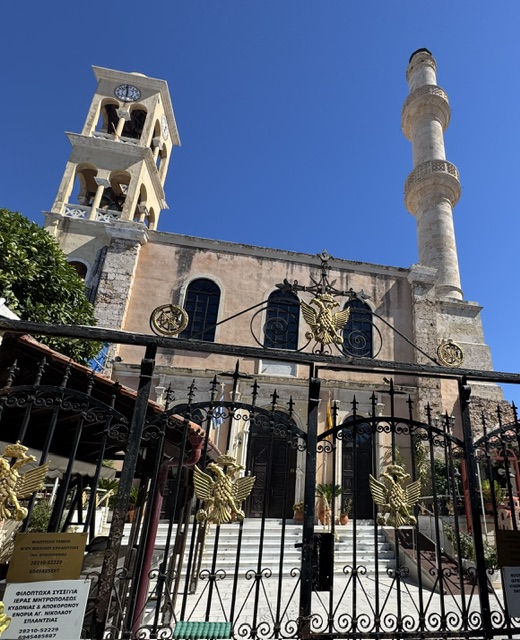
1205 Beginning of the church foundation
1320 Finished building by the Dominicans
1645 Occupation of the Turks
1918 The Church came back to Orthodox worship
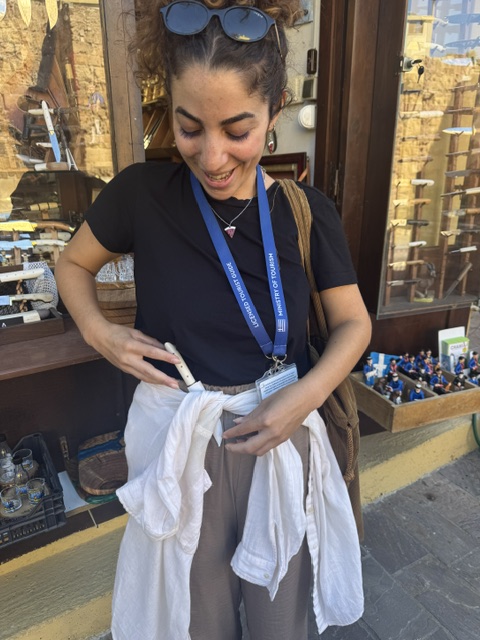
Here’s Iro demonstrating the use of a knife in early Crete. Our hotel was on the block that was the knife workshop block. There was one store/workshop left and nope, forgot to get a photo of it. However, she explained that getting a knife was a precious gift. On all blades was printed a saying, a poem, a message, usually of love. In addition, when a couple became betrothed, the man gave a woman a small (“useless because too small”) knife. The woman wore it in her belt and it signified that she was taken.
We then got a bit of a rest, cleaned up and walked the old city, getting dinner at a place Iro had recommended. Our wait person said the food was as good as his mother’s. And it was a great dinner!
 Reb's Walks!