Caveat to this section. Turns out between meals, hikes, transition, it was really hard to get time to write every day. So I’m now writing on the last day of the tour and trying to recollect a truly memorable week.
That being said, this will be the longest entry because of learning about the area and the people who settled here.
Today we met up with 3 others who were staying at our hotel and going on the Backroads trip. Turns out Bolzano only has 50 taxis and is quite a big city, actually second wealthiest in Italy. We were going to the Sheraton to meet and it was a solid 30 minutes away. If you’re going to Bolzano, definitely stay near the old town since it’s not that easy to get transportation early or late. There are buses, but time, and getting to where you want to go might be challenging.
So we met our first 3 new people taking a van together – all so nice and turned out that was true for the whole group.
We met for a check in at the Sheraton, to collect water bottles, luggage tags and snacks (turns out food would NOT be a problem on this trip), quick intro. What a nice collection of people between guests and guides. Just a treat for the whole week.
We had our first 4 mile hike on route to our first on route hotel, so we’d come dressed with day packs while the bus took our bags to the hotel after we were dropped at the Gondola.
We started our hike in Welschnofen and took a gondola ride up to the Catinaccio mountain group in the Dolomites. Per our guides, the “Dolomites” was taken from the name of a French geologist, Déodat de Dolomieu, who was the first to describe the type of carbonate rock abundant in these mountains. Evidently he was a chemist and was trying to figure out the mixture of elements in the rock because it was known that it wasn’t pure limestone. He finally add acid to the rock and unlike pure limestone, which would have bubbled up, it stayed stable and he realized that the make up of the stone was almost half calcium carobonate and half magnesium.
There is Dolomite rock elsewhere, but the unique geological history of this area came about because it was once a marine area fully covered with coral and other marine organisms that settled into dolomite rock. When the plates came together and created uplifting, these unusual mountains were formed. This was an important part of our talks by several guides, a lot of pride in this area of their unique mountain region within the alps. And deservedly so – it was spectacular.
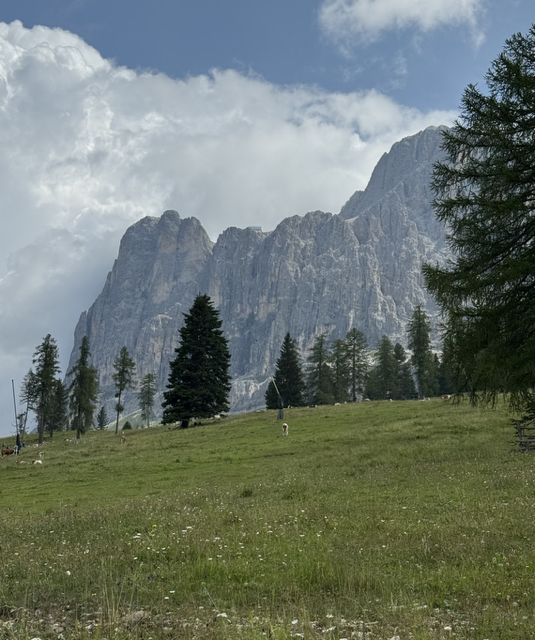
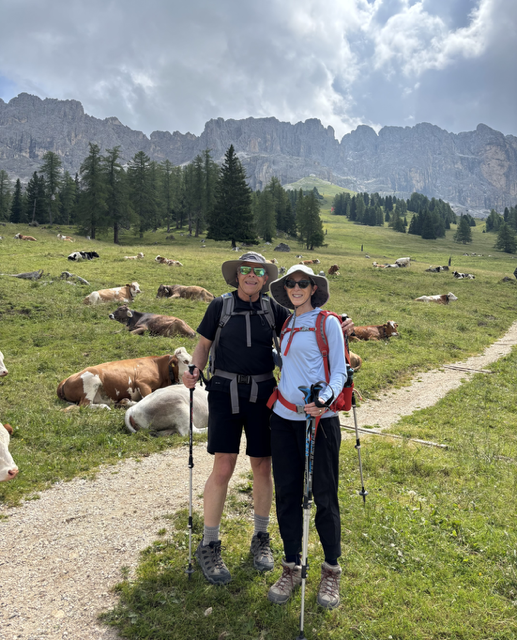
Coming from the Rockies, it was startling to see such distinctly different formations. The vast mountain meadows with these dramatic peaks towering over us had all of us taking photo after photo in a vain attempt to capture the beauty. We were hiking, but this is a winter wonderland evidently. Even with climate change happening – and that was talked about a lot – snow was still the primary driver in this area. You can see a snow making machine behind the cow.
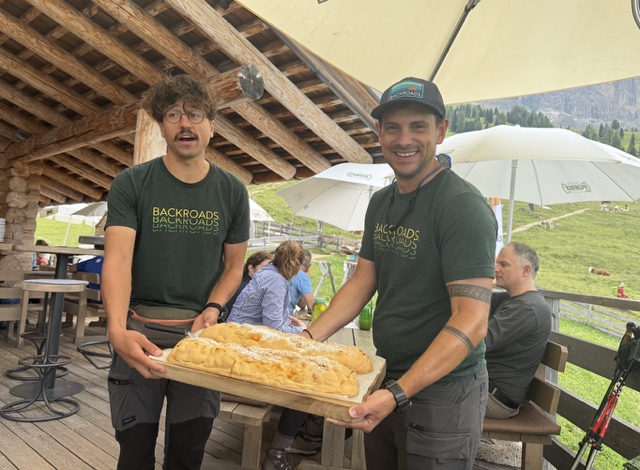
Today set the tone for the rest of the week. We hiked from the gondola drop off across the mountains to a lunch at a rifugio – an alpine hut that was one of a series across these mountains. The scenery was just a start – we couldn’t believe how beautiful it was. Seemingly inaccessible, even if a gondola went up, we had the most incredible lunches every single day. A huge variety from which to choose, plates of salad, bread, meats and cheeses promptly put out to greet us to get us warmed up for whatever we wanted from the menu. Really? Astonishing amounts of incredible food. Today’s specialty was the Apple Strudel. It set the tone for Rick – needing to assess apple strudel in every rifugio. This first one set the high bar. Here’s Luca and Martin holding it up for demo before cutting in.
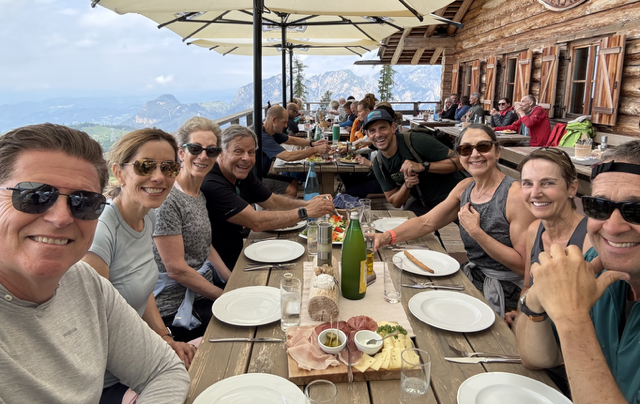
I was so conditioned from Camino food routines, small breakfast, a few snacks, big mid-day meal and little to no supper, made me think – I’m not going to like this whole 3 meal routine and how can you hike after a lunch? Well, turns out, just fine. Oh my goodness, the food was so good, the company was wonderful, the views incredible – every day we just relaxed into these lunches and then carried on after.
We never stopped marveling at these primarily family-run rifugio’s ability to quickly put out these incredible meals, handling a fair number of people with ease. It was also starting to hike for miles seeing some, but not a ton of people and then arrive at the rifugio and all these other people were there too. There are trails all over these mountains and people come all different ways to explore. Sometimes there were dirt roads (rare to see cars), so bikes and trails with different levels of difficulty offered a variety of ways to get up to these places.
We were a group of Americans, one from Peru and one from Portugal, but the rest of us were mono lingual and just marveled at this area. Depending on where the line was in the Dolomites determined German/Italian/English, OR Italian/German OR Ladin/German/Italian. Kids are growing up with 3 languages, one week for each sequentially and then when they get older, subjects moved to a particular language. So cool.
The history of this area is that of Tyrol. The people consider themselves Tyrolean and Ladin was the earliest people and language spoken here. Again, the area determined the languages spoken. We got a synopsis lecture on the history of the area – but I didn’t have my iPad and a lot of the specifics went out the window. What I remember: Italy became a country in the late 1800’s. The northern part was Tyrolean and went back and forth between Austria and Italy. At the time of WWII, this area was part of the Austro-Hungarian empire.
Italy, Austria and Germany made a pact to all defend if one was attacked. When the Crown Prince was assassinated, starting WWII, Austria attacked Russia along with Germany. Italy held out as a neutral territory, wanting Austria to give them Serbia and Croatia if they joined in the war. Austria said no. Then France and England jumped in and asked Italy to join them along with Russia. Again, Italy asked for territory – if they won the war, they wanted the Dolomites and Tyrolean territory. Done. So – very much against many of the Tyroleans who spoke German and considered themselves Austrian, they were now Italian territory since France/England won the war. It’s now settled, but memories are long and the languages reflect the different alliances.
Story of the Ladin in the Dolomites
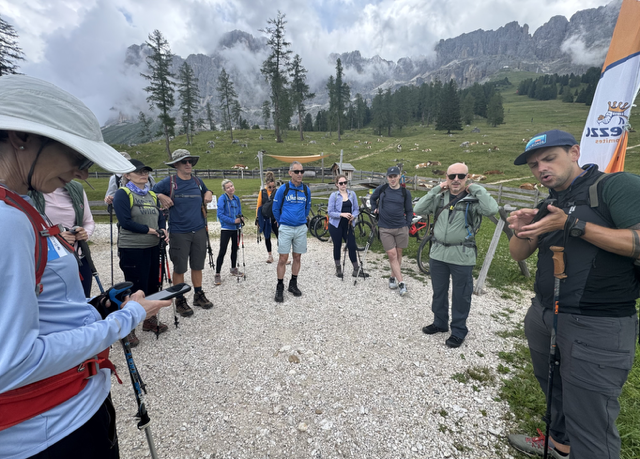
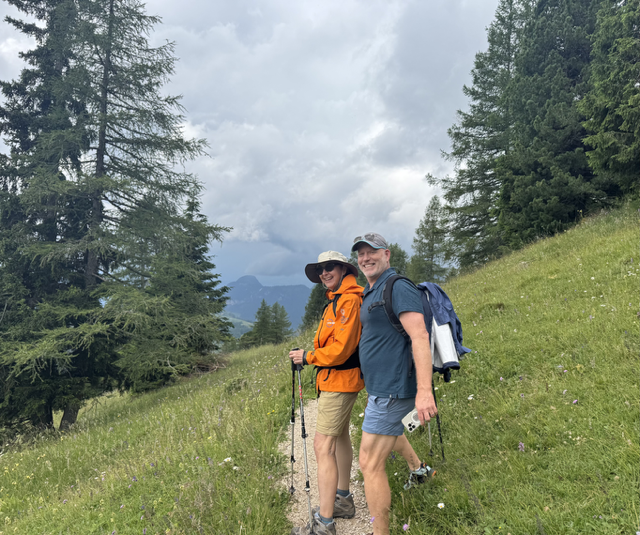
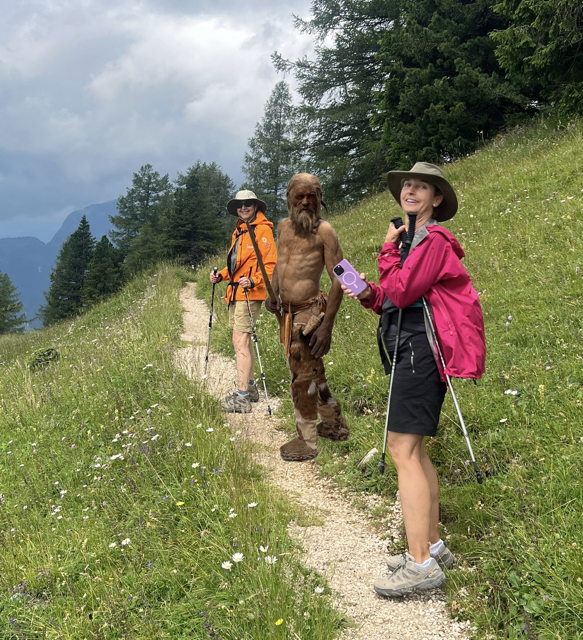
And now – to the hiking. We had our first experience of the mountains. It was a bit rainy, but not enough to deter us (and so much better than the torrential rain predicted) and the group was such a congenial group, there was a lot of chatting and exclaiming together. The hike went very quickly both before and after lunch. Matthew made sure the Ötzi joined us on many days!
We’d always start with a brief overview with a drawing and description. Backroads had great mapping and tracking on their app and I didn’t look at it once. But I would have if I’d been alone or up in front as our super woman, Michelle, was fun. But I usually brought up the back. I’m steady, but not quick!

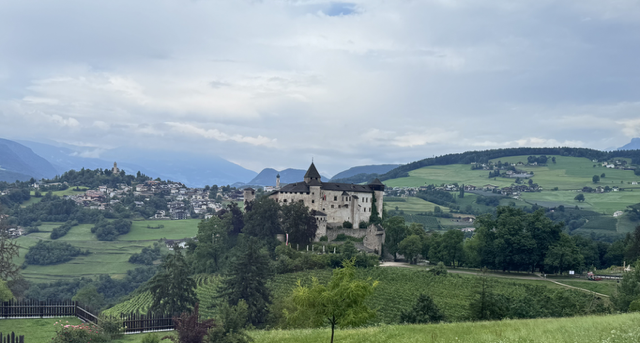
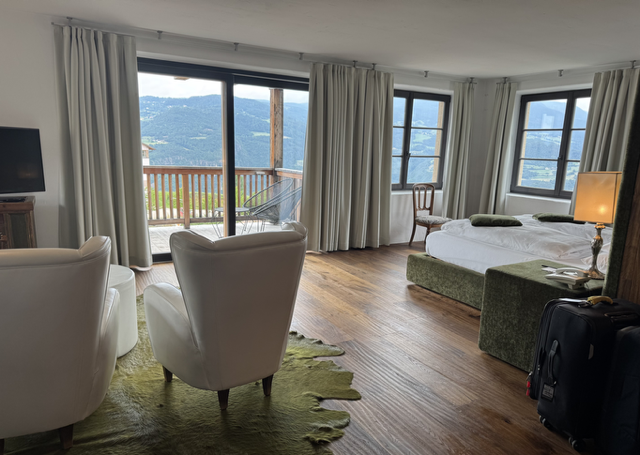
We arrived at our hotel and oh, so much fun, right up my alley. It was a historic building, a tower, built in the 1200’s. The Romantik Hotel Turm was originally a residential tower, first mentioned as a courthouse tower and jail in a document in 1244. Sold to a Monastery in 1398,. Used from 1820-1833 as a vacation resident by a Bolzano family. It was converted to an inn with attaché butcher shop i the late 19th century. [The rooms were so individual, a few of us traded looks just to see what had been done. They were really big and every one had spectacular views. It didn’t matter which direction you looked, it was beautiful.
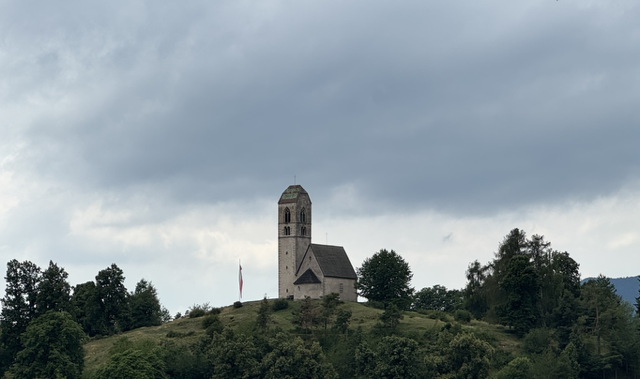
Rick and I went out to explore after cleaning up from the hike. We were in the heart of this tiny town and the church right next door was incredible. Rick thought it might be the most beautiful we’ve seen in our travels. Evidently Italy has a fund and helps take care of these historic structures.
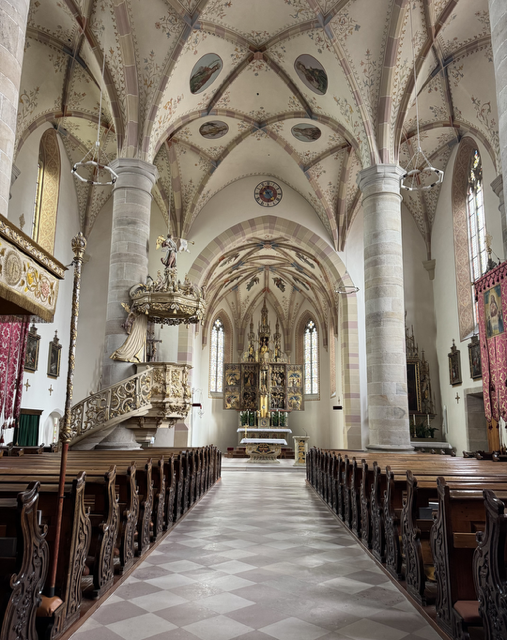
This one was immaculate and the organ incredible. On our last morning, the organist was practicing for 9am mass and I got to listen for a bit before we left for our next hike.
Outside monuments were interesting. This one was to WWI and was painted in 1921. This was on the wall of the church entry.
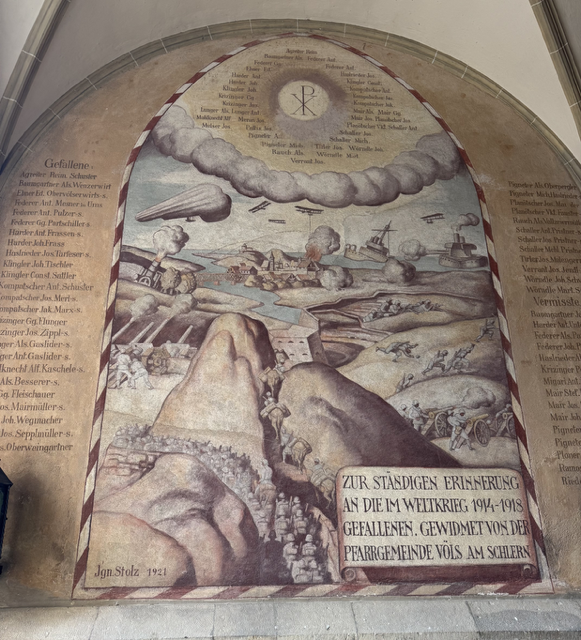
This monument had us stumped. We’re so conditioned to one way of thinking for WWII and this seemed to celebrate Germany. However, later on one of our hikes, I saw the same helmet painted on a dairy barn door and realized that it may have been more of an emblem of the Tyroleans who had died, no matter the side they were fighting on.
The cemetery was beautiful as well, so well tended and cared for, with many photos in the crosses that served as headstones. It made it feel very personal.
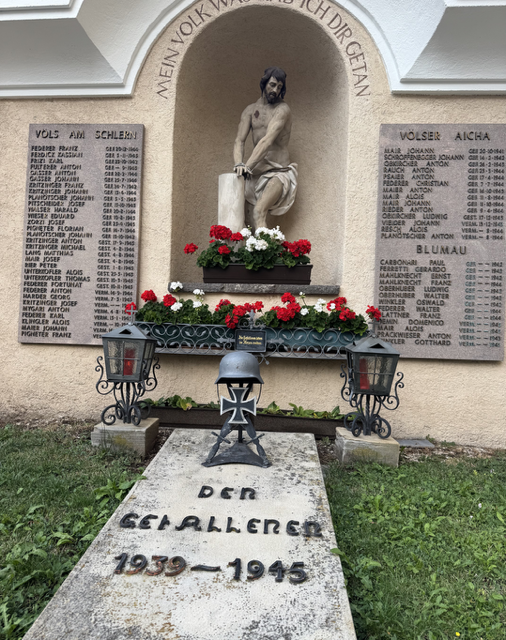
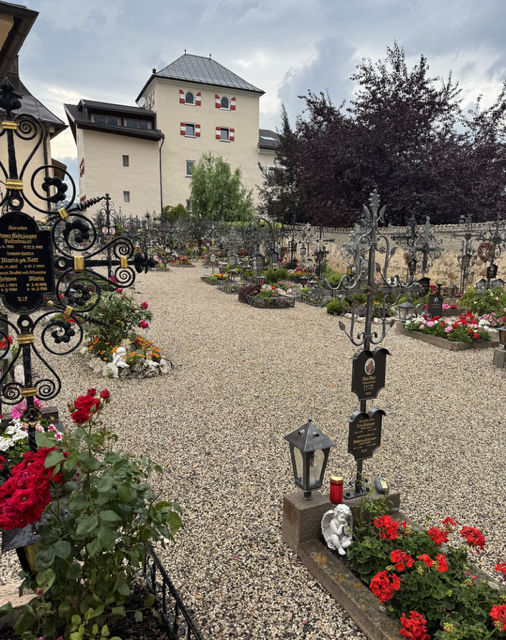
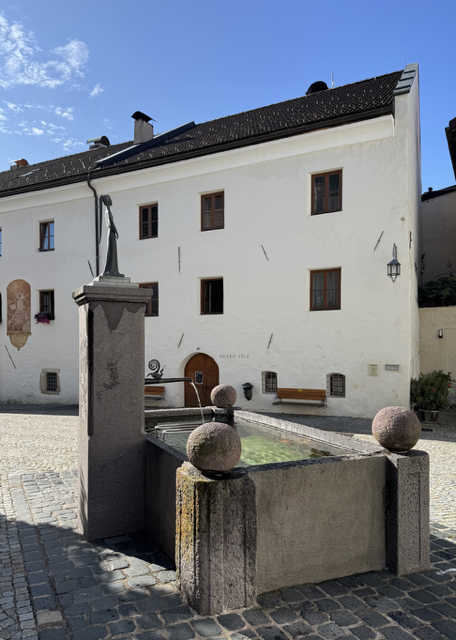
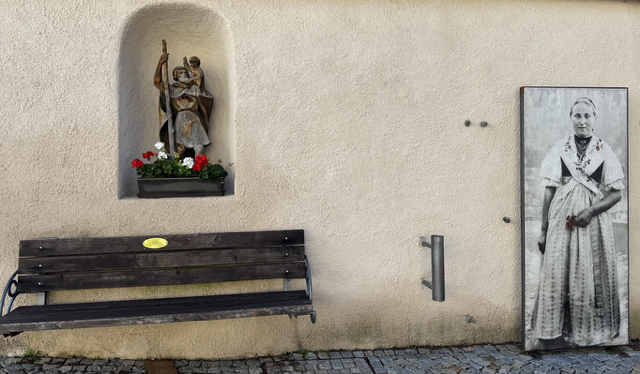
The town fountain was beautiful and there was a local exhibit of an artist’s photos around the town sharing the lives of women in the area.
Finally, strikingly, the benches all through the town had yellow oval medal plaques with quotes asking about life. I translated all of them because I was so curious.
Wolf Schneider’s “diary for the Essentials”
We don’t know who we are, where we come from, where we are going and what we can hold on to.
…In this sea of vagueness, of “It could be – but it could also be different,”man seeks security and in doing so renounces truth.
And today genetics and neurobiology explain…For Brockman, the conclusion therefore seems inevitable that the natural sciences hold the key to the answers to humanity’s important questions:
What am I? Where do we come from, where are we going? How does society work? Hubert us Breuer
Each of us has a story to tell about who we are, where we come from and where we are going. These stories shape our personality, create our certainties and our fears. Andreas Barella
Social work begins with the guest ion: Who is in need?…These are the biblical questions: Who am I, where do I come from, where am I going? This gives rise to very practical challenges. The Jesuit order sent me to Romania in 1991…and the CONCORDIA work was born in Romania and the Republic of Moldova. Father Georg Sporschill
If man comes from heaven, he returns there. To answer the question: “Who are we, where do we come from, where are we going?” …and there are still some who think that man has made a long journey and is not of this world…. Alessandro Conti Puorger
Wolfgang Nethöfel: Being Pious
Piety is a domesticated wild animal…if you let it off the leash of morality. And within this beast lies the knowledge of where we come from, who we are, and where we are going. Our guide dog walks on the reins of morality.
And there were many many more.
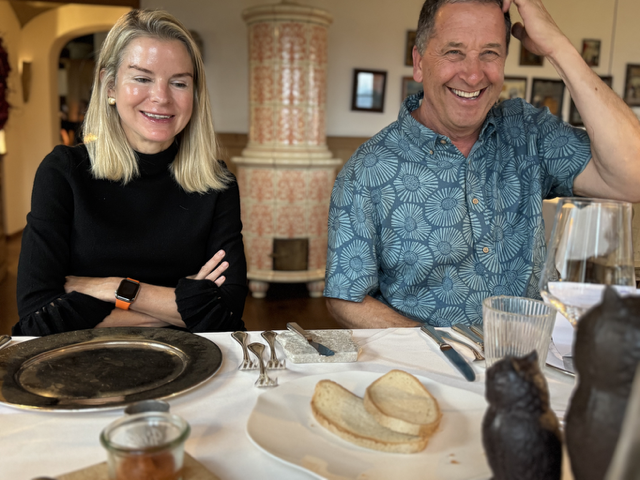
The end of our day was a group welcome cocktail/mocktail gathering and a great dinner at the hotel. Rick – laughing. We laughed a lot on this trip!
 Reb's Walks!