Greece, 3.Oct.2025, Friday

Meteora and Thermopylae

The word Meteor means suspended in the sky. There used to be 24 monasteries on the top of these mountains. Now there are 6 and 2 of them are converted to convents. They didn’t have enough monks who wanted to live a secluded life, so the archbishop converted 2. The ascetics  (word derived from asceccsis sp?) meaning exercise, mind, body, etc. They started in the caves here in the 12th century. They would come down periodically for services and to get what they needed to survive in the caves. 

In the midst of the rock wall that we could see from the van was a small area carved out of the wall with flags showing. Every year on April 23, ever since the 14th century- men would go up/down climbing with their women’s scarves to dedicate their faith to St. George. Some would climb by perseverance – then would throw rope ladders for others, and use nets and baskets to bring up what they needed to build the chapel. Now men and women go to visit. Incredible. 
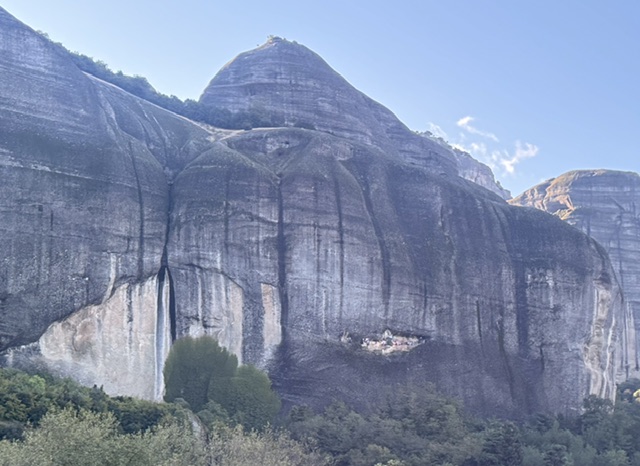
What makes a monastery? Needs to have a church and more than one person. Needs to be a community in practice. Try to be self-sufficient. It often started with an ascetic – lives by himself in a natural cavity completely isolated from the world. Hermits – derived from the work hermos – desert. Jerusalem ascetics. But these were called ascetics. 

We passed by the St. Nicholas monastery – by itself on the rock. The whole thing was built with nets/baskets to bring up the material to build it. That’s the only way people could approach. Cistern for water. Build a courtyard to grow vegetables. Meat would not have been part of their daily diet. Bread, olives, onions, tomatoes would be their diet. 
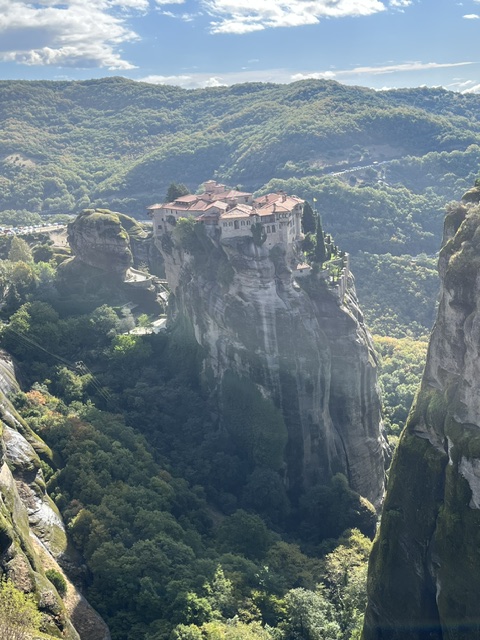
Visitors can go – there are cells where people can go on retreat – can ask to spend time there. Need to be Greek Orthodox. Oh my lord, they dropped down sheer walls for people and goods to come up. We passed the one to St. Nicholas, closed on Friday, where the balcony that was the drop spot was so high, I couldn’t see where the bottom was from the road. Plus, I really didn’t like looking, frankly.

Our first stop was the Holy Monastery of the Transfiguration. It was started by the Saint Athanasios the Meteoritis in the middle of the 14th century. He set down the rules by which the community was to live in this first monastery and all other monasteries followed these guidelines. He started in a cave and gradually others came to practice and study with him and the monastery grew. The Blessed Athanasios (he’s been sainted) wrote/said? “I place you under the roof of the Blessed Virgin Mary which is the purpose of this monastery.” He was succeeded by a prince who became a monk under his guidance, who built up the monastery closer to what it is today, named in honor of the Transfiguration of Christ. The skulls of both these monkeys are saved here and honored on the 20th of April every year. Now the monastery looks huge, but only 3 monks inhabit it. However, there’s considerable space for Greek Orthodox who want to go on retreat short or long, now both men and women can be there. The way up and down was by net and baskets. Incredible. Now – we can walk up carved and built stairs – otherwise I definitely wouldn’t have seen it. 
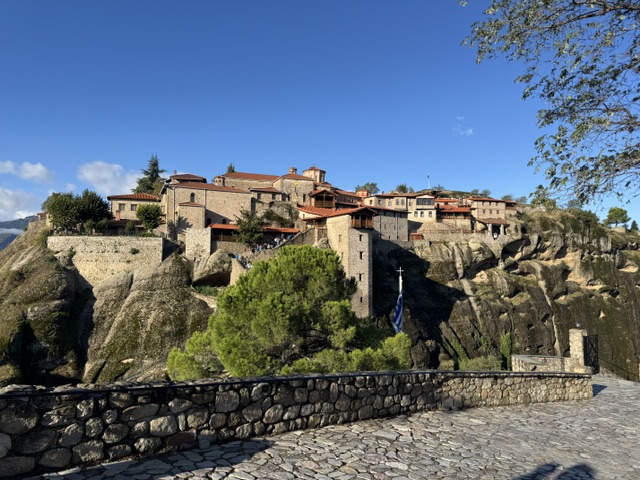
If you look closely, there’s a wooden balcony just above and to the left of the flag. That’s where they dropped the nets to bring up visitors and necessary commodities. Needless to say, it was much smaller in those days without accommodations for extras or rarely extras. 

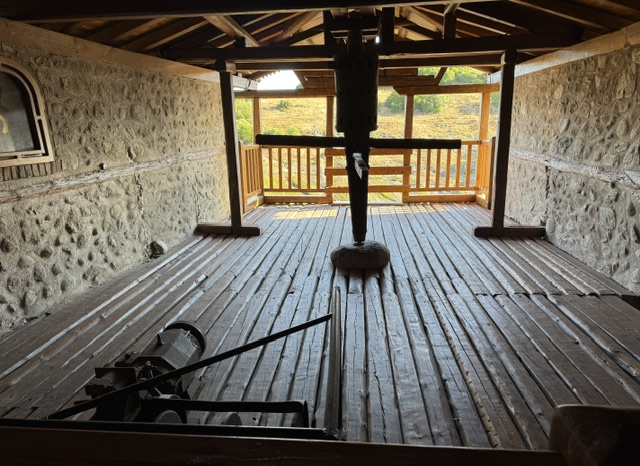
Here’s the pulley system and rotating spindle that you could push against to raise and lower the nets and baskets
When we were in the chapel, Katarina added more information for the Orthodox practices. Over the exit door is a painting of the sleep of Mary, that’s the euphemism for death. In fact, the word for cemetery is derived from the Greek word meaning the place of sleep. Standing over her is Jesus with the image of her rebirth at the second coming resting on his hand. To the north is Jesus’ resurrection. Super interesting because it’s entirely different from the Catholic images we’re used to. In this image, Jesus is descending into Hades, stepping on the door, all the locks and keys are to the side and the angels are holding back people trying to stop him. He’s reaching down to two coffins – Adam and Eve – taking their hands and pulling them up as the start to the second coming. 

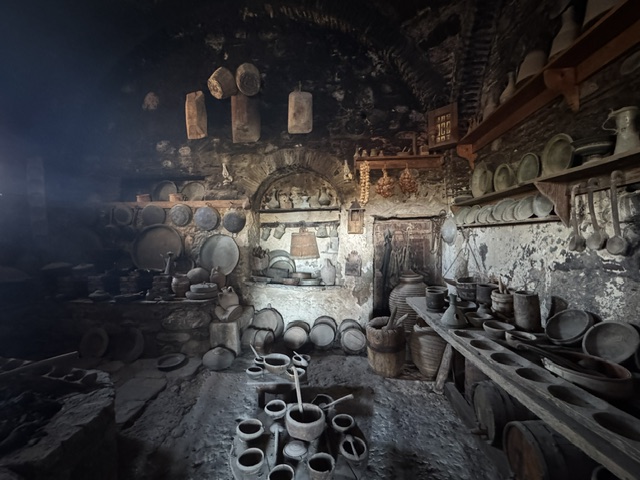
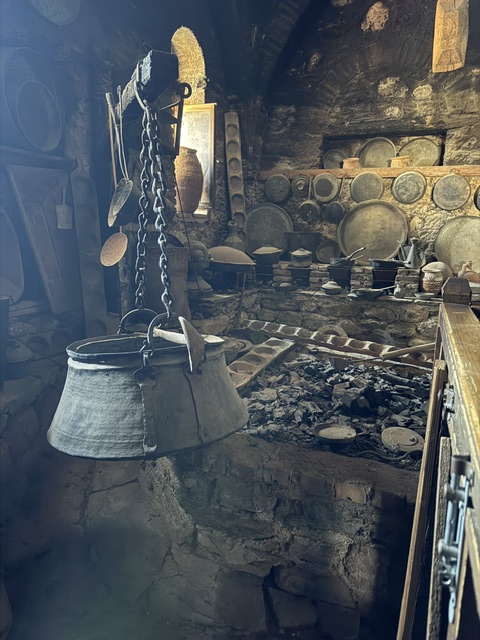
Katarina also told us a lot of stories about visiting her grandmother in the summers in her home village. When we saw the kitchen in the monastery, many of the elements were used in her grandmother’s kitchen. The monastery closed this kitchen in the 1950’s when they built a new kitchen for those coming for retreat. In the 1980’s it was made a UNESCO site and tourism grew and funds helped restore and build to make it an accessible building. They clearly had a lot of people who were eating up here in those days.
Katarina also talked about going with her grandmother at least once a summer to the monastery near her village, but similar to these, built high up on a wall of the mountain. They would spend the night, get clean, fast for a long time, go to confession and then to the service. She said it felt like a theater to her when she was little. People stand for the service, though there are some chairs along the walls that look like the choir stalls you see in old Catholic churches. You pull up the seat and stand in the space, but there’s a little leaning shelf where  you can rest a bit. So she’d be standing, the service was in Eastern Orthodox Greek, understandable when you’re older and listening carefully, but when little just flowed over here. There were candles, murmuring, singing and incense. She said that sometimes because the fasting was for a long time, she would feel very faint. I’m guessing those services left a big impression. 

During Ottoman times people could practice, but not make a loud noise about it. Literally. So no bells to call people to service. Instead, the monks made this long wooden plan to hit with a mallet and it gave different signals depending on where and how it was tapped. In addition, to the left was a small chime that could be used for the main services to call the monks.
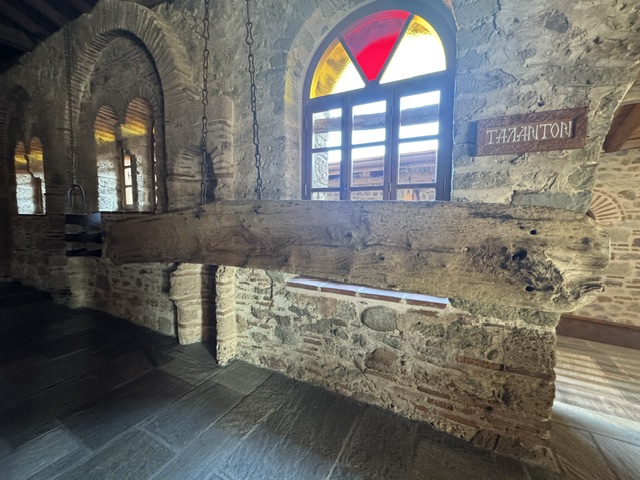
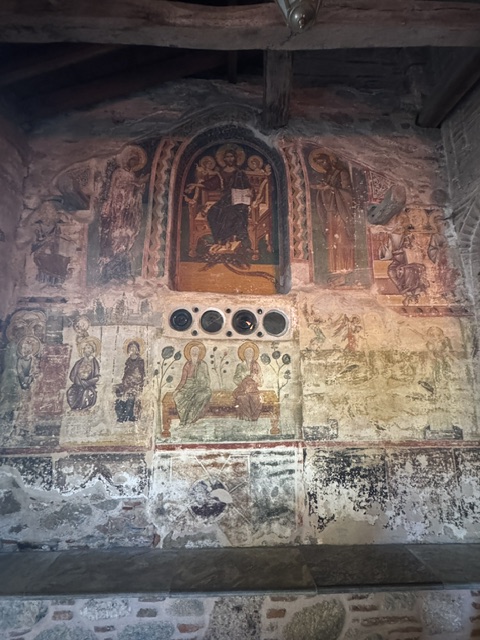
The whole monastery was painted with icons and frescoes telling stories. These are original and have held their color so well because of the protection, over 400 years old. 

Below is from the courtyard of the monastery.
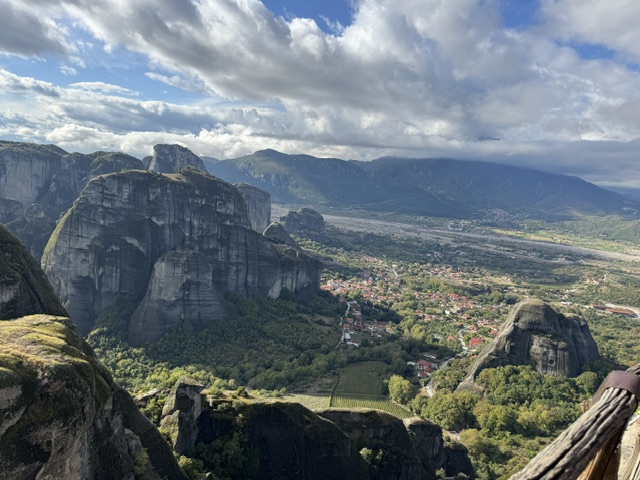
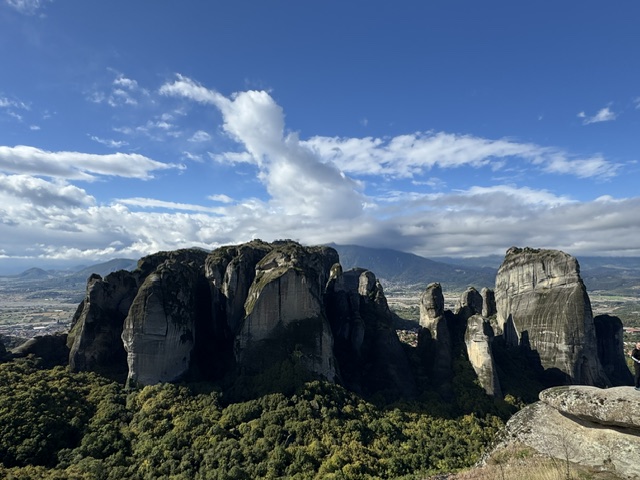
And this is the first monastery we were just visiting from a distance, hard to even see and how in the world did they build this? I mean, I know, lower a basket for supplies, but really?!
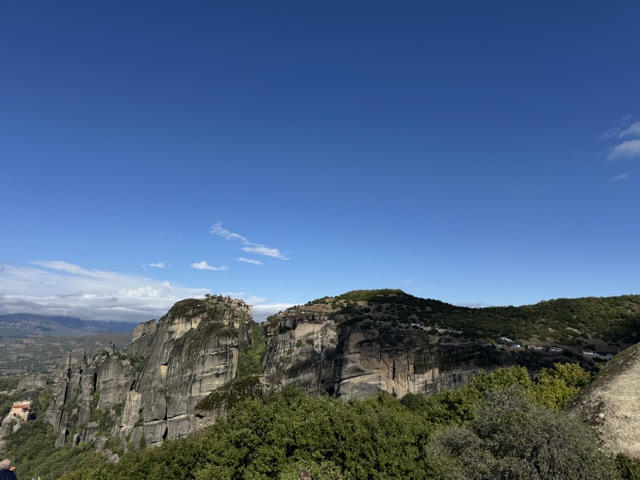
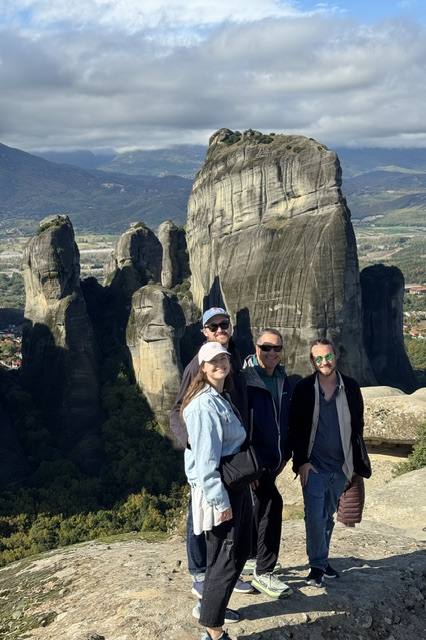
I was hiding in the bus to avoid the photo opp heights and the driver told me that the caves were caused because high winds spin small amounts of sand that gradually eroded out a space “some are big enough to park this bus (20 seater)”.  There are a lot of winds in these mountain tops, but it was gorgeous when we were exploring.

Here the rest are standing near the edge of the photo opp:
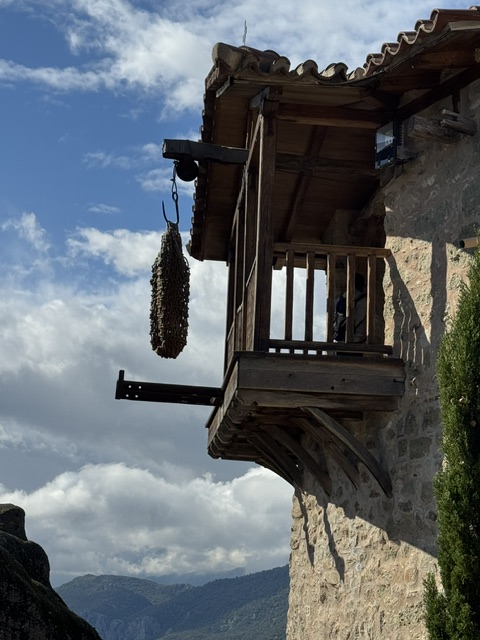
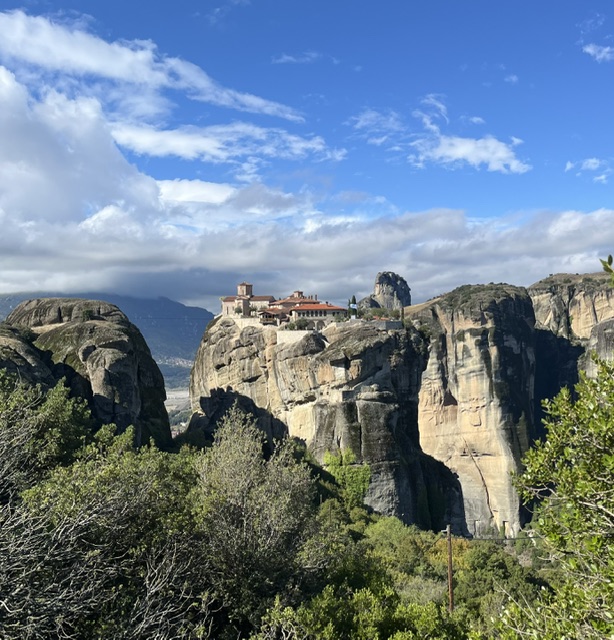
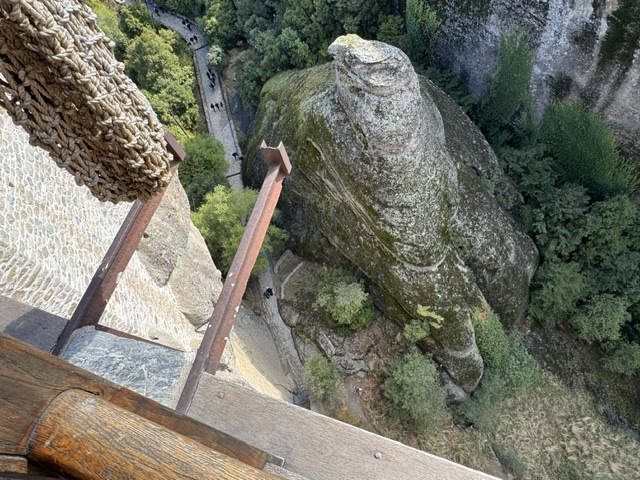
We then stopped at the Monastery of Holy Trinity. This was a higher climb so fewer tourists go, and again we were grateful that we were traveling now and not earlier in the summer when there were so many tourists, it was hard to see anything. This monastery still had the net hanging outside showing where transportation happened. It’s hanging off the wooden balcony about mid-way up the building. Straight down. I did NOT go near to look down, but Eli C took photos for me. This monastery also currently has 3 monks. They transport both here and at the main biggest monastery via a small cart that crosses on wires – looked totally sketch, but definitely easier to get groceries in!

The stairway carved into the hillside is courtesy of UNESCO funds. Thank you!
Looking down from the balcony – I didn’t take the photo
We drove by 2 convents and they have more occupancy, up to 23 or 24 nuns and some come from other orthodox communities. Here’s one of them seen from the second monastery. This is the most visited of all the sites because there’s a bridge from the road to the building, no stairs.

There were courtyards and gardens – they must have started with crating dirt up and over time more accumulated. Notice the skirt – no women were to enter with their knees – even the idea – showing. 
On our way back to Athens, we stopped at Thermopylae. The word means – steam and gates – there are hot springs here and have been since 5th century BC. In addition, in earlier centuries it was a narrow width so could be considered a gate. They did excavate and found arrows and blades that were Persian and dated from the time of the war. Thus, it was confirmed that this is where the famous battle was – however, it was just a hill where they battled, there were no ruins or buildings to excavate, so they put a plaque down to commemorate and built a new monument to King Leonidas. 
Where we stopped used to be a narrow space between the mountain and the sea and they’d built a wall between the mountain to the sea. 10 years earlier, the Greeks had successfully defeated the Persians, but they came back and conquered. The famous battle happened here between the Greeks and the Persians, with the Spartans leading the land forces and the Athenians leading the naval forces. Now – it’s hard to imagine how they could have blocked the Persians because over time a river coming down the mountain brought soil and silt, and the sea moved back so it’s now a big opening from the mountains to the plains. In the 5th century BC though it was a narrow opening and, this is where the Spartans took a stand against the Persians, delaying them from passing into Greece. 

However, they had been betrayed by a Greek man who showed the Persians a local trail through the mountains in order to surround the Greeks. The leader, King Leonidas, asked 300 Spartans to stay, they all had to have sons back in Sparta because they knew this would be a suicide mission. They had a 1,000 other Greeks from other areas also taking a stand as part of the force. The goal was to hold back the Persians long enough for others to get away and protect what they could. I guess there’s a movie about this, books, stories, I’m afraid I was ignorant, but Eli W and Rick knew about and wanted to see the spot. 

Evidently the Spartans (I mean I do know the Spartans) had a saying, come back carrying your shield or being carried on your shield. Either you were victorious or you were dead. They were also the only Greeks whose woman competed and trained at the gymnasium (separately from the men) because they wanted them to be strong women who’d give birth to strong sons. The sons were taken at 7 years to train as soldiers. 

We came back – it took 6 hours – to get back, a lot of it because of Athens traffic. But the consensus was that it was worth the trip because of Delphi and Meteora. The next morning, Rick and I were in a cab and the driver asked where we’d gone. When we said Meteora, he said, “Oh that’s really special. Islands, beaches, that’s normal. Getting to see Meteora is wonderful.” 

We went to dinner at that great store/restaurant we’d see with Valientini – Ergon. And it was wonderful as advertised!
Greece, 2.Oct.2025, Thursday

Katarina our guide was great. I wrote a few notes in the van as we drove north towards Delphi and Meteora. We were driving into new territory to us and she said that 80% of Greece is covered by mountains and hills, Olympus is the highest at 10,000. Parnasus goes up to almost 8,000 feet and Delphi is there.

Helas is what the Greeks call their country. In the 6th century BC, the Mediterranean Sea was actually a Greek sea since the Greeks owned all the land around. Barbarbar – was the word they used for barbarians – for those who didn’t speak the language and weren’t cultured. 

On the way to Delphi, we passed the dammed Marathon lake that was the sole source of water for Athens until the 1950’s. The Marathon race gets its name from this area. The Greeks defeated the Persians in 490 BC and the fastest runner, chosen by the king, ran back 26.2 miles to Athens to let people know. He gave the news, then dropped dead. Happily, the outcome is different for most who run marathons these days. The marathon is held the first week of November here and is huge. 

Now passing Thebes. Thebes, Argos, and Athens have all had continual occupants for 5 millennia. Thebes is the birth place of Dionysius, god of wine. The most famous offspring of Thebes was Oedipus. 

We passed through a small town before Delphi. In WWII, Mussolini demanded that Greece allow the Italian army to invade coming from Albania. They said no and had success pushing them back. But then the Nazis crossed the border from Bulgaria and within a couple of weeks, the Nazis reached Athens and put the swastika flag on the Parthenon. Right away, guerrillas, men and women, immediately went to the forest and started attacking transport trains, bridges that supported them, etc. Each time they had success, the Nazis would decimate a village.

4/12/44 end of the Nazi rule. On the way out of the country, the Nazi’s destroyed everything they could, canals, fields, villages, etc. This really pushed the farmers to move towards Athens, nowadays the trend is being reversed. People are starting to move back towards their families villages houses that were still held and kept when they moved away. The people who moved back post/curing COVID are doing tourism, agroturismo, or farming. 

Agachova – we drove through this incredibly picturesque mountain town, so pretty. But in the van, so I don’t have photos. 

The Panhellenic Games were the biggest of the competitions that brought all together, in the name of Zeus. The second biggest were in Delphi in honor of Apollo. The symbol of Apolonia was the laurel – the poet laureate gets its name from here. Delphi was considered to be the center of the Greek world. Zeus dropped the stone in the spot – known as the navel.

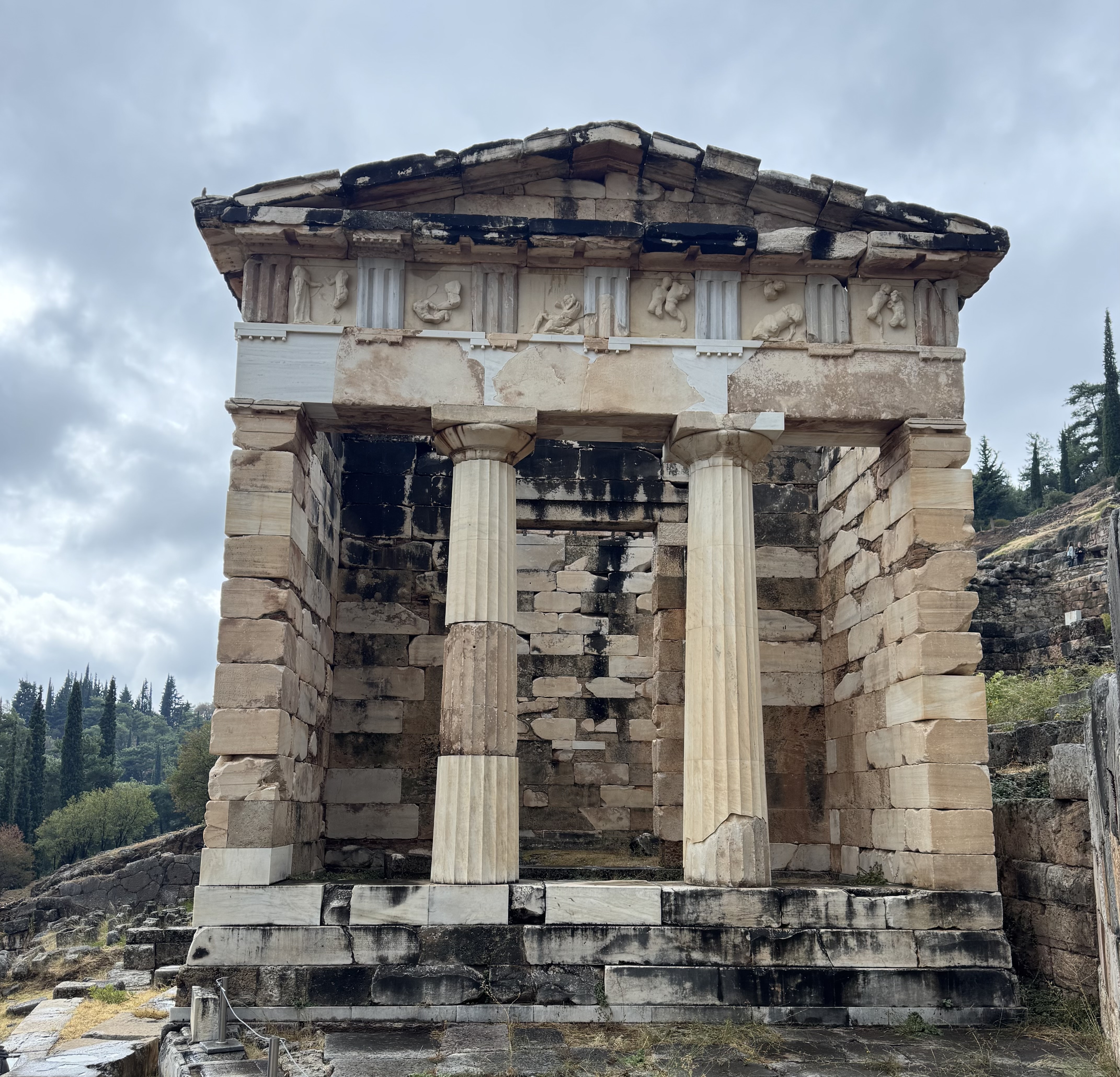
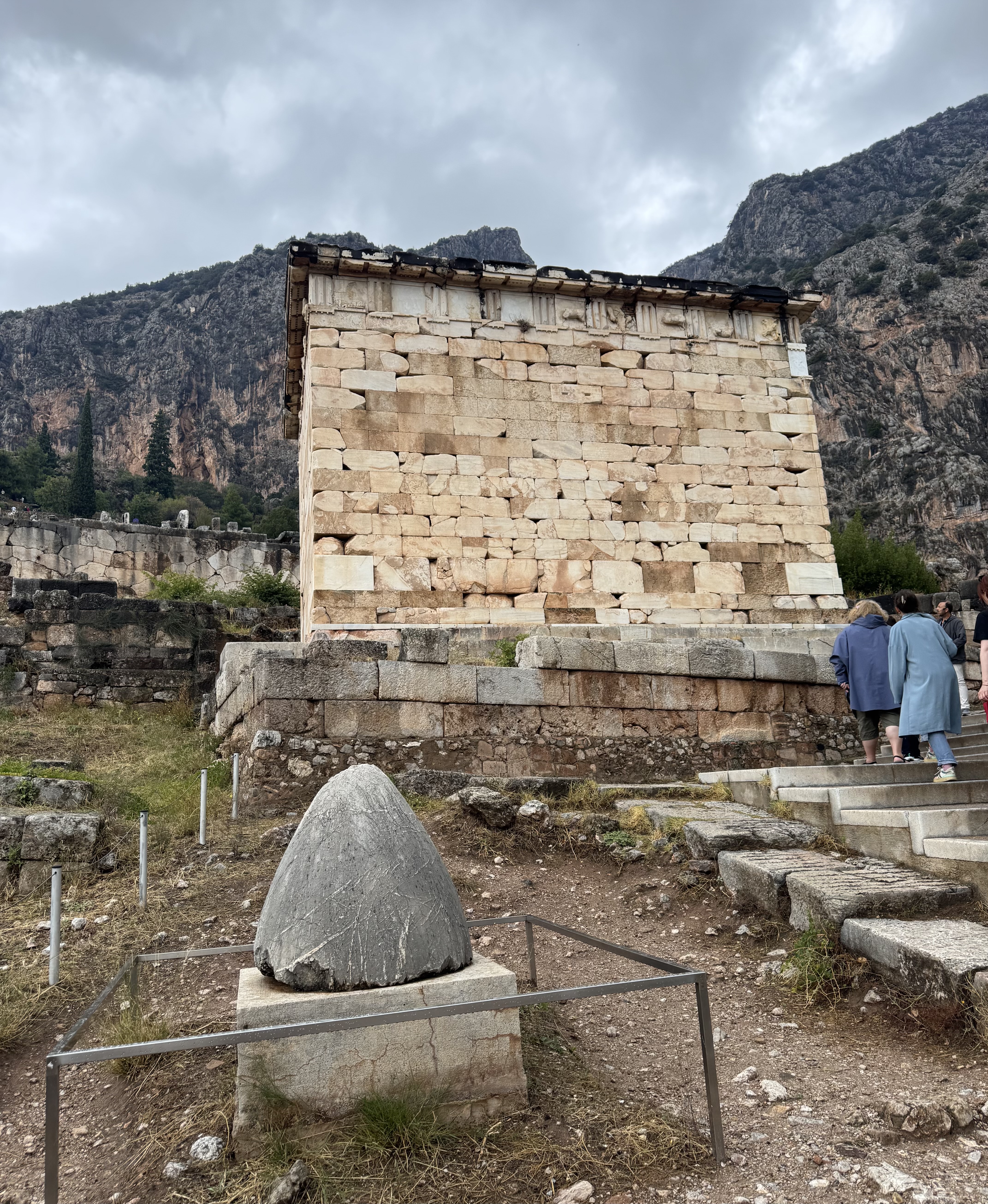
This photo shows an ancient, though probably not the original, egg shaped “navel” that was at the center of the temple. Behind it is the rebuilt wall of the Athenian treasury from the people of Athens to Apollo. Again, using all the original pieces they could find and it’s remarkable what they did find.

There was never a city in this area, it was considered a panhellenic sanctuary. So no big center or settlements nearby because the temple might come under the auspices of that settlement.

The Delphi sanctuary had to be excavated because an entire village was built on top of Delphi. The village had to be torn down and rebuilt a few meters to the west. I asked about how the people felt about this and they were ok. They knew there was an important site under their houses, they got new houses, new infrastructure and the possibility of jobs both working at the site and being able to offer food, hotels, etc. to tourists. The French started the work here with an agreement with the Ottomans who were still in partial control. This started in the early 19th century. 

Delphi was originally a site of Gaia, the female earth goddess. There was a serpent that guarded the site and Apollo killed the serpent in order to take over. The prophecies at the Oracle of Delphi were given over a period of nearly 2,000 years, beginning in the Mycenaean period (around 1400 BCE) and ending in the 4th century CE. The oracle, known as the Pythia, was a priestess of the god Apollo who was believed to channel prophecies while in a trance. 

Prophecies were given 9 days a year, once a month except during winter. There was a process on the days of prophecies. The people would line up on the avenue leading to the temple. A group called the Panhellinion league would hear the question and it had to be a clear question presented by a city’s delegation. This was not a place to ask about your future or if you would get a husband. The requests were about auspicious places to put a temple, build a city, manage a political issue, auspicious time to have a festival. If your question was deemed important enough to put to the priestess, a pure perfect animal was sacrificed and then the question was put forth.

The offerings given at Delphi were always vague, not specific. The people of the time believed you couldn’t escape fate, but you could have direction in how you lived your life. The league was made up of representatives from all areas of Greece. This was a neutral territory recognized as sacred by all. 

This Panhellenic league would know most of the country’s issues because of all the people who came to request answers and would navigate the ongoing questions to keep the peace as best as possible. The league would give the question to a priestess (at the most popular times, there might have been 3 at most). A priestess, Pythenian, would get the question and go into the inner temple and breathe the air (most recent science indicates that there was a gas that came up through the rock fissures), and come back out to give the answer. The answers are always needed interpretation. The saying over the temple door was “Know Thyself”.  Thus, if you were clear, knew yourself, you could interpret the best outcome from the priestess’ answer. If you weren’t clear, your interpretation probably wouldn’t be clear and you might not be able to even approximate what the message said. 

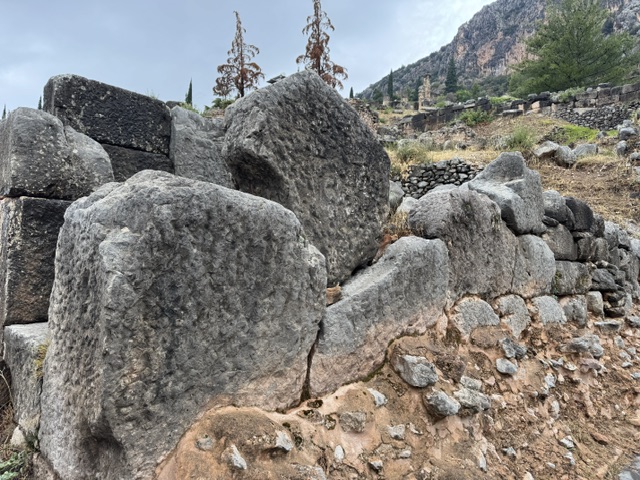
These stones forming the wall are from 6th century BC, earliest parts of the temple. 

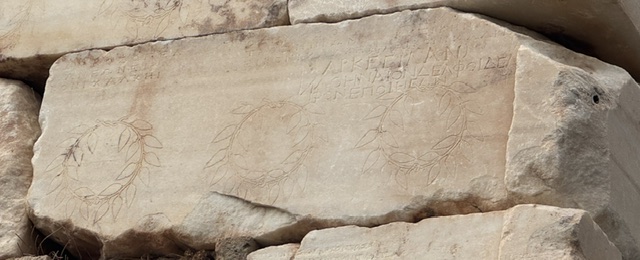
These stones below were inscribed with winners of the Panhellenic games, the great honor to have their names on the stones at the base of the temple. You can see the laurel wreaths.

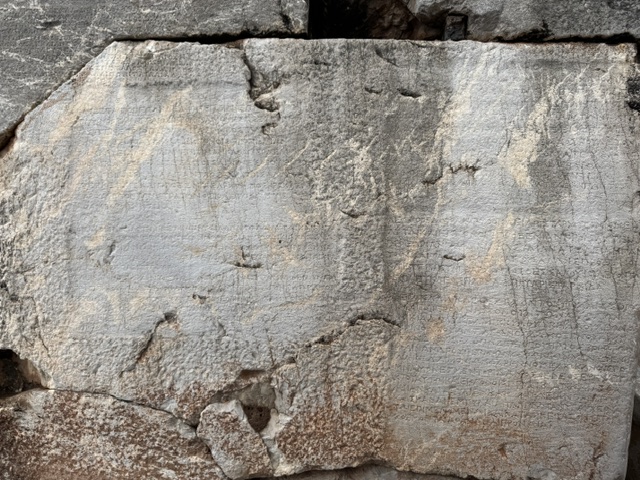
This stone’s writing below were the names of slaves who had earned enough to buy their freedom or had been ransomed and had been freed. By coming to the temple and having their names inscribed in the foundation block, they were official. Then it was their choice whether they stayed or went back to the country where they had been taken – most did this. Almost all slaves were from those areas that had lost in battle. 

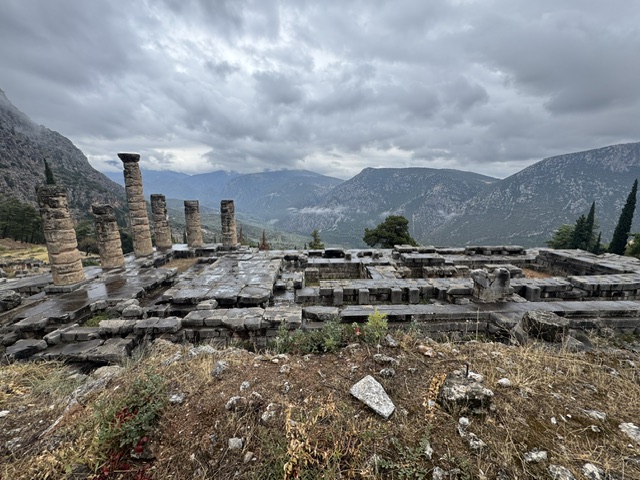
Here’s my best photo of the full temple – hard to grasp how big it is.

Dionysius was honored here when it wasn’t in Apollo’s hands. Apollo was all about order, music, poetry, the sun. Dionysius was the opposite, going for escstasy – having the wine, being drunk was like having the god inside you. The festivals were for everyone, high and low, women and men, including slaves. It let all those who were repressed to let go in a big way.

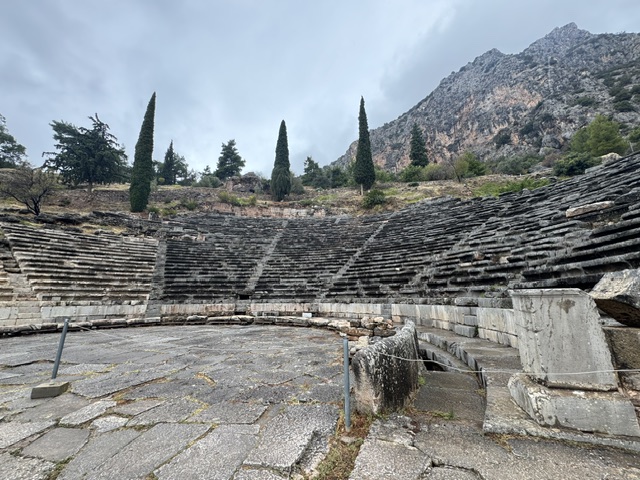
This is the theatre – it used to be much bigger, but it’s still pretty impressive! 

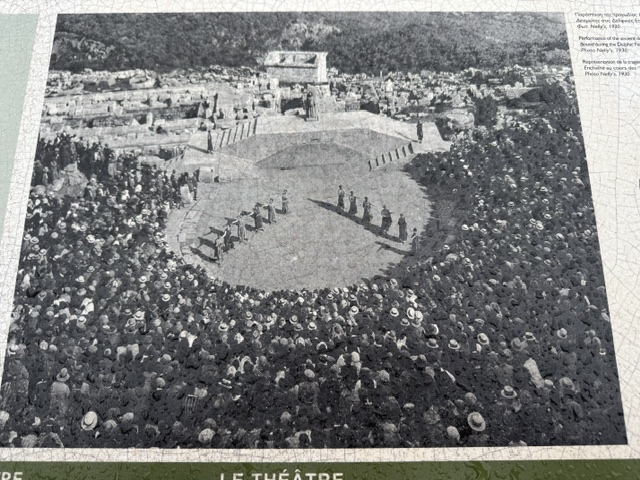
It was still in use in 1930, could hold 5,000 people – a performance during the Delphic Festival.

The citizens here strived for a balance:  “Nothing in excess, everything in moderation” is inscribed in the Delphi site. This plus “Know Thyself” are the only two inscriptions.  So balancing Apollo’s and Dionysian values.

Every 4 years were known as the Pythian game, originally started as funerary games for the serpent Python. The priestess was also related to this Python – all went back to the earlier traditions. 

So Apollo, Dionysius, then Athena were worshipped here. She had a temple, we just couldn’t reach it because it was blocked off.

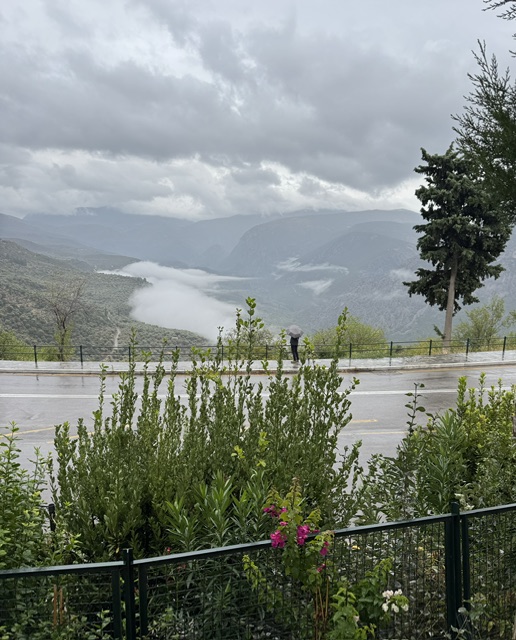
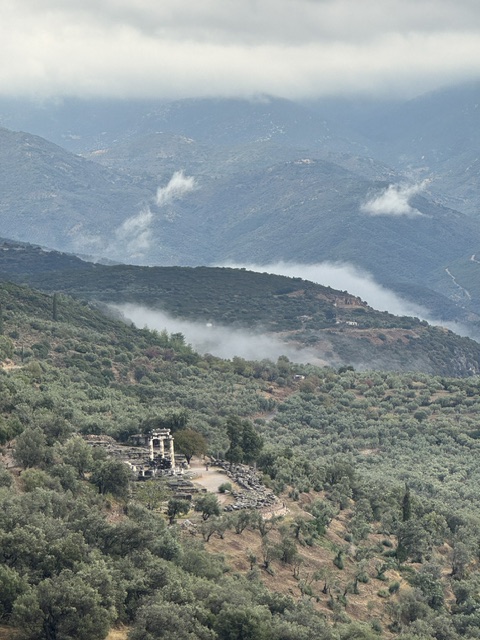
This is the view from the temple, the museum and walks around. It is a plain filled with olive trees below the Parnassus mountain. So beautiful and we got to see it before it completely filled with fog. 

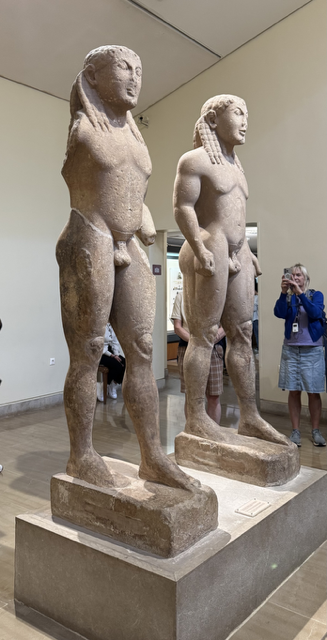
We then went to the museum which really did have just remarkable pieces from the site. My favorite, though not the most famous, were these two statues. Kleobis and Biton. Can you imagine finding these as archeologists? They knew immediately who they were because of oral traditions telling their history, but Herodotus wrote of them as well.

They are real characters, not mythological. 2500 years ago or so, there was a well-off woman who would go to practice at the site on the days welcoming women. One day, the oxen did not show up who were supposed to pull her palanquin. So her twin sons, strong, fit, at their prime, yoked up and pulled her to the temple. When there, she prayed that her sons would be given immortality. They pulled her back home after. That night, both brothers died in their sleep.

As Katarina said, this was the mother’s prayer answered. Since the people did not believe in any after life, the only way to have immortality was to be remembered. Because the sons were in the peak of their life, had done wonderful deeds, were beautiful, they have never been forgotten. As Katarina said, I’m telling you their story 2500 years after they died and we still know them and talk about them!

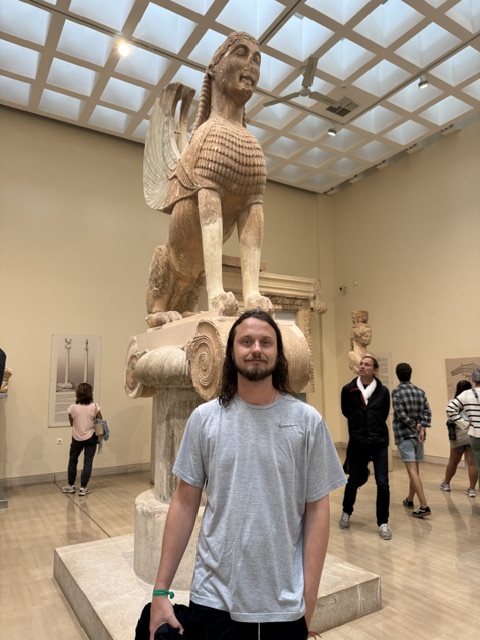
I loved the sphinx that guarded the temple, incredible to find it. 6th century BC. Crazy.

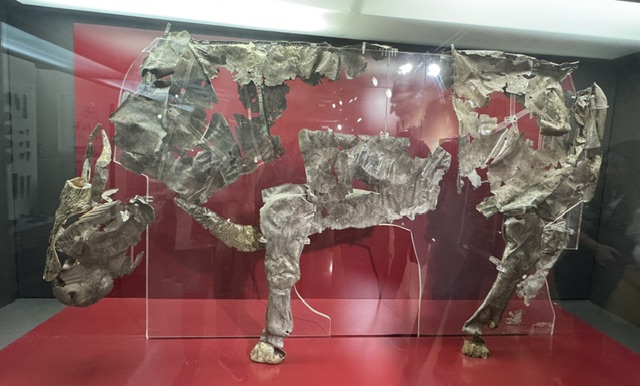
This was a bull that was wood, with silver nailed to cover it and then gold plated in different areas. Truly amazing, both that it had survived from 6th century BC and that they were able to put it together this well. A number of the nails that held the silver to the wood were still in the metal. 

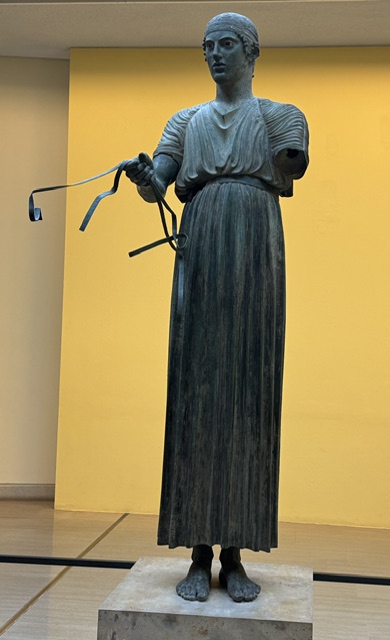
Finally, the most famous piece was this bronze charioteer, 470BC. There was a photo of the archeologists who found it. Needless to say, that was a very good day!

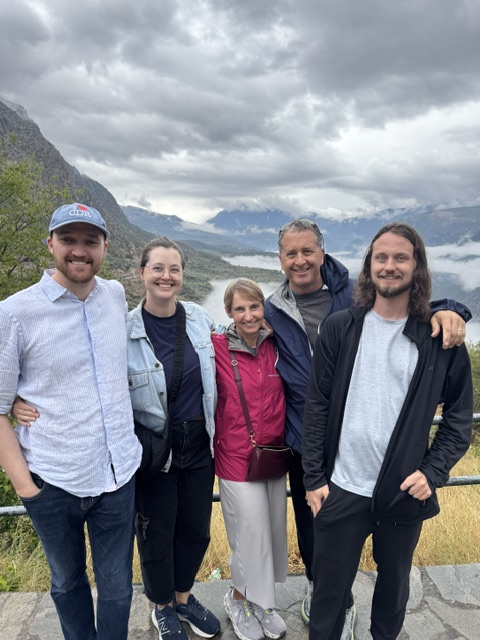
And we had a really good day too 🙂

Though I have to say that seems like I’m shrinking – when did I get so small?!

Greece, 1.Oct.2025, Wednesday

Today’s breakfast didn’t go well at the hotel, delayed, missing pieces, not great. So Kaziah and I ran out to THE place in Chania for bougatsa – the traditional treat for any time of day of filo dough enclosing sweet cheese and sprinkled with sugar or a less sweet cheese and sprinkled with sugar and cinnamon. This was to help sustain Eli C until lunch and it was delicious!

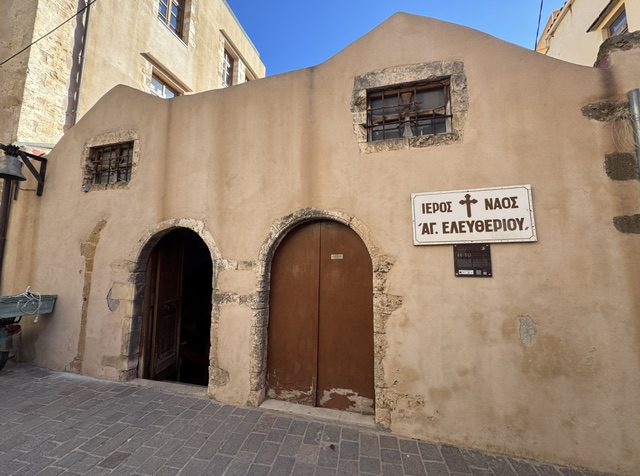
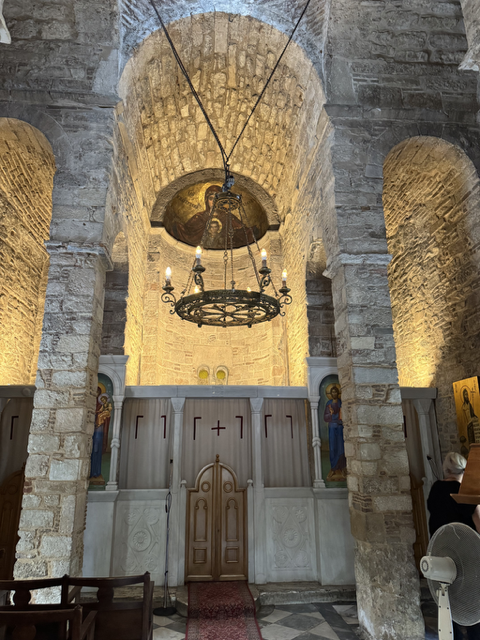
On the way, on our block, we passed a church from the 11th century and it was open. I veered toward it and Kaziah grabbed my arm and kept me moving. We realized this had become a pattern with the family, me veering, them correcting course. I really have become predictable. But the history! The cool insides, all slightly different, quiet. And for this one – for over 1,000 years, people have been coming here for comfort and support. I just love that. Ok, maybe tomorrow (this one is only open early in the morning). 

Today we met our guide, Iro, at our hotel lobby and we drove to see a monastery that produced olive oil and wine (and Orthodox Christianity) and then to tour Chania. 

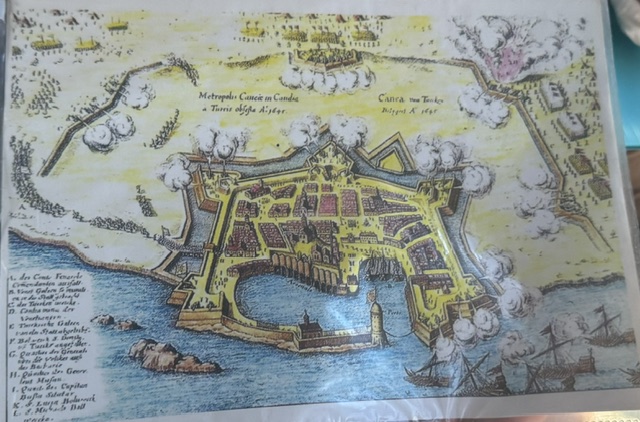
Iro was wonderful, completely delightful. So full of knowledge and loving her subject. First, we looked at the maps of Chania to see the original Byzantine walls, then the Venetian walls extending beyond, but still protecting the community. You can still see so much of this today.

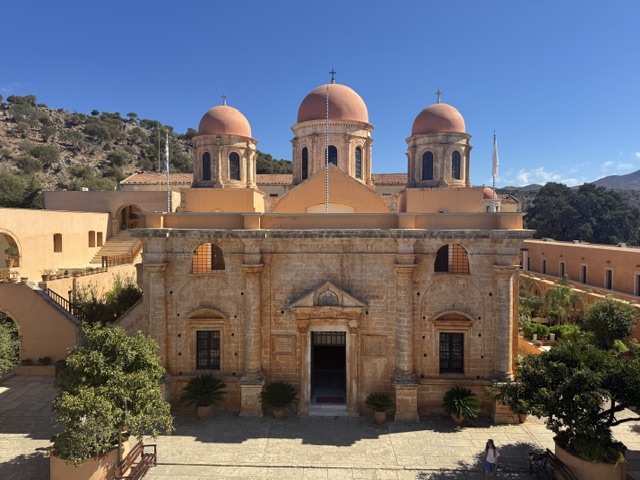
We then went to the The Holy Trinity Monastery, the Agia Triada. It was built in the 17th century by two brothers of the Venetian Zangaroli family on the site of a pre-existing church. This monastery had an interesting history of origin. The Venetians were Catholic and thus their churches reflected the western approach to Christianity. However, when this church was being built, the Ottoman’s were encroaching and the Venetians wanted to the support of the community. So they supported the building of an orthodox monastery in the hopes that they would sway the community to support them. That didn’t happen, but the community didn’t fight on either side – all were occupiers. 

Probably related to this, there is fierce support for Palestinians in Greece, considered to be another occupied country. Signs, posters, shirts, people gathering to protest, especially visible in Chania. 

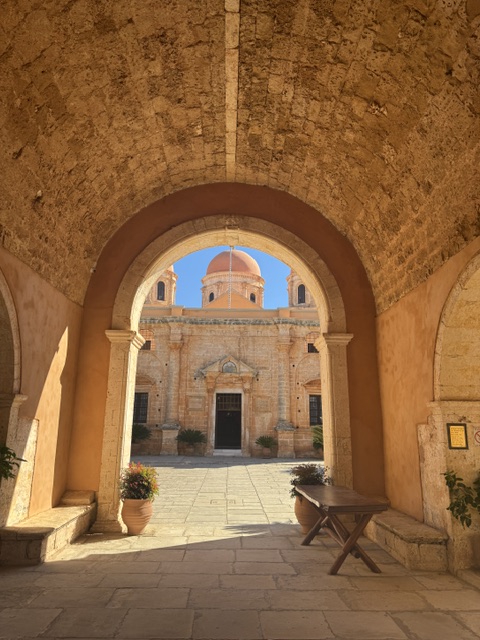
Back to the monastery. It was truly beautiful and so well maintained. There are only 6 monks left and it has been continually occupied since it was built. The buildings looked immaculate because of renovation. They were not as clear about what was replaced as they were at the Parthenon and our guide regretted the lack of clarity in this aspect. But it was beautiful. 

The facade of the church has double columns of Ionian and Corinthian style and bears an inscription in Greek, which is dated to 1631.

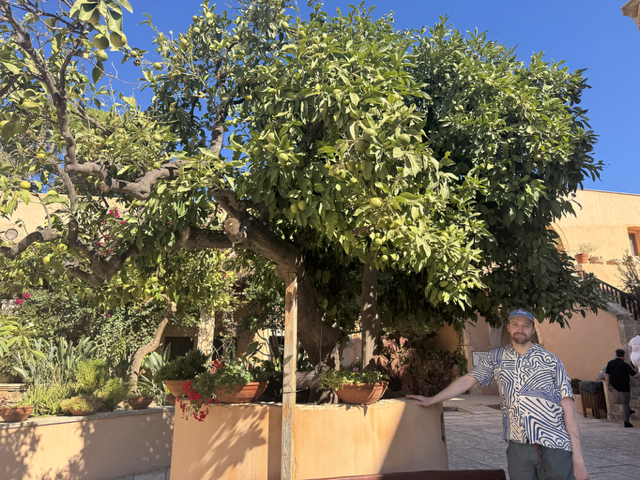
This tree had a plaque saying that is was from the original structure and was 600 years old. Iro was dubious, but we loved the idea. And olive trees can live for up to 5,000 years old, though usually their life span is 300-600 years. So this might be the original olive tree planted when the church was built.

We couldn’t take photos in the actual building, so I didn’t, but Iro explained some of the practices here and that was helpful. The reason so many of these churches are dark inside is the flashes of light off the lanterns and the liberal use of gold and silver was because these are glinting reminders of the Holy Spirit. The reason people would come in, greet an icon, do a circle of the church and then kiss the icon after making 3 signs of the cross is because it’s as if they’re physically connecting with the saint. I saw this done in every church. They said many fewer people are practicing orthodoxy, but in every church I saw men and women of different ages making this gesture to the icons. 

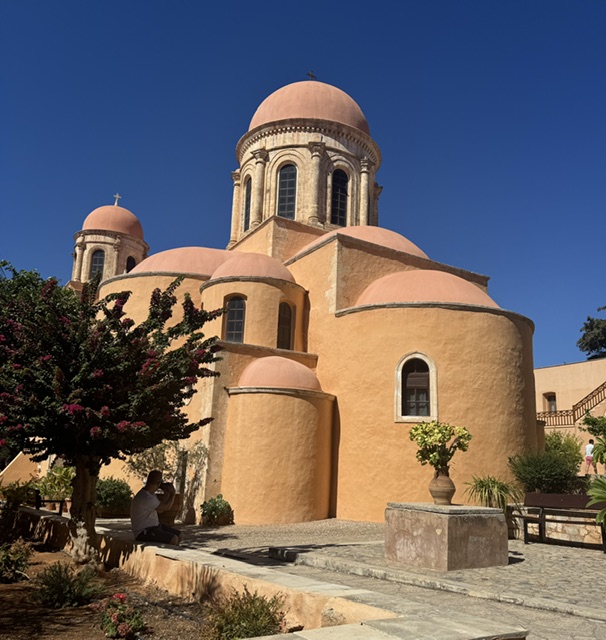
This is from the back of the church and shows a key element of the Orthodox Church. The rounded dome are to indicate the symbolism of the earth. Often inside in the roof of the dome will be a painting of Jesus with his arms outspread so as to say, all are in my care throughout the world. 

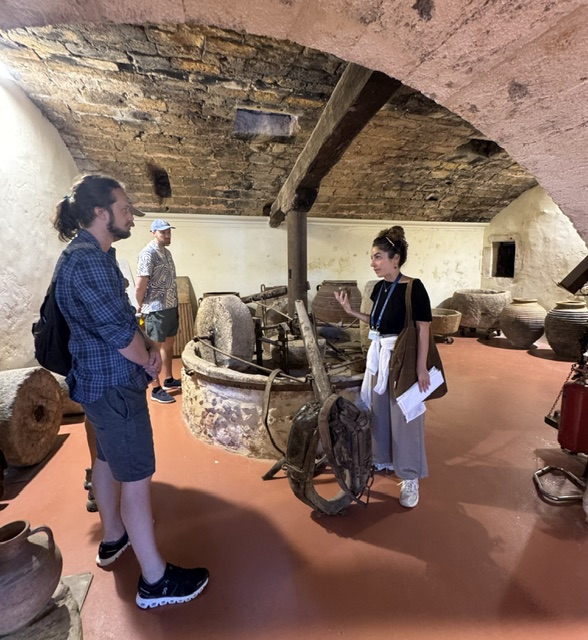
We then went to look at some of the original oil production implements. To this day, all the land we could see was owned by the church/monastery. They are farmed locally and then I’m guessing the product supports both farms and the monastery. The products were sold out of the monastery’s store and they covered a range of oils, vinegars and wine. 

This olive press was the first step, dumping in the olives and donkeys would walk in a circle with the giant stone grinder gradually reducing the olives to a pulp. This was then wrapped multiple times in linen and again pressed in another machine until it produced the oil. I said that yoke was huge for a tiny donkey and she said, no – they weren’t as big as a large horse, but they were much bigger than ponies. Still, probably not a great life for a donkey. But – the oil got made!

Even though I’d gone to the organic olive farm in Italy and had Cathy to tell me info, I’d missed the fact the olive oil ages rapidly and diminishes its antioxidants and all the other healthy aspects of the oil. I thought it aged and got better like wine! No wonder the wonderful oil I got from the Italian farm is no longer as fiery as it was when I first opened it. I’ll have to start using it up more rapidly. Everywhere a distinction was made between EVO – those first pressed olives – used for tasting and salads and the regular olive oil used for cooking. At lease I was already doing that. 

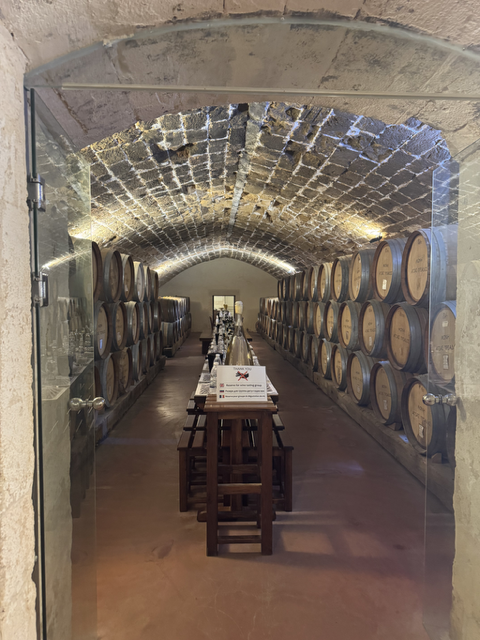
The wine cellar was beautiful, but none of us are wine drinkers, so we just admired. We did taste the vinegars and oils!

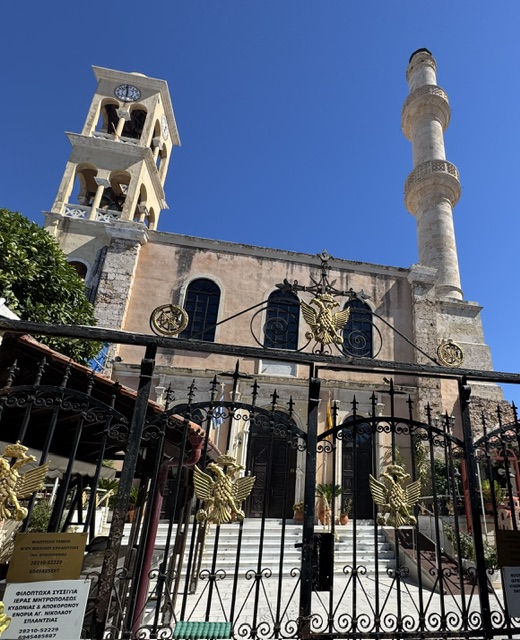
We then walked the streets of Chania with Iro and learned a lot more about the history. Which I’m not going to recount. Well, not all of it. This church was interesting. It’s the only one in Greece that shows the three different occupations. In the middle the Catholic Church built during the Venetian period. On the right most of the original minaret added in the Ottoman Empire and the bell tower on the left built more recently making this an Orthodox Church. The sign outside said:

1205 Beginning of the church foundation
1320 Finished building by the Dominicans
1645 Occupation of the Turks
1918 The Church came back to Orthodox worship

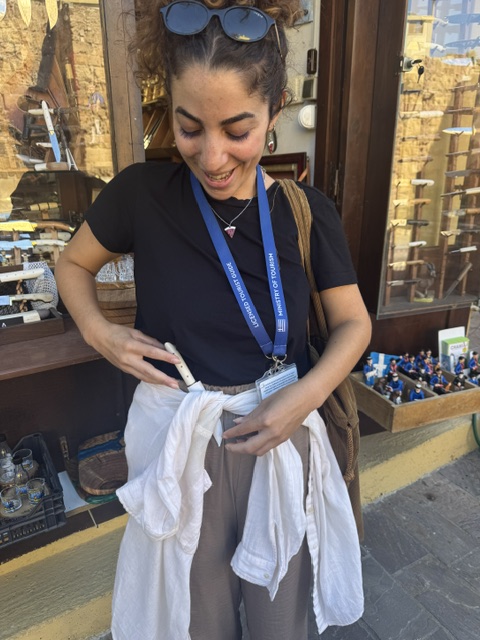
Here’s Iro demonstrating the use of a knife in early Crete. Our hotel was on the block that was the knife workshop block. There was one store/workshop left and nope, forgot to get a photo of it. However, she explained that getting a knife was a precious gift. On all blades was printed a saying, a poem, a message, usually of love. In addition, when a couple became betrothed, the man gave a woman a small (“useless because too small”) knife. The woman wore it in her belt and it signified that she was taken.

We then got a bit of a rest, cleaned up and walked the old city, getting dinner at a place Iro had recommended. Our wait person said the food was as good as his mother’s. And it was a great dinner!

Greece, 30.Sep.2025, Tuesday

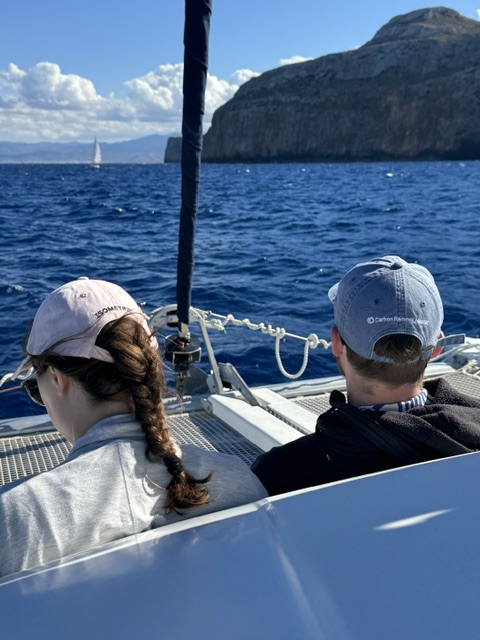
Today was a day mostly away from history and culture. We went out on a catamaran to see the gorgeous Greek water, a particular wish of Eli C’s.

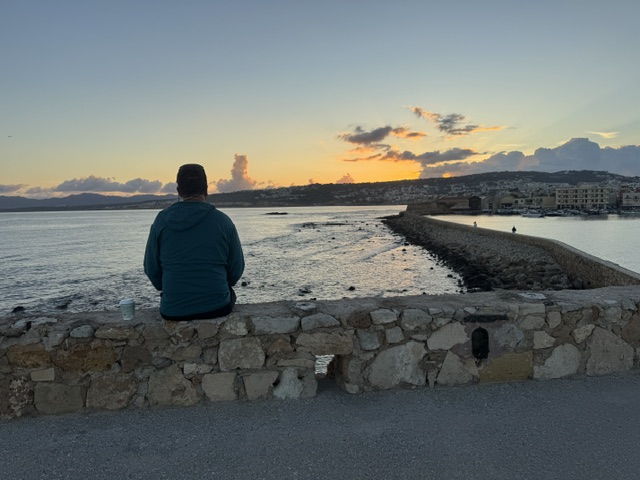
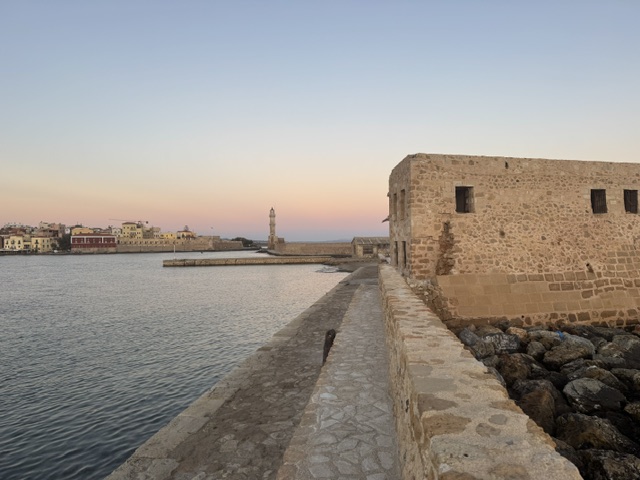
First, however, Rick and I got up in time to see the sunrise from the Venetian harbor of Chania. 

A man and his coffee cup 🙂

Eli W decided to stay back from the boat trip, he’s not such a swimmer and he really wanted to explore the town on his own. He said he had a really nice day exploring the old town and found a pair of linen pants that suited the hot weather. 

Eli C, Kaziah, Rick and I went, meeting up with 4 other people and it was just a treat of a day.

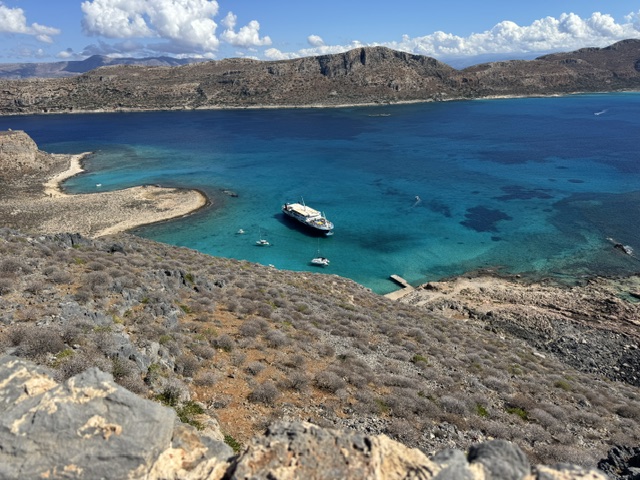
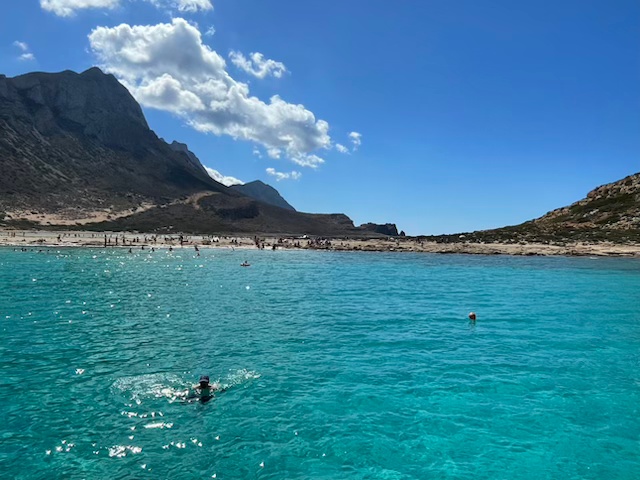
Below is our catamaran from the top of Fort Gramvousa – I’ll write about that in a bit. Our boat felt quite sizable when we were on it, but next to the ferry pulling in and unloading a ton of people, we look tiny. Rick and I climbed up, but Kaz and Eli wanted all the swim time possible. The water is wonderful with so many different hues of blue. 

Our first stop was the Balos lagoon, whoops, I forgot to get any pictures. But Kaziah did. Here’s Eli reveling in the warm turquoise water.

We swam to the lagoon from the boat and played a bit around the boat, had lunch on the boat which was great and then continued to Gramvousa Island. Ok that island did have some fun history to add to our day of leisure.

The Gramvousa Island fort defended Venetian trade routes and was also a strategic base in the event of a new Ottoman-Venetian war for Crete.  Greeks fled the Ottomans on the mainland to Gramvousa and Gramvousa then became a hive of piratical activity that greatly affected Turkish-Egyptian and European shipping in the region. During that period the population of Gramvousa became organised and they built a school and a church. The church was called Panagia i Kleftrina and was dedicated to the wives of the pirates. Only pirates were allowed to enter. The pirates did have a code they lived by – they only stole food and cargo/money, but never killed anyone and always left the boat to the sailors/passengers. 

In ancient times the island was known as Korykos, which means leather bag. The island was renamed “Gramvousa” in honour of Vousa, the wife of a pirate chief and the only inhabitant of the island to evade capture when the pirates were forcibly removed in 1828 by British and French ships after Greece gained independence and had naval support from Britain and France. 

Currently there’s a caretaker who lives there with his wife and 2 kids (not an extravagant life) because he likes the isolation. Tons of people get off the ferries during the season, but then free! 

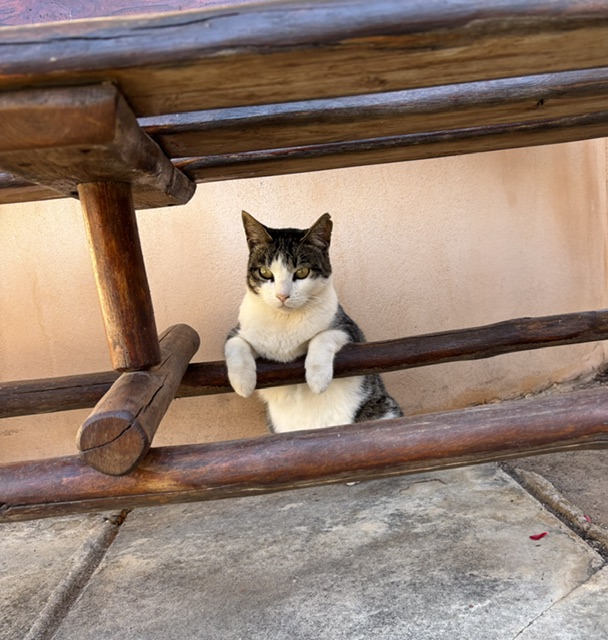
We went out to dinner that night at a place Valentini had suggested for “authentic Greek” that Kaziah directed us to. Unfortunately, we’re not authentic Greeks so it wasn’t a successful meal except for a couple of amazing appetizers, but cats were coming around and I wanted to give them Rick’s fish. It didn’t have sauce and would have been benign. To the family’s dismay, I took a chunk and dropped it to the cat looking up at me with pleading eyes. We were sitting on the porch next to the sidewalk, so we were outside. Then there were 2 more cats. We had worried about that. I then read online that many people took their left overs and gave them to the stray cats that were everywhere. The family wouldn’t let me do it. Not sure why. 

The next day, we asked our guide about this situation. She said yes, people give food right in the restaurants and take their left overs for stray animals. We saw signs in the old city of Chania near restaurants saying please don’t feed the cats, we give them the food at the end of the night. I didn’t see a single cat that didn’t look well fed and they looked healthy too. 

When I looked online to see what it said about Greece and cat culture, it supported this idea that they’re cared for and appreciated. “In Greek culture, the regard for cats is a mix of ancient respect for their utility and independence and a modern appreciation for them as a beloved and ubiquitous part of the landscape. Cats have served as pest control, symbols of luck and resilience, and companions cherished by locals and tourists alike.”

It was a treat of a day – again! 

Note on corruption – wow, completely consistent, these people do not have any regard or trust in their government. Cristos who drove us to and fro the catamaran said that these current protests for the rail accident are small, but continuing. He’s friends with the lawyer who represents the parents of the victims.  He’s seen crowds of a million in Athens and 10,000 in Chania protesting this accident and the government coverup. Legally and politically, once you’re in the system you can’t be touched. So even if they knew directly whose pocket has the money that was supposed to fix and update the trains and the signals – they couldn’t touch them. But they’re continuing to try.

Greece, 28.Sep.2025, Sunday

We got to sleep in a bit today. Surprisingly, everyone was still up and at breakfast by 7:30, with Eli W being the first one up!

We decided to meet and walk towards the Agora, going through the Plaka area, the old city with shops, coffee shops, restaurants. I led the way, repeating my walk from a couple of days ago. 

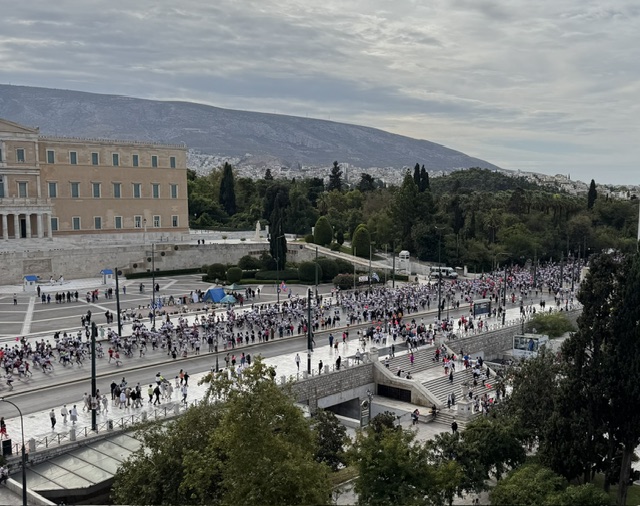
We started down through a street completely clogged with a Race for the Cure run. A 5 K that had 1000’s of people streaming up from the metro to join the start in the park. How totally fun to be able to see the gathering start from above before we left for our walk. I hope they raised a ton of money!

Hard to imagine now, with 4.5 million people and modern streets and incredible history, but 200 years ago when Athens started to rebuild after the Ottoman Empire was ousted, there were only 10,000-12,000 residents. Europe had helped Greece oust the Ottoman Empire and put a king, King Otto, from Germany in place. He rebuilt the city, making Athens the capital of Greece.

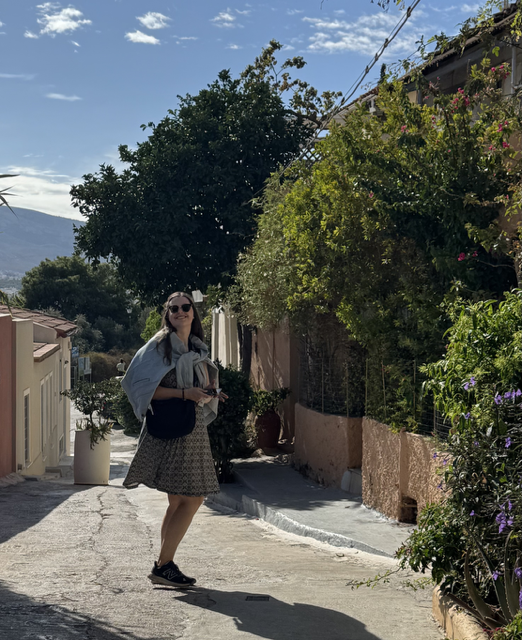
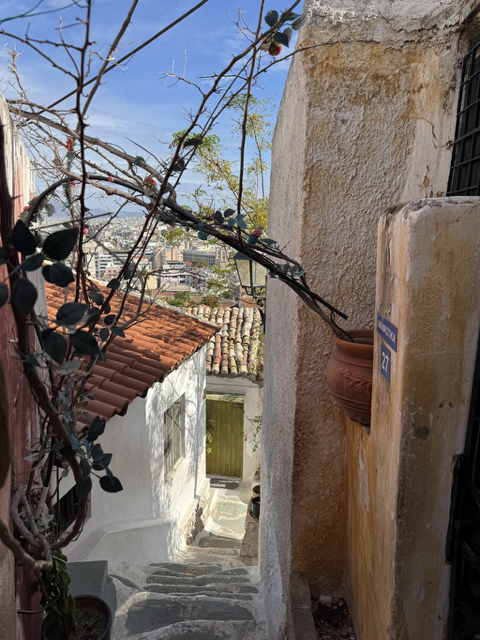
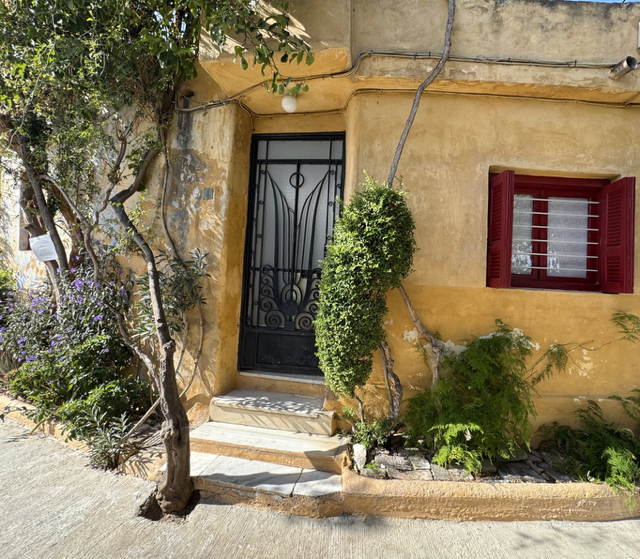
We walked along narrow streets, ending up in the wonderful neighborhood of Anofiotika. This cool neighborhood was built into the hillside below the Acropolis. In the 1840s expert masons, stone-workers, and builders from the Cycladic island Anafi signed on to construct a royal palace for the new King Otto and to help excavate archaeological sites around the Acropolis. A law at the time stated that if you erected a building between sunset and sunrise, the property was yours. So working at night, using the traditional Cycladic building methods they had grown up with, these builders fashioned their homes right below the monument they were excavating by day. The new locals called their neighborhood Anafiotika, which means “Little Anafi”.  This little neighborhood is just wonderful, tiny lanes, tiny sidewalks, a wonder to walk through.

We then walked down through the Plaka neighborhood, just below and curving around Anafiotika. There were shops, restaurants, houses on a sleepy Sunday morning with people going to church and visiting family. Rick, Eli W and I continued onto the Agora to listen to Rick Steve’s tour (for me again, always learning more). Rick wanted to see where Aristotle taught – yep, here in the Agora!

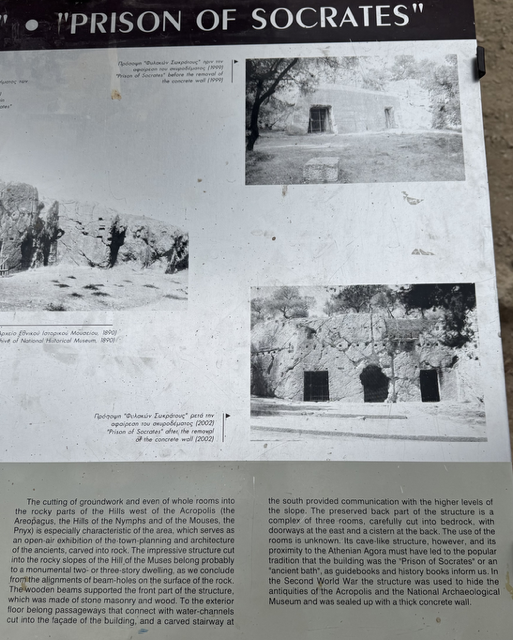
We then walked back, circling the Acropolis as I had done the other day, but MUCH more efficiently, getting back to the hotel in about 30 minutes. We did see Socrates’ Prison. Turned out this was a name given to the space, I don’t know that Socrates was ever here, but the Greeks hid the treasures from the Acropolis here when the Nazis invaded, cementing up the wall in front of the caves. And it worked! Saving many treasures. I thought I had photos of Rick in front, but nope, don’t know what happened. Here’s the plaque and a photo. 
Back at the hotel, we rested our feet and then walked out again with Valentina – a guide taking us on a food tour of the Plaka. Oh my goodness, so good and so much fun! She was full of stories and enthusiasm about food and Greece and Greece’s history. 

And did I take photos? Hmm, not many. Valentina took a bunch of photos and is sending to me, I along with the names of where we went, what we ate, etc. 

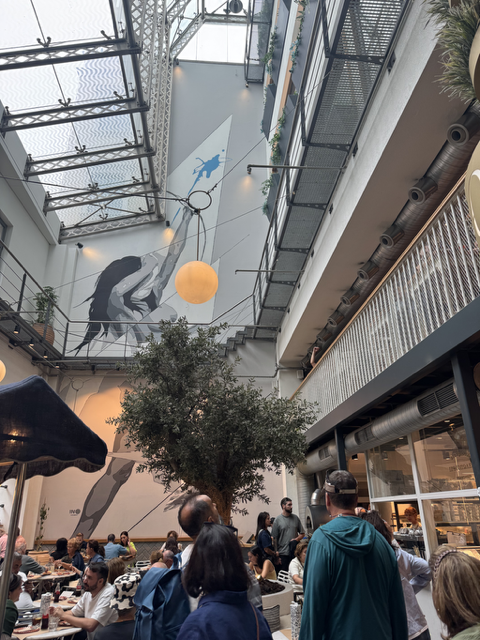
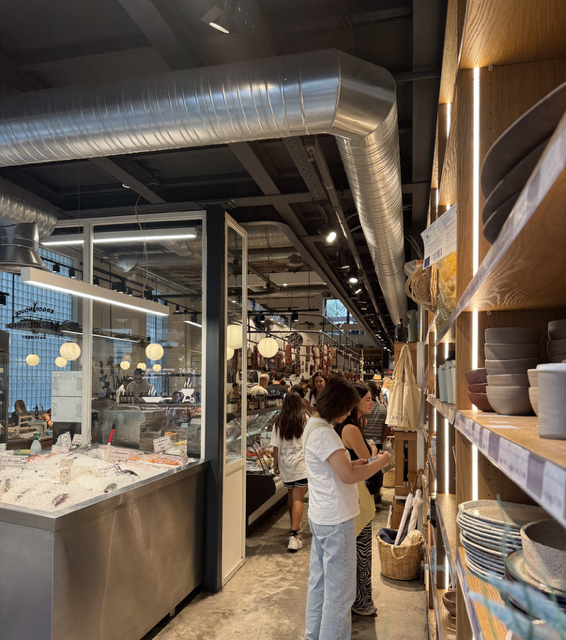
This was a stop, Ergon, for 3 kinds of cheese, 2 kinds of meat. All of them were originating from Italy. The Greek creators lived in Italy, learned a specific item, then came back to Greece and made it Greek. Sheep and goat milk instead of cow, spices added to the meats specific to Greece, etc. 

The family who started this restaurant/store was a couple with two young boys who had a market stall. When they were ready to sell, the brothers decided they wanted to grow the business. Their parents were already known for selling the most pure cheese products, meat products, vegetables, etc. So the the brothers decided to stay with this theme and traveled the country looking for small farmers, entrepreneurs specializing in the BEST feta, the BEST ham, the BEST mushrooms, etc. They then enlarged the space and started serving a small cafe as well as the store. They grew, started a second store, then built this restaurant store, decorated by the most famous Greek street artist. 

In the background, they were also quietly doing work with their producers, teaching them how to market, set a logo, disseminate their products etc. Helping many in Greece get the word out about their unique products. They did not advertise anything about this foundation sideline, but work got out. And their fame and name grew. 

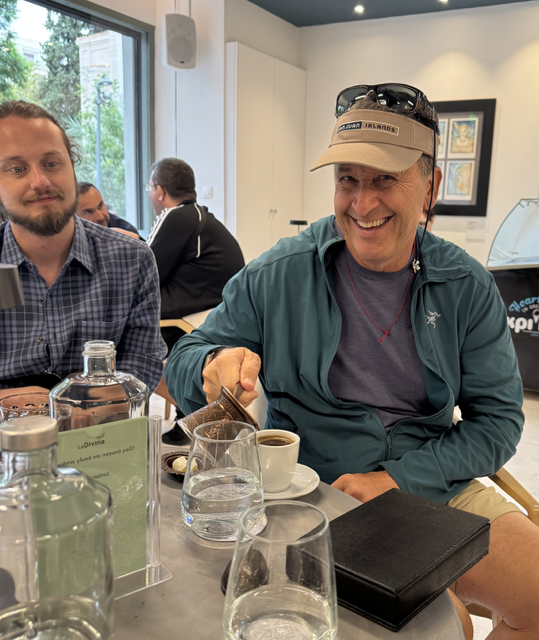
Our next stop was for Greek coffee. The cafe off the Maria Callas museum, and it was wonderful. Turns out in order to make real Greek coffee, it has to be heated over hot sand cooking in a copper pan until bubbles rise in the small cup and once the grounds in the bubbles are skimmed off and it’s almost at a full boil, it’s turned off. You can add a bit of sugar, but NO milk product. That would be horrifying. 

This tradition came from the Arabic traders who brought the beans to Greece. Evidently (according to myth/fact) one of the nomadic traders wanted to have coffee during the day, not just in the evening when they had time to cook it. They only carried copper pots and he realized between the metal and the heat of the sun, he could bring water and coffee grounds hot enough to make a great coffee. Obviously, not a lot of cows traveled with the camels. A final note was that it was to be sipped, not tossed back. No, no – there’s mud at the bottom! Rick said it was amazing coffee.

We did make one church stop – the little one that I’d seen before next to the giant cathedral, built in the 1000’s, maintained and we got to see inside. It’s tiny, but simple and wonderful. The family rolled their eyes that I managed to get in a church viewing even on a food tour. But just one!

We moved way too fast for Eli C – he loves all the items, would have been very happy to have way more time in the stores. But, hopefully, when we come back through after Meteora, we can go back and get some products. Like halva (sesame paste, so pure, incredibly good), honey, oil, spices. He’s going to need another suitcase 🙂

We had eaten our way until 5:30 and we came back to the hotel and that was it for the evening. Eli C went out for one more souvlaki, but the rest of us were ready for a chill evening. However – there was a big event going on outside our hotel and I watched it build from 5:30 until it ended around 9:30.

We’d gone by the parliament building and had seen the flowers, candles and a tent set up outside the building. We learned that this was an ongoing protest about a train accident from 2 years ago and this week, one of the fathers of the one of the young people killed had started a hunger strike protest. 

It was kind of bizarre to see the soldiers marching in front of the tomb of the unknown soldiers in the midst of this sad protest. But they continued their march. We had seen them marching in front of the president’s house yesterday and had noted the kilts, the pompoms and the piece of black material hanging down from the hats. And tap shoes? The steps were incredibly precise, I’ll include a video. I knew that the kilts had 400 pleats to recognize the 400 years of Turkish rule that was overthrown, starting in 1827, fully recognized and borders drawn by the European countries in 1932. But the pompoms and black piece of fabric? Valentina told us that every piece of the uniform and the march itself were symbols of the war of independence. 

The slow loud march of the tap shoes was because that was part of the guerrilla strategy against the bigger forces of the Turks – making them think there were more soldiers coming their way than there were. The black material indicates the mothers’ tears for all who died. The pompoms were part of what people wore on their shoes in the days of revolution. They weren’t allowed to carry weapons, so they fashioned pompoms as “decoration” but in fact they were designed to hide daggers. Here’s a video of the march in the midst of the protest.

Back to the protest: I went online to get specifics on the protests – they’ve been ongoing for 2 years since the accident – and have grown huge again. Today, with the father of one of the university students who died having started his hunger strike and the people in the city for the race, there was a huge protest on the steps of the parliament building. When I searched online, the first article that popped up was from NPR from February and it’s now September and the protests are still going strong.

https://www.npr.org/2025/02/27/g-s1-50918/greece-train-crash-tempi-protests

It was sad and impressive and I very much hope they get answers and accountability. Valentina said they had the money to do the necessary repairs that the train unions had been advocating for, but the money went into someone’s pocket. She also said the families of the students who died have become a strong network with a lot of public support. 

I watched throughout the evening, listening to the songs, trying to get google translate to decipher the speakers’ messages – didn’t work except for brief random sentences. 

Then, vacationers that we are, Eli W, Rick and I also watched the second episode of this season’s Great British Baking Show. 

Greece, 27.Sep.2025, Saturday

The family made it in last night by 10, very tired, staggering, but happy to be here. 

We had a wonderful breakfast to start our day. They have a great buffet here, looking at the Acropolis and Parthenon and then we met our driver for the tour at 8:30. The morning was perfect weather wise. We met our guide at the Acropolis. Turns out there were 7 ocean liners in today, rarely happens, plus it’s international museum weekend all across Europe, so it was free entry, and this negated the tickets that had already been arranged. Babis – our guide – got in line at 7 this morning with 40 people already ahead of him and it still took him 1.5 hours. He was so nice about it. 

So there were a lot of people and it didn’t even matter. Babis was a great guide, so easy, knowledgeable, it was a treat exploring with him. Eli W was able to ask all the questions he had related to his prior knowledge, very fun to see and hear. I’m not going to write about the history – biggest impact was the astonishing fact that there’s anything standing at all given the ways in which the building has been damaged, but it is completely impressive despite Lord Elgin stealing an enormous amount and putting it in the British Museum. 

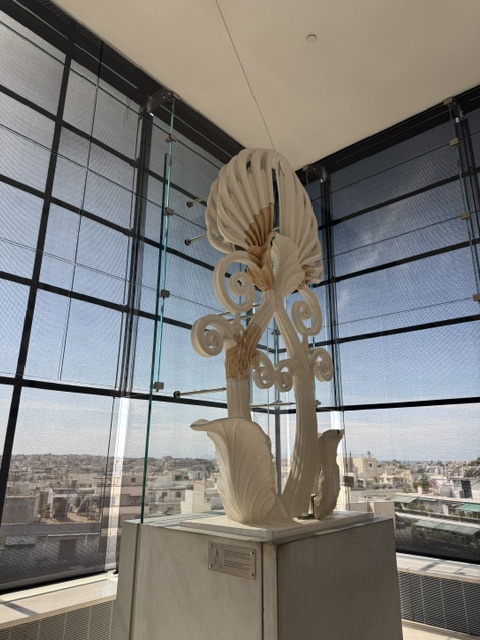
We went to the Acropolis Museum next which is truly a feat of design, mimicking to the exact footage of the Parthenon on the top floor. They have put the original pieces in the same place on the pedestals on top that they were on the actual building. They put in white all the pieces the Elgin stole and left blank wherever a piece was completely destroyed or missing and can’t even be approximated. 

Babis had another group, had to run another gauntlet of tickets and people so we offered to let him go after the museum instead of doing the rest of the city – we’d already run over time. He recommended a restaurant in the Plakas area and we got dropped off there for lunch. It was so cool to be sitting outside in Athens with the family. 

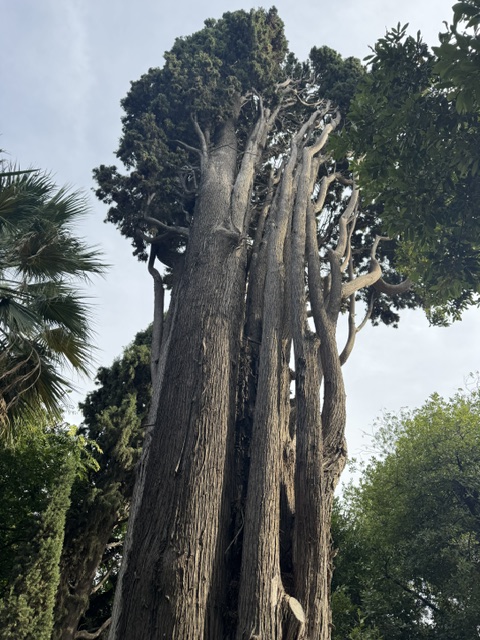
We walked back to the hotel, everyone took naps (I read and wrote this) and then we walked around the National Garden, just two blocks from the hotel. Eli C is continually enthralled with the trees – and some of them are huge!

We ended the day with a meal that sent Eli C into ecstasy – it was incredible, the same restaurant here in the hotel that had so surprised me on my first night. They made a table for 5 on the balcony so he and Kaziah were able to watch the sunset behind the acropolis and have incredible food – the rest of us saw it too, by turning to look. Beautiful!

Greece, 26.Sep.2025, Friday

I know I’ll probably repeat some of today with the family, but needed to do some walking so took my earbuds and phone and walked a couple of Rick Steves tours. They’re so good!
When we were here 8 years ago for my sister’s and stepmother’s birthdays, I didn’t do either of the walks I did today and they were great. Ended up walking about 9 miles which was more than I expected, but I saw a lot!
One fact that stood out today was that there was a big schism in Christianity. A note from AI: The Schism between the Roman Catholic and Eastern Orthodox churches occurred in 1054 with the event known as the East-West Schism. This formal break in communion was the result of centuries of growing tensions, political and cultural differences, and theological disagreements between the Western and Eastern branches of Christianity. The formal split was marked by the mutual excommunication of the Pope of Rome and the Patriarch of Constantinople. 

I never thought about it and why the Orthodoxy practices are so different. The churches are so elaborate and gorgeous. Evidently, practitioners are supposed to stand, thus the many things to look at, but very few chairs for only older practitioners. 

Anyway, I looked at the first walk, Athens City and it started 350 feet from the front door of the hotel. Clearly meant to be. Between 2500 years of history (he does know how to pack it in), the cool perfect morning weather and the interesting sights, I had a wonderful morning. 

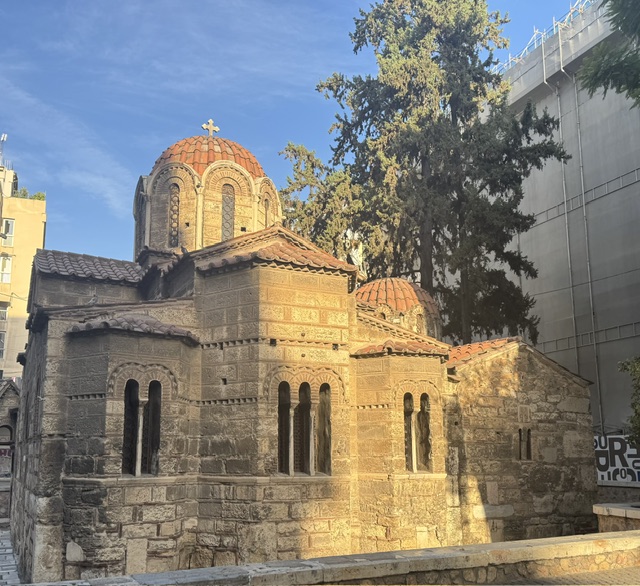
At the end of the biggest pedestrian shopping mall is this gem. The Church of Kapnikarea, built in the 11th and 12th centuries. I love these kinds of juxtapositions. 

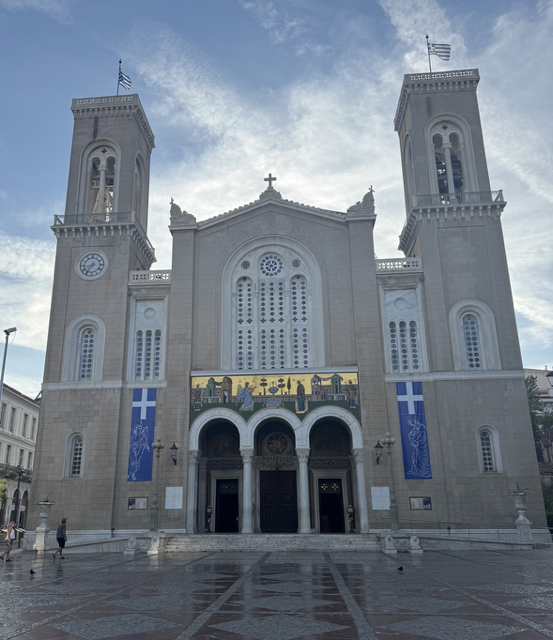
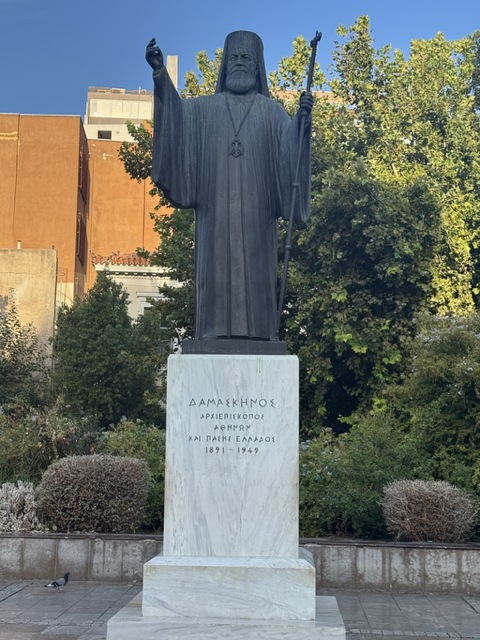
The next stop was the big cathedral, built in 1842. The only reason I’m including this is because the archbishop here in WWII was incredible. He was a rare Christian leader who spoke out against the Nazi’s and protected the Jews as much as he could. They threatened to put in front of a firing squad and he joked they should hang him instead. After the war, he was the caretaker prime minister. Pretty amazing. The statue of him was erected by Athens’ Jewish community as a show of thanks. 

I then continued with the tour around Athens, winding up through a wonderfully tiny neighborhood in the back of the Acropolis that I wondered if I’d find again. Can’t wait to be there with the family. 

I came back to the hotel, to cool off, and get a hat and drop the over shirt – it was getting hot. My plan was to do the tour of the Agora, the ancient home of democracy. I was telling one of the bellmen my plan and he told me to go to this neighborhood in the back (different back) of the Acropolis for lunch. Off the beaten track. Cool, I’ll do that. 

We’ll, the Agora was great, though the entry was not marked and was all the way on the other side from the Rick Steves directions. But I did find it, following a French couple who were also wondering if they’d ever find their way in. 

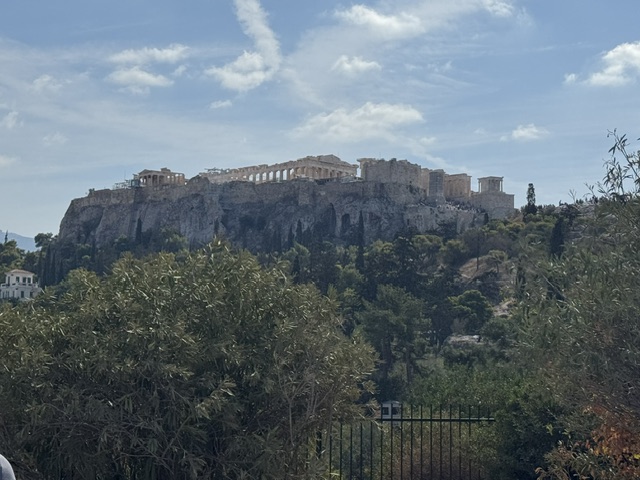
Ach, just looked at my photos, really impossible to convey the enormity of this open-air plaza where people actually voted and help their senators accountable. So many cool places, here’s a view of the Acropolis from the Agora. They used to march in a parade from here all the way up once a year, a great spectacle taking a newly woven robe to Athena in the Parthenon. 

After I finished the tour, I decided to try to find this neighborhood to the right and back of this view of the Acropolis where Georgia told me to go. I was watching my phone’s battery and using GPS as sparingly as I could. And I walked. And walked. 

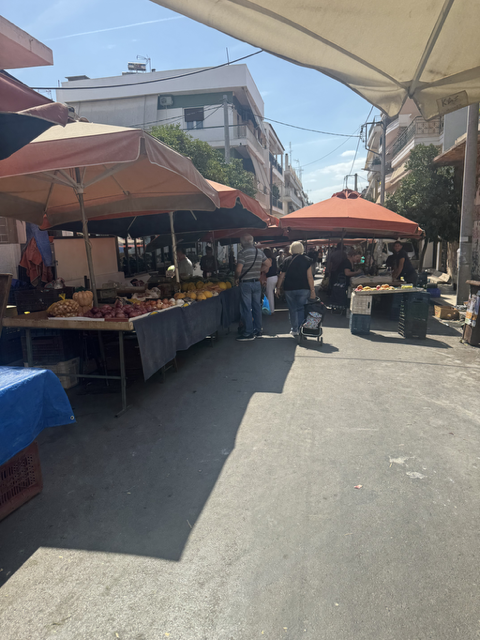
I ended up in great neighborhoods, saw parents waiting to pick up their kids and then a market that was only locals and went for blocks. I was definitely the only tourist in the midst so just took one snap. I then continued with the tour around Athens, winding up through a wonderfully tiny neighborhood in the back of the Acropolis that I wondered if I’d find again. Can’t wait to be there with the family.

I then finally gave up on finding these small plate restaurants that he said were great and started trying to find my way back. At one point, I was in the midst of land with no people in sight and I had no idea where I was. This was wide open in the midst of Athens! On my map it said I would pass Socrates’ prison – I wanted to see that. I didn’t see that. 

I did see this burial spot of Thucydides – amazing to know this name and his history and here he was!

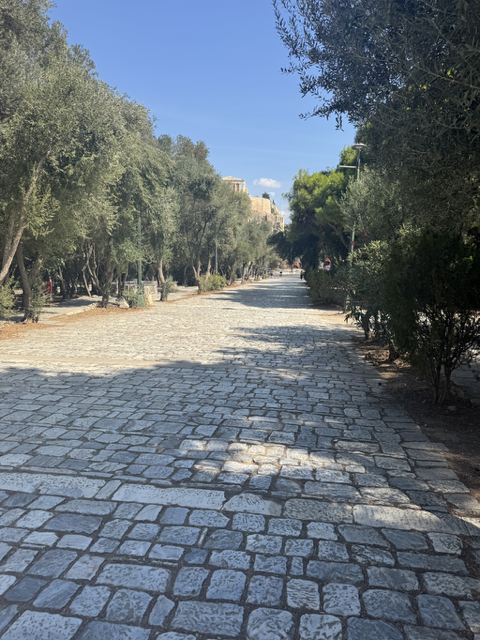
Then I suddenly hit a beautiful cobble wide walkway, ok, I must be getting closer to something I’ll recognize.

Whew, ok I recognize something (the Acropolis)and think I can find my way back if my phone runs out. 

Yay, so happy to eventually make my way back to the hotel. I realized I did an entire circumnavigation of the Acropolis adding in many different areas. Loved getting a real sense of the space and how the neighborhoods work. 

Greece, 25.Sep.2025, Thursday

I wanted to explore with the family, so went on Viatours to find something that would be a day excursion and found a boat trip that went to three islands. It looked like a sailing boat from the ad, but nope, it motored, but it had these crazy big cushions that every one sat on for and aft and we just motored along. The weather was perfect, I had a good spot with a fair amount of sun protection (it’s hot!). I read two parts of two different books, chatted with a few passengers and had a very chill day. 

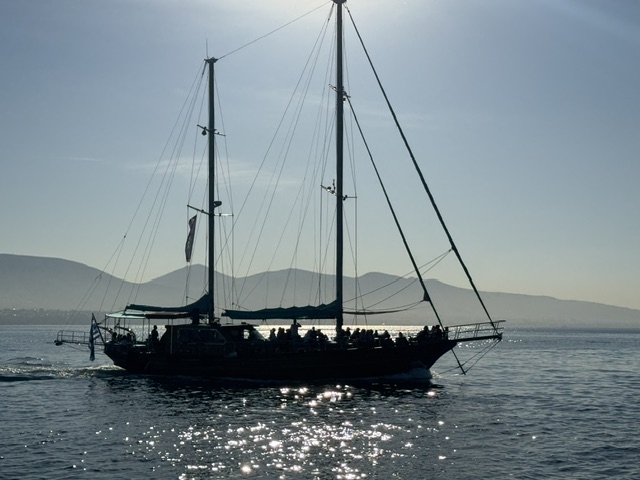
This was a sister boat that went out at the same time. See how it looks like there would be sails?

We had three stops, I walked out and back at the first island, Agistri. I had thought I’d rent a bike, but it really was just the shoreline and then I would have been riding up into hot and arid hills, that didn’t really call. But I had a decent walk and the water was beautiful. 

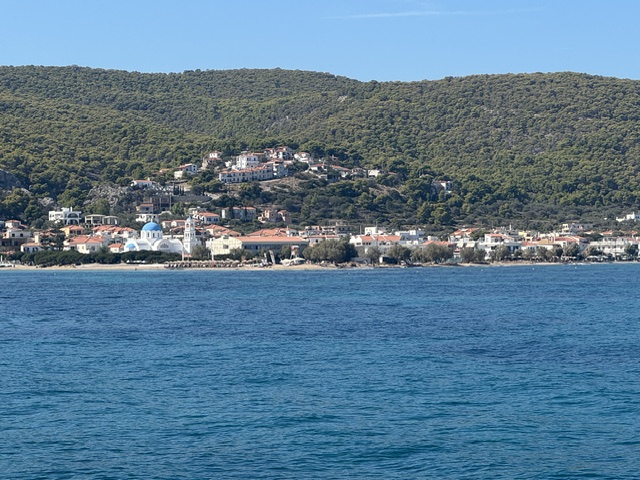
This is coming into the island, so pretty, with the classic blue and white church at the center. 

The second island, Metopi, was just a stop for a swim. I did jump in, I’d brought mask and snorkel, but there weren’t any fish. However, the water was a perfect temp, I was really hot after walking on the previous island and it felt great. This island was a small rock and protected (though I don’t know what was there to be protected, so dry!), so we just were in the water for maybe 30 min.

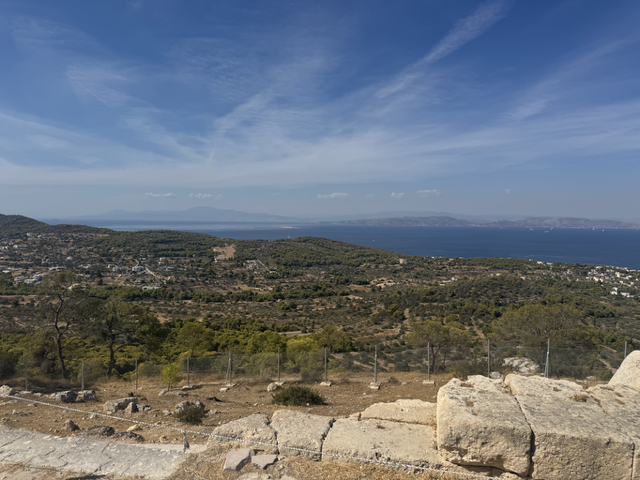
The last island was Aegina, known for pistachio production. They had all kinds of pistachio products, but way too early in the trip to buy anything and I’m not wild about pistachios anyway so didn’t try any (“they’re so fresh!”). However, it did have a totally cool temple and monastery. Two other women and I shared a taxi for a set fare and he got us up to both places and back to the boat in time. 

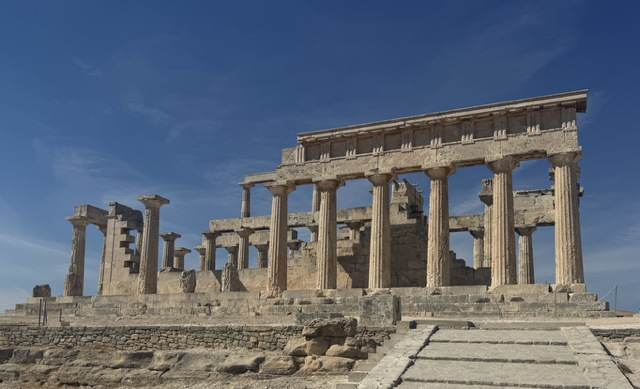
Even though it was just a tiny island, evidently Aegina was a serious maritime trading site. The Temple of Aphaia was the precursor to the Parthenon. Just unbelievable to see this temple at the very top of the island with views everywhere. You couldn’t help but  think about who did the work, ach, but it was truly beautiful, built between 500 and 490 BC.

The nymph Aphaia was thought of as the daughter of Zeus and was only worshipped here. So curious how these things evolve. 

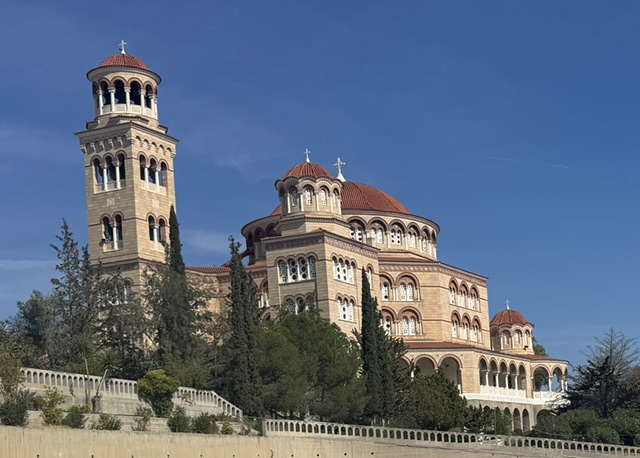
We did a quick hit and run to the monastery, truly beautiful and huge. It looked so well maintained and had an amazing balcony with balustrades all the way around which caught the breezes and was so cool. Even a monk with full robes would be comfortable!

This was the Chrysoleontissa Monastery. (Copied from internet) According to the local tradition, Panagia Chryssoleontissa was originally built in the coastal village of Leonti, which was, however, very vulnerable to pirate incursions. After being raided and laid waste no less than three times, it was decided in the early 17th century that it should be transferred to a secure location away from the sea.

Legend has it that, for three consecutive mornings, when the builders returned to the construction site, their tools, left there since the previous night, had disappeared. Instead, they found them at the exact place where the monastery stands today. So, the monks decided that this should be the chosen place.

In its present form, the complex is square and includes a crenelated tower built in 1601, and the primary church (called the katholikon), which was erected later on, in 1808. Situated in the center of the courtyard, the convent church is dedicated to the Dormition of the Mother of God, Saint Dionysios, and Saint Charalambos.

Built to protect the monks from the pirates, it is 20 meters high and has three storeys. With its characteristically high walls, turrets, battlements, and narrow windows, it looks more like a fortress than a monastery. The place also features a huge garden and six chapels.

Having played an important role in the 1821 Greek War of Independence, in terms of both spiritual and financial support, this is also a place of great historical significance.

Up to 1935, it functioned as a male monastery. Since then, it has been a convent, housing about 10 nuns. Don’t ask me how 10 nuns can keep it up. 

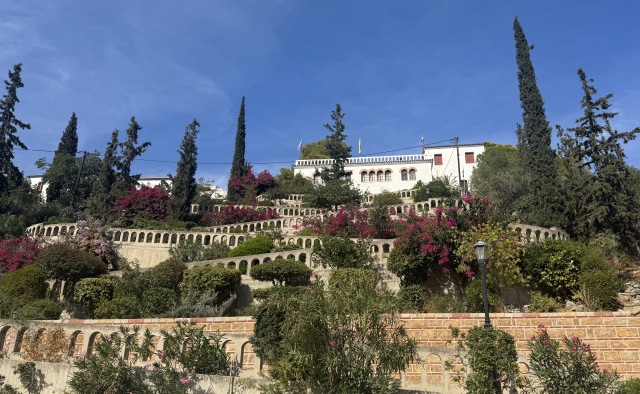
I guess this pathway led up to the chapels and the housing. Just gorgeous.

Fié Allo Sciliar, 9.July.2025

Day 4 of hiking

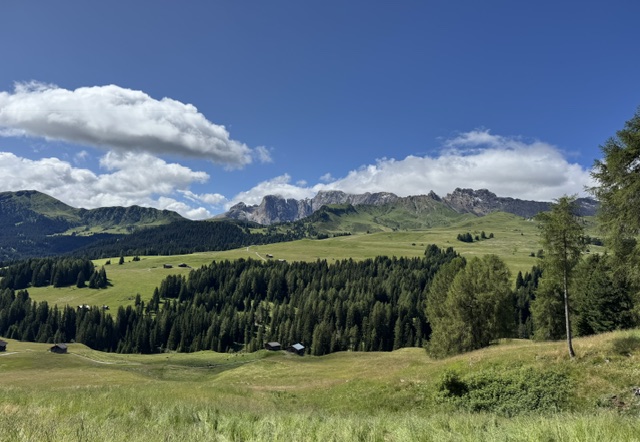
We started with a lift taking us to the Gardena Pass, one of four mountain passes that encircle the Sella Massif. We were then hiking the Puez-Odle park, an UNESCO World Heritage site. We passed through the village of Corvara and could see into the Badia Valley, “considered to be the heart of the Dolomites region and the indigenous Ladrin people.”

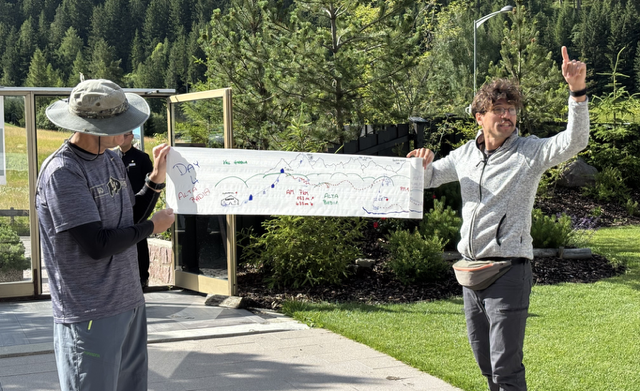
Here’s Luca with an assist from Matt:

We will have a day with a lot of choices. The shortest route was the Colfosco Route: 5.8 miles, 500’ gain, 2,200’ loss. The longest route was going all the way until the hotel, The Wellness Hotel Fanes in San Cassiano, 11.4 miles 1,700’ gain and 3,100’ loss. I did the first and then left Rick and all the others who did the second and then Rick and 2 others carried on to finish out the last, walking up the last hill to the hotel. They actually ended up hiking 14 miles? I did not. We had been told that this next hotel had a great salad bar and I knew it was another sauna, steam hotel. This time, I wanted to ask without a bunch of people around, how does this actually work? If no one was around that I knew, maybe I could do the whole sans clothing thing and enjoy. And I did! I’ll get back to that. 

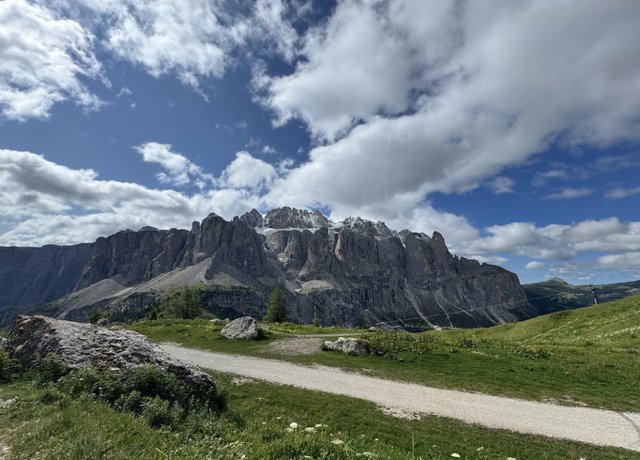
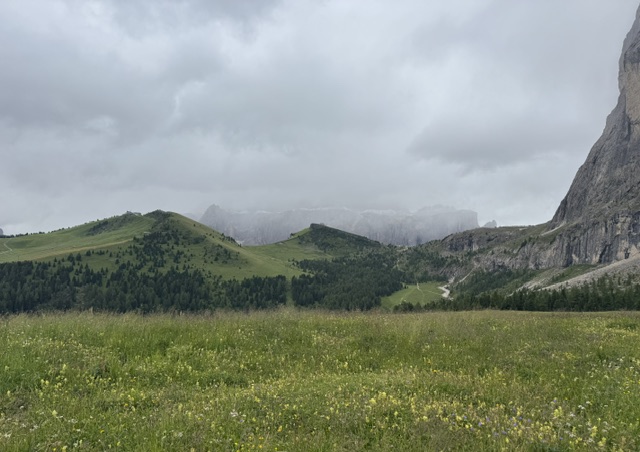
So off we went on our hike. And here’s the Sella’s north face:

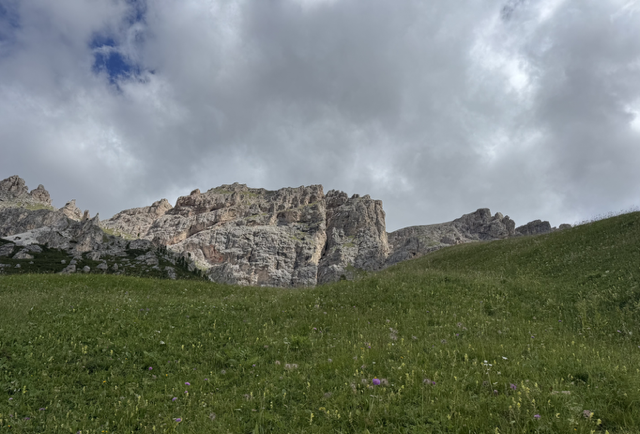
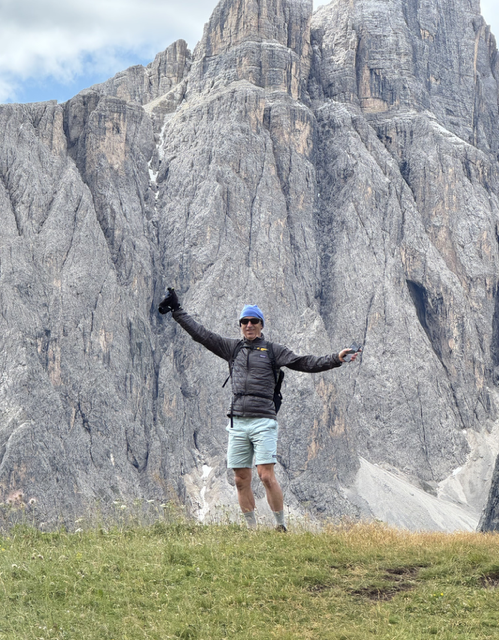
And another perspective, and Stuart holding his own in front of it:

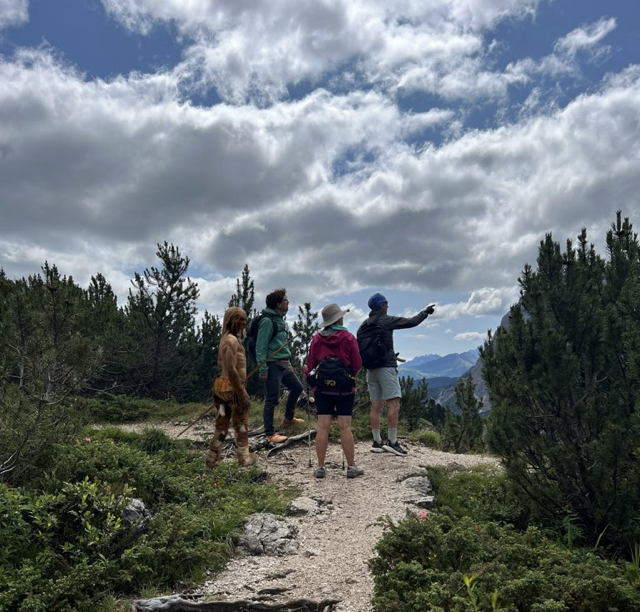
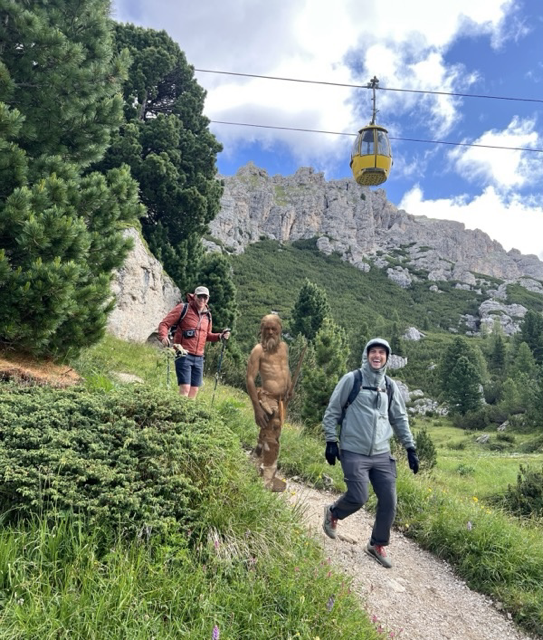
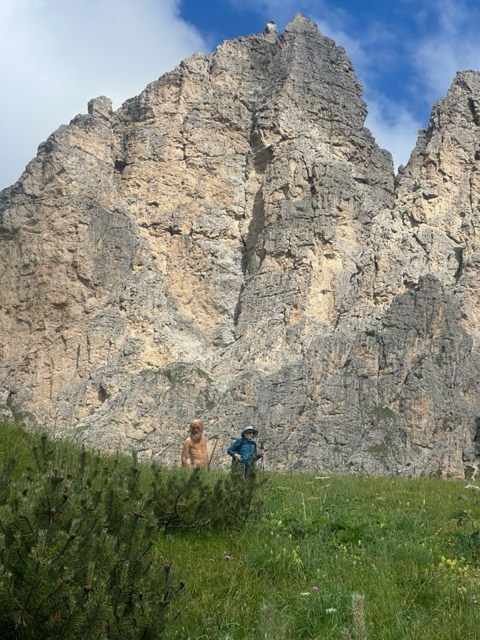
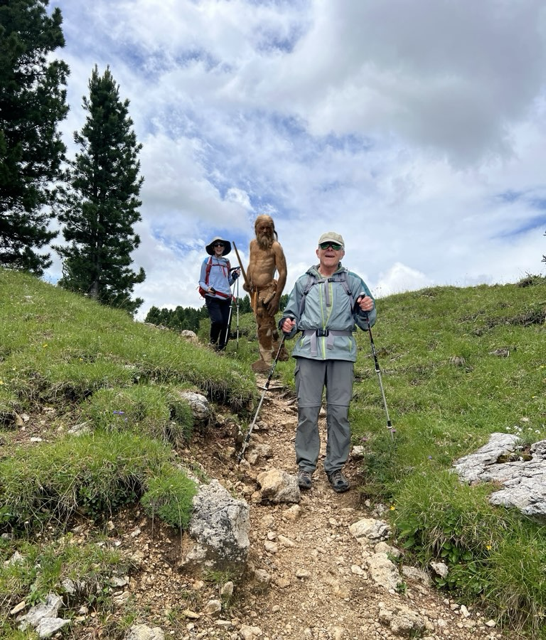
Ötzi joins for a look and the downhill.

And a quiet moment with Sara

Today, I took the first route, main climb up to lunch and then down the gondola with all the others and then off, back to the hotel. I indulged all by myself by exploring the spa. I finally went to the woman at the desk and said what do you do with the peel? How do the interaction of the showers work? What’s with the group sauna in the turning room? And I got all my answers!

No suits for most of the areas, one sauna that wasn’t that hot allowed it. Take the peel (little pots of delicious smelling goop) into the sauna/steam room, get quite hot/sweaty rub it all over, sit for a while longer until even more sweat running off you, then shower. You’re supposed to shower after each room. Oops, none of us did that in the other hotels. I don’t think. And take one of the little white pads to sit on. Well, that’s delicate and a nice little touch. 

So I found the hottest steam room, called Turkish bath. I was a little worried that you were supposed to do more since there were a couple of hoses in there. Add to the steam? Rinse off there? I didn’t use them. 

The Turkish bath was very dark, little lights over head with a variety of short benches with little walls next to them. If felt very private and it was great.

Then the special performance sauna. I missed this, but a lot of the others did it when they got back just in time from the longer hikes. You’re supposed to go in the cold plunge little pool or whirlpool then into the sauna. A guy puts ice and herbs on the hot rocks then waves a towel or a large fan like a matador, walking around the space and blowing HOT air over everyone while softish music plays. That was the 5:15 one. The 6:15 one was loud music, and even hotter. Rick did this, he had a massage first so missed the soft one. When he came up just in time for dinner he was in a complete daze. I decided I’d rather try for the soft one tomorrow. 

For dinner, we were on our own again so 6 of us had the great salad bar and other things – the salad bar didn’t even count in terms of having dinner – and then to bed.

Fié Allo Sciliar, 8.July.2025

Day 3 of hiking

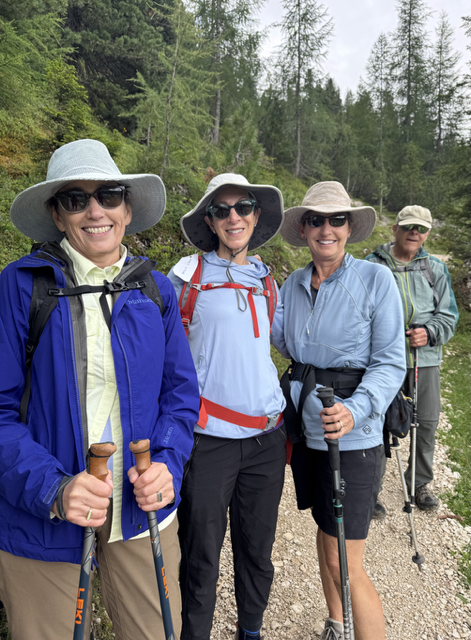
We left our wonderful hotel today to venture further into a new valley. We had three choices of routes, and everyone took the long route (I think, can’t remember). The San Casiano Route, 11.4 miles, 1700’ gain, 3,100’ loss. So beautiful. Every day we just marvel. 

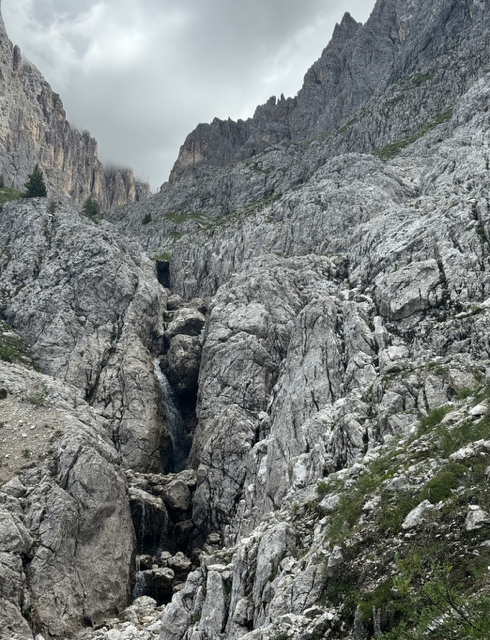
We started with a lift taking us to the Gardena Pass, one of four mountain passes that encircle the Sella Massif. We were then hiking the Puez-Odle park, an UNESCO World Heritage site. We passed through the village of Corvara and could see into the Badia Valley, “considered to be the heart of the Dolomites region and the indigenous Ladrin people.” 

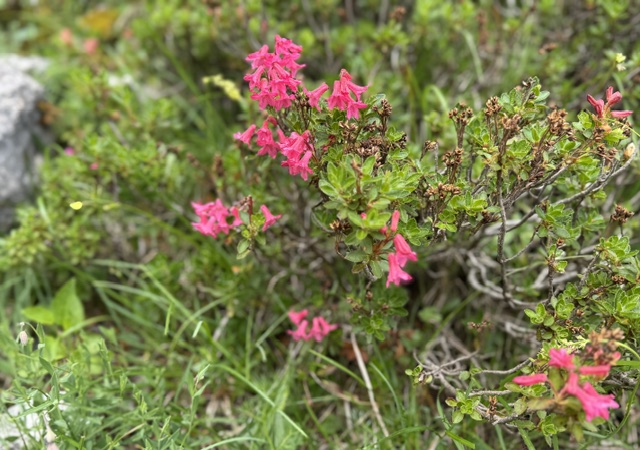
Mountain rhododendron, the flowers are incredible. So many colors, shapes, all tiny. 

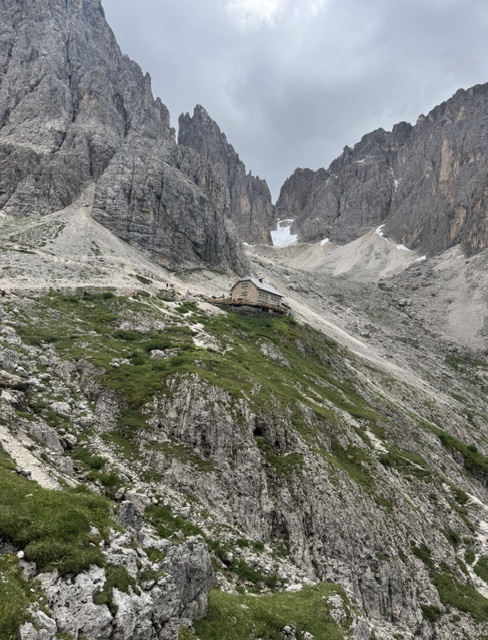
After a long hard climb, we caught sight of our rifugio for lunch. So happy to see this!

View coming back down after an incredible meal, in the Santan Cristina Gherdeina area.   And Ötzi is sighted again!

Our hotel tonight was the Alpenroyal Grand Hotel. One night, but really fun because by now our whole group was getting into this sauna/steam thing. And this hotel had an outdoor pool that was warm and with targeted jets around some of the edges. Hard jets! So you felt like you got a massage. Which Rick and now a few others did, but I was happy with the pool and saunas. I’ve decided I like the steam rooms the most. 

On my way to the restaurant, I’d noticed a coat of arms sign with 1370 written on it, and then I saw a full family tree from the same family all the way up to today with a line with people born in the 1950’s and 60’s. Amazing. I’d known that most of the hotels and rifugio’s were family run, but this was one long line of owners!

Dinner on our own, nothing planned so 8 of us ate together, Marla/Ken, Sara/Stuart, Carol/Matthew and Rick and me. So fun and great food again. Started to see a theme here.