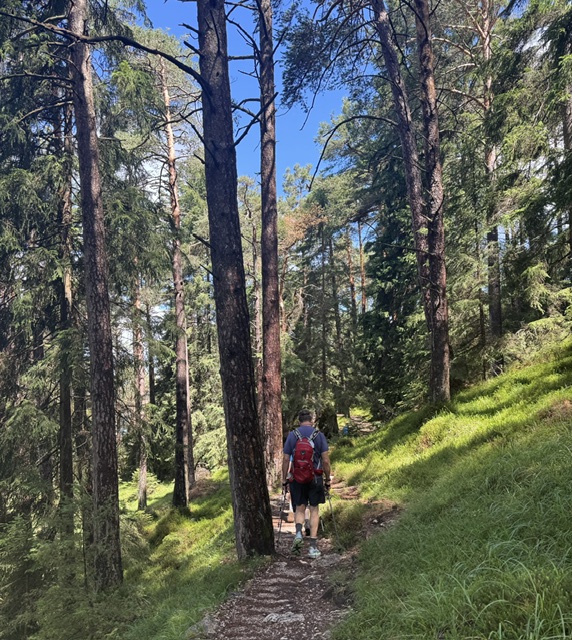
We walked outside our hotel on the Völser Weiner Route, our first hike of the day. It was 5.4 miles, 1500’ elevation gain, 900’ loss. This gain loss is what I’d heard a lot about for the Dolomites. Sometimes it did feel like a steady serious uphill or downhill, but except for our next to last day, it was never super hard. It was definitely manageable and the miles were never that long the way we were scheduled. That being said – you could do seriously long hikes if you wanted to, trails go ALL over these mountains.
A note re our hotel – and turns out all of these hotels – they’re “wellness” centers. What does that mean? Goodness, spa, sauna, steam, pools. And in this ancient hotel, they’d carved out spaces in so many directions that Rick and I took at least 30 minutes just to explore and see what was what. It wasn’t until we left after 2 nights that we found out there were two more steam and sauna rooms that we’d completely missed. Rick went for a massage yesterday and Sara texted me asking if I wanted to go to the sauna. Ok. Happy to do it with someone else. You can’t wear bathing suits in the sauna so our group by consensus said we were all going to wrap our towels around us. Sara had come up to see our room and when we were looking out the window we saw at a distance a bunch of people drop their towels and get into the fountain pool. Hmmm.
So we went down and to the sauna and baked. A lot. Then we really wanted to go to the pool but didn’t have suits. We finally decided, with some prodding on my part, to go to that same fountain pool and if no one was there we knew, we’d go behind the statue and hop in. We did and felt quite brave and pleased with ourselves. And what a great way to recover from the sauna!
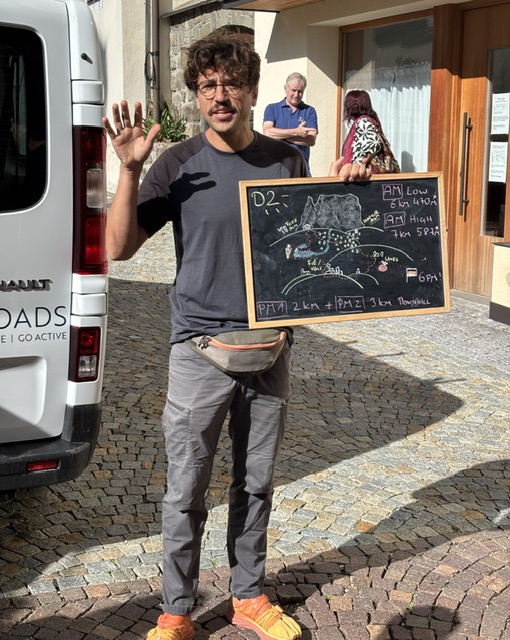
Here’s Luca doing his artistic debriefing of the second day’s options.
We walked outside our hotel of our hotel, down the hill and the first site was a memorial to WWI with bits and pieces the artist had found on the hillsides. WWII was not fought in this area because they’d realized how futile it was to try to fight in the nooks and crevices of these mountains. Refugees and resistance fighters were able to hide here.
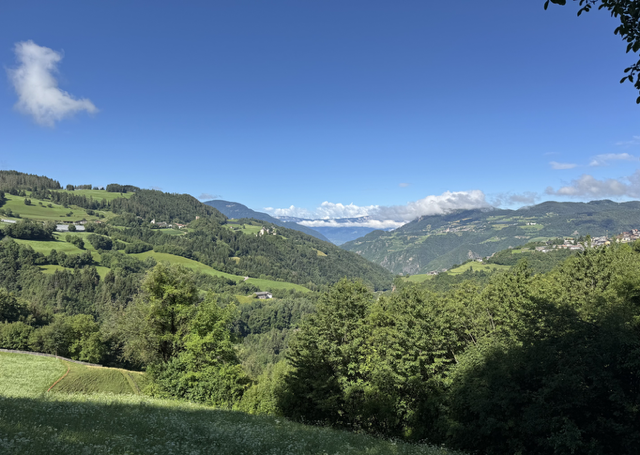
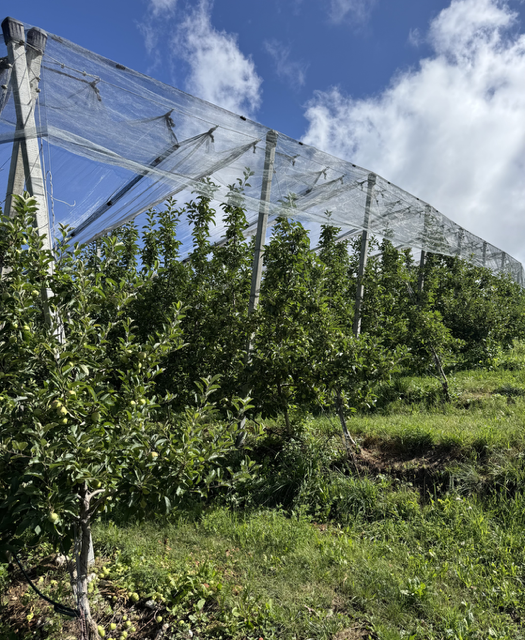
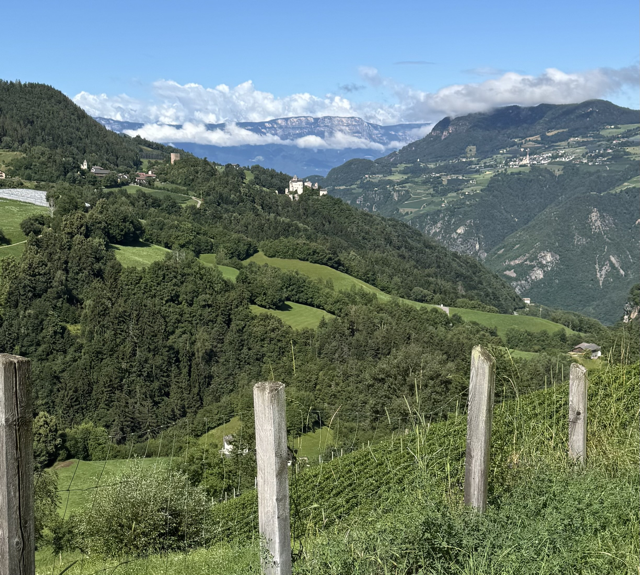
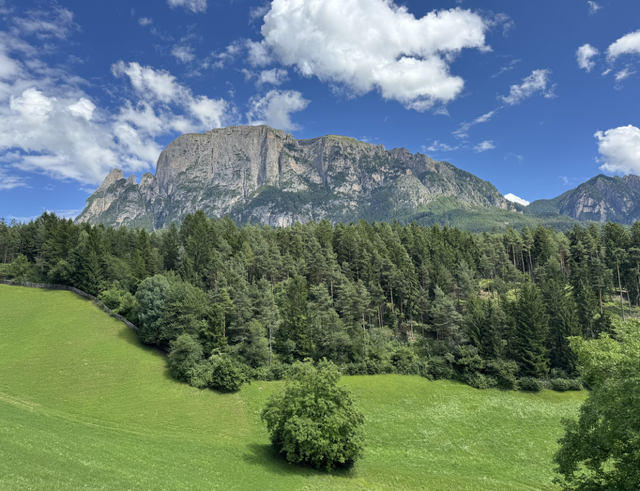
Our hike today set the frame of all the days. We were going valley to valley around the Schwerin massif, “an enduring symbol of South Tyrol.”. But first, orchards, vineyards, dairy farms…
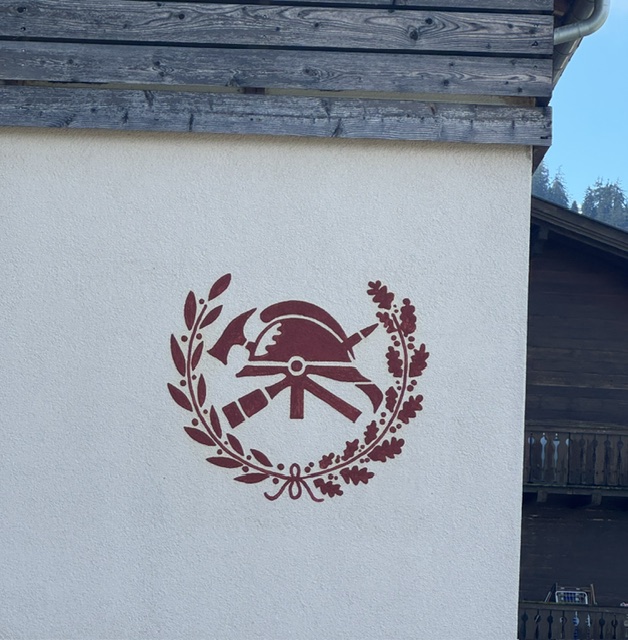
Tyrolean helmet
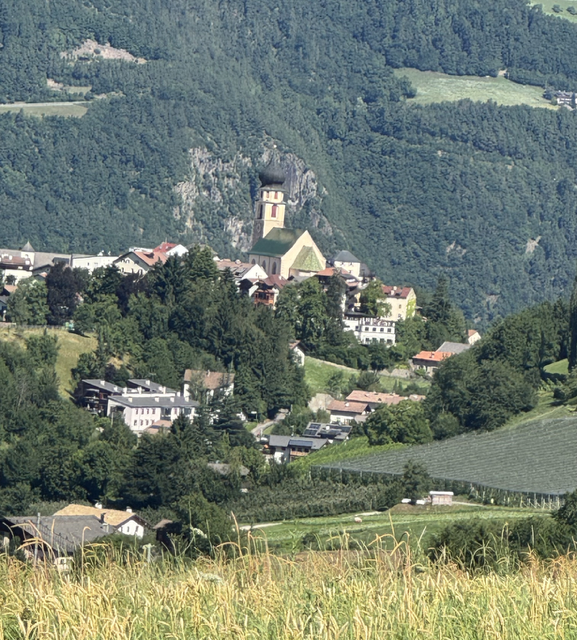
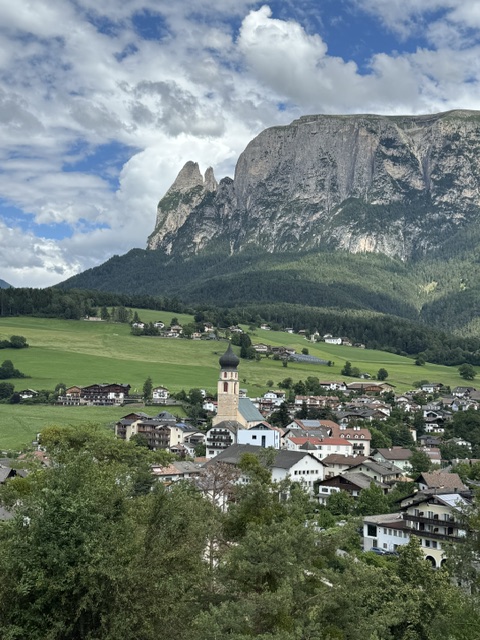
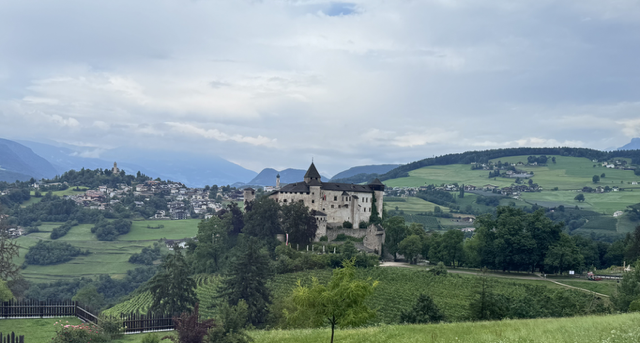
Looking back down over the church and our hotel – the building just to the right of the church. This is a lot of town are, nestled into a side of a mountain.
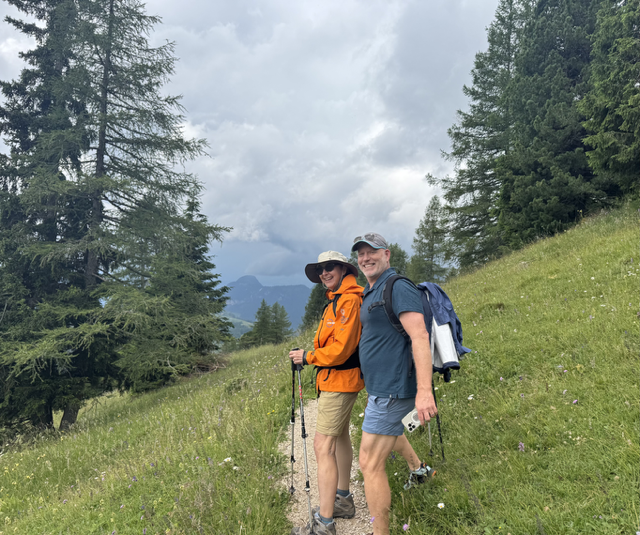
Carol and Matthew on the way up, past beautiful meadows and then into the woods.
And our next lunch rifugio with Sara and Marla to welcome me 🙂
And after another amazing lunch, we were off to a mountain lake for swimming.
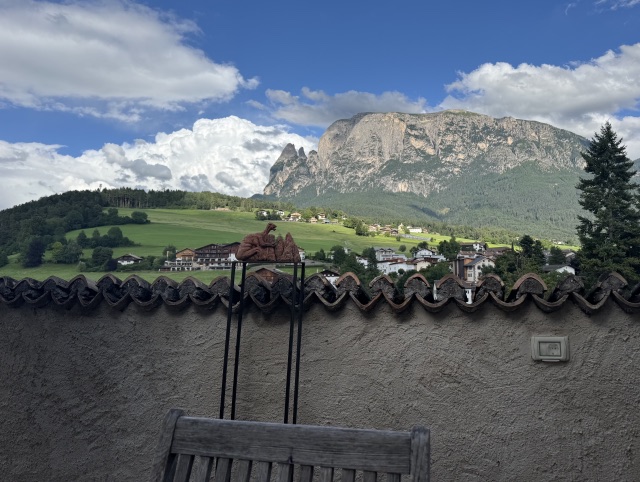
Here’s the Schwerin massif at the center of 5 valleys. We would see 4 and peak over the top to the fifth over the days of hiking.
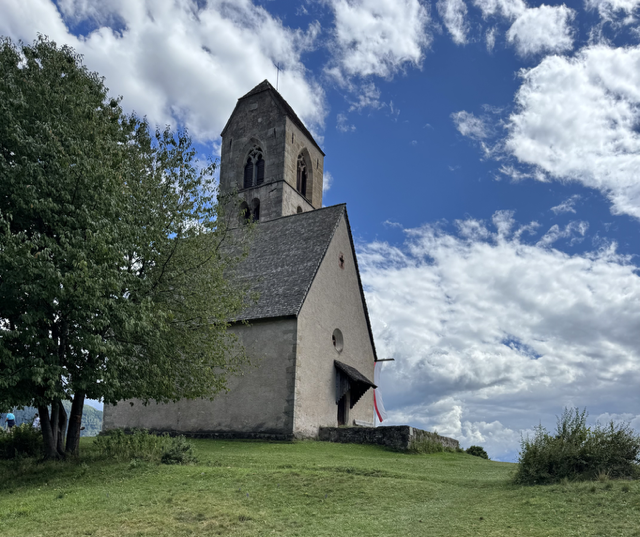
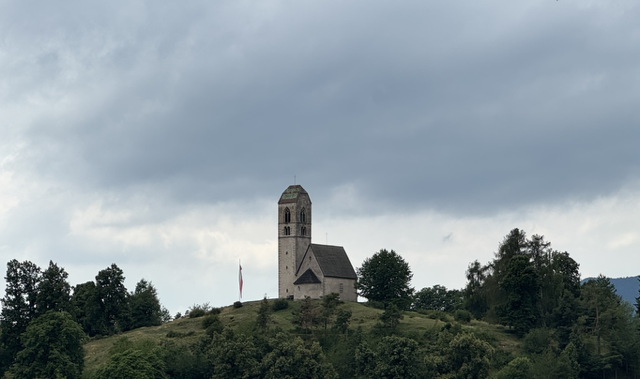
We came back into town, but I had some energy and really wanted to see that little church we could see out our window. It looked so far away, but Elizabeth, the youngest amongst us, had already explored early that morning and said it was a wonderful church built on ruins. And that there was a wonderful jeweler in town and worth seeing her shop. So church first.
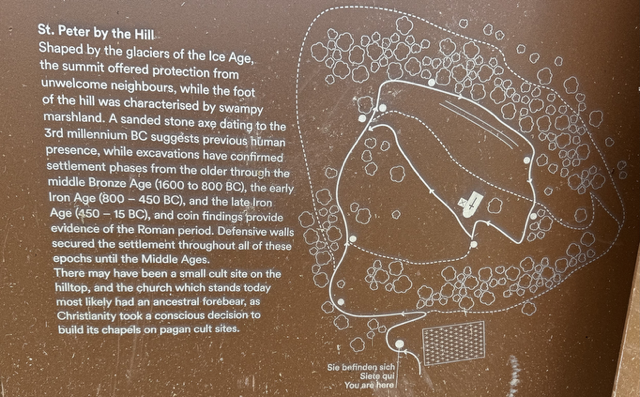
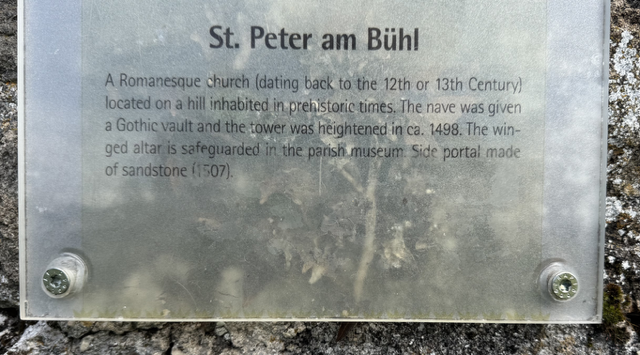
This plaque explains some of the archeology that was happening around the church. There was a little chapel outside the cathedral that was closed and had a sign “churches, museum and aperitif tours”. Bewildering combo, but this site explained that the chapel was the archeological museum.
I climbed up the hill towards the church passing this site. I went inside and there was a space carved out from the rock that was tiny. How 80 people could fit in here was bewildering, but it did feel protected.
It watched over the town.
In town looking up at church
On my way back, I went into the jeweler hoping to find a wedding ring for Rick. Yes, 36 years later. Several years ago, he’d put his ring into my hands for safe keeping. I have no idea what happened, but it was lost. We were in the Romantik hotel, in a darling little town, on a totally amazing trip with some of our oldest friends (college, Quaker meeting, NY roommate) and wouldn’t that be a cool place to find a ring?
I was completely sweaty from the day, but went in and the goldsmith was a darling woman, so appealing and she did have rings. So I went back and had a shower and asked Rick if we could look for a ring for him. And we found one! We both think it’s perfect and I love seeing it on his hand. The goldsmith had to make a new one to his size so we had to go back at 7. In the meantime, we went to have a cocktail/mocktail on the patio at the hotel. Funny little statues around the place – actually a ton of art all over the hotel, but here’s a snippet.
We then had a dinner out at a woman’s house. She and her husband cook dinners for the group all local food, from her garden or within a few k of her house. She announced a wine that was within 1 k and another that was 7 k away. She’s been recognized – magazine covers around the kitchen – for her part of the Slow Food movement. Another astonishing meal. So efficiently served and delicious. The apricot cake was my favorite.
Rick decided to get some quiet time (there’s very little on this trip) and stayed home, picked up the new ring and had a quiet dinner at the hotel.
Caveat to this section. Turns out between meals, hikes, transition, it was really hard to get time to write every day. So I’m now writing on the last day of the tour and trying to recollect a truly memorable week.
That being said, this will be the longest entry because of learning about the area and the people who settled here.
Today we met up with 3 others who were staying at our hotel and going on the Backroads trip. Turns out Bolzano only has 50 taxis and is quite a big city, actually second wealthiest in Italy. We were going to the Sheraton to meet and it was a solid 30 minutes away. If you’re going to Bolzano, definitely stay near the old town since it’s not that easy to get transportation early or late. There are buses, but time, and getting to where you want to go might be challenging.
So we met our first 3 new people taking a van together – all so nice and turned out that was true for the whole group.
We met for a check in at the Sheraton, to collect water bottles, luggage tags and snacks (turns out food would NOT be a problem on this trip), quick intro. What a nice collection of people between guests and guides. Just a treat for the whole week.
We had our first 4 mile hike on route to our first on route hotel, so we’d come dressed with day packs while the bus took our bags to the hotel after we were dropped at the Gondola.
We started our hike in Welschnofen and took a gondola ride up to the Catinaccio mountain group in the Dolomites. Per our guides, the “Dolomites” was taken from the name of a French geologist, Déodat de Dolomieu, who was the first to describe the type of carbonate rock abundant in these mountains. Evidently he was a chemist and was trying to figure out the mixture of elements in the rock because it was known that it wasn’t pure limestone. He finally add acid to the rock and unlike pure limestone, which would have bubbled up, it stayed stable and he realized that the make up of the stone was almost half calcium carobonate and half magnesium.
There is Dolomite rock elsewhere, but the unique geological history of this area came about because it was once a marine area fully covered with coral and other marine organisms that settled into dolomite rock. When the plates came together and created uplifting, these unusual mountains were formed. This was an important part of our talks by several guides, a lot of pride in this area of their unique mountain region within the alps. And deservedly so – it was spectacular.
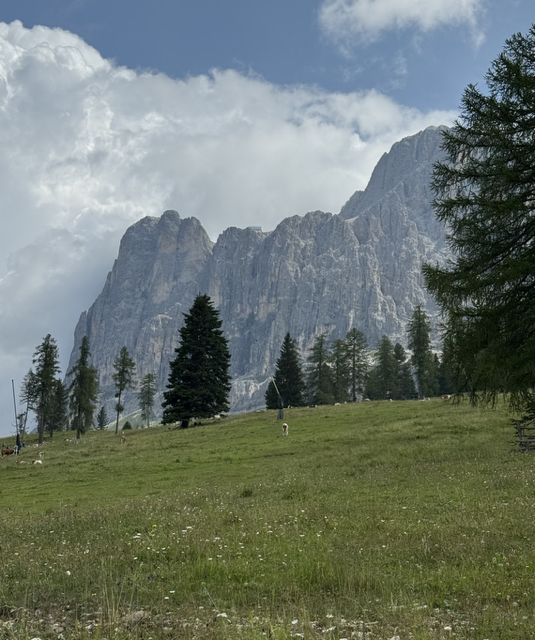
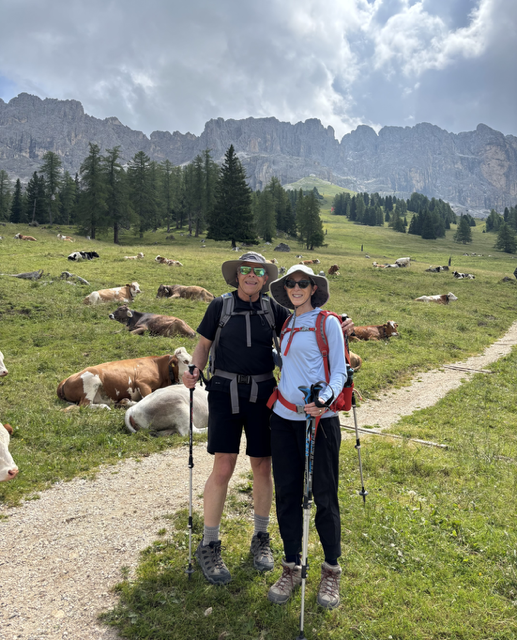
Coming from the Rockies, it was startling to see such distinctly different formations. The vast mountain meadows with these dramatic peaks towering over us had all of us taking photo after photo in a vain attempt to capture the beauty. We were hiking, but this is a winter wonderland evidently. Even with climate change happening – and that was talked about a lot – snow was still the primary driver in this area. You can see a snow making machine behind the cow.
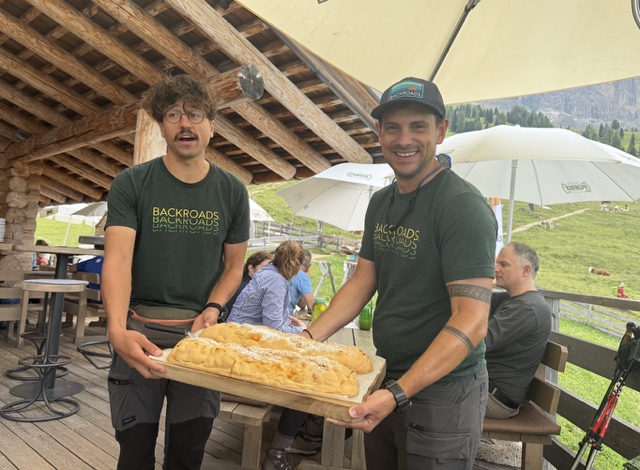
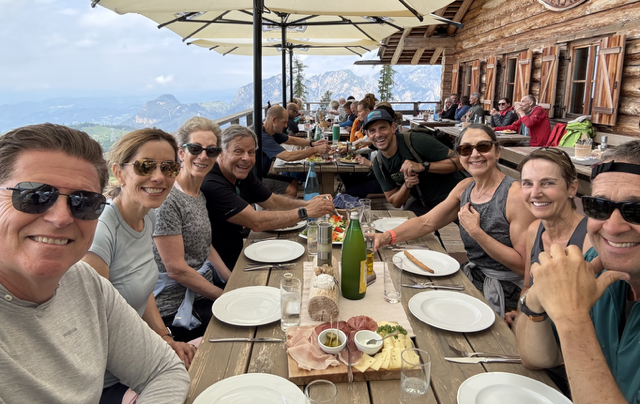
Today set the tone for the rest of the week. We hiked from the gondola drop off across the mountains to a lunch at a rifugio – an alpine hut that was one of a series across these mountains. The scenery was just a start – we couldn’t believe how beautiful it was. Seemingly inaccessible, even if a gondola went up, we had the most incredible lunches every single day. A huge variety from which to choose, plates of salad, bread, meats and cheeses promptly put out to greet us to get us warmed up for whatever we wanted from the menu. Really? Astonishing amounts of incredible food. Today’s specialty was the Apple Strudel. It set the tone for Rick – needing to assess apple strudel in every rifugio. This first one set the high bar. Here’s Luca and Martin holding it up for demo before cutting in.
I was so conditioned from Camino food routines, small breakfast, a few snacks, big mid-day meal and little to no supper, made me think – I’m not going to like this whole 3 meal routine and how can you hike after a lunch? Well, turns out, just fine. Oh my goodness, the food was so good, the company was wonderful, the views incredible – every day we just relaxed into these lunches and then carried on after.
We never stopped marveling at these primarily family-run rifugio’s ability to quickly put out these incredible meals, handling a fair number of people with ease. It was also starting to hike for miles seeing some, but not a ton of people and then arrive at the rifugio and all these other people were there too. There are trails all over these mountains and people come all different ways to explore. Sometimes there were dirt roads (rare to see cars), so bikes and trails with different levels of difficulty offered a variety of ways to get up to these places.
We were a group of Americans, one from Peru and one from Portugal, but the rest of us were mono lingual and just marveled at this area. Depending on where the line was in the Dolomites determined German/Italian/English, OR Italian/German OR Ladin/German/Italian. Kids are growing up with 3 languages, one week for each sequentially and then when they get older, subjects moved to a particular language. So cool.
The history of this area is that of Tyrol. The people consider themselves Tyrolean and Ladin was the earliest people and language spoken here. Again, the area determined the languages spoken. We got a synopsis lecture on the history of the area – but I didn’t have my iPad and a lot of the specifics went out the window. What I remember: Italy became a country in the late 1800’s. The northern part was Tyrolean and went back and forth between Austria and Italy. At the time of WWII, this area was part of the Austro-Hungarian empire.
Italy, Austria and Germany made a pact to all defend if one was attacked. When the Crown Prince was assassinated, starting WWII, Austria attacked Russia along with Germany. Italy held out as a neutral territory, wanting Austria to give them Serbia and Croatia if they joined in the war. Austria said no. Then France and England jumped in and asked Italy to join them along with Russia. Again, Italy asked for territory – if they won the war, they wanted the Dolomites and Tyrolean territory. Done. So – very much against many of the Tyroleans who spoke German and considered themselves Austrian, they were now Italian territory since France/England won the war. It’s now settled, but memories are long and the languages reflect the different alliances.
Story of the Ladin in the Dolomites
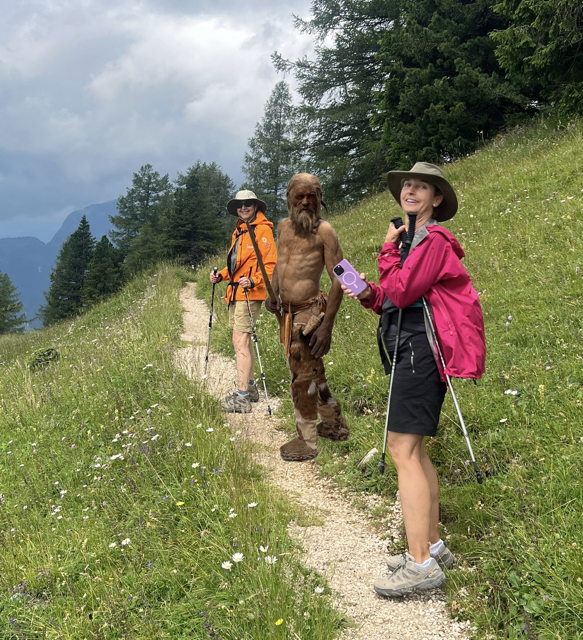
And now – to the hiking. We had our first experience of the mountains. It was a bit rainy, but not enough to deter us (and so much better than the torrential rain predicted) and the group was such a congenial group, there was a lot of chatting and exclaiming together. The hike went very quickly both before and after lunch. Matthew made sure the Ötzi joined us on many days!
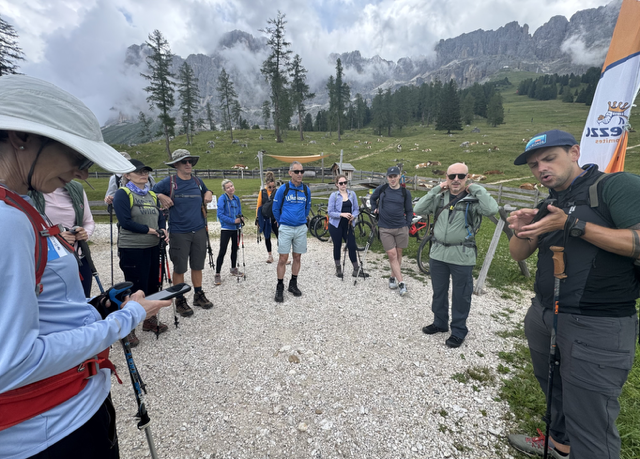
We’d always start with a brief overview with a drawing and description. Backroads had great mapping and tracking on their app and I didn’t look at it once. But I would have if I’d been alone or up in front as our super woman, Michelle, was fun. But I usually brought up the back. I’m steady, but not quick!
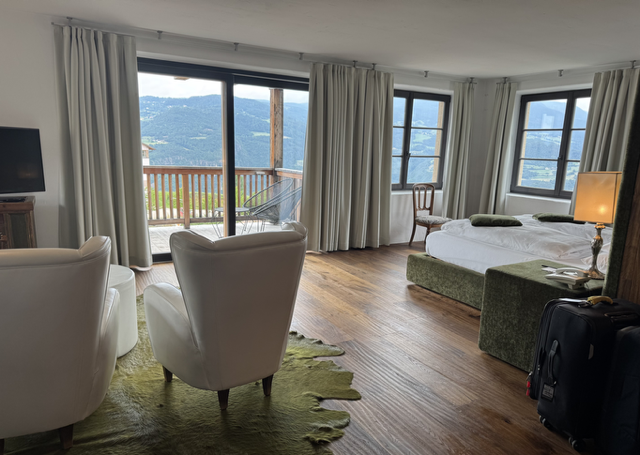
We arrived at our hotel and oh, so much fun, right up my alley. It was a historic building, a tower, built in the 1200’s. The Romantik Hotel Turm was originally a residential tower, first mentioned as a courthouse tower and jail in a document in 1244. Sold to a Monastery in 1398,. Used from 1820-1833 as a vacation resident by a Bolzano family. It was converted to an inn with attaché butcher shop i the late 19th century. [The rooms were so individual, a few of us traded looks just to see what had been done. They were really big and every one had spectacular views. It didn’t matter which direction you looked, it was beautiful.
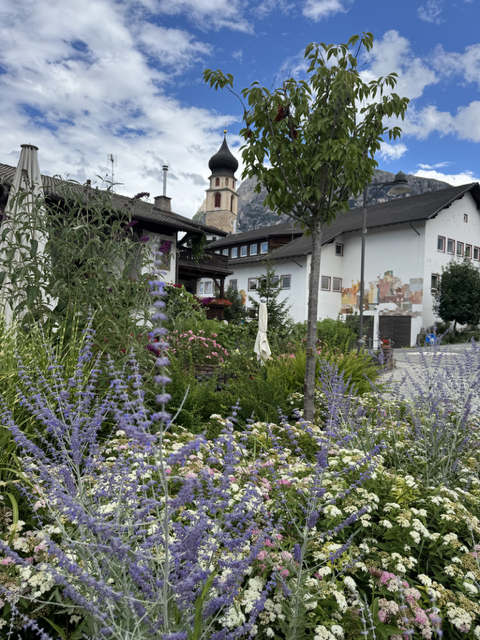
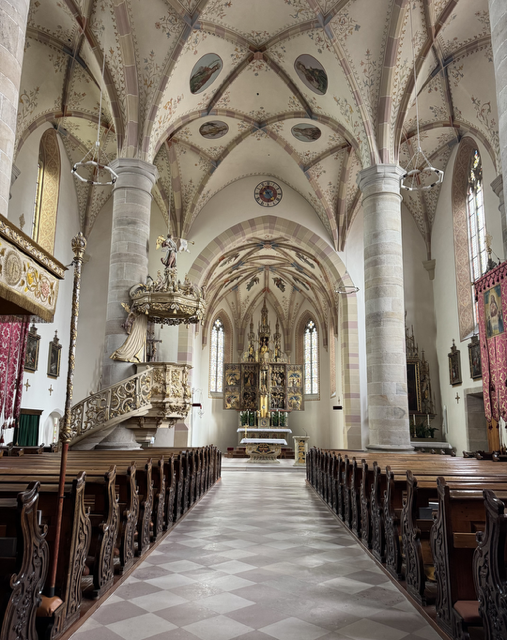
Rick and I went out to explore after cleaning up from the hike. We were in the heart of this tiny town and the church right next door was incredible. Rick thought it might be the most beautiful we’ve seen in our travels. Evidently Italy has a fund and helps take care of these historic structures.
This one was immaculate and the organ incredible. On our last morning, the organist was practicing for 9am mass and I got to listen for a bit before we left for our next hike.
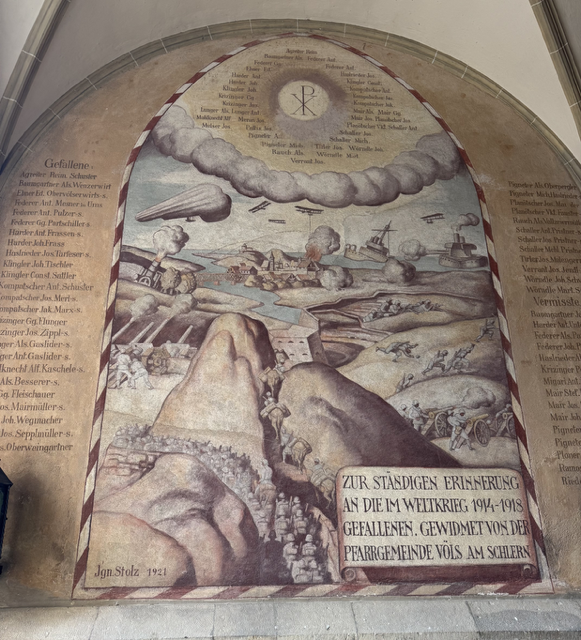
Outside monuments were interesting. This one was to WWI and was painted in 1921. This was on the wall of the church entry.
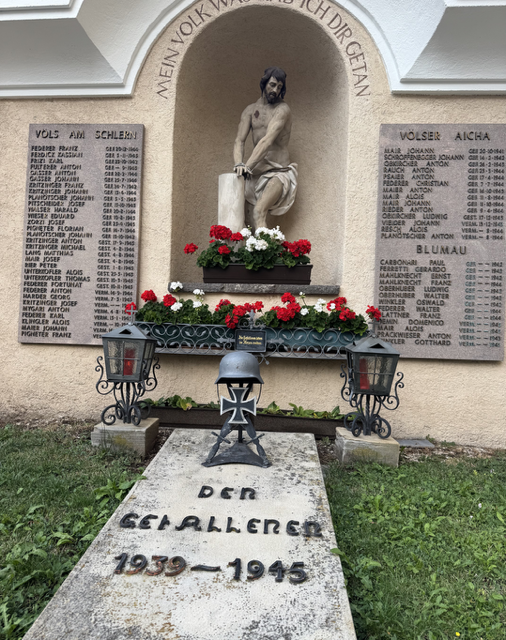
This monument had us stumped. We’re so conditioned to one way of thinking for WWII and this seemed to celebrate Germany. However, later on one of our hikes, I saw the same helmet painted on a dairy barn door and realized that it may have been more of an emblem of the Tyroleans who had died, no matter the side they were fighting on.
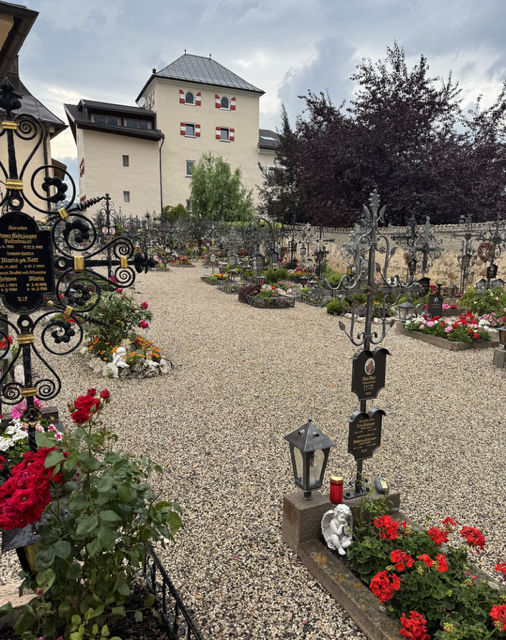
The cemetery was beautiful as well, so well tended and cared for, with many photos in the crosses that served as headstones. It made it feel very personal.
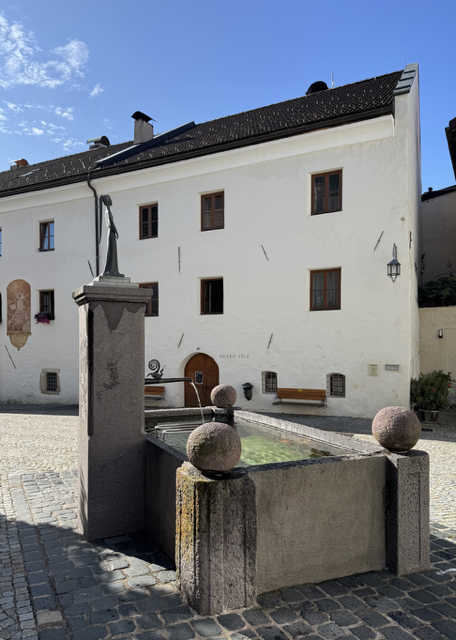
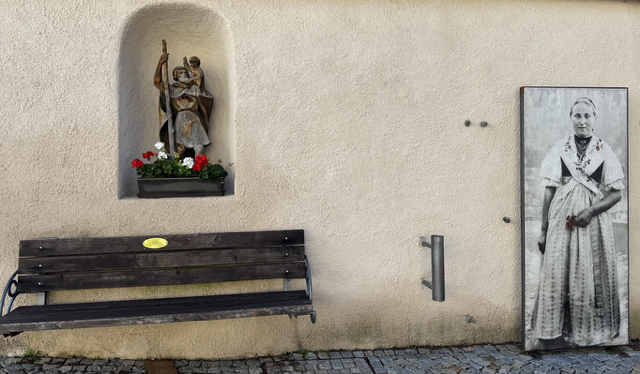
The town fountain was beautiful and there was a local exhibit of an artist’s photos around the town sharing the lives of women in the area.
Finally, strikingly, the benches all through the town had yellow oval medal plaques with quotes asking about life. I translated all of them because I was so curious.
Wolf Schneider’s “diary for the Essentials”
We don’t know who we are, where we come from, where we are going and what we can hold on to.
…In this sea of vagueness, of “It could be – but it could also be different,”man seeks security and in doing so renounces truth.
And today genetics and neurobiology explain…For Brockman, the conclusion therefore seems inevitable that the natural sciences hold the key to the answers to humanity’s important questions:
What am I? Where do we come from, where are we going? How does society work? Hubert us Breuer
Each of us has a story to tell about who we are, where we come from and where we are going. These stories shape our personality, create our certainties and our fears. Andreas Barella
Social work begins with the guest ion: Who is in need?…These are the biblical questions: Who am I, where do I come from, where am I going? This gives rise to very practical challenges. The Jesuit order sent me to Romania in 1991…and the CONCORDIA work was born in Romania and the Republic of Moldova. Father Georg Sporschill
If man comes from heaven, he returns there. To answer the question: “Who are we, where do we come from, where are we going?” …and there are still some who think that man has made a long journey and is not of this world…. Alessandro Conti Puorger
Wolfgang Nethöfel: Being Pious
Piety is a domesticated wild animal…if you let it off the leash of morality. And within this beast lies the knowledge of where we come from, who we are, and where we are going. Our guide dog walks on the reins of morality.
And there were many many more.
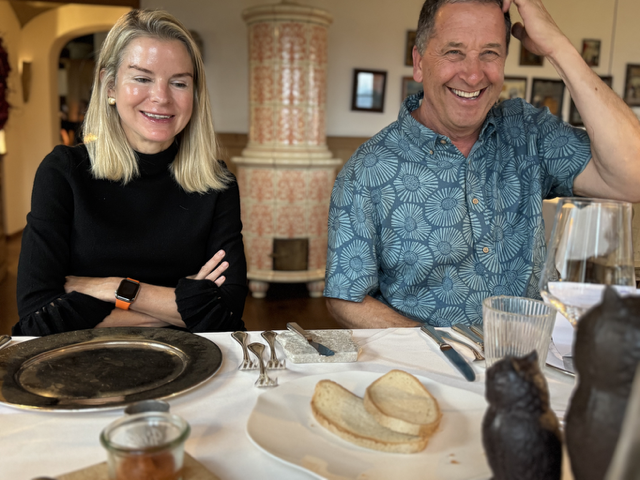
The end of our day was a group welcome cocktail/mocktail gathering and a great dinner at the hotel. Rick – laughing. We laughed a lot on this trip!
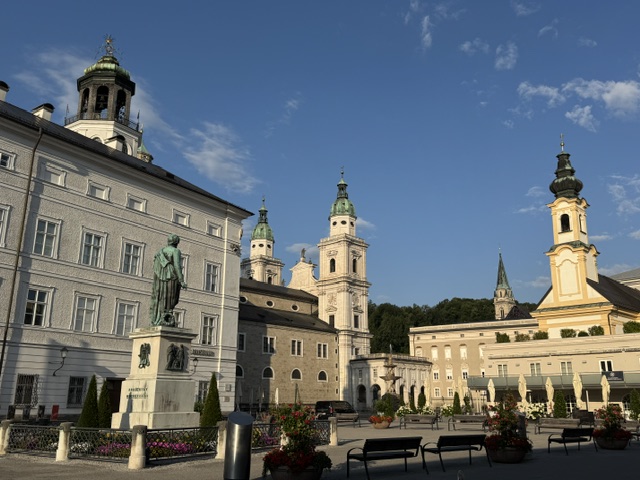
Final sunrise and listening to the bells in Mozartplatz and Residenzplatz. It’s so beautiful here.
The train was easy again, clean, this time we knew to look for the car number, and the seat number, we were familiar with the Innsbrook train station for the transfer. So much easier.
We got to our hotel in Bolzano, turned out to be a 500 year old manor house that looks like a castle that had been completely redone. Castle Hortenberg. Snuggled in the midst of a bunch of apartment buildings. The things this castle has seen in its lifetime, I can’t imagine. All the land gone, but somehow the owners made this a quiet oasis. The owners sound pretty amazing, committed to philanthropy, have vineyards and an olive farm, environmentally focused. It was a wonderful overnight.
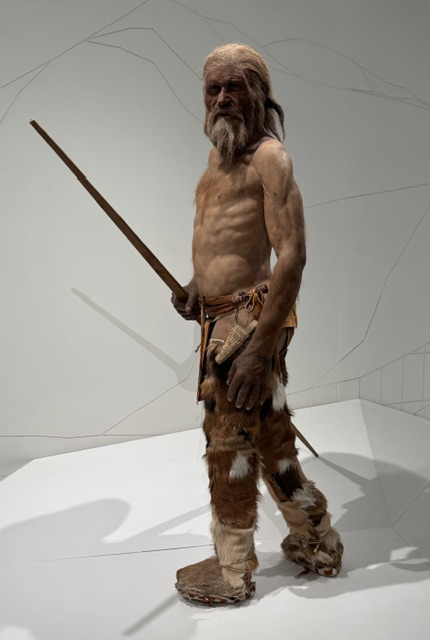
We then realized that we were only about 5 minutes from the old city, which probably makes sense since this would have been an important element of the region. We walked in and met Marla, Ken, Carol, Matthew, Sara and Stuart at the South Tyrol Archeological Museum. My friend Sabra had just been here a couple of weeks ago and said it was a great exhibit. Marla got tickets for our group and we were off to see Ötzi the Iceman.
Fascinating. Here’s the link to give info, but safe to say, all of us were fascinated to learn the story of how he was found, why he’s so remarkable and some behind the scenes stories from our guide.
Here’s a Wikipedia synopsis: Ötzi”, a well-preserved natural mummy of a man from about 3350 BC (53 centuries ago).This is the world’s oldest natural human mummy, a wet mummy, as opposed to mummies preserved by dry conditions in a desert environment. It has offered an unprecedented view of Copper Age European culture. The world’s oldest complete copper age axe was found among his extensive equipment, which also comprised a rather complex fire-lighting kit and a quiver loaded with 12 arrows, only two of which were finished, clothing, and a flint knife complete with its sheath.
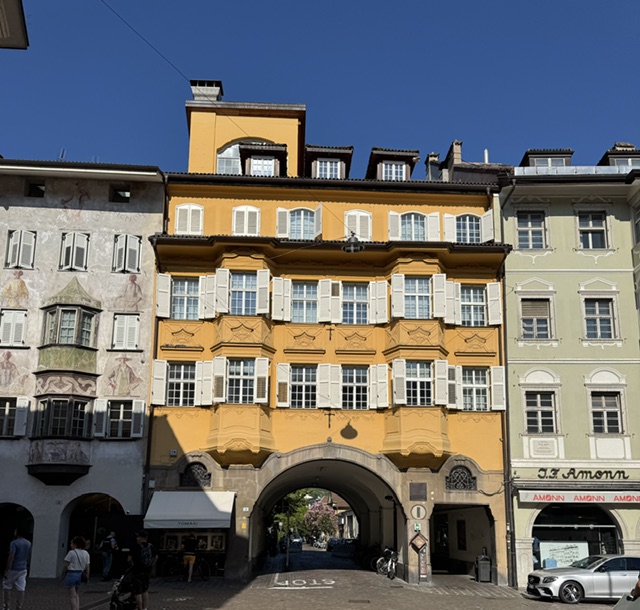
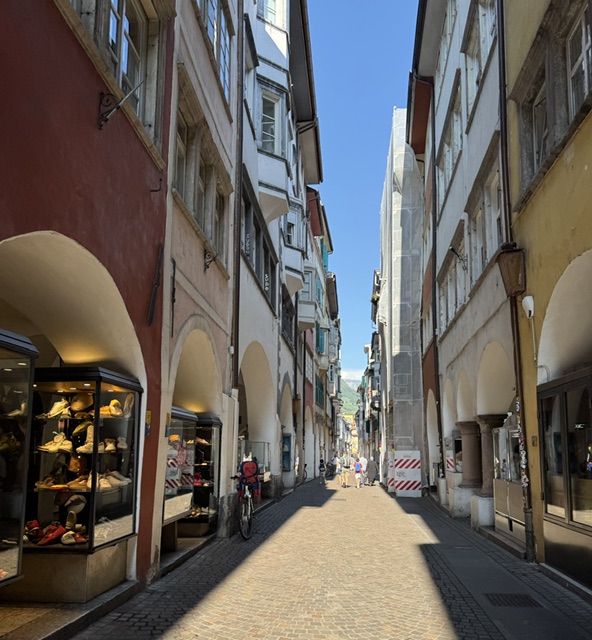
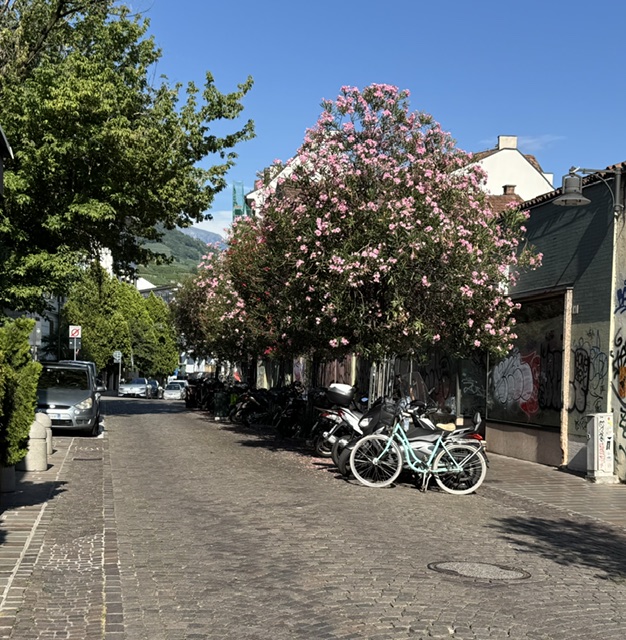
We then all went back to hotels to get a bit cleaned up, or settle a bit, since the others had just come in recently and then we met up in different groups for dinner. Sara, Stuart, Rick and I went to a place near our hotel, a beer garden, with decent food and then we walked in to see more of the old town all of which have the hills and mountains as soon as you get to an open spot.
Another fun day on our way to starting our Backroads hiking tour in the Dolomites.
Salzburg. We had another full day to explore Salzburg, how lucky is that?! Marl and Ken went ahead to Bolzano today, Sara and Stuart were going to walk for many miles all over, and Rick and I targeted museums and other sites we hadn’t seen.
We got the Salzburg card. Totally worth the cost, it paid for itself within a few museum visits. The tricky thing is that supposedly, you can download on your phone, Marla said it worked for her. But the first museum we went to, Mozart’s birthplace, said you need the actual card. So note to my future self. If I’m to come back, get the card at the Info center on Mozartplatz. So easy.
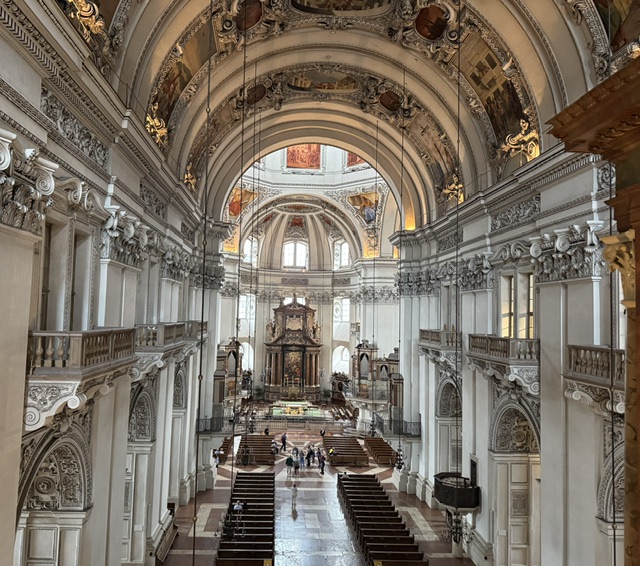
With the card, we went to Mozart’s museum, I loved it again and Rick thought it was great. Then to the Domquartier Residenz of the Prince-Archbishops showing over 1300 years of history. Crazy huge and I hadn’t seen before. It went through halls from the Residenz of the Archbishop, to the Cathedral, to St Peter’s church, and carried on. I, of course, was completely turned around since we were inside and walked connector to connector just as the archbishop and the higher ups would have back in the day. But it was remarkable and huge. I started speeding past a lot, but different parts caught my interest. As in the Middle Ages Mideaval approach to Mary as noted above. We did see the Cathedral from the organist’s viewpoint.
Then – the funicular (running since 1892) up to the Hohensalzburg Fortress. Last year, I only had time to go up and quickly around the perimeter and then back down. This time we went into all the museums or exploratory areas. it’s incredibly huge. Here’s a video from the very tip top and everything you see is part of the fortress.
I never did see the gardens that you could see from the top windows. I have no idea where these places were. It is a remarkable place to explore, with museums, restaurant, cafe, church and just walking around seeing outdoor exhibits. Sara and Stuart walked up to it and then across the beautiful park we could also see to the contemporary museum and then back down. I’d do that next time (if I go back). We stuck with the funicular for this trip.
We then finished the Rick Steve tour, this is another thing I’d do next time. Even if hokey – I’d like to go to the bar/restaurant that Charlemagne visited, the longest serving restaurant – in the world? Just next to St. Peter’s. They have a Mozart concert/dinner.
By now, we were wearing out, but I really wanted to go see the Hellbrun Palace (Schloss) and knew it was easy. Marla had pointed out where to get the bus and with my handy Salzburg card I could go out and back and see the place. Rick had bought tickets for the same concert we’d seen yesterday, thinking it was different instruments and concert, and I was aiming to be back in time for that. I missed and he went on. Turned out to he heard the same concert, but he loved it again and talked with the performer afterward, so he was really pleased.
I took the bus 25, so easy. Straight shot out. I wouldn’t have known when to get off since there was no signage on the bus for the stops (though the bus driver said there was). But a passenger heard me, and said he’d show me. Turned out he was a tour guide, so nice, and he walked me into the palace and pointed out the tea house high on the hill that was built in a month to impress a visiting dignitary who’d wanted to come back after hunting to have tea.
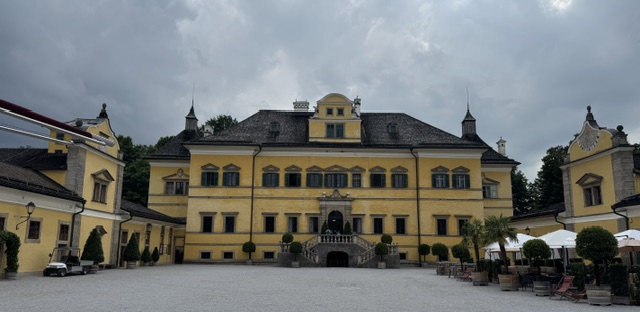
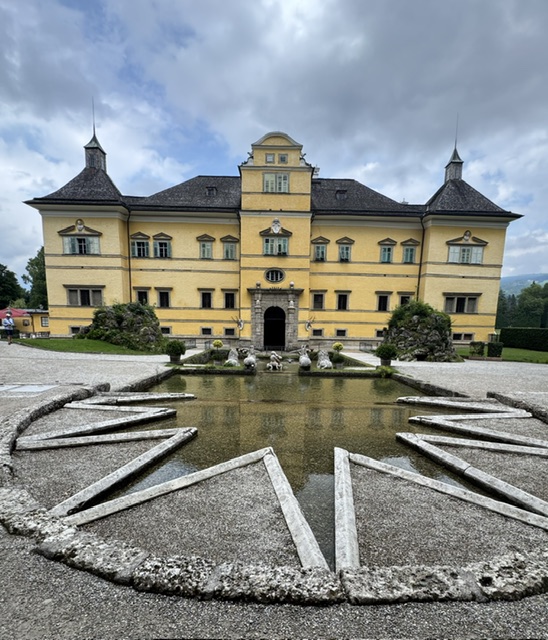
The Hellbrunn pleasure hunting palace was built in 1612 by Archbishop Markus Sittikus. The palace really was just pure entertainment for the Archbishop and his guests to get out of Salzburg on hot days to hunt and relax. There were no bedrooms, just one floor of beautifully painted rooms.
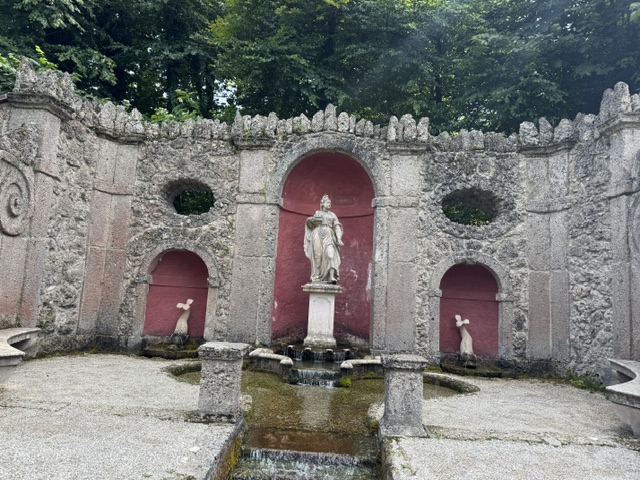
What I hadn’t understood, even though Marla and Ken had talked about it, were the Trick Fountains. I kept thinking it was a German word meaning something else. But no – it really did mean trick fountains! An entertainment that the Archbishop gave his guests.
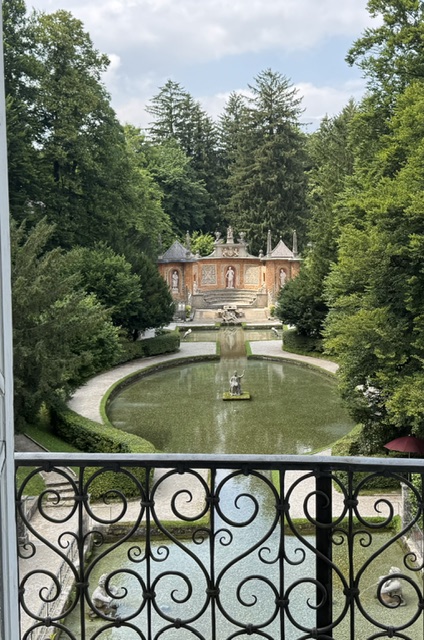
I didn’t take any photos of the inside, I think it wasn’t allowed? But I did take this one from the window above. This is the entry photo to start the tour for the guests. It looks beautiful and was, but it also started the surprises.
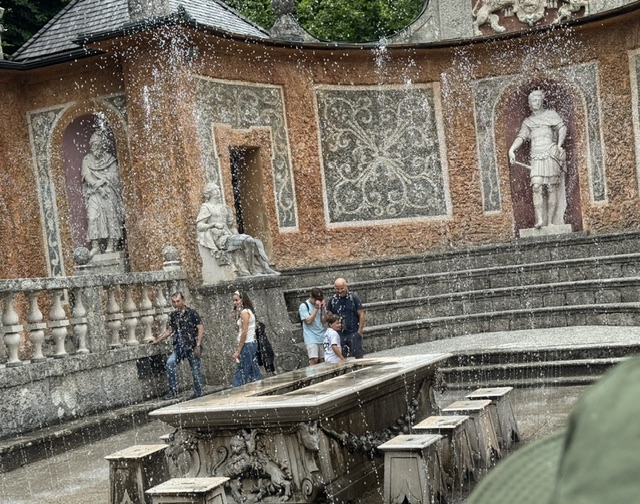
If you look at the back, there’s a table with stone seats around it, with the head seat saved for the Archbishop. They would sit down and then the water would turn on – all of the seats had spouts except for the Archbishops. Hope their fancy clothes were water proof. Here it is in action:
View from the back with star fountains that sent out water in many directions!
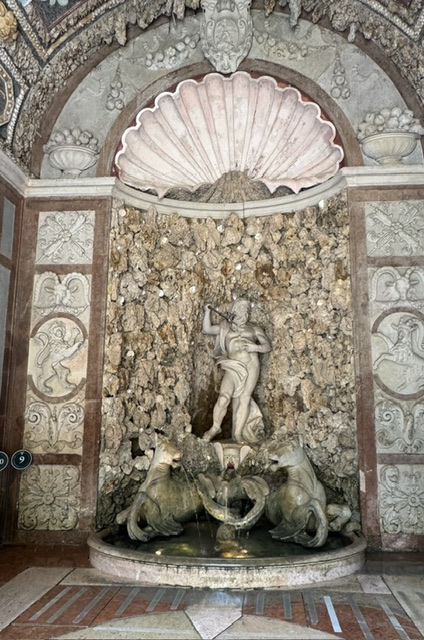
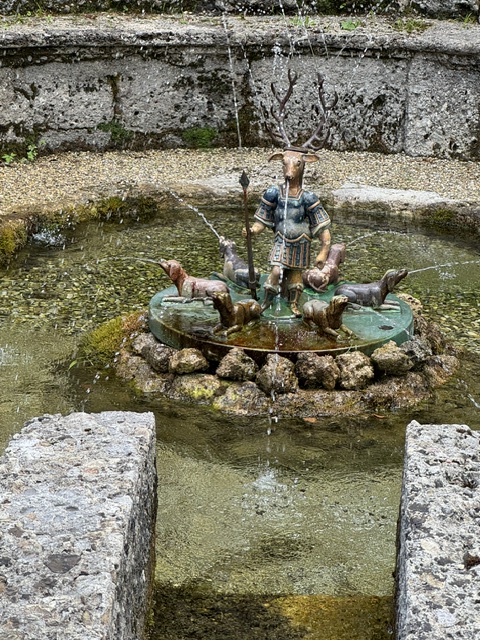
These trick fountains have been operating for over 400 years and they were incredible. All controlled with gravity and water wheels. Random water spurting out from all over the place and totally unexpected. I didn’t get hit too much, but it would have been fine since it was warm. There were so many different presentations, small active scenes, large statues, grottos.
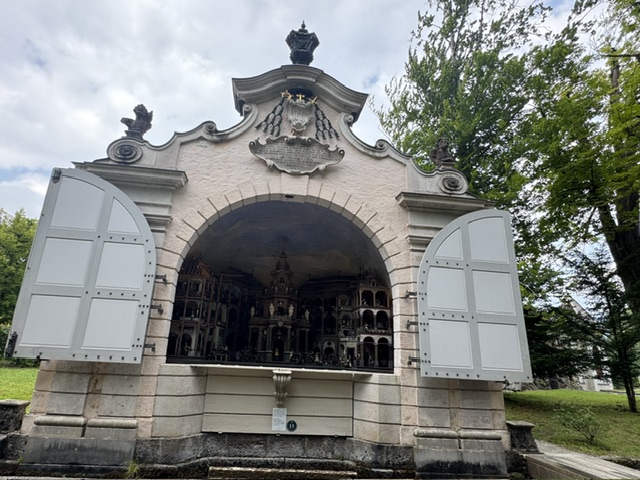
I thought the most incredible demonstration was an entire theatre run with water pouring over a series of water wheels that moved ALL the characters from repairing the roof way up on the top level to all the other activities.
It probably took me 45 minutes to go through all the fountains and I would have taken more time but I was trying to see if I could get back in time for the concert.
Luckily, I’d taken note of where the bus stop was, a bit of a walk back up the road to the main road, and the bus came along in just a few minutes. I’d really wanted to have a dessert on the terrace cafe of the hotel, where Tricia, Holly, Flynn and I had gone last year. I got a table and people were super slow to serve so I could sit, enjoy the river and connect with Rick and Sara and Stuart who joined us for a simple dinner and/or a dessert.
We then decided to walk to Mirabell Gardens since Rick hadn’t seen that and how fun to see it and then to happen onto a performance of Austrian dancers and musicians. As Stuart said, it was charming and at the same time, reminding that these kinds of people are the same as the ones who killed his family, great uncle in WWII.
WWII is very much ignored here. There were signs on the river of people who had resisted and saved Jews and others during the war, a sign of Crystalnacht and burning of the books, a few things. But in general, a big silence. It was striking that the military museum in the fort stopped entirely after WWI except to talk about the military band that stopped after WWI and was brought back in the 1990’s.
Salzburg. Today we met up with Marla and Ken, Sara and Stuart and did a lakes tour outside of Salzburg that Marla had arranged. At first I was repeating places I’d been to last year on our Sound of Music tour (which was totally fine by me, of course), but then we took a right and it was all new. So beautiful and interesting!
We stopped for a 15 minute walk about, none of us wanted coffee, but loved getting to see the little town of St Gilgen, named after St. Giles, started in 1376 as a lake port town. For us, the most notable piece was seeing where Mozart’s mother came from, her house on the lake and where his sister came for years. It’s just as charming as the Bavarian towns we visited, but in a different way. Some of the same painting, but more substantial buildings – I’m guessing it gets a lot colder here. Bishop Gideus was the name who founded the town in the 11th century.
For whatever reason, this small town has the most expensive private school in Austria, 9-18 years, in English. Not the norm, education is free in Austria and our guide said there was little reason to do this kind of education. The cool thing is that the school specializes in music instruction. Probably a really good senior performance!
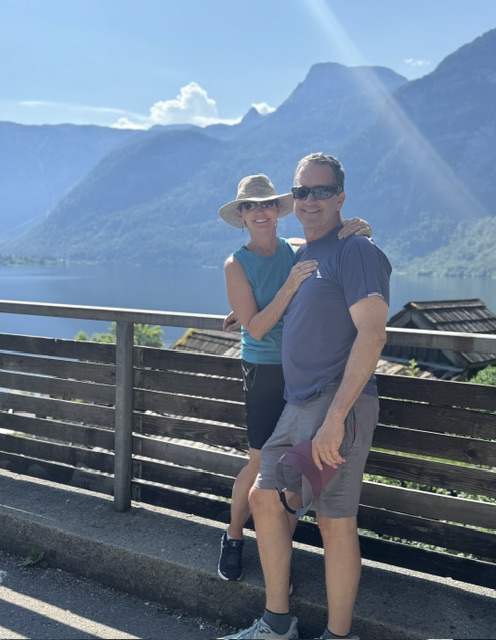
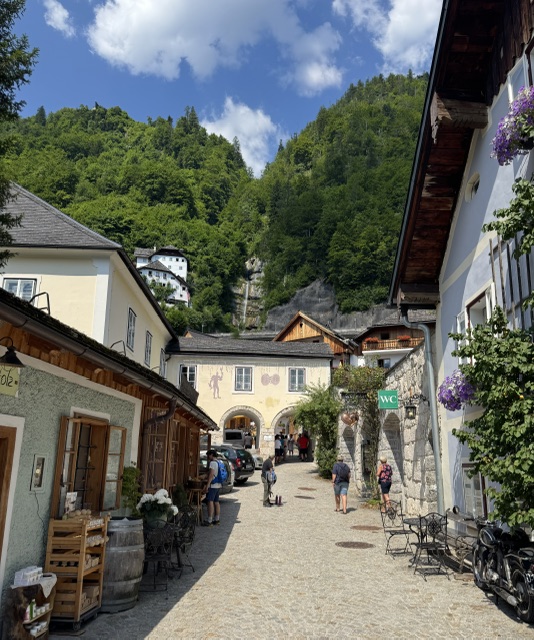
We then drove to Hallstatt, an incredibly picturesque village on the lake that was founded and centered on the salt mines that gave Salzburg and the surrounding regions their wealth and trading power. The region is a UNESCO World Heritage site with the oldest salt mine in the world. Hallstatt means salty place. Evidently, this was a quiet town, population of 700 and everyone knew each other, doors were kept open for breezes and visits. Then someone in China visited and fell in love with the village square. They took videos, drawings, etc. and went back home to recreate the village in China and the Chinese visitors descended. It probably brought a lot of income, but it also completely changed the inherent culture. There were signs everywhere reminding people (German, English, Chinese languages) that this was a town and home, an active living community and to treat it respectfully – do NOT walk into homes (that was happening a lot) to view the inhabitants, quiet, no littering, etc.
Now, it’s just darling, no cars at all except for those who live there. Parking above and walking down and up the stairs to get into the town.
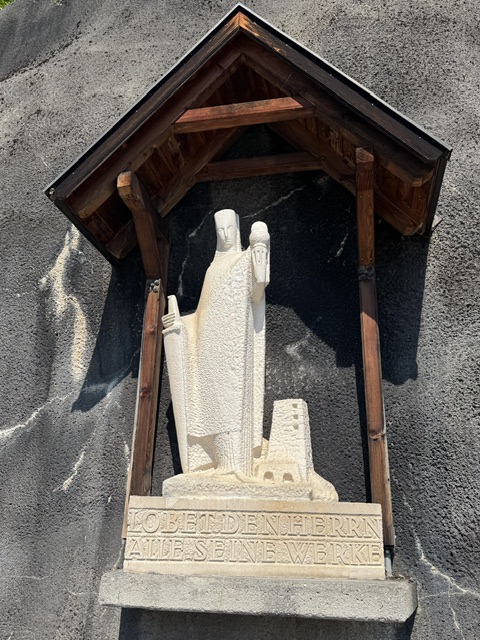
Cool modern statue of the saint for the salt miners, ach, St. Bridget? I can’t remember.
When we were parked, before descending, our guide pointed out the highest hill up to the right. Evidently on this hillside, there’s a platform that extends out past the land, called the 5 finger viewing platform. It has a clear bottom with 5 different spaces extending out. Horrifying is all I could think.
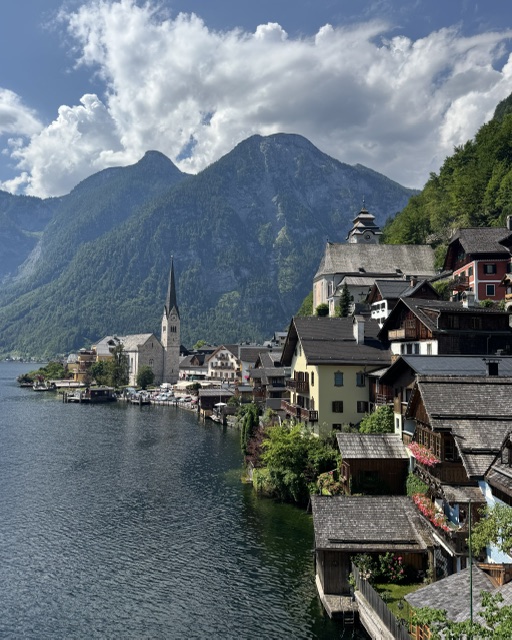
There are 2 churches, both beautiful with views, with the Lutheran church (1700’s) on the lake and the Catholic with a 12th century tower and the church itself built into the steep hillside from the 1300’s to the late 1400’s, perched above where all can see it. It had a cool tradition to manage the limited burial space. There was a tiny cemetery, so carefully kept, like the St. Peter’s cemetery in Salzburg. People were buried and a year, year and half later, the bones were dug up. They were cleaned and the skulls were painted with the name, date of death and then the bones and the skulls were carefully placed in the carnal house. New space for the next body. The last one was buried/dug up in 1995. I’m not sure what happens now. This ossuary is in a building dating from the 12th century.
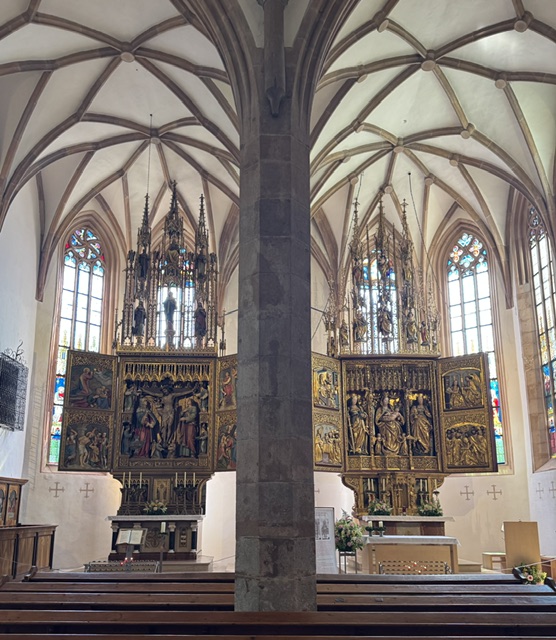
The Catholic church had two altarpieces. The one on the right was from more than 500 years ago, the one on the left was from the 1800’s. I thought it telling that the one on the right was all about Mary, caring, and kind. The one on the left, utterly tortured. When Rick and I went through the Residenz tour, the church museum had some beautiful statues and images of Mary from the Middle Ages. And I heard a line, I’ve never heard before despite having gone into a LOT of churches over my caminos. During the Middle Ages, Mary was regarded as having come to offset/mitigate/not sure of the word the original sin of Eve. Thus softening how people could feel about themselves. I love that idea.
View of the Lutheran church and the lakefront
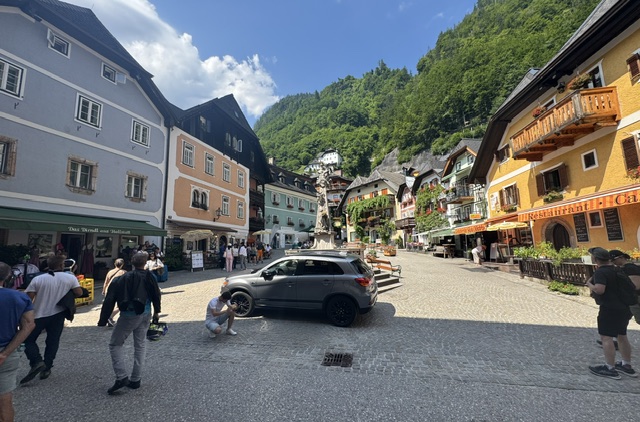
The town square that so charmed the Chinese artist was wonderful, but hard to capture. The green store on the left is a ceramic store active since 1492. We did a brief stop in, but between time constraints and care with packing, none of us bought anything. I probably would have anyway if they’d had a small vase that I liked because the work was incredible. I immediately assumed it was porcelain, but she said no, all ceramic. Truly beautiful works. Next street over was also wonderful
The house on the right, the blue one, had this sign out front. Great detail for history buffs.
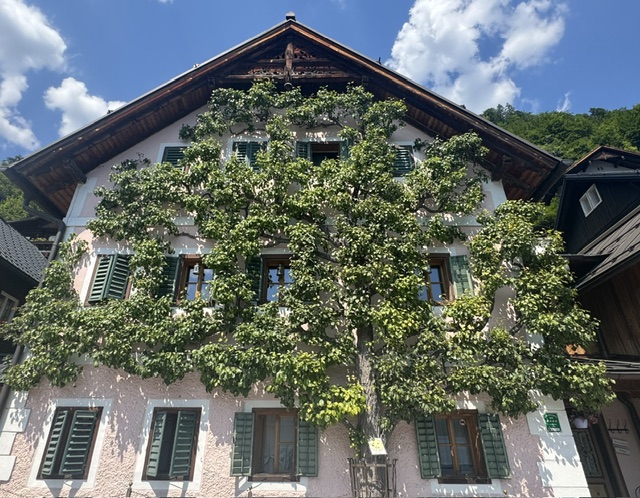
This house had groomed the pear tree for how long? It reminded me of trees from the Cloister Museum in NYC, but those were tiny trees.
Across the lake was the train stop people could take, then a ferry to come to the town. They do not make it easy to get here. But what caught our eyes was a castle that was to the right and the end of the road after the train. The Red Bull guy wanted to buy it, but they put so many restrictions on what he could do that he gave up. It’s still for sale…
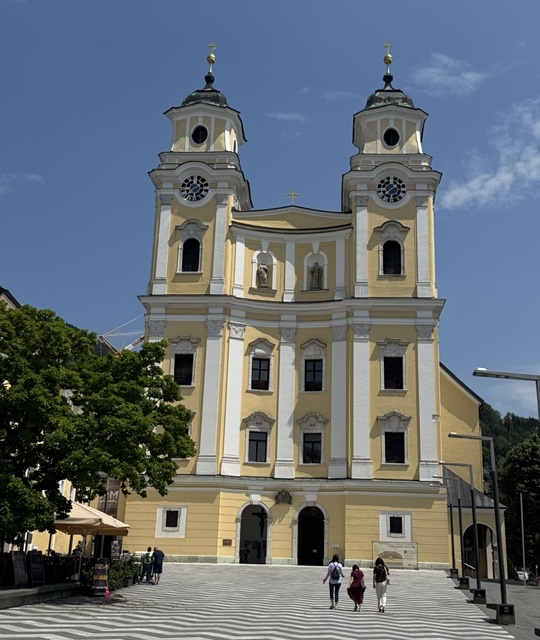
Our final stop was the medieval Mondsee Abbey, started in 748 by Benedictine monks. The cloister church is where wedding takes place in the movie, mix of gothic and baroque, and I wrote about this last year. Still fun to see again and this time I found my travel angel – playing a guitar! Perfect. Hope it doesn’t get crushed in my suitcase.
We then all came back, cleaned up a bit and then met to walk over to a concert in the Residenz. It was wonderful!
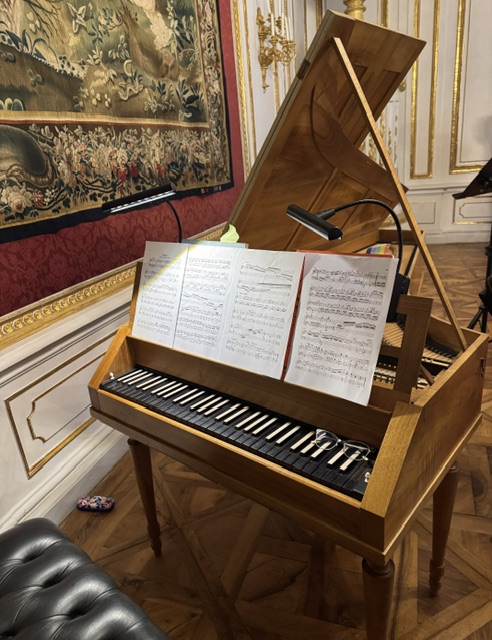
A small venue, a period instrument, a piano forte, and a truly skilled performer. We all loved it. We were able to ask the woman a few questions and she talked about the fact that you couldn’t practice because it was too precious an instrument, so you just had to really know the piece on a piano and then go for it when performing. The keys were reversed black and white and small both in depth and breadth. Truly impressive.
We then had an hour before the restaurant opened and wandered the old city a bit, got caught in an incredible downpour under one of the arches near the Cathedral and then had dinner at the same place I’d liked so much last year – with the great apricot desserts. We didn’t get to repeat that experience, but it was a fun meal again. In the Goldgasse Hotel.
A great day. Really fun with the whole group, but by general consensus, we decided to do the alone thing the next day since we’d soon be with each other for a week with the Backroads tour. I was looking forward to having another day alone with Rick.
Elmau to Salzburg. Easy relaxed morning before catching a ride from the hotel to the train station. All the notices we got re this train trip was DON’T PRINT until you’re basically getting on the train because you can’t change things. Well, I printed the tickets at the hotel, but it was a ticket for a later train. Rick found the small print saying we need to have printed tickets to cross the border on our email. Sigh. Then translating and determining from signs which side to stand on for the train, we didn’t know if we were going to be able to ride, have to get a ticket on the train? Turned out fine, the downloaded pdf worked. But note to self – read ahead!
We took a train to Innsbruck, then changed to a train to Salzburg. So easy, everything on time, clean, clear notices. What a great way to travel.
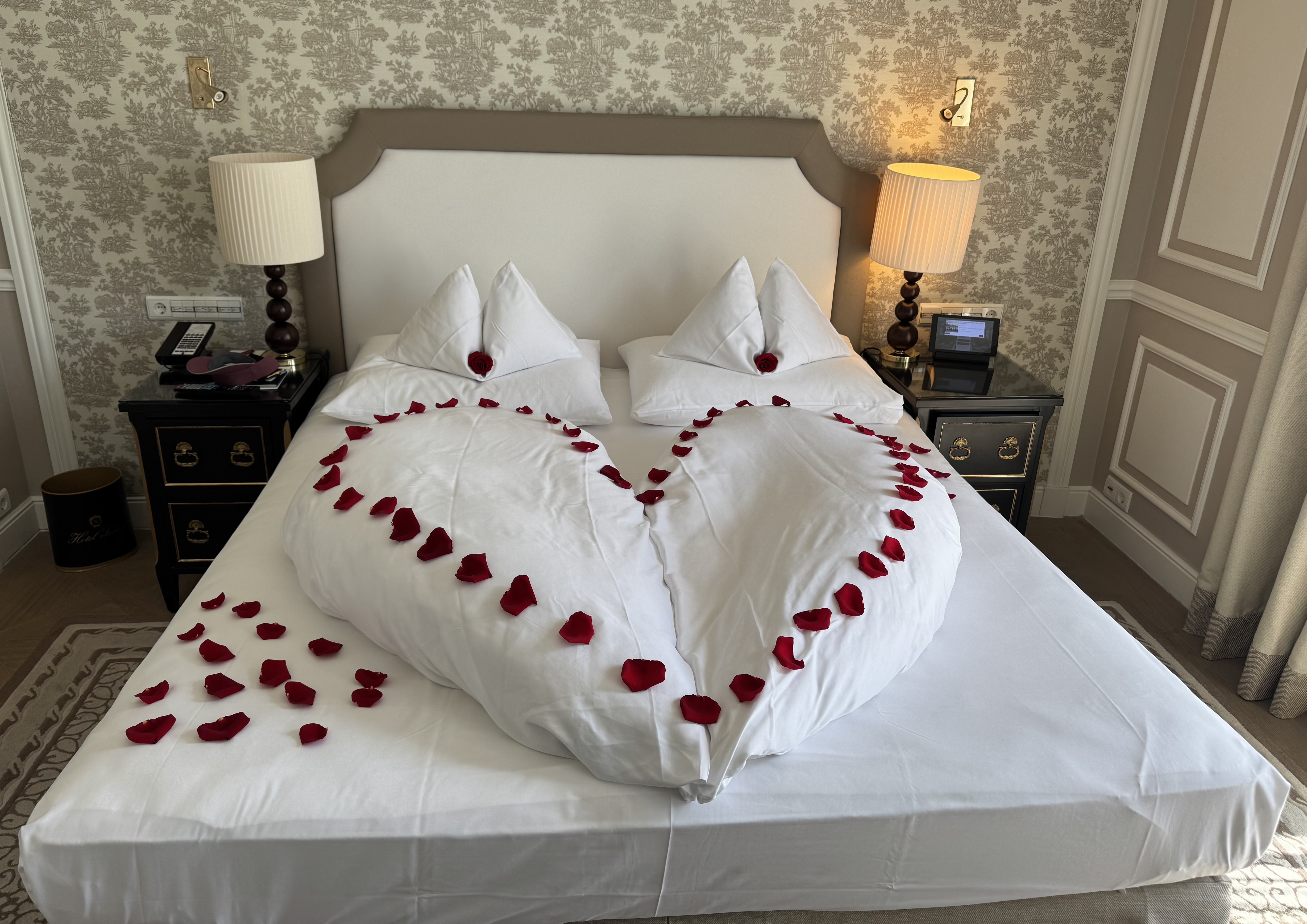
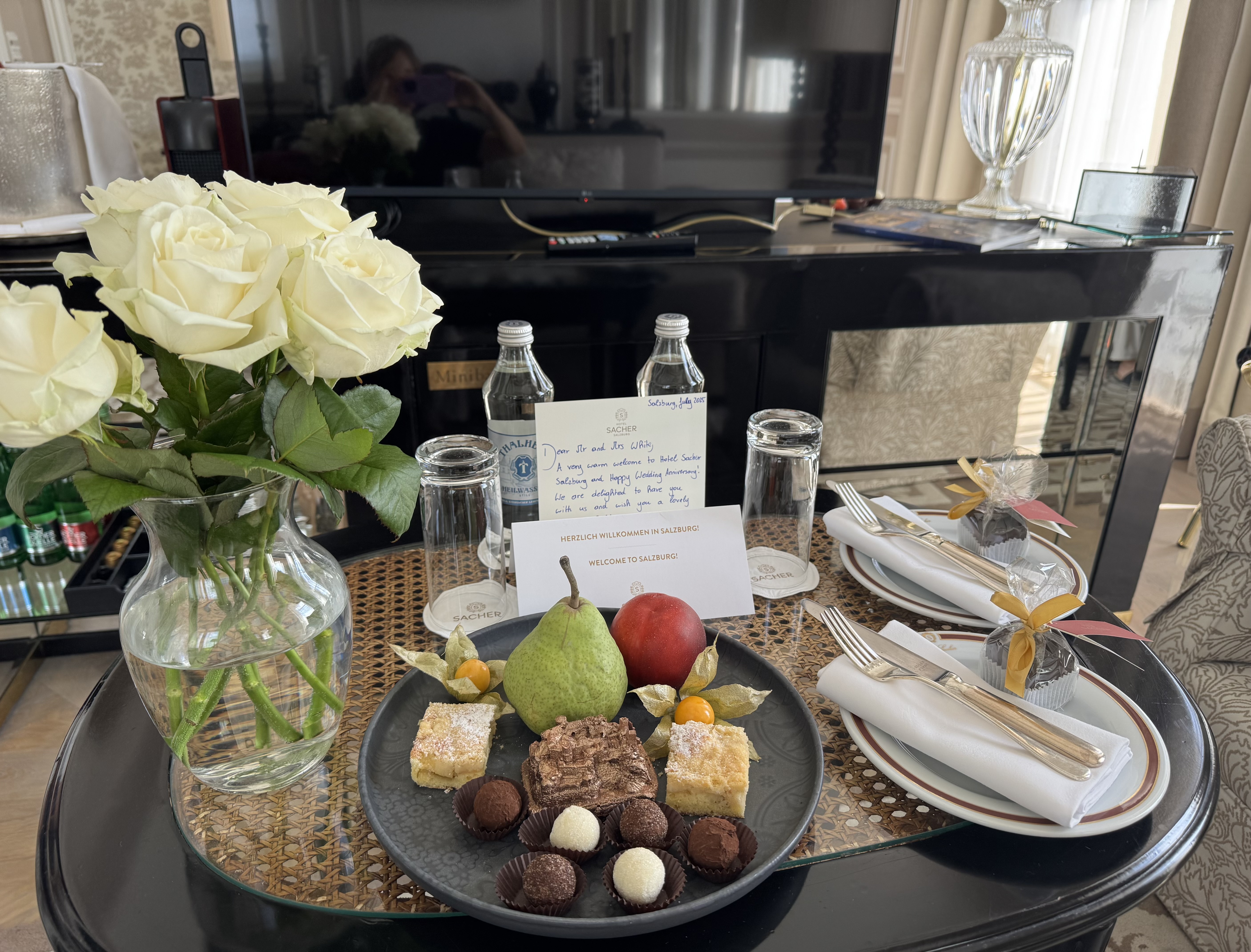
Then, the sweetest thing. I had been emailing with the concierge at Sacher Hotel about a concert for 6 of us and dinner reservations and had also asked about a dinner reservation for just Rick and me for tonight since we’d be arriving on our 36th anniversary. We walked into our room and found they’d gone wild. Such a fun surprise, we loved it and promptly sat down and ate our Sacher Torte cubes – a small square of the famous Sacher Torte – the perfect size.
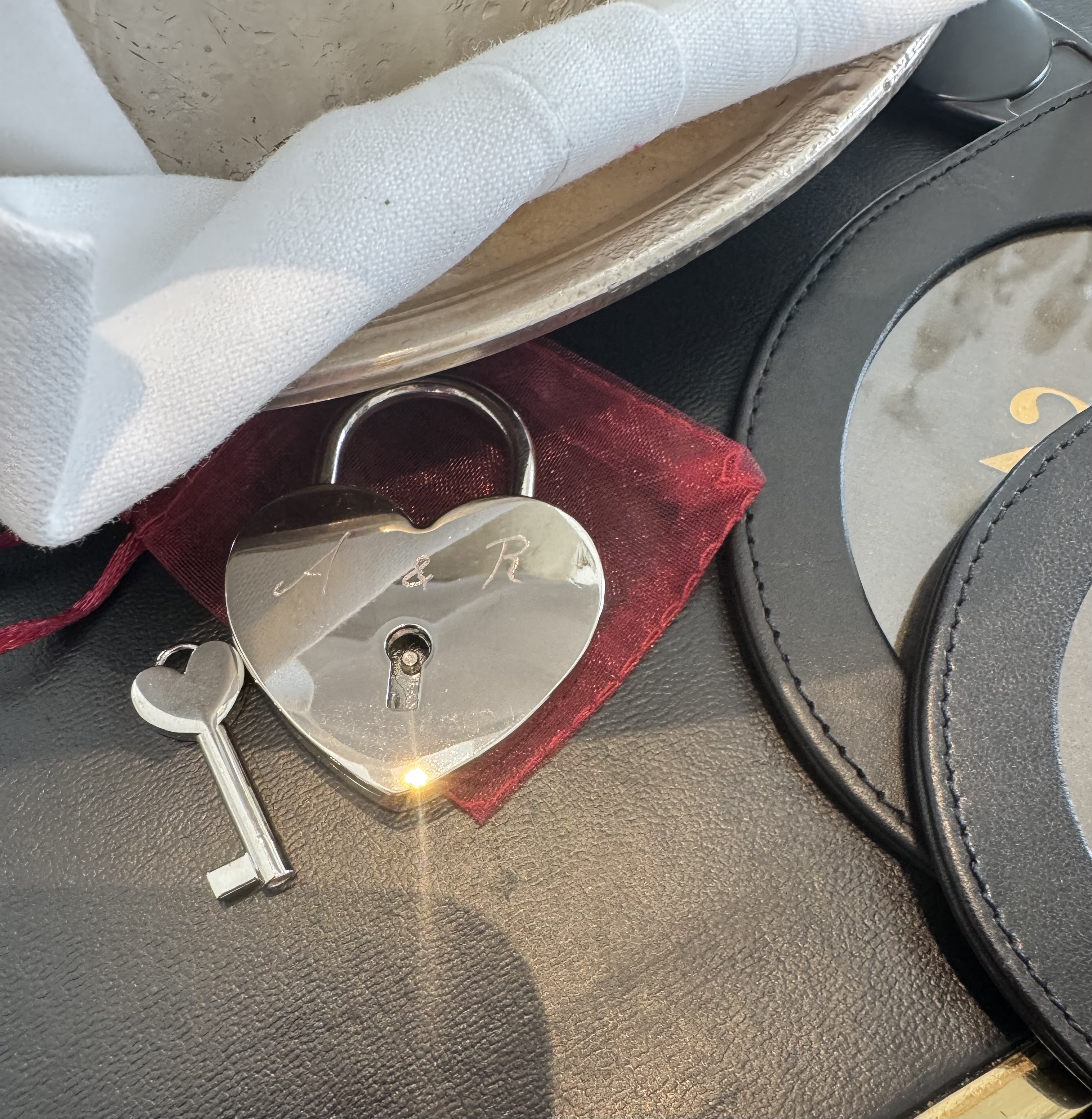
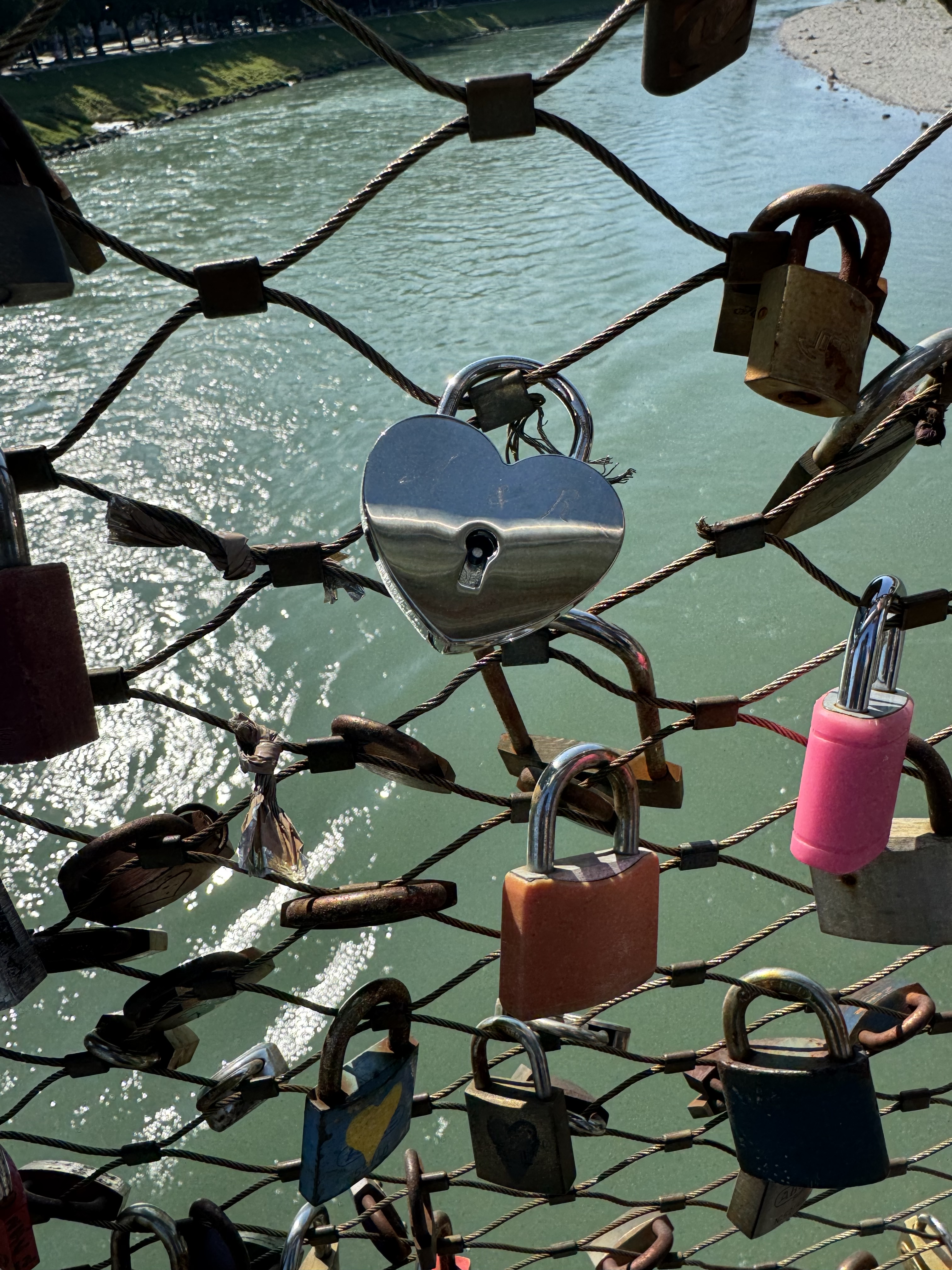
They also made this lock below to hang on the bridge where all the love locks are hung – right next to the hotel. Amazing.
We then did half of the Rick Steves tour before we ran out of time. It was so fun to redo it with Rick and have him see everything we saw last year when we were here.
We hung our lock on the bridge and then went back to the hotel for showers – it’s SO hot in Europe right now – and then to the best dinner we’ll have our entire time traveling, I’m sure. Incredible food. Neither of us are foodies, but this meal caught our interest. The restaurant was Pan y Vin. Well worth a visit.
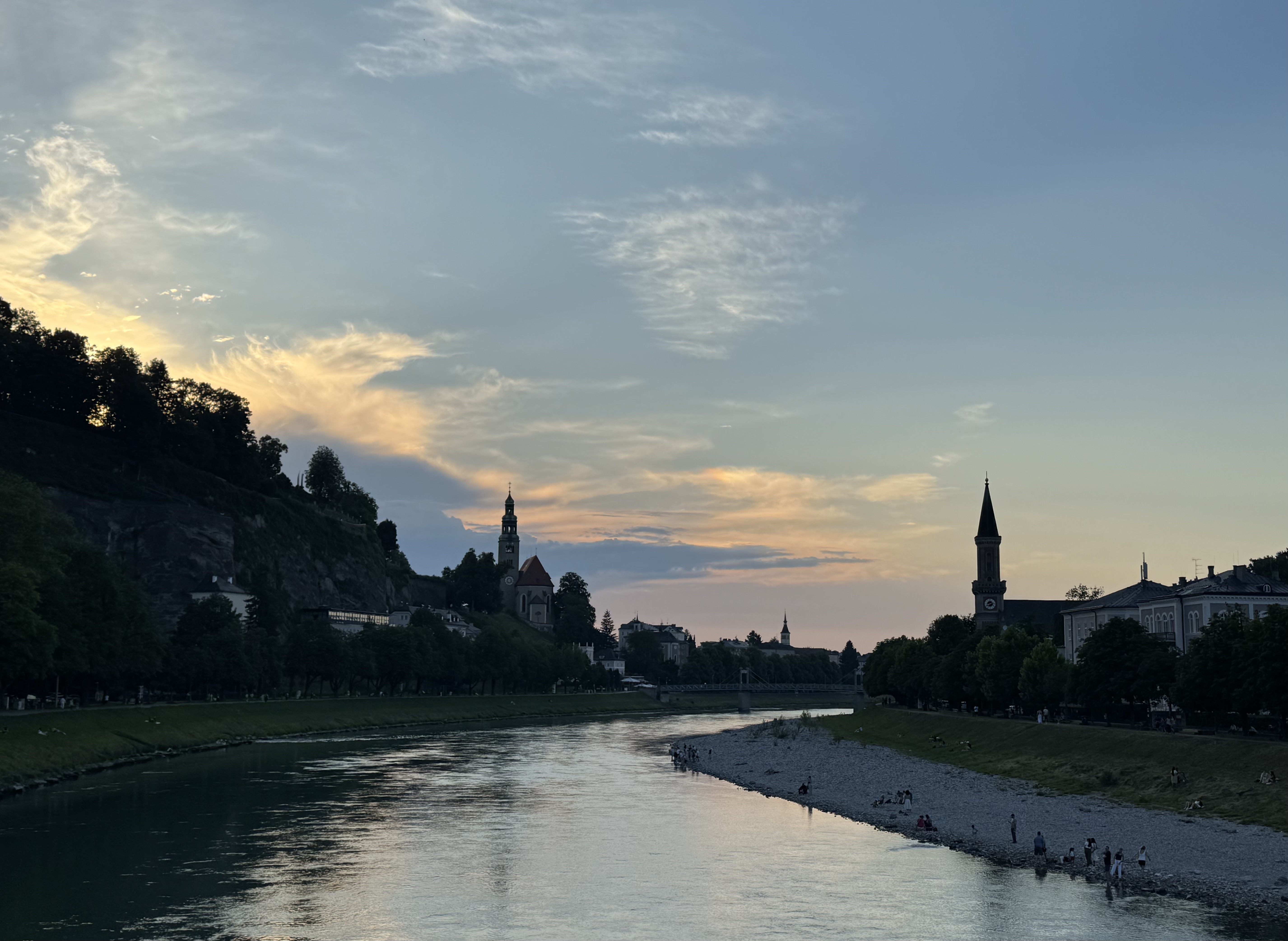
And then the sunset and back to the room. A wonderful day!








 Reb's Walks!