Greece, 3.Oct.2025, Friday

Meteora and Thermopylae

The word Meteor means suspended in the sky. There used to be 24 monasteries on the top of these mountains. Now there are 6 and 2 of them are converted to convents. They didn’t have enough monks who wanted to live a secluded life, so the archbishop converted 2. The ascetics  (word derived from asceccsis sp?) meaning exercise, mind, body, etc. They started in the caves here in the 12th century. They would come down periodically for services and to get what they needed to survive in the caves. 

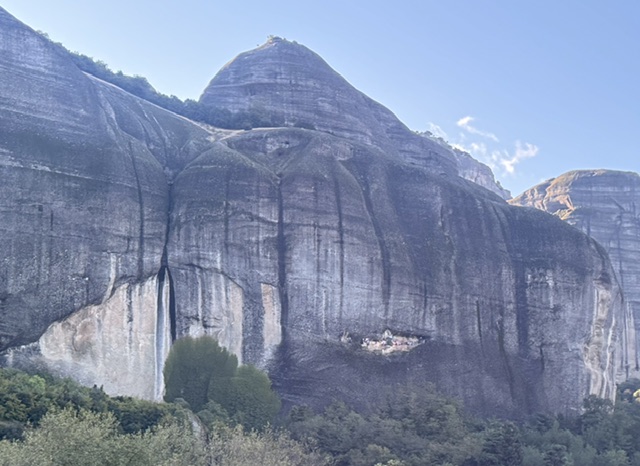
In the midst of the rock wall that we could see from the van was a small area carved out of the wall with flags showing. Every year on April 23, ever since the 14th century- men would go up/down climbing with their women’s scarves to dedicate their faith to St. George. Some would climb by perseverance – then would throw rope ladders for others, and use nets and baskets to bring up what they needed to build the chapel. Now men and women go to visit. Incredible. 
What makes a monastery? Needs to have a church and more than one person. Needs to be a community in practice. Try to be self-sufficient. It often started with an ascetic – lives by himself in a natural cavity completely isolated from the world. Hermits – derived from the work hermos – desert. Jerusalem ascetics. But these were called ascetics. 

We passed by the St. Nicholas monastery – by itself on the rock. The whole thing was built with nets/baskets to bring up the material to build it. That’s the only way people could approach. Cistern for water. Build a courtyard to grow vegetables. Meat would not have been part of their daily diet. Bread, olives, onions, tomatoes would be their diet. 
Visitors can go – there are cells where people can go on retreat – can ask to spend time there. Need to be Greek Orthodox. Oh my lord, they dropped down sheer walls for people and goods to come up. We passed the one to St. Nicholas, closed on Friday, where the balcony that was the drop spot was so high, I couldn’t see where the bottom was from the road. Plus, I really didn’t like looking, frankly.

Our first stop was the Holy Monastery of the Transfiguration. It was started by the Saint Athanasios the Meteoritis in the middle of the 14th century. He set down the rules by which the community was to live in this first monastery and all other monasteries followed these guidelines. He started in a cave and gradually others came to practice and study with him and the monastery grew. The Blessed Athanasios (he’s been sainted) wrote/said? “I place you under the roof of the Blessed Virgin Mary which is the purpose of this monastery.” He was succeeded by a prince who became a monk under his guidance, who built up the monastery closer to what it is today, named in honor of the Transfiguration of Christ. The skulls of both these monkeys are saved here and honored on the 20th of April every year. Now the monastery looks huge, but only 3 monks inhabit it. However, there’s considerable space for Greek Orthodox who want to go on retreat short or long, now both men and women can be there. The way up and down was by net and baskets. Incredible. Now – we can walk up carved and built stairs – otherwise I definitely wouldn’t have seen it. 
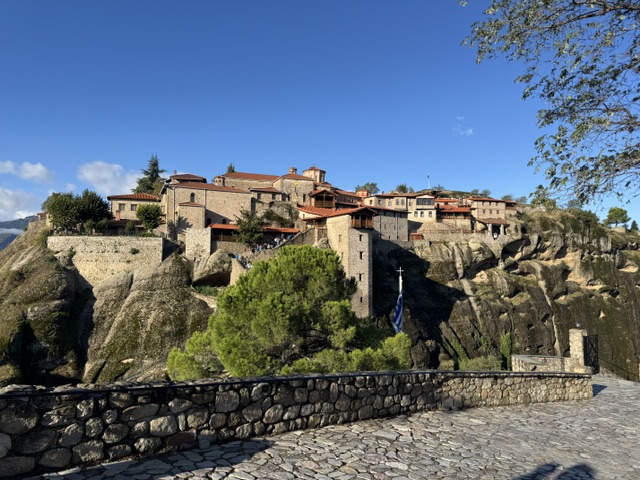
If you look closely, there’s a wooden balcony just above and to the left of the flag. That’s where they dropped the nets to bring up visitors and necessary commodities. Needless to say, it was much smaller in those days without accommodations for extras or rarely extras. 

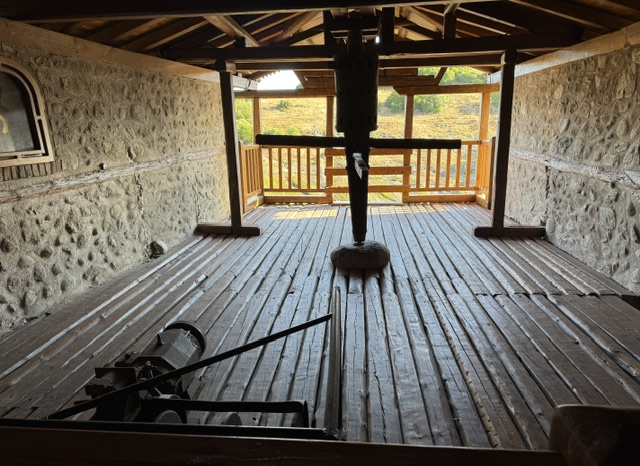
Here’s the pulley system and rotating spindle that you could push against to raise and lower the nets and baskets
When we were in the chapel, Katarina added more information for the Orthodox practices. Over the exit door is a painting of the sleep of Mary, that’s the euphemism for death. In fact, the word for cemetery is derived from the Greek word meaning the place of sleep. Standing over her is Jesus with the image of her rebirth at the second coming resting on his hand. To the north is Jesus’ resurrection. Super interesting because it’s entirely different from the Catholic images we’re used to. In this image, Jesus is descending into Hades, stepping on the door, all the locks and keys are to the side and the angels are holding back people trying to stop him. He’s reaching down to two coffins – Adam and Eve – taking their hands and pulling them up as the start to the second coming. 

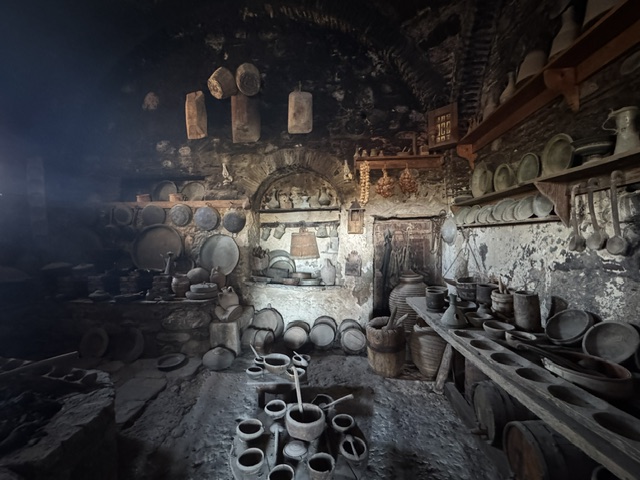
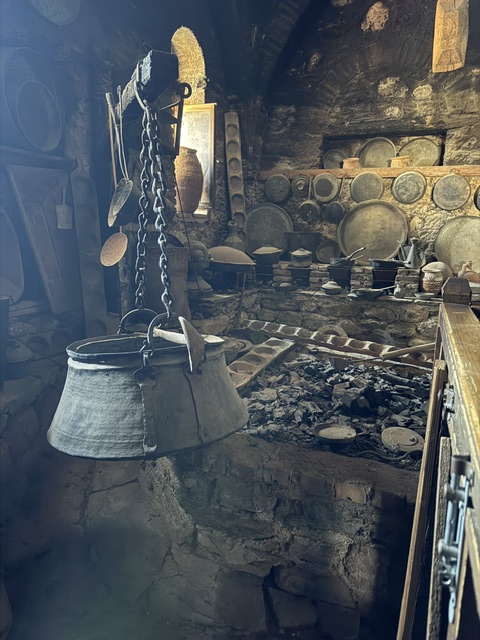
Katarina also told us a lot of stories about visiting her grandmother in the summers in her home village. When we saw the kitchen in the monastery, many of the elements were used in her grandmother’s kitchen. The monastery closed this kitchen in the 1950’s when they built a new kitchen for those coming for retreat. In the 1980’s it was made a UNESCO site and tourism grew and funds helped restore and build to make it an accessible building. They clearly had a lot of people who were eating up here in those days.
Katarina also talked about going with her grandmother at least once a summer to the monastery near her village, but similar to these, built high up on a wall of the mountain. They would spend the night, get clean, fast for a long time, go to confession and then to the service. She said it felt like a theater to her when she was little. People stand for the service, though there are some chairs along the walls that look like the choir stalls you see in old Catholic churches. You pull up the seat and stand in the space, but there’s a little leaning shelf where  you can rest a bit. So she’d be standing, the service was in Eastern Orthodox Greek, understandable when you’re older and listening carefully, but when little just flowed over here. There were candles, murmuring, singing and incense. She said that sometimes because the fasting was for a long time, she would feel very faint. I’m guessing those services left a big impression. 

During Ottoman times people could practice, but not make a loud noise about it. Literally. So no bells to call people to service. Instead, the monks made this long wooden plan to hit with a mallet and it gave different signals depending on where and how it was tapped. In addition, to the left was a small chime that could be used for the main services to call the monks.
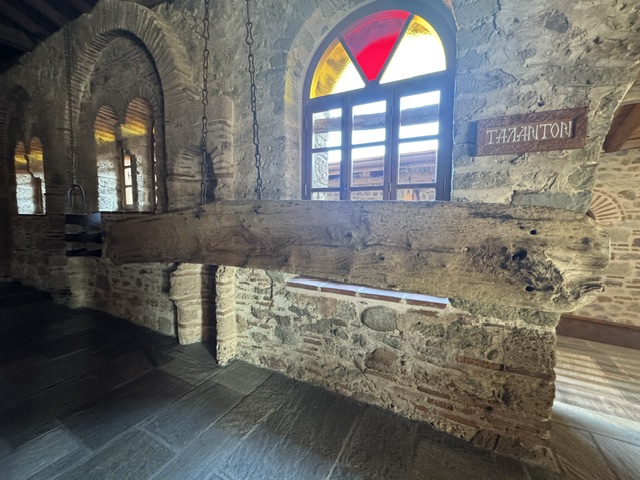
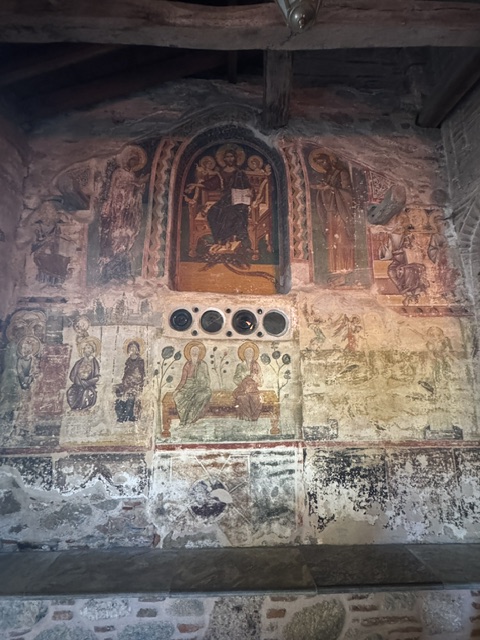
The whole monastery was painted with icons and frescoes telling stories. These are original and have held their color so well because of the protection, over 400 years old. 

Below is from the courtyard of the monastery.
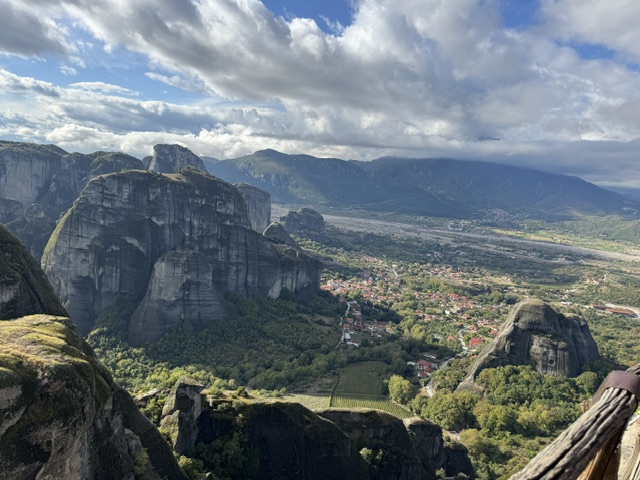
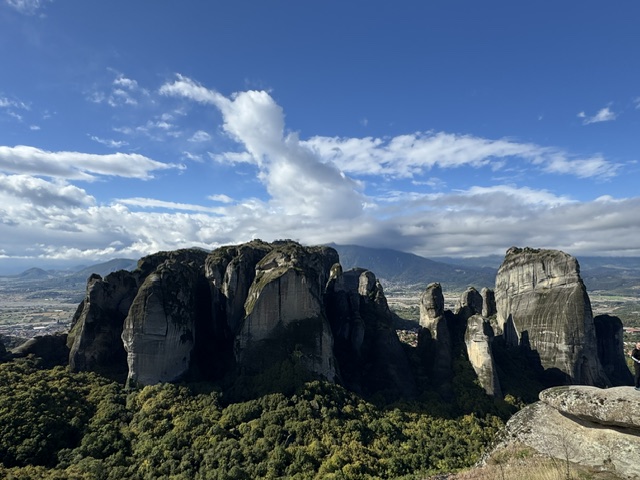
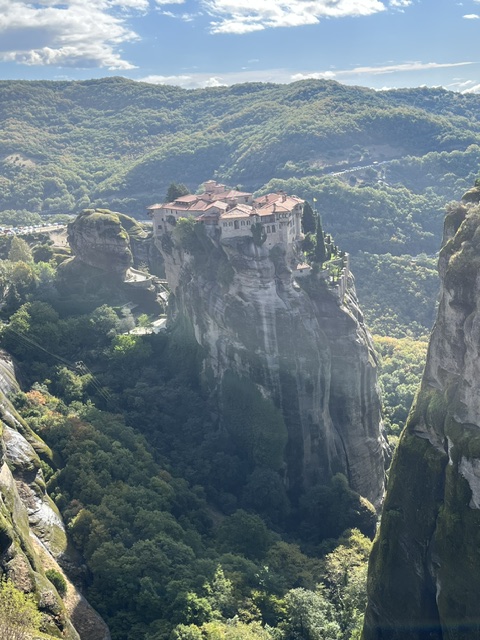
And this is the first monastery we were just visiting from a distance, hard to even see and how in the world did they build this? I mean, I know, lower a basket for supplies, but really?!
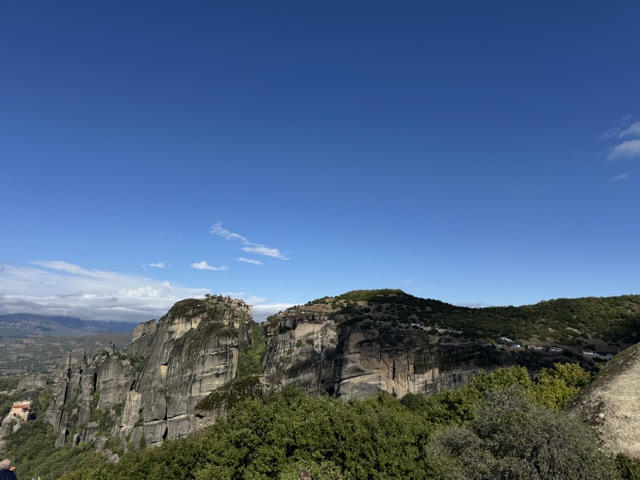
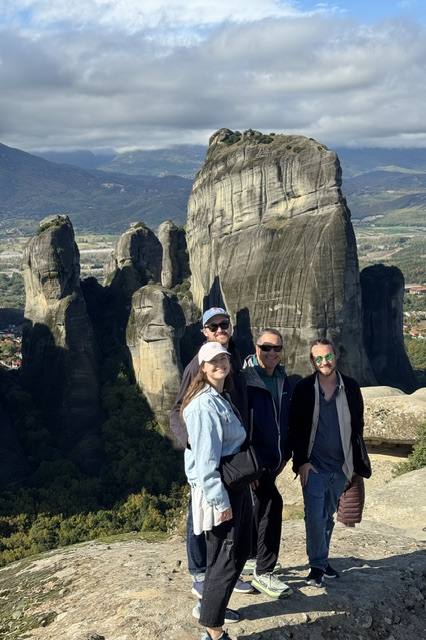
I was hiding in the bus to avoid the photo opp heights and the driver told me that the caves were caused because high winds spin small amounts of sand that gradually eroded out a space “some are big enough to park this bus (20 seater)”.  There are a lot of winds in these mountain tops, but it was gorgeous when we were exploring.

Here the rest are standing near the edge of the photo opp:
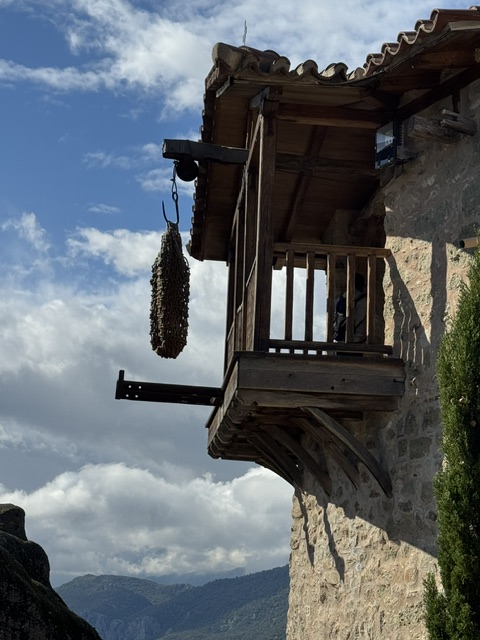
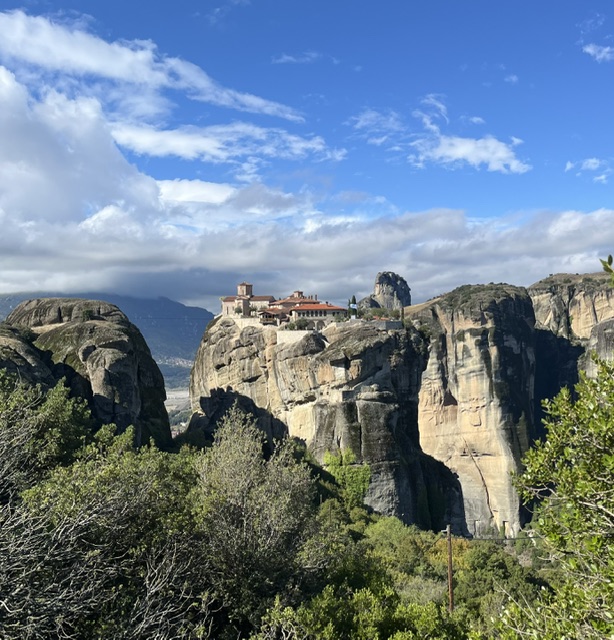
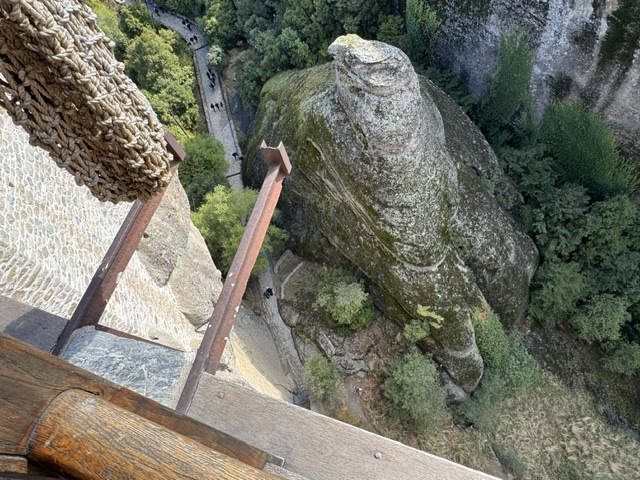
We then stopped at the Monastery of Holy Trinity. This was a higher climb so fewer tourists go, and again we were grateful that we were traveling now and not earlier in the summer when there were so many tourists, it was hard to see anything. This monastery still had the net hanging outside showing where transportation happened. It’s hanging off the wooden balcony about mid-way up the building. Straight down. I did NOT go near to look down, but Eli C took photos for me. This monastery also currently has 3 monks. They transport both here and at the main biggest monastery via a small cart that crosses on wires – looked totally sketch, but definitely easier to get groceries in!

The stairway carved into the hillside is courtesy of UNESCO funds. Thank you!
Looking down from the balcony – I didn’t take the photo
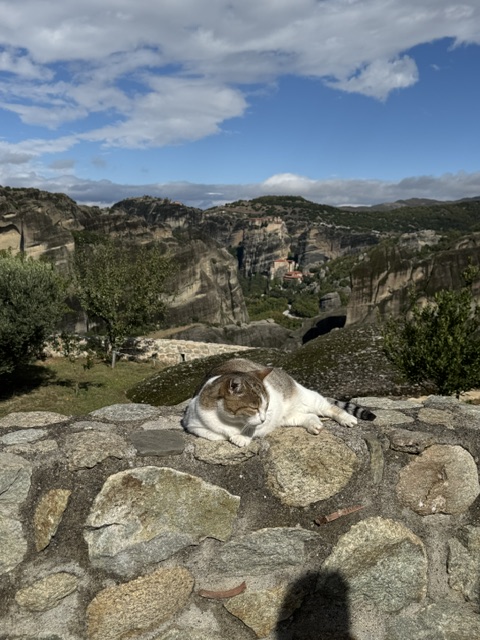
We drove by 2 convents and they have more occupancy, up to 23 or 24 nuns and some come from other orthodox communities. Here’s one of them seen from the second monastery. This is the most visited of all the sites because there’s a bridge from the road to the building, no stairs.

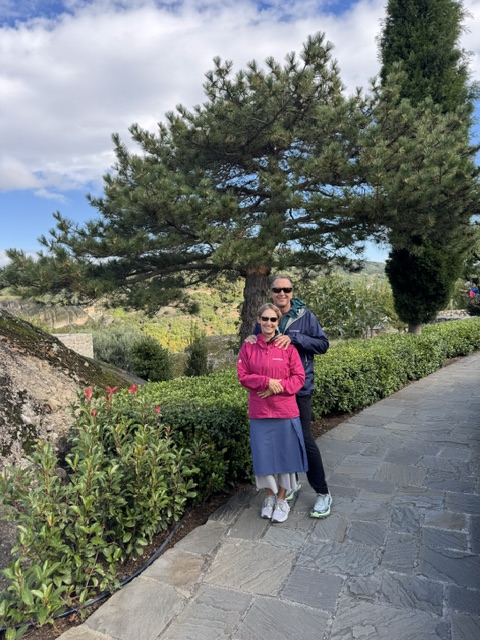
There were courtyards and gardens – they must have started with crating dirt up and over time more accumulated. Notice the skirt – no women were to enter with their knees – even the idea – showing. 
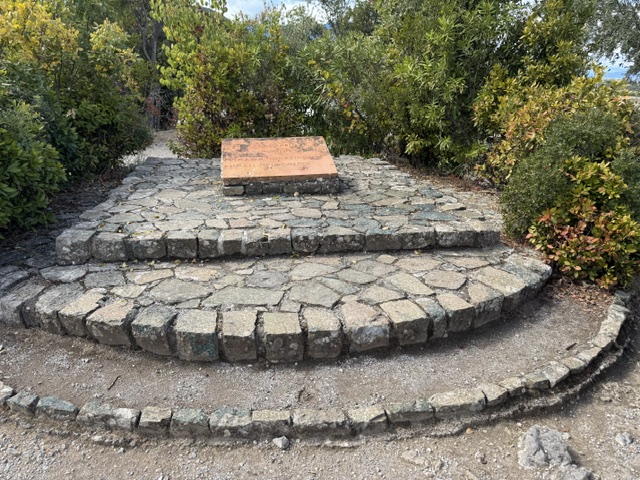
On our way back to Athens, we stopped at Thermopylae. The word means – steam and gates – there are hot springs here and have been since 5th century BC. In addition, in earlier centuries it was a narrow width so could be considered a gate. They did excavate and found arrows and blades that were Persian and dated from the time of the war. Thus, it was confirmed that this is where the famous battle was – however, it was just a hill where they battled, there were no ruins or buildings to excavate, so they put a plaque down to commemorate and built a new monument to King Leonidas. 
Where we stopped used to be a narrow space between the mountain and the sea and they’d built a wall between the mountain to the sea. 10 years earlier, the Greeks had successfully defeated the Persians, but they came back and conquered. The famous battle happened here between the Greeks and the Persians, with the Spartans leading the land forces and the Athenians leading the naval forces. Now – it’s hard to imagine how they could have blocked the Persians because over time a river coming down the mountain brought soil and silt, and the sea moved back so it’s now a big opening from the mountains to the plains. In the 5th century BC though it was a narrow opening and, this is where the Spartans took a stand against the Persians, delaying them from passing into Greece. 

However, they had been betrayed by a Greek man who showed the Persians a local trail through the mountains in order to surround the Greeks. The leader, King Leonidas, asked 300 Spartans to stay, they all had to have sons back in Sparta because they knew this would be a suicide mission. They had a 1,000 other Greeks from other areas also taking a stand as part of the force. The goal was to hold back the Persians long enough for others to get away and protect what they could. I guess there’s a movie about this, books, stories, I’m afraid I was ignorant, but Eli W and Rick knew about and wanted to see the spot. 

Evidently the Spartans (I mean I do know the Spartans) had a saying, come back carrying your shield or being carried on your shield. Either you were victorious or you were dead. They were also the only Greeks whose woman competed and trained at the gymnasium (separately from the men) because they wanted them to be strong women who’d give birth to strong sons. The sons were taken at 7 years to train as soldiers. 

We came back – it took 6 hours – to get back, a lot of it because of Athens traffic. But the consensus was that it was worth the trip because of Delphi and Meteora. The next morning, Rick and I were in a cab and the driver asked where we’d gone. When we said Meteora, he said, “Oh that’s really special. Islands, beaches, that’s normal. Getting to see Meteora is wonderful.” 

We went to dinner at that great store/restaurant we’d see with Valientini – Ergon. And it was wonderful as advertised!
Greece, 2.Oct.2025, Thursday

Katarina our guide was great. I wrote a few notes in the van as we drove north towards Delphi and Meteora. We were driving into new territory to us and she said that 80% of Greece is covered by mountains and hills, Olympus is the highest at 10,000. Parnasus goes up to almost 8,000 feet and Delphi is there.

Helas is what the Greeks call their country. In the 6th century BC, the Mediterranean Sea was actually a Greek sea since the Greeks owned all the land around. Barbarbar – was the word they used for barbarians – for those who didn’t speak the language and weren’t cultured. 

On the way to Delphi, we passed the dammed Marathon lake that was the sole source of water for Athens until the 1950’s. The Marathon race gets its name from this area. The Greeks defeated the Persians in 490 BC and the fastest runner, chosen by the king, ran back 26.2 miles to Athens to let people know. He gave the news, then dropped dead. Happily, the outcome is different for most who run marathons these days. The marathon is held the first week of November here and is huge. 

Now passing Thebes. Thebes, Argos, and Athens have all had continual occupants for 5 millennia. Thebes is the birth place of Dionysius, god of wine. The most famous offspring of Thebes was Oedipus. 

We passed through a small town before Delphi. In WWII, Mussolini demanded that Greece allow the Italian army to invade coming from Albania. They said no and had success pushing them back. But then the Nazis crossed the border from Bulgaria and within a couple of weeks, the Nazis reached Athens and put the swastika flag on the Parthenon. Right away, guerrillas, men and women, immediately went to the forest and started attacking transport trains, bridges that supported them, etc. Each time they had success, the Nazis would decimate a village.

4/12/44 end of the Nazi rule. On the way out of the country, the Nazi’s destroyed everything they could, canals, fields, villages, etc. This really pushed the farmers to move towards Athens, nowadays the trend is being reversed. People are starting to move back towards their families villages houses that were still held and kept when they moved away. The people who moved back post/curing COVID are doing tourism, agroturismo, or farming. 

Agachova – we drove through this incredibly picturesque mountain town, so pretty. But in the van, so I don’t have photos. 

The Panhellenic Games were the biggest of the competitions that brought all together, in the name of Zeus. The second biggest were in Delphi in honor of Apollo. The symbol of Apolonia was the laurel – the poet laureate gets its name from here. Delphi was considered to be the center of the Greek world. Zeus dropped the stone in the spot – known as the navel.

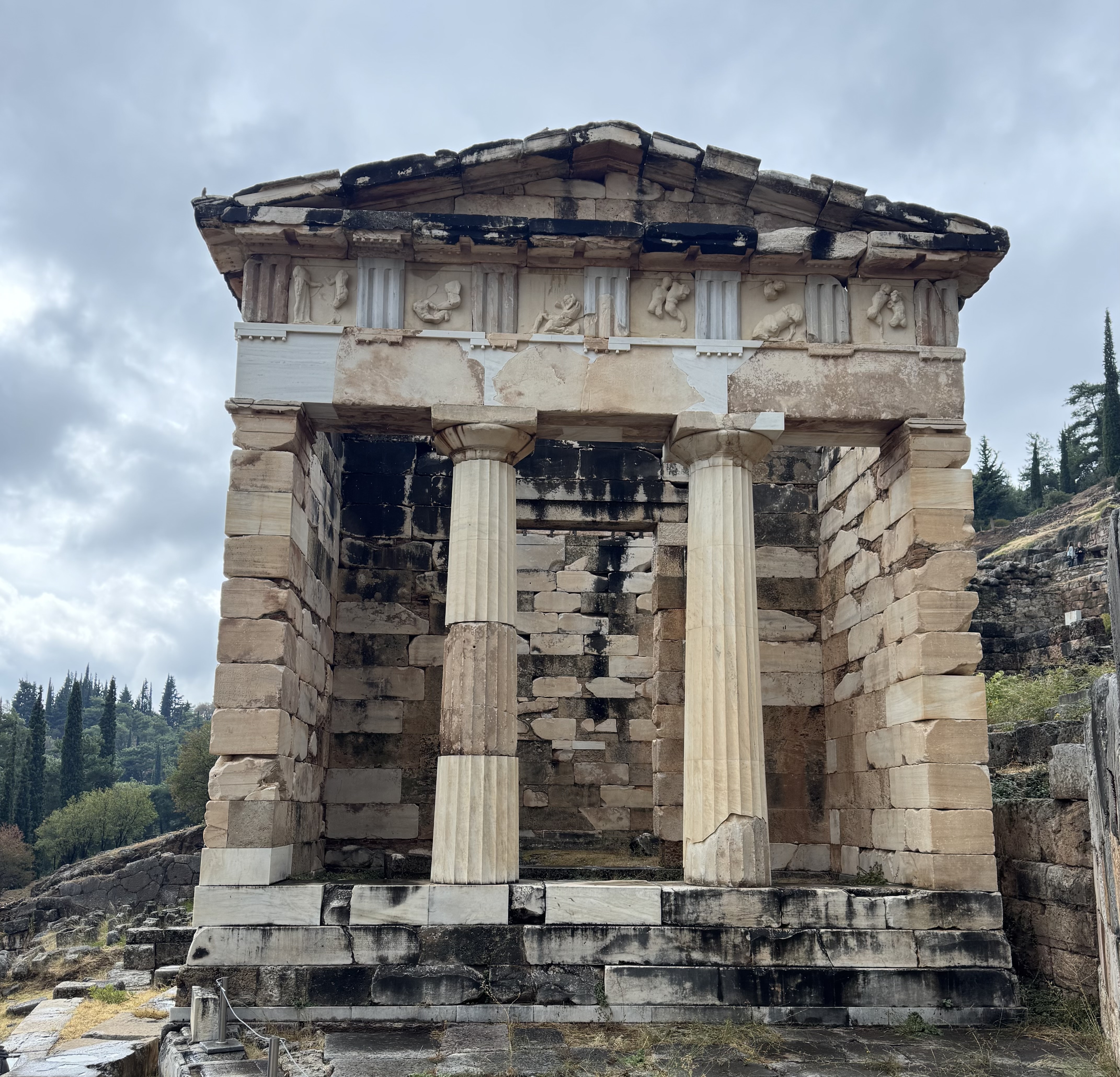
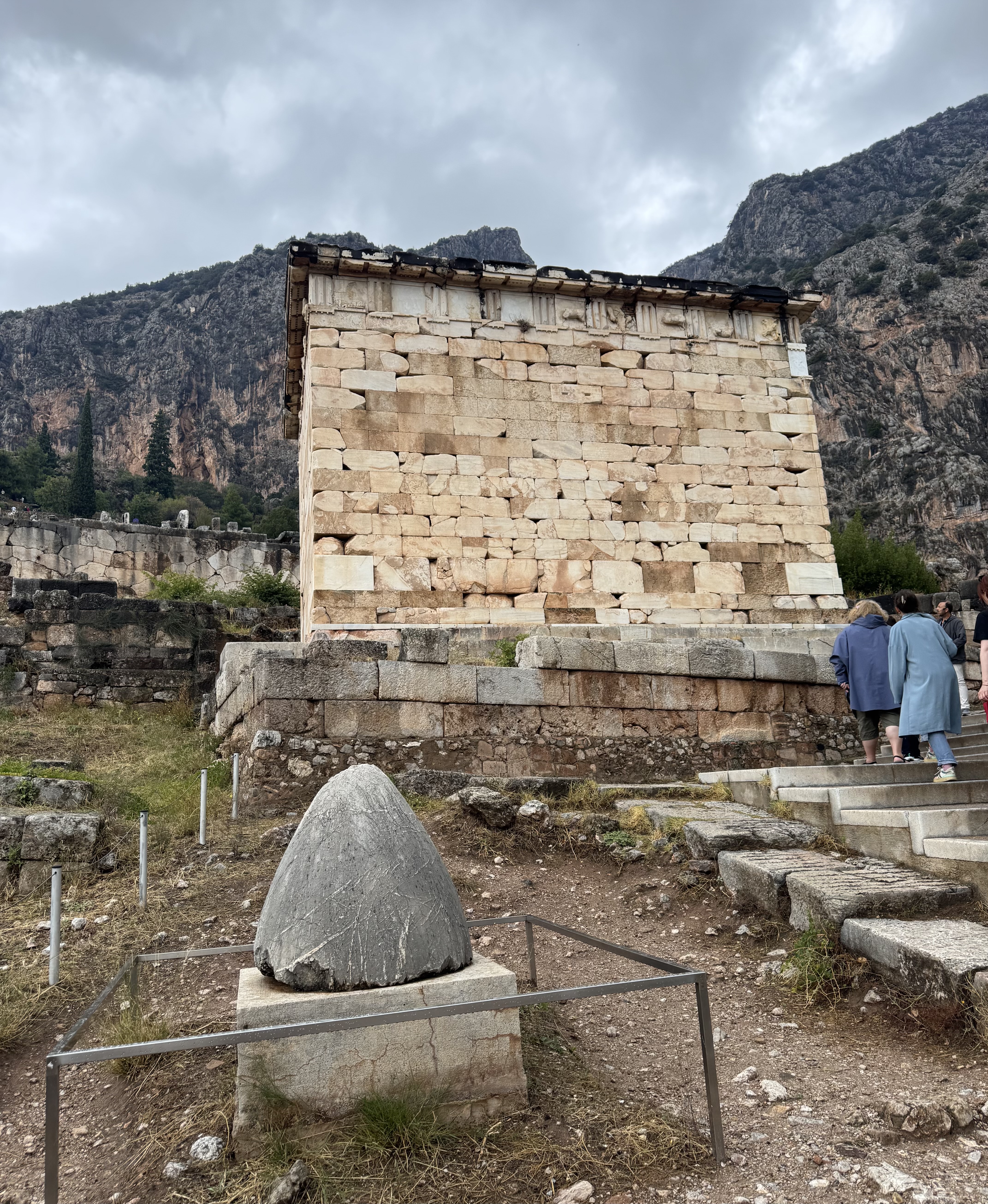
This photo shows an ancient, though probably not the original, egg shaped “navel” that was at the center of the temple. Behind it is the rebuilt wall of the Athenian treasury from the people of Athens to Apollo. Again, using all the original pieces they could find and it’s remarkable what they did find.

There was never a city in this area, it was considered a panhellenic sanctuary. So no big center or settlements nearby because the temple might come under the auspices of that settlement.

The Delphi sanctuary had to be excavated because an entire village was built on top of Delphi. The village had to be torn down and rebuilt a few meters to the west. I asked about how the people felt about this and they were ok. They knew there was an important site under their houses, they got new houses, new infrastructure and the possibility of jobs both working at the site and being able to offer food, hotels, etc. to tourists. The French started the work here with an agreement with the Ottomans who were still in partial control. This started in the early 19th century. 

Delphi was originally a site of Gaia, the female earth goddess. There was a serpent that guarded the site and Apollo killed the serpent in order to take over. The prophecies at the Oracle of Delphi were given over a period of nearly 2,000 years, beginning in the Mycenaean period (around 1400 BCE) and ending in the 4th century CE. The oracle, known as the Pythia, was a priestess of the god Apollo who was believed to channel prophecies while in a trance. 

Prophecies were given 9 days a year, once a month except during winter. There was a process on the days of prophecies. The people would line up on the avenue leading to the temple. A group called the Panhellinion league would hear the question and it had to be a clear question presented by a city’s delegation. This was not a place to ask about your future or if you would get a husband. The requests were about auspicious places to put a temple, build a city, manage a political issue, auspicious time to have a festival. If your question was deemed important enough to put to the priestess, a pure perfect animal was sacrificed and then the question was put forth.

The offerings given at Delphi were always vague, not specific. The people of the time believed you couldn’t escape fate, but you could have direction in how you lived your life. The league was made up of representatives from all areas of Greece. This was a neutral territory recognized as sacred by all. 

This Panhellenic league would know most of the country’s issues because of all the people who came to request answers and would navigate the ongoing questions to keep the peace as best as possible. The league would give the question to a priestess (at the most popular times, there might have been 3 at most). A priestess, Pythenian, would get the question and go into the inner temple and breathe the air (most recent science indicates that there was a gas that came up through the rock fissures), and come back out to give the answer. The answers are always needed interpretation. The saying over the temple door was “Know Thyself”.  Thus, if you were clear, knew yourself, you could interpret the best outcome from the priestess’ answer. If you weren’t clear, your interpretation probably wouldn’t be clear and you might not be able to even approximate what the message said. 

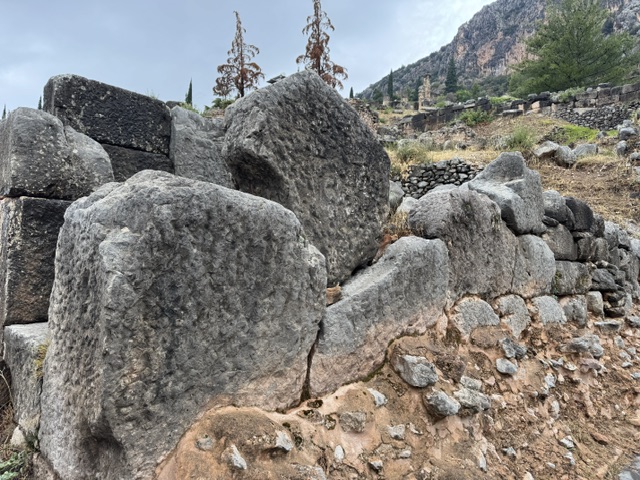
These stones forming the wall are from 6th century BC, earliest parts of the temple. 

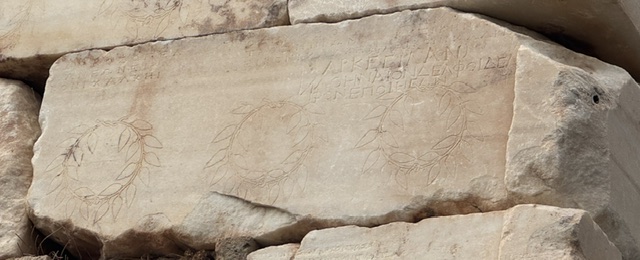
These stones below were inscribed with winners of the Panhellenic games, the great honor to have their names on the stones at the base of the temple. You can see the laurel wreaths.

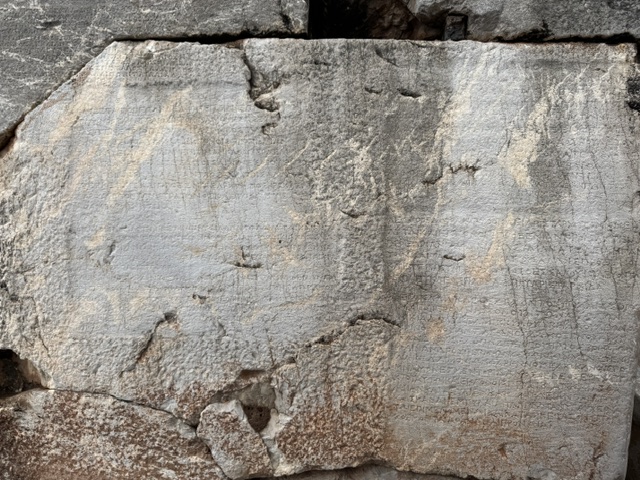
This stone’s writing below were the names of slaves who had earned enough to buy their freedom or had been ransomed and had been freed. By coming to the temple and having their names inscribed in the foundation block, they were official. Then it was their choice whether they stayed or went back to the country where they had been taken – most did this. Almost all slaves were from those areas that had lost in battle. 

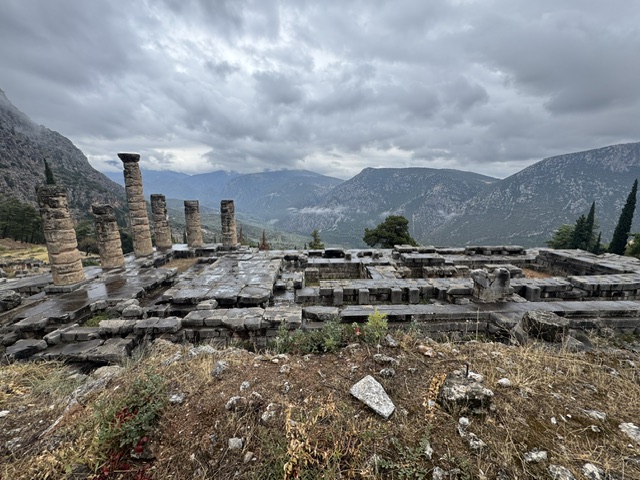
Here’s my best photo of the full temple – hard to grasp how big it is.

Dionysius was honored here when it wasn’t in Apollo’s hands. Apollo was all about order, music, poetry, the sun. Dionysius was the opposite, going for escstasy – having the wine, being drunk was like having the god inside you. The festivals were for everyone, high and low, women and men, including slaves. It let all those who were repressed to let go in a big way.

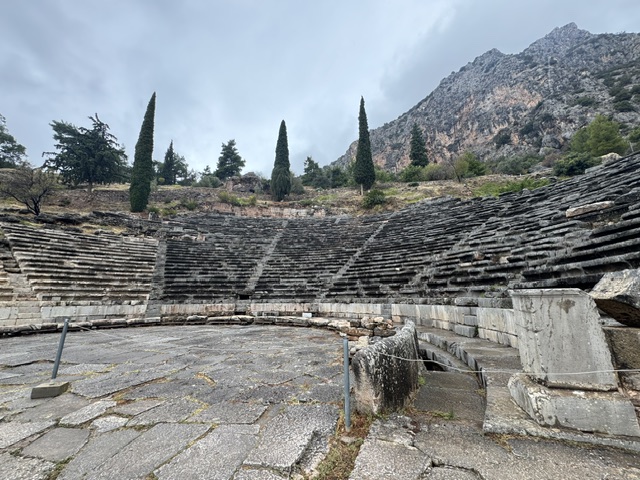
This is the theatre – it used to be much bigger, but it’s still pretty impressive! 

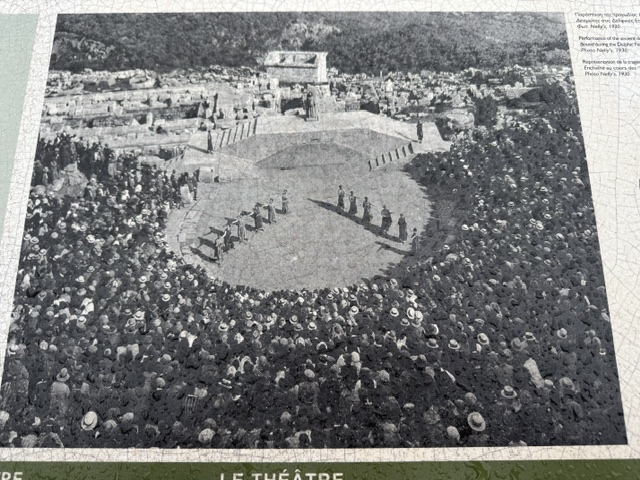
It was still in use in 1930, could hold 5,000 people – a performance during the Delphic Festival.

The citizens here strived for a balance:  “Nothing in excess, everything in moderation” is inscribed in the Delphi site. This plus “Know Thyself” are the only two inscriptions.  So balancing Apollo’s and Dionysian values.

Every 4 years were known as the Pythian game, originally started as funerary games for the serpent Python. The priestess was also related to this Python – all went back to the earlier traditions. 

So Apollo, Dionysius, then Athena were worshipped here. She had a temple, we just couldn’t reach it because it was blocked off.

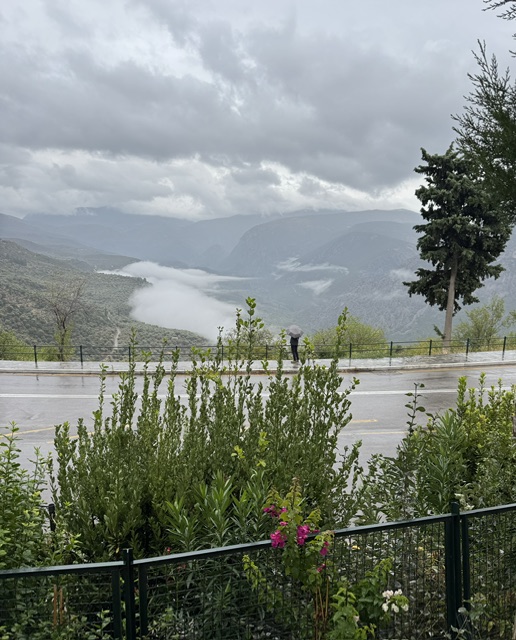
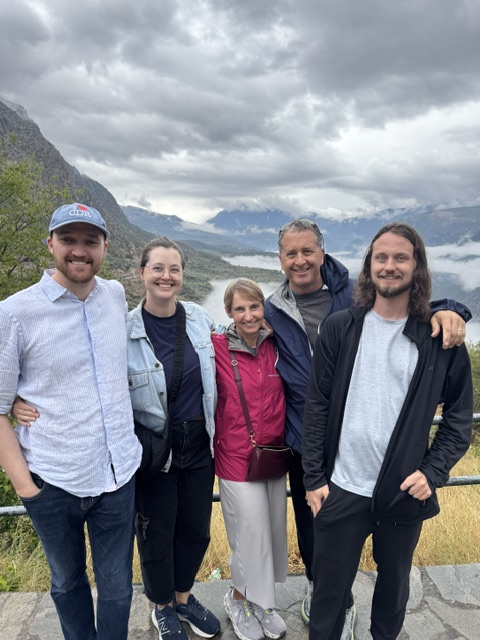
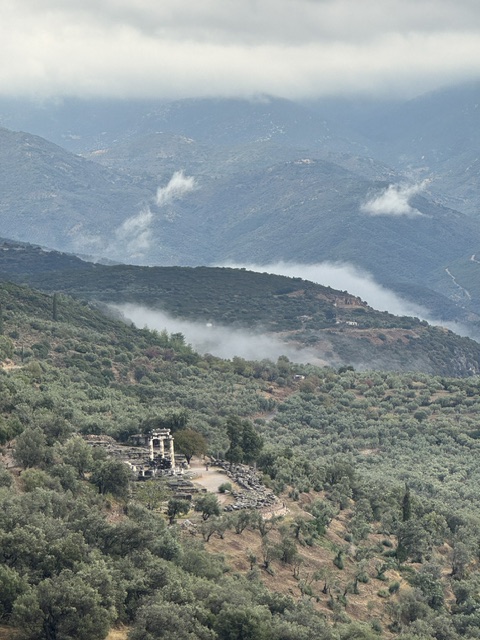
This is the view from the temple, the museum and walks around. It is a plain filled with olive trees below the Parnassus mountain. So beautiful and we got to see it before it completely filled with fog. 

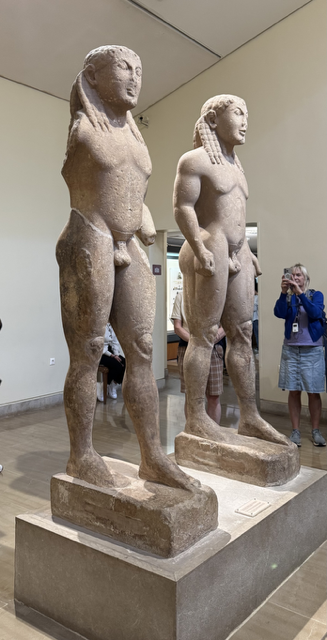
We then went to the museum which really did have just remarkable pieces from the site. My favorite, though not the most famous, were these two statues. Kleobis and Biton. Can you imagine finding these as archeologists? They knew immediately who they were because of oral traditions telling their history, but Herodotus wrote of them as well.

They are real characters, not mythological. 2500 years ago or so, there was a well-off woman who would go to practice at the site on the days welcoming women. One day, the oxen did not show up who were supposed to pull her palanquin. So her twin sons, strong, fit, at their prime, yoked up and pulled her to the temple. When there, she prayed that her sons would be given immortality. They pulled her back home after. That night, both brothers died in their sleep.

As Katarina said, this was the mother’s prayer answered. Since the people did not believe in any after life, the only way to have immortality was to be remembered. Because the sons were in the peak of their life, had done wonderful deeds, were beautiful, they have never been forgotten. As Katarina said, I’m telling you their story 2500 years after they died and we still know them and talk about them!

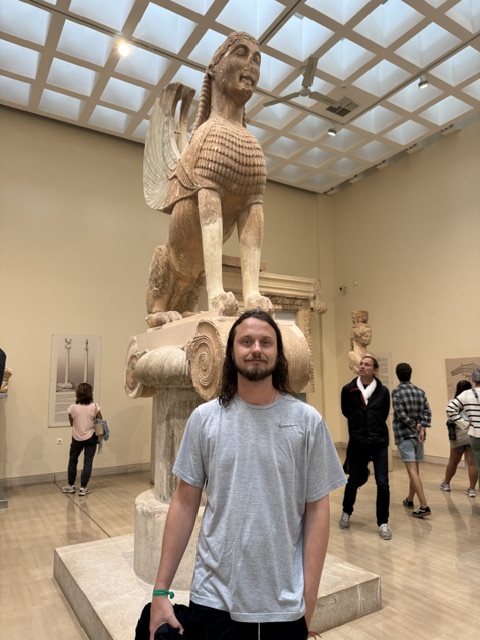
I loved the sphinx that guarded the temple, incredible to find it. 6th century BC. Crazy.

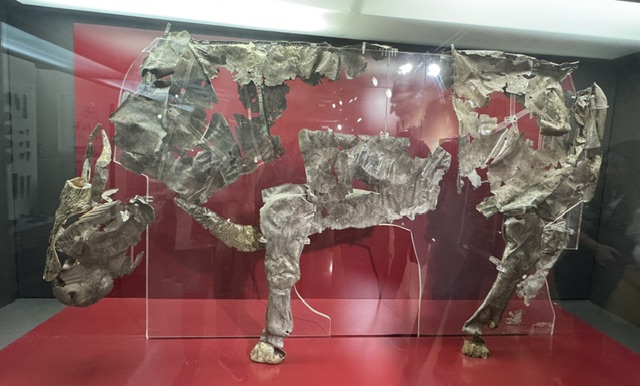
This was a bull that was wood, with silver nailed to cover it and then gold plated in different areas. Truly amazing, both that it had survived from 6th century BC and that they were able to put it together this well. A number of the nails that held the silver to the wood were still in the metal. 

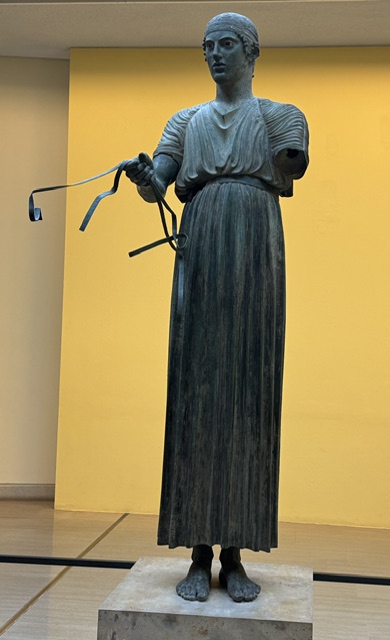
Finally, the most famous piece was this bronze charioteer, 470BC. There was a photo of the archeologists who found it. Needless to say, that was a very good day!

And we had a really good day too 🙂

Though I have to say that seems like I’m shrinking – when did I get so small?!

Greece, 25.Sep.2025, Thursday

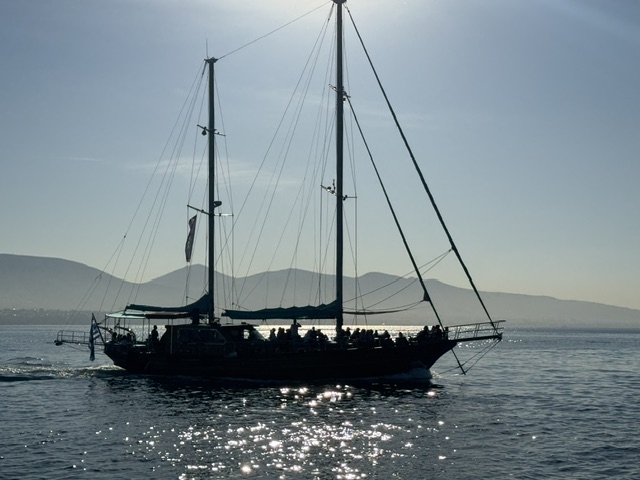
I wanted to explore with the family, so went on Viatours to find something that would be a day excursion and found a boat trip that went to three islands. It looked like a sailing boat from the ad, but nope, it motored, but it had these crazy big cushions that every one sat on for and aft and we just motored along. The weather was perfect, I had a good spot with a fair amount of sun protection (it’s hot!). I read two parts of two different books, chatted with a few passengers and had a very chill day. 

This was a sister boat that went out at the same time. See how it looks like there would be sails?

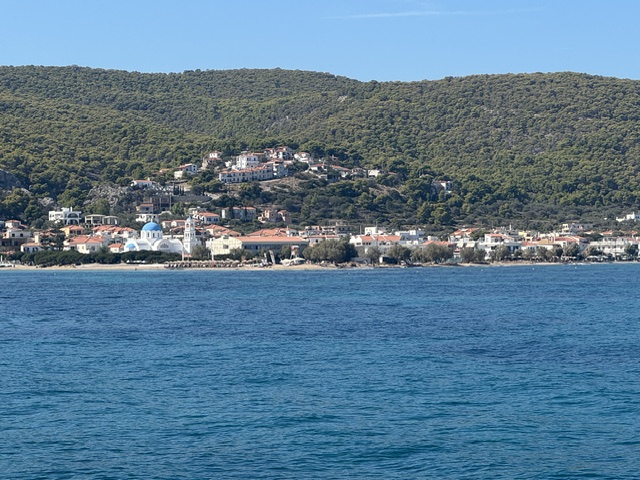
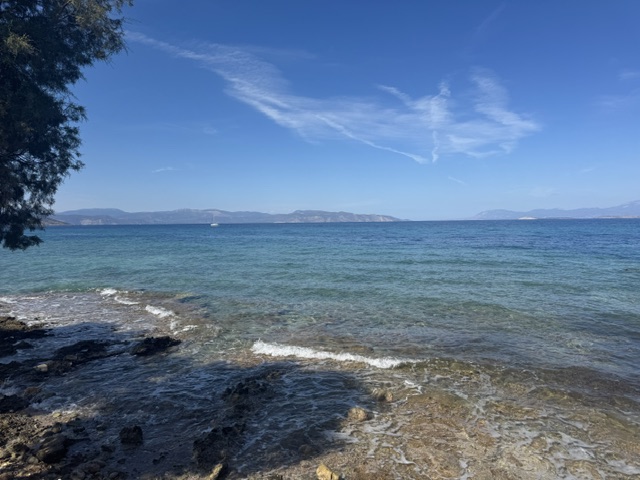
We had three stops, I walked out and back at the first island, Agistri. I had thought I’d rent a bike, but it really was just the shoreline and then I would have been riding up into hot and arid hills, that didn’t really call. But I had a decent walk and the water was beautiful. 

This is coming into the island, so pretty, with the classic blue and white church at the center. 

The second island, Metopi, was just a stop for a swim. I did jump in, I’d brought mask and snorkel, but there weren’t any fish. However, the water was a perfect temp, I was really hot after walking on the previous island and it felt great. This island was a small rock and protected (though I don’t know what was there to be protected, so dry!), so we just were in the water for maybe 30 min.

The last island was Aegina, known for pistachio production. They had all kinds of pistachio products, but way too early in the trip to buy anything and I’m not wild about pistachios anyway so didn’t try any (“they’re so fresh!”). However, it did have a totally cool temple and monastery. Two other women and I shared a taxi for a set fare and he got us up to both places and back to the boat in time. 

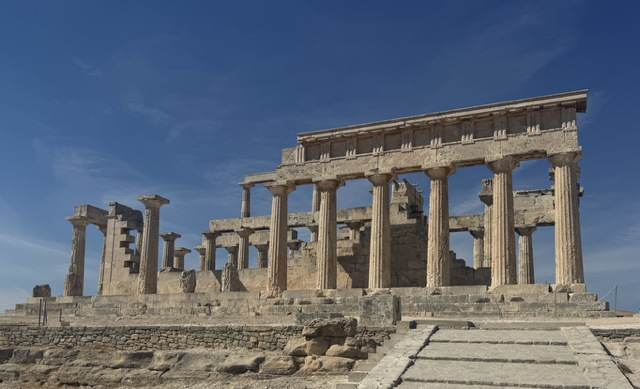
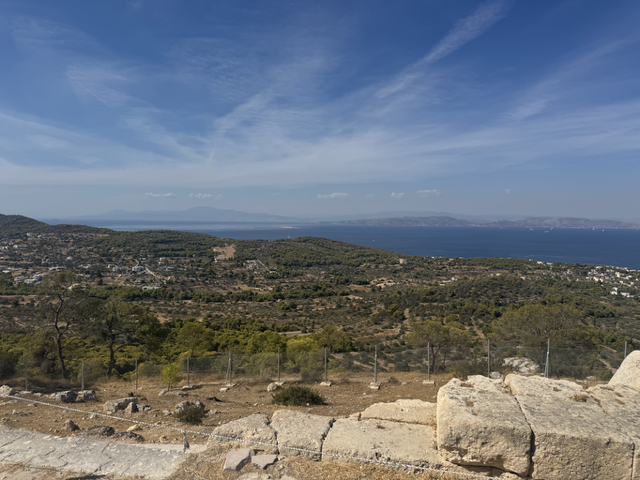
Even though it was just a tiny island, evidently Aegina was a serious maritime trading site. The Temple of Aphaia was the precursor to the Parthenon. Just unbelievable to see this temple at the very top of the island with views everywhere. You couldn’t help but  think about who did the work, ach, but it was truly beautiful, built between 500 and 490 BC.

The nymph Aphaia was thought of as the daughter of Zeus and was only worshipped here. So curious how these things evolve. 

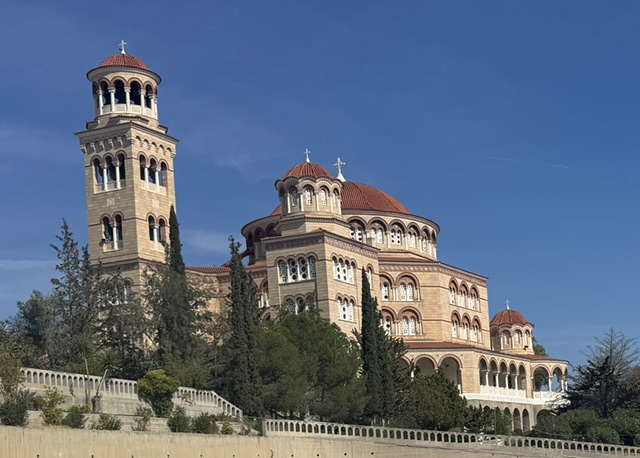
We did a quick hit and run to the monastery, truly beautiful and huge. It looked so well maintained and had an amazing balcony with balustrades all the way around which caught the breezes and was so cool. Even a monk with full robes would be comfortable!

This was the Chrysoleontissa Monastery. (Copied from internet) According to the local tradition, Panagia Chryssoleontissa was originally built in the coastal village of Leonti, which was, however, very vulnerable to pirate incursions. After being raided and laid waste no less than three times, it was decided in the early 17th century that it should be transferred to a secure location away from the sea.

Legend has it that, for three consecutive mornings, when the builders returned to the construction site, their tools, left there since the previous night, had disappeared. Instead, they found them at the exact place where the monastery stands today. So, the monks decided that this should be the chosen place.

In its present form, the complex is square and includes a crenelated tower built in 1601, and the primary church (called the katholikon), which was erected later on, in 1808. Situated in the center of the courtyard, the convent church is dedicated to the Dormition of the Mother of God, Saint Dionysios, and Saint Charalambos.

Built to protect the monks from the pirates, it is 20 meters high and has three storeys. With its characteristically high walls, turrets, battlements, and narrow windows, it looks more like a fortress than a monastery. The place also features a huge garden and six chapels.

Having played an important role in the 1821 Greek War of Independence, in terms of both spiritual and financial support, this is also a place of great historical significance.

Up to 1935, it functioned as a male monastery. Since then, it has been a convent, housing about 10 nuns. Don’t ask me how 10 nuns can keep it up. 

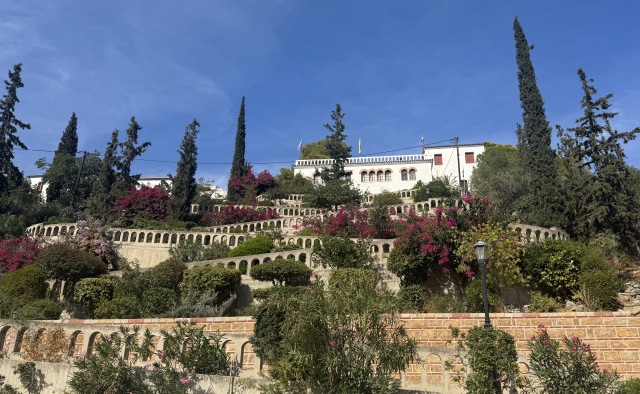
I guess this pathway led up to the chapels and the housing. Just gorgeous.

Salzburg to Bolzano, 5.July.2025

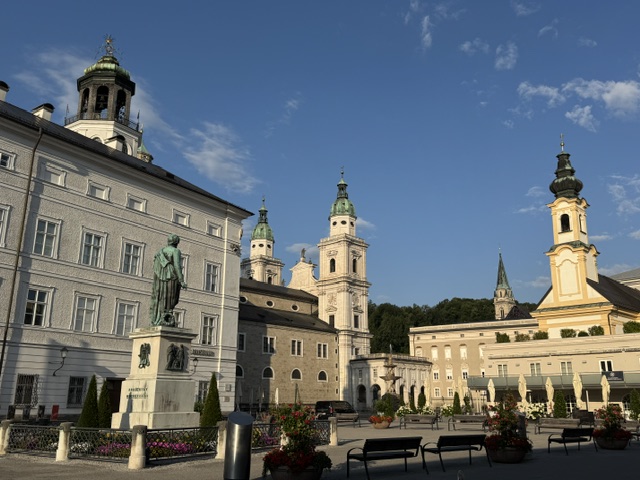
Final sunrise and listening to the bells in Mozartplatz and Residenzplatz. It’s so beautiful here.

The train was easy again, clean, this time we knew to look for the car number, and the seat number, we were familiar with the Innsbrook train station for the transfer. So much easier. 

We got to our hotel in Bolzano, turned out to be a 500 year old manor house that looks like a castle that had been completely redone. Castle Hortenberg. Snuggled in the midst of a bunch of apartment buildings. The things this castle has seen in its lifetime, I can’t imagine. All the land gone, but somehow the owners made this a quiet oasis. The owners sound pretty amazing, committed to philanthropy, have vineyards and an olive farm, environmentally focused. It was a wonderful overnight.

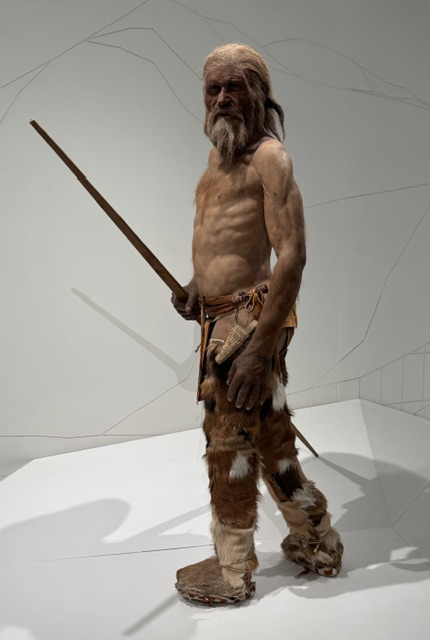
We then realized that we were only about 5 minutes from the old city, which probably makes sense since this would have been an important element of the region. We walked in and met Marla, Ken, Carol, Matthew, Sara and Stuart at the South Tyrol Archeological Museum. My friend Sabra had just been here a couple of weeks ago and said it was a great exhibit. Marla got tickets for our group and we were off to see Ötzi the Iceman. 

Fascinating. Here’s the link to give info, but safe to say, all of us were fascinated to learn the story of how he was found, why he’s so remarkable and some behind the scenes stories from our guide. 

Home | Museo Archeologico dell’Alto Adige

Here’s a Wikipedia synopsis: Ötzi”, a well-preserved natural mummy of a man from about 3350 BC (53 centuries ago).This is the world’s oldest natural human mummy, a wet mummy, as opposed to mummies preserved by dry conditions in a desert environment. It has offered an unprecedented view of Copper Age European culture. The world’s oldest complete copper age axe was found among his extensive equipment, which also comprised a rather complex fire-lighting kit and a quiver loaded with 12 arrows, only two of which were finished, clothing, and a flint knife complete with its sheath.

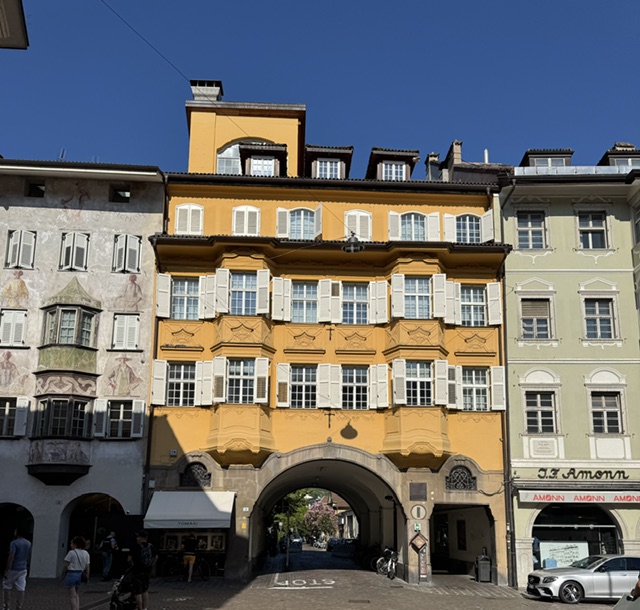
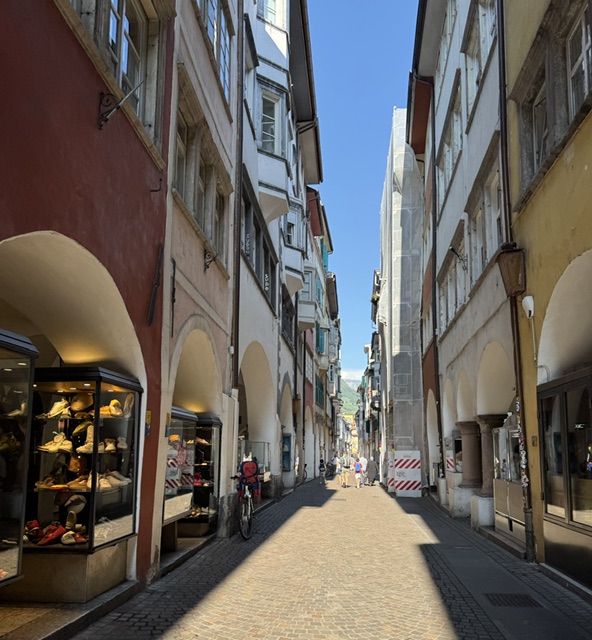
We then all went back to hotels to get a bit cleaned up, or settle a bit, since the others had just come in recently and then we met up in different groups for dinner. Sara, Stuart, Rick and I went to a place near our hotel, a beer garden, with decent food and then we walked in to see more of the old town all of which have the hills and mountains as soon as you get to an open spot.

Another fun day on our way to starting our Backroads hiking tour in the Dolomites.