
I wanted to explore with the family, so went on Viatours to find something that would be a day excursion and found a boat trip that went to three islands. It looked like a sailing boat from the ad, but nope, it motored, but it had these crazy big cushions that every one sat on for and aft and we just motored along. The weather was perfect, I had a good spot with a fair amount of sun protection (it’s hot!). I read two parts of two different books, chatted with a few passengers and had a very chill day.
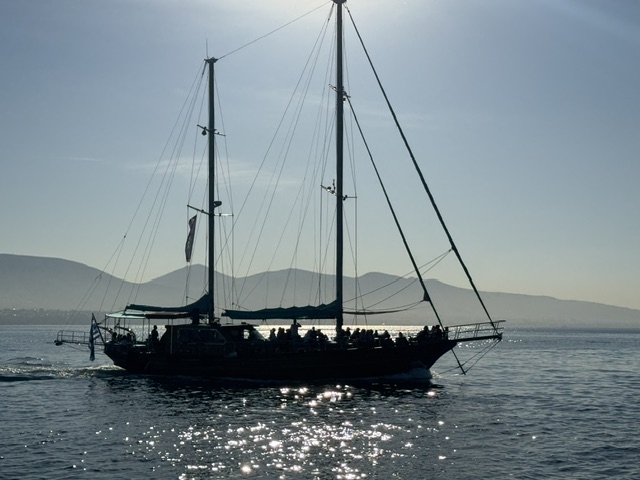
This was a sister boat that went out at the same time. See how it looks like there would be sails?
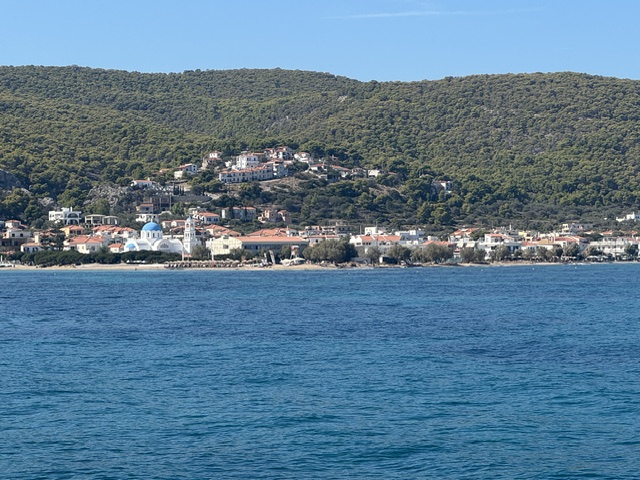
We had three stops, I walked out and back at the first island, Agistri. I had thought I’d rent a bike, but it really was just the shoreline and then I would have been riding up into hot and arid hills, that didn’t really call. But I had a decent walk and the water was beautiful.
This is coming into the island, so pretty, with the classic blue and white church at the center.
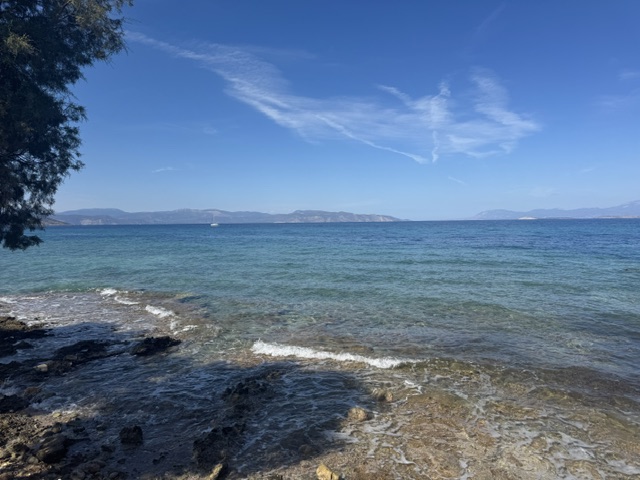
The second island, Metopi, was just a stop for a swim. I did jump in, I’d brought mask and snorkel, but there weren’t any fish. However, the water was a perfect temp, I was really hot after walking on the previous island and it felt great. This island was a small rock and protected (though I don’t know what was there to be protected, so dry!), so we just were in the water for maybe 30 min.
The last island was Aegina, known for pistachio production. They had all kinds of pistachio products, but way too early in the trip to buy anything and I’m not wild about pistachios anyway so didn’t try any (“they’re so fresh!”). However, it did have a totally cool temple and monastery. Two other women and I shared a taxi for a set fare and he got us up to both places and back to the boat in time.
Even though it was just a tiny island, evidently Aegina was a serious maritime trading site. The Temple of Aphaia was the precursor to the Parthenon. Just unbelievable to see this temple at the very top of the island with views everywhere. You couldn’t help but think about who did the work, ach, but it was truly beautiful, built between 500 and 490 BC.
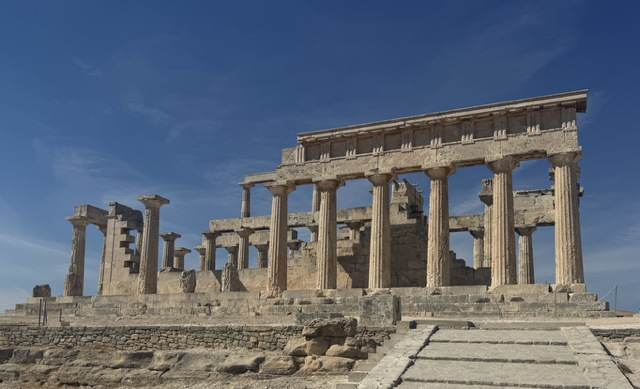
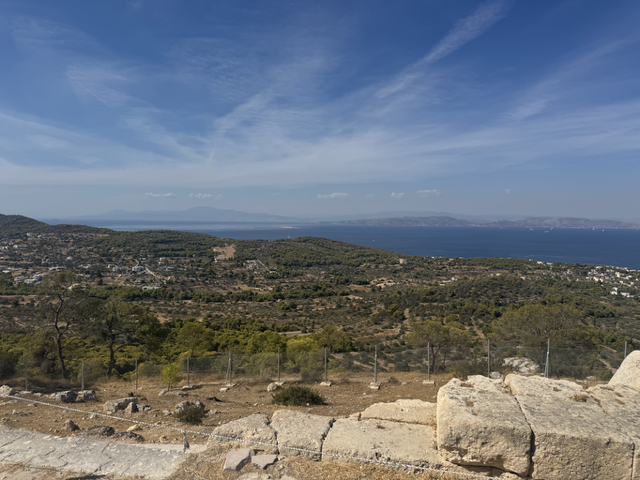
The nymph Aphaia was thought of as the daughter of Zeus and was only worshipped here. So curious how these things evolve.
We did a quick hit and run to the monastery, truly beautiful and huge. It looked so well maintained and had an amazing balcony with balustrades all the way around which caught the breezes and was so cool. Even a monk with full robes would be comfortable!
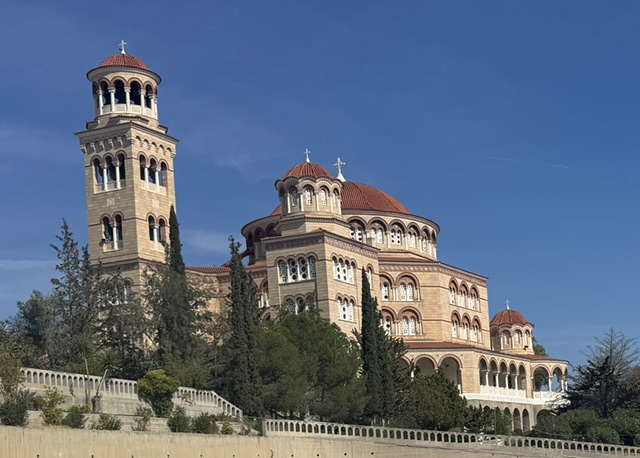
This was the Chrysoleontissa Monastery. (Copied from internet) According to the local tradition, Panagia Chryssoleontissa was originally built in the coastal village of Leonti, which was, however, very vulnerable to pirate incursions. After being raided and laid waste no less than three times, it was decided in the early 17th century that it should be transferred to a secure location away from the sea.
Legend has it that, for three consecutive mornings, when the builders returned to the construction site, their tools, left there since the previous night, had disappeared. Instead, they found them at the exact place where the monastery stands today. So, the monks decided that this should be the chosen place.
In its present form, the complex is square and includes a crenelated tower built in 1601, and the primary church (called the katholikon), which was erected later on, in 1808. Situated in the center of the courtyard, the convent church is dedicated to the Dormition of the Mother of God, Saint Dionysios, and Saint Charalambos.
Built to protect the monks from the pirates, it is 20 meters high and has three storeys. With its characteristically high walls, turrets, battlements, and narrow windows, it looks more like a fortress than a monastery. The place also features a huge garden and six chapels.
Having played an important role in the 1821 Greek War of Independence, in terms of both spiritual and financial support, this is also a place of great historical significance.
Up to 1935, it functioned as a male monastery. Since then, it has been a convent, housing about 10 nuns. Don’t ask me how 10 nuns can keep it up.
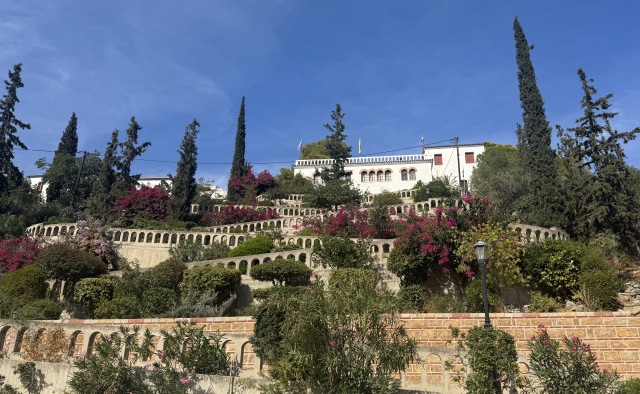
I guess this pathway led up to the chapels and the housing. Just gorgeous.
 Reb's Walks!