Vietnam, 12.Feb.2025, Wednesday

Every day has gotten better. Today was so interesting. I confess, I did a fair amount of it a bit dingy since I woke up at 2:30; we’re all dealing with jet lag at different paces. But – it was a great day.

Our new guide and the driver are delightful. Yesterday, in our group we discussed communism and Vietnam and how Hie, our guide, seem to portray in action someone very devoted to and admiring of the system as well as being anxious that he did everything right – with what seemed like concerns of who was overseeing his work. That may be just our projections, but we all picked up on it. He also talked about the cement “king” just doing what you can do if you’re rich – you’ve worked hard and are able to show off your success. 

He was truly admiring of Ho Chi Minh, thought that Vietnam (or at least as he presented to us) was a country of one people, no north or south except for direction and location of cities and that all benefited by the one party system. Holly, last night at dinner, had read to us of a Proclamation, secretly written by the politburo last year, prior to Biden’s visit. This was not to be supposed to be disseminated, but was leaked. The document expressed the politburo’s intent to open more and more to market systems, but that there would be further suppression of any free press (there is none) and opposition parties. Yes, a market economy but ruled as a one-party system. 

Our current guide’s family was from the center and supported the monarchy and republic from generations back. His family’s history reflected the book I’ve been reading; this is a much more nuanced country than was presented by our other guide who’s based in Hanoi and has always supported Ho Chi Minh. Our Hue guide’s family were intellectuals, had served in the republic and were pretty well off. Their house was taken, they had to flee, and when they were allowed to return, a government official had taken over their house. 

We asked about the cement king and he said, yes, he did earn that, he was also given the rights and privileges because of his party connections. It’s not in isolation. He told us of struggling to find his way for a living and finally realizing that maybe he could train as a guide. He spoke both French and Vietnamese and was studying English. He scored the highest score in English and when he went to the school that he was trying to enter, he should have been assured of a spot because of his scores. Instead, his name had been erased in favor of someone connected to the party. 

He also said that it’s definitely not one country in terms of how people feel about the party, but that all the way to the most southern parts, everyone loves Ho Chi Minh. So the narrative as presented at Ho Chi Minh’s mausoleum and his homes may in fact have been a pretty accurate story of how he lived his life and his commitment to his people. Again, per our guide, I guess Ho Chi Minh was horrified by the Tet offensive and how many of his own people were killed and targeted, but he was already very ill by that time. There is speculation that his generals held off until Ho Chi Minh was quite sick to initiate the offensive and then the news was what finally undid him. Interesting slant. 

Honestly, there’s been SO much to learn and think about that I can’t write it all, but wanted to get the highlights down. And I haven’t even started on what we saw!

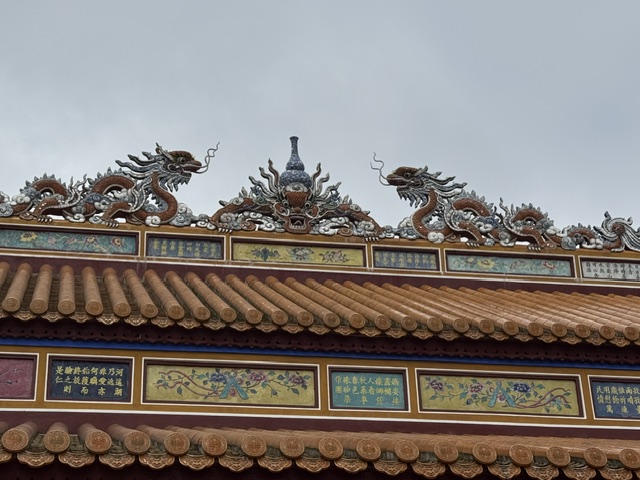
We’re exploring Hue now. It felt like a really nice city as we drove through, seemingly middle class, nice size and comfortable. From 1802 to 1945 Hue was the capital city of Vietnam under the Nguyen Emperors who were based at the Imperial City, Hue’s great walled citadel inspired by the Forbidden City in Beijing. The complex originally contained over 160 building with ornate palaces, pavilions, gardens and gateways in traditional style dominating the site. Most remained unchanged until 1945 with the last emperor was deposed.

Battles then took a toll, first between the Viet Minh and French in 1947, burning the core including the main palace. Worse happened in 1968 during the Tet offensive between the VC and the US (who originally refrained from bombing the area in order to avoid damaging the historic structures, but as fighting intensified, restrictions were ignored). After the Battle of Hue, only 10 major sites survived. Now many are restored, but large empty spaces are left to show a hint of what was lost. 

Our guide told us that Nguyen is the most common name in Vietnam. When mandarins (soldiers) wanted to move up, they gave their daughter to the king, who never said no. So all those children had the name. Then when wars were fought and there were prisoners, they could be let off more easily if they took Nguyen as their last name. Same for peasants who only had first names. If they would take Nguyen as their last name, it gave them a leg up. Currently 40% of the people in Vietnam of Nguyen as their last name.

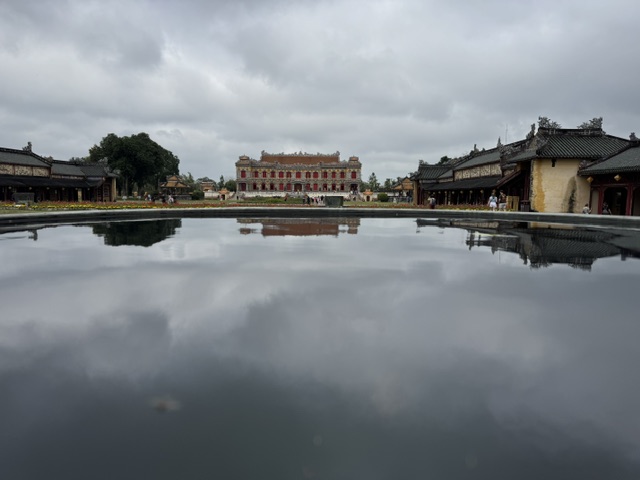
Since the Citadel was the name of the area we were seeing, I assumed we’d be spending our time exploring the fort:
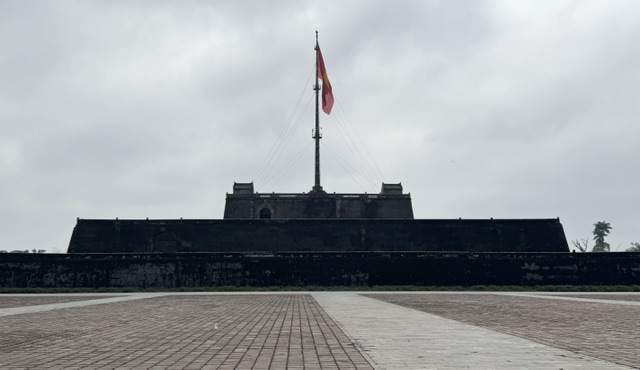
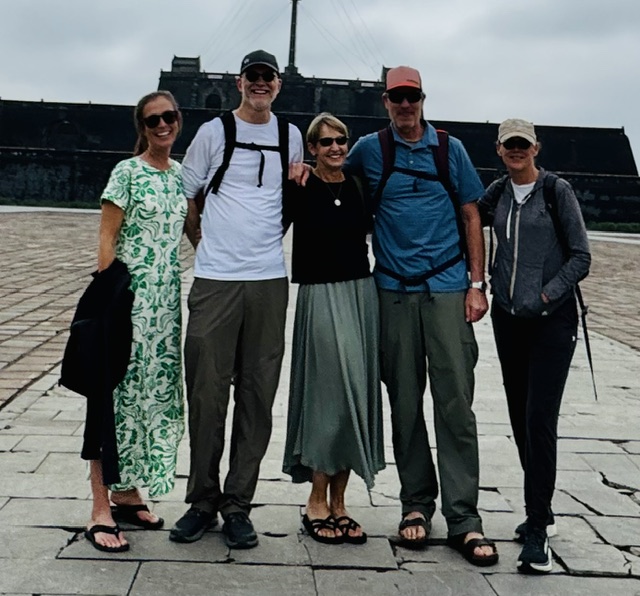
But no, we were on our way to seeing some incredible temples. 

These Nguyen’s are the ones who rebuilt the temples in Hoa Lu on the origins of temples from then 9th and 10th century.  The Hue Imperial Citadel was beautiful, with building after building lined up on a grid. This area was heavily bombed during the Vietnam War (Tet offensive happened here) and was the middle ground, so back and forth between the republic and the VC. Large sections of the Citadel were preserved and others have been restored. Then there were large spaces where the entire temple was gone. 
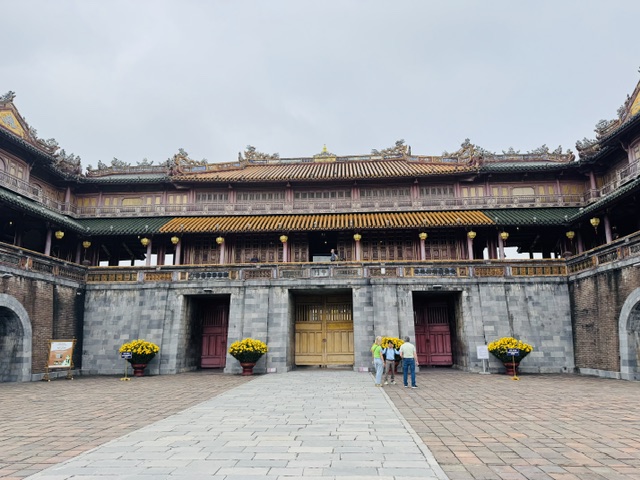
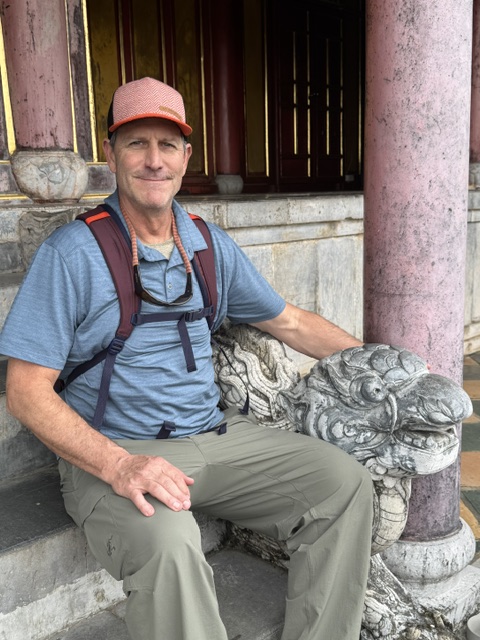
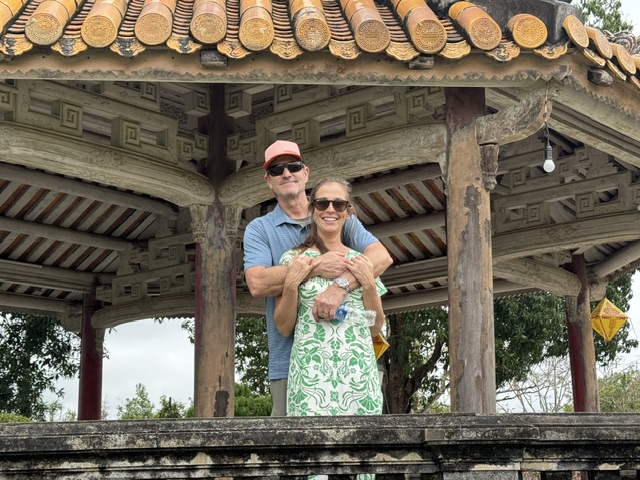
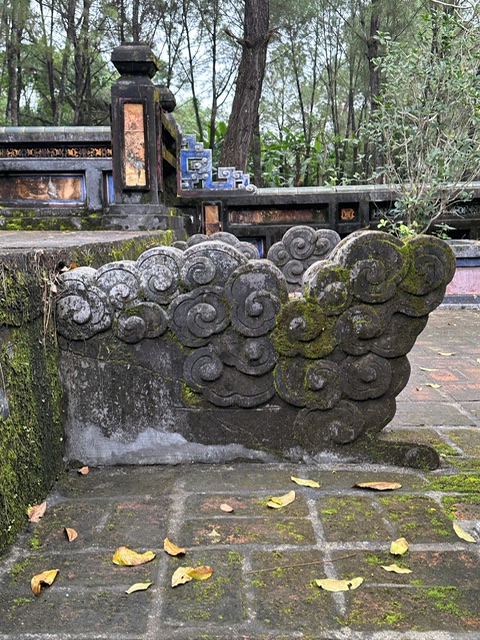
Shoot, I can’t remember the name, or find it online, but this precursor to the staircase banister was one of the many details that Pat loved seeing in the architecture. The details were incredible! 
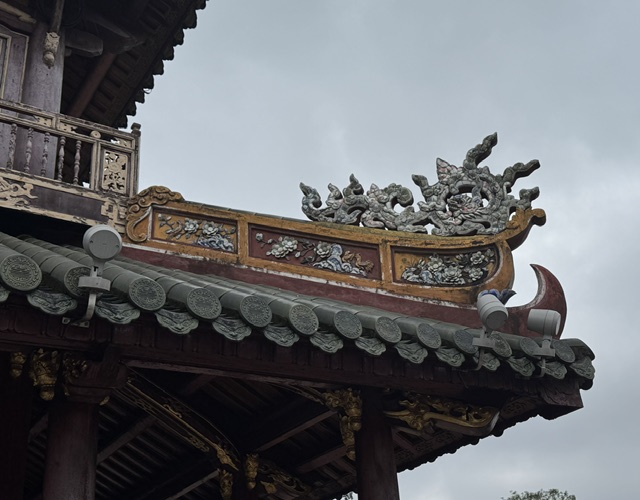
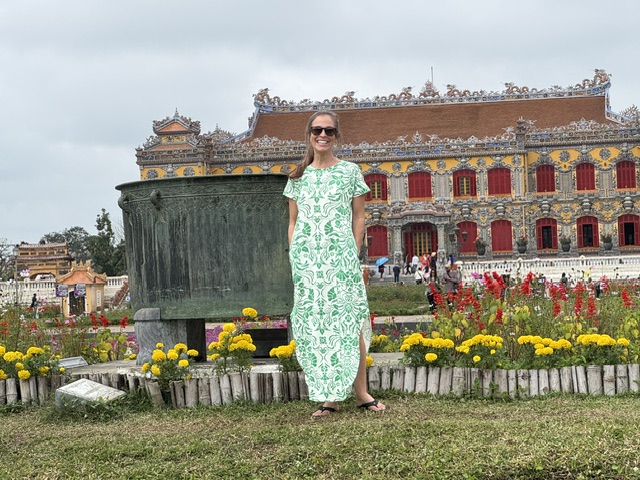
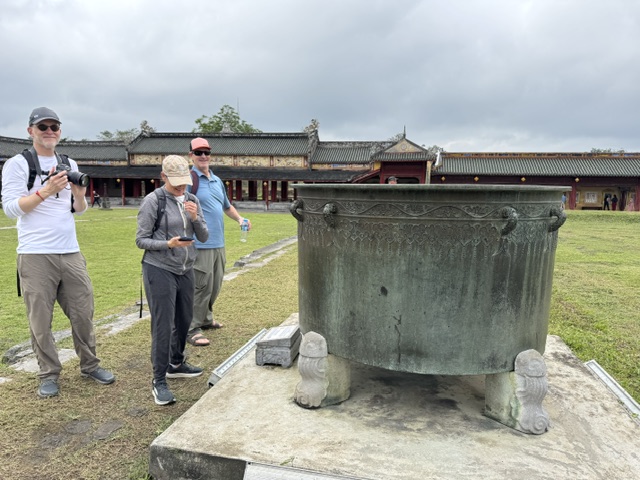
Per our guide’s advice, the photo above was taken from the top of the brass cauldron below.
We then drove to the Thien Mu Pagoda, Hue’s best preserved religious monoment and still an ongoing monastery. It was built in 1601 and is a 7 storied tower pagoda, on top of a hill overlooking the Perfume River. I guess it’s an iconic image of Vietnam, it was new to me. But – this monastery, so far, stands out for me as the most wonderful place we’ve visited.
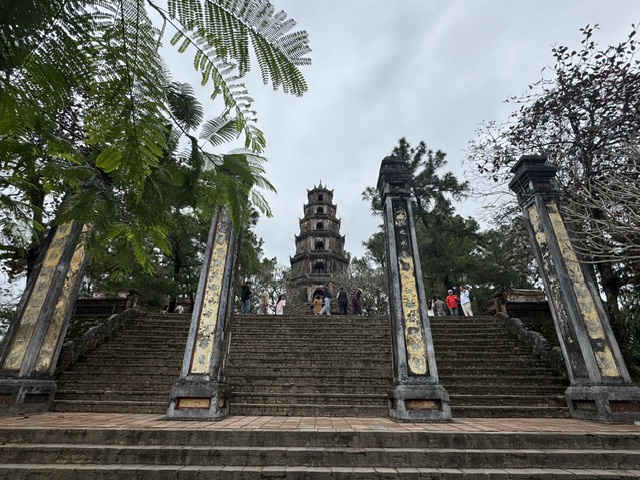
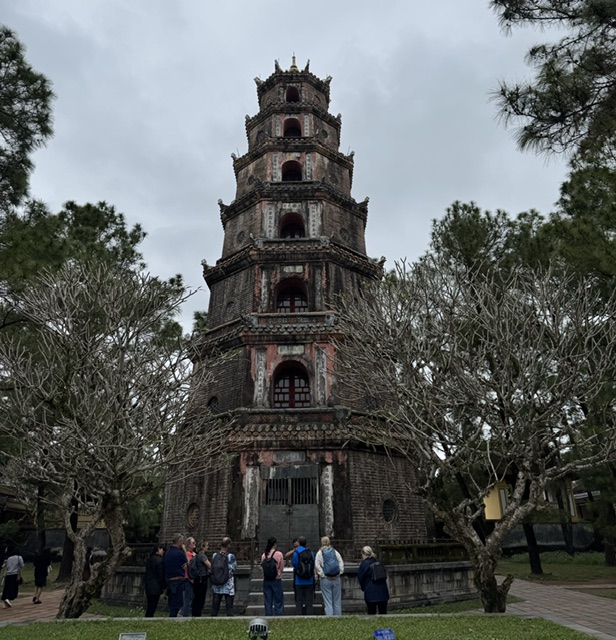
As soon as we passed the pagoda, the architecture became much more simple, one story, white with greenery all around. The plantings were incredible and so very intentional. 

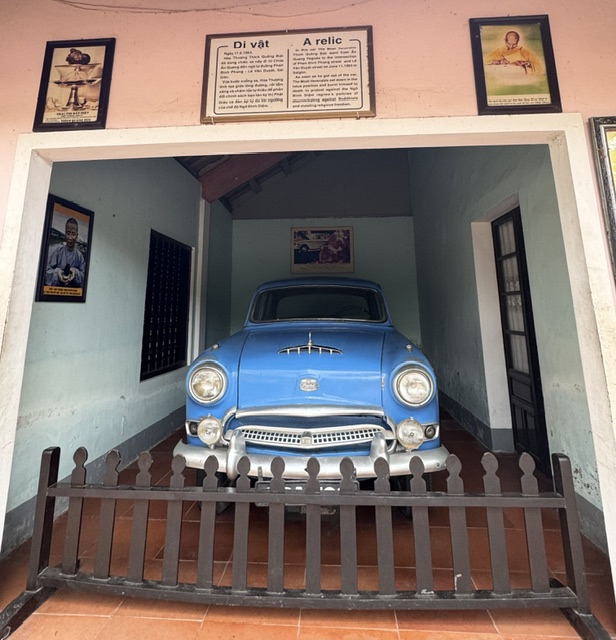
The first building had an old car with the story of a monk who had immolated himself. 6 of his fellow monks had done this in protest in Hue.  This monk took this car, drove it to Hanoi, stepped out and put himself on fire. Incredibly sad. His face was beautiful, and such a commitment to his practice and protesting what was happening to Buddhists in the war. Somehow, it was a peaceful memorial, perhaps because of his photo. 
We then continued back into the property, all of us spreading out, called to different areas, architecture,  and plants. There was an incredible and ancient bonsai garden. I could have stayed there for the rest of the trip. There was something rare and peaceful that seeped into your bones if you stood still for even a moment. 

And then yes! There was more. Such a day.

Next we visited the Khai Dinh Royal Tomb. This tomb was built for a king that had 132 wives and no children, maybe he had smallpox? But he wanted to have an incredible tomb. Khai Dinh was the penultimate emperor of Vietnam, from 1916 to 1925, and widely seen as a puppet of the French. It took 11 years to construct his flamboyant tomb from his designs, finishing after he died. 

Confession here – I didn’t take my phone. Probably forgot it in the heat and long day. 

As our guide said, the king was 50/50 good/bad. He built wonderful buildings that lasted, an entire complex that was Feng Shui. And he killed over 200 people because he forced them to keep working all summer in the brutal heat. This king wanted to leave a record of his accomplishments and wrote 500 Chinese characters on a large stelae, finishing it before he died.
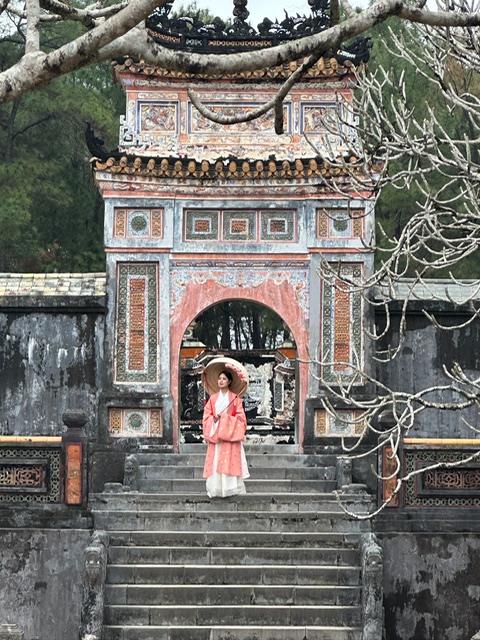
There was a standout “instagram” woman at this place. She/her photographer chose perfect places for her to pose and her outfit was the most spectacular of the MANY costumes that we had seen. They’re very serious in these poses, but when Scott walked by her and told her how beautiful he thought she was, she gave him a big grin. Photo courtesy of Scott:

As part of our tour on this day, we went to the Tu Hieu Pagoda where Thich Nhat Hanh died. Thich Nhat Hanh was a Vietnamese Zen master, poet, scholar, and peace activist. He was born Nguyen Dinh Lang in Hue in 1926. He was cremated after his death in 2022 at the age of 95. His funeral was a seven-day silent meditation course. Thousands of people attended his funeral at the Tu Hieu Pagoda.
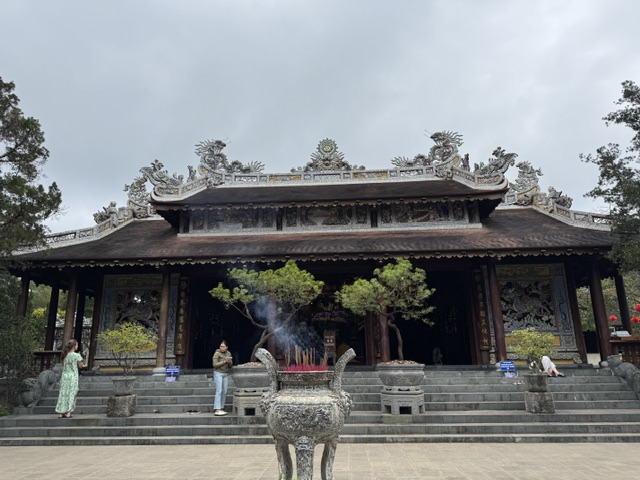
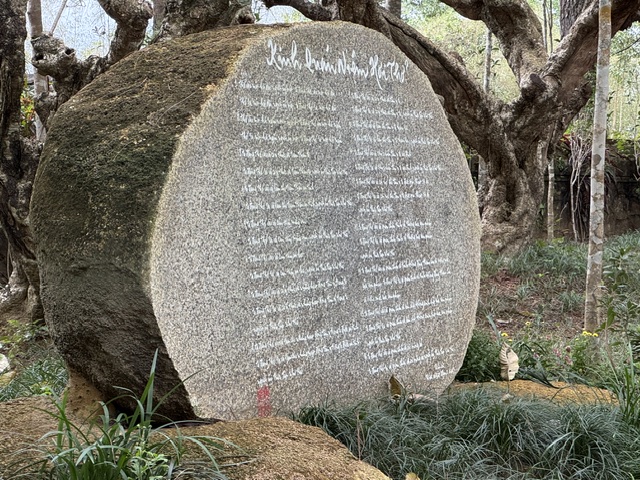
A slim chance was offered that we could go to the 4am chanting practice in the building where the monks practice, but our guide wasn’t able to find any monks and the buildings where he had gone before were locked behind a fence. We did see TNH’s burial tomb and the stone with a piece of his writing next to it. I would love to know what it says, but the script defied all of the translation apps. I’ll keep searching. 
It was amazing being somewhere that Thich Nhat Hanh had been, but it didn’t feel like Thien Mu Pagoda and monastery. Still – a gift.

And finally, Scott had asked about where incense was made – we’d been seeing these astonishing circle incense burners that could burn for days, sending prayers and blessings out once lit. Turns out that right near Thich Nhat Hanh’s burial place was incense row. 

Sadly, I was tired and missed getting a photo, but take these photos of this shop’s incense and multiply it by 10? 15? For all the stores in a row, beautiful. We ended up buying a variety of things here. We took so long, they finally gave us tea and ginger and we just sat down while they made a bracelet for Pat.

That was our last stop. Our guide said there was a great restaurant 10 min from the hotel, bit all we could think is that when we got back to the hotel, we weren’t leaving! 

In the meantime, our guide was supposed to drive and drop us in Hoi An, the next town, but we liked him so much, we asked him to stay with us and do a walking tour of the town once we got there. And he could! That’s tomorrow. 
Vietnam, 11.Feb.2025, Tuesday

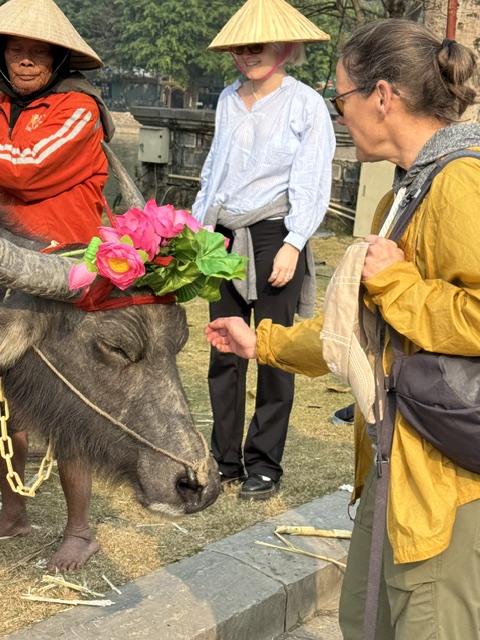
Note from yesterday – forgot Kellie finally getting to see a water buffalo.

Yesterday we were all a bit underwhelmed with the previous day so we didn’t have high expectations for today, but it was great. So incredibly interesting. First, we drove enough to see much more of the city and there are gorgeous buildings built both by the Vietnamese and by the French during colonialization, in addition to wide avenues and lanes of trees. 

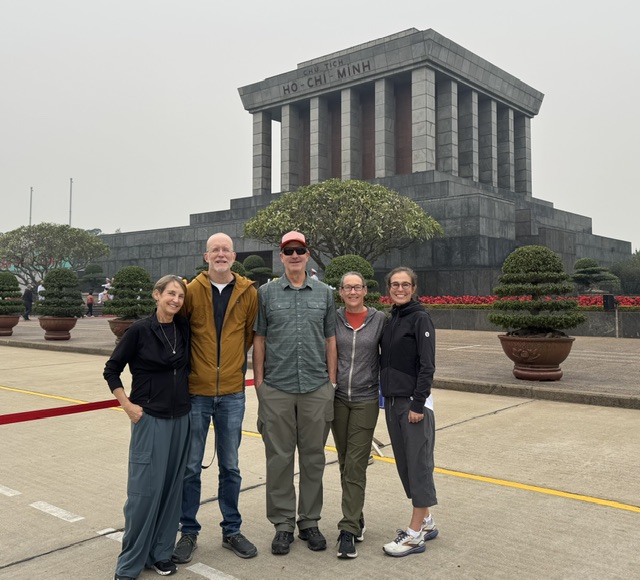
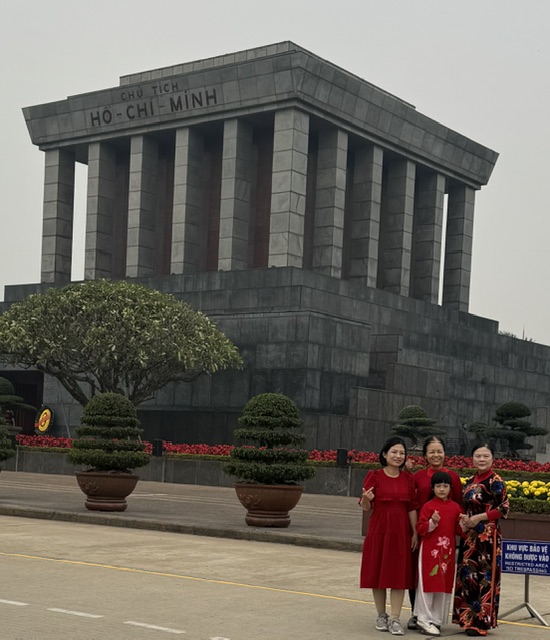
Our first stop was the Ho Chi Minh Mausoleum, housing the “beloved revolutionary leader affectionately known to the Vietnamese are Uncle Ho.” It’s interesting learning the Viet Cong side of things since the book I’m reading is based more on the Republic’s view of the war. Our guide was adoring and proud of Ho Chi Minh and there were hundreds, thousands?, of people in line and moving respectfully through the paths in the compound towards the mausoleum. No cel phones were allowed past a certain point, well before the building. One small group of older Americans ahead of us were pretty oblivious and despite warnings from the soldiers, one of the women kept pulling out her cel phone. A soldier finally confiscated her phone and then escorted her all the way around the room of the actual body, then in an office at the bottom deleted all the photos and video she was evidently collecting. 

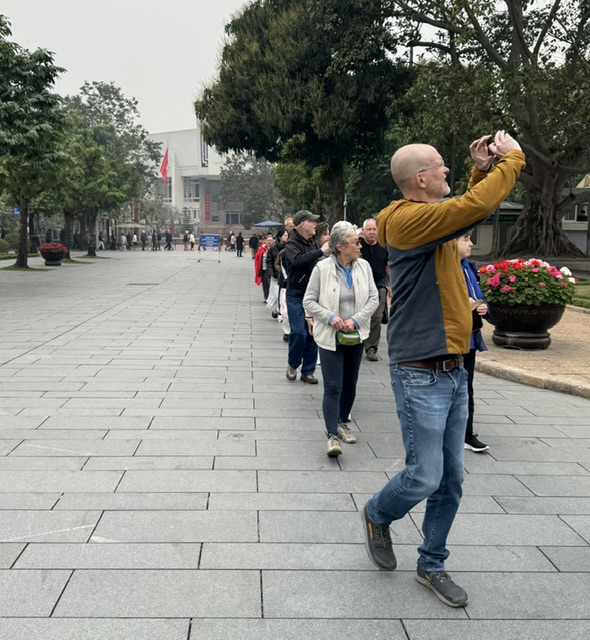
The line curves all the way back and around – and we had to stay single file, our guide kept asking us to move back to single file.

It was a very quiet and respectful crowd, no knees or shoulders showing, no hats. It was actually kind of amazing to see this man so well preserved. That’s really Ho Chi Minh. The man who led this country and defeated first the French and then the American armies. 

This is after we came out, then photos are allowed.

Saw the changing of the guard, the sign above them says: The Great President Ho Chi Minh Lives Forever In Our Cause. The sign greeting us as we walked toward the monument started with Socialist Republic, but I couldn’t get the rest from our vantage point after the tour.

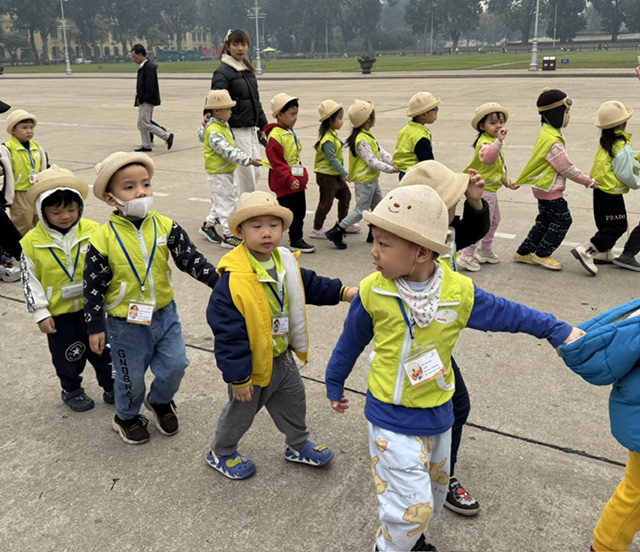
So many groups visiting, the little ones are adorable with all their matching hats.

Many of the visitors wore red and black. I never learned why, but assuming it’s the color of the flag and of communism.

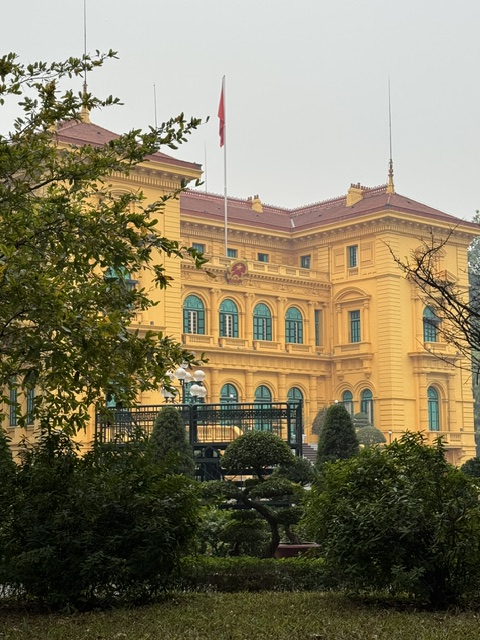
This was an example of one of the French colonial buildings. Gorgeous, but Ho Chi Minh said he wouldn’t stay there, too fancy, he made it into a greeting building for when international dignitaries came. 

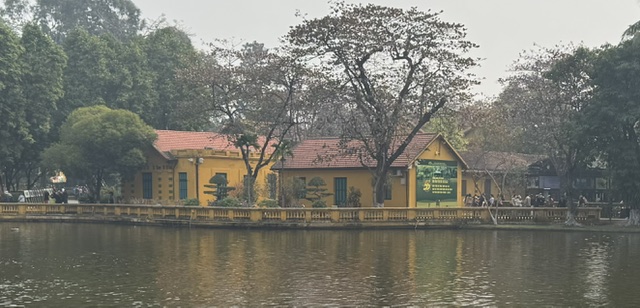
We then visited Ho Chi Minh’s complex. He lived there from 12/19/54 to 9/2/69, “mapped out the Vietnamese revolution, let the Vietnamese people to construct socialism in the North and fight the American aggressors in the South, contributed actively to the struggle for national independence, democracy, peace and social progress worldwide.” 

We saw where he ate, had meetings, etc. It was a pretty compound, not at all pretentious and his home was small and quite simple. 

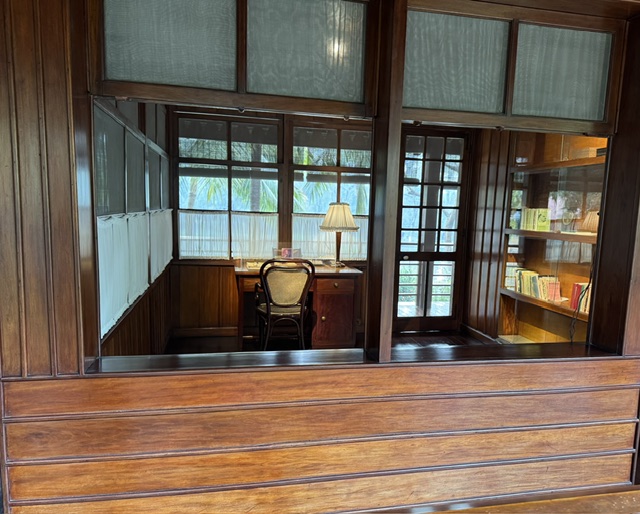
The people then built him a new house, really beautiful, of wood, 2 rooms living above, small office and small bedroom and an open meeting area below. It almost felt Frank Lloyd Wright like. No kitchen or restroom, he went over the other house for those needs.
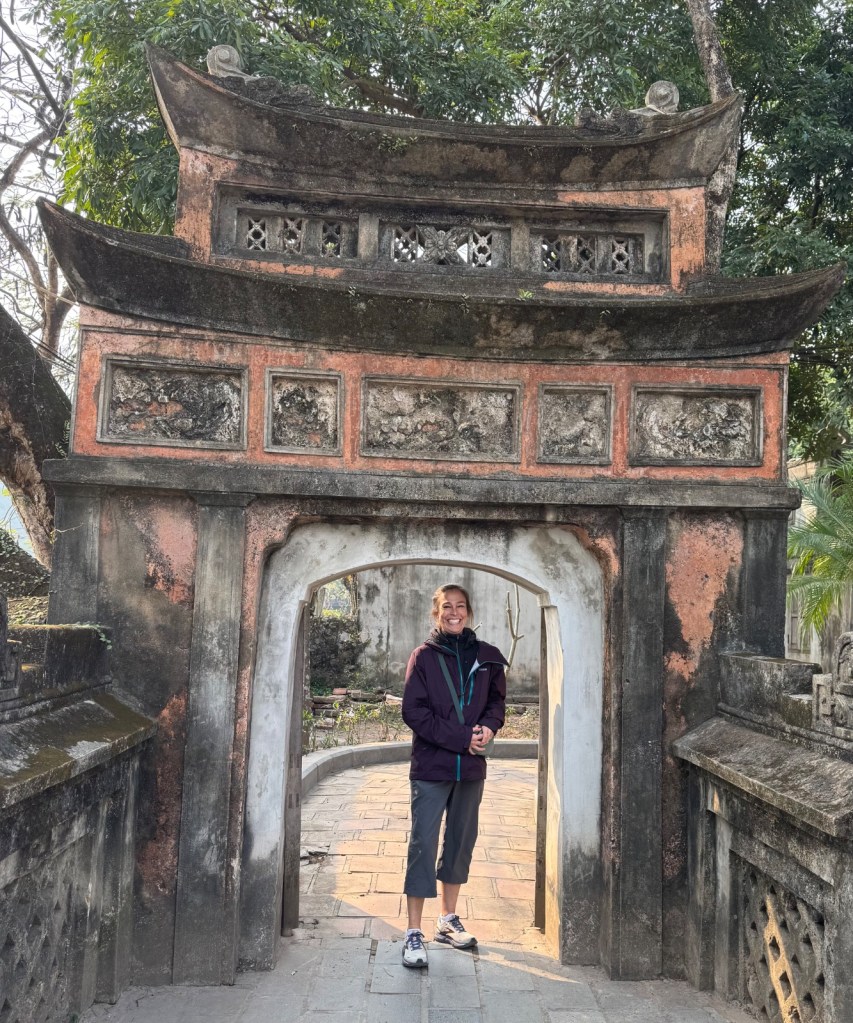
We were wondering what others in the south would say about him, “Uncle Ho”? Or with families who were with the republic, would it be different? The narrative was consistent with both our guide’s stories and the written pieces around the compound of a beloved leader. Ho Chi Minh was a man who kept things simple and walked rough paths with bare feet so that he could walk with the people in the south when he went to visit. He was a reader with books next to his desk and photos of Marx and Lenin above his bookshelf. And completely committed to his people and their well being. 

Maybe he didn’t know what the Viet Cong were doing to their fellow Vietnamese? Of course, it went both ways, but knowing how the South in the US still thinks about the “War Between the States”, I’m guessing it’s not quite so consistent a story line throughout the country. But still – it was fascinating.

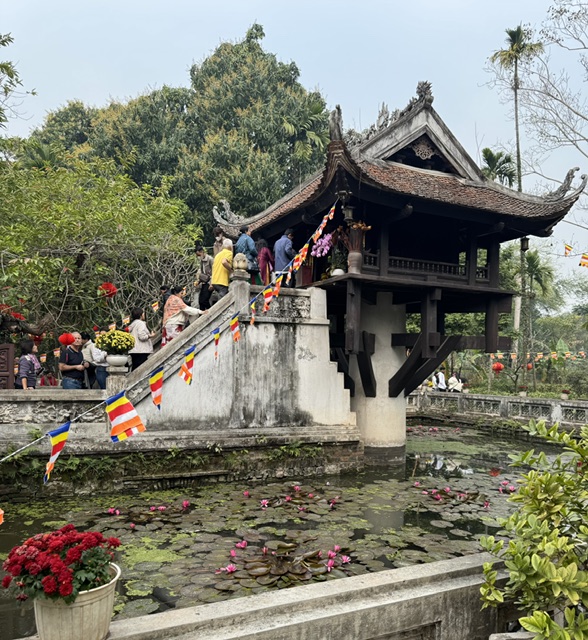
We saw the One Pillar Pagoda, also in the compound. This is a Buddhist temple built in 1049 in the shape of a lotus blossom and set on a single stone pillar, considered by many to be one of Vietnam’s most iconic pagodas. 

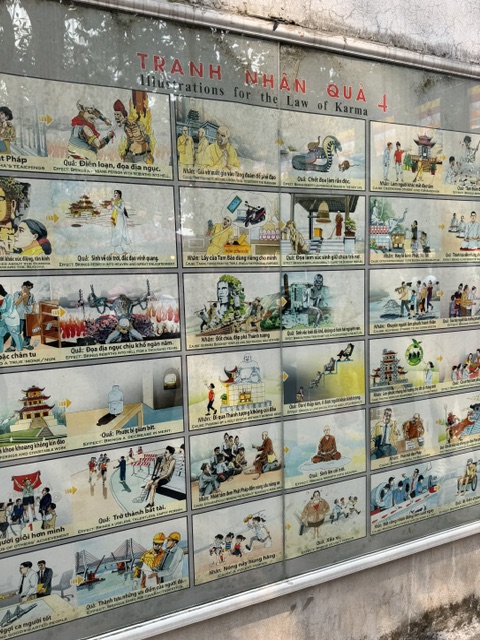
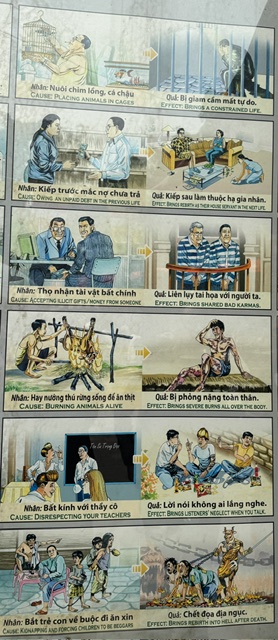
On the surrounding walls of the plaza were murals of Illustrations for the Law of Karma. Lessons on every one. Kellie and I couldn’t get enough of them. I just kept photoing and cropping to be able to read them.

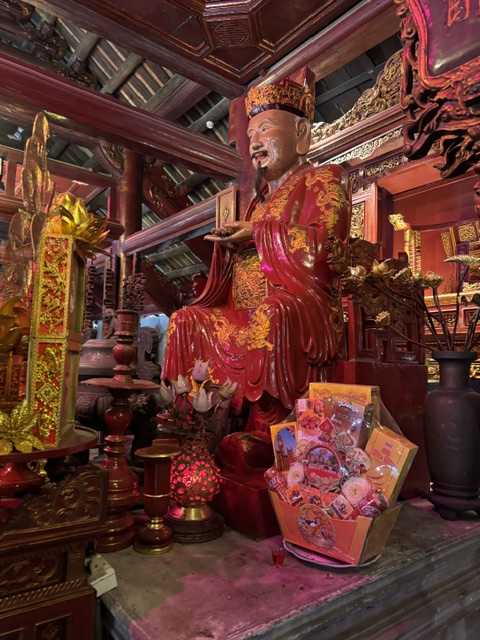
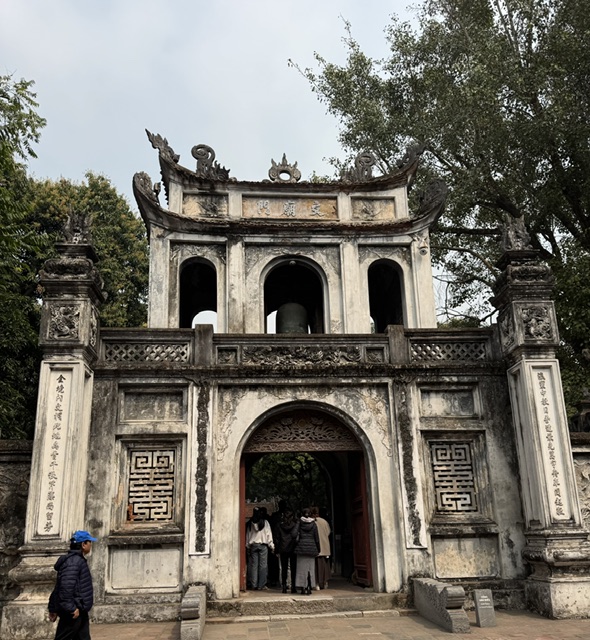
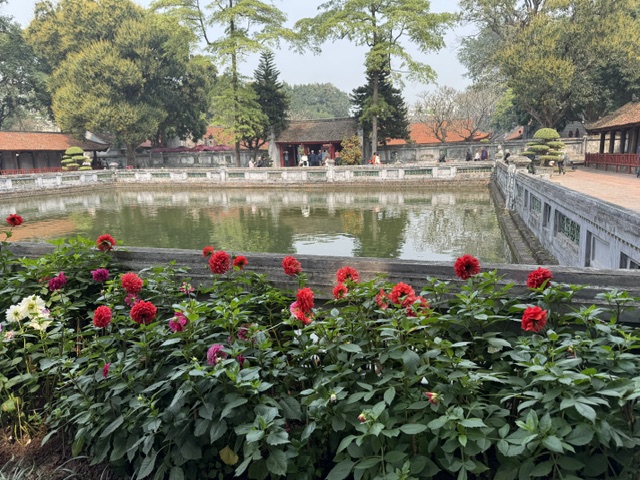
Then we saw the Temple of Literature. This was great. Founded in 1070 by Emperor Le Thanh Tong, this complex is dedicated to the Qufu-born philosopher Confucius (Khong Tu) and was the site of Vietnam’s first university, Quoc Tu Giam (1076). The altars are still popular with students praying for good grades. In 1253 the university was expanded to admit excellent students from common families, becoming a leading educational center and a place to select talented individuals for the country. 

Confucius:

The analogy for the scholars was a fish becoming a dragon – the ultimate symbol in Vietnam. The fish were swimming around and a few exceptional ones were plucked out, they were then  on their way and with each accomplishment shifted little by little until they completed their imperial exam and became like a dragon. 

The classrooms, library, and dorms had been rebuilt to resemble the architecture at the time and were beautiful. This school continued from the late 11th century to 1779 when the last exam was given. Over these 100’s of years, exams were only given 116 times, with 1,032 people graduating.

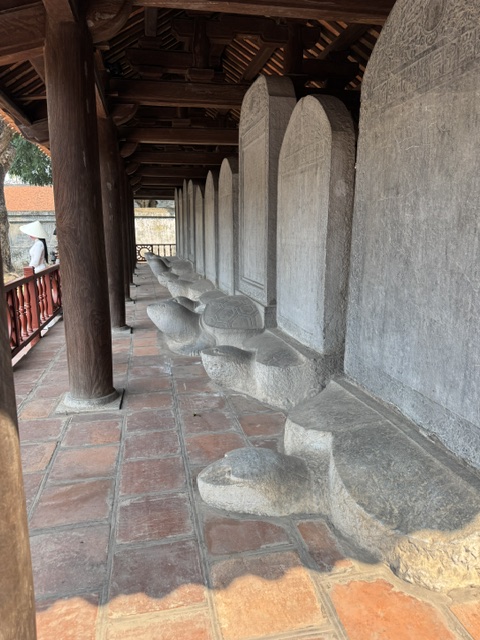
Each time an exam was given, a turtle was carved and a panel erected above it. There are 82 of these carvings left. The graduates were all then launched into careers supporting the king and other areas of government. Their name was enscribed on the panel. However, if they were not illustrative or successful, their names were then erased. 

Our final stop after a quick lunch was the Hanoi Hilton, named by the American POW’s, all of whom were titled pilots by the Vietnamese regardless of their role in the war. This was grim, of course, because it was first built by the French to punish political prisoners and criminals. The political prisoners were treated much more harshly. It was then used by the Viet Cong for their prisoners. I don’t know what the reality was for the Americans imprisoned there, but there were photos of them having Christmas, playing games, reading letters from home, etc. Of course, this is Hanoi and they were looking for American visitors. 

And now, we’re flying to Hue, the imperial capital of the Nguyen Lords from the 17th to the 19th centuries. 

We stayed in yet another totally cool and old hotel, had dinner, went to bed. Notice I don’t say to sleep. Jet lag is a strong companion, but it’s all so interesting that we make it right through the day.

Vietnam, 10.Feb.2025, Monday

Today, we all relished breakfast again, such good food. Pat and Scott asked the server about the Vietnamese coffee that is a traditional drink. It’s very very slowly pressed strong coffee with condensed milk and poured over ice. They decided to try the coffee. They both loved it, thought it was a great addition to the coffee repertoire. Even Scott who doesn’t normally drink caffeine. Pat began slightly hallucinating because it was so strong and on top of the coffee he’d already drunk, the caffeine load was big. He and Scott then jittered their way out of the restaurant 🙂

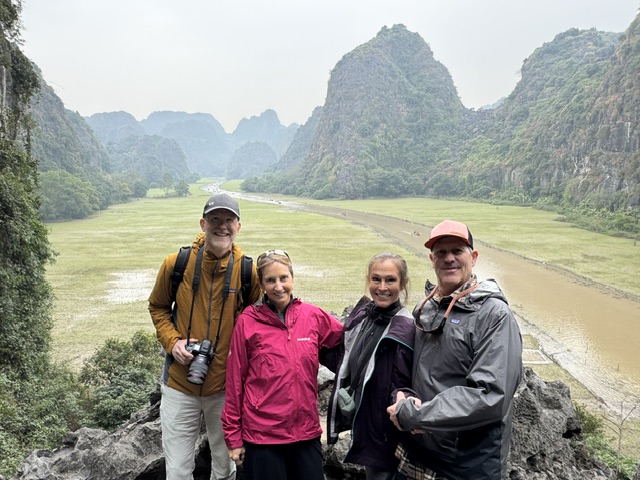
Today, we’re driving out to the Tràng An. A scenic area near Hoa Lú which is renowned for its boat cave tours and historic temples. On 23 June 2014, at the 38th session of the World Heritage Committee in Daha, the Trang An Scenic Landscape Complex was inscribed as a UNESCO World Heritage Site. 

Honestly, it was a bit odd. It’s a two hour drive, we’ve been driving almost two hours now (I’m writing in the van) and it’s been a continual city spread, occasional rice patties, but mostly just a series of buildings, with occasional houses in the midst along the road. Reminds me of Houston, where the spread just never ends. The video shows a bit of this. 

The photo here is the “house” of one of the two cement kings. As our guide says, if you have money, you can show off as much as you want. He wanted to build a house that looked like St. Petersburg. And he did!

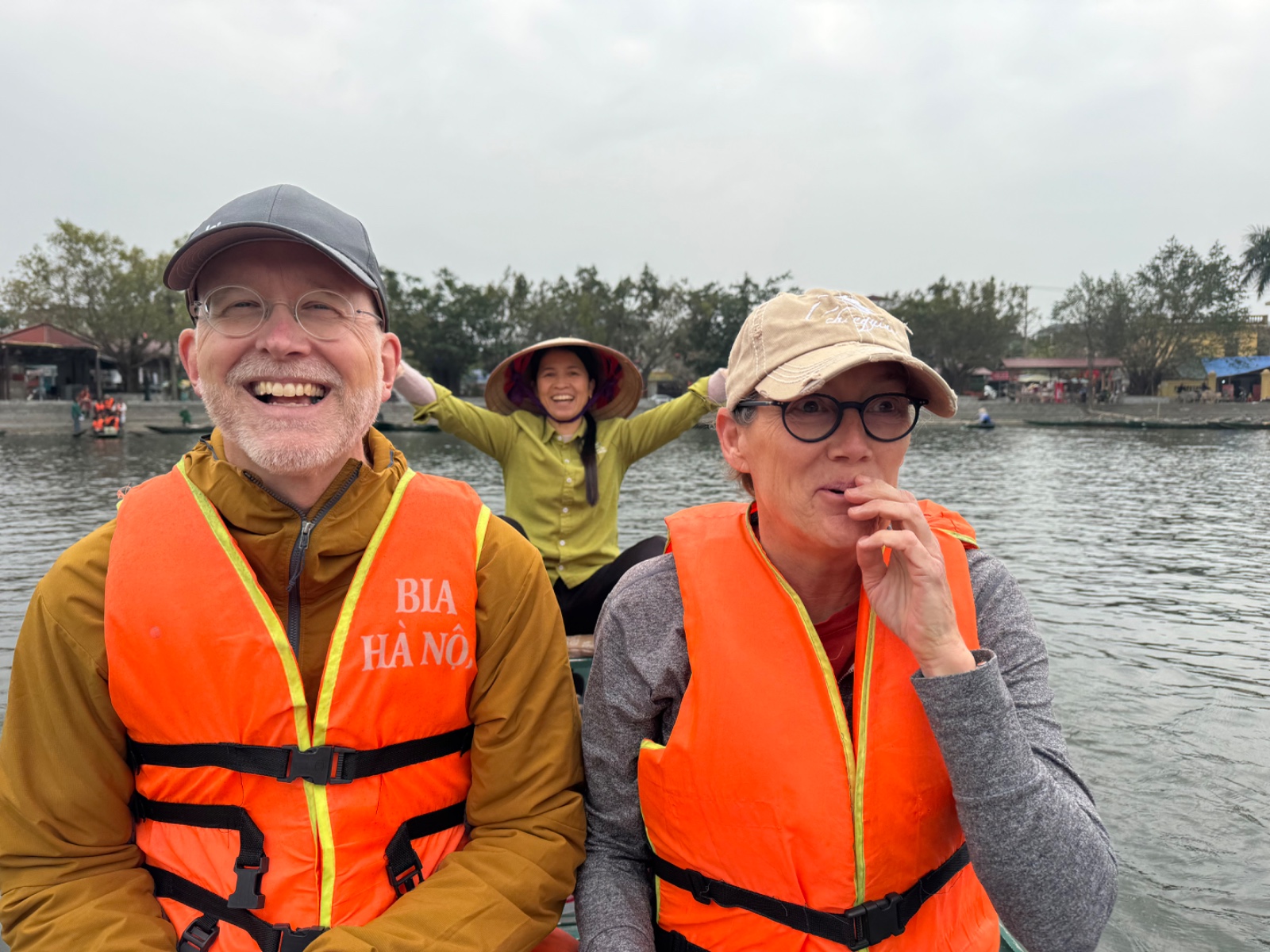
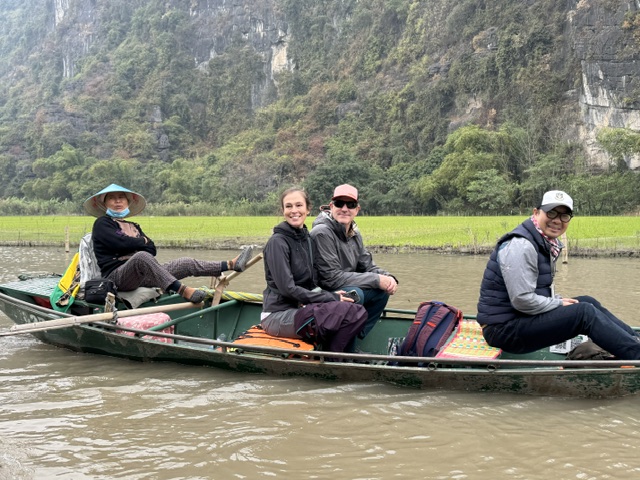
At the end of the drive, we got out and into an open air bus that drove us to a river spot. And we were in Disney. Well, obviously it wasn’t, but it felt like it. We got into boats, 3 into each with a rower; both of our rowers were women. The rowers were small and strong. They started off using hands, then switched to feet to row us for almost 2 hours up a river and then back down. So all these little boats are going along in a row, all visitors wearing bright orange life vests. 

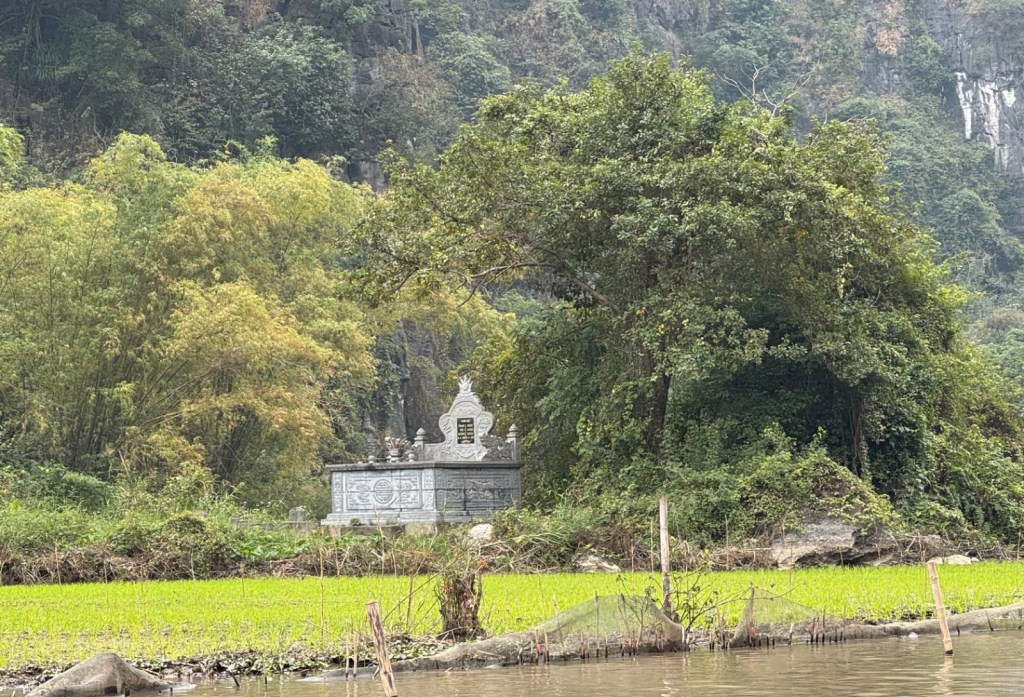
It was pretty rowing along the rice patties surrounded by the karst peaks. There were occasional cemetery spots or just a cemetery stone. The practice for cemeteries in this area is when someone dies, they are buried. After 5 years, the family lifts the body out of the grave, cleans the bones, then they put it back in with the rest of the family. The vaults along the rivers are recent and carved out of cement. Later they will be painted. Some of the cemeteries we passed were beautiful with the carvings and paintings.

After almost 2 hours, we left the boats, thanking our guides, and walked along a path that passed an ancient small temple carved into the mountain. My photo translation of the stone said “The Tran Dynasty brought spring to the country after thousands of years of Chinese domination.” Thai Vi Lunh Tu was the leader of this dynasty who consolidated Vietnam and the various fighting factions to defeat the Chinese. 

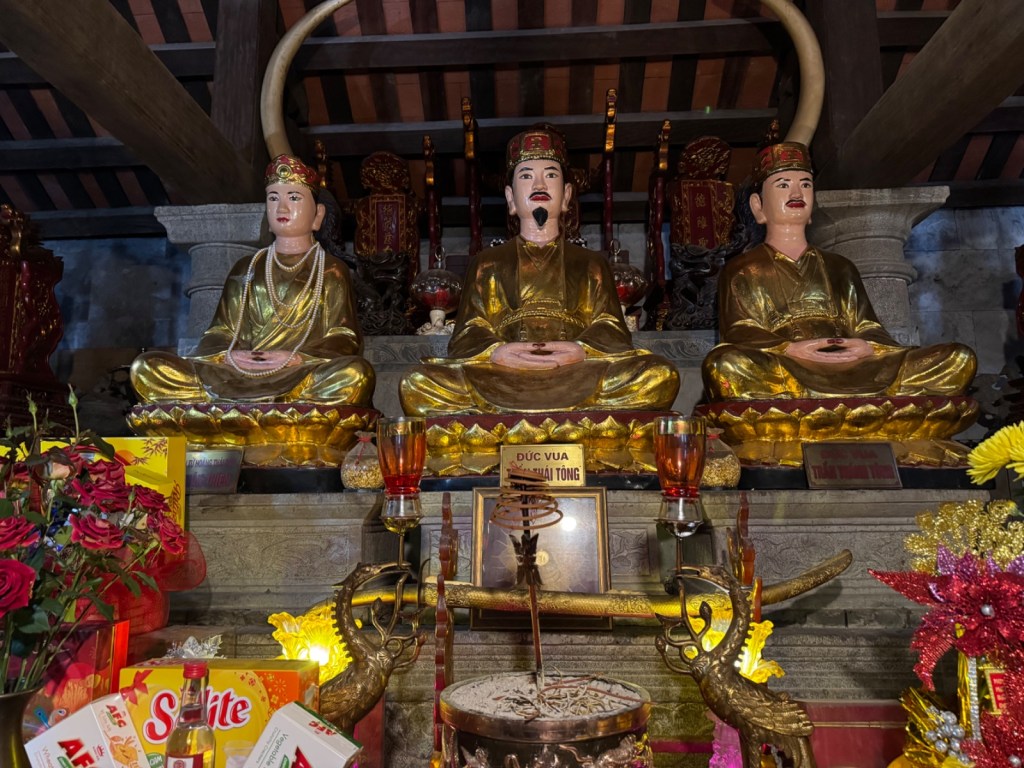
This cave temple was “The sacred place of worship of the Tran dynasty, established by the Supreme Emperor Tran Thai Tong, the first King of the Tran Dynasty to leave home and become a monk in 1273.”  The final note on the stone was clearly a more recent note recognizing history. “Since the Dai Viet era, our people have always firmly protected the fatherland, all people as one, chasing the enemy to the north. The Tran Dynasty had great achievements in the three resistance wars against the Yuan-Mongol army. Generations of Vietnamese people have always worshiped the Tran Kings as the sun that appears daily from the east, radiating a radiant halo for the nation.”

Turns out that where we were going next after lunch was the 18th century recreation of the temples recognizing these original emperors. 

Our guide told us that a temple honors kings/emperors and a pagoda is a place of worship and there were both in this site we were visiting.

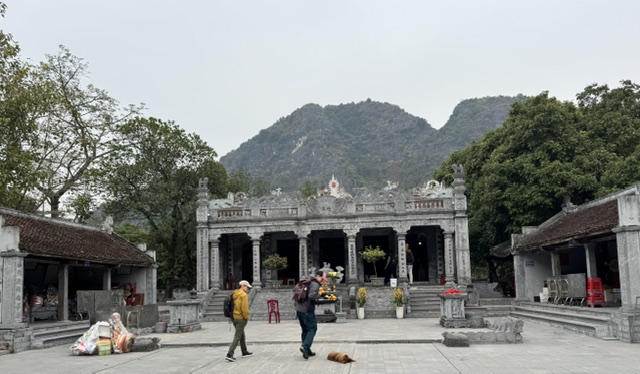
But before that site, we went to a temple with some notes (transcribed) about the history: Thai VI Temple. Saving the country is a great achievement, the old temple is a 1000 years old, the Northern land is famous. May the people be blessed with endless blessings. Ancient temple, a building that the South can admire.

And no, it’s not a dead dog, just sleeping hard.

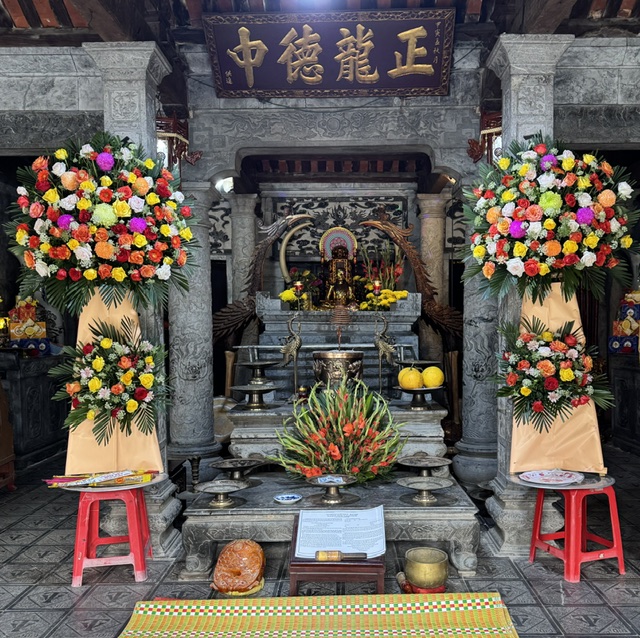
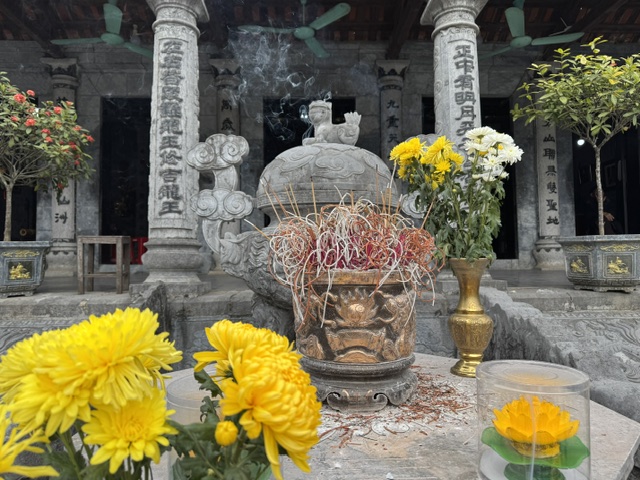
Incredible incense container behind the yellow flowers.

As we were leaving haunting music started, instantly transporting us back many years.

Then we saw the musician. I could have stayed there a long time. He told us that he was the last who could play the instrument and that no one wanted to learn.

 And now to the main destination. Lu is the site of a 10th-century capital of an ancient Vietnamese Kingdom called Dai Co Viet. This small Kingdom covered an area of only 300 hectares, and reigned from the 10th century, during the Dinh and Le dynasties to the 11th century, during the Ly Dynasty. In 968, King Dinh Bo Linh of Dai Co Viet (an ancient name of Vietnam) constructed his capital in Hoa Lu and ruled until 980. This first king fought off the Chinese and brought all the Vietnamese groups together. Hoa Lu endured for almost 31 years through the Le dynasty (980-1009) and the Ly dynasty (1009–1010). This latter dynasty cemented power and built gorgeous buildings (all now long gone). 

Banner welcoming us says: Celebrate the 1057th Anniversary of the Dai Co Viet State (968-2025)

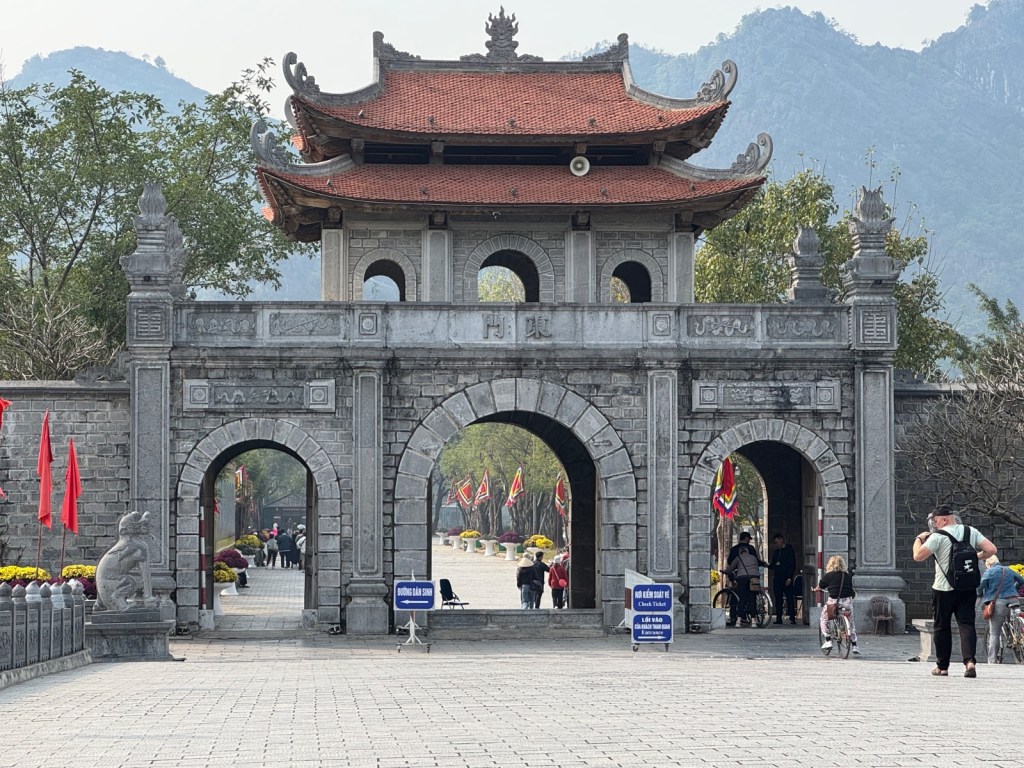
Entrance gate. 

The first emperor, statue in Hanoi.

River surrounds a lot of the site. 

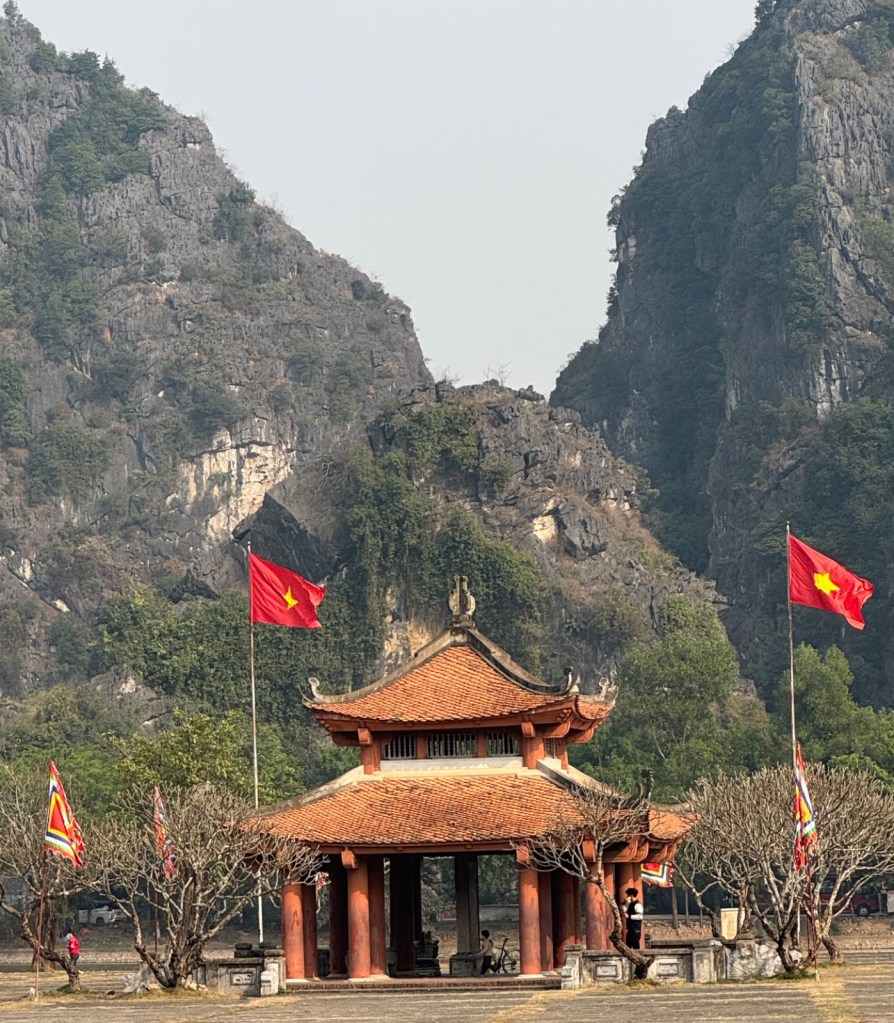
It was hard to get photos of the full buildings, ornate, with sculptures and incense burners in front. This was the first small temple we saw:

A marker next to a temple  had these words (per my Photo Translate and shortened a bit): This was the first ancestor of the Dam Huy Hoan family. More than 2000 years ago…he was an intelligent, upright and brave person and he had many descendants. In the family genealogy, there is a passage that says: The Dam family had scholars who passed the imperial examinations (more about this later) . In the family, there was a daughter who worked as an oil painter. Because she was from a noble family, she was intelligent and virtuous, complete in both her ability and her behavior. And it continued on through her son who revered her. Nice to see a woman so noted. Not a lot of that here. 

Except for these two women, mentioned several times over our days: Two of the country’s most revered heroes are the Trung sisters, Trac and Nhi, who led an insurrection against China in A.D. 40 and liberated Vietnam. One of their commanders, Phung Thi Chinh, is said to have given birth during the battle and to have continued fighting with her infant strapped to her back.

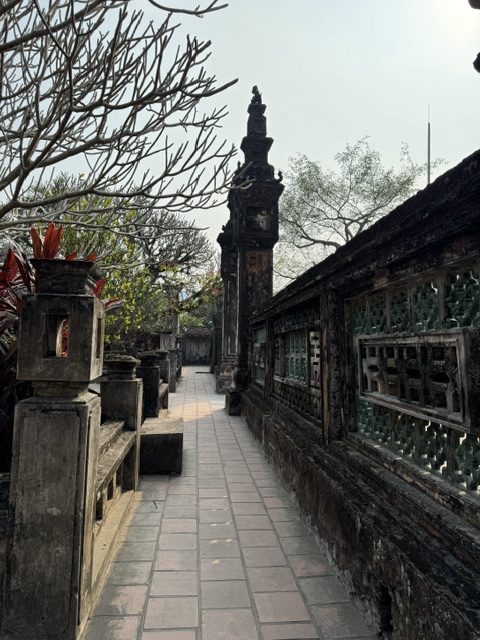
A few scenes that definitely miss the intricacy of the palaces and temples:

The Vietnamese knew where the palaces were, and the early history of Vietnam’s first emperors. The Nguyen dynasties rebuilt on the original site temples in their own style in the 17th and 18th centuries to celebrate Vietnam’s history. It wasn’t until the late 1990’s and early 2000’s that they uncovered the original palaces, finding columns, coins, pottery, etc. Amazing 1000 year old pieces. 

That night we were all feeling jet lagged and had dinner at the hotel and all went to bed. 

Vietnam, 9.Feb.2025, Sunday

I’m off on a trip to Vietnam, Cambodia and then continuing on to see Singapore on my way to visit my sister Summer in Brisbane, so a big trip. So cool. I’m with friends, Scott, Kellie, Pat and Holly and Rick was a critical element of the group and he’s not here. Rick’s beloved (by all the White clan) Aunt Audreé died the weekend before we left and he couldn’t miss the funeral. So we left without him, not easy for any of us. Hardest on Rick of course, but he rallied and had some of his own adventures while I was gone.

Normally, part of what I love doing in these blog posts is talking about the history, but oh man, the history of Vietnam is incredibly complicated. I keep trying to put it together, but it will stay a challenge throughout our trip. Between dates, colonization, wars with China, France and America, monarchies, independence at different times, etc. hard to synthesize. 

Our first day we took time to recover from the flights. The flights were so easy, connected, but oy, they’re long. When I was trying to figure out how to attend the funeral, we were able to set up flights coming back and returning without losing too much time off the trip, but then Rick did the calculation of travel versus time in country and it didn’t remotely make sense. He’s done so many Asian trips because of work that he knew what he was talking about. I was in serious fantasy land with my hopes to come back. Now I know. This is a far far distance away. 
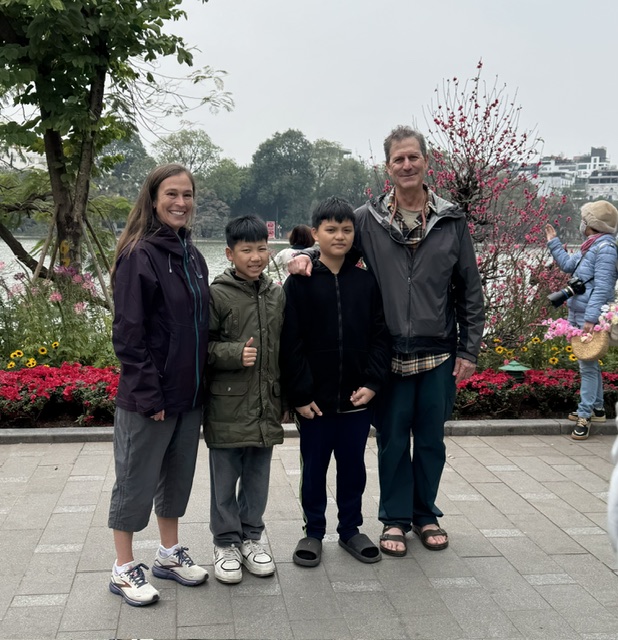
We started in Hanoi. In the 11th century the King moved the capital here and called it  Tung Lao – ascending dragon – because of a cloud formation that he saw. Now the city is called Hanoi which means inside the river, renamed in the early 19th century. There used to be regular flooding with houses built on one side of the river to try to hold back the river from the rest of the city. Now hydro electric plants control the river so it no longer floods the city.

Sunday was a day off to explore, walk, see Hanoi and try for a nap. There’s a lake in central Hanoi that is walking distance from the hotel (Sofitel, built in 1901, oldest elevator in Hanoi, a very beautiful old building) and Pat, Holly and I went to see. Groups of middle-aged (mostly) women were doing these exercise routines to music all around the lake.

In addition there were moms with kids who would ask “do you have time?” Then the kids would ask questions from their papers – learning to speak English. So we had some delightful interactions with the kids – Pat and Holly were a hoot, they couldn’t resist any of the kids!

Pat and Holly also got caught by shoe cleaners. Pat thought the guy who told him he could repair a tear on his green suede Birkenstocks was great. Then before the end, his cool Birkenstocks had been turned into dark brown, no longer suede and the guy told him $20 American wasn’t enough and told him where to go to find a bank. Funny. 

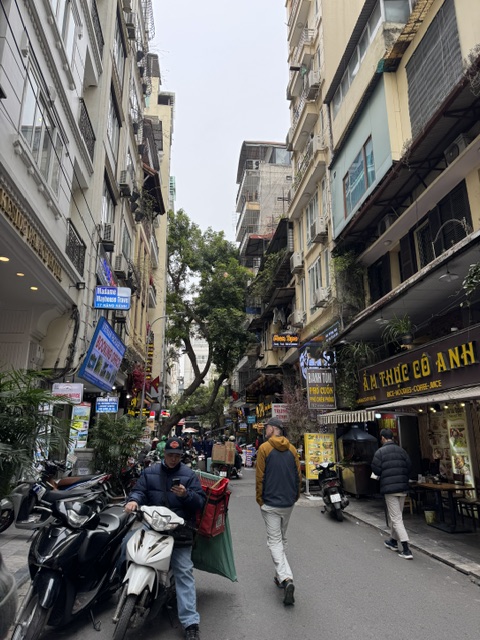
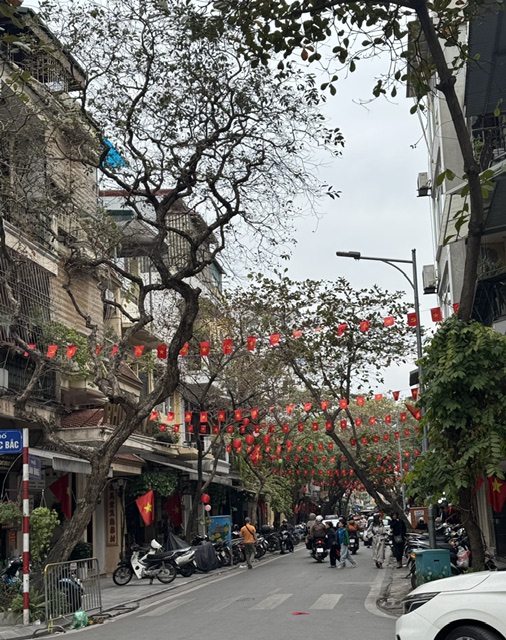
Scott and Kellie then joined after a late breakfast and we walked again, this time exploring the old city. Scott never seems to lose his way and he steadily led us on and around without ever referring to his phone. Amazing. We wound onto smaller roads, 100s of scooters lined up on the sidewalks so we walked the streets along with the cars, scooters, people, tourists, people cooking street food on the sidewalks and somehow it worked. You really can walk around Hanoi – at least the part where we were. 

It was pretty clean, regular small piles of trash collected at the curb and then picked up. And though it’s grey, crowded and busy, the plants and trees that somehow survive add to the walkability of the city. 

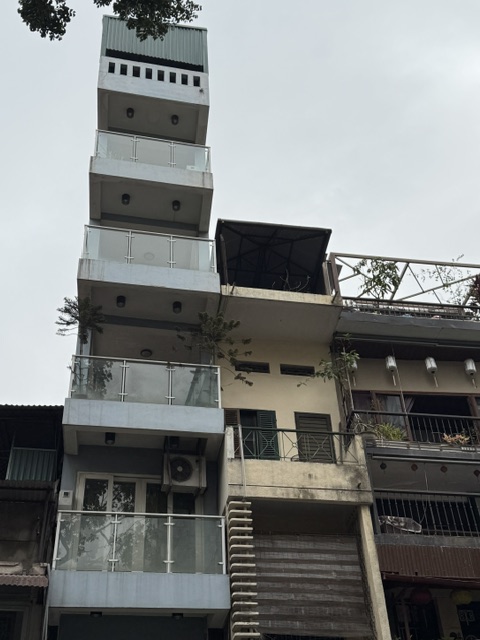
We were fascinated by the very thin and tall buildings. Some were left from the French colonial times and were beautiful, even if it’s just the facade that’s holding up. They were right next  to houses that were a wonder they were still standing. Our guide we had later for a walking food tour told us that each generation’s family keeps adding up, with the senior family member having the first floor.

Traditionally, the business was/is at the front of the building, the middle of the building committed to the manufacturing of whatever is sold and then living at the back. There were slim little alleys leading to each section and access. Our guide stopped at one point and pointed to the electrical boxes, one per family. There were 17 in one alley and you just had to guess how the configuration worked since it wasn’t at all obvious how 17 families were in that building.

Our last stop before walking back was the “train street”.  Scott knew about it and led us to an entrance, but a woman stopped us and just talked a lot about coffee. Confusing and she wasn’t letting us go up to see the train street. So we went to the left to find our way around. We found a way and then I understood the term “train street”.  The only way to be on the street when the train came through (5/day) was by being IN the buildings, looking out, or on the curb fronting the buildings. Our timing was amazing because we got front row seats in a cafe, ordered fries, cokes, smoothies and then a group came along and we heard the guide say the train was coming in 10 minutes. And it did! People were blowing whistles and waving oblivious tourists back – “you’ll die if you don’t move off the street” – and then we waited with cameras in hand (of course). Crazy. I have the video below. 

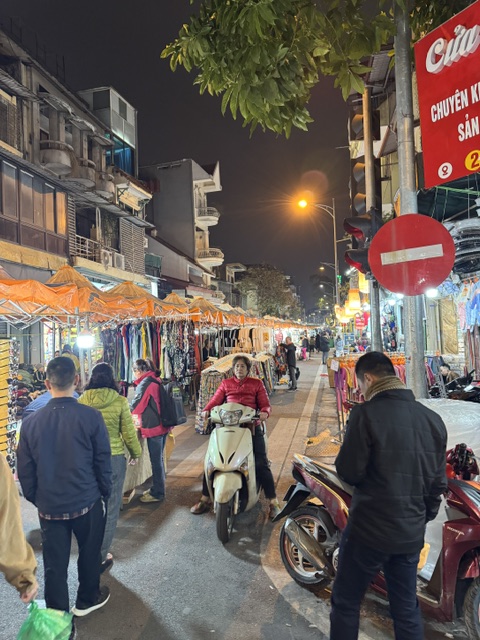
We went back to the hotel for some down time and then met our guide, Hi, for a walking food tour. We had pretty high expectations since a lot of us had done different food tours in other countries that were amazing. The next morning, Kellie said the good thing about this food tour is that none of us got food poisoning. So  – fun to see the lights and all the people out eating on tiny little stools and chairs and tables and to hear some of the stories, but it wasn’t a repeater.

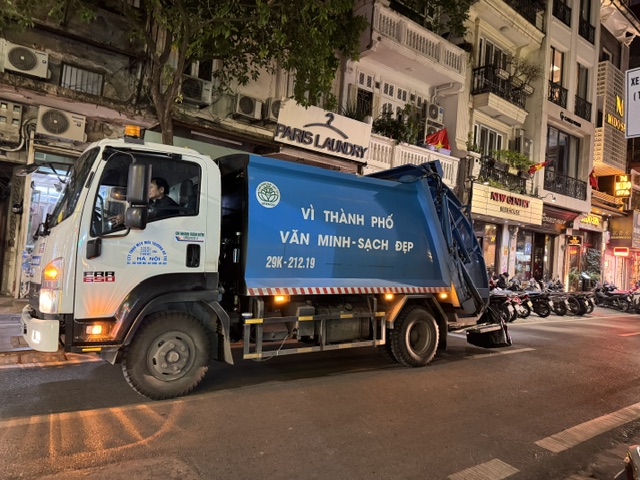
One thing we saw was the trash pick up truck – it was singing a song that evidently beckoned everyone to bring their trash and both home owners and business people were bringing their bags out – small that we saw. 

Brief notes from Hi’s talk during our evening walk re different farm ownership over Vietnam’s history:

When the Kings ruled, the farmer got land for himself and land to support the owner of the land which he worked and thus paid the owner. On his own land he could also earn money for himself and feed his family.

The French ruled Vietnam from 1858–1885 and again from 1887–1954 and supported the land owners. The farmers were taxed so highly that they then gave up. So many farmers moved to working in manufacturing and mining and working for the French in the later 1800’s. 

When Ho Chi Minh wanted to unify the country, he said the farmland belonged to the farmer and the factories belonged to the country. So the farmers were able to plant for themselves, but also had to provide for the troops. Then all the land become a cooperative. All had to work and could only sell their goods to the country which undercut motivation and agricultural productivity tanked.  

In 1989 when the Soviet Union left, inflation was at 300%. Then the north started making changes, giving land back to the families, and initiating a market economy. There was a tax, but farmers could also sell at market prices. Vietnam became the second biggest rice exporter. Now industry is starting to exceed rice exports and gradually more rice land is being converted. 

Right now the average income is 2500 per person. 

The last king was in 1945. 

Here’s a synopsis of more recent history:

In WWII Japan ruled Vietnam. At the end of WWII the Chinese liberated Hanoi from the Japanese, the British liberated Saigon, from the Japanese. The British turned the south over to the French who were here before. Ho Chi Minh declared independence for ALL of Vietnam, saying no to the division and declared war against the French with Chinese support. 100,000’s of Vietnamese died. In 1954 the French retreated. The Geneva convention in 1954 declared a south and north Vietnam, but Ho Chi Minh said no. The Geneva convention set a DMZ around Danang, but it didn’t work. Americans came in 1954 in a low level way to support the Republic in the South and it just escalated further and further through the Vietnam war until Ho Chi Minh won.  

China supported Ho Chi Minh during the Vietnam war, providing military equipment, etc. That involvement escalated after the arrival of US combat troops in 1965. After the Vietnam war, China left, but left their weaponry behind.

In 1979, China invaded Vietnam in response to Vietnam’s invasion of Cambodia, but Vietnam used all of the Chinese weapons left (this was according to one of our guides) and defeated the Chinese in a war that lasted about a month, with China withdrawing its troops in March 1979.

The conflict damaged relations between China and Vietnam, and diplomatic relations were not fully restored until 1991. According to our Hanoi guide, over time the Chinese started flooding Vietnam with tourists. But the tourists were so disrespectful in their behaviors that Vietnam said no. They built a wall in the north and then restricted how many Chinese could visit.