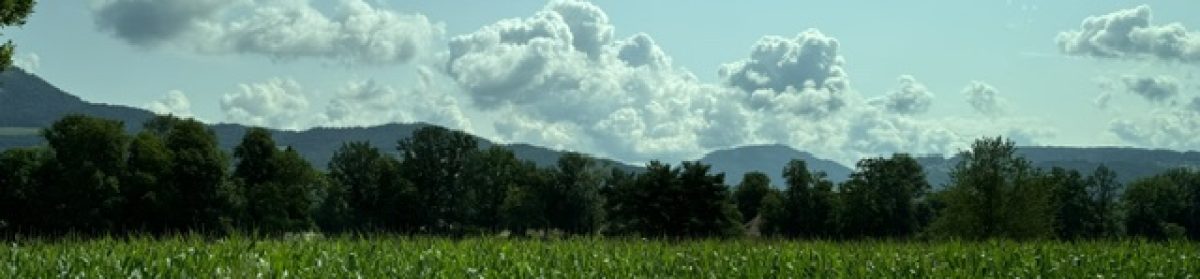
Well, today was a bit challenging. By the end, there were no other pilgrims and my maps weren’t working and I was beginning to wonder if I’d ever get here. Here being a gas station hotel. Hmmm. It was also the first day that I needed more water and didn’t have it. Oops. There were no cute little towns with cafes and that was a surprise because it looked like there were on the map I did have. The towns were there, but nothing open at all. I was walking through another asleep village and saw a farmer hosing down his tractor in a giant garage so I asked if I could have some water and filled up my water bottle. Saved me!
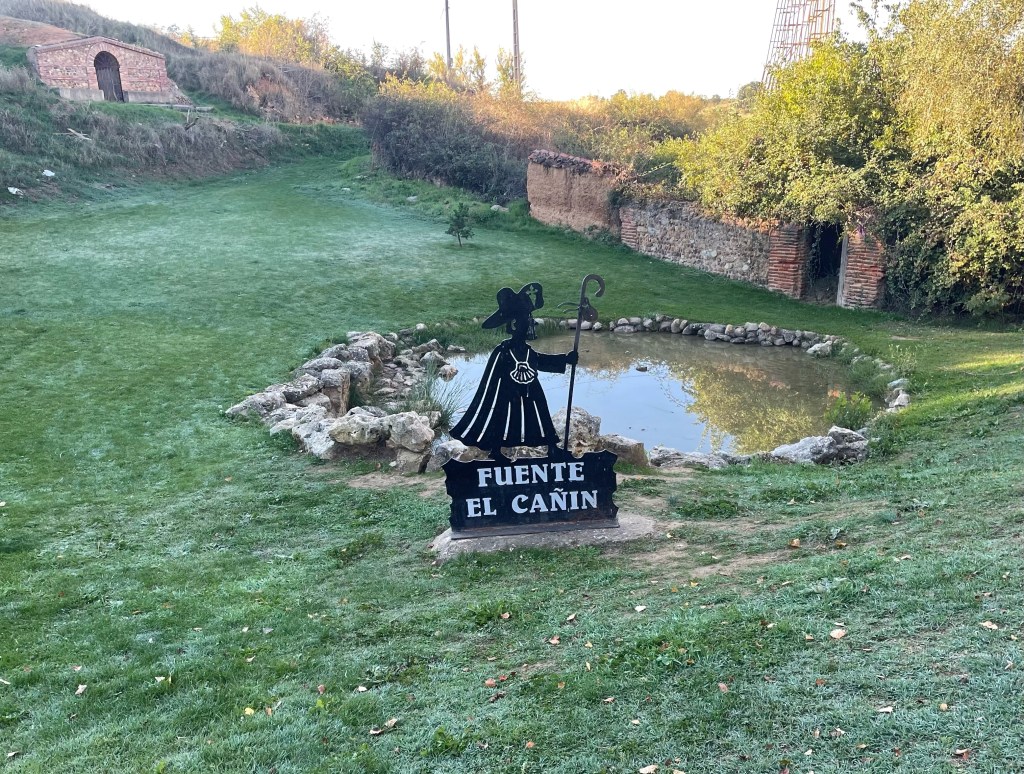
But it was pretty, land changing again, starting to be a bit hilly, just slight, tomorrow the climbs start happening. Happily, tomorrow is only 10 miles. The photo above was a fun pilgrim statue – and that was it for that town. Don’t know where the town was, maybe it’s just a sign of a town.
The town that I’m just outside of had this bridge which was the most significant thing for the town and it was beautiful.
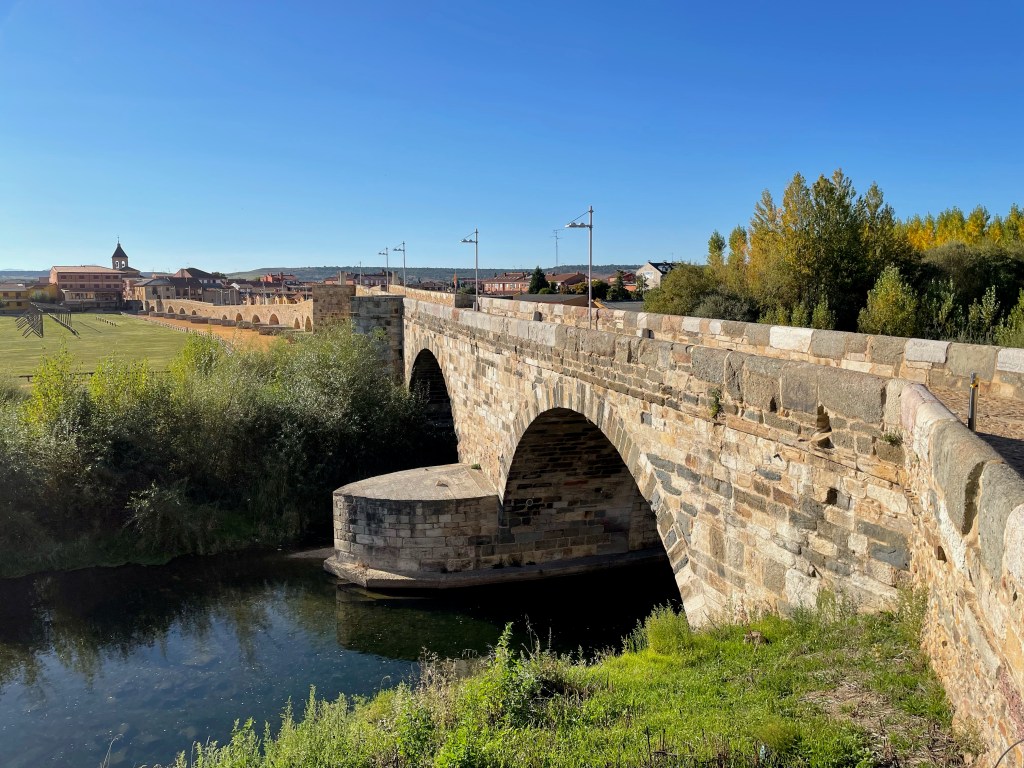
This one had a good story – And this bridge of 19 arches has 4 that are original to 13c and were there for the story!
From The Pilgrimage Road to Santiago:“In 1434 the Leon knight Suero de Quinones held forth on this bridge against all comers in what may have been Europe’s last true medieval tournament. Suero, scorned by his lady, wore an iron collar around his neck as a sign that he considered himself bound to her. When that failed to impress, he resolved to challenge the best lances of Europe to meet him on the Orbigo Bridge. Suero went to King Juan II at Medina del Campo, where he secured the King’s permission. In fact, the King had his herald ride through the kingdom reading out Suero’s 22 conditions of challenge. The word spread like wildfire through a European nobility sated with the messy intricacies of court politics and gruesome dynastic wars and yearning for the simpler world they read about in Amadis de Gaula and their other books of chivalry. That fictitious world was a place in which a single knight, by the force of his personality and sword, could prove the virtue of his cause though the whole world be arrayed against him.
The wooden lists were constructed in what is now the grove alongside the bridge: 146 paces long, with a palisade and spectator galleries. 1434 was a Jacobean Holy Year (like this year, actually) so in addition to the contestants, their retinues, royalty, and the merely curious, the Orbigo road also thronged with pilgrims. Suero had the sculptor Nicolas Frances make him a life-size mannequin, sumptuously dressed like a herald, to set beside the pilgrimage Road with a sign pointing the way to the lists. The jousting began 2 weeks before St. James’s Day, the moment of maximum traffic along the Road (Camino). Colorful battle tents were pitched everywhere; pennants fluttered in the breeze. The air rang with the shouts of squires and the clang of steel as the knights rehearsed for the upcoming contests.
At dawn on July 11, 1434, the longed-for tournament began. Musicians blared out the fanfare, church bells rang, and the assembled knights and their retinues marched to the village church for mass. The jousting went on for several weeks and after each day’s contests the knights banqueted on the river bank. Musicians played and the knights and ladies danced in the flickering torchlight. On July 15 Suero was pitted against a Calatan challenger who, respecting Suero’s reputation, dressed in a double thickness of steel. To mock him, Suero appeared in only light armor covered with a woman’s blouse. The enraged, heavily encumbered Catalan was no match for the prancing Suero until a lucky blow to Suero’s head knocked him from his horse. The crowd gasped. But a moment later, Suero danced up, crying, “It is nothing.” On July 20, Suero and his close companions stood off 9 knights of Gutierrez de Quijada, who had stopped at the tournament on their way to Compostela (Santiago). Gutierrez, his knights beaten, rode off swearing vengeance.
On the last day of the tourney, August 9, a final great procession was held. Suero appeared and proclaimed that since he had proven his fealty to his secret lady by wearing the iron band and by breaking 300 lances at the jousts, he was now free. With that he removed the iron band and presented it to the judges. The crowd roared its approval. From the bridge, Suero led a procession all the way back to Leon (what I did today) where he vowed – now that he was free – to journey to Compostela as a pilgrim. This he did, and when he reached the cathedral, he deposited a jewel encrusted gold bracelet as token of his release from the prison of love. You will see the bracelet in Compostela around the neck of the image of Santiago Alfredo in the cathedral museum.
Footnote: 24 years later, after taking part in many battles in the 15c civil wars, Suero was riding in open countryside when he chanced upon the still-rancorous Gutierrez de Quijada. The 2 men dropped their visors and charged at each other. A moment later, the quixotic Suero de Quinones lay dead.”
Ok – totally fun story, the best I’ve read in the whole book. I’m definitely going to the museum to look for that bracelet and what a fun piece of pageantry to put into my head when I walk back into the little town to continue the Camino tomorrow!
 Reb's Walks!
How are your feet and legs after 20 miles of walking? You are amazing! Keep it up 🥰
Xox
Jill
LikeLike