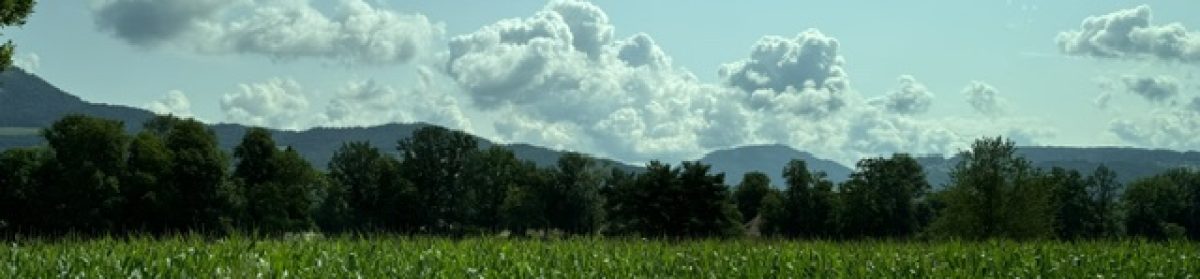
It was supposed to be a little over 12 miles, but we missed (I thought) the fountain and chapel of Saint Irene, so we walked a good bit back to see – realized, oh, I took photos of this, thought it was the church of Saint Vincenzo. Nope. I’ll come back to this.
We started out really early today, at 7:30, pitch black when out of the city lights which was pretty quickly. But we wanted to beat the rain and have quiet in the morning. Which we did and it was completely wonderful. Today was one of those blissful days for me – of which I’ve had an amazing number. I just walked all day. Didn’t listen to anything but the birds, cows, dogs, roosters, my footsteps. Rick and I talked a bit here and there, but mostly walked separately as I dawdled. At first we walked pretty briskly, but then I realized we were striding not strolling and I wanted to stroll. Empty the rocks out of my shoes, find a bush, take photos, have a snack, that sort of thing. So I did!
Rick bought a headlamp in Melide and that made a big difference for the first hour until it started to get light and I slowed down. Our first stop was here for a much needed coffee for Rick:
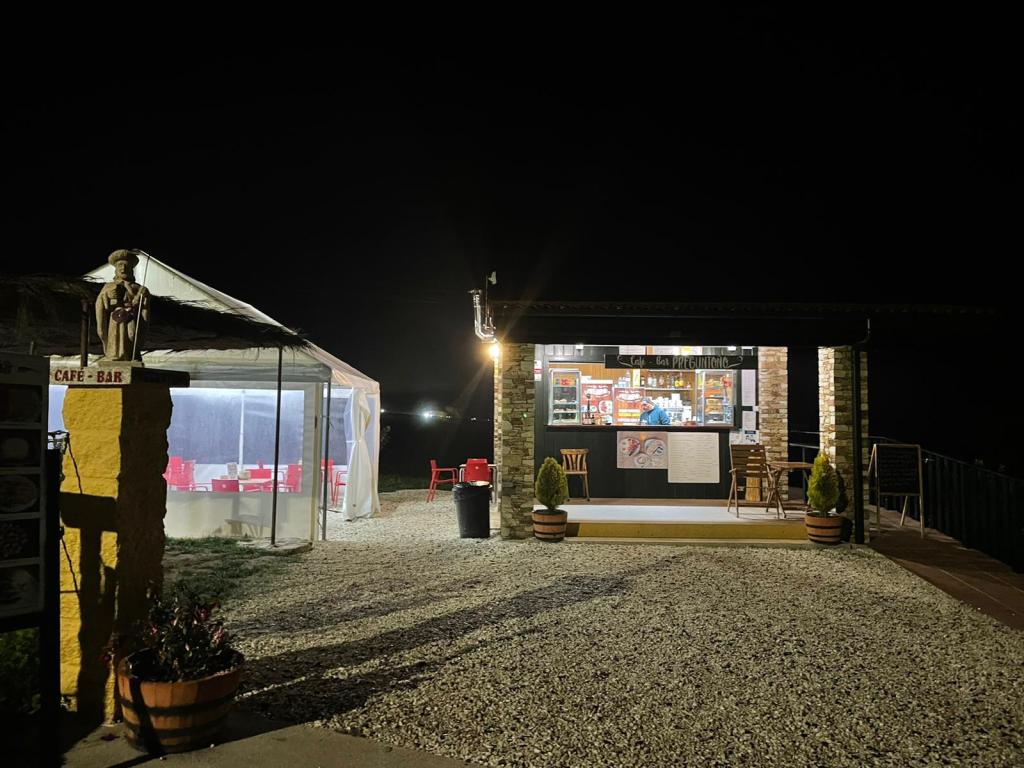
It came as a shining beacon and the place was so cute. We would have eaten, but it was too early, so carried on.
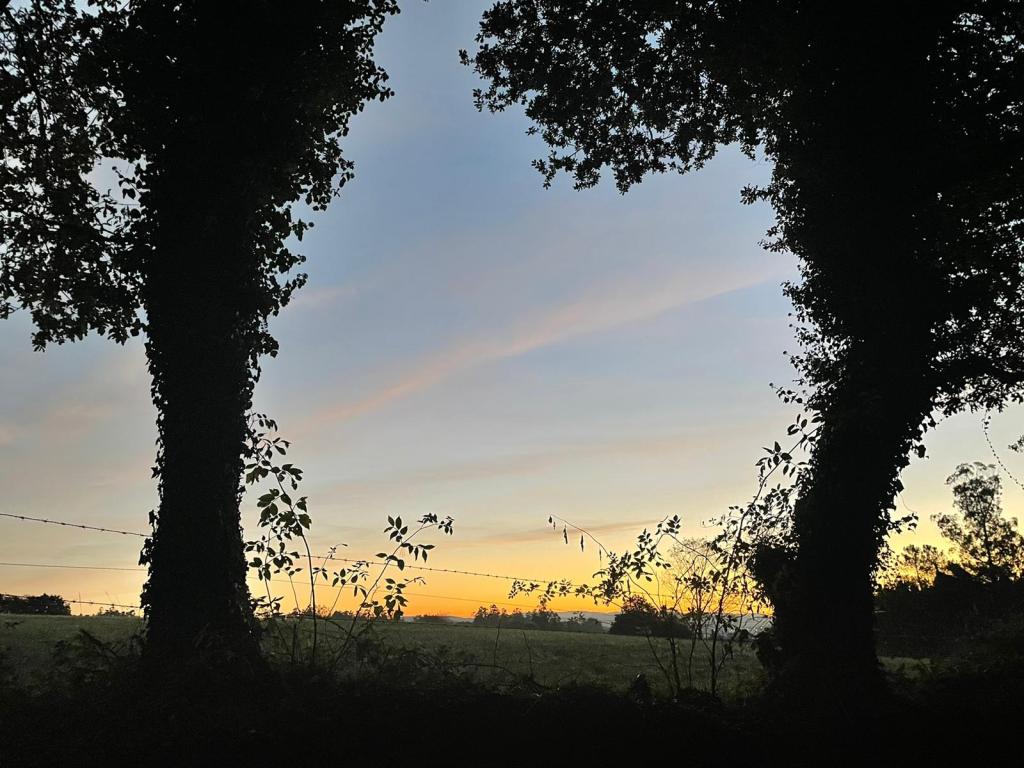
There was a bit of a ditch between me and the barbed wire, so you just have to look past the wire. It was beautiful.
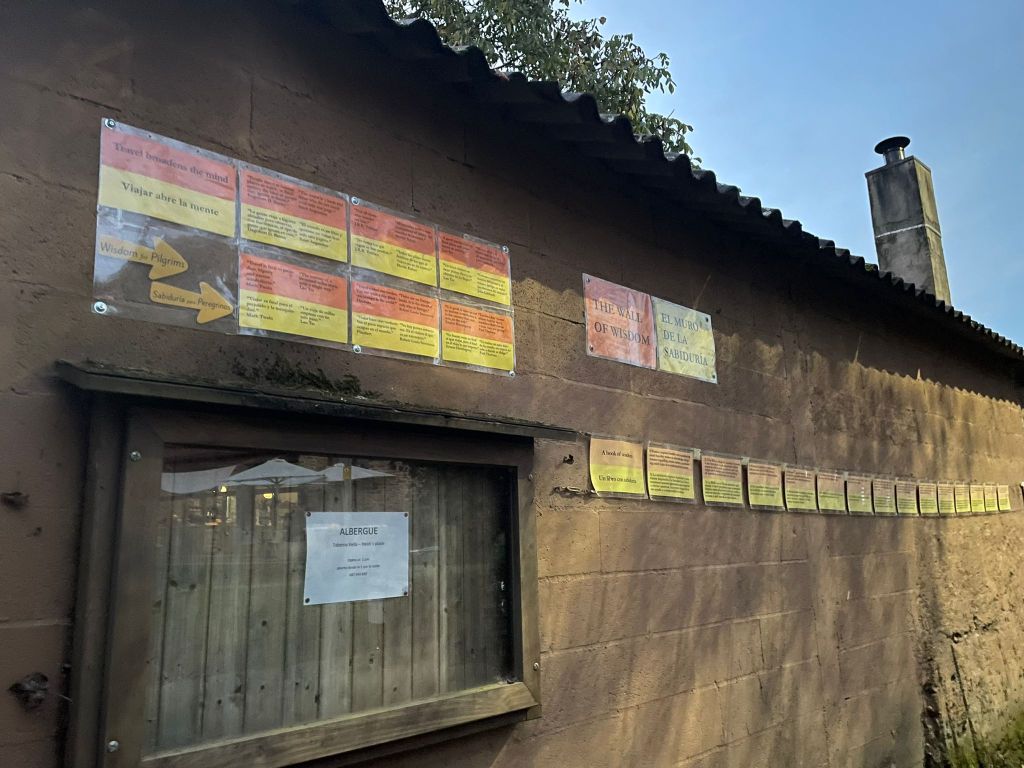
Another potential stop for breakfast, but not open yet. I read everything – it was in English as well as Spanish – but then decided the writer, while expressive, was a bit confused as to what they were trying to advocate. But fun to read their exploration of taking the Bible into current day living.
Then great breakfast. Rick realized yesterday too much gluten was flaring things and I’m A-OK with cutting back on bread. We found a great place that did eggs and ham, fresh orange juice, coffee, hot chocolate. We walked in to quiet and within 10 minutes it was full of pilgrims. The two tables next to us filled up with 8 Spanish guys who ordered food, but first got their beers, bottle of vodka, glass of red wine for one and settled in. It was 10am. They saw my grin looking over and wanted us to join, but I said I wouldn’t be able to walk. They were laughing, no – this helps the digestion! The walking! Join in – they were all raising their glasses. So happy. I stuck with my orange juice, but enjoyed watching and listening to their camaraderie.
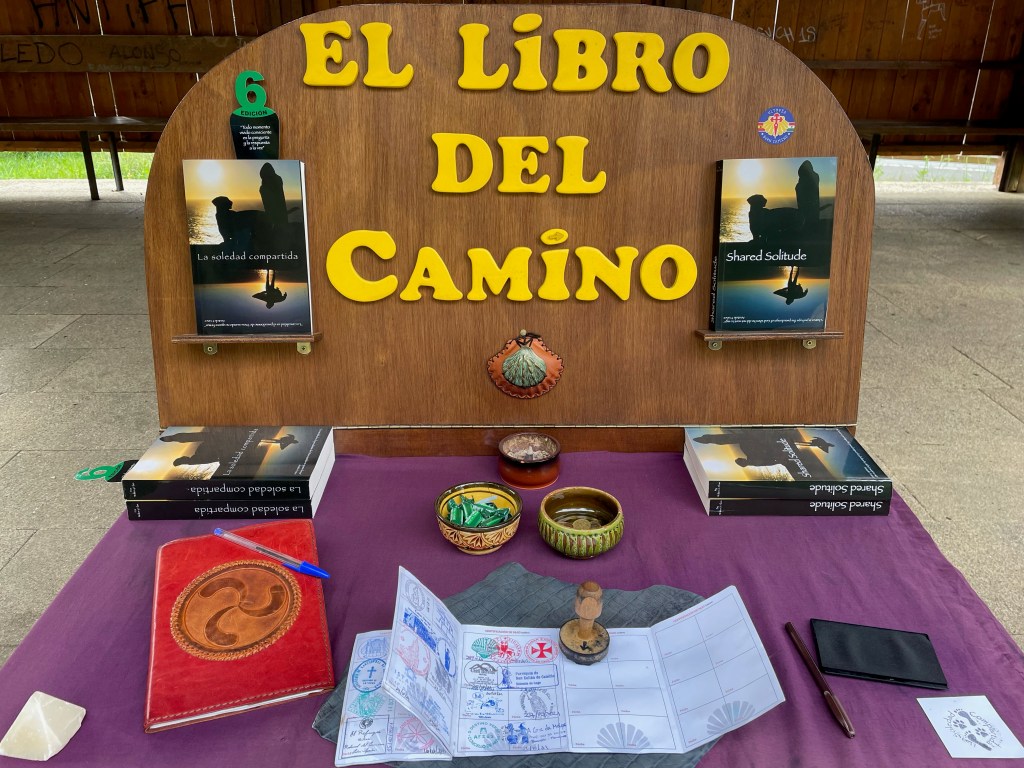
Next stop – had to take this photo and get a stamp. The guy had written a book about the Camino and its spiritual journey, had unpacked his van next to the Camino with a handy rest stop and set up his stella, books, signs and incense. That’s my second Camino passport spread out with the stella ready to go.
And then Irene. Ah, Irene. So – I’d read about the Chapel and Fountain of Irene. Here’s what’s very confusing.
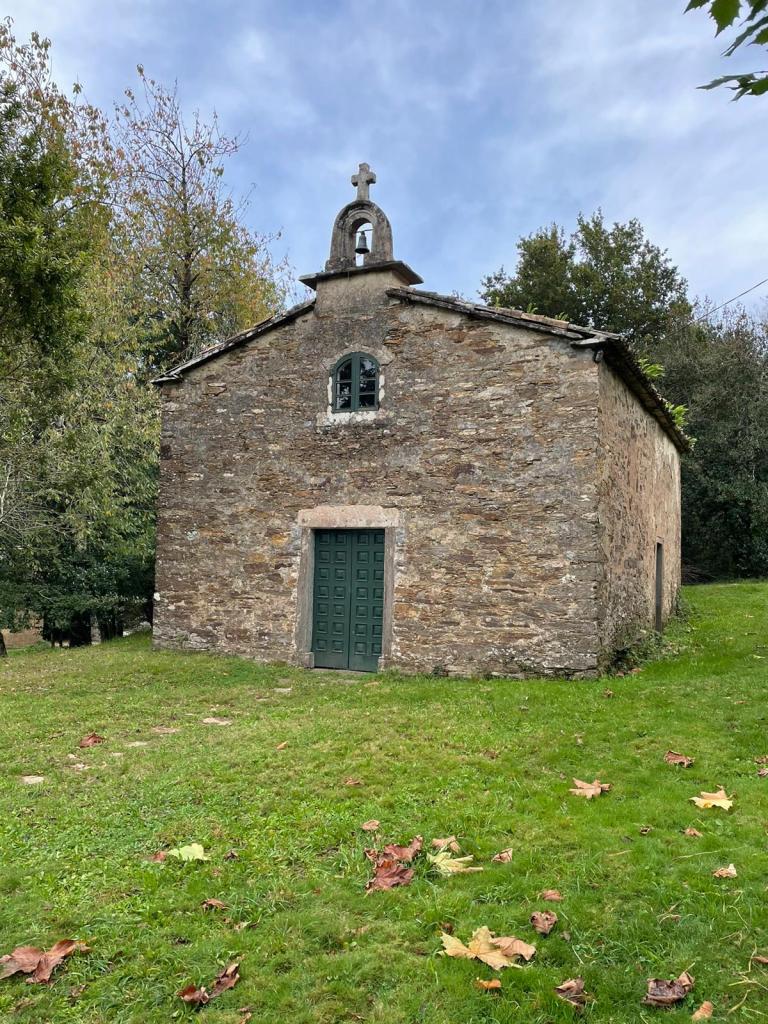
Cute little chapel, built in the 17th c, but while it’s called the Chapel of Saint Irene (well Capella de Sta Irene), it’s actually dedicated to San Pedro. Really? How does that work? And which Saint Irene? From Rome? Died 288 AD, was a Christian woman in the Roman Empire during the reign of Diocletian. OR Saint Irene of Tomar, Portuguese: c. 635-653, a Christian who was martyred for her faith in Visigothic Portugal. Guessing the second. But then where does San Pedro come in? Explored online, but it’s just going to stay a Camino mystery.
Then next to the Chapel is a wonderful old fountain with a history that’s much more clear. You can’t see the actual water fountain here, it’s just to the side.
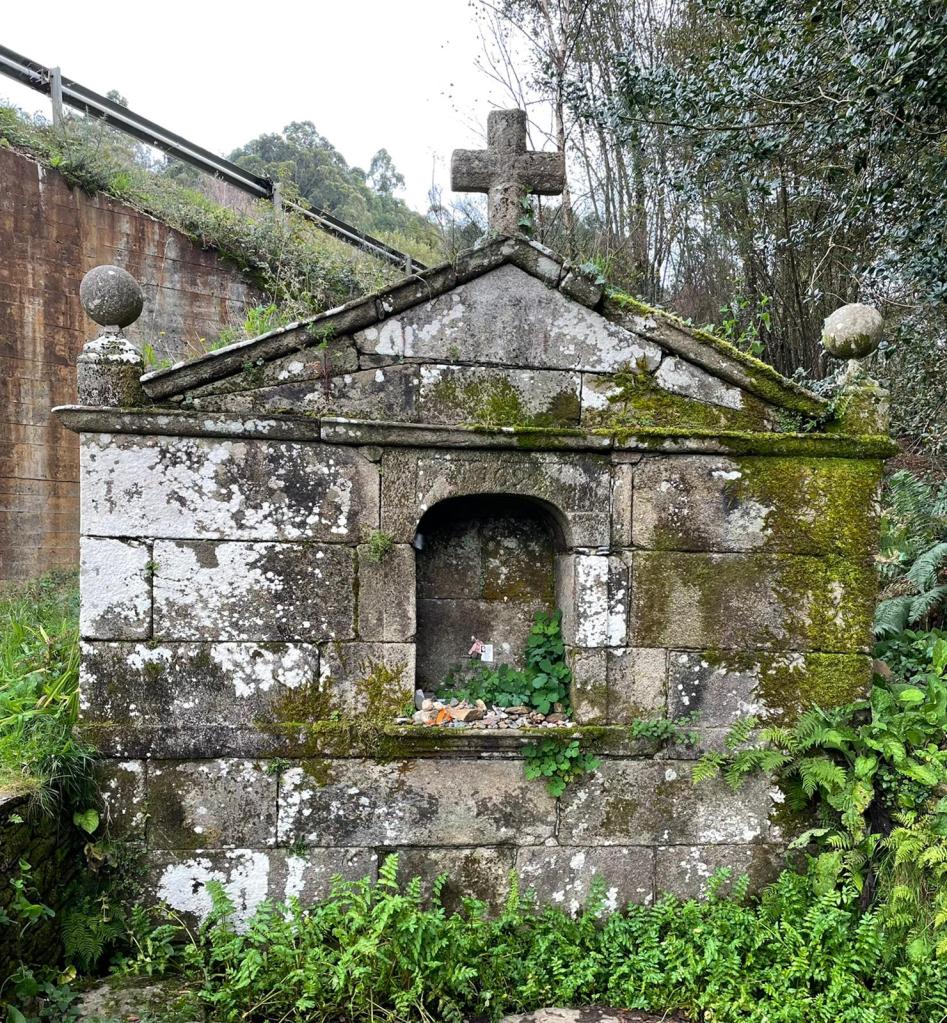
Notes from online: The water emanating from this source is able to kill pests and plagues of crops, so it was used to spray the crops. Also, it is presumed that it cured all the ills of children, who stopped crying when they passed by the image of Saint Irene. Sadly, the image from 1692 was stolen in the 80’s.
It wasn’t the first time stealing happened in this area. In 1808 Napoleon’s troops, on their way to Santiago, entered and robbed in this chapel before going to sleep in the atrium of the parish church of Arca – next town over.
Then, using the Chapel of Saint Irene for location, just after, if you looked south, you could see Pico Sacro:
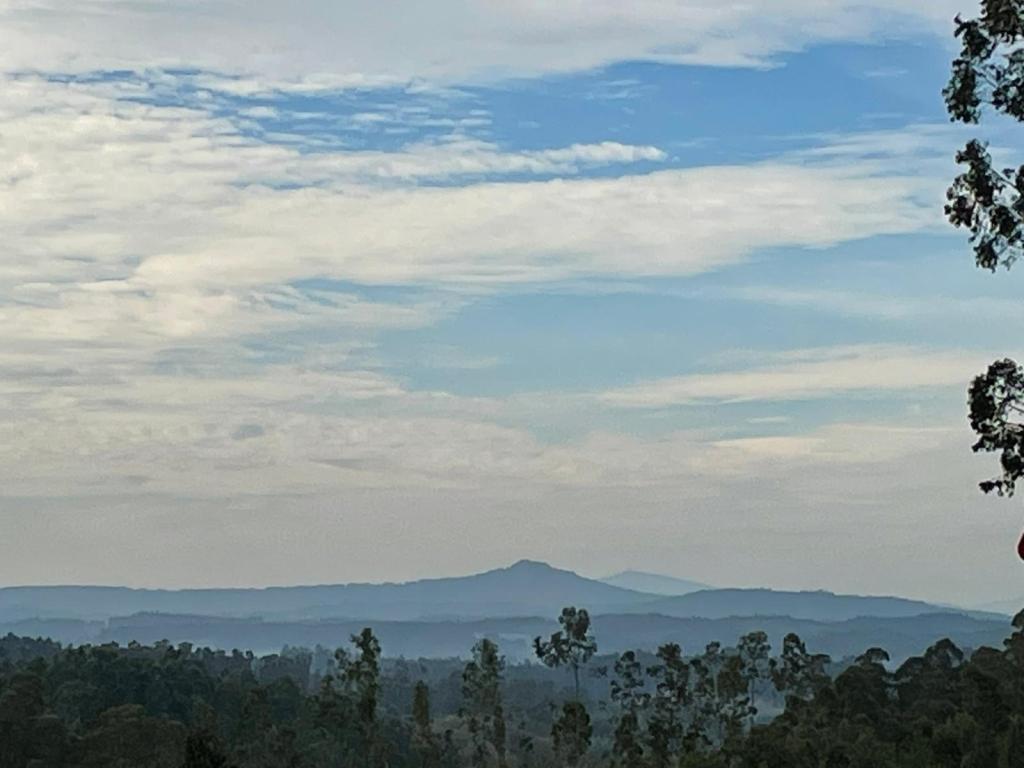
Hazy with incoming weather, but you can see the peak. Here’s the story from the CC Book III (note below) within the Pilgrimage book:
“The martyred St. James’ body was brought to Galicia for burial. The lady Lupa, the region’s ruler, set Santiago’s disciples many trials in order to secure her permission to bury the Saint. The last was to take the body to Mt. Ilicino and to harness to the burial cart the wild oxen they would find there. She neglected to mention the fierce dragons that were terrorizing the mountain’s inhabitants. With faith, and some judicious exorcisms, the disciples banished the dragons, and the ferocious oxen, cowed by the miraculous example, came placidly to the cart. The mountain was renamed Pico Sacro. Centuries later, Christians built a small chapel to Santiago on the mountain.”
I mean, dragons! How could I not want to see the peak?
More than you ever wanted to know – but I’d like to have it as a record, so putting it here. This is one of the main sources referred to repeatedly in The Pilgrimage Road to Santiago by David M. Gitlitz and Linda Kay Davidson that I keep using as my reference guide throughout my trip. I realized I never really explored the Liber Sancti Jacobi. Codex Calixtinus de la Catedral de Santiago de Compostela. It was referred to in the movie The Way by the Irish poet making a passionate argument about Roland (I think).
This is the link if you want to learn more about it – but to summarize. The book was written between 1160 and 1173 by several people, but it was brought about by Calixtus, who become Pope, but before that was a monk and then the Abbott of Cluny. He, the secretary at Cluny, and others were instrumental in getting it written. One of the books of the Codex was a guide for pilgrims. Here’s the site online for a full description – it’s really good!
https://www.omifacsimiles.com/brochures/calix.html
The town where we’re staying is wonderful, a small medieval town with our hotel less ancient and great. Great food, comfortable room and it’s pouring rain out while we’re cozy inside and looking forward to dinner. Plus there’s a little living room like area next to our room and I’m sitting here writing, watching the rain and feeling completely happy.
The thought that popped into my head today was that I would be happy to go home. Not rushing it, but will be happy when it unfolds. It’s a gift when a transition will happen that you’re not dreading or desperate for, but just pleased that it will happen when it does happen. Make sense?
So, this town cleared up a mystery for me. I’ve been so curious about these horreos, the little buildings up high that have been everywhere. I was told that they were for grain. Did I write this already? Anyway, neither Rick nor I had come up with that guess. In the old days, the horreo in the yard indicated someone’s wealth. The size of the farm determined how big someone was allowed to build their horreo. The families stored their grain in the horreo to dry out, stacked on shelves, or piled, but the air could get through, the water couldn’t and rodents couldn’t get up to it.
Today, Rick and I first saw someone who was piling her corn on top of a small building to dry. We actually saw her laboriously pushing her wheelbarrow up next to Irene’s chapel to her house, then piling the corn up. I wanted to help when I saw her going back down for the next load, such hard work, but thought better not.
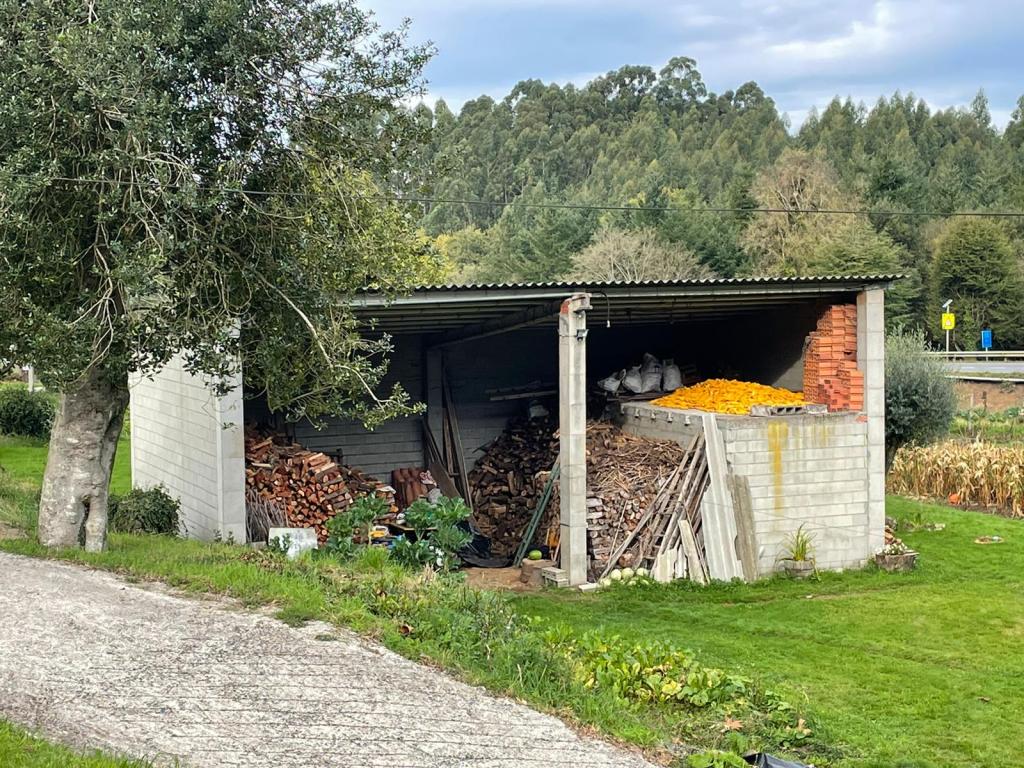
Then I was taking a video of this town just to show it and realized at the very end that four people were actually using the horreo! Sadly, I didn’t want to seem voyeuristic so stopped once I realized what I was seeing. Older folks, two men up next to and in the horreo, two women sorting and piling corn from a small wagon into pails and handing them up – relay to get the corn into the horreo. I came back and asked the guy downstairs at the hotel about it. He said the corn would be in there all year. It’s used now for animals. Before corn was also used for flour, but no longer. The corn that most people eat comes from big industrial farms, like our Nebraska.
Here’s a small group of ancient buildings, including the horreo, that someone has made livable. If I can get it to go, a wee video.
And a walk through…
 Reb's Walks!
You did a Hyperpfeiffout 😆
LikeLike
And it was worth it! It’s rare to find a mountain these days that used to have dragons 😊
LikeLike