We’re starting our Camino del Norte with a one-day layover in Madrid. We staggered to our hotel after getting off the plane, dozed for a couple of hours and then went out to do a tour.
I’d read about Afrohispanica Tours with Kwame Ondo in The Guardian. It’s a tour in Madrid focusing on Black history. I was interested because I’d been following the reporting that The Guardian has done with their stories on Manchester and other areas in England and how their rise and success was based in large part on the slave economy. This was Madrid’s reality and Kwame was terrific. Both Rick and I learned a lot we’d never known. And, no, I can’t remember everything, but here’s a few facts:
The banks in Spain were all based on the coast, mostly in Santander, and a lot of the money boosting the banks came from the slave trade.
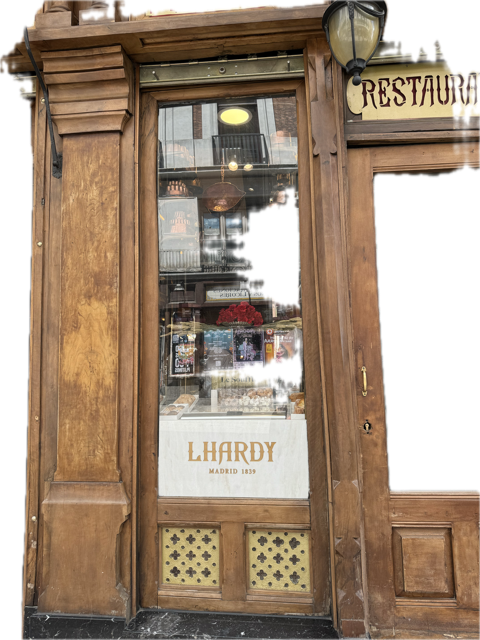
Spain supported slavery until 1873 when the president wrote and proposed the ending to the trade. He had to leave the country because wealthy families and businesses based on the trade were furious, but it was still passed. Both the president and the vice president were ardent abolitionists, so even when the president had to leave, the vice president took over. Thus the Spanish colonies in the Caribbean were among the last to abolish slavery, in Puerto Rico in 1873. The restaurant below is where the president wrote his proclamation:
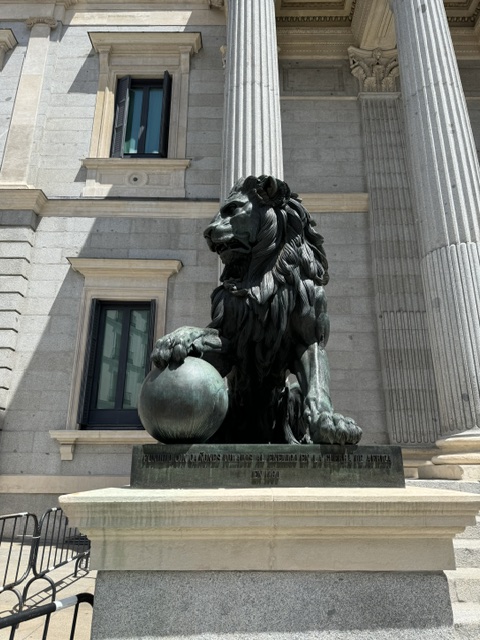
The lions in front of parliament were made from cannons from the Moroccan and Spanish war, when the Moroccans were fighting for independence.
There was a conference, the Berlin conference, in 1884-5 when the European nations divvied up Africa for who could colonize and capitalize on the workers there. Maybe not enslaved peoples, but worked as if. How could we not have known this?
There was a street in Madrid named Calle de las Negras – for the concentration of enslaved women in that area. The name has now changed.
King Carlos III was one of the biggest slave owners of his time, keeping 1,500 enslaved people on the Iberian peninsula and the 18,500 others held in Spain’s colonies in the Americas. As aristocratic families sought to keep up with the monarch, the proportion of enslaved people in Madrid swelled to an estimated 4% of the population in the 1780s. (Fact from the Guardian article).
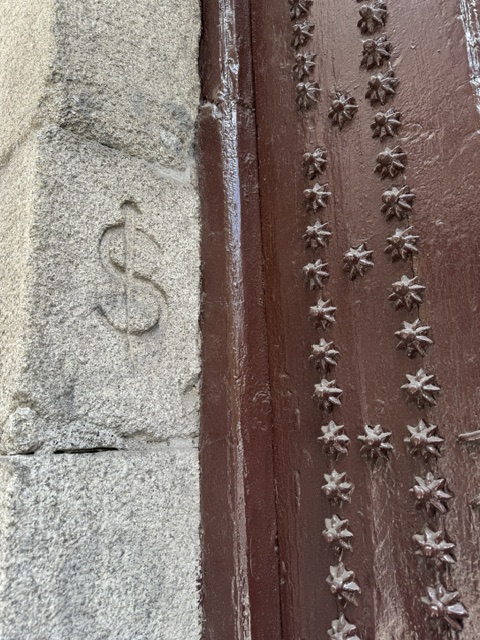
This is the symbol of slavery in the doorway of the Parish of San Ginés, we thought it was a dollar sign. But it’s an S for slave with a nail driven through it. Horrifying. And it’s on the other side of the church from one of the oldest bookstores in Spain – both connected to the church. One enlightened, one not.
The tour definitely broadened our perspective on Madrid and Spain’s Black history and opened the door to learning more about it. Thanks, Kwame!
Then Rick and I were the first to arrive at the restaurant at the hotel and had dinner and went straight to bed. We’re such an exciting pair of travelers.
 Reb's Walks!
Hi Rick and Rebecca! So happy I received your email letting me know the blog is back on! So fun and so exciting and so happy for the two of you doing another adventure walk. Love and hugs from Durango.
LikeLike