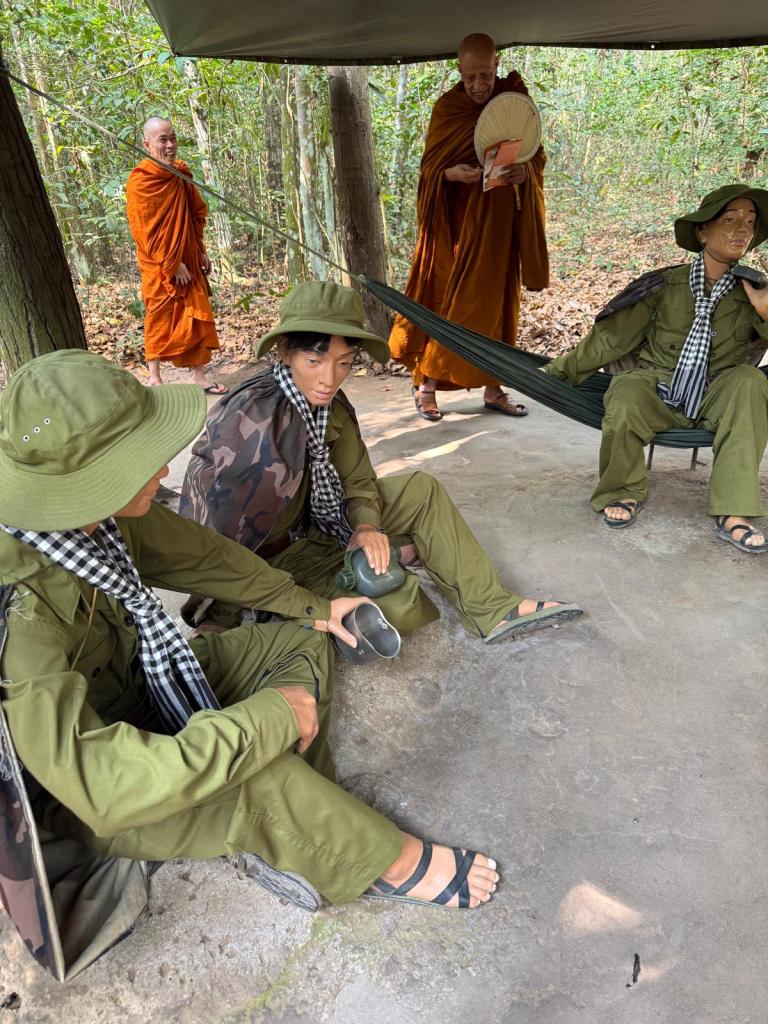
Today we drove to see the tunnels. I’d heard about these tunnels from different people who’d gone to see them and couldn’t really understand why it was such a destination because I haven’t read enough Vietnam War history. Now I understand.
We’re here in the coolest part of the year and actually, if you’re sitting still in the shade, it’s not bad at all. And our poor soldiers coming here, wearing full gear, carrying loaded packs and then going into the jungle. The jungle we saw was new since 1986-90 – they cleared out all the damaged jungle from the agent orange, replanted and started working with the existing tunnels to show the cleverness of the VC and the north Vietnamese as they fought in the jungle.
This was a totally party line place. Our guide told us not to ask too many questions here. And in fact, unbeknownst to me, I asked a bad question – were there women in the tunnels? This was a bad question because the VC forced many civilians into fighting with them, women, children, and men. So, yes, there were many women fighting alongside the men.
By the end, we had a great deal of respect for the tenaciousness of the north in fighting this fight and had just a small small glimpse of how completely awful it was for the Americans, Australians and others who fought here.
A couple of videos of Joe explaining the tunnels.
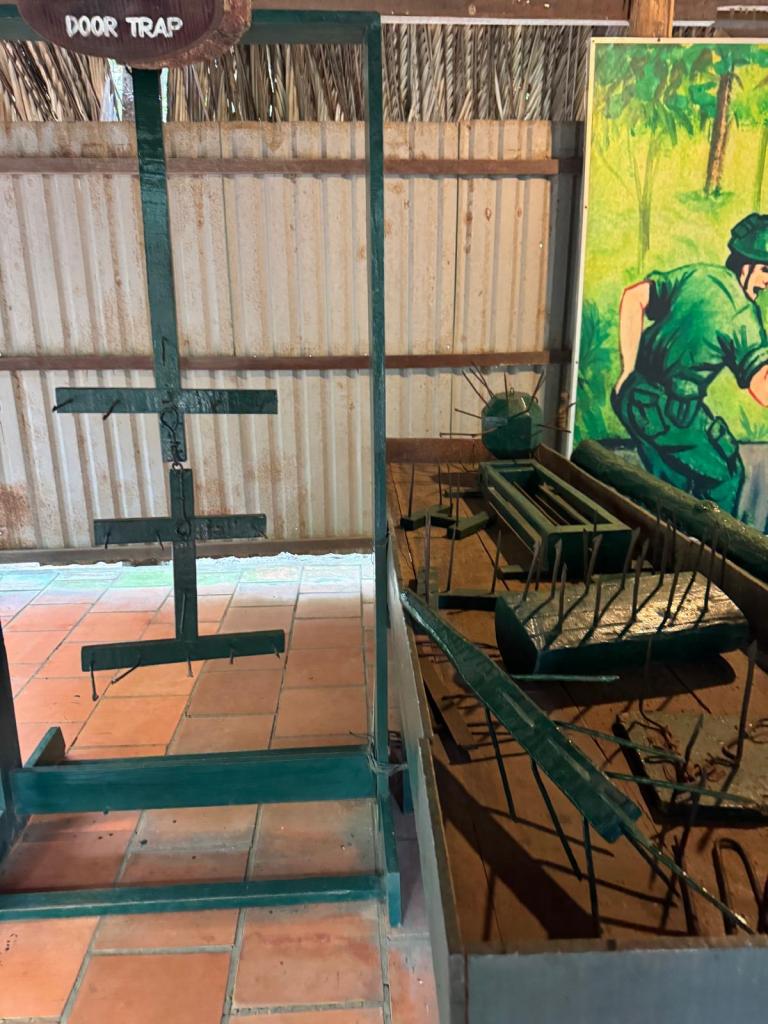
The actual tunnels were a large network that funneled supplies to Saigon and allowed the VC to fight a guerrilla war. We were shown many types of traps set with bamboo spikes both in the tunnels and on the paths. The current jungle was just a hint of what the original jungle was. Then there were so many poisonous snakes above and below, spiders, many ways to die and that’s without the soldiers, traps, heat, and disease. Awful.
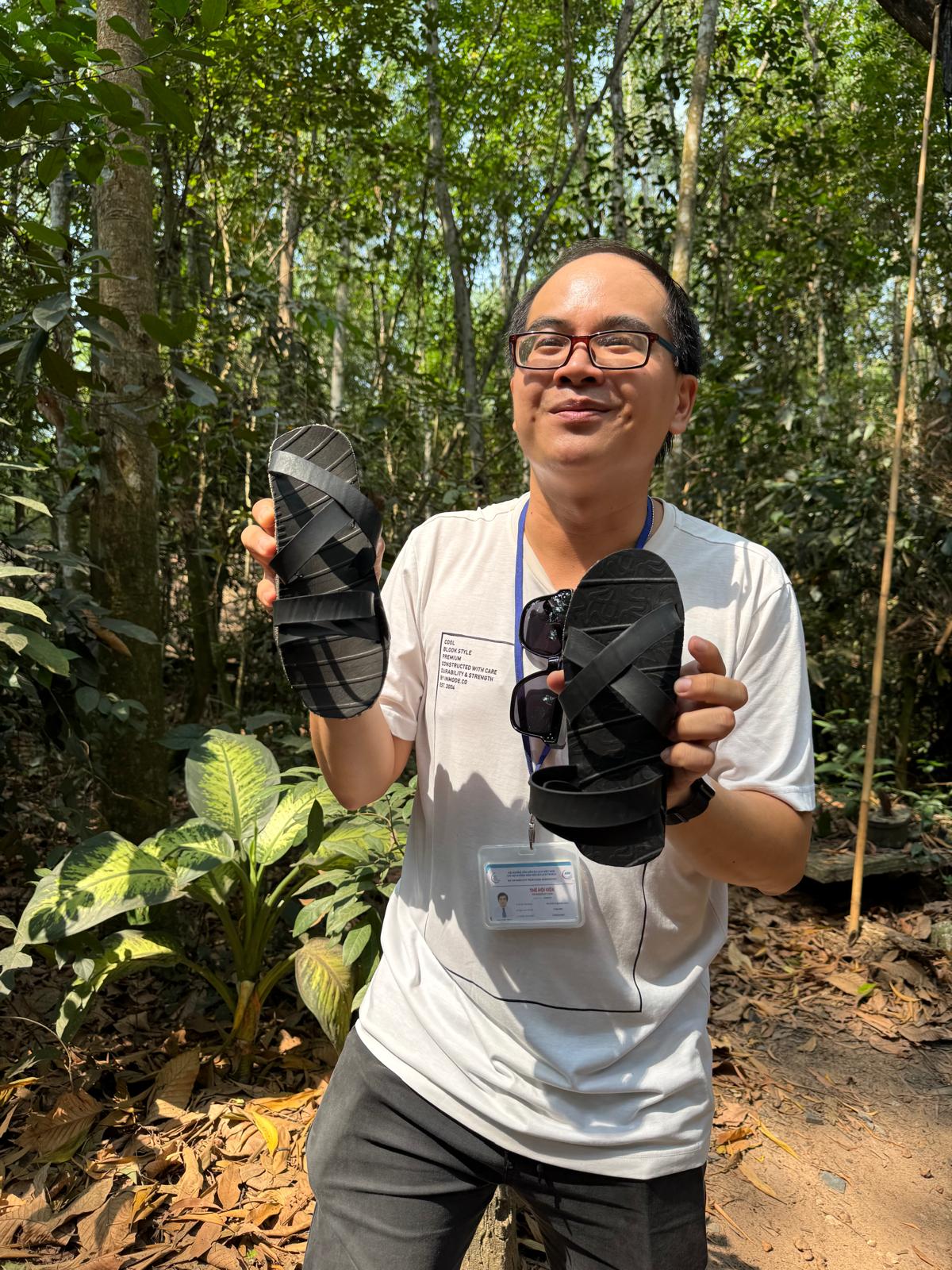
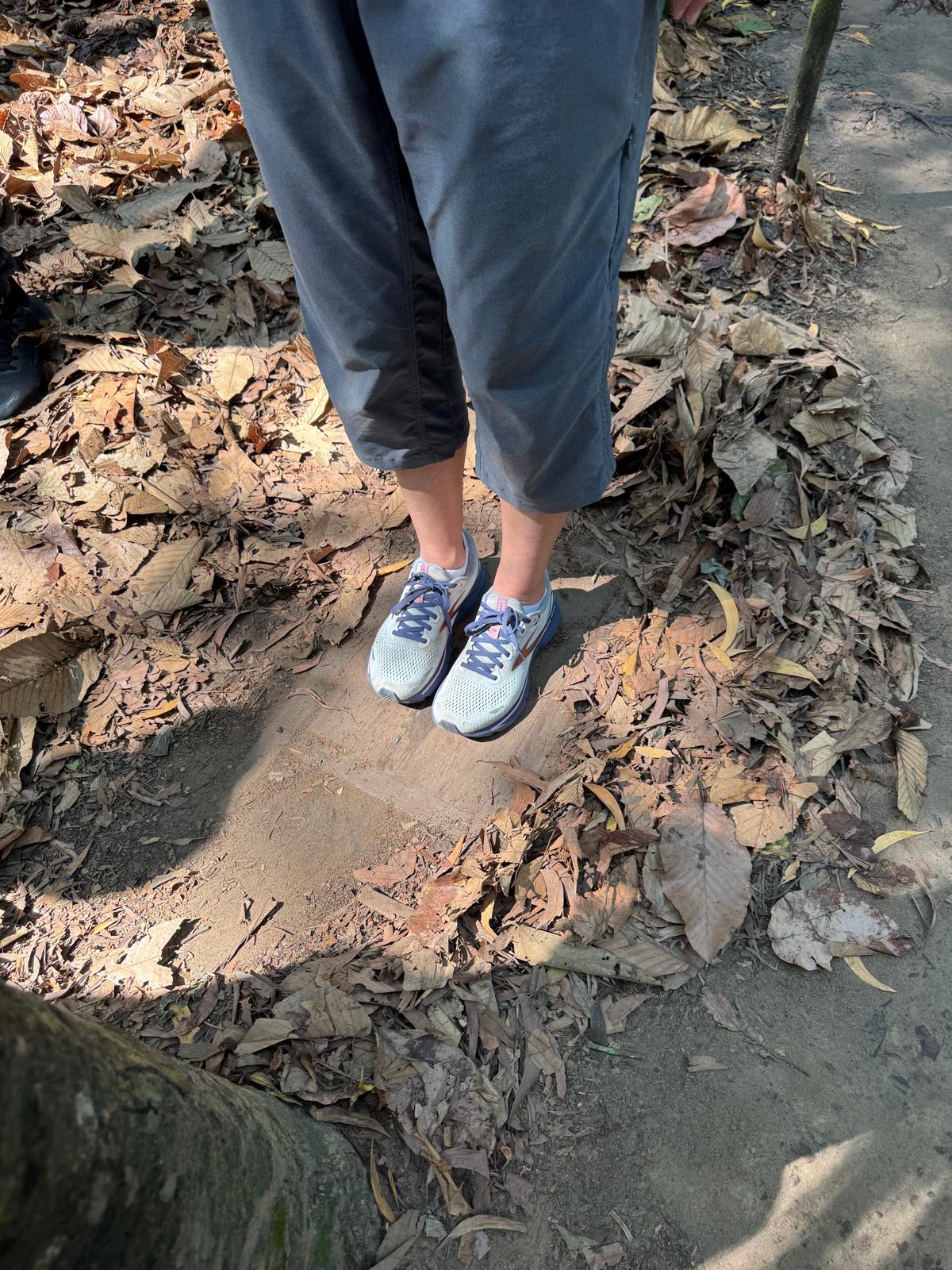
The VC were incredibly resilient, strategic and nothing went to waste. Cars/trucks never stopped going up and down the Ho Chi Minh trail and tires wore out rapidly. We were shown how the tire and tube were combined into shoes for the soldiers. Evidently, they were able to move silently and knew when people were coming down the trails if it was the south Vietnamese/Americans because they all had boots supplied by the Americans.
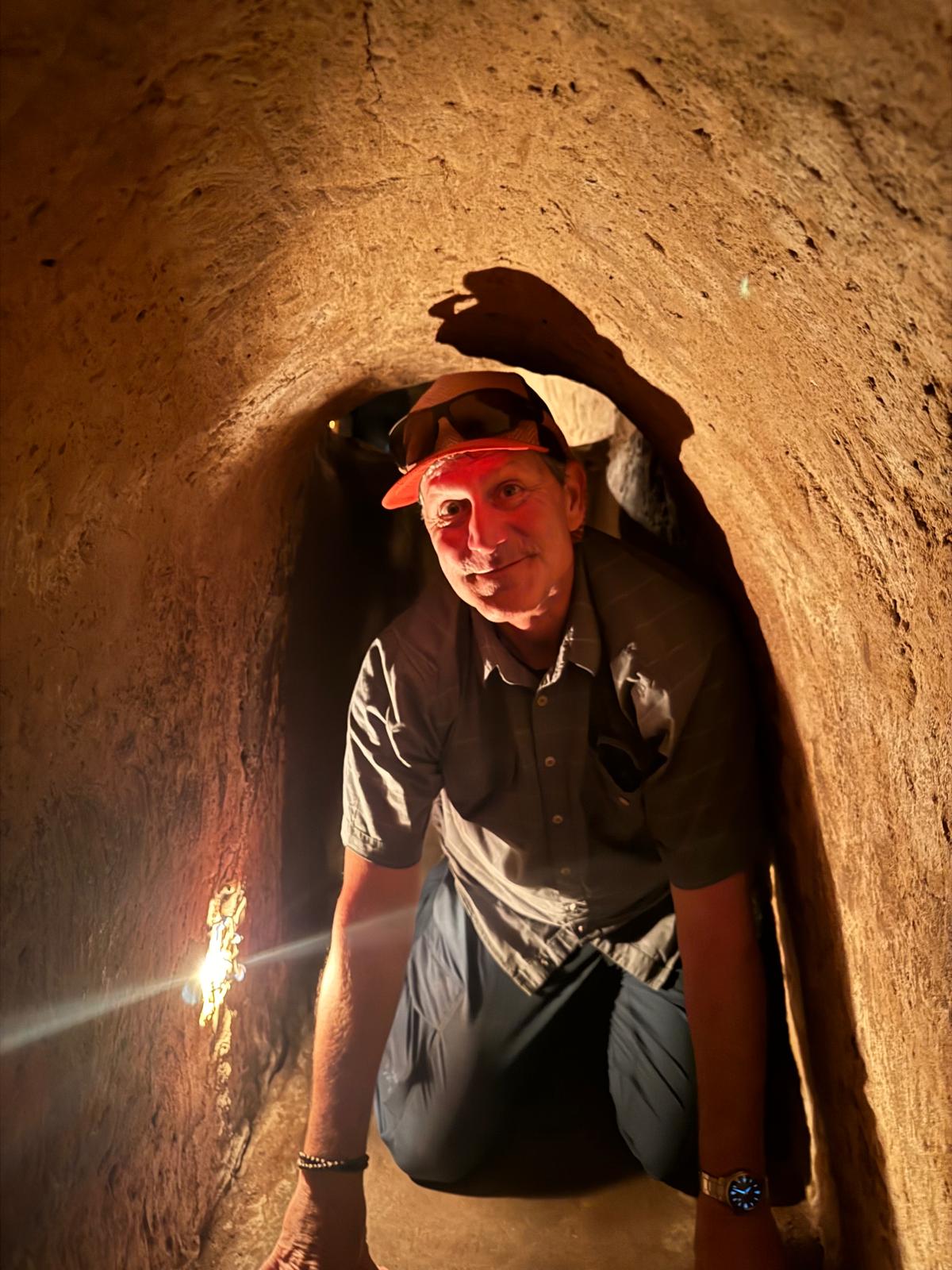
The tunnels were very small. This entrance has been enlarged by 20% and the tunnels enlarged by 40% so that visitors can now experience them.
They had trap after trap if someone tried to enter the tunnel – poisonous snakes at the roof bc an enemy would enter head first with a partner holding their boots, then if they made it into the tunnels successfully, there were pits with a variety of sharpened bamboo spikes used in many ways to torture or kill the unsuspecting. The spikes were coated with oil to slide further and dung to set up infection.
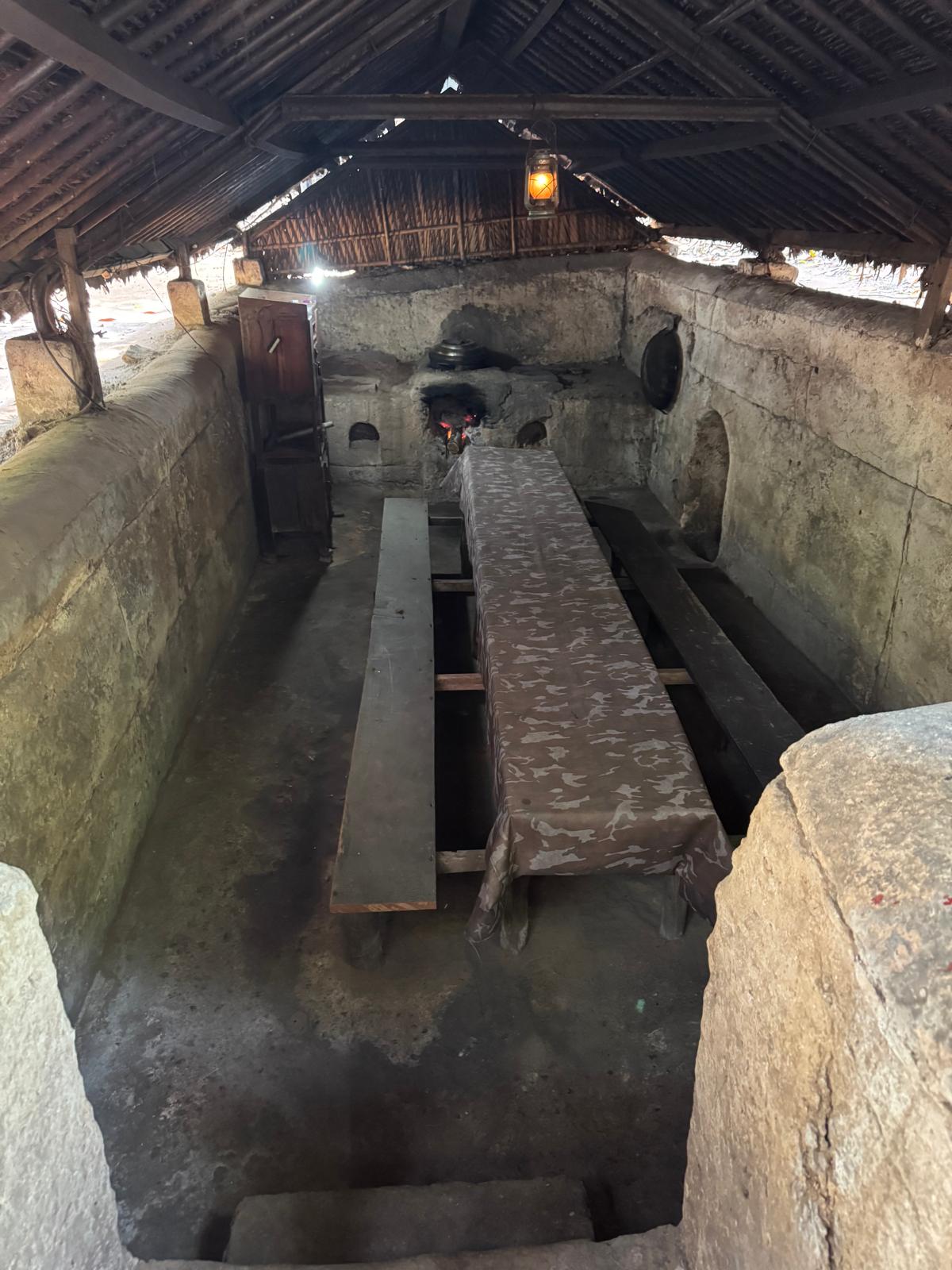
This was one of the gathering places – would have been an earthen roof over the wood beams, there are 3 tunnels into this room
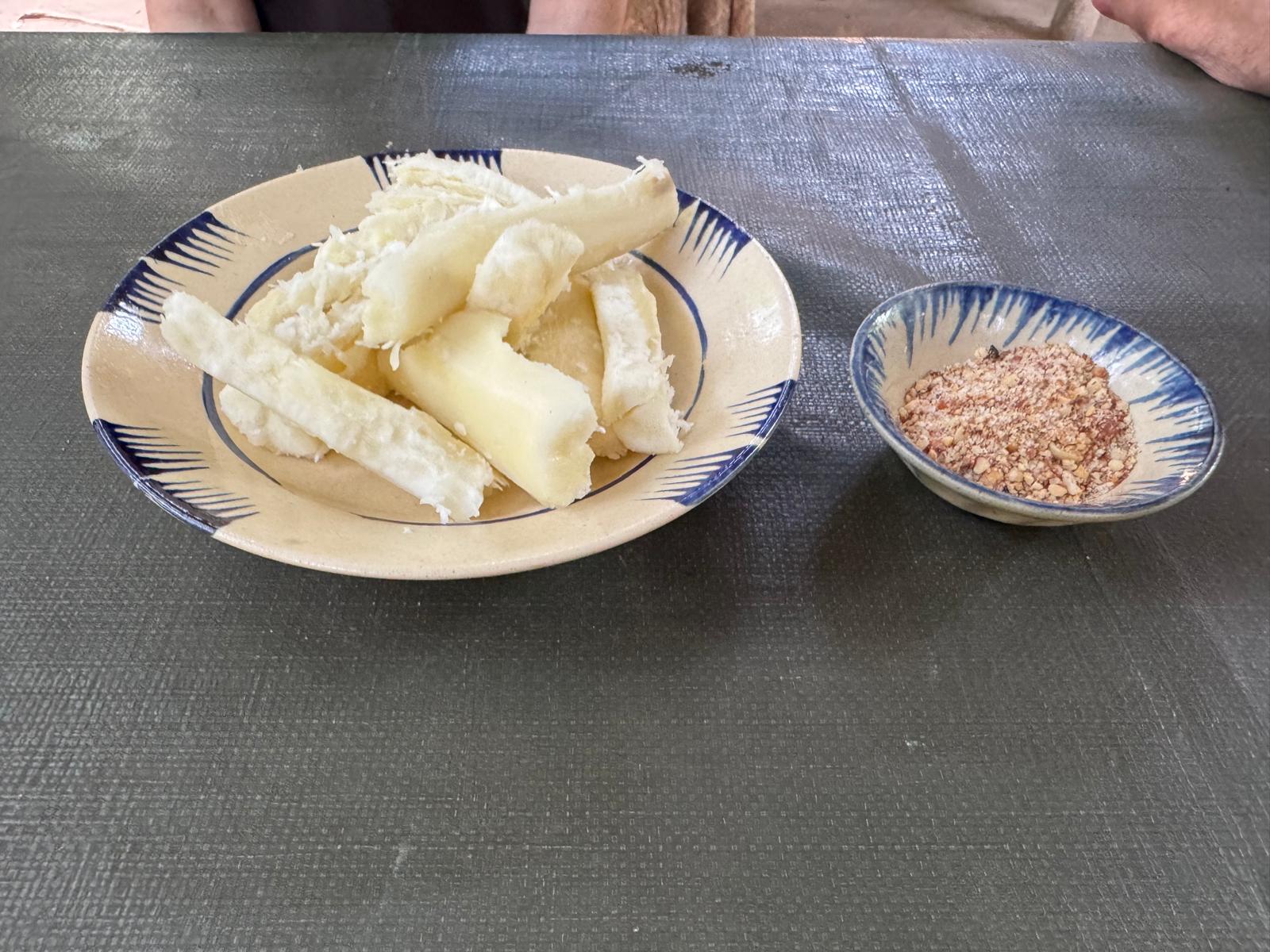
After the tunnels, I was reading my book and one of the author’s brothers was VC. He was offered yams in a family dinner and said he doesn’t tough them because that’s all he had during the time he was underground. Tourists got the peanut spice, rarely did they get anything more.
We were glad we went because it did give a small small glimpse of the war and how incredibly bewildering and awful it was when the allies arrived and went into battle. We also had a glimpse how determined the north was as they created this new type of warfare.
And then our guys came home and were booed and rejected by the general population.
I can’t imagine the level of internal chaos the whole experience created in so many young men.
We then flew to Cambodia. Kellie was intent on getting a shower at the airport if there was any way – and there was in the lounge. I went right after her and it was great – very clean, they had a whole shower kit. Much better for getting onto the plane.
We arrived in the evening at the Amansará in Siem Riep and it was incredible. The aura of serenity was amazing. When I walked in my room, there was chanting set on the iPad. I ended up using it to fall asleep for a few nights.
Today, again, was so interesting and fun too. We drove 2.5 hours south to the Mekong Delta.
We were given bikes and these actually fit pretty well, basic bikes, but the seats could go high enough. We then took a ferry across to an island and started riding.
The weather was hot, but perfectly fine with the breeze and we were often in shade from the trees. We rode a lot of the island and all along the way we were behind houses and occasionally little shops. All of our stops were to visit women who were individual entrepreneurs – making their products by hand and then selling directly to the market.
Our first stop a woman was making rice wine. She gave us a sip (I smelled it) and it was like drinking everclear alcohol – not that I ever drank that, but the smell made me think of. They cook it longer and longer to make it less strong and more drinkable, and that product is sold more often. In the video our guide is saying that if you sell that super strong wine – it doesn’t go well.
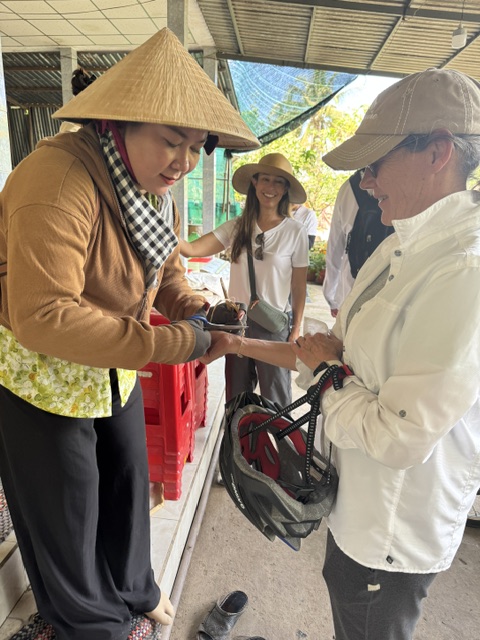
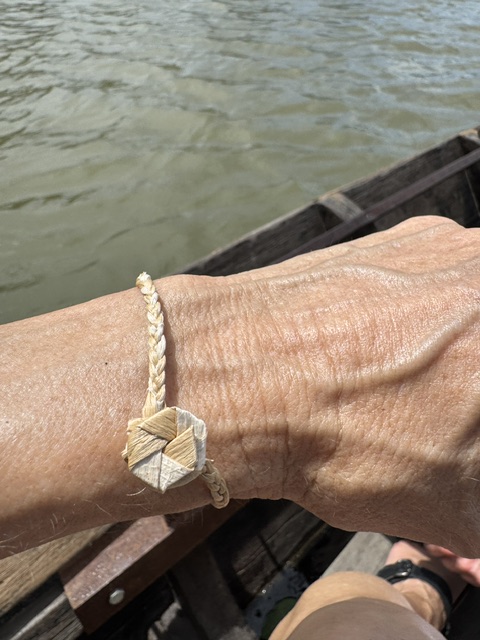
Basket and bracelets made from the water vines/reeds that were growing all around the delta and tributaries. We each got a bracelet – so pretty.
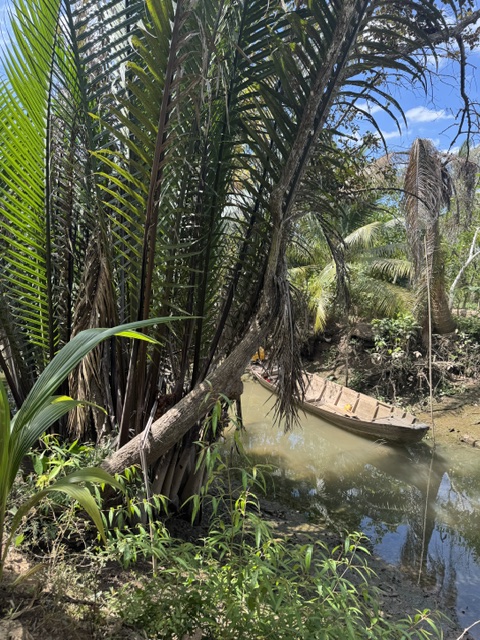
Scene on the ride
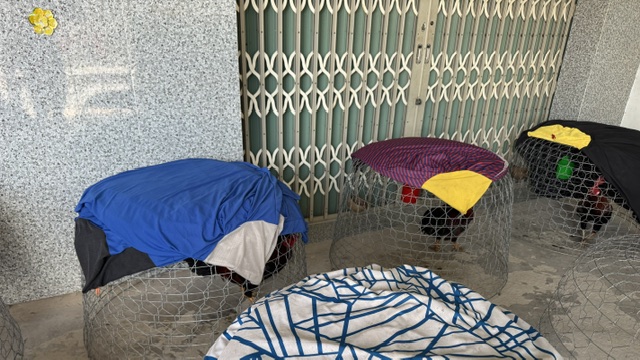
Another scene – we saw roosters in several places in both Vietnam and Cambodia. As the Cambodian guide said, it’s outlawed in both places, so you just pay off the policeman. These roosters were gorgeous and you knew immediately why they were so well taken care of. Different lives and hard lives. I had to let it go, but didn’t end up having a snack sitting next to them.
Then nail files, so precise.
Tofu – first soaked for 4 days, then ground with water, cooked until most of the water evaporated, then drained through a basket covered with something like cheese cloth and a heavy pot pressing down until the water is mostly gone, then it’s cut in blocks.
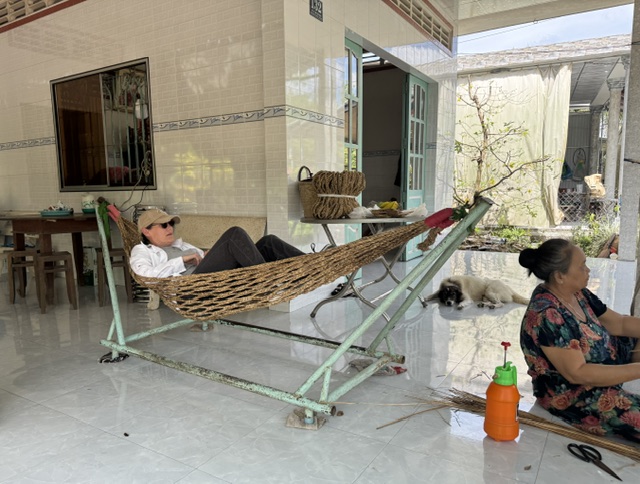
Macrame weaving to make hammocks. She’s the last one making these on the islands. It’s too hard on the hands and hard work to begin with, and no one in her family wants to continue the tradition.
Our guide said that if he was to make one of these products, it would be making tofu, least hard on the body.
We then left the bikes and got into small boats (we’re starting to see a pattern) that were the same that the Viet Cong used to smuggle goods/weapons into Saigon. They were able to row into the reeds, lie down in their boats and be completely hidden.
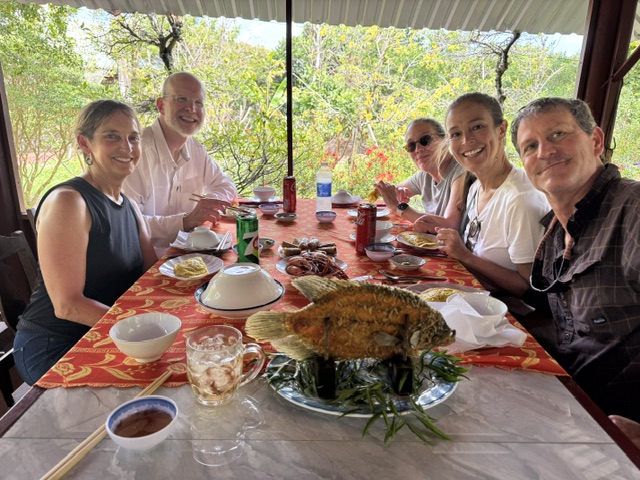
Then lunch with a whole fish. Here, people eat the shrimp shells and in this type of fish, they also eat the scales. Pat’s up for trying anything and said the scales and tail weren’t bad, just really crunchy like fries.
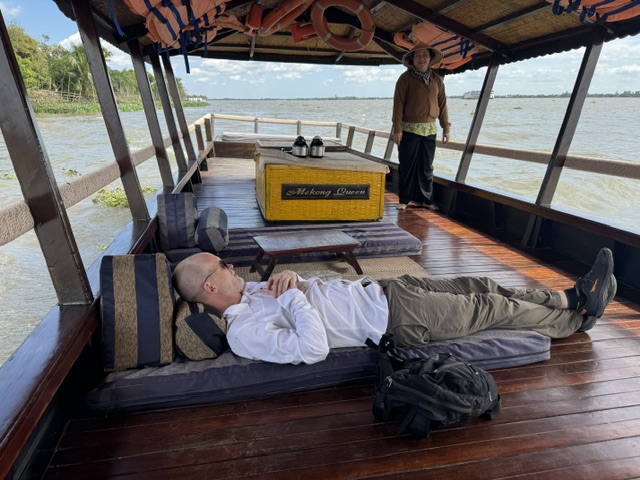
Then we got into a larger boat that took us back to the ferry and back to the mainland.
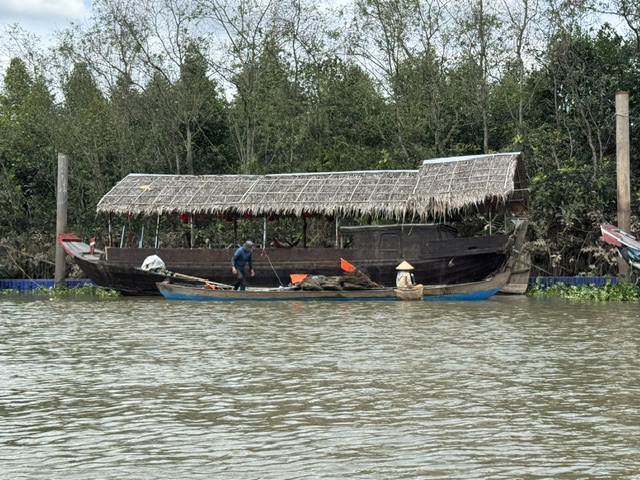
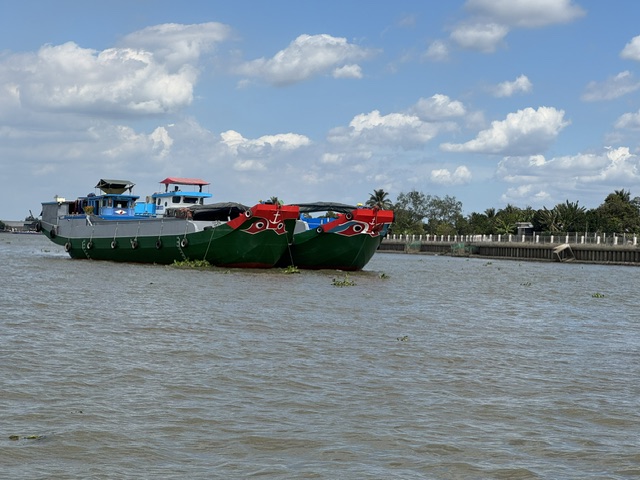
There were large boats that looked like stationary houseboats, along the river.
Our guide said they were owned by the government and rented out for free of pennies to those who wanted a vacation, but couldn’t afford one. Bathroom? River. Our fish – where did they come from? Further out in the delta. We think.
The Mekong Delta actually has 9 tributaries, has a 3 meter tide and you can take a boat all the way up to Saigon or even up to Cambodia. Our island adventure was on Caí Be in the province of Then Giang.
We loved this day, but boy we were ready for showers by the time we got back to the hotel.
It’s incredible that every day has brought new, different, learning experiences.
Per usual, I was up at 5 and saw this early morning scene from in front of my room. Early fishing boat:
Today we took an early flight from Danang to Saigon. Again, we walked into a really interesting day, this time fully focused on the Vietnam war. Our guide (I’ll call him Joe) said – you’ve come from the north – they’ll be really careful about what they say. You can ask me anything in the van, if we’re outside the van, we can talk some, but quietly.
US Consulate – we drove by this, it’s still in operation, though it’s been modernized. It was empty for 20 years after the year, then was given back to the US. Since it was in poor shape, they had to tear down one main building, but the rest remain.
Reunification Palace – former headquarters of the South Vietnamese Government and presidential residence, then taken over by the North Vietnamese. This was a very cool building, though at first it seemed pretty uninteresting compared to the original French building that had been there. However, the windows were largely designed with bamboo looking pillars that allowed air and light to flow through, allowed them to see enemies approaching, but didn’t allow anyone to see in. Pretty remarkable. The whole building was designed on Feng Shui principles.
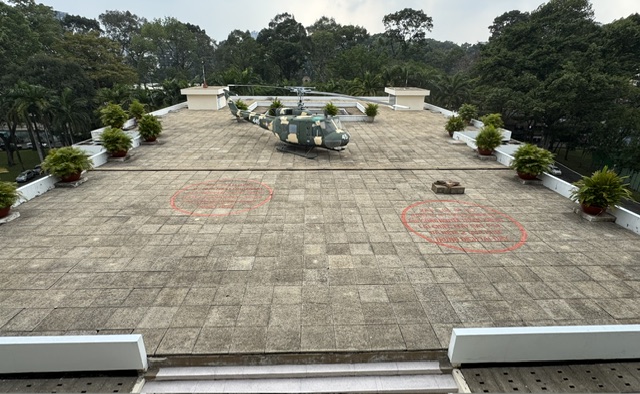
There were photos of someone who’d been a VC (learned that Cong in Viet Cong meant communist in Vietnamese) and had joined the south as a spy. He was in the South Vietnamese army for 5 years, rising up through the ranks and was then sent to America to train as a jet pilot. He came back and moved up in the Air Force until he was flying jets. He then loaded his jet with 2 bombs and drove over the palace and dropped his bombs. He’d been in the building and knew the weak point was the staircase. He dropped successfully but the bombs didn’t explode. Local lore is that the dragon rug given them years before at the center of the building just in front of the stair case kept the bombs from exploding. No one was hurt and they now show where they were dropped next to a helicopter. The pilot flew straight to “an improvised airstrip prepared by the Liberation Forces” and turned his plane over the VC.
The note about the bombing was interesting – adding this detail. “This feat seriously undermined the republic’s authority and prompted the US President to order the evacuation of the last of the Americans still in Sài “. Note Liberation Forces capitalized and republic is lower case letter. Throughout our days in central and southern Vietnam, the stories and semantics shifted depending on who was presenting the info.
It was interesting to go through the whole residence. Some gorgeous meeting rooms and designs, as well as this scene used for a photo posed by Joe, our guide.
We then went down to the bunker.
Throughout the Reunification Palace, if it was the president’s private area, there were multiple phones for different connections. If there was a black phone, that was the direct line to the US. In the bunker, there were multiple rooms with phones, typewriters, radios and it was so hot. This was the president’s bedroom.
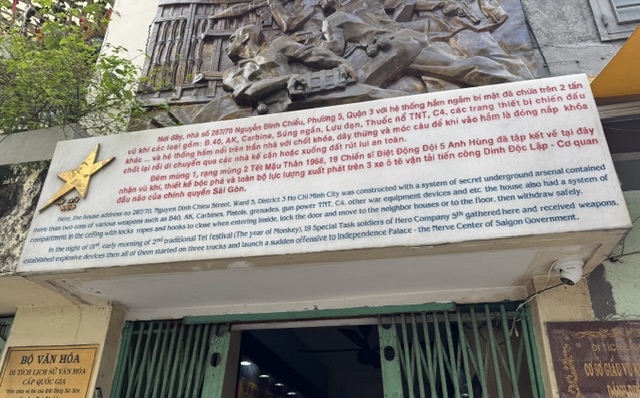
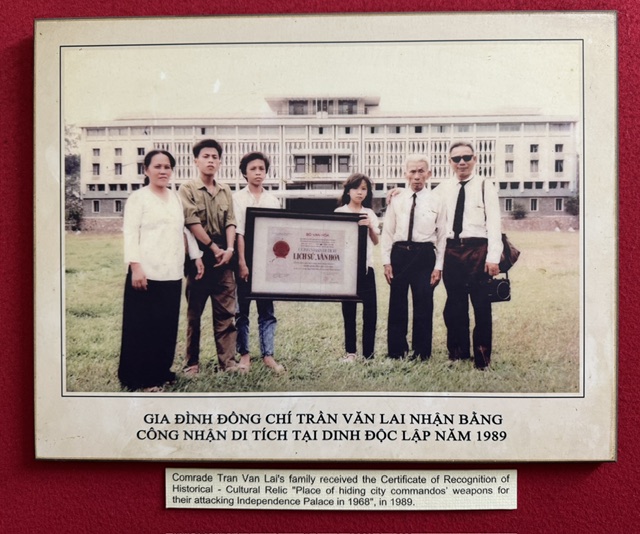
Our next stop was a secret weapons chamber used by the VC. This was a wild story. The man who owned this house was secretly devoted to the communist party. He was the contractor who rebuilt the Reunification Palace. He knew that the weak part was on the side. He and fellow VC secretly brought in weapons from the Ho Chi Minh trail hidden in fruit baskets, bamboo rolls, carved out panels of wood, and under food carts coming to the market – which was outside his door on the street.
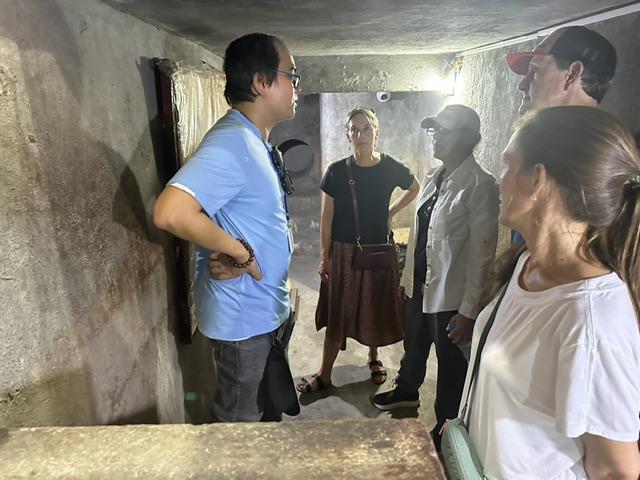
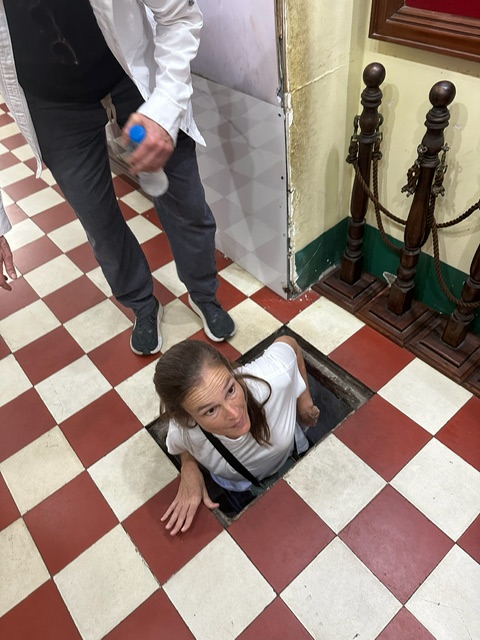
He then built a bunker under the house that connected to bunkers under 3 more houses. It was a tiny space in the one that we saw, but he stored a ton of weapons in preparation for attacking the Reunification Palace in an assasination attempt on the president. There were 50 in the group who attacked; he wasn’t there since he was directing as general. They severely damaged the building, but in the end were all killed or declared missing. There was a photo of maybe 8 of them with the general after the war was over. The South Vietnamese strongly suspected that his house was the source of the weapons and came with weapons firing and shot up his front gate – you can still see the bullet marks. They then went through the whole house (tiny) looking for the storage space. It was so cleverly disguised that they never found it. Red and white checkered floor – with one very small panel that could be pulled up by the edge of one of the tiles – hid the bunker. We went down into it, tiny, crazy, and clearly the man was completely committed to the case. Later after the war, he was very famous and highly rewarded for his efforts.
In the bunker.
Getting into the bunker!
Next was the former residence of the US Ambassador of South Vietnam in the early 1960’s, Mr. Henry C. Lodge Jr who “supported the overthrow of the South Vietnamese government”. This note was from Wikipedia and things can definitely be slanted here when you Google items. In fact, he was very committed to the Vietnamese, but thought it was a losing battle by the end and wanted America to pull out. We watched a short documentary film in the living room which fleshed out a bit of the story from Henry Lodge’s perspective. The house itself was a fourth of what he had when he lived there with his family – there were 4 houses connected, a full block. Now it’s one section, but still beautiful. Joe’s boss is the owner of the guide business and bought this house, keeping a fair amount just as it was when Lodge was there and living more in the back. Amazing.
Joe then took us to our favorite lunch of the whole trip. This was a fried pancake shop, making the same kind of pancake sandwich that we had on the bike ride. But the woman who started it had a particular method of cooking and particular ingredients. Her daughter/grandaughter? Was the one cooking now and we were able to take video as well as photos because she loved explaining how she cooked (vegetable oil now because of so many allergies) and seeing how much people liked her food. There were also two things that came in banana leaves – a rice paste with things on top. I really liked this one as well as the fried pancake.
Her son did a trick with a piece of wood and a screw and three beer bottles, opening them with one quick chop. A big crowd pleaser that one!
Finally, the woman showed us a photo from the Tet offensive during the war – mostly destroyed. Scott or Pat then took a photo from the same vantage point showing what it looks like now. I’m hoping I can find those photos.
Rex Hotel – we went here for a drink at the end of the tour. I asked why so many signs say Cocktails/Mocktails. Has it always been that way? Joe said that last year they cracked down on drinking and driving. If you’re caught having drunk anything at all, you’re fined severely and can have your scooter/bike/car taken away for 2 months. Serious consequences. Joe then said that many police are undercover and just watching. So they’ll be on a corner and watch what people are doing, remember the faces of people drinking and then if they see a person driving who’s been drinking, they pull them over. Joe said he couldn’t pick out the policemen. When they’re wearing their uniform, they’re off and showing off. Most are undercover when on duty.
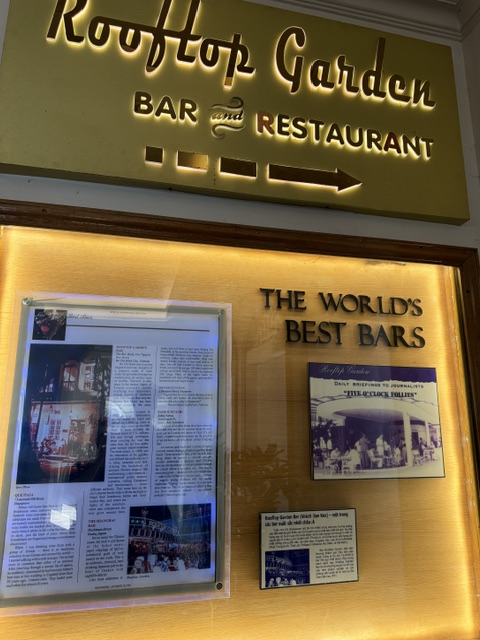
The hotel’s bar was the site of the United States military command’s daily press conference, and derisively named Five O’Clock Follies by cynical journalists who found the optimism of the American officers misguided. The daily event was hosted by Barry Zorthian, chief spokesperson for the U. S. government in Saigon from 1964-68.
From the Rex Hotel on the balcony – where the famous bar is – we could see the former CIA building, where helicopters did the final evacuation in April 1975. We saw this from a distance and it was a TINY little spot on top of a building. They had a photo of swarms of people on the ladder and leading up the ladder – they’d climbed 9 stories to get to this spot. And only 8 people were able to get on the helicopter and then it was gone. Awful. That famous ladder is now in the Gerald Ford museum.
We were ready to call it a day after this, but Joe told us we were making a BIG mistake if we missed the Vespa food tour. From the first time we started planning this trip, Kellie had said she was not going to do the Vespa tour. In the end, we all went.
Our guide and the Vespa drivers were all from the Vespa Wanderers Team. My cortisol leves were VERY high for the first leg, by the second stop, I’d relaxed, by the third, I wasn’t even paying attention to the traffic and was just watching the city go by. The drivers were so safe, communicating by radio on their vests, using blinkers and totally safe.
Saigon is a beautiful city, very prosperous, clean, lot of great food and a lot of shopping. For the party members – crazy high end shops and cars driven by only a few. But many people were out and about and it seemed like it was far removed from being a third world country. In fact our guide, the gorgeous and very energetic Chi, said that was the case. People have food, are starting to have more choices. She was from Hanoi, but had left and was living and working on her own and having a great time!
Finally relaxed after this stop!
So – a long day, but full of very cool experiences, and we ended it on a high because the Vespa tour was so much fun.
Today was a free day. We had a very late breakfast, the breakfasts here are just incredible, well except for the GF bread. Then scattered. We all scheduled different kinds of massages courtesy of the hotel. I went for reflexology. After Holly read aloud the list of possible options (breast massage to perk things up, abdomen massage to loosen things up), I didn’t know what might happen during a full massage and didn’t want to take a chance. It was very cool – little houses on a pond. First a foot bath with gardenias and mint and lemongrass aroma therapy oil. I went to a massage table and I lay down, ok, I’ll really relax. The masseuse then played the singing bowls and then the massage. So cool. Completely relaxing.
I staggered back out after and rode the bike to the work out place – great gym. I got on the treadmill and finished Dirty Dancing on my iPad, my treat from the night before. So had a work out and broke a sweat for the first time in a month. Then I swam in the longest lap pool I’ve ever seen. Mostly I just wheezed and tried to get to the end. But I did it! I couldn’t resist that gorgeous pool.
Then read, wrote, took quiet time for the rest of the afternoon. So nice.
We took a shuttle back into town to see a show at the Hoi An Lune Center. This was an acrobatic show using primarily bamboo for all athletics and many of the instruments. It was a pretty frenetic show, the people were so strong and the music was cool, many different instruments. Supposedly the show was based on the culture in the highlands of Vietnam. We had no idea if that was the case of if what they were speaking/singing throughout the show was even a language. But it was definitely diverting!
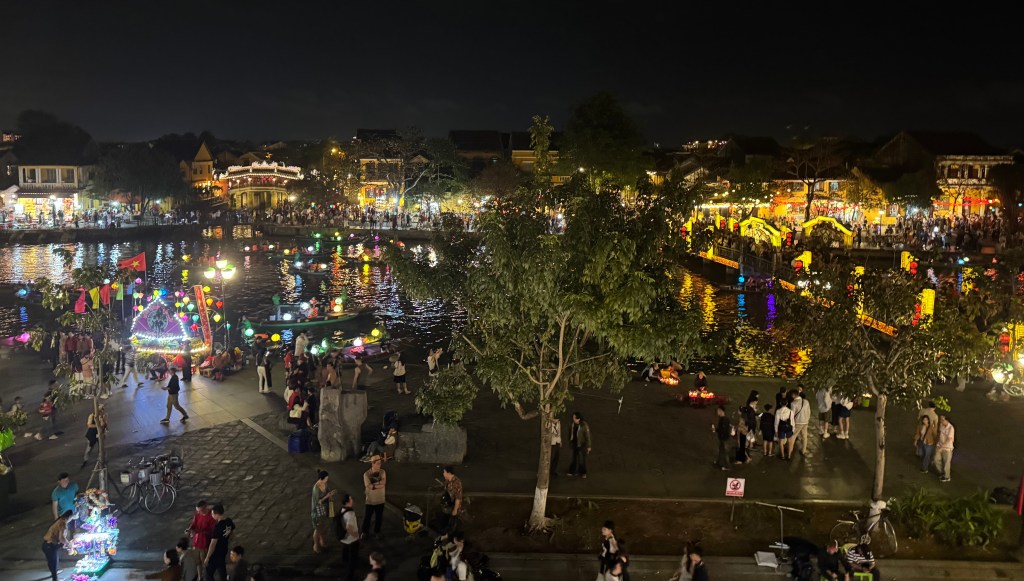
We then walked down the river – lantern river with the night market – to our dinner spot. Our guide from Hue had set this up for us, arguing for a particular table on the highest balcony right up front so we could see all the colors and activity on the river and the banks. It was great. And maybe the best Vietnamese food we’ve had yet.
This video is before it gets really dark and the lights shine even more, but at the start you can see all the chairs set up for people who sit to watch the lantern boats go by.
The last one is from our balcony at the restaurant. Amazing.
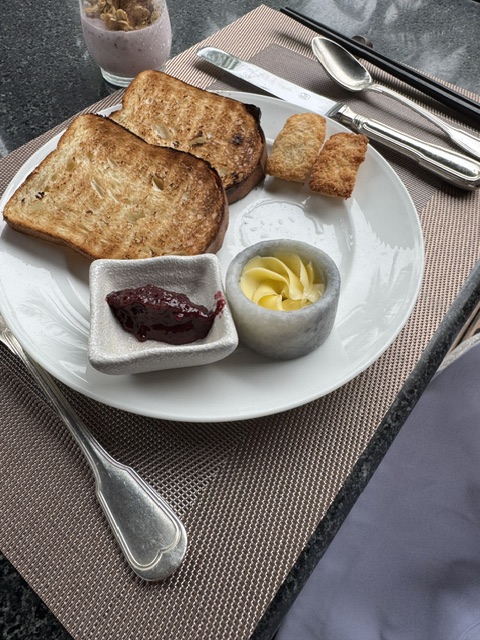
First breakfast, gluten free toast for Kellie. Guess which one is GF?
Our guide was Than, she didn’t have that much English, but oh man, she was darling and laughed at everything. So much fun to be with for the day.
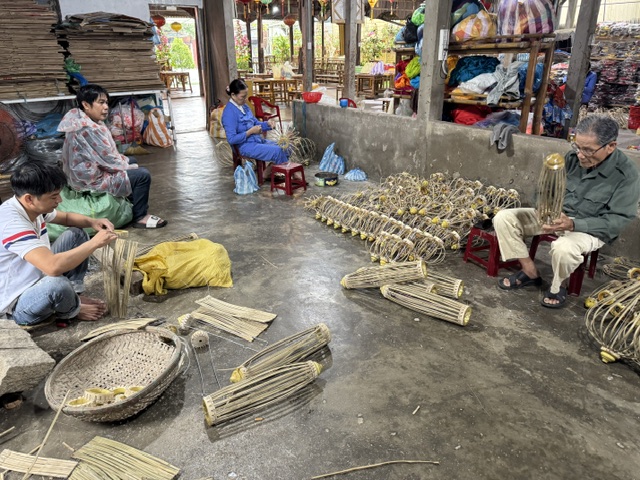
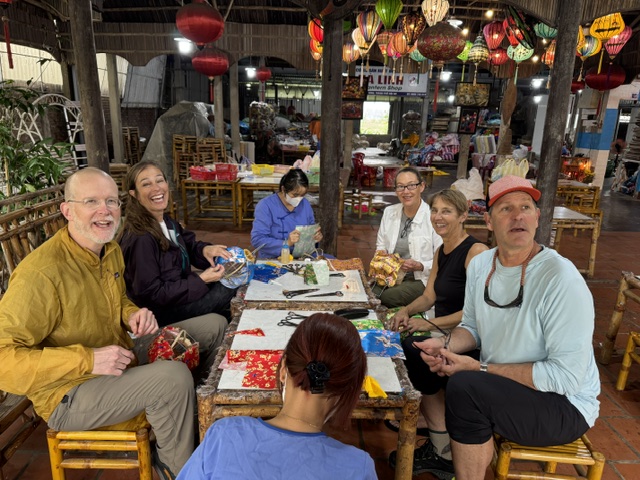
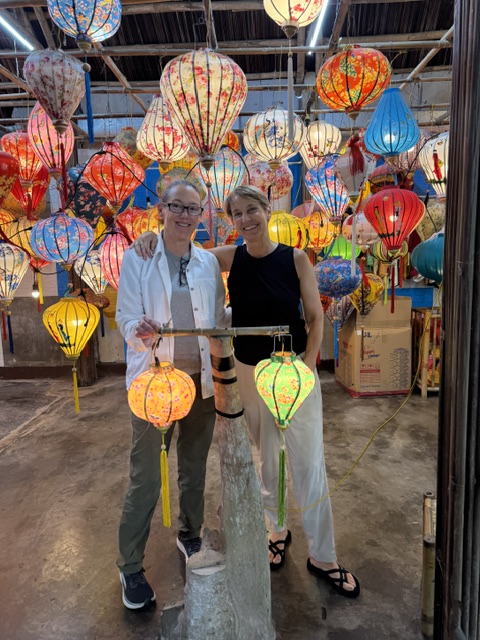
Our first stop was at a lantern making shop and making our own lanterns. Pat and Kellie were ready to put their hands to art, but we quickly learned that the women sitting on either end of our table had very exacting standards and no one met them. Not even Kellie! We’d start something and it would be taken out of our hands and tightened, then taken out of hands for a bit of trimming, then for gluing (Pat – I would have done the gluing!), etc. But by the end, we each had our own little lantern 🙂
As we finished, Pat yelled out his usual Cam On! Tto thank the team and Tham cracked up. She then stopped us and explained that because of the inflections in Vietnamese, you had to be super careful how you spoke the words. Pat had been saying Cam On to everyone and often the faces were a bit confused/funny. But what the hey – he was trying! Then Tham said that in fact he’d been saying shut up every time. We were laughing so hard. Then she gave us a demonstration of what inflection can do to a one syllable word:
Styling
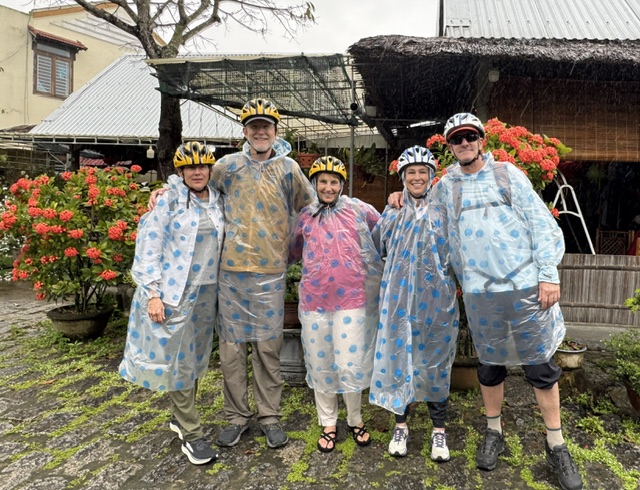
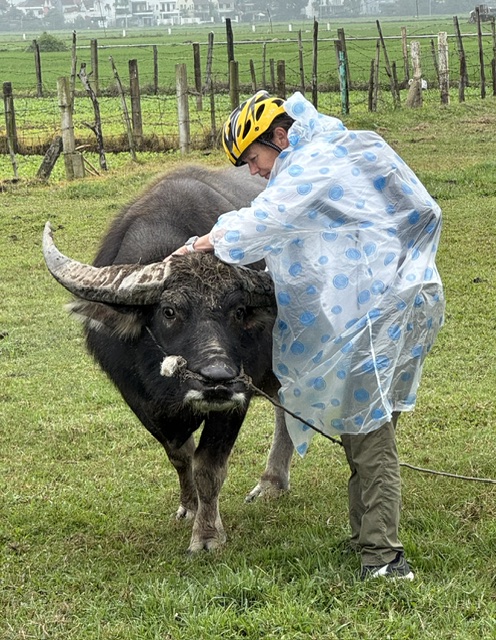
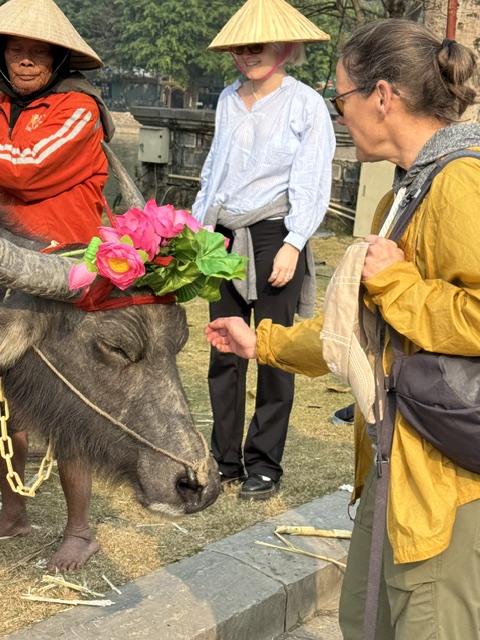
We then got on bikes. Than had prepared for all contingencies. She had water bottles, bags for our bags, rain coat/ponchos and off we went in the drizzle. This was a fun piece of the day because there are paths all around the rice patties and through the backs of the houses in the villages. Kellie’s highlight was stopping and getting to know a water buffalo. This water buffalo’s highlight of his life was having Kellie scratch his ears. I don’t know if I caught his expression, but he really did look like he was in heaven.
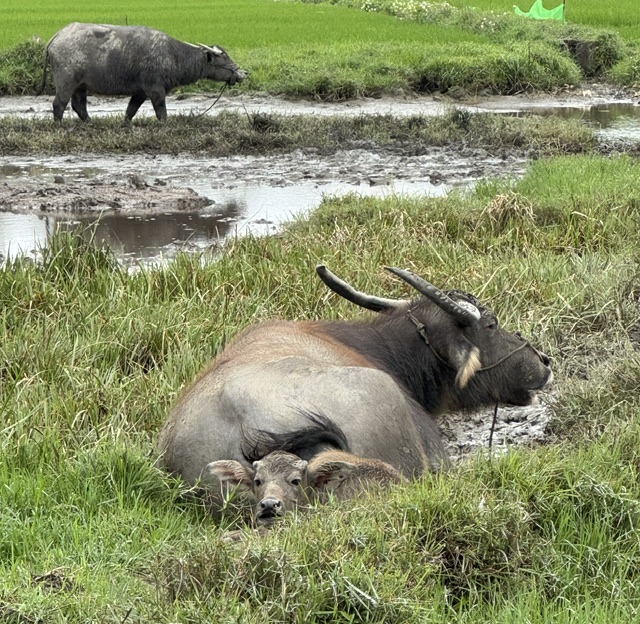
Water buffalo are beloved pets here, incredible docile (except if protecting a baby) and well cared for.
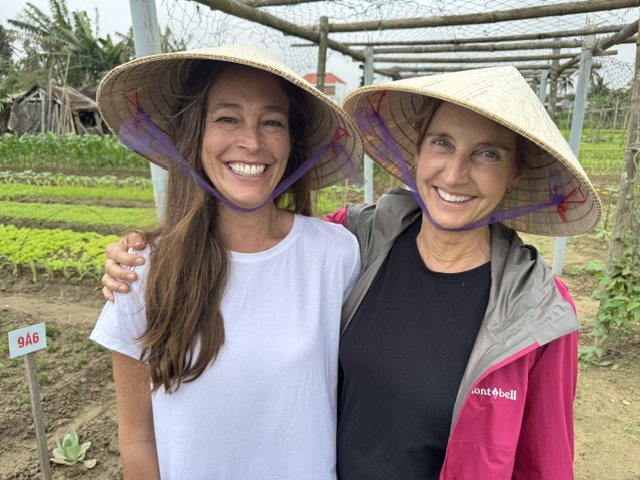
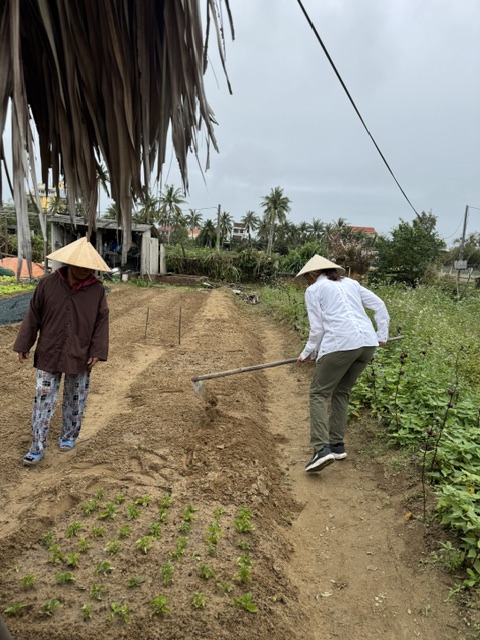
Then we stopped at an organic farm, the only one in the area. This garden was incredible. I tried to get a video for Eli C and Kylie – our farmers – but it was hard to capture. So many different vegetables with different flowers mixed in to keep the insects away. We then got to farm – a wee square. We were startled because the farmer (who clearly had a vast amount of knowledge) was putting cuttings straight into the dirt. We all wondered if she was then going to just pull them up after we left? But I don’t think so. There was another square that some other group had clearly planted and was growing well. They make a fertilizer with a mix of water buffalo dung, and a few other things, super rich looking, so maybe things just grow easily there.
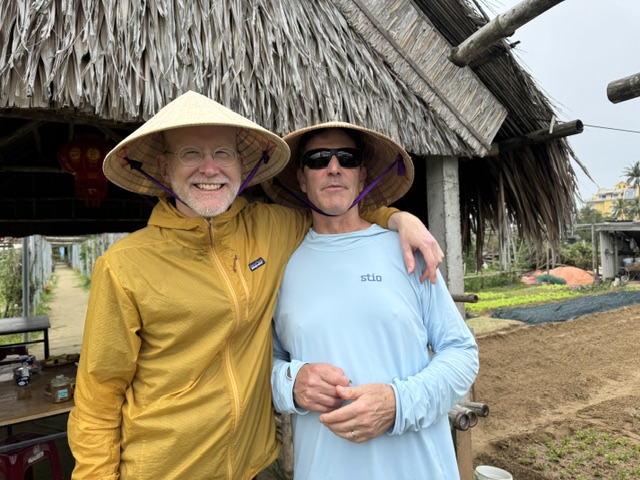
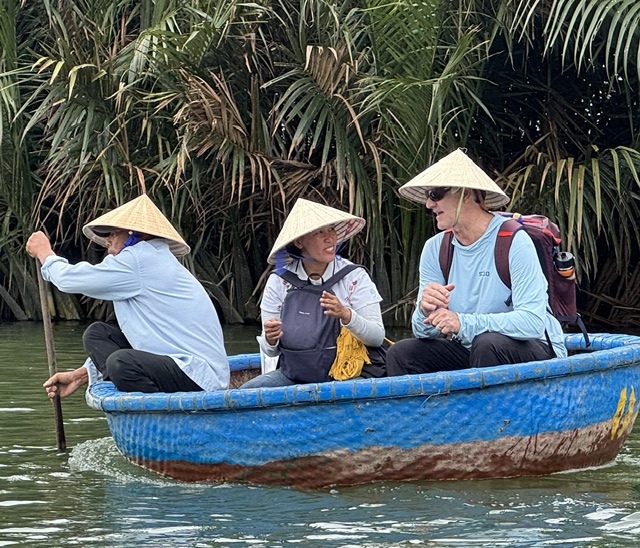
We left the bikes and got in little coconut basket boats and rowed to lunch. These little boats come about because the Chinese were taxing all boats. So the people figured out how to make very large baskets – from bamboo actually – and then to row them thus avoiding the taxes. Clever and it was a pretty little ride. They put the hats on us before we even started moving, but it was nice because we could row. And we started to appreciate these hats – they’re actually pretty comfortable and seriously effective for both sun and rain.
Our stopping point was our lunch spot.
Here we got a wee cooking lesson learning to make a classic Vietnamese pancake with shrimp, pork, and vegetables. All rolled up in rice paper. Turned out that was just the start to the meal – and it was a fun start. We had a variety of dishes; my favorite was morning glory. Later we read that this vegetable, also called water spinach, is the second most common food item after rice. It grows in all climates and soils, the only thing that grows everywhere in the country. It has Vitamins C and B6, iron, calcium and lots of fiber.
After lunch we drove to town where we were dropped off and went back to the store for our fittings. My skirt was looking a lot like a mumu, the fabric is great and feels great, so what the hey, I’ll be comfortable! The dress is a mystery. Figured I’d try it out the last night of our travels.
We then started looking for our hotel shuttle. It wasn’t where we were initially told it would be, tried another place, then Scott started texting with someone back at the hotel who was in charge of our rooms. We got the message to look for Jolly Culture. Ok, so then we asked people where Jolly Culture was. Finally, Scott got some clarity – can you spell that – and it was Yuly Couture. Funny. We found our shuttle and then we had 24 hours at the hotel before we’d leave and come back for a show and dinner. Free day!
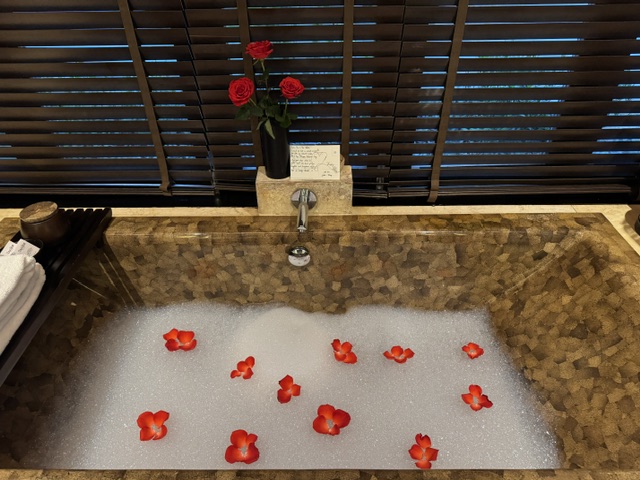
It was actually Valentine’s Day, something we kept forgetting but there were reminders everywhere. We came to our group living room and found treats and a shell design for Happy Valentines. Then we went to our rooms and all of us found warm baths and hot tea waiting for us. What?! I took a photo and then realized it was actually hot and thought, ok, well, shouldn’t waste the water. Fun.
Really nice quiet evening. I stayed in, ordered room service and took some quiet time. All of us did the same, retreat for a night.
We drove from Hue to Hoi An, a 3.5 hour drive up and over the mountains, largely jungle looking except for intermittent towns. We all looked at that green and couldn’t imagine being 18 and dropped into this area to fight – knowing nothing. We drove through Danang on our way to Hoi An and will come back here to fly to Saigon.
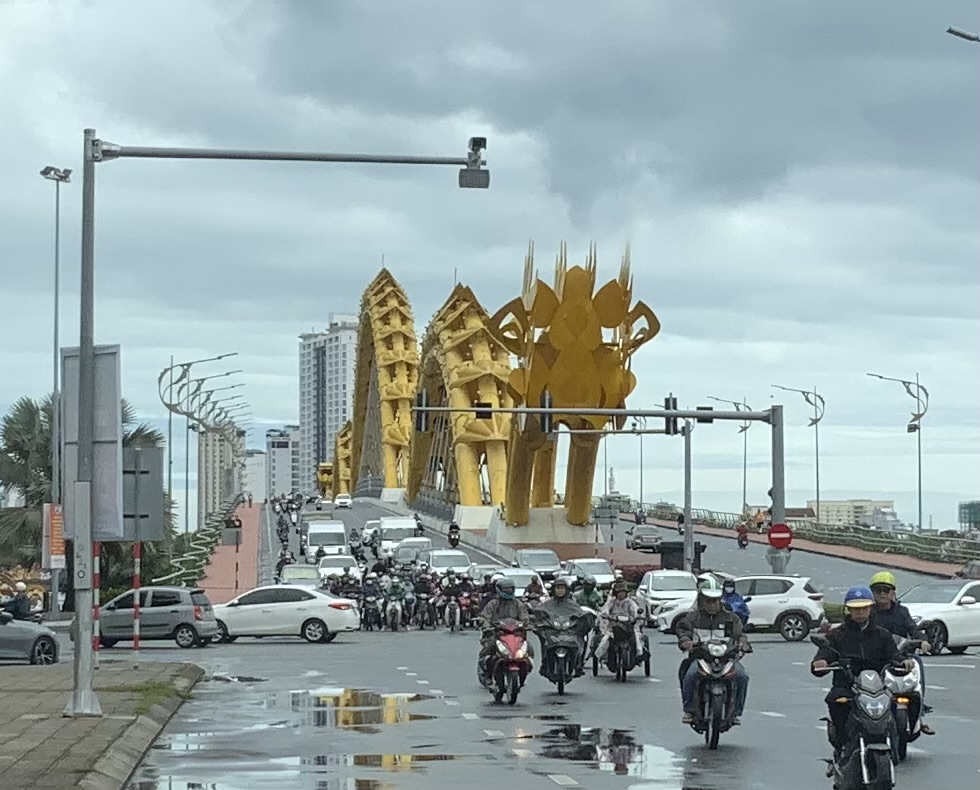
We crossed an amazing dragon bridge in Danang, the head is decorative, but the back is all structural and it’s designed to spew fire and water as part of a show on Saturdays and Sundays. This bridge was built both to welcome, to give a sign of luck and strength and to withstand typhoons. There can be 8 typhoons a year in Danang – from October to December mostly – and it takes a toll, However, in the last 3 years, no typhoons have hit. Instead, because of climate change, now the typhoons are moving to the north. In the last years, they’ve wiped out northern villages because the buildings weren’t designed to withstand the storms.
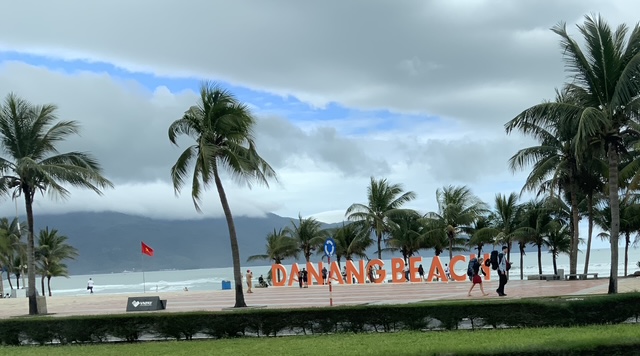
Danang is a pretty city, 5th largest in Vietnam, and modern because of how much was destroyed during the Vietnam War. It was in the midst of the DMZ. We drove along Danang Beach, which was called China Beach by the Americans because of all the pieces of Chinese pottery they found on the beach. Danang has grown steadily and there were a lot of big and gorgeous buildings/hotels, restaurants along the beach.
The next time I opened my book, When Heaven and Earth Changed Places, she was on China Beach in ‘86, first visit back from the States. She described it as shacks lining the beach, some still with GI writing on pieces of the walls. Most people wore black pajamas,but with western wear starting to get mixed in, and there was a peasant market on the street across from the beach. There was not a remnant of that scene now, almost 40 years later.
Our guide said that this city is a common spot for Korean visitors. They liked that it was a newly built city, very clean and Danang advertises to the Koreans – there are now 10 flights a day between Korea and Danang.
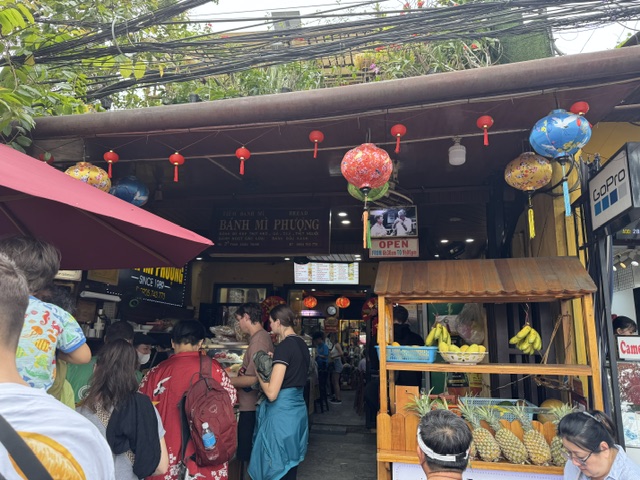
We drove straight to the old city of Hoi An and first had lunch at a well-known bánh mì, or sandwich, shop. It was a classic little store front business until Anthony Bourdain visited. The owner has now built this shop as well as two others. We walked into a large 2 story shop filled with people and the bánh mì were really good. I think it’s mostly because of the great French bread rolls. The first time we had them in Hanoi, we decided it was a mystery interior and just ate them. You can see Anthony Bourdain’s photo proudly displayed.
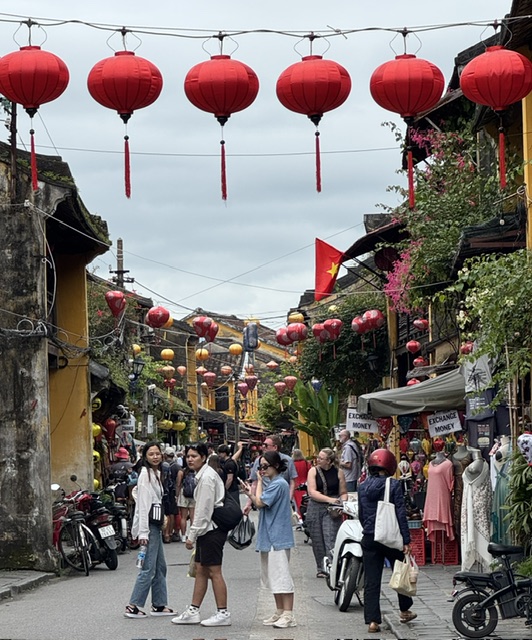
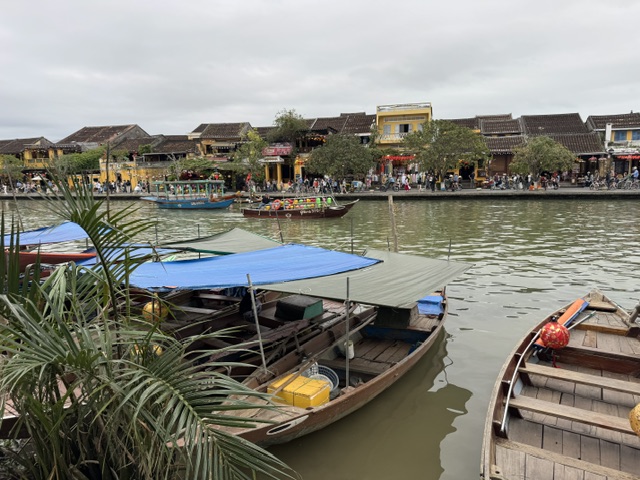
We then started exploring the old town of Hoi An. Hoi A was a trading post in the 2nd century and was an economic hub during the Cham Dynasties (7th–10th centuries). In the 16th century Hoi A became a major international trading center. It was a center for the spice trade and a settling point for Chinese merchants and soldiers. In the 18th century, the town was a top travel destination for Chinese and Japanese merchants. In the 1800’s many of the buildings were renovated with traditional methods. It’s now an UNESCO site. And filled with tourists. Every storefront targets tourists and only the pagodas are still used, though again, filled with tourists. And, yes, we were joining the throng!
During typhoons and storms, the river floods and the stores are inundated. When Kylie was here, it was raining a ton and she said the river flooded and all the shops had water in them, but the store owners were matter of fact. They raised everything up to higher shelves and when the water went back down, they cleaned and the lowered all the goods.
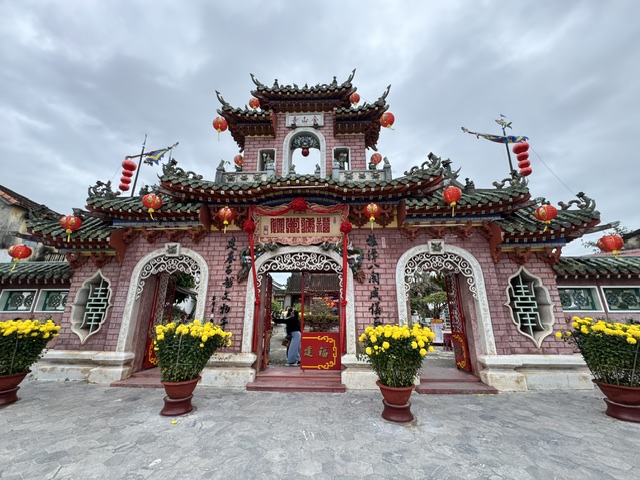
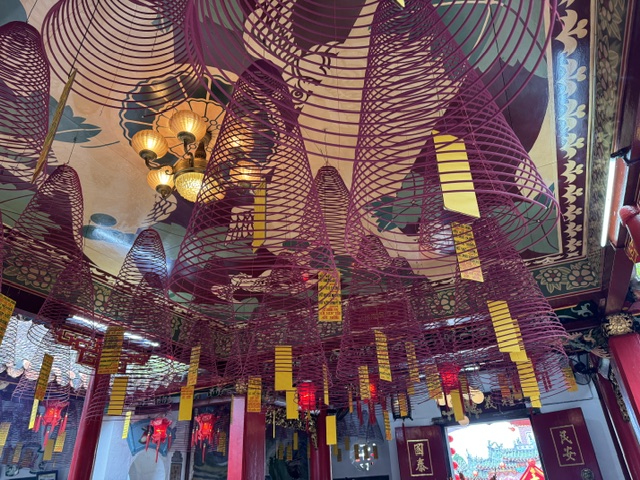
There are temples throughout the town, mixed in with all the colors and shops, you could walk by and not even see one. As noted above, this was a Chinese center and still reflected this in the temples. This temple was notable. Quan Cong Temple, 1653, constructed as a place of worship dedicated to Quan Van Truong. “He was the famous general with talent, steadfast spirit, bravery, righteousness and virtues of an honorable man, living in the period of ‘Three Warring Kingdoms’ ruled by Han Dynasty, China.
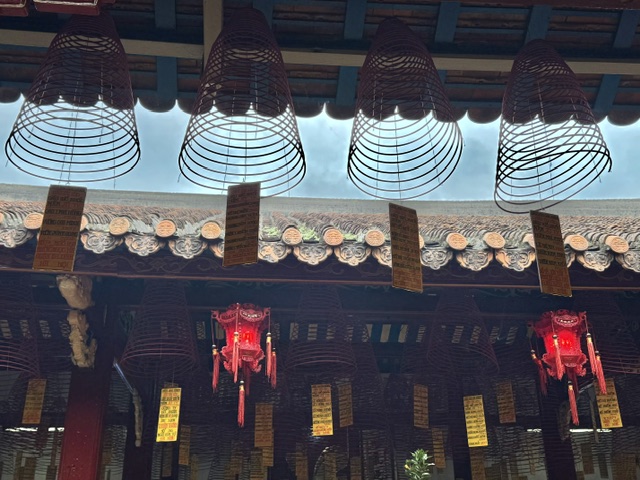
The cones of incense above were amazing, each one burning very slowly and sending up the prayers and blessings that are written inside for as long as they’re burning. Scott was fascinated and bought a large one for Hakubai, hoping that the flattened cone will loosen when the box is opened.
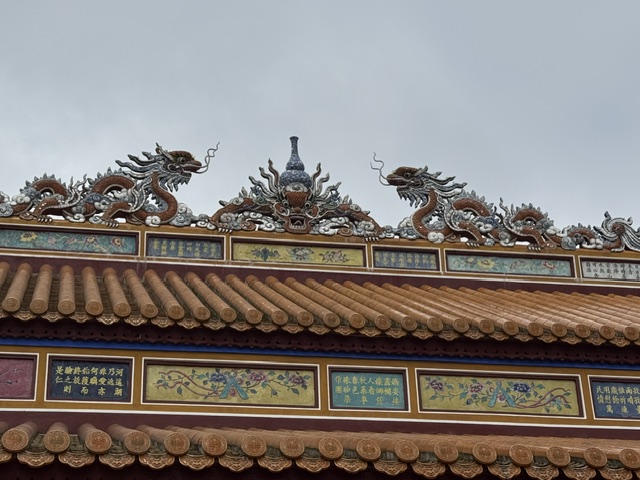
Again – the details. In this case for the roof tiles
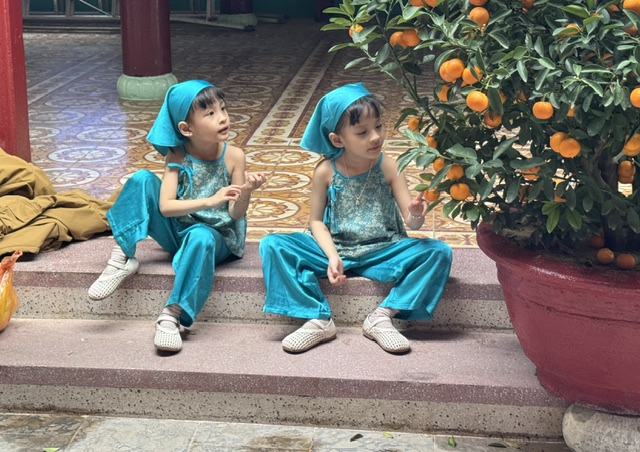
And the kids – we could have taken a gazillion photos of children all over, but were trying to be respectful, so didn’t get that many shots.
For us, the weather was perfect. A little cool, misty and we were able to walk and explore. We knew that this town was famous for hand tailoring any kind of clothes you might want in a very short period. I wanted to see a store, but Pat had already planned to have 2 linen shirts made. So we walked, took photos – so photogenic – and then stopped at the store. And it was THE store according to our guide. We liked the whole experience of being in the store, looking at patterns and fabrics and all but Scott ended up buying something. Fun and funny exploring the options.
The manager gave us a tour, talking about how they started, the first one and set up a training school to make sure the clothes were made perfectly. A customer chooses a pattern and a fabric, then comes back the next day for a fitting and then picks up the piece (or it’s delivered to the hotel) the next day. It can be finished in one or two days. Each tailer takes one item at a time, then a finisher makes sure all pieces are perfect, clipping strings, etc., then ironed and handed over.
We left and walked across the bridge to the new side of town and waited while Scott and our guide found a restaurant and reserved a table for the next day to watch the river of lanterns. River of light? Can’t remember, but it’s beautiful.
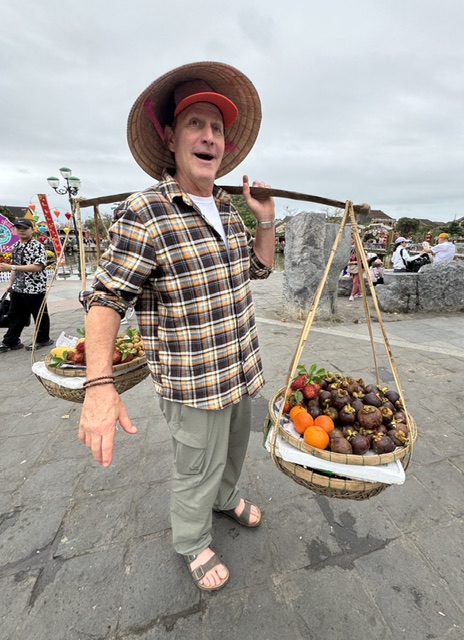
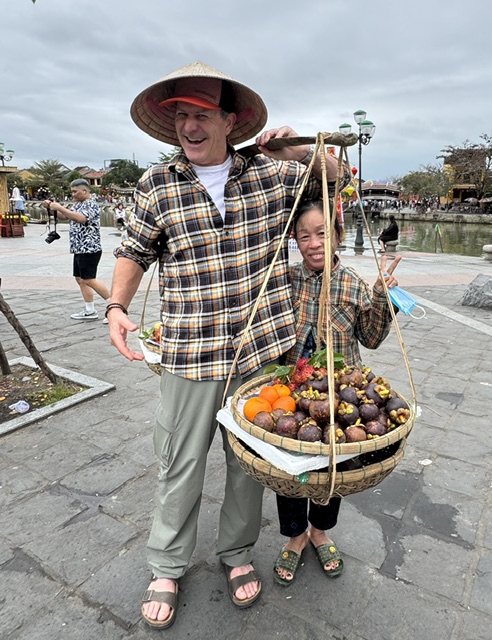
While we were waiting a small woman came up behind Pat and suddenly dropped her baskets on his shoulder, completely surprising him. Luckily, he’s strong because it was heavy! We were all cracking up – she put her hat on his head and then agreed to stand next to him, still laughing.
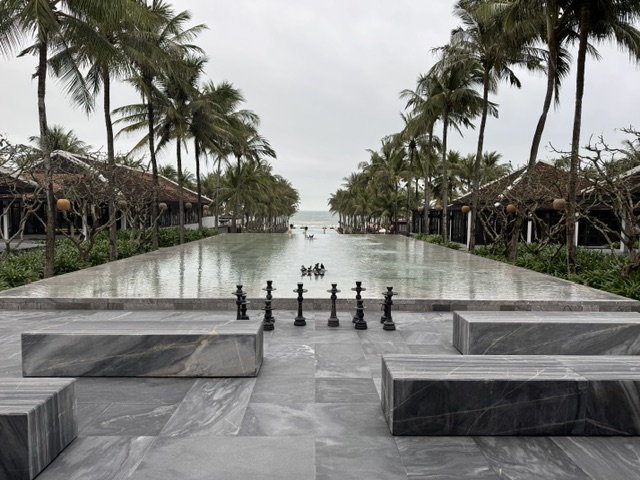
We then went to our hotel and our jaws dropped. It was so beautiful. Very simple clean lines, many pools, restaurants and we were very pleased that one of our days was going to be free to just hang out.
We stayed in for dinner and just enjoyed the scenery.
Every day has gotten better. Today was so interesting. I confess, I did a fair amount of it a bit dingy since I woke up at 2:30; we’re all dealing with jet lag at different paces. But – it was a great day.
Our new guide and the driver are delightful. Yesterday, in our group we discussed communism and Vietnam and how Hie, our guide, seem to portray in action someone very devoted to and admiring of the system as well as being anxious that he did everything right – with what seemed like concerns of who was overseeing his work. That may be just our projections, but we all picked up on it. He also talked about the cement “king” just doing what you can do if you’re rich – you’ve worked hard and are able to show off your success.
He was truly admiring of Ho Chi Minh, thought that Vietnam (or at least as he presented to us) was a country of one people, no north or south except for direction and location of cities and that all benefited by the one party system. Holly, last night at dinner, had read to us of a Proclamation, secretly written by the politburo last year, prior to Biden’s visit. This was not to be supposed to be disseminated, but was leaked. The document expressed the politburo’s intent to open more and more to market systems, but that there would be further suppression of any free press (there is none) and opposition parties. Yes, a market economy but ruled as a one-party system.
Our current guide’s family was from the center and supported the monarchy and republic from generations back. His family’s history reflected the book I’ve been reading; this is a much more nuanced country than was presented by our other guide who’s based in Hanoi and has always supported Ho Chi Minh. Our Hue guide’s family were intellectuals, had served in the republic and were pretty well off. Their house was taken, they had to flee, and when they were allowed to return, a government official had taken over their house.
We asked about the cement king and he said, yes, he did earn that, he was also given the rights and privileges because of his party connections. It’s not in isolation. He told us of struggling to find his way for a living and finally realizing that maybe he could train as a guide. He spoke both French and Vietnamese and was studying English. He scored the highest score in English and when he went to the school that he was trying to enter, he should have been assured of a spot because of his scores. Instead, his name had been erased in favor of someone connected to the party.
He also said that it’s definitely not one country in terms of how people feel about the party, but that all the way to the most southern parts, everyone loves Ho Chi Minh. So the narrative as presented at Ho Chi Minh’s mausoleum and his homes may in fact have been a pretty accurate story of how he lived his life and his commitment to his people. Again, per our guide, I guess Ho Chi Minh was horrified by the Tet offensive and how many of his own people were killed and targeted, but he was already very ill by that time. There is speculation that his generals held off until Ho Chi Minh was quite sick to initiate the offensive and then the news was what finally undid him. Interesting slant.
Honestly, there’s been SO much to learn and think about that I can’t write it all, but wanted to get the highlights down. And I haven’t even started on what we saw!
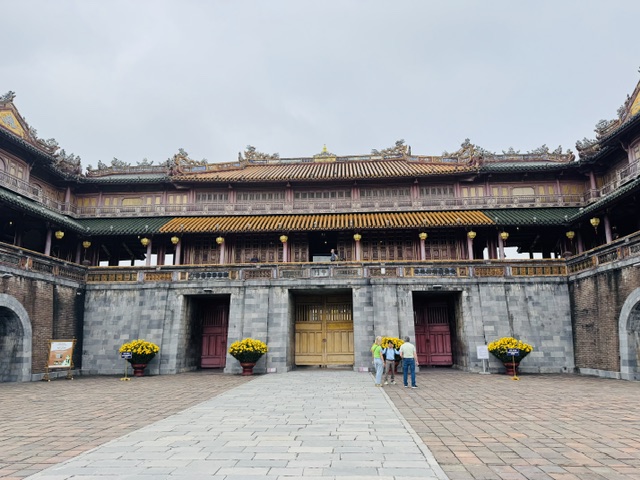
We’re exploring Hue now. It felt like a really nice city as we drove through, seemingly middle class, nice size and comfortable. From 1802 to 1945 Hue was the capital city of Vietnam under the Nguyen Emperors who were based at the Imperial City, Hue’s great walled citadel inspired by the Forbidden City in Beijing. The complex originally contained over 160 building with ornate palaces, pavilions, gardens and gateways in traditional style dominating the site. Most remained unchanged until 1945 with the last emperor was deposed.
Battles then took a toll, first between the Viet Minh and French in 1947, burning the core including the main palace. Worse happened in 1968 during the Tet offensive between the VC and the US (who originally refrained from bombing the area in order to avoid damaging the historic structures, but as fighting intensified, restrictions were ignored). After the Battle of Hue, only 10 major sites survived. Now many are restored, but large empty spaces are left to show a hint of what was lost.
Our guide told us that Nguyen is the most common name in Vietnam. When mandarins (soldiers) wanted to move up, they gave their daughter to the king, who never said no. So all those children had the name. Then when wars were fought and there were prisoners, they could be let off more easily if they took Nguyen as their last name. Same for peasants who only had first names. If they would take Nguyen as their last name, it gave them a leg up. Currently 40% of the people in Vietnam of Nguyen as their last name.
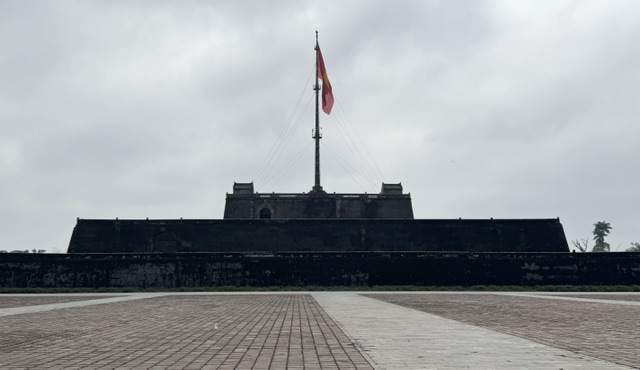
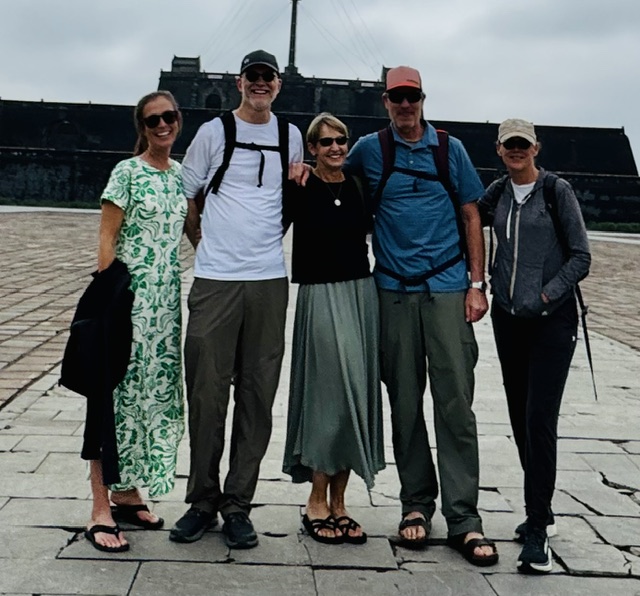
Since the Citadel was the name of the area we were seeing, I assumed we’d be spending our time exploring the fort:
But no, we were on our way to seeing some incredible temples.
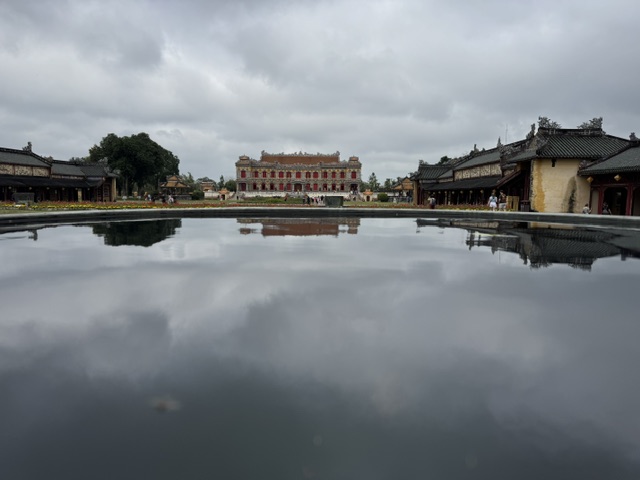
These Nguyen’s are the ones who rebuilt the temples in Hoa Lu on the origins of temples from then 9th and 10th century. The Hue Imperial Citadel was beautiful, with building after building lined up on a grid. This area was heavily bombed during the Vietnam War (Tet offensive happened here) and was the middle ground, so back and forth between the republic and the VC. Large sections of the Citadel were preserved and others have been restored. Then there were large spaces where the entire temple was gone.
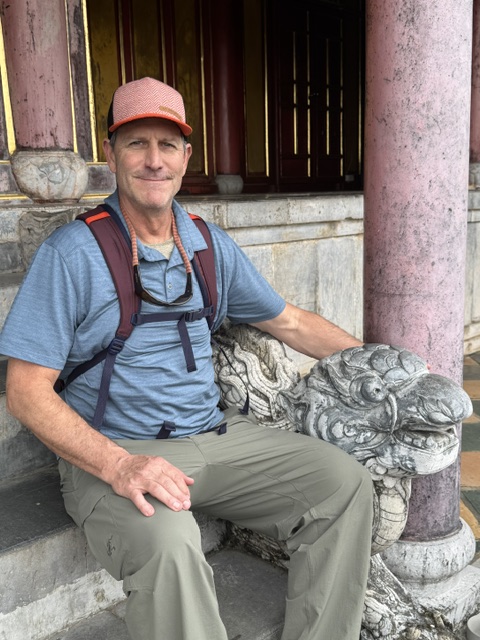
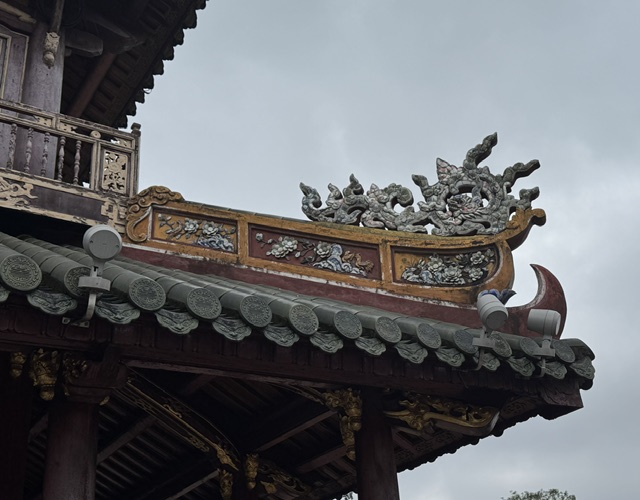
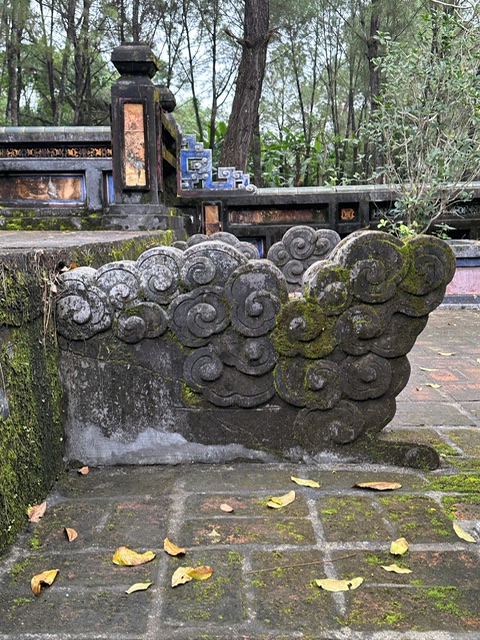
Shoot, I can’t remember the name, or find it online, but this precursor to the staircase banister was one of the many details that Pat loved seeing in the architecture. The details were incredible!
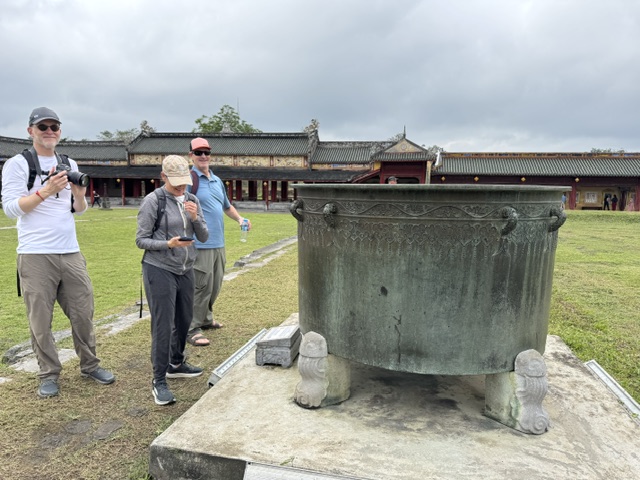
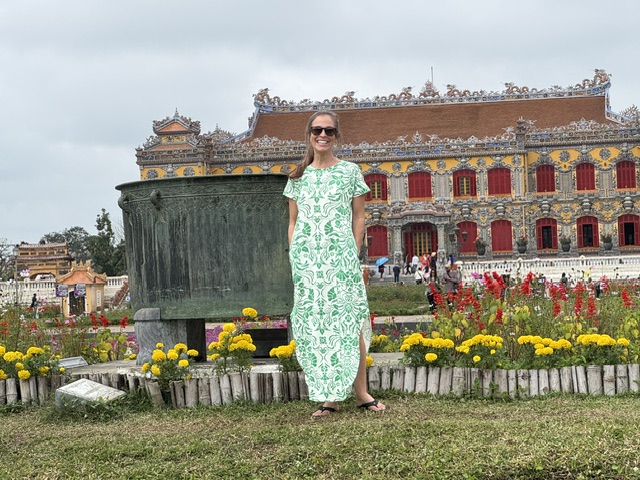
Per our guide’s advice, the photo above was taken from the top of the brass cauldron below.
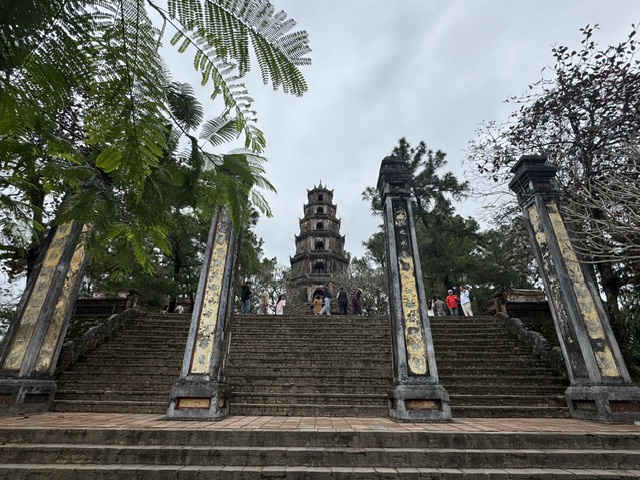
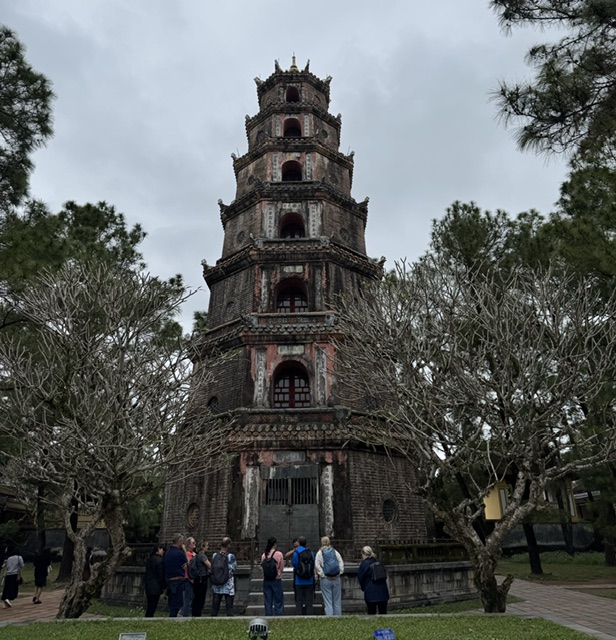
We then drove to the Thien Mu Pagoda, Hue’s best preserved religious monoment and still an ongoing monastery. It was built in 1601 and is a 7 storied tower pagoda, on top of a hill overlooking the Perfume River. I guess it’s an iconic image of Vietnam, it was new to me. But – this monastery, so far, stands out for me as the most wonderful place we’ve visited.
As soon as we passed the pagoda, the architecture became much more simple, one story, white with greenery all around. The plantings were incredible and so very intentional.
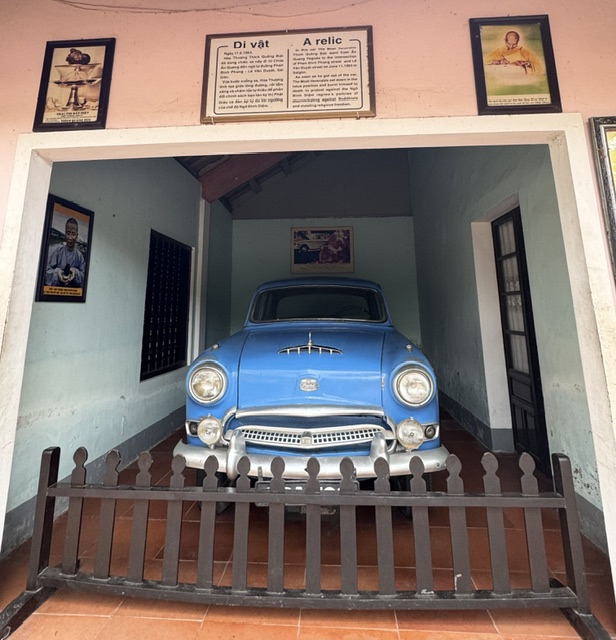
The first building had an old car with the story of a monk who had immolated himself. 6 of his fellow monks had done this in protest in Hue. This monk took this car, drove it to Hanoi, stepped out and put himself on fire. Incredibly sad. His face was beautiful, and such a commitment to his practice and protesting what was happening to Buddhists in the war. Somehow, it was a peaceful memorial, perhaps because of his photo.
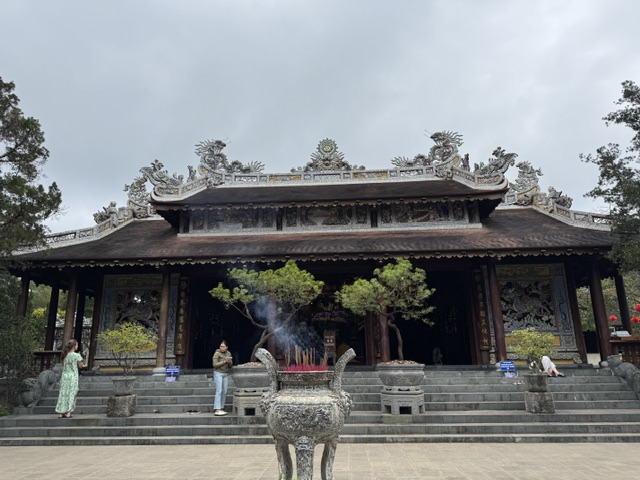
We then continued back into the property, all of us spreading out, called to different areas, architecture, and plants. There was an incredible and ancient bonsai garden. I could have stayed there for the rest of the trip. There was something rare and peaceful that seeped into your bones if you stood still for even a moment.
And then yes! There was more. Such a day.
Next we visited the Khai Dinh Royal Tomb. This tomb was built for a king that had 132 wives and no children, maybe he had smallpox? But he wanted to have an incredible tomb. Khai Dinh was the penultimate emperor of Vietnam, from 1916 to 1925, and widely seen as a puppet of the French. It took 11 years to construct his flamboyant tomb from his designs, finishing after he died.
Confession here – I didn’t take my phone. Probably forgot it in the heat and long day.
As our guide said, the king was 50/50 good/bad. He built wonderful buildings that lasted, an entire complex that was Feng Shui. And he killed over 200 people because he forced them to keep working all summer in the brutal heat. This king wanted to leave a record of his accomplishments and wrote 500 Chinese characters on a large stelae, finishing it before he died.
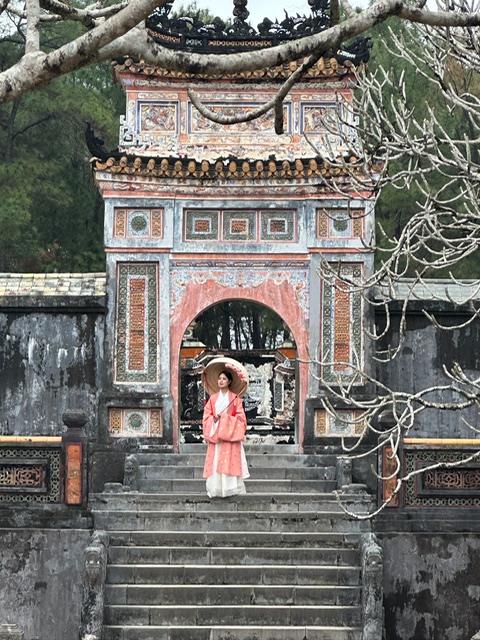
There was a standout “instagram” woman at this place. She/her photographer chose perfect places for her to pose and her outfit was the most spectacular of the MANY costumes that we had seen. They’re very serious in these poses, but when Scott walked by her and told her how beautiful he thought she was, she gave him a big grin. Photo courtesy of Scott:
As part of our tour on this day, we went to the Tu Hieu Pagoda where Thich Nhat Hanh died. Thich Nhat Hanh was a Vietnamese Zen master, poet, scholar, and peace activist. He was born Nguyen Dinh Lang in Hue in 1926. He was cremated after his death in 2022 at the age of 95. His funeral was a seven-day silent meditation course. Thousands of people attended his funeral at the Tu Hieu Pagoda.
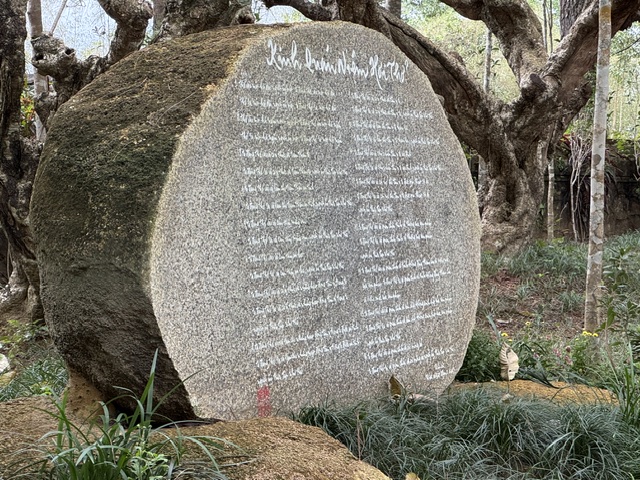
A slim chance was offered that we could go to the 4am chanting practice in the building where the monks practice, but our guide wasn’t able to find any monks and the buildings where he had gone before were locked behind a fence. We did see TNH’s burial tomb and the stone with a piece of his writing next to it. I would love to know what it says, but the script defied all of the translation apps. I’ll keep searching.
It was amazing being somewhere that Thich Nhat Hanh had been, but it didn’t feel like Thien Mu Pagoda and monastery. Still – a gift.
And finally, Scott had asked about where incense was made – we’d been seeing these astonishing circle incense burners that could burn for days, sending prayers and blessings out once lit. Turns out that right near Thich Nhat Hanh’s burial place was incense row.
Sadly, I was tired and missed getting a photo, but take these photos of this shop’s incense and multiply it by 10? 15? For all the stores in a row, beautiful. We ended up buying a variety of things here. We took so long, they finally gave us tea and ginger and we just sat down while they made a bracelet for Pat.
That was our last stop. Our guide said there was a great restaurant 10 min from the hotel, bit all we could think is that when we got back to the hotel, we weren’t leaving!
In the meantime, our guide was supposed to drive and drop us in Hoi An, the next town, but we liked him so much, we asked him to stay with us and do a walking tour of the town once we got there. And he could! That’s tomorrow.
Note from yesterday – forgot Kellie finally getting to see a water buffalo.
Yesterday we were all a bit underwhelmed with the previous day so we didn’t have high expectations for today, but it was great. So incredibly interesting. First, we drove enough to see much more of the city and there are gorgeous buildings built both by the Vietnamese and by the French during colonialization, in addition to wide avenues and lanes of trees.
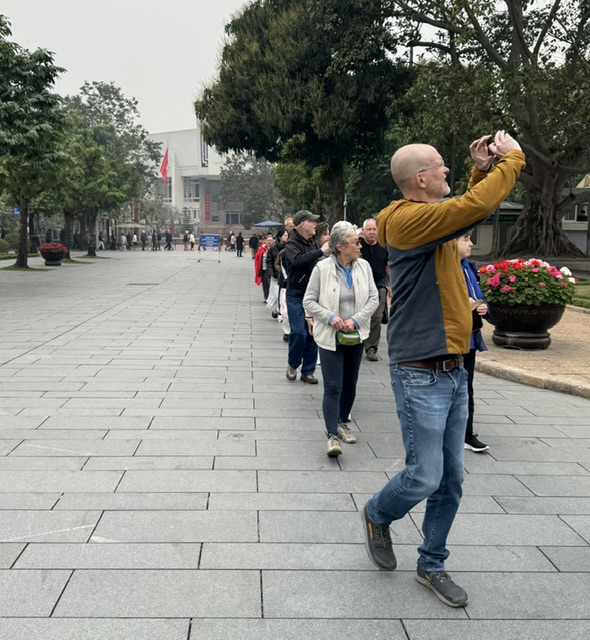
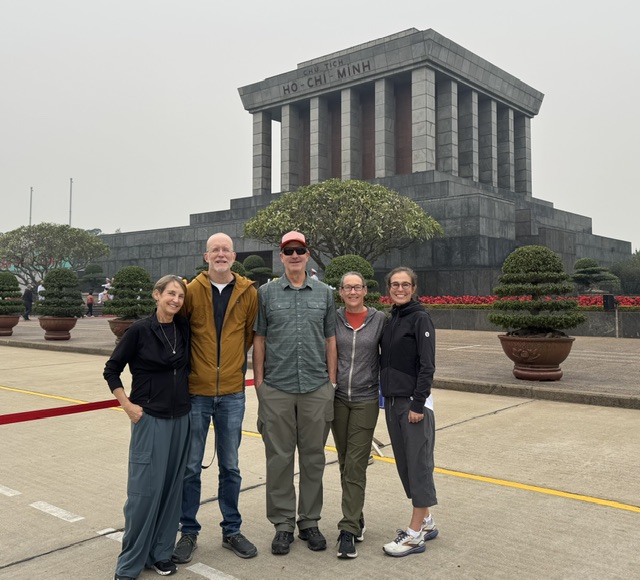
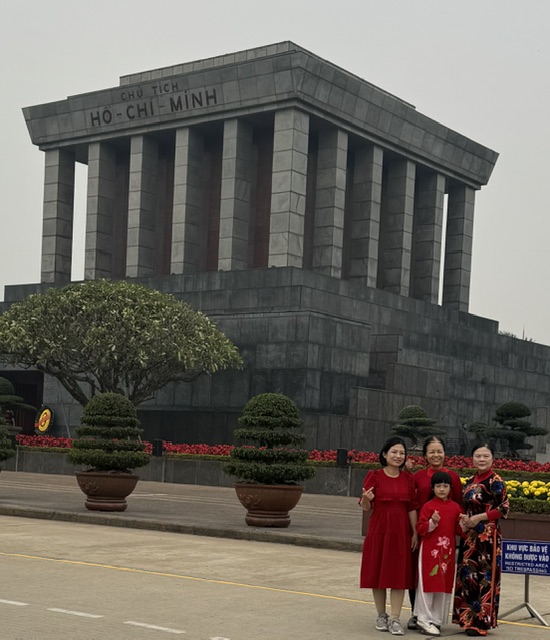
Our first stop was the Ho Chi Minh Mausoleum, housing the “beloved revolutionary leader affectionately known to the Vietnamese are Uncle Ho.” It’s interesting learning the Viet Cong side of things since the book I’m reading is based more on the Republic’s view of the war. Our guide was adoring and proud of Ho Chi Minh and there were hundreds, thousands?, of people in line and moving respectfully through the paths in the compound towards the mausoleum. No cel phones were allowed past a certain point, well before the building. One small group of older Americans ahead of us were pretty oblivious and despite warnings from the soldiers, one of the women kept pulling out her cel phone. A soldier finally confiscated her phone and then escorted her all the way around the room of the actual body, then in an office at the bottom deleted all the photos and video she was evidently collecting.
The line curves all the way back and around – and we had to stay single file, our guide kept asking us to move back to single file.
It was a very quiet and respectful crowd, no knees or shoulders showing, no hats. It was actually kind of amazing to see this man so well preserved. That’s really Ho Chi Minh. The man who led this country and defeated first the French and then the American armies.
This is after we came out, then photos are allowed.
Saw the changing of the guard, the sign above them says: The Great President Ho Chi Minh Lives Forever In Our Cause. The sign greeting us as we walked toward the monument started with Socialist Republic, but I couldn’t get the rest from our vantage point after the tour.
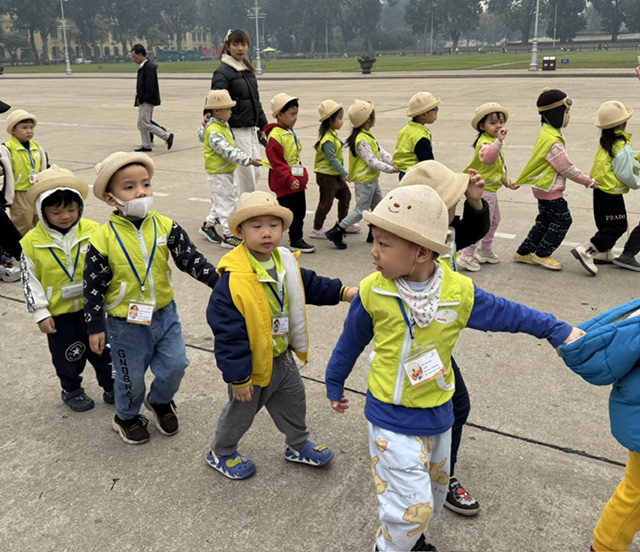
So many groups visiting, the little ones are adorable with all their matching hats.
Many of the visitors wore red and black. I never learned why, but assuming it’s the color of the flag and of communism.
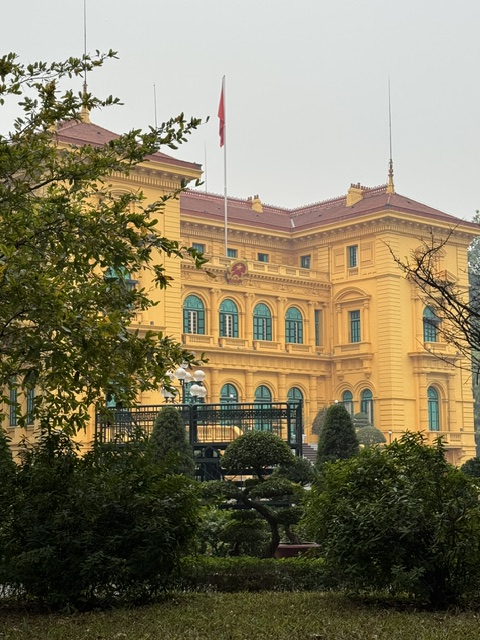
This was an example of one of the French colonial buildings. Gorgeous, but Ho Chi Minh said he wouldn’t stay there, too fancy, he made it into a greeting building for when international dignitaries came.
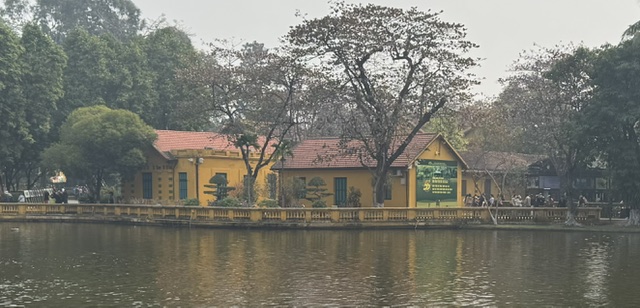
We then visited Ho Chi Minh’s complex. He lived there from 12/19/54 to 9/2/69, “mapped out the Vietnamese revolution, let the Vietnamese people to construct socialism in the North and fight the American aggressors in the South, contributed actively to the struggle for national independence, democracy, peace and social progress worldwide.”
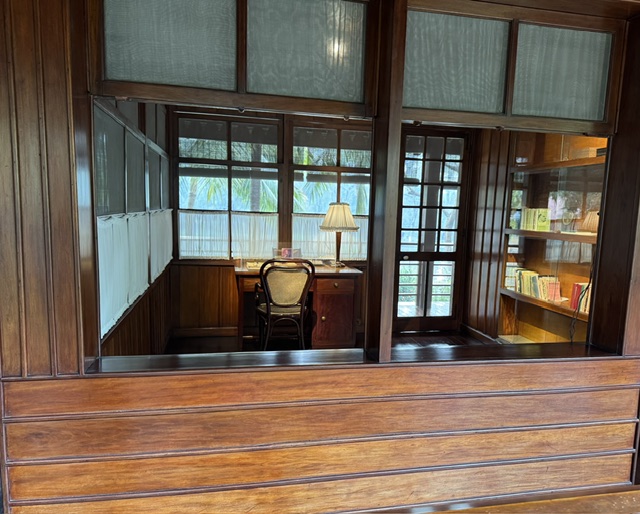
We saw where he ate, had meetings, etc. It was a pretty compound, not at all pretentious and his home was small and quite simple.
The people then built him a new house, really beautiful, of wood, 2 rooms living above, small office and small bedroom and an open meeting area below. It almost felt Frank Lloyd Wright like. No kitchen or restroom, he went over the other house for those needs.
We were wondering what others in the south would say about him, “Uncle Ho”? Or with families who were with the republic, would it be different? The narrative was consistent with both our guide’s stories and the written pieces around the compound of a beloved leader. Ho Chi Minh was a man who kept things simple and walked rough paths with bare feet so that he could walk with the people in the south when he went to visit. He was a reader with books next to his desk and photos of Marx and Lenin above his bookshelf. And completely committed to his people and their well being.
Maybe he didn’t know what the Viet Cong were doing to their fellow Vietnamese? Of course, it went both ways, but knowing how the South in the US still thinks about the “War Between the States”, I’m guessing it’s not quite so consistent a story line throughout the country. But still – it was fascinating.
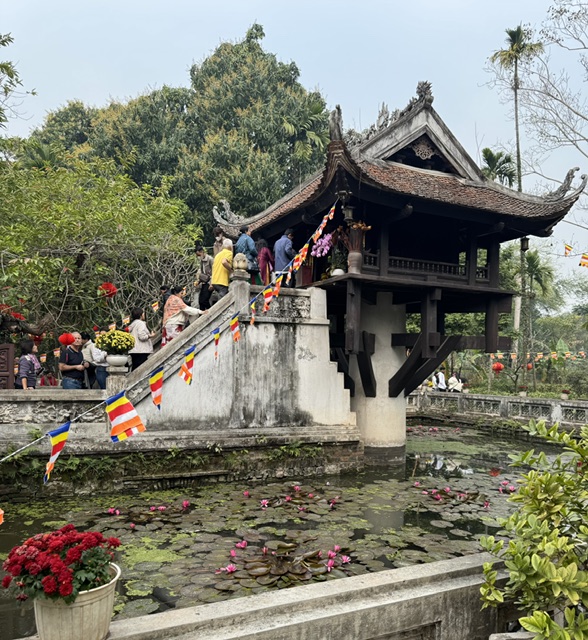
We saw the One Pillar Pagoda, also in the compound. This is a Buddhist temple built in 1049 in the shape of a lotus blossom and set on a single stone pillar, considered by many to be one of Vietnam’s most iconic pagodas.
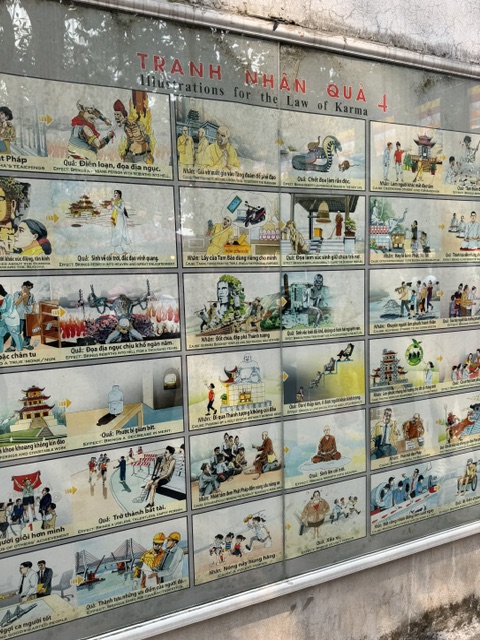
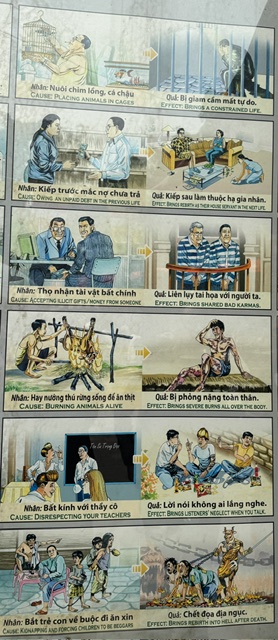
On the surrounding walls of the plaza were murals of Illustrations for the Law of Karma. Lessons on every one. Kellie and I couldn’t get enough of them. I just kept photoing and cropping to be able to read them.
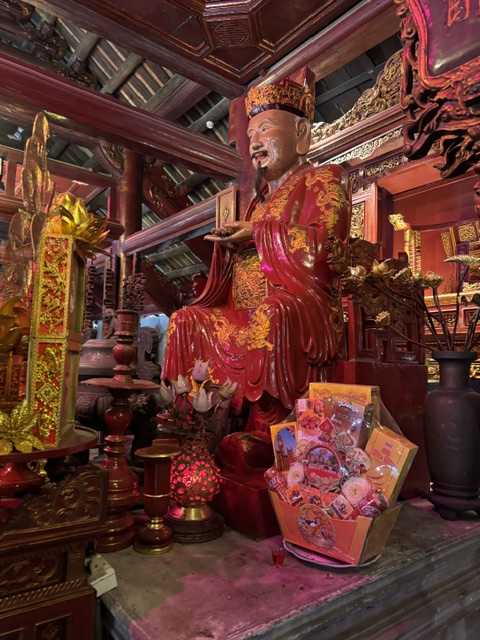
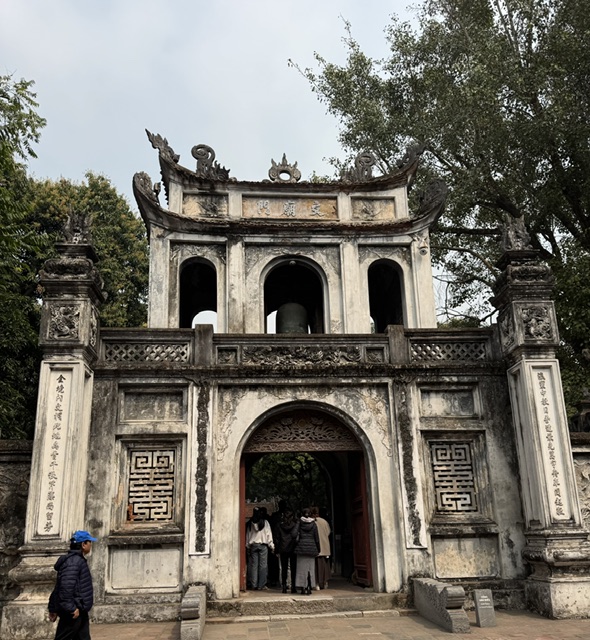
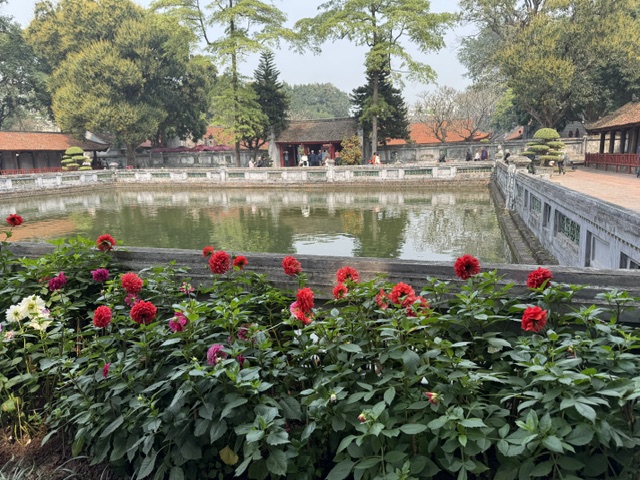
Then we saw the Temple of Literature. This was great. Founded in 1070 by Emperor Le Thanh Tong, this complex is dedicated to the Qufu-born philosopher Confucius (Khong Tu) and was the site of Vietnam’s first university, Quoc Tu Giam (1076). The altars are still popular with students praying for good grades. In 1253 the university was expanded to admit excellent students from common families, becoming a leading educational center and a place to select talented individuals for the country.
Confucius:
The analogy for the scholars was a fish becoming a dragon – the ultimate symbol in Vietnam. The fish were swimming around and a few exceptional ones were plucked out, they were then on their way and with each accomplishment shifted little by little until they completed their imperial exam and became like a dragon.
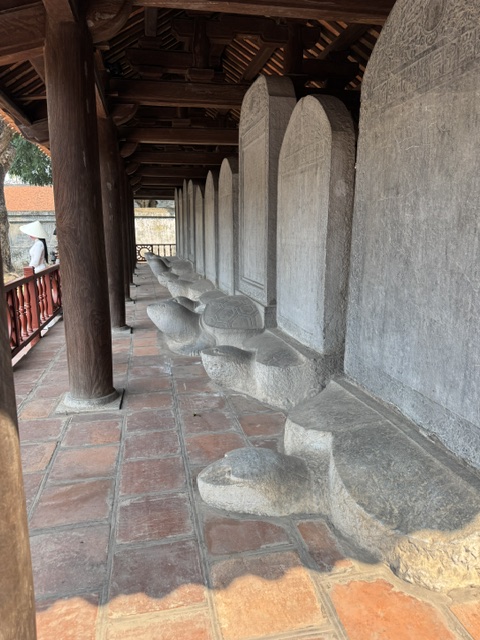
The classrooms, library, and dorms had been rebuilt to resemble the architecture at the time and were beautiful. This school continued from the late 11th century to 1779 when the last exam was given. Over these 100’s of years, exams were only given 116 times, with 1,032 people graduating.
Each time an exam was given, a turtle was carved and a panel erected above it. There are 82 of these carvings left. The graduates were all then launched into careers supporting the king and other areas of government. Their name was enscribed on the panel. However, if they were not illustrative or successful, their names were then erased.
Our final stop after a quick lunch was the Hanoi Hilton, named by the American POW’s, all of whom were titled pilots by the Vietnamese regardless of their role in the war. This was grim, of course, because it was first built by the French to punish political prisoners and criminals. The political prisoners were treated much more harshly. It was then used by the Viet Cong for their prisoners. I don’t know what the reality was for the Americans imprisoned there, but there were photos of them having Christmas, playing games, reading letters from home, etc. Of course, this is Hanoi and they were looking for American visitors.
And now, we’re flying to Hue, the imperial capital of the Nguyen Lords from the 17th to the 19th centuries.
We stayed in yet another totally cool and old hotel, had dinner, went to bed. Notice I don’t say to sleep. Jet lag is a strong companion, but it’s all so interesting that we make it right through the day.
Today, we all relished breakfast again, such good food. Pat and Scott asked the server about the Vietnamese coffee that is a traditional drink. It’s very very slowly pressed strong coffee with condensed milk and poured over ice. They decided to try the coffee. They both loved it, thought it was a great addition to the coffee repertoire. Even Scott who doesn’t normally drink caffeine. Pat began slightly hallucinating because it was so strong and on top of the coffee he’d already drunk, the caffeine load was big. He and Scott then jittered their way out of the restaurant 🙂
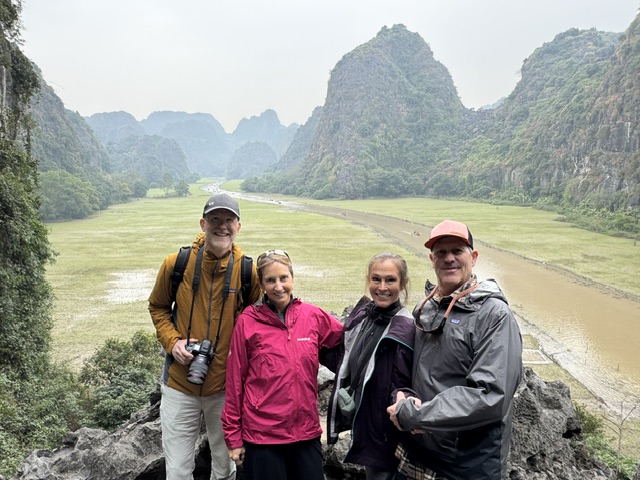
Today, we’re driving out to the Tràng An. A scenic area near Hoa Lú which is renowned for its boat cave tours and historic temples. On 23 June 2014, at the 38th session of the World Heritage Committee in Daha, the Trang An Scenic Landscape Complex was inscribed as a UNESCO World Heritage Site.
Honestly, it was a bit odd. It’s a two hour drive, we’ve been driving almost two hours now (I’m writing in the van) and it’s been a continual city spread, occasional rice patties, but mostly just a series of buildings, with occasional houses in the midst along the road. Reminds me of Houston, where the spread just never ends. The video shows a bit of this.
The photo here is the “house” of one of the two cement kings. As our guide says, if you have money, you can show off as much as you want. He wanted to build a house that looked like St. Petersburg. And he did!
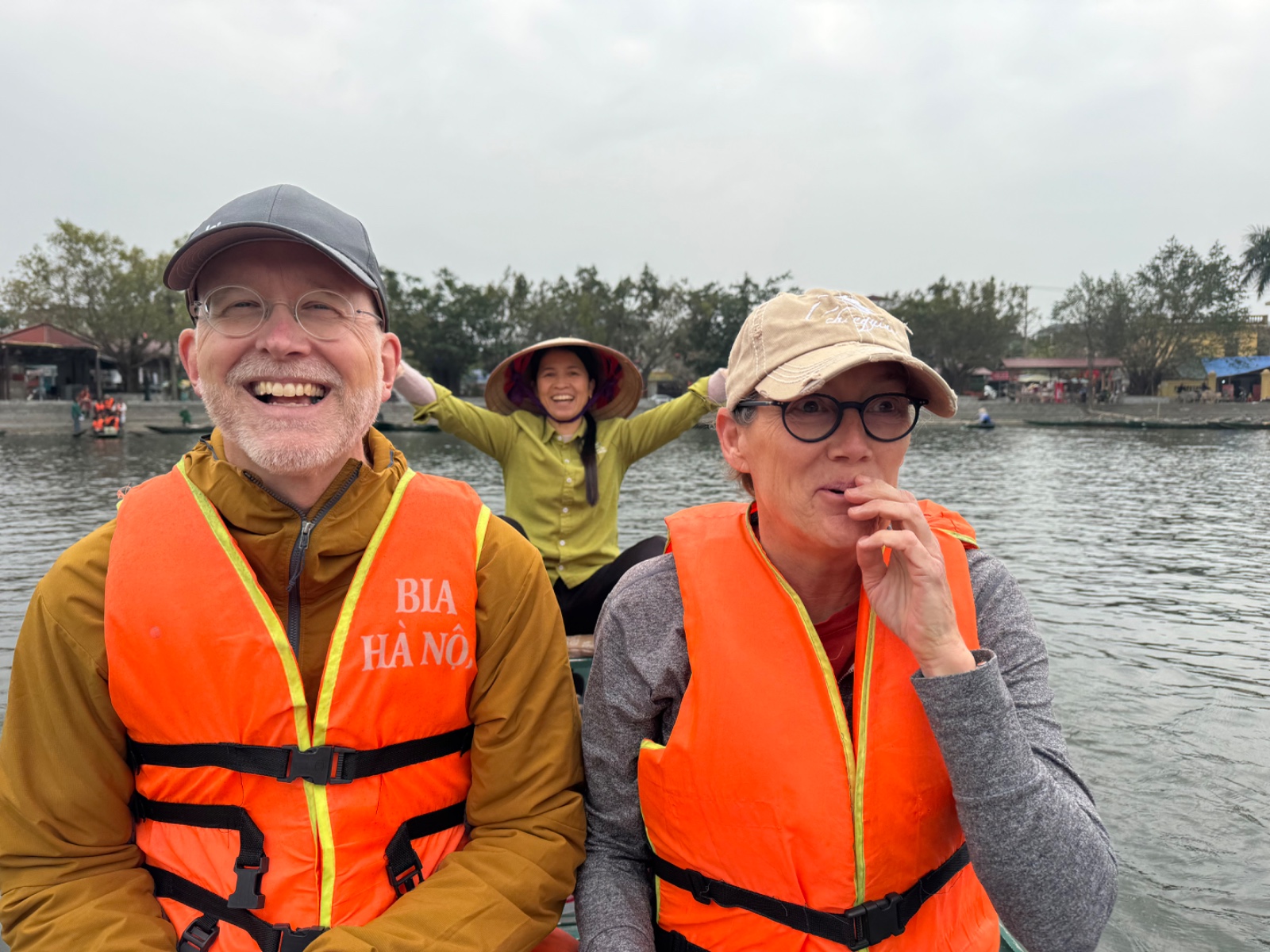
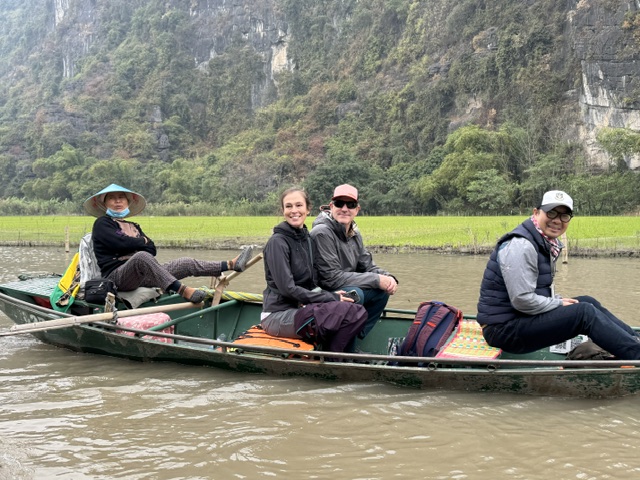
At the end of the drive, we got out and into an open air bus that drove us to a river spot. And we were in Disney. Well, obviously it wasn’t, but it felt like it. We got into boats, 3 into each with a rower; both of our rowers were women. The rowers were small and strong. They started off using hands, then switched to feet to row us for almost 2 hours up a river and then back down. So all these little boats are going along in a row, all visitors wearing bright orange life vests.
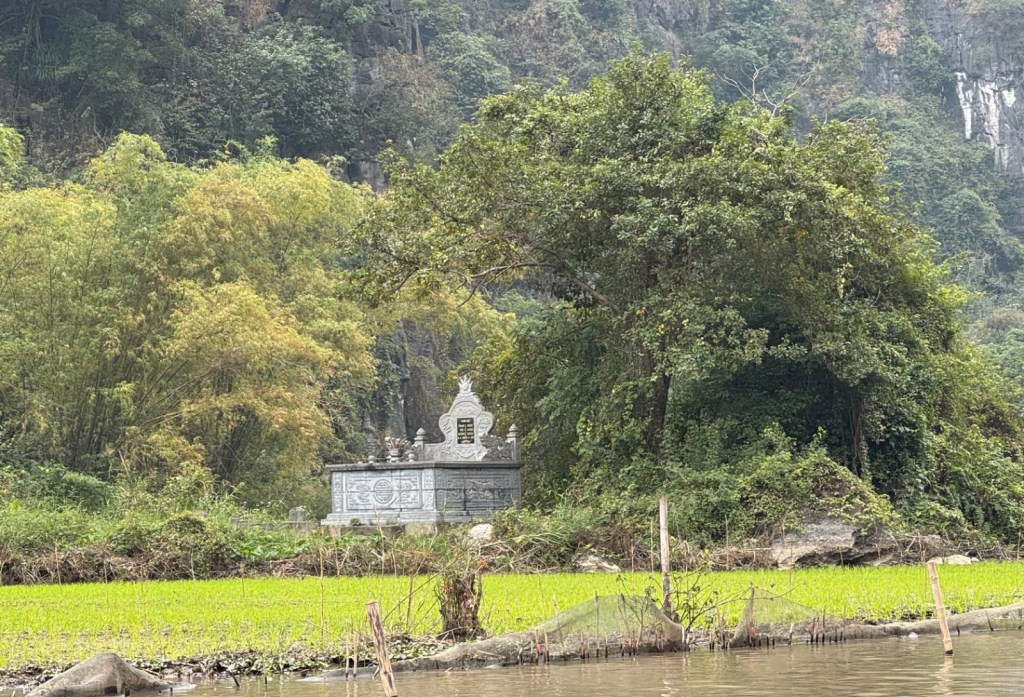
It was pretty rowing along the rice patties surrounded by the karst peaks. There were occasional cemetery spots or just a cemetery stone. The practice for cemeteries in this area is when someone dies, they are buried. After 5 years, the family lifts the body out of the grave, cleans the bones, then they put it back in with the rest of the family. The vaults along the rivers are recent and carved out of cement. Later they will be painted. Some of the cemeteries we passed were beautiful with the carvings and paintings.
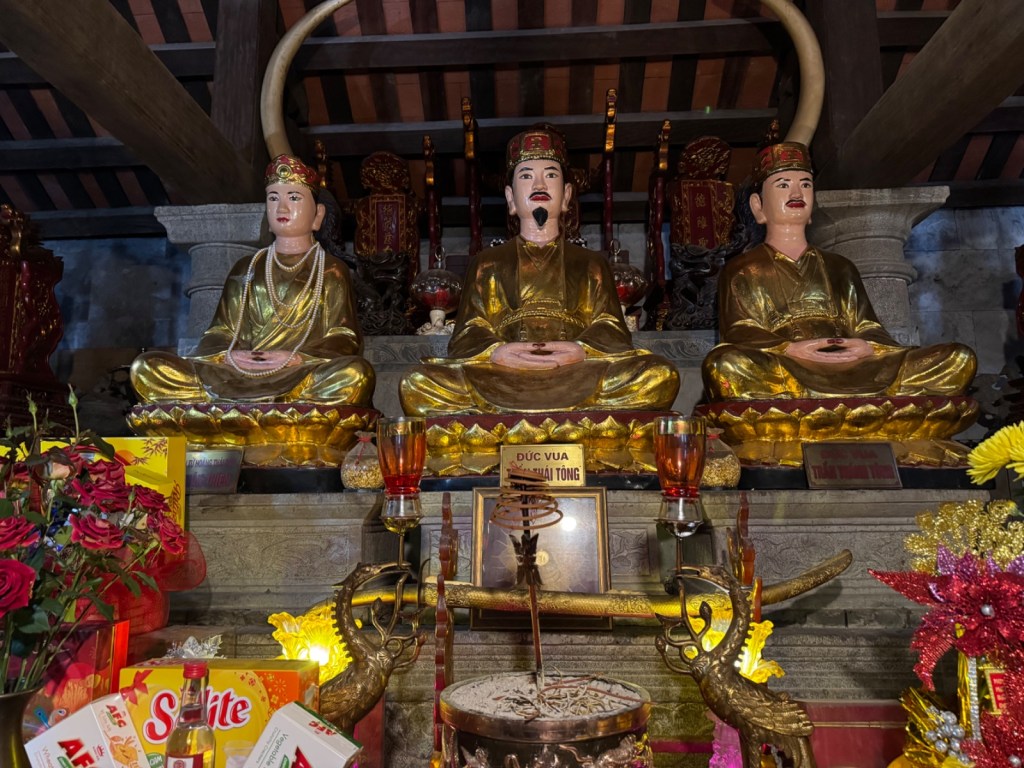
After almost 2 hours, we left the boats, thanking our guides, and walked along a path that passed an ancient small temple carved into the mountain. My photo translation of the stone said “The Tran Dynasty brought spring to the country after thousands of years of Chinese domination.” Thai Vi Lunh Tu was the leader of this dynasty who consolidated Vietnam and the various fighting factions to defeat the Chinese.
This cave temple was “The sacred place of worship of the Tran dynasty, established by the Supreme Emperor Tran Thai Tong, the first King of the Tran Dynasty to leave home and become a monk in 1273.” The final note on the stone was clearly a more recent note recognizing history. “Since the Dai Viet era, our people have always firmly protected the fatherland, all people as one, chasing the enemy to the north. The Tran Dynasty had great achievements in the three resistance wars against the Yuan-Mongol army. Generations of Vietnamese people have always worshiped the Tran Kings as the sun that appears daily from the east, radiating a radiant halo for the nation.”
Turns out that where we were going next after lunch was the 18th century recreation of the temples recognizing these original emperors.
Our guide told us that a temple honors kings/emperors and a pagoda is a place of worship and there were both in this site we were visiting.
But before that site, we went to a temple with some notes (transcribed) about the history: Thai VI Temple. Saving the country is a great achievement, the old temple is a 1000 years old, the Northern land is famous. May the people be blessed with endless blessings. Ancient temple, a building that the South can admire.
And no, it’s not a dead dog, just sleeping hard.
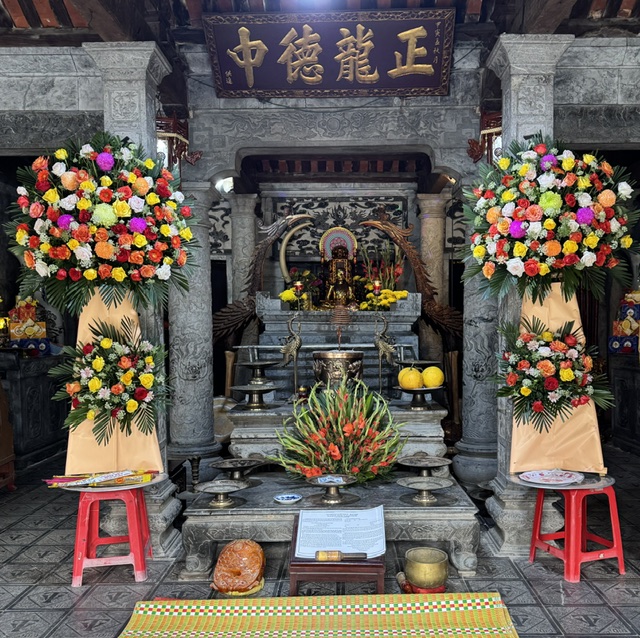
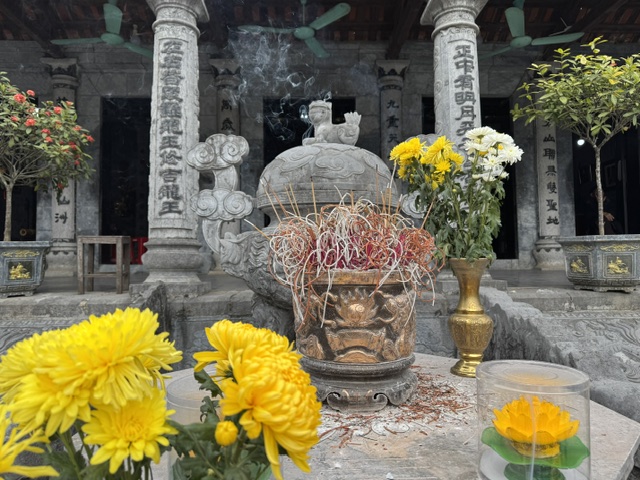
Incredible incense container behind the yellow flowers.
As we were leaving haunting music started, instantly transporting us back many years.
Then we saw the musician. I could have stayed there a long time. He told us that he was the last who could play the instrument and that no one wanted to learn.
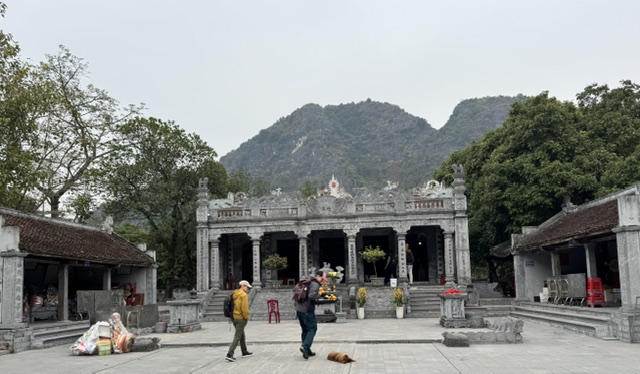
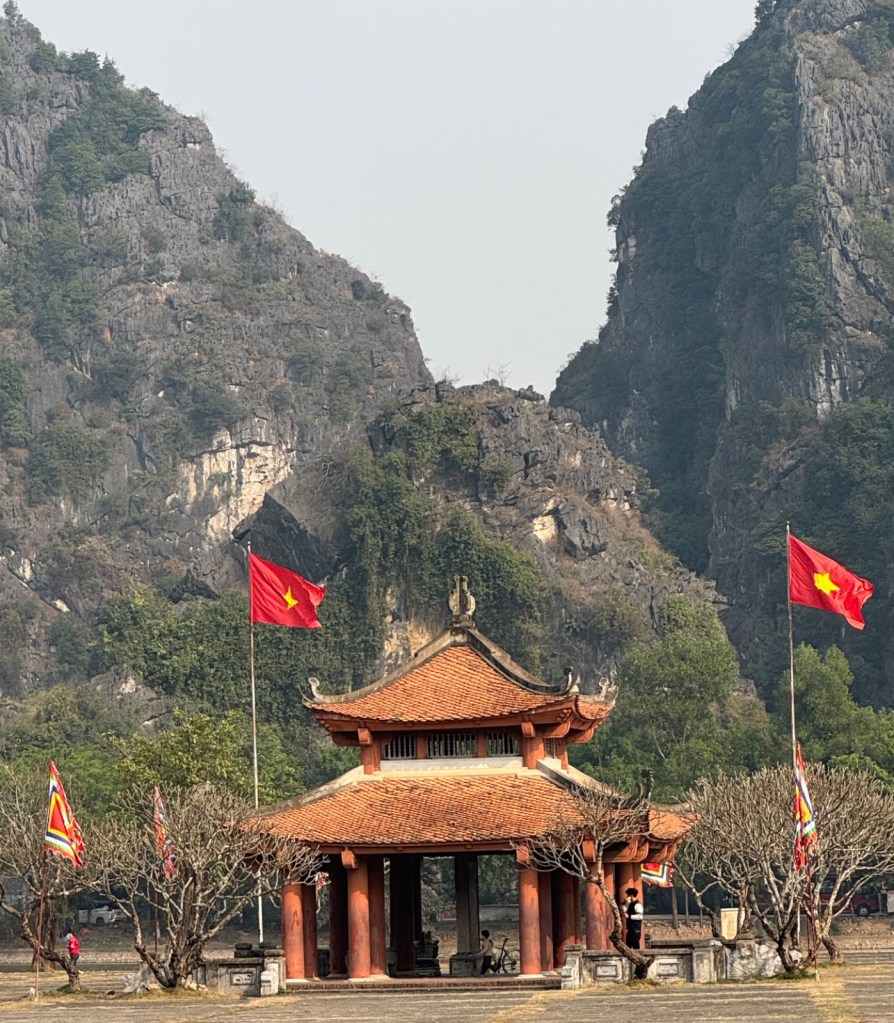
And now to the main destination. Lu is the site of a 10th-century capital of an ancient Vietnamese Kingdom called Dai Co Viet. This small Kingdom covered an area of only 300 hectares, and reigned from the 10th century, during the Dinh and Le dynasties to the 11th century, during the Ly Dynasty. In 968, King Dinh Bo Linh of Dai Co Viet (an ancient name of Vietnam) constructed his capital in Hoa Lu and ruled until 980. This first king fought off the Chinese and brought all the Vietnamese groups together. Hoa Lu endured for almost 31 years through the Le dynasty (980-1009) and the Ly dynasty (1009–1010). This latter dynasty cemented power and built gorgeous buildings (all now long gone).
Banner welcoming us says: Celebrate the 1057th Anniversary of the Dai Co Viet State (968-2025)
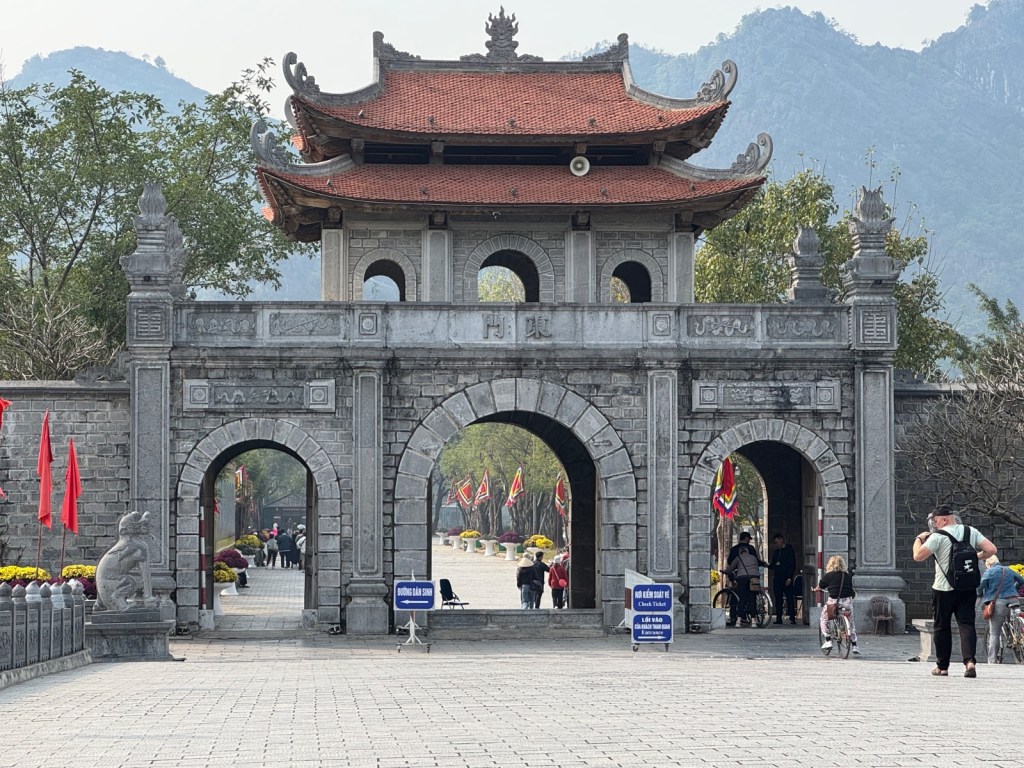
Entrance gate.
The first emperor, statue in Hanoi.
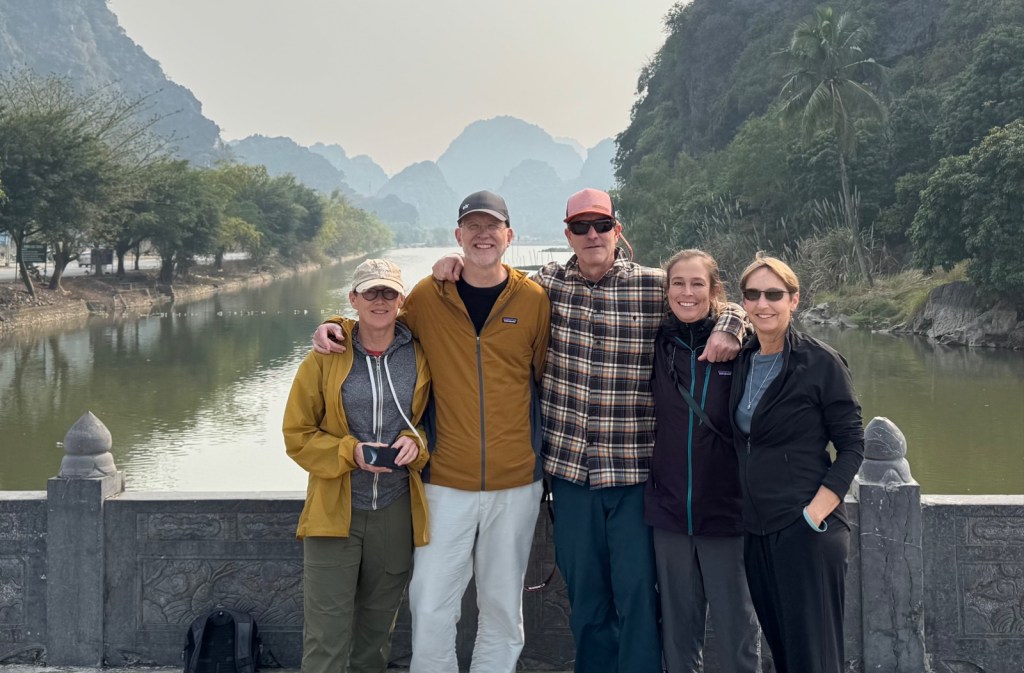
River surrounds a lot of the site.
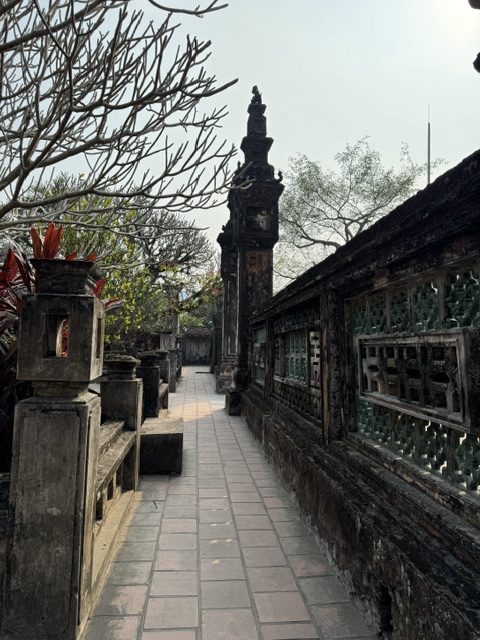
It was hard to get photos of the full buildings, ornate, with sculptures and incense burners in front. This was the first small temple we saw:
A marker next to a temple had these words (per my Photo Translate and shortened a bit): This was the first ancestor of the Dam Huy Hoan family. More than 2000 years ago…he was an intelligent, upright and brave person and he had many descendants. In the family genealogy, there is a passage that says: The Dam family had scholars who passed the imperial examinations (more about this later) . In the family, there was a daughter who worked as an oil painter. Because she was from a noble family, she was intelligent and virtuous, complete in both her ability and her behavior. And it continued on through her son who revered her. Nice to see a woman so noted. Not a lot of that here.
Except for these two women, mentioned several times over our days: Two of the country’s most revered heroes are the Trung sisters, Trac and Nhi, who led an insurrection against China in A.D. 40 and liberated Vietnam. One of their commanders, Phung Thi Chinh, is said to have given birth during the battle and to have continued fighting with her infant strapped to her back.
A few scenes that definitely miss the intricacy of the palaces and temples:
The Vietnamese knew where the palaces were, and the early history of Vietnam’s first emperors. The Nguyen dynasties rebuilt on the original site temples in their own style in the 17th and 18th centuries to celebrate Vietnam’s history. It wasn’t until the late 1990’s and early 2000’s that they uncovered the original palaces, finding columns, coins, pottery, etc. Amazing 1000 year old pieces.
That night we were all feeling jet lagged and had dinner at the hotel and all went to bed.
I’m off on a trip to Vietnam, Cambodia and then continuing on to see Singapore on my way to visit my sister Summer in Brisbane, so a big trip. So cool. I’m with friends, Scott, Kellie, Pat and Holly and Rick was a critical element of the group and he’s not here. Rick’s beloved (by all the White clan) Aunt Audreé died the weekend before we left and he couldn’t miss the funeral. So we left without him, not easy for any of us. Hardest on Rick of course, but he rallied and had some of his own adventures while I was gone.
Normally, part of what I love doing in these blog posts is talking about the history, but oh man, the history of Vietnam is incredibly complicated. I keep trying to put it together, but it will stay a challenge throughout our trip. Between dates, colonization, wars with China, France and America, monarchies, independence at different times, etc. hard to synthesize.
Our first day we took time to recover from the flights. The flights were so easy, connected, but oy, they’re long. When I was trying to figure out how to attend the funeral, we were able to set up flights coming back and returning without losing too much time off the trip, but then Rick did the calculation of travel versus time in country and it didn’t remotely make sense. He’s done so many Asian trips because of work that he knew what he was talking about. I was in serious fantasy land with my hopes to come back. Now I know. This is a far far distance away.
We started in Hanoi. In the 11th century the King moved the capital here and called it Tung Lao – ascending dragon – because of a cloud formation that he saw. Now the city is called Hanoi which means inside the river, renamed in the early 19th century. There used to be regular flooding with houses built on one side of the river to try to hold back the river from the rest of the city. Now hydro electric plants control the river so it no longer floods the city.
Sunday was a day off to explore, walk, see Hanoi and try for a nap. There’s a lake in central Hanoi that is walking distance from the hotel (Sofitel, built in 1901, oldest elevator in Hanoi, a very beautiful old building) and Pat, Holly and I went to see. Groups of middle-aged (mostly) women were doing these exercise routines to music all around the lake.
In addition there were moms with kids who would ask “do you have time?” Then the kids would ask questions from their papers – learning to speak English. So we had some delightful interactions with the kids – Pat and Holly were a hoot, they couldn’t resist any of the kids!
Pat and Holly also got caught by shoe cleaners. Pat thought the guy who told him he could repair a tear on his green suede Birkenstocks was great. Then before the end, his cool Birkenstocks had been turned into dark brown, no longer suede and the guy told him $20 American wasn’t enough and told him where to go to find a bank. Funny.
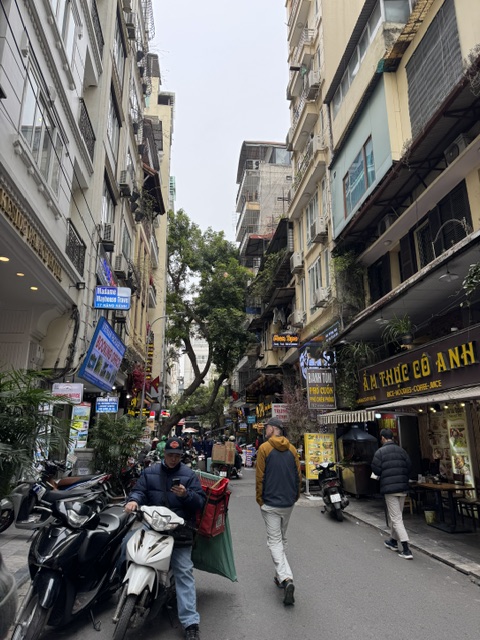
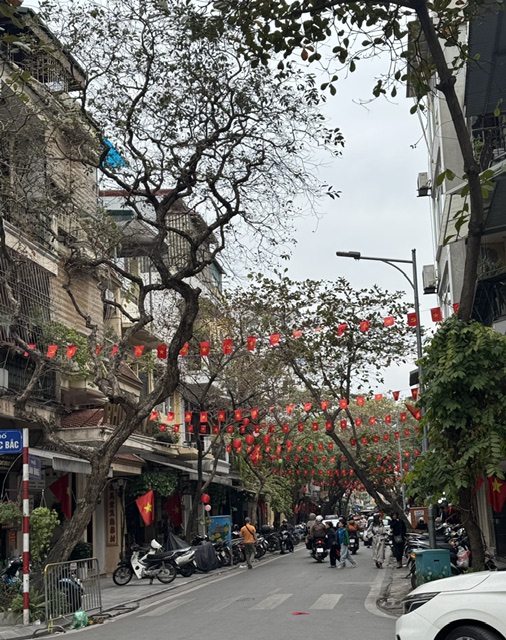
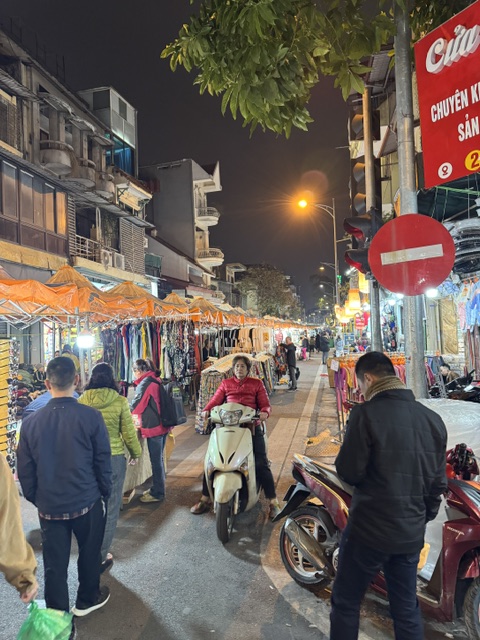
Scott and Kellie then joined after a late breakfast and we walked again, this time exploring the old city. Scott never seems to lose his way and he steadily led us on and around without ever referring to his phone. Amazing. We wound onto smaller roads, 100s of scooters lined up on the sidewalks so we walked the streets along with the cars, scooters, people, tourists, people cooking street food on the sidewalks and somehow it worked. You really can walk around Hanoi – at least the part where we were.
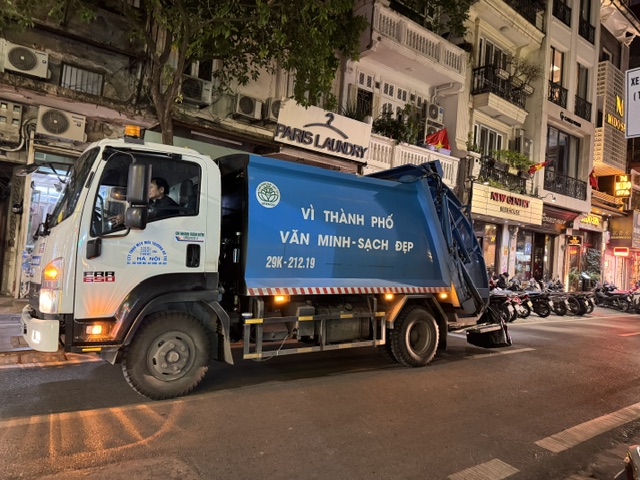
It was pretty clean, regular small piles of trash collected at the curb and then picked up. And though it’s grey, crowded and busy, the plants and trees that somehow survive add to the walkability of the city.
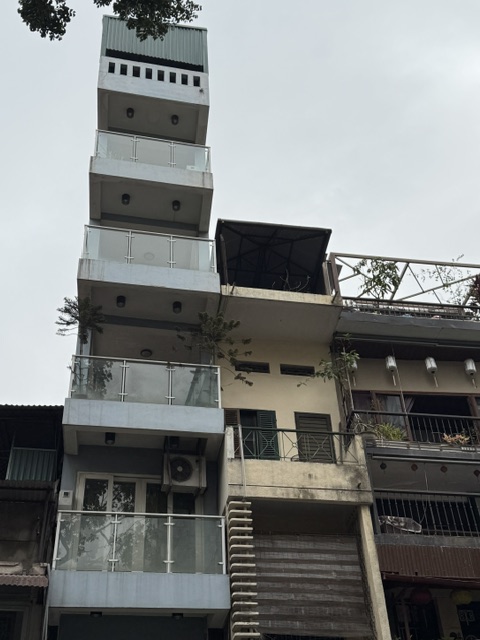
We were fascinated by the very thin and tall buildings. Some were left from the French colonial times and were beautiful, even if it’s just the facade that’s holding up. They were right next to houses that were a wonder they were still standing. Our guide we had later for a walking food tour told us that each generation’s family keeps adding up, with the senior family member having the first floor.
Traditionally, the business was/is at the front of the building, the middle of the building committed to the manufacturing of whatever is sold and then living at the back. There were slim little alleys leading to each section and access. Our guide stopped at one point and pointed to the electrical boxes, one per family. There were 17 in one alley and you just had to guess how the configuration worked since it wasn’t at all obvious how 17 families were in that building.
Our last stop before walking back was the “train street”. Scott knew about it and led us to an entrance, but a woman stopped us and just talked a lot about coffee. Confusing and she wasn’t letting us go up to see the train street. So we went to the left to find our way around. We found a way and then I understood the term “train street”. The only way to be on the street when the train came through (5/day) was by being IN the buildings, looking out, or on the curb fronting the buildings. Our timing was amazing because we got front row seats in a cafe, ordered fries, cokes, smoothies and then a group came along and we heard the guide say the train was coming in 10 minutes. And it did! People were blowing whistles and waving oblivious tourists back – “you’ll die if you don’t move off the street” – and then we waited with cameras in hand (of course). Crazy. I have the video below.
We went back to the hotel for some down time and then met our guide, Hi, for a walking food tour. We had pretty high expectations since a lot of us had done different food tours in other countries that were amazing. The next morning, Kellie said the good thing about this food tour is that none of us got food poisoning. So – fun to see the lights and all the people out eating on tiny little stools and chairs and tables and to hear some of the stories, but it wasn’t a repeater.
One thing we saw was the trash pick up truck – it was singing a song that evidently beckoned everyone to bring their trash and both home owners and business people were bringing their bags out – small that we saw.
Brief notes from Hi’s talk during our evening walk re different farm ownership over Vietnam’s history:
When the Kings ruled, the farmer got land for himself and land to support the owner of the land which he worked and thus paid the owner. On his own land he could also earn money for himself and feed his family.
The French ruled Vietnam from 1858–1885 and again from 1887–1954 and supported the land owners. The farmers were taxed so highly that they then gave up. So many farmers moved to working in manufacturing and mining and working for the French in the later 1800’s.
When Ho Chi Minh wanted to unify the country, he said the farmland belonged to the farmer and the factories belonged to the country. So the farmers were able to plant for themselves, but also had to provide for the troops. Then all the land become a cooperative. All had to work and could only sell their goods to the country which undercut motivation and agricultural productivity tanked.
In 1989 when the Soviet Union left, inflation was at 300%. Then the north started making changes, giving land back to the families, and initiating a market economy. There was a tax, but farmers could also sell at market prices. Vietnam became the second biggest rice exporter. Now industry is starting to exceed rice exports and gradually more rice land is being converted.
Right now the average income is 2500 per person.
The last king was in 1945.
Here’s a synopsis of more recent history:
In WWII Japan ruled Vietnam. At the end of WWII the Chinese liberated Hanoi from the Japanese, the British liberated Saigon, from the Japanese. The British turned the south over to the French who were here before. Ho Chi Minh declared independence for ALL of Vietnam, saying no to the division and declared war against the French with Chinese support. 100,000’s of Vietnamese died. In 1954 the French retreated. The Geneva convention in 1954 declared a south and north Vietnam, but Ho Chi Minh said no. The Geneva convention set a DMZ around Danang, but it didn’t work. Americans came in 1954 in a low level way to support the Republic in the South and it just escalated further and further through the Vietnam war until Ho Chi Minh won.
China supported Ho Chi Minh during the Vietnam war, providing military equipment, etc. That involvement escalated after the arrival of US combat troops in 1965. After the Vietnam war, China left, but left their weaponry behind.
In 1979, China invaded Vietnam in response to Vietnam’s invasion of Cambodia, but Vietnam used all of the Chinese weapons left (this was according to one of our guides) and defeated the Chinese in a war that lasted about a month, with China withdrawing its troops in March 1979.
The conflict damaged relations between China and Vietnam, and diplomatic relations were not fully restored until 1991. According to our Hanoi guide, over time the Chinese started flooding Vietnam with tourists. But the tourists were so disrespectful in their behaviors that Vietnam said no. They built a wall in the north and then restricted how many Chinese could visit.






























 Reb's Walks!