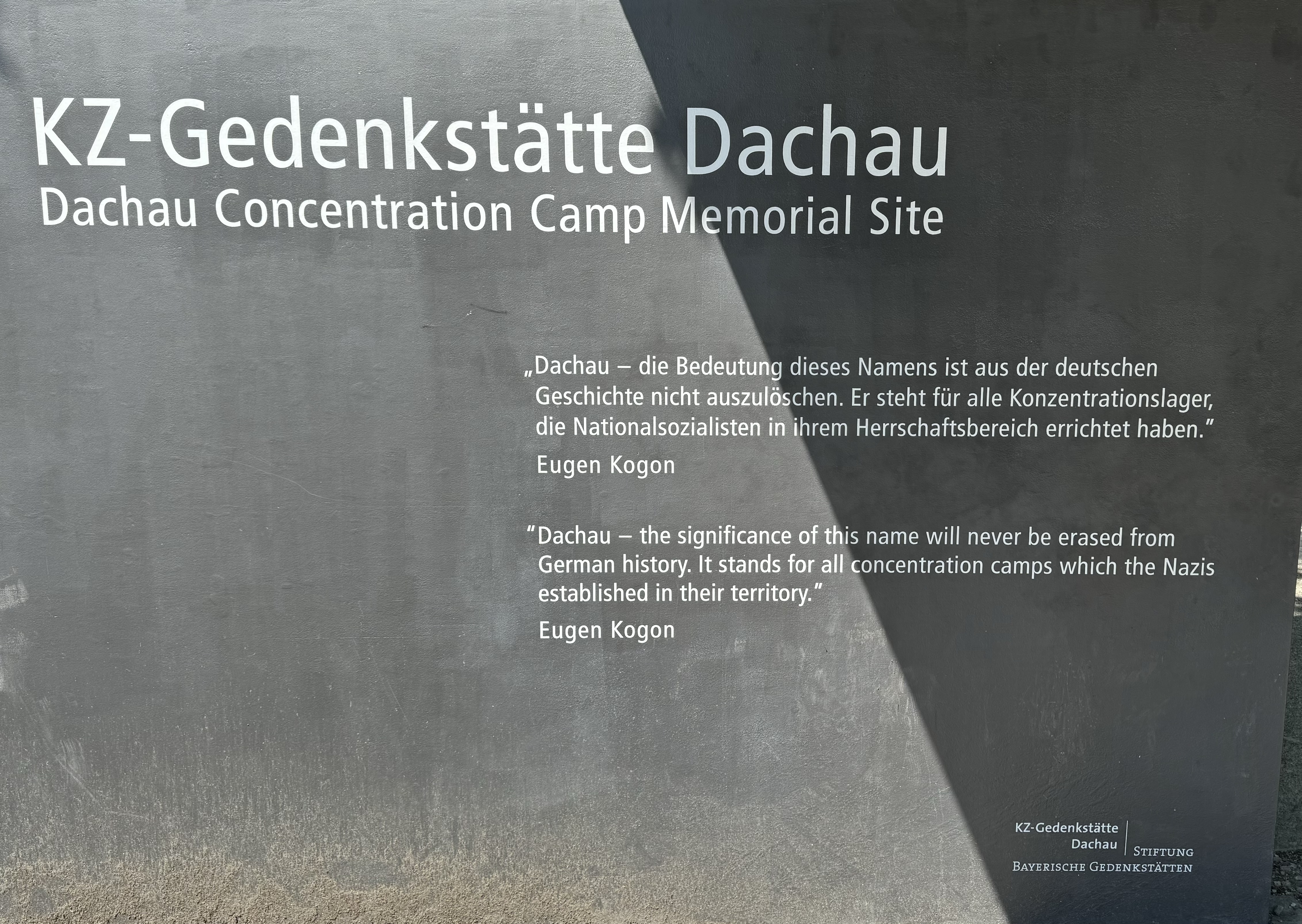
Tricia and I went to Dachau today. The memorial is 30 min away, took a cab out and then a bus/train combo to come back. This is my only photo, couldn’t imagine taking photos of the actual site or images shown. We were really glad we went. We walked, listened, read, for 4.5 hours before we had finished learning as much as we could. They’ve done a wonderful job of telling the history. And the survivors were the ones who insisted that it be made into a memorial. I didn’t realize that this was the model for all concentration camps; the commander of Auschwitz learned his trade here.
We flew from the airport an hour away from Ribadesella to Madrid. Got to see our first full sunrise from the car – bye Camino del Norte!
Madrid, we got to our hotel and mostly thought we don’t want to walk anywhere. But then thought – let’s go see the Crystal Palace in El Retiro park. We had never gone, have always headed to the ancient areas. This was old too, just not as old. The Crystal Palace was built in 1887 as the official headquarters of the General Exhibition of the Philippines in Madrid. They’re doing remodels so no entry, but truly a beautiful building.
And, look! We’re still standing and smiling.
The park was a great scene and it was a Wednesday! But the weather was perfect, 74 degrees, a bit of a breeze and so many talented musicians. We could have sat and watched for hours. Here’s a bit of 2 groups. The bassoonist and cellist had gone to the conservatory here in Madrid. The guitarists reminded me of the music from Chocolat.
What a gift of a trip. A few people had asked how many miles we walked. I hadn’t totaled, but did so now and I walked 268 over the weeks. It didn’t seem that long, but I guess it adds up.
It was a truly wonderful experience with Rick and friends, history, people, getting to practice Spanish, food, walking through so much incredible terrain. This camino – I totally recommend. I loved it.
First a note from yesterday walking the town. We actually were able to go into the cathedral and sit for a bit. And we could sit because it was the first church that didn’t smell overwhelmingly of mold. Of note were the two giant shells at the top of the rentable. This was clearly a camino church. And, unlike most others, it held regular masses. I would have gone just to see, but too long a day and it was very monitored. Tourists were not invited during that time except for the mass and I didn’t want to sit for a full hour.
Today: We made it! And we walked the whole thing, it just unfolded that way. We got to the point, the only point really, where we could easily get a taxi – and saw one waiting for a fare – but it was way too early. We both agreed we were having a great day, it was pretty and we kept going. Incredible, given that Rick broke 4 vertebrae, one shattered, only 4 months before we started the walk.
Here’s a photo from last night, I got Rick to walk up despite the 97 stairs because it was such a pretty view, plus I wanted him to see the green path I hoped to walk to start our last day.
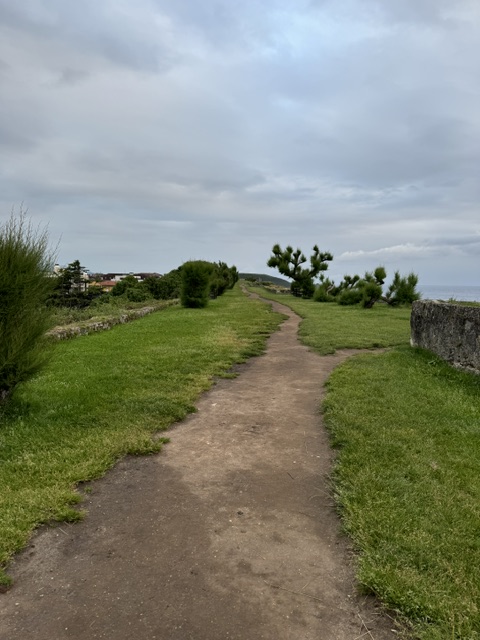
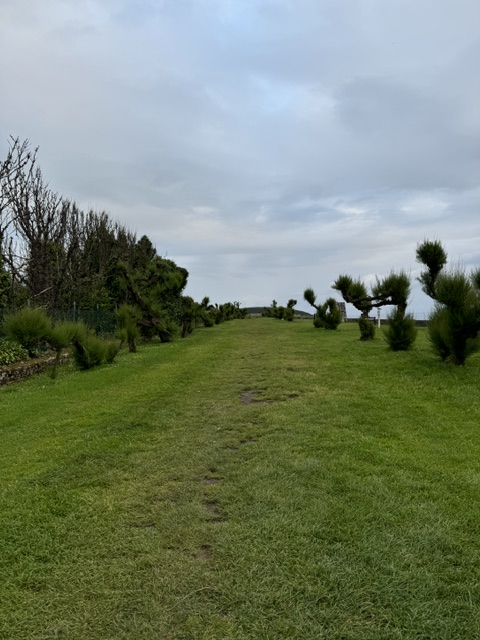
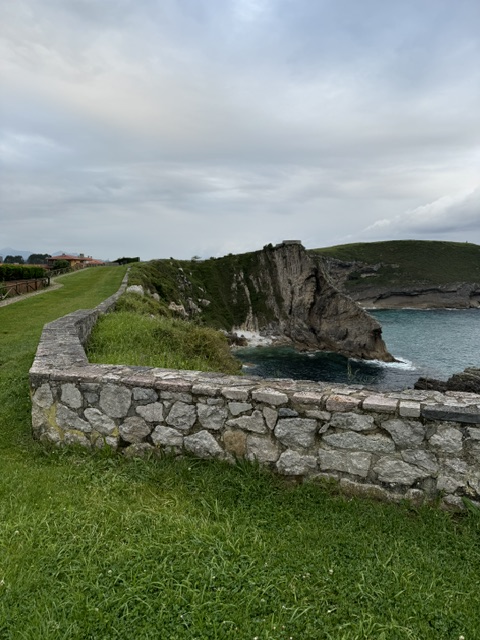
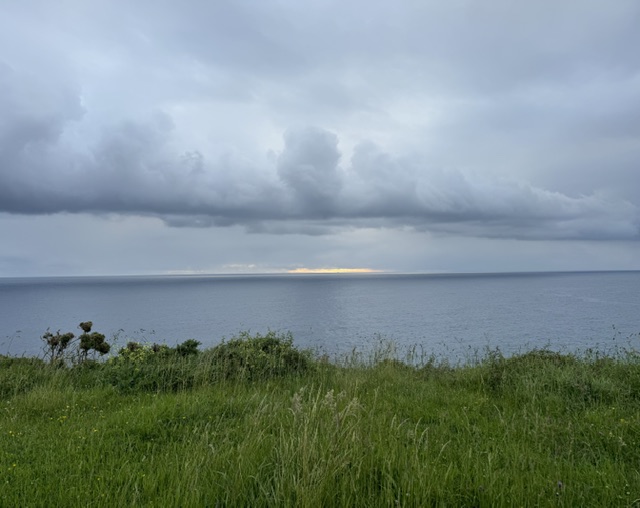
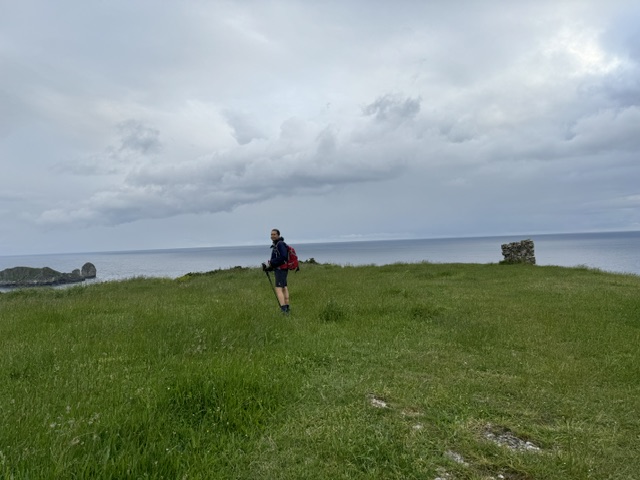
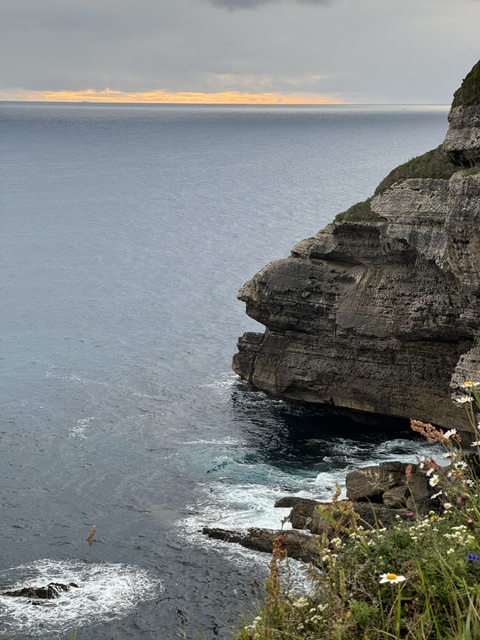
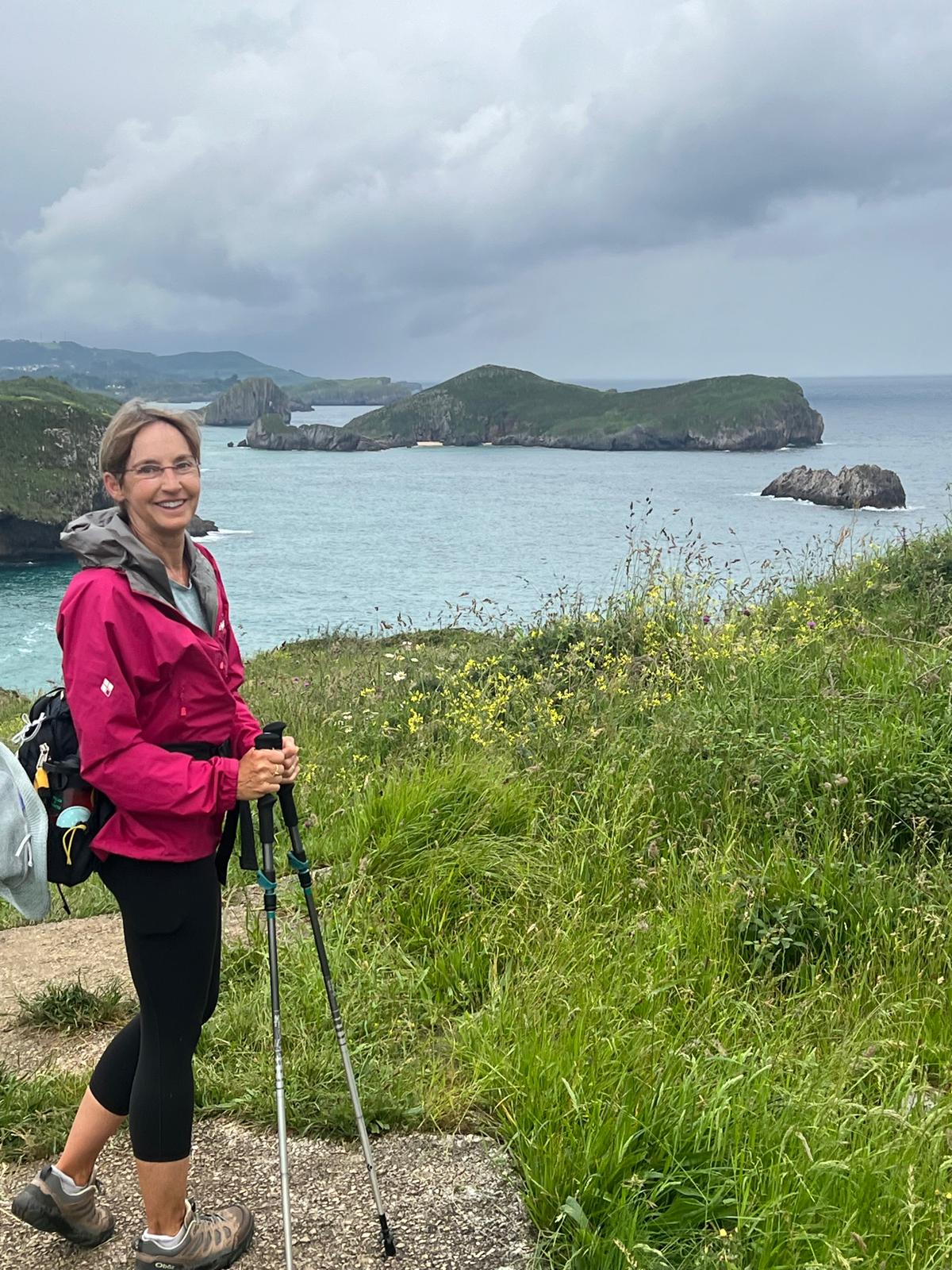
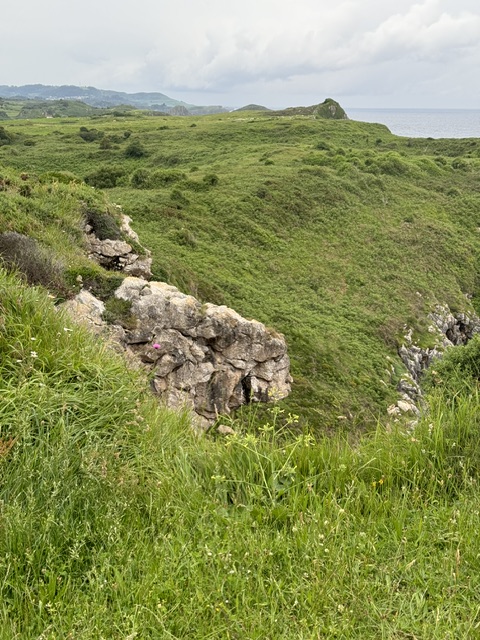
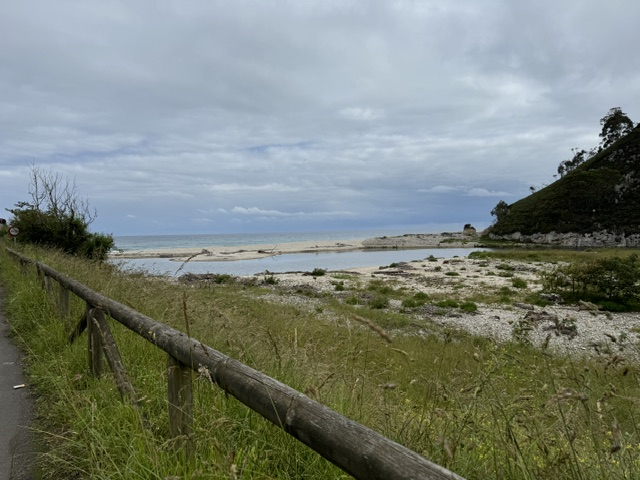
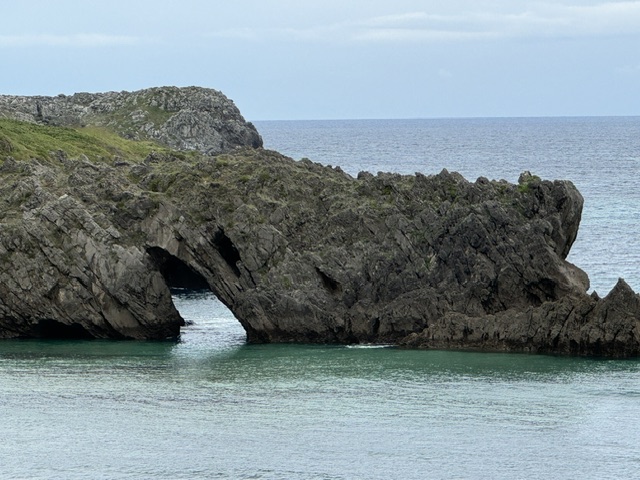
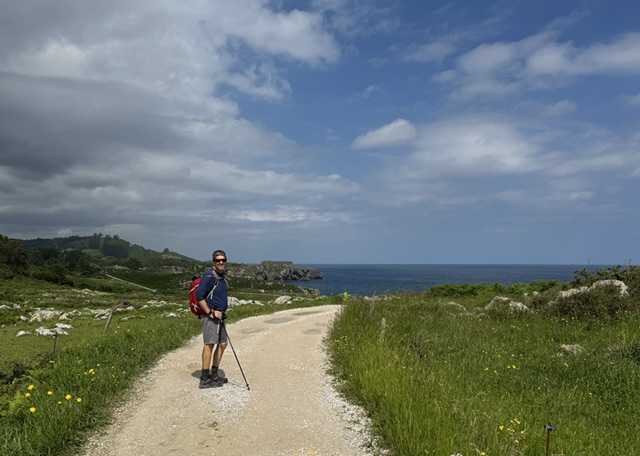
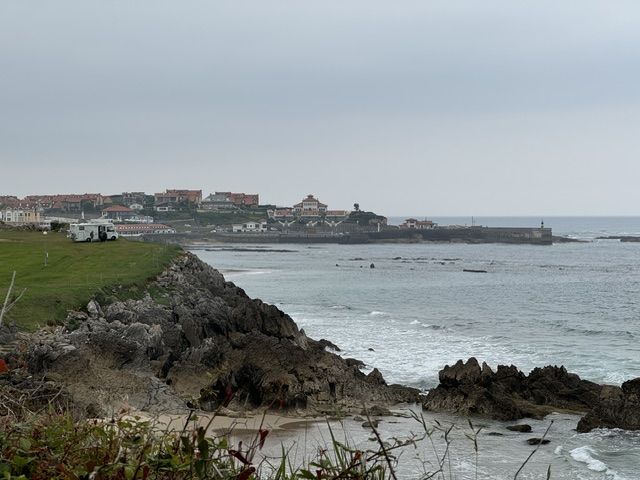
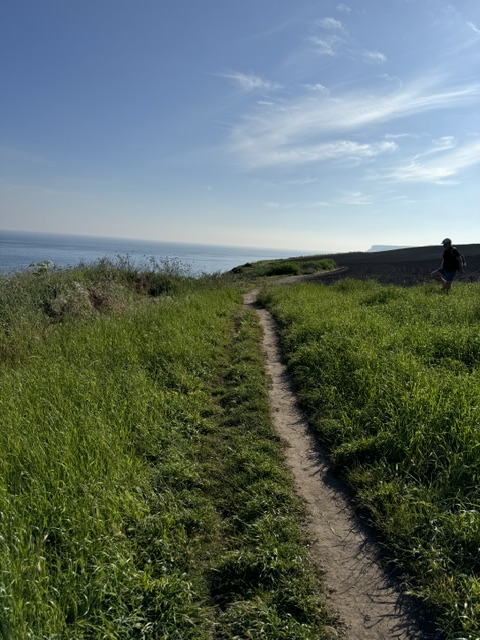
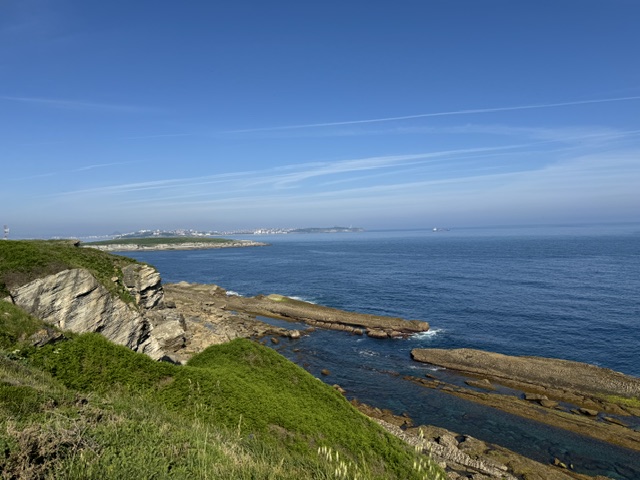
This morning, the first part of the walk right along the coast was such a gift. It was the green path from the top of the hill that we’d been on last night. Rick had agreed to do the extra 1.6k (on top of expected 20 miles) by going the coastal route which I really wanted to do. A wonderful way to start our hike. I mean, look at these photos – this is was what we walked. The one photo with the rocks down low looks like a man’s head, pointed out by a Spanish birder out for the early day’s walk. The other with the rocks sticking out from the side, he also pointed out – nature’s gargoyle.
Rick and I’ve both developed a system that works for us with water/electrolytes/food to keep us going on pace. I used fountains all along the way since I only carry a one-liter bottle. I have come to love the LMNT packets for electrolytes. I’ve also learned I need to eat every 2 hours or less – at 6 drank my wee protein shake before we left, morning snack at a bar on a beach, then my meat/cheese and roll, the “picnic” the hotel gave us for breakfast, then my Whole Foods protein balls, then my almond M&Ms, then my honey sting gummies – and I still had a pumpkin seed back up that I didn’t open.
Here’s our last camino breakfast! Looking over the cove with the monastery on the right.
The guide book had said that we would pass some monasteries on the way and that these early monasteries had it down, prime real estate alongside the town with the best views and access to the water. No kidding.
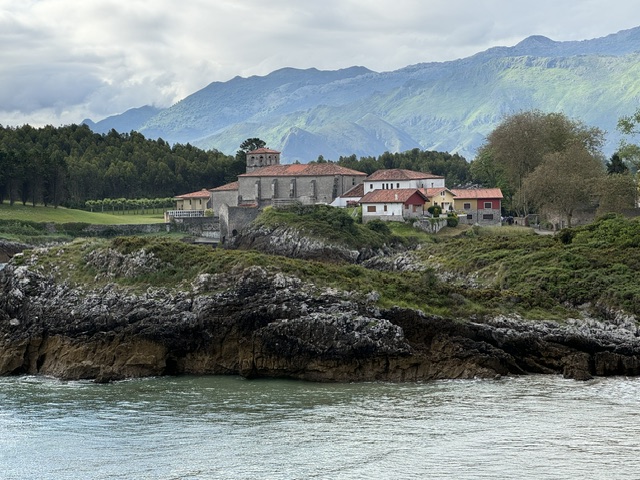
The first monastery we passed, the Monasterio de San Salvador de Celorio, a Benedictine monastery. Sign says 17th century, but online it looks like this building started in the 11th century, but info was pretty sketchy. It first presented as a pretty, well-kept small church on the path. Then we had our breakfast and continued up a little path on the other side of the beach to the promontory just to see the side view and it was huge! Plus a castle up on the hill. The monastery looked like it was in surprisingly good shape, couldn’t really discern the details for either this or the castle from this distance.
We thought it was thisIt was really this
And the castle/fort/place for bad monks? up the hill to the left:
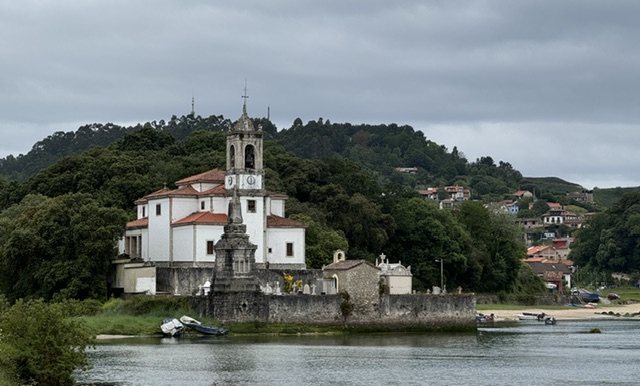
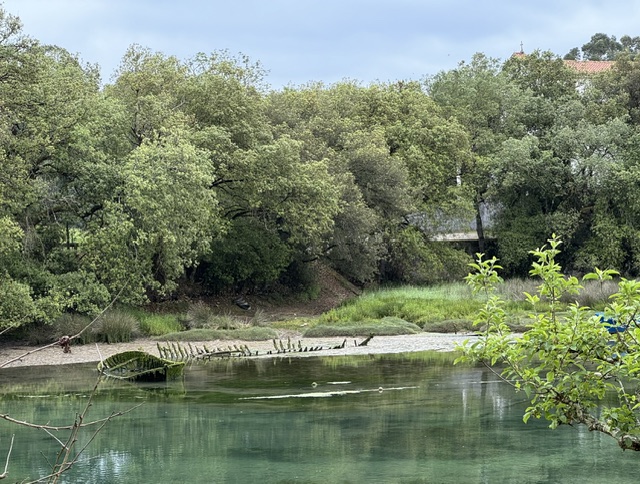
The Iglesia de Nuestra Señora de los Dolores. I wondered about this one since “dolor” means pain or to hurt. Ok, “Our Lady of Sorrows.” Well, I guess she did have a rough life. Built in 1794, a youngster. And next to the Iglesia was a marine graveyard. Rick said it looked like an Andrew Wyeth painting. I think the boats are older than the church.
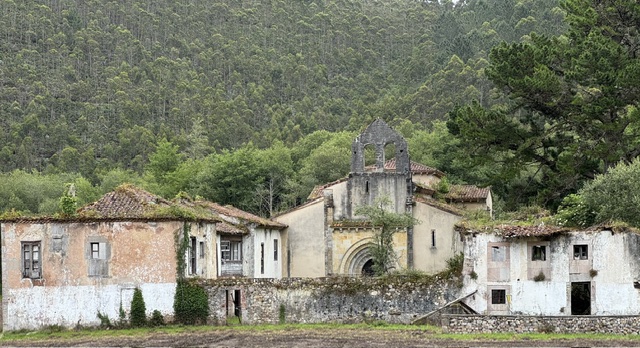
The Monasterio de San Salvador, also Benedictine, had a pilgrim refuge in the 13th century. For me, the visual just leads the imagination to think what it would have been like to come upon it after so many miles of walking in the 1300’s, 1400’s, 1500’s, how long? And then the changes that led to today’s condition. It’s been declared an asset of cultural interest. So enough money for a plaque, but sadly for the building’s sake, no more. But it is zoned for agriculture and heritage, so no condos coming in.
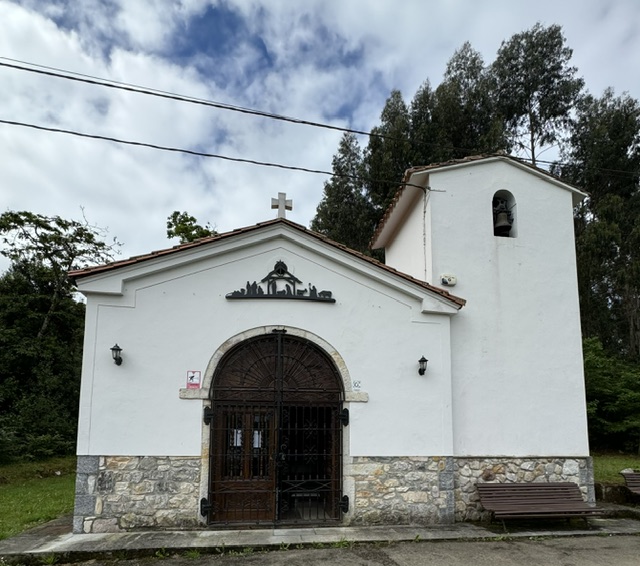
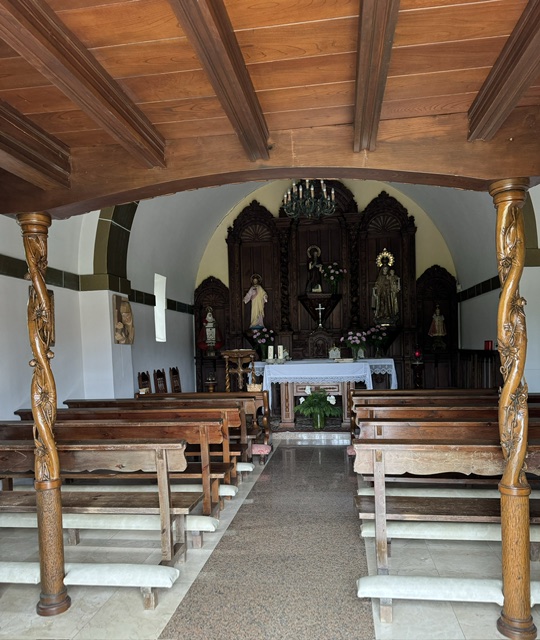
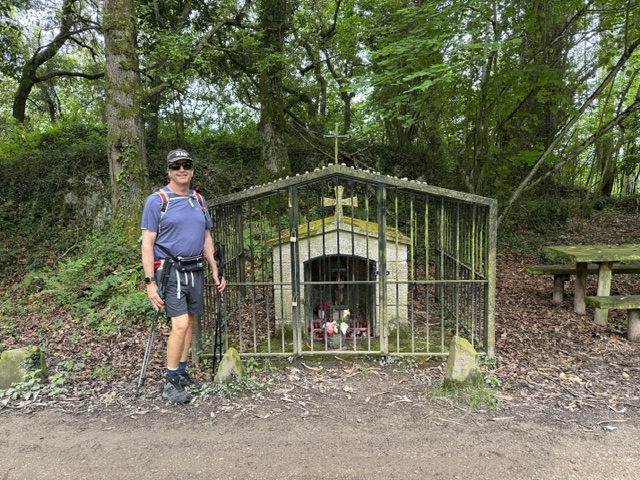
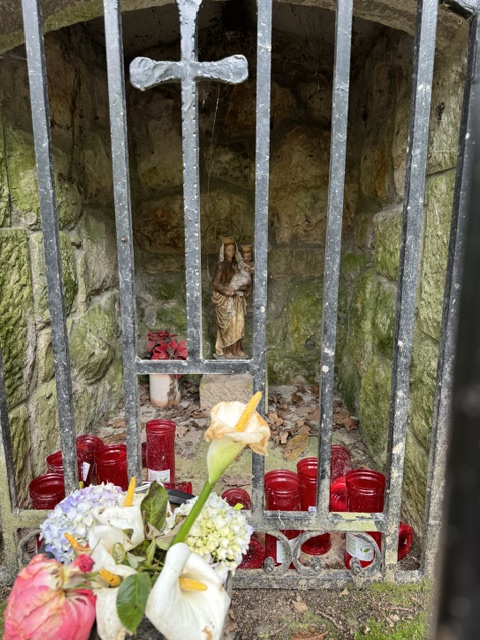
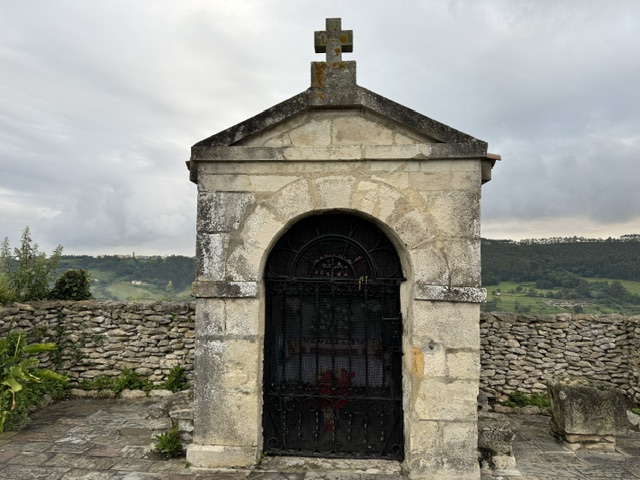
A chapel that was finally open, so calm and sweet, hearing the cow bells behind us. If we had had more time we would have sat for a bit.
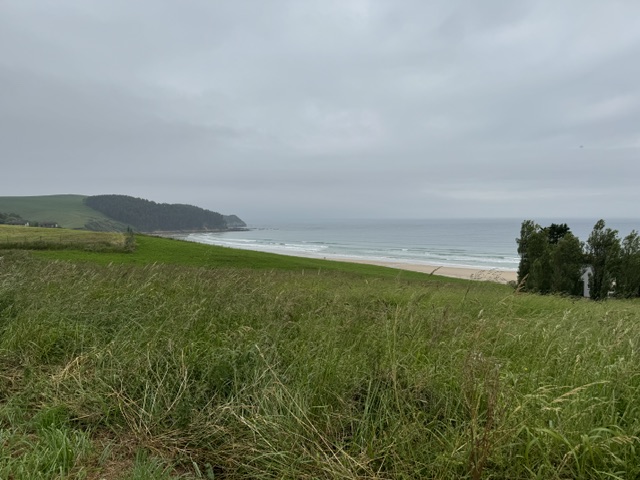
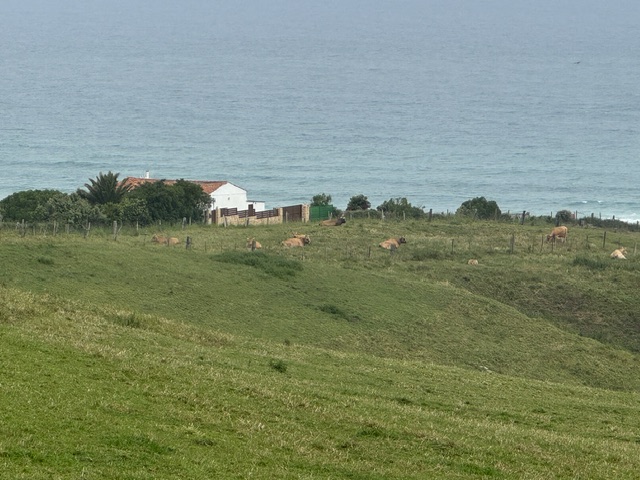
Walked in the meadows and hills, then get sightings of beaches or coves.
And a dog’s chapel? We really didn’t know, but clearly cared for with many candles.
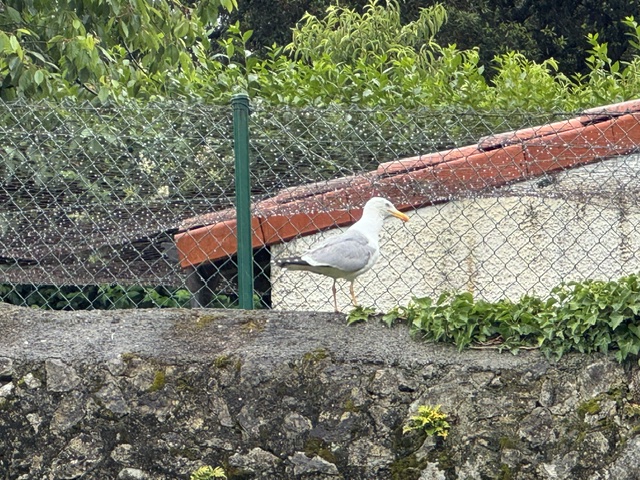
This seagull got us both laughing. It was walking up and down, stopping, looking longingly through and talking to the chickens in the other side for the fence who all had something to say. Clearly confused why it wasn’t in there with its fellow chickens being handed food for no work!
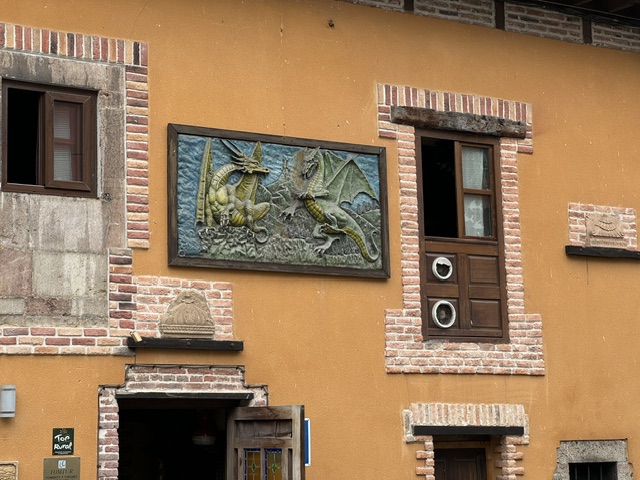
This was the town, Nueva, that we thought might be a stopping point. A pretty and very active small town, but what intrigued us was the theme of St. George and the Dragon.
On the side of a hotel
St. George above the windows
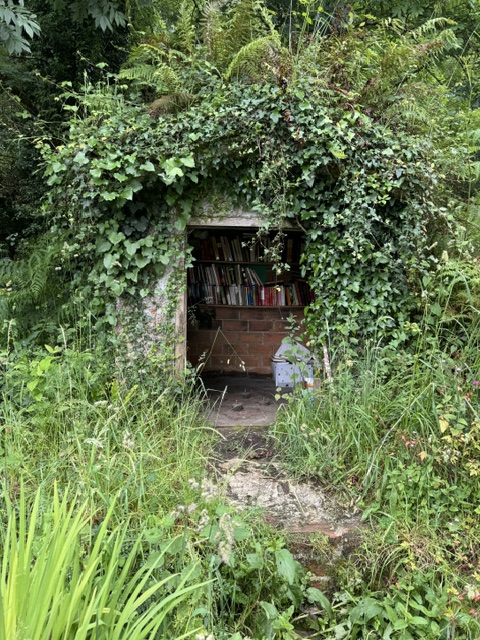
And our kind of chapel, for sure, just missing a few chairs.
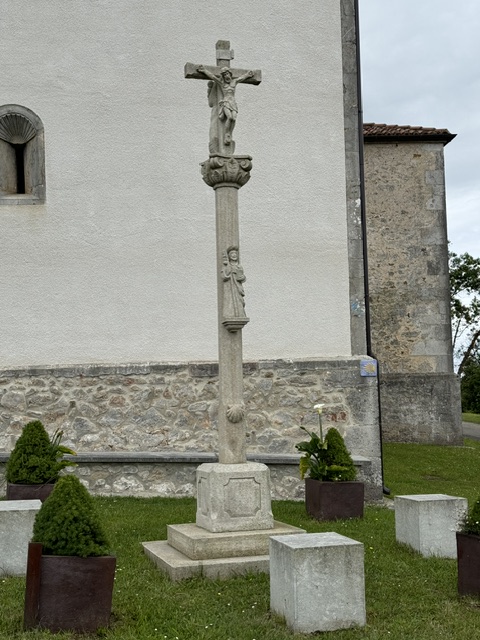
One of our stopping points, a church with a step to sit on, a cross that is the marker all along the Frances, but first one we’ve seen here and a fountain on the side of the cemetery. A group of Spanish women asked me if the water was potable, I said yes since it was actually marked on our map.
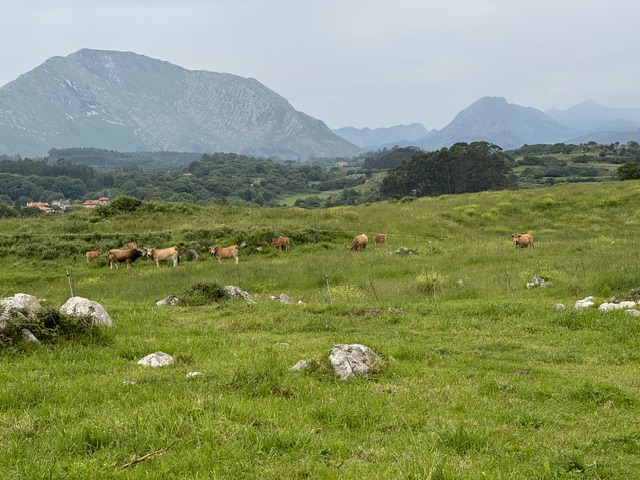
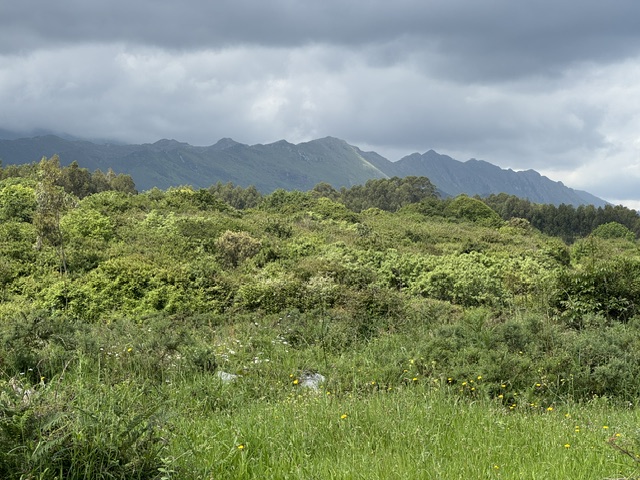
Really glad we’re on this side of those mountains and we don’t have to cross them, but they’re beautiful to see in the different light changes we keep having.
And we finally walked into town, but it didn’t feel like we were dragging the last few miles, a nice change. The town, Ribadesella, is known, like Santillaña del Mar’s Altamira, for its caves. The Altamira caves have had to be closed for protection reasons and a museum has been opened up with a full replication – can’t imagine. In Ribadesella, you can see the real thing. You have to reserve long in advance for both. Someday – maybe we can return.
The town, Ribadesella, was conquered by the Romans during Augustus’ rule, then founded in 1270 by Aflsono X and like some of the other towns, developed around whaling. Then the wars totally impacted, from Napoleon, the Carlist Wars, and the Spanish Civil War. We didn’t se anything medieval, it seemed more Victorian on the harbor, if anything. But really pretty and inviting. Except since seen from tired feet, we just kept moving toward the hotel.
When we finally got to the hotel too late for eating and too early for eating, a feeling remembered all too well from my early days on the Camino Frances, we were both heading towards hangry. We got showers, stretched with the roller to get time used up and still – when we had to walk back into town (ach) for food, there was none. Seriously, not a single plate of ANYTHING on people’s tables in the restaurants, just coffee, maybe a drink, not even tapas. When I asked at a restaurant if it was possible to find food anywhere, he said not until 8. Oh yeah, that was going to be a problem.
The only thing open was an ice cream shop, so we got an ice cream, then saw a panadería that had empanadas and got enough to manage the evening. Really, we didn’t need much, just something.
Then back to the hotel, walking the promenade a little just to see, and then Clarkson’s Farm and bed. I listened to the bells at 10, one last time for my Spanish bells. And I slept! It was a beautiful thing.
Hotel Verdemar, clean, outside of town, half block from promenade that goes around the bay. Good to ask for high room, no restaurant though it had the illusion. And no one else in the hotel, except maybe one person.
A wonderful day. Rick and I weren’t sure given that the hike was supposed to be 17ish miles, but it was fine. I was very done by the end, but the vast majority of the day was just an unfolding of beauty, mountain and ocean and villages.
Since the apartment didn’t have breakfast and the cafeteria didn’t start until 8, we decided we’d just stock up on our food items and go when we woke up. Plus the apartment owner had left us home-made yoghurt that turned out to be incredible. No way to thank you, but wish we could have.
We were on our way by 7:20 and walked in wonder for an hour. Even though the first hill was immediate and Rick said it was like being given a double black diamond when you just walked out on the slope for the first time. But really, over quickly and wonderful with the cow bells, church bells, green all over.
It was misty, cool, perfect, the rain never overwhelmed
A wonderful little altar, fresh flowers, so lovingly cared for
And then we saw two women going to care for it
Loving mom
Train station
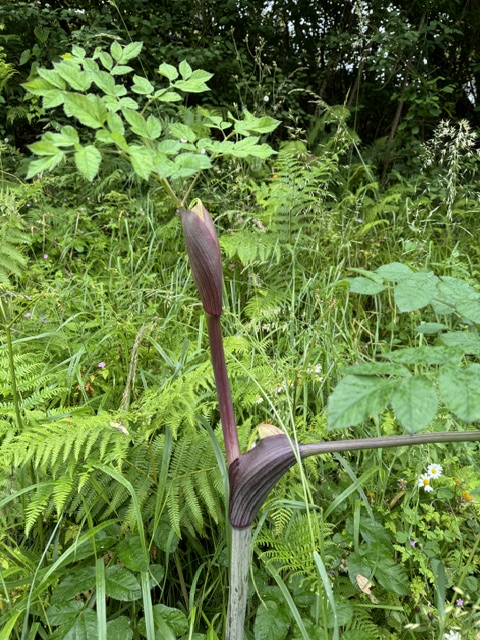
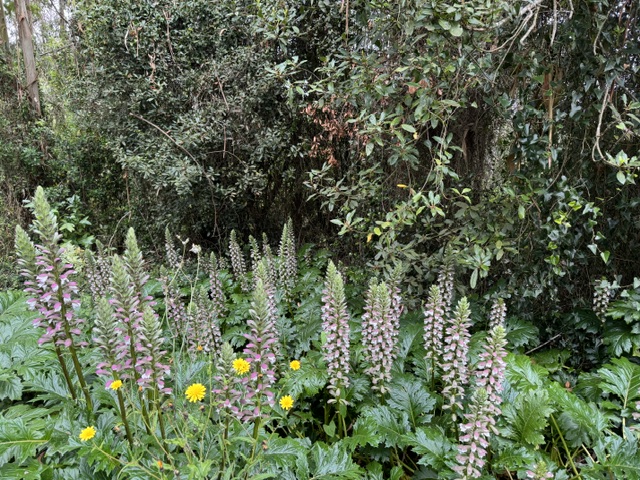
Interesting plants, seems like it should be a big flower coming out, but branch on the left is what comes out
We ran into a couple from Vermont after about 1.5 hours and they were just delightful. Both fascinating, Rick and I fell into conversation and that kept up for another hour. I’d already drunk my protein shake and started on my protein snack when we finally found an open cafe and stopped. Yay. And that was our only stop available all day, glad we stopped!
Then we were back on our own, walking, dreaming, about 6 hours in, starting to listen to books.
Unexpected coves, beaches would appear around a corner
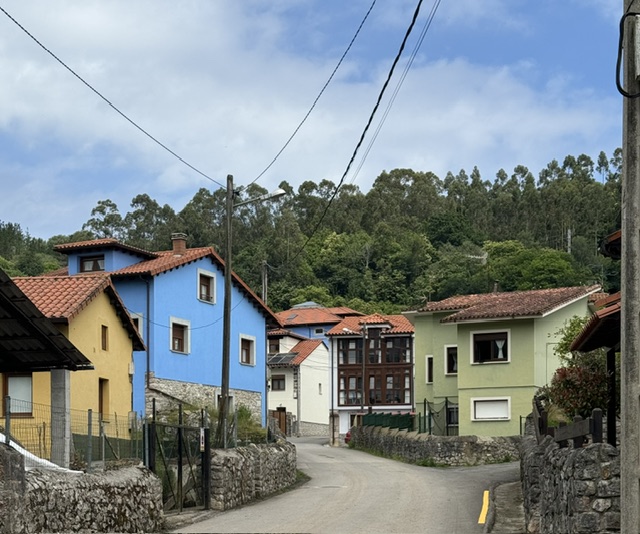
Great little towns with wonderful color
Finally see our town, way down there
We finally walked town around 2:30 which wasn’t bad at all and a faster pace than normal.
Both of us had feet that were calling for different shoes so went straight to the hotel, change quickly and then went looking for food. A lot of it. We went back to a restaurant that we’d seen earlier that was full of people and got a table outside, looking at the marina.
Rick had to take a photo of these guys, they never took their helmets off!
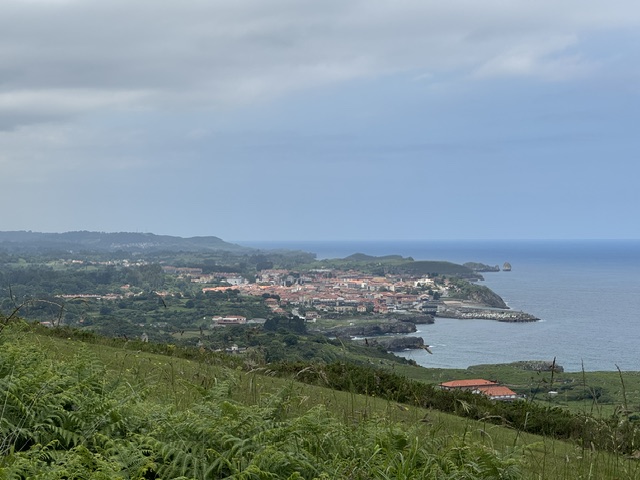
Rick headed back to the hotel, but I’d gotten a burst of energy when we were walking to the restaurant and I saw what looked like a medieval town right near our hotel. So cool!
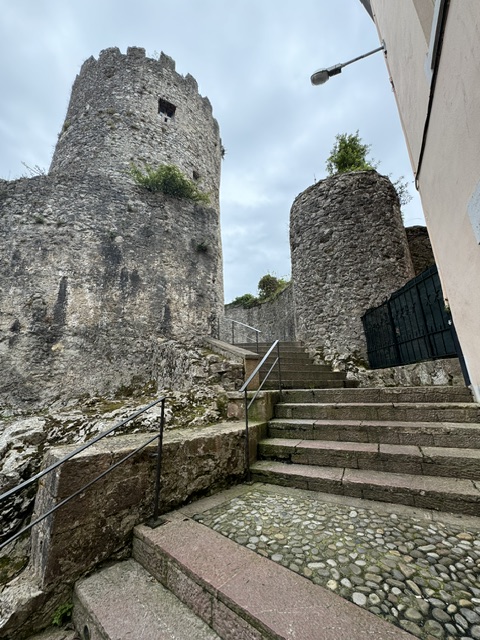
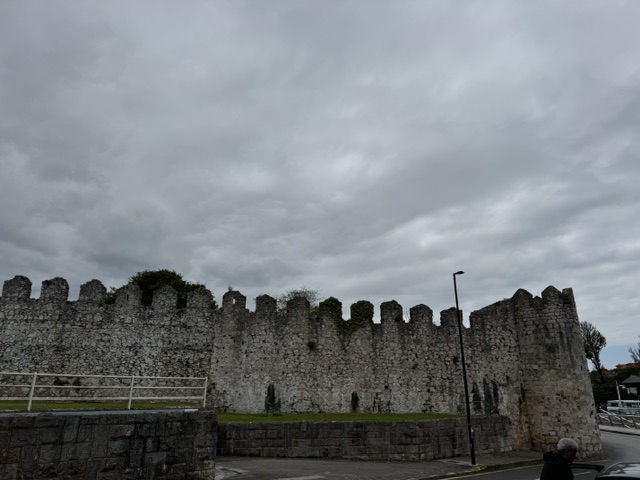
Yet again, I had no expectations for the town and have been absolutely delighted with what we found. Another port town, made it’s living from whaling, city walls from 1200’s, church from 1300’s, alongside the new and beautiful. There’s a beach right outside our hotel and the ancient walls are right across from it and the mountains ring behind the whole town. Incredible. This has been so different from the Camino de Frances or Primitivo because the towns are all port towns, or mountain towns and have so much character. I loved those other caminos for sure, but wow the towns/villages are additive on this one.
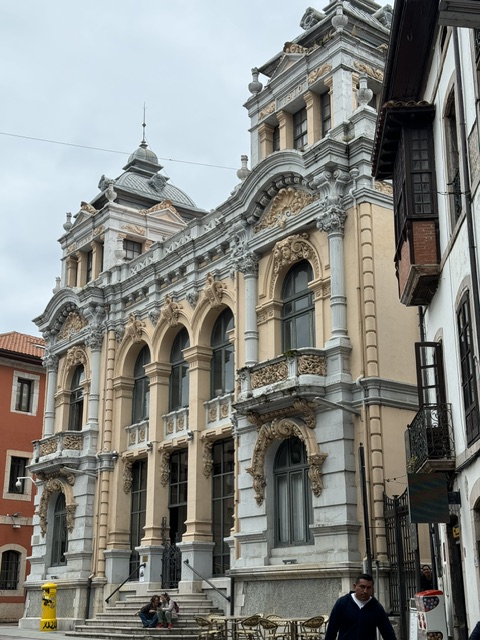
I started to walk, first saw the casino – a number of towns had this, all built late 1800’s or very early 1900’s.
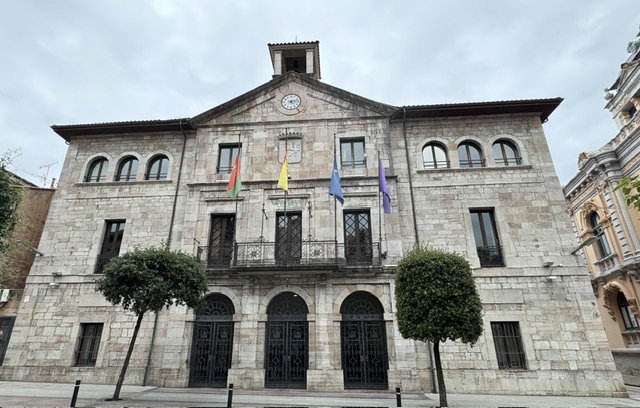
Town hall, totally different next door
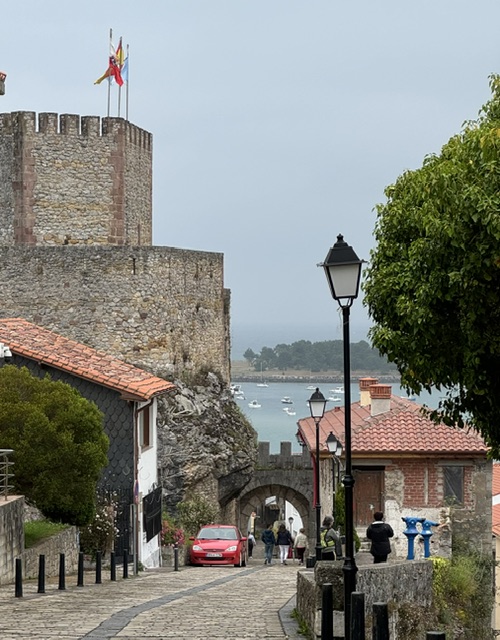
Turned a corner and saw this!
Had to wander this area, so beautiful
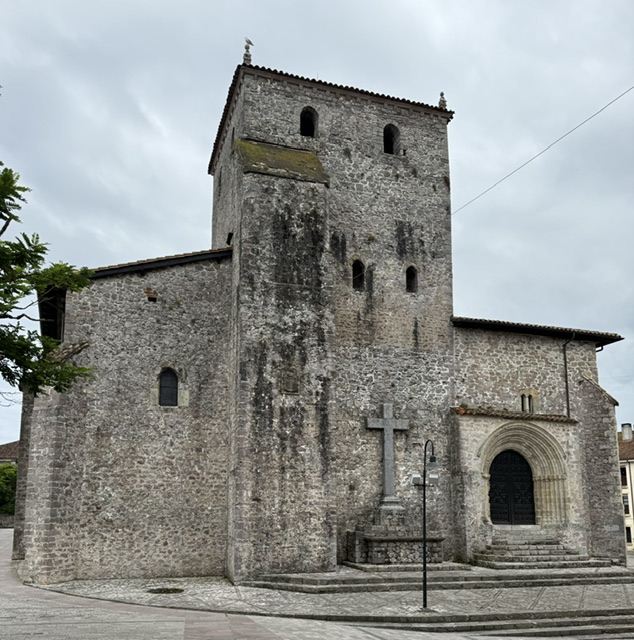
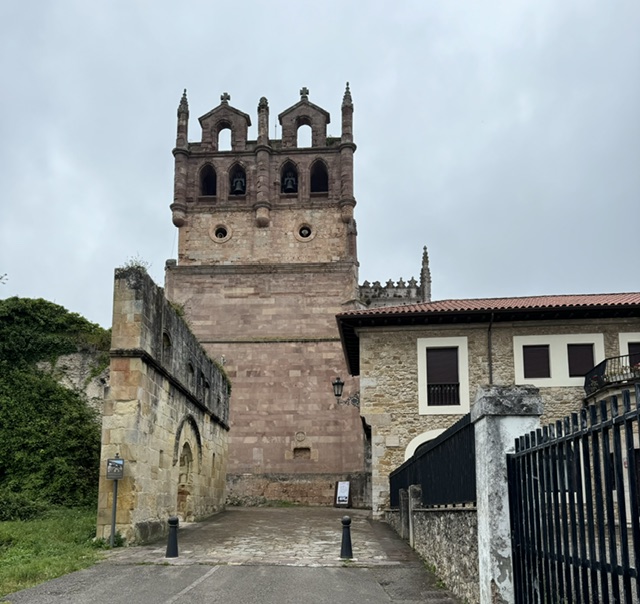
Church from the 1300’s and this is just the back, La Iglesia de Santa Maria del Conceyu. In order to build the church the town raised a tax with which everyone collaborated. These days, the church is still owned by the town of Llanes.
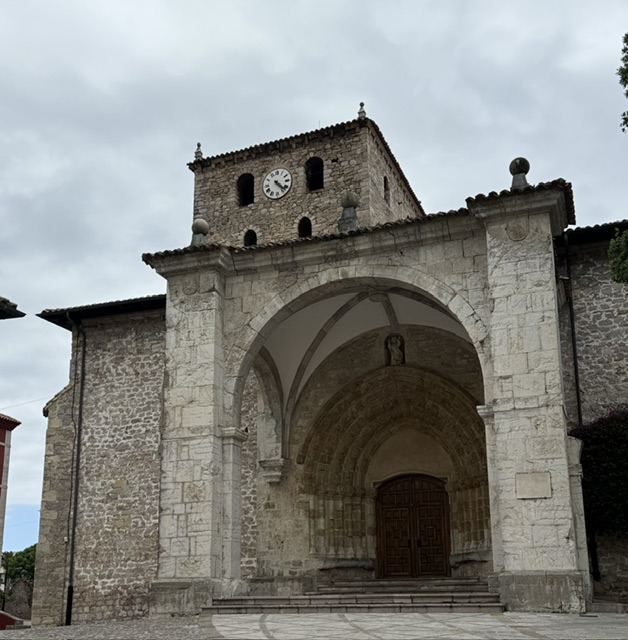
This is the front, couldn’t get back enough in the little square to get a photo of the whole building.
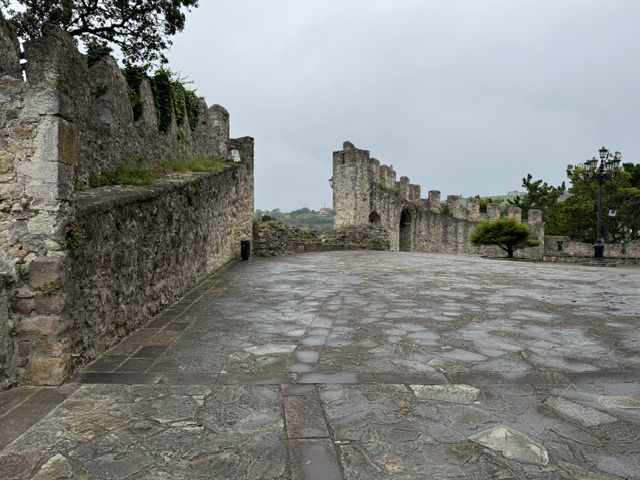
Walls across from our hotel
I took a few videos trying to capture the bells and the town and ocean. There’s a wall going up outside our hotel across the beach and you can walk all along this wide park-like walk for an extra 1.6 kilometers to the next town. We’re going to do that tomorrow morning. Amazing the attention given to the outdoors and public spaces.
Our hike tomorrow is at least 19.5, but we’re thinking we’re going to shorten it. It’s so nice here, I really want to do that walk that adds the extra AND there are two monasteries I’d really like to see tomorrow AND another wonderful fishing village. Our last night. So rather than be totally wiped out, we’re opting for choices. We’ll start early again, maybe we’ll change our minds, but we’ve gotten the name of the taxi company and we may call!
Today just flew by, such an easy gorgeous walk. We both were a bit startled when it was over so quickly. And it ended at an apartment, so that was a surprise too. But the lady who checked us in was great and I managed to get everything we needed from her very fast Spanish about being in the apartment. The great thing is that there’s a washer and she said we could turn on the radiators to dry things if the rack on the balcony didn’t do the trick. And we were definitely due, I was going to find a lavandería for our clothes and then realized, oops, Sunday. Ach.
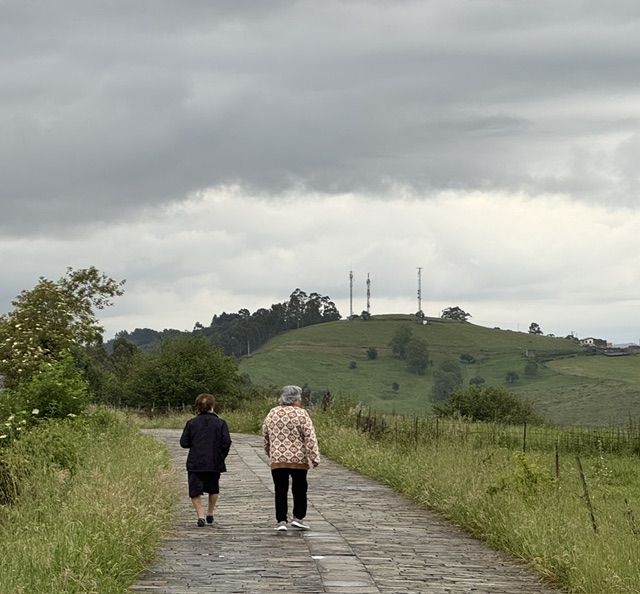
But the walk – it was through a national park, Parque Natural de Oyambre, with some houses/farms clearly grandfathered. It was founded in 1988 after a lot of work of preservationists. And it was just beautiful. We started out with misty rain and by the end it was warm enough and we were down to t-shirts. And the terrain was mostly dirt roads and back road tarmac so easy to walk and look and listen. And that’s what we did all the way. I never turned on music or a book because it was just a treat.
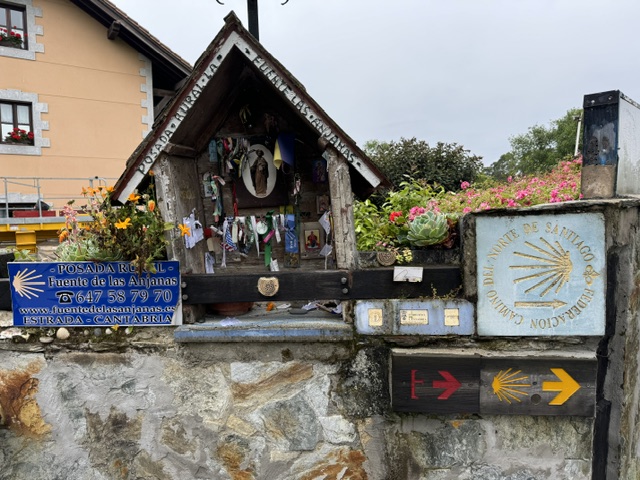
Outside a pretty alburgue – seemed like people left prayers here
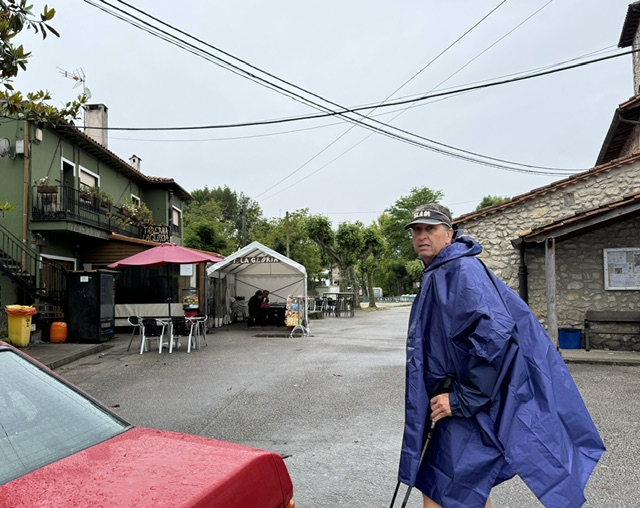
The place on the left below was the only place we found for coffee and a snack on the way since we’d left so early. The name was Taberna La Gloria and that’s the church right next to it. Sunday morning. We started counting who and how many were going to the two different places. Sadly, the Taberna edged it out. When we walked by the church, there were lay people leading the reading and we didn’t see a priest, so just the neighborhood gathering together, mostly older folks. But sweet. The doors were wide open so they heard the game and the people next door in the bar. Very communal and the little town seemed pretty active. Rick’s wearing his poncho that he called the blueberry. The blueberry did get some work time!
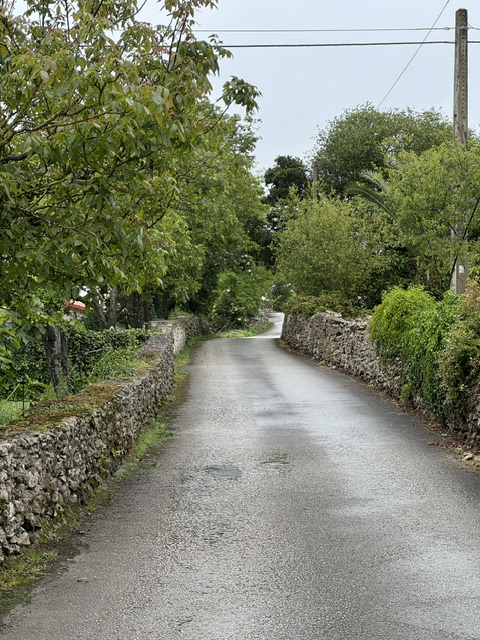
Leaving the town, so pretty, these walls everywhere are amazing. No cement, or rarely, just very carefully placed stone.
We got into the apartment, did a load, hung it out, started the next load and went to find lunch. We went to the first restaurant we found that was full of locals and had a great dinner. We’re finally learning to share the salad or first course – we usually want salad – and then have a second. They just have enormous portions!
Our salad had lettuce and tomato, walnuts, sardines (a totally different thing here and delicious) and a new type of thing called gula. I finally called the wait person over to ask what is this yummy little thing we’re eating? Gula – from the river. We decided they were river worms.
Here’s what I found: Gula’s live in freshwater and travel from rivers to the Caribbean Sea, where they lay their eggs. Each specimen lays between 500,000 and 4,000,000 eggs. Initially, they have a millimetre of length, they do a 11-month trip till they arrive to the European rivers, where they finally settle down. And we eat them. Rick wondered if it was worth it. To the worm or baby eel.
The things we are learning on this trip. Also, Rick and I have started a new Netflix special and are cracking up every night. Kylie told us about it and said she’s on the third season and still laughing with every episode. Clarkson’s Farm. Guy in the Cotswolds who decides to farm his farm himself after stopping his career. Truly funny.
Today was an amazing day. First, the scheduled hike was only 7 miles which felt very doable (the different mileage reflects how much we walked in the town, getting to the hotel, lunch, etc.). Then, we were able to get an earliesh tea and coffee from our super nice front desk woman who also manned the bar (that’s where you get coffee) until the breakfast opened downstairs.
We left at 9, so civilized and not at all motivated to leave earlier. The weather was cloudy, cool, but t-shirt weather most of the time with a bit of breeze. The scenery was so engaging, I never turned on any books or music, just watched the scenery go by. My back rallied and so did my energy!
So we had a great day, both of us marveling. We were on a beautiful avenue out of town and then made a right and were next to the ocean the rest of the time. Even when we couldn’t see it because of a hill between us and the water, we could hear it. Such a nice way to walk.
Ideal farm:
Rick and I watched curious to see what would unfold with these guys. It seemed like a lot of work and noise, but they must have been pleased once they got up. I realized when I rewatched it, that it does a nice job showing the ocean and the fishing village we’re walking to built into the hills. Gorgeous. Raining, misting, but raincoats were great and it stayed a perfect temperature.
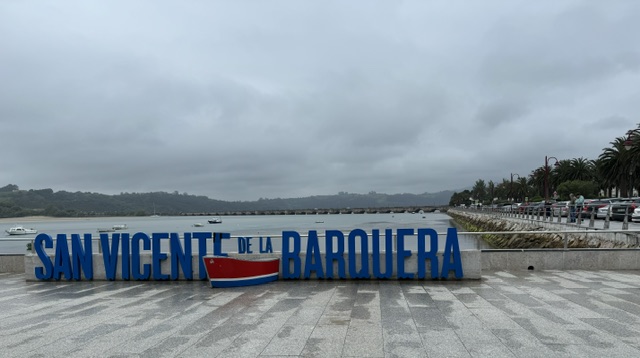
Proud town sign, the bridge beyond is a stone bridge built in the 15th century on the site of another built of wood, then added to over the centuries. When it was built during the time of Carlos III, it was considered one of the largest bridges in the kingdom.
The town itself is up and down hills, a fishing town, with a giant castle and a giant church, both built in the 1300’s and added onto till the 1500’s. Both of which you could only see on Monday. Really? We tried because we were told at our usual late lunch that a wedding was happening at the cathedral at 5 and if we walked up, we should be able to see it. We saw the florist walk in and Rick and I went behind, Rick got a few feet in and saw the beginning of splendor before the wedding planner yelled that we weren’t supposed to be in there.
So, really, this giant Catholic Church has been turned into a wedding venue. Amazing. I tried to photograph both the castle and church, plus the town walls from the 1300’s, but hard to get a grasp.
Here’s the sign for it – just tempting people, really.
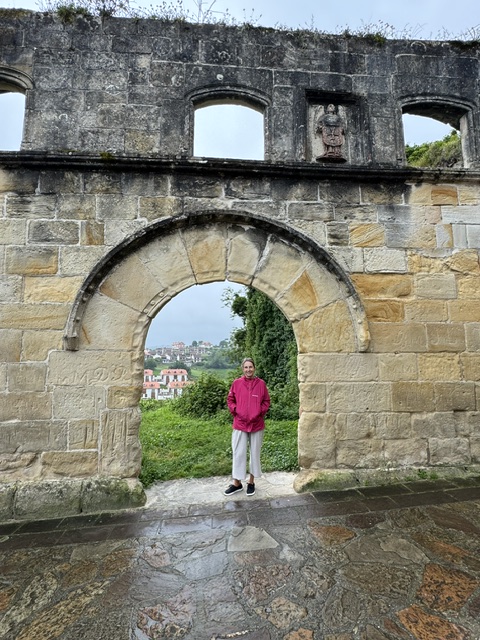
This is the door of the pilgrim. San Vicente de la Barquera was an important point of the Camino del Norte and had numerous hospitals and shelters for pilgrims, all within the city wall. Hikers on their way west, after leaving town would go through the wall by what is known as Door of the Pilgrim.
Pilgrim door on the left, church, and hospital on the right.
Here are some of the city walls outside the church:
Best I could get of the castle. Castillo del Rey. Built in 1210 (!) by Alfonso VIII, on top of an 8th century castle when King Alfonso 1 was the Asturian king.
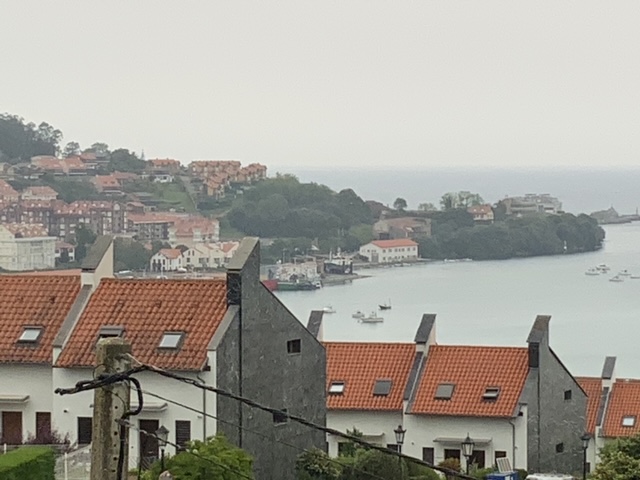
This photo is from our hotel window and kind of shows how the town is built up into the hills, with the marina below. We’re on the next hill over from the castle and church. I’m sitting here, listening to the church bells celebrating the wedding and to sheep baaing, though I can’t see them. Probably in the hills just behind us.
Hotel el Tejo Comillas, clean, nice rooms, seems to do a really good job with quiet between rooms – a first! Super nice front desk person who sent us to a great lunch.
I got up early and explored the town while it was quiet. Just the streets alone are incredibly beautiful – and the walls – all of it. The whole town looks like this an it goes on much more than you’d expect.
Wow, don’t know why but I hit such a wall today. Had a really hard time keeping going, ate all my strategy protein, energy, drinks, etc. Rick hit a wall yesterday, glad we didn’t have it the same day!
Today was a wonderful hike (aesthetically). We copied yesterday and took a taxi for the first 2-3 miles and the taxi drive again said, no, I should drop you here, it’s a better place. And he was right. We got off the main roadway onto a country lane and that was the main walking, plus some dirt roads, a bit of beach, a bit of trail above the beach. Just really pretty. Rick said it reminded him of the Camino Frances – with the variety of rural backroads.
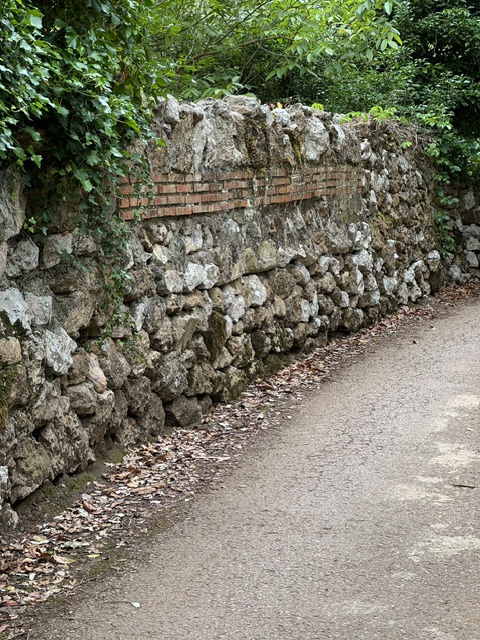
As I’m walking, just looking and exploring, I see things and stories just start. Like this one. Why the brick? Why there? Why stone after? And I can come up with whole stories of relationships, left overs made useful, so many possibilities because of an odd wall.
Different views:
Out of the blue, this little scene – looking toward the water, the sign said: Bank of Equality In Ruiloba, there is no place for violence. Healthy and respectful relationships.
Then, total surprise, we came into the town Comillas and it was full of life. A bunch of stalls set up in the main plaza, a lot of people walking and talking throughout, a small tight town up and down the hills, but so much more active and lived in than a lot of the other towns we’ve gone through. And the buildings! My goodness, one gorgeous building after another. Evidently this became quite a heyday in the late 1880’s and people brought their architects with them to build summer houses and palaces. Mountains to hike in, beach just below on the other side of town.
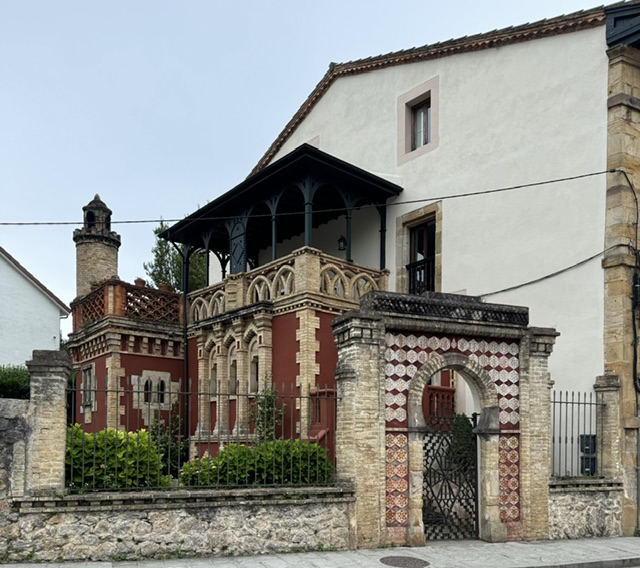
Here’s just one of the many interesting pretty places, the old blended into the new.
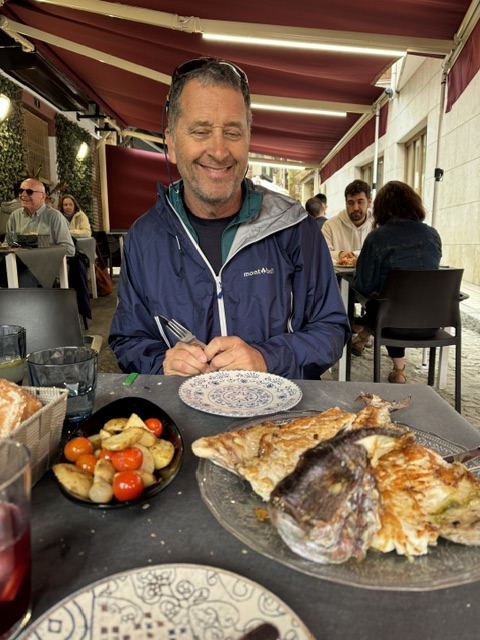
All I wanted to do was lie down, but I knew I wanted to explore a bit. I took a quick shower to try to revive and then we went out for a great lunch. I’m clearly becoming inured to the quantity of animals I’m eating over here. This fish didn’t even faze me. Rick and I both are aiming for pure veggies when we get back.
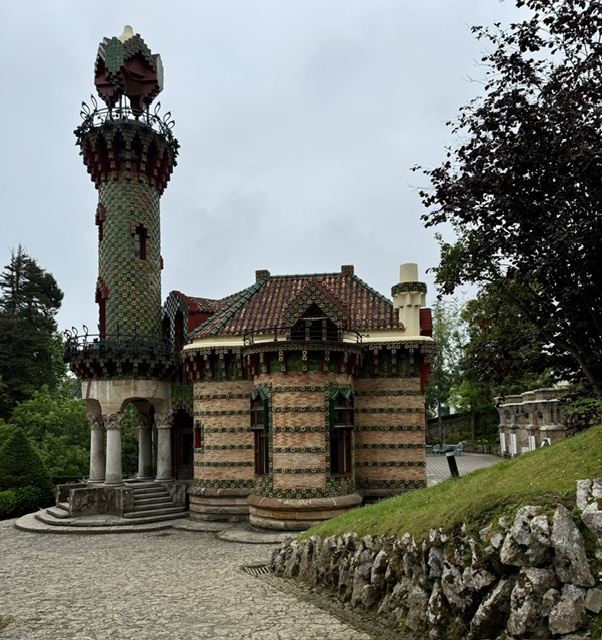
We then walked up to and toured the Capricho de Gaudi (Gaudi’s whim)- one of his first buildings where he was given free reign and it showed a lot of what was to come from his designs.
It was lovely, small, but so clever with space use and design. It was the summer house of the local Marquis, who was his main patron.
We also walked by the main house of the Marquis. He was 14 when his father died and went to Cuba to build a life and started a shipping business with one ship. What it didn’t say and I was assuming after our Black history tour in Madrid, was that his main business to start was probably the slave trade. No signs anywhere said this around his property buildings, but our guidebook said the slave trade was the main source of his money. Later it was steam ships and banking.
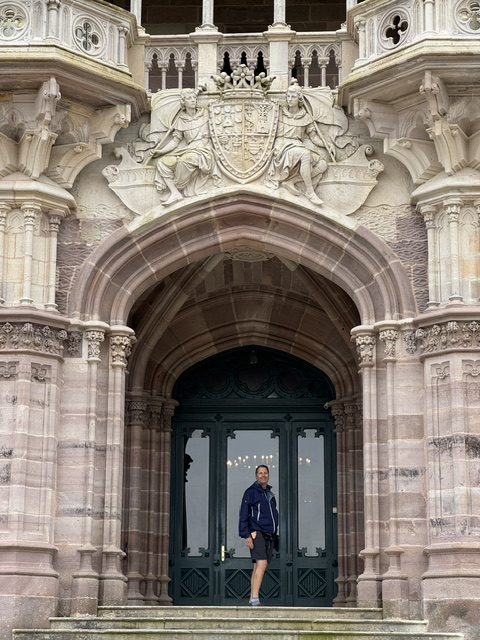
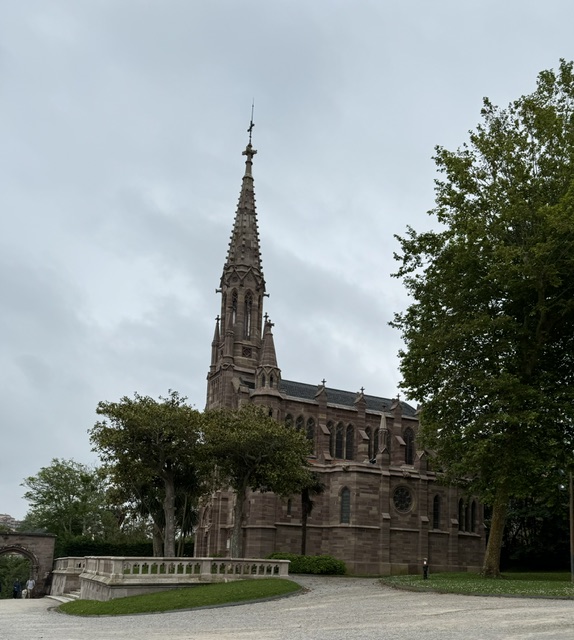
He did have style – both with enjoying Gaudi’s creativity for his summer house and then building the gorgeous Sobrellano palace and an accompanying chapel (looked like a full size church to us) for his family. He also wanted to build a seminary to train priests and to support the poor in getting an education, per the notes near his building. Wikipedia said he was pressured by a Jesuit and agreed to finance the building of the Seminario Pontificio. So interesting how history is written. He died before the official ground breaking, but his son completed the project.
This is the chapel
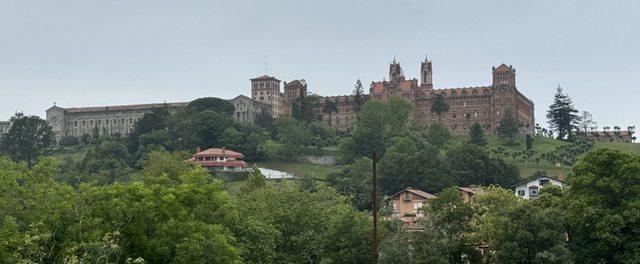
We couldn’t get over to these buildings, but they were spectacular from a distance. Again, our guide book said that the school was acclaimed for its seminary, focus on cannon law, music school and choir. But the school was moved to Madrid in 1964 and it’s been empty since. Really? It’s so gorgeous, hard to believe. Nope – that was an old note. The updated history reflects what the woman at the front desk told us. But it was all in Spanish and I thought maybe I misunderstood. Happily, no, got almost all of it!.
The academic activities of Comillas Foundation are an University Degree in Hispanic Studies and Master in Teaching Spanish as Foreign Language. Besides that, the foundation provides forums and seminars related with Spanish language and culture. Comillas Foundation headquarters is situated at the former Comillas Pontifical University building. Until now, the activities of the foundation were held at the Sobrellano Palace, a few hundred yards from the future location, until the restoration of the buildings are concluded. From May 2010, Comillas’ Foundation activities take place in an historical building entirely renovated.
In addition, there is a food bank and supports for the local people who are struggling. So – yay – happy buildings with a purpose again.
We came back to the room and I went into cocoon mode.
Today was so great. First, we had our morning and breakfast at our wonderful hotel in Santander. Then arrangements had already been made for us to take a car a good few miles into the Camino. We’d read in every app/book that if possible, don’t do the walk out of Santander. It was through miles and miles of city and industrial areas. There’s a train that a lot of people take or taxis.
So we looked at the map and realized that we’d actually like to go further than the drop off point to avoid more city-like areas. Our driver suggested he drop us at the far side of the town we’d chosen to avoid continuing industry. So nice!
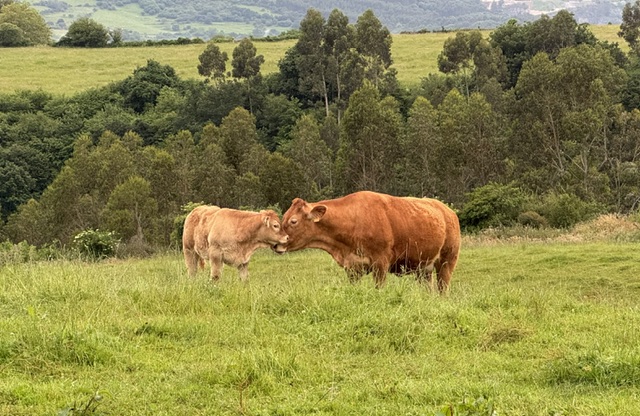
We walked the road a bit, then turned off the main road and were back on country roads. The hills are more settled, but still with cow pastures and cows and fields of what looks like corn, but is probably animal feed crops.
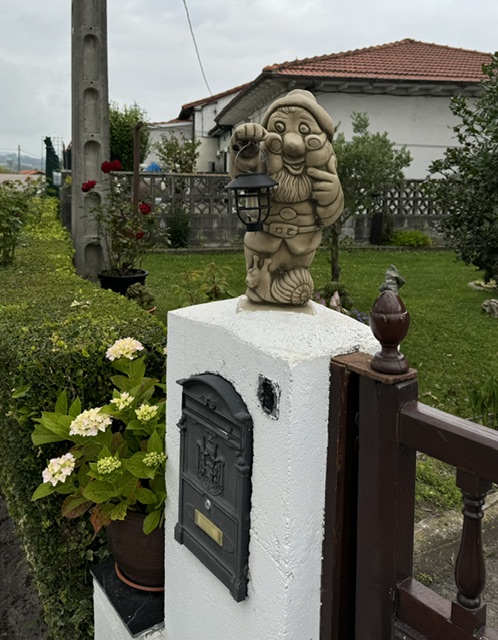
Have I ever mentioned Snow White and the 7 dwarf theme? I’ve seen it on all three caminos, never understand it, not a lot of places, but every once in a while. When it was the 6 of us, we saw the whole crew along a stream in a garden. Here’s a marker on a driveway post.
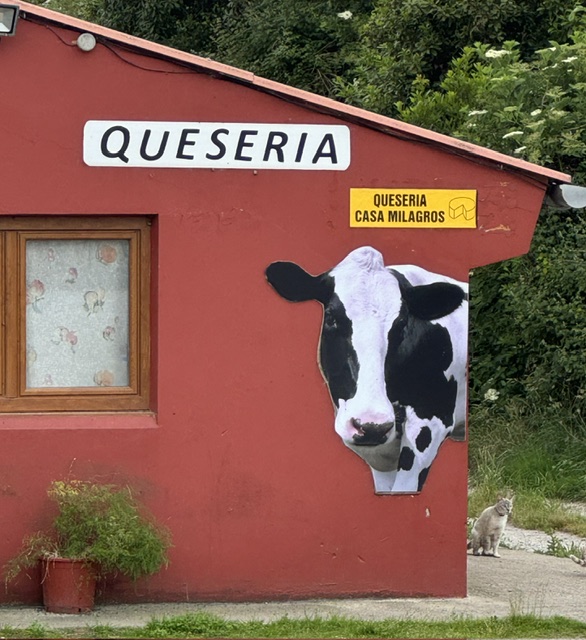
Great store
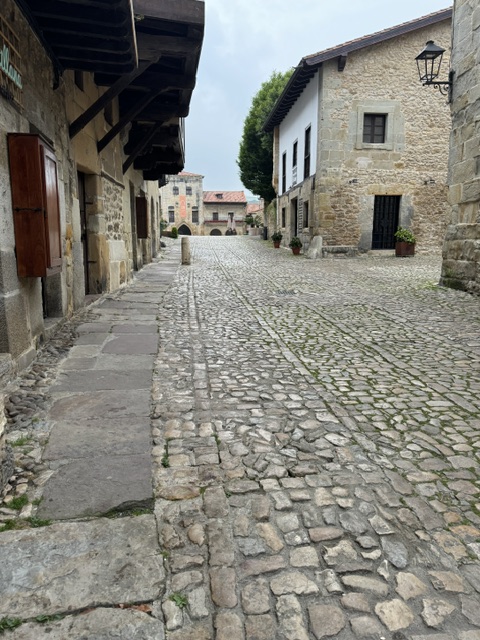
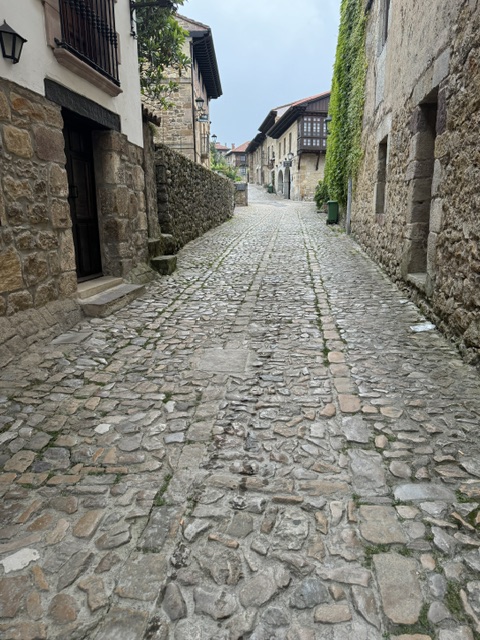
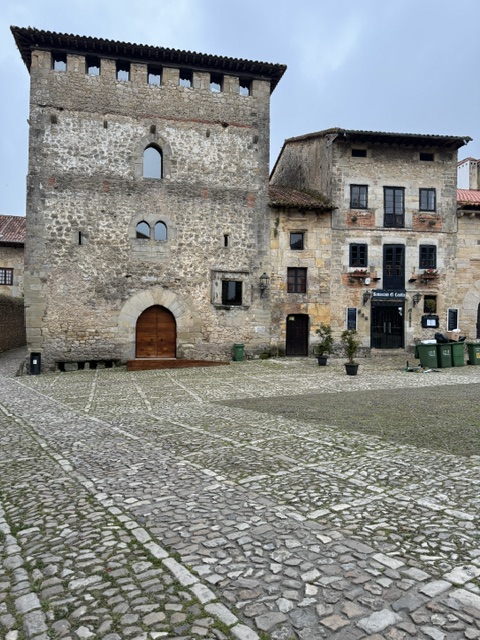
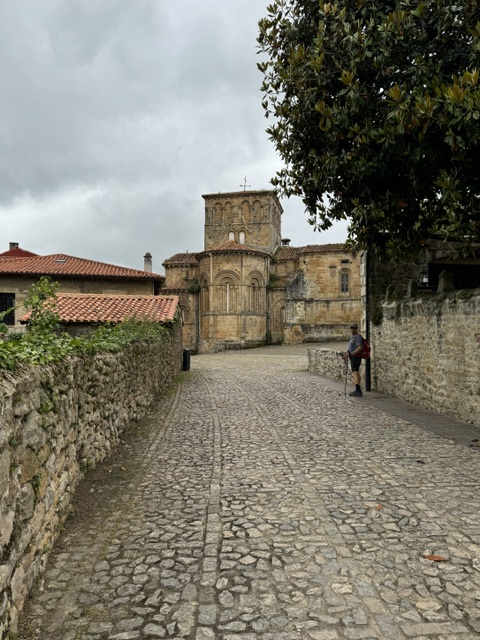
Then, we walked into a completely medieval town. Couldn’t believe it. We’d read that it was one of the most charming villages we’d see, but couldn’t really grasp it until we were in the midst. All the roads/paths/houses and buildings are consistently the same stone and it’s beautiful.
I’m psyched to be spending a night here. There are a ton of school groups of all ages and adult tours as well. But the lucky thing about being here for the night is that I’ll get to walk around tonight and early tomorrow when no one is up to see what it was like. This was one of the two main destinations for trips out of Santander that I’d seen when trying to figure out what to do IN Santander. The other is the cave museum and that and the caves are on my to-see list if we come back.
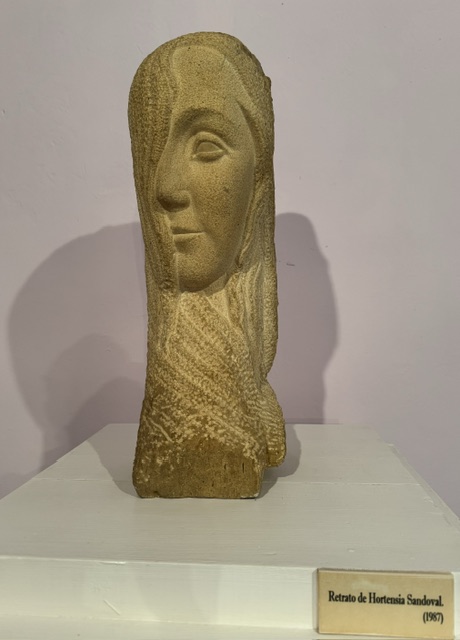
We wandered a bit, seeing a museum of a local sculptor, wonderful:
Hard to choose what photo to include, I really liked his work over the many years, decades shown – aside from when Franco jailed him for 5 years.
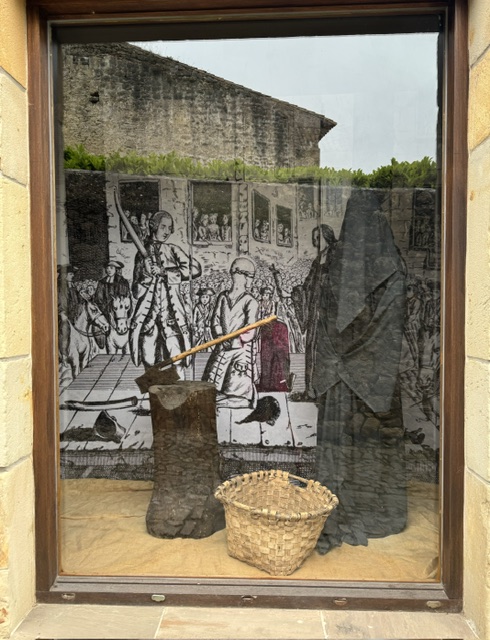
and decided against seeing a museum about torture and the inquisition.
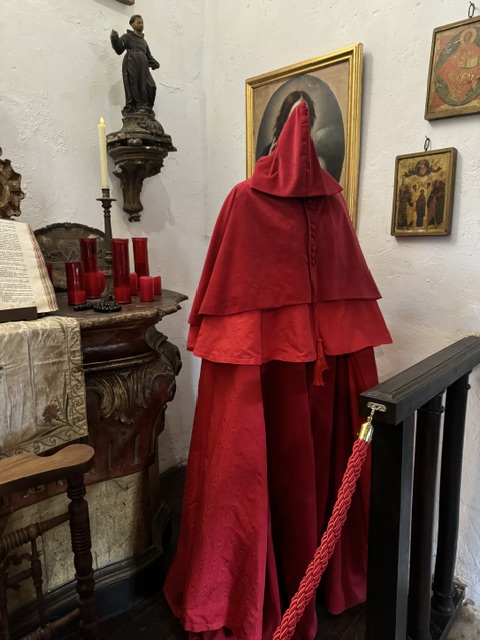
Instead we went to the house-museum that covered the people living there since the 1500’s. Incredible.
The first owner was one of the lead people in the inquisition. Something to be proud of. Not.
Another was a Nazi soldier, high up in the ranks, whose father helped develop the Inigma code. This soldier tried to work with a few others to go behind Hitler’s back to Switzerland to negotiate a peace treaty. He ended up being the enemy of the Nazi’s and the Allies. He lived here as a carpenter. And there were many more including a woman who started a cottage industry hiring locals for sewing costumes and clothes.
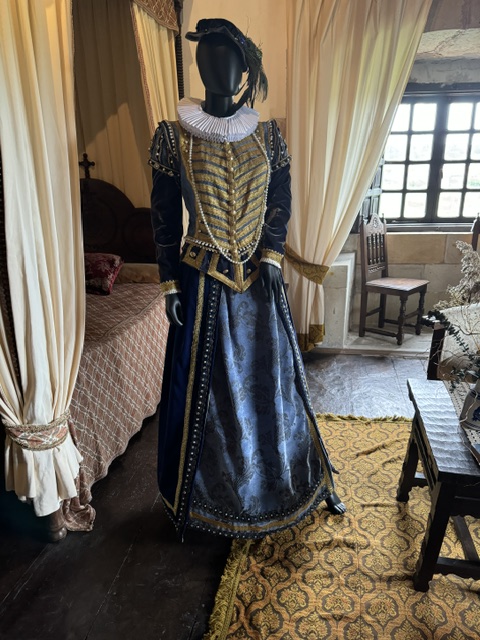
Lady’s suit around 1530’s
Fun note – the four poster bed began around this time to serve a few functions. Warmth when the curtains were drawn and privacy from all the servants who were always around. Who knew?
Cool museum.
Got lunch (overwhelmed again at the amount of food, changing it up going forward) and came back to the room for a shower and a bit of quiet.
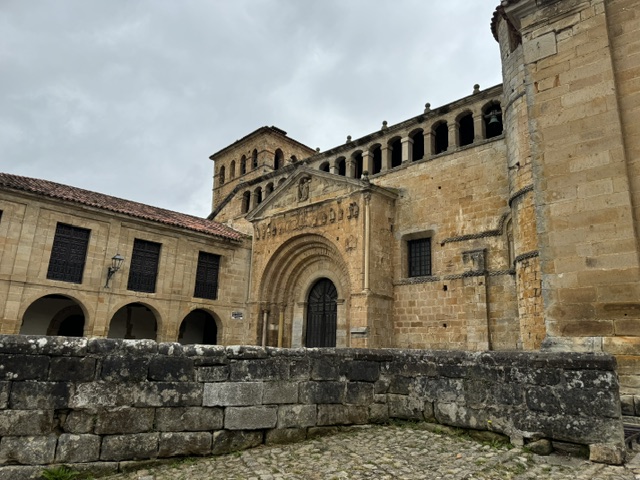
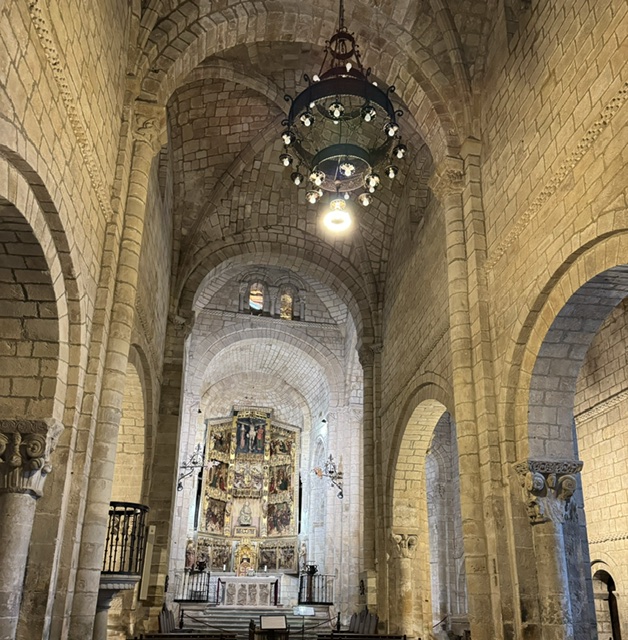
Went to the main church here, only one we see that’s still a church, but maybe mostly a museum. The Colegiata de Santillana del Mar. To walk in was to walk into an ancient building. All notes in Spanish, but tried to use translation to get some of the history.
The church has its origins in a monastery dating from 870. Tradition has it that it was home to the relics of Santa Juliana. This is stated as certain when reading about the town. Over the course of the 11th century it was transformed into a collegiate church, although the building visible today dates from the 12th century.
Yet again, it smelled so much like mold that Rick was out very quickly. So strange given that it’s all stone and wood.
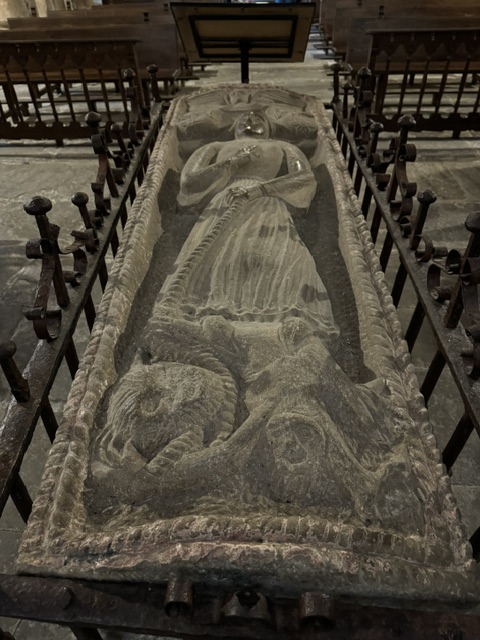
Here Juliana is, face and arm rubbed shiny, probably from people asking for prayers.
Really personal story written on the plaque next to her sarcophagus in the church: Towards the end of the third century during the cruel persecution of Roman emperor Maximillian against Christians, a young senator, named Eluzo, attempted to marry a maiden from Nicomedia, named Julianna, illustrious for her birth, personal merit and unique garments. Love that.
Julianna’s father was a Gentile and one of the most ardent persecutors of Christians in Nicomedia. The daughter had been secretly educated in Christianity. But not content with this, she had resolved never to have any other husband but Jesus Christ, not to aspire to any other goods or honors than those of heaven.
She was in this resolution when her parents promised her to Eluzo. She was strangely surprised when she heard from her own father that everything was already finished, and that the same day the one who was destined to visit her would come to visit her.
Juliana received Eluzo with great courtesy, but with much more modesty, giving him to understand that she could not consent to that wedding until she saw as a judge and prefect of the city. Eluzo, through efforts and money, obtained the position he sought. He took possession of it and sent a message to Julianna, offering her the prefectura at her disposal.
Juliana, unable to hide any longer, sent him to say that she was glad to see him placed in a position of honor, but that he still had to take another step. It was necessary to become a Christian like she was.
Eluzo, without wasting any more time, set off in search of Julianna’s father and told him what his daughter had responded to him. He was overcome with anger and responded to the prefect: I swear to you that I myself have to be my daughters’ prosecutor and you have to be her judge. Saying this, he entered Juliana’s room full of fury and asked: What is this, daughter? Do you not know what an honor it is to be majesty of the prefect of Nicomedia?
I know well, sir, that Eluzo is a gentleman, but he is not a Christian. Her father exclaimed in anger: I myself will go and put him in the clutches of wild beasts, because I want to see him torn to pieces rather than converted into a Christian. And losing all feeling, he treated his daughter with barbaric cruelty. She was then handed over to the city prefect for trial.
So – bad ending for Juliana, tortured and beheaded, but never wavered.
Wikipedia noted that: Eleusius was later eaten by a lion after a shipwreck on an island unknown.
Further note since everything I read had Juliana residing in Naples was this: Juliana is clearly a historical figure as Saint Gregory the Great requested relics of her from Bishop Fortunatus of Naples for an oratory that a wealthy Christian woman had built on her estate in Campania, Italy, to honor Saint Juliana and others. On the other hand, tradition in the north of Spain holds that Saint Juliana is buried there, in a town near the Cantabrian Sea that took its name from her, Santillana del Mar. Santillana is a contraction of Santa-Iuliana. The Church of St. Juliana in Santillana is a Romanesque abbey, well over a thousand years old.
And that’s my history for the day!
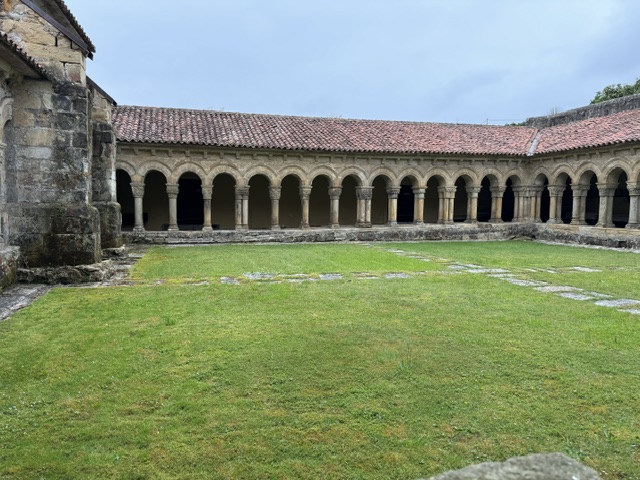
Cloister, looks much bigger than it actually is:
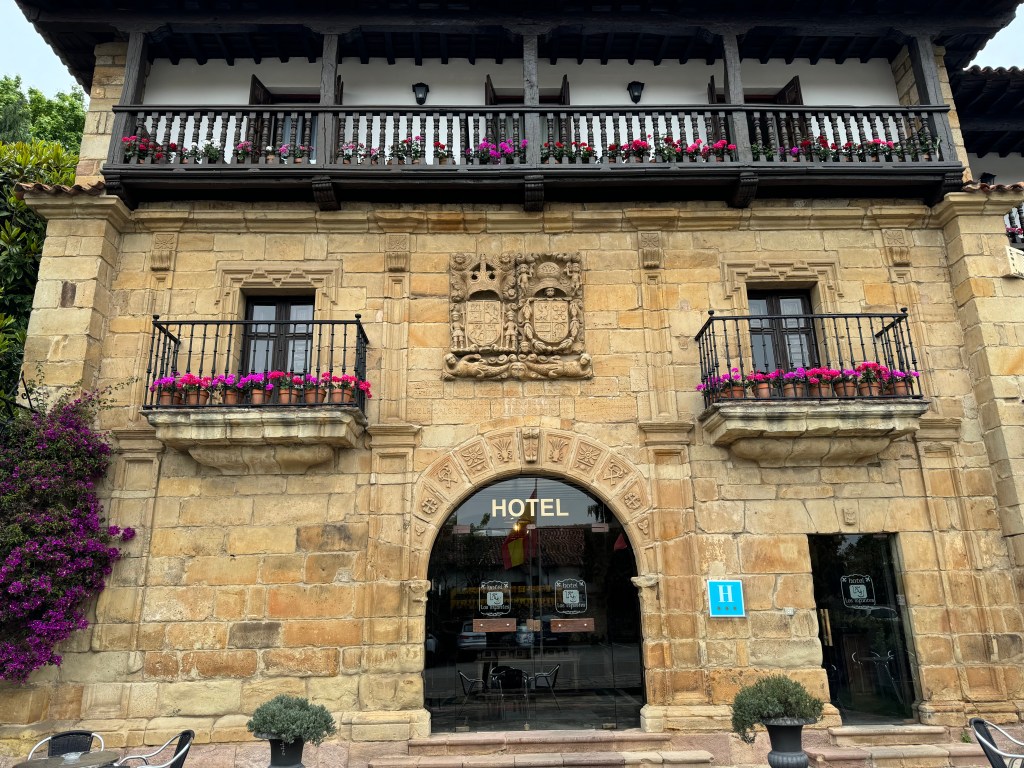
Hotel Museo Los Infantes, wonderful, 17th to 18th century palace became a hotel – moved stone by stone and rebuilt in 1974. The people running it are so nice. “The hotel is a real museum, it is entirely decorated by precious antiques.” Which is true, but means it’s not completely comfortable in the sitting areas. But looks cool!
I asked the front desk person why it was named “Los Infantes”, he just shrugged. And I can’t find anything about it online. So – just a cool old building converted to a wonderful hotel!
Le Petit Boutique Hotel, wonderful. Clean. New. Nice section of the city, though not anywhere near the camino. A block from the water and walking areas.
Yay, a day in place! We had a nice breakfast at the hotel with Carol and Matthew and then waved them off in a cab to the airport.
We then went back up to our room to investigate what to do. I’d done some exploring last night and discovered – there’s nothing to do! There is a 2 block area of the old city, per our hotel host, but when I used all kinds of words to see what there is to do in Santander, all the trips were leaving to go somewhere else. A monastery. Incredible caves (too late to get tickets) with prehistoric paintings. But in the city, finally found a maritime/aquarium museum. Rick and I were so relieved. We could just chill with no agenda.
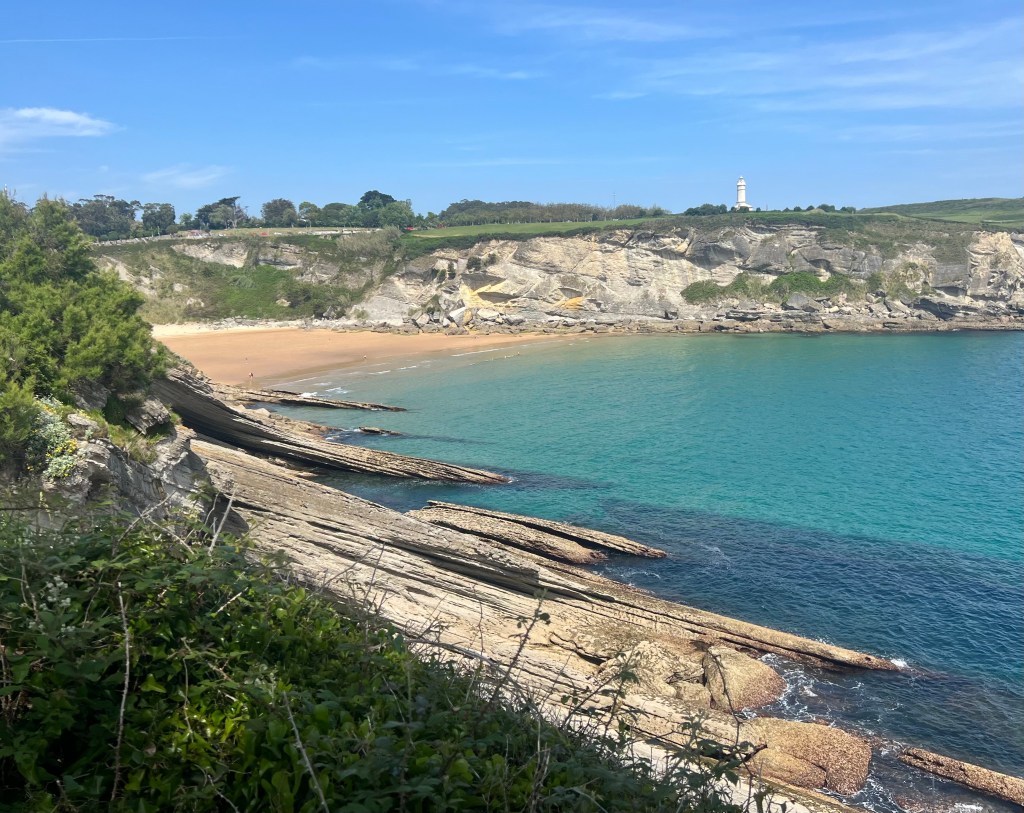
We walked out to the lighthouse and back and decided, we’d done enough.
The rock formations along the beaches are so cool, I guess further along the coast, they turn and are lined up like books. We’ll miss that because it needs an extra day to go that way. But even here where you can see the slabs, it’s great. And then beyond the beach shows where the high tide line is, but until then it’s just long, flat and perfectly sandy for ages. Such a good place to learn surfing or swimming. Way too cold for us, but a fair number of people are going in to swim or play. Surfers are all in wetsuits.
We then went back to the same restaurant for lunch (there’s no way that would have happened with C&M here). Rick then worked in the room, I did laundry at a laundromat a few blocks away.
We both had some time sitting down by the water, just watching. Such a great day – and the weather was beautiful again!
Today was a total treat. First – because of the hotel mixup, we were 1+ mile already on our way. And, as a bonus, none of us bashed our heads on the rafters, so already starting off positive. Then – the day was gorgeous, a sea breeze, no clouds or rain and we walked on the edge of the bluffs above the water or on the beach all the way until we caught a ferry that took us across the bay and cut off 5 extra hours if we’d walked around.
Incredible path:
Coming to the beach leading to Santander
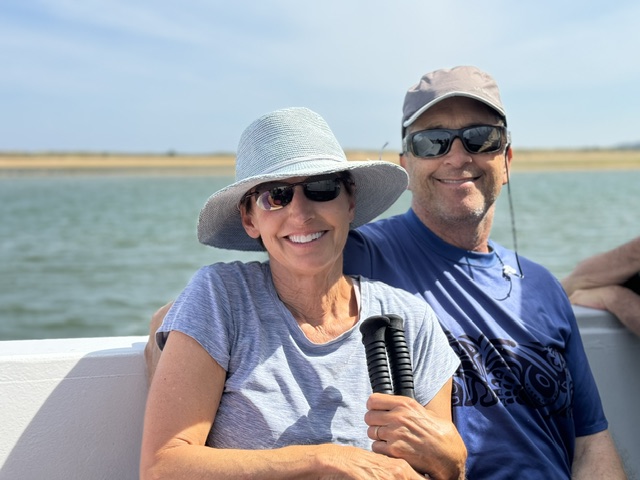
Ferry ride – notice the happy smiles because something is carrying us for a long way!
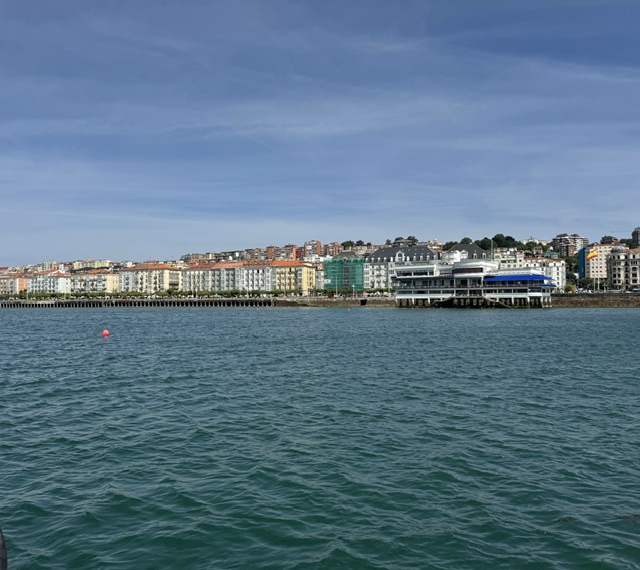
Santander is big, so clean, pretty modern with a few old buildings mixed in, but not many.
Last day for Carol and Matthew
We went straight to our hotel, changed, unloading our hiking shoes and went to lunch that the hotel recommended. A neighborhood place, that per usual, when with Carol and Matthew, was great. Though, confession, we’re getting a bit codded out. There’s a lot of cod in the menus here.
We then walked over to the Palace de Magdalena, a summer palace of the royals built in 1909, and is gorgeous. Of course. Then – just parked in our room letting our feet/legs recover. With the luxury of knowing that we’re not going anywhere tomorrow. A day off!



















 Reb's Walks!