Supposed to be staying in Hotel la Vijanera, beautiful stone work, wonderful restaurant, nice people. Guessing the rooms would have been great. But nope – we got there and they said that they had 65 middle schoolers coming with 4 teachers and a bus driver and expected chaos. We’d been moved 1.5 down the road 10 days ago, but had no idea. The new place is very sweet, right near the beach which is beautiful, and a bit further along on the i amino, but probably not a recommender.
The front desk guy at the original place was so nice and drove 3 of us down to the new place after we ate – Rick was ready to walk the distance and said it was a beautiful walk. He’s amazing, first walk after getting back from Chicago and walked the whole way.
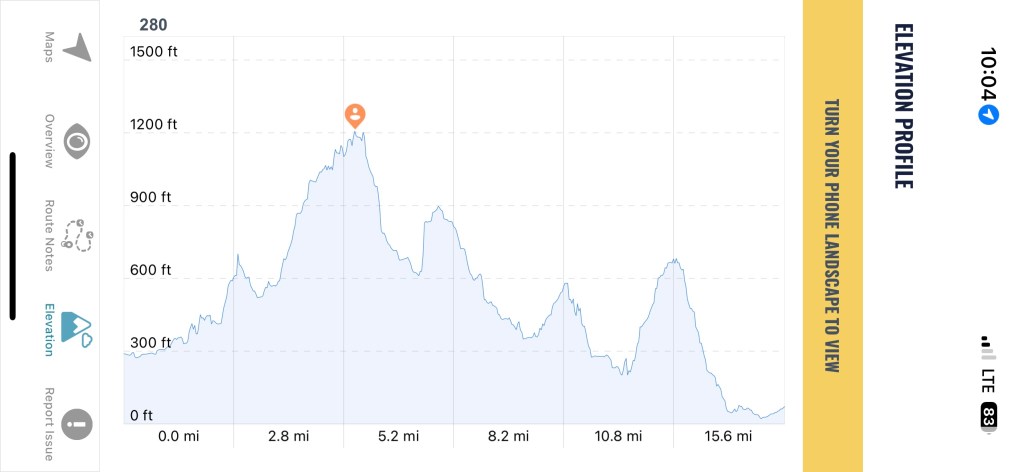
I was very relieved today because Matthew crafted a different camino from what MacsAdventure had and was 5 miles shorter. Rick was up for anything and actually followed our path on All Trails marked as a camino. It was all tarmac which made for easy walking and a lot of it was country lanes or very low use 2 way roads. And I was still tired! Yep, it’s adding up. I’m expecting a second wind after a day off in Santander, day after tomorrow.
We had a nice breakfast at our place and a bit of time to talk to the owner. It was all in Spanish, but I understood most of it. I was saying that the Norte was spectacular and the food great, but the signage on the Camino de Frances was much easier to follow. He said that it was because everyone on the Camino del Norte thinks their way is the best and puts up directions accordingly. He also said that May and September into October are definitely the best times to hike. From mid-July through August, Noja goes from a population of 30,000 to a population of 130,000. In general, it’s just tourists and no peregrinos, too hot, too crowded and too expensive. He said it could rain any time, but maybe a bit less in the fall.
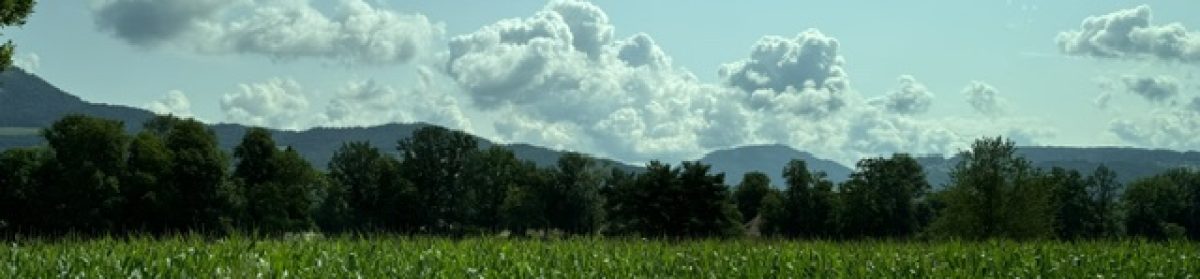
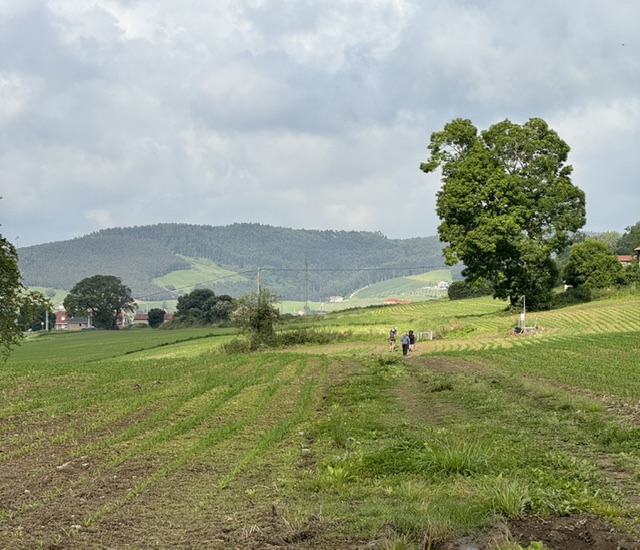
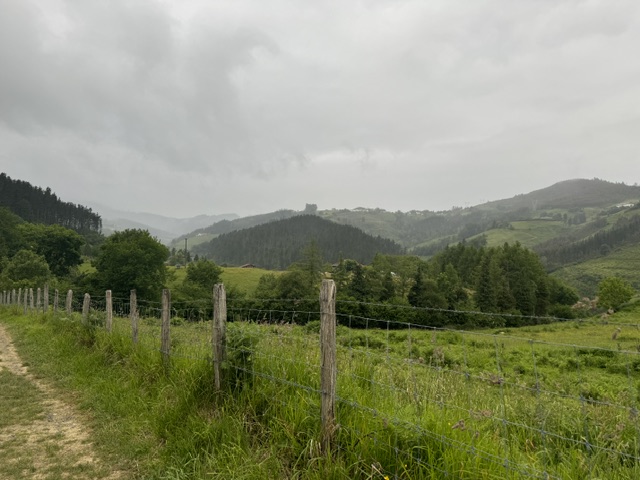
So pretty walk with really nice weather.
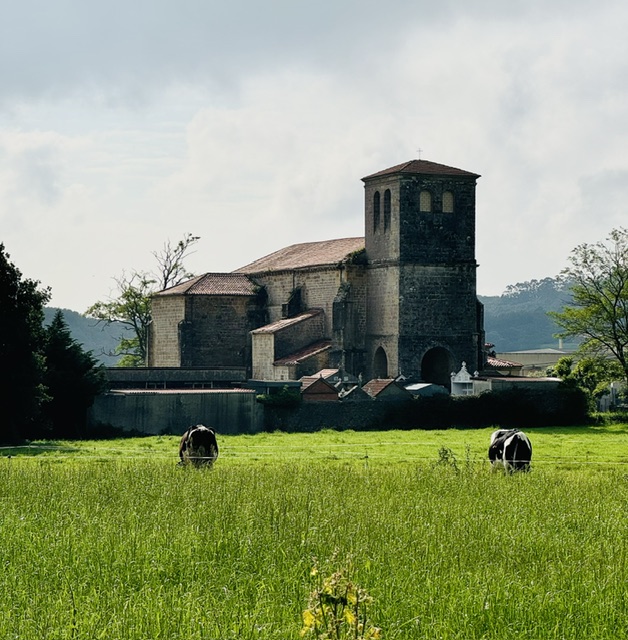
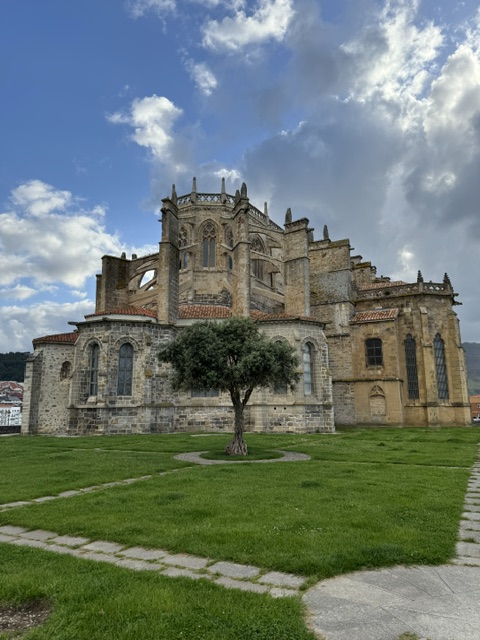
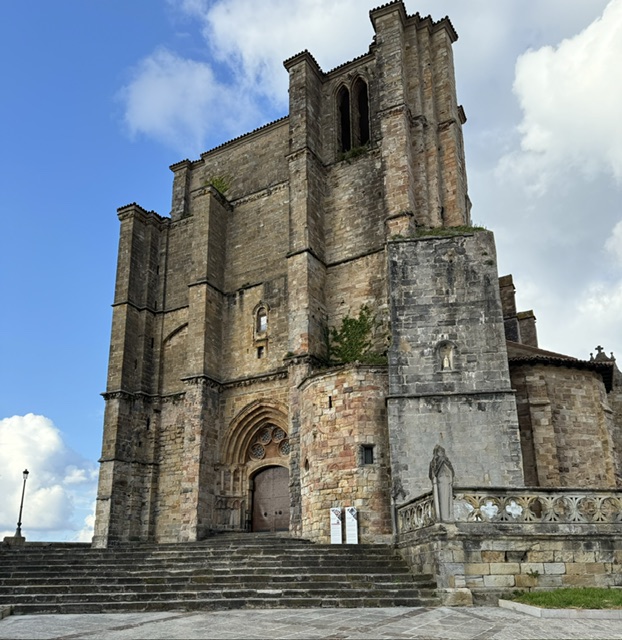
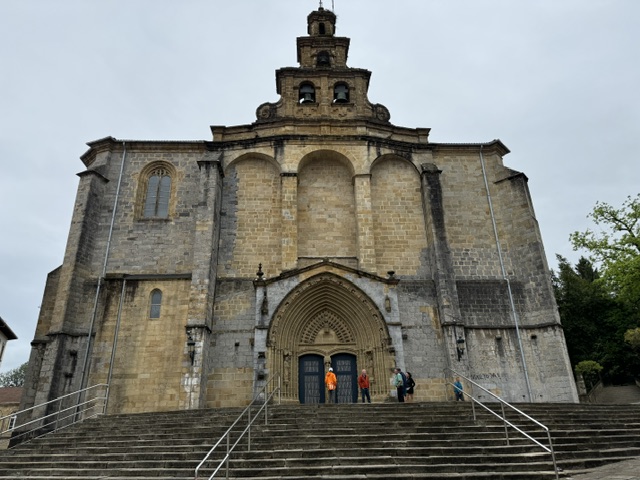
Tiny town, giant church. Wish I knew more about the social structure and how these things got built back in the day.
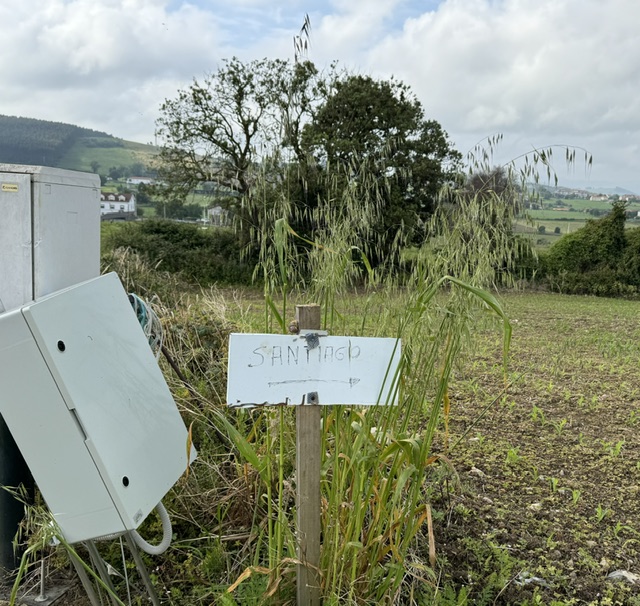
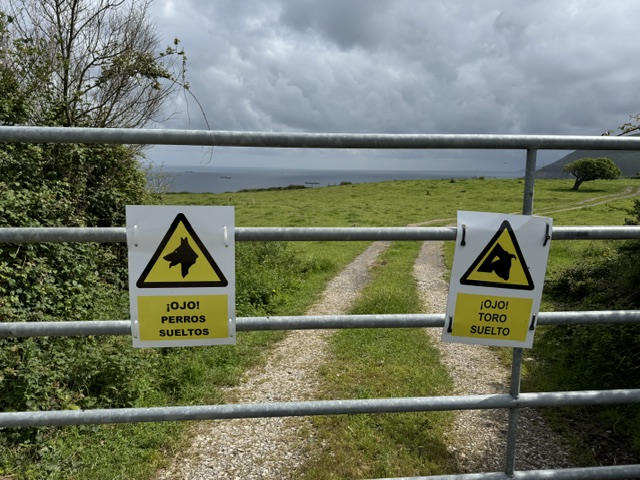
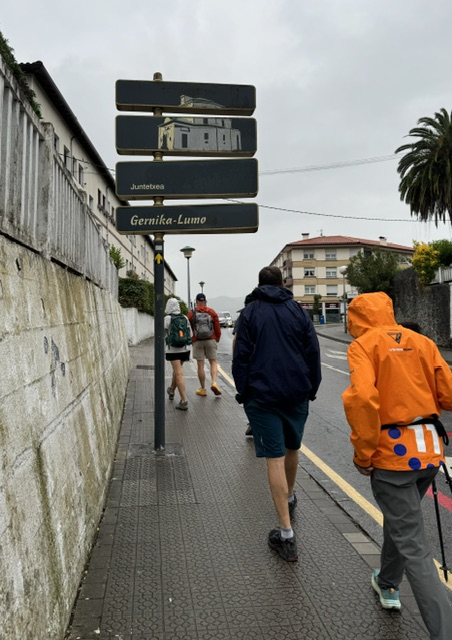
Like I said, not great signage at times. Very nice of someone to put this up. Maybe the farmer who was nice enough to let people walk across his field?
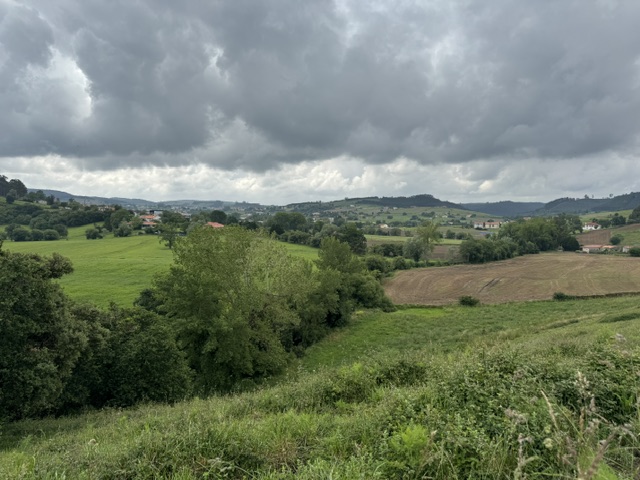
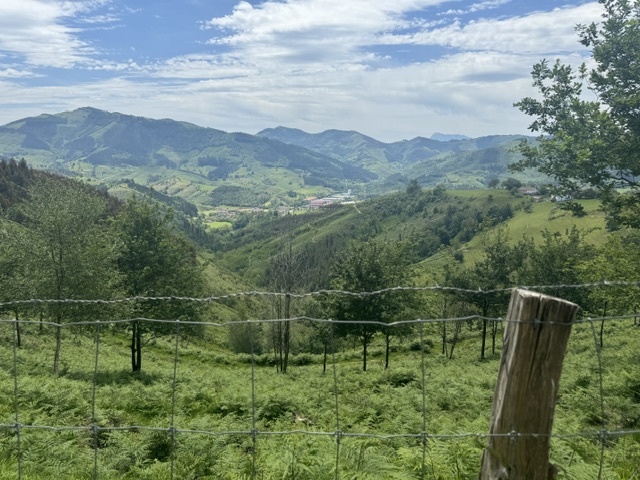
View from a top of a hill, can just feast the eyes as we walk today.
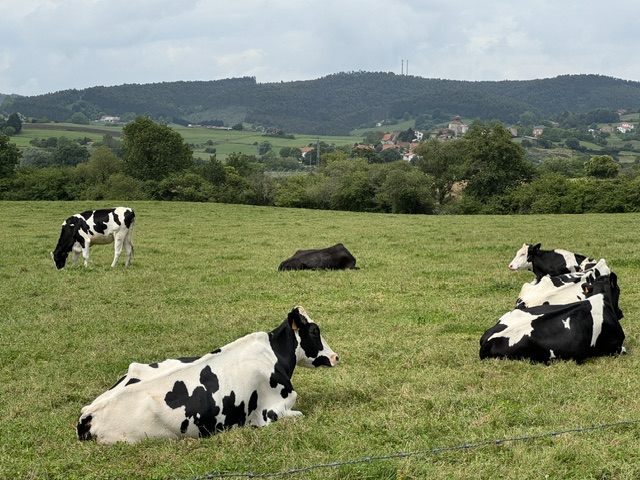
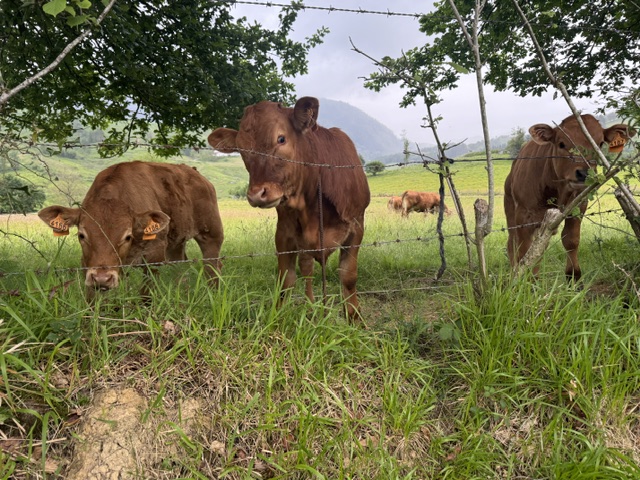
Incredibly clean cows…
Walked by a lot of timber clear cutting here. Saw logs being loaded and also rolls of smaller bits and pieces that are then used for parchment or particle board (they’re near the bottom of the photo, tractor is collecting and rolling). And I mean it’s clear cut – there was nothing on these hills when done. Alternated with replanted trees, so never giant swaths of bare land, but enough.
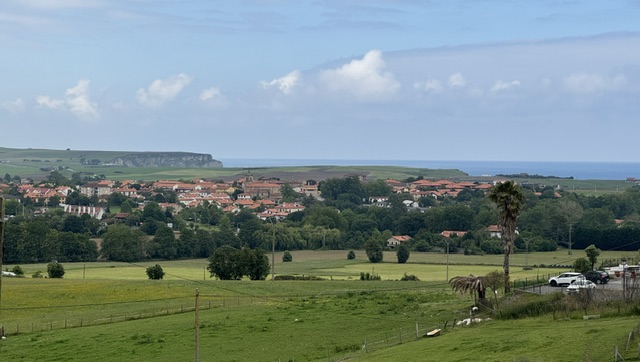
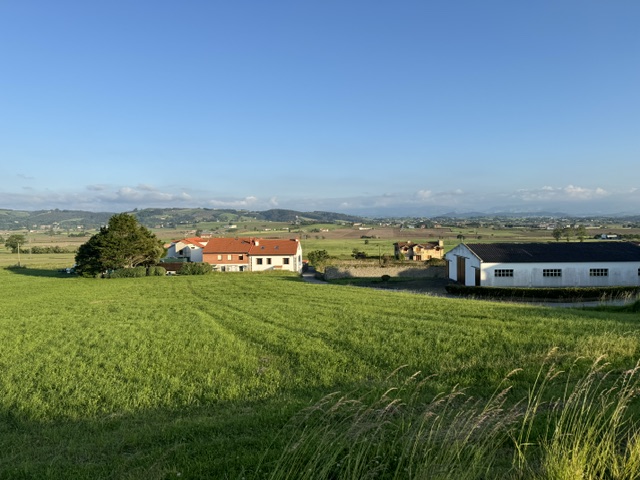
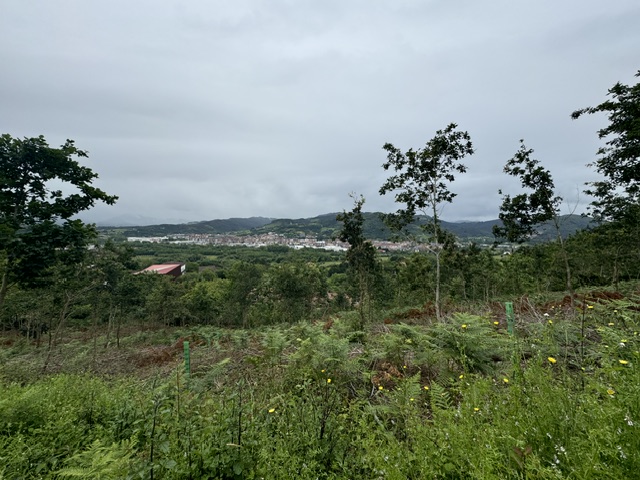
Coming into our town, very happy to see it and so pretty! Nestled into a bit of a valley with the ocean just beyond.
We had a great lunch at the original place as they said there wouldn’t be anything at or near the new place for lunch. The new place is sweet and they were excited to have visitors. Very low rafters, but second floor, fields outside and a cama matrimonia versus small twin beds. Might be a sleeping night. Just hoping for no head bashing before we leave tomorrow 🙂
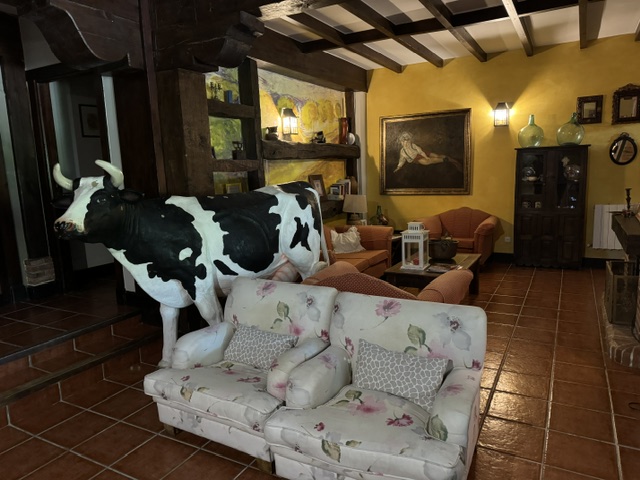
Love the living room decoration. Right up my alley. Really, who wouldn’t want a full size cow in their Irving room?
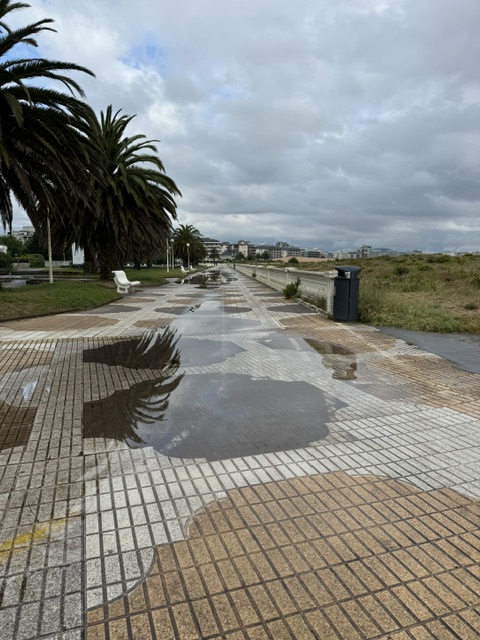
We dropped our stuff then walked down to the beach. Gorgeous. Matthew and Carol walked back up and Rick and I stayed just for the marvel of having an incredible beach basically to ourselves with warm weather and the sound of the waves.
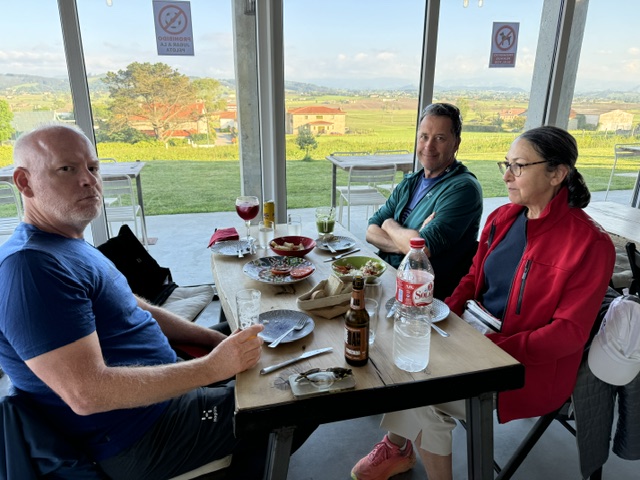
Found a dinner place, the only place, very cool, brand new, mod – had a yoga group going behind it, all 6 people young adults, where did they come from? None of us were that hungry, but it was so pretty and it was something to do. And it was great, very fresh, veggies from their garden. And I’ve now eaten anchovies at multiple places. I had no idea they could be so tasty.
We loved some of the phrasing on the menu:
8 anchovies of the highest quality….accompanied with some toasted bread to get greater delight.
All our dishes are made fresh. All of this entails a philosophy, a duration and surely understanding on the part of our clients.
It’s so incredibly beautiful, breezy, sunny and it feels Iike we should be out and walking, but we’ve done enough, so we came back to the room. It’s 9:30, sun still up, bright skies. I can still hear kids playing, church bells, the breeze. Wonderful.
Liendo to Noja, 17.5 miles. Posada la Mies. Quiet, on the hill, code to get in, quirky, but friendly!
Did my usual super early wake up, decided I’d take one more day hiking alone and got up early, tiptoed around finishing packing, then did my best to silently lug down my suitcase without waking the house up. First place we’ve been in where I knew people would hear me if I wasn’t careful. I was out the door by 6:30, figured I had a few hours if it was going to rain, looked good last night.
The directions didn’t align at all and I ended up walking next to a 2 lane highway for hours, on the shoulder. In the rain. But it was Sunday, very little traffic, only 3 cars passed me and the birds were singing. Happily, it wasn’t windy at all and it wasn’t cold. So I marched on. It was one of those days that reinforces the understanding that everything changes.
A side street finally took me off the highway, then a rainbow came out, the sun peaked through and the rain starting lightning up. Then a camino sign! The first that actually seemed related to where I was going – to Laredo and ending in Noja. I followed the sign, turning down a stairway and suddenly, I was in old town Laredo at the chapel and hospital that served pilgrims in the 1600’s. So cool. Then the rain stopped. Yay.
I went into the first cafe I found for a CoalaCao and a tortilla, this time the basic eggs, patatoes, cheese and sat down under an outside heater and started drying off a bit.
Then I was back on the trail that aligned with my map, and walked the longest promenade I’ve ever seen. Miles. Long enough for it to start raining again. Curving around an enormous bay. After the old town, it was a bit odd, just 6 story buildings, one after another, most clearly empty, waiting for the summer season. But the sea was beautiful and there were people walking with their dogs and chatting. Finally came to the end where I knew I was supposed to get a ferry. That was great, wish the ride lasted longer.
Can’t see the bay to the right, just past the sea grass
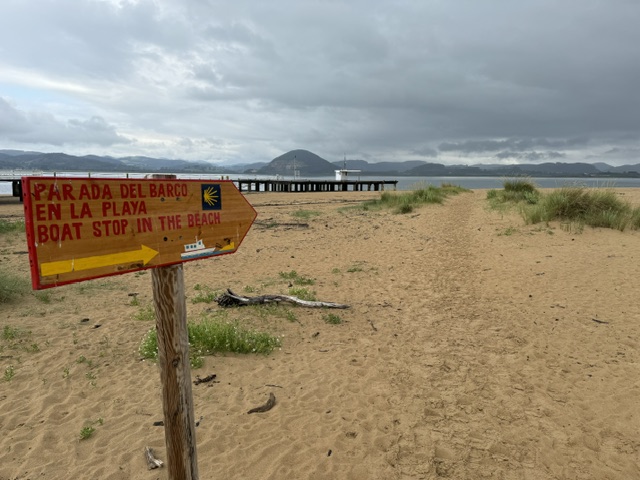
Love this sign for the ferry. Not related to that long dock on the left.
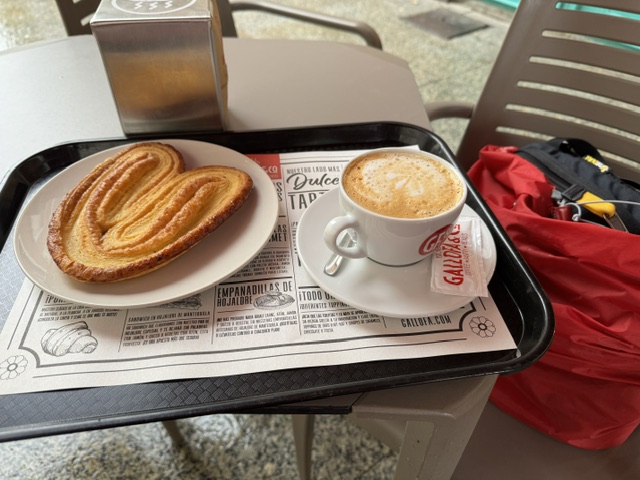
Then a great little town, home of the sardine. It had all the character that I’ve come to expect in these towns, Sunday morning people getting their pastries and bread, I stopped again for decaf, pastry and the bathroom. There’s no way here for outside option, too busy.
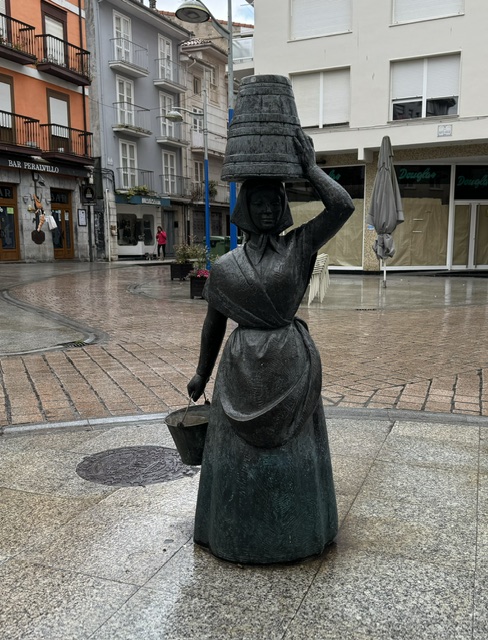
Another statue of a woman, there are so many in this area. Her pail was full of water just as it would have been.
Then tried to take the right that the map indicated and ended up above a beach, almost crawling through these bushes on a really rocky hidden trail that climbed up a hill – finally gave up. Couldn’t believe it. I ran into someone else who’d give up and he was covered with mud and also couldn’t believe it was the trail. Back onto a highway, again, ON the highway, this one busier. Then found a side street that led down to the beach, next to an estuary, the sun fully came out and I put away my rain things. Final walked into a pretty beach town and to the hotel. Yay!!
Went to the restaurant Matthew had picked out and then Rick joined. We’re all back together, so nice. I found out that Carol had been so tired that she asked Matthew to read out the menu from the restaurant to motivate her to keep going. Love that, we are entirely differently motivated. But it worked!
After shower and organizing things, Rick and I walked around town and found the Santiago church. It was huge inside, but smelled so badly of mold that we couldn’t stay beyond a look. Weird since wooden floors, but unmistakable.
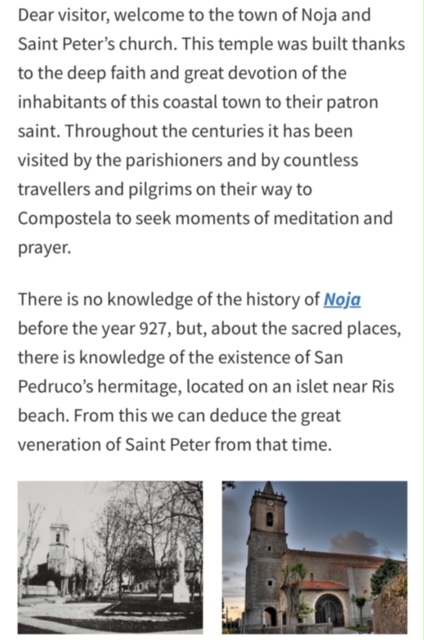
This gives a photo, better than I could take bc of its size. But we really liked the note that they didn’t have info for Noja prior to 927. Funny, as if that’s a problem.
Tomorrow, definitely following Matthew’s directions, if I can keep up, because I’d like to stay off highways. Though it turned out they were on the highways most of the time too.
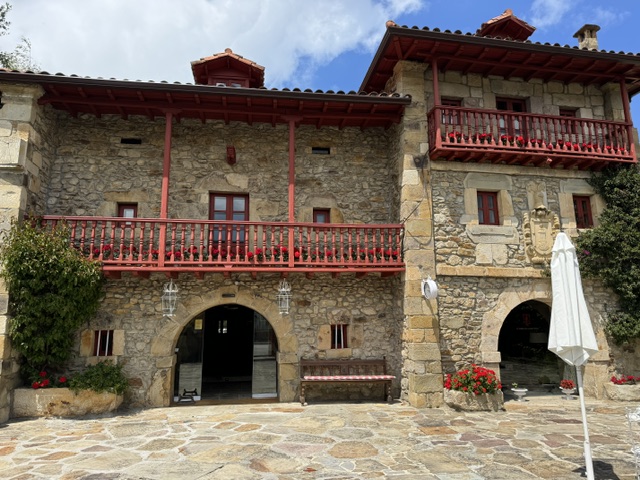
Hotel La Torre de la Quintana, amazing 1500’s building, same owners since the 1700’s.
Today was a wonderful day. Started off getting to talk to Kylie for a long time, always a gift and talked to Kaziah last night! I had realized last night that waiting for the 8am breakfast was too late if I wanted to walk the whole thing and get to Liendo in time for lunch. Otherwise, it would be the perfect miss of getting in at 4, only snacks available if that, and then dinner at 8. When I want to go to bed…
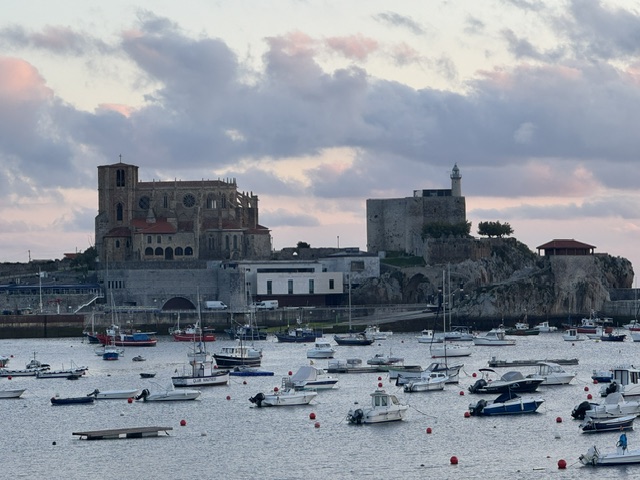
When I read the description of the coast and mountain view’s, I decided I’d get up early and just start. When I decided, it was too late to text C&M, so would do it in the morning. I woke up at 4:22. Because. Sigh. Got up a bit after 5 and then connected with Kylie. We talked for a while, then I called her back as I left the hotel. So fun because I ended up sharing the start of my walk with her on FaceTime. Loved that! She got to see the bay at sunrise or just after and the castle and church and the next cove as I walked and we talked. Such a nice start to the day.
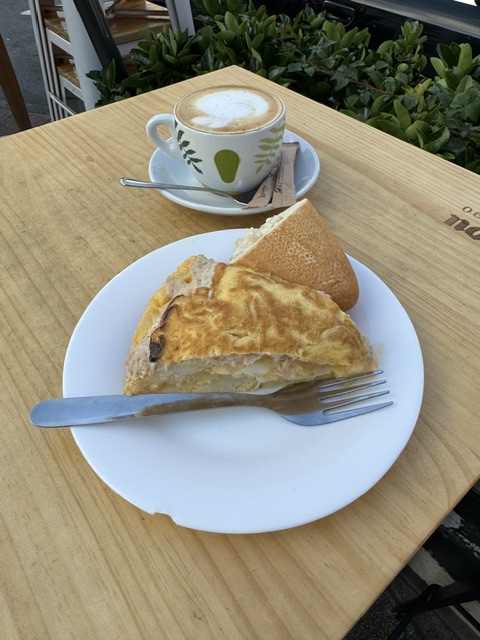
I hung up, found the perfect place for a tortilla (like a frittata over here) and a cup of decaf. At first, I wanted a piece of the tortilla that had just come out and was still steaming, and one of the guys at the bar got it and it looked great. She told me what it was and I said yes and then belatedly interpreted what she’d said, a blue cheese tortilla. Oh, ew, first thing in the morning? So I had one with cheese, tuna and ham. That sounds good, right? It was great actually. Then I was off.
Today was a classic day for me on Camino. Silence (after chatting) for a couple of hours, hour of dharma on Audible, then listened to a book on tape. Great hike.
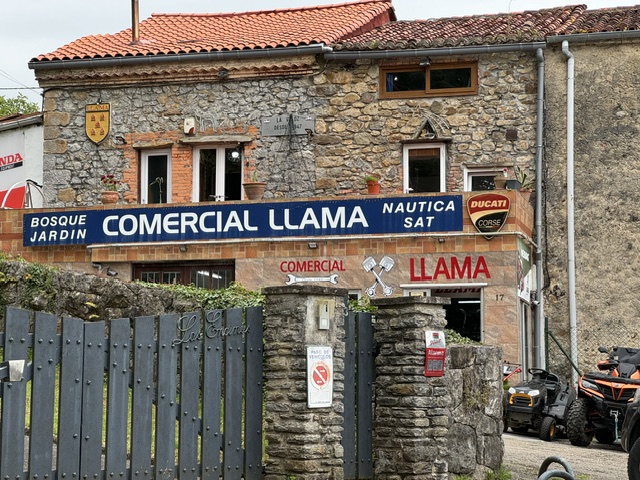
Loved this store sign, lends itself to so many ideas.
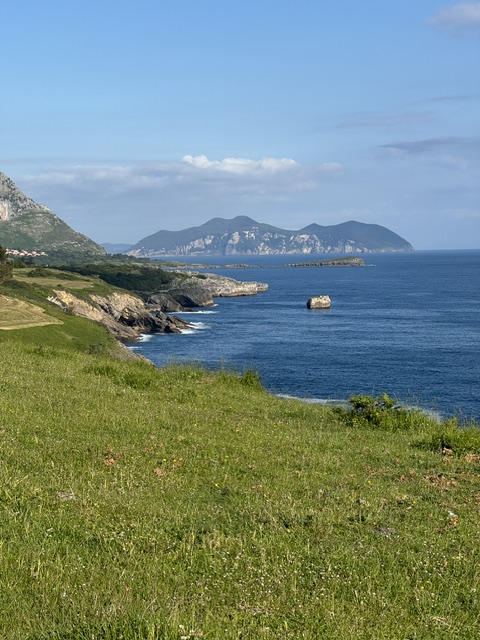
I was very happy when I got to the top of the mountain, for some reason, everything a bit achy today.
I stopped to get a photo and then realized the birds were singing like crazy and it was just wonderful, so back to silence, the sound of my feet, the birds and animal bells.
It seems like the bigger the animal, the bigger the bell, so there are tonal differences. Don’t know if you can hear this, but the goats are high up on the rocky side of the hill, hard to see on the video, with the cows closer at hand.
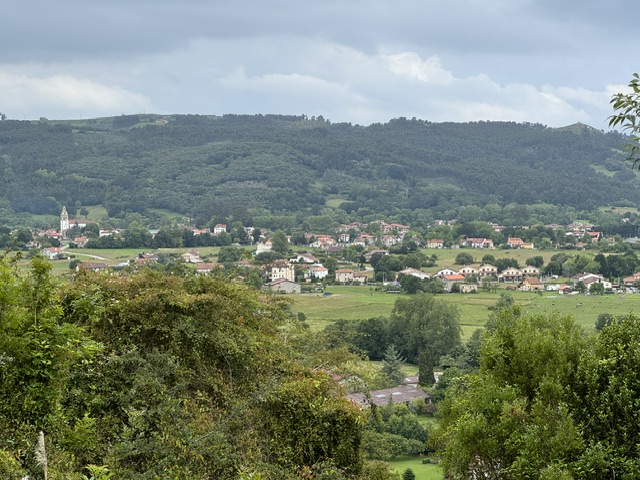
The last couple of miles felt long, but cool village. Big gorgeous houses, a lot of them blending old walls, with newer building, and spread out on this flat valley. It felt really different from what we’ve been seeing.
I arrived at our hotel and it’s exactly what I love most. Built in the 1500’s, updated, cool interesting rooms. I’m at the top (fun carrying my very heavy bag up, but worth it), probably in what might have been a servants room, cleverly crafted windows, rafters gleaming, wonderful. Rick would have whacked his head everywhere he turned, so perhaps better to miss just this one.
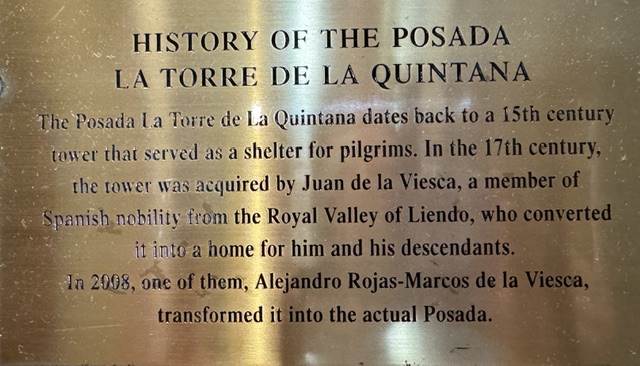
The plaque for the hotel, 500 years later, it’s hosting pilgrims again 🙂
We crossed from the Basque region to the Cantabrian region yesterday and maybe we’re starting to see cultural differences in the housing styles and how the village is laid out. We went to a big lunch, of course, yummy – Carol found it. Then the afternoon letting the bones recover, they’re feeling it.
Hotel Sercotel Las Rocas, new, big, clean, restaurante, but didn’t eat there, got a high room facing the ocean.
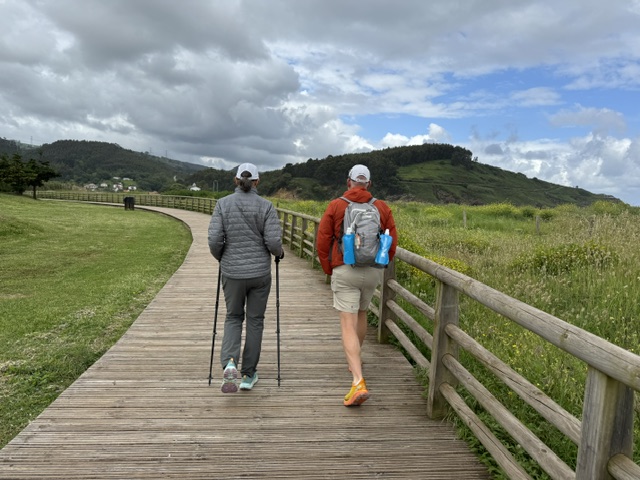
A fantastic day! Only thing missing was Rick because he would have loved this day. First, we decided to not walk the whole thing. The first 5 looked like what I did yesterday, kind of commercial, walking in the hills amongst houses. Instead, we took a taxi to the coastal town, Playa La Arena. We started right off on a beautiful walk, then a boardwalk, along the ocean and cove. And it just kept going!
Loved these signs together
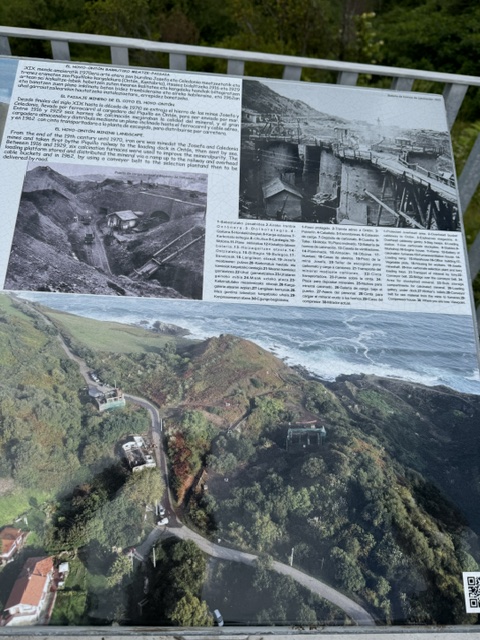
Serious mining happening here before the 80’s when everything played out.
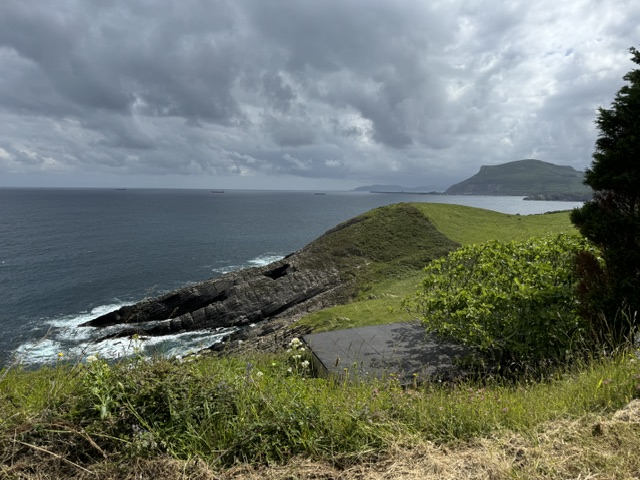
Just gorgeous, again.
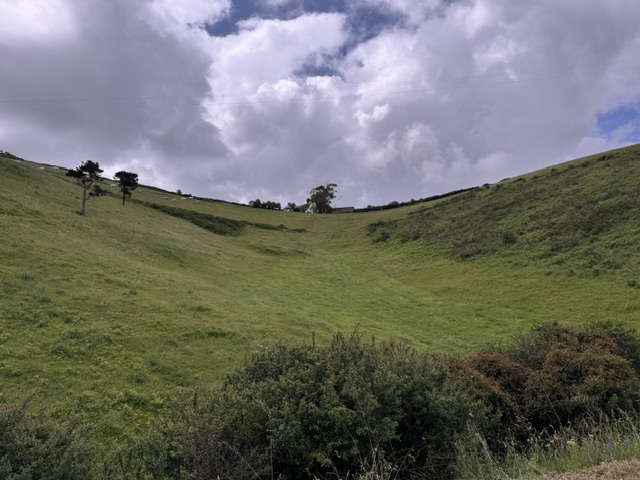
Remember the weed whacking? We saw the sheep on the upper left and I thought, at least they don’t need to weed whack this hill. But then on the upper right – he’s weed whacking. Incredible.
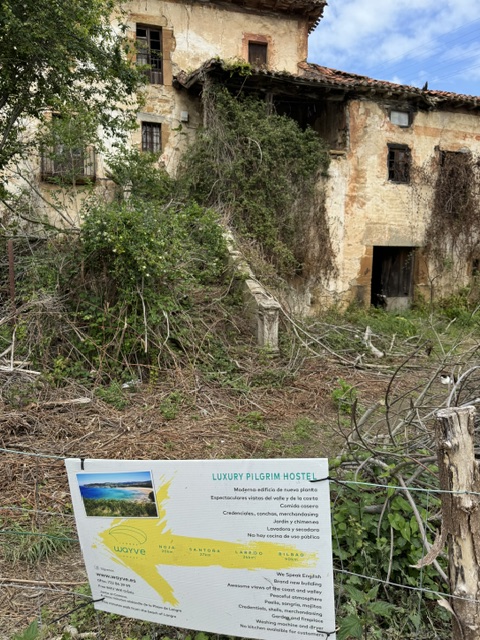
Really? In general, the arrow just means it’s on the camino. In this case, guessing it meant WAY down the road. This kind of decay has been really rare.
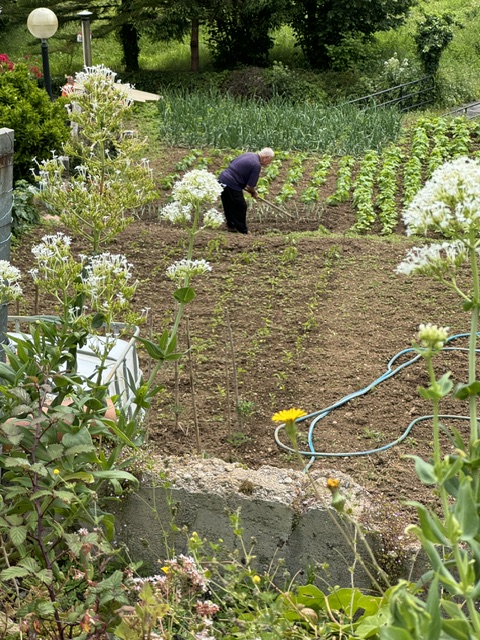
Since we’ve come into the Cantabrian area, the gardens have been incredible.
Loved this, just your morning baguette delivery
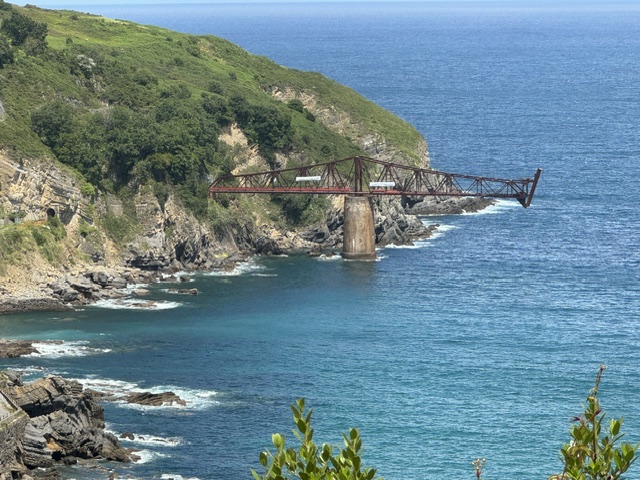
Oh, so curious, we conjectured that the freighters at one point were unloaded here, maybe through a tunnel? And then, sure enough, there was the tunnel. On the left side, just a wee thing from this perspective. Crazy. Clearly, now it’s just a seeming bridge going to…
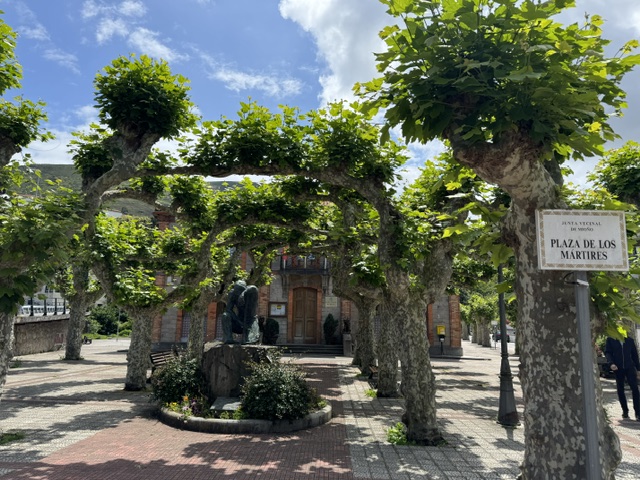
About 2 or 3 miles shy of the end, I really needed to find a bathroom and place to sit down just for a few minutes. Carol and Matthew were on the move so I sent them off (I knew they’d find lunch and let me know where to go – SO nice) and I sat down at a bar and had my usual CoalaCao. Next to the bar was a plaza, Plaza of the Martyrs, with these old trained beech trees created an arbor for a monument and to lead up to the town building. The monument was so sad, inspired by a painting by David Coma, was to the miners and said:
We try to represent men that are a part of our past, of us. He is the miner with a strong constitution and character, who with his work supports a family. Trapped in history, held in place until his strength abandons him, and the disease overcomes him. That intention that pushes us makes us try different (?) reaches its conclusion in this man from Miono. Trustworthy but defeated, terrified. A memory of ours, that we want to share with others.
In Bilbao mining fueled the growth of the area, but clearly the mining was as horrible for people here as it was in England, Wales, Appalachia. I’d just never heard about it here.
Then I started off, quickly off the map so retraced my steps, then found myself entering a long tunnel for bikers and pedestrians.
Halfway through, my MacsAdventures dinged me and said I was off the trail again. Well, I’d followed the Camino signs into the tunnel so I kept going. I came out of the tunnel and I was back on. Love the maps, but learning to give them some time, because I’m so fast moving. Hah!
Then I walked into magic, the town Castro-Urdiales. That’s how it felt! Absolutely gorgeous town with a blue bay, green park, clean, really pretty white balustraded promenade and 100’s of people out talking and walking. Really, by the end of the night, between all the happy chatty people, the ancient buildings, the harbor, castle, gigantic church at the very end – it felt like a Spanish Disney. And – our hotel was big, clean and I was able to get a room that was high and faced the ocean and bay. Just completely wonderful.
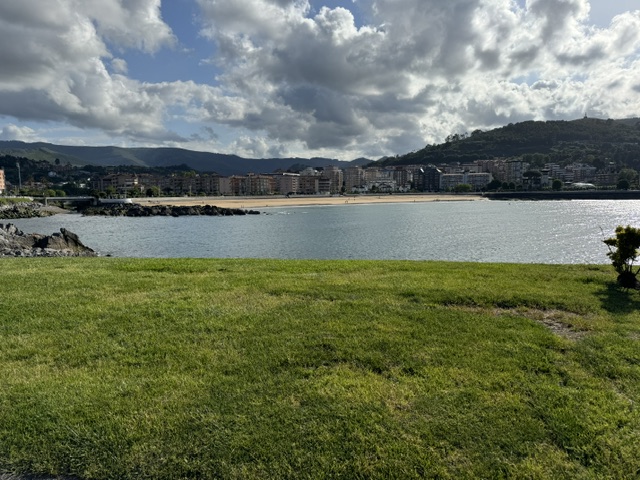
Hard to capture the bay and the full promenade going around it.
Matthew and Carol were waiting at the lunch place, another good meal and then I had the afternoon to clean up, organize, read a bit to get off my feet and then went back out. It was too beautiful to stay in, though it was really pretty just looking out the window.
I walked through the park, intensely green – and, oh, part of the magic was the sun – to make everything greener, bluer, brighter.
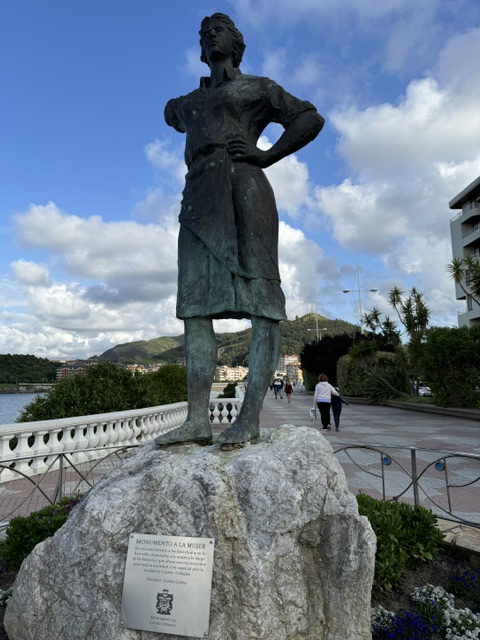
This statue was very cool.
The writing said: Monument to women in recognition of the rights that have been amputated from women through history and that are now recognized by the entire society and especially by the city of Castro-Urdiales.
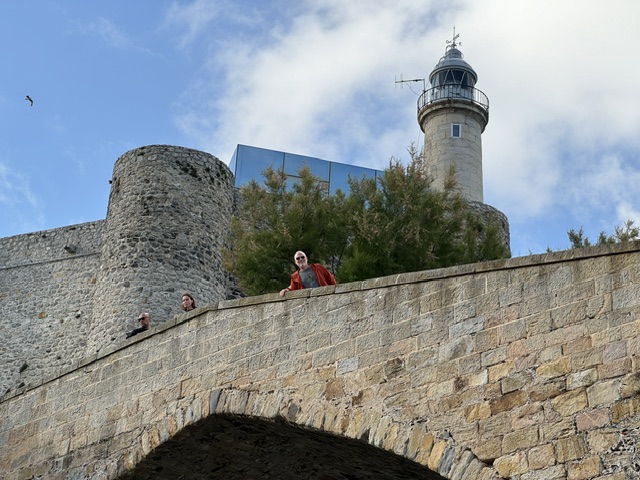
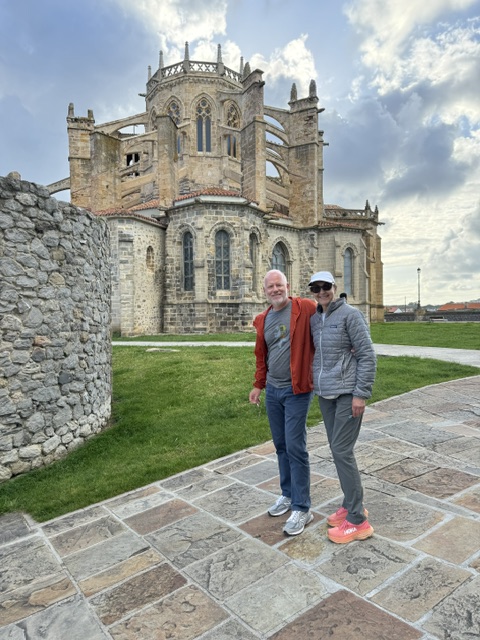
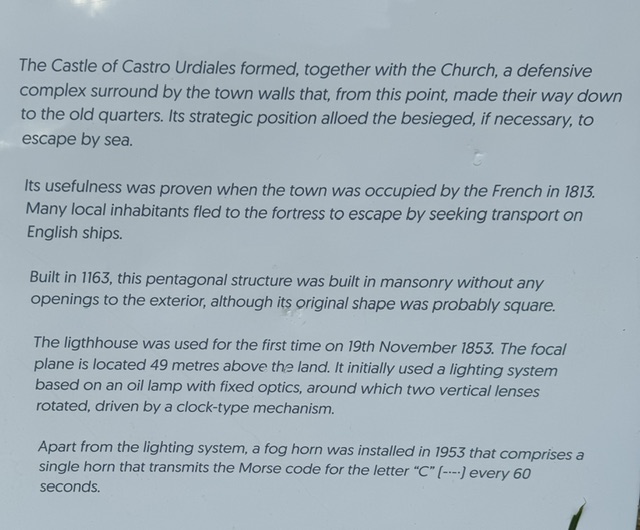
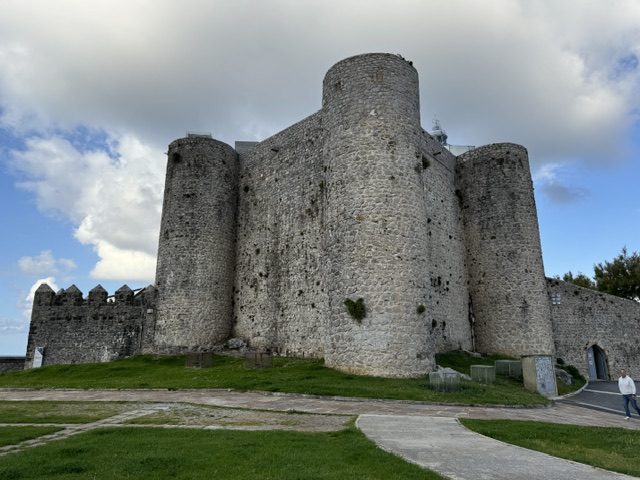
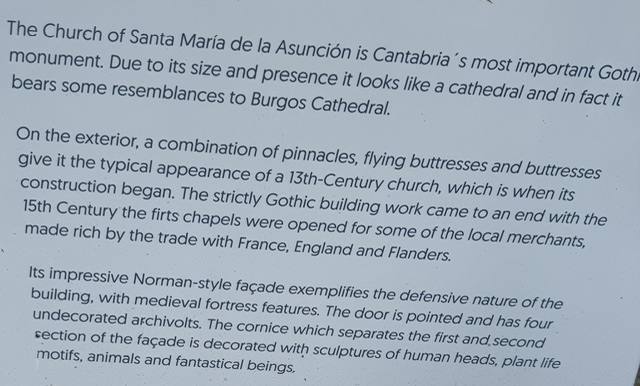
Then Carol and Matthew came out and we walked the promenade around to the castle/fort and church. Just crazy crazy that these buildings were constructed 100’s of years ago. Really, people should have just been making do in caves or stone huts. But no. They were building things like these, seen from the promenade.
When I was in Bilbao, the audio tour for the cathedral noted that when they were building the cathedral, the request went out for help and in turn anyone who helped was tax free for the entire duration of the construction. Maybe that’s how they got this done?
Matthew peering over the bridge on the way to seeing the castle and church.
Then we saw a rowing crew go out, staggering under the weight of the boat until they got a grip on it. We later saw them flying through the bay, seriously fast, like the rowers on the river the night before in Portulagette.
The above is the back! This is the front.
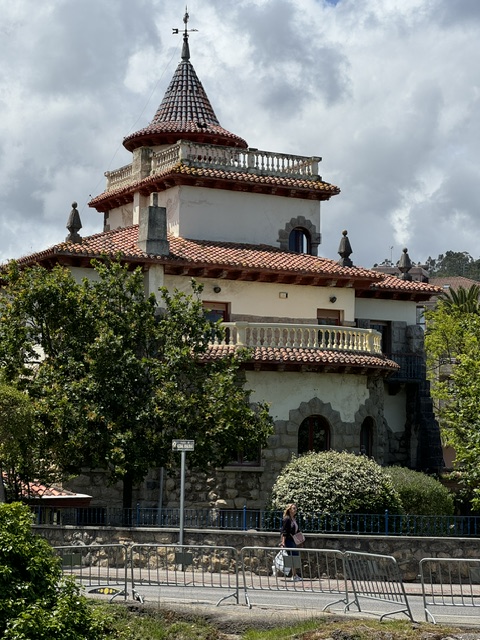
Walked back through town, got some churros to share (fried dough, what’s not to love when it’s really fresh) and saw this building. Probably the first time Burger King’s ever actually been in a palace:
Finally, came back to the room and got to talk to Kaziah so ended the evening with another treat. Showed her the view with FaceTime so that she could see a bit. I would love to come back here with the family, mix of walking and exploring .
Today, we’re down to Carol, Matthew and me and we walked separately since we started from different points and probably with different plans. I walked the camino following the MacsAdventure map and they walked the river – all the way! I had no idea that was an option because I didn’t explore. I thought I would do my usual when I’m on my own, quiet for 1-2 hours, then listen to dharma and then when tired and needing motivation, go to music or a fun book. It was raining as I started so had all my gear on and my pack covered. I did do the hour and half in quiet, but the entire time was just walking through and out of Bilbao. It was interesting seeing the town, all the kids walking to school with their parents, people going to work, cafes full.
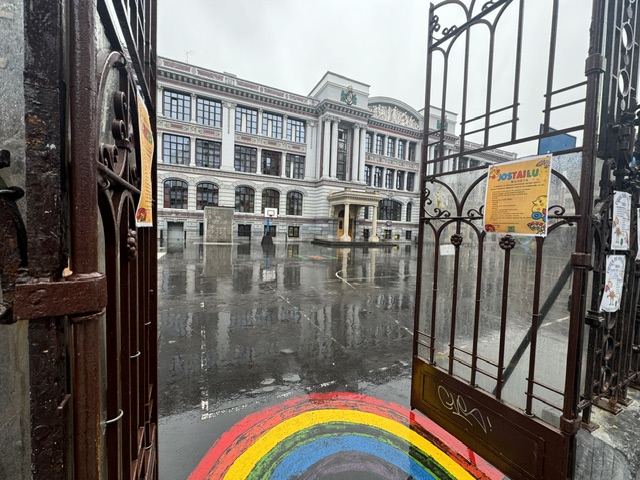
The schools here are often in old, incredible buildings:
But – a long time of city walking.
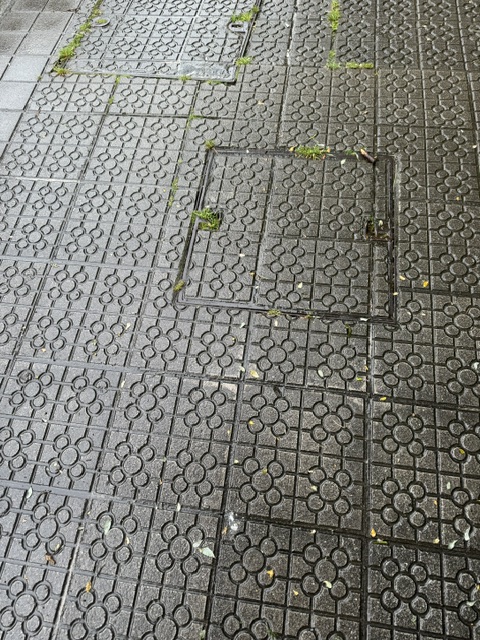
It’s this slow misty rain that just slicks, I was slipping and I had on hiking shoes with good treads. No wonder their sidewalks are patterned.
Finally hit a park and as the rain continued and the views were ok – back over the city and then just kind of rural walking with houses and not, I ended up putting on a book and that’s what I did for the next many hours. I was completely soaked. Luckily, the temperature stays truly constant, high 50’s low 60’s, so I wasn’t that cold.
I found an indoor covered area with a grocery store and pastry and got a pastry, drank my protein shake and kept going. Found another place where I could get a hot chocolate and a bathroom (!) bc the outdoors wasn’t conducive today.
Coming into the town from up above the river.
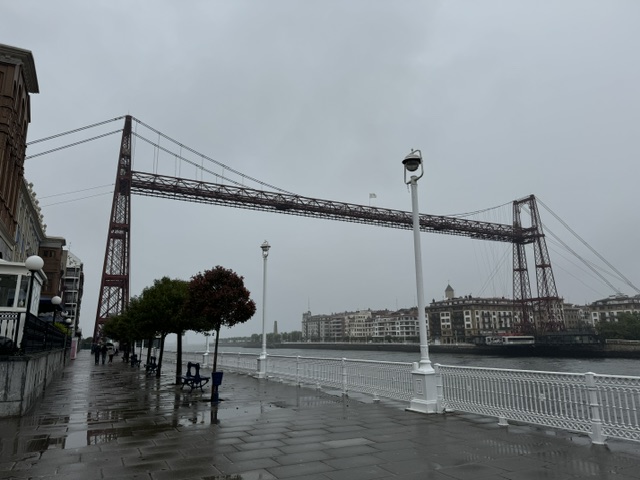
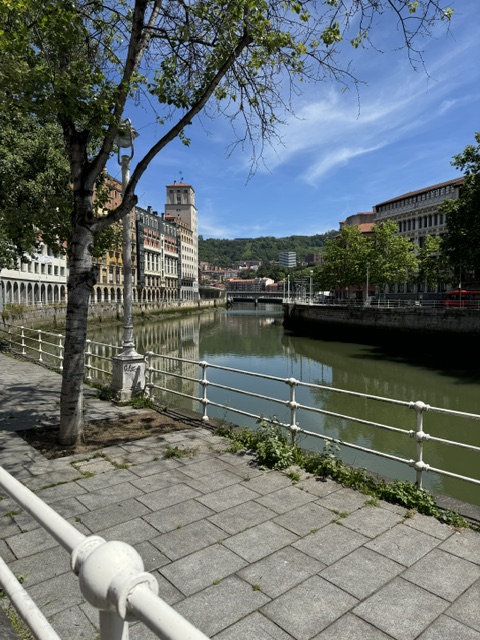
Finally walked into Portugalete and to the best hotel yet, Gran Hotel Puente Colgante. I couldn’t believe it. Right on the river, the weather was clearing up, and Carol came out to greet me to say they’d already sat down to lunch. So a very nice start to our afternoon in the town. Per usual, Tee Travel had booked us into a good hotel with the worst room, but happily, I was able to upgrade so that I could see the river and the famous suspension bridge. And it was only 13 euros! Turns out Carol and Matthew had done the same thing.
I was going to get a shower, but I just combed my sopping hair back like that was my norm and went down to lunch. The afternoon was very chill, walking a bit, there’s a small old town with great walking sidewalks to get you up the Main Street.
I had a flash back to our trip to Italy last year and exploring Assisi – with Frances of Assisi and Poor Clare – amazing humans. This building was founded in 1614 by a group of Poor Clare nuns joining a group of religious women from Portugalete. It stayed until 1979 and now this monastery is the Cultural Centre for the town.
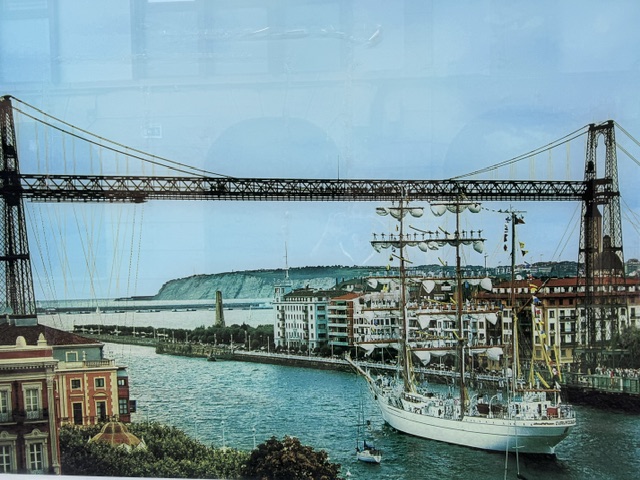
I took this photo of a photo because it’s CRAZY. If you look closely, you can see all the men on the top rigging and right at the top touching the bridge while people gather on the walk way of the bridge – they’re completely crazy too – as the boat goes under. I don’t know when this was, but not so long ago because the little sailboat next to the big boat is clearly modern.
Matthew talked about maybe paying the 10 euros to go up the elevator and walk the bridge. I told him I’d watch while sitting on the ground bc watching him walk would make me fall down, so why not just head it off at the pass.
We all walked down to the end of the river to the opening to the Bay of Biscaye.
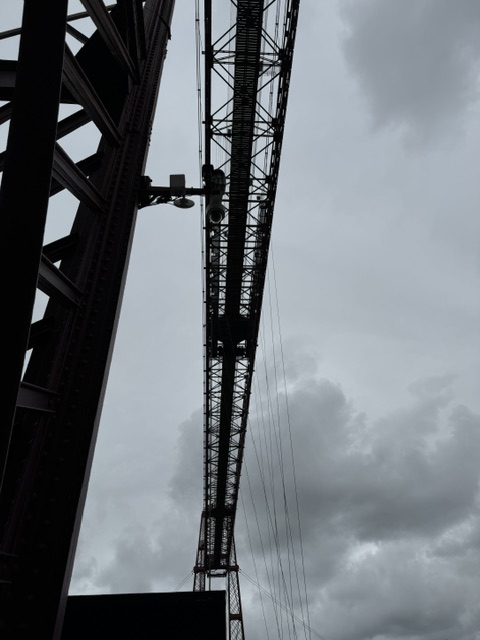
Looks like an interesting bridge, but then you realize that it carries a suspended ferry back and forth, allowing big boats (have seen freighters with tugs going by) to go under while allowing pedestrians and up to 6 cars at a time to cross the river.
Here’s the video of the action, no need to watch to the end, I was just curious – really? Cars coming off too?
Ready for Pintxos – definitely a set-it-up-and-they-will-come scenario.
Cool parks for kids around, this one seemed like a magical use of ancient and green – just leant itself to stories and creativity.
Just a chill and relaxed night. I brought a couple of pintxos up to my room and finished my VERY long history blog re Bilbao.
Walking 8.6 miles exploring Bilbao, a truly wonderful city! I’d love to come back with Rick so he can see. This is a long post because I indulged and put a lot of history – for me to remember.
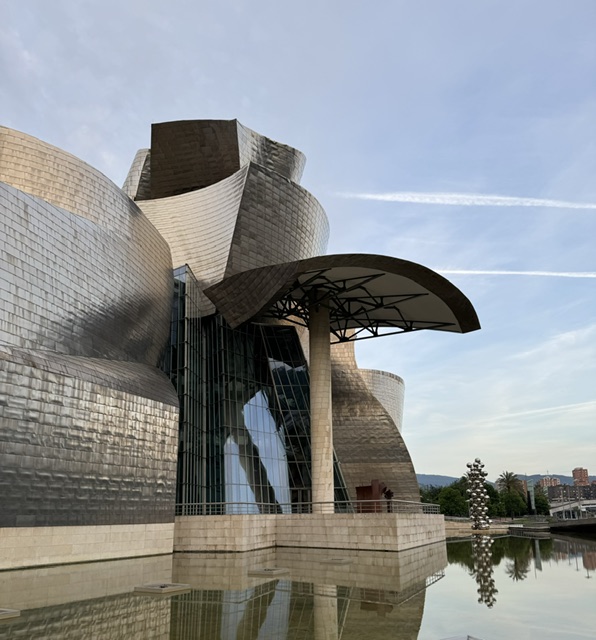
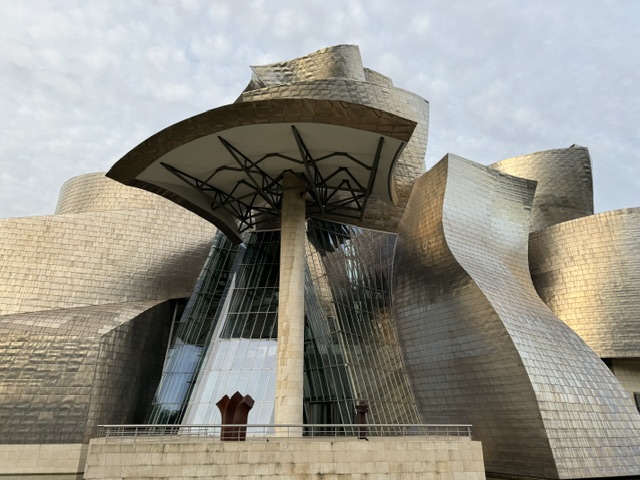
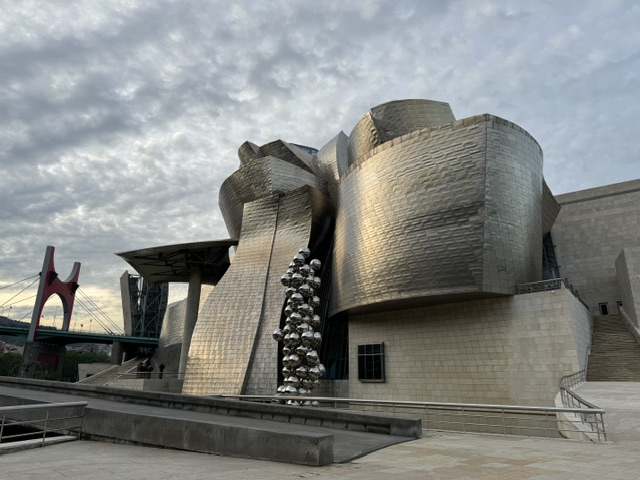
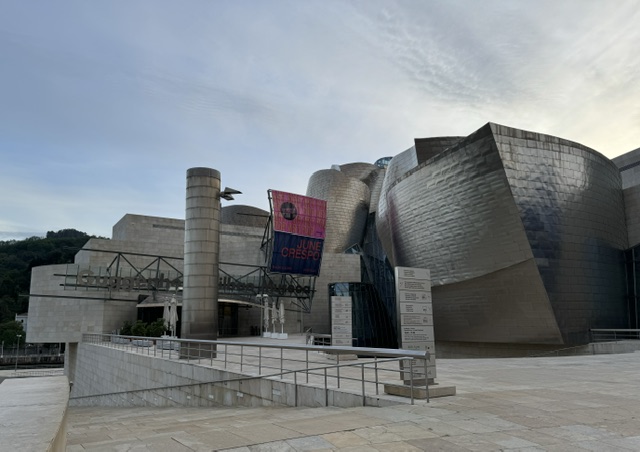
I popped up awake at 5am. Really? On my day off? Ok. Dawdled, then went down to the lounge area to write up another day on the blog and to wait for Bob and Susan so that I could say goodbye. They went off to catch their plane and it ways another beautiful day – so I went out to see what photos I could capture of the Guggenheim without people around.
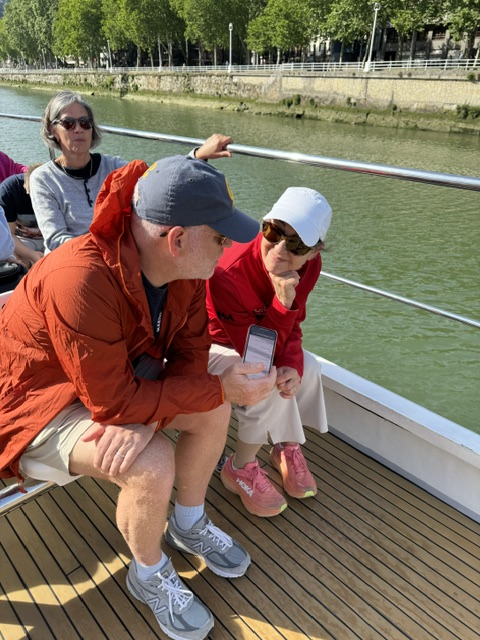
This one shows the idea of a boat stranded on the shore, supposedly a focus of the design (per our boat tour).
Boat again
At 7, this is a very quiet city except for runners and dog walkers.
I enjoyed the quiet, the views, the weather for a bit and then came back and had a really good breakfast! That’s not my norm because the offerings are usually pretty lean and I’m not that hungry in the morning, but I could make my own pot of decaf, had eggs, couple pieces of cheese and for the first time, my favorite of toast with tomato, oil and salt. So Spain.
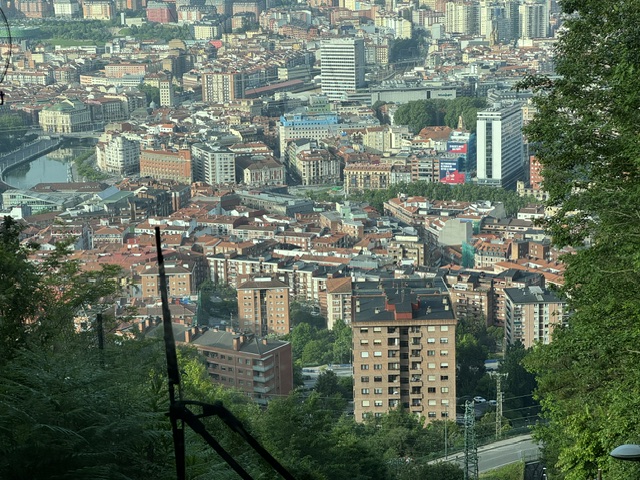
Then I conferred with the front desk guy and a map and started out. There was a funicular within 2 blocks of the hotel that took people up to an entirely different neighborhood at the top of the hill and visitors up to see an incredible view of the city. I was very proud of myself and got in the front car for a full view. It felt way safer than inside the Guggenheim. And it did let me see how big Bilbao is while still contained within the valley. There are about a million inhabitants of the greater area, while central Bilbao is about 350,000.
From the funicular car
From the park at the top
I then started wandering to where I was supposed to meet the walking history tour I’d signed up for. Carol and Matthew were going to do a separate exploration on their own using public transport – especially the tram – to see the city in a different way.
I joined the English group with a wonderful guide and I never heard her name. But boy, did she have info. And being a Bilbaoina (her word), she was passionate about her city and the Basque culture. And she talked fast! We walked and talked for 2 full hours and I started dictating to myself so that I could remember a lot. I loved it – so cool.
So – from here to almost the end, it’s summarizing Bilbao’s history from my notes.
In 1300 Diego López V de Haro created a charter for Bilbao. He was a very farsighted and canny Lord of Biscaye. At that point, there was a central group of feudal states in the region, basically 5 mountains with 5 valleys and representation from each of the 5 would come together to meet under that tree in Gernika to set policy, agreements, etc.
The king of Castile in the 1300’s was building alliances through marriages, but was also looking for a safe port to get his goods out and Lord de Haro convinced him that Bilbao would be the choice. Safe, protected river to get the goods out to the sea. De Haro would have a taxation system since everything had to come over one bridge to get to the river and the boats. They worked out a deal and people started coming.
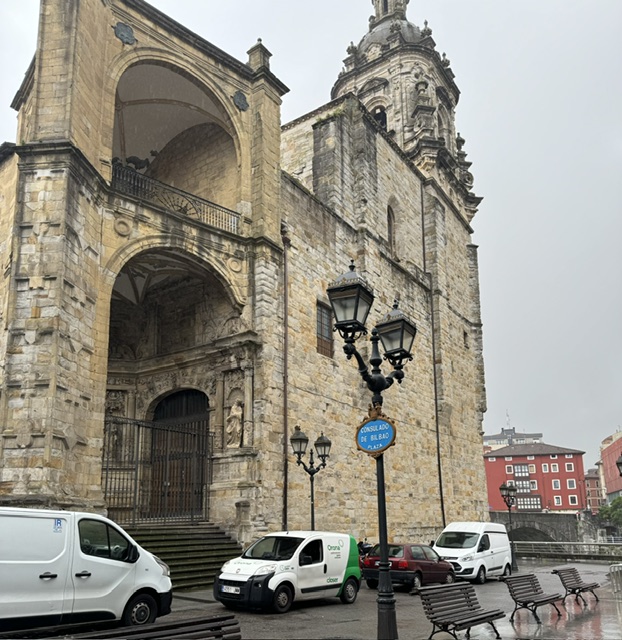
All merchants had to cross over the one bridge at the top of the river to get their goods weighed, pay a tax and move on to boats going to the port. It was so busy that a consulate was built right next to the bridge and the powers-that-be would sit on their balcony and make sure all was going well. It became such an important commercial city, they had a consulate in Belgium through the 1400-1500’s. Not the norm for a city to have a consulate.
This is a church that replaced the consulate when it was destroyed by a flood, the balcony was the only thing saved – the bridge is to the right, same place, different bridge.
De Haro also decided that he wanted to make Bilbao an important center and let it be known that if merchants settled in the area, they could live tax free. That worked and a medieval town group up within fortress walls. The wealthy and aristocratic (often the same) were within the walls, fishermen, farmers, were outside.
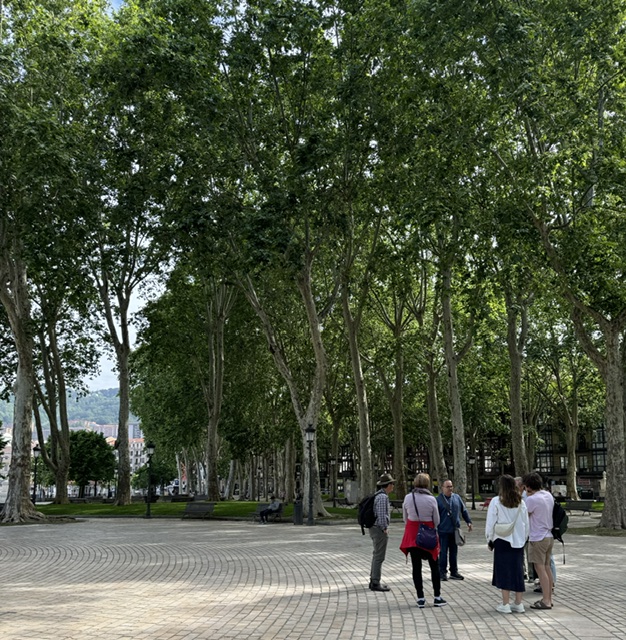
The building was in the arenal area – arenal means quicksand or marsh. They had to drain the area to build since it was two rivers coming together to form the estuary and big river. Because the land was so limited, there was only one small park to meet and it was the one place that people of all walks of life might meet up, though there were designated areas for each group within the park. This was true up until the late 1800’s. The whole focus was the iron industry, the steel industry and wool transfer, not on expanding park areas. Our guide said she grew up with smoke and soot, sounds like how Pittsburgh used to be described.
The park is still the same size today, though now there are giant parks made from reclaimed mining and smelting areas.
The train station is a point of pride and dependence – it’s where coal came in since iron and wool were the main products of the area. Built in 1898 and opened in 1902. Right now there are on-going political arguments with Madrid about having a high-speed train come to Bilbao. They’re trying to manage an explosion of tourism, while they want the tourists – a main source of income – they also absolutely want to insure their culture stays true to the Basque as Bilbao is the de facto center of the Basque region. The building on the right side is the conservatives club on going since the 1800’s. Very stuffy, very hard to get into.
As the iron industry grew (second only to Barcelona), the town leaders wanted to make the town much bigger, more sophisticated and they decided to break down the inner city walls and add the neighborhoods of the surrounding villages. They brought in important architects from all over Europe and you can look at the buildings from the late 1800’s and see French, Italian, English architecture influences.
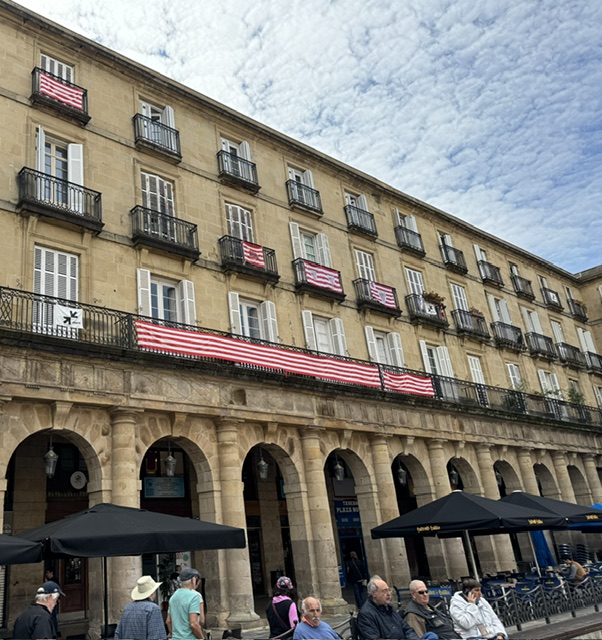
Flags waving from the balconies reflect the fact that the Bilbao football (soccer) won their first big tournament in 40 years. The whole city went crazy and two months later the banners are still waving.
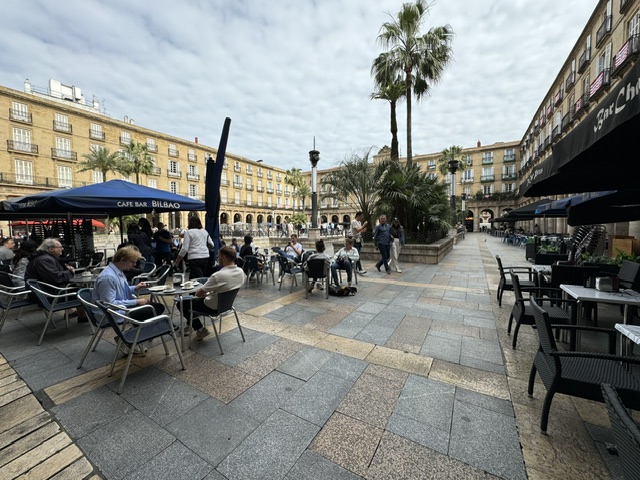
The plaza nueva was built in 1864 and was the first place built outside the old city when they decided to break down the walls. They wanted to expand in a significant way and this was the first design – echoing the central squares in Madrid and other great Spanish towns.
A grocery store stood here before the square was built and this restaurant still reflects the history and the interior design of the store.
These steps are modeled after the Roman steps. This was the way the Camino came through Bilbao down off the mountain behind the town. The Camino del Norte connects to the Camino Primitivo. That one started in the late 900’s, the Norte started in the late 1200’s. There are 374 steps that wind up to a cathedral above where the Camino pilgrims would stop before coming down into town and into the Cathedral de Santiago, also on this path. It was also on this path that farmers would bring their market goods to town, down a long muddy path straight to the market. In the same place where we ate yesterday. They built these stairs to honor the Camino because it brought trade and money, and opened Bilbao up to the outer world.
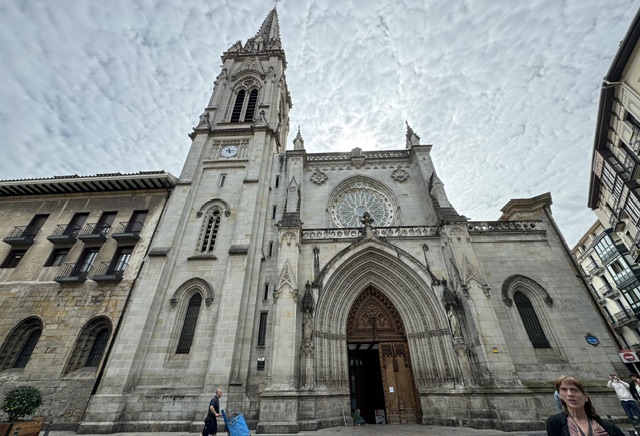
This was also when they built the Cathedral de Santiago to give thanks to the Camino for helping the town so much. Started the building in the 1300s.
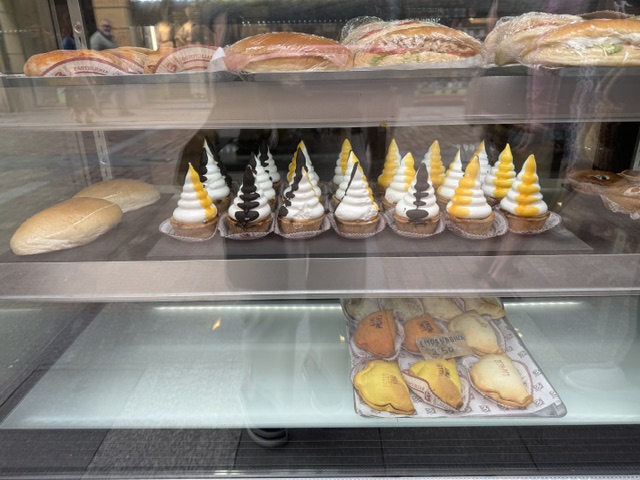
Carolina dessert – famous meringue dessert after the person who crafted it, the white/chocolate/lemon one.
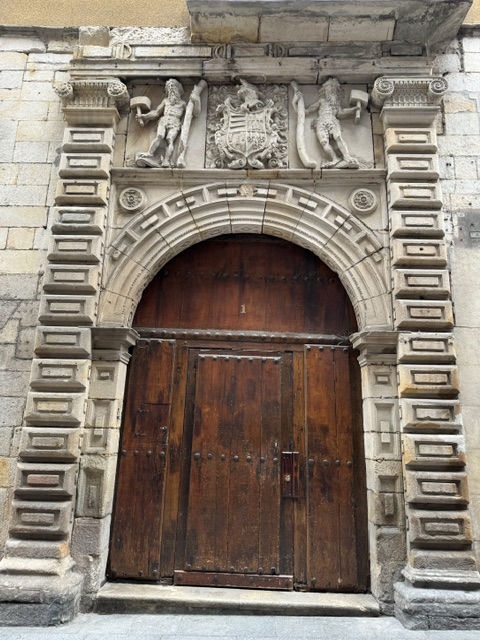
This facade is what’s left of a palace from the 1400-1500’s. The person who lived here would have been of the aristocracy, but they were also in a position to see who came into town, to greet them, welcome them and convince them that this was a great town and it might be worth their while to stay or to at least use this town for most of their trade.
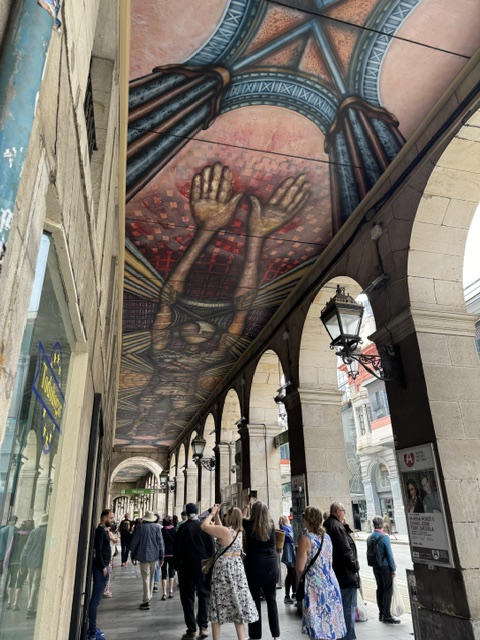
1983 a massive flood, went above the lintel just below the arches here. The painting was commissioned by the city to help rejuvenate the old town, but because of the mud even more than the water, the old town was destroyed and much of it had to be rebuilt. Since the river is tidal, if there’s a really high tide concurrent with heavy rains and flash flooding, it can be catastrophic, as it was in 1983 and several times over the past centuries.
The 1983 flood happened almost simultaneously with the end of the iron mines – tapped out and the end of the steel industry, shutting down of the smelting plants, etc. They decided they had to change the town’s income from industry to service/tourism. There must have been some seriously far ahead thinking on the town’s politicians because the decade after the flood is when they commissioned Frank Gehry to design the Guggenheim museum. This museum brought in so many tourists that it helped jumped start the town again.
It seems that the town’s politicians took the example of the late 1800’s to heart. They commissioned famous architect after famous architect to design buildings. When we did our boat tour (noted later) it was basically an architectural tour of Pristker winner after winner designing building after building. As Matthew said, there didn’t seem to be a plan, but with so many gorgeous and interesting buildings, it became cohesive. This is truly a beautiful city.
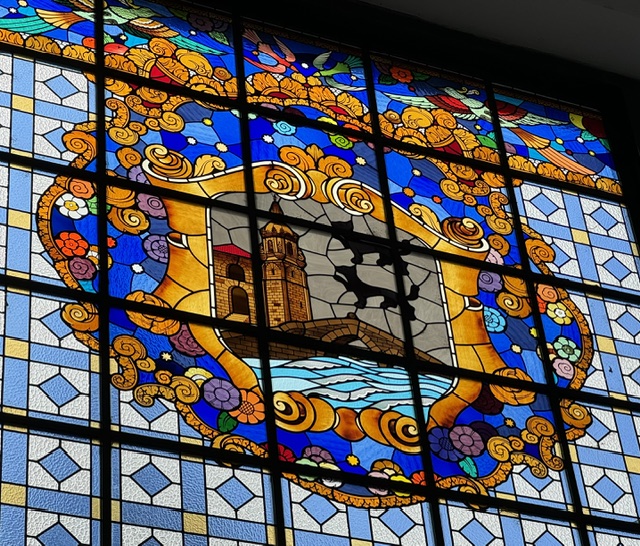
The coat of arms in stained glass at the end of the market showed the consulate building/church, bridge and the wolves reflecting Diego López V de Haro’s name.
Here’s the shield again, at the top of the entry to the Church of St. Nicholas. He is the patron saint for sailors and this shows a desperate scene of widows with drowned husbands and men who’ve lost everything to the sea. The lions holding the shield up are demonstrating the strength and resilience of Bilbaoans who come back after every struggle.
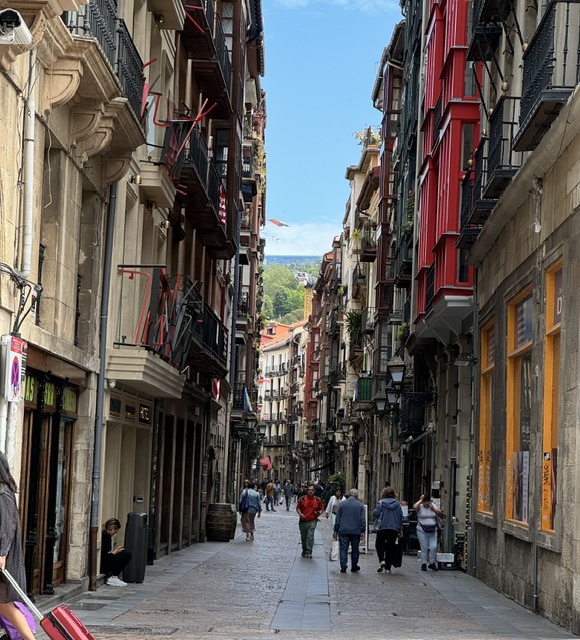
This street is the darkest street of the city, no sun hits it, it’s also one of the 7 planned streets of the medieval city, all running parallel and leading to the market from the mountain behind the town.
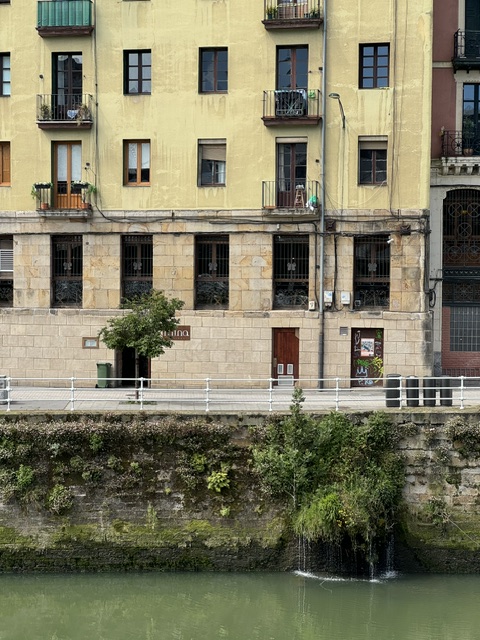
Cool Michelin star restaurant, Mina. Its entry is the entry into the last active iron mine, closed in the 1980’s. When the mine closed, they then started building on top of it, working their way up to the top of the hill. Someone asked if they weren’t worried about building on top of the mines and the guide said no, the rock is incredibly hard and there are no concerns. Right under the restaurant is water coming out and that’s a mountain stream running down and out from under all the houses.
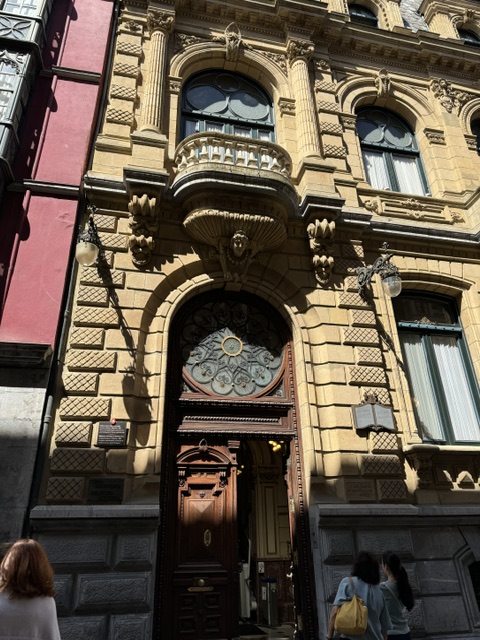
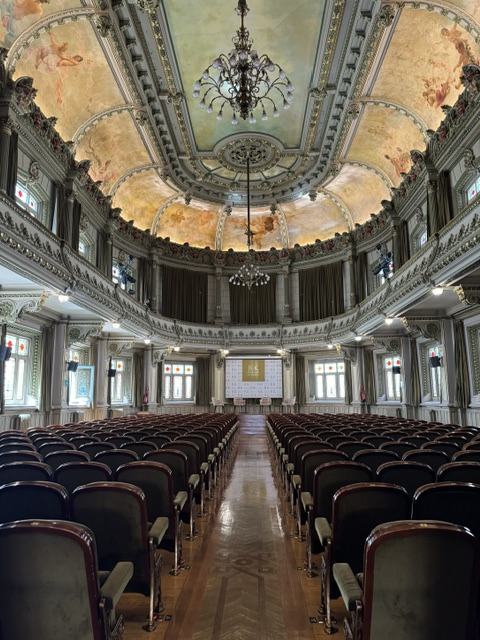
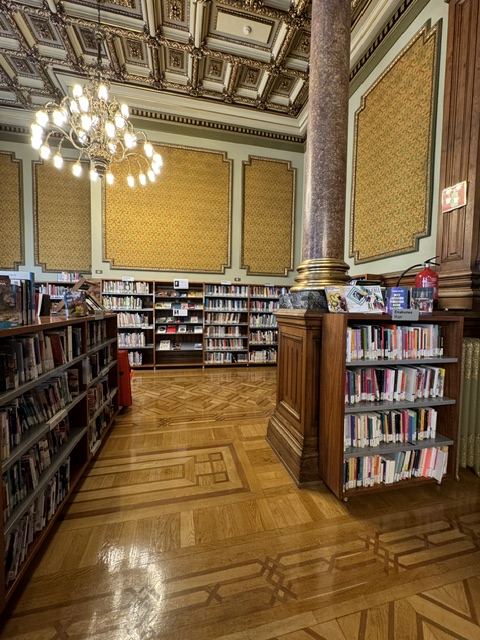
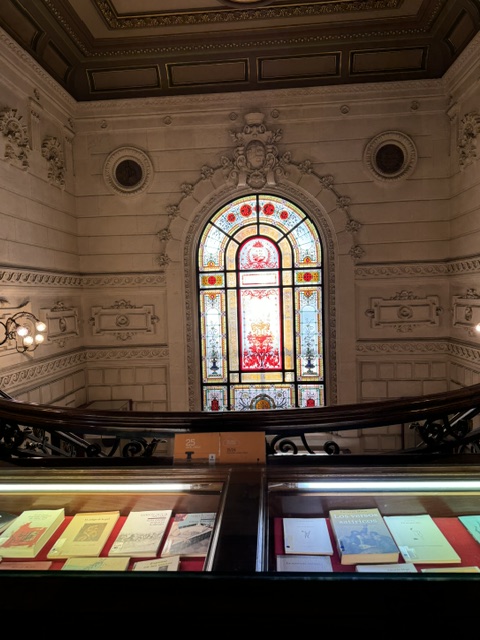
This last palace on our tour was the liberal club (versus the conservative club that was next to the train station). Over the door is a replica of the head of the Statue of Liberty. When Franco came in, he dissolved the club and took the place for his own, when he left, it became the library. The conservative club was more concerned about commercial interests and they held onto their building. I went back later to see the library. I’d study here in a second.
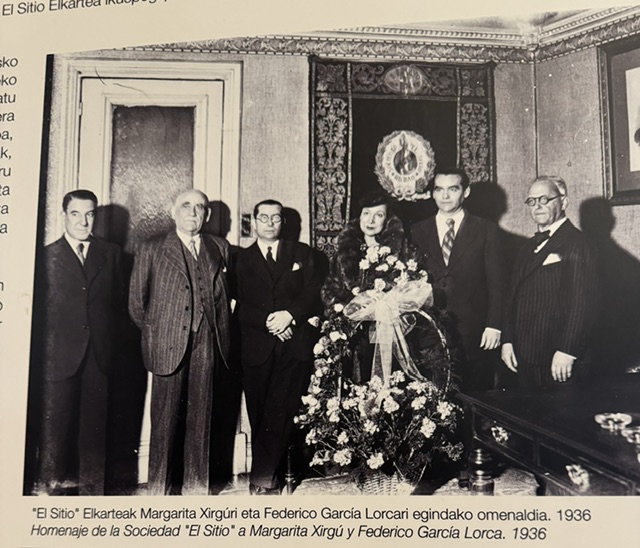
First thing I saw when I walked in was a photo of the poet Frederico Garcia Lorca, one of my favorite poets. Killed by the Francoists in Granada shortly after this photo was taken. Learned about him when we were in Granada with the kids years ago.
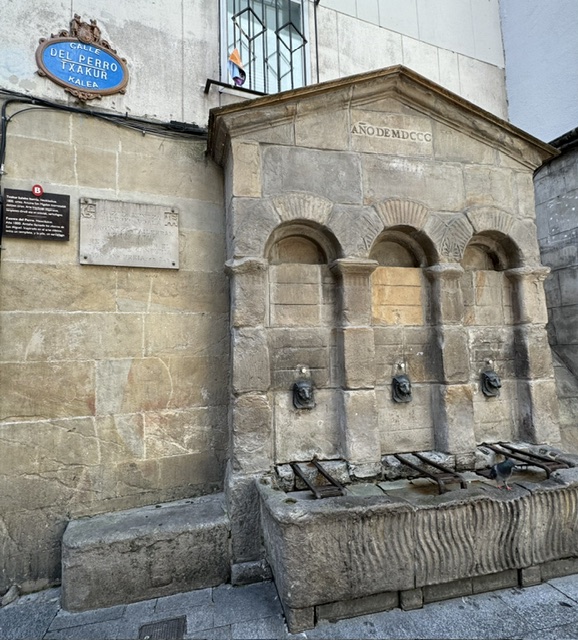
I then went looking for lunch, found the street the guide said was full of good places to eat, I remembered it because of the puppy fountain where Bilbaons commonly meet.
I walked up and down the street 4 times dithering because I knew my timing was all wrong – 12:30pm. Finally went in a place where people were eating and he said the menu del dia started at 1pm, but I could have one of the first course options. Luckily, one of the options was paella and it looked great – he had big pots of the first courses – all stews and the like.
Then I went back to the market to find one of those Carolina treats and ran into Carol and Matthew! They were looking for a treat and coffee too, so we joined up and I told them a bit. We decided we wanted to do the boat tour I’d been thinking about and we planned to meet up later.
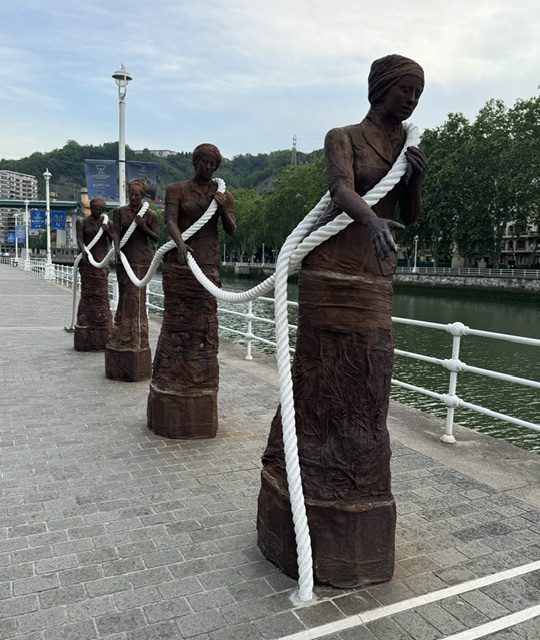
We listened to a recording on our phone talking about the history and the architecture. It was a fun ride and one note of history explained a wonderful statue by Dora Salazar that both Matthew and I had wondered about. Evidently, the boats that came in from the port were pulled up the last part of the river to the head of Bilbao by towing. And the people who often did the towing were widows who had no other way to earn their money and it was a brutal job.
The boat tour ended up being a great way to see more of the city and was really an architectural tour. An amazing city with amazing architecture. Kind of astonishing for a city this size, and it seems to have worked as the planners had hoped – this city is booming!
We then went to a place for pintxos that Matthew’s partner had recommended and it was fantastic! Beautiful building, fun people watching and the food was incredibly good.
Finally, Matthew and Carol sent this Basque gift that they ran into after I left and took the tram down to near my hotel. What a totally great day 🙂
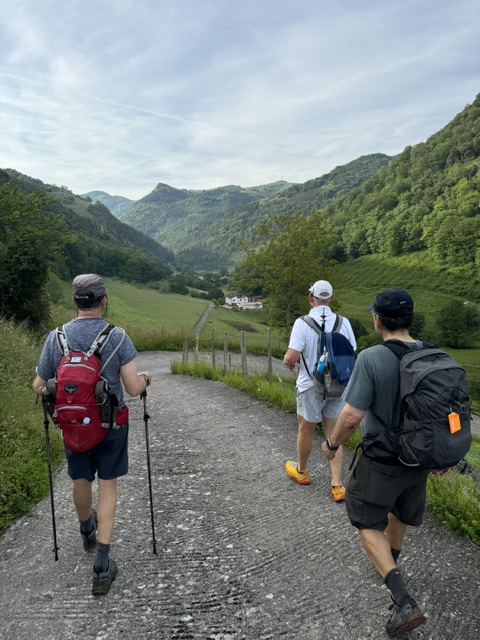
Ok, today was an entirely different experience. Sunny, perfect bit of a breeze, only 7 miles (kept walking in town thus higher mileage) over the mountains and that hill that looked so big turned out to be manageable without a ton of mud. Just a gorgeous hike. Wish Rick could have been with us!
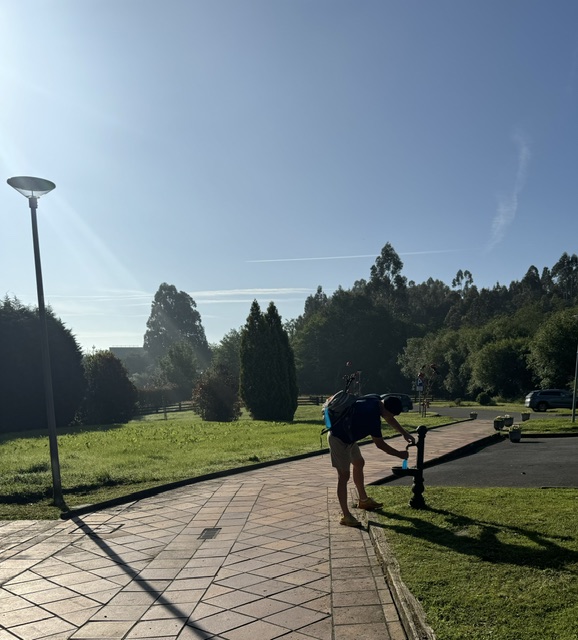
Starting by filling water bottles – fountains are pretty frequent, happily!
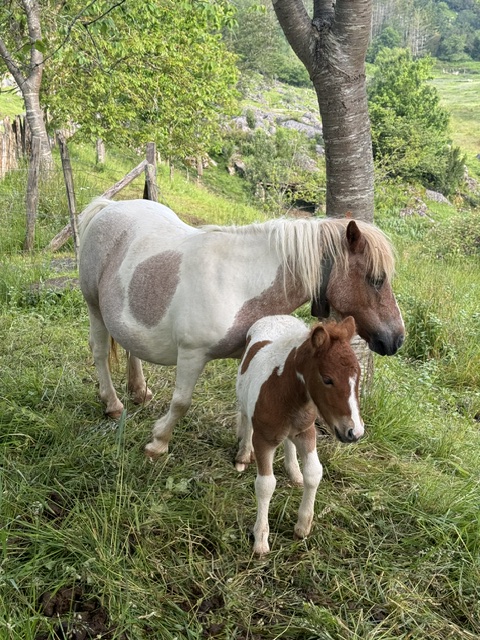
Baby photo for the day
We arrived in Bilbao – big city! We followed the camino trail pretty far, but since it tries hard to stick to the original and through parks to be as much as it was, we ended up cutting off and following Matthew and his GPS through the city to get down the hill a bit more easily. That being said it was really downhill within the city. San Francisco has nothing on these city hills. Crazy. Used my poles to try to save my knees. At one point, we took one of those elevators that carry you down the hill. I did NOT like it because it’s way out in the air and then you can see through the front so I just closed my eyes and let my knees give their thanks. And then – we were there!
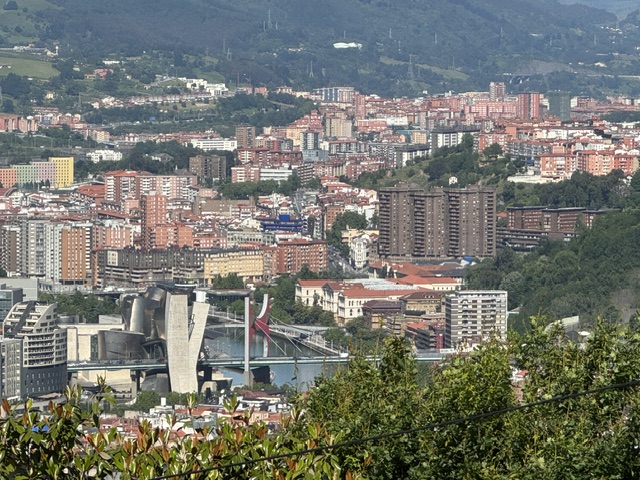
First sighting of the Guggenheim, next to the Y and red piece of the bridge:
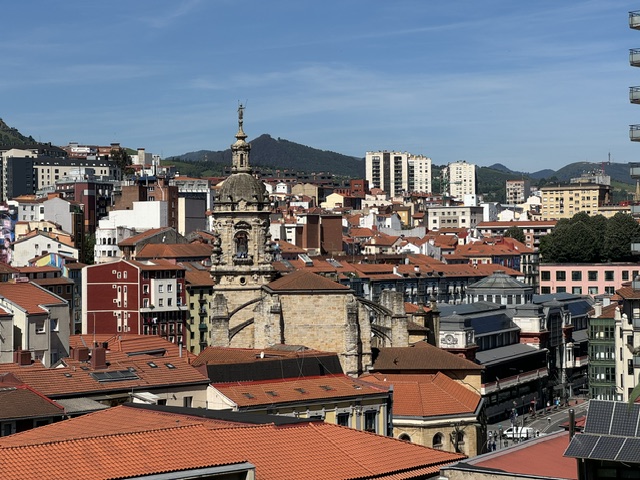
This church was the main one visited by the merchants that came into Bilbao to trade or to move their goods down the river to the sea.
Per usual, there were wonderful old buildings mixed into the new. We aimed straight for the market on the river for coffee and a few pintxos to hold us until we got to lunch. There hadn’t been any snacks on the way so we were ready.
Here’s the market, a beautiful building and the first market I’ve been to in an old city that was fully indoors (except a few tables outside) and clean!
It’s the red and white (colors of Bilbao) building on the left next to the bridge.
Bob, Susan and I walked along the river to our hotel, the Hotel Conde Duque. Good hotel, nice, clean, great staff, nice casual restaurant, sadly the room is on an air shaft. Luckily, I am planning on walking a lot because the city is just beautiful.
We got cleaned up, started sorting things and then met up (Carol and Matthew were at a different hotel because of later booking for the trip) at the Guggenheim Bilbao museum. Fabulous building by Frank Gehry. I’m going to try to go back tomorrow morning to get some photos without so many people.
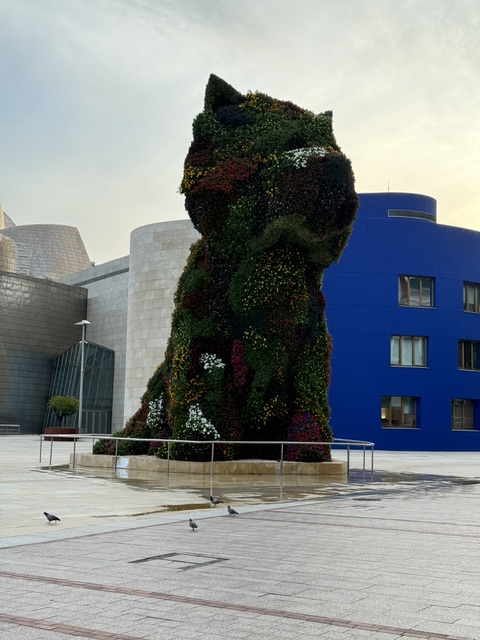
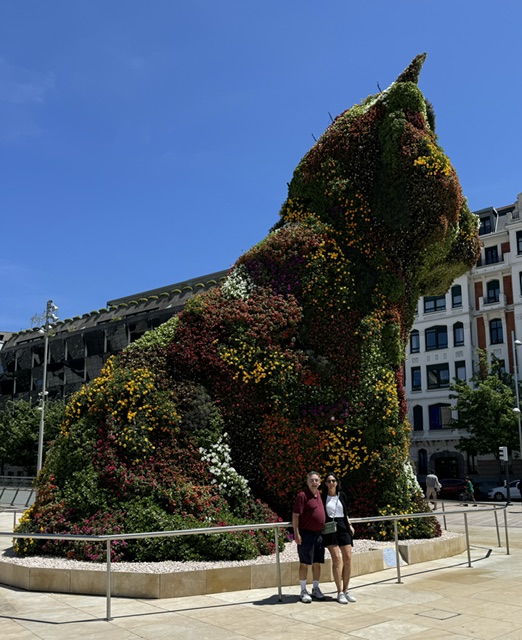
Matthew told us to meet us at the big dog with the flowers in front of the museum. From our hotel, Bob, Susan, and I approached from the back, but every side of the museum is a visual gift so we just kept walking around and up the stairs then found the dog. Then we understood why he thought it was a good meeting place! “Puppy” by Jeff Koons. The flowers were incredible.
Matthew had made reservations for us for the museum and for lunch in the Bistro in the museum. Totally wonderful meal. I did remember to take a wee video. Hard to convey how interesting, fresh and good the food was. I’m not going to turn into a foodie, but I am definitely appreciating some of the meals we’ve been having.
This gazpacho seemed to have the oddest ingredients – sheep cheese at the bottom, Iberian ham, croutons. Every element was perfect!
In the museum, totally cool exhibits, not a surprise, but it’s like the Guggenheim in NYCity and has open air walk around spaces for each floor and pretty open stairs in between. Or a see-through elevator. I managed to do part of the second floor and then was back on the ground and staying put. But that was totally fine because I loved the exhibits on the first floor.
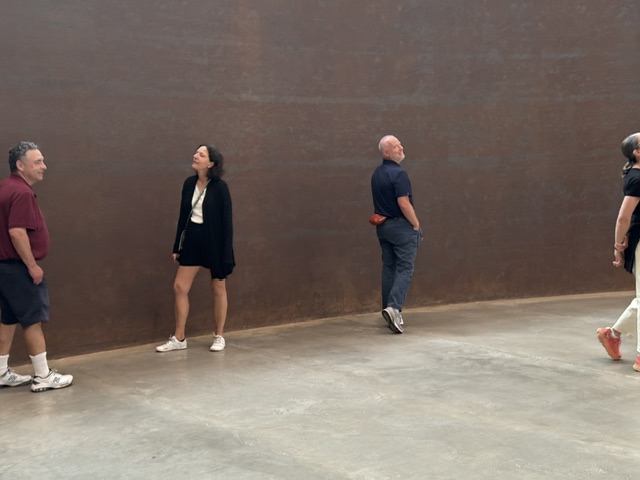
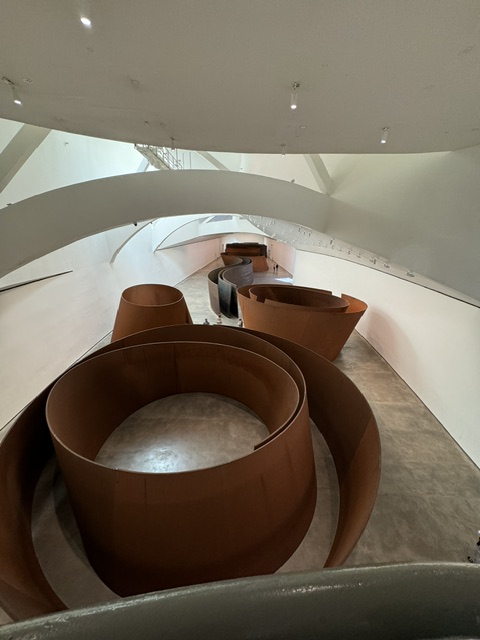
This was a small piece of one of the exhibits. I got to walk it more when I came back down to this floor. It was called “The Matter of Time” by Richard Serra. He designed it for this space and used metals for all the pieces. As I remember from the audio tour, it was meant to have the person observe themselves and their reactions in response to walking in the midst, around, through these different tilting spaces. They made me so dizzy! Little kids were running through no problem, but I generally had my hand on a wall when the angles were really pronounced and I was walking through them. Susan said she had the same reaction. The observer observing the observed. Very interesting.
Here’s the exhibit from the second floor.
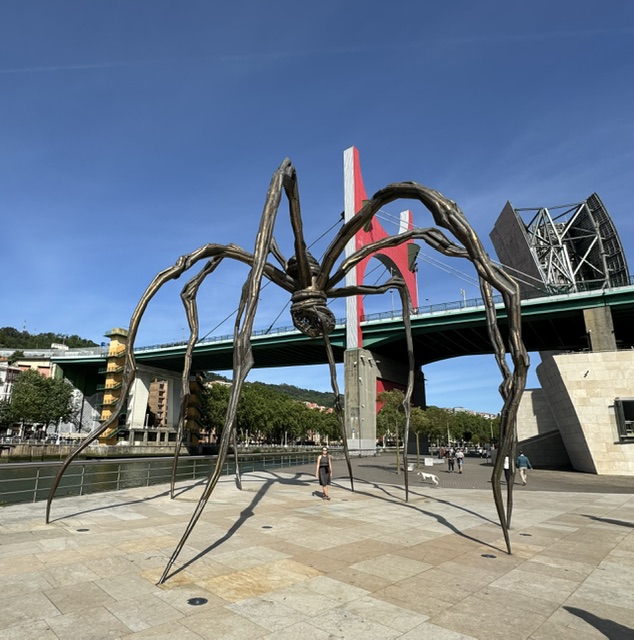
Here’s another outside statue – that’s me underneath, it was huge!
After the museum, we went back to our rooms and chilled. Read, unpacked to set up for laundry, etc. Tomorrow is a free day! Sadly, Bob and Susan have to leave, but then up to us what we want to do.
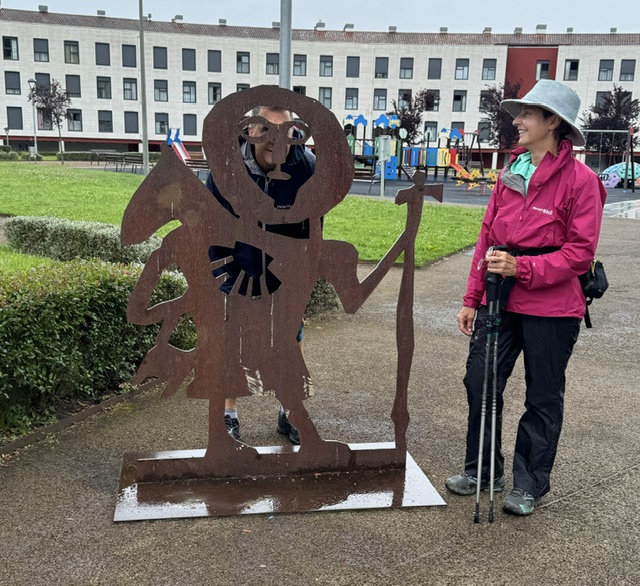
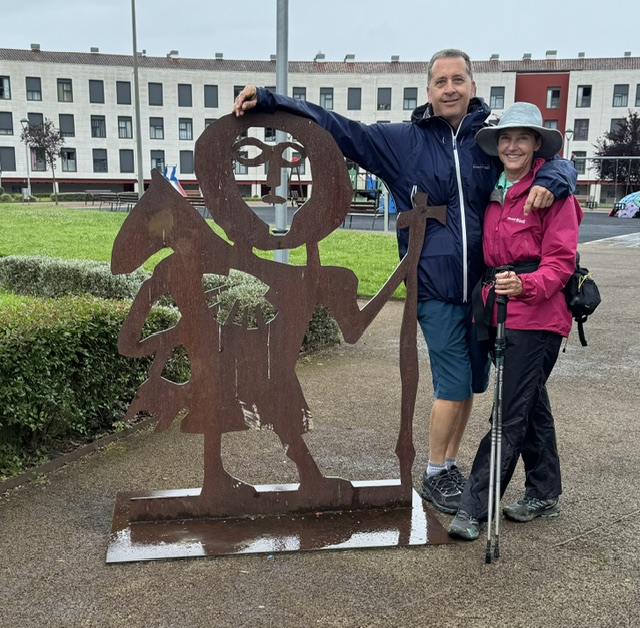
Left Hotel Guernica, big, nice, clean, elevator, really decent breakfast and front desk staff really nice. The front desk woman took our photo next to the peregrino (pilgrim) statue before Rick left our group. Yes, that’s her thumb in the corner, but we got the photo!
We walked through Gernika to exit the town, stopping at a few sites on the way that were all marked on the camino, according to the hotel map.
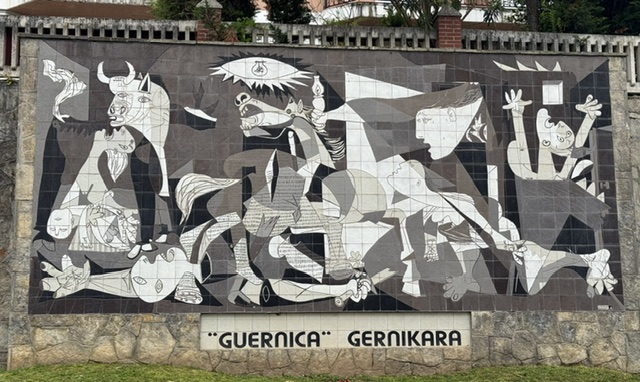
First, the Guernica mural in tile that replicated Picasso’s Gernica.
In town next to the Assembly Hall stands the Tree of Gernika. By ancient tradition, Basques, and indeed other peoples in Medieval Europe, held assemblies under a tree, usually an oak, to discuss matters affecting the community. Starting in the late 1300’s under different trees the democratic assembly would meet with 2 representatives from each district. By 1512, its oak, known as the Gernikako Arbola, became symbolic of the traditional rights of the Basque people as a whole. The Spanish kings would come to swear their commitment to the Basques and kept the peace in this way. The trees are always renewed from their own acorns. One of these trees (the “Old Tree”) lived until the 19th century, and may be seen, as a dry stump, near the assembly house. A tree planted in 1860 to replace it died in 2004 and was in turn replaced; the sapling that had been chosen to become the official Oak of Guernica is also sick so the tree will not be replaced until the earth around the site has been restored to health.
Rick walked with us through the city to see these things and then left before he was covered in mud since he’d just scoured his shoes in order to fly home without tracking a lot of Spain onto the plane. Rick had to leave and we missed having him with us. He’s off to Chicago for meetings and will be back on camino in a few days.
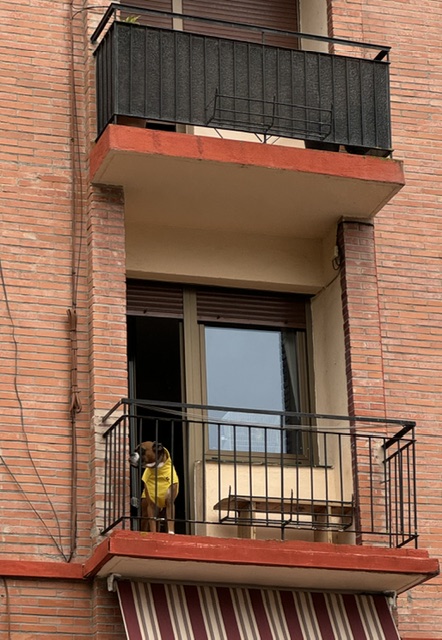
Even the dogs were ready for the rain, on the balcony!
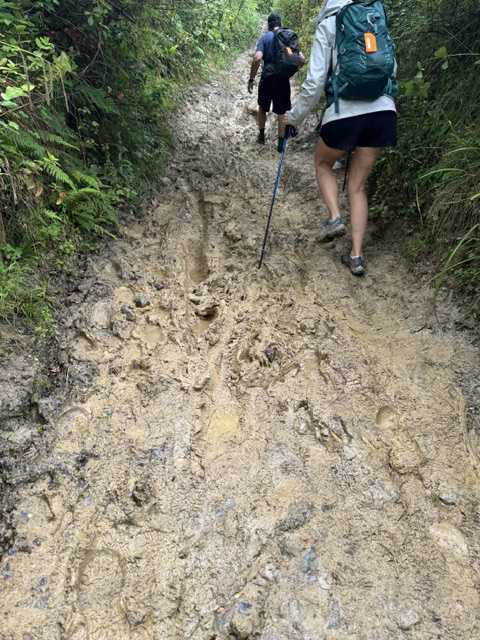
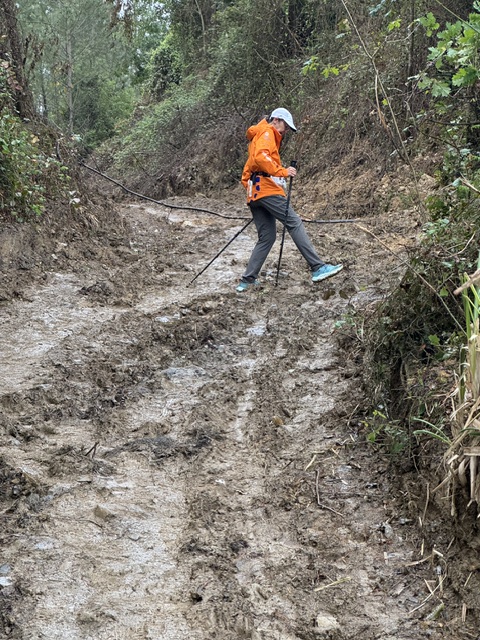
Today ended up being a 14 mile hike instead of 11, and in mist or rain all day, but we were prepared and the rain was very manageable. I did wish I could record the sound, not of birds, but of incredible squelching as our shoes and poles got stuck and had to pull them out!
First dry, not so bad
Then not so much
The country continued to be green, mountainous and beautiful.
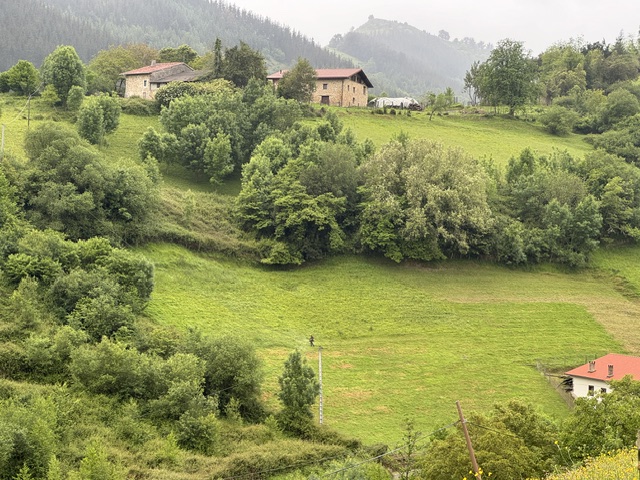
A farm by itself, gorgeous
A moment on the trail, last of a group we’d walked through
Starting to see embedded Camino shells occasionally
Baby animal photo for the day
Matthew had been exploring on his phone where we could get lunch when we got in and realized that we should really eat before we went to our hotel, it was another rural casa on the outskirts of the town. We were drying out so we went to the one restaurant that was open and managed to get a table for our group. We were really lucky because we were able to go right in; the restaurant never had an empty table, they turned rapidly. And it definitely filled us up!
Our hotel was lovely, Hotel Rural Matsa, quiet, dark at night (from my room, others had a bit more noise from fellow residents) and the owner made us tea and coffee in the late afternoon. The beds were weird, but I’d repeat if I came this way because it kept us very near the Camino. We all then went to our rooms and snacked on whatever chocolate we had at hand. Realized this the next day when we were comparing notes. Funny response to wanting just a bit of something before bed.
Gernika history: On April 26, 1937, during the Spanish Civil War, the town was razed to the ground by German aircraft belonging to the Condor Legion, sent by Hitler and by Mussolini’s Aviazione Legionaria to support Franco’s troops. For almost four hours bombs rained down on Guernica in an “experiment” for the blitzkrieg tactics and bombing of civilians seen in later wars. There were five waves of attacks some almost at the rooftops and many of those killed had mistakenly left air-raid shelters believing that the enemy attacks had ceased.
The bombing of Guernica was deliberately chosen to occur on a Monday (April 26, 1937), because it was known that the Basque people who lived outside of Guernica proper would travel into town for the Market Day, thus affording the pilots of the German and Italian aircraft the opportunity to murder as many people as possible.
On Tuesday, April 27th, Franco ordered all to lie and declare that the town was bombed by the “reds” and it was a Basque plot. We read this at the Museum of Peace on the outside exhibit of photos: “Justice was never done, but there is no lie that hides the truth forever, because the history of our people is embedded in its collective memory. Having recovered our historical memory, we reveal the truth, we pass on to our descendants the historical moment that our elders lived, and we do justice.”
Our crew, still in post hike tired mode, next to the Peace Museum on the left with the photos of the city after the bombing next to Carol in the orange.
Until modern times, it had been generally accepted that the number of deaths had been over 1,700, but these numbers are now known to have been exaggerated. Historians now agree that the number of deaths was under 300. However, it is true the 85+% of the dwellings were razed. Astonishing that the air raid shelters did such a remarkable job protecting. For Franco – who’d asked for these towns to be targeted (Irún too) because they supported the Republic and were Basque nationalists – this backfired because it cemented the Basque’s commitment to the Republic and to their own liberation.
Basque language: I realized I’ve never written about this. It’s a source of great pride to the Basque people, that their language may be the oldest European language. Both our guides in San Sebastián were Basque and spoke about their language. I don’t know why it’s called Basque when that’s totally different from Euskara (their word for their language). Here’s a note from Wikipedia: Basqueeuskara is the only surviving Paleo-European language spoken in Europe, predating the arrival of speakers of the Indo-European languages that dominate the continent today. Basque is classified as a language isolate, with no relationship to any other language having been established.
Gorka, our wonderful Pintxo guide in San Sebastián, told us that a Rosetta-stone like discovery of a bronze hand with writing on it proved that Basque was in fact a unique and extremely early written language. Online, I finally found this note: Inscriptions found on a 2000-year-old metal hand may be written in a language related to modern-day Basque. If this interpretation is correct, it could help explain the origins of the Basque language – one of the biggest mysteries in linguistics. Of course, there are scientists who are questioning this, but it’s a big deal here!
Ok, now today’s hike. We all hiked to Gernika from Markina, but Carol and Matthew were in a different hotel and on different timing so we split up for the hike. The rest of us stayed on the MacsAdventure and the Camino signed trails the whole way. It was described as “moderate” whereas yesterday’s hike was described as “moderate-strenuous”. Today was great and it was definitely easier than yesterday in terms of height (today 2500) and distance, but as Bob said, Europe’s “moderate” does not mean the same thing as American “moderate”. Yesterday, I wrote that we rarely saw any creeks or rivers. But then today, we got to walk along a river for the first mile or more, then creeks for a lot of the rest of the hike. That was wonderful.
Near the top of the biggest hill was the Monastery of Saint Mary of Zenarruza that was fantastic. You could actually stay there and a sign said they had Baroque concerts. Sadly, we were too early to see it since we left at 7:30 and got up the mountain pretty quickly. The camino went right through it; you can see the arch below:
After we’d moved past, we were surrounded by green, mountain views, mist and clouds. At one point, I stopped and it was silent except for the ringing of the monastery bells, birds and the creek. The sounds are just wonderful on these hikes so far.
Monastery:
I couldn’t get all the sounds together, this is the bird chorus:
There are so many baby animals! These are still in the field with their mothers, though getting bigger. So far, donkeys, cows, horses, sheep, ducks. Just missing puppies and kittens 🙂
Misty scene
Happy moment for our group
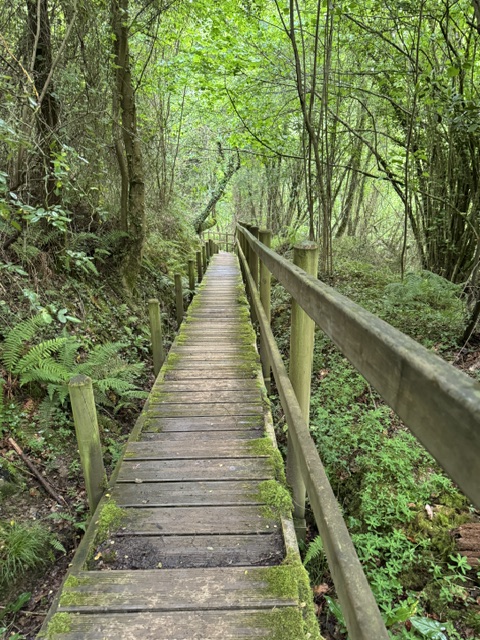
Incredible wooden steps that went down through a whole section of what felt like cloud forest.
Oh, here’s a cultural note that we’ve all been curious about. Can you see the guy in the distance on the hill? He’s weed whacking the ENTIRE hill. Not mowing, not tractor mowing, weed whacking. We have seen people everywhere doing this. Whole hills, sometimes just berms (which makes more sense), but this one was a doozy. They must get so tired.
Bob and Susan
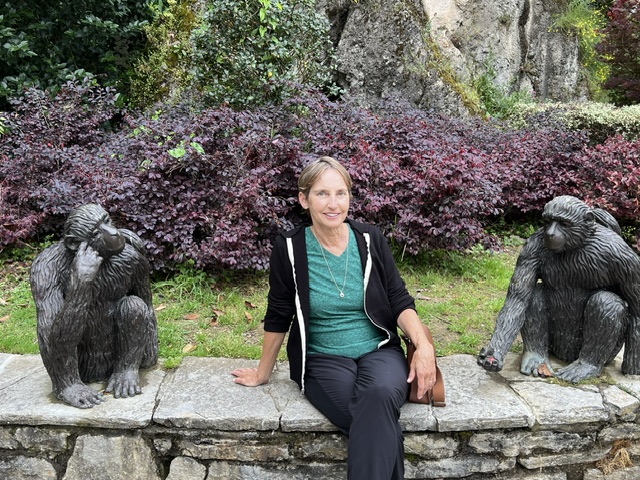
I’m here too:
When I saw Gernika from the mountain, I could see that it was just a small isolated town and so horribly easy to target and repeat target as the notes above described.
First monument was a statue:
Got into Gernika by 3, quick changed and went to a burger place for lunch. It’s Sunday, most things are closed and this was close to the hotel. Rick has pretty much forsaken his eating norms while we’re here. He’d be crazy hungry if he had to stay vegetarian. But going to the pulled pork sandwich was a big switch up and he said it was wonderful!
We then walked around Gernika, exploring. We knew if we went back to the hotel, we’d never leave again – so walked. Many of the signs, museum, and plaques are about Gernika being a place of peace and connection with all who suffer the impact of bombing and warfare.
One building left standing, now with repairs showing in different areas was the Iglesia Andra Maria.
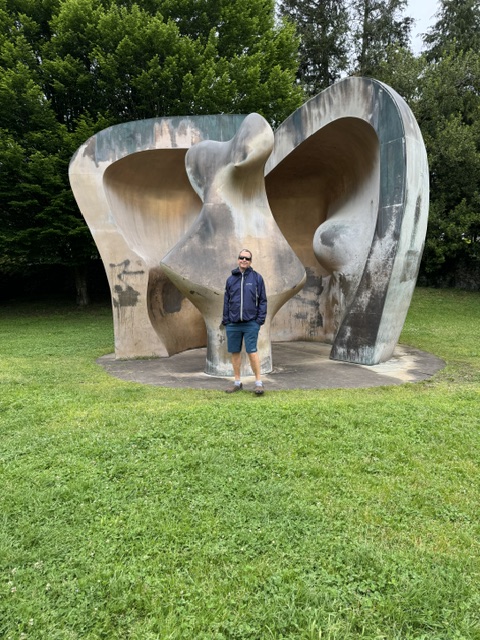
Henry Moore’s “Large figure in a shelter” 1985-86. The year he died, amazing. A tribute to trying to find comfort after being bombed.
Then back to the hotel to repack (every night), shower, set up for tomorrow. Sadly, Rick has to fly to Chicago for work (happily, he loves the work), but then is turning right around and coming back to keep hiking. His feet will be happy to get a break, but we’ve just finally adjusted to jet lag so that’ll be a bit of a readjustment.
Ok, today was a big one. We knew it was going to be long and Rick and I wore out at the end. But – it was spectacular. Matthew had found a way through GPS to cut off a few miles from the expected 17 that we were going to do. We all started together, then Carol and Susan continued down to see the town Deba and to walk the coastal path for 1.5 hours. They then caught 2 buses sequentially to get up to Markina, our destination.
The rest of us turned left into mystery land, trusting Matthew’s enthusiasm and exploring mind. And it was incredible. We were the only ones there (huh, good thing?) and it was definitely on a map so we kept going. We left behind all traffic noise (and people) and walked through the hills. I took a short video trying to see if I could capture the bird song that accompanied us as we walked through a forest. This was right at the beginning, before we’d really gotten into the more remote hills.
We walked up and down and down and back up and up and down. Yep, a lot. In the end we walked 18 miles and did 3500 vertical. At one point, someone walking by, told us that we were on the wrong road, it ends and then – he drew his hand across his throat to say – really the end. But then I explained that we were on camino and taking a short cut because of time. Then, he nodded and said, good to go – kind of, tricky trying to communicate between Spanish and Basque. But he wished us luck (I think) and off we went.
I was so happy for a long long time. Every day, just filled with happiness for so many moments. We stopped at a fountain to refill our water, eat a quick snack and kept going. Then we started going up. For a long long time. Matthew and Bob outpaced us and we never saw them again. Happily, Rick and I are pretty well matched and we certainly weren’t going to lose each other. We took another 5 minute break when I absolutely had to sit down, then kept going. Both of us pulled out our earbuds, me for a book, him for music and then a book. And, oh thank goodness, we had those resources. Basically we were on the MacsAdventures mapped trail for a small fraction of the time for the entire day, just briefly seeing Camino signs and then we were off again. The rest of the time we were using All Trails and just hoping we would get to the town of Markina.
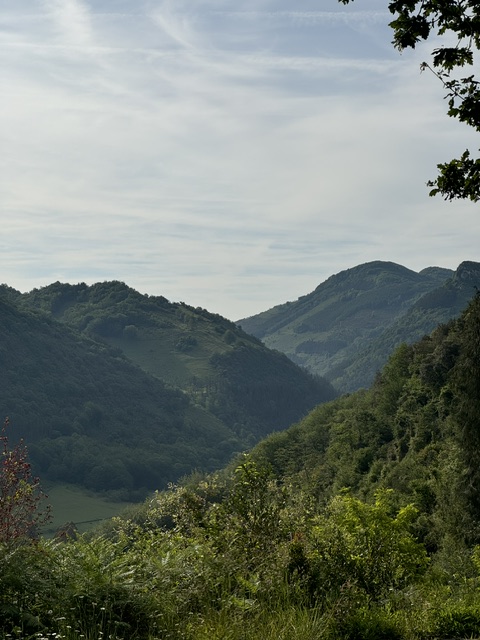
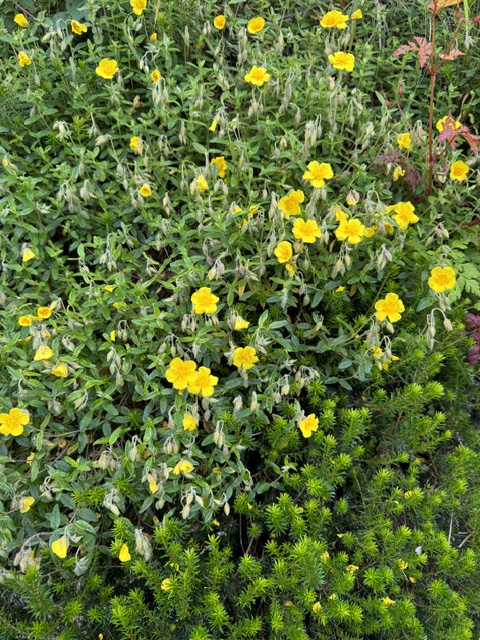
Some scenes on the way:
We thought we’d be going down and then up the other side on the trail faintly seen. We were right.
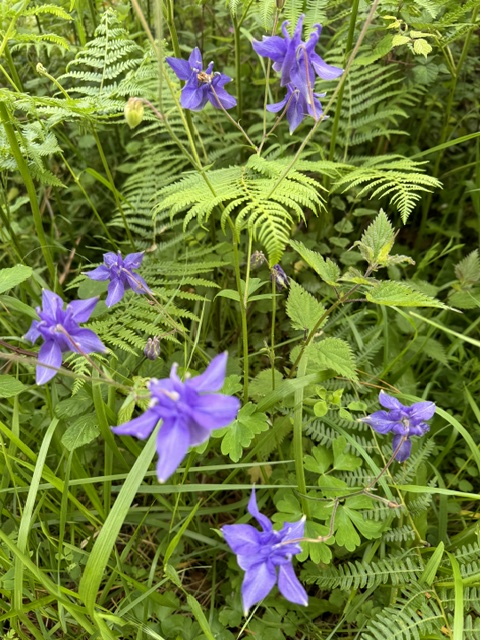
European Columbine
There’s a ton of water here, so lush and you can hear the water, but it’s been managed for so long that it generally feeds through pipes to the farms and towns, so we see very few creeks.
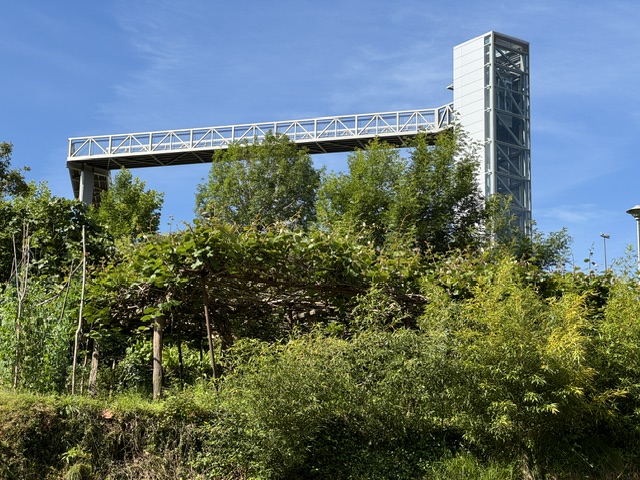
We walked near this town, but didn’t see any cafes so we didn’t deviate from the path. Sigh. This is one of the elevators set up to get people up the hill.
Conferring
And, finally, Markina? Please, please let it be Markina. Now, how do we get there?
I’m afraid that by the time we got to the town, we were both used up. We literally went in circles trying to figure out where our hotel was and then decided we had to eat. We found a little place, totally local, not a word of English and managed to order and then just sat. And, actually the food was just fine, better than we’d expected. The vinegar they used on the salad was great! We recovered, stopped cursing and finally figured out where the hotel was. 15 minutes away.
Turns out it’s a hostel, blend of hotel rooms and bunks for walkers. The Casa Rural Intxauspe is a pretty busy scene, really nice family running it and we settled into our room. I quickly did a load of laundry and hung it on the line and got a shower – bliss.
Bob and Matthew had walked straight to Matthew and Carol’s hotel, turns out it’s 30 min away from ours and had an amazing lunch with Carol and Susan. Made Matthew happy! There’s no way we were going to add any extra time to our walk, plus we were 45 min behind Bob and Matthew.
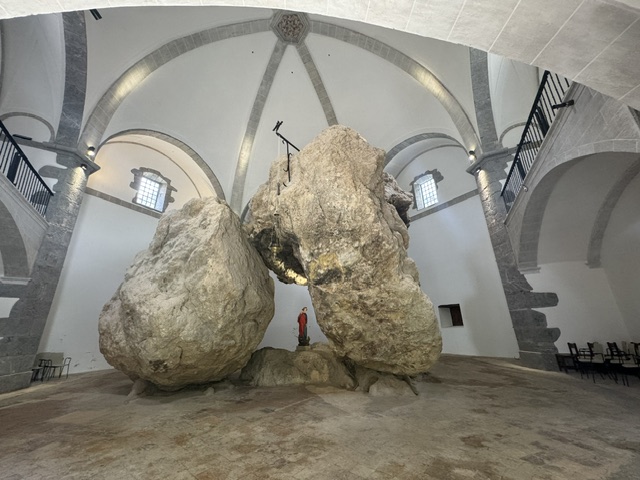
Rick and I did see one startling monument on our way into town, we didn’t even try to see the churches. This monument is the hexagonal Ermita de San Miguel de Arretxinaga, founded in the 11th century around three Megalithic stones. The archangel saint Michael is the statue you can see, probably about my size. The saint wields the spear against the demon at his feet in the form of a dragon or another fantastic animal. I was so tired, I didn’t even try to go in to explore, just looked in, goggled at the stones and left.
Despite having lunch, it wasn’t the grand lunch that we’ve usually had, so we’re going to go down to dinner as well. That’s new, then hoping we sleep a LONG time.




























 Reb's Walks!