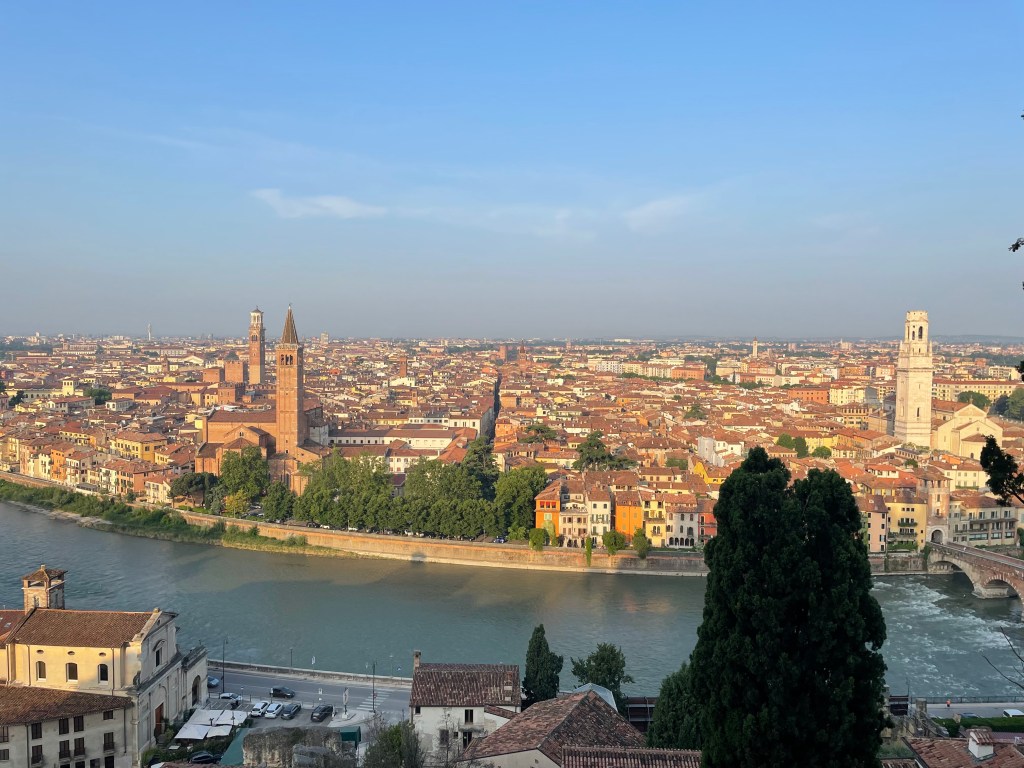
Verona/Vicenza I took an early morning walk around Verona today, up the hill to see the view and back through town. It’s taken long enough to start to get a clear sense of how to move once in the streets where you can’t really see landmarks outside to orient. In this photo, the Duomo’s white tower looks the tallest, but the family of Della Scalia who built the medieval Castel on the distant left, made sure their tower was higher than the churches – thus the lack of the steeple. Government over church.
A few things came back from Krystal’s walk.
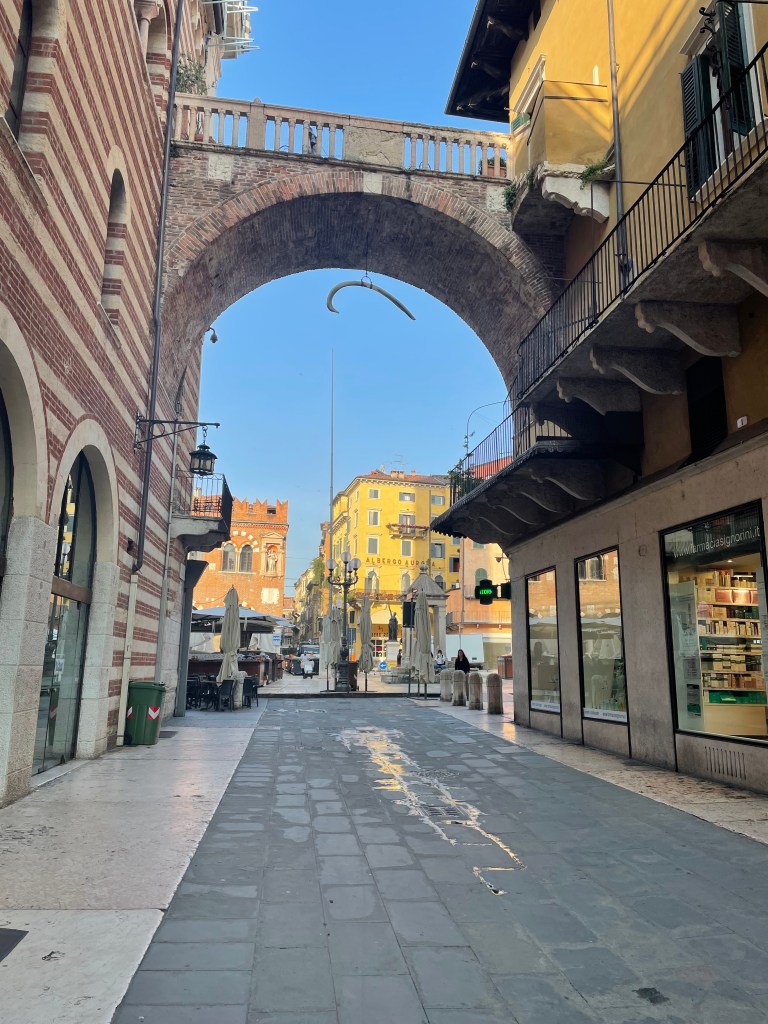
Whale bone hanging, noted in Atlas Obscura: A whale rib was used to advertise the store by the arch that offered exotic goods from far away.
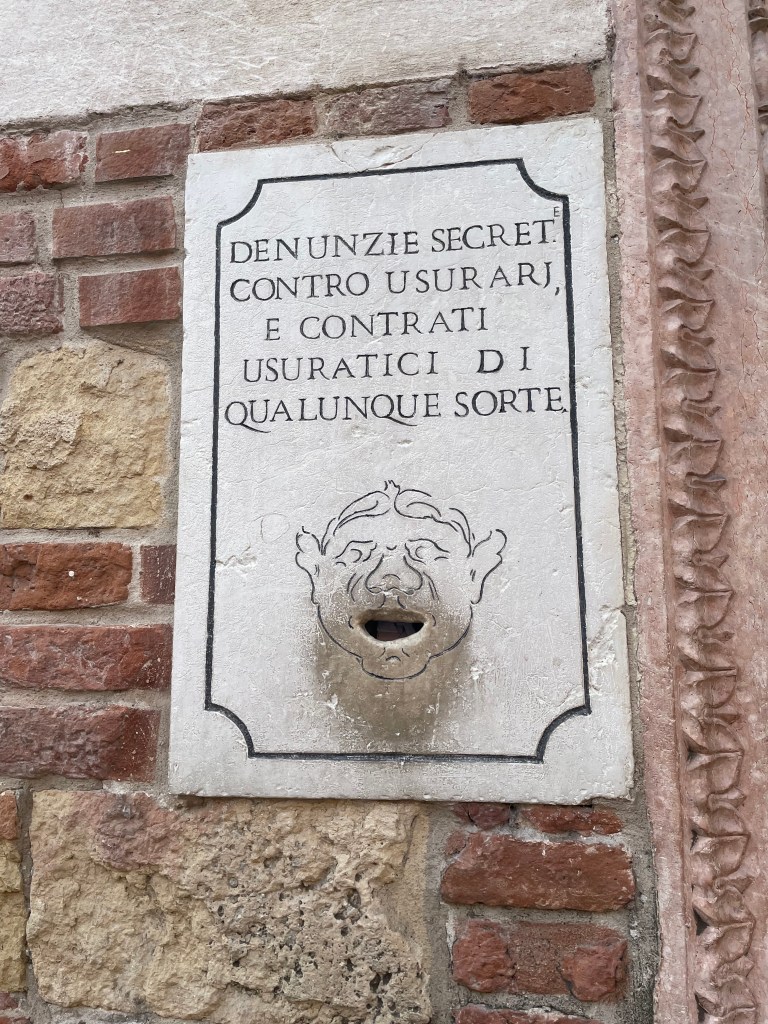
Citizens could voice their concerns anonymously by placing hand-written notes into designated boxes. In turn, the government would address each complaint individually. These boxes, or bocche di leone (lions’ mouths), were scattered throughout the city. Each stone receptacle resembled an intricately carved face, often that of a lion—the winged lion of St. Mark is the symbol of Venice —with a slot at the mouth into which letters could be inserted.
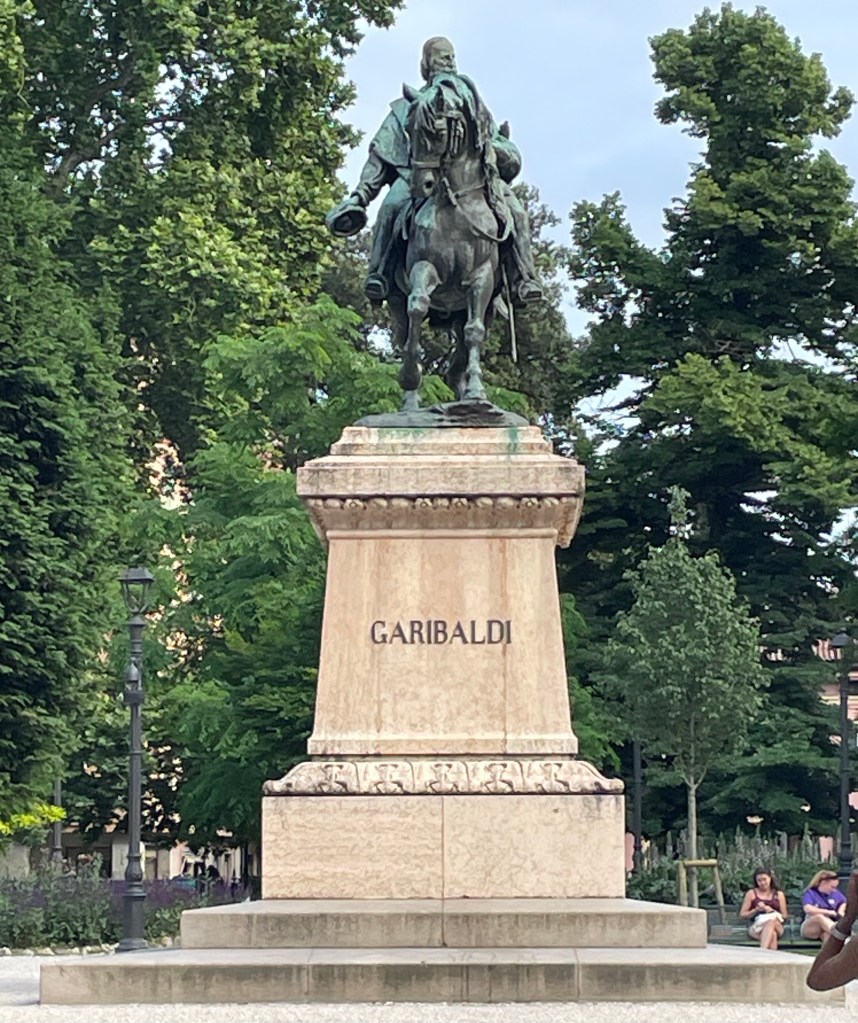
Garibaldi is the man who united Italy, starting in 1848.
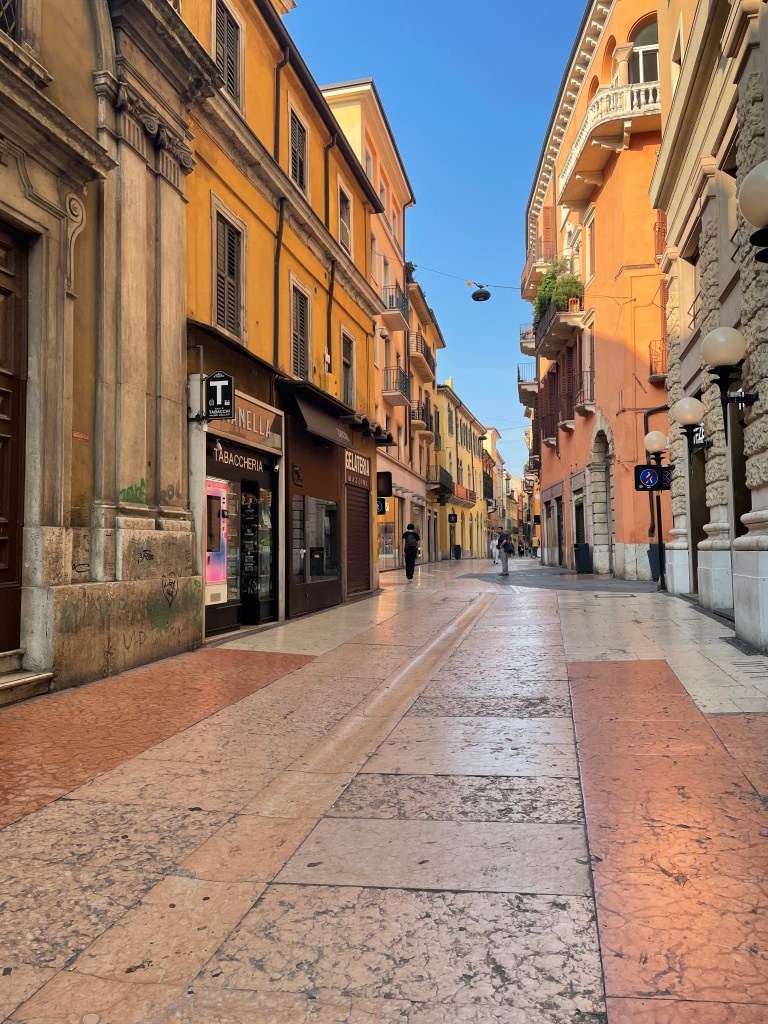
Main shopping and pedestrian street paved with marble.
And then back to the apartment to get ready to go to Vicenza. Cathy had wanted to see this city, which is famous for Palladian architecture. Leaf stayed home to work, but the rest of us jaunted off for the day. It took about an hour and went mostly on the Autostras, filled with semis and then through the industrial outskirts until we arrived in the old city. The buildings were just astonishing and so many!
From Brittanica.com – Andrea Palladio, original name Andrea di Pietro della Gondola, (born Nov. 30, 1508, Padua, Republic of Venice—died August 1580, Vicenza), Italian architect, regarded as the greatest architect of 16th-century northern Italy. His designs for palaces (palazzi) and villas, notably the Villa Rotonda (1550–51) near Vicenza, and his treatisce I quattro libri dell’architettura (1570; The Four Books of Architecture) made him one of the most influential figures in Western architecture.
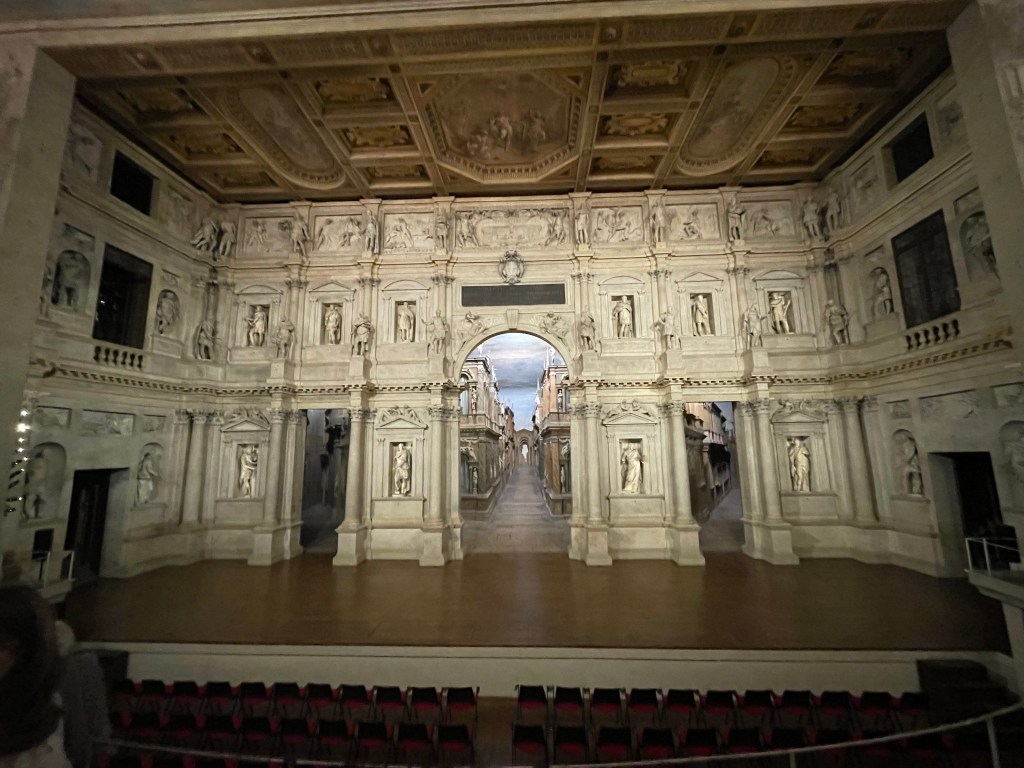
Happily, they had an audio guide that actually downloaded to our phones (almost never works) and we were able to wander the old city of Vicenza discovering some of Palladio’s buildings. We started with the Olympic Theatre built in 1585. The theatre is the same today as when it was built, the stage set a remarkable design with 7 streets (only able to see all 7 if you move about the theatre) which was the city of Thebes since they were putting on Greek plays. It was the first covered theatre ever and the set design was only dismantled once, during WWII, to protect it, putting it in the basement of the basilica.
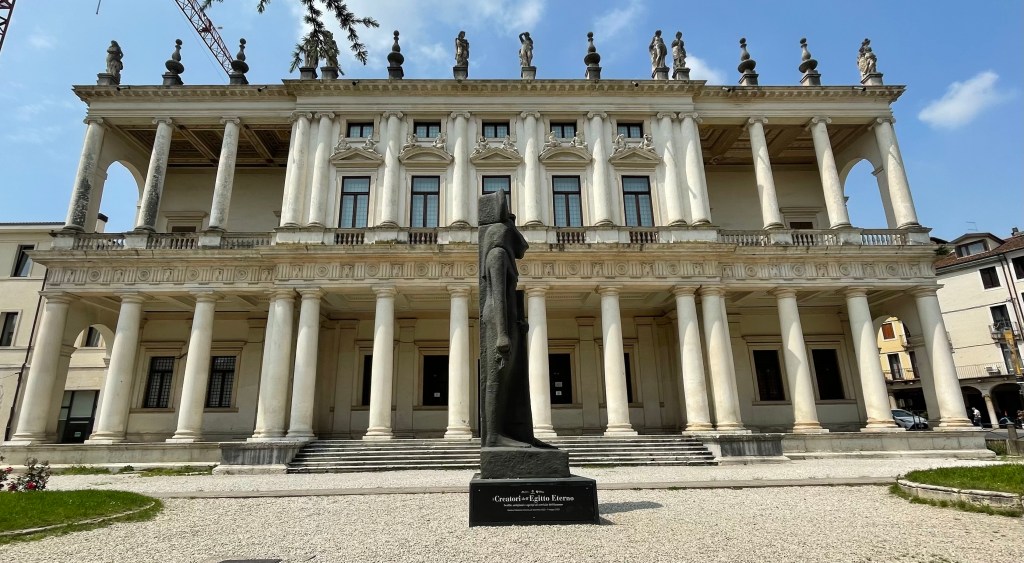
Palazzo Chiericati – designed to welcome guests who arrived on the two rivers that intersected in front of the building. The arcade under was a place to protect guests from the rain and weather.
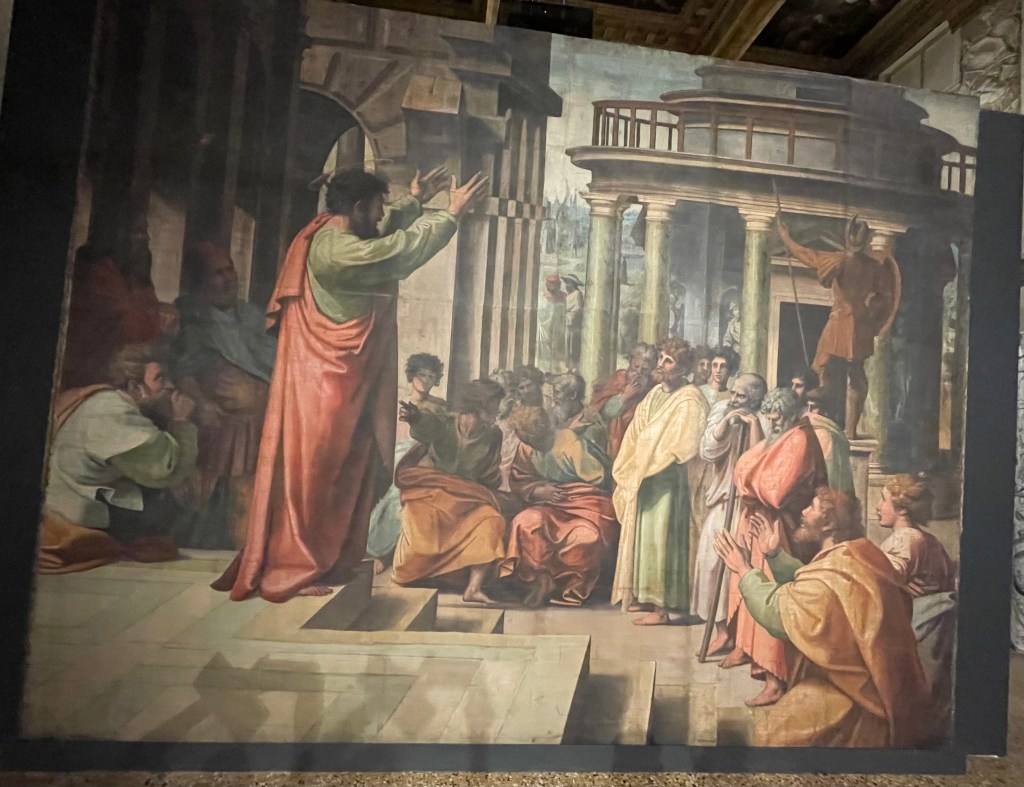
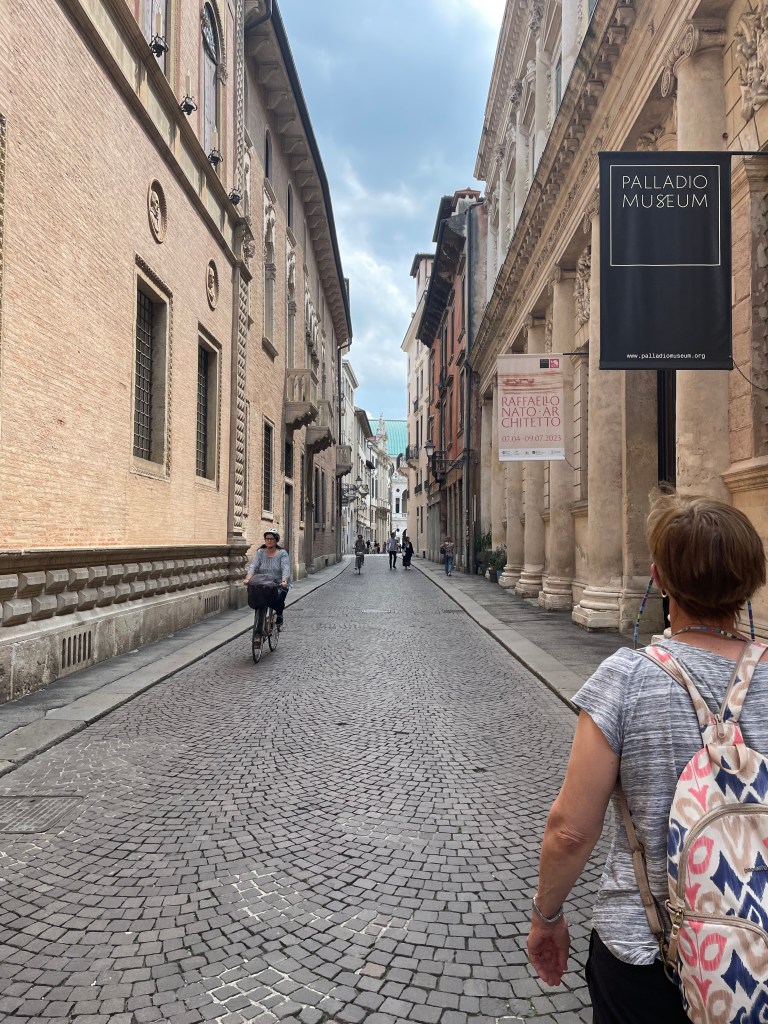
Palazzo Barbarano, the Palladio Museum was wonderful. There was a current exhibit of Rafael as architect – and yes, the same Rafael that we think of as a painter. Total reframe looking at one of his famous paintings and focusing on all the architectural elements.
Here’s the painting that was examined with the focus on the columns, angles, etc.
We had lunch, a great lunch with interesting flavors, on a side street that we found near the museum. This entire street was filled with gorgeous buildings, one after the other. They must have all been palazzos and people walked down the street like it was normal!
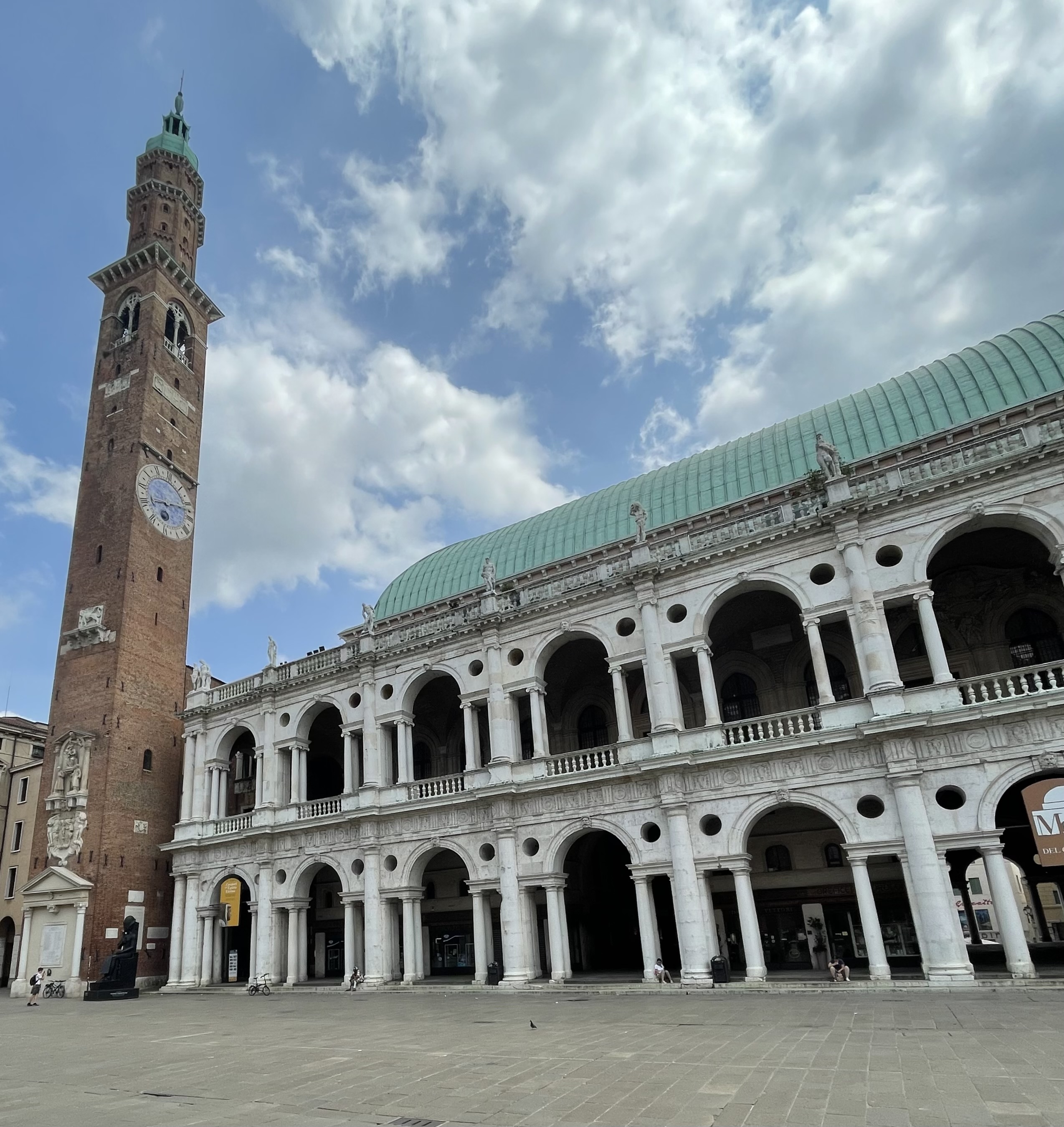
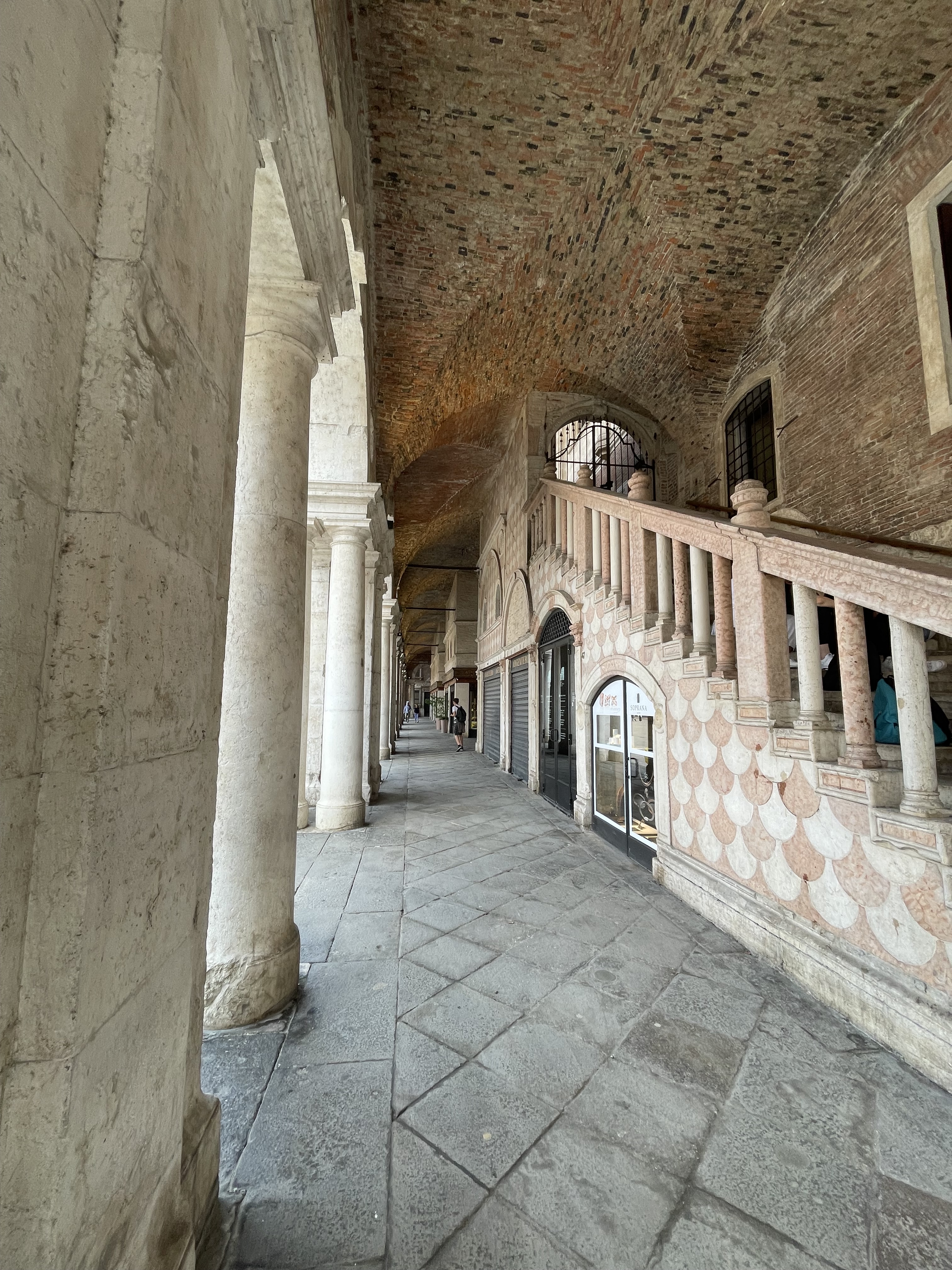
This sign did a good job explaining Palladio’s vision and purpose for the basilica.
Ach – really couldn’t get the whole thing in the photo
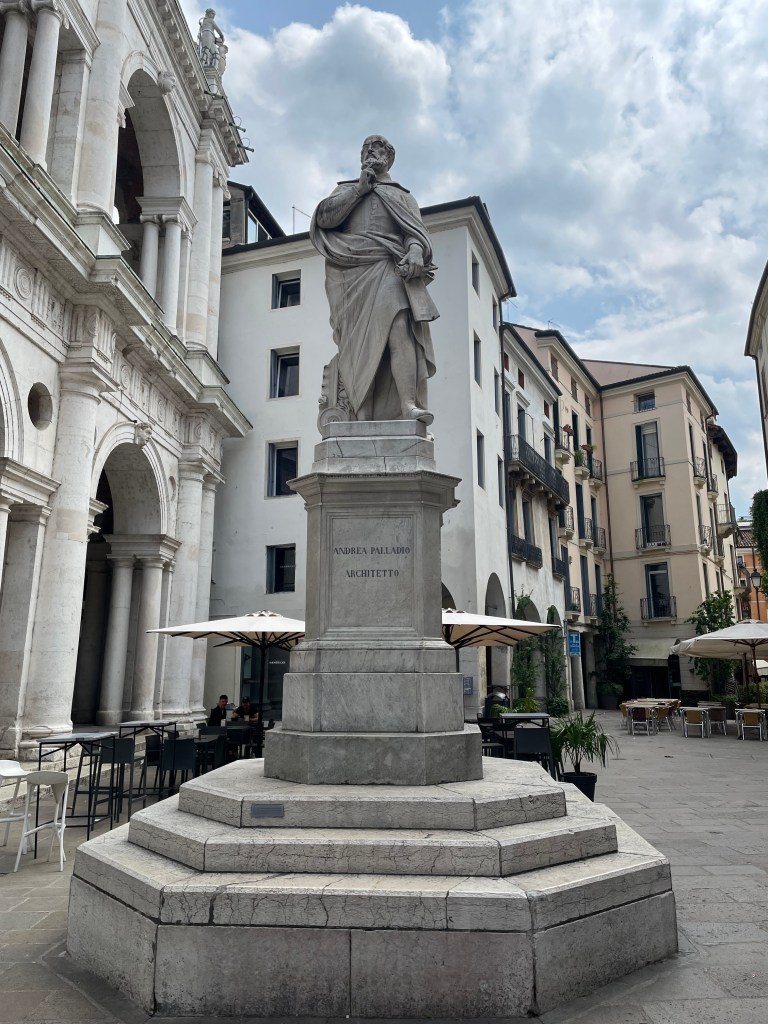
And Palladio:
We could have continued for hours if not another day with buildings inside and outside the main town center of Palladio’s design.
We then drove home (after 5 days, it does feel like coming home), did a final wander on our own and then made dinner trying to clean out the frig and cupboards since tomorrow’s travel is car to boat and will be harder to carry multiple bags.
Verona We had a day of exploring Verona today, getting lost a few times in this small city because of the windy streets, but we’re getting to know it.
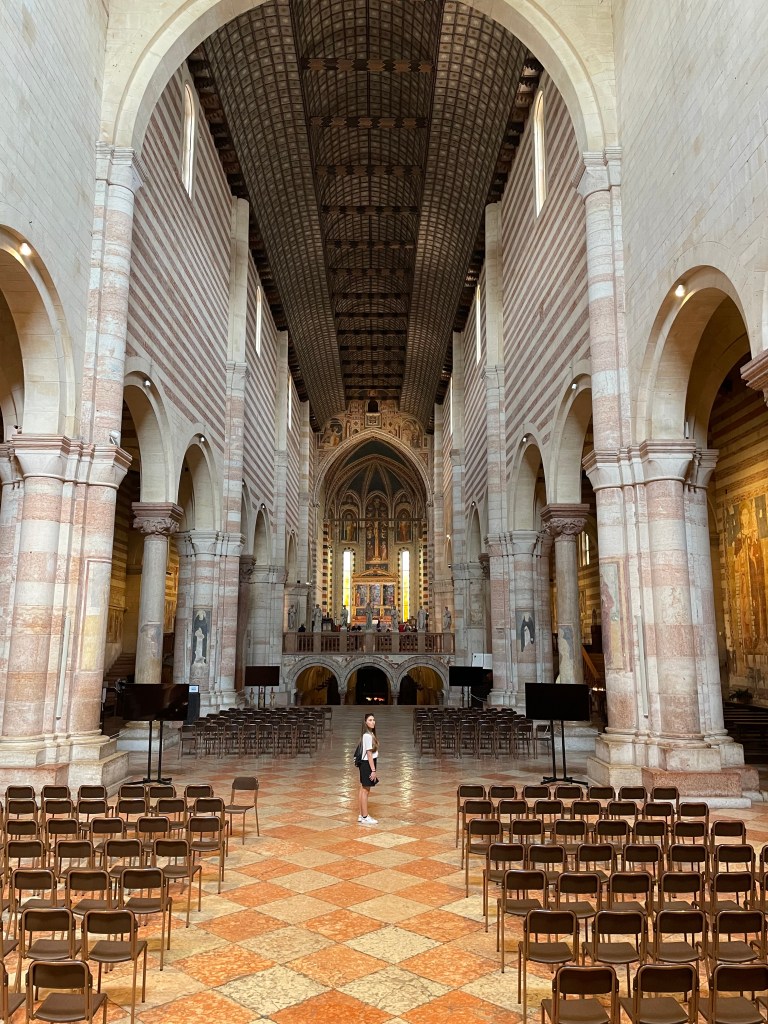
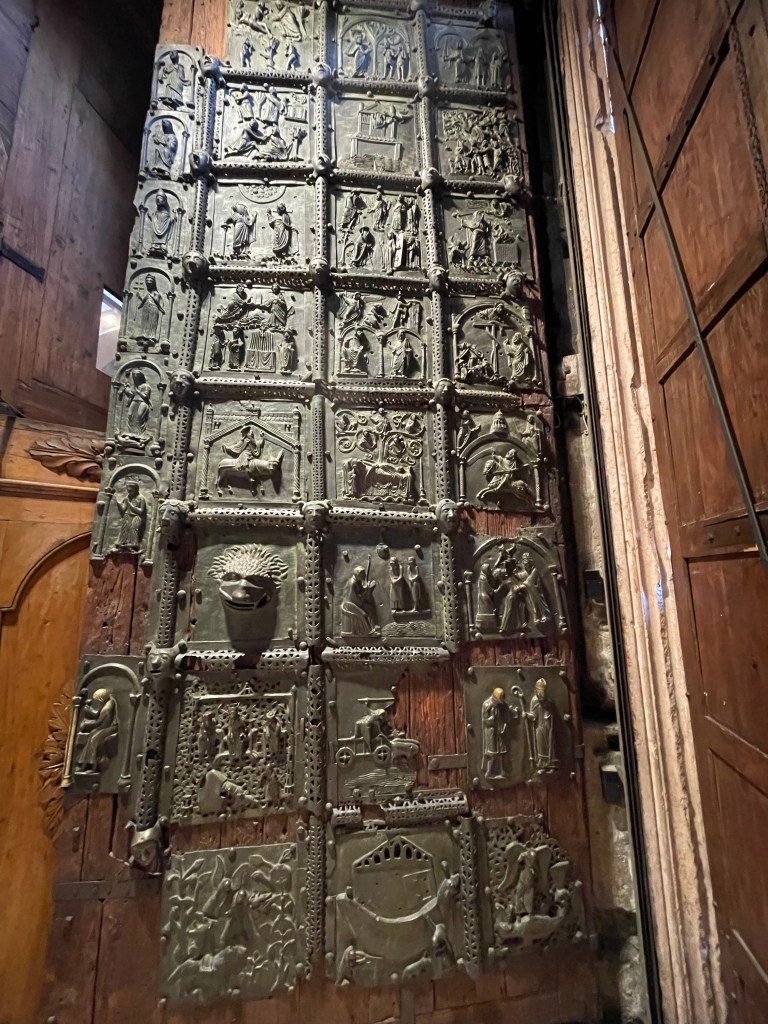
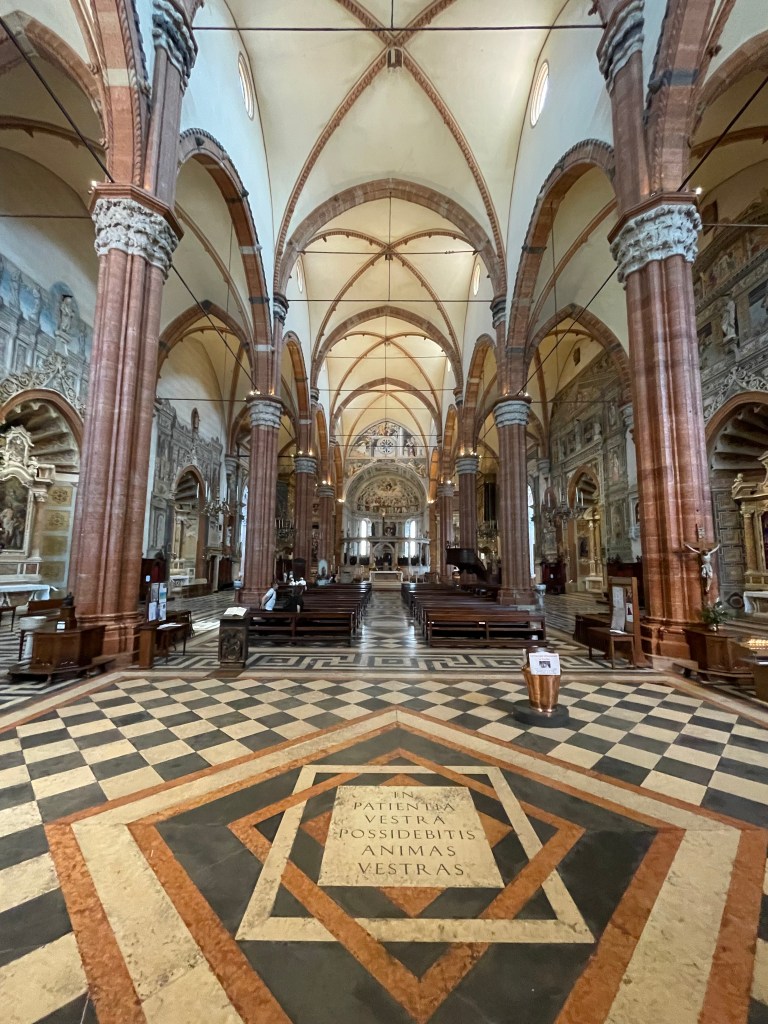
I went out early and sat by the river, like yesterday, but this time decided to wander over to the Basilica of St. Zeno. It’s huge! I don’t know why I keep being surprised. Rick, Cathy and I came back later so that we could go inside. Some of the discoveries: different building design, painting by Raphael, alter piece by Montagna, and the most incredible bronze doors with plaques of different scenes.
From bikethecity.it: San Zeno Maggiore, or St. Zeno in English, is the patron saint of Verona. He was the 8th Bishop of Verona from 362 until his death in 380, known for founding Christianity in the city. He was respectfully nicknamed ‘il Vescovo Moro’, which translates as the Moor Bishop. This is due to his African origins as he was born in Mauritania.
Saint Zeno lived a simple life in austerity and was a well-educated man. He is considered the protector saint of fishermen because it is said that he used to fish in the river Adige.
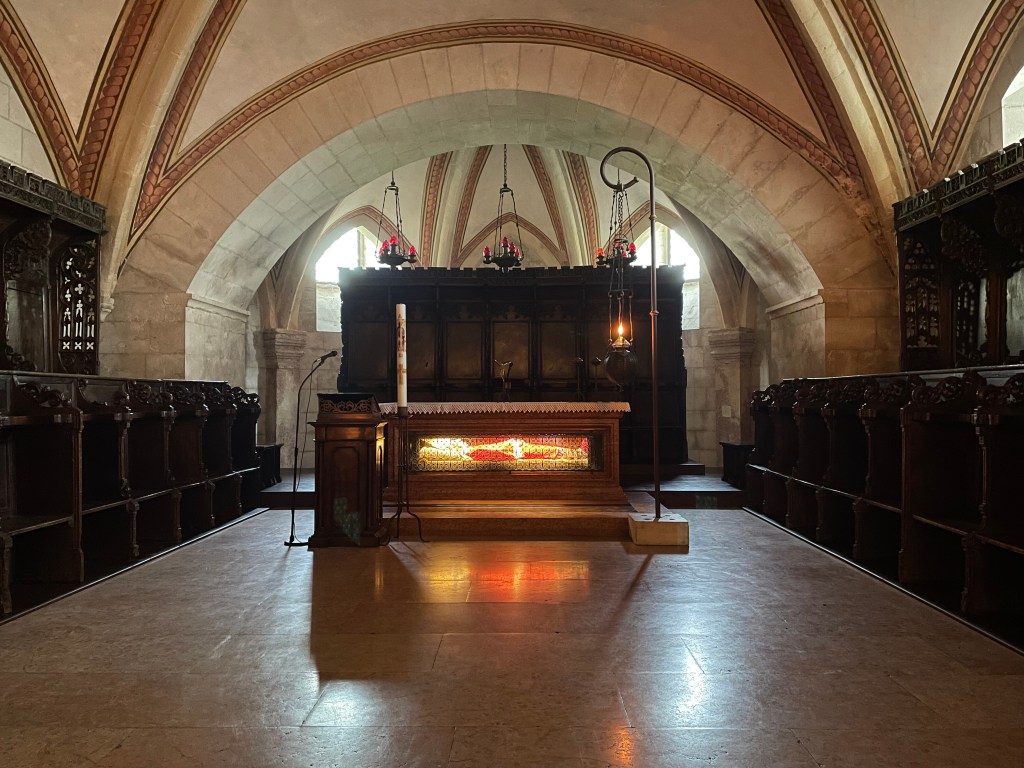
The San Zeno Basilica holds his remains in the crypt under the main altar.
Here’s a bit of the church history from Wikipedia: “The current church was built on the site where at least five other religious buildings had previously been built. It seems that its origin is to be found in a church built on the tomb of San Zeno of Verona, who died between 372 and 380. The building was rebuilt at the beginning of the 9th century at the behest of Bishop Ratoldo and the King of Italy Pippin who judged it inappropriate for the body of the patron saint to rest in a poor church. The consecration took place on 8 December 806 while on 21 May of the following year the body of San Zeno was transferred to the crypt.”
Modifications/changes continued for centuries, but it feels cohesive even as you can see the particularly ancient areas. The art that I mentioned above was worth a lot of time and Cathy and I pondered the bronze doors for a good while. Our favorite was of one of the three artists, who cast himself doing the creating. He’s on the lower left side.
On the steps up to the altar, we saw a great example of the fossils that Krystal had told us about on our tour with her. She noted that the streets and sidewalks in a lot of Verona are made with marble, but it’s not really pure marble. Instead, it’s Verona marble, which you can tell because of all the fossils embedded in the stone.
Sharon, Cathy, Rick and I also went to the Duomo and did a quick tour. The most remarkable piece of the tour was seeing the 3rd and 4th century church through glass flooring under S. Elena’s church which itself started in the 9th century.
Then, we had the most amazing tour. Leaf had wanted to see the Biblioteca Capitolare, the oldest continually operating library in the world. And it was fantastic. He had a whole series of emails in goggle translated with the library to try to get us into an English tour – and it worked! The young woman who did the tour was incredibly knowledgeable and loved her work and sharing the stories.
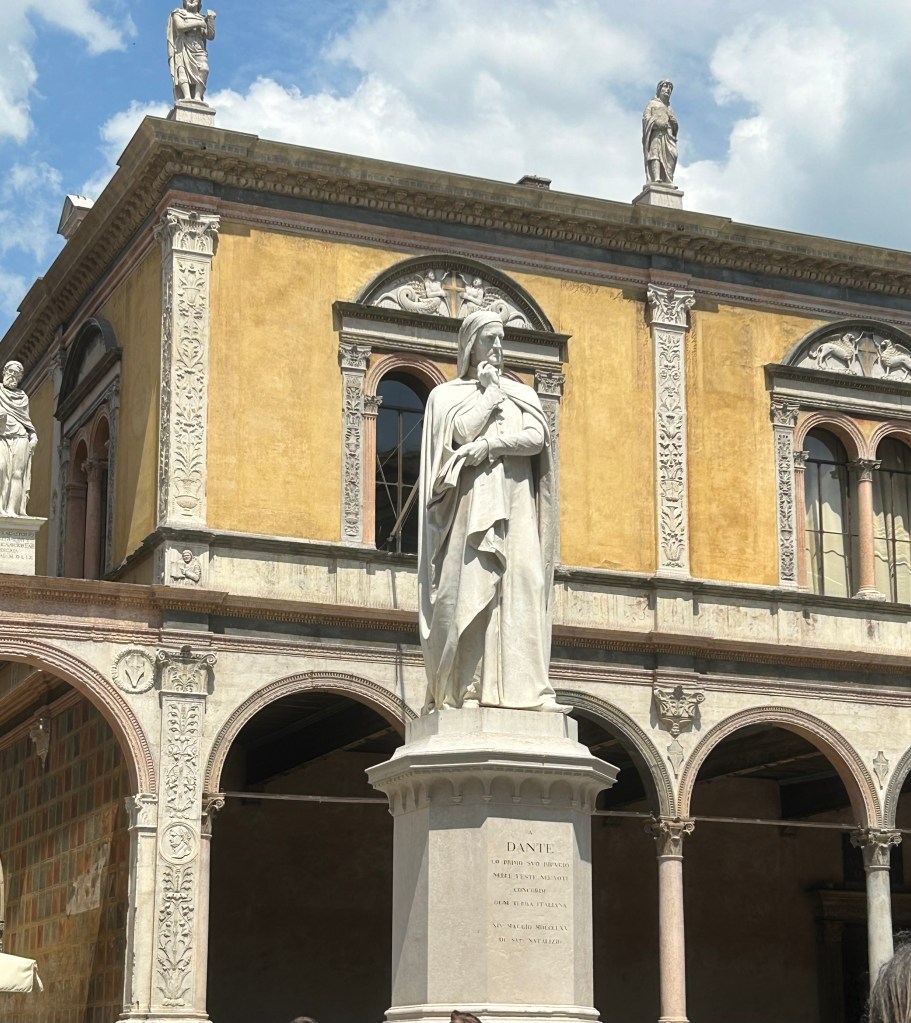
Valeria, our guide, started by showing us the outside of St. Helen’s canonical church that a few of us had seen earlier when we toured the Duomo – only way to see the inside. In 1320 Dante Alighieri held his dissertation, the Quaestio de Aqua et Terra, in St. Helen’s canonical church. The church belonged to the same Chapter of Canons which was in charge of the Library. This event is remembered by an inscription on the external wall of the church. There was a statue designed to commemorate his 700th birthday.
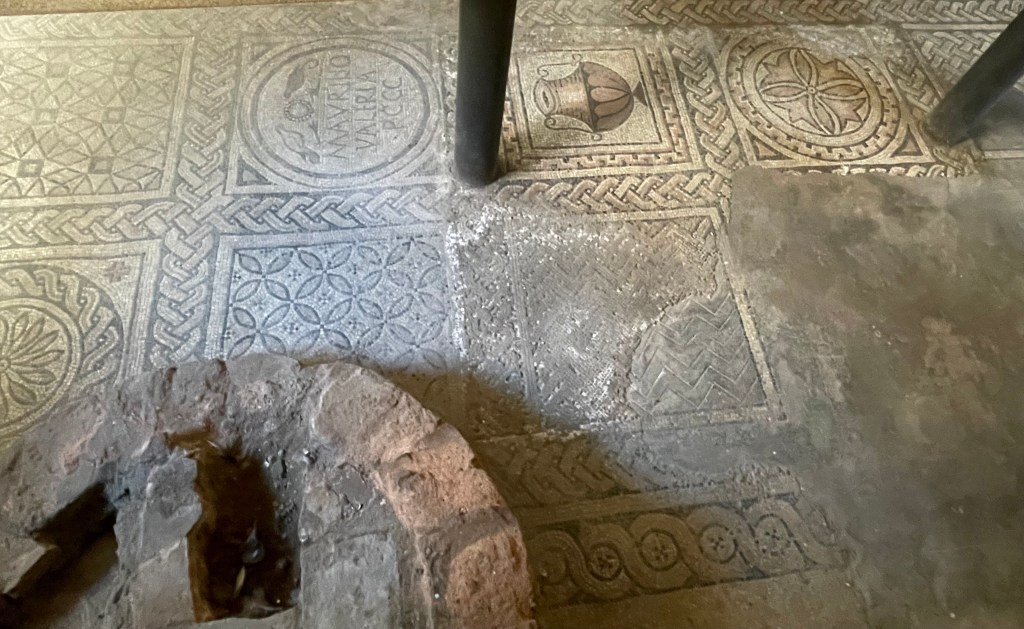
We then moved to see many more mosaics from the Roman church that we’d first seen in S. Elena’s church. These continued through all of the buildings we were in – with sections of floor glassed, or flooring open to the designs below. Incredible. Valeria particularly liked 2 different mosaics. The one below had her name – a couple who donated to the churches gave enough to be able to put their name in the design.
This one’s first name meant dung – which could have had many meanings, bringing life, secure enough to carry off the name, and his design included 382 florins – which is how much he donated to put in a lot of mosaics.
When we were in this area, the site of the first church, she said speculation assumed that the library started in the 3rd or 4th century on this site. Here’s some information from the Biblioteca Capitolare’s website:
Originally, it was founded as a Scriptorium: a sort of writing laboratory, dedicated to the production of parchment books for the education and the spiritual training of the future clergymen. The scribes, in charge of copying the books, belonged to the Schola majoris Ecclesiae, the Cathedral Chapter’s school (“Capitulus” is the Latin word for “Chapter”, from which the name “Capitolare” comes from). During the transitional centuries between the Late Antiquity and the Early Middle Ages, marked by deep crisis, it was mainly churchmen who were given an education. Despite the political, social, demographic and economic decadence, they had the chance to receive and pass on the ancient classical culture.
One of those scribes, Ursicinus, left us the first written evidence of the Scriptorium’s existence. The book he copied, now known as Manuscript XXXVIII, contains the narration of the lives of St. Martin of Tours – written by Sulpicius Severus – and of St. Paul of Thebes, by St. Jerome. At the end of the last page, he added some data which were very unusual for the time: his own name, the place and the date. The date, written as “the Kalends of August in the year of consulate of Agapitus”, is identifiable as 1 August AD 517: a time when Verona was under the rule of Theodoric, King of the Ostrogoths.
The note, although very concise, is extremely important. In fact, it bears witness of a first form of cultural activity, organized for the book copying, back in the early 6th century. It is therefore likely that the first installation of the Scriptorium had been founded at least one century before. According to other scholars, its foundation might also be connected to the establishment of the first Basilica in the late 4th century.
Amongst the other treasures of the Capitolare there are also a few books even older than Ursicinus’: for example, Manuscript XXVIII, the oldest known copy of the “De Civitate Dei” (The City of God) by St. Augustine. It dates back to the early 5th century, and it is therefore contemporary with the author.
Valeria, our guide, had a group of 10 people who were in nerdeuphoria. Seriously cool. We were all riveted. She told us all of the above with a wry sense of humor and delight about what we were going to see and were seeing as we walked the cloister where the order of the Chapter still has members living and working in the library.
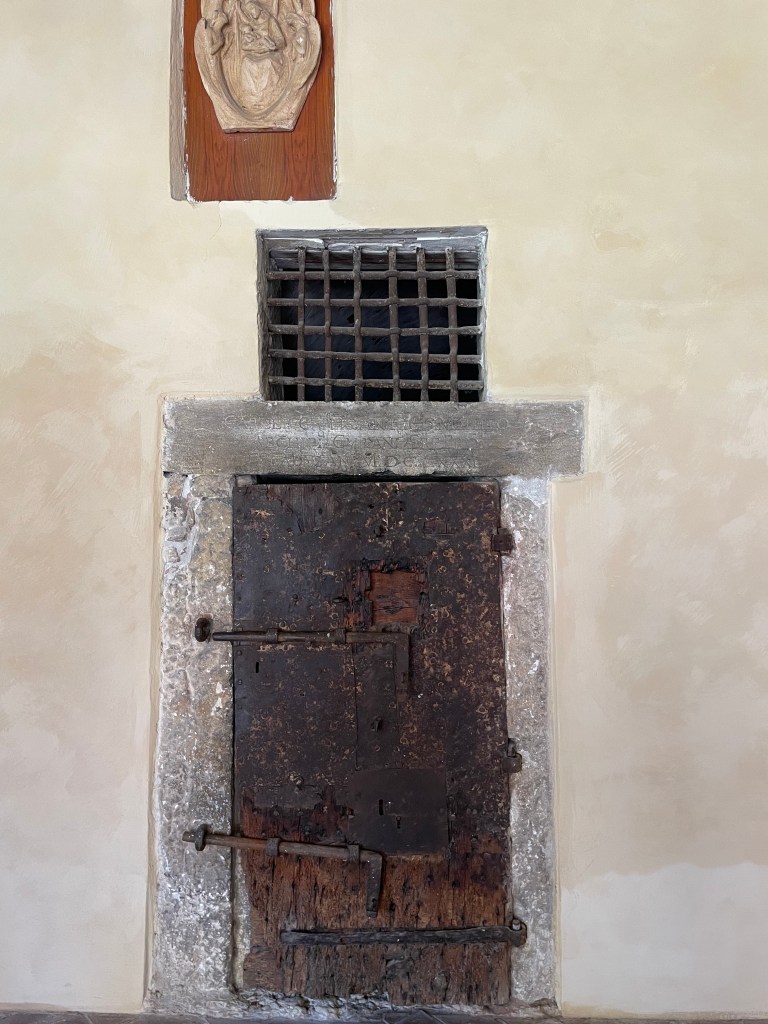
And the little room where priests or cannons were having a hard time following the rules spent time. Now, it’s where they keep their bikes:
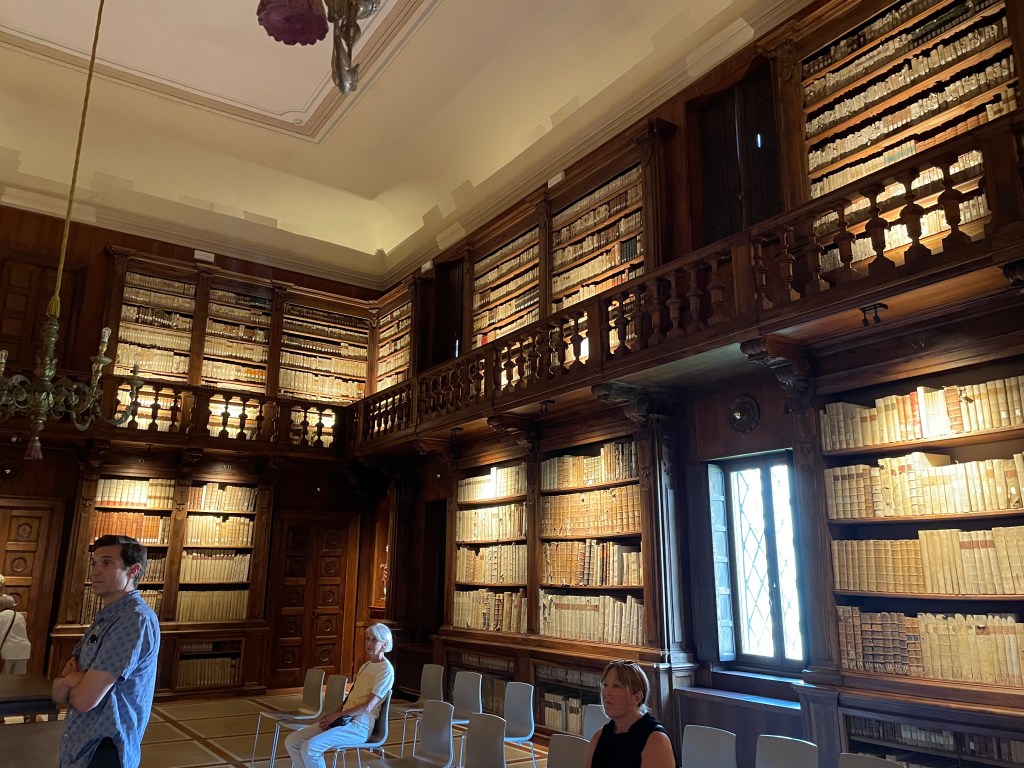
And then into the library which had to be fully rebuilt after it was bombed by the Americans. Sigh. WWII.
The librarian Giuseppe Turrini had already removed the manuscripts and the most valuable printed books, and stored them in the rectory of Erbezzo – a small town on the nearby mountains. Other precious books had been previously hidden in a secret room inside the Cathedral. Those which were left, buried in rubble, were then partially retrieved and put back on the shelves after the hall’s reconstruction. They still show signs of the damage they underwent from the damages of the explosion. We could see this when she pointed them out.
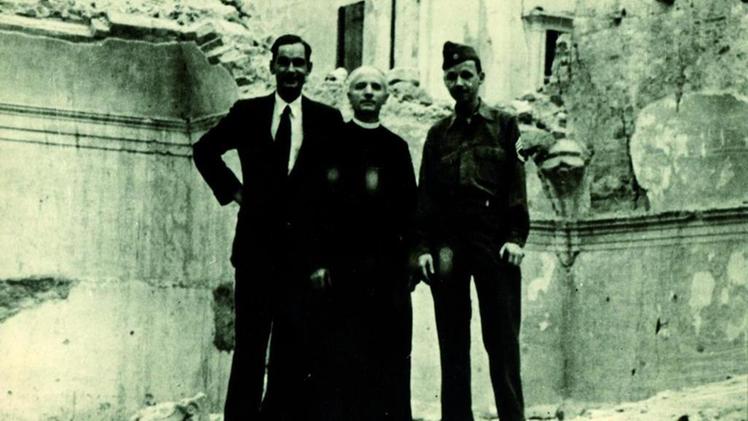
Wolfgang Hagemann, Giuseppe Turrini and Bernard Peebles in 1945. Really – the story is amazing, so am putting the whole thing here, from L’Arena:“ A priest between two enemies who, on opposite fronts, had fought for a common goal: to save the Chapter Library from war. The image taken 70 years ago shows Monsignor Giuseppe Turrini, prefect of the Capitolare, between Wolfgang Hagemann and Bernard Peebles in the rubble of the library, in the uniform of a sergeant major of the US army, special department of Monuments, Fine Arts and Archives: the Monuments Men at whose feats the George Clooney film was dedicated. Hagemann and Peebles were eminent philologists, both had studied in Verona on the codes of the Capitolare. Enlisted on opposite fronts, they had found a way to get sent to Italy with the same concern: to save the Capitulary. Hagemann had arrived in Verona with ranks of officer and prestige: he had been Rommel’s personal interpreter, the desert fox. He placed himself at Turrini’s disposal and was invaluable: the monsignor, fearing the bombings which punctually arrived in January 1945 (destruction of the monumental Maffeian hall, 1,250 volumes and files lost) had transferred codes and manuscripts to the rectory of Erbezzo. He believed them to be safe, but Hagemann warned him instead of the danger: it was an area of anti-partisan operations and the Germans could set fire to the town (Vestena suffered this Nazi retaliation). Hagemann sent a trusted officer to Erbezzo, Fritz Weigle, who had also studied at the Capitulary in 1927, and he affixed a «befel» signed «Wolff/SS-Obergrappenführer u. General der Waffen-SS» which declared the KUNSTDENKMAL building: «Prohibited occupation and requisition», as translated for use by the fascist militias. In the last, dramatic period of hostilities, however, Hagemann intervened to advise the transfer of the codices to the Marciana Library in Venice and to other safer hiding places. Meanwhile, Peebles, who had already saved the archives of Philip V in Sicily, was going up the peninsula with the allied troops, recovering documents from 1713 that were used as wallpaper. Arrived in Verona with the first liberators, he rushed to the Capitolare: the photo shows him with the former enemy, rediscovered as a scholar and custodian of the cultural heritage.
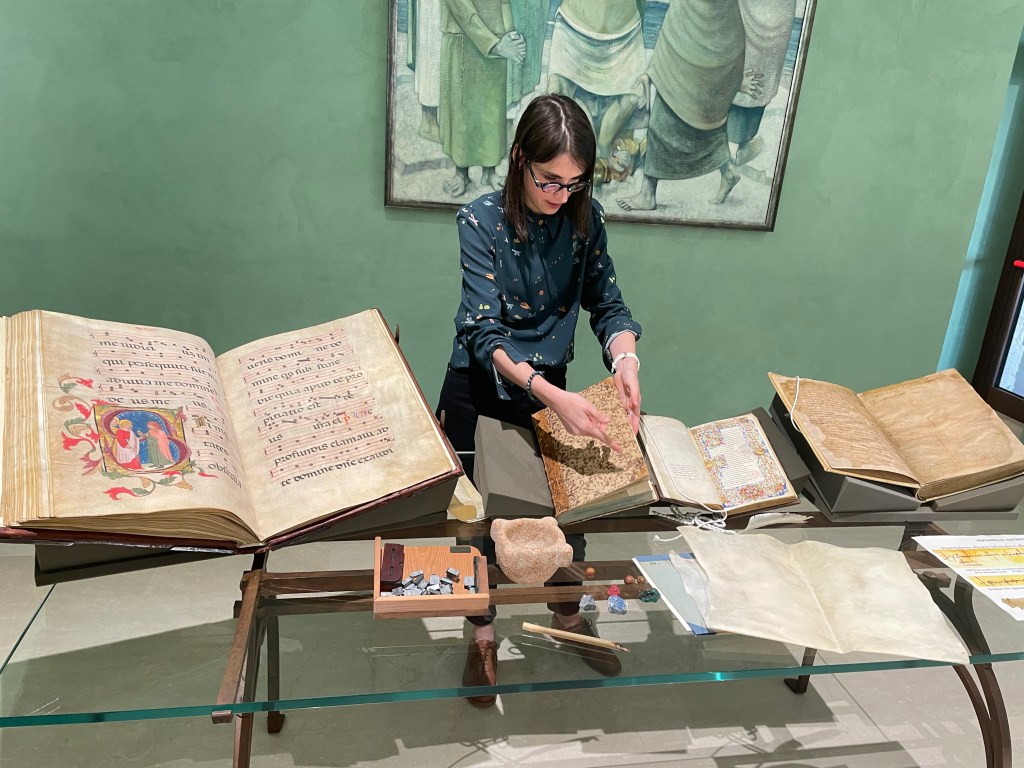
Then – the grand reveal – Valeria showed us several incredible examples of their collection. She washed her hands first and told us that the experts no longer used white gloves. They’d learned that the weave of the gloves could do damage and the lack of hand sensitivity with the barrier meant that damage could happen when turning the pages.
First she showed us books made with parchment – sheep for the big pages, lamb for the small pages. The yellower side was the outside where you could still see pores. It was incredibly durable and absorbed the ink really well. One skin held two pages, front and back:
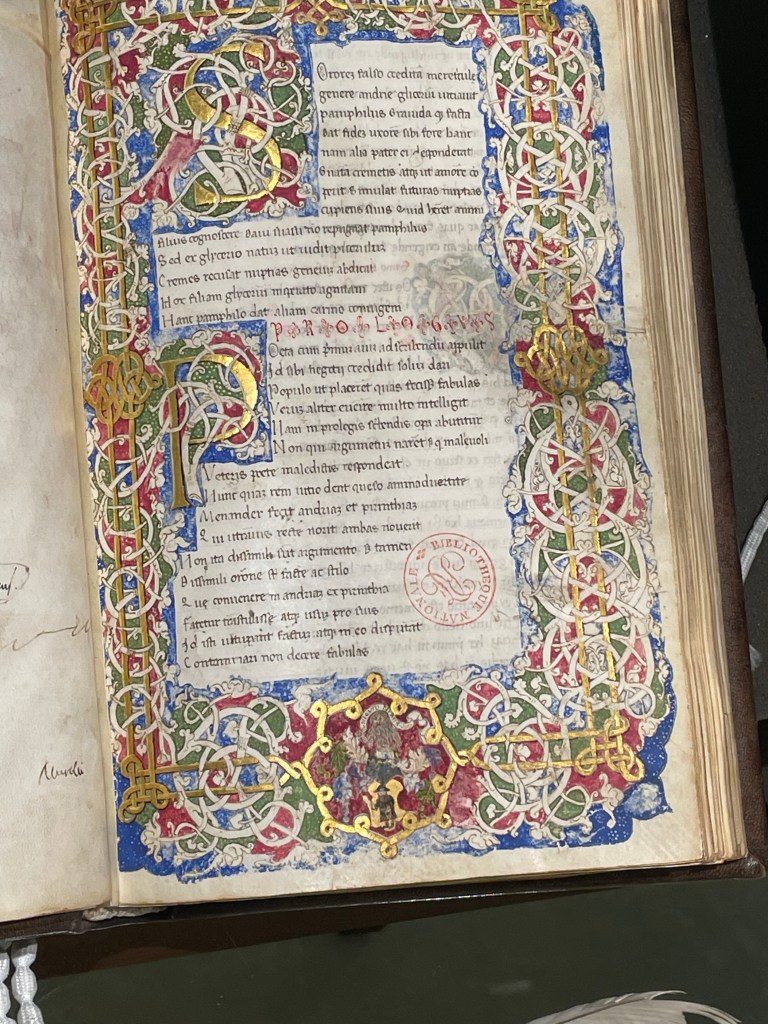
The text below was taken by Napoleon after he left post invasion, each item was stamped as owned by France. They were able to get back about 2/3rds of the collection that he took away and felt lucky to get them. They have requested another specific book from their collection, but it’s been 25 years and they haven’t heard anything yet.
With the invention of the printing press, around 1450, the library got its first incunabula (early printed books, produced between 1450 and 1500). The one below was the Divine Comedy. Illustrated with incredible detail within the wooden blocks for the press – the big print on the written page is Dante’s words, the rest is commentary. Seriously.
Today we had a day away from Verona, driving to Lago di Garda. It was wonderful! We had read a few articles that Cathy had from a friend of hers who lives in Lucca – mykindofitaly.com. He wrote 2 posts about Lago di Garda that were informative and a treat to read. So – that’s what we used to explore the lake.
We started to go into the town at the bottom of the lake, Sirmione, but as we got close, everything in the article indicated better to go up along the lake if we didn’t mind missing Roman ruins. We didn’t.
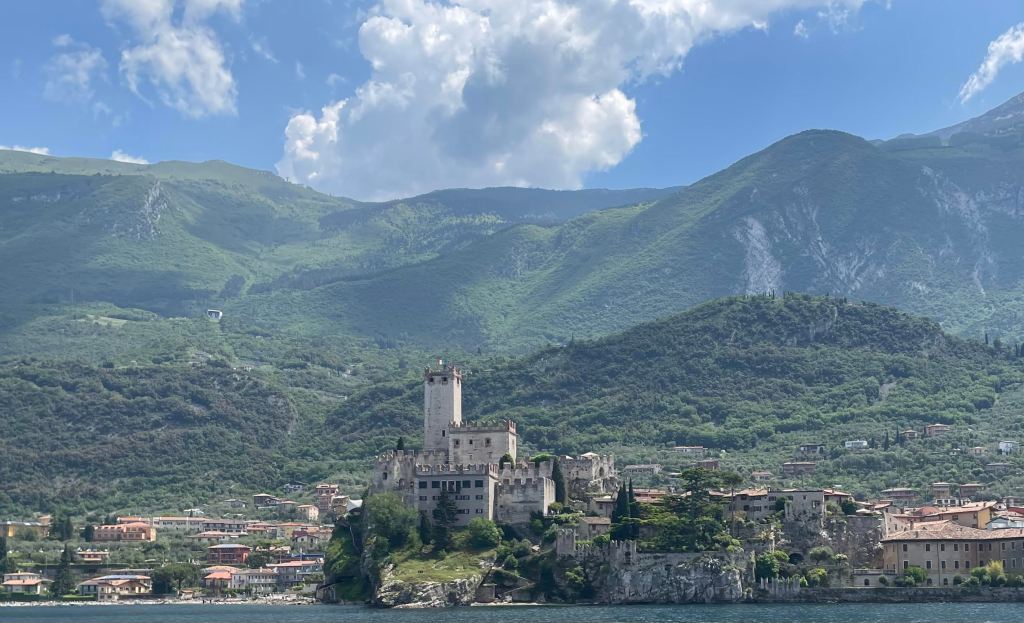
Our Sirmione detour added at least 30 min to the drive, but Leaf took it in stride, Rick made a few jokes about our planning, and we drove up a lot of the east side of the lake, finally stopping at Malcesine. It was a 2-lane road and the ride was hairy a lot of the way because there were multiple bikers, of all varieties, scooters, motorcyclists who wove between the lines, and no shoulder. Oh, and cars and trucks and people walking across the streets at all of the little towns. And it’s not even high season! You had to be calm and very alert. Leaf, of course, was both.
We knew there was a ferry at Malcesine that crossed over to Limone. We’d been in the car for more than an hour and were ready to move when we got to Malcesine. We parked, found a restroom, then bought ferry tickets at the information office (really conveniently located in the middle of town, next to parking and a grocery store). We caught a ferry just as it was loading up. And we got seats on top!
It was beautiful. Spectacularly beautiful. Bewildering because all the messages on the ferry were in German. Wait, what? And they continued – only in German. Once back on land, we heard German, most of the tourists seemed to be German (Swiss German?), written signs were in German first, then Italian – but the food was all Italian. Confusing, but interesting.
We enjoyed the ride over, cool breeze, beautiful on both sides of the lake with dramatic mountains on both sides as well. We landed in Limone and caught a quick lunch of paninis that were seriously good. Then – off and walking. This would have been a terrible day for our Eli – castles on both sides of the lake in each town, and we missed both and instead took a trail that the blog said was fantastic. And it was! Short, only 2.8 miles each way, but the walkway was built into the mountain and hung out over the lake and was quite dramatic. Happily, it was pretty wide and had a solid feel to it – no surprise views below my feet – so I was able to walk the whole thing without issue.
We strolled along, watching paragliders up high and an incredible variety of water activity below, wind surfers, parasail surfing, foils, sunfish, really colorful and fun to watch.
Hmm, guess I was watching, I don’t have photos of the actual walk hanging over the lake or the water activity!
When we got back to Limone, we were SO hot. We got lemon freeze drinks and again – caught the ferry just as it was leaving and hopped on. Our timing was lucky both ways.
We decided to drive the rest of the way up to the top of the lake, not far, and then take a more major road home, away from the lake. I was driving now and had it easy. The traffic and bikes had decreased a bit so it wasn’t quite as nerve racking negotiating the road.
We got to Riva del Gardia at the very top of the lake and suddenly, we felt like we were in a different country. Maybe Switzerland? The buildings were so different from what we’d seen in every other Italian town. It was beautiful in a very different way. We walked around town and then sat down for a snack next to the water. The town really was a pleasure to walk around. It had cooled down, the streets were wide and almost the whole town was pedestrian and bike only.
When I read a bit of history, as well as looking at the signs around town, we realized that Austria had occupied this area quite a bit. The constant push and pull between the church and the German/Austrian powers over the years had left their influence.
I drove home on the Autostrada and it was easy. I love having the road clear of all but a few entrances and exits, it feels much safer. People don’t usually go the speed limit, makes sense since it’s close to 80, but in general, it feels really safe and there are rarely crazy drivers. In addition, Rick noted that the vineyards were planted very differently – so we had interesting views on a lot of the ride home. This is one beautiful country!
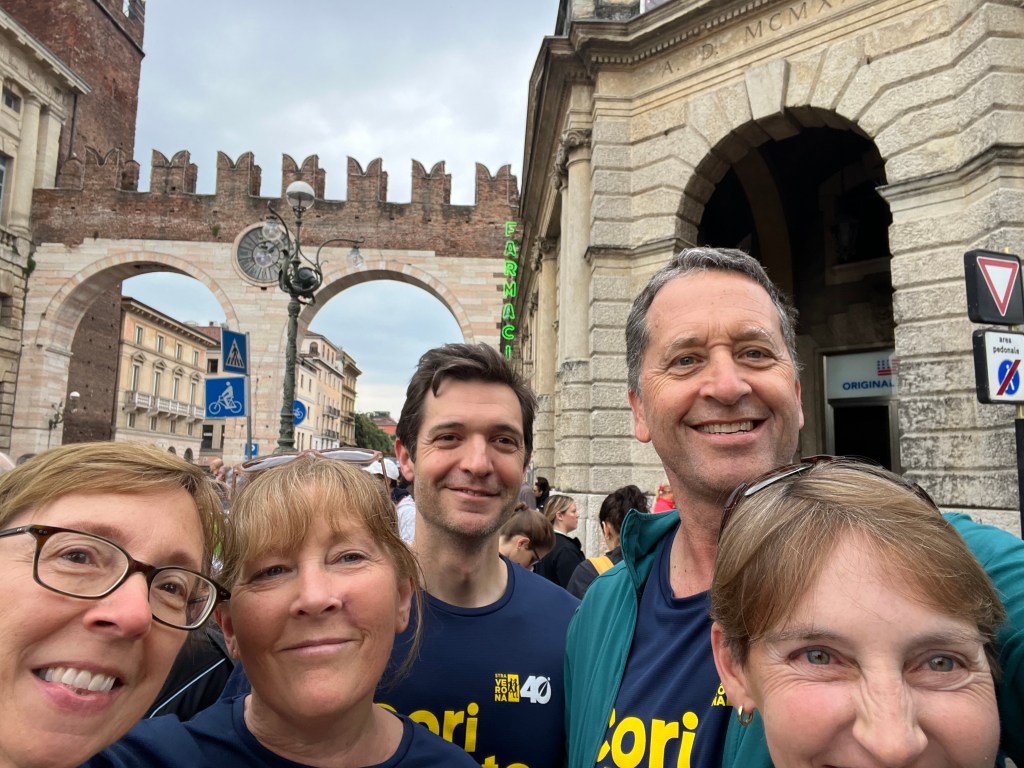
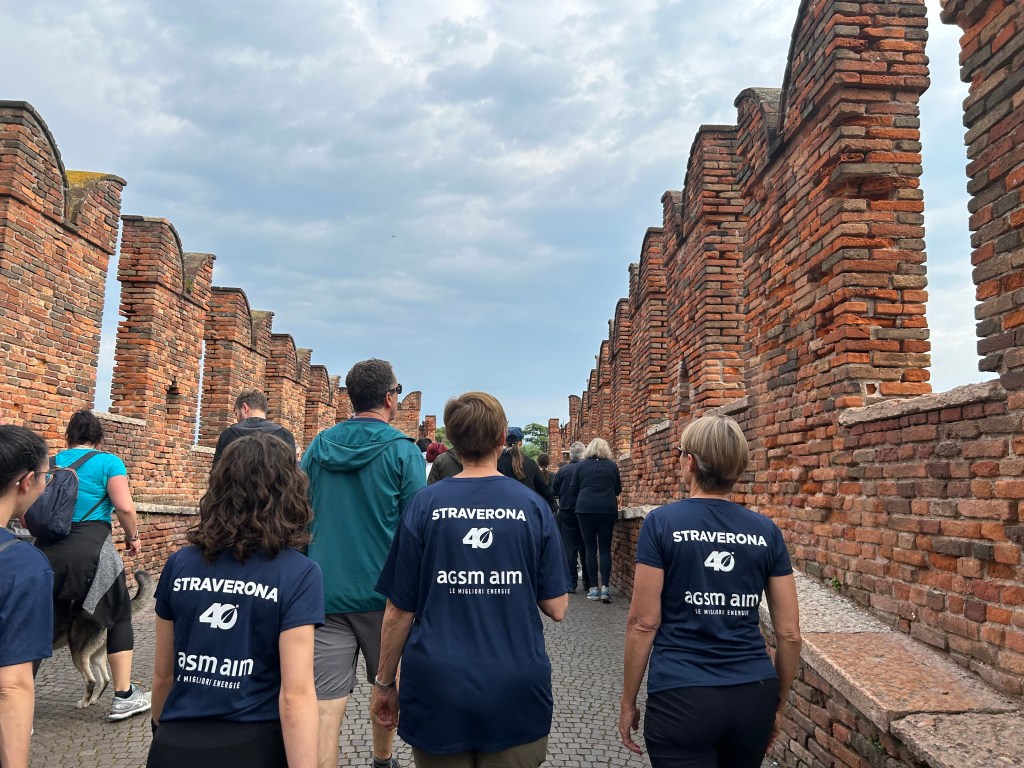
We started the day early to get out for our 5k race – slow walk for most of us. We all wore our shirts and absolutely loved the scene. Warm, dry, bit of a breeze, perfect.
We started in the “stroller, older, wheelchair” group at 8:30. Four of us walked, but pretty quickly Leaf moved into a run and then joined the 10k group and ended up running a crazy path up the hill to the overview of the city on dirt, thin cobbles, all in a big group. But he definitely got a run in!
Waiting for the start:
At the start – and selfies are just hard to get, but you can see all of us there!
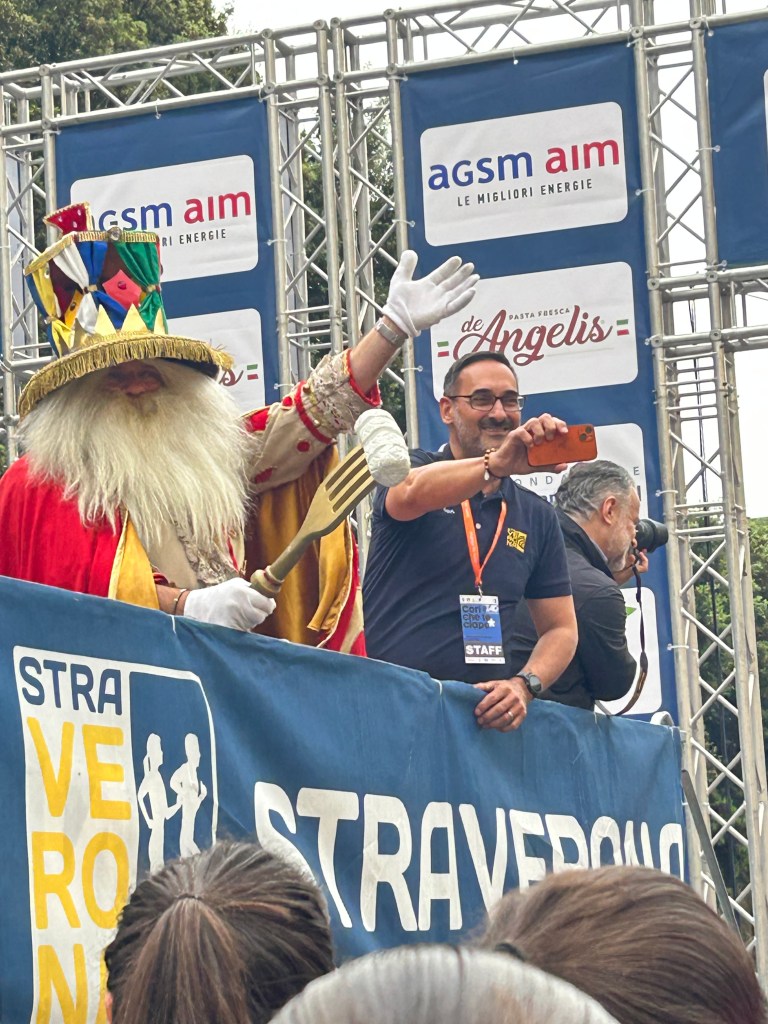
Some scenes along the way:
We never figured out what the story was of the guy with the marshmallows.
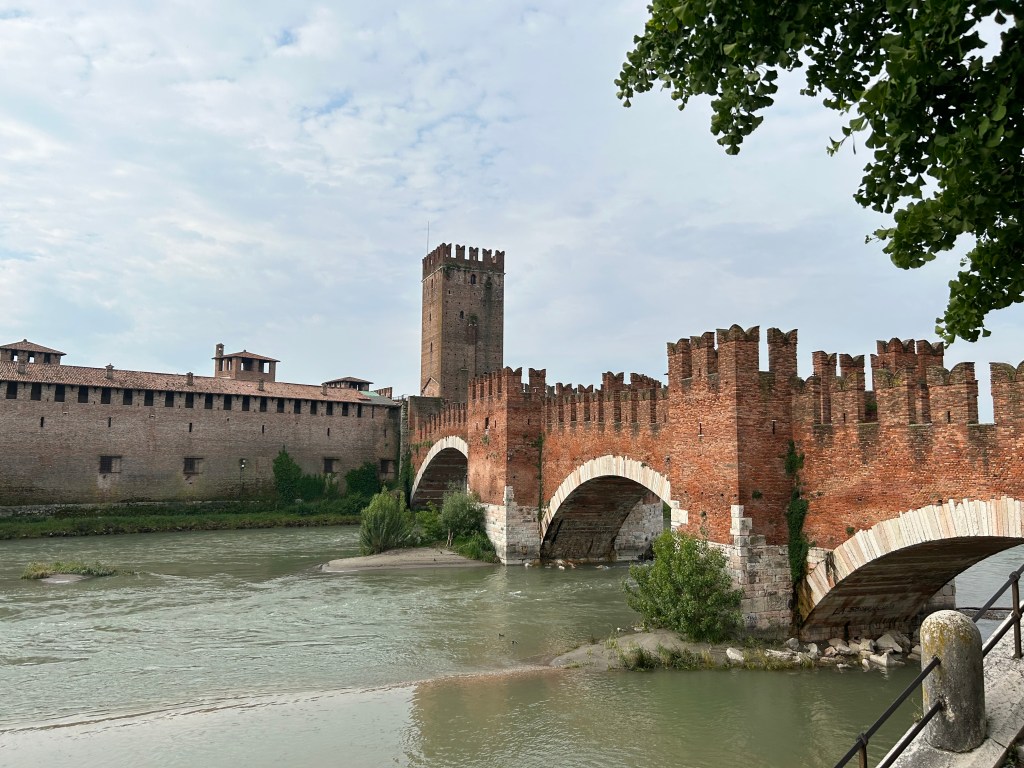
Below is the medieval bridge attached to the castle 2 blocks from our apartment.
The bridge, Ponte Di Castelvecchio, and castle were built by the Lord Canagrande In della Scala (the big dog) in the 1300’s. The divided top meant that he did not put the church first, but the opposing government. He built the fortress of Castelvecchio with an escape route to the Adige Valley, in case of a riot by one of the enemy factions within the city.
The river Adage curves all around Verona, an easily defensible barrier and the Germans bombed the bridges as they were retreating. Just as in Florence, the people of Verona dived and recovered everything they could from this particular bridge, then built two brick kilns to make replica bricks in order to fully rebuild the bridge.
We then came back to the apartment, showered, and then went right back out to meet Krystal for our walk around Verona. She was wonderful! American, so understood our questions, passionate about Verona and its people, history and architecture.
Telling us about the Roman wall seen behind us and looking down the Roman road – straight; “that’s how you know they were Roman, all the other roads twist and turn. The pavers under the wall show how they they’ve been worn by those who’ve passed during and since those times.”
Verona first had a Roman wall around the city, there are only 2 gates left, this is one of them, as well as one bridge (we ran back over this at the end of the run). Then a larger medieval wall was built around the city and most of this wall is still left. Finally a Renaissance wall was built, even bigger yet. A protected city.
Waiting while we get some water, hot day!
When Dante got kicked out of Florence for disclosing way too much about famous people in his Divine Comedy, he went to Verona and lived there for a couple of years.
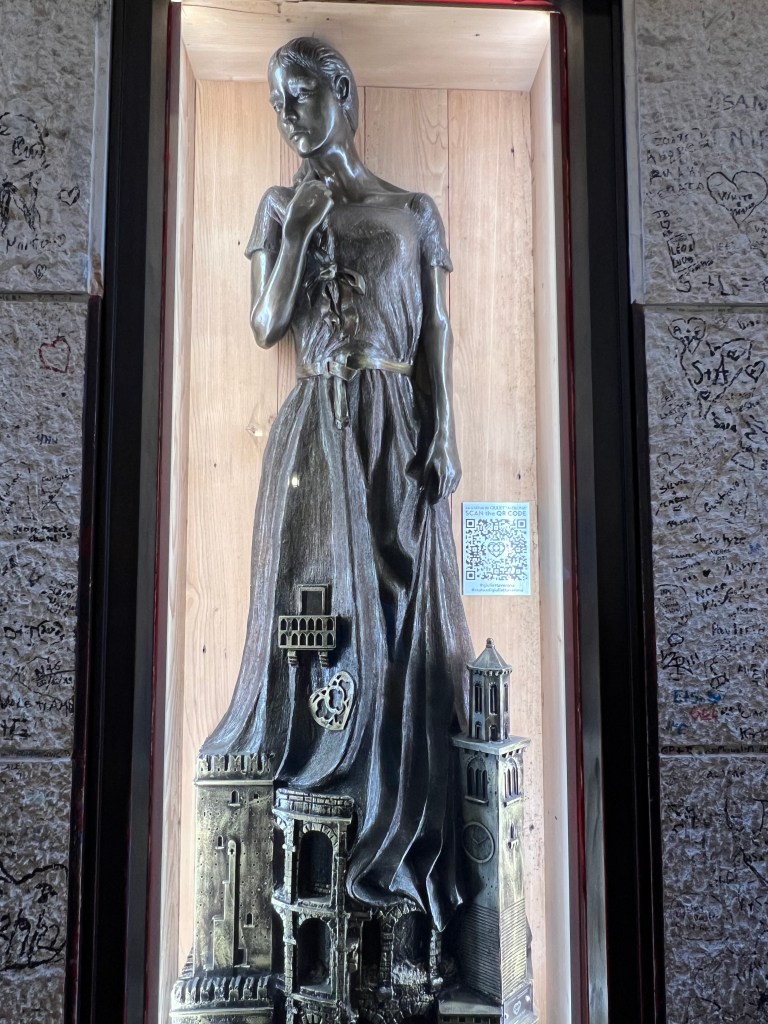
We walked by “Juliette’s” house, which was closed, but the statue below was behind glass across the street to protect it since so many people kept touching her breast to be lucky in love.
I was going to visit the Casa di Giulietta because I thought it was a medieval house museum and it kind of is, but not really, so let it go. The 4th floor balcony was made from Roman stones that had been saved for special building purposes. There’s actually a law against standing on the balcony and reciting Shakespeare. Romeo and Juliet come to mind when thinking of Verona, so here’s a summary for how the house came to be from the casadiguillietta.com.
The story of Romeo and Juliet was born from the pen of Luigi da Porto, a nobleman from Vicenza, and was published as a short story in 1531; the Veronese setting is probably inspired by Dante’s Comedy . In the XVII canto of the Paradiso the lordship of Bartolomeo della Scala is remembered, while in the VI canto of the Purgatorio the Montecchi and the Cappelletti are remembered, medieval families fighting each other. The Montecchi were really an ancient and noble Veronese family involved in the factional struggles of the thirteenth century, while the Cappellettis were a Guelph family from Cremona, believed to be Veronese at the time of da Porto.
The story of Romeo and Juliet immediately began to circulate in Verona and was reprinted and rewritten several times. In 1553 two versions were written, one in prose by the famous novelist Matteo Bandello, the other in verse by the Veronese nobleman Gherardo Boldieri; soon crosses the borders of the peninsula. Known and appreciated in France, it then reached England where, in 1596, it was staged by William Shakespeare with the title of The most Excellent and Lamentable Tragedy of Romeo and Juliet . The universal fame of Romeo and Juliet is owed to the immortal verses of William Shakespeare.
Around 1560 Gherardo Boldieri hypothesised that a sarcophagus of medieval origin preserved in the garden of the church of San Francesco al Corso (indicated by Da Porto as the burial place of Juliet) was the tomb of the young heroine: thus began the Veronese ‘myth’ of Romeo and Juliet.
In the eighteenth century, Juliet’s tomb was already visited by European travelers on the Grand Tour who began to question the existence of the Capulet house. After all, if a tomb exists, a house must have existed too: and so begins the story of Juliet’s house.
The tower house at number 23 of via Cappello has medieval origins and is attested in documents as early as 1351. It housed an inn, called del Cappello, owned by the heirs of a certain Antonio Cappello. This is also attested by the sign with the hat that can still be seen today on the keystone of the arch facing the internal courtyard.
It stayed an inn through the centuries, and at the end of the 18th century European’s began to visit it on Shakespearean tours. Hans Christian Andersen wrote about it between 1833 and 1834: “I climbed the ladder Romeo had secretly climbed, to meet love and death. There was still the grand ballroom, with the faded frescoes on the walls, the large windows reaching down to the floor, but hay and straw were scattered around (…). Here once the proudest families of Verona had danced to the sound of sweet music, here Romeo and Juliet had dreamed their brief love dream; I deeply felt the vanity of all earthly splendor.”
So – back to Rebecca here – the owners decided they should just make it Juliet’s house and created medieval frescoes, some furniture, etc that would reflect the time of Juliet and of the house’s original look.
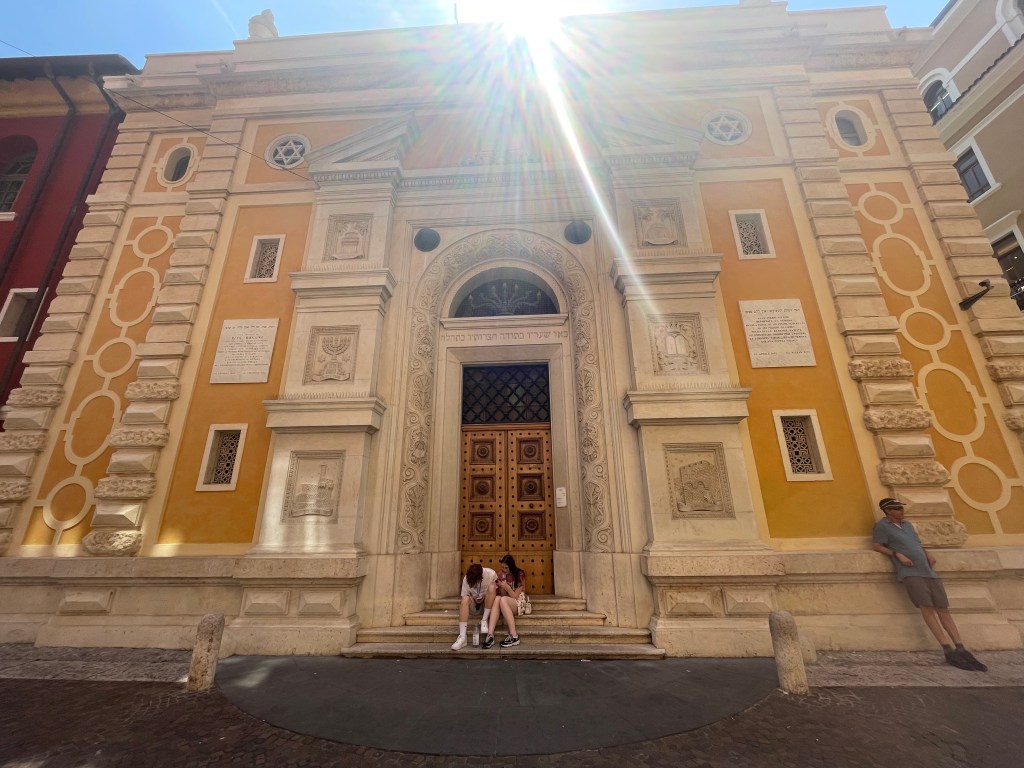
Here’s a much more significant part of Verona’s history, their one remaining synagogue. The sun is shining down as if making sure we don’t miss the building:
Verona has gone back through history and placed gold markers on each spot they could document where someone was arrested and deported – they’re throughout the city.
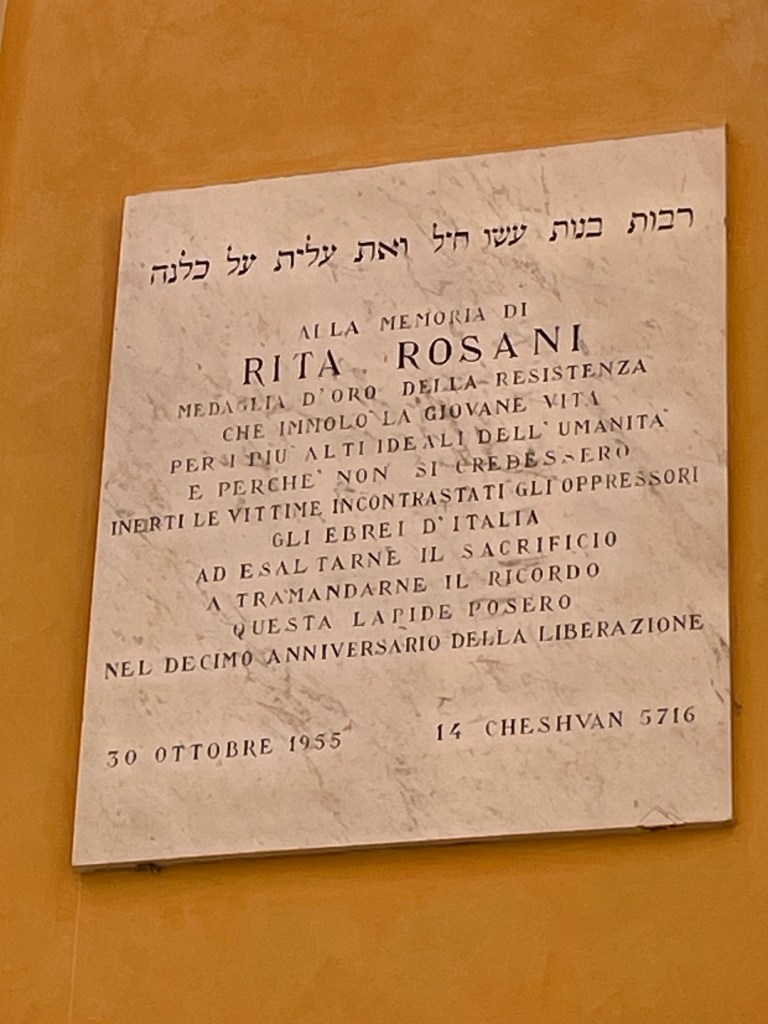
Below photo: There was also a plaque on the building that tells about Rita Rosani, a leader of a group of partisans. The plaque says: “Many women have behaved valiantly, but you surpass them all.” She was only 24 when she died, but she led a small party of partisans and gradually had gathered more until she had 15 with her when there was a final battle. The men were ready to retreat and regroup and she went out in front with a musket and was killed.
Her belated Gold Medal of Military Valor was given with this description: “Persecuted politically, she became part of a partisan armed band living the hard life of a fighter. She was companion, sister, animator of indomitable value and ardent faith. She never retreated from the certain danger and suffering of her rough existence, in order to complete the delicate and very risky missions entrusted to her. When her band was surrounded by preponderant Nazi-fascist forces, she took up arms and last to retreat, she fought strenuously until she fell bravely on the field, sacrificing her young and heroic existence to the homeland.”
I was just going back through my pictures (I’m a couple days behind) and I realized there’s a LOT more to remember from our walk with Krystal, but I’ve already forgotten it. Really have to do these posts each day. What I will say is that Verona has a lot to offer and it’s a wonderfully vibrant town.
We then met Krystal’s husband, Zeno, and their 4 year old daughter, Clara – precocious and darling. We had a long leisurely typically Italian lunch. Rick and Leaf were SO ready to get moving and here came the third course, oh, and desert… Happily, we were outside and in the shade so it was overall a treat of a lunch.
And then – reading, showering post hot day’s walk, and then later walk around town a bit because it cooled down and was perfect 🙂
Travel day! We left our tower, ready to move towards something that was a little less grand, a little warmer and perhaps even a bit newer :). We started to Verona and Cathy mentioned that she’d like to go by a bakery on the way that she’d learned about. So 15 minutes after we started our trip, we stopped for cappuccino and pastries. Seriously yum. The driver (it wasn’t me) couldn’t believe we hadn’t gotten further, but it was a fun stop.
For the first time, we were seeing a town, Castiglione del Lago, that had people in it and there were young people both at the counter and having treats as well as older folks.
And then – we started on our way to Verona. An easy drive, the directions to the apartment were perfect and Luigi met us outside the door. We unloaded our things and took turns loading into the small, but lovely, elevator with Luigi’s instructions – close these doors tightly, then close this door tightly, then push the button to the 5th floor. And it worked! And when you get out, you have to repeat and make sure everything’s closed up tightly for the next person.
The apartment is very central, though we had no idea until we walked that afternoon looking for a late lunch/dinner. The apartment must have been recently renovated, everything works and it’s now warm and not raining for a bit. What a nice change. So we have windows open, bright rooms with lots of light and we settled in quickly.
Cathy had gotten tickets (which was NOT easy) to Peter Gabriel at the Arena, a giant Roman arena that’s still used for performances. Primarily opera from June to September, but also a few big music performances. It can hold 15,000 people, it was general admission and raining off and on, so we weren’t sure how it was going to go. But what a fun idea!
Tomorrow we are scheduled to meet a friend of a friend of Cathy’s who’s lived in Verona for the last 10 years, married to a Veronian man and who does tours for friends and family. She told Cathy there would be a big race downtown so let’s meet a bit later.. Leaf looked up the race and realized it was like the Bolder Boulder, lot of people, all ages/abilities and there was a 5k, 10k and 20k option. So we all decided – sure, we’ll do that too!
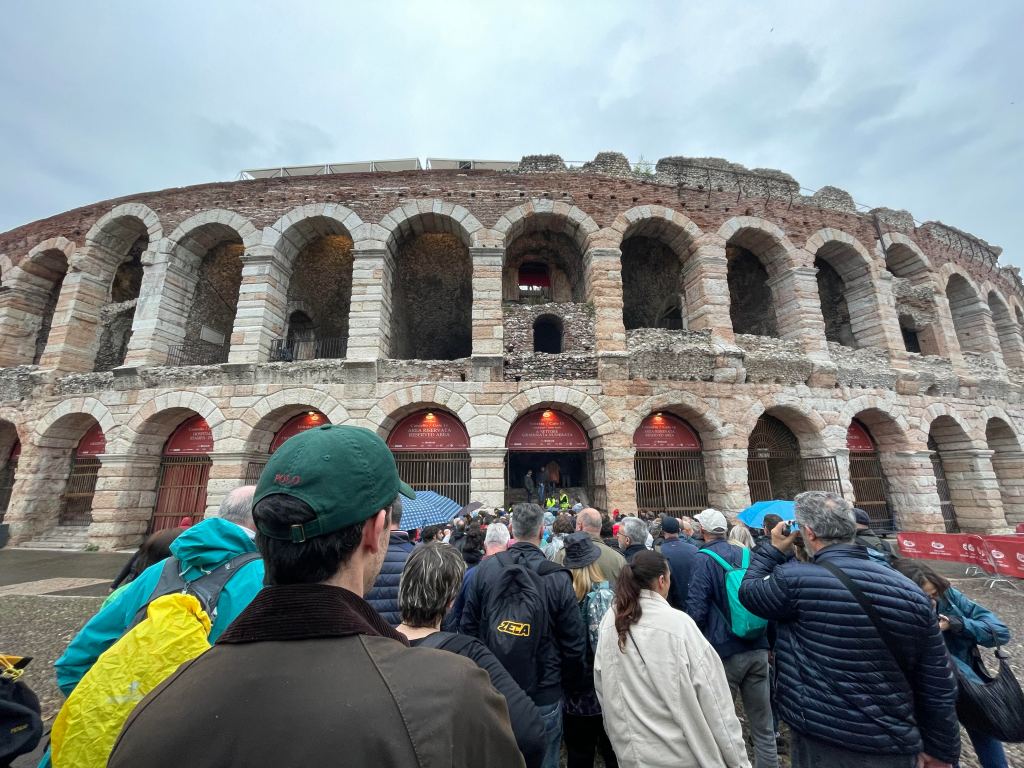
But we had to register – now. We went 4 blocks from our apartment and were at the center of things and saw the arena and absolutely throngs and lines of people. For the race registration? We finally found where to register for the race which was happening the next morning and realized all the lines we were looking at were people already lining up to get into the concert! Good grief.
Luckily, Rick had prepared in case we couldn’t get back before the concert and had extra bags to cover us if it rained, an inflatable pillow to sit on, a poncho (they were selling them for 5) and we got in line. Leaf went back to get Sharon who was getting some stuff settled at the apartment. We thought we could just tell them where we were. So didn’t work like that. It was crazy full and we were shuttled into some of the last seating. Leaf and Sharon ended up getting shuttled to the exact opposite side of the arena.
Getting into the arena:
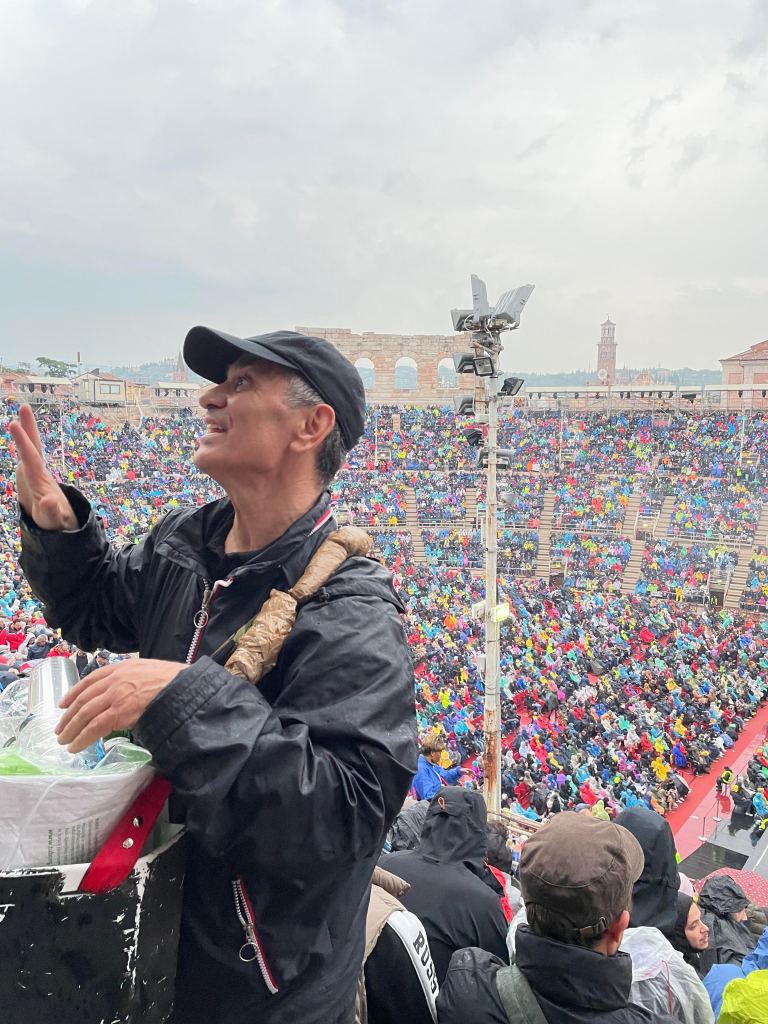
But then – so fun. Bright colors because of the ponchos, gorgeous sky, the rain stopped and we were in a Roman arena 2000 years old listening to a concert! And the audience – crazy polite. The stone steps we were sitting on were a definite hazard and they took safety seriously. Very steep, very hard, and no handholds. We only saw 2 people leave and come back, presumably going to the bathrooms. We weren’t allowed to bring in pointy umbrellas or binoculars, or any food/drinks. When they sold cans of beer, they poured them into plastic cups and kept the cans, when they sold bottles of water, they opened them and kept the tops. All safety measures.
Guy selling drinks, look at all the colors of the audience!
It was pure fun – maybe some of the songs were slow and long, but the audience loved him and we loved the scene and enjoyed a lot of the music too. A great night!
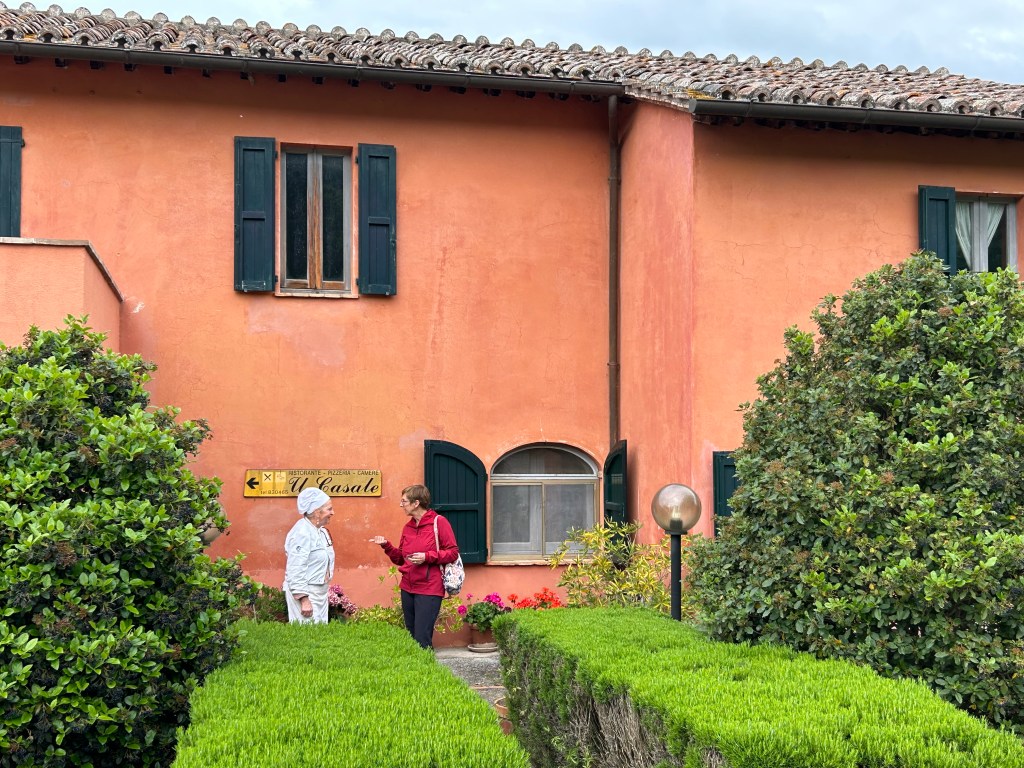
When we were at lunch at Il Casale, we had seen an arrangement of beans, lentils, pasta in bags and assumed they were for sale. After we’d had an incredible lentil dish, Cathy went to buy some and they said, no, not for sale. But the chef gave Cathy her lentil dish recipe and told her where to go to get them. “Just over there”, not far.
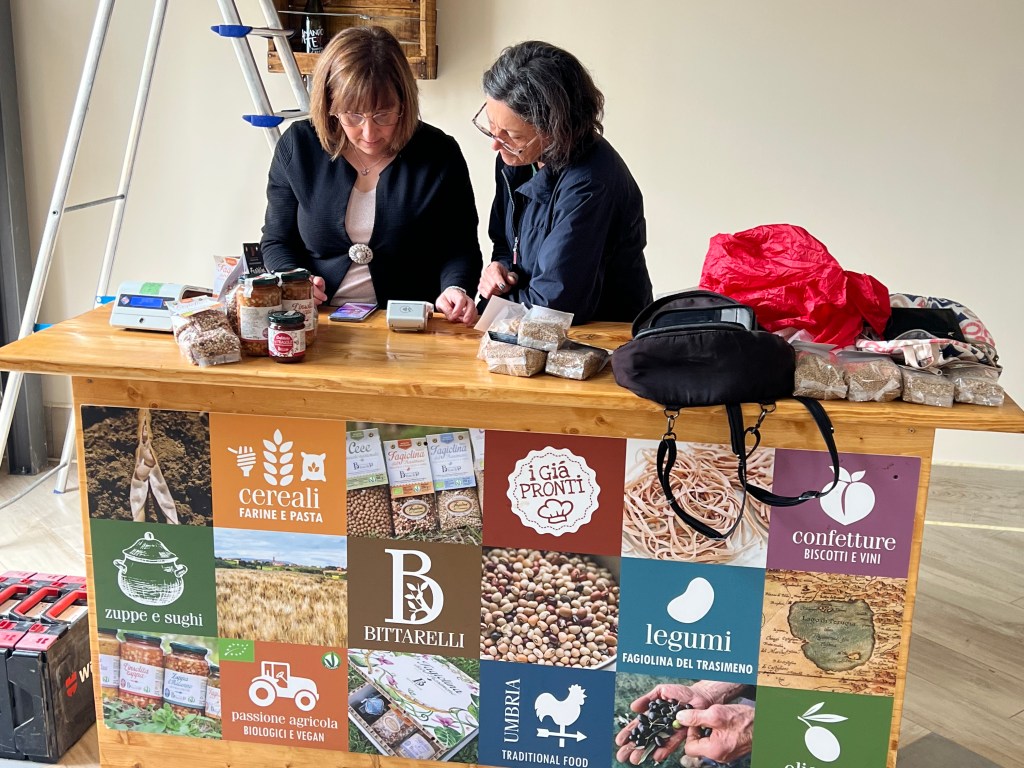
This morning, we went to buy lentils. And drove and drove. Leaf stayed home to work and the four of us went on a food adventure. We realized why she wouldn’t sell her lentils because it took a good while, but it was a fun drive. We were laughing about the distance to go for Cathy’s lentils. Then we arrived at the farm and were the first customers at a new packing plant they had just opened. They had so much! Lentils, beans, pasta, sauces, jams, and such nice people. They grow and package everything there.
We couldn’t resist and all bought a few things, even though it will load the bags down. Worth it! Using the charge machine for the first time in the building…Cathy brought her own bag to load up!
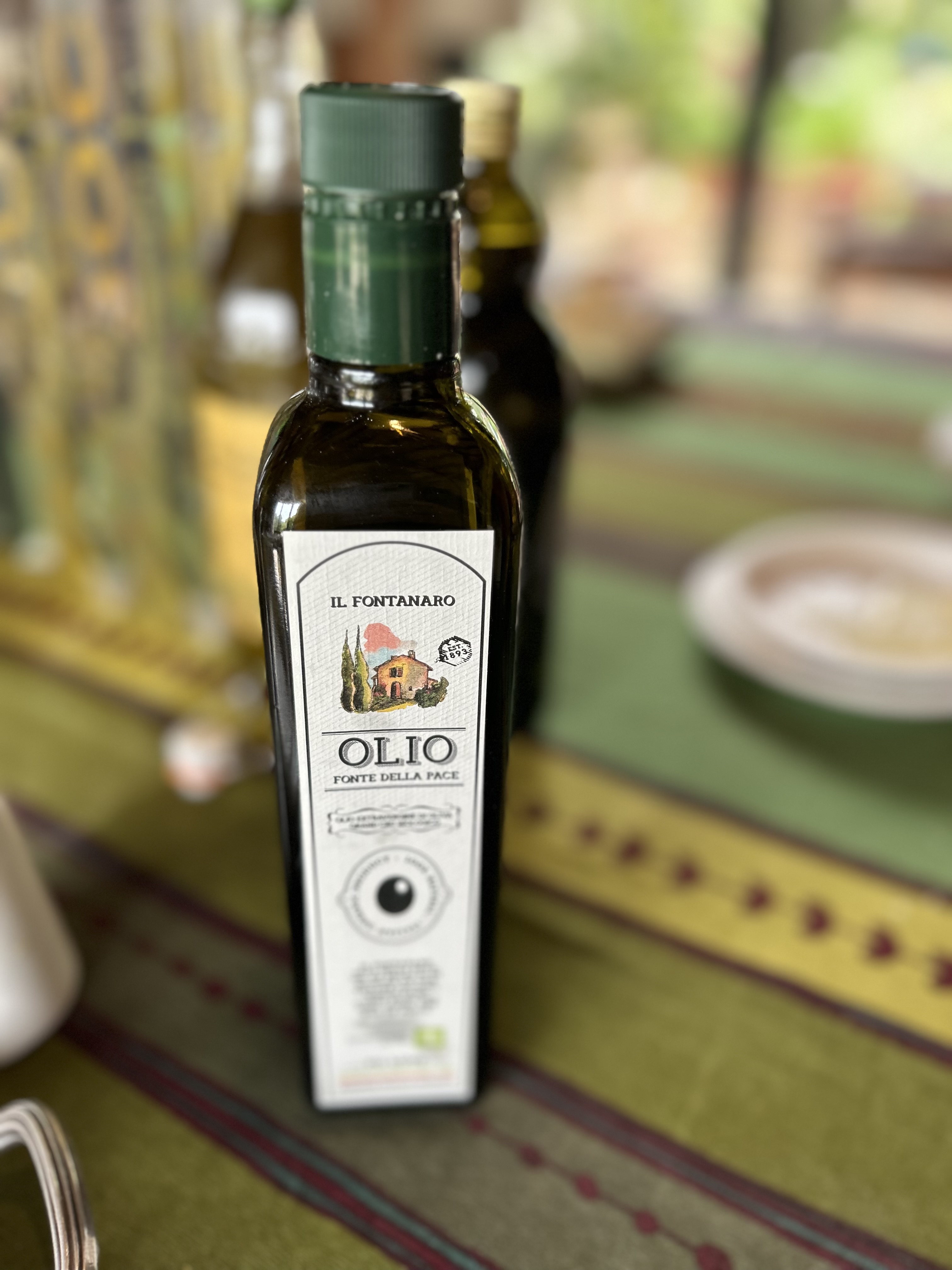
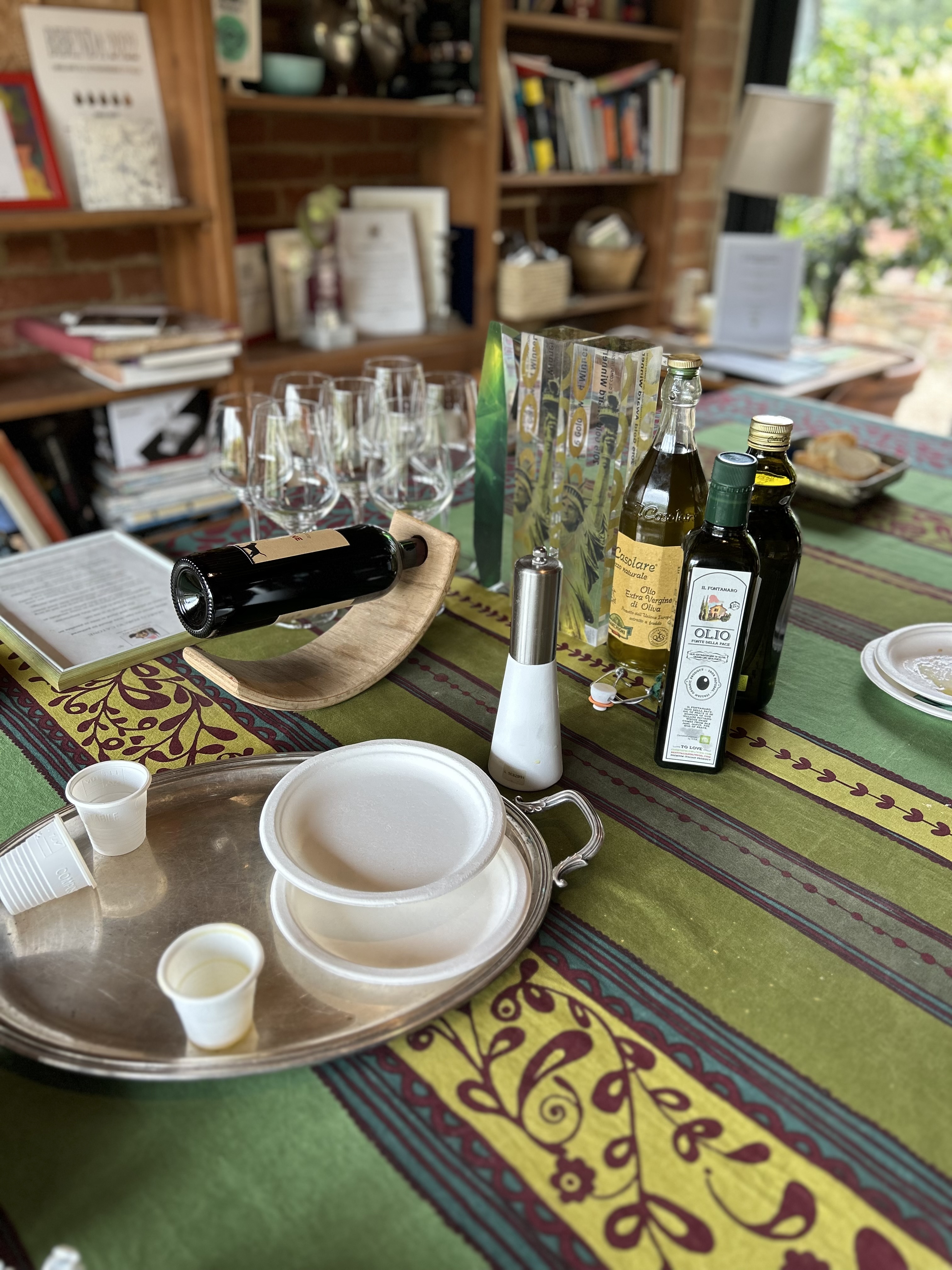
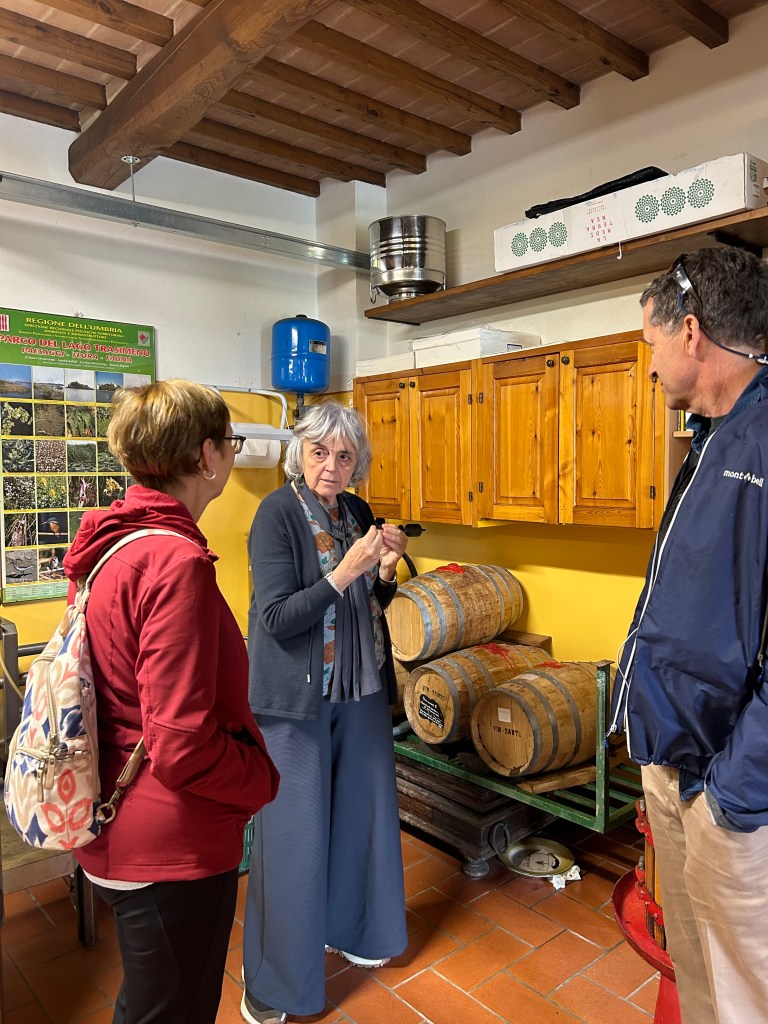
We then went to an olive oil tasting that Cathy had arranged (noting a theme here?). We were up for it, but a bit dubious about drinking sips of different olive oils just for how we’d react after. But it wasn’t like that at all. First, this small organic olive oil/wine/honey farm was amazing. We were given the talk, taste, and tour by Lucia, the owner. She was passionate about her work and product and had won top prizes every year for her oil. As she said over and over, it was quality, not quantity from 3000 trees.
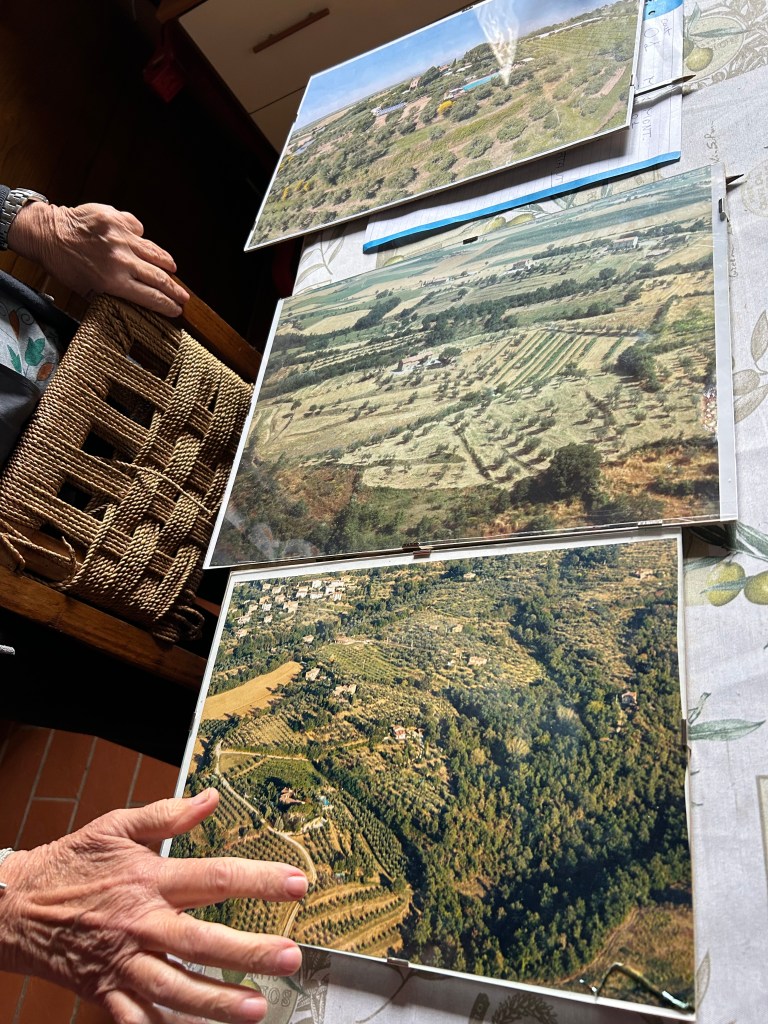
Cathy started with Italian, Lucia responded in English and stuck with that. She had a full lecture and it was interesting. She and her husband worked in Rome and financed this “dream” from a distance, going back and forth. When they started, there were a few trees, bare ground and a rough farm house. 9 of them slept upstairs in a group, 6 cows downstairs. She showed us photos of the progression of growth over the 40 years they’d been farming.
We were all appreciative, asking a few questions in the midst of the talk when the moment was right and then Cathy, who was the most appreciative and knowledgeable, asked a question. “Do you run your mill all year around?” Lucia just looked at her and said, “weren’t you listening to what I said? Didn’t you learn anything? I said, we work with the earth. There’s only one harvest time!” And more. Ach. Later, hilarity once we were out of Lucia’s hearing. Cathy, of course, knows all about oil and after we tasted the oil (delicious) was able to offer the note, “this has the perfect balance of bitter and tart (which got approval)”.
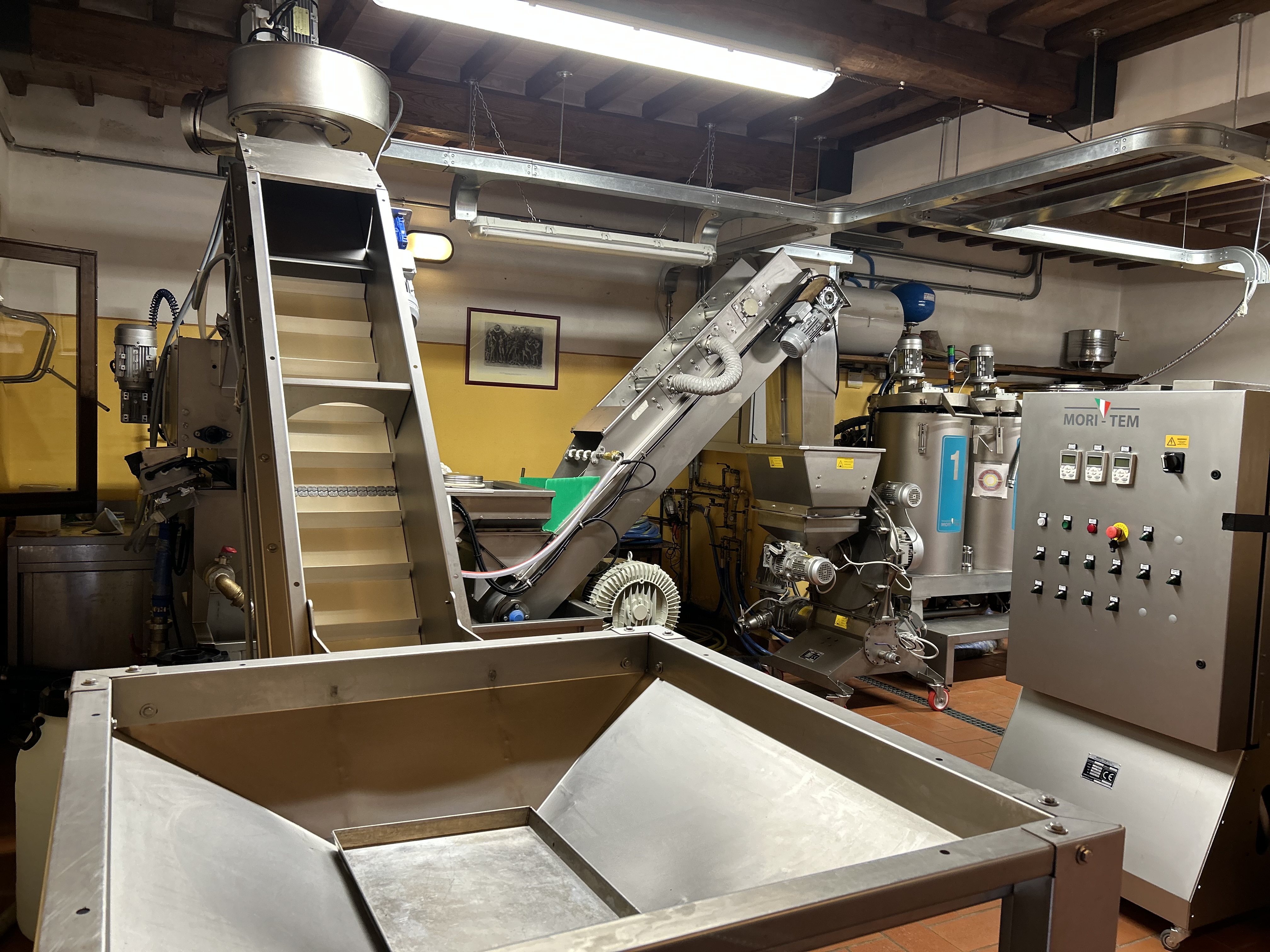
Lucia told us that she only moved up 13 years ago to live full time on the farm because she and her husband needed to keep working to finance the farm. But she also said they had 6 villas and apartments which was how they afforded running the olive oil mill. “This is a work of dreamers and passion, but it doesn’t pay for itself.” They need the income from the property rentals. She was very proud, rightly so, of their completely up to date oil processing system and it was so interesting. She’s so proud of her granddaughter and is hoping she’ll want to take over some day:) Would be great to be here in the fall and actually see everything in situ.
We bought some oil, but since we can also order online, I restrained and only bought one. Luggage is getting heavy between lentils and oil.
Series of photos from the tasting through a bit of the tour:
Explaining below how the trees roots can live for a thousand years so that even if a tree is damaged, it can recover and grown again.
Just before flowering:
These photos show the progress of the farm over 40 years, middle is the start, then above and then below is current.
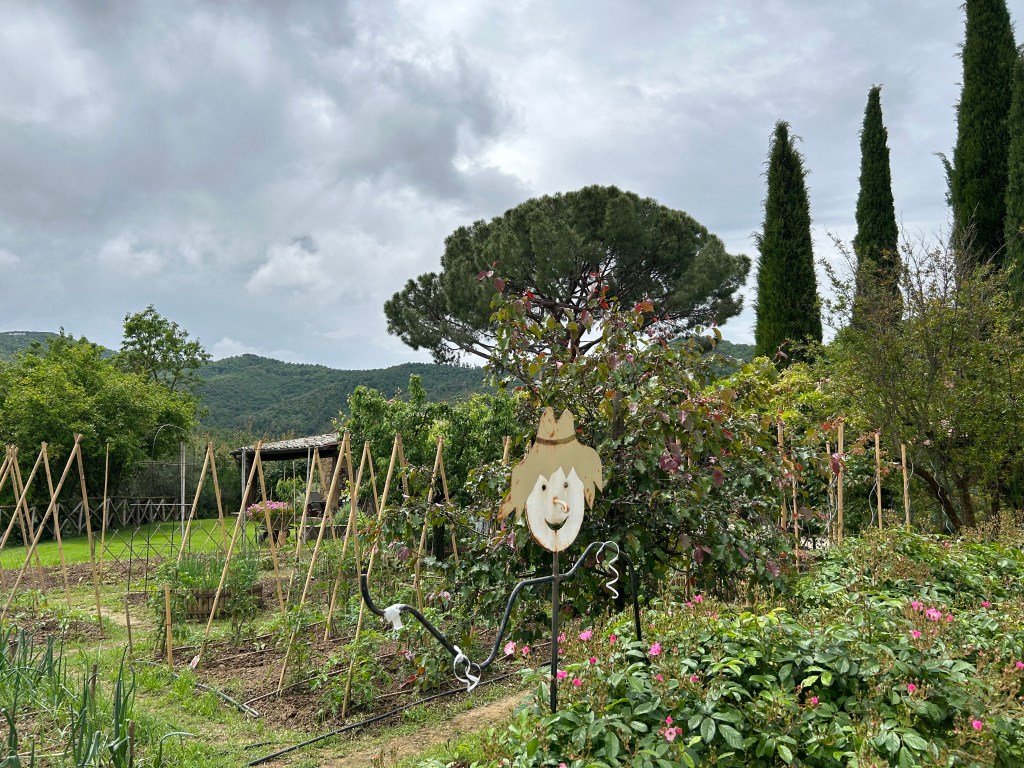
And a gorgeous garden in addition to the olive mill, winery, and honey production:
We left with thanks and goodbyes and drove back towards home really pleased with a totally different and oh so Italian morning, courtesy of Cathy’s planning.
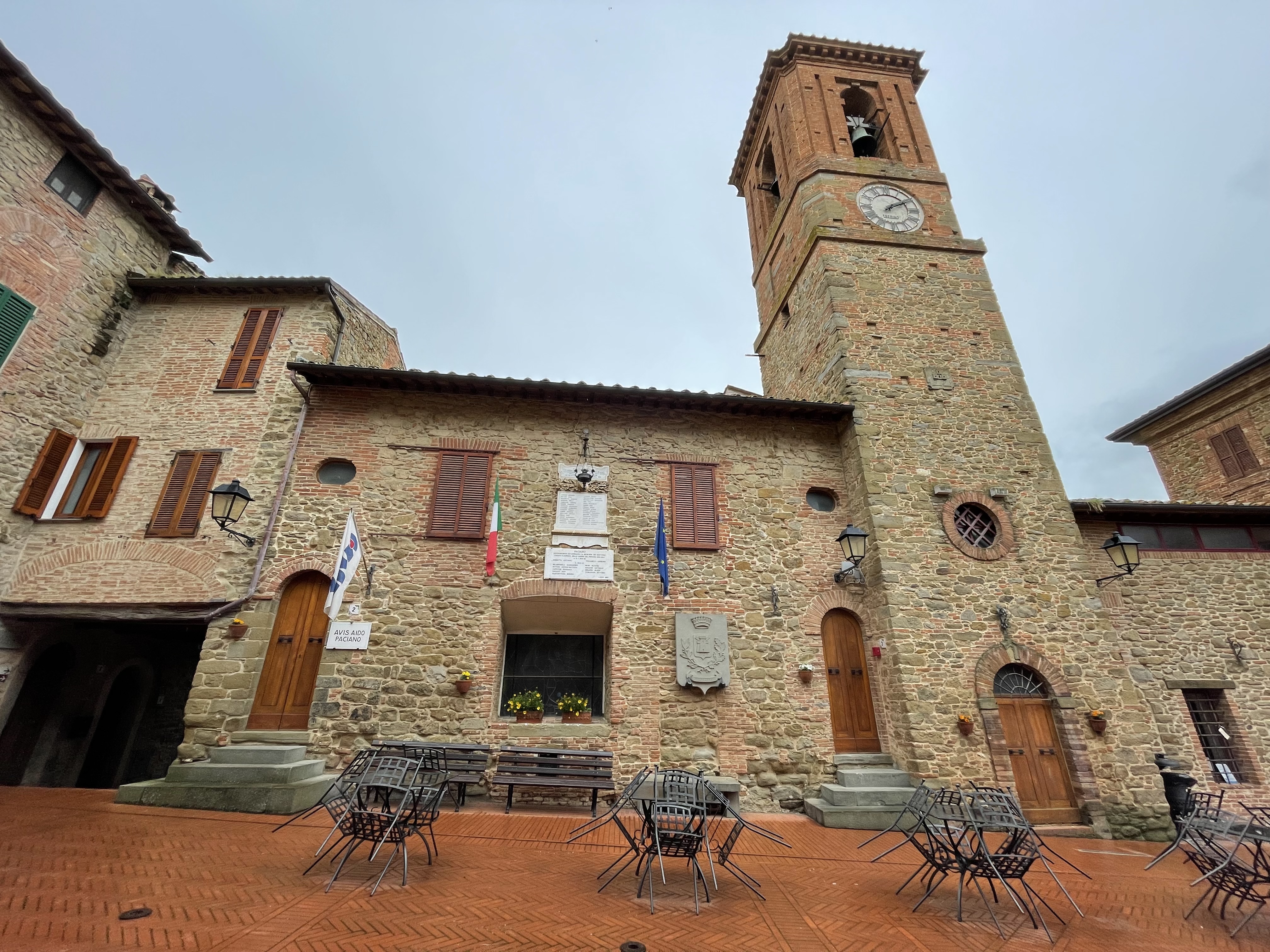
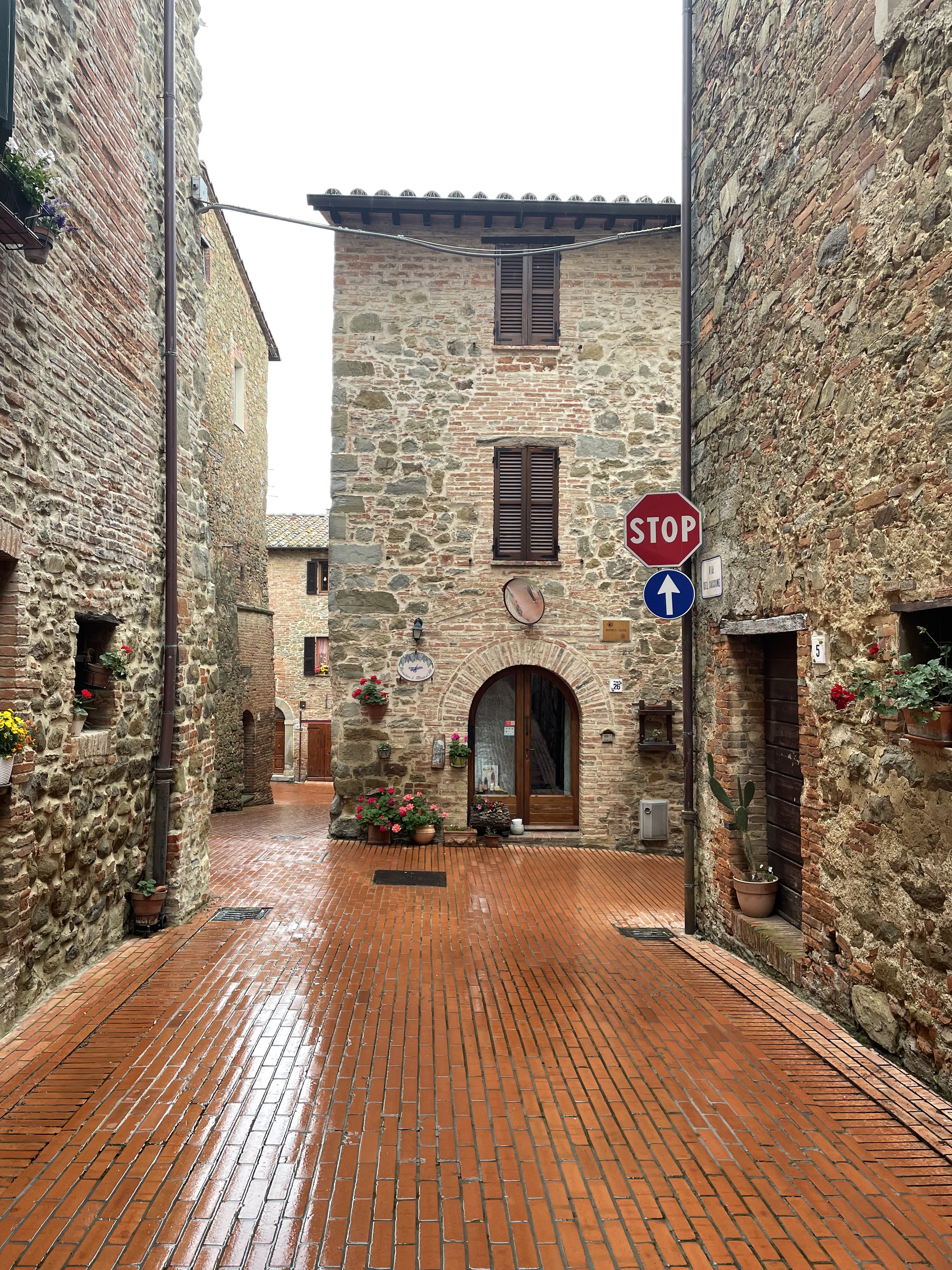
Lunch was bread, salad, and soup from the lentil farm, great. Cathy, Sharon and I then went for a walk into Paciano while Rick and Leaf took a nap. Paciano was another seemingly dead and beautiful small medieval town. Where are all the people? So bewildering.
Both Paciano and Panicale are immaculate, flowers and gardens outside of town cared for, some few signs of life with curtains, parked cars, but no people. Rick and Leaf staggered their walks, but both ended up hiking up and over the mountain behind us and said it was gorgeous, wonderful views. I was ok not doing any bushwhacking to get the views and after our walk, just read and had some down time.
That night we went for dinner in Paciano, and there were some people – the restaurant filled up while we were there. Good dinner, few new flavors, Sharon got a great pizza and we were in and out in an hour. Cathy said we probably broke a timing record for the restaurant. We then drove over to Panicale so Sharon could see it and I really wanted to see if any people had emerged post “pausa” the Italian word for siesta. Nope. Still beautiful, a few tourists in the restaurants on the plaza (maybe 7?) and very very few windows lit up.
We walked up the road outside of Panicale to see the view both Rick and Leaf had talked about – they were right, expansive and wonderful at night. Seriously steep road and aesthetically and wonderfully paved and a car drove up it while we were up there! Would not want to do that drive in the rain.
Two views from the ridge line
The next morning when we talked with Katia, checking out of the tower, she said it’s so sad. She lives outside of Panicale, and is the youngest person in town at 50. There are 16 seniors who live in town and she does grocery runs for them and helps out. She said Americans, Bulgarians (?), and Colombians have bought buildings, hotel, apartments and then just leave them empty, staying a week or two. So sad. And there’s nothing for her kids to do once school is over, so everyone leaves. But it is beautiful, so she’s hoping maybe something will shift.
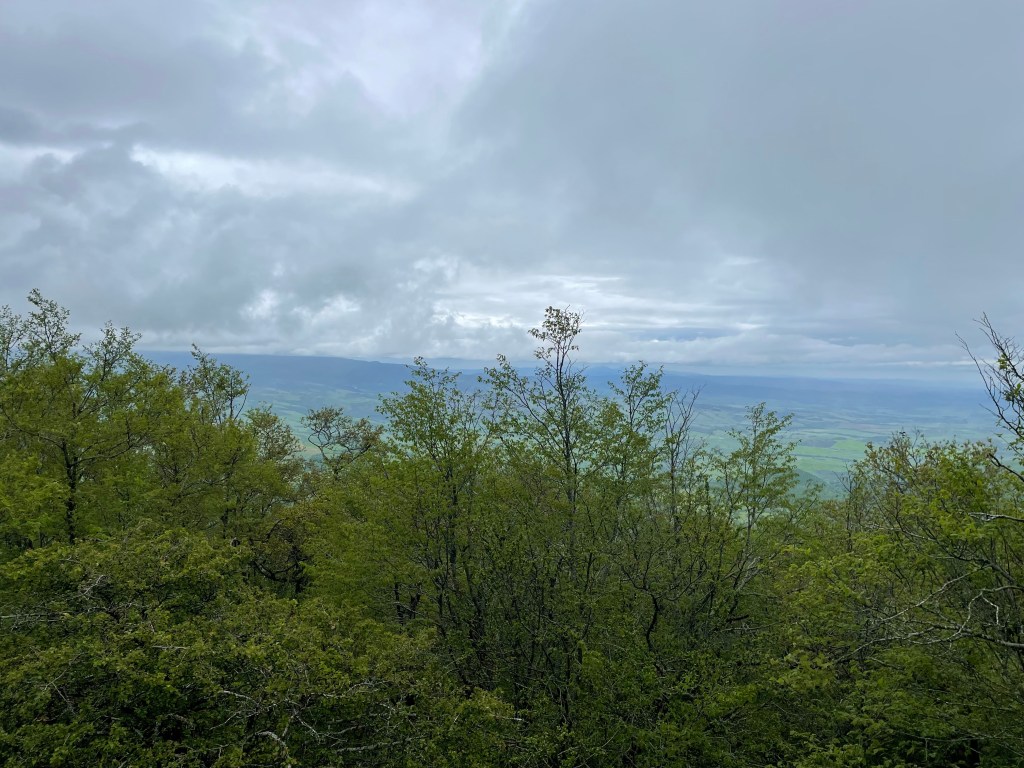
Today was a different day. We decided to do a hike, crossing back into Tuscany and doing the Monte Cetona hike, 6 miles round trip. It was beautiful and the rain held off all day. Amazing. Granted, when we reached the top, the clouds had socked in and blocked the view, but they lightened before we left.
Leaf tried to go 4 wheeling again up the mountain, but All Trails got us back on track and we found our way to the trail head. We actually could have driven a lot of it since the hike was on a rough dirt road, but we were all ready for some exercise.
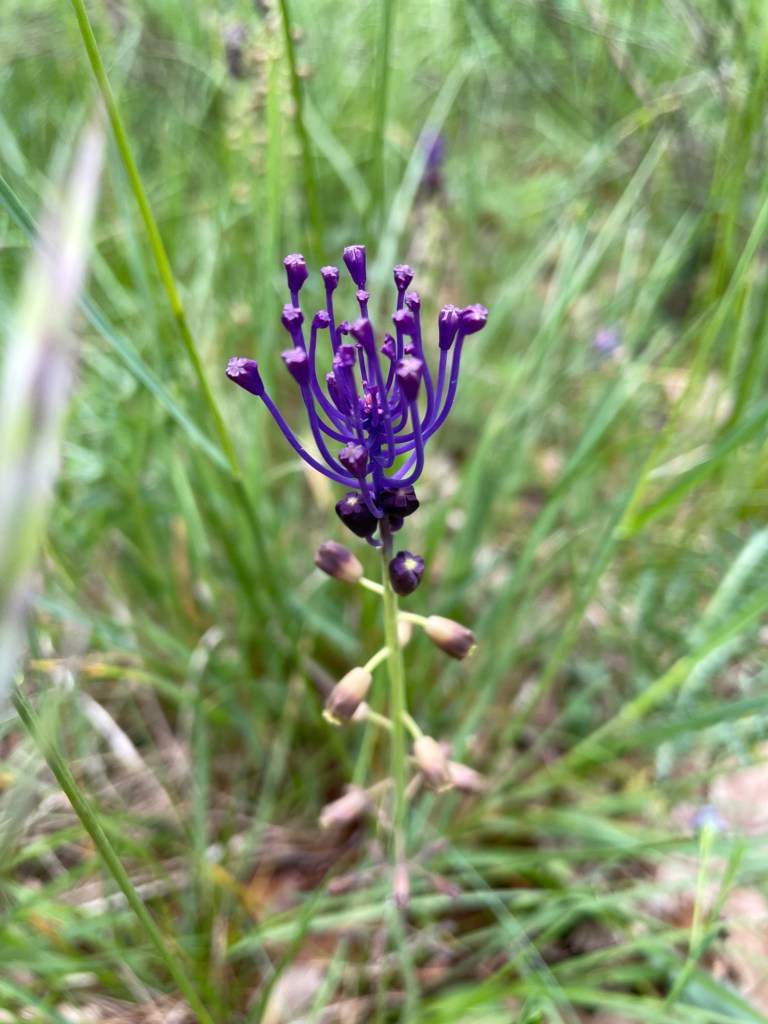
It was basically up all the way through a forest of trees with some cool flowers and birds singing away, the first one we identified was a cuckoo. Fun!
We came to a stone monument and a metal cross. There was a series of 14 crosses on the way up to a giant cross at the top, an amazing feat of determination to put that cross up on the top of the mountain.
Cathy did her best to decipher the stone plaque, but bit confusing. It seemed a team effort between different regions. Later found a description in Wikipedia:
On the mountain top stands a high metallic summit cross, built in 1967. It was realised to replace smaller crosses settled there after WWII. The realization of the project was promoted in 1965 by the parishes of Diocese of Chiusi, after the return of the local bishop from Rome where he took part in the Second Vatican Council. It was officially inaugurated on October the 1st of the same year by Brunetto Bucciarelli-Ducci.The lighting system was turned on for the first time June 29, 1968 at 9 o’clock in the evening, via radio control, by Pope Paul IV. The cross is 10 metres wide, 15 metres high and its weight is 6.200 tons.
Honestly, it seems like there must be more of a story about this cross because the effort to get the pieces up there and to construct it would have been huge, but haven’t found any more. But the views – wonderful.
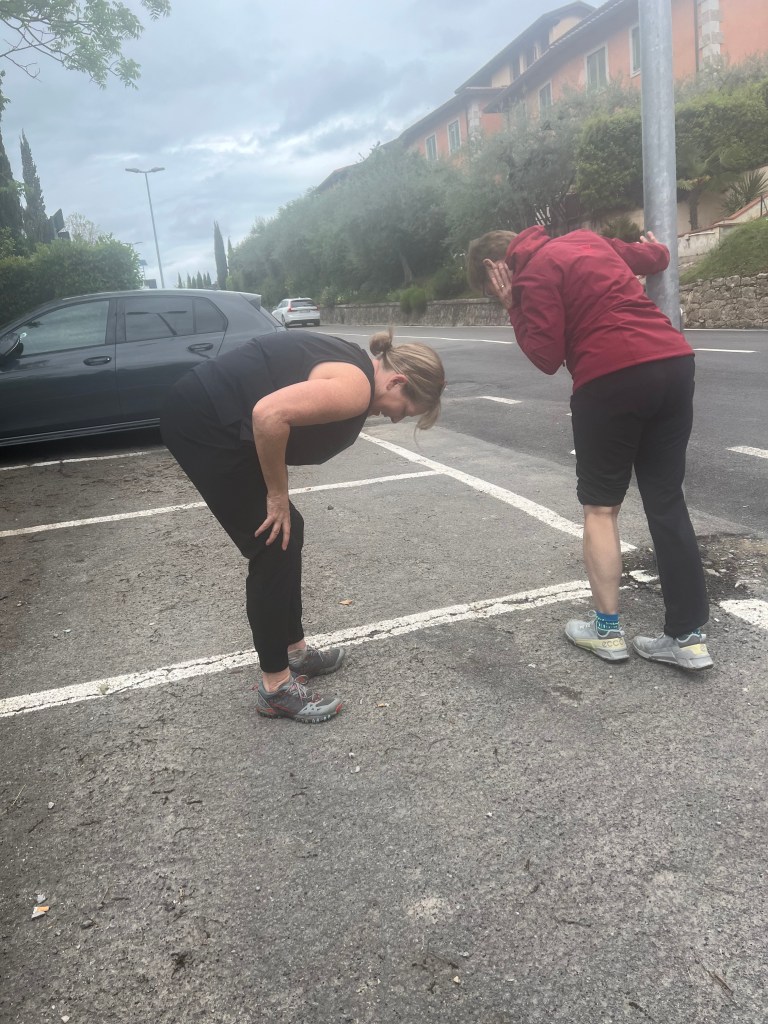
We hiked back down and then at the car Leaf started finding ticks – we’d already said we needed to check for them. Unfortunately for him, but happily for us, he was the chosen one. It was my turn to drive, so I drove, and we laughed at the ongoing drama of the back seat as he found 1, 2, and when he found 3, I quickly pulled into a parking spot. We all jumped out and started rechecking our pants and legs.
We got back in a then Leaf found numbers 3, 4, maybe 8 tiny ticks by the end. Sharon and Cathy were squeezing to get away from him. Per usual, he was a good sport about it, but he started laundry as soon as we got home and we all contributed everything we were wearing for the day.
Before we got home, though, we went looking for lunch. The timing is tricky here, couldn’t shower first because everything would close down before we got back out. We used the recommendations that Katia, who’d welcomed us to the house, had given us. We had the most incredible meal. Well into the country, nothing else close, unassuming house – and yet, that was the restaurant.
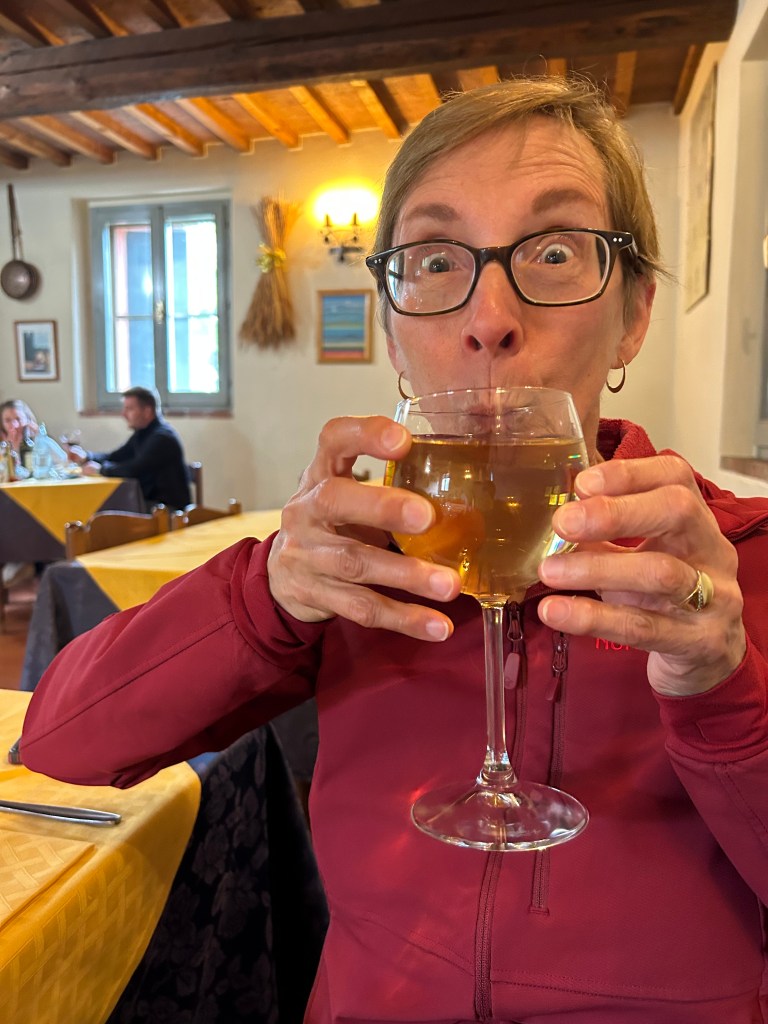
We had a HUGE lunch and relished every bite. Many different flavors and we tried a lot of different dishes. Cathy was given a very large glass of wine that she felt terrible about because she rarely finishes a glass, and certainly not one this size. But it was ok because the owners loved chatting with her.
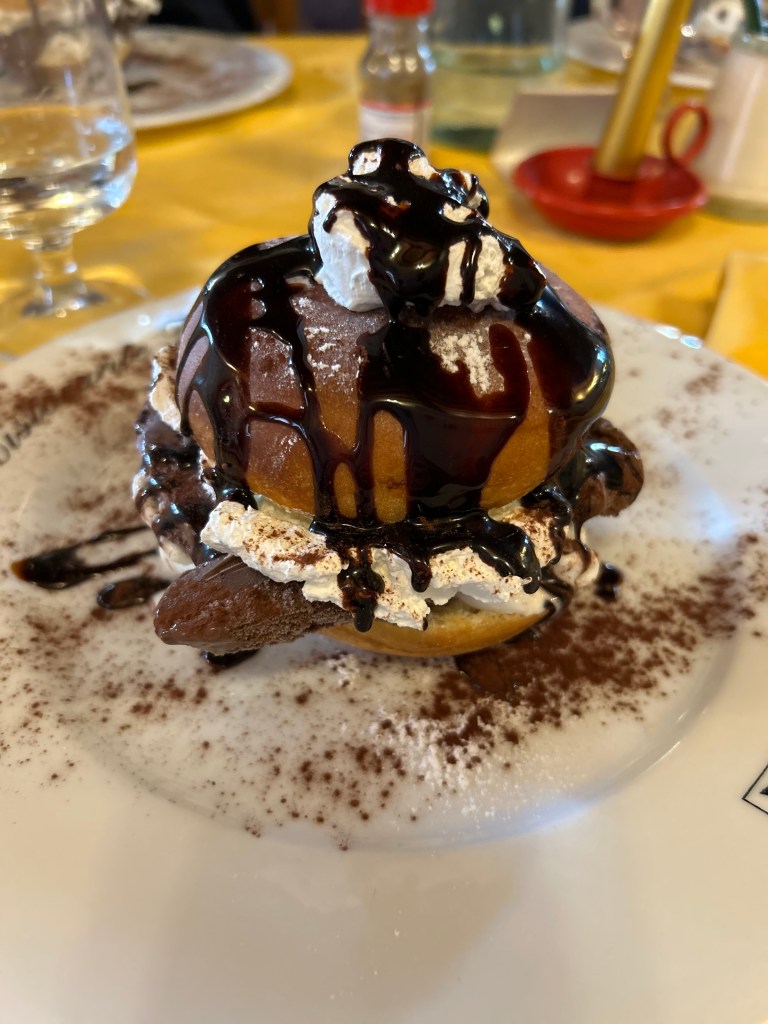
The owner took pride in telling us that his partner had earned multiple awards for her cooking and so she should have. It was a simple kitchen and she put out really interesting diverse foods. Here’s a photo of a desert we couldn’t resist, Rick and I each had one to ourselves, though neither of us could actually finish it. But boy was it delicious trying!
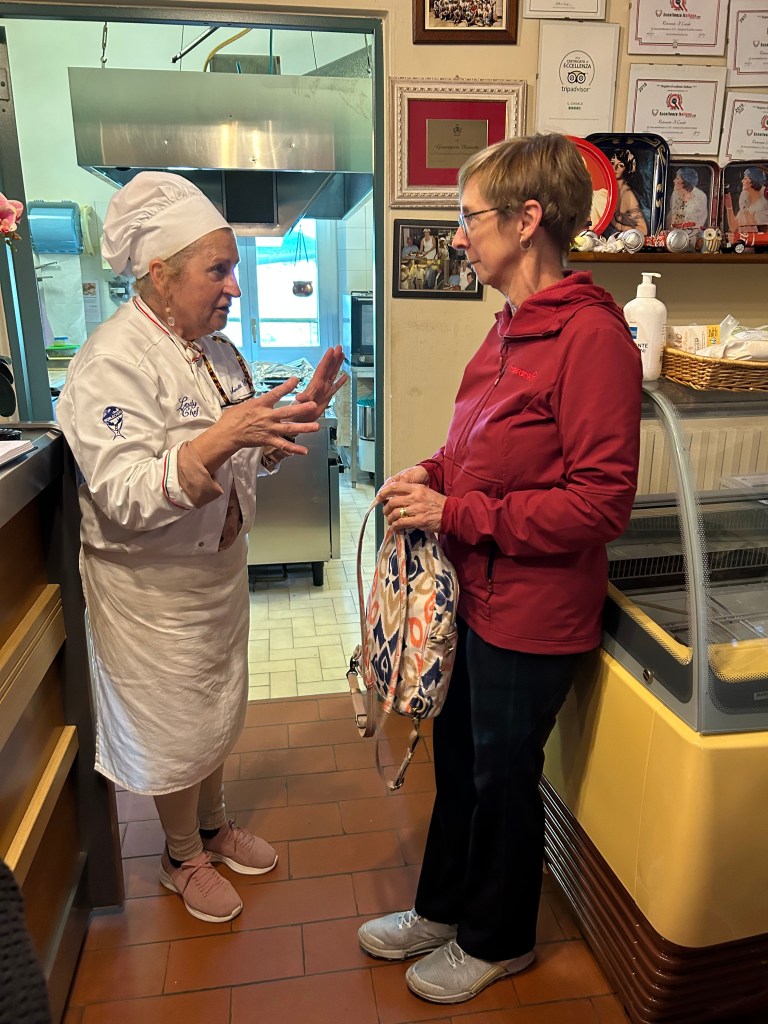
Before we left, Cathy had gotten a recipe from the chef and directions for where to go to buy these delicious lentils that we all loved.
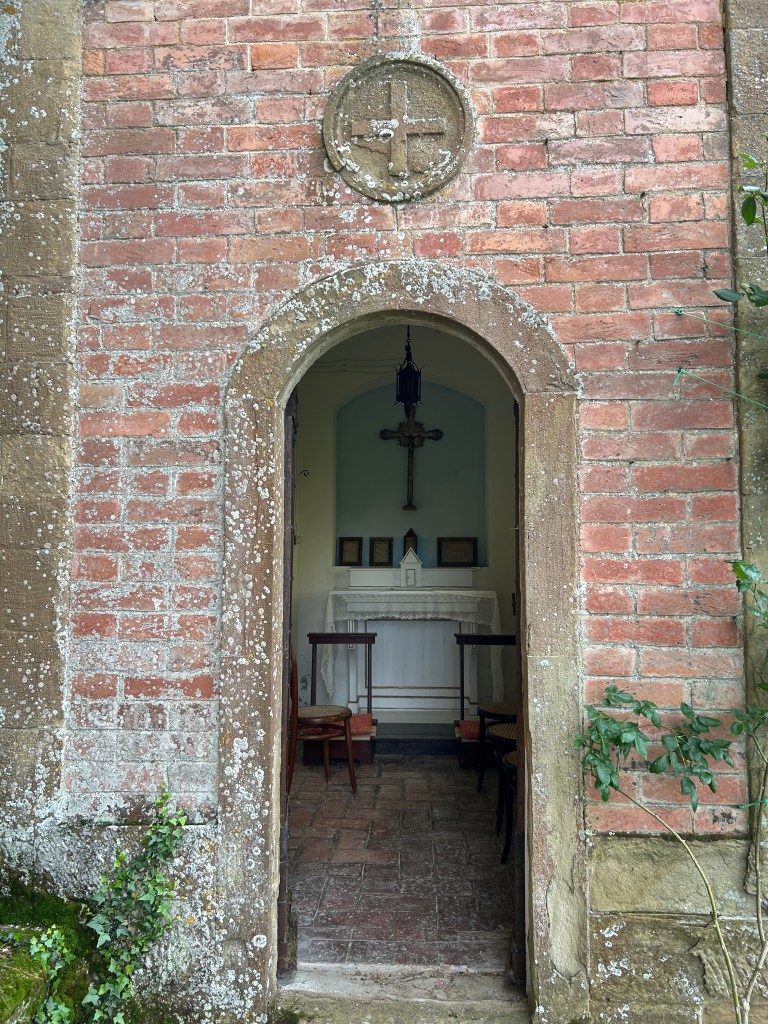
Then home, showers, laundry and reading/writing. In the early evening, the caretaker came and opened the chapel so that we could see it. Very small and sweet and actually cool to see what a place like this might have had for a family chapel.
We had another incredible salad for dinner, but I could only eat a little and Rick had to forgo even the thought of it.
I loved today! Every day has been wonderful, but today was especially so because we spent the day in Assisi, home of St. Francis and Poor Clare – or St. Clare – Chiara in Italian. First, we drove to Perugia to get me signed on as a driver, but then very happily, Leaf kept driving. Because our first excitement of the day was confusion around GPS directions and finding parking near where we wanted to start our Rick Steves audio tour. Leaf drove, but he had a LOT of help from the peanut gallery who weren’t driving.
Leaf ended up winding through Perugia tracking and retracking to get us back on the way and then driving all through the medieval town of Assisi. We were scraping by walls and tourists alike with mere inches to spare with Sharon hyperventilating with the precariousnesses of the hills and driving. All of us were laughing so hard that by the time we parked, my sides hurt in ways I haven’t experienced in years. Leaf earned serious kudos from all of us. And parked right in the old city instead of one of the big parking lots. I didn’t get any photos because it was very hard to capture the situation, plus, like Sharon, there were times that both eyes and ears were covered. At one point, we circled the plaza in front of St. Claire’s cathedral which was NOT a driving area. Cathy was looking for any cameras that might capture the moment and trigger a ticket. We’ll all share the cost… Here’s a photo of Sharon beaming in pride at Leaf and Leaf recovering from the drama:
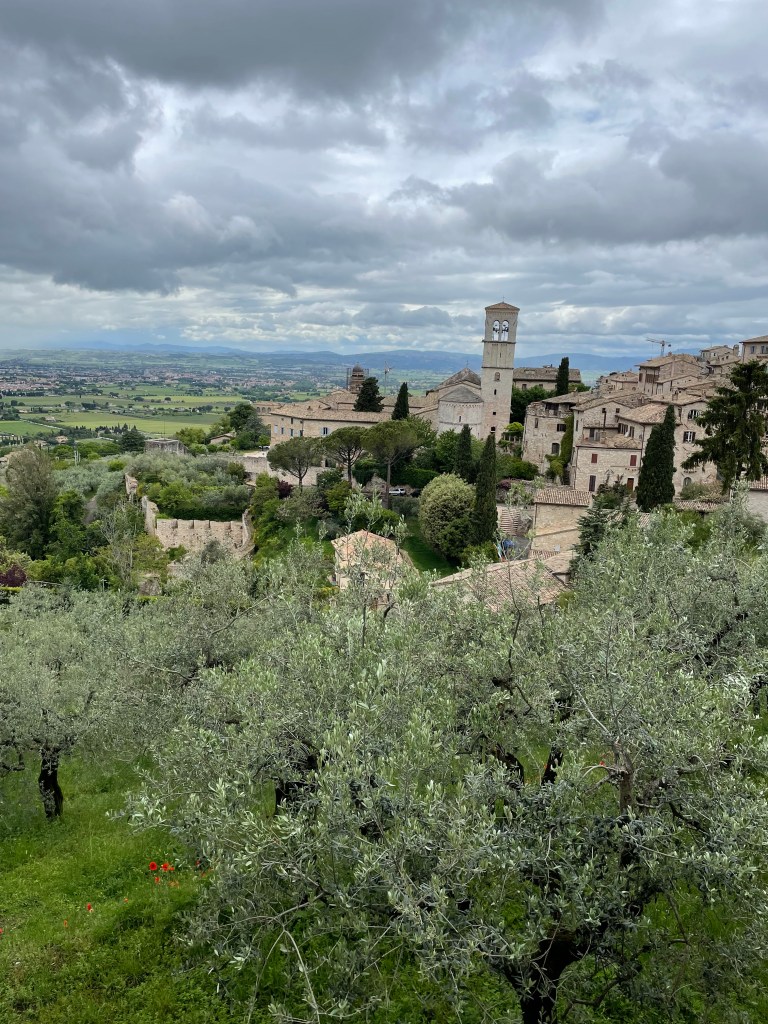
But back to Assisi. I think the reason that this cathedral and the stories had such an immediacy was because both Francis and Clare were born and died in Assisi and had a huge impact on their communities and far beyond. They were so revered in their work and commitment to Jesus that Francis was made a saint 2 days after he died and the Basilica was started the day after that. So when they say they have relics and robes – they really do.
St. Francis was born 1181/82 and died October 3, 1226, aged 44. Clare was born 16 July 1194 and died on August 11, 1253, aged 59. She was canonized on September 26, 1255, by Pope Alexander IV, also unusually quick. So both the town and the churches reflected a man and a woman who felt very present and real.
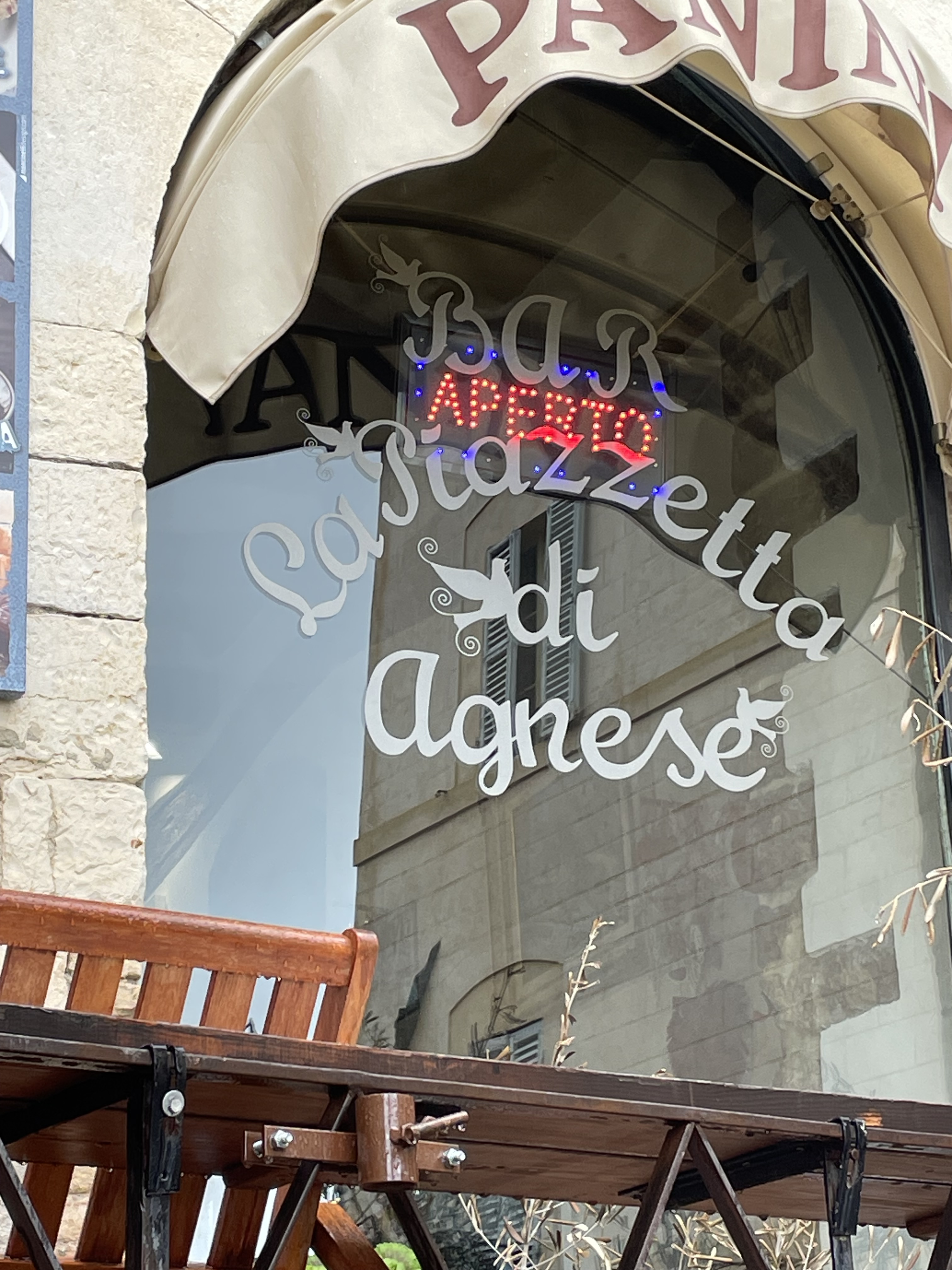
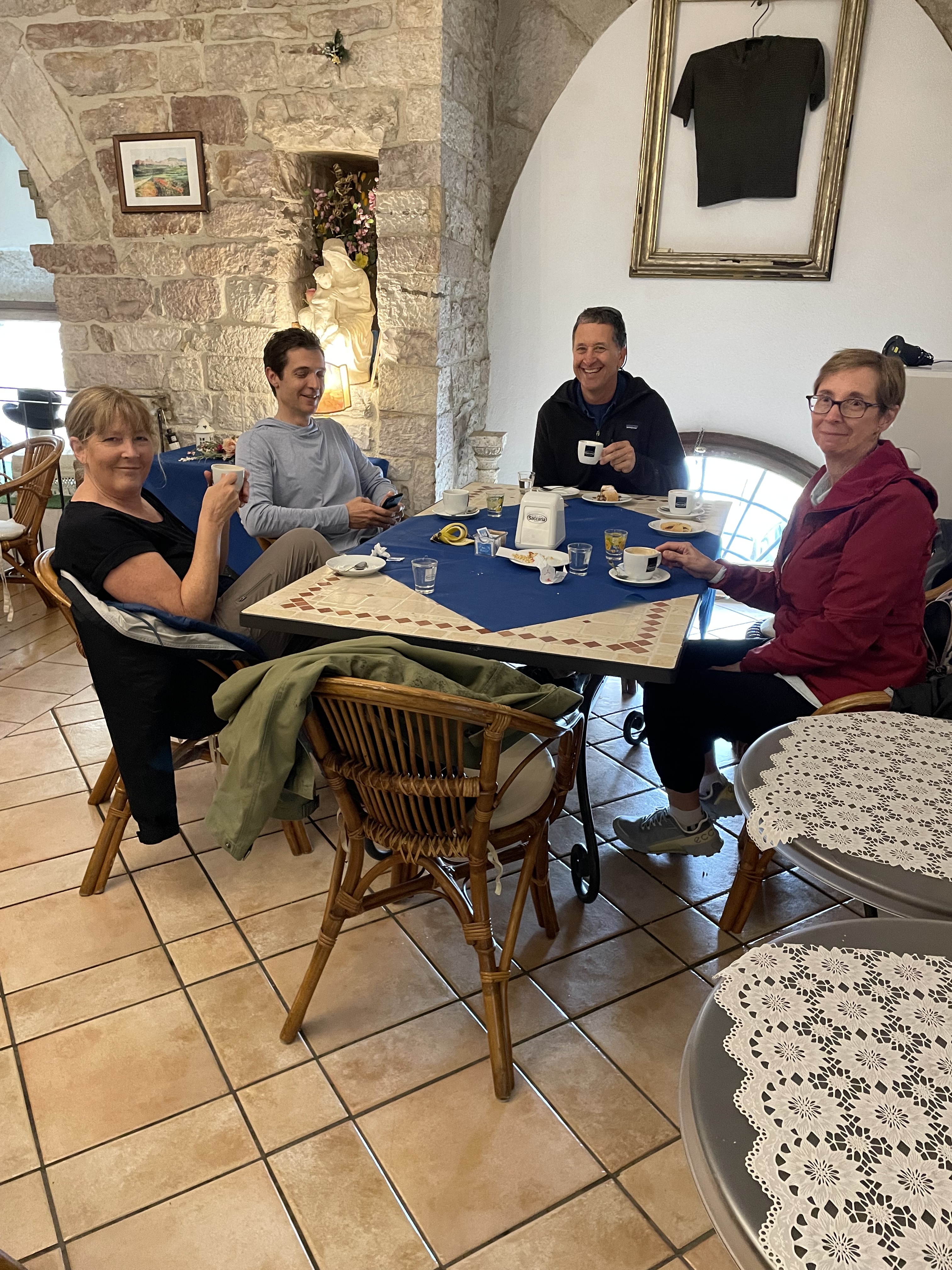
Per our custom now, we started our day (once parked) at a cafe – or in this case a bar that was actually a cafe. I had to choose this one because of the name, thinking of Kaz and Eli’s dog, Agnes’s. Of course, Agnes was also one of Clare’s sisters and very influential in her own right.
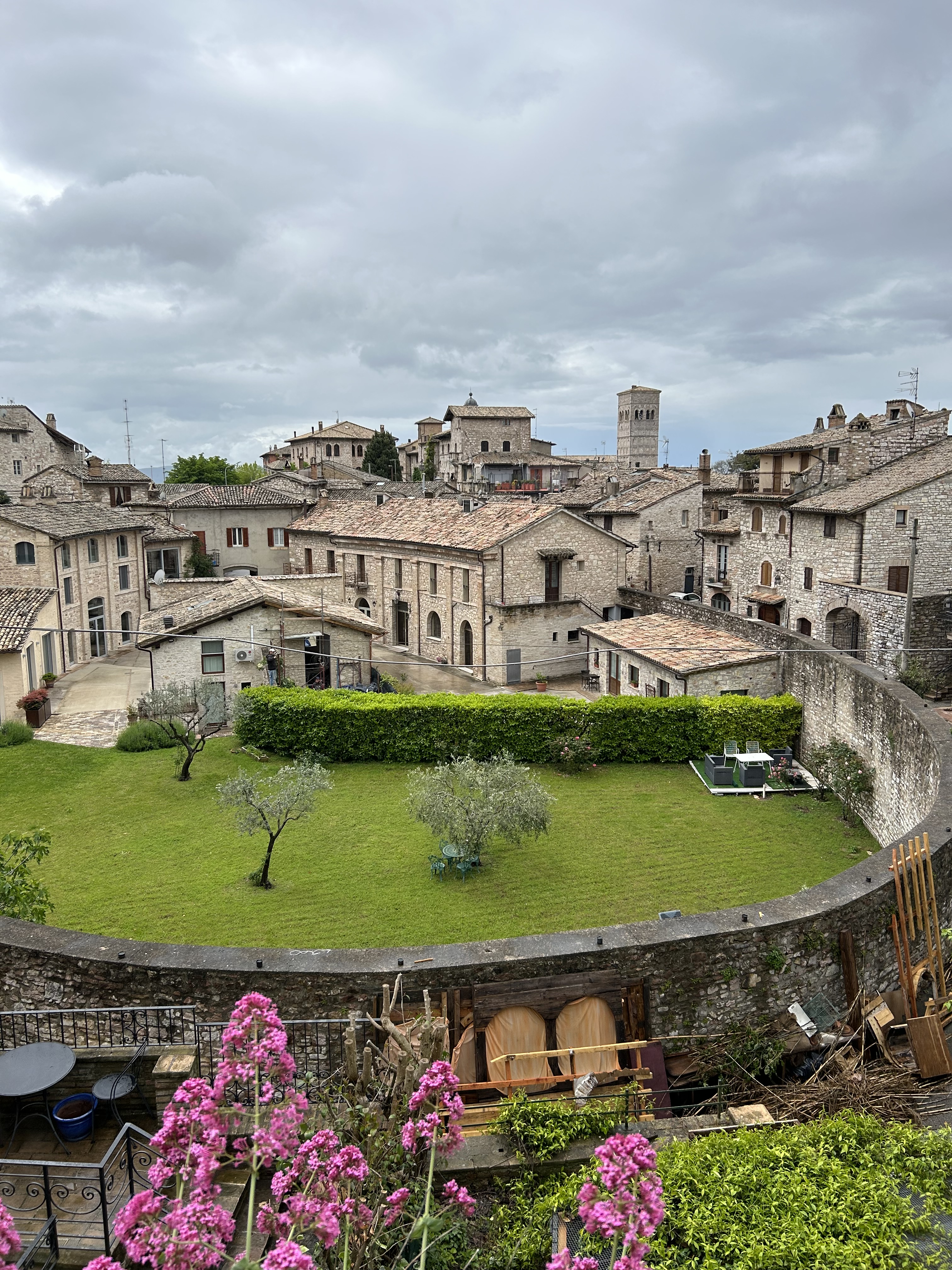
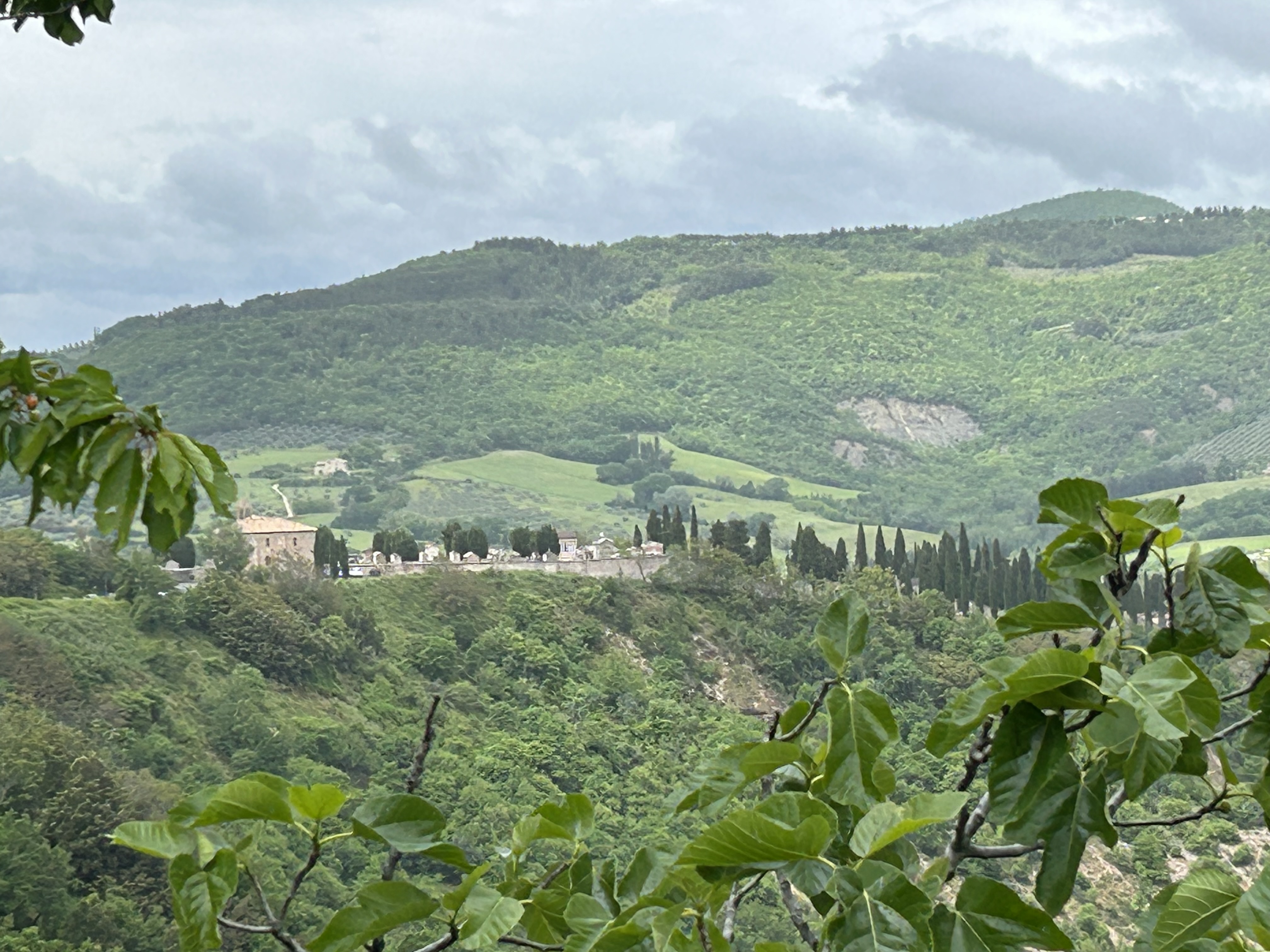
Once we gathered ourselves with coffee and pastry, we started off. In circles. We could not figure out the Rick Steve’s directions for the town tour, it actually was the least clear tour I’ve done and it’s probably my 5th or 6th to do? But we finally got traction. This is the Roman amphitheater, absorbed into a medieval circle of homes. The town gate was just a block away from which you could see out into Umbria – the “green heart of Italy”. It’s the only region that does not have a sea or other country boundary.
Then we started walking Assisi. The first place of note was the aqueduct built by the Romans and that still brings water to Assisi. There was a fountain that still works and was the gathering place during Roman times for collecting water for the houses in the area. I think I was wearing out re photos because I’m missing a lot. The two above were taken by Sharon and this is the only one I got of the aqueduct and you can see the edge of the fountain behind Rick. Raining pretty steadily, though not hard.
Then we came to the Cathedral of San Rufino, built in 1029, rebuilt in 1140. San Rufino is the patron saint of Assisi to this day and this cathedral is where both Francis and Clare were baptized and practiced until they became adults. Here’s the baptismal font where they were both baptized.
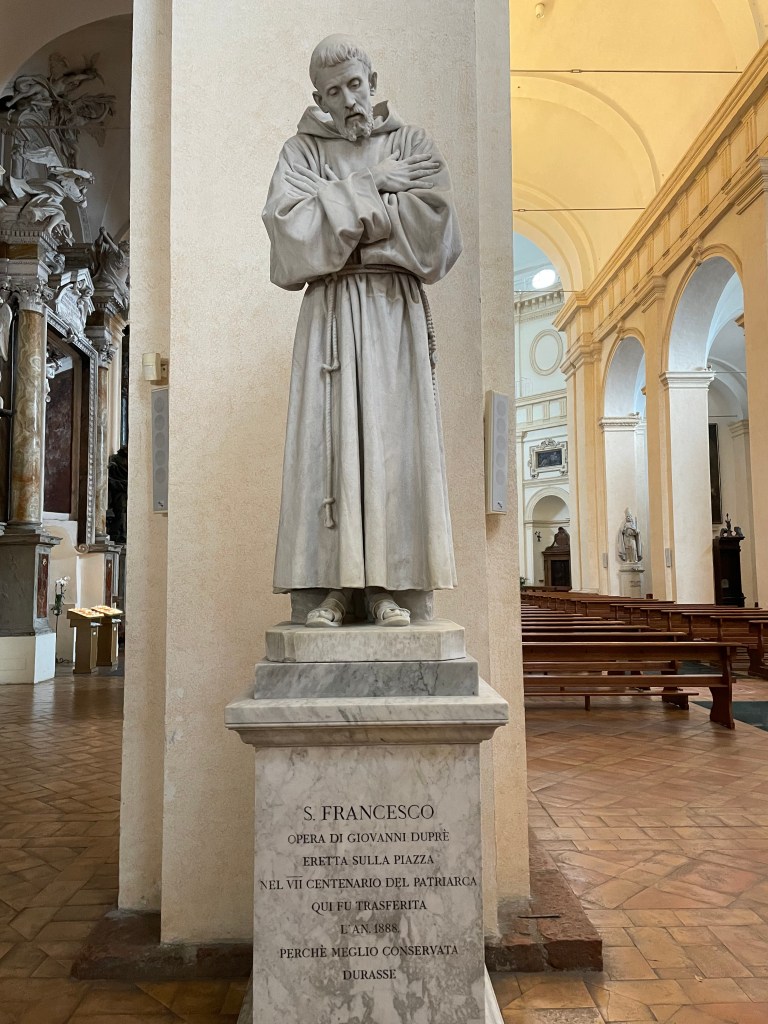
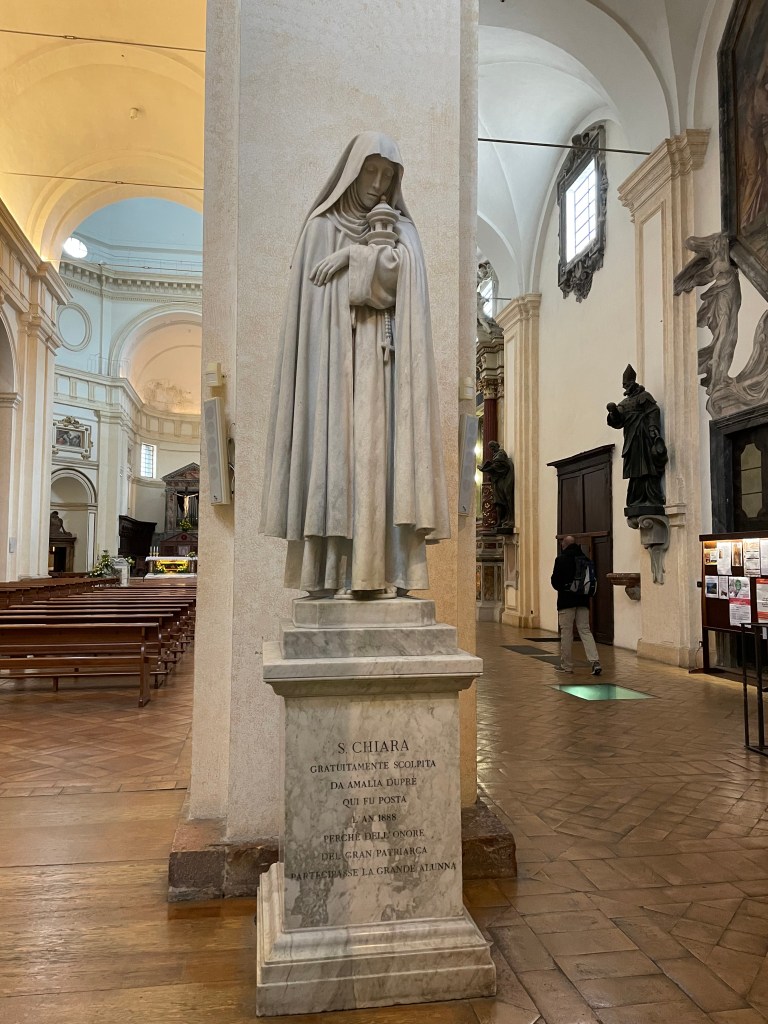
When you walk in, the first thing you register are the two statues of Francis and Clare. So here are the stories of the two.
(Biography.com) Saint Francis of Assisi, though revered today, began his life as a confirmed sinner. His father was a wealthy cloth merchant who owned farmland around Assisi, and his mother was a beautiful Frenchwoman. Francis was not in want during his youth; he was spoiled, indulging himself with fine food, wine, and wild celebrations. By age 14, he had left school and become known as a rebellious teenager who frequently drank, partied and broke the city curfew. He was also known for his charm and vanity.
In these privileged surroundings, Francis of Assisi learned the skills of archery, wrestling and horsemanship. He was expected to follow his father into the family textile business but was bored by the prospect of life in the cloth trade. Instead of planning a future as a merchant, he began daydreaming of a future as a knight; knights were Medieval action heroes, and if Francis had any ambition, it was to be a war hero like them. In 1202 war broke between Assisi and Perugia, and Francis eagerly took his place with the cavalry.
Francis and the men of Assisi came under heavy attack, and in the face of superior numbers, they took flight. The whole battlefield was soon covered with the bodies of butchered, mutilated men, screaming in agony. Most of the surviving Assisi troops were immediately put to death.
Unskilled and with no combat experience, Francis was quickly captured by enemy soldiers. Dressed like an aristocrat and wearing expensive new armor, he was considered worthy of a decent ransom, and the soldiers decided to spare his life. He and the other wealthy troops were taken as prisoners, led off to a dank underground cell. Francis would spend nearly a year in such miserable conditions — awaiting his father’s payment — during which time he may well have contracted a serious disease. Also during this time, he would later report, he began to receive visions from God.
After a year of negotiations, Francis’ ransom was accepted, and he was released from prison in 1203. When he came back to Assisi, however, Francis was a very different man. Upon his return, he was dangerously sick in both mind and body — a battle-fatigued casualty of war.
One day, as legend has it, while riding on a horse in the local countryside, Francis encountered a leper. Prior to the war, Francis would have run from the leper, but on this occasion, his behavior was very different. Viewing the leper as a symbol of moral conscience — or as Jesus incognito, according to some religious scholars — he embraced and kissed him, later describing the experience as a feeling of sweetness in his mouth. After this incident, Francis felt an indescribable freedom. His earlier lifestyle had lost all of its appeal.
Subsequently, Francis, now in his early 20s, began turning his focus toward God. Instead of working, he spent an ever-increasing amount of time at a remote mountain hideaway as well as in old, quiet churches around Assisi, praying, looking for answers, and helping nurse lepers. During this time, while praying before an old Byzantine crucifix at the church of San Damiano, Francis reportedly heard the voice of Christ, who told him to rebuild the Christian Church and to live a life of extreme poverty. Francis obeyed and devoted himself to Christianity. He started rebuilding the church of Saint Domian by carrying rocks by hand. He also began preaching around Assisi and was soon joined by 12 loyal followers.
OK – I’ll stop there, but the story goes on describing how his devotion and preaching spread. I found it fascinating. In the upper basilica there is a series of frescoes by Giotto that tells of Saint Francis’ life. They’re just wonderful. We were told how the windows and the murals all over the church were teaching tools for those who couldn’t read, but could see the lives of saints and be inspired. We weren’t allowed to take photos in the lower basilica, where St. Francis‘ bones are buried. Some of his and Clare’s robes and other pieces of their lives are displayed as well. Amazing.
And now, Saint Chiara’s story.
(Biography.com) Clare was born in Assisi, Italy, in 1193 to wealthy parents, and was taught to read and write as well as spin yarn and do needlework. She had little interest in her luxurious surroundings (she lived in a palace), and influenced by her mother’s religious devotion, Clare dedicated her life to God at an early age. She also showed early on that her calling would involve helping the poor, as she set aside food from her family table to give to the needy on the streets.
When Clare was 18, Francis of Assisi came to preach in the church of San Giorgio at Assisi. Inspired by his words, Clare asked Francis to help her in dedicating her life to God, and he vowed to do so. The following year (1211), Clare’s parents chose a wealthy young man for Clare to marry, but she pointedly refused, fleeing soon after for the Porziuncola Chapel, where Francis received her. She took vows dedicating her life to God, and that moment, occurring on March 20, 1212, marked the beginning of the Second Order of Saint Francis.
Clare’s sister Agnes soon joined her, and they moved to the Church of San Damiano, recently rebuilt by Francis. It wasn’t long before other women joined them, and San Damiano’s residents, known for their ascetic lifestyle, became known as the “Poor Ladies.” (Known as the Order of San Damiano, 10 years after Clare’s death the order would be renamed the Order of Saint Clare.)
Again, I could go on about her followers and the growth of the community, but you can read that. But – she was flat out amazing.
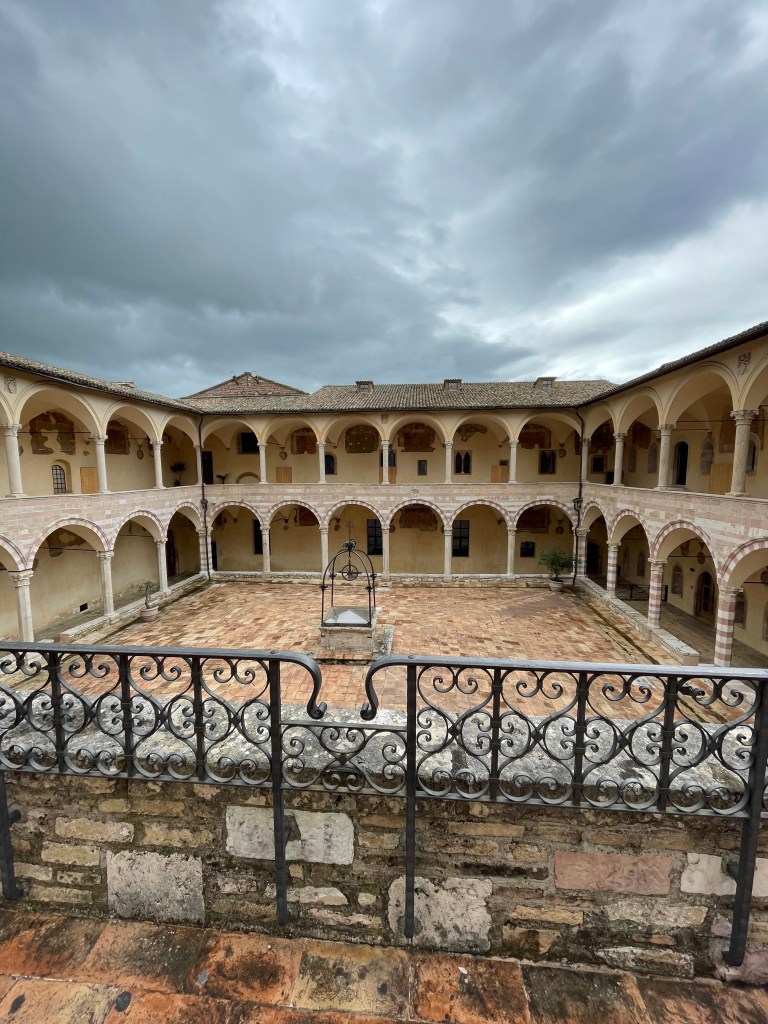
So now we come to the Basilica, the first stone of which was placed the day after St. Francis was canonized. There’s an upper and a lower basilica, as well as a cloister. So much to see. In addition, as one approaches, there’s a plaza with a series of arches in which were stores in the medieval times that people could visit on the way in and out. I’m afraid I was so caught up in the stories (Rick Steve had a tour for the basilica as well) that I got very few photos, but here are a few.
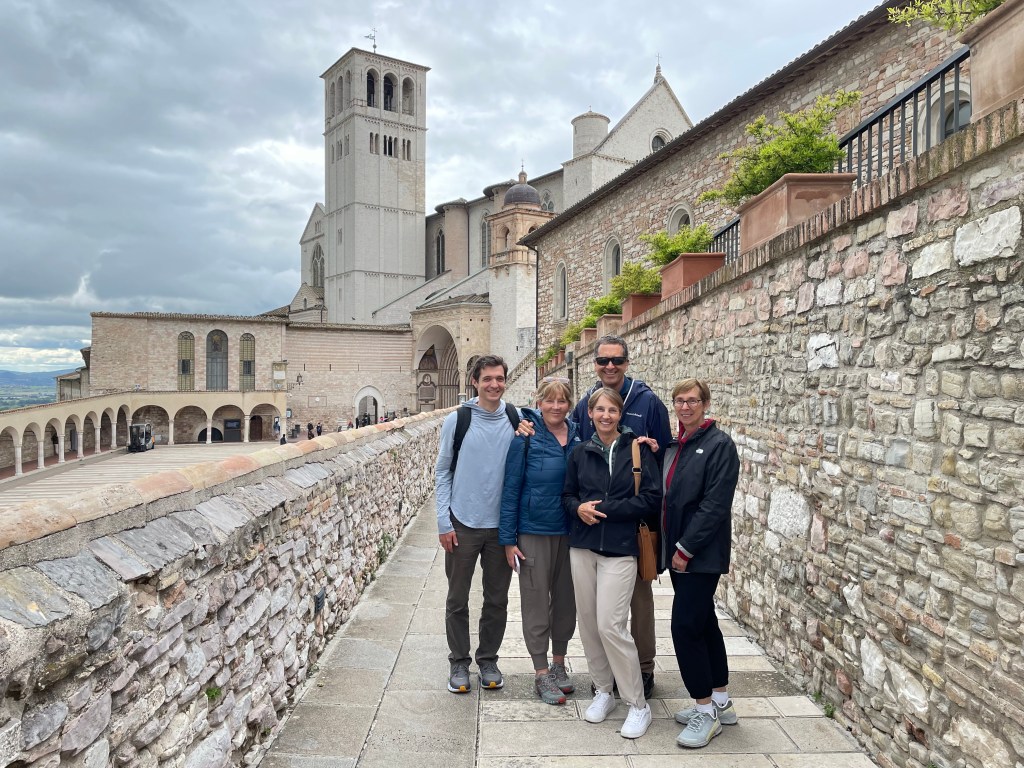
Here it is behind us:
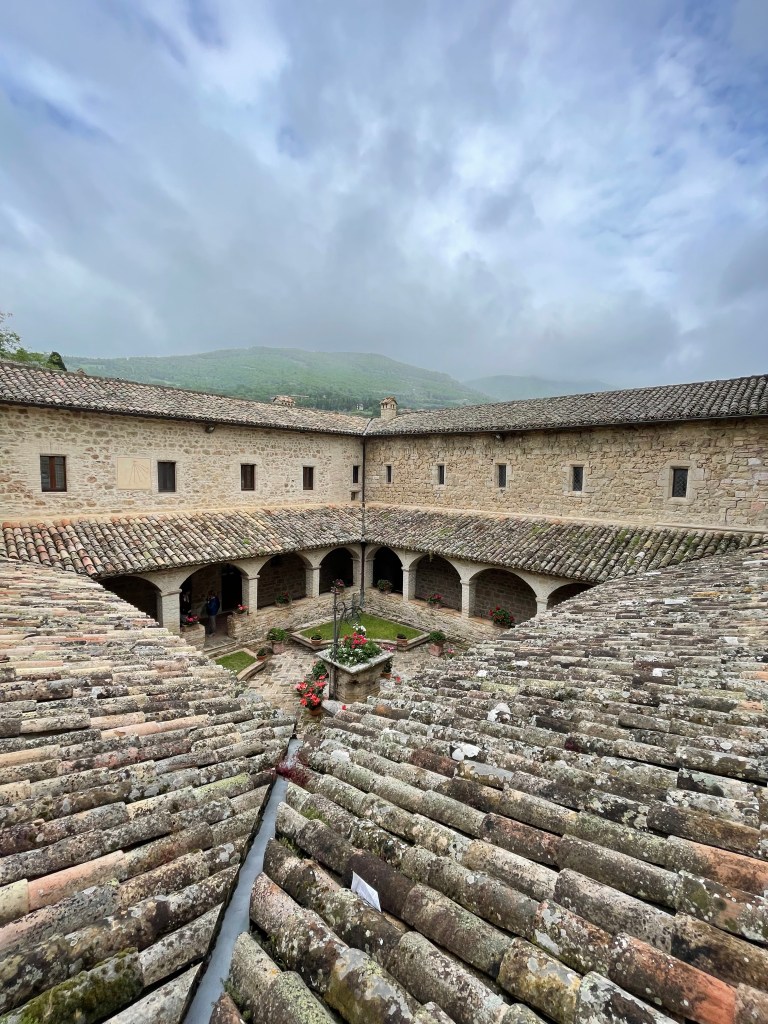
Cloister:
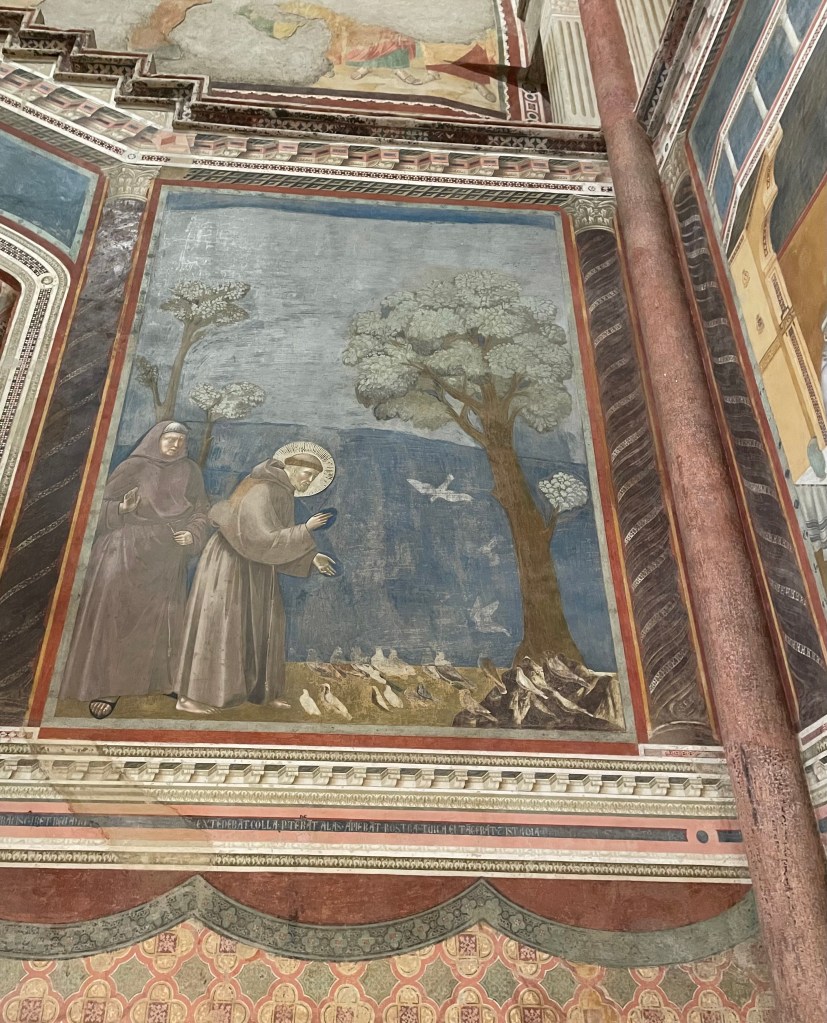
One of the most famous of the frescoes of St. Francis “Sermon to the Birds” – alludes to the truth that all are welcome, all are able to hear the message of Jesus’ love. Tradition has given to Giotto, the best-known naturalistic painter of his period, the authorship of these works, or at the least, the credit for having designed them.
The church for St. Clare was San Damiano. There is another newer one, bigger, that was built after her death because the numbers of her followers had grown so much. However, the small church of San Damiano was just wonderful. It was built between the 8th and 9th century and had fallen into ruin when Francis had a directive “by the Crucifix: “Go Francis and rebuild my house, which as you can see is falling into ruin”. Francis restored it in 1206. He predicted that this place would become the dwelling place of Clare and the other Sisters of San Damiano (Poor Clares) who remained here from 1211 until 1260.” This is where St. Francis wrote the Canticle of the Creatures in 12225. I didn’t get a photo (getting quite tired), but here’s a stock photo of the outside.
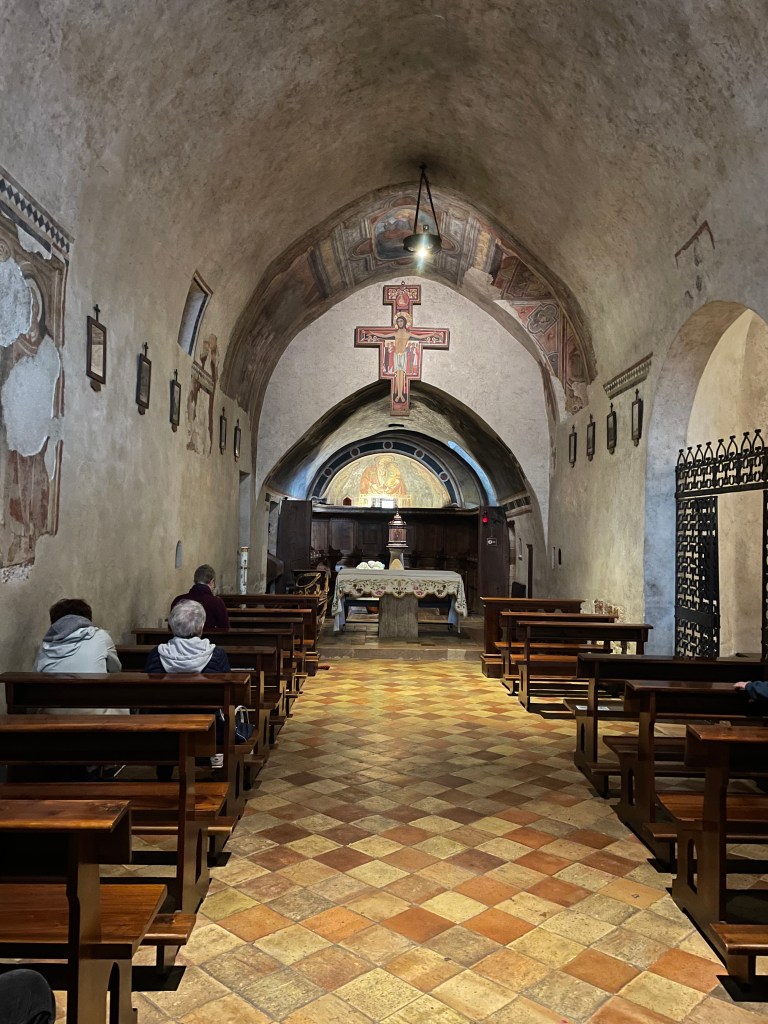
Inside was quiet, more people were sitting in meditation and prayer, so again, few photos.
The cloister:
Here’s a story about the cloister that was posted in the church: The Cloister was a haven of peace. Clare, in September 1240, confronted the troops of the Saracens led by the emperor Frederick II of Germany, who entered the cloister. Clare ordered to be brought, infirm as she was, to the door facing the enemies, preceded by the small silver box in which the body of Christ was kept. The Saracens, struck by the force of her prayer, very quickly left the place of San Damiano. The city of Assisi continues to celebrate this liberating event of Clare with the “Festa del Voto” (Feast of the Promise), every year.
There’s so much more that could be written about both the saints, but there was more to be seen in Assisi, so will move on to a few other highlights.
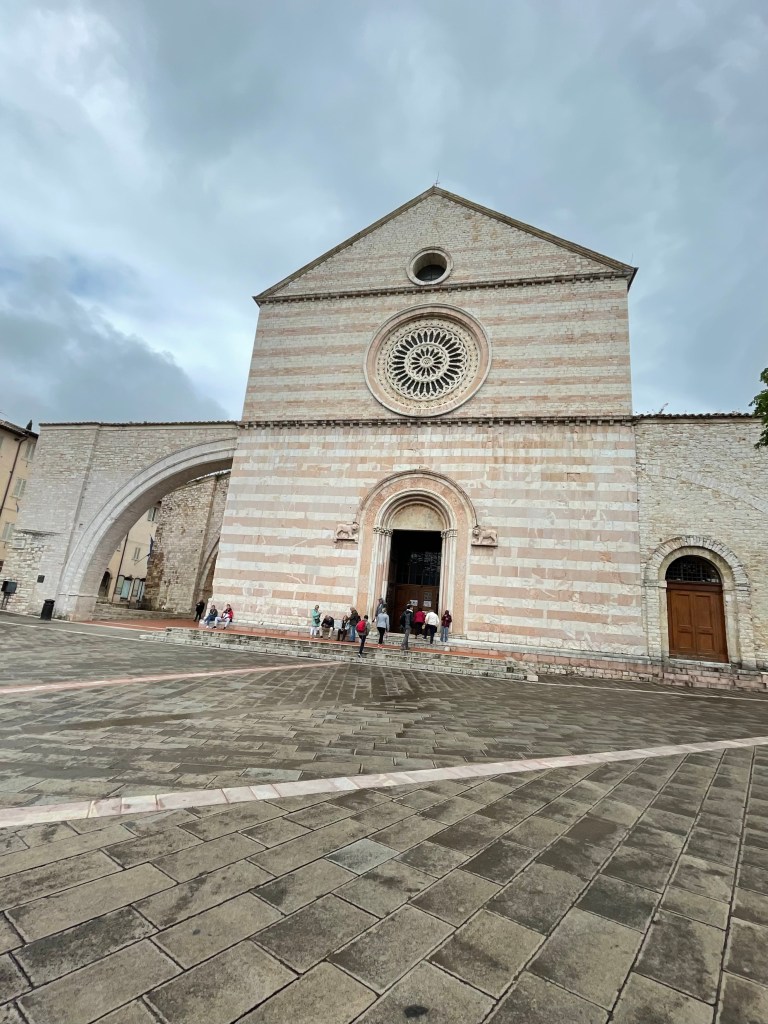
Here’s the Basilica of St. Clare, started in 1260 seven years after her death, and is where her bones are buried. The plaza in front of it is where Leaf drove a circle as we tried to figure out where to go next. Notice the lack cars…
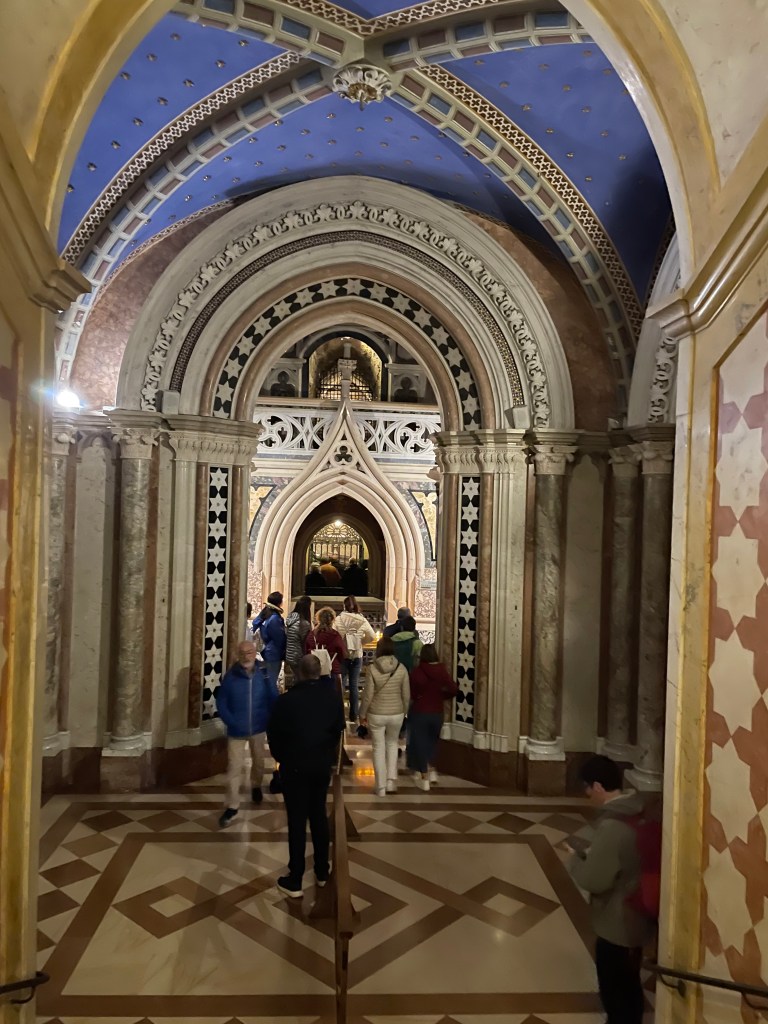
Having remained, like the body of St. Francis himself, hidden for six centuries, Clare’s tomb was found in 1850 after a prolonged search. On Sep 23 that year, the coffin was unearthed and opened. The flesh and clothing of the saint had been reduced to dust, but the skeleton was perfectly preserved. On Sep 29, 1872, the saint’s bones were transferred to a shrine in the crypt of the Basilica of Saint Clare. And this was a scene because of the fervor and devotion of people going down to the tomb, women falling to their knees, praying, crying. Not all, but it wasn’t rare. It felt too disrespectful to take photos any closer with those who were so moved, but this is the layered approach to the crypt.
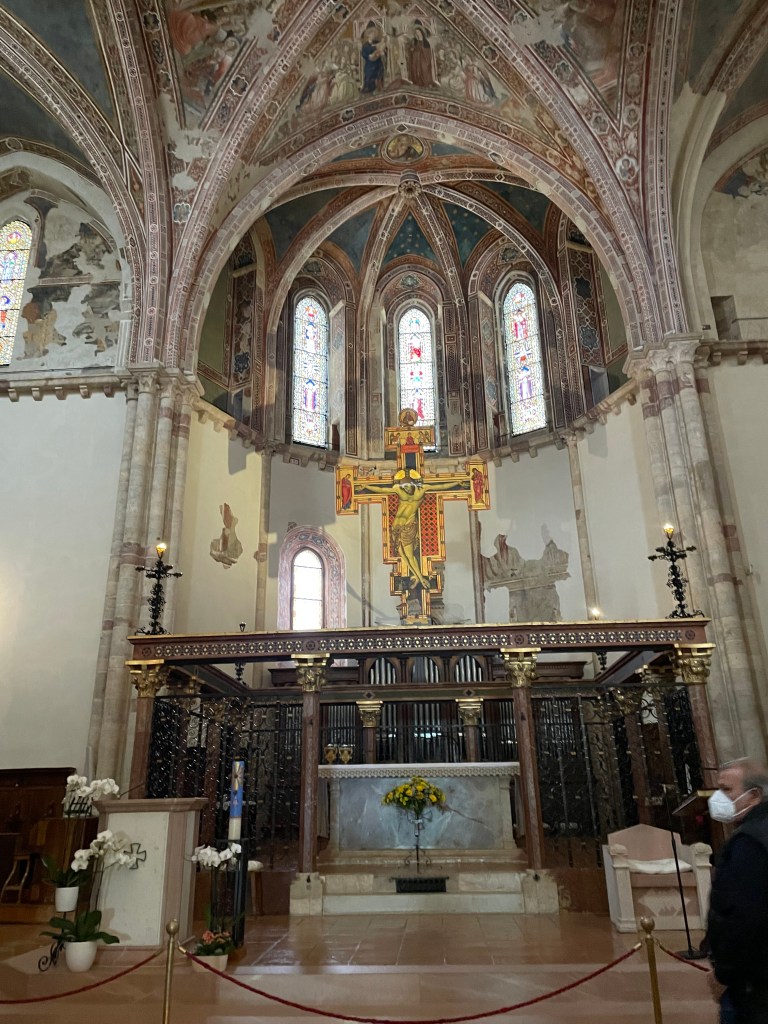
The cross below is the San Damiano Cross that St. Francis was praying before when he received the commission from the Lord to rebuild the Church. It now permanently resides here with a copy in San Damiano.
The view from the plaza in front of the Basilica of St. Clare:
The day was just wonderful and a gift. Tomorrow, we’ll take a break from touring and hike 🙂
Had our first Umbrian adventure – went to Orvieto for the day. We had a few things we wanted to do, primarily an underground series of tunnels from Roman times – and completely missed on that because it was sold out by the time we went to buy tickets. But we walked around the, yes, medieval town and explored. Raining most of the time, but raincoats and umbrellas worked and we saw most of the town.
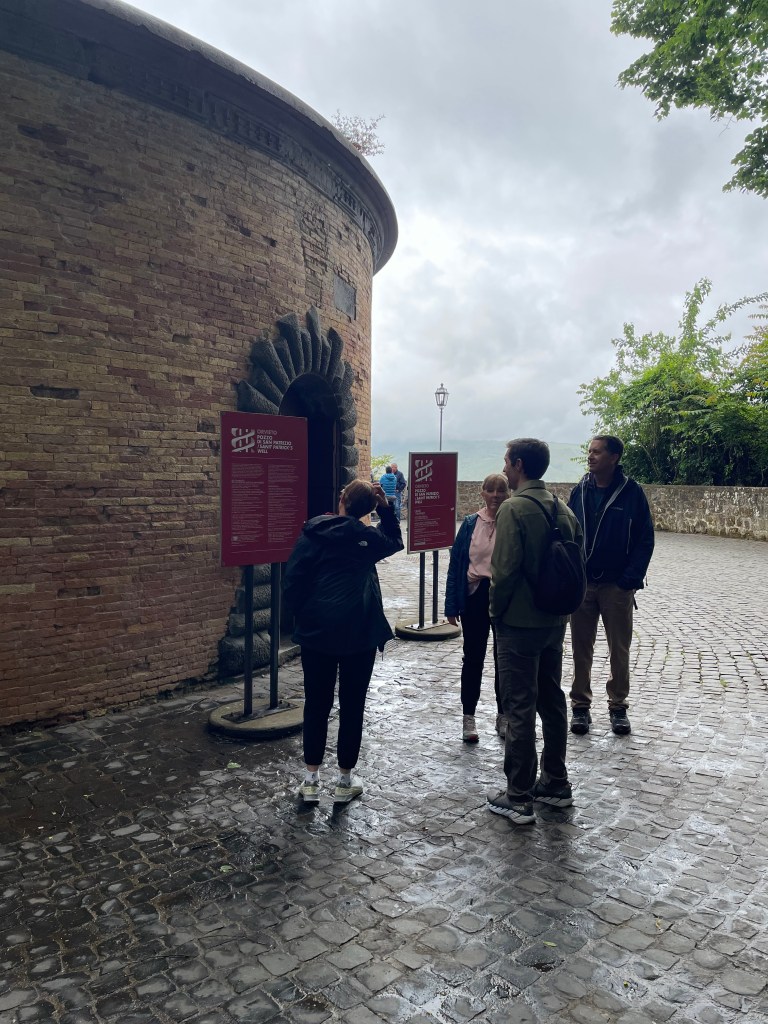
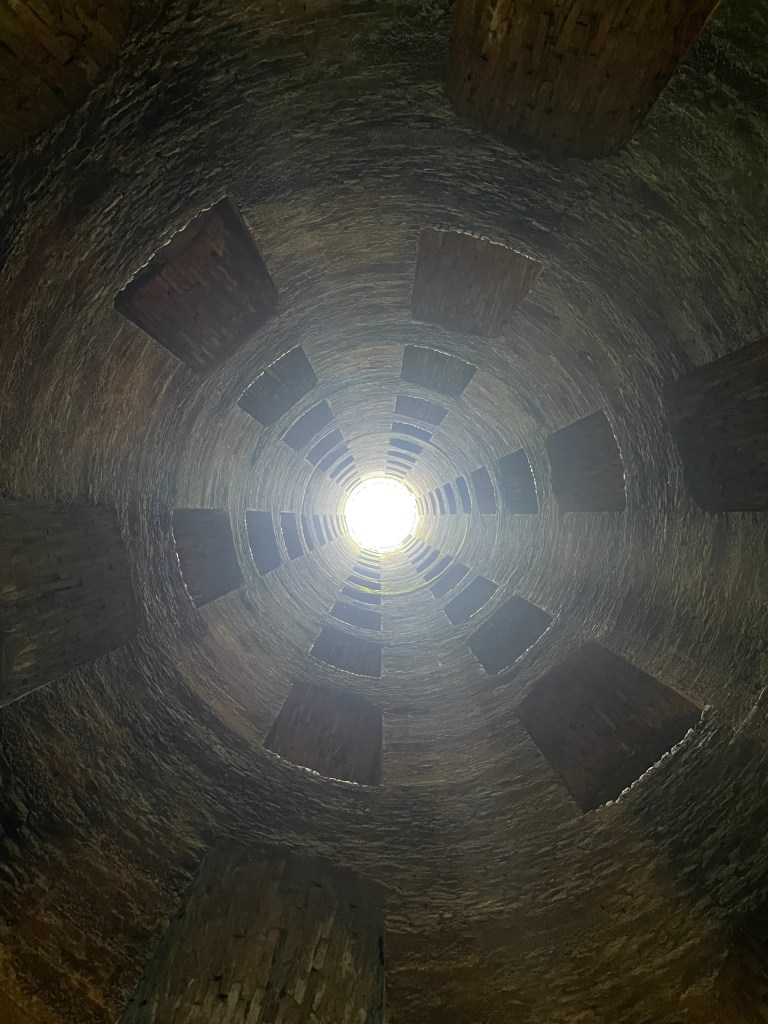
The first thing we did was to go down the Well of St. Patrick. Amazing construction of two spiral staircases circling the well. We didn’t read the initial sign too carefully and were curious about the width and shallow depth of the 248 steps down and 249 steps back up and admired the 70 arched windows. Turns out the stairs were designed with windows all the way down for light and with that stair scale so that mules could go down one side and back up the other bringing up bags of water for the towns people. I’m guessing it was hard on the mules, but it was a beautiful design. The Well of St. Patrick was dug at the behest of Pope Clement VII, who had taken refuge in Orvieto during the Sack of Rome in 1527 and designed by Florentine Antonio da Sangallo the Younger.
Looking up from the bottom.
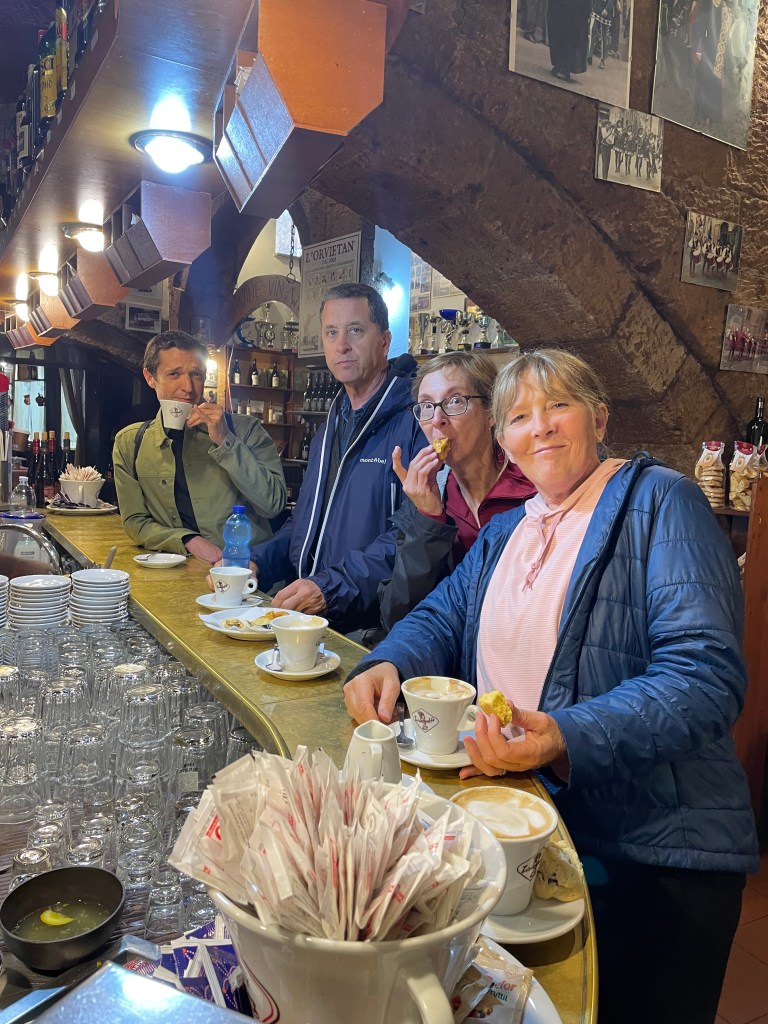
Took a bus up from the Well and really started the day with our first coffee –
Then we walked and walked, got lost, walked some more and finally felt like we’d seen most of the town, so stopped for lunch.
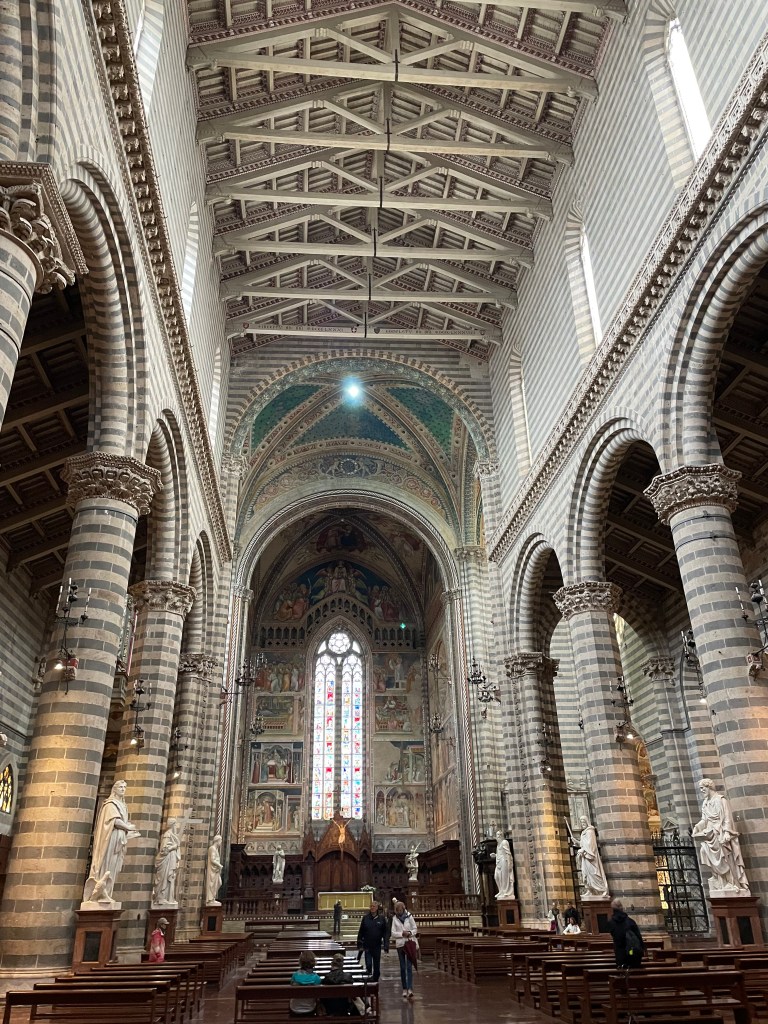
Then off to the Duomo, yes, another church. This time, though, we didn’t have any English interpretations for the amazing frescoes and just guessed.
The outside was beautiful, striking and different because of the vividness of the mosaics against the stone. It was started in 1270 and additions continued up until the 1600’s, with the front facade primarily from the 1300’s. Incredible that they’re still so gorgeous. In addition, in the 60’ s Emilio Greco created the bronze doors for the cathedral. The aesthetics were not in dispute, but a national controversy broke out about the church’s historical cycle and when should the cycle be complete for the cathedral. The doors were finally hung in 1970. I thought they were beautiful and in keeping with the cathedral. They now have an exhibit of Greco in the museum next to the duomo. The artist donated statues with statues to Orvieto in recognition of their commitment to him and his art.
We then explored an archeological museum with treasures found in Etruscan tombs. The objects were amazing, made from ceramic, gold, glass, bronze and iron. Primarily from 5th to 3rd centuries BC. Cathy and I were fascinated and spent a long time exploring. Leaf and Sharon fully hit jet lag and Sharon curled up on a bench to sleep a bit while listening to us in the other room – we were the only ones in the museum. They couldn’t believe how long we took and that we had to discuss every single display case. Funny – but they’re right, we took a LONG time. I’d read about the Etruscan finds a number of times, so loved finally getting to see some of the remarkable art. Rick was on a phone call so missed it all. And I didn’t take a single photo!
But then Rick called and he had wandered into the Palazzo Papale (now Palazzo Soliano) attached to the right of the cathedral. It was originally begun in the mid-13th century when the popes moved to Orvieto to escape conflict in Rome. It now shows art removed from the Duomo for protection. What I loved most were these two pieces of Mary and Mary Magdalene.
And then we were on our way home in the rain. Getting back to the tower was a great retreat, made our salad and snack dinner, with the heat turned on in the kitchen. And then to books and bed.
Today we did one of my favorite things – unloading. We spent 1.5 hours in the post office packing up 2 boxes, listing all the contents, doing all the forms, to send home all the things we no longer needed after the hiking. The guy in the post office – the only one – was so nice, patient and knew enough English that we got through it. We’ll see what gets home. And by the time we were, done there was a gathering of about 10 people behind us, all sitting on the benches, chatting, laughing, knowing who was which number in the line. Then they waved and smiled as we left, bless those hapless Americans…
We had a few more hours before Sharon, Cathy, and Leaf came from Rome to pick us up (!) so we went back to the hotel and repeated our wonderful morning of quiet by the pool.
Then, here they came – so fun meeting friends in Italy! We loaded our things into the car, then walked into town to have lunch at the same place, this time with Cathy interpreting when it got a bit confusing. Then we drove out of Tuscany into Umbria. It continues to be beautiful, it feels a little less groomed, more fields that are a bit less cultivated, and maybe a bit drier – but not this week! Rain expected every day so we’ll just work around it.
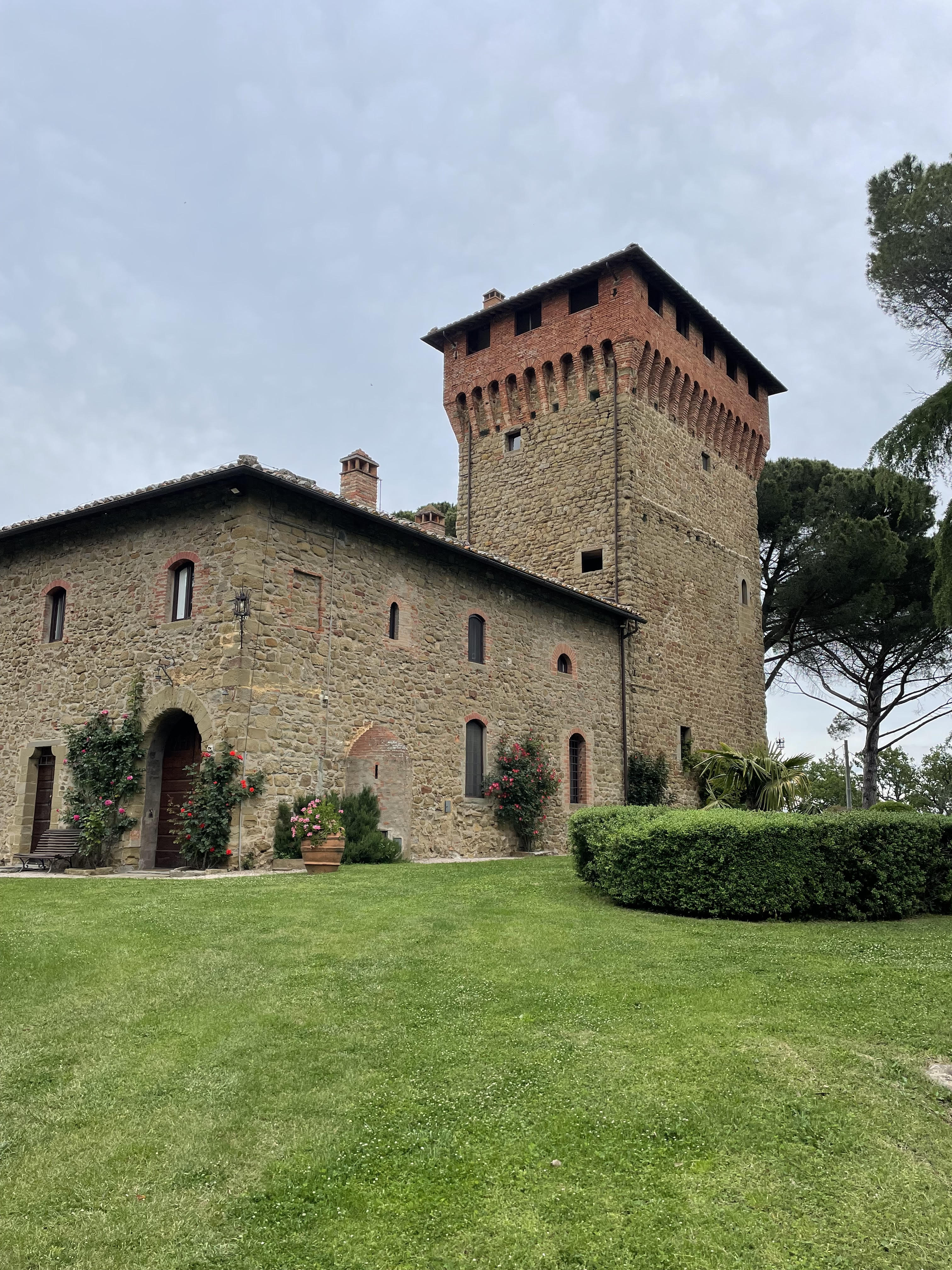
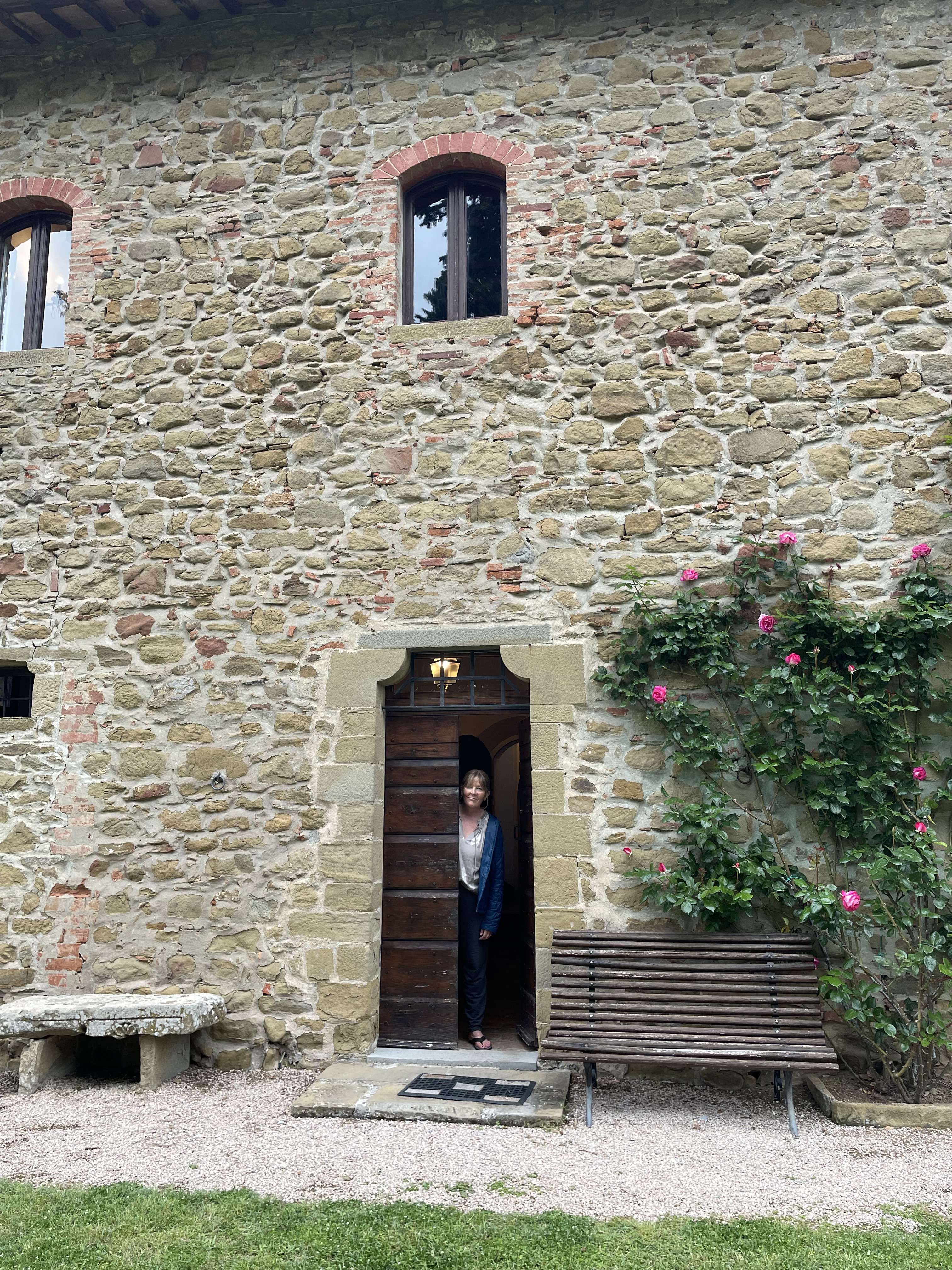
We got to our tower – hah! Really, it’s absolutely crazy, but this is our VRBO rental for the week. We couldn’t believe it even though we’d obviously seen the photos on line. It’s so beautiful. We walked around the property with Katia, the wonderful person who manages the property for Emma Villas. The grounds were immacately kept, roses, a pool (way too cold) and we just enjoyed looking at the outside. Then inside – 8 bedrooms – 4 of which are in the tower stacked on top of each other. And it’s so quiet! Outside and inside, the walls are thick and the doors are inches wide of solid wood. Very cool. Sharon said downright spooky when in it alone when the rest of us walked to Panicale, a few kilometers away.
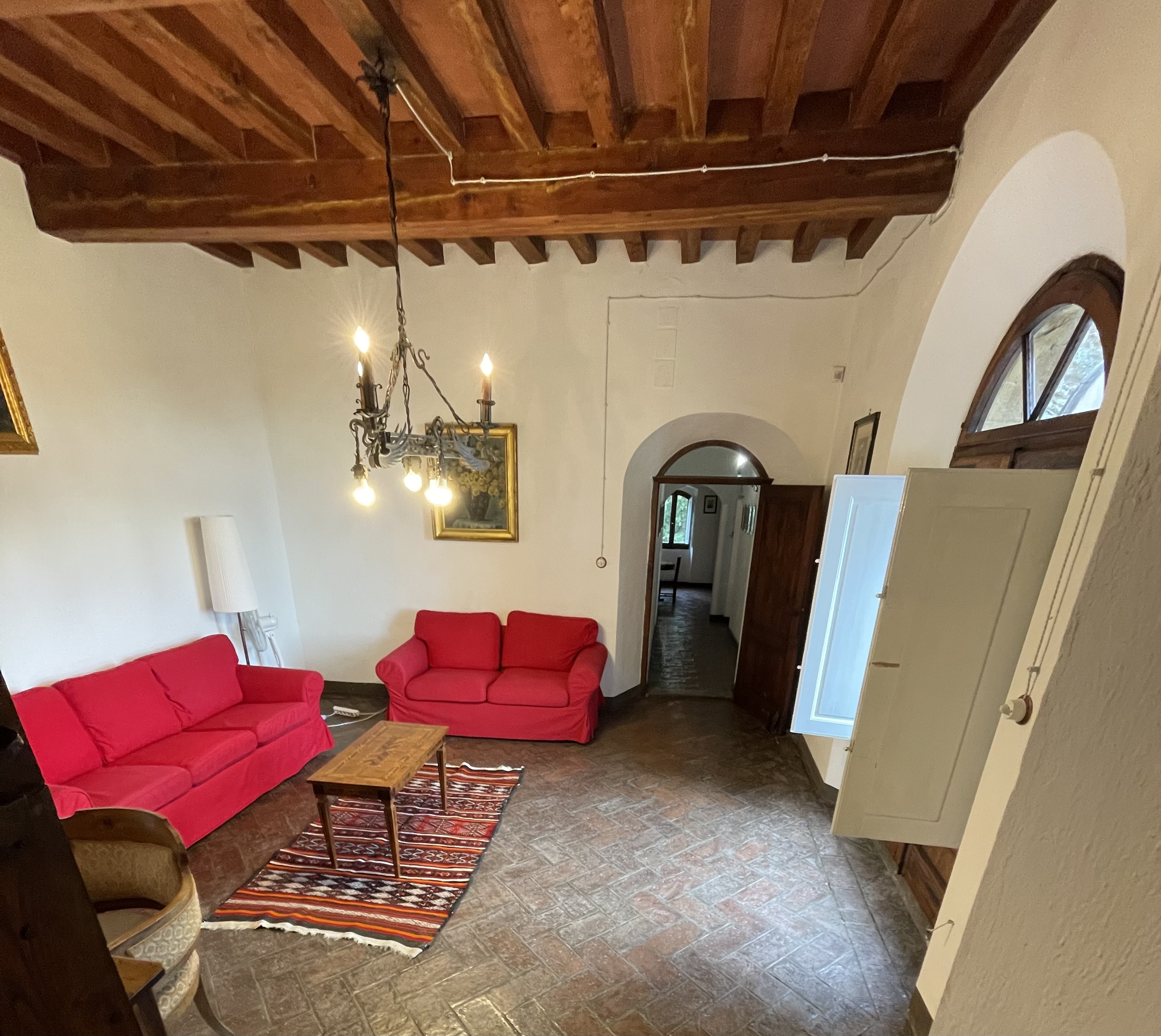
The sitting room where we spend time when not eating and the view from the balcony that we don’t go on – too cold, but pretty out the window!
The dining room and living room where we don’t go – too cold and odd smell, cleaning? But fun to see on the first walk through:
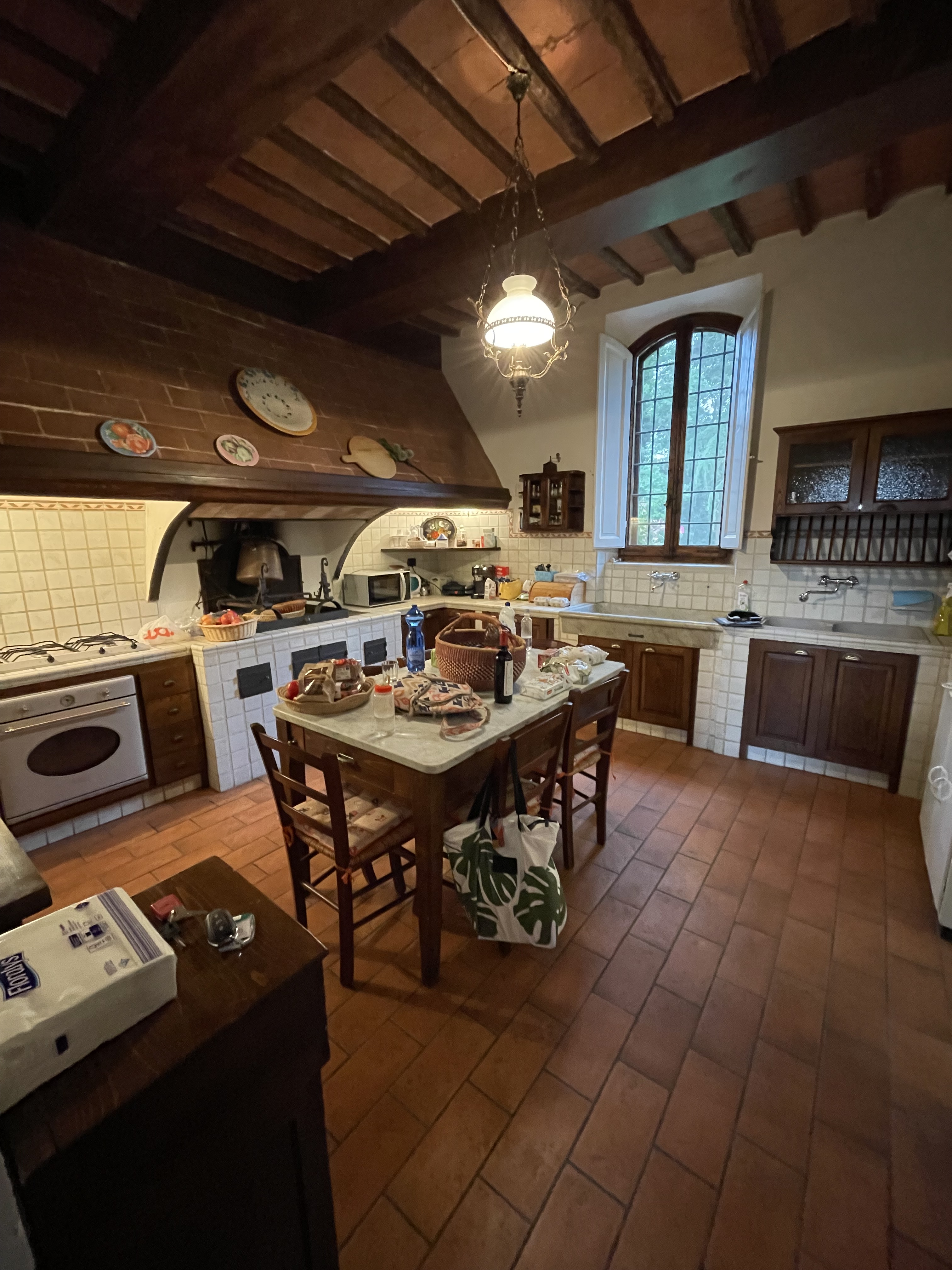
Where we spend most of our time:
Panicale is another medieval town, tiny, wonderful. I want to go back, sit in the plaza with a decaf (descafeinada) and watch the town. When we walked through the town, around 6, there were about 2 people out and we were walking, not dawdling (I like dawdling), so didn’t stick around to see if more would come out. We think people live here, but this has been a pretty common pattern in a fair number of towns. So well kept, clean, cared for gardens and no people. But then we drove through the next morning around 10:30 and there were a ton of cars. Clearly a rhythm of living that we haven’t figured out. Saw the sunset from the plaza in Panicale:
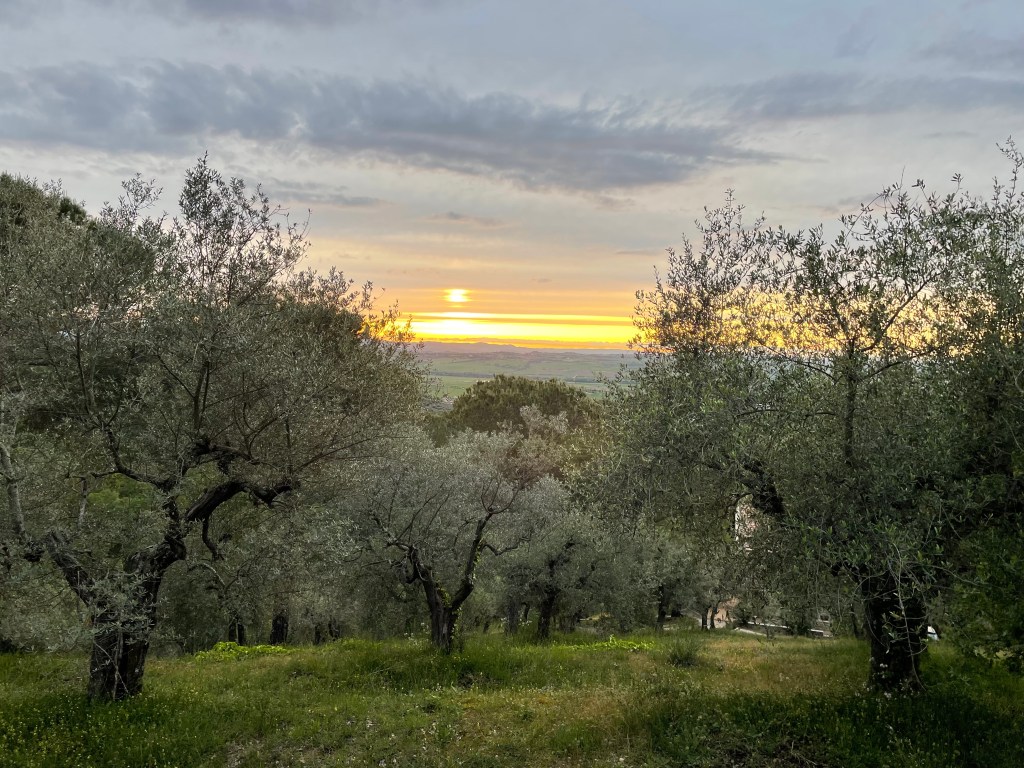
And sunset on our walk back – first one I’ve seen since arriving here, beautiful:
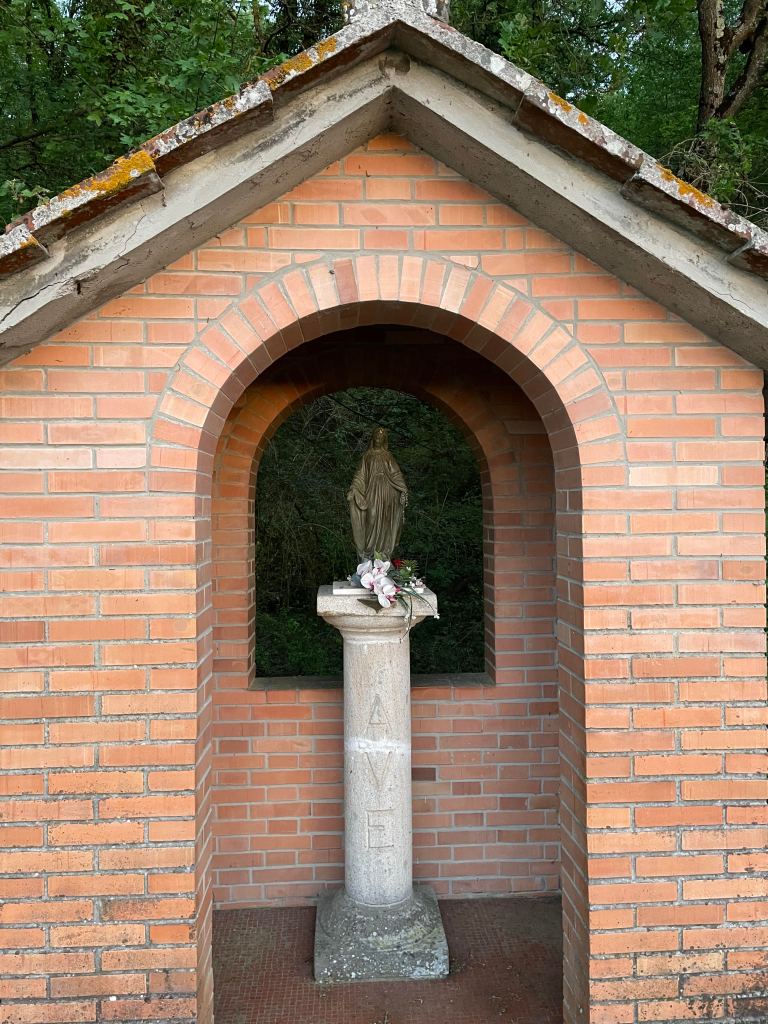
Roadside shrine:
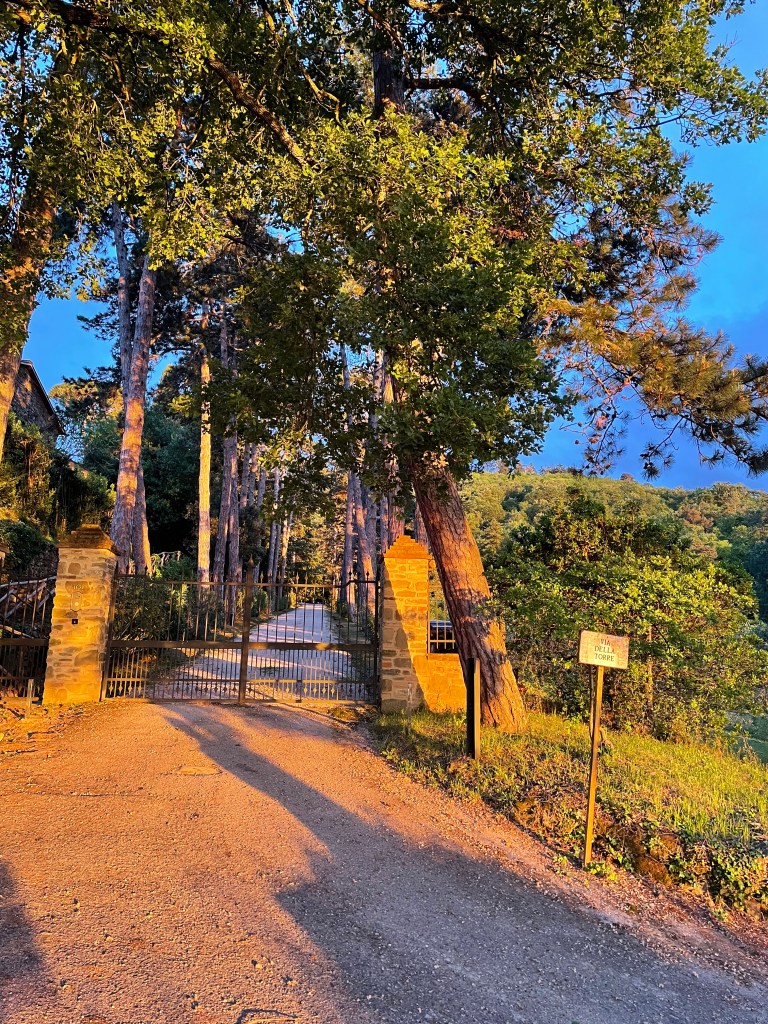
And back to the drive up to the house, oh, sorry, tower:
We got back to the tower and we all layered in all the thin clothes we had and huddled in the kitchen for a wonderful dinner of salad and ad hoc of cheeses and hams (I’ll have eaten a full pig by the time I leave, sigh) and crackers. We finally figured out it was possible to turn on the radiator the next morning – so at least the kitchen is a bit warm. Towers and castles are cold. Katia had told us that if we wanted to turn on the heat, it could be between 200-500 euros for the week. Whatever we turned was a small system and only does a few key areas, kitchen and sitting room.
Here’s the history of “our” torre, Torre d’Orlando, courtesy of the owners: The tower is all that remains of the ancient castle of old Paciano, which was one of the most important in the area of Lake Trasimeno as it is situated on the old road which takes you from Perugia via Panicale to Chiusi. It is first mentioned in 917 (well, no wonder it’s hard to heat). In 1312, there was a new ruler of the area. Then, in the early 1400’s, Bartolomeo I di Felcino Armani, the husband of Sismonba di Cola Bartolini used her dowry of 800 gold florins to purchase the property.
In 1434, the Tower was under the Papal rule of Eugenio IV who gave the responsibility of rebuilding the castle to Tanrrebi I Bourbon and from then on it was passed down through the generations to today.
Amazing. Cold, but amazing. Rick said it’s wonderful, but probably won’t use ideas from here as we plan for our house…
















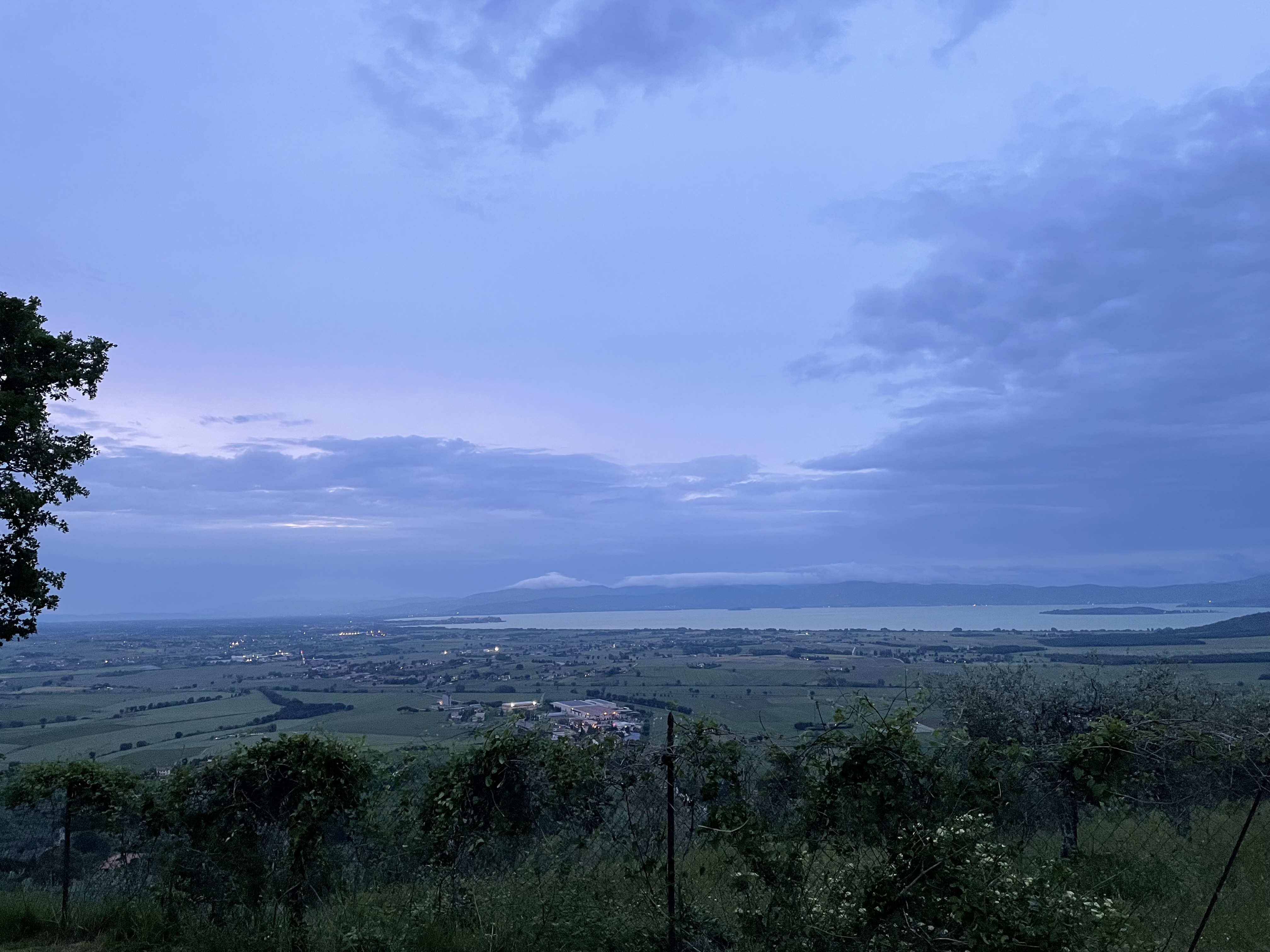
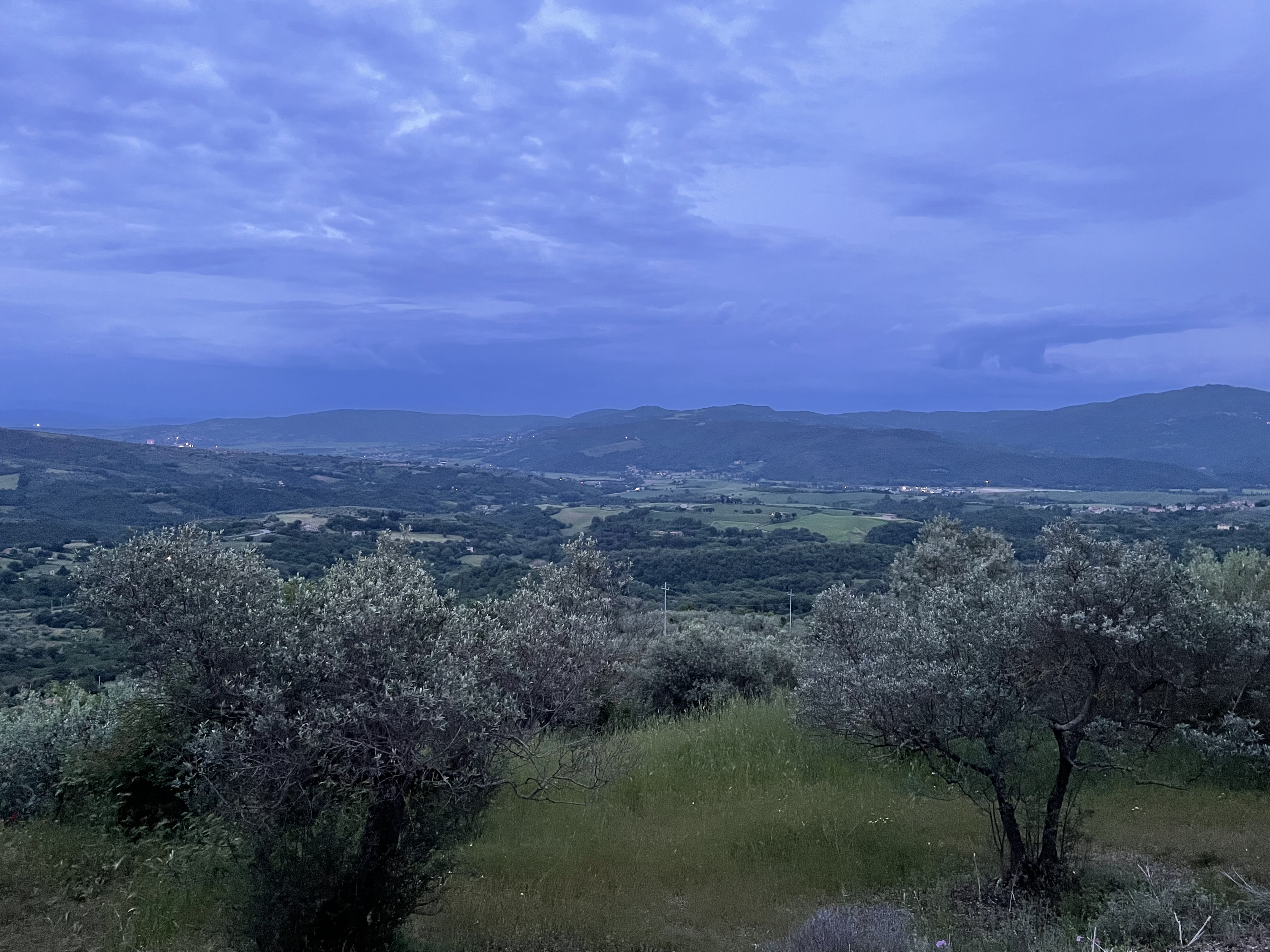
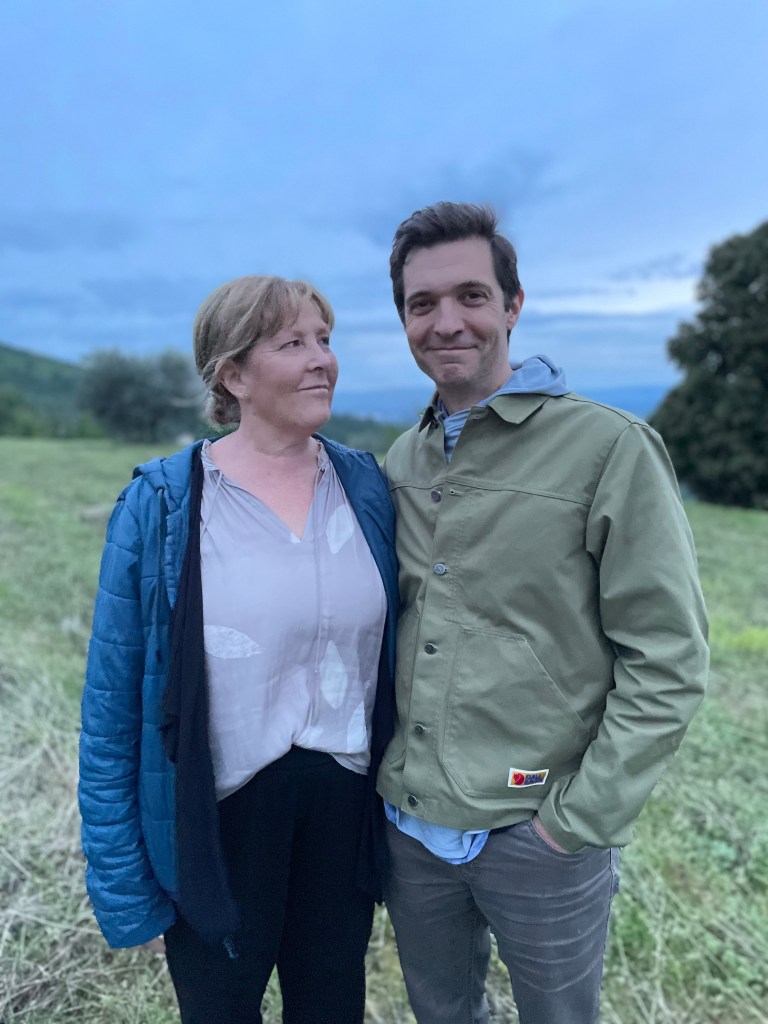
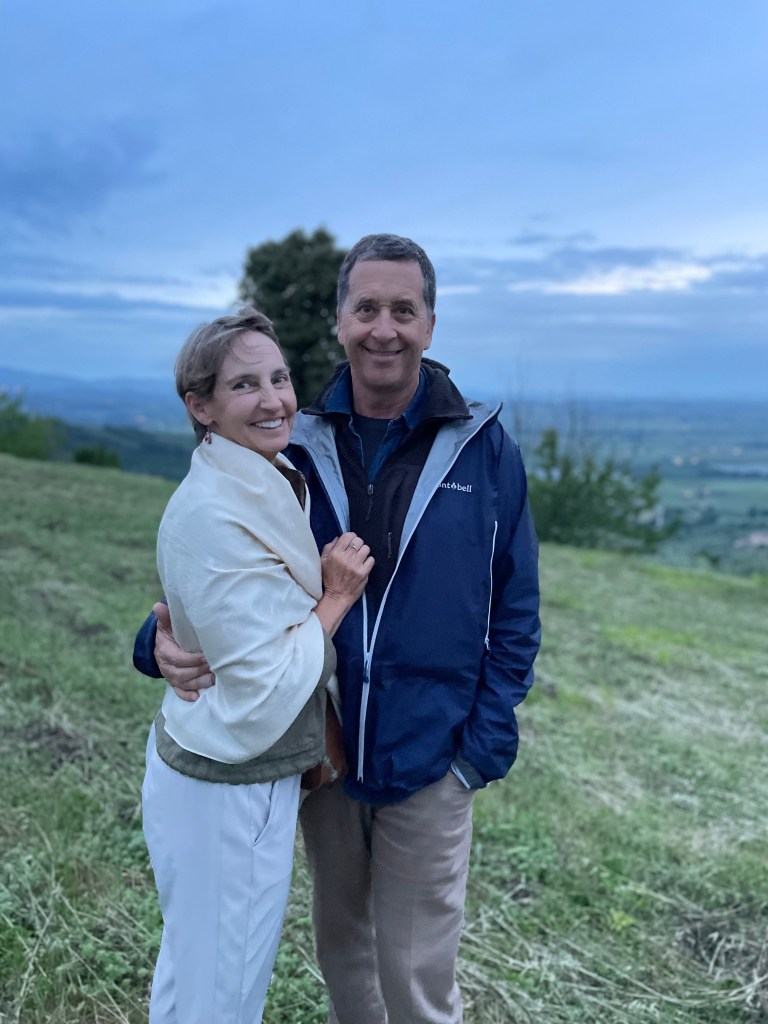









 Reb's Walks!