Today was my first guided day and it was great. I’m sure I won’t remember everywhere we went but we did go to the area I’d wanted to explore at night. So now I (mostly) know how to get there and back.
Since it was a gorgeous sunny day, the guide, Bulit (pronounced in a nice Turkish way, not like bullet), suggested that we shift the agenda around and take advantage. So we walked through small streets seeing sights on the way. I don’t think you can go anywhere without seeing something gorgeous.
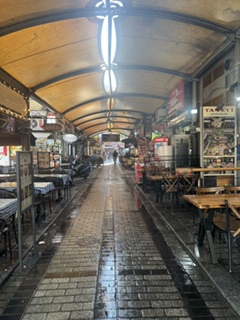
Just one of many small streets lined with small restaurants, some covered like this one, most not.
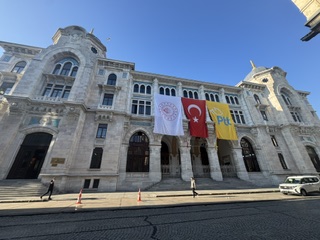
The first post office from the 1800’s, also had the first radio transmitter.
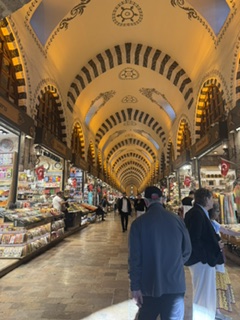
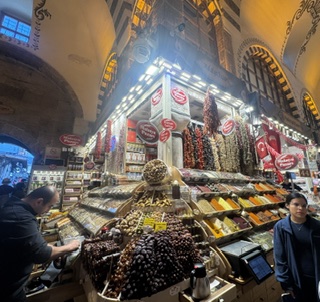
Spice Market – Bulit said it was a great time to go because later in the day it was packed and hard to move. It’s also called the Egyptian market since Egypt used to be part of the Ottoman Empire and spices were brought from there and introduced to Istanbul. It was financed by the mother of Sultan Mehmet. Evidently Sultan Mehmet IV had started the process, building the market next to the mosque he’d built. But then he died and his son didn’t like him or his projects, so did his own. His grandmother, Hatice Turhan Sultan, stepped in and financed the market her son started, finishing in 1664.
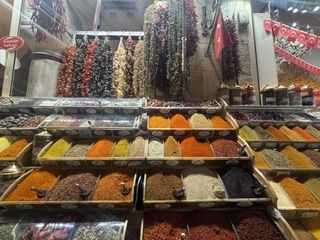
I thought this was interesting because the strings on the right of the row on top are okra! Bulit said this was the best vegetable and that the people loved okra but couldn’t have them over the winter so they were dried, as well as aubergine and others I couldn’t identify.
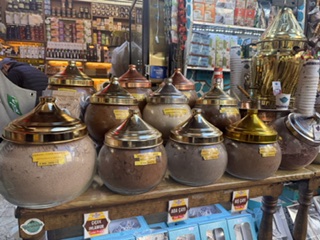
Different types of coffee. Bulit said the first users of coffee were the Turks, bringing it from Africa. Honestly, he’d used to many “firsts” “biggest” “most famous” phrases that I decided to look this fact up. Turns out he was close! Coffee was first used in Yemen by the Sufis to keep them going when their practices had to go beyond what they could naturally endure.
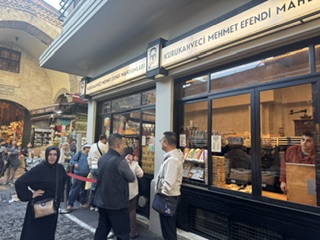
The best known of the coffee shops, there was a steady line and evidently nothing like it would be later. The guy behind the window is one packing coffee after it’s carefully measured, bag after bag.
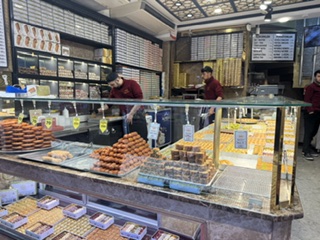
And sweets! Whoa, they like their sweets here. I’ve already had Turkish Delight – ala Narnia. They are beautifully crafted, but they don’t call me at all. Fun to look though!
We then saw a small exquisitely crafted mosaicked (is that a word?) mosque. The Rüstem Pasha Mosque, an Ottoman mosque located in the Hasırcılar Çarşısı in the Tahtakale neighborhood of the Fatih district of Istanbul, Turkey, near the Spice Bazaar, built in 1563. Rare in that it was primarily mosaics and voted the most beautiful mosque in 2007. Truly the mosaics were worth taking time to explore, if we hadn’t been moving, I would have sat for quite a while, it had a wonderful feel.
We then wound our way through more wonderful little streets to a main ave and caught a cab to then catch a ferry. It only did a few stops and went up and down the Bosphorus. Unbelievable buildings all the way up and down, palaces, mosques, houses. And the day was perfect! I’m so hoping we get a day like this when Rick’s here so we can repeat.
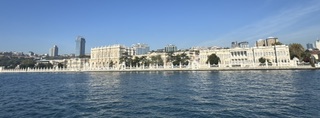
One of many, though perhaps the largest, unbelievable palaces. 1850’s. On the right, is the kitchen for that palace!!!
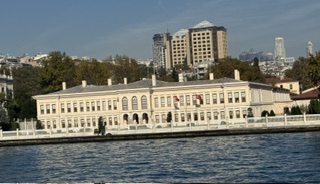
The kitchen for that palace!!!
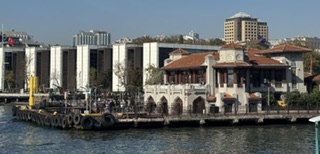
A wonderful ferry dock. The building has a cafe on top and a library downstairs so that people could/and still do sit and read while having their coffee. Very cool sultan, again from the 1800’s.
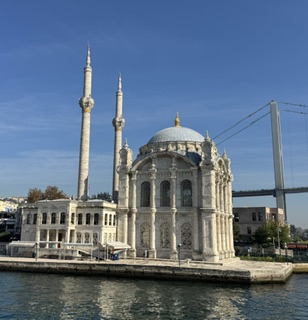
Built for Friday prayers for the sultan – I assume from the palace above? I, sadly, couldn’t keep track of them and didn’t like to ask repeatedly – who? But I loved this place of worship.
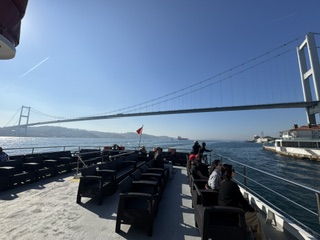
The first bridge connecting the European and the Asian continents in Istanbul built in 1973. I asked Bulit if there was any difference between the sides. He said no, but the Asian side is primarily residential since it used to be so hard to get there. Now, with bridges and tunnels for metro, it’s evened out for cost.
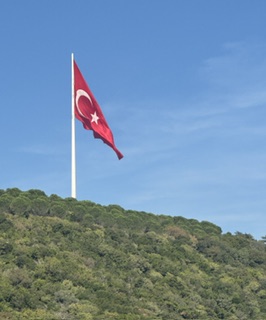
I looked up the symbolism: The Crescent: Traditionally linked to the lunar cycle, growth, renewal, and historically tied to the wider Islamic world. The Five-Pointed Star: Often interpreted as a symbol of light, guidance, or unity, with some modern cultural views associating the star with Turkish identity and the crescent with Islam. The Red Field: Represents courage, strength, and the blood of soldiers who sacrificed their lives for the nation
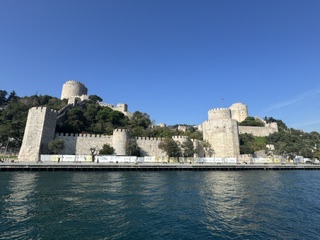
Rumeli Fortress was built by Fatih Sultan Mehmet II to control the ships passing through the Bosphorus, before the conquest of Istanbul. The fortress, whose construction started in March 1452, was completed in August of the same year. In historical sources, it is mentioned that 300 masters, 700-800 workers, 200 coachmen, boatmen and transporters worked in its construction.
We then went to Istiklal Caddessi (“Independence Street), that I’d read about and where I’ll return tonight to see the scene. But it was already pretty amazing and very fun to walk around. Bulit asked about food and I said let’s get lunch, I really wanted to try a local meal. He took me to a buffet style place that he’d said earlier is where most people eat since most didn’t have much time at lunch. He was really pleased about all the food and picked out a lot of his favorite items per my request and we shared the plates. I mostly just wanted salt and spices. It was a nice lunch as I asked about his family. He said most marriages are still arranged and generally are more successful than when people choose for himself. That being said, Bulit and his wife met through FB!
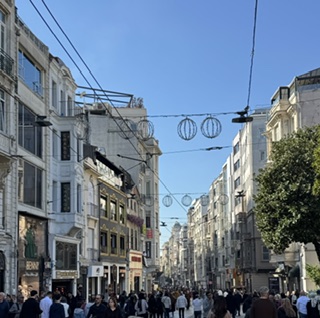
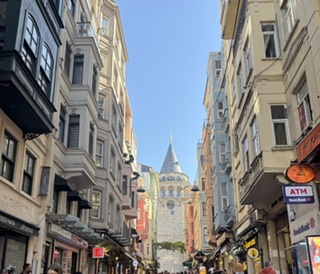
We walked past incredible buildings and winding streets to Galeta Tower, a center for social, political and economic life for over 200 years. Then, very nice of him, he showed me a wonderful historic hotel – the Pera Palace Hotel with very nice bathrooms. Public restrooms are few and far between here. Plus it sounds like they have a high tea. He kept calling it a 5 tea, but I’m guessing it was a high tea. Such a set up for it.
I then asked if I could be back at the hotel by 3:30 because I had a practice for the upcoming Nepal trip that I needed to do. I don’t know if it was a language miss or a willful miss, but it worked for both of us when I was back at the hotel by 2:30. I made tea and caught up on notes. But I’m going back out!

