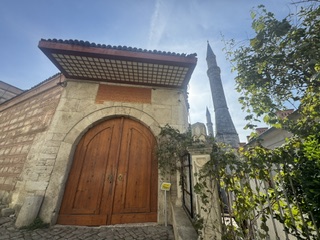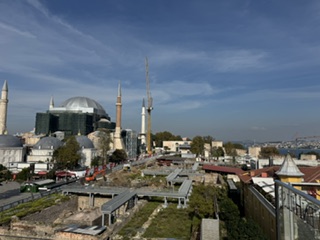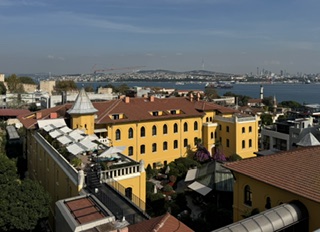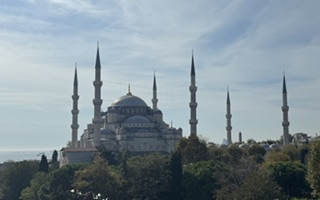
I woke up at 4:30 and I have no idea what I did for the next 3 hours until it was time to go to breakfast. Email? Read? Clearly, it was really significant.
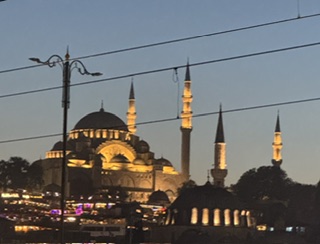
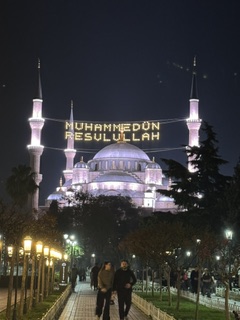
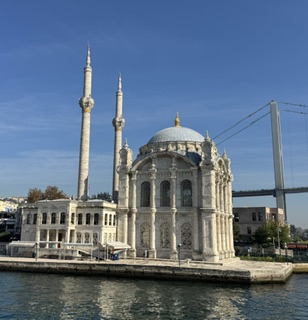
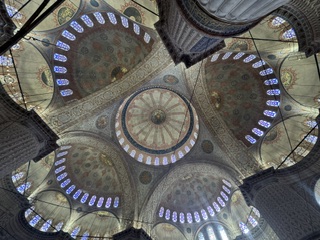
Bulut and I met at 9 and started on the sites tour. And it was amazing. First the Blue Mosque. Sultan Ahmed I decided to build a large mosque in Istanbul in the hope of soliciting God’s favour. He was the first sultan to build an imperial mosque since Selim II (d. 1574.). Given the mosque’s location, size, and number of minarets, it is probable that Sultan Ahmed intended to create a monument that rivalled or surpassed the Hagia Sophia.
This site was occupied by the palaces of several Ottoman viziers, which required a costly expropriation process. This, along with the fact that the empire was under economic stress, aroused the protests of the ulema (Islamic legal scholars), who argued that sultans should only fund the construction of an imperial mosque with spoils of conquest. Ahmed I had won no major victories and thus had to divert funds from the treasury for this expensive project. The ulema went so far as to forbid Muslims from praying at the mosque.
Despite the opposition, the sultan went ahead with the project. Construction started in 1609 and completed in 1617, when the opening ceremony was held. Ahmed I died around the same time or very soon afterwards in 1617. According Bulut – even Mecca protested since the Mosque had 6 minutes, which was more than the Mosque in Mecca. So Ahmed paid for them to add a minaret, thus bringing theirs to 7. However, despite the grandeur, people really didn’t come. So Ahmed sent to Syria for some of the relics of the Prophet. Then – everyone came!
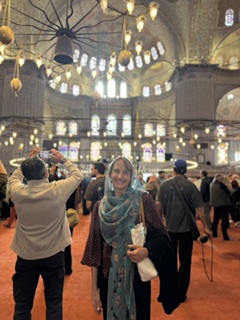
Again, according to Bulut – the ostrich eggs decorating some of the lights givesoff some kind of something the keeps spiders from coming in. Really? But there are no spiders.
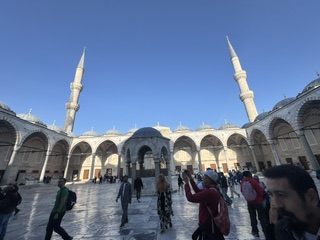
Courtyard with the final two minarets that I couldn’t quite figure out from outside. Incredible courtyard. The center feature was a fountain for people to clean hands/face? Before they went in to pray. Now this is an extra place for the 5 times a day that people pray between sunrise and sunset – since the main altar area fills up.
We then went to the Grand Cistern. I’d heard about this, but hadn’t gotten too excited. Holy moly, it was incredible. Basilica Cistern was constructed in the 6th century during the reign of Byzantine Emperor Justinian I. Its purpose was to store water for the Great Palace of Constantinople and nearby buildings.
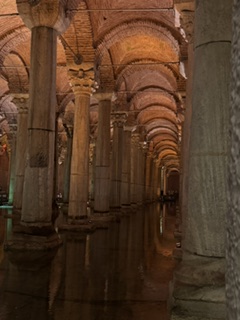
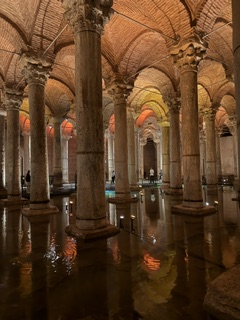
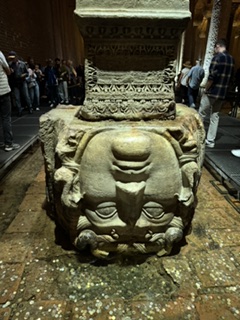
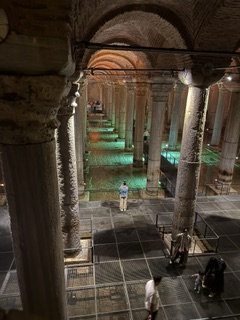
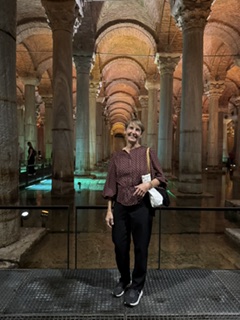
The underground location allowed a large volume of water to be stored beneath the centre of the Byzantine capital. It was so big, it never even filled up, but the water did go up to about halfway up the columns. There are 336 marble columns, scavenged from earlier Roman and Byzantine structures. Bulut said they were taken from pagan temples, given that many had Greek or Roman motifs. Funny, I don’t think of Greek mythology and practice as pagan, but I guess it is. These elements included 2 Medusa heads used to support the columns in the best way possible – upside down if necessary!
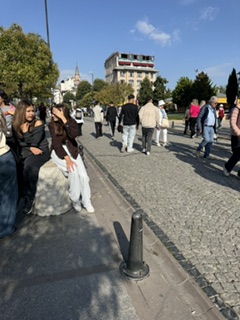
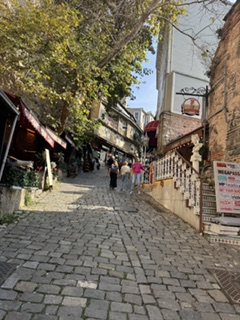
And it’s right under this whole street – it’s always been under the street. Incredible.
And then the Hagia Sophia. Honestly, this was so big it was impossible to grasp or get a real photo. Evidently it’s the 4th biggest domed structure, but the other three, including the Duomo and St. Patrick’s in London, were modeled on this one. It is truly incredible. The bottom floor is an active mosque, so you couldn’t go down there to look up and get a grasp of how huge this was. Hagia Sophia, means Holy Wisdom, was built in 537 AD in Constantinople (now Istanbul) under Emperor Justinian I, and for nearly 1,000 years, it stood as the world’s largest cathedral. Originally constructed as a Christian place of worship, the Hagia Sophia was converted into a mosque after the Ottoman conquest of Constantinople in 1453. In 1935, the Hagia Sophia became a museum, and in 2020, it was reconverted to an active mosque.
Luckily, when it became a mosque originally, the mosaics were plastered over so that later, they could be uncovered. Unfortunately, people bribed guards and took pieces of the mosaics away as holy souvenirs. However, there were still remarkable images left.
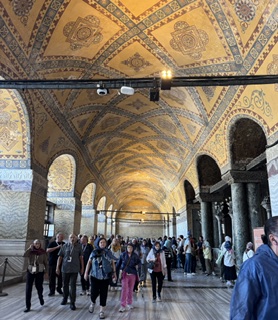
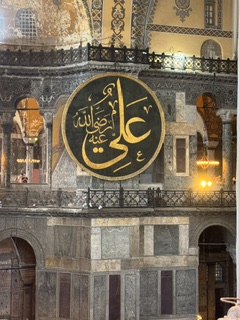
Just one corridor (and a few people), and then medallions to Allah and the Sultans painted on top. This looks huge and it was really big, but it was small compared to the height of the wall.
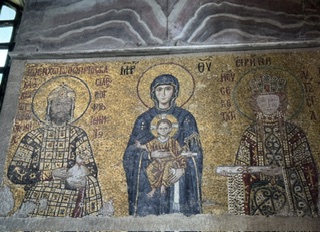
One of the ancient mosaics, high enough that there was a fair amount left from those who took pieces off. She has the best face. Amazing that it’s made out of bits of stone to be so expressive.
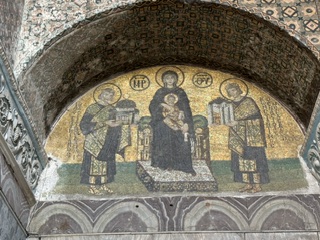
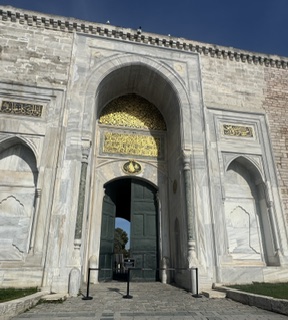
The entry of the sultans.
We then toured the area of the ancient Hippodrome (now only part of the wall left) with the columns of different kinds. The first was a beautiful obelisk with hyroglyphics on all sides. Pharaoh Thutmose III originally had the red-granite obelisk carved and erected at the Temple of Karnak in Thebes (Luxor) to celebrate his military victories. Roman emperors later moved the monument from Egypt to Alexandria, and eventually Theodosius I had it shipped to Constantinople (modern-day Istanbul).
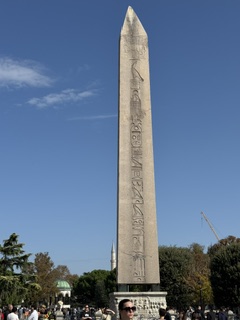
It was erected on the central barrier (spina) of the Hippodrome of Constantinople—an expansive arena used for chariot races and imperial ceremonies. Bringing an ancient Egyptian obelisk to the capital was a deliberate political statement. It demonstrated Roman dominance over Egypt and elevated Constantinople’s status as a true rival to old Rome. And how in the world did they do it?
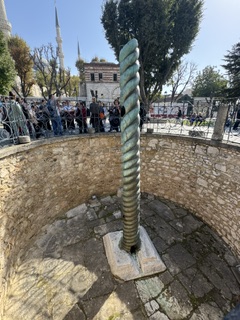
The column features the names of 31 allied Greek city-states inscribed directly onto its bronze coils, honoring the coalition that fought together. Ancient accounts note that the monument was cast by melting down captured Persian weapons left behind on the battlefield. Originally erected at the Sanctuary of Apollo in Delphi, it supported a golden tripod and cauldron dedicated to the god Apollo in gratitude for their survival and triumph. The snake column was moved to Constantinople in 324 AD by Emperor Constantine the Great, it became a symbol of the majesty and universal rule of the Christian Roman Empire. During the later Byzantine and Ottoman periods, people viewed the serpent shape as a magical talisman believed to protect the city of Constantinople from poisonous snakes and pests.
And then a rug store. However, this one was recommended by Engin who set up the whole trip and noted that this was a safe rug merchant and it’s where she and her family get there rugs. I was up front – I’m not buying anything, but I might come back. Oh my goodness. They were amazing. And so was the pomegranate tea!
Then ceramics – Bulut took me to this store and the craftsmanship really was wonderful. But nope, I’m not buying anything because I’m traveling. But fun to see.
Then, the best lunch ever. I asked him to pick his favorite place and I can’t wait to take Rick when he gets here. And I’m going to repeat every single thing.
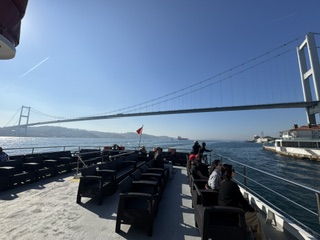
Then my attempt to go on a food tour didn’t work and I asked Bulut if there was a boat tour that was actually worth anything. He said yes and set me up for the evening. I asked the hours and they’re picking me up between 7:15-7:45 and dropping me off at 12. Wait, what? But as Bulut said, we’re not starting until 10 tomorrow and I can sleep. Well, I can try. We’ll see how it goes.