Istanbul, 22.Oct.2026, Thursday

I woke up at 4:30 and I have no idea what I did for the next 3 hours until it was time to go to breakfast. Email? Read? Clearly, it was really significant.

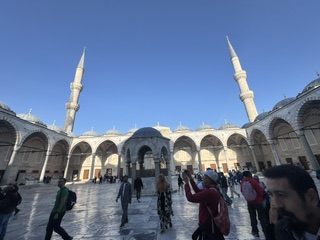
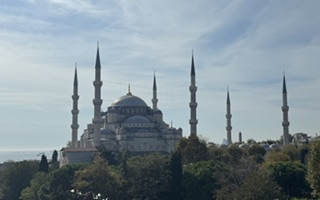
Bulut and I met at 9 and started on the sites tour. And it was amazing. First the Blue Mosque. Sultan Ahmed I decided to build a large mosque in Istanbul in the hope of soliciting God’s favour. He was the first sultan to build an imperial mosque since Selim II (d. 1574.). Given the mosque’s location, size, and number of minarets, it is probable that Sultan Ahmed intended to create a monument that rivalled or surpassed the Hagia Sophia.

This site was occupied by the palaces of several Ottoman viziers, which required a costly expropriation process. This, along with the fact that the empire was under economic stress, aroused the protests of the ulema (Islamic legal scholars), who argued that sultans should only fund the construction of an imperial mosque with spoils of conquest. Ahmed I had won no major victories and thus had to divert funds from the treasury for this expensive project. The ulema went so far as to forbid Muslims from praying at the mosque.

Despite the opposition, the sultan went ahead with the project. Construction started in 1609 and completed in 1617, when the opening ceremony was held. Ahmed I died around the same time or very soon afterwards in 1617. According Bulut – even Mecca protested since the Mosque had 6 minutes, which was more than the Mosque in Mecca. So Ahmed paid for them to add a minaret, thus bringing theirs to 7. However, despite the grandeur, people really didn’t come. So Ahmed sent to Syria for some of the relics of the Prophet. Then – everyone came!

Again, according to Bulut – the ostrich eggs decorating some of the lights givesoff some kind of something the keeps spiders from coming in. Really? But there are no spiders.
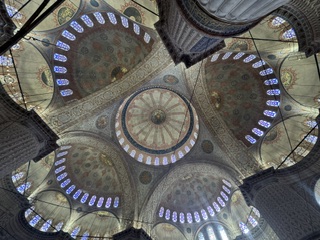
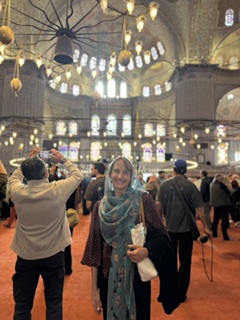
Courtyard with the final two minarets that I couldn’t quite figure out from outside. Incredible courtyard. The center feature was a fountain for people to clean hands/face? Before they went in to pray. Now this is an extra place for the 5 times a day that people pray between sunrise and sunset – since the main altar area fills up.

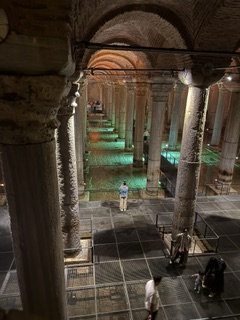
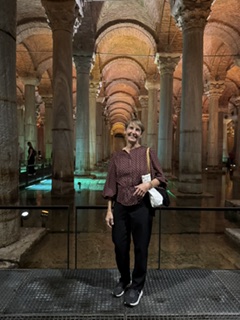
We then went to the Grand Cistern. I’d heard about this, but hadn’t gotten too excited. Holy moly, it was incredible. Basilica Cistern was constructed in the 6th century during the reign of Byzantine Emperor Justinian I. Its purpose was to store water for the Great Palace of Constantinople and nearby buildings.
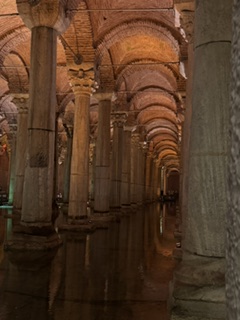
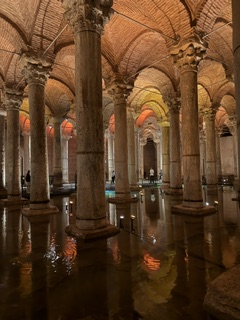
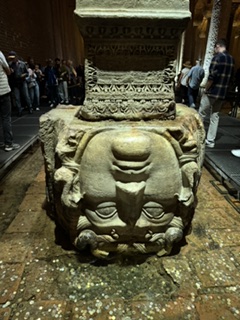
The underground location allowed a large volume of water to be stored beneath the centre of the Byzantine capital. It was so big, it never even filled up, but the water did go up to about halfway up the columns. There are 336 marble columns, scavenged from earlier Roman and Byzantine structures. Bulut said they were taken from pagan temples, given that many had Greek or Roman motifs. Funny, I don’t think of Greek mythology and practice as pagan, but I guess it is. These elements included 2 Medusa heads used to support the columns in the best way possible – upside down if necessary!
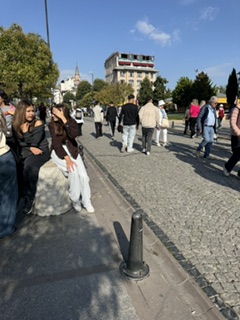
And it’s right under this whole street – it’s always been under the street. Incredible.

And then the Hagia Sophia. Honestly, this was so big it was impossible to grasp or get a real photo. Evidently it’s the 4th biggest domed structure, but the other three, including the Duomo and St. Patrick’s in London, were modeled on this one. It is truly incredible. The bottom floor is an active mosque, so you couldn’t go down there to look up and get a grasp of how huge this was. Hagia Sophia,  means Holy Wisdom, was built in 537 AD in Constantinople (now Istanbul) under Emperor Justinian I, and for nearly 1,000 years, it stood as the world’s largest cathedral. Originally constructed as a Christian place of worship, the Hagia Sophia was converted into a mosque after the Ottoman conquest of Constantinople in 1453. In 1935, the Hagia Sophia became a museum, and in 2020, it was reconverted to an active mosque.

Luckily, when it became a mosque originally, the mosaics were plastered over so that later, they could be uncovered. Unfortunately, people bribed guards and took pieces of the mosaics away as holy souvenirs. However, there were still remarkable images left.
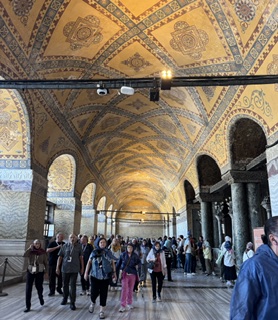
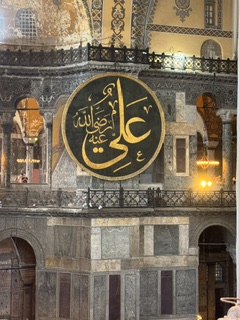
Just one corridor (and a few people), and then medallions to Allah and the Sultans painted on top. This looks huge and it was really big, but it was small compared to the height of the wall.
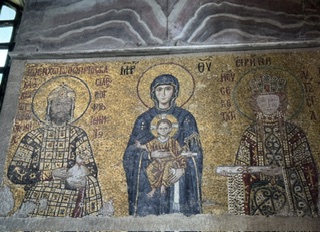
One of the ancient mosaics, high enough that there was a fair amount left from those who took pieces off. She has the best face. Amazing that it’s made out of bits of stone to be so expressive.
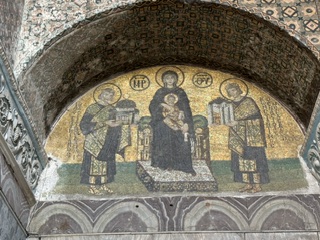
The entry of the sultans.

We then toured the area of the ancient Hippodrome (now only part of the wall left) with the columns of different kinds. The first was a beautiful obelisk with hyroglyphics on all sides. Pharaoh Thutmose III originally had the red-granite obelisk carved and erected at the Temple of Karnak in Thebes (Luxor) to celebrate his military victories. Roman emperors later moved the monument from Egypt to Alexandria, and eventually Theodosius I had it shipped to Constantinople (modern-day Istanbul).
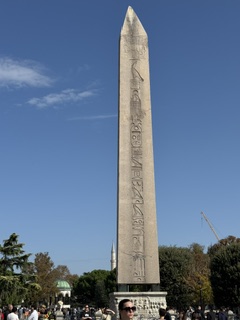
It was erected on the central barrier (spina) of the Hippodrome of Constantinople—an expansive arena used for chariot races and imperial ceremonies. Bringing an ancient Egyptian obelisk to the capital was a deliberate political statement. It demonstrated Roman dominance over Egypt and elevated Constantinople’s status as a true rival to old Rome. And how in the world did they do it?
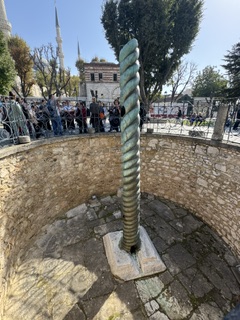
Snake column

The column features the names of 31 allied Greek city-states inscribed directly onto its bronze coils, honoring the coalition that fought together. Ancient accounts note that the monument was cast by melting down captured Persian weapons left behind on the battlefield. Originally erected at the Sanctuary of Apollo in Delphi, it supported a golden tripod and cauldron dedicated to the god Apollo in gratitude for their survival and triumph. The snake column was moved to Constantinople in 324 AD by Emperor Constantine the Great, it became a symbol of the majesty and universal rule of the Christian Roman Empire. During the later Byzantine and Ottoman periods, people viewed the serpent shape as a magical talisman believed to protect the city of Constantinople from poisonous snakes and pests.

And then a rug store. However, this one was recommended by Engin who set up the whole trip and noted that this was a safe rug merchant and it’s where she and her family get there rugs. I was up front – I’m not buying anything, but I might come back. Oh my goodness. They were amazing. And so was the pomegranate tea!

Then ceramics – Bulut took me to this store and the craftsmanship really was wonderful. But nope, I’m not buying anything because I’m traveling. But fun to see.

Then, the best lunch ever. I asked him to pick his favorite place and I can’t wait to take Rick when he gets here. And I’m going to repeat every single thing.

Then my attempt to go on a food tour didn’t work and I asked Bulut if there was a boat tour that was actually worth anything. He said yes and set me up for the evening. I asked the hours and they’re picking me up between 7:15-7:45 and dropping me off at 12. Wait, what? But as Bulut said, we’re not starting until 10 tomorrow and I can sleep. Well, I can try. We’ll see how it goes.
Istanbul, 21.Oct.2026, Wed evening

Another great day. I will say that I think 2 days with a guide is probably enough. Definitely enough? Bulut is great, but we’re kind of stretching things out a bit. That being said, every day has been special.

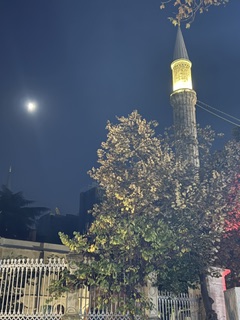
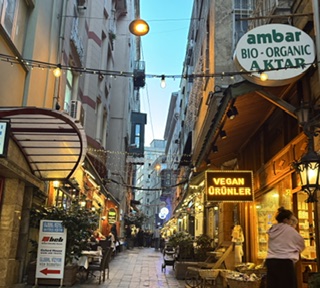
First – photos from the night’s adventure. I was so pleased with myself because I left my hotel room. Turns out yesterday’s practice was at 4AM, not 4PM. Still working on all the time differences. So I had time and after writing up the day’s events, went on out. I was going to walk and then decided to take the tram over the bridge to the stairs up to Galata Tower. That worked perfectly and then I started wandering the streets. They’re all charming with stores, restaurants, homes all intermingled. Eventually, I made my way to Istiklal street. I was starting to think a bathroom might be a good idea, so that required a restaurant and that was a bit easier than said. I kept looking up the tiny side streets – but not for cars instead for restaurants. I finally found one, sat down in a cloud of cigarette smoke (they’ve never heard of lung cancer here) and ordered. Basic please. I just wanted one decent meal that I wanted to eat. Ordered from the best picture on the menu (high cuisine not). I then asked about the restroom, nope. Out of commission with construction. I could tell it was real because he started to give me instructions and then stopped chagrined.

Ok, I’m a camel. I had lemon/mint tea, so good, dinner (chicken with mushroom sauce and fries) and then started walking again. Happily, Bulut had shown me the Pera Hotel with the available restrooms for those in the know. I knew and wasn’t going to take a no. Not a problem at all. It really is like stepping back into the 1880’s Victorian era.

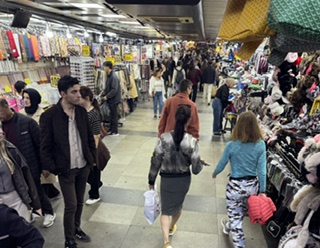
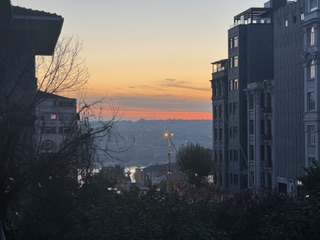
Then I started making my way home. The lights were coming on with sunset and I was looking foward to seeing the mosques lit up. In order to get to the bridge or tram or even across the street, you have to go into a shopping tunnel. So many shops, so many directions, and as anyone who knows me knows, as soon as I’m out of sight of the outdoors, I have NO sense of direction. So instead of coming out on the bridge, I came out at the tram. Ok, that works, but then it looked like the Lex at rush hour (NY) and I looked around to see if there was any way to cross the street and there was.

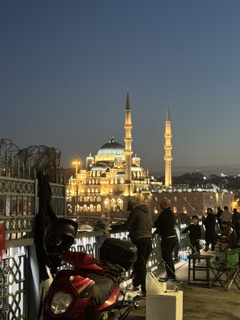
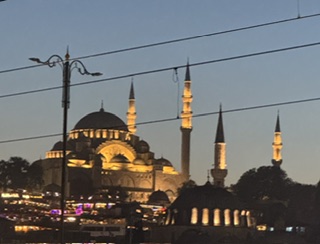
I started across the bridge and was in heaven.  How do I get to be so lucky?! To see such different cultures, to be walking across the Bosphorus towards all these minarets of the mosques, people fishing on the left and petting the random cat (cats are EVERYWHERE) and then Kylie called!

So very fun and great timing and tech and cel worked so well, I was able to send her a couple of photos as we talked so that I could share the experience with her in real time. The best. Such a happy moment.

Istanbul, 21.Oct.2026, Wednesday

Today was my first guided day and it was great. I’m sure I won’t remember everywhere we went but we did go to the area I’d wanted to explore at night. So now I (mostly) know how to get there and back.

Since it was a gorgeous sunny day, the guide, Bulit (pronounced in a nice Turkish way, not like bullet), suggested that we shift the agenda around and take advantage. So we walked through small streets seeing sights on the way. I don’t think you can go anywhere without seeing something gorgeous.

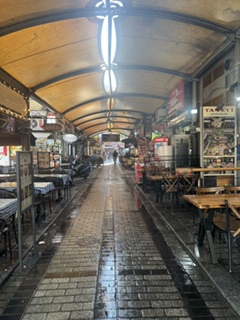
Just one of many small streets lined with small restaurants, some covered like this one, most not.

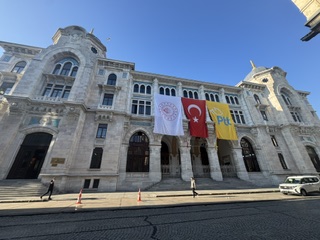
The first post office from the 1800’s, also had the first radio transmitter.

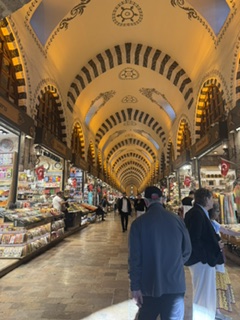
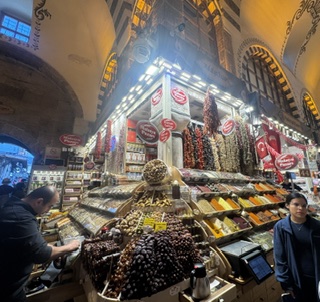
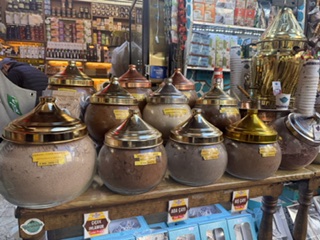
Spice Market – Bulit said it was a great time to go because later in the day it was packed and hard to move. It’s also called the Egyptian market since Egypt used to be part of the Ottoman Empire and spices were brought from there and introduced to Istanbul. It was financed by the mother of Sultan Mehmet. Evidently Sultan Mehmet IV had started the process, building the market next to the mosque he’d built.  But then he died and his son didn’t like him or his projects, so did his own. His grandmother, Hatice Turhan Sultan, stepped in and financed the market her son started, finishing in 1664.

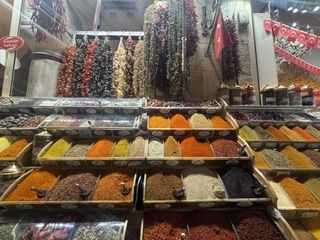
I thought this was interesting because the strings on the right of the row on top are okra! Bulit said this was the best vegetable and that the people loved okra but couldn’t have them over the winter so they were dried, as well as aubergine and others I couldn’t identify.

Different types of coffee. Bulit said the first users of coffee were the Turks, bringing it from Africa. Honestly, he’d used to many “firsts” “biggest” “most famous” phrases that I decided to look this fact up. Turns out he was close! Coffee was first used in Yemen by the Sufis to keep them going when their practices had to go beyond what they could naturally endure.

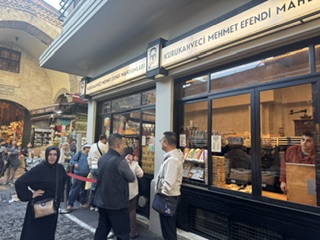
The best known of the coffee shops, there was a steady line and evidently nothing like it would be later. The guy behind the window is one packing coffee after it’s carefully measured, bag after bag.

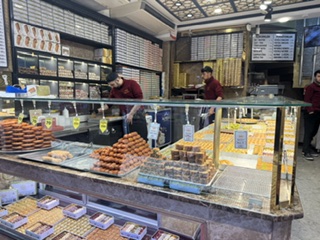
And sweets! Whoa, they like their sweets here. I’ve already had Turkish Delight – ala Narnia. They are beautifully crafted, but they don’t call me at all. Fun to look though!

We then saw a small exquisitely crafted mosaicked (is that a word?) mosque. The Rüstem Pasha Mosque, an Ottoman mosque located in the Hasırcılar Çarşısı in the Tahtakale neighborhood of the Fatih district of Istanbul, Turkey, near the Spice Bazaar, built in 1563.  Rare in that it was primarily mosaics and voted the most beautiful mosque in 2007. Truly the mosaics were worth taking time to explore, if we hadn’t been moving, I would have sat for quite a while, it had a wonderful feel.

We then wound our way through more wonderful little streets to a main ave and caught a cab to then catch a ferry. It only did a few stops and went up and down the Bosphorus. Unbelievable buildings all the way up and down, palaces, mosques, houses. And the day was perfect! I’m so hoping we get a day like this when Rick’s here so we can repeat.

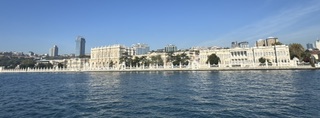
One of many, though perhaps the largest, unbelievable palaces. 1850’s. On the right, is the kitchen for that palace!!!

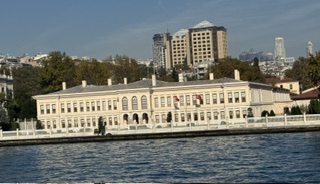
The kitchen for that palace!!!

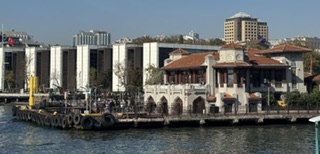
A wonderful ferry dock. The building has a cafe on top and a library downstairs so that people could/and still do sit and read while having their coffee. Very cool sultan, again from the 1800’s.

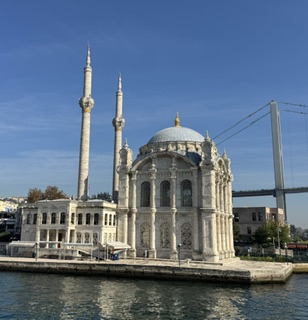
Built for Friday prayers for the sultan – I assume from the palace above? I, sadly, couldn’t keep track of them and didn’t like to ask repeatedly – who? But I loved this place of worship.

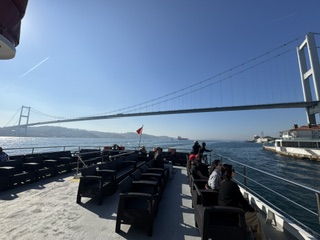
The first bridge connecting the European and the Asian continents in Istanbul built in 1973. I asked Bulit if there was any difference between the sides. He said no, but the Asian side is primarily residential since it used to be so hard to get there. Now, with bridges and tunnels for metro, it’s evened out for cost.

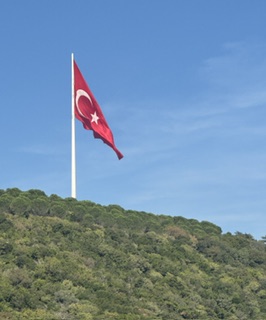
I looked up the symbolism: The Crescent: Traditionally linked to the lunar cycle, growth, renewal, and historically tied to the wider Islamic world. The Five-Pointed Star: Often interpreted as a symbol of light, guidance, or unity, with some modern cultural views associating the star with Turkish identity and the crescent with Islam. The Red Field: Represents courage, strength, and the blood of soldiers who sacrificed their lives for the nation

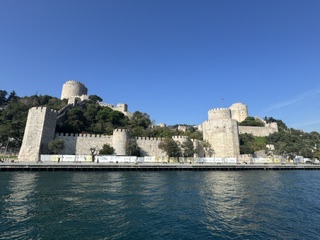
Rumeli Fortress was built by Fatih Sultan Mehmet II to control the ships passing through the Bosphorus, before the conquest of Istanbul. The fortress, whose construction started in March 1452, was completed in August of the same year. In historical sources, it is mentioned that 300 masters, 700-800 workers, 200 coachmen, boatmen and transporters worked in its construction.

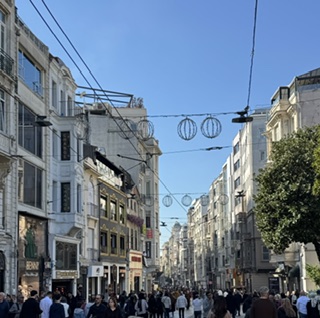
We then went to Istiklal Caddessi (“Independence Street), that I’d read about and where I’ll return tonight to see the scene. But it was already pretty amazing and very fun to walk around. Bulit asked about food and I said let’s get lunch, I really wanted to try a local meal. He took me to a buffet style place that he’d said earlier is where most people eat since most didn’t have much time at lunch. He was really pleased about all the food and picked out a lot of his favorite items per my request and we shared the plates. I mostly just wanted salt and spices. It was a nice lunch as I asked about his family. He said most marriages are still arranged and generally are more successful than when people choose for himself. That being said, Bulit and his wife met through FB!

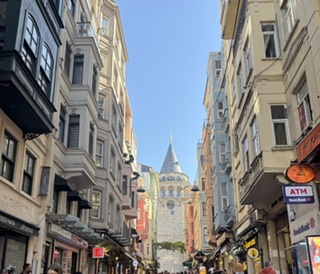
We walked past incredible buildings and winding streets to Galeta Tower, a center for social, political and economic life for over 200 years. Then, very nice of him, he showed me a wonderful historic hotel – the Pera Palace Hotel with very nice bathrooms. Public restrooms are few and far between here. Plus it sounds like they have a high tea. He kept calling it a 5 tea, but I’m guessing it was a high tea. Such a set up for it.

I then asked if I could be back at the hotel by 3:30 because I had a practice for the upcoming Nepal trip that I needed to do. I don’t know if it was a language miss or a willful miss, but it worked for both of us when I was back at the hotel by 2:30. I made tea and caught up on notes. But I’m going back out!

Istanbul, 20.Oct.2026, Tuesday

I can’t believe I’m on another adventure. Quite a year!

I’m in Istanbul with a 3-day layover to get a big of jet lag out of the way, then to Nepal for 2 weeks, then back to Istanbul to meet Rick to explore.

Istanbul. There’s a reason so many people have talked about this city and we’ve wanted to see it. It’s amazing, beautiful, interesting, and a lot to learn. I came into the trip pretty wiped out because of a serious pace in the weeks leading up to it. I slept a little on the plane, though not much, and when I finally got to Istanbul, I was weaving on my feet.

I’m in a little hotel right in the Old City, the Hotel Komana. Built above a 1700 year old cistern from the Roman then Byzantine years. My favorite thing (not) – a big clear panel in the restaurant looking down at the archeological remains of a truly gorgeous white stone (brick?) cistern. Happily, I don’t have to cross the panel to eat in the breakfast room and I probably won’t.

Confession – I came into this trip appallingly ignorant. My friend Sharon had been here before and talked about her hotel looking over the sea. Sea? I thought it was landlocked. Sigh. I just thought about the Mediterranean on the southern border. I’m going to be learning a lot.

I had set up a guide for later in the week, but nothing today. And good thing. I was so wiped out, I slept until 9. 9!!! Unheard of. Then slowly got it together and went to breakfast at 10. Crazy. I then did email for 2 hours trying to catch up. And left the hotel by 12.

I really am just across a park from the Hagia Sophia and the Blue Mosque. I found a bench and just watched the people (so watchable) and listened to Rick Steves’ short talk about Rumí. Yep, learned a lot I hadn’t known about Rumí and Sufism.

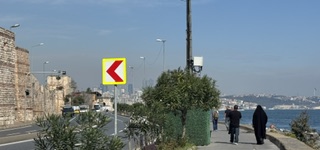
On the Bosphorus, ancient city walls on the left, traditional garb on the right (15 million people, 98% Muslim) and a very modern city all around.

Then continued to walk. Clearly, I was such a mark. A guy started stating facts behind me, I thought maybe he was leading a group? Then, no, he was directing the comments to me about the Blue Mosque. Nice guy, we chatted as we walked and yep, he was a rug merchant. But what the hey, it’s all new to me. So we walked a few blocks down to his store. And what a store it was – the rugs were unbelievably gorgeous. Designs I’d never seen before. I told him flat out that I wasn’t buying anything. In fact, we had rugs in our garage that were going to family because they didn’t fit in our house. But I got to look anyway while sipping  “our local fruit tea” in a wonderfully fluted glass. I then left with him next to me pointing to “this is our family’s jewelry store”.   Nope, I don’t buy jewelry; I live in Boulder. We just work out.

But – I may have to take Rick to look because, truly, the rugs were beautiful.

I then wandered through the streets, trying not to trip on anything because I was looking everywhere. I eventually walked down to the Sea of Marmara which has a slim connection down to the Mediterranean  (so not landlocked) and is a sea fully within the borders of Turkey. The Sea of Marmara linked to the Bosphorus Strait that connects to the Black Sea. So the Bosphorus connected the Mediterranean with the Black Sea. An amazing access point for Istanbul.

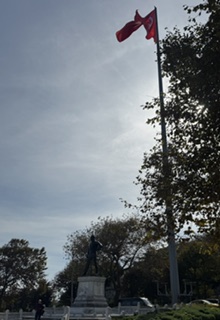
The first monument to Ataturk and the Turkish flag above.

I was walking all round the point of Gülhane Park which surrounded the Topkapi Palace. It was at the top of the hill with a ton of tall wonderful trees surrounding it so I couldn’t capture a picture. Plus it was so big, I couldn’t figure out where it started and ended. I think the main archeological museum is inside this building. History note: in 1839 Grand Vizier Mustafá Resid Pasha proclaimed the Edict of Gülhane here, launching sweeping modernization and equality reforms. These imperial gardens were made into a public park in 1912.

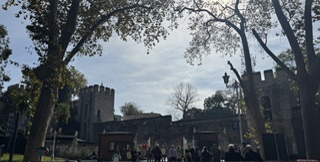
This is the only glimpse I could get of this giant palace built in 1478 and occupied by leaders for 380 years. Prior to being built the priests of the Hagia Sophia had their houses in the olive groves on the hillside. Plus just a tiny portion of the towers and one of the gates to enter.

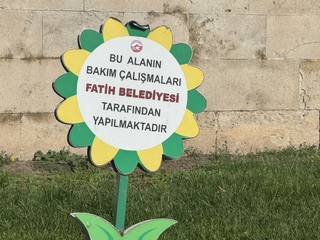
The term Fatīh Beledīyesi stumped me and it was everywhere. Turns out it’s the municipality of Fatīh. Fatīh means “Conqueror”or “The Opener”. Specifically honors Sultan Mehmed II who conquered Constantinople in 1453.

One door into the palace which was closed for the day.

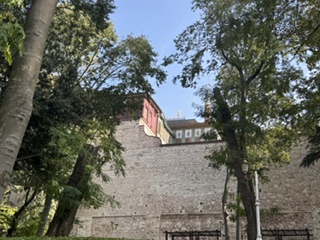
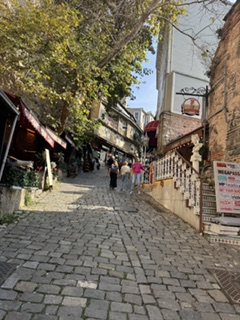
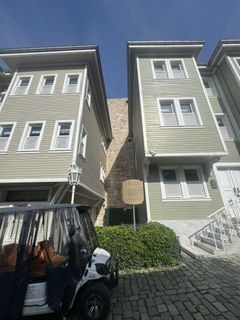
I then walked up a wonderful cobblestone street with a whole row of small townhouses built right up against the ancient town wall.

And came out at the Hagia Sophia.

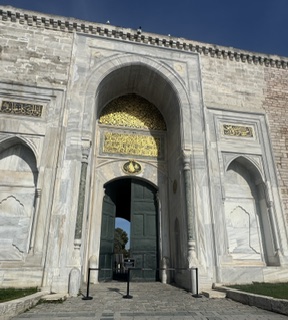
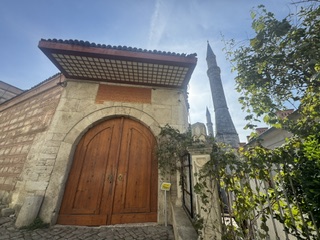
This is at the end of the cobble streets – the first towers of the Hagia Sophia and I don’t know what this door was with the beautiful writing above. Maybe a guard house for the palace?

I’d walked an entire circle and was right back near my hotel. I’m not going to describe any of these sites because I’m going to be exploring them tomorrow with a guide, so will learn more then.

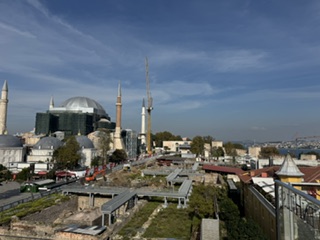
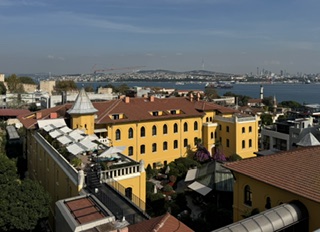
Seen from the rooftop of my lunch place, glimpse of a mosque, but look at the architectural site! It must be a nightmare to try to build here, everything is on top of Roman or Byzantine or even older structures.

The yellow building is the old jail, now the Four Seasons. I’m guessing the outside makes it look a lot nicer than it was in the old days inside.

Then – I decided, ok, not ready to figure out how to get to the happening spot “just across the bridge and up the funicular” since I hadn’t even seen the bridge. Instead, I decided to go to the Turkish baths that I’d heard so much about. I went to see if I could get a res and I could – in 45 minutes. So I went back to the hotel and dumped everything I didn’t need and off I went. I thought I was very brave because I am a total prude and I’d HEARD STORIES.

The one that was  closest to me was the Hurrem Sultan Hammam, just beautiful. Built in 1556, perfectly symmetrical domes on each side, one for women and one for men. The insides were white marble with high domes carved with stars that let a ton of light in. And they moved people through. I went around 4pm and turns out that was perfect. Most tourists, especially tour boat people, were gone and the evening rush of locals hadn’t started.

It was great and while it wasn’t crazy, there were plenty of of women, all in little bath towels with disposable underwear (considered rude not to wear underwear) which were VERY small by my standards. Everyone was taken by hand, literally, walked by hand from place to place by our person who was also wearing the towels. Water, scrubbing, massage, bubbles poured over, more massage, more water, by the end I was so relaxed, I walked out without my jewelry and had to run back.

Definitely a fun thing to do.

Then I sat on a bench and watched the sun setting near the Blue Mosque, watched people, and listened to another Rick Steves talk. This one was about nightlife and it made me want to go find this mile long Itstiklal St where everything is happening. This includes fish markets – where you choose your fish and they cook it for you. I probably won’t do that. However, I don’t want to find my way by tram, bridge, funicular in the night until I’ve done it by day. I’ll try that tomorrow.

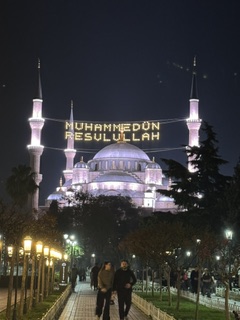
The Blue Mosque

Back to my room like a homing pigeon, stayed here for dinner again and then just hung in my room eating the night chocolate from today and yesterday. Sweet.